A Soviet space souvenir carries its date within it: it cannot predate the mission it shows, and its rocket says whether it was drawn before or after 1967, the year the USSR showed the Vostok launcher to the public. This guide gives the chronology of the missions that produced objects, from Sputnik to Buran, the shapes that give away each period, and the marks, prices and dedications that refine the date.
NOVEMBER 2026•7 MINUTE READ
by Marwen Yahyaoui
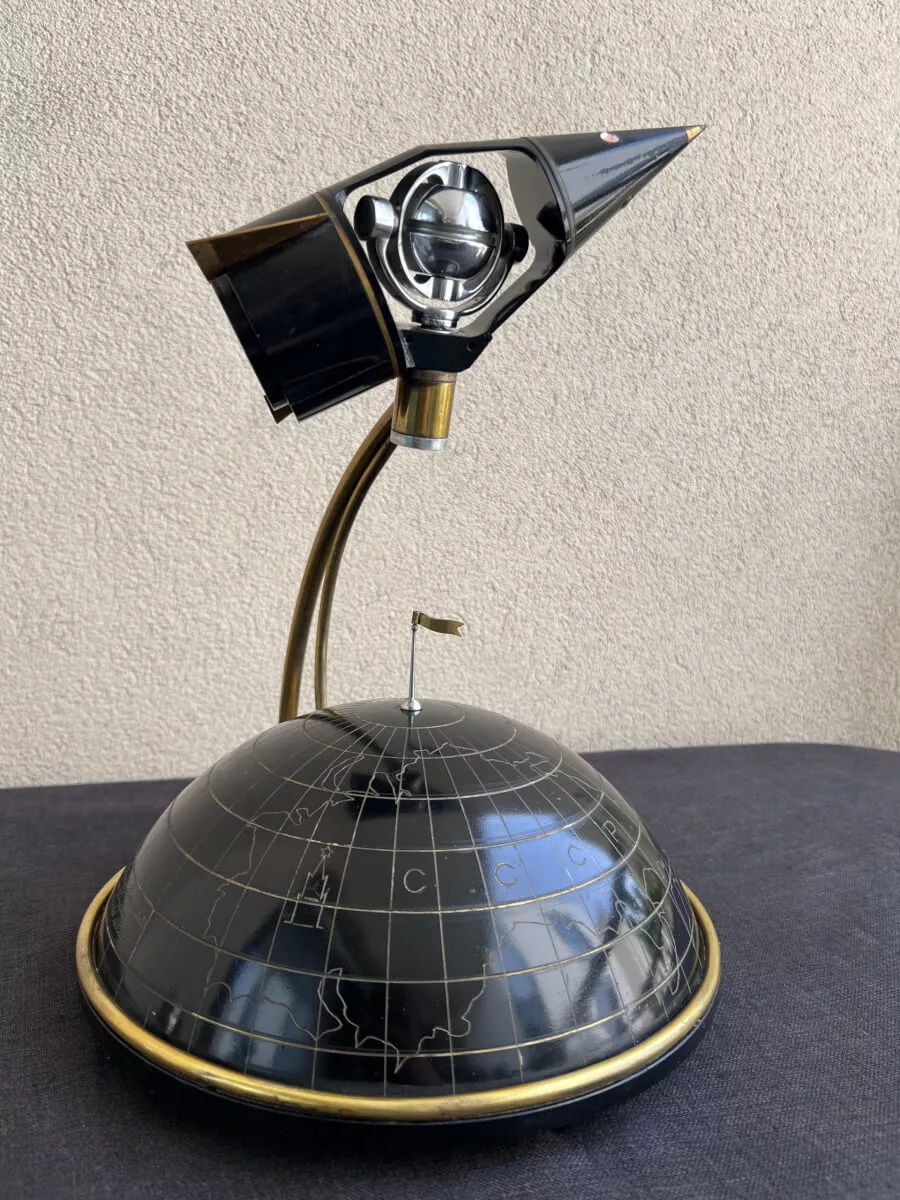
Globe with a Vostok rocket, given by the staff of the MZEMA factory in Moscow to Evgeny Mazur, deputy minister of General Machine Building, for his 60th birthday.
Soviet space objects are rarely dated, but they can almost always be dated, for a simple reason: a souvenir never shows a mission that has not yet happened. A plate with Laika is later than 3 November 1957; a night light with the Vostok spacecraft, than 12 April 1961; a rocket with four side boosters, than 1967. This guide gives the chronology of the missions that produced objects, the shapes that give away each period, and the details that narrow the date to a few years.
The rule: never before the mission
That is the lower bound. Identify what the object depicts, and you have its earliest possible date. The upper bound is vaguer, but it exists: a souvenir is produced in the enthusiasm of the event, then for the round anniversaries. A Gagarin object is from 1961-1965, or from 1971, 1981, 1986, 1991. In between, almost nothing. An object showing several missions is dated by the most recent one.
What the object shows
Not before
Sputnik 1, sphere with four antennas
4 October 1957
Laika, Sputnik 2
3 November 1957
Sputnik 3, conical satellite
15 May 1958
Luna 1, 2 and 3, the Moon and its far side
January to October 1959
Belka and Strelka, the two dogs
19 August 1960
Gagarin, Vostok 1
12 April 1961
Titov, Vostok 2
6 August 1961
Nikolayev and Popovich, first group flight
11 August 1962
Tereshkova and Bykovsky
14 and 16 June 1963
Leonov, first spacewalk
18 March 1965
Luna 9, first Moon landing
3 February 1966
Vostok launcher with four side boosters
June 1967
Lunokhod 1
17 November 1970
Salyut 1, first station
19 April 1971
Soyuz-Apollo
17 July 1975
Intercosmos, Chrétien first Frenchman
24 June 1982
Mir
20 February 1986
Buran
15 November 1988
1957-1960: the spheres and the dogs
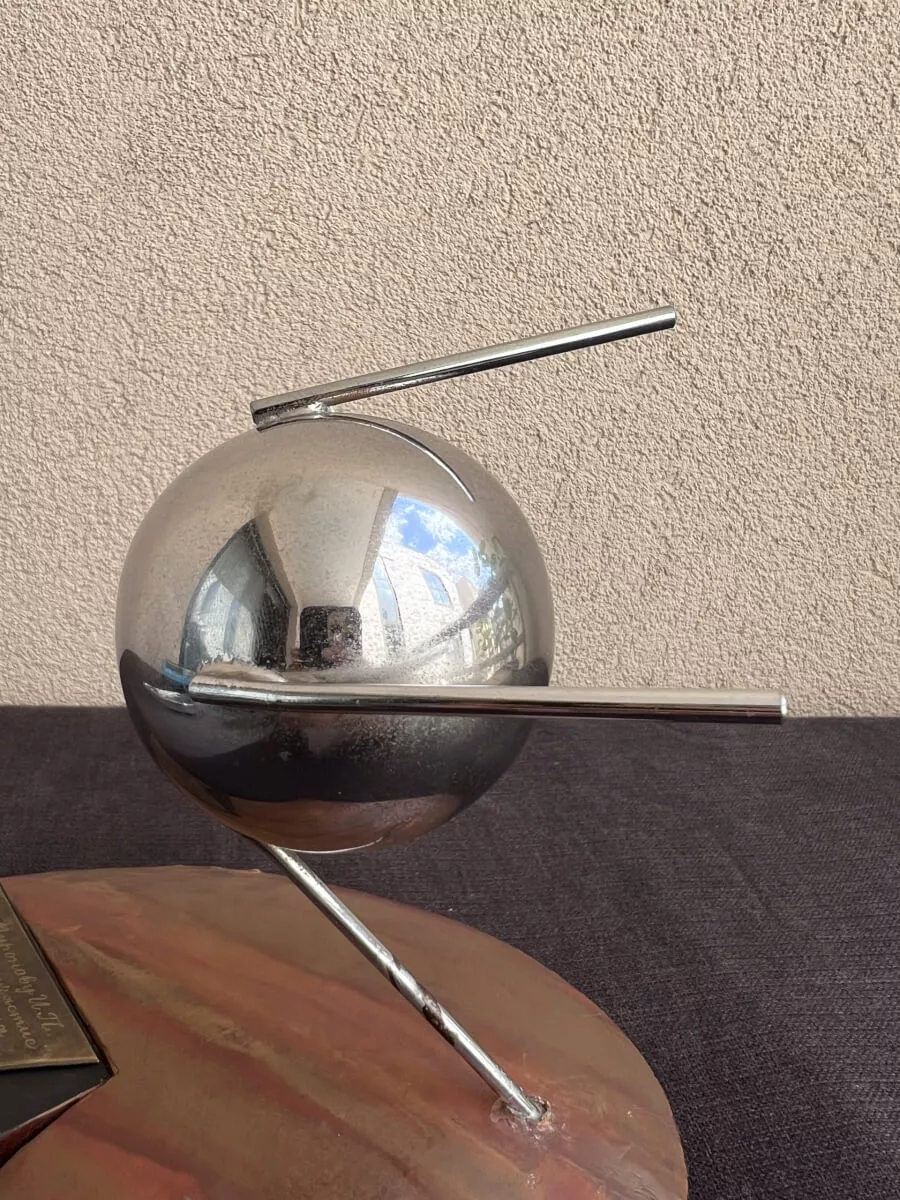
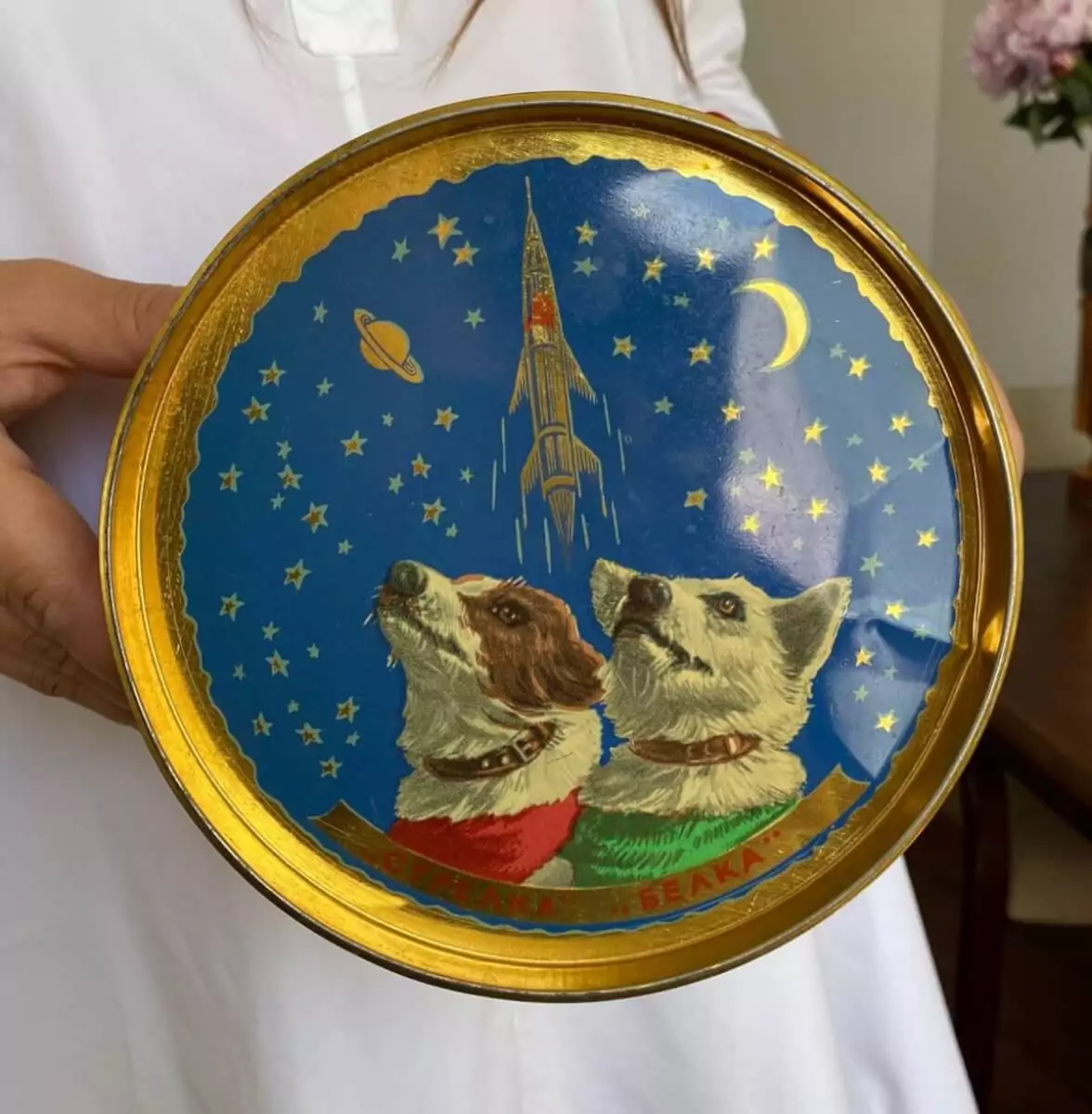
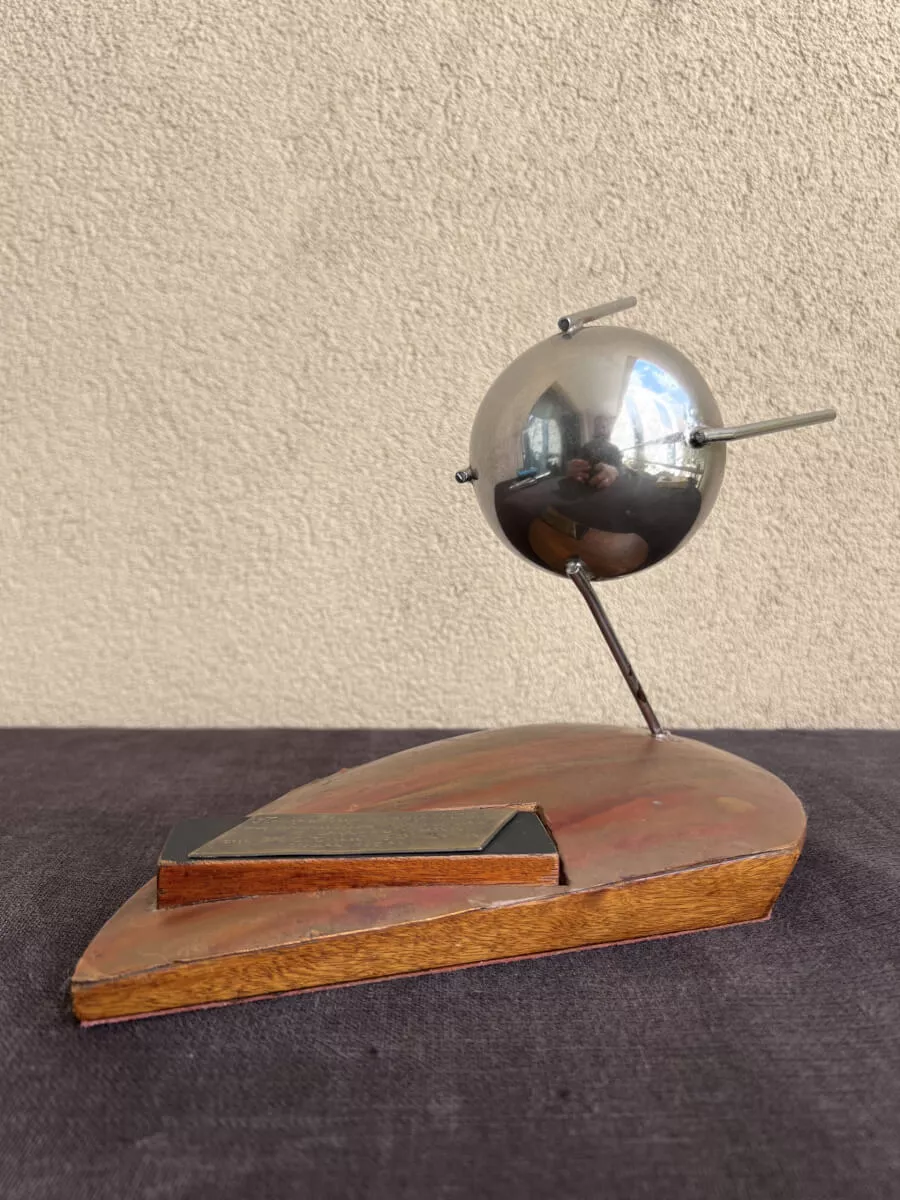
The first objects show what the press showed: the polished sphere of Sputnik 1 with its four antennas, on a base, sometimes mounted on a half-sphere as the Moon; the cone of Sputnik 3; then, in 1960, the two dogs who came back alive, Belka and Strelka, on sweet tins and rugs. These objects are in chrome-plated metal, wood, lithographed tinplate; plastic is rare before 1962. The bases often carry an engraved dedication plate, because a desk Sputnik was an honorary gift, given to an engineer or an official.
Chrome-plated Sputnik 1 on a wooden base, honorary gift of 1958, with its engraved plate.
Sweet tin for New Year 1961: Belka and Strelka, the imaginary rocket and the Moon.
1961-1965: Gagarin and the imaginary rockets
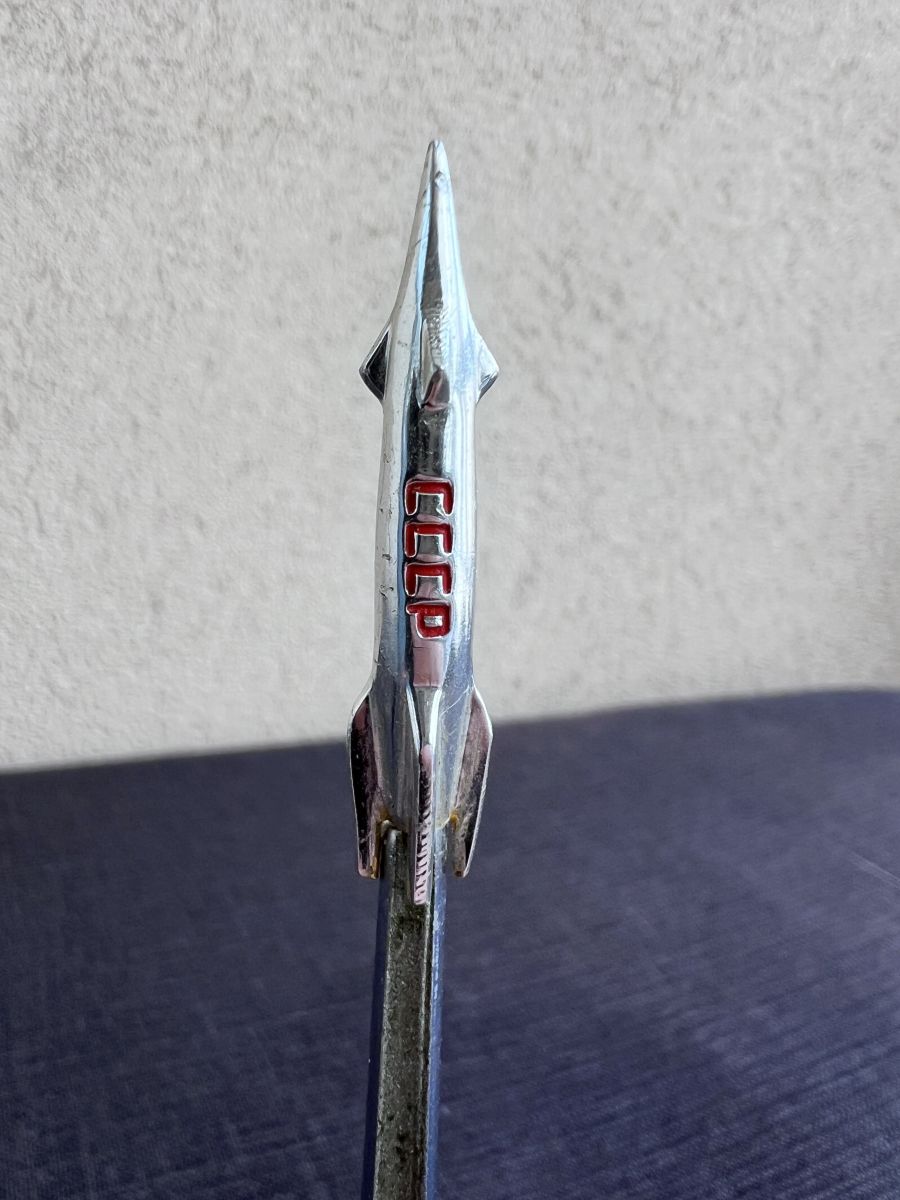
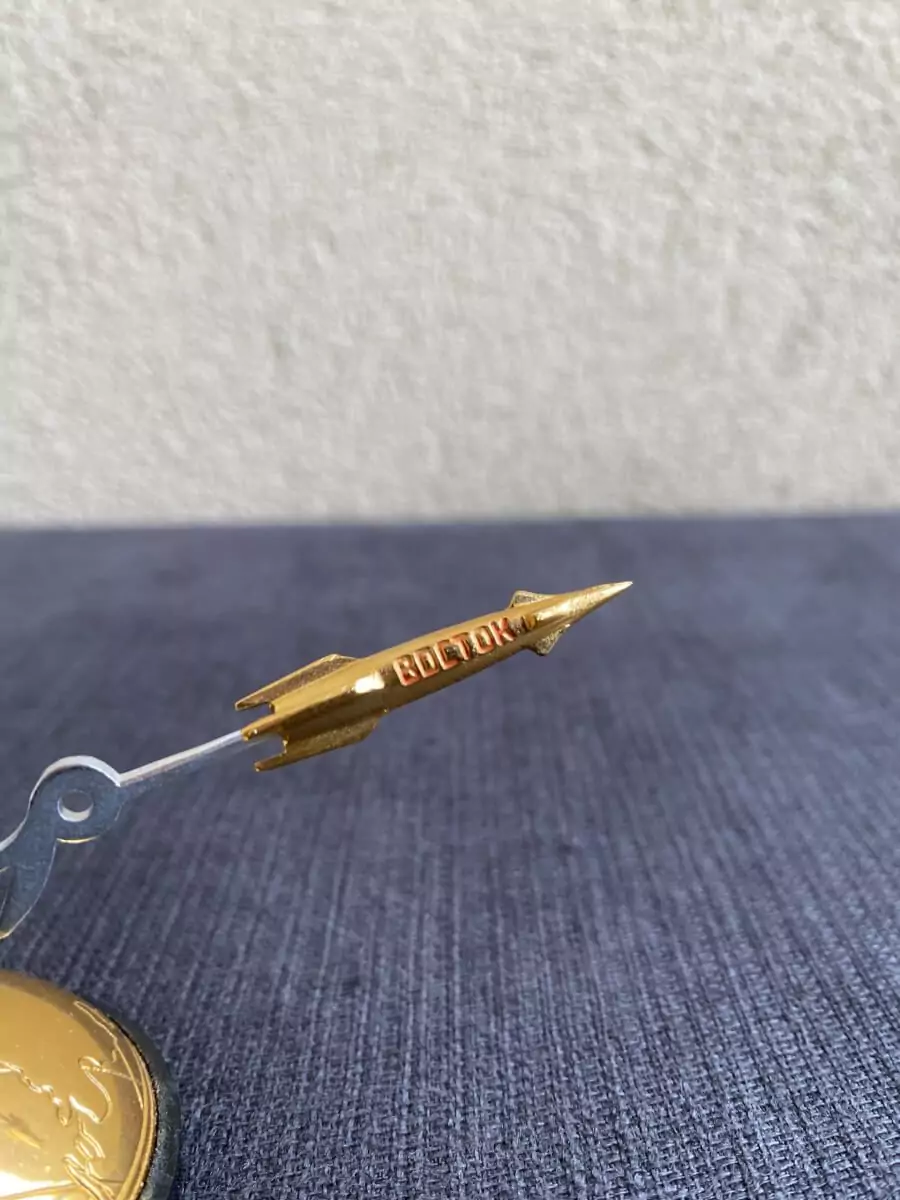
Gagarin’s flight set off mass production, and most of the space souvenirs you will see come from it. A decisive detail: the real launcher was secret. Until June 1967, when the USSR exhibited a Vostok rocket at the Le Bourget air show, no object shows the real rocket with four side boosters. The souvenirs of 1961 to 1967 show cartoon rockets, pointed cigars with fins, often three, marked « Восток » or « СССР ». An object with this imaginary rocket is from before 1967, or copied from a pre-1967 model. An object showing the real launcher, with its four clustered cones, is from after 1967.
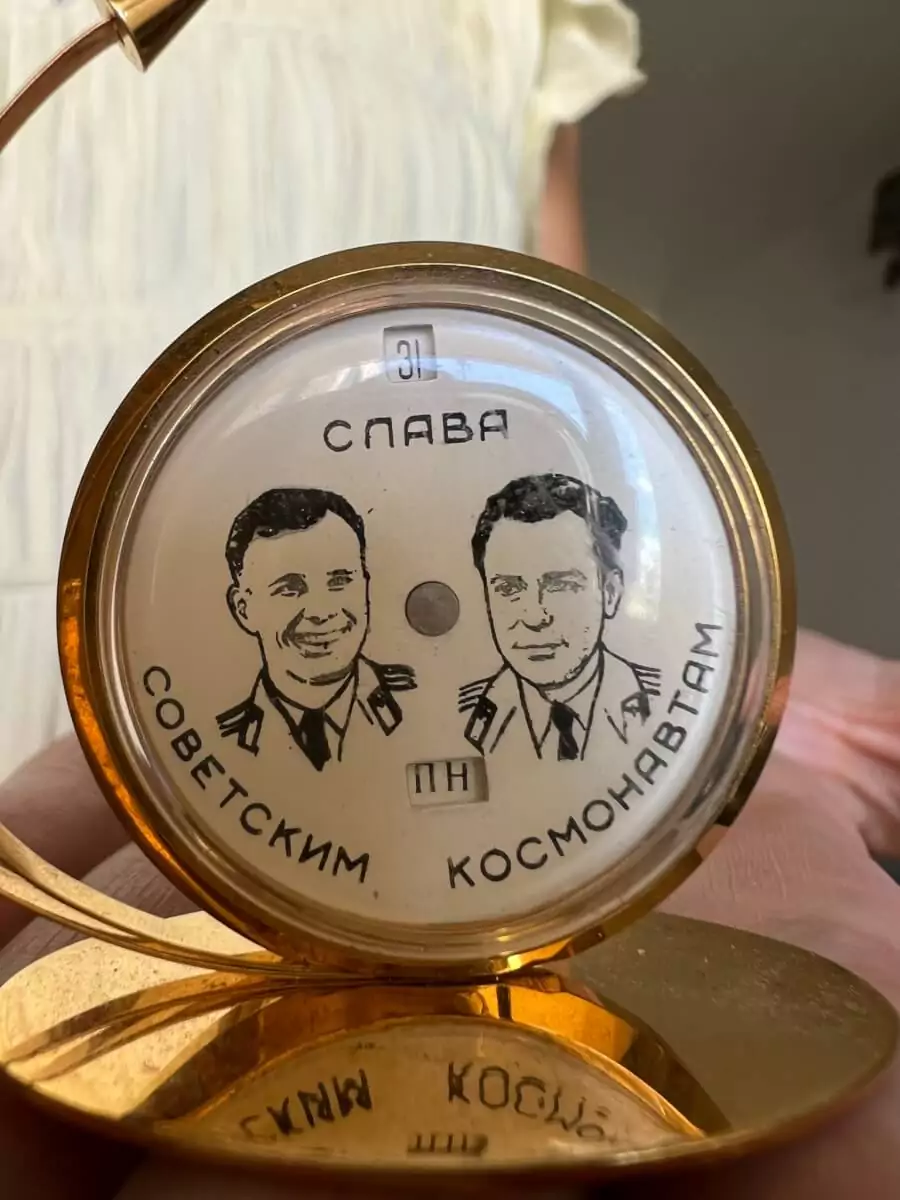
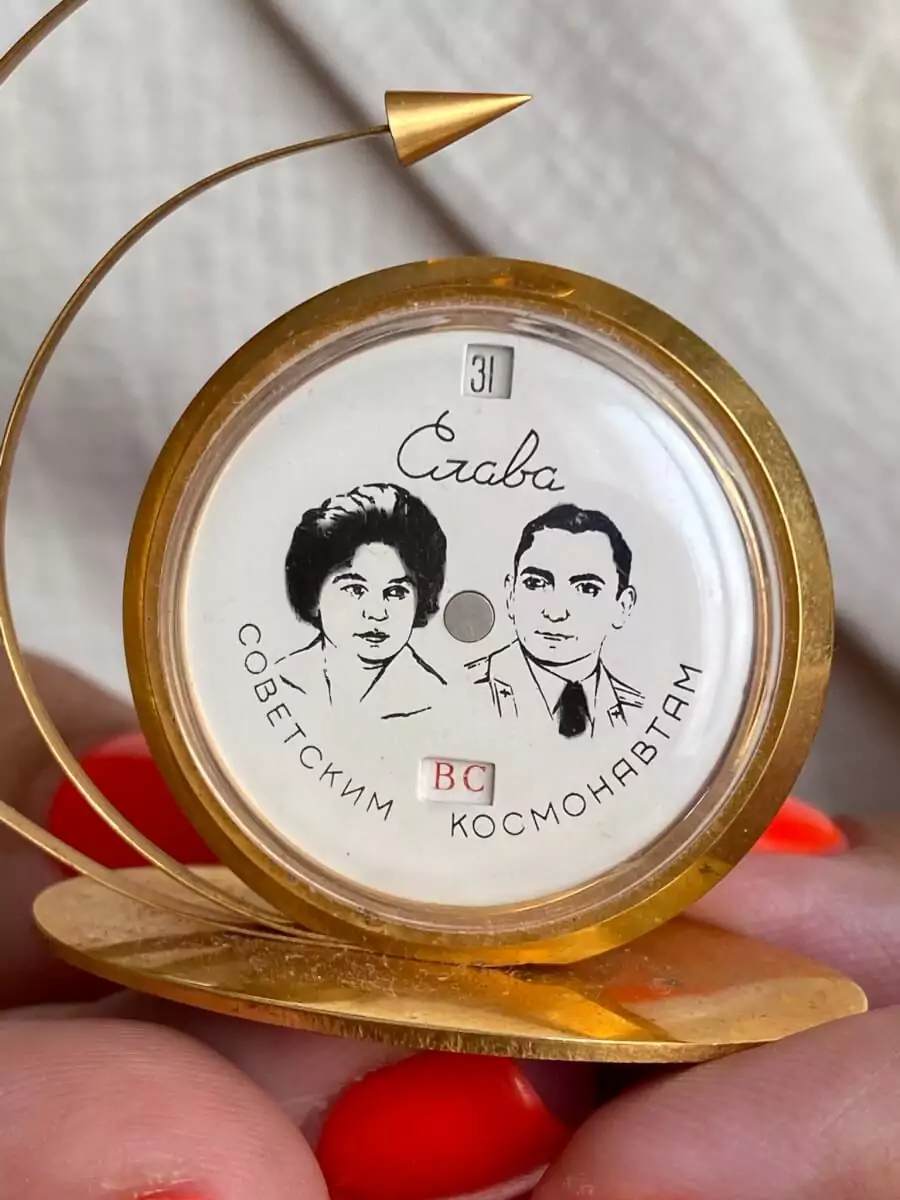
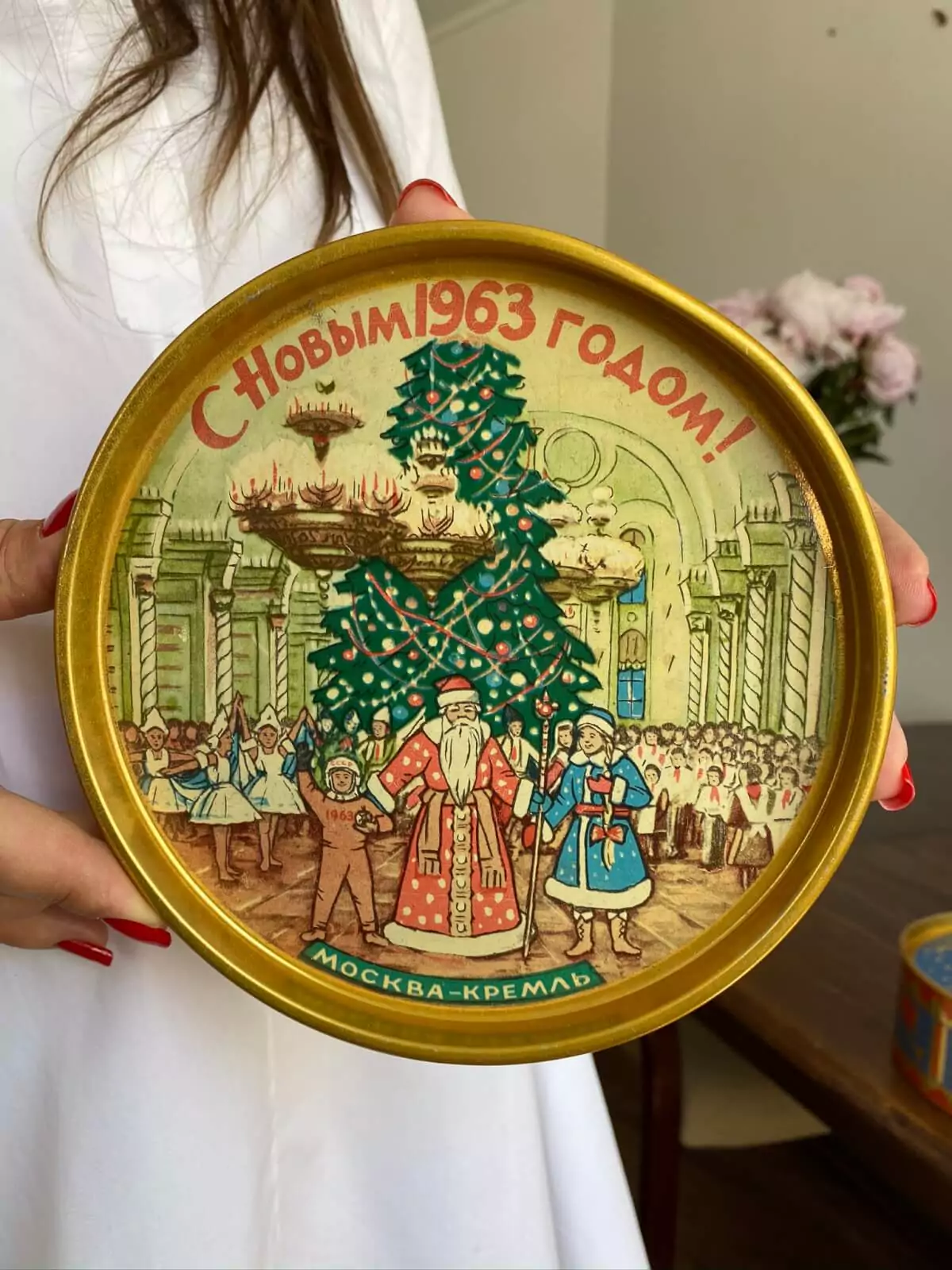
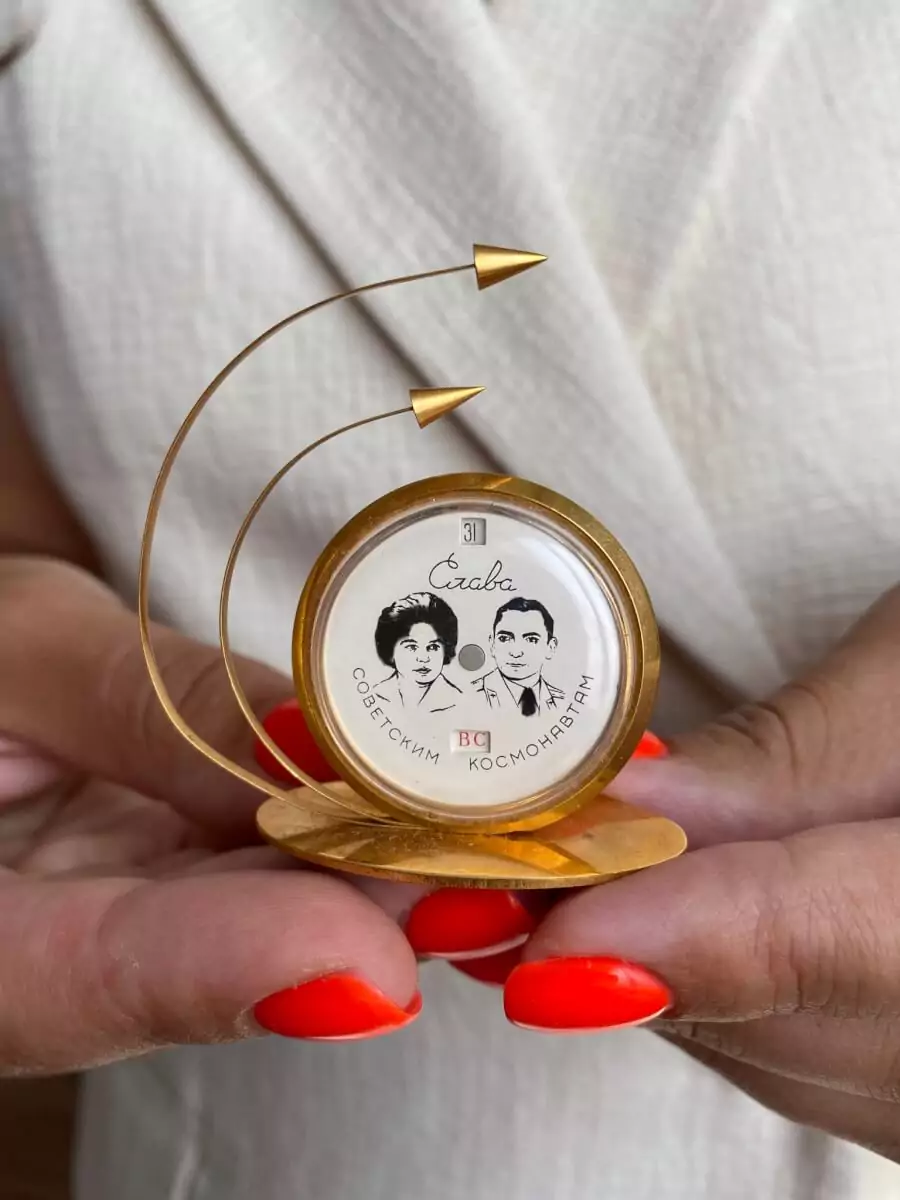
The Moscow factory’s tear-off desk calendars, with portraits of cosmonauts, are dated by the faces: Gagarin and Titov, 1961-1962; Nikolayev and Tereshkova, after November 1963. New Year sweet tins carry their year in letters: « С Новым 1962 годом ».
« СССР » souvenir rocket with fins: the imaginary rocket of before 1967.
Small « Восток » rocket on its sphere, in its « космический корабль Восток » box, 1960s.
Gagarin and Titov desk calendar: after August 1961.
The same with Nikolayev and Tereshkova: after November 1963.
Sweet tin « С Новым 1963 годом », a cosmonaut among the children, Moscow-Kremlin.
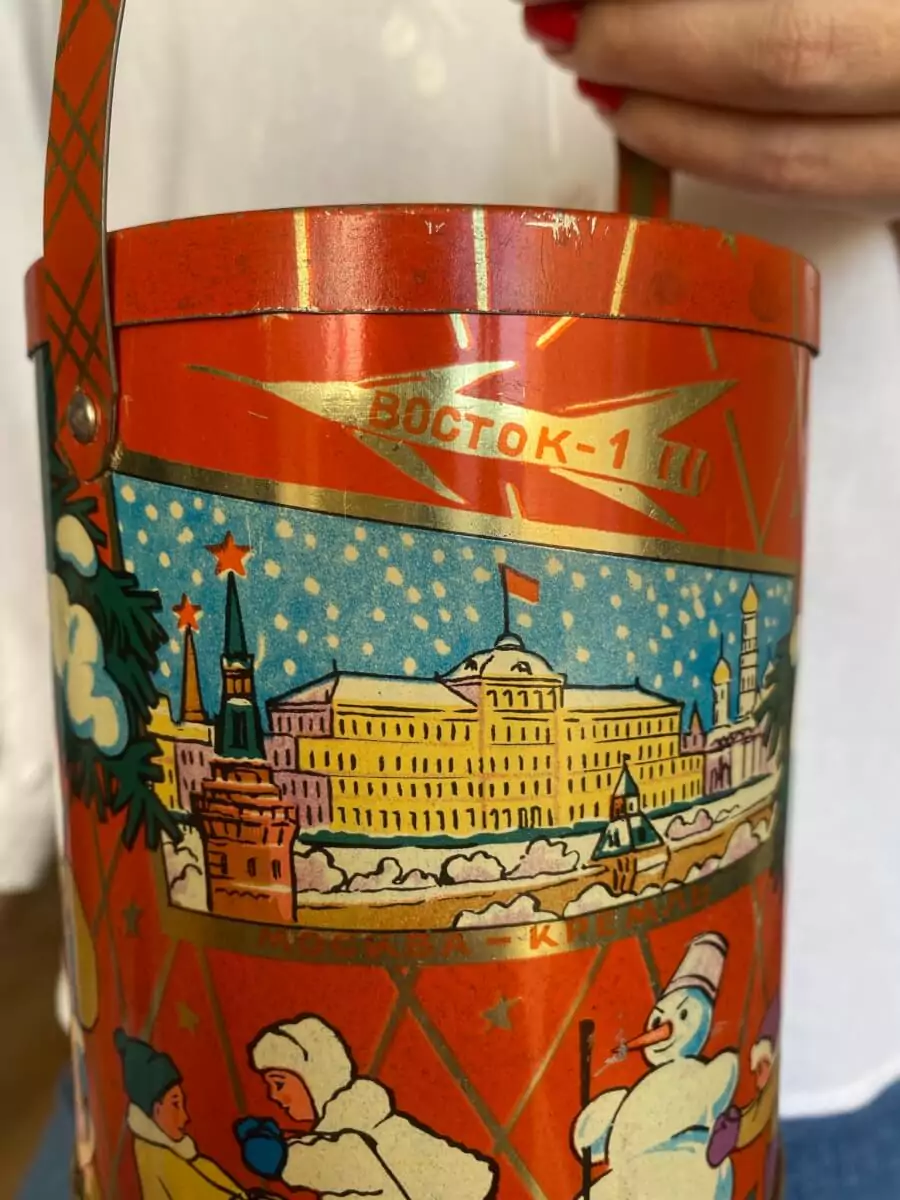
« Vostok-1 » tin for New Year 1962, the imaginary rocket over the Kremlin.
1966-1975: the Moon, Lunokhod, Salyut
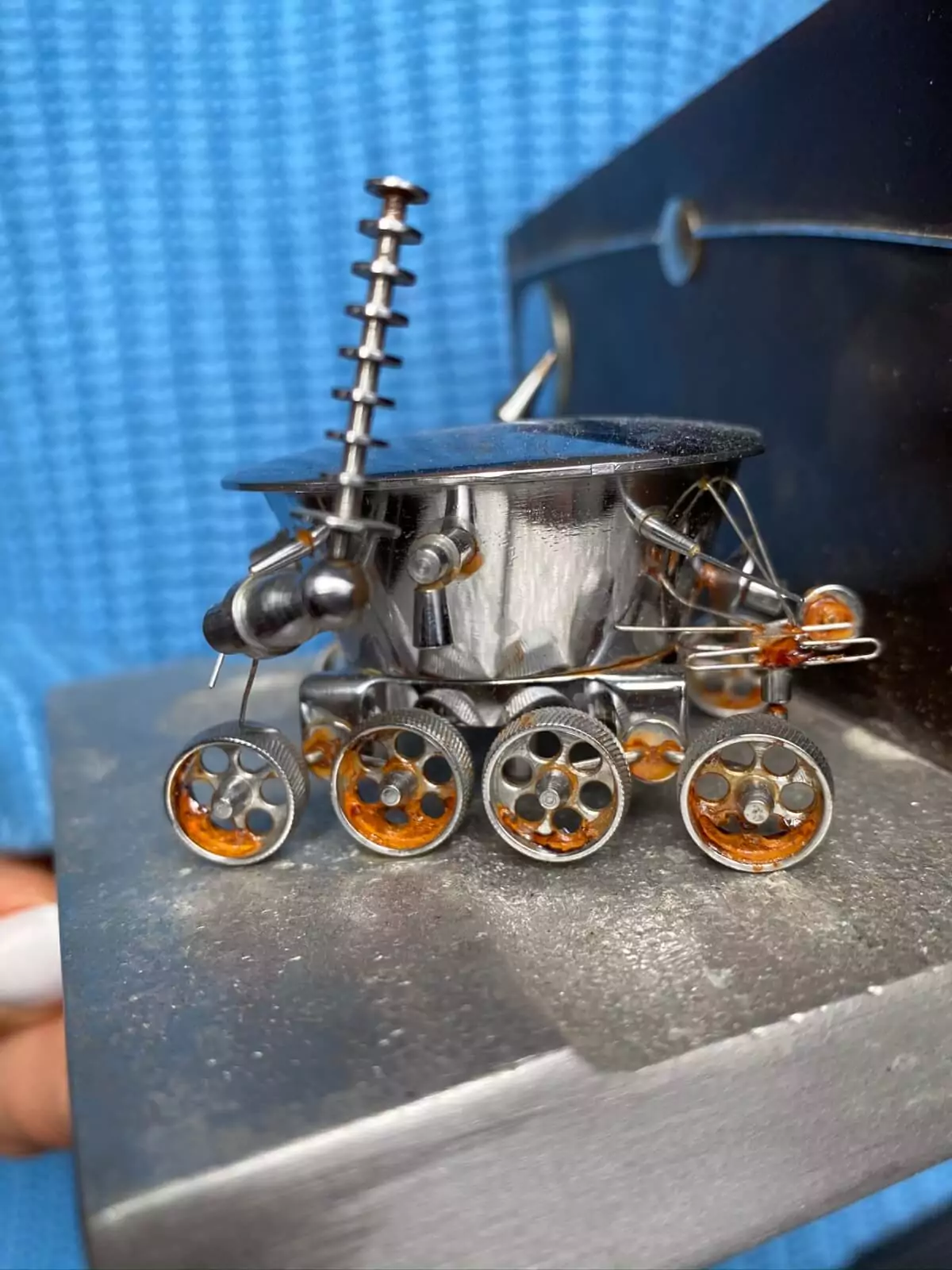
Luna 9 in February 1966 gave a night light; Lunokhod in November 1970 gave models, battery toys and officers’ gifts, where the eight-wheeled vehicle is recognisable among all. Objects of this period are in plexiglass, aluminium, coloured plastic, and more often carry a factory mark and a moulded price. The Salyut station and the Soyuz-Apollo meeting of 1975 produced plates, medals and stamps rather than desk objects.
1978-1988: Intercosmos, the flights with the brother countries
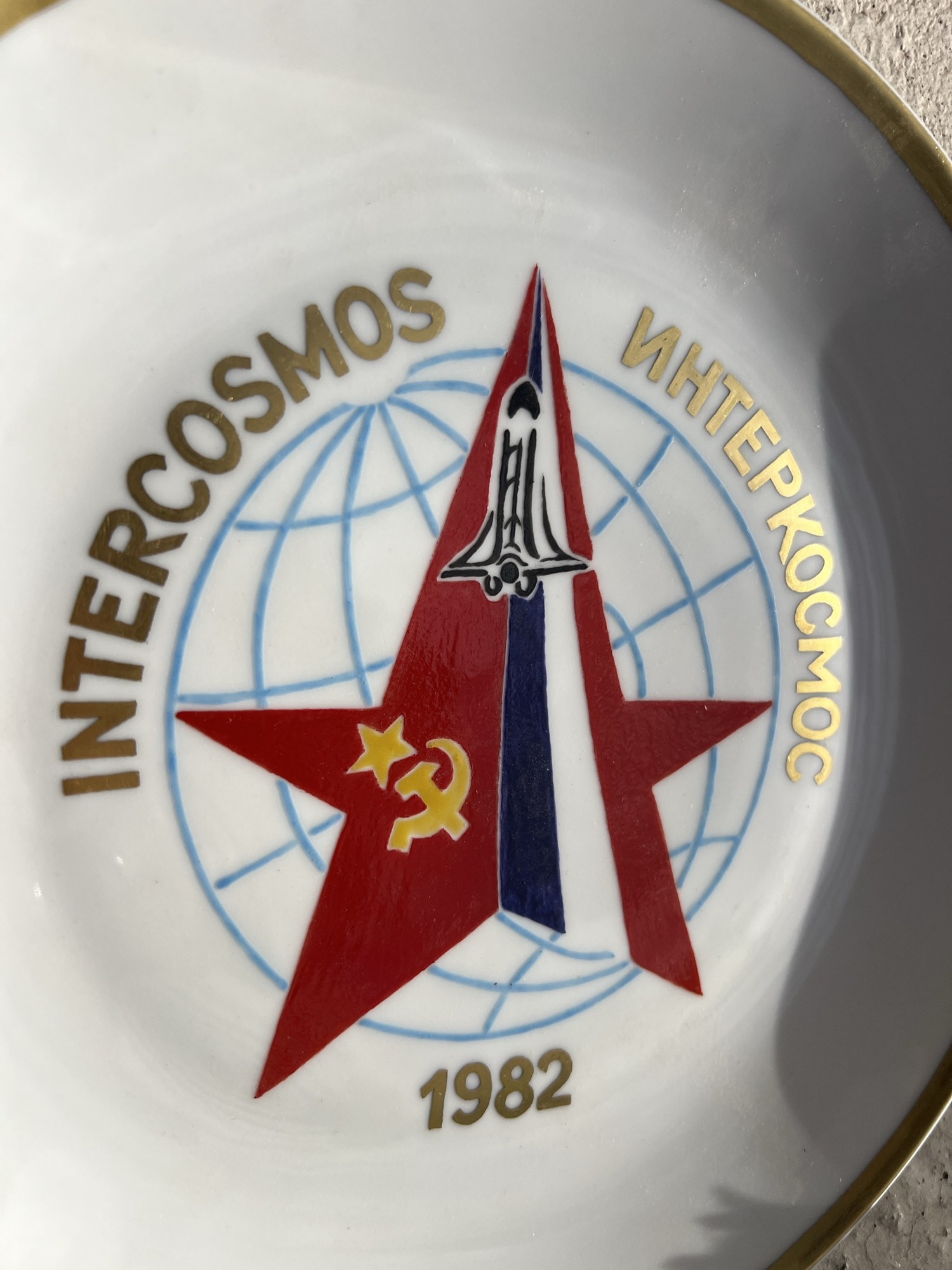
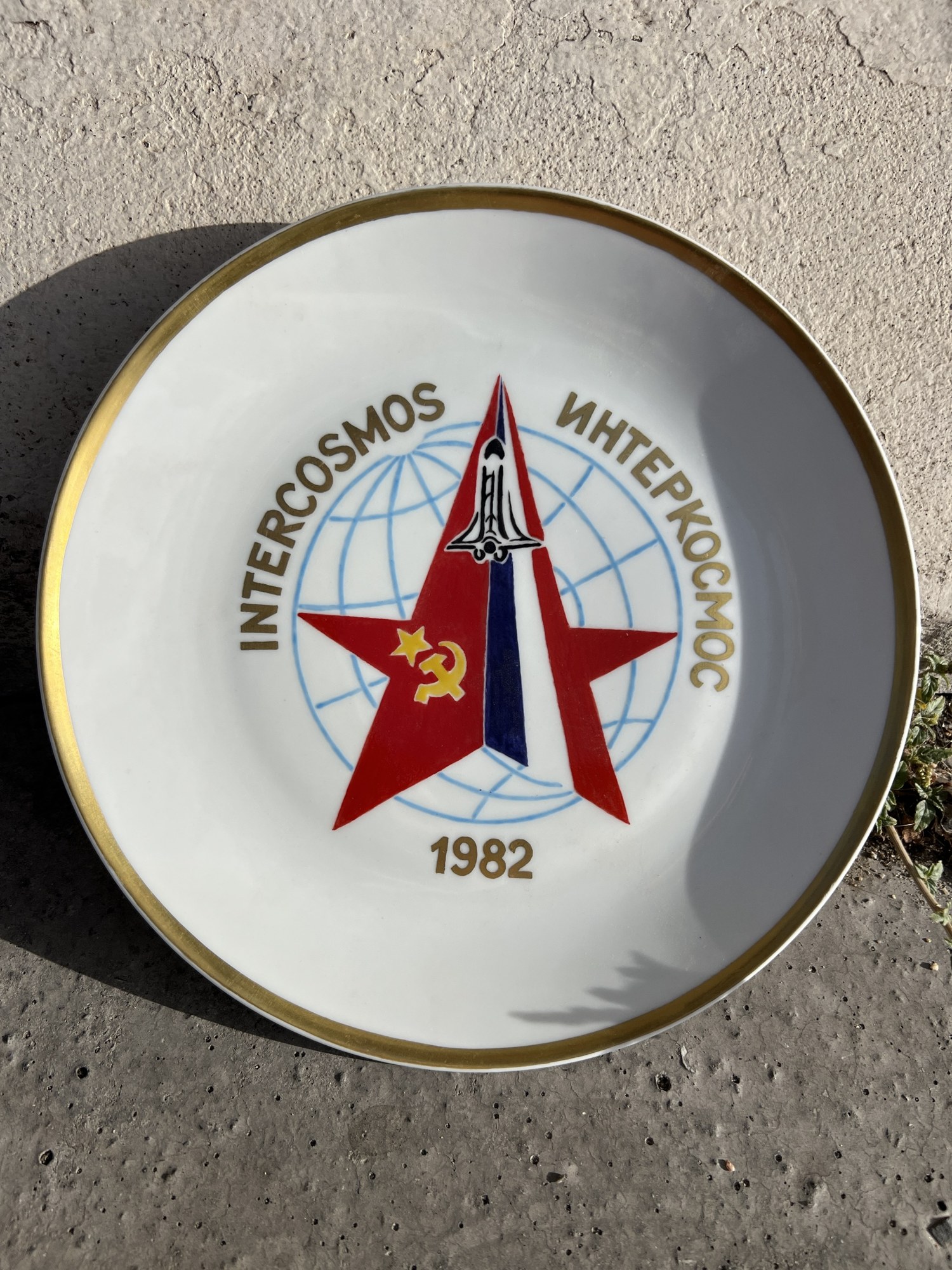
From 1978, each flight of a foreign cosmonaut aboard Soyuz produced its objects, marked « Интеркосмос » with the programme’s emblem, and often the year: the flight of Jean-Loup Chrétien in June 1982, the first Frenchman in space, has its plates painted « Intercosmos 1982 ». These are the easiest space objects to date; the year is written.
Intercosmos 1982 plate, the Franco-Soviet flight, hand-painted.
The marks that refine the date
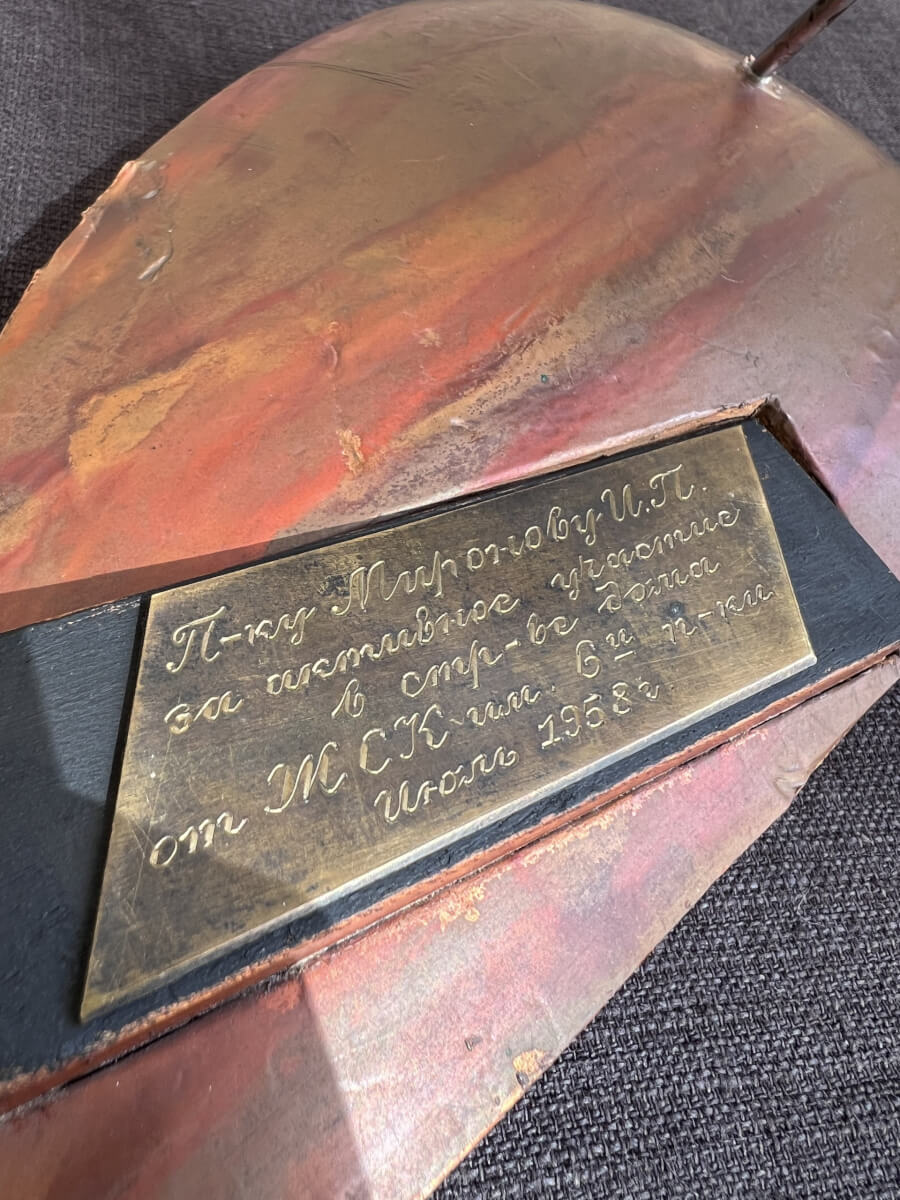
Once the mission is identified, three details narrow the range. The moulded or stamped price, in roubles and kopecks: the 1961 monetary reform divided prices by ten, a price in tens of roubles on a small object is from before 1961, a price in roubles and kopecks from after. The factory logo and the article number, sometimes the month and year. The engraved dedication, finally, dated to the day, which gives a safe upper bound: the object existed when it was given.
Dedication plate engraved on the base of a Sputnik, dated 1958.
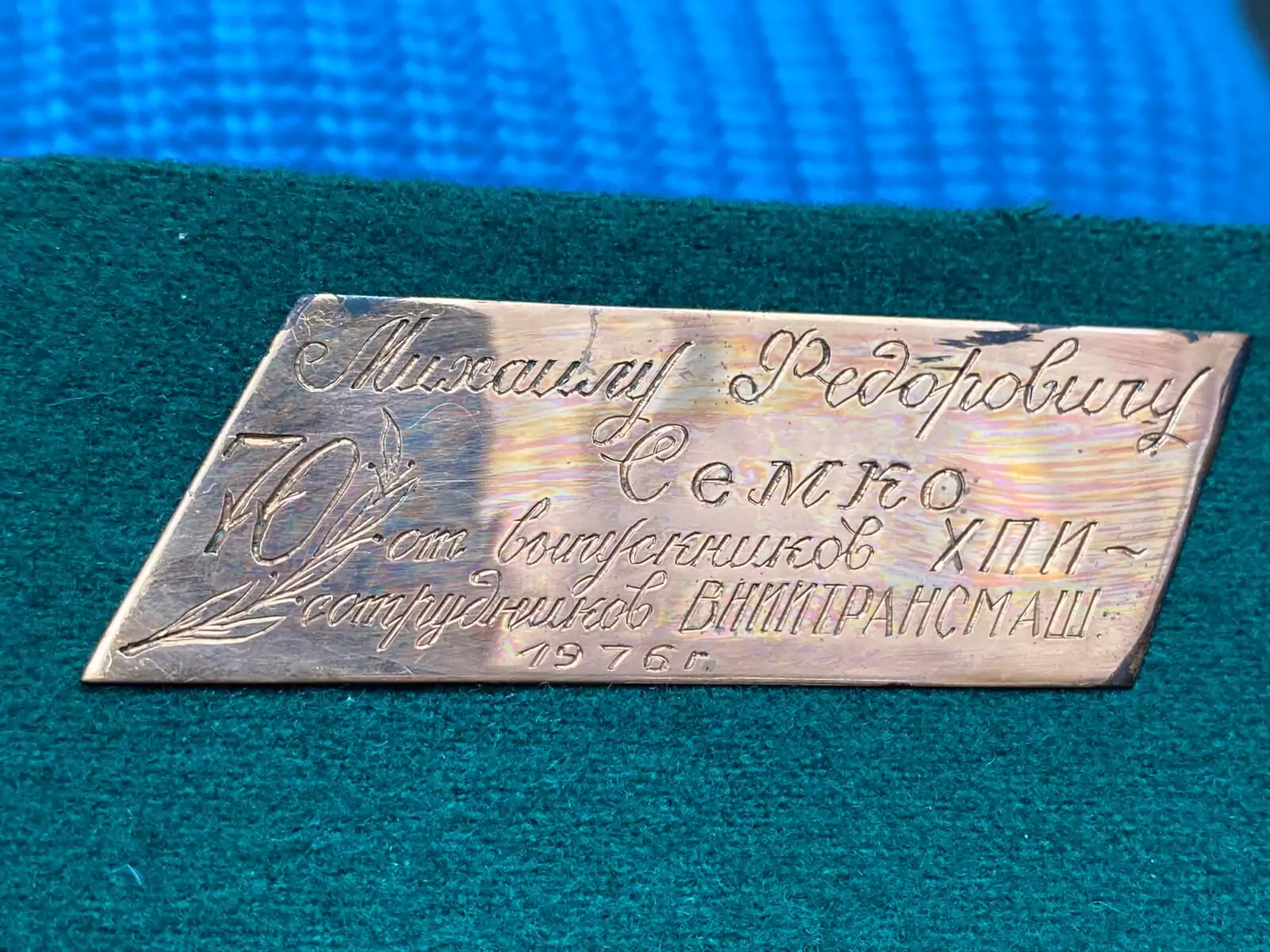
Plate of a Lunokhod gift, 1976, name and factory.
What does not date
The word « СССР » on the object dates nothing: it is there from 1957 to 1991. Style alone misleads: imaginary rockets were copied into the 1980s on tins and toys. The ageing of plastic depends on storage, not on age. And a date painted on an object is not always its own: « 1961 » on a 1975 night light commemorates, it does not date.
Frequently asked questions
How do you date a Sputnik object?
By its shape: sphere with four antennas, after October 1957; cone, after May 1958. By its base, often dedicated and dated.
Does a « Vostok » rocket on an object date it to 1961?
Not necessarily. Finned rockets are imaginary and were reproduced into the 1980s. Only the real rocket with four side boosters, visible after 1967, is a safe marker.
Are all Gagarin objects from 1961?
No. They were produced in 1961-1965, then for each anniversary of the flight, 1971, 1981, 1986, 1991. Style, material and the moulded price tell them apart.
What is a Soviet space souvenir worth?
From 100 to 300 euros for ordinary objects, 350 to 900 for dedicated desk Sputniks, Lunokhod models and large pieces.
Are Intercosmos objects rare?
No, they are dated and numerous, which makes them the best objects to start a space collection with.
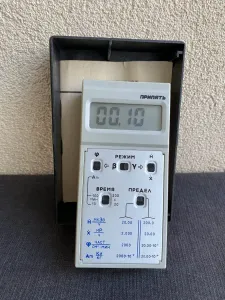
The ДП-5В (DP-5V) is the field radiometer of Soviet civil defence: a green Bakelite console, a probe with a rotating gamma, beta and check-source shield, headphones and a manual that explains operation and maintenance. The one in this article served in an industrial bakery in Chișinău and was serviced in March 1991. Its owner shared his photos and documents with us, and we turned them into a tool that lets you operate it on screen, step by step.
The Moscow Games, from 19 July to 3 August 1980, boycotted by some sixty countries, produced more objects than any Soviet event: a bear cub, Misha, drawn by Viktor Chizhikov, an emblem made of running tracks, five thousand torches, watches from every factory, platinum coins, rings, tea glass holders, posters. This guide tells the story of the Games and reviews the objects, with the marks that authenticate them and the prices.
The 3017 chronograph of the First Moscow Watch Factory carries a five-digit number on the balance cock. The most common dating method reads it as a single series, from 1959 to 1979. Four factory passports show there are two, and that the same number can point to two watches made ten years apart. Here is how to read the number, the dial, the logo and the bridge, with a decoder to date your Strela, Poljot or Sekonda.
This website uses cookies to improve your experience while you navigate through the website.
Out of these cookies, the cookies that are categorised as necessary are stored on your browser as they are essential for the working of basic functionalities of the website.
We also use third-party cookies that help us analyse and understand how you use this website.
These cookies will be stored in your browser only with your consent.
You also have the option to opt out of these cookies.
But opting out of some of these cookies may affect your browsing experience.
Necessary cookies are absolutely essential for the website to function properly. This category only includes cookies that ensure basic functionalities and security features of the website. These cookies do not store any personal information.
Cookies that are not strictly necessary for the website to work and that are used specifically to collect personal data through analytics, ads and other embedded content are called non-necessary cookies. User consent is required before these cookies run on the website.
✕
Soviet in Paris
Offline right now. Leave your message and your email, we reply within 24 hours.
Hello 👋 A question about an item, an order or shipping? Write to us.
Your email is used only to reply to you.
Subscribe to our newsletter and get 10% off your first order.
Subscribe
★ New pieces before anyone else
★ New blog articles
★ Soviet in Paris news and updates
Join the Party
10% off your first order
Receive your welcome card and our next arrivals.
Your code appears here and is also sent to you by email. You can leave the Party in one click, at any time.