A metal tube, a wire, a rare gas and a few hundred volts: that is all it takes to turn an invisible particle into a click. The same principle drove the DP-5 of Soviet civil defence, then the pocket dosimeters put on open sale in 1990, after Chernobyl. This guide explains how the tube works, which factories made the Pripyat, the Bella and the RKSB-104, and how to read these instruments before you buy one.
OCTOBER 2026•12 MINUTE READ
by Marwen Yahyaoui
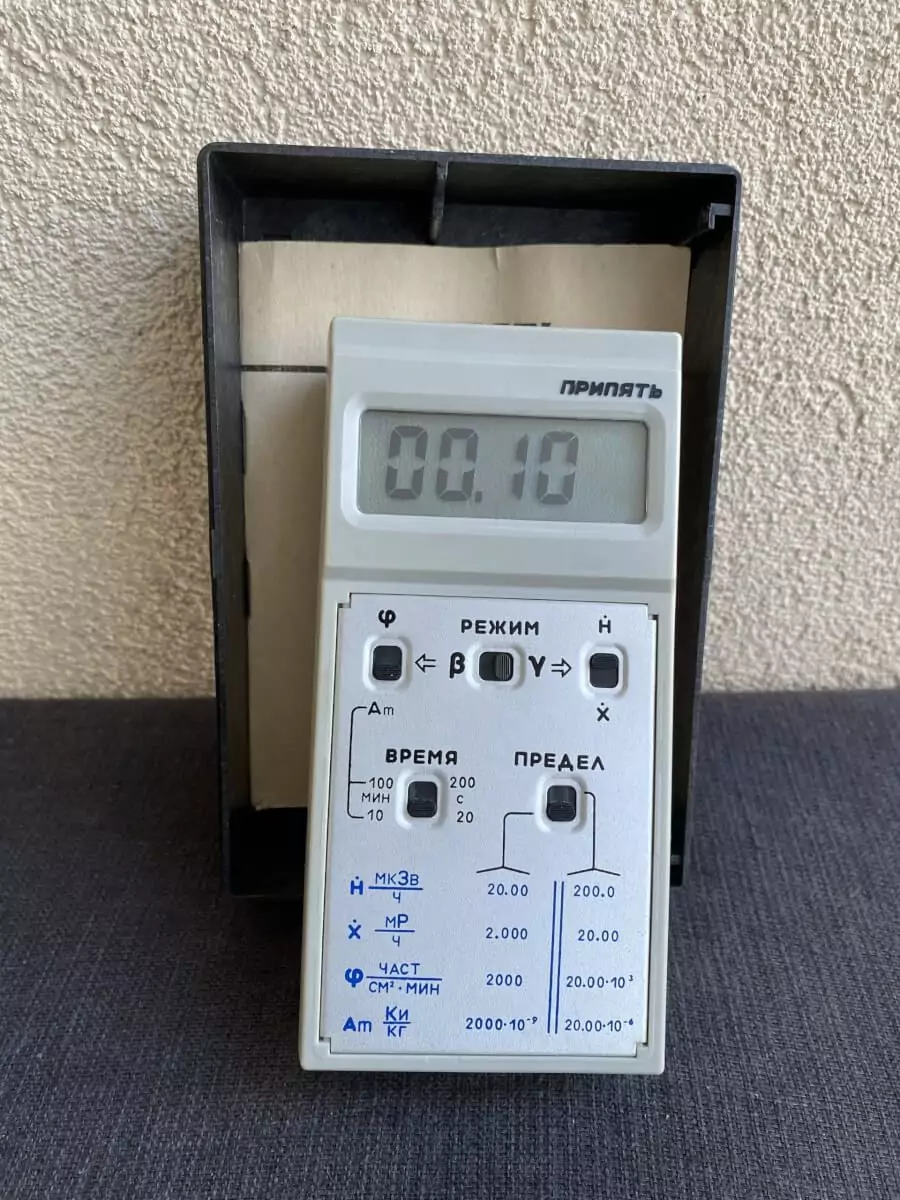
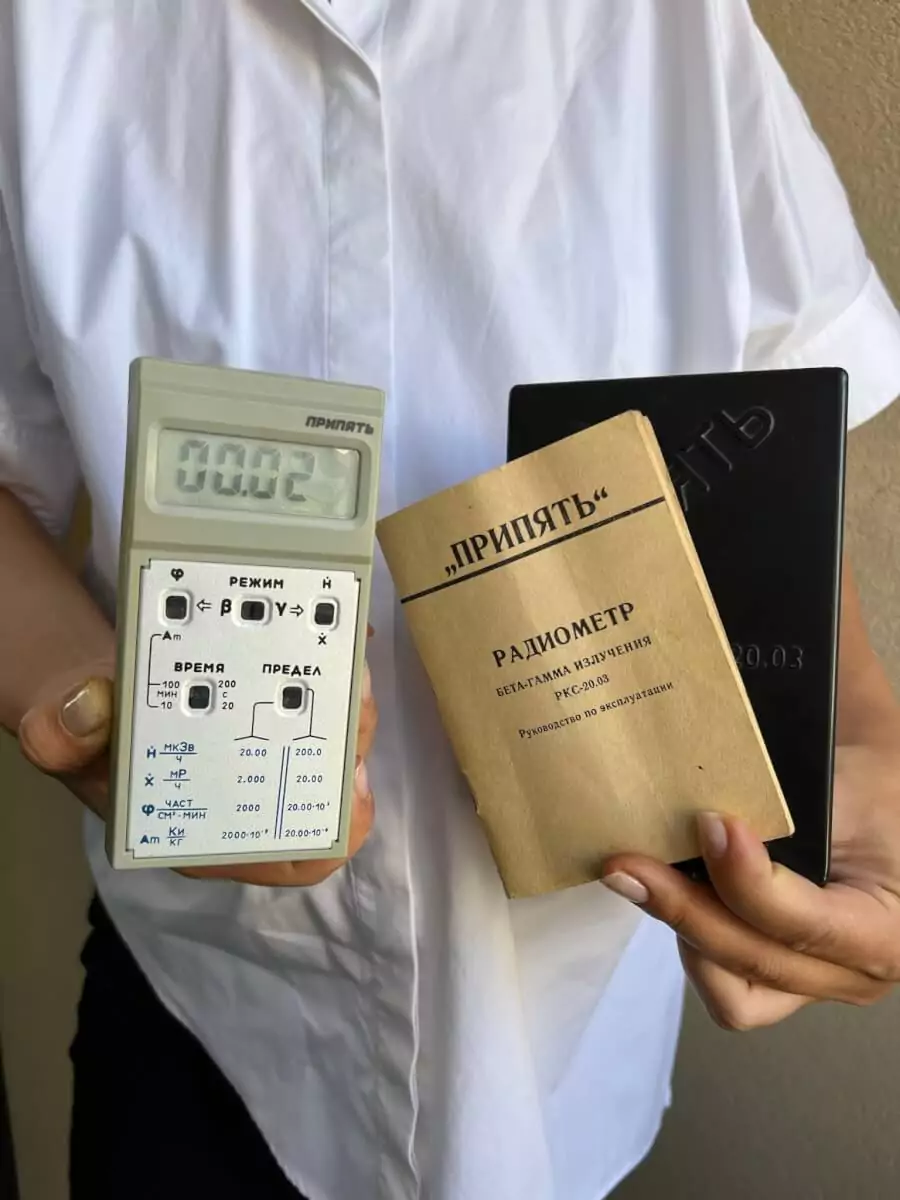
Pripyat РКС-20.03 (RKS-20.03) radiometer, released by the factory on 23 September 1991, in front of its case.
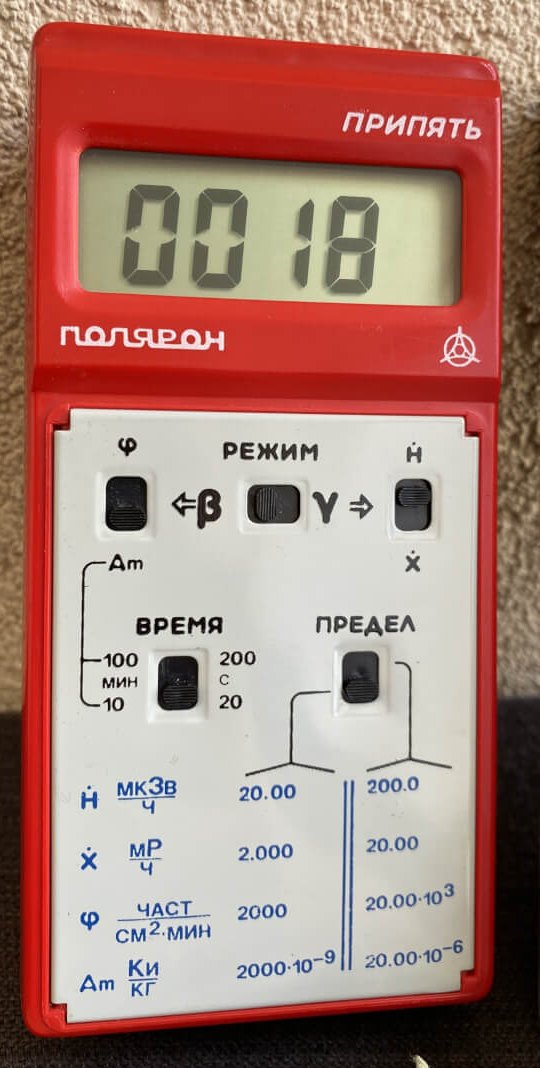
This grey instrument is a РКС-20.03 “Припять” (Pripyat) pocket radiometer: a liquid-crystal display, slide selectors, a 9-volt battery, and Geiger tubes inside. It measures gamma radiation and beta particles. The one in the photo passed through the shop, in its case, with its passport.
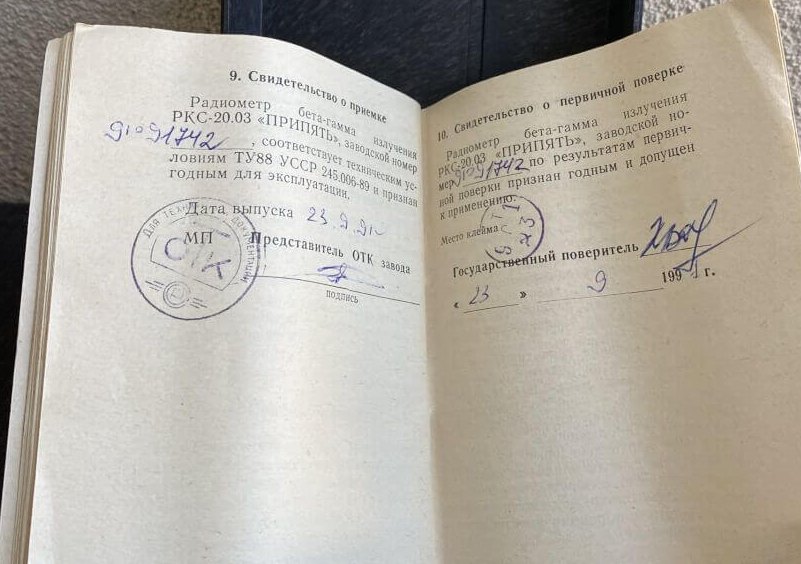
The passport carries the same date twice. On 23 September 1991, the factory’s quality control certified that the instrument met technical specification ТУ88 УССР 245.006-89 (TU88 UkSSR 245.006-89) and was “found fit for use”. The same day, a state verifier signed off its first verification: the instrument was “approved for use”. The USSR was dissolved three months later, on 26 December 1991.
The Pripyat’s passport: acceptance certificate dated 23.9.91 on the left, first state verification on the right.
Before Chernobyl: the DP-5 of Soviet civil defence
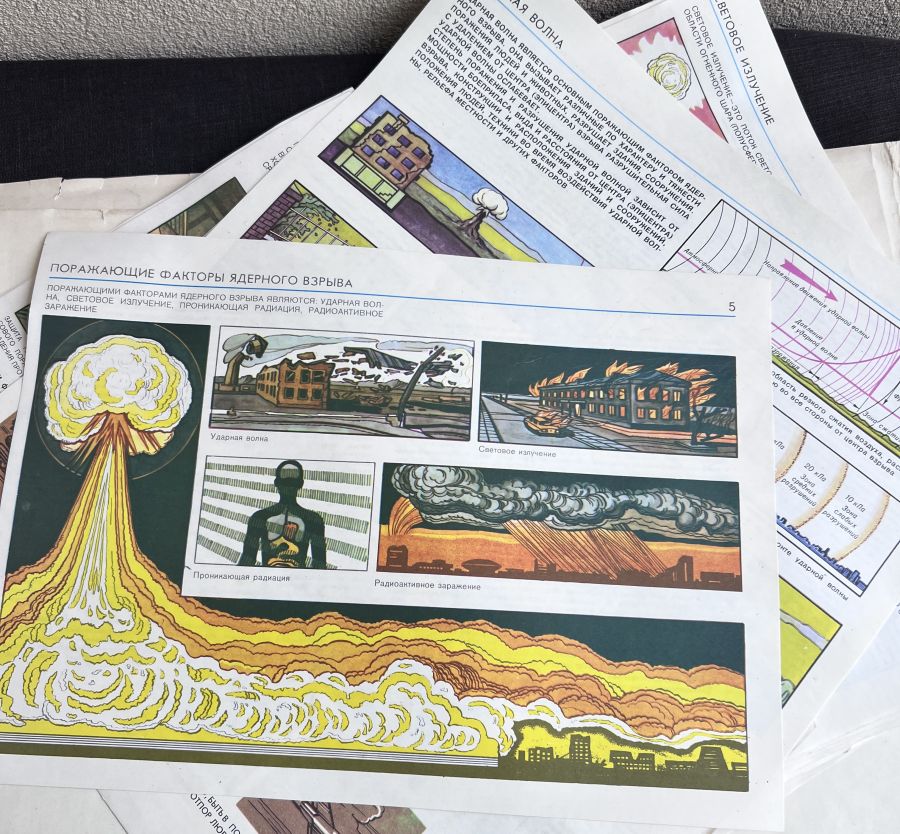
Until 1986, measuring radiation was a job for the army and civil defence. The shop offers a series of civil defence boards printed in Kyiv in 1977 for the Ministry of Education. Several of them cover measuring instruments.
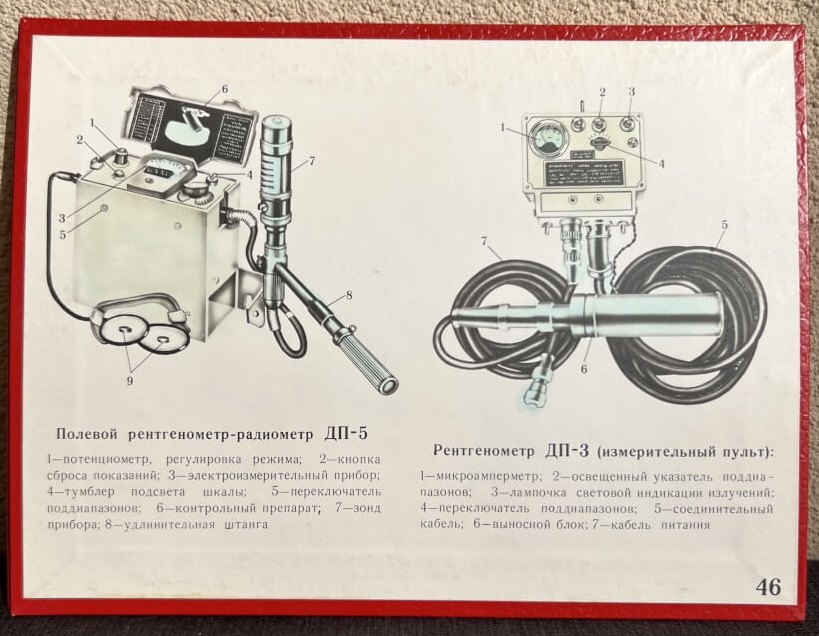
Board No. 46: the ДП-5 (DP-5) field roentgenmeter-radiometer, left, and the ДП-3 (DP-3) roentgenmeter.
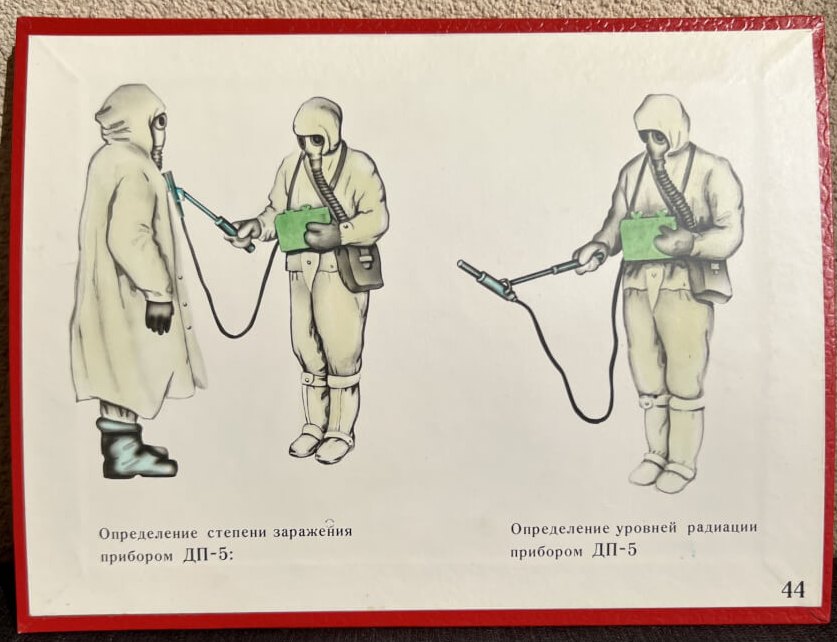
Board No. 44: checking a person for contamination and measuring the radiation level with the DP-5.
Board No. 46 details the ДП-5 (DP-5) “полевой рентгенометр-радиометр” (polevoy rentgenometr-radiometr, field roentgenmeter-radiometer). Its key names the adjustment potentiometer, the reset button, the needle meter, the scale lighting switch, the sub-range switch, the check source housed in the lid, the probe and its extension rod. The drawing also shows a pair of headphones. Board No. 44 shows it in use: a man in a protective suit and gas mask runs the probe along a person to check for contamination, then holds it toward the ground to measure the radiation level.
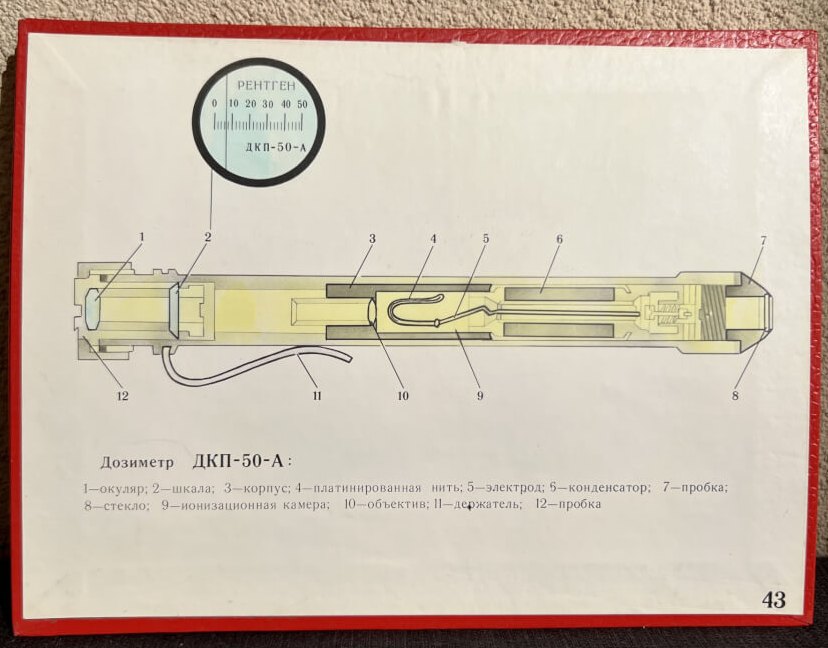
Board No. 43: cutaway of the ДКП-50-А (DKP-50-A) dosimeter, with its scale from 0 to 50 roentgens.
Board No. 43 shows a cutaway of the ДКП-50-А (DKP-50-A) personal dosimeter. It is not a Geiger counter: it is a tube with an ionisation chamber, a platinum-coated fibre and an eyepiece, read by eye on a scale from 0 to 50 roentgens.
According to a Ukrainian civil protection course, the ДП-5В (DP-5V) version measures from 0.05 milliroentgen per hour to 200 roentgens per hour, in six sub-ranges. The collector Bogin, who opened his, describes two Geiger tubes inside: a glass СИ-3БГ (SI-3BG) for the highest range and a metal СБМ-20 (SBM-20) for the others. The probe has a rotating metal shield: in one position the instrument measures beta and gamma rays, in the other gamma only. A dedicated article on the DP-5V shows a complete set and a tool to operate it step by step, based on its manual.
1990: Soviet dosimeters go on open sale
After the Chernobyl accident, told in our article Chernobyl, forty years on: the objects of a disaster, people wanted to measure for themselves. Boris Polenov, in “Дозиметрические приборы для населения” (Dozimetricheskie pribory dlya naseleniya, “Dosimetric instruments for the population”, Energoatomizdat, 1991), writes that a range of first household dosimeters, бытовые дозиметры (bytovye dozimetry), was designed and put into production in a short time, and reached wide sale in 1990. They were sold by the regional enterprises of the Изотоп (Izotop) association and by retail shops.
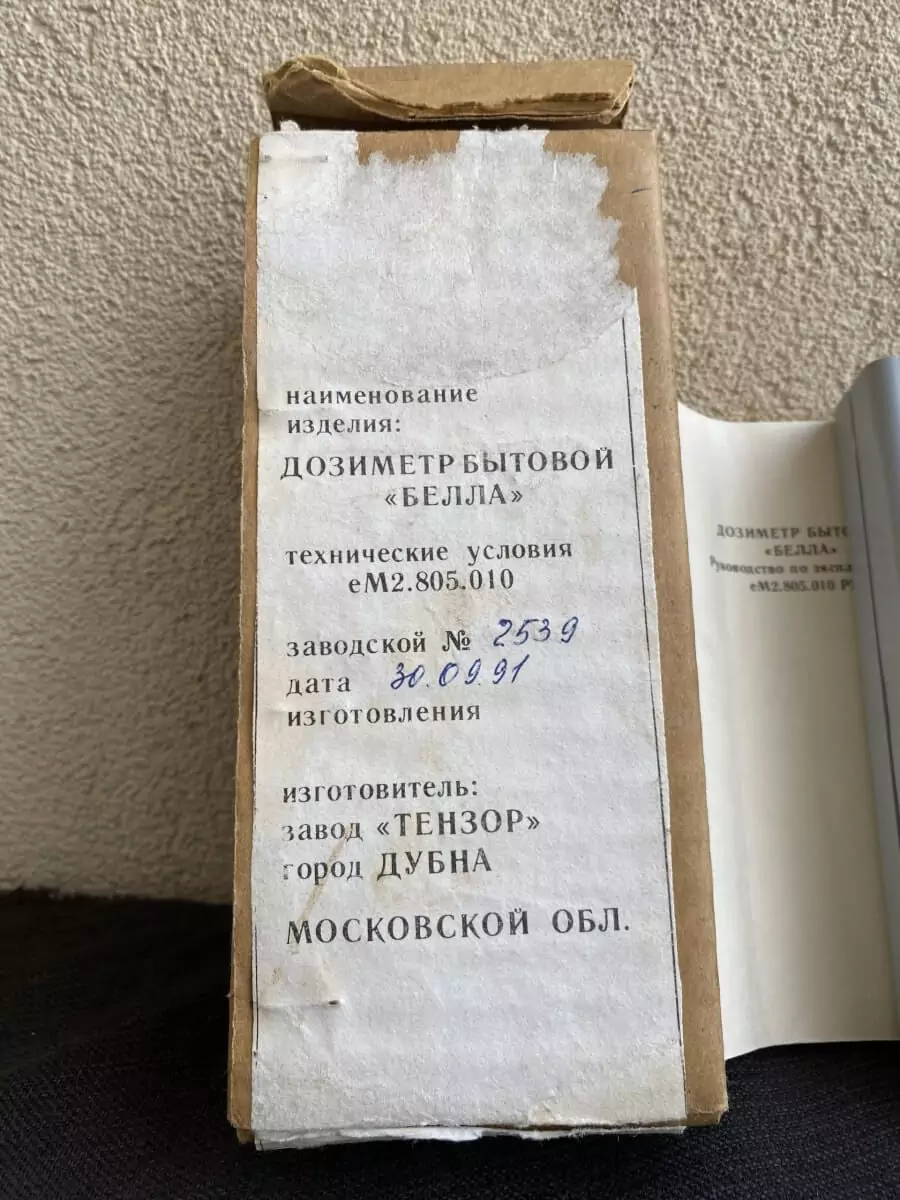
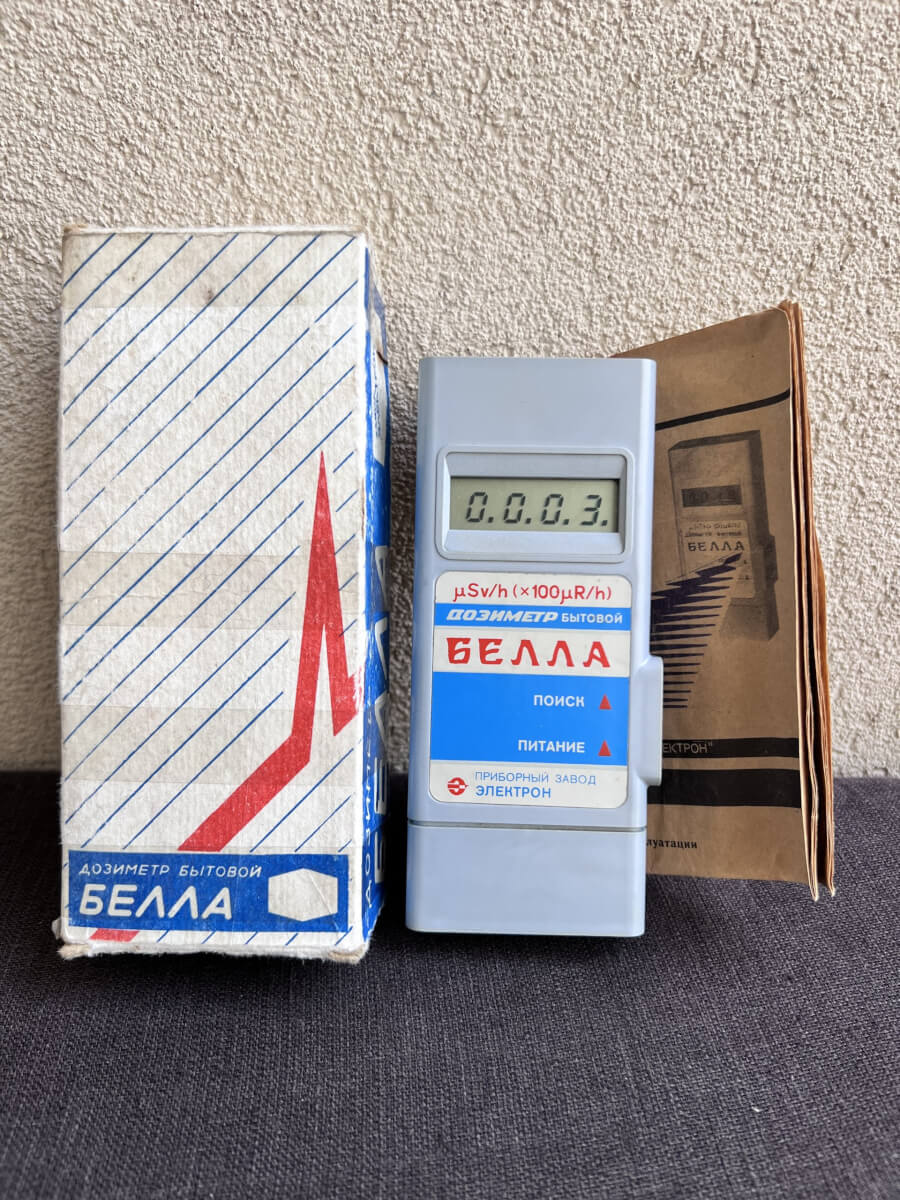
Box of a Bella household dosimeter: Tenzor plant, town of Dubna, Moscow region, No. 2539, made on 30.09.91.
Among them the book lists the Белла (Bella), the Мастер-1 (Master-1), the Сосна (Sosna), which holds four SBM-20 tubes, and the РКСБ-104 (RKSB-104). The Pripyat is listed apart, among instruments for professional staff: Polenov notes that it is also due to be sold to the public, at a reduced price. All of them count with Geiger tubes.
How a Geiger counter works: from particle to click
Hans Geiger proposed the principle in 1908 in Manchester, in Ernest Rutherford’s laboratory. In 1928, with Walther Müller, who worked under him, he turned it into the sealed tube that carries both their names.
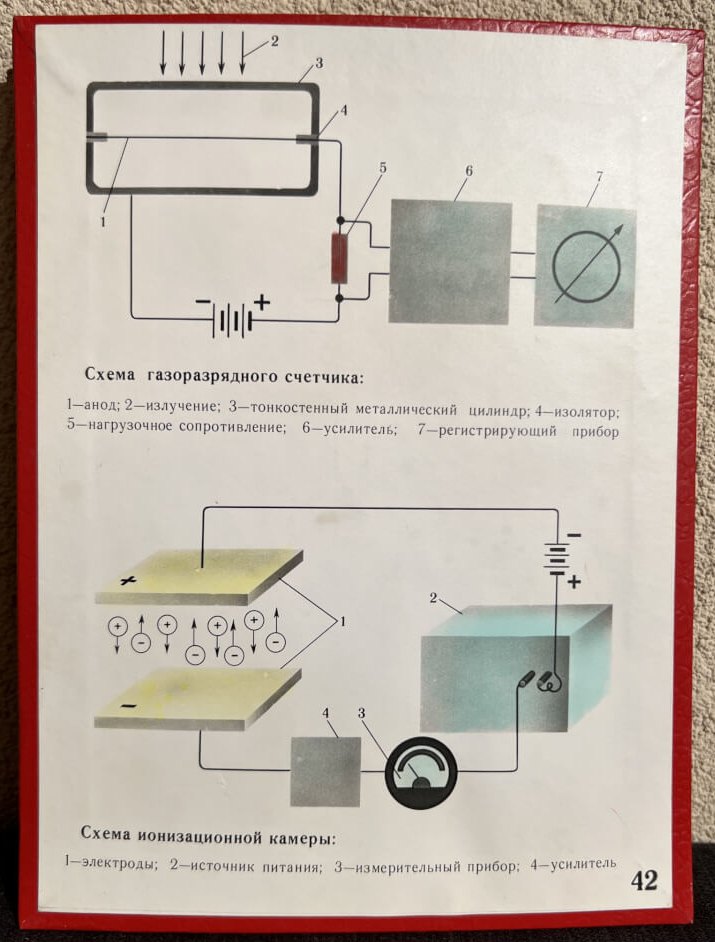
Board No. 42: diagram of the gas-discharge counter, top, and of the ionisation chamber, bottom.
Board No. 42 of the civil defence series gives the circuit, under the title “Схема газоразрядного счётчика” (Skhema gazorazryadnogo schyotchika, diagram of the gas-discharge counter): a thin-walled metal cylinder, an anode wire stretched down the centre and held by insulators, a battery, a load resistor, an amplifier and a recording instrument. A Pripyat or a Bella uses the same arrangement.
In Soviet pocket dosimeters, the most common tube is the СБМ-20 (SBM-20). According to its datasheet, it is a stainless steel cylinder 108 mm long and 11 mm across, with a 50-micron wall, weighing 10 grams and filled with neon, argon and bromine. It detects gamma radiation and beta particles energetic enough to pass through its wall, not alpha particles. The diagram below shows it in cross-section.
The tube wall acts as the negative electrode. The central wire is held at about 400 volts. At rest the gas does not conduct. A beta particle, a fast electron, passes through the wall. A gamma photon crosses the gas almost without touching it: it is by striking the wall that it knocks out an electron, which flies into the gas. Along its path, that electron in turn knocks electrons off the gas atoms.
These free electrons rush toward the wire. Close to the wire the electric field is so strong that each one frees others: this is the Townsend avalanche. The avalanches give off ultraviolet photons that trigger new ones, and the discharge spreads along the whole wire. The much slower positive ions then form a sheath around the wire that weakens the field: the discharge stops by itself, and the bromine, a halogen, keeps it from restarting. The brief current produces a pulse, amplified all the way to the speaker: that is the click.
Three consequences matter to the user. Every pulse is the same size, whatever the energy of the particle: a Geiger counter counts, it does not tell you what it counted. After each click the tube is blind for a brief moment, the dead time, at least 190 microseconds for the SBM-20 according to its datasheet: at very high rates, some particles go through uncounted. And an instrument only reads up to the end of its scale.
The night of 26 April 1986, in unit 4 at Chernobyl, is the example. The dosimetrist Nikolai Gorbachenko, whose account Grigori Medvedev published in “Чернобыльская тетрадь” (Chernobylskaya tetrad, “The Chernobyl Notebook”, Novy Mir magazine, 1989), had only a ДРГЗ (DRGZ) radiometer graduated up to 1,000 microroentgens per second. It was off the scale everywhere, and a second instrument, graduated up to 1,000 roentgens, burned out when switched on. Anatoly Dyatlov, in his memoir, gives the same ceiling: 1,000 microroentgens per second, or 3.6 roentgens per hour. That figure was the end of a scale, not a measurement: Medvedev puts the radiation near the debris at up to 15,000 roentgens per hour.
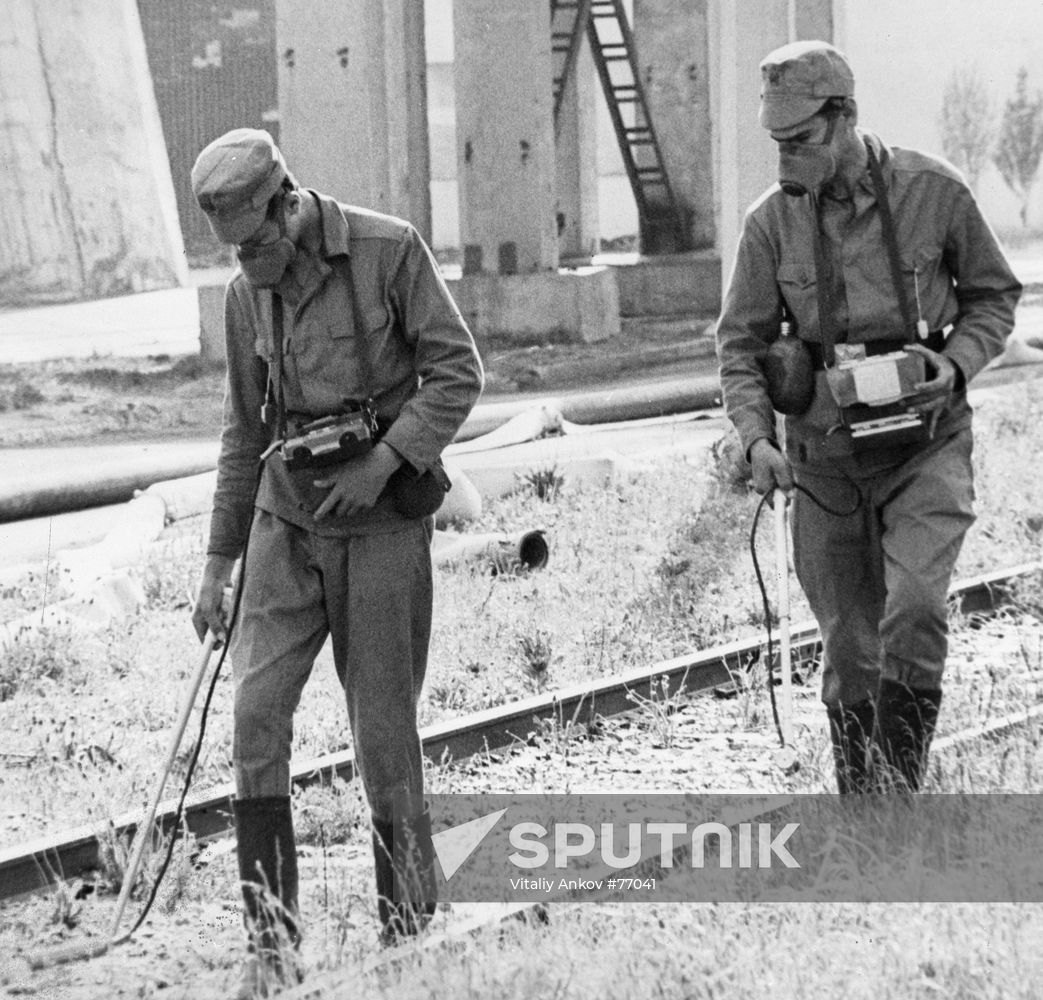
Dosimetrists on the site of the Chernobyl plant during the clean-up after the accident. The agency dates the picture 27 April 1986. Photo Vitaly Ankov, RIA Novosti / Sputnik (no. 77041).
Reading a Soviet dosimeter: roentgens and sieverts
A dosimeter counts pulses over a set time, then converts that count into a dose rate according to its calibration. Soviet instruments display the rate in roentgens, in sieverts, or in both. The roentgen measures the ionisation produced in air. The sievert, today’s unit, expresses the effect on the body, and one sievert equals 100 rem. For gamma rays, one roentgen deposits about 0.0096 gray in soft tissue, hence the practical rule: 100 microroentgens per hour is roughly 1 microsievert per hour.
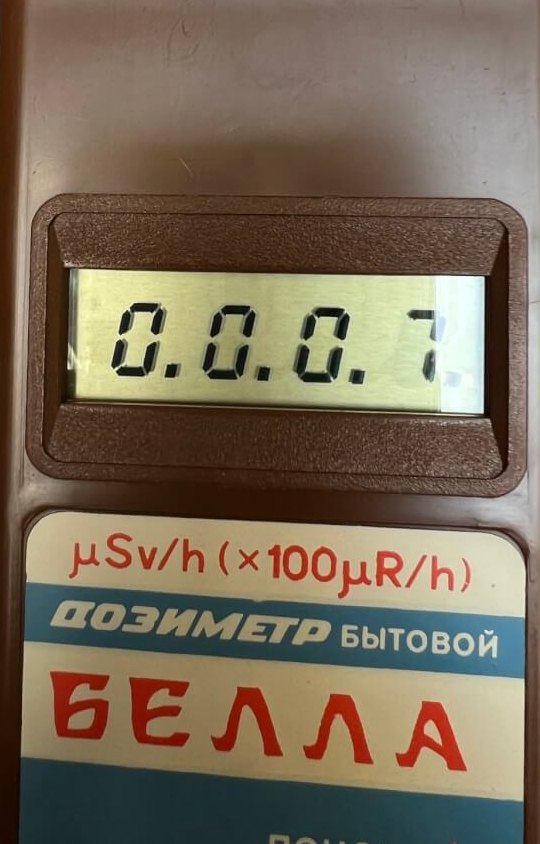
The face of a Bella: the display reads in µSv/h, or multiplied by 100 in µR/h.
The Bella prints it on its face: “µSv/h (×100 µR/h)”. The figure on the display reads in microsieverts per hour, or, multiplied by 100, in microroentgens per hour. The Pripyat has both scales, printed in Cyrillic at the bottom of its face: мкЗв/ч (mkZv/ch, microsieverts per hour) and мР/ч (mR/ch, milliroentgens per hour). It measures from 0.1 to 200 µSv/h, or from 0.01 to 20 mR/h, and also the flux of beta particles, from 10 to 20,000 particles per square centimetre per minute.
To practise: twelve readings on four Soviet instruments, in microsieverts, milliroentgens and roentgens per hour. First convert the figure on the display, then rate it on the scale of a 1991 Soviet handbook.
The dosimeters that passed through Soviet in Paris
Ten dosimeters have passed through the shop: five Pripyats, four Bellas and one RKSB-104. Their plates and papers tell where they come from.
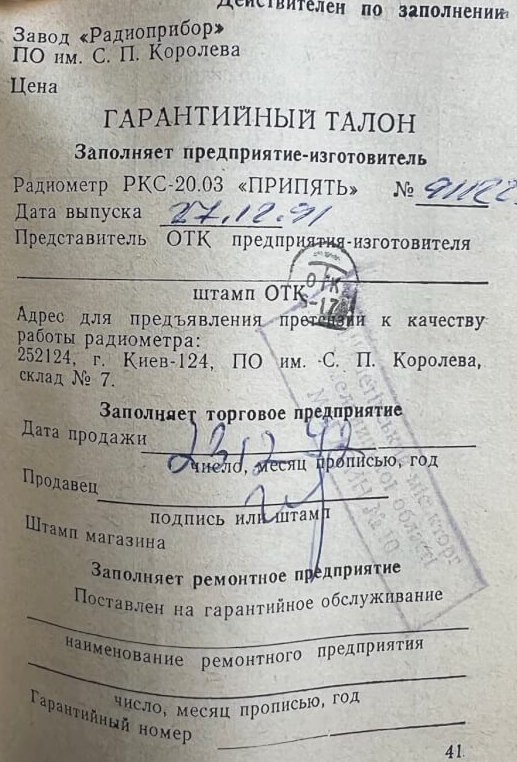
The Pripyat, two Ukrainian makers. The warranty cards name two makers: the Радиоприбор (Radiopribor) plant of the S. P. Korolev production association, in Kyiv, and the Полярон (Polyaron) production association, in Lviv. The shop’s two red Pripyats carry the name Полярон under the display: one left the factory in December 1990, the other in July 1991. Among the grey ones, one is dated 23 September 1991, and another, dated 27 December 1991, has its warranty card in the name of Radiopribor. The red one from December 1990 has its price marked on the back: 175 roubles, when the average Soviet monthly wage was 190.1 roubles in 1985.
Red Pripyat No. 15433, July 1991: the name Полярон (Polyaron) under the display.
Warranty card of a grey Pripyat: Радиоприбор (Radiopribor) plant, Kyiv, release date 27.12.91.
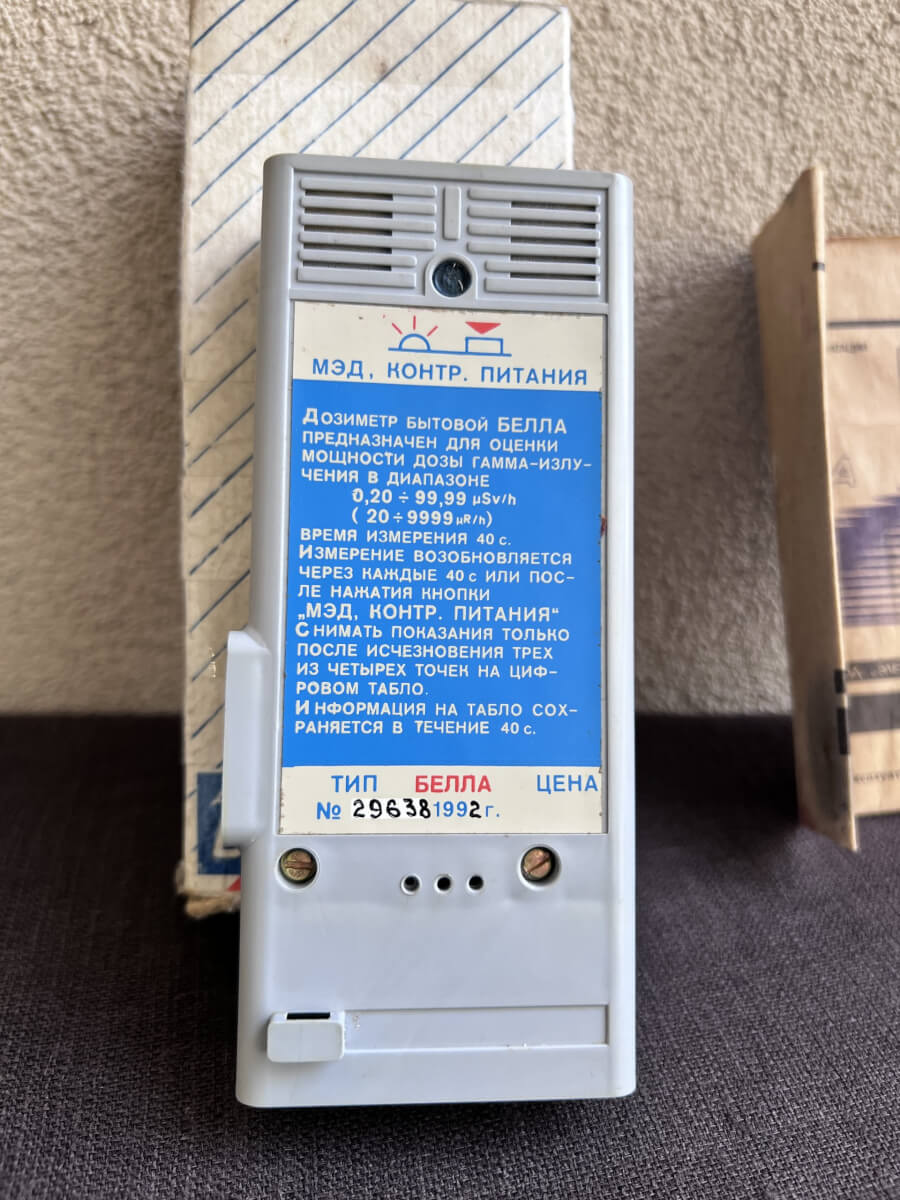
The Bella, from Dubna to Zhovti Vody. The label on the back presents the instrument as a household dosimeter “intended for estimating the dose rate of gamma radiation”, from 0.20 to 99.99 µSv/h, with a 40-second measurement that repeats every 40 seconds. One of the shop’s examples was made by the Тензор (Tenzor) plant in Dubna, in the Moscow region, on 30 September 1991. Two others, dated 1992, come from the Электрон (Elektron) instrument plant; the warranty card of one of them gives its address, in Жёлтые Воды (Zhyoltye Vody, in Ukrainian Zhovti Vody), in the Dnipropetrovsk region. Polenov describes the Bella with a single SBM-20 tube, a 9-volt battery and a weight of 250 grams.
Back of Bella No. 29638, 1992: measuring range, measuring time and instructions.
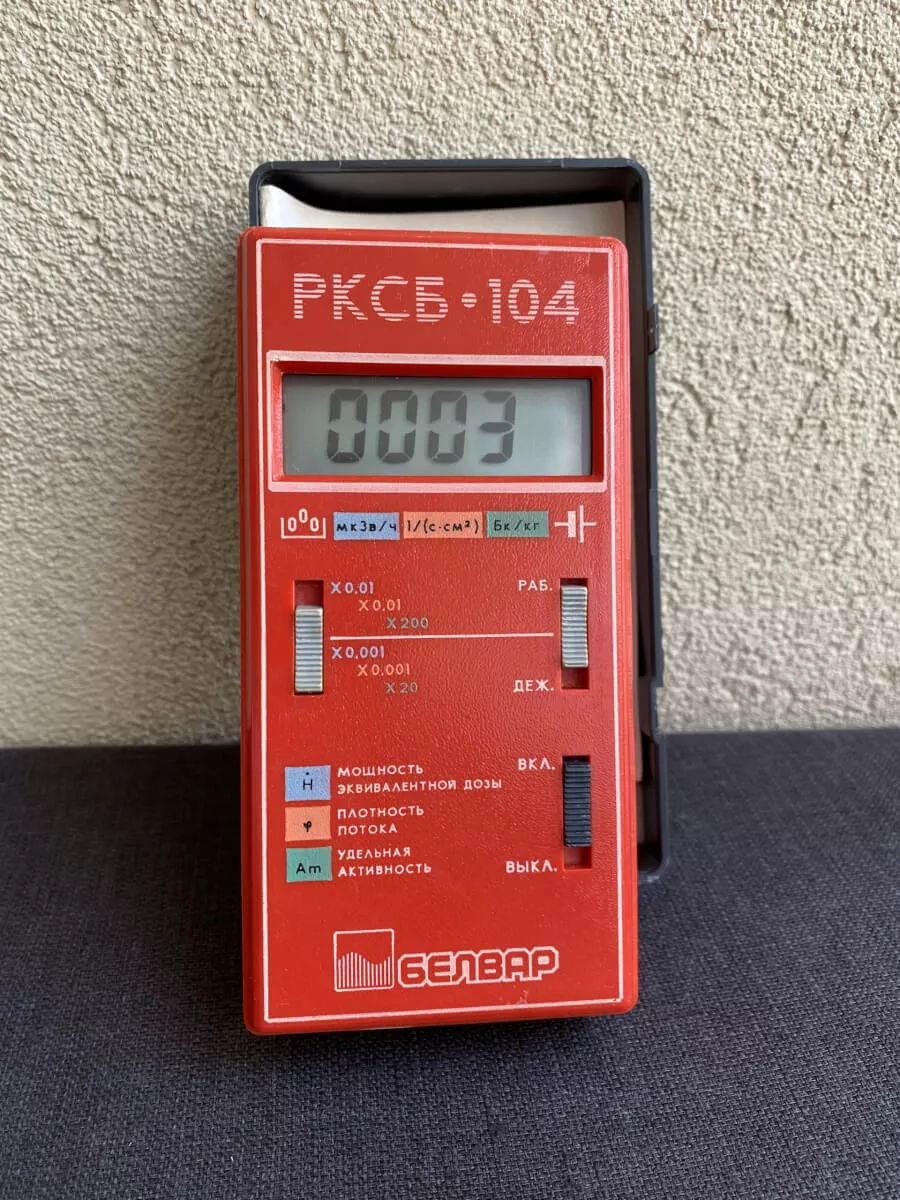
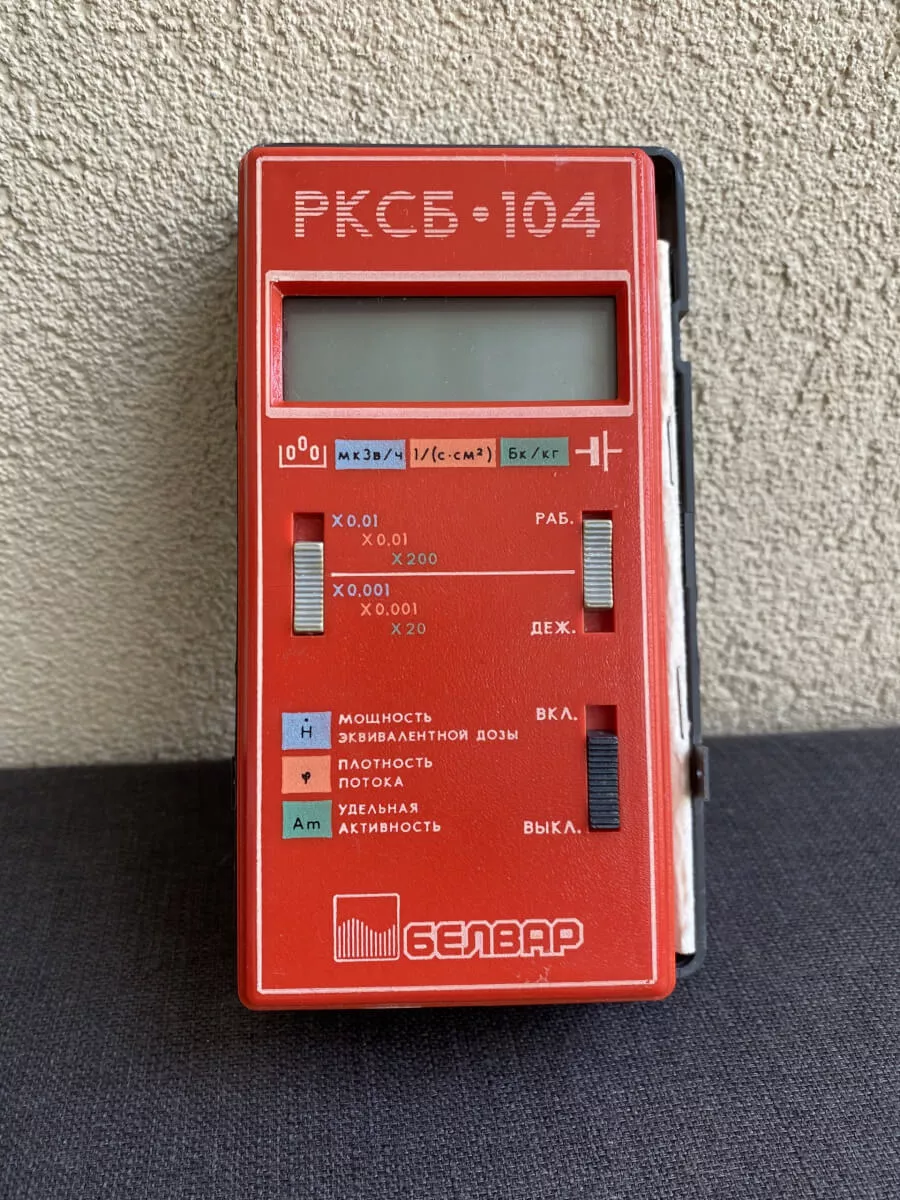
The RKSB-104, by Belvar. Its face carries the name of its maker, Белвар (Belvar), a Minsk company, and its passport calls it a “combined instrument for measuring ionising radiation”. According to Polenov, it measures the dose rate from 0.1 to 100 µSv/h, estimates the flux of beta particles and the activity of a sample, with two SBM-20 tubes under a removable filter lid, and sounds an alarm above one of its 31 thresholds, set with a coded switch. It weighs 400 grams. The shop’s example is new, with its box and passport.
RKSB-104: the three measuring modes on the face, and the name Белвар (Belvar) at the bottom.
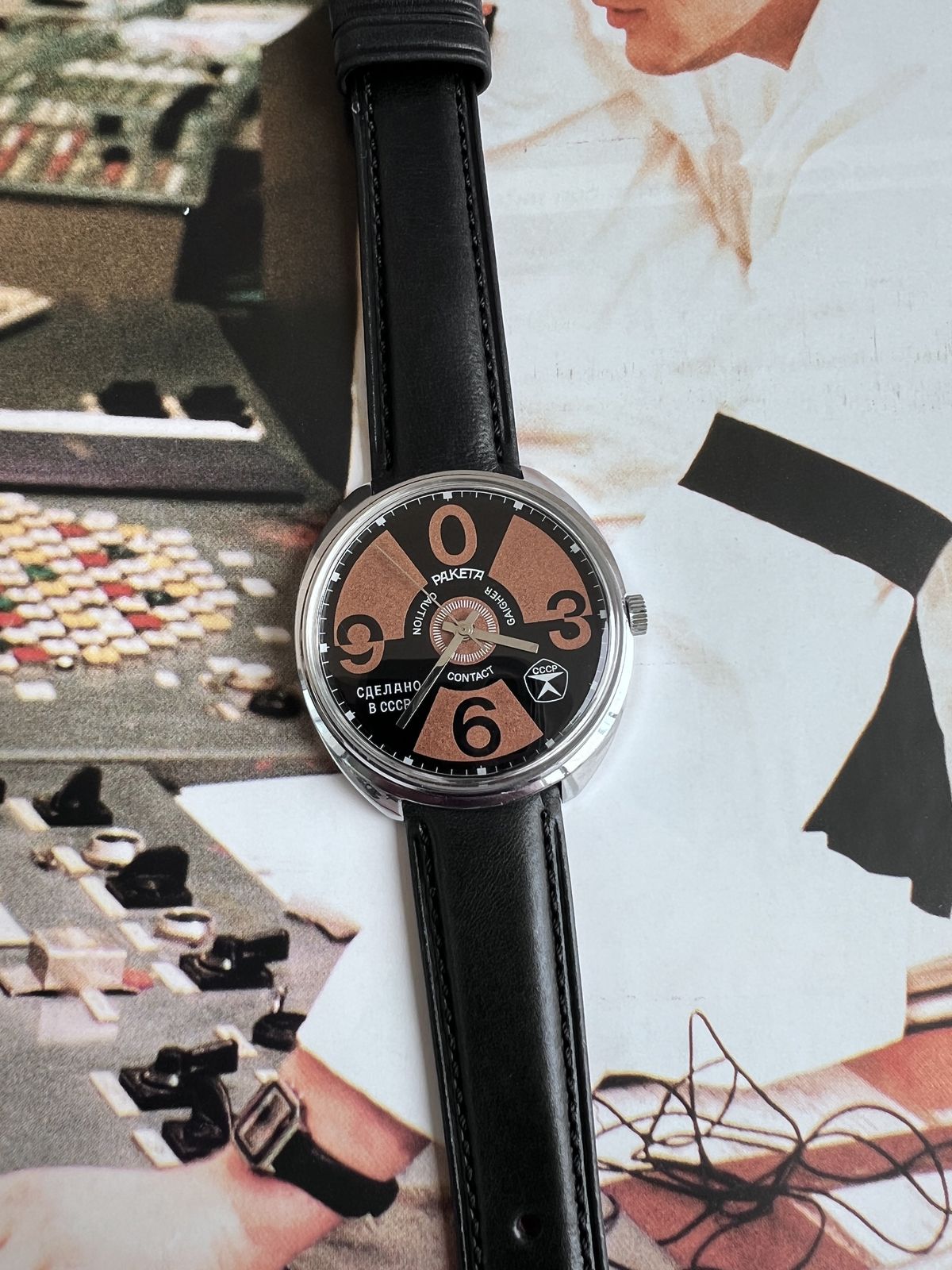
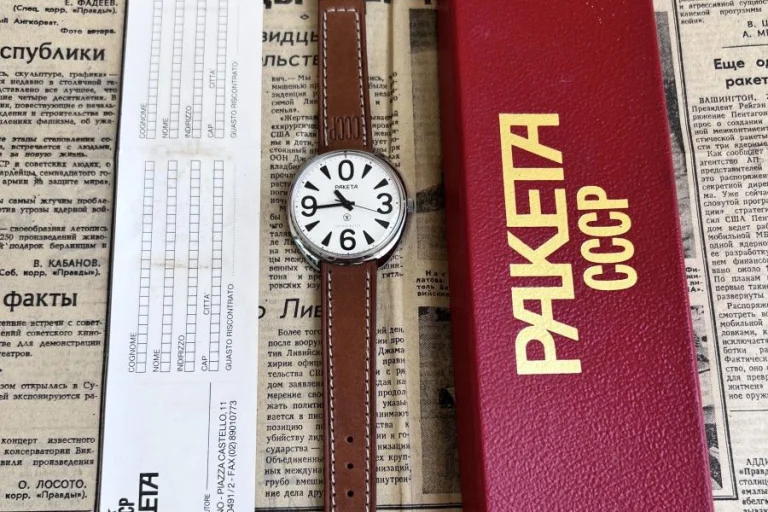
The Geiger counter also gave its name to a watch dial: the Raketa Big Zero “Gaigher”, made for the Italian market, carries the words CAUTION, CONTACT and GAIGHER around the centre. The dial is Italian, from the early 1990s; the rest of the watch is Soviet. Its story is told in our article Raketa Big Zero: history, versions and fake dials.
Raketa Big Zero “Gaigher”: CAUTION, CONTACT and GAIGHER around the centre of the dial.
Before you buy a Soviet Geiger counter
Check that it counts. A counter also records natural background radiation, which averages 2.4 millisieverts per person per year worldwide. Switched on, far from any source, the instrument should therefore click now and then and show a low figure, not zero.
Open the battery compartment. These instruments run on a 9-volt battery, the Soviet “Корунд” (Korund) type, a format sold everywhere today. A battery left inside may have leaked. The SBM-20 datasheet states at least 20 billion pulses, Polenov about 10 billion.
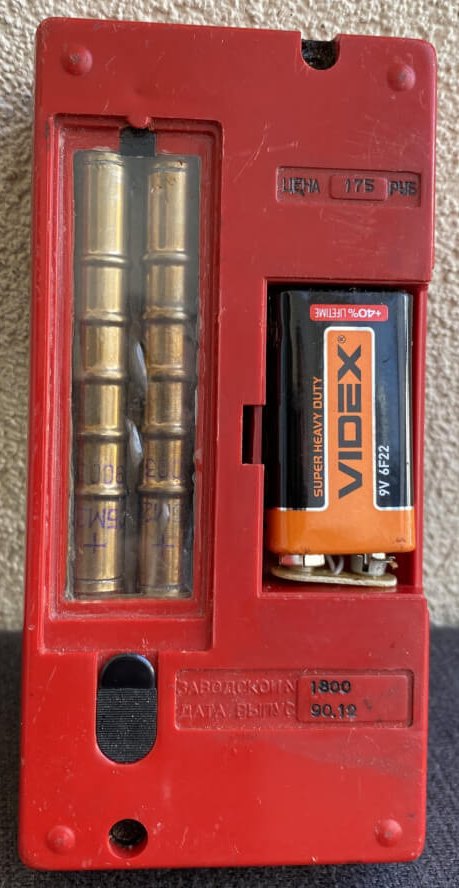
Back of a red Pripyat, covers removed: two Geiger tubes on the left, the 9-volt battery, the price of 175 roubles, No. 1800 and the date 90.12.
Read the plate and the papers. On the red Pripyats, the number and the release date are written on the back, year then month: 90.12 for December 1990. On the grey one dated 23 September 1991, an eight-digit number is moulded on the back, 91091742, and written by hand in the passport. On the Bella, the number and the year are at the bottom of the back label. The passport or the warranty card gives the exact day and the maker.
DP-5: the check source. The “контрольный препарат” (kontrolny preparat, check source) of board No. 46 is a radioactive source: the collector Bogin describes strontium-90 in his, set in the lid under a metal cover. It must not be taken apart. Before buying a DP-5, ask the seller whether the source is present and find out which rules on possession and shipping apply where you live.
Collectible or measuring instrument. The Bella presents itself as an instrument for estimating, and the state verification in our passports dates from 1991. Polenov writes that interpreting a contamination reading must be left to specialists in organisations entitled to issue official conclusions. A dosimeter of that period is first of all a collector’s piece: for a measurement that a health decision depends on, turn to a body equipped with calibrated instruments.
Copies and later production. We found no reported copy of the Pripyat, the Bella or the RKSB-104. Production went on after the end of the USSR: two of the shop’s Bellas are dated 1992. The date on the plate and the date in the papers tell whether the instrument left the factory before or after December 1991.
As with any collector’s piece, research thoroughly, compare several examples and rely on trusted collectors’ sites and buying guides.
The ДП-5В (DP-5V) is the field radiometer of Soviet civil defence: a green Bakelite console, a probe with a rotating gamma, beta and check-source shield, headphones and a manual that explains operation and maintenance. The one in this article served in an industrial bakery in Chișinău and was serviced in March 1991. Its owner shared his photos and documents with us, and we turned them into a tool that lets you operate it on screen, step by step.
The Moscow Games, from 19 July to 3 August 1980, boycotted by some sixty countries, produced more objects than any Soviet event: a bear cub, Misha, drawn by Viktor Chizhikov, an emblem made of running tracks, five thousand torches, watches from every factory, platinum coins, rings, tea glass holders, posters. This guide tells the story of the Games and reviews the objects, with the marks that authenticate them and the prices.
The 3017 chronograph of the First Moscow Watch Factory carries a five-digit number on the balance cock. The most common dating method reads it as a single series, from 1959 to 1979. Four factory passports show there are two, and that the same number can point to two watches made ten years apart. Here is how to read the number, the dial, the logo and the bridge, with a decoder to date your Strela, Poljot or Sekonda.
This website uses cookies to improve your experience while you navigate through the website.
Out of these cookies, the cookies that are categorised as necessary are stored on your browser as they are essential for the working of basic functionalities of the website.
We also use third-party cookies that help us analyse and understand how you use this website.
These cookies will be stored in your browser only with your consent.
You also have the option to opt out of these cookies.
But opting out of some of these cookies may affect your browsing experience.
Necessary cookies are absolutely essential for the website to function properly. This category only includes cookies that ensure basic functionalities and security features of the website. These cookies do not store any personal information.
Cookies that are not strictly necessary for the website to work and that are used specifically to collect personal data through analytics, ads and other embedded content are called non-necessary cookies. User consent is required before these cookies run on the website.
✕
Soviet in Paris
Online. We answer in person, no AI and no chatbot. Reply right away, 20 min at most.
Hello 👋 A question about an item, an order or shipping? Write to us.
Your email is used only to reply to you.
Subscribe to our newsletter and get 10% off your first order.
Subscribe
★ New pieces before anyone else
★ New blog articles
★ Soviet in Paris news and updates
Join the Party
10% off your first order
Receive your welcome card and our next arrivals.
Your code appears here and is also sent to you by email. You can leave the Party in one click, at any time.