Turn over a Soviet watch and you will sometimes find far more than a serial number. A few lines engraved in Cyrillic cursive, a name, an institution, a date. From award watches presented by the command to family dedications, these engravings anchor each piece to a place, an event and a precise year. A windfall for collectors, almost an archive for researchers. Three dedicated watches from our stock tell three Soviet lives.
AUGUST 2026•9 MINUTE READ
by Marwen Yahyaoui
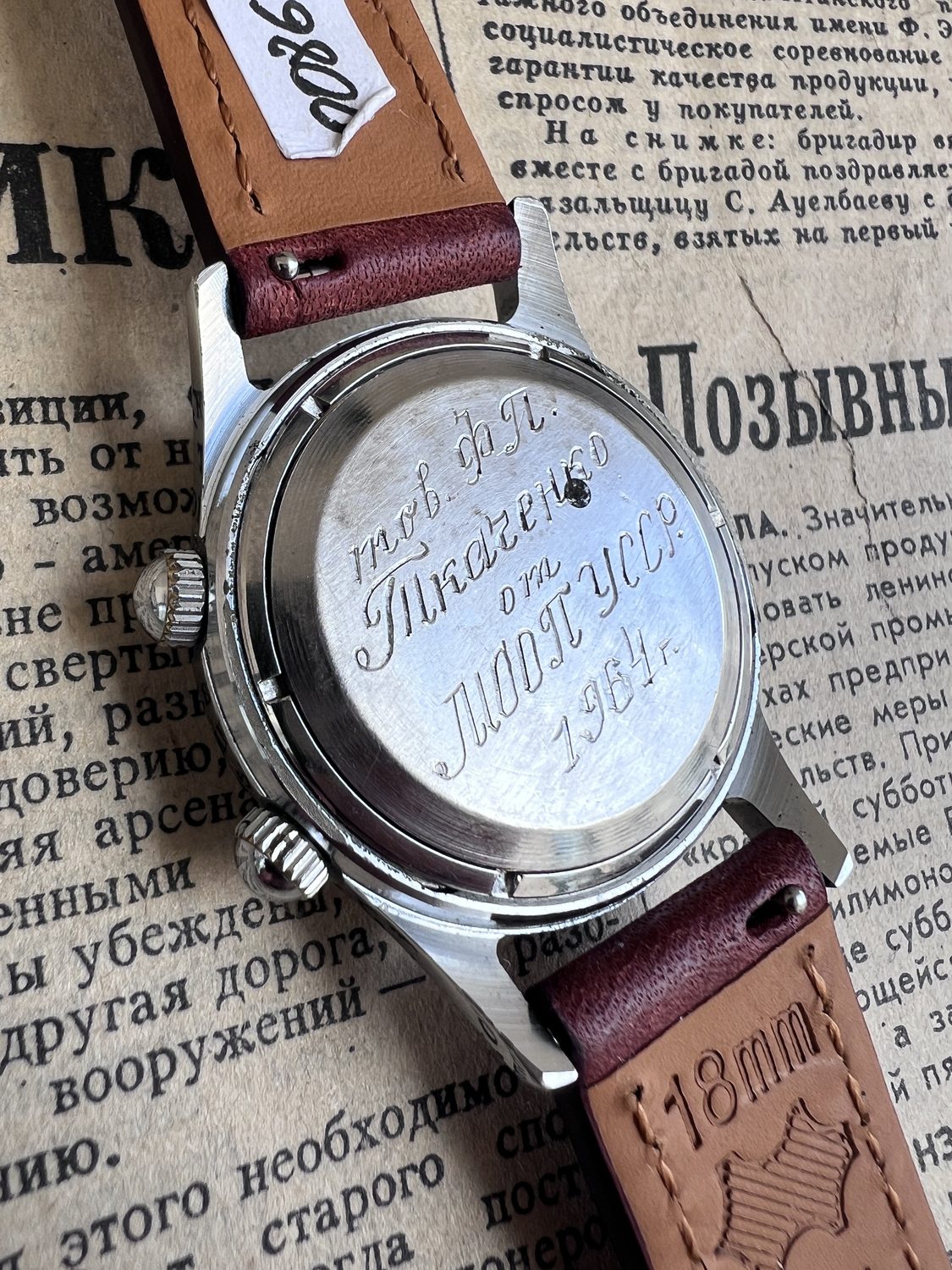
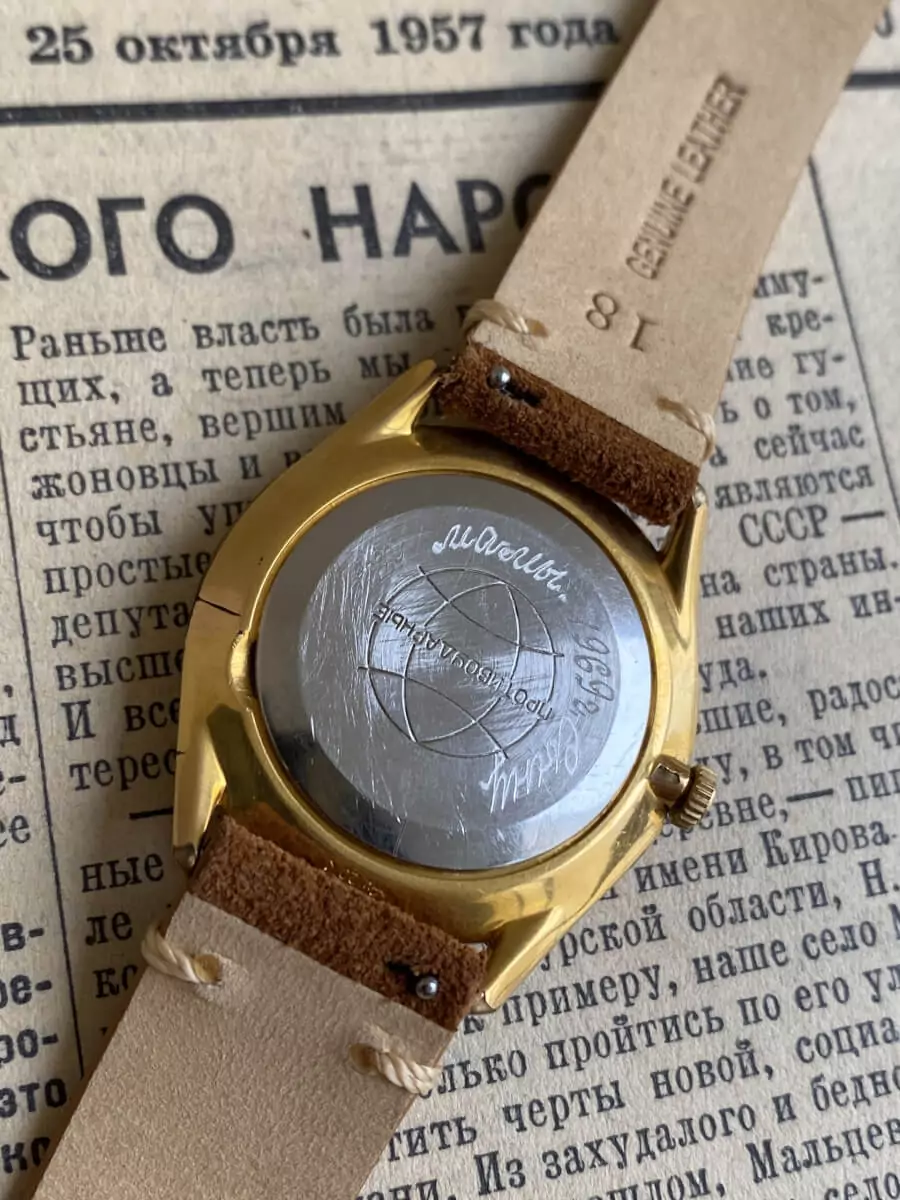
This one, a Signal alarm watch from 1964, carries on its back the name of a Comrade Tkachenko and that of the Ukrainian ministry that presented it to him. In three lines, the case back tells us who wore this watch, who gave it to him, where and why. No catalogue, no serial number provides that kind of information.
These dedicated watches, known in Russian as наградные часы (award watches) when they come from an institution, form a category of their own in Soviet watchmaking. Each engraving anchors the object to a place, an event and a precise year. Where most vintage watches are dated by cross-checking catalogues and calibres, the dedicated watch dates itself. It carries its history on its person.
Giving a watch, a paradoxical gesture in the Slavic world
To understand the weight of these engravings, you first have to understand the place of the gift in Slavic culture. Giving is never a neutral gesture there. A gift commits, creates a bond, obliges. And among all the objects one can give, the watch holds a singularly ambivalent position.
A stubborn superstition, still alive today in Russia and Ukraine, holds that giving a watch brings bad luck. The pointed hands are said to connect with the old Slavic belief forbidding the gift of sharp objects, carriers of negative energy. The watch, a symbol of passing time, is also said to count down the days left to a relationship or a life. To get around the curse, custom provides a simple remedy: the recipient hands over a symbolic coin in exchange, turning the gift into a purchase.
And yet no object was given more widely in the USSR than the watch. The paradox is explained by the nature of the gesture: the award watch was not a gift in the private sense of the word, but a distinction. Presented in public, before the collective or the regiment standing to attention, engraved with the recipient’s name, it escaped the superstitious register of the gift and entered that of honour. One does not refuse a decoration.
A tradition born under the tsars, systematised by the Soviets
The tradition of the award watch goes back well before 1917. In Imperial Russia, the Cabinet of His Majesty kept lists of dignitaries, generals and officers to be rewarded. Those chosen received gold watches, more rarely silver ones, sometimes set with diamonds, together with an official certificate issued by the Cameral Department of the Imperial Cabinet. Some carried a portrait of the emperor in enamel on the cover.
The civil war abruptly democratised the practice. The Bolsheviks, short of official decorations in the early years, rewarded their distinguished fighters with whatever had value: honour sabres, engraved revolvers, inscribed cigarette cases, leather jackets and, of course, watches. The engraved watch became one of the revolutionary rewards par excellence.
Institutionalisation came next. The disciplinary regulations of the Soviet armed forces listed the watch among the “valuable gifts” that could be presented to all categories of servicemen, from the private soldier to the senior officer. The labour code extended the principle to all workers and employees in the country. During the Great Patriotic War, a watch presented by the command was sometimes seen as more precious than a medal: it was rare, expensive, useful, and it arrived immediately, without waiting for the slow administrative channels of decoration.
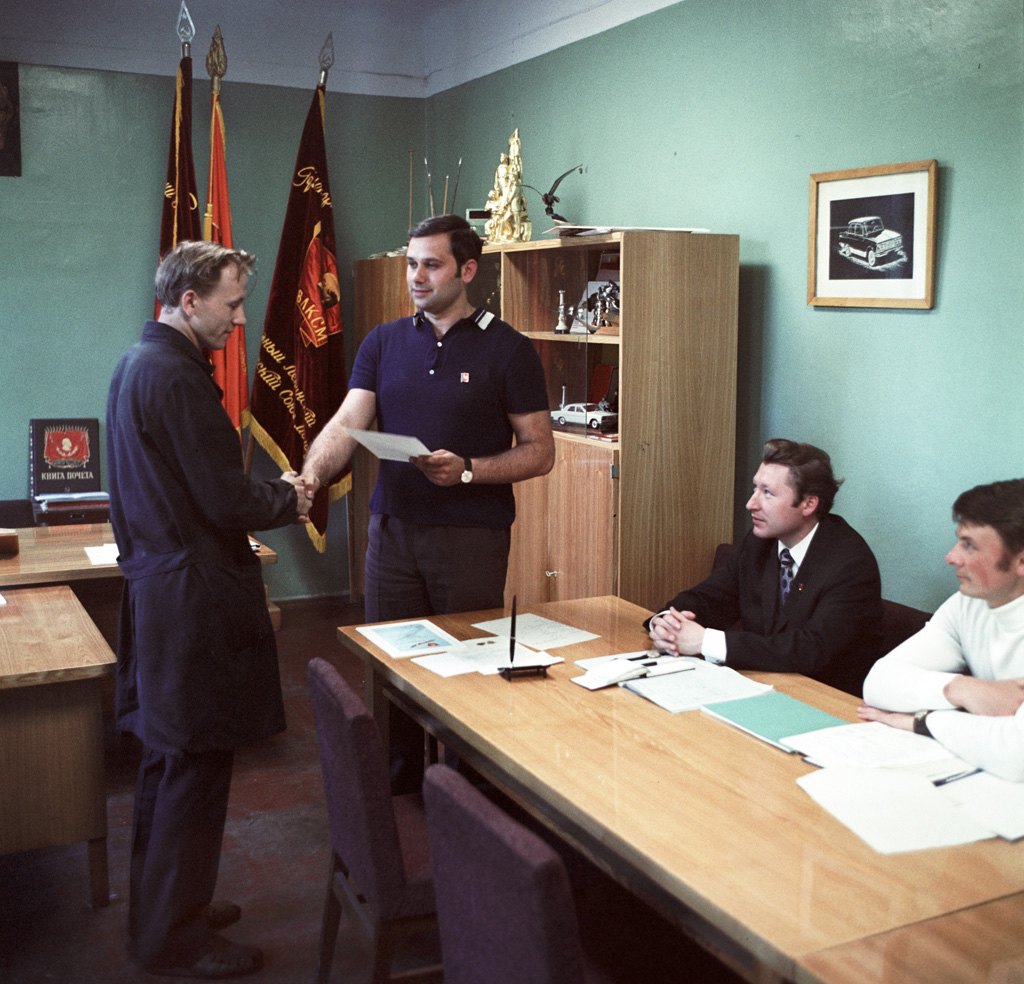
In civilian life the logic was the same. An engraved watch rewarded exceeding the production plan, years of service, retirement. The presentation took place at a ceremony, before the assembled work collective, with the recipient stepping out of the ranks. Servicemen, militia officers, civil servants, Party officials and, more rarely, ordinary workers: the dedicated watch ran through the whole of Soviet society.
Presentation of an award to a deserving worker before the committee, 1973. Photo: RIA Novosti archive, image 730407 / Max Alpert / CC BY-SA 3.0
Who signed these dedications
Engraved dedications follow almost codified formulas, and the identity of the giver says a great deal about the historical value of the piece. Three broad families can be distinguished.
Institutional dedications first: “от командования” (from the command), “от Министерства” (from the ministry), “Заказ МО СССР” (order of the USSR Ministry of Defence). These are the most sought after. They link the object to a specific organ of state, sometimes to an identifiable military unit, and document the award practices of a given administration on a given date.
Collective dedications next: “от коллектива” (from the collective), “от товарищей по работе” (from workmates), typical of retirements and jubilees. They tell the story of the Soviet working world from the inside, with its numbered brigades, its factories and its rituals of sociability.
Private dedications last: from a mother to her son, from a wife to her husband, for a birthday or a diploma. Rarer on watches, superstition obliges, they are also the most moving. They are fragments of family life fixed in metal.
And who held the burin? Professional engravers, the гравёры, whose training began with calligraphy: before touching metal, the apprentice had to master an impeccable cursive hand. In the USSR these craftsmen worked with the штихель (hand burin) in the engraving workshops of the public services network, the служба быта, often housed in the same Doms byta as the watch repair workshops. Gold cases went through the jewellery workshops.
It is this shared training that explains something striking to anyone who handles many dedicated watches: how alike the handwriting is. From Kyiv to Leningrad, on pieces engraved thirty years apart, you find the same elegant sloping cursive, inherited from the standardised calligraphic models taught to every engraver in the country. Our two engraved watches from 1964 and 1991 demonstrate the point: two cities, two periods, one single trained hand.
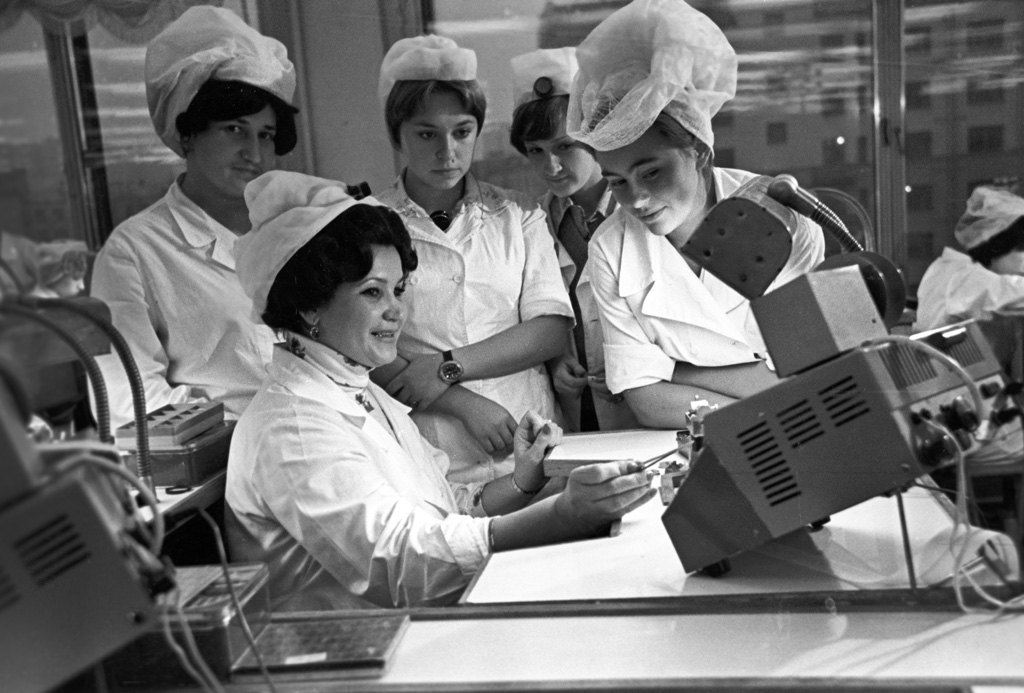
Assembly workshop of the 2nd Slava Watch Factory, Moscow, 1980. Photo: RIA Novosti archive, image 865510 / Yaroslavtsev / CC BY-SA 3.0
Three engravings, three lives
Three watches currently in our stock illustrate each of these families, and show concretely what a dedication brings to the collector and to the researcher alike.
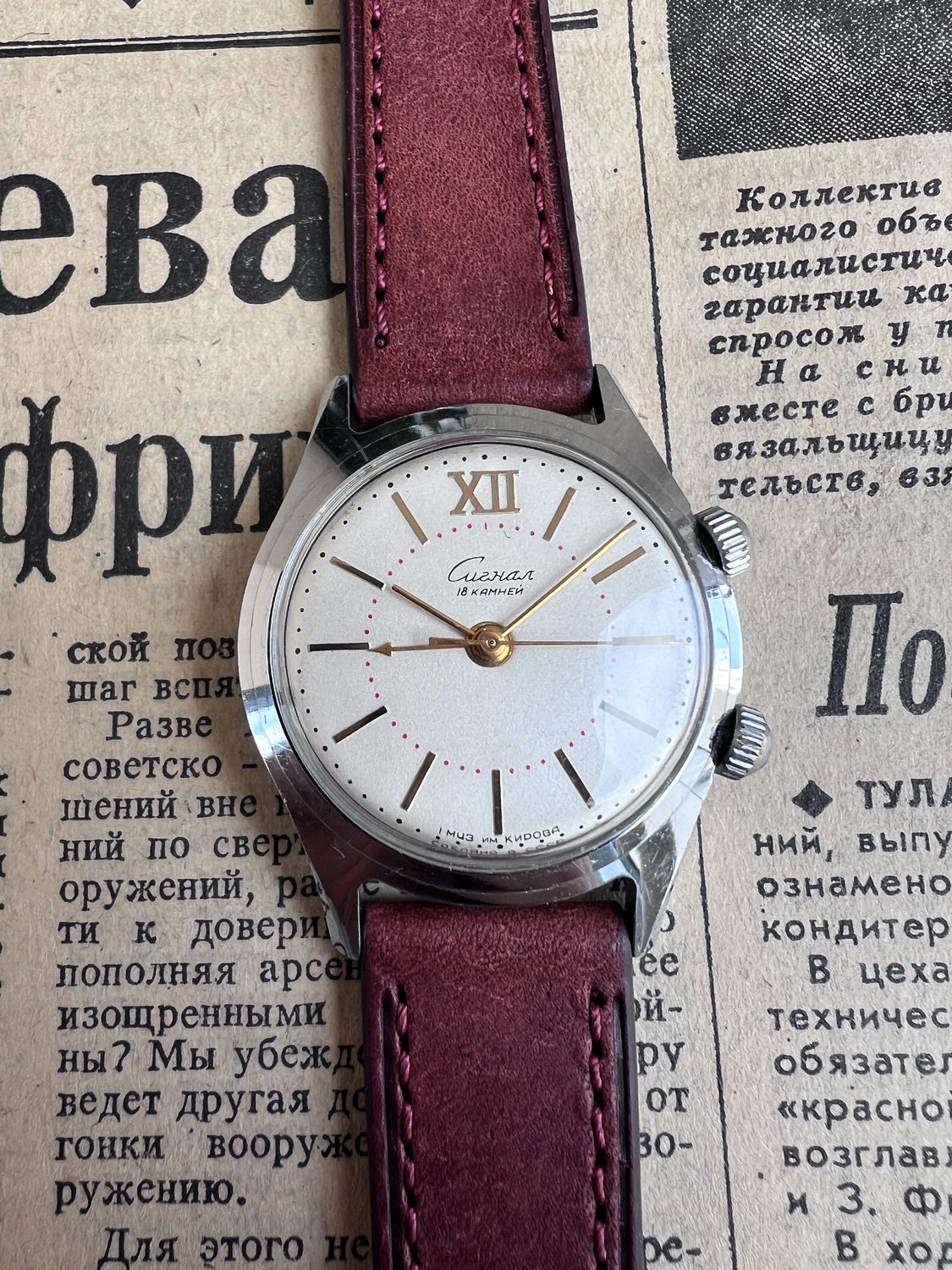
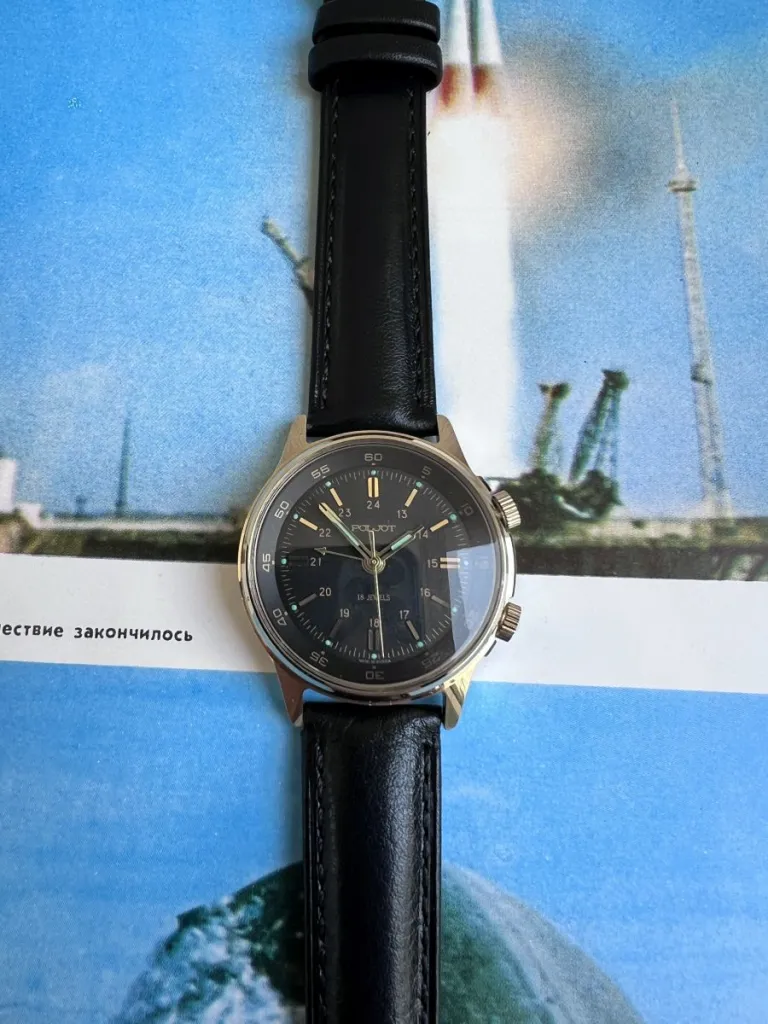
The first is a Signal alarm watch from the 1st Moscow Kirov Watch Factory. Its case back reads: тов. Ф.П. Ткаченко от МООП УССР 1964г., that is “To Comrade F.P. Tkachenko, from the MOOP of the Ukrainian SSR, 1964”. The MOOP was the Ministry for the Protection of Public Order, the name the Ministry of the Interior carried between 1962 and 1968. A single engraved line, and we know that this watch was presented by a Ukrainian ministry to a named official, within a six-year window during which that ministry bore that name. The engraving confirms the dating of the calibre and the geography of the piece. It is exactly the kind of cross-check dreamt of by researchers working on Soviet administrative award practices.
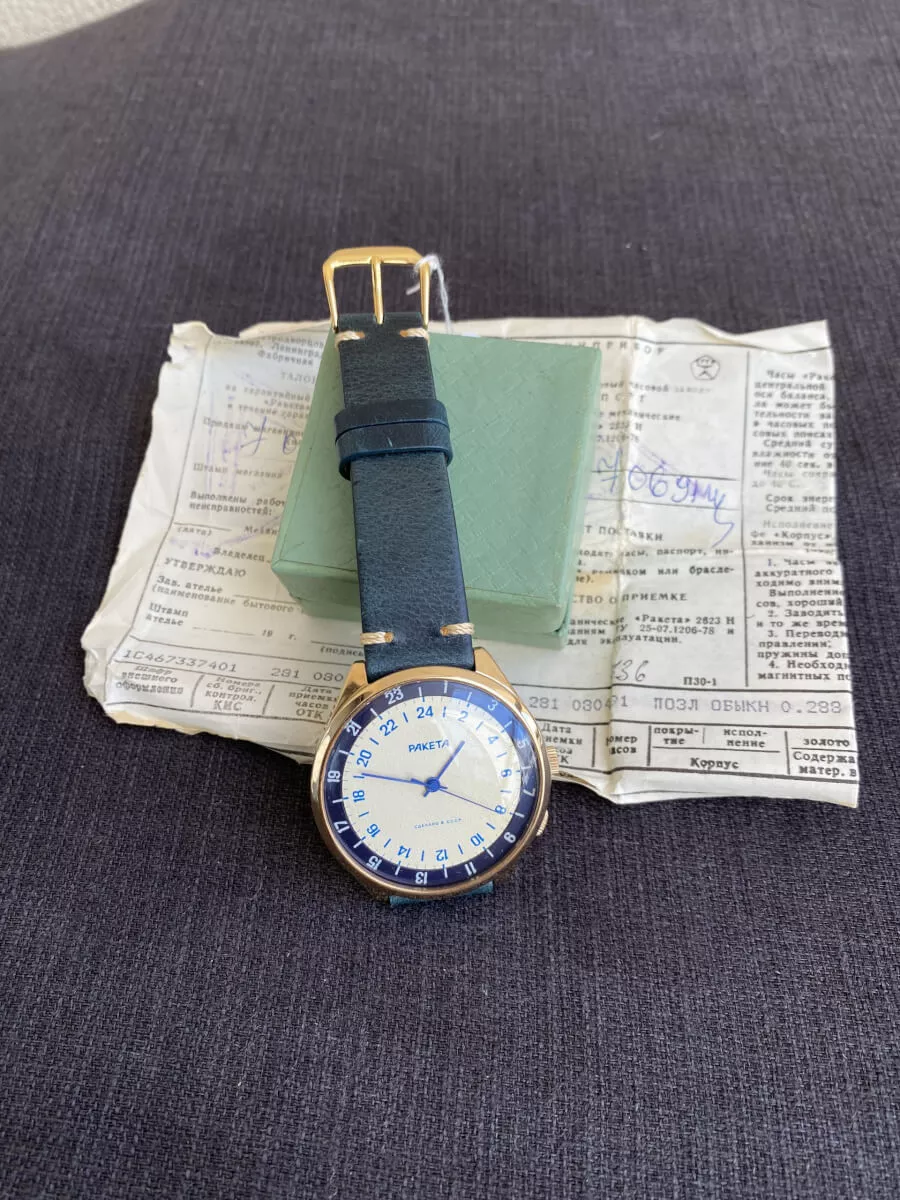
The second is a gold-plated Raketa Arctic Circle, new with its original passport. The dedication, written out across the whole case back: “To Nikolai Ivanovich, on the day of his retirement, from the collective of brigade 736, 7.VI.91”. This is 7 June 1991. The USSR has less than seven months left. A work brigade is still giving, according to the unchanging ritual, an engraved watch to a colleague who is leaving. The piece documents both a social rite and its final season.
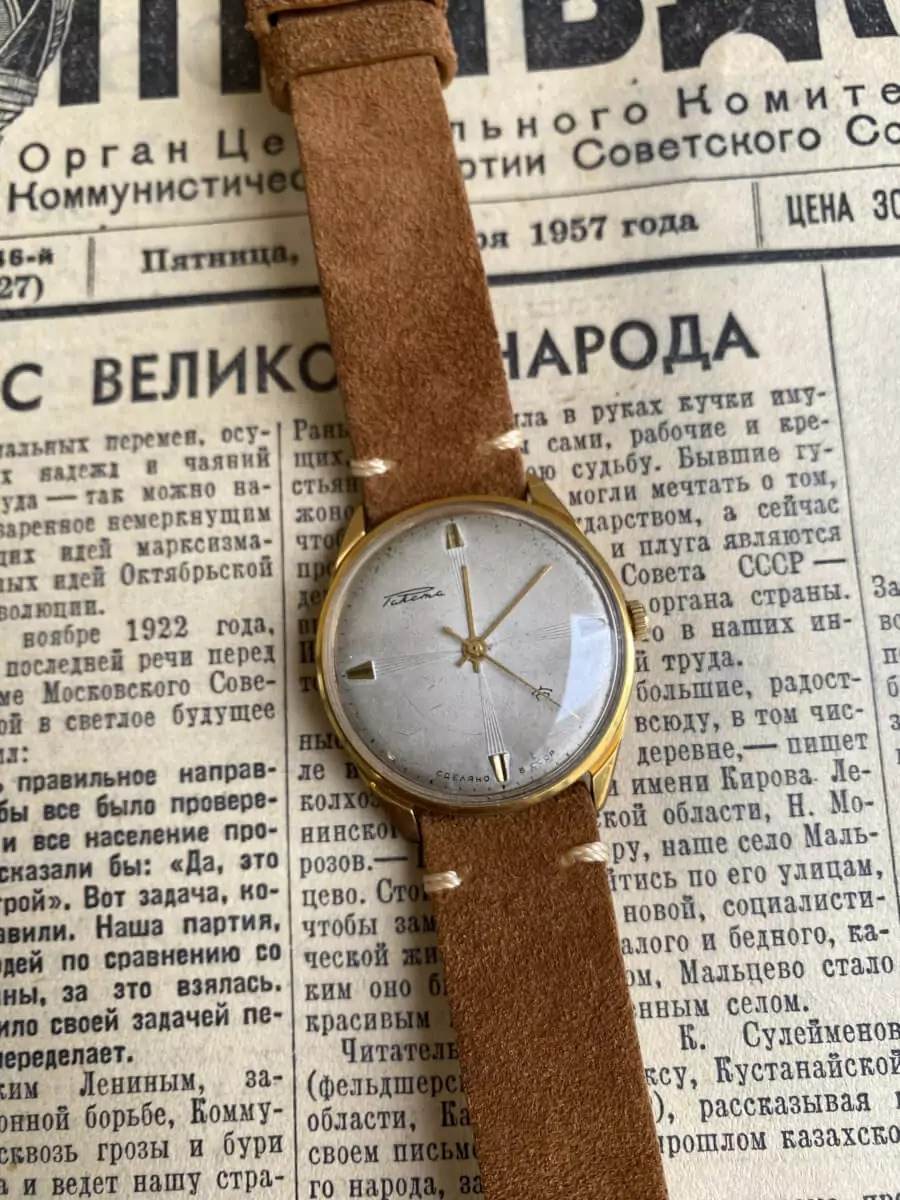
The third is a Raketa with an aircraft propeller dial, Baltika 2209 movement. On the back, only a few words: “From a mother to her son, 1969”. No institution, no rank. Just a mother, a son and a year. It is the dedication that dates the watch: without it, this model would be dated approximately by its calibre. With it, 1969 becomes a firm marker. And one can imagine, without being able to state it, a son entering aviation or simply passionate about the sky, in the year of the first step on the Moon.
How to read a Soviet dedication
A few conventions come up on almost every engraving and often puzzle collectors who do not read Cyrillic. The abbreviation тов. stands for товарищу, “to the comrade”, and precedes the recipient’s name. Initials are placed before the surname, in the Russian administrative manner. The small г. after a year is short for года, “of the year”. Dates are frequently written with the month in Roman numerals: the 7.VI.91 on our Raketa reads 7 June 1991.
The formulas themselves are almost codified. Here are the most common ones, those you will come across on nine dedicated watches out of ten:
от командования, from the command · от коллектива, from the collective · от товарищей по работе, from workmates · за долголетний и добросовестный труд, for long years of conscientious work · в день юбилея, on the day of the jubilee · в день ухода на заслуженный отдых, on the day of departure for a well-earned rest (retirement) · на добрую память, in fond memory · за отличную службу, for exemplary service.
With these keys, most case backs can be deciphered even without speaking Russian. And if an engraving defeats you, send us a photograph: we will gladly translate it.
Why collectors and researchers look for them
For a long time, an engraving on the back lowered the price of a vintage watch. That era is over for Soviet pieces. The dedication brings three things the market values more and more.
A firm dating first: the engraved year is primary data, not an estimate. A provenance next: a name, an institution, sometimes a unit or a brigade, all elements that tie the object to a verifiable human trajectory. A documentary value last: taken as a series, these engravings form a corpus for the social history of the USSR, from military award practices to retirement rituals. Every dedicated watch is a data point that is dated, located and signed.
For the collector, it is also a guarantee against anonymity. Two identical Raketa watches come off the same Petrodvorets line. Only one of the two belonged to Nikolai Ivanovich, of brigade 736. That watch exists in a single example.
Available at Soviet in Paris
The three dedicated watches presented in this article are available for sale, each in a single example. Other engraved pieces join our catalogue of Soviet watches on a regular basis.
The ДП-5В (DP-5V) is the field radiometer of Soviet civil defence: a green Bakelite console, a probe with a rotating gamma, beta and check-source shield, headphones and a manual that explains operation and maintenance. The one in this article served in an industrial bakery in Chișinău and was serviced in March 1991. Its owner shared his photos and documents with us, and we turned them into a tool that lets you operate it on screen, step by step.
The Moscow Games, from 19 July to 3 August 1980, boycotted by some sixty countries, produced more objects than any Soviet event: a bear cub, Misha, drawn by Viktor Chizhikov, an emblem made of running tracks, five thousand torches, watches from every factory, platinum coins, rings, tea glass holders, posters. This guide tells the story of the Games and reviews the objects, with the marks that authenticate them and the prices.
The 3017 chronograph of the First Moscow Watch Factory carries a five-digit number on the balance cock. The most common dating method reads it as a single series, from 1959 to 1979. Four factory passports show there are two, and that the same number can point to two watches made ten years apart. Here is how to read the number, the dial, the logo and the bridge, with a decoder to date your Strela, Poljot or Sekonda.
This website uses cookies to improve your experience while you navigate through the website.
Out of these cookies, the cookies that are categorised as necessary are stored on your browser as they are essential for the working of basic functionalities of the website.
We also use third-party cookies that help us analyse and understand how you use this website.
These cookies will be stored in your browser only with your consent.
You also have the option to opt out of these cookies.
But opting out of some of these cookies may affect your browsing experience.
Necessary cookies are absolutely essential for the website to function properly. This category only includes cookies that ensure basic functionalities and security features of the website. These cookies do not store any personal information.
Cookies that are not strictly necessary for the website to work and that are used specifically to collect personal data through analytics, ads and other embedded content are called non-necessary cookies. User consent is required before these cookies run on the website.
✕
Soviet in Paris
Offline right now. Leave your message and your email, we reply within 24 hours.
Hello 👋 A question about an item, an order or shipping? Write to us.
Your email is used only to reply to you.
Subscribe to our newsletter and get 10% off your first order.
Subscribe
★ New pieces before anyone else
★ New blog articles
★ Soviet in Paris news and updates
Join the Party
10% off your first order
Receive your welcome card and our next arrivals.
Your code appears here and is also sent to you by email. You can leave the Party in one click, at any time.