Until the early 1960s, Soviet luminous dials, like Swiss and American ones, were painted with radium 226. A radium dial no longer glows, but it stays radioactive for thousands of years. This guide says which objects are concerned, pilot’s watches, cockpit clocks, compasses, alarm clocks, how to recognise them by eye and with a Geiger counter, what the real risks are, and how to keep them safely or part with them.
NOVEMBER 2026•10 MINUTE READ
by Marwen Yahyaoui
Shturmanskie type 1, 1949-1954: the Arabic numerals of these navigator’s watches were painted with radium, and their ochre tint is the trace of it.
A radium dial is a paradox: it has not glowed for fifty years, and it is as radioactive as on its first day. Radium 226 has a half-life of 1,600 years; the zinc sulphide powder it made glow is destroyed by its own radiation within a few decades. What remains is a brown, crackled paint that emits without light. This guide says where it is found on Soviet objects, how to recognise it, what a counter measures, and what needs to be done, which is little, provided you know it.
Which objects are concerned
Radium was used to paint the hands and indices of everything that had to be read at night, in the USSR as everywhere, from the 1920s to the early 1960s. The pilot’s and navigator’s watches of the 1940s and 1950s, Shturmanskie type 1 and 2, military Kirovskies. The first aviation cockpit clocks, before the variants with non-radioactive pigment introduced in the 1960s. Old military compasses, including Adrianov compasses and first-generation diver’s compasses. Alarm clocks and small clocks with luminous hands from before 1960. Ship and tank instruments, gauge dials and compasses.
Soviet civilian watches from after 1960, Raketa, Vostok, Slava, Poljot, as a rule use a phosphorescent pigment without radium, which explains why they glow little and not for long. A 1980s Komandirskie, an Amphibia, a 24-hour Raketa are not radium. Export dials marked « T » for tritium, common in Switzerland, are rare on Soviet watches.
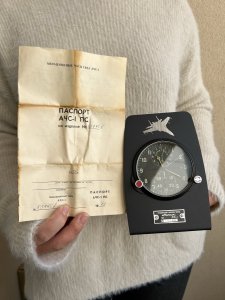
AChS-1 cockpit clock from 1983, variant with non-radioactive pigment: the indices still glow faintly after exposure.
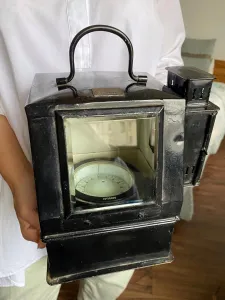
Topographic compass from 1954: a compass of this date may carry radium on the needle and the marks.
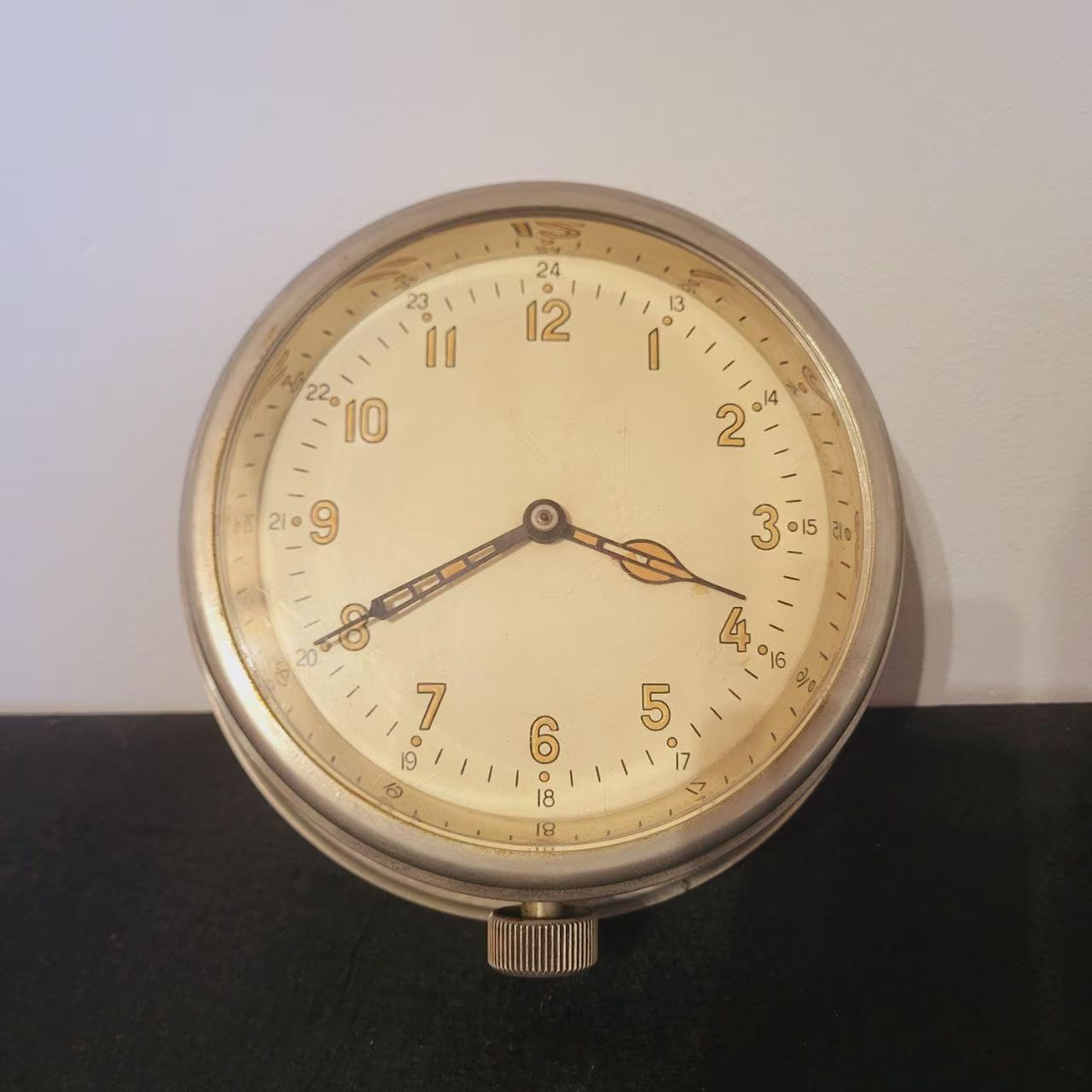
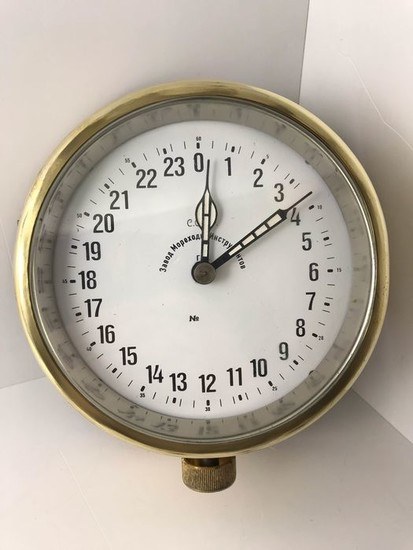
The first-generation Vostok 5-ЧМ (5-ChM) ship’s clock below, with a 12-hour dial and the hours 13 to 24 in small numerals, is one of the most radioactive you will come across. We advise never buying one. It is also used as the base for fake 24-hour clocks: its dial is replaced with a fake 24-hour dial, and residues of radium paint can remain.
First-generation Vostok 5-ЧМ ship’s clock with its period dial: one of the most radioactive, not to be bought.Fake 24-hour clock built on the same base, with a fake dial marked Завод мореходных инструментов (Zavod morekhodnykh instrumentov, Nautical Instruments Factory): radium residues are possible.
Recognising a radium dial without a counter
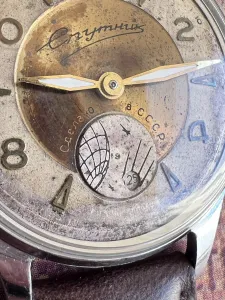
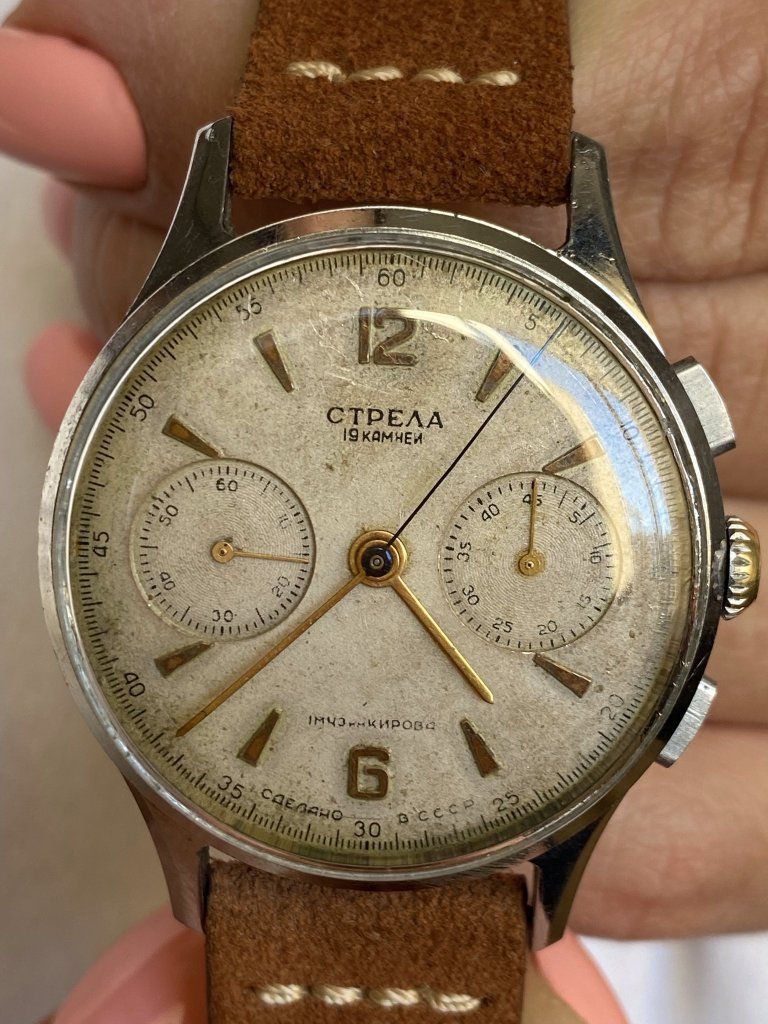
Three signs, to be taken together. Colour: aged radium paint is ochre, brown or bronze green, often crackled, sometimes fallen off in flakes; non-radioactive paint ages to pale yellow and stays smooth. The burn: on a radium dial, the area where the hands rested for years shows a brown shadow, « burnt » by the radiation of the hands, and the crystal may carry a haze in the same place. The absence of glow: a 1950s radium dial no longer glows, or barely, in the dark, because its phosphor is dead; a dial that glows brightly after exposure to light and fades within two or three hours is almost always a non-radioactive pigment. The reverse rule, a dial that glows faintly and endlessly, points to radium with a still-living phosphor, which is rare.
None of these signs is proof. Only a counter is.
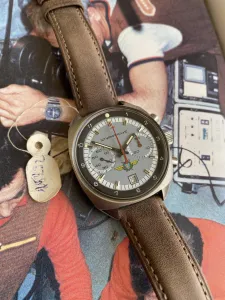
Shturmanskie type 2: ochre indices, hands with browned tips, the signs of radium paint.
Diver’s compass photographed in the dark after exposure to light: a bright glow that fades within a few hours is the sign of a radium-free pigment.
What a Geiger counter measures
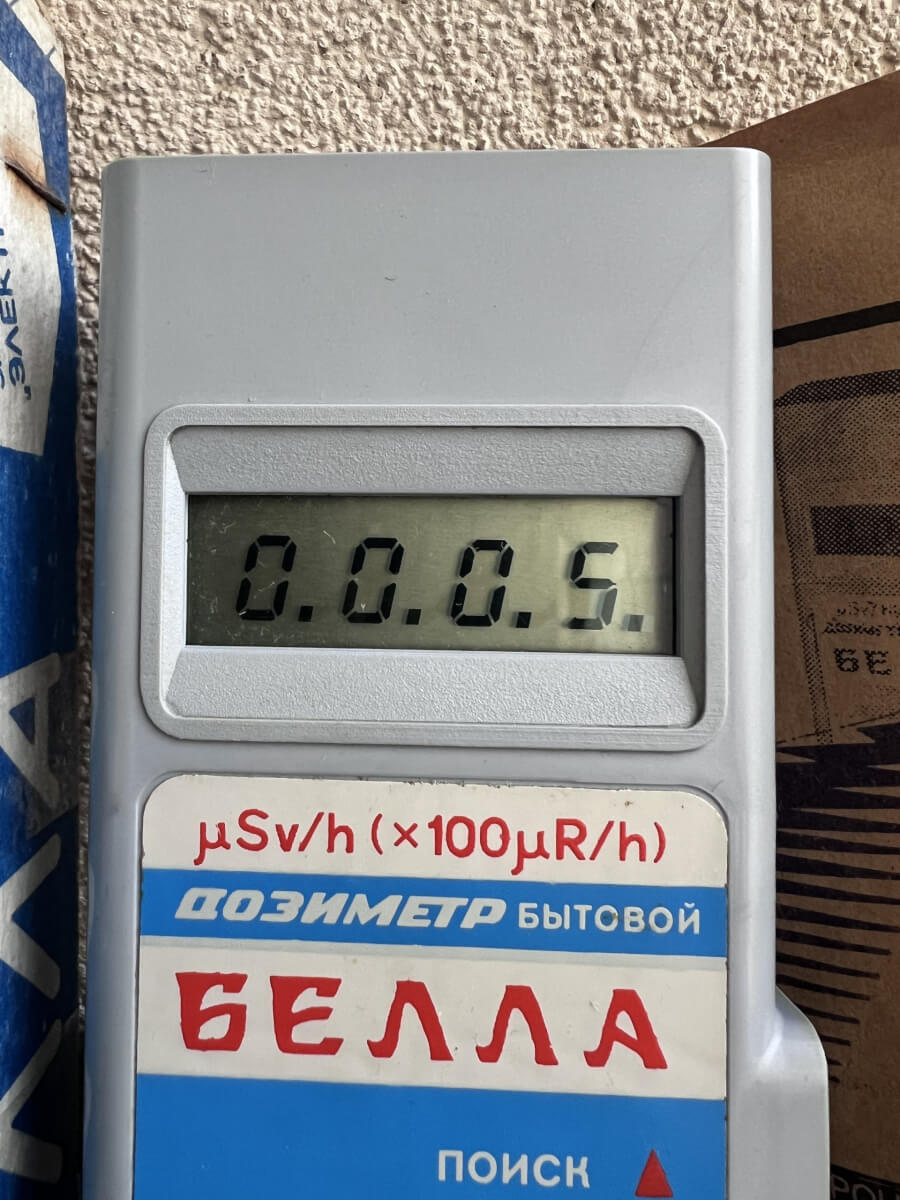
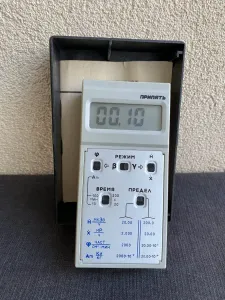
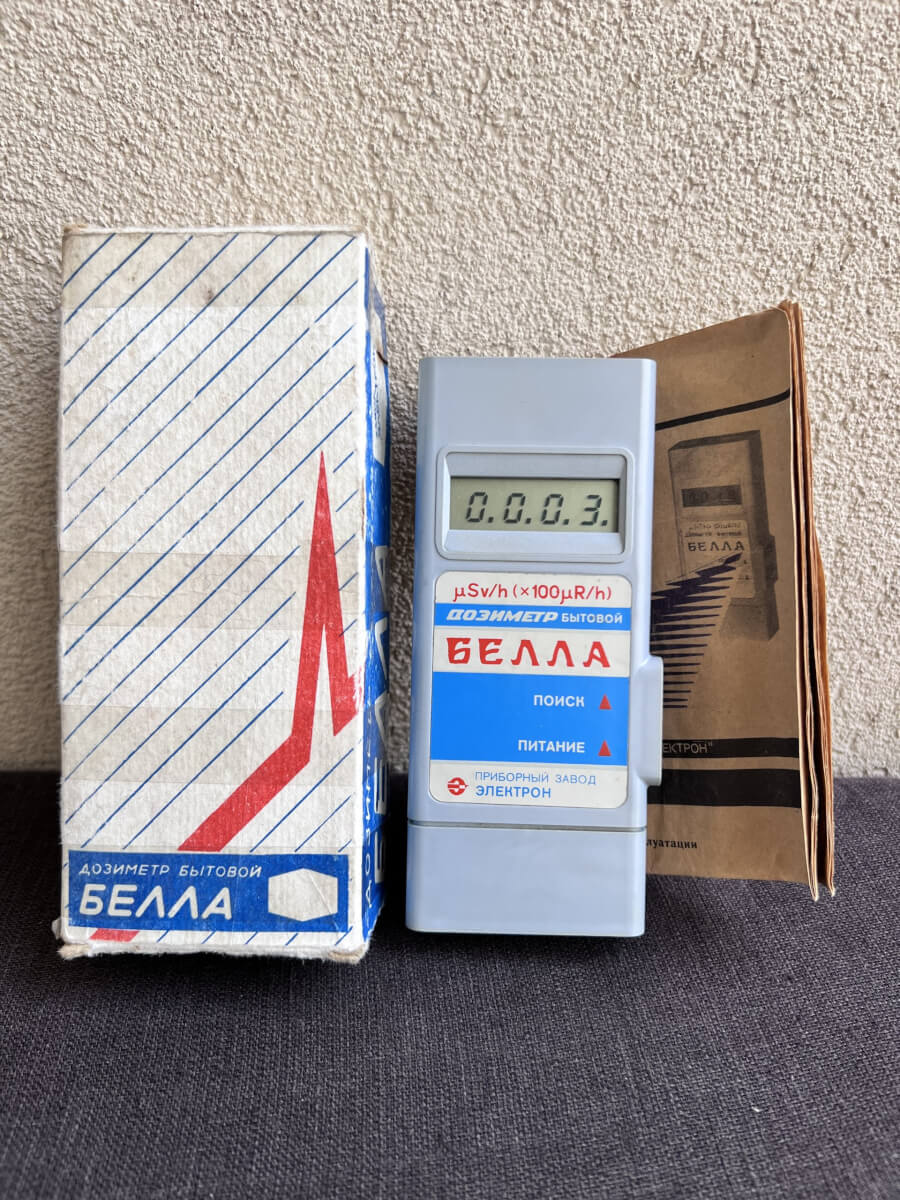
A counter with an SBM-20 tube, the one in the Soviet Pripyat, Bella and RKSB-104, detects gamma rays and beta particles energetic enough to pass through its wall, not alphas. That is more than enough: a radium dial makes the instrument react as soon as it comes within a few centimetres. Placed against the crystal, it reads from a few microsieverts per hour for a watch with radium on the hands only, to several tens for a pilot’s watch with radium numerals; the natural background in France is 0.045 to 0.21 microsieverts per hour depending on the region. A cockpit clock or a radium compass can also exceed ten. At one metre, the reading falls back to the natural background: radiation decreases with the square of the distance. A non-radioactive dial does not move the needle.
To measure, place the counter’s window against the crystal, wait for it to settle, note the value, then repeat at 30 cm and at one metre. We have covered the handling of Soviet counters in our guide Soviet Geiger counter.
The Bella dosimeter, graduated in microsieverts per hour, the instrument that settles the question.
The RKSB-104, more precise, also measures surface contamination.
The real risks
The risk of a radium watch worn or displayed is not external irradiation. The gamma radiation of a watch dial, added up over a year of daily wear, represents a dose of the order of what the public receives from the natural background, and the regulatory limit of 1 millisievert per year for the public outside natural and medical radioactivity is not reached by a dial. The two serious risks lie elsewhere. The first is dust: old paint crumbles, and a particle of radium inhaled or swallowed lodges in the bone. That is why a radium dial is not scraped, the case is not opened by its owner, and you wash your hands after handling one open. A service is decided case by case with a watchmaker. The second is radon: radium decays into radon 222, a gas, which builds up in a closed display case or drawer holding several objects. An aired room, or a display case left ajar, is enough.
A radium watch, intact, on a shelf, is a harmless object for whoever lives next to it. Ten radium cockpit clocks in a bedroom cupboard, no.
Servicing a radium watch
Our Soviet Times workshop considers servicing requests for radium watches case by case. We measure the watch: if its level is low enough to send it to Ukraine, it is serviced; if not, we return it to its owner. The radium watches we sell are serviced when needed.
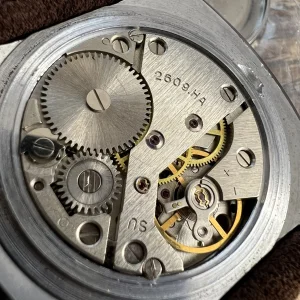
Back of a type 1 Shturmanskie.
The Pripyat, the Soviet radiometer of 1990, reads in microsieverts per hour.
Crossing a border with a radium object
The objects we bring back from Ukraine, Russia or Belarus go through a radiation detector twice, automatically: when leaving those countries and when entering the European Union. Trucks and cars drive through a detection arch, pedestrians walk through a portal. A watch with low radioactivity still gets through.
A radiation detection arch for trucks and cars, during trials in Nevada.
On the Polish side, the Border Guard states that every crossing point has fixed equipment monitoring radiation continuously, day and night. On 15 April 2026 at Medyka, on the Ukrainian border, the portal went off as a traveller walked through: a single 100 dollar note, contaminated with an isotope used in medicine, read 1,905 times the natural background. She was sent back to Ukraine with her money. On 4 November 2026 at Medininkai, between Belarus and Lithuania, the fixed system went off as a truck of chanterelles carrying caesium 137 approached; it returned to Belarus with its load.
On the Ukrainian side, 82 crossing points had fixed systems in 2021: TSA VM250 and Янтарь-1А (Yantar-1A) arches for vehicles, PM700 and Янтарь-1П (Yantar-1P) portals for pedestrians. The alarm goes off as soon as the radiation of a piece of luggage or a load exceeds the natural background; the object is held, then experts decide whether to let it through, have it tested or confiscate it. Of the 19 radioactive sources found at Ukrainian borders between 2018 and October 2020, 80% were in private travellers’ luggage or cars, mostly parts of Soviet military and aviation equipment, watches and altimeters. The Ukrainian Border Guard names the Soviet aviation clock with radium 226 and thorium 232 among the items most often found in illegal trafficking.
The check applies on the way out too. On 12 January 2022 at Boryspil airport, near Kyiv, the Янтарь (Yantar) luggage portal went off for a Russian passenger flying to Istanbul. A search of his hand luggage found the cause: an aviation clock whose dose rate was a hundred times above the permitted standard. It was handed over to the competent authorities.
In Russia, at the Moscow airports, every traveller walks through the Янтарь (Yantar) portals. According to customs, the items seized most often are watches and compasses with luminous paint.
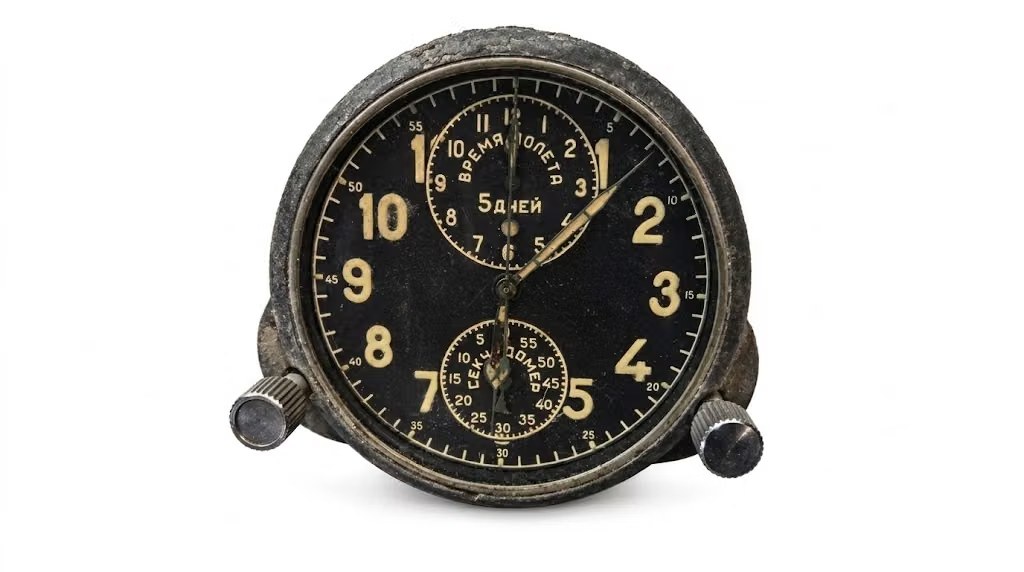
Parcels are checked too. In October 2026, customs at Moscow’s Domodedovo airport stopped a package sent from Israel to a resident of Udmurtia: the declaration listed keys, a bag, a backpack and clothes, the parcel held old Soviet aviation cockpit clocks. Their dial reads Время полёта (Vremya polyota, flight time) and 5 дней (5 dney, five days). At their surface, radiation reached 2.75 microsieverts per hour, about twenty times the natural background. Rospotrebnadzor, the Russian health watchdog, found them non-compliant, their import was banned and the parcel sent back to the sender.
Soviet cockpit clock seized by Domodedovo customs in October 2026: 2.75 microsieverts per hour at its surface. Photo: Domodedovo customs press service.
Keeping, selling, parting
In France, owning a radium watch or clock is legal; radium antiques are common objects at flea markets. Selling them is permitted for old horological objects, but an honest seller says so. If you wish to part with them, do not throw them in the bin: ANDRA, the national radioactive waste agency, takes back radium objects from private individuals free of charge on request. To keep them: away from a bedroom, out of an airtight display case, never taken apart by their owner, and worn occasionally rather than every day.
Frequently asked questions
Is my Soviet watch radioactive?
If it is civilian and from after 1960, almost certainly not. If it is a 1950s pilot’s watch, an old compass or a pre-war alarm clock with luminous hands, probably yes. A Geiger counter settles it in ten seconds.
Does a radium dial still glow?
Generally not. The radium remains, the phosphor it made glow is dead. A dial that glows strongly after light is not radium.
Is it dangerous to wear a radium watch?
Worn closed and intact, no, at the level of the doses. The risk is paint dust if the watch is opened or damaged, and radon if several objects are shut away.
Can a radium watch be serviced?
Our Soviet Times workshop considers each request case by case: if the watch’s level is low enough to send it to Ukraine, it is serviced; if not, it is returned to its owner.
What to do with a radium clock you no longer want?
Offer it to a collector who knows what he is buying, or hand it to ANDRA, which takes it back free of charge.
The ДП-5В (DP-5V) is the field radiometer of Soviet civil defence: a green Bakelite console, a probe with a rotating gamma, beta and check-source shield, headphones and a manual that explains operation and maintenance. The one in this article served in an industrial bakery in Chișinău and was serviced in March 1991. Its owner shared his photos and documents with us, and we turned them into a tool that lets you operate it on screen, step by step.
The Moscow Games, from 19 July to 3 August 1980, boycotted by some sixty countries, produced more objects than any Soviet event: a bear cub, Misha, drawn by Viktor Chizhikov, an emblem made of running tracks, five thousand torches, watches from every factory, platinum coins, rings, tea glass holders, posters. This guide tells the story of the Games and reviews the objects, with the marks that authenticate them and the prices.
The 3017 chronograph of the First Moscow Watch Factory carries a five-digit number on the balance cock. The most common dating method reads it as a single series, from 1959 to 1979. Four factory passports show there are two, and that the same number can point to two watches made ten years apart. Here is how to read the number, the dial, the logo and the bridge, with a decoder to date your Strela, Poljot or Sekonda.
This website uses cookies to improve your experience while you navigate through the website.
Out of these cookies, the cookies that are categorised as necessary are stored on your browser as they are essential for the working of basic functionalities of the website.
We also use third-party cookies that help us analyse and understand how you use this website.
These cookies will be stored in your browser only with your consent.
You also have the option to opt out of these cookies.
But opting out of some of these cookies may affect your browsing experience.
Necessary cookies are absolutely essential for the website to function properly. This category only includes cookies that ensure basic functionalities and security features of the website. These cookies do not store any personal information.
Cookies that are not strictly necessary for the website to work and that are used specifically to collect personal data through analytics, ads and other embedded content are called non-necessary cookies. User consent is required before these cookies run on the website.
✕
Soviet in Paris
Offline right now. Leave your message and your email, we reply within 24 hours.
Hello 👋 A question about an item, an order or shipping? Write to us.
Your email is used only to reply to you.
Subscribe to our newsletter and get 10% off your first order.
Subscribe
★ New pieces before anyone else
★ New blog articles
★ Soviet in Paris news and updates
Join the Party
10% off your first order
Receive your welcome card and our next arrivals.
Your code appears here and is also sent to you by email. You can leave the Party in one click, at any time.