A Soviet compass does not read like a hiking compass. The Adrianov, the Soviet army's wrist compass, counts degrees one way and mils the other. The compass of a fleet boat keeps its card pointing north while the boat swings around it. Using pieces and period papers from our shop, this guide shows how to take a bearing, follow it on the ground and read a Soviet marine compass.
OCTOBER 2026•12 MINUTE READ
by Marwen Yahyaoui
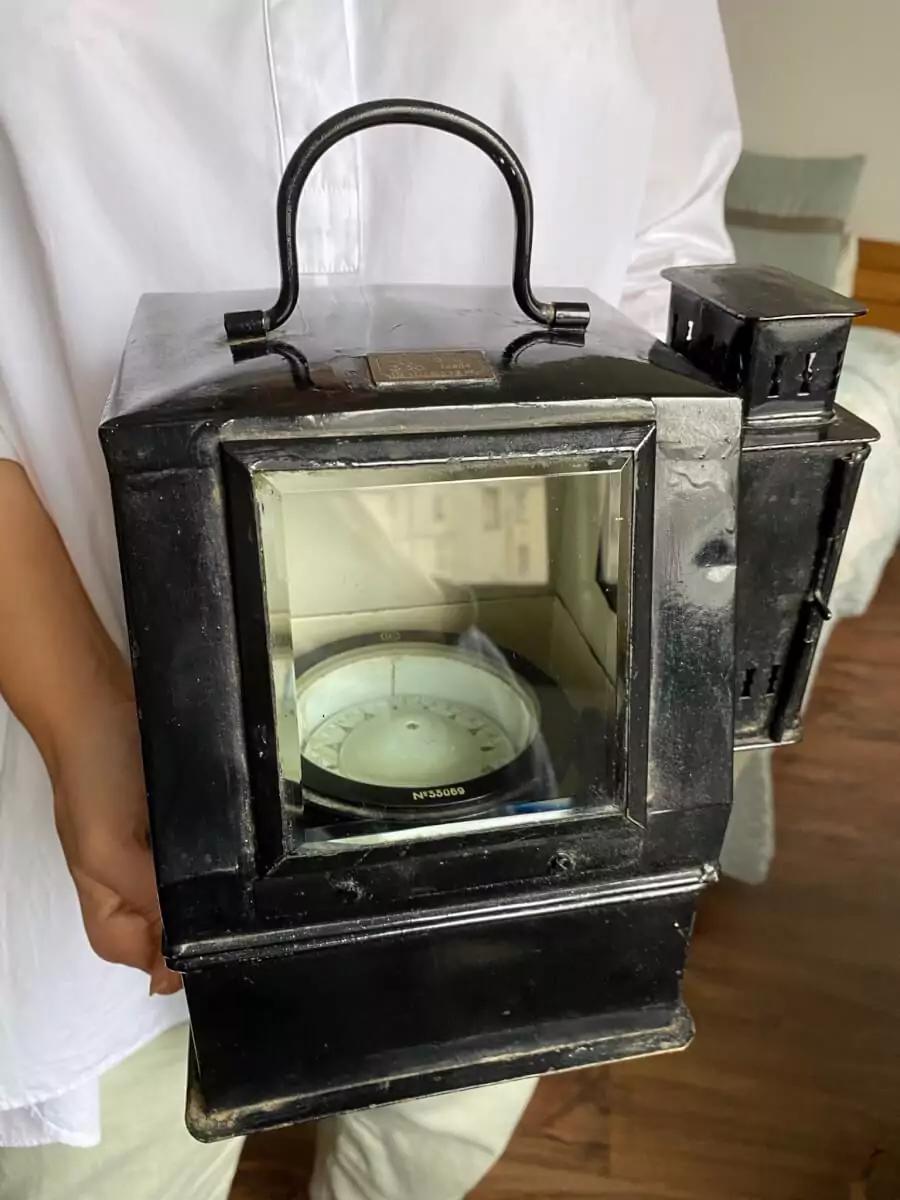
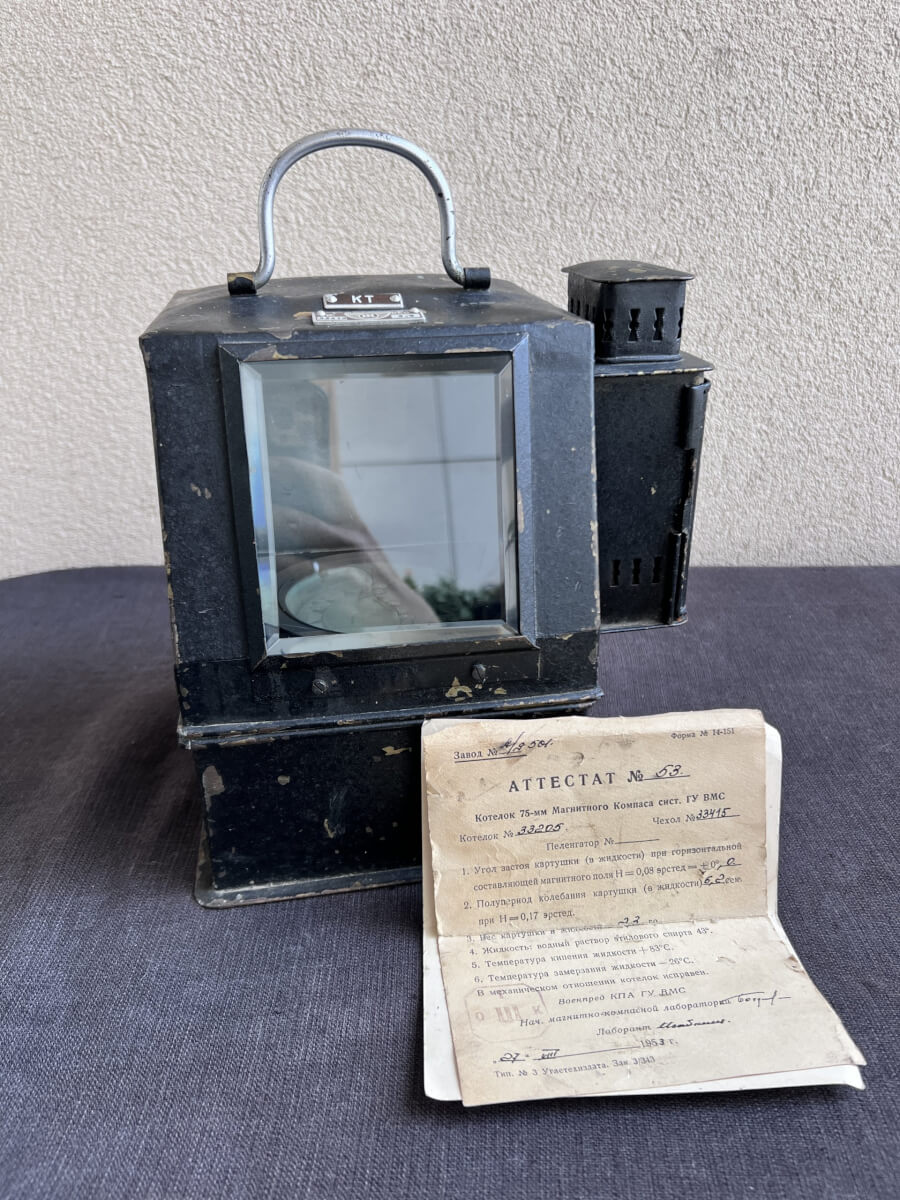
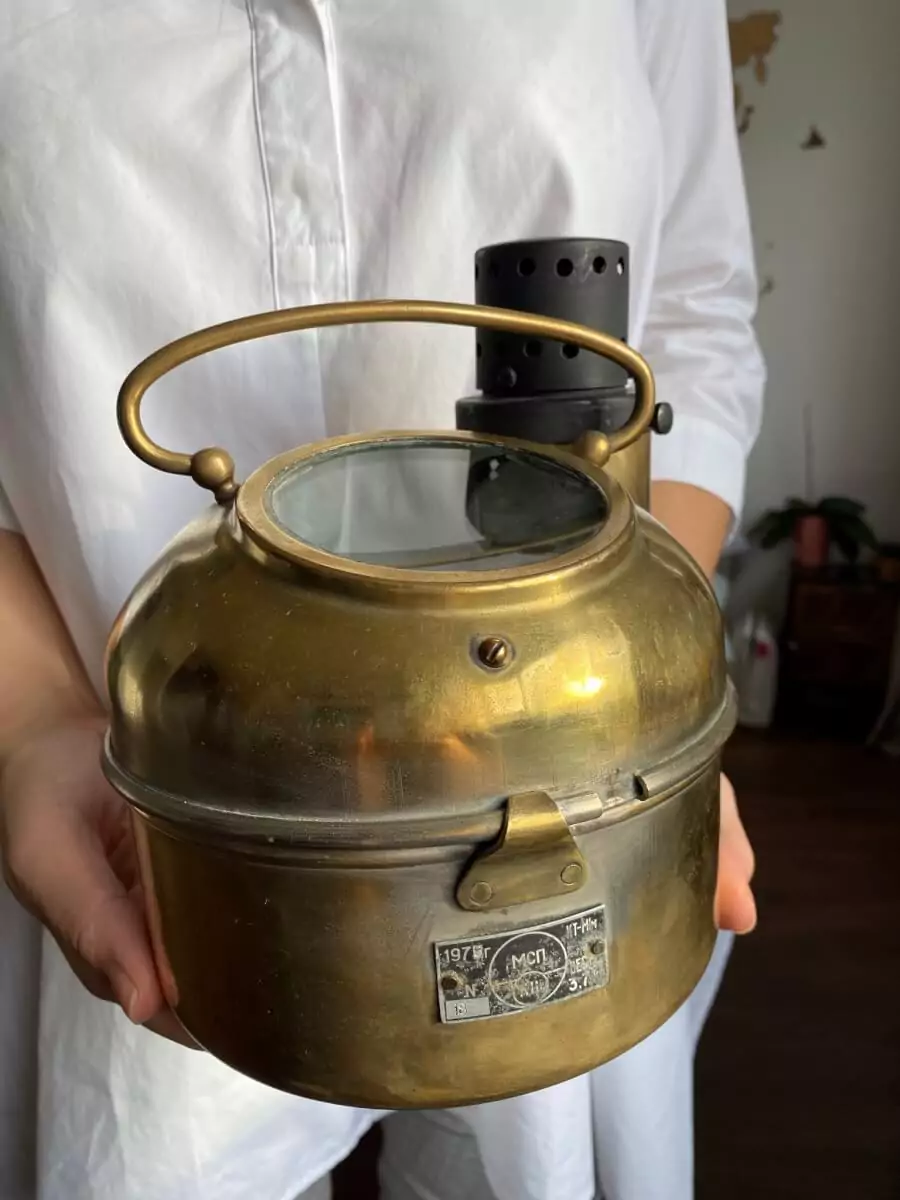
Soviet navy boat compass, 1949, with its lamp on the side.
Soviet compasses found today come in two families. On land, the soldier’s and the geologist’s instrument: a free needle above a dial, and a sight that you rotate to aim at a landmark. At sea, the compass of the ship’s boats: a card weighted with magnets, floating in alcohol, sealed under a hood with its own lamp. The principle is the same, the reading is reversed.
The Adrianov compass
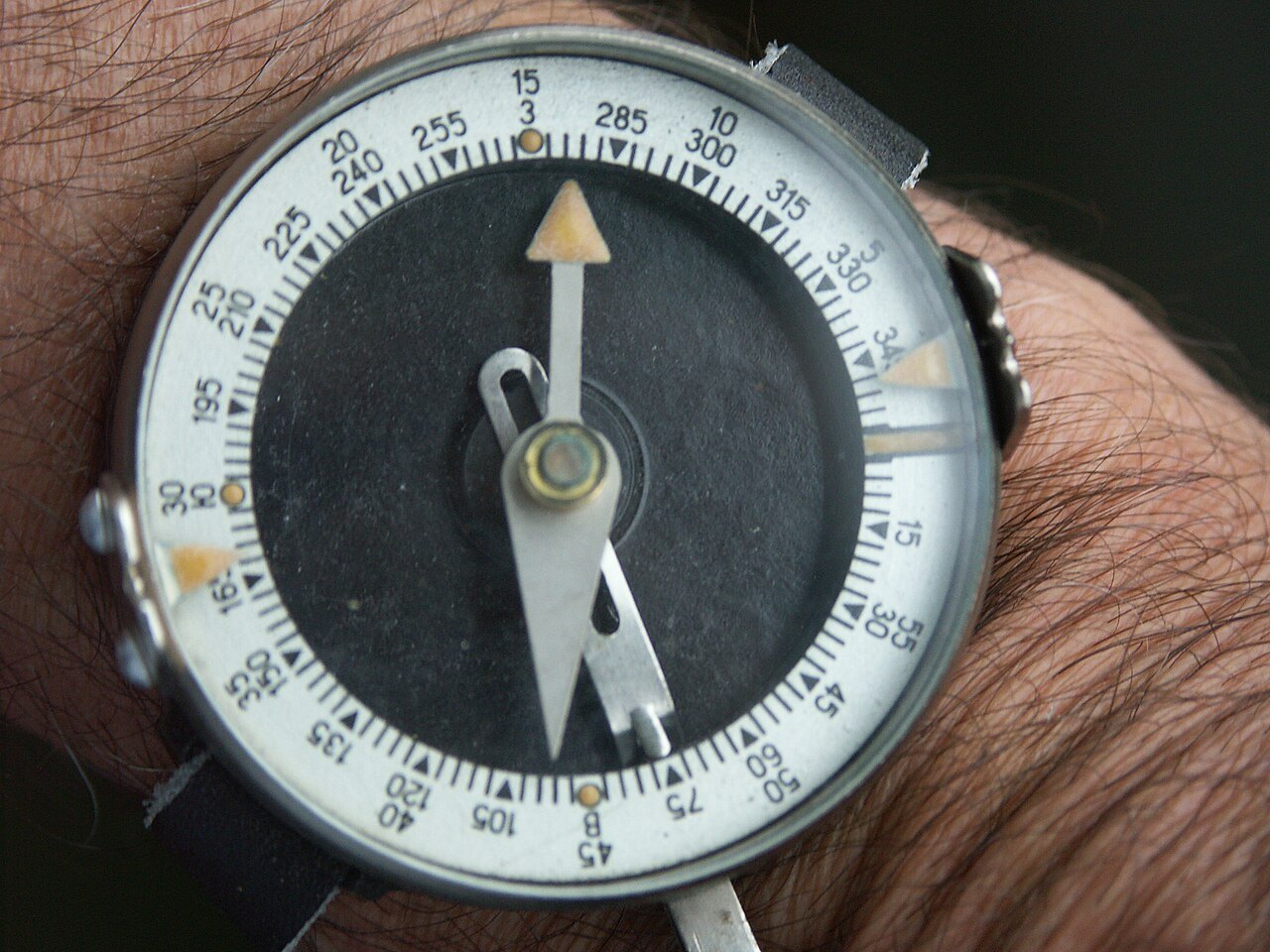
Adrianov compass: the thick bar marks north, the letters З, Ю and В west, south and east. Photo Jean-Patrick Donzey, Wikimedia Commons, CC BY-SA 3.0.
The Компас Адрианова (kompas Adrianova) is worn on the wrist. The 1986 military topography manual, “Военная топография” (Voennaya topografiya), published by Voenizdat, describes it part by part. The magnetized needle sits on a pivot in the centre of the case. When not in use, a brake, the арретир (arretir), presses it against the glass. According to the magazine “Научная Россия” (Nauchnaya Rossiya), the case holds no liquid, which leaves the needle swinging longer than in a liquid-filled compass. Around it, a fixed dial, the лимб (limb), is divided into 120 divisions of 3°. A rotating glass lid sits on top, carrying the sight: a rear sight, the целик (tselik), and a front sight, the мушка (mushka), with a reading index facing the front sight. The north tip of the needle, the indexes and the 90° marks carry luminous paint for night use. According to the Online Compass Museum, it measures 50 mm across and weighs 60 grams.
It is named after the military topographer Vladimir Nikolayevich Adrianov (1875-1938), who designed it in 1907: the Tver regional encyclopedia calls it the country’s first luminous military compass. The 1986 manual still names it, together with the АК (AK) artillery compass, as the most widely used instrument for finding your way in the field.
Reading the dial: degrees, mils, and where north is
The dial carries two sets of numbers that start from the same zero, north, marked with a thick bar. The degree scale runs clockwise from 0 to 360, numbered every 15°. The other scale counts деления угломера (deleniya uglomera), the angular units of Soviet artillery, runs counterclockwise and is written in hundreds: 15 means 1,500 mils, 30 means 3,000. The other cardinal points are marked with Russian letters: З (Z) for запад (zapad), west, Ю (Yu) for юг (yug), south, В (V) for восток (vostok), east. Our guide to reading Cyrillic on a Soviet watch dial gives the full alphabet.
One division is therefore 3°, or 50 mils, and a full circle is 6,000 mils: the Soviet artillery circle, where NATO armies use 6,400. Before taking any bearing, find the scale that increases clockwise: that is the one giving the bearing in degrees. The АК artillery compass works differently, with 60 divisions of 1-00 numbered clockwise and a sight fixed to the case.
A magnetic bearing (azimuth) is the angle between magnetic north and the direction of an object, measured clockwise. The 1986 manual uses the example of a lone tree and gives the method:
Hold the compass level, away from any metal object.
Release the brake. The needle swings, then settles on magnetic north.
Turn the whole compass, still level, until the north tip of the needle sits on the zero of the dial.
Without moving the compass, turn the lid and aim at the tree through the rear sight and the front sight.
Read the scale at the index, on the front sight side. In the manual’s example, the tree is at 330°.
To come back, use the back bearing, which differs by 180°: seen from the tree, the starting point is at 150°. The manual asks you to stand at least 40 to 50 metres away from power lines, railway tracks, military vehicles and large metal masses, which pull the needle off north.
The reverse operation lets you follow a direction read on a map or given in an order. First set the required bearing by turning the lid until the index faces the right graduation. Release the brake, then turn the compass until the north tip of the needle is back on zero. The sight now shows the direction to follow: pick a distant landmark on that line, a tree, a post, a church tower, and walk to it. Once there, repeat.
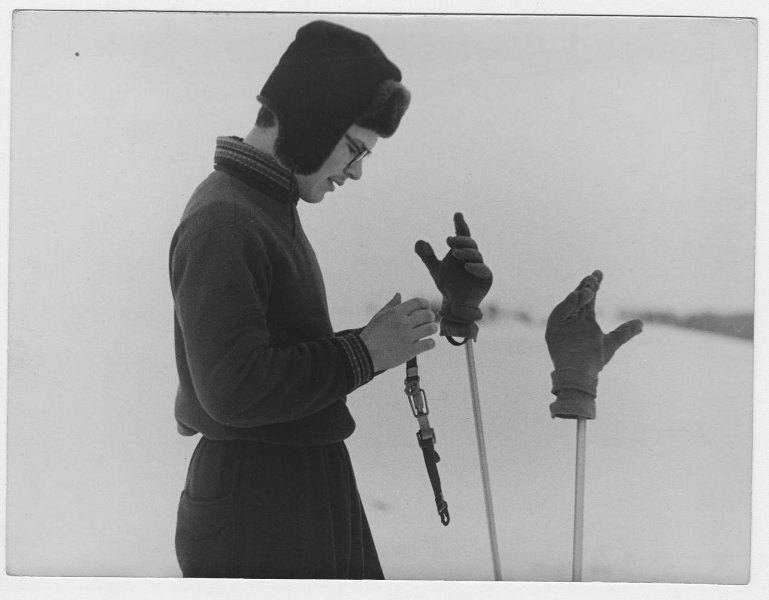
A skier stops to read his compass, held by its strap, 1970s. The photograph is titled « По компасу » (Po kompasu, « By compass »). Photo Igor Gnevashev, MAMM / MDF, via russiainphoto.ru.
Distances are counted in pairs of steps, each soldier knowing the length of his own. The manual allows that, on a bearing march, the error at the arrival point is usually no more than one tenth of the distance covered, about a hundred metres per kilometre. If the target point is not in sight, search for it within a radius of that size.
The needle shows magnetic north, not true north, nor the map grid. The difference, the magnetic declination, is given on the map, and a bearing taken from the map must be corrected by it before being set on the compass.
The geologist’s instrument: the буссоль
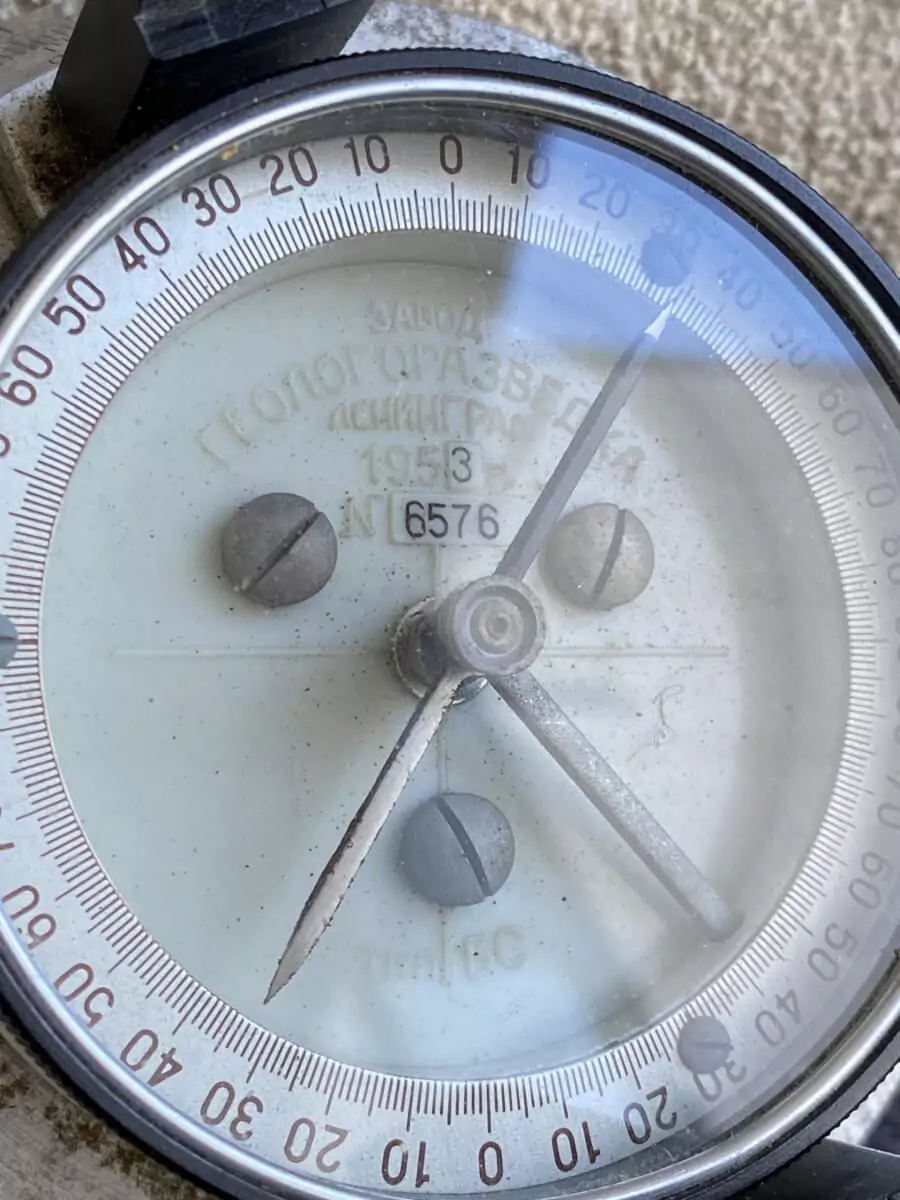
The dial of the БС bussol: Geologorazvedka plant, Leningrad, 1953, a circle graduated in quadrants.
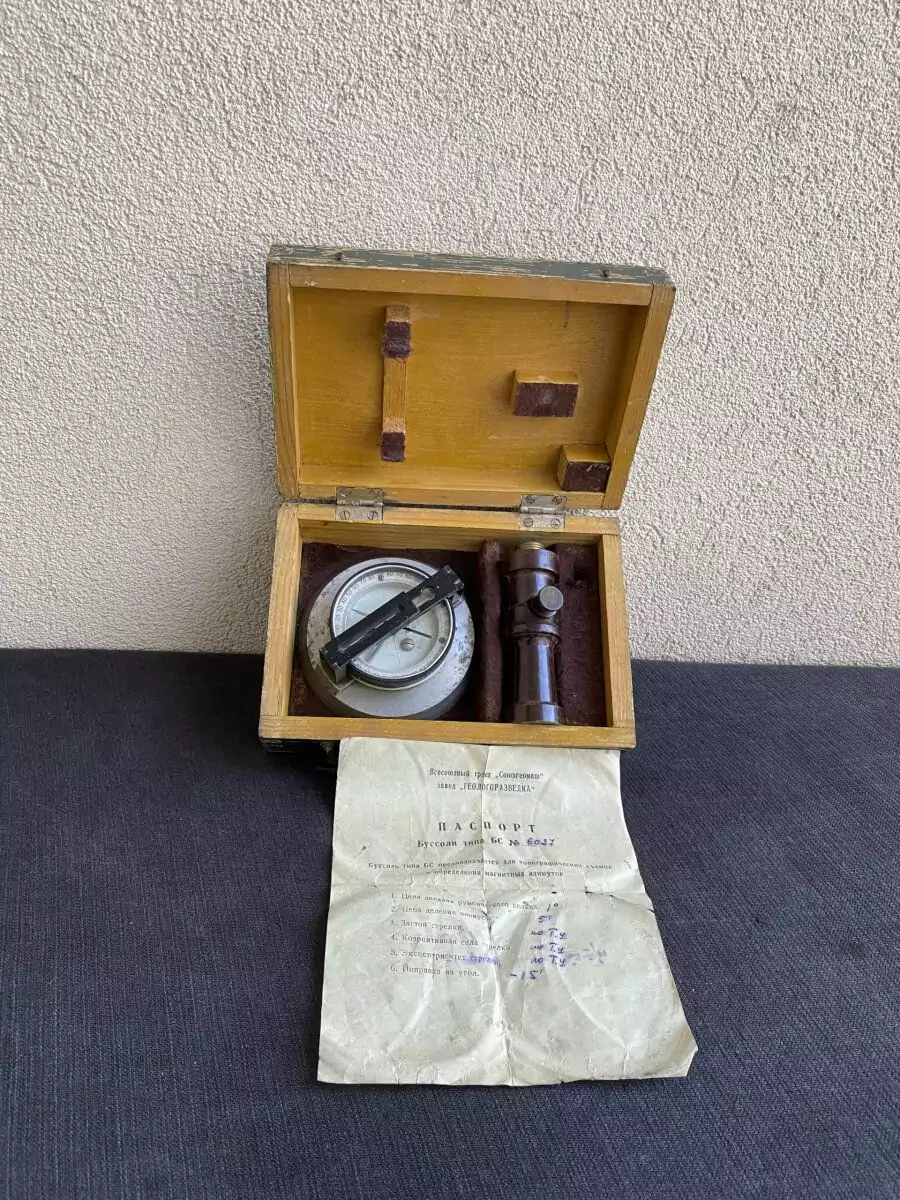
The passport kept in the box: a type БС bussol, intended for topographic surveys.
For accurate measurements, the Soviets also used the буссоль (bussol), a sighting compass set on a tripod. The one in our shop reads “Завод Геологоразведка, Ленинград, 1953” (Zavod Geologorazvedka, Leningrad) on its dial: it comes from the Geologorazvedka, “Geological Prospecting”, plant in Leningrad. The plate on its box places the plant under the Soyuzgeomash trust and the Ministry of Geology and Subsoil Protection. The passport kept in the box describes the type БС (BS) bussol as “intended for topographic surveys and for determining magnetic bearings”. It is stored in a wooden box with its Bakelite tripod head.
It reads differently again. The circle is not graduated from 0 to 360 but in quadrants, from 0 at north and south up to 90 at east and west. The passport gives 1° divisions and a vernier reading to 5 minutes of arc. A bearing is then given as a quadrant and an angle, north-east 30° for example.
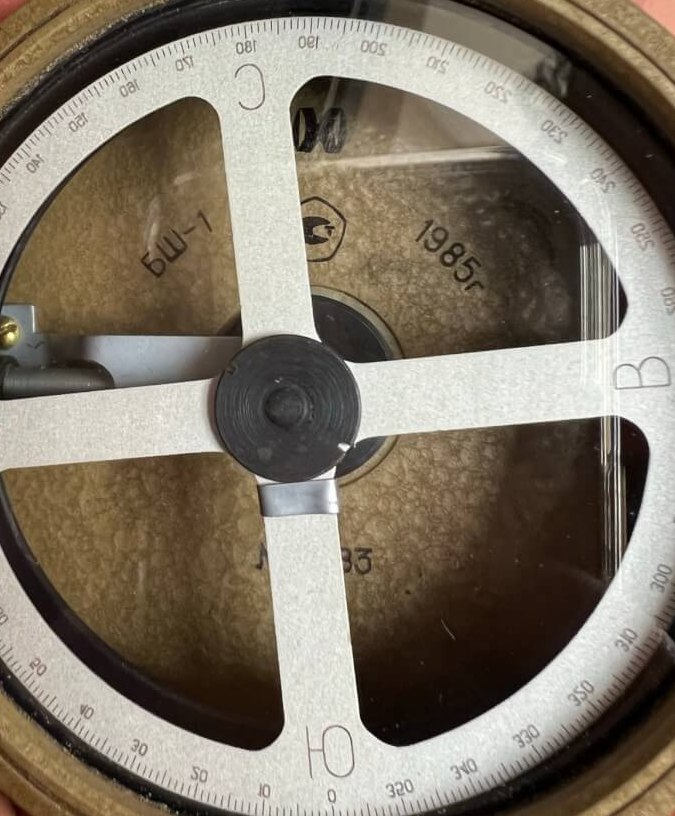
The dial of the 1985 БШ-1 (BSh-1) bussol, graduated to 360°.
More recent, the БШ-1 (BSh-1) mine surveyor’s bussol of 1985, which went through the shop new in its box, was used to measure bearings in reconnaissance: a 65 mm dial graduated to 360°, a measurement error of 30 minutes of arc, a 93 mm alidade, an operating range of −30 to +50 °C, and a weight of 200 grams.
At sea: the Soviet navy boat compass
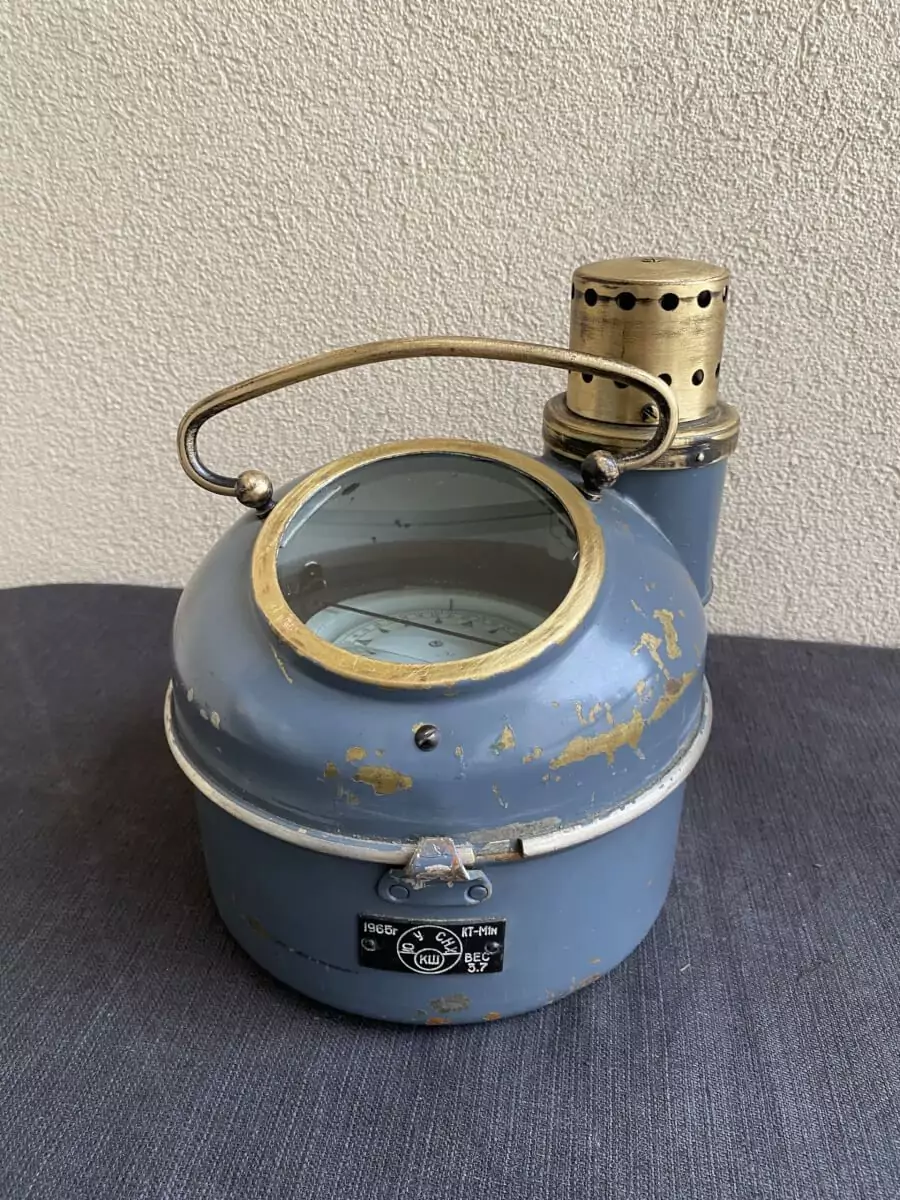
1972 KT-M1m boat compass: the bowl under its glazed hood, the oil lamp on the side.
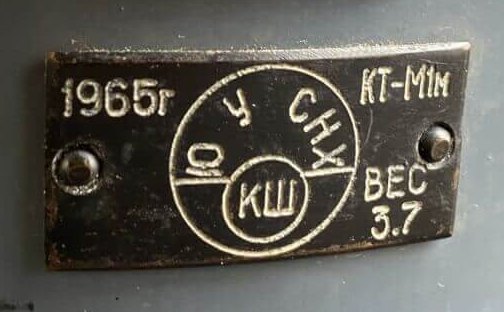
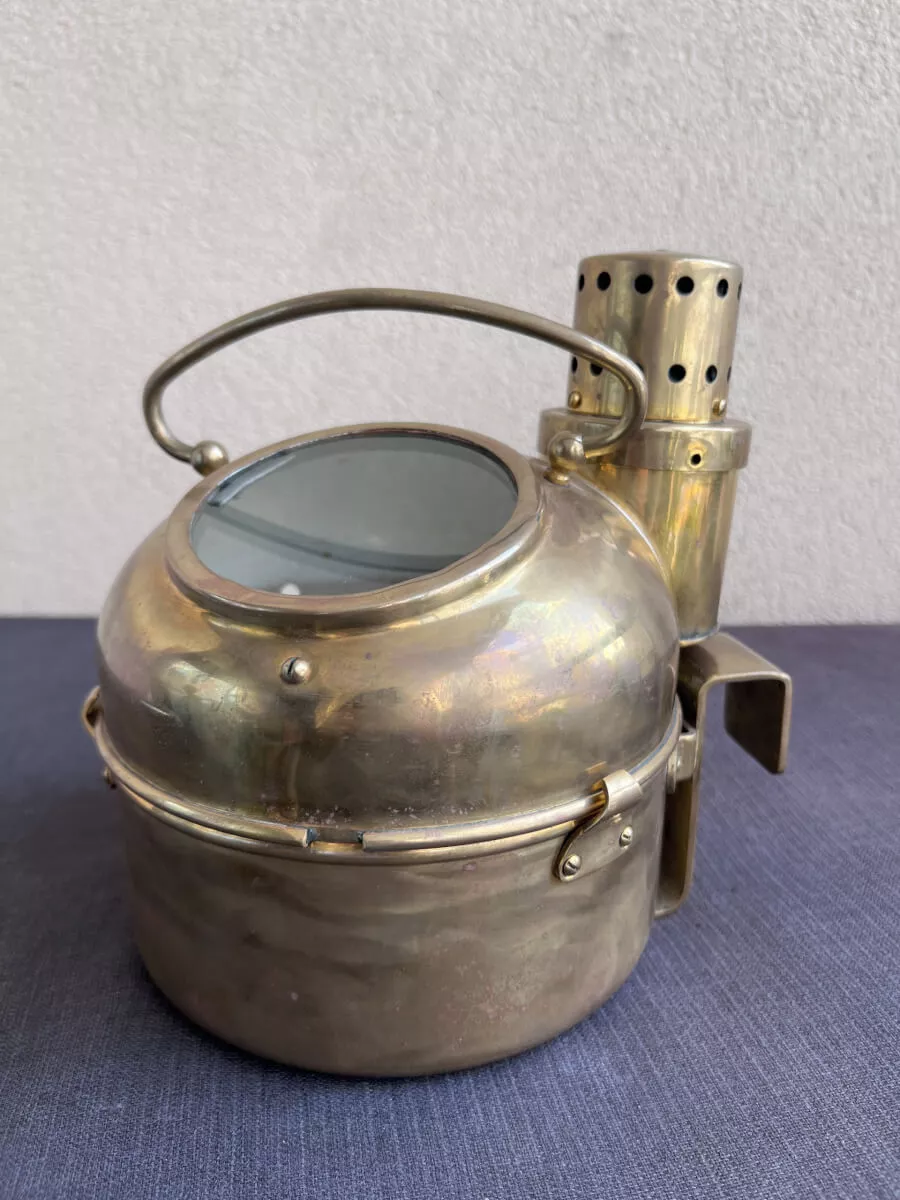
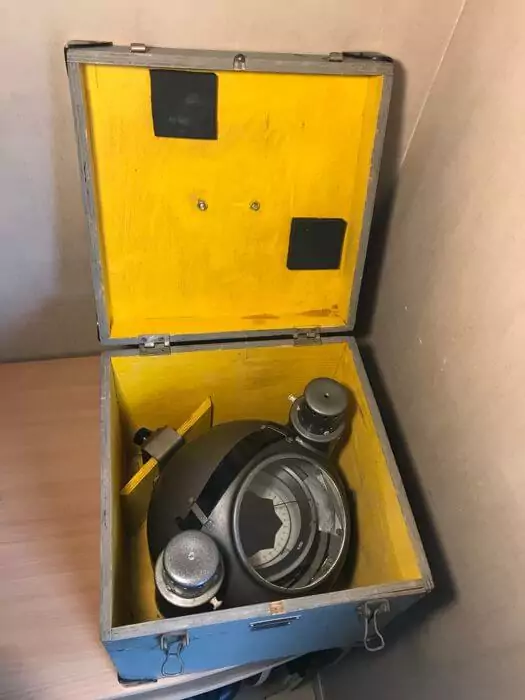
The marine compasses in our shop, which our product pages call binnacle compasses, are boat compasses. Those from 1965, 1972 and 1975, with a round case like the 1974 one, carry the plate КТ-М1м (KT-M1m). The 1953 one, with a square black-painted case like the 1949 one, carries a КТ (KT) plate. The compass consists of a bowl, the котелок (kotelok, “the pot”), holding the graduated card, and an oil-lamp case. The top of the case serves as a lid and a bracket lets the whole thing hang in the boat. The Russian naval supplier Morkniga describes the КТ-М1м as the boat compass of the Soviet navy, with a spring-suspended case. Its deviation is not corrected, the listing explains: a boat carries no iron, so the heading only needs correcting for declination.
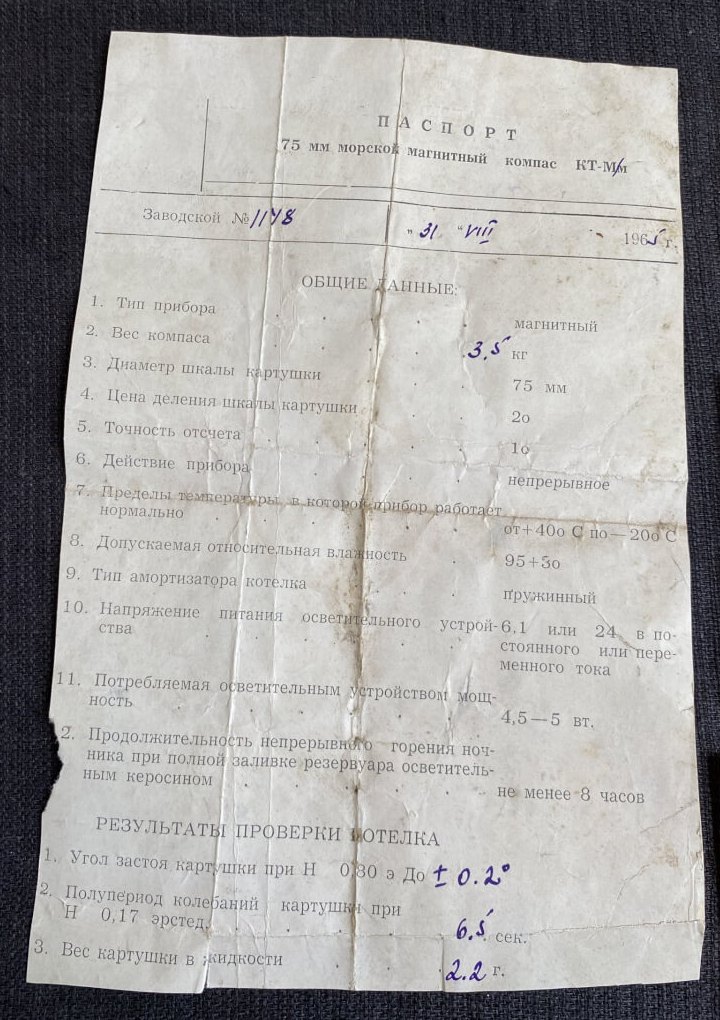
The passport of KT-M1m compass no. 1148, dated 31 August 1965.
The passport of our 1965 compass names it “75 мм морской магнитный компас КТ-М1м” (75 mm morskoy magnitny kompas), a 75 mm marine magnetic compass, and gives the factory figures: a 75 mm card graduated every 2 degrees, a reading accuracy of one degree, operation from −20 to +40 °C, a spring shock absorber, and a night lamp burning at least 8 hours on a full tank of lamp kerosene. Lighting could also be electric, at 6.1 or 24 volts.
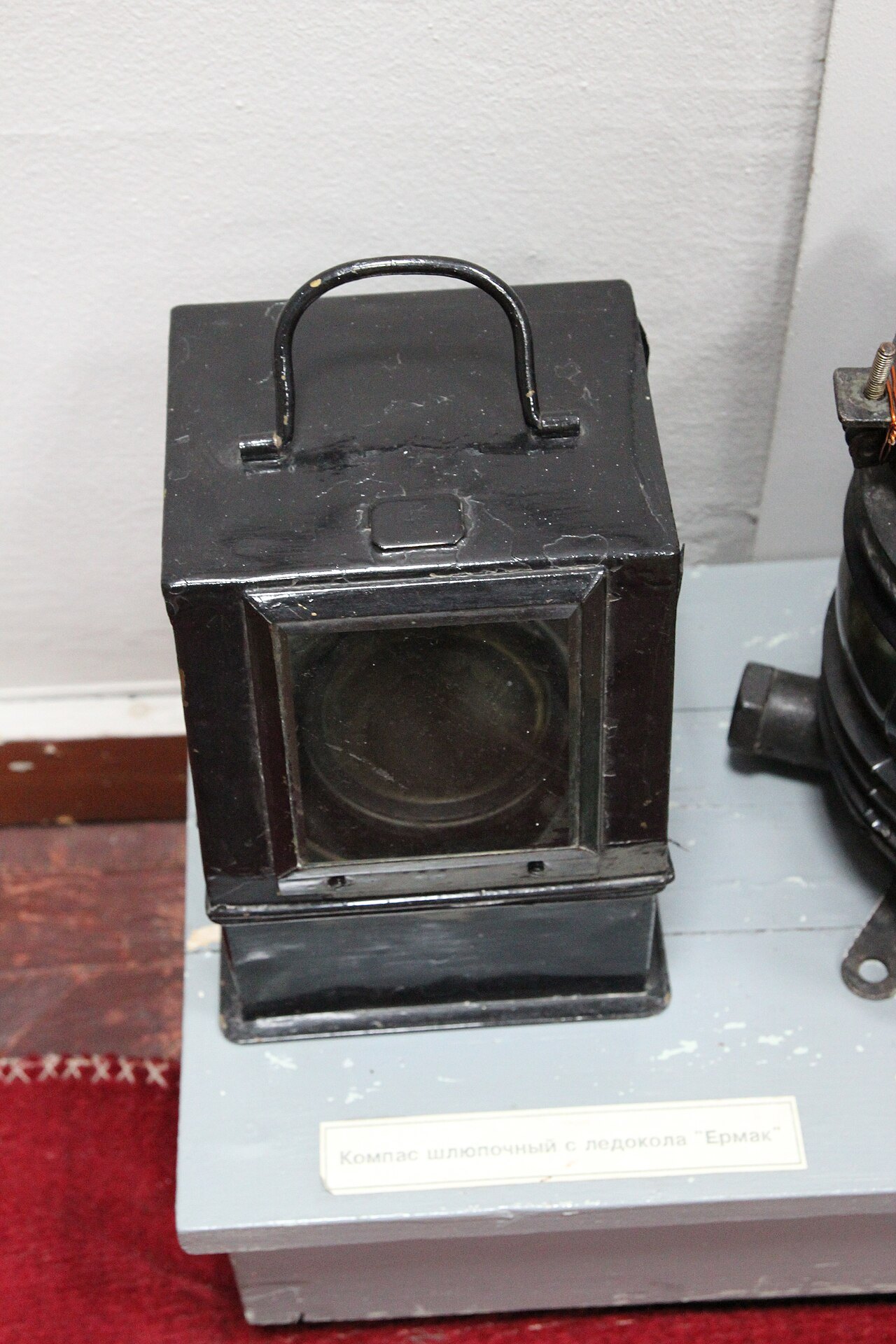
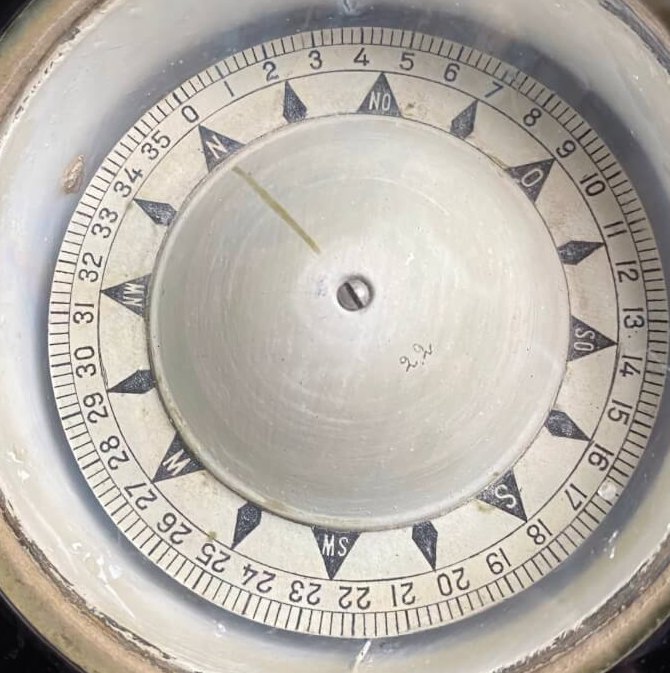
A square-cased compass of the same type at the Naval Museum of the Northern Fleet. The label reads: Компас шлюпочный с ледокола « Ермак » (kompas shlyupochny s ledokola Yermak), boat compass from the icebreaker Yermak. Photo Insider, Wikimedia Commons, CC BY-SA 3.0.The card of the 1949 compass: tens of degrees from 0 to 35, points in Latin letters, O for east.
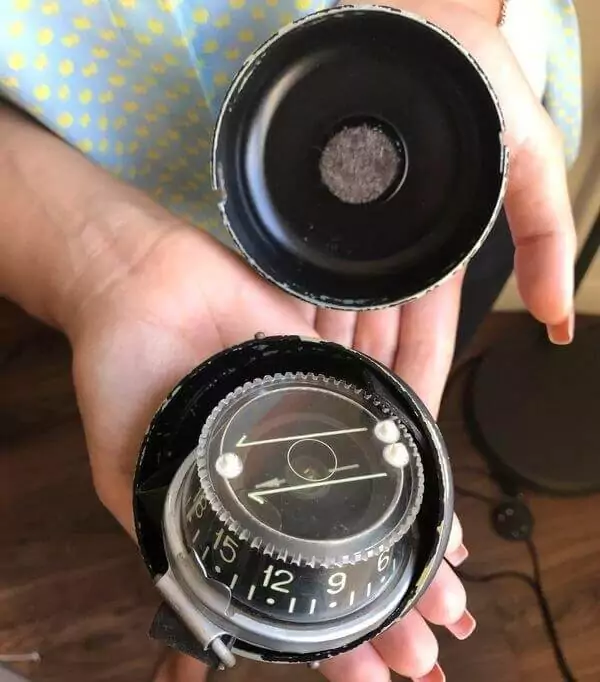
The card reads like that of any ship’s compass: the magnets are fixed underneath and it keeps pointing north while the boat turns around it. The heading is read at the lubber line, a fixed mark on the bowl aligned with the boat’s axis. On our cards the tens of degrees are numbered 0 to 35 and the intermediate points carry Latin letters, N, NO, O, SO, S, SW, W, NW: O stands for east.
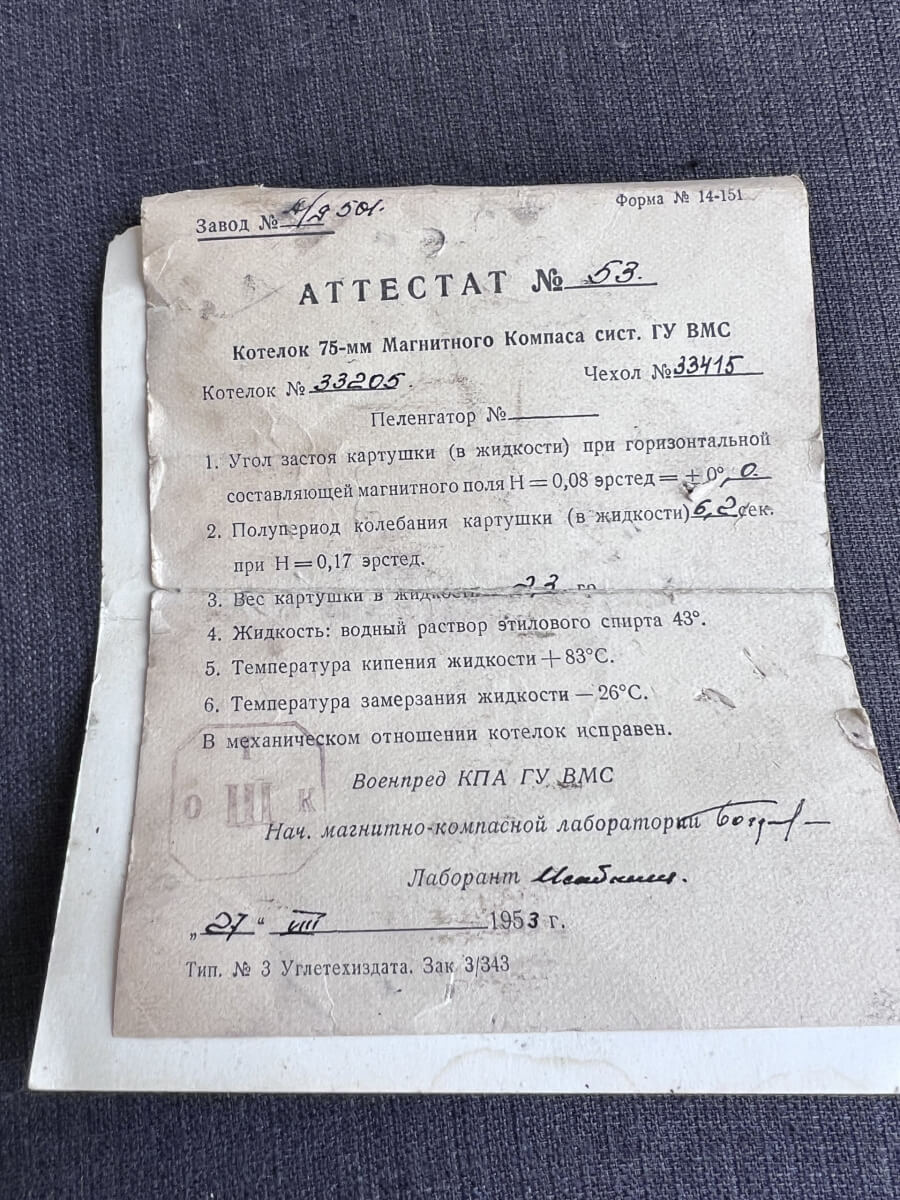
The certificate of the 1953 compass: the bowl is filled with a 43° ethyl alcohol solution.
The bowl is filled with liquid, which damps the swing of the card. The certificate of our 1953 compass names it: an “aqueous solution of ethyl alcohol at 43°”, boiling at +83 °C and freezing at −26 °C. This paper dated 27 August 1953 is drawn up in the name of the military representative of the ГУ ВМС (GU VMS), the main directorate of the naval forces, and signed by the head of the magnetic compass laboratory and by a laboratory assistant. It also records how the card behaves in the liquid: a half-period of oscillation of 6.2 seconds.
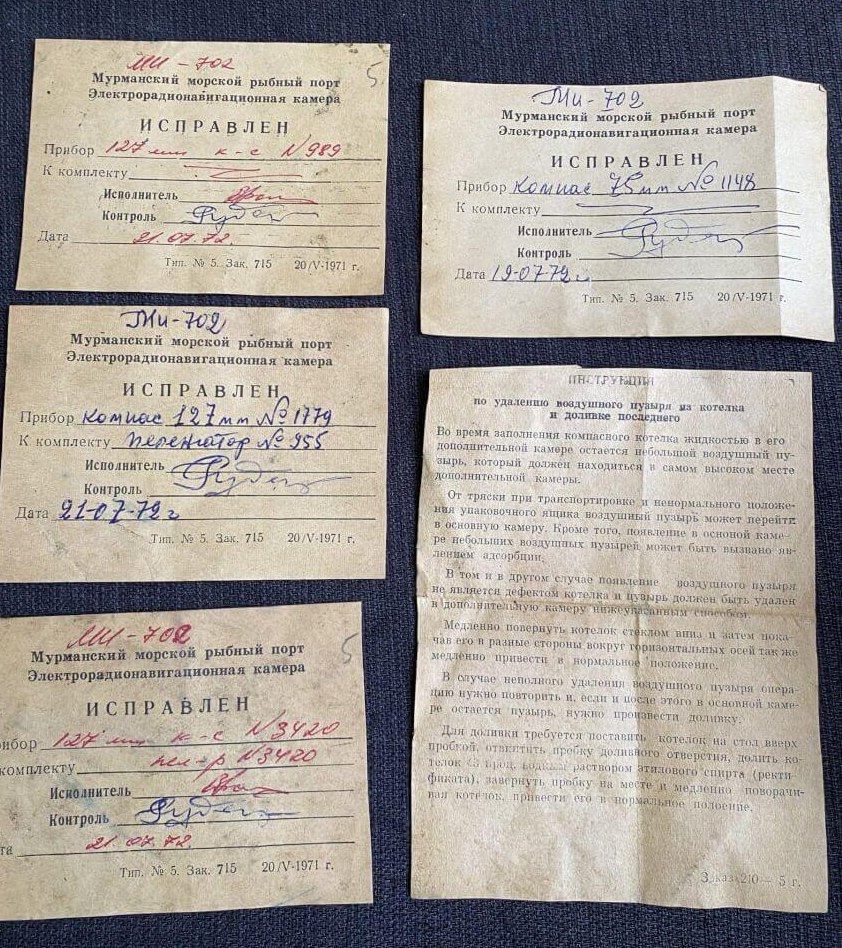
The workshop slips of the Murmansk fishing port, 19 and 21 July 1972, and the instruction for removing the air bubble.
These compasses were used. On 19 July 1972 the electro-radio-navigation workshop of the Murmansk sea fishing port overhauled 75 mm compass no. 1148, our 1965 one. On 21 July it signed three more slips for 127 mm compasses, all marked by hand “Ми-702” (Mi-702). The four “Исправлен” (Ispravlen, “repaired”) slips stayed with the compass. With them, a printed instruction explains how to remove an air bubble from the bowl: slowly turn it glass down, rock it about its horizontal axes, slowly bring it upright, and if the bubble remains, top up with rectified alcohol through the filling plug. A bubble, the text says, is not a defect of the bowl.
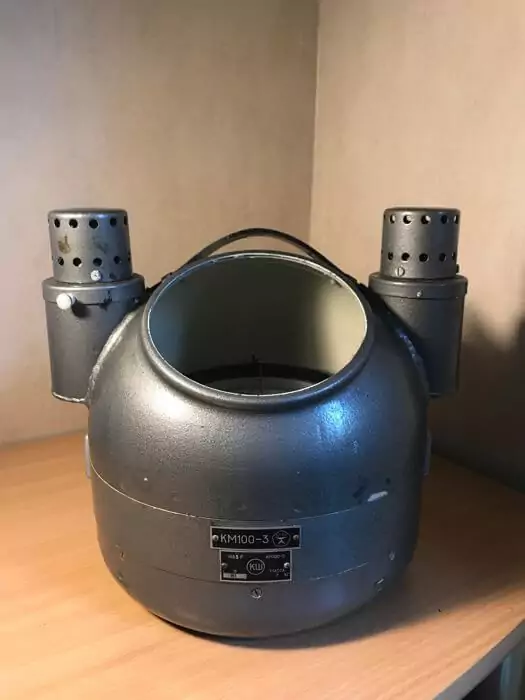
1983 KM100-3 compass, with its two oil lamps.
Larger, the КМ100-3 (KM100-3) compass, also written КМ100-М3, has no binnacle. The Russian supplier Ciclon describes it as the compass of light lifeboats and sailing yachts: it fixes onto the boat’s backboard, has oil lighting and no deviation compensator. Its 100 mm card is graduated every 2 degrees. Ours, with its two emergency oil lamps, carries a 1983 plate; it weighs 7 kg, 11.2 kg in its case.
Under water: the KNM diving compass
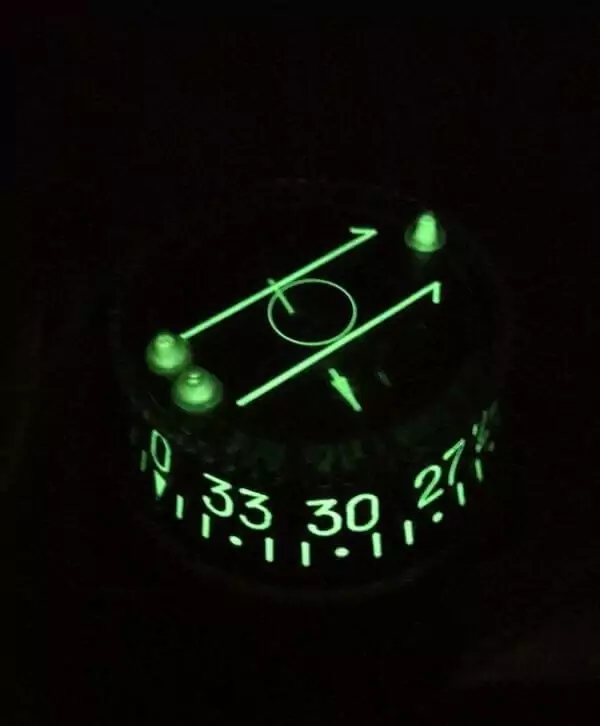
The KNM diving compass in the dark: fluorescent lines, numbers and sights.
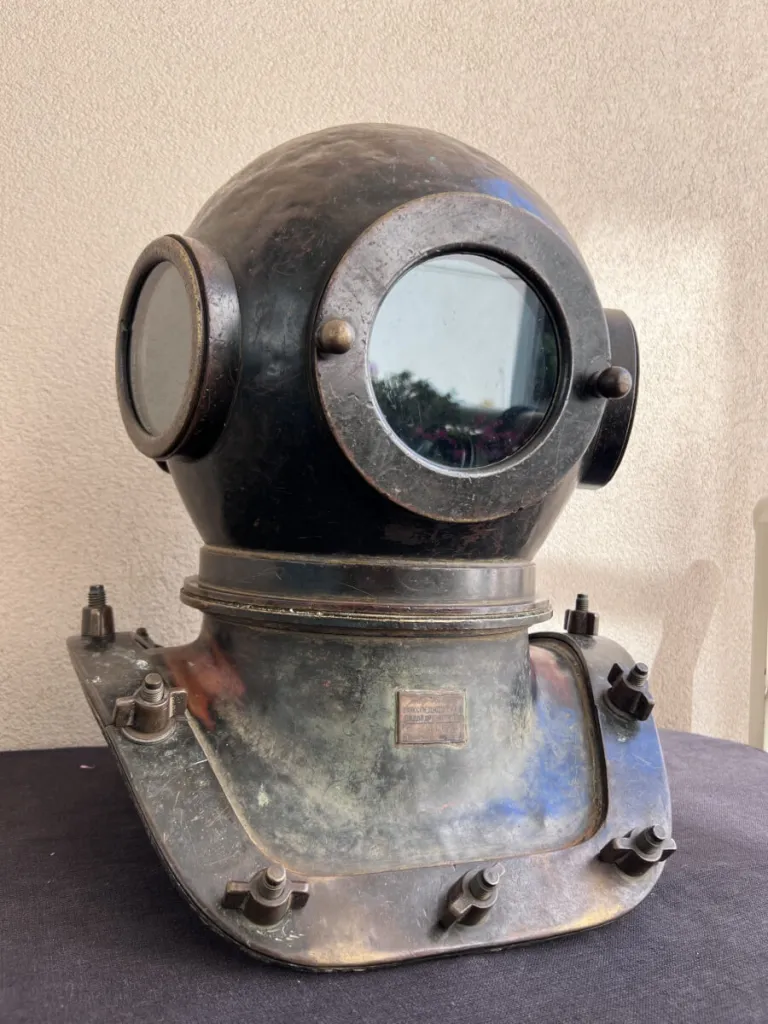
КНМ (KNM) stands for компас наручный магнитный (kompas naruchny magnitny), “magnetic wrist compass”. According to the manual reproduced by the Online Compass Museum, its clear plastic bowl is filled with a 50% glycol or 43% alcohol solution, and a small bubble acts as a level: the compass is flat when the bubble sits inside the engraved circle. You turn the bowl on its base to bring the required bearing to the index, then swim keeping the lines of the card parallel to those of the bowl. Lines, numbers and sights are painted in fluorescent paint. Ours comes from army stocks, where this model served from the 1960s to the 1990s. It completes the equipment shown in our article on the Soviet diving helmet.
Before you buy
Is an Adrianov compass radioactive? Older examples most often carry radioactive luminous paint, based on radium 226. Later series use non-radioactive phosphorescent paint; sources disagree on when the change was made. Russian Wikipedia gives a test: charge the compass with a torch, then leave it in the dark. Non-radioactive paint stops glowing after two and a half to three hours, radium paint keeps glowing. A radioactive compass must never be taken apart: the paint dust is the main hazard. A dosimeter removes the doubt, as with the objects shown in our article Chernobyl, forty years on.
Adrianov compass: the needle. The 1986 manual gives a sensitivity test: bring a metal object close, take it away, and check that the needle comes back to the same graduation each time.
The plate of the 1965 KT-M1m compass: year, model and weight.
Boat compass: plate, bowl, papers. The plate gives the model, year and weight. A bubble in the bowl is not a defect according to the period instruction: it can be removed or topped up. Two different numbers on bowl and case do not mean a marriage of parts: the 1953 certificate itself gives one number to the котелок (33205) and another to the case (33415). Also check that the card turns freely and that the lamp and its hood are there. A compass that keeps its passport, certificate or repair slips can be dated and followed through time.
Copies and recent production. We found no reported copy of the boat compass or of the Adrianov compass. However, new compasses sold under the Adrianov name are still on offer in Russia: compare with dated examples before you buy.
As with any collector’s piece, research thoroughly, compare several examples and rely on trusted collectors’ sites and buying guides.
The ДП-5В (DP-5V) is the field radiometer of Soviet civil defence: a green Bakelite console, a probe with a rotating gamma, beta and check-source shield, headphones and a manual that explains operation and maintenance. The one in this article served in an industrial bakery in Chișinău and was serviced in March 1991. Its owner shared his photos and documents with us, and we turned them into a tool that lets you operate it on screen, step by step.
The Moscow Games, from 19 July to 3 August 1980, boycotted by some sixty countries, produced more objects than any Soviet event: a bear cub, Misha, drawn by Viktor Chizhikov, an emblem made of running tracks, five thousand torches, watches from every factory, platinum coins, rings, tea glass holders, posters. This guide tells the story of the Games and reviews the objects, with the marks that authenticate them and the prices.
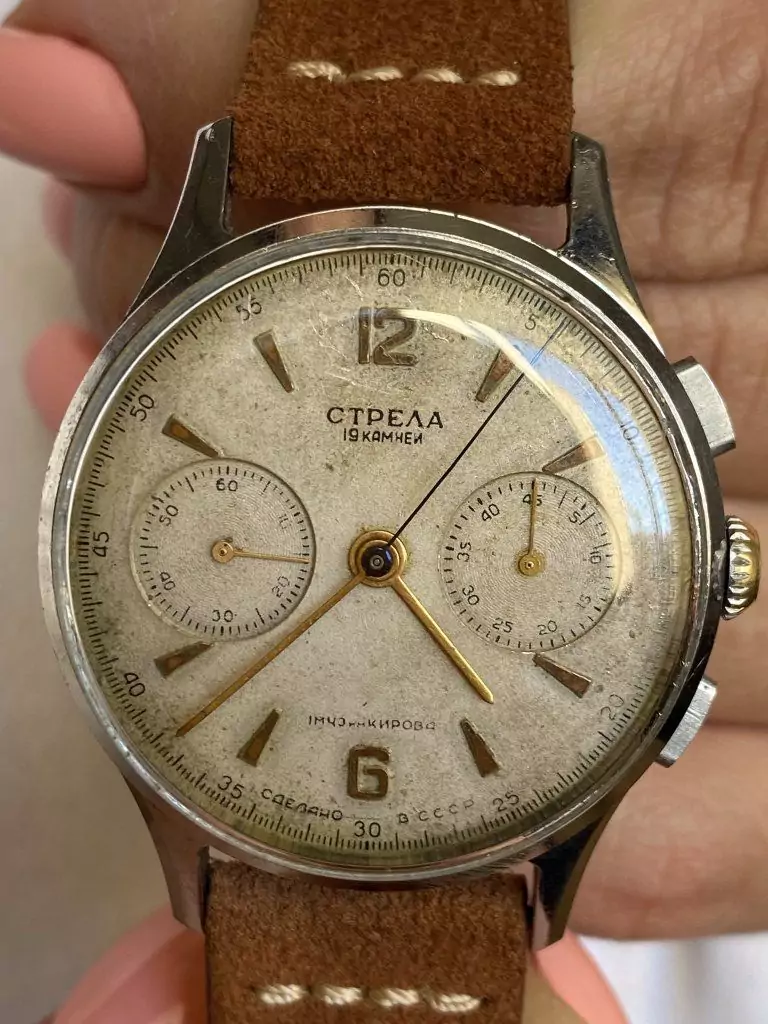
The 3017 chronograph of the First Moscow Watch Factory carries a five-digit number on the balance cock. The most common dating method reads it as a single series, from 1959 to 1979. Four factory passports show there are two, and that the same number can point to two watches made ten years apart. Here is how to read the number, the dial, the logo and the bridge, with a decoder to date your Strela, Poljot or Sekonda.
This website uses cookies to improve your experience while you navigate through the website.
Out of these cookies, the cookies that are categorised as necessary are stored on your browser as they are essential for the working of basic functionalities of the website.
We also use third-party cookies that help us analyse and understand how you use this website.
These cookies will be stored in your browser only with your consent.
You also have the option to opt out of these cookies.
But opting out of some of these cookies may affect your browsing experience.
Necessary cookies are absolutely essential for the website to function properly. This category only includes cookies that ensure basic functionalities and security features of the website. These cookies do not store any personal information.
Cookies that are not strictly necessary for the website to work and that are used specifically to collect personal data through analytics, ads and other embedded content are called non-necessary cookies. User consent is required before these cookies run on the website.
✕
Soviet in Paris
Online. We answer in person, no AI and no chatbot. Reply right away, 20 min at most.
Hello 👋 A question about an item, an order or shipping? Write to us.
Your email is used only to reply to you.
Subscribe to our newsletter and get 10% off your first order.
Subscribe
★ New pieces before anyone else
★ New blog articles
★ Soviet in Paris news and updates
Join the Party
10% off your first order
Receive your welcome card and our next arrivals.
Your code appears here and is also sent to you by email. You can leave the Party in one click, at any time.