The oils in a movement age even when the watch is not worn. This guide gives the recommended service interval, what factory passports said, the official rate tolerances, how repair shops worked in the USSR, the warning signs and everyday habits, with a Soviet movement in 3D.
OCTOBER 2026•6 MINUTE READ
by Marwen Yahyaoui
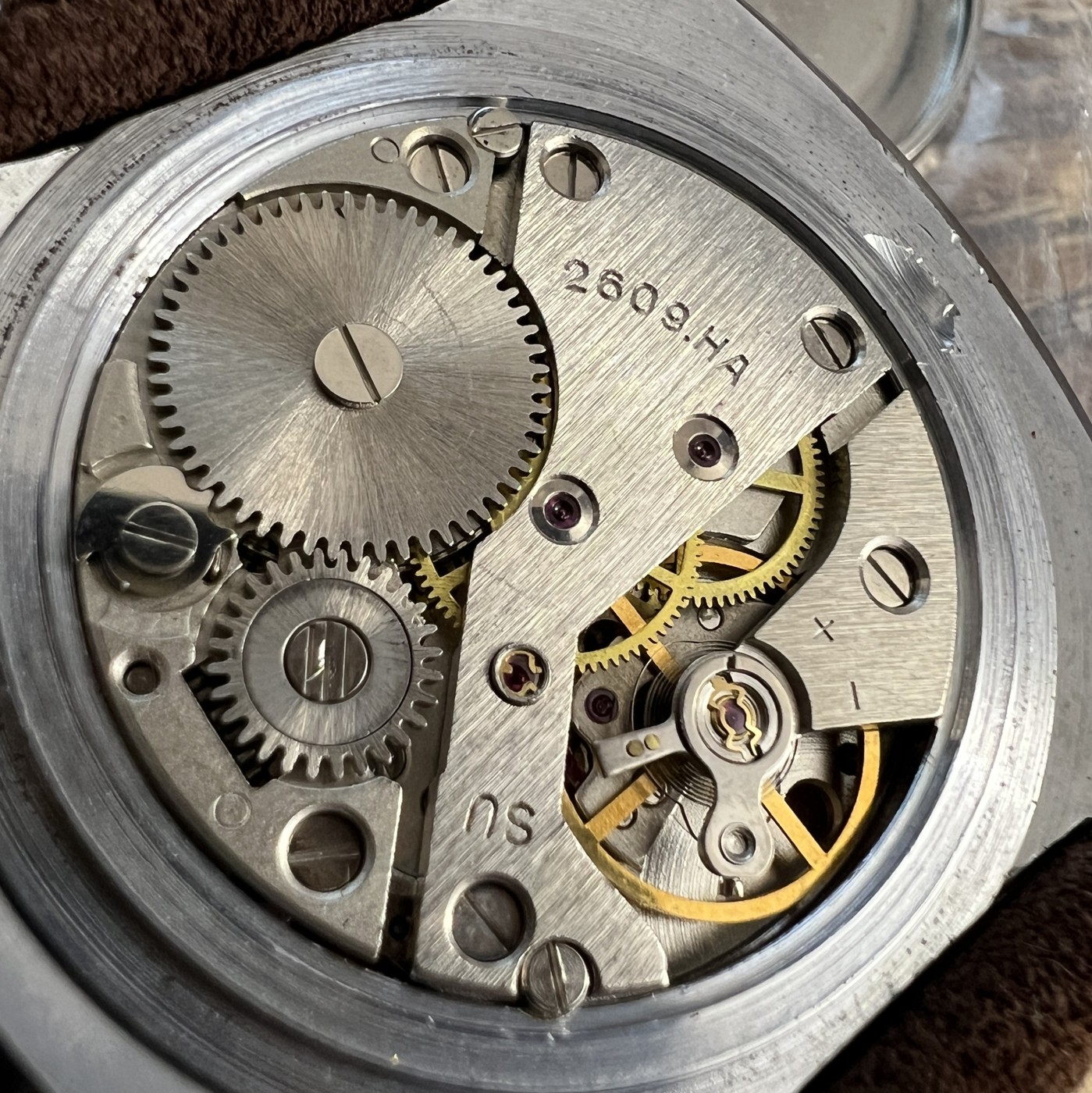
Raketa 2609.НА movement, seen from the back.
What the factory promised
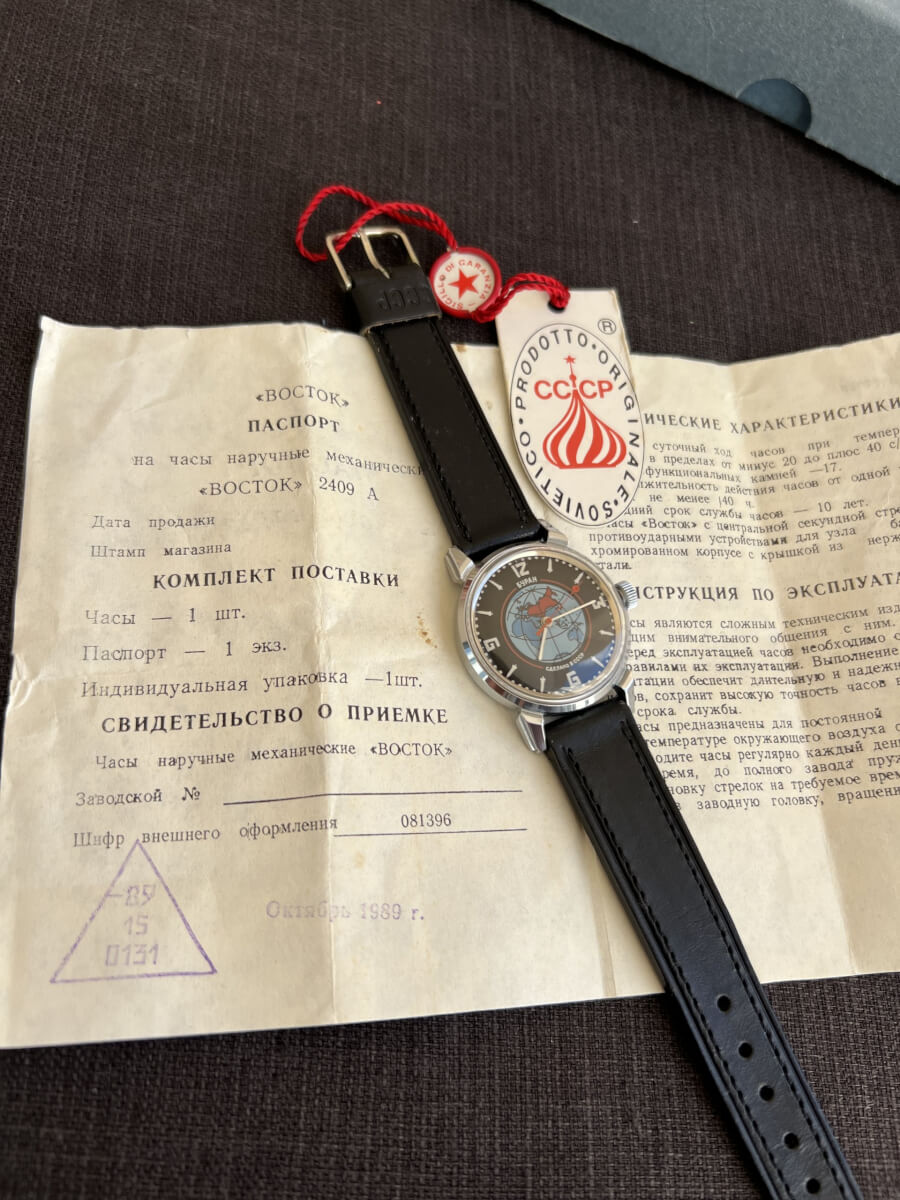
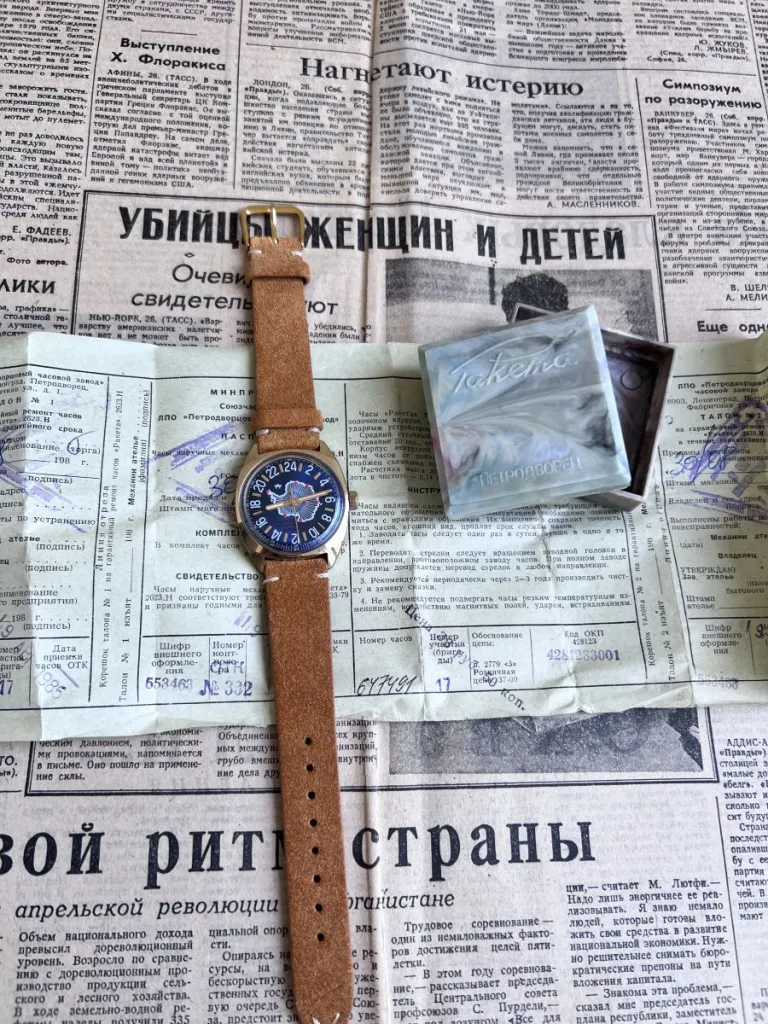
The passport that came with each watch set out what the buyer could expect. That of a Vostok from October 1989 states a rate of between minus 20 and plus 40 seconds a day, 17 jewels, at least 40 hours of running on a full wind and an average service life of ten years. Its instructions take a few lines: wind the watch every day, at the same time, fully, and wear it at an ambient temperature of 0 to 40 °C, the range for which the factory guaranteed these figures.
Passport of a Vostok from October 1989, with the technical inspection stamp.
These figures follow the standard. ГОСТ 10733 allows, for a movement of 20 to 26 mm, a deviation of minus 20 to plus 60 seconds a day, and minus 40 to plus 85 for the small calibres of ladies’ watches. A Soviet watch that gains thirty seconds a day is therefore not out of adjustment: it is within its factory tolerance.
How often to service
There is no single rule, and sources vary.
The manufacturer Vostok asks for a check, cleaning, lubrication and adjustment every three to four years, at an authorised centre.
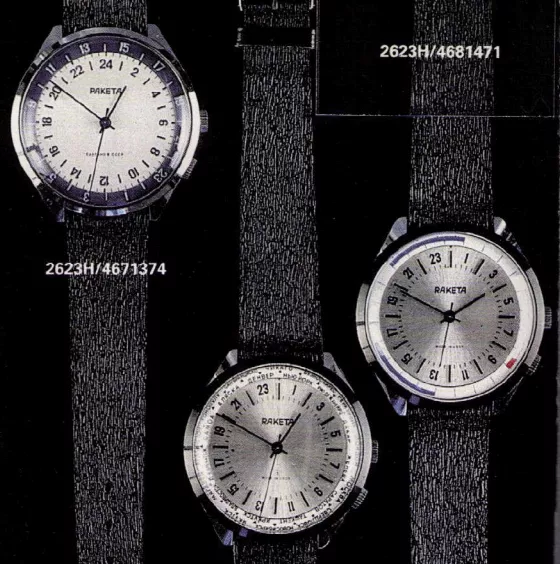
The passport of a 1985 Raketa 24-hour watch advises cleaning every two to three years. Yet a 2623.Н worn regularly often runs ten years or more without a service, as noted in our 24-hour watch guide.
Current advice from watchmaking sites ranges from three to five years for a traditional watch to five to seven years for a modern one. One of them adds that vintage watches should be watched more closely, and that servicing too often can be as harmful as not servicing at all.
In practice a watch worn regularly is serviced within the range given by the manufacturer. A watch that has lain idle for a long time, or whose past is unknown, should be examined before being worn every day.
In the USSR: the workshop, the warranty and the exchange watch
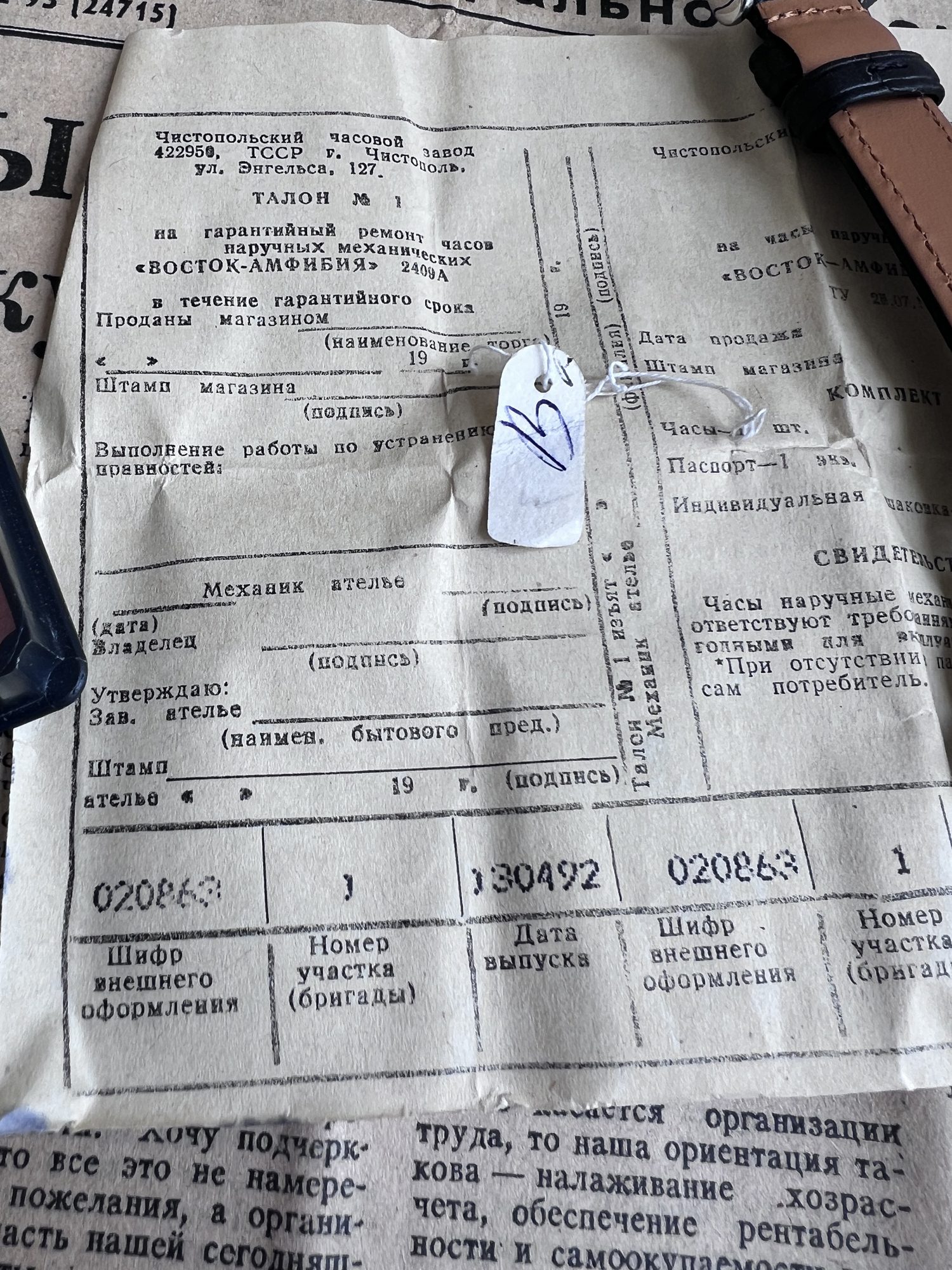
Each passport contained detachable warranty coupons, to be stamped by the workshop. Warranty repairs were carried out by the “consumer services” workshops, on behalf of the factory and at its expense.
Warranty coupon of a Vostok Amphibia: the lines “Механик ателье” and “Зав. ателье” await the signatures of the mechanic and the workshop manager.
A Soviet manual of 1977, Kharitonchuk’s “Reference Book on Watch Repair”, describes how these workshops operated. They distinguished two levels: partial repair, often done in front of the customer, and general repair, with complete dismantling. A repaired watch was guaranteed for six months up to 20 mm calibre, nine months above that, and had to keep within plus or minus 90 seconds a day.
The same manual describes a forgotten service: exchange. The owner of a broken watch could leave with an already repaired one, of the same brand or one of equivalent value, taken from the workshop’s “exchange fund”. For a gold watch, only the movement was exchanged.
Signs that a service is needed
The watch stops, or gains or loses a lot. A deviation of a few tens of seconds a day is common on a vintage mechanical watch. A deviation of several minutes a day points to a problem: magnetisation, dry oils or a knock.
Winding becomes stiff, or you feel a rough grinding under the crown.
The power reserve drops: the watch no longer runs as long as before.
The seconds hand hesitates or stops.
Moisture appears under the crystal.
What a service includes
According to the general description given by watchmaking sites, a full service includes these steps:
Dismantling the movement.
Ultrasonic cleaning of the parts.
Replacing worn parts.
Lubricating the friction points.
Reassembly and rate adjustment.
Water-resistance test.
A movement takes not one oil but several. The Soviet manual of 1977 lists several according to the part being lubricated: one of them, МЗП-6, is reserved for gear trains. In the movement below, the points to oil are those where parts turn or rub: rotate it, then wind it.
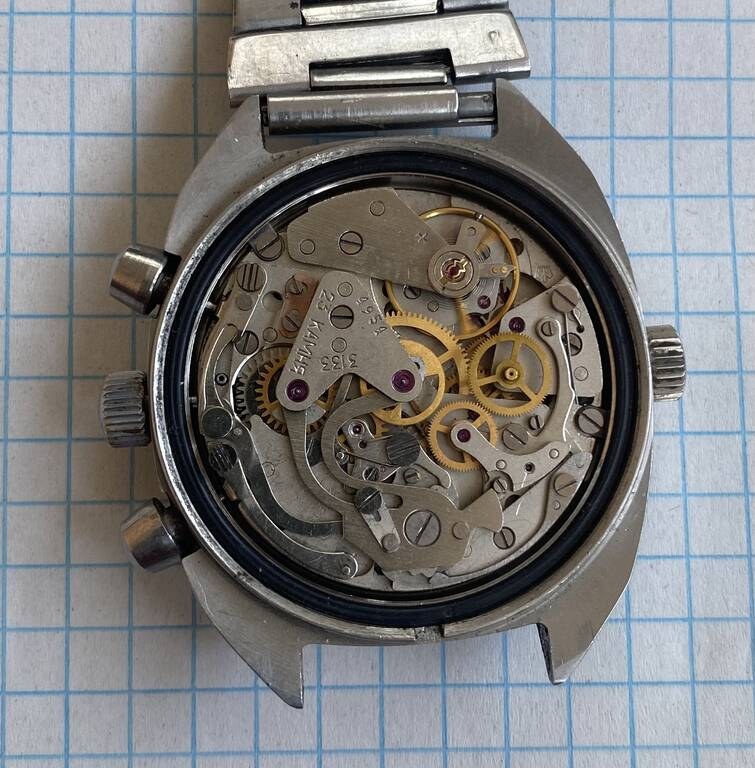
Replacing parts depends on the calibre and on the availability of parts. On a Poljot 3133, for example, servicing is expensive and few watchmakers take it on: this is explained in our Poljot 3133 guide.
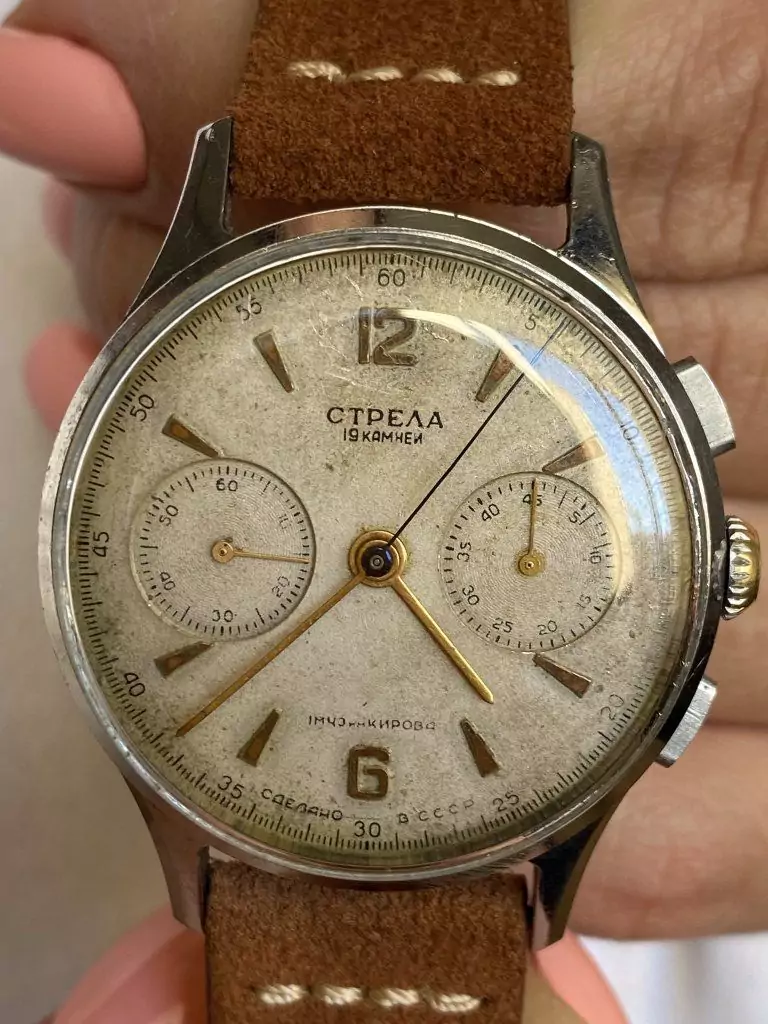
Movement of a Poljot 3133 chronograph before servicing.
Habits that limit wear
Wind at a fixed time. A hand-wound watch is wound by the crown, clockwise, until you feel resistance: about 20 to 30 turns, without forcing beyond that. The manufacturer Vostok advises winding at the same time each day.
Wind the watch off the wrist. Vostok recommends this to avoid uneven pressure on the crown, which it describes as one of the most vulnerable parts.
For an automatic worn every day, the manufacturer says to wind it by the crown once a week, 20 to 30 turns.
Do not change the date at night. Vostok asks not to set it between 10 pm and 2 am: this is when the calendar mechanism is engaged.
Keep it away from magnetic sources such as loudspeakers: they can make it run fast or slow. The standard reserves the word “Антимагнитные” for watches that do not stop in a field of 4,800 amperes per metre.
Avoid repeated shocks, such as working with pneumatic tools.
Keep the watch away from heat, cold and water. Vostok advises against storing it in a cold room: the oils thicken and the movement stops. See our article on the water resistance of a Soviet watch.
Have a cracked crystal replaced without delay: dust gets in through the crack.
For a quartz watch stored for a long time, remove the battery: a leaking battery damages the movement.
Yes, in most cases, for the reason given above: oils age and dry out even if the watch has never been used. A “NOS” piece, new old stock, may therefore well be examined before being worn every day.
Servicing at Soviet Times
Our Soviet Times workshop carries out full servicing of hand-wound watches, automatics and chronographs. What the service includes, the prices, the turnaround and the warranty are set out on the watch repair page. The quote is free and without obligation.
The ДП-5В (DP-5V) is the field radiometer of Soviet civil defence: a green Bakelite console, a probe with a rotating gamma, beta and check-source shield, headphones and a manual that explains operation and maintenance. The one in this article served in an industrial bakery in Chișinău and was serviced in March 1991. Its owner shared his photos and documents with us, and we turned them into a tool that lets you operate it on screen, step by step.
The Moscow Games, from 19 July to 3 August 1980, boycotted by some sixty countries, produced more objects than any Soviet event: a bear cub, Misha, drawn by Viktor Chizhikov, an emblem made of running tracks, five thousand torches, watches from every factory, platinum coins, rings, tea glass holders, posters. This guide tells the story of the Games and reviews the objects, with the marks that authenticate them and the prices.
The 3017 chronograph of the First Moscow Watch Factory carries a five-digit number on the balance cock. The most common dating method reads it as a single series, from 1959 to 1979. Four factory passports show there are two, and that the same number can point to two watches made ten years apart. Here is how to read the number, the dial, the logo and the bridge, with a decoder to date your Strela, Poljot or Sekonda.
This website uses cookies to improve your experience while you navigate through the website.
Out of these cookies, the cookies that are categorised as necessary are stored on your browser as they are essential for the working of basic functionalities of the website.
We also use third-party cookies that help us analyse and understand how you use this website.
These cookies will be stored in your browser only with your consent.
You also have the option to opt out of these cookies.
But opting out of some of these cookies may affect your browsing experience.
Necessary cookies are absolutely essential for the website to function properly. This category only includes cookies that ensure basic functionalities and security features of the website. These cookies do not store any personal information.
Cookies that are not strictly necessary for the website to work and that are used specifically to collect personal data through analytics, ads and other embedded content are called non-necessary cookies. User consent is required before these cookies run on the website.
✕
Soviet in Paris
Online. We answer in person, no AI and no chatbot. Reply right away, 20 min at most.
Hello 👋 A question about an item, an order or shipping? Write to us.
Your email is used only to reply to you.
Subscribe to our newsletter and get 10% off your first order.
Subscribe
★ New pieces before anyone else
★ New blog articles
★ Soviet in Paris news and updates
Join the Party
10% off your first order
Receive your welcome card and our next arrivals.
Your code appears here and is also sent to you by email. You can leave the Party in one click, at any time.