The АЧС-1, made in Chelyabinsk, is the Soviet on-board instrument par excellence. Yet its story begins in the 1930s, in Paris, around a chronograph ordered from a Swiss manufacture.
MAY 2026•18 MINUTE READ
by Marwen Yahyaoui
In the cockpit of a MiG-21, as in that of a Tu-160 or a Su-27, the same black dial occupies a central place on the instrument panel. Luminous white numerals, two sub-dials, and Cyrillic inscriptions that are enough to identify it instantly: ВРЕМЯ ПОЛЕТА for flight time, СЕК for the chronograph counter, ПУСК for the chronograph command and for stopping the movement. This is the АЧС-1, considered the most produced cockpit clock of all time.
To understand this piece, you have to accept an unexpected genealogy: its distant ancestor is a Jaeger chronograph ordered in Paris in the 1930s, and the official documentation of the Molnija factory acknowledges this today without hesitation. Between that Swiss starting point and contemporary Russian cockpits, the АЧС-1 crossed the whole history of Soviet aviation, and even ended up serving on the ground, on the test consoles of the Baikonur cosmodrome.
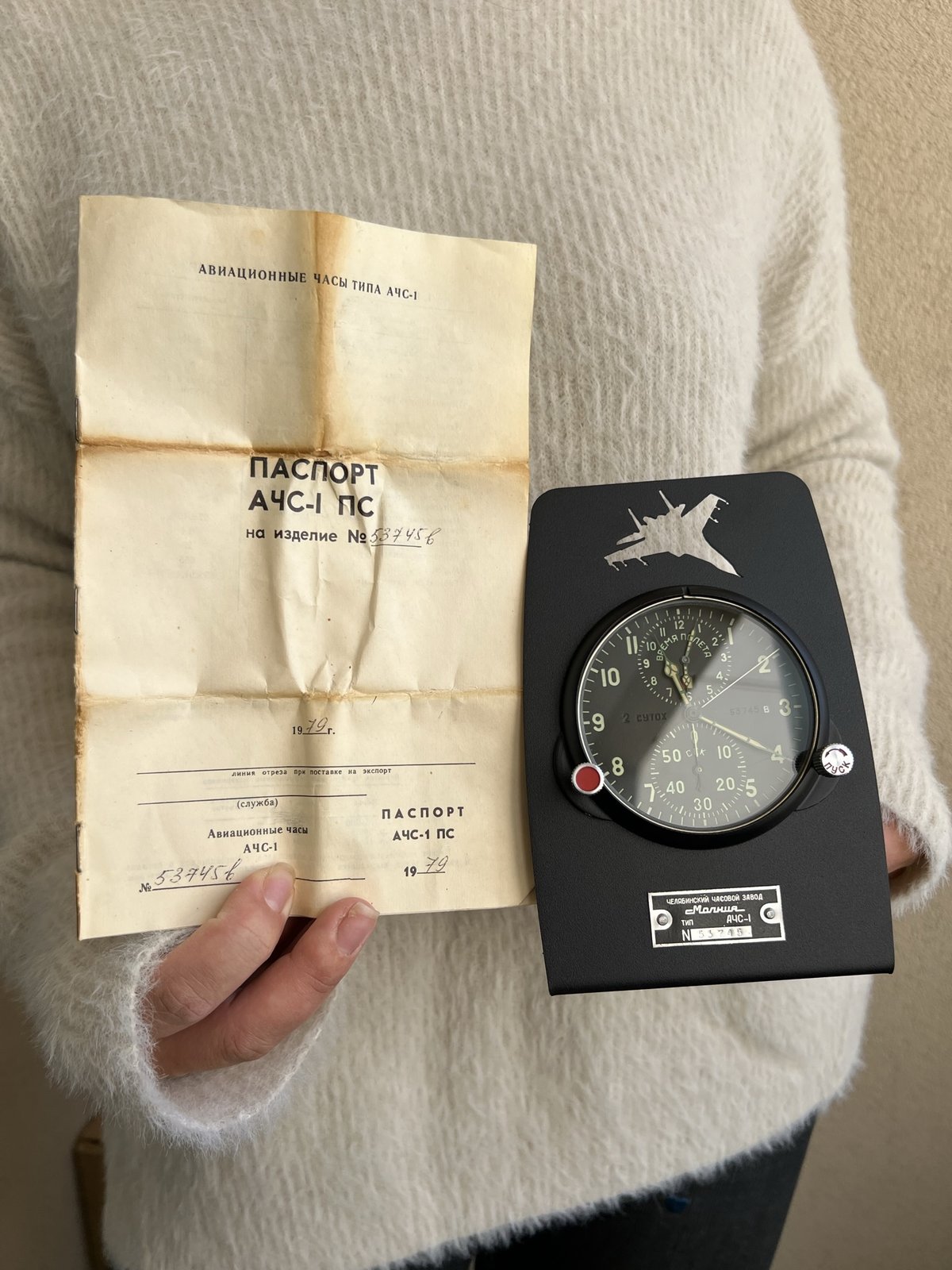
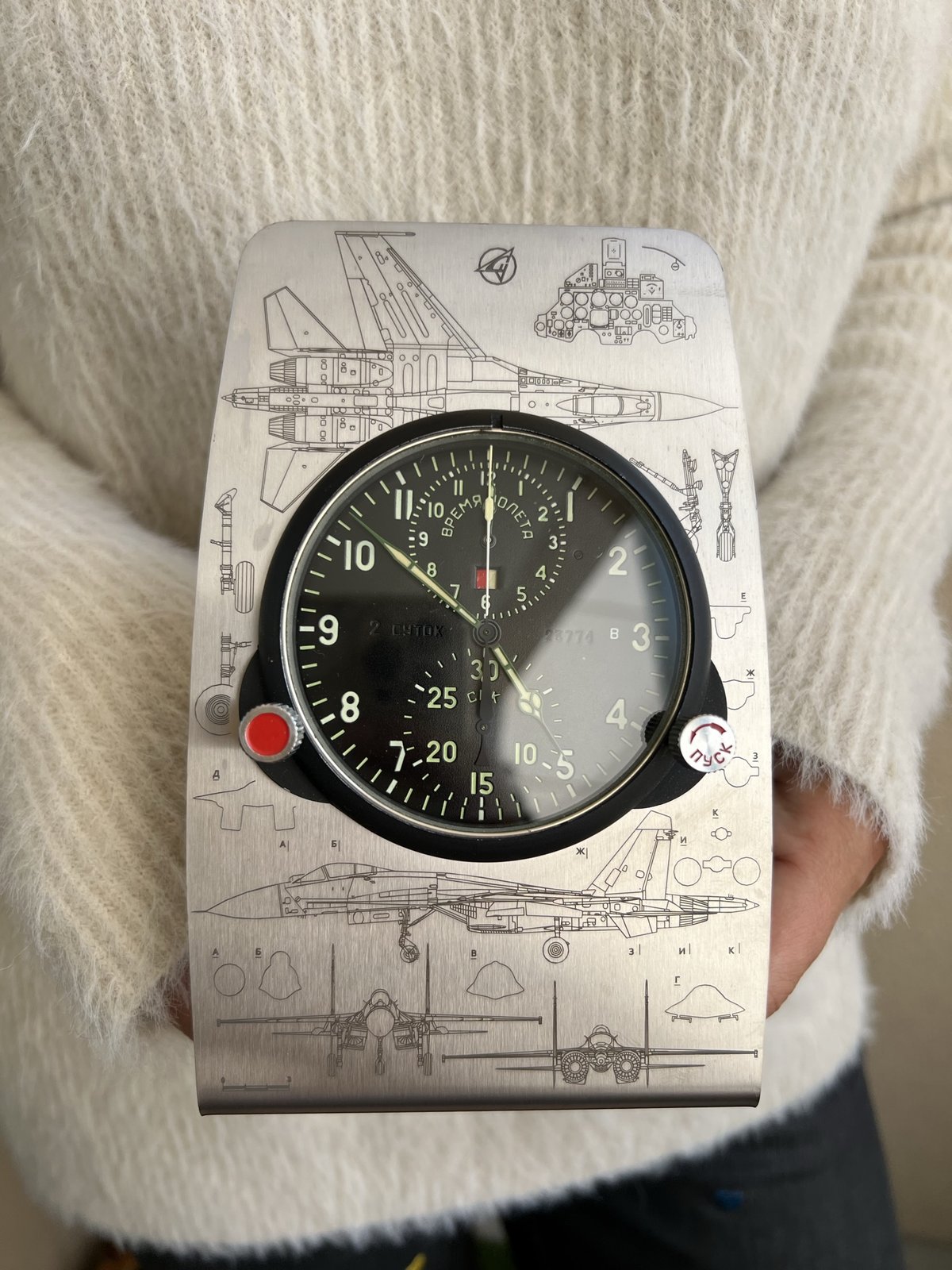
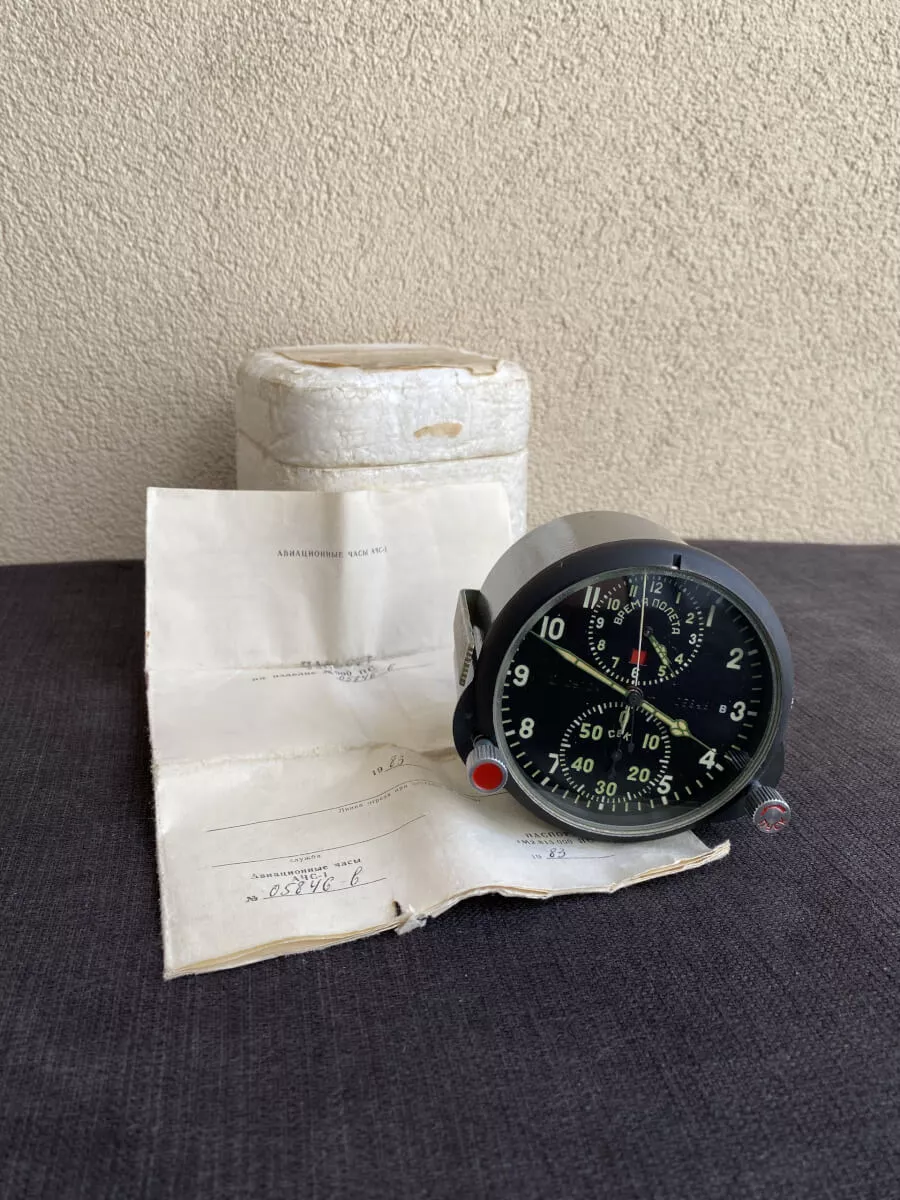
An AChS-1 number 53745 B seen from the front, together with its original passport signed in 1979. The piece is mounted on a Su-27 themed display.
The Chelyabinsk factory, born of an evacuation
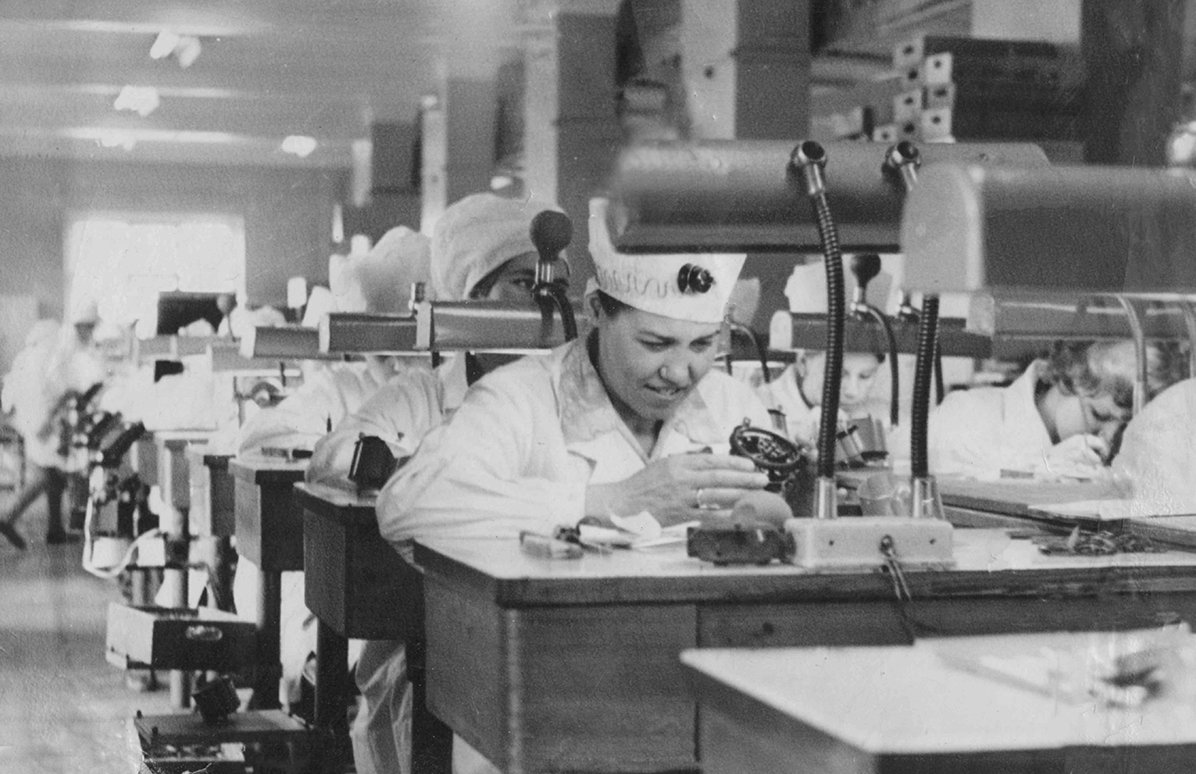
To understand the AChS-1, you have to go back to a four-storey building on ulitsa Tsvillinga, in the centre of Chelyabinsk, at the eastern foot of the Urals. This neoclassical building, originally intended to house the municipal library, never took in a single book. On 17 November 1947 it officially became the city’s first watch factory. This was the birth of the Chelyabinsky Chasovoi Zavod, better known by its brand name, Молния, which simply means Lightning.
The factory did not appear out of nowhere. During the Great Patriotic War, the First Moscow Watch Factory, founded in 1930 on the basis of the former American Dueber-Hampden manufacture bought by Amtorg, had been evacuated to Zlatoust, in the Urals, to escape the German advance. It was there, in the middle of the war, that chronometers for the navy, tank clocks and the first Soviet aviation chronographs were produced. When the war ended, the Ministry of Industry decided not to bring everything back. Part of the machinery, and above all more than a hundred experienced workers and some thirty engineers, were transferred some 110 kilometres further east, to Chelyabinsk, where they gave shape to the new factory.
Assembly workshop of the Molnija factory in Chelyabinsk, 1950s to 1960s. The women workers in white coats assemble the aviation calibres by hand. Molnija archive photograph.
From its very first year, the factory produced civilian pocket watches, tank clocks, ship clocks and, above all, aviation clocks for the Ministry of Defence, its main customer. The first cockpit model to come off the Chelyabinsk lines in 1948 was called the AVR-M. Eight-day power reserve, a calibre taken directly from Moscow production, and an already military destiny: the model, already made in Moscow, had equipped the MiG-1 and MiG-3 fighters, the Yak-1, Yak-2, Yak-4 and Yak-7, the Su-2 bomber and the famous Il-4. The technical pattern would return ten years later, in a more accomplished form, on the engineers’ drawing board.
From the Jaeger order to the Soviet chronograph
The AChS-1 officially entered production in 1958. But its architecture was not invented in Chelyabinsk. It was reverse-engineered from a foreign clock that Soviet aviation already knew very well.
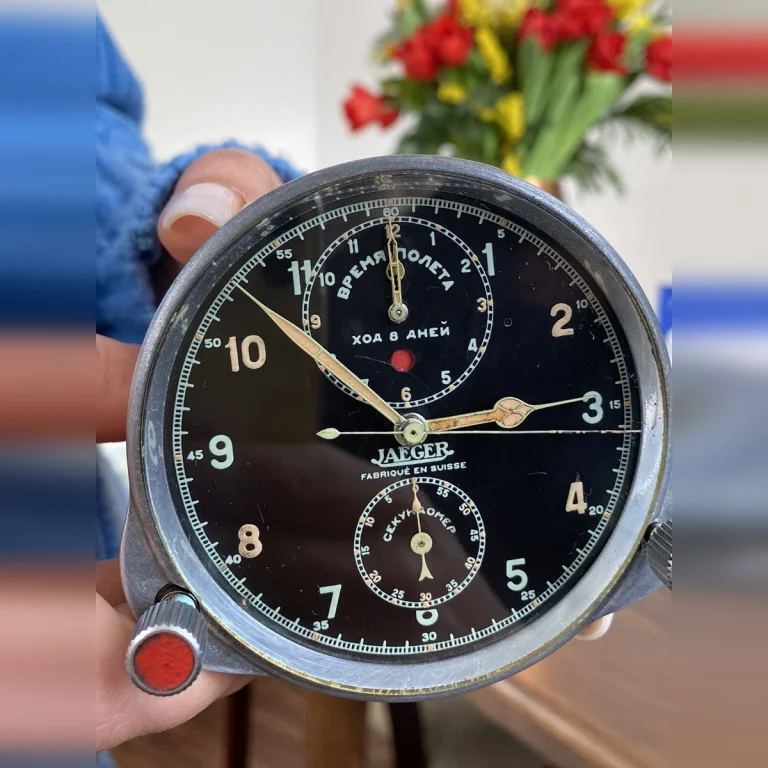
On this precise point, Molnija’s official documentation is explicit. The manufacturer writes in its own company monograph that “the prototype of the AChS-1 was the aviation clocks produced by one of the Swiss manufactures for Soviet aviation until 1939”. The wording is deliberately vague about the identity of the Swiss manufacture, but collectors know which one it is: Jaeger, which in the 1930s supplied eight-day chronographs with bilingual Russian and French dials for the TB-3 and TB-7 strategic bombers. We have devoted a detailed article to these founding pieces, of which the AChS-1 is the direct descendant.
The lineage is therefore clearly established, and even officially acknowledged by the Soviet manufacturer: contemporary Russian aviation horology was born from a Swiss spark. The AVR-M of 1948 served as a bridge between the two eras, but it was with the AChS-1 that the pattern settled and began its mass-production career.
The dial, the case, the controls
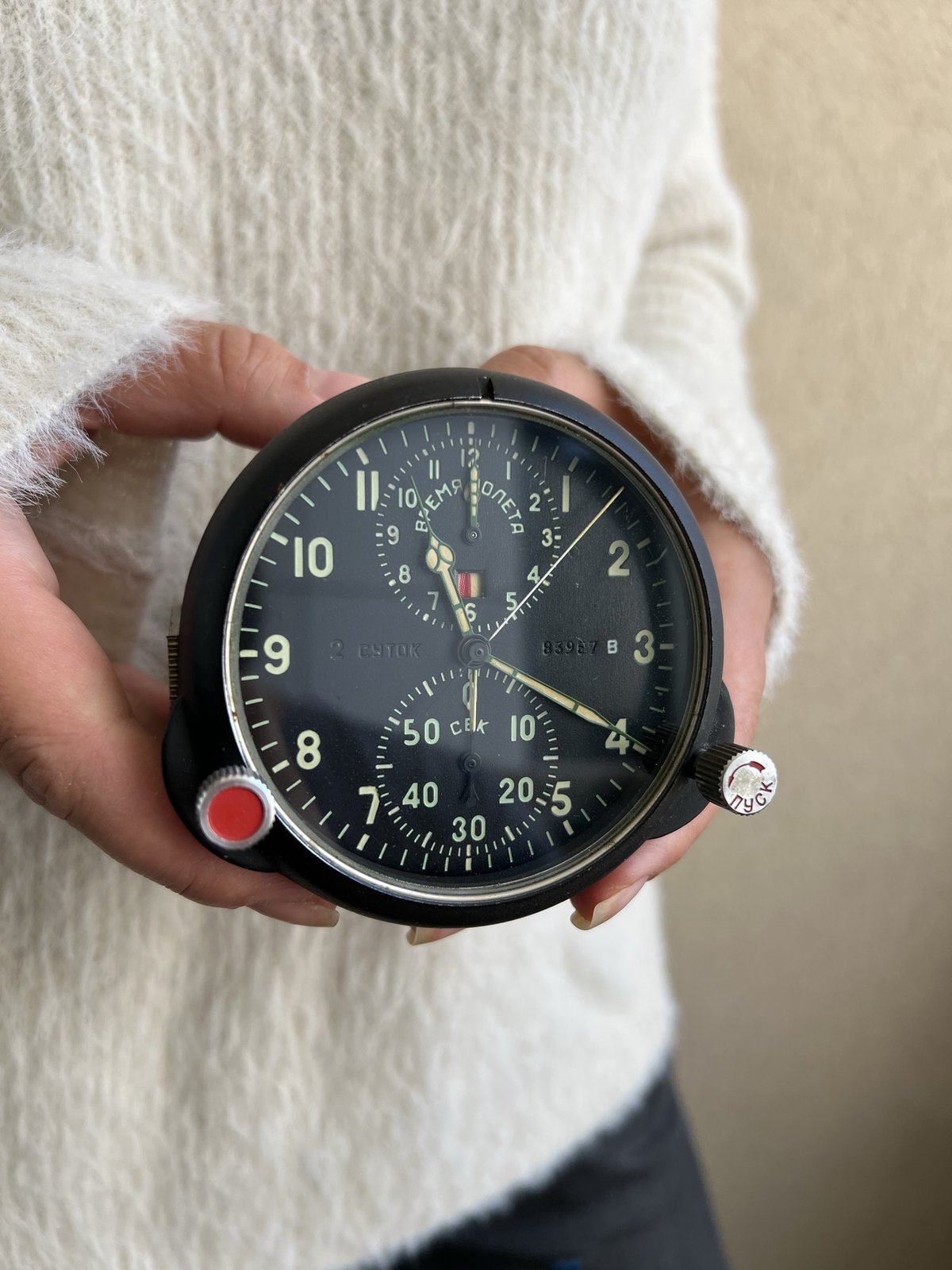
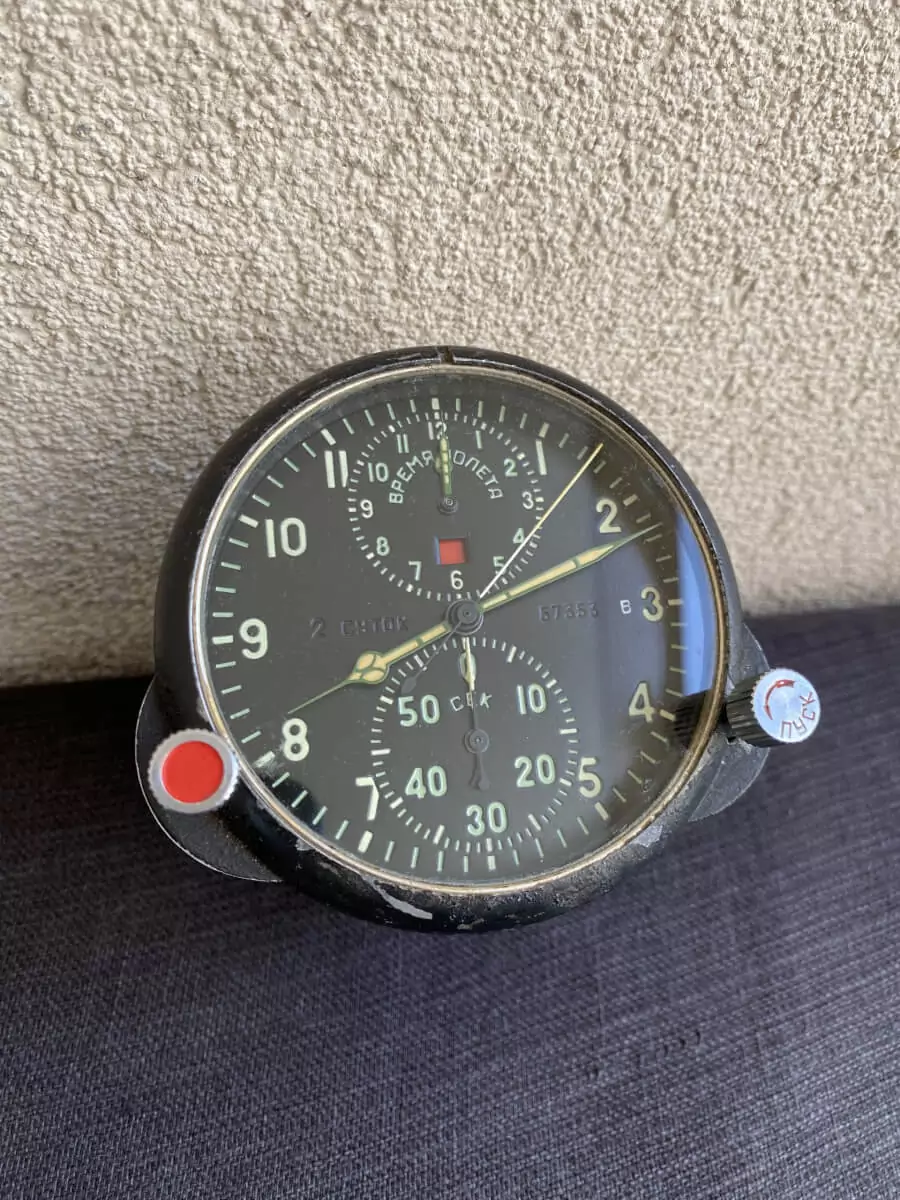
AChS-1 number 83937 B seen from the front. The B marking to the right of the hands indicates a non-radioactive luminescence.
The АЧС-1 is massive, and its first characteristic is its size. The case measures 85 millimetres in diameter, with a depth of 54 millimetres, rising to 62.5 millimetres including the crowns, and a weight of around 655 grams. The total height of the device, including the mounting bracket, reaches 91.4 millimetres. This is not an instrument you wear. It is a device that bolts into an instrument panel, and it was calibrated to withstand accelerations of several G, temperature ranges of plus or minus sixty degrees, and permanent mechanical vibration.
The dial is black, matt, with almost no decorative information. The luminous Arabic numerals mark the hours from one to twelve. A minute scale graduated every five points runs around the periphery. At the centre, two main luminous hands indicate the current time, and a third sweep hand, thinner, travels across the full diameter of the dial. It is this hand that serves as the chronograph seconds hand, and it comes to a halt as soon as the pilot operates the ПУСК crown.
At twelve o’clock, a first sub-dial carries the inscription ВРЕМЯ ПОЛЕТА, meaning flight time, graduated from 1 to 12 cumulative hours. At six o’clock, a second sub-dial marked СЕК serves as the minute totaliser for the chronograph. On the original АЧС-1 it is graduated over sixty minutes, with the figure 30 at the bottom vertical position. On the АЧС-1М, the modified version discussed further on, the same sub-dial is reduced to thirty minutes, and this time it is the figure 15 that occupies the lower position. It is an immediate marker for telling the two generations apart.
Below the centre, a discreet mention: 2 СУТОК, two days, which refers to the stated power reserve. We shall come back to it, as this figure conceals a technical particularity that no official manual has ever fully documented.
On the sides of the case, two crowns flank the dial. On the left, a crown painted red performs three functions. It first serves to set the time and to wind the movement, winding being carried out exclusively anticlockwise (the gear train does not turn the other way). It then controls the flight-time counter, handling its start, its stop and its reset to zero when the pilot strings together several flight legs. On the right, a black crown carrying the mention ПУСК (which means start in Russian) performs two distinct functions. It first controls the clock’s chronograph function, whose measurable duration reaches thirty minutes or one hour depending on the version. It also serves to stop and restart the clock’s main mechanism, an uncommon function in civilian horology but one that makes full sense in a cockpit: when the aircraft is grounded for long periods, the pilot can stop the movement to preserve the energy stored in the mainsprings, and restart it instantly before a new flight without having to wind the clock.
To see what each crown does, try them on the clock below.
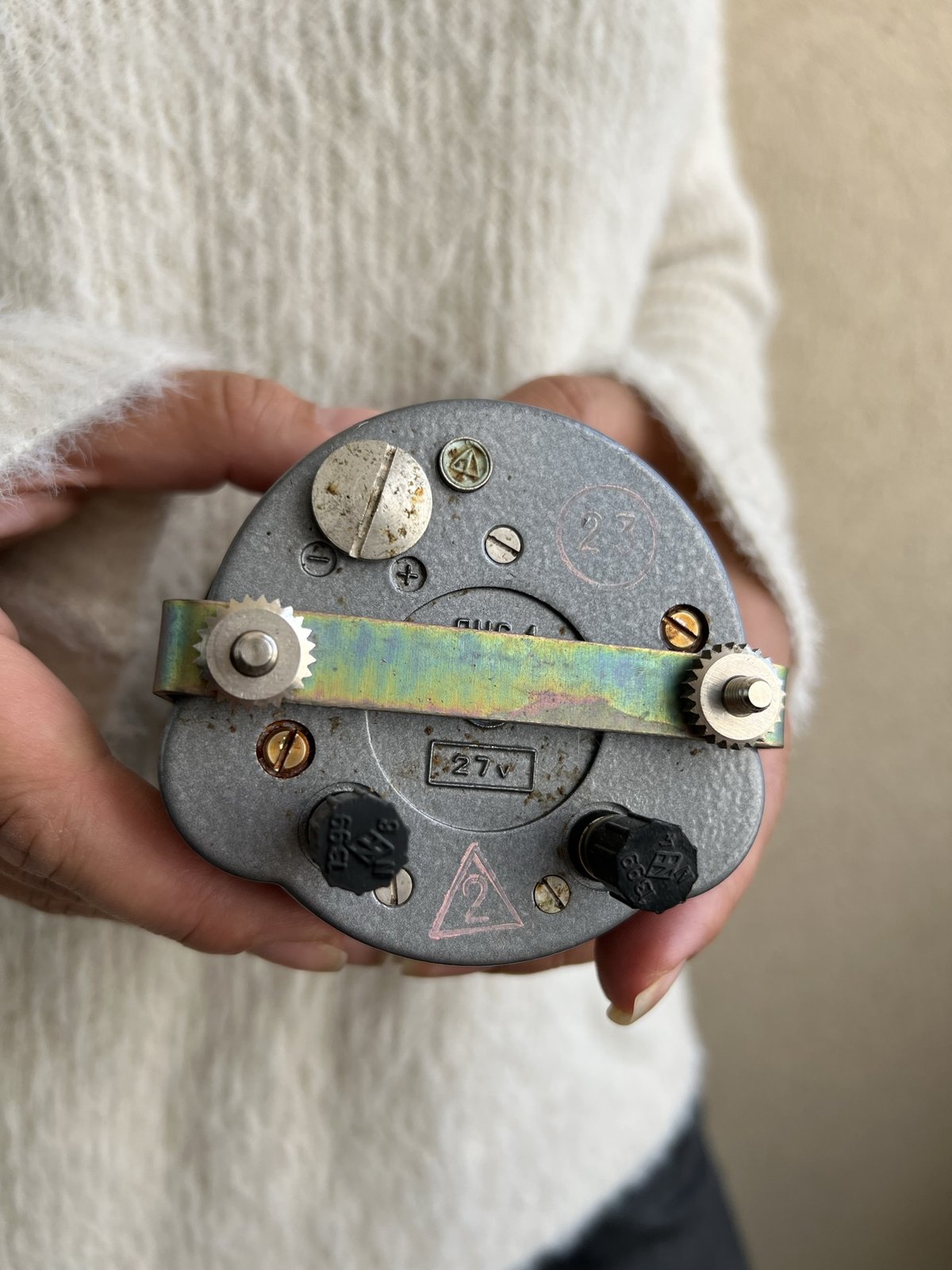
Rear view of an АЧС-1. The case is a single moulded aluminium piece, whose АЧС-1 marking comes directly from the casting. Also visible are the 27V mention, the two black bakelite electrical terminals, and the instrument panel mounting bracket.
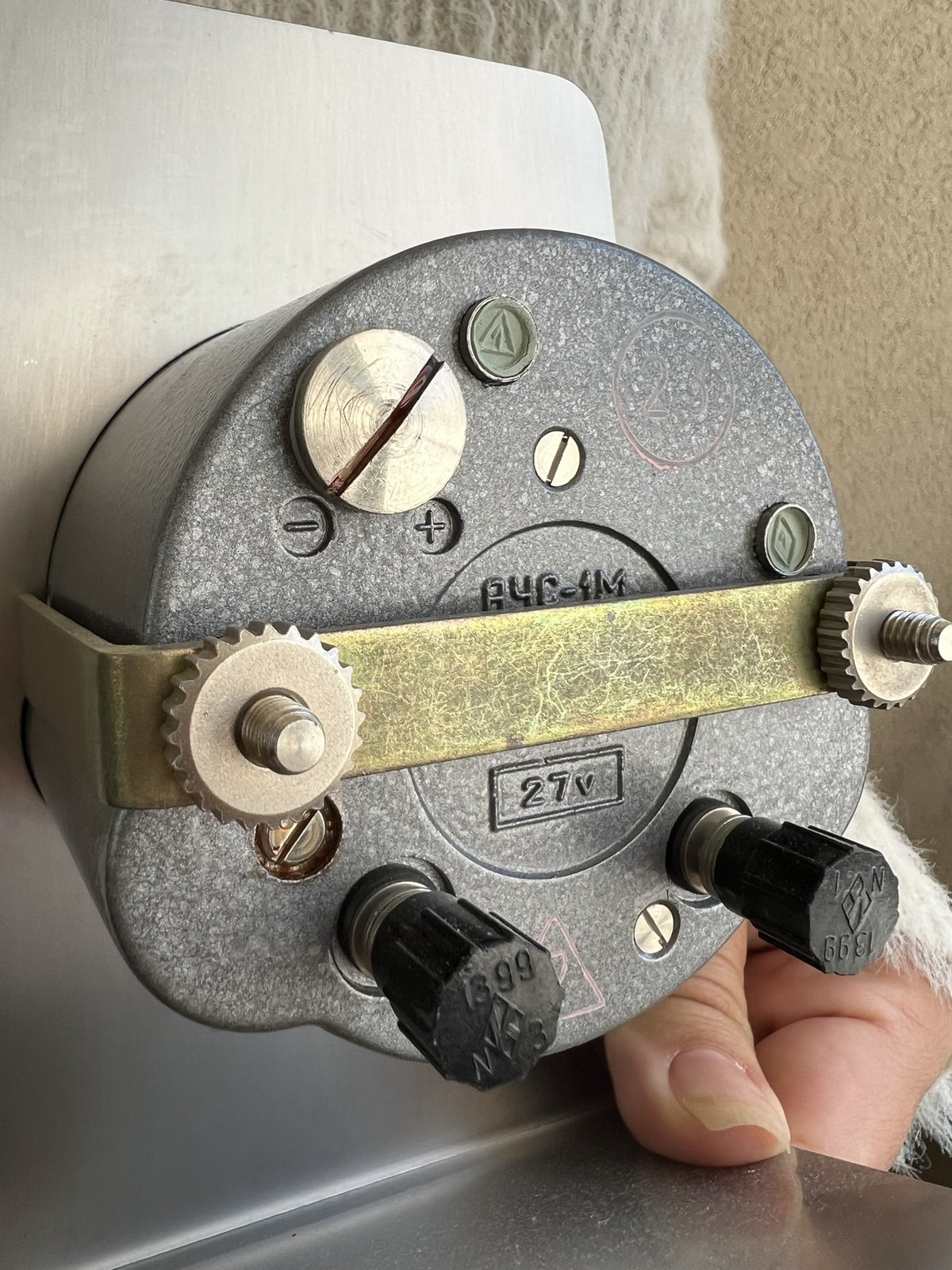
The back of the clock is just as telling. Under a rack-type mounting bracket, one reads the engraved inscription АЧС-1, the serial number and the mention 27V. This last one concerns not the movement, which is purely mechanical and hand-wound, but the electrical heating system built into the case. At high altitude, the cabin temperature could drop very low. The heating kept the watch oil at a correct viscosity. The factory manual specifies that this circuit is associated with a built-in thermoregulator, which automatically keeps the movement at a stable working temperature once the heating has been switched on by the pilot, with no further manual intervention. Two black bakelite terminals, on the lower side of the back, received the wires of the aircraft’s 27V circuit. Finally, an adjustment screw bearing plus and minus signs allowed a military watchmaker to regulate the rate on the ground, as part of periodic servicing.
The secret of the double mainspring
The dial announces it: two days of power reserve. 2 СУТОК. That is the official information, the one found in instruction manuals, on dealers’ websites and in almost every description on the second-hand market. But it is inaccurate, or more precisely, it is deliberately understated.
The AChS-1 in fact has two mainsprings mounted in parallel, mechanically coupled to a single winding train. When the pilot turns the left-hand crown, he arms both barrels simultaneously. Fully wound, the clock’s real power reserve reaches about eighty-four hours, that is three and a half full days, and not two.
So why announce 48 hours on the dial? The answer lies in one word of horology: isochronism. A mainspring does not release its energy in a perfectly constant way. The more it unwinds, the lower the torque it transmits to the escapement, and the more the rate tends to lose accuracy. By displaying two days where the movement holds eighty-four hours, Molnija’s engineers were indicating to the pilot the recommended winding interval, that is the window within which the clock ran in the most stable portion of its reserve. It is a usage recommendation disguised as a technical specification, but behind that understated figure lies a mechanism far more generous than it appears. It is also why АЧС-1 clocks forgotten in a cupboard can surprise their new owner by continuing to run for three days after a full wind. The ПУСК crown, which allows the movement to be stopped and restarted instantly, completes this energy-saving logic: between two missions, the pilot could stop the mechanism and keep the power reserve intact.
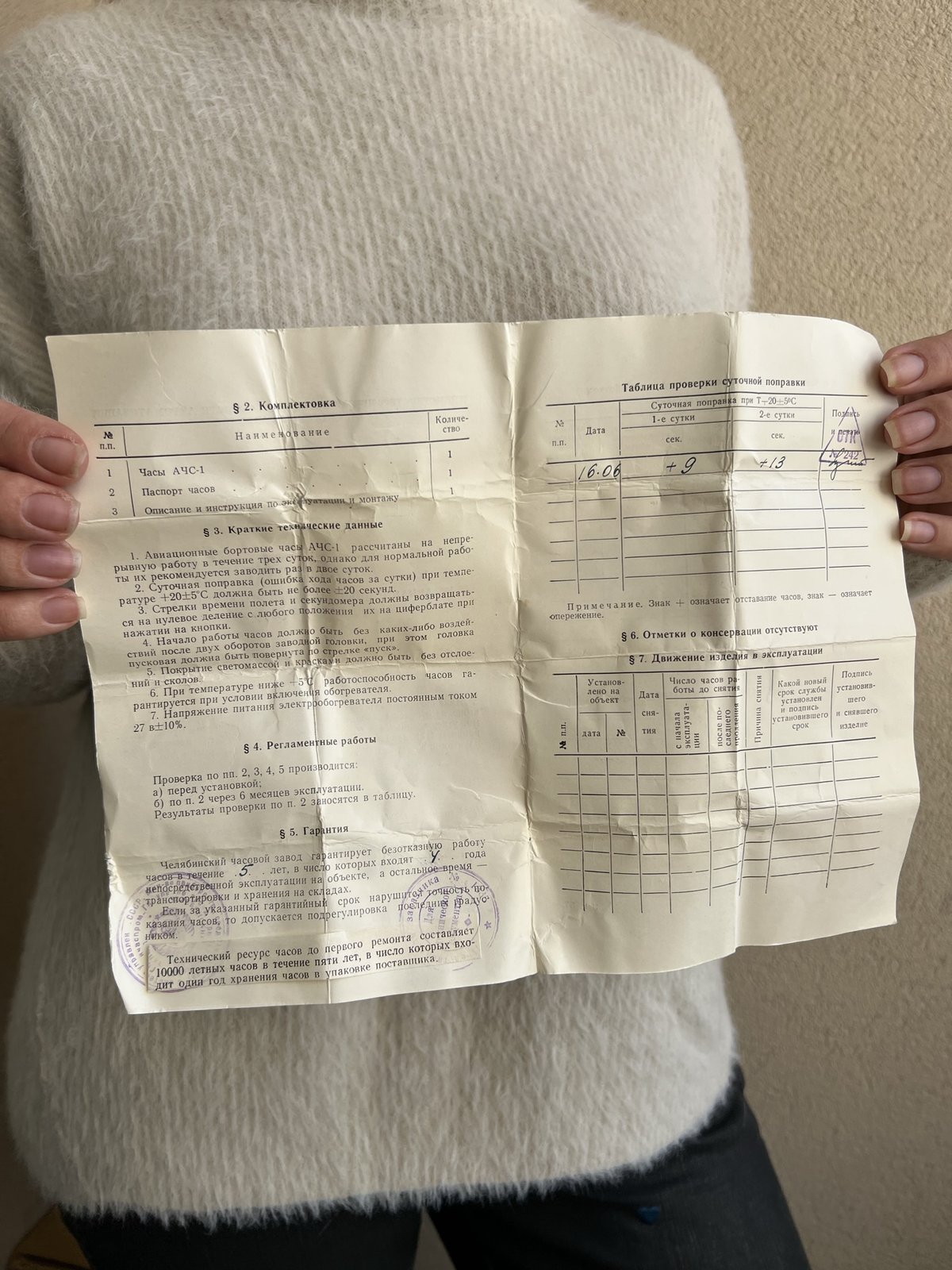
This technical particularity is in fact confirmed in the official factory documentation. On the passport of an АЧС-1 produced in December 1970 and preserved intact with its serial number 17941, the technical section states that “the АЧС-1 on-board clocks are designed to run continuously for three days, but for normal operation it is recommended to wind them every two days”. The factory therefore explicitly acknowledges the existence of this extended reserve, while recommending winding every two days to preserve the accuracy of the movement. The same document sets the maximum rate deviation at twenty seconds per day at twenty degrees Celsius, and specifies the electrical heating voltage at 27 volts ±10%, required as soon as the temperature drops below minus five degrees.
Technical pages from the passport of an АЧС-1 produced in 1970. Section §3 confirms in black and white the real power reserve of three days, the permitted rate deviation of ±20 seconds per day, and the heating voltage of 27V ±10%.
The B and K variants, and how to tell them apart
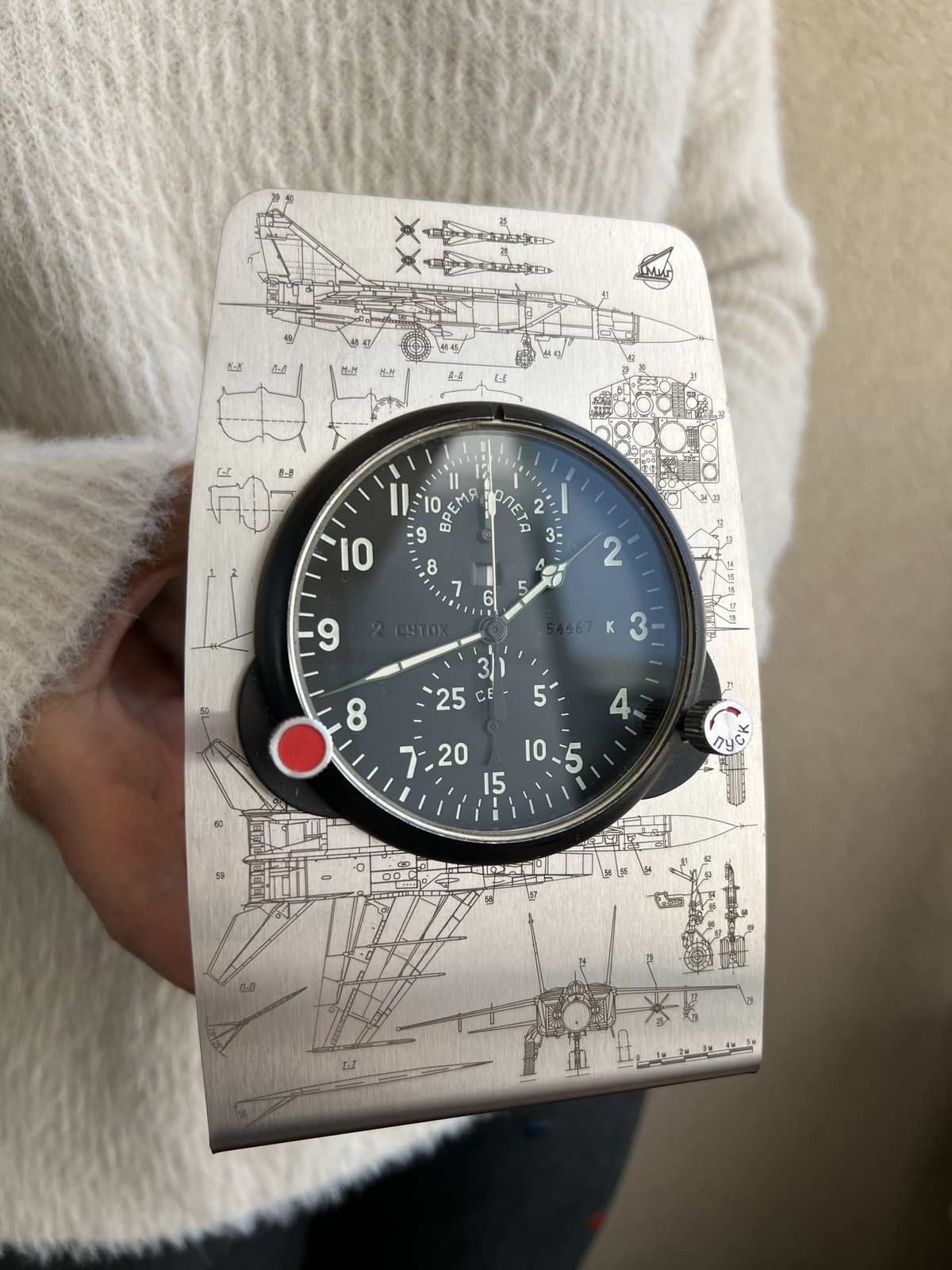
AChS-1 number 54467 K. On the K variant, the numerals and hands are pure white, with no luminous pigment, optimised for reading under red night cabin lighting.
Not all AChS-1 clocks are alike. Two main variants circulate on the second-hand market, and knowing how to tell them apart avoids a few unpleasant surprises.
The B variant, identifiable by the Cyrillic letter В printed to the right of the serial number on the dial, has luminous paint of a light beige or cream appearance. This is a non-radioactive phosphorescent pigment luminescence, introduced from the 1960s onwards to replace the older radium paints. This variant, which today makes up the vast majority of available pieces, poses no handling problem and retains excellent contrast on a black dial.
The K variant, identifiable by the Cyrillic letter К in the same position, has no luminous paint at all. Its numerals and hands are pure white, with no green pigment. This specification corresponds to cabins fitted with red night lighting, which would destroy the contrast of a conventional green lume. In daylight, an AChS-1 K reads just as well as a B variant. In the dark it does not glow, and that is precisely what was required.
To the naked eye, in a photograph, the two variants can be confused. The most reliable marker remains the Cyrillic letter stamped on the dial to the right of the number. Alongside these two widespread variants, one more rarely comes across AChS-1 clocks predating the 1960s, whose luminescence relied on radium compounds. We do not sell those at Soviet in Paris.
The aircraft it equipped
From the day it entered production in 1958 until the end of the USSR, the AChS-1 equipped almost everything the Soviet air fleet was able to send into the sky. It appears in the cockpits of the MiG-15, MiG-17, MiG-19, MiG-21, MiG-23, MiG-25 and MiG-29 fighters, of the Su-24 and Su-27, of the Tu-22M3, Tu-95MS and Tu-160 strategic bombers, of the Il-76 heavy transport, and of a wide variety of Mil and Kamov helicopters, including the Mi-8, Mi-24, Mi-28 and Ka-50.
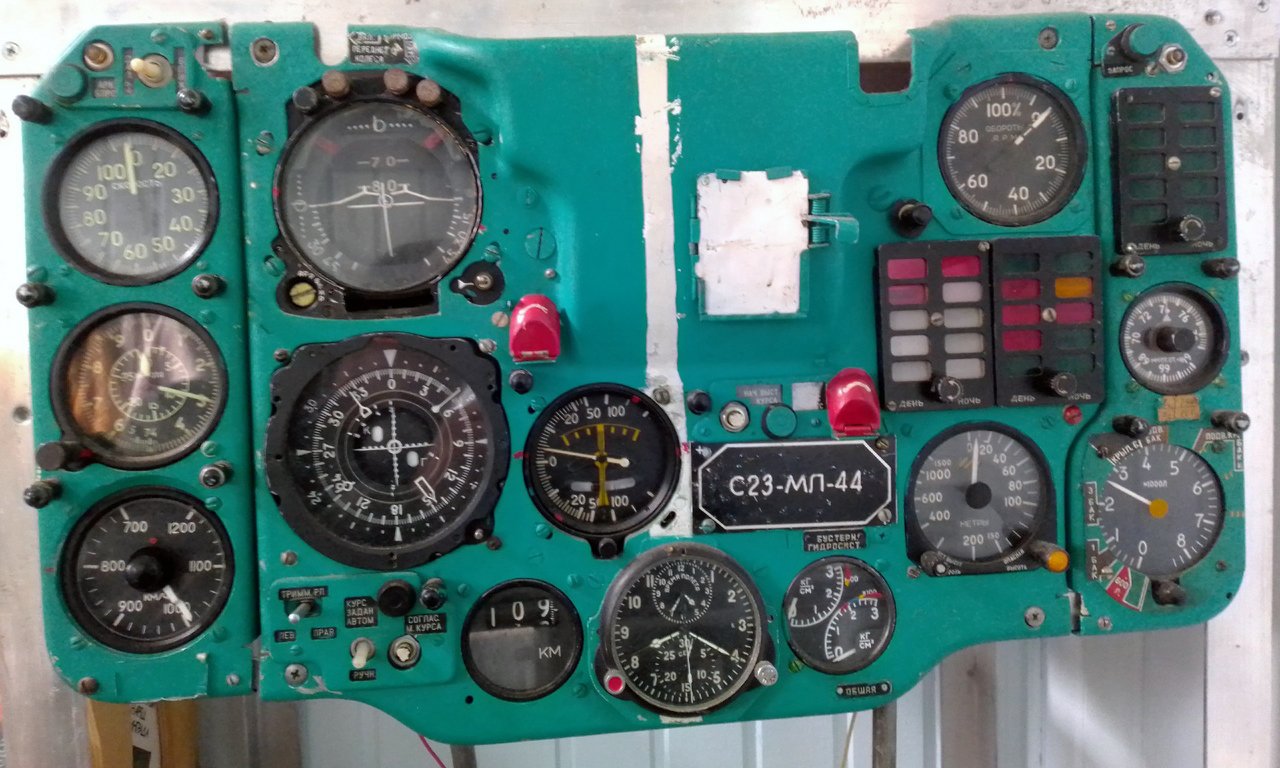
Instrument panel of a MiG-23ML, identified by its С23-МЛ-44 plate. The AChS-1 occupies the lower central position on the panel, to the right of the distance counter.
On this MiG-23ML panel, the АЧС-1 is immediately recognisable. Black dial, two sub-dials, red-painted crown on the left, ПУСК in red on a white background on the right. It occupies a central position on the instrument panel, at the pilot’s eye level.
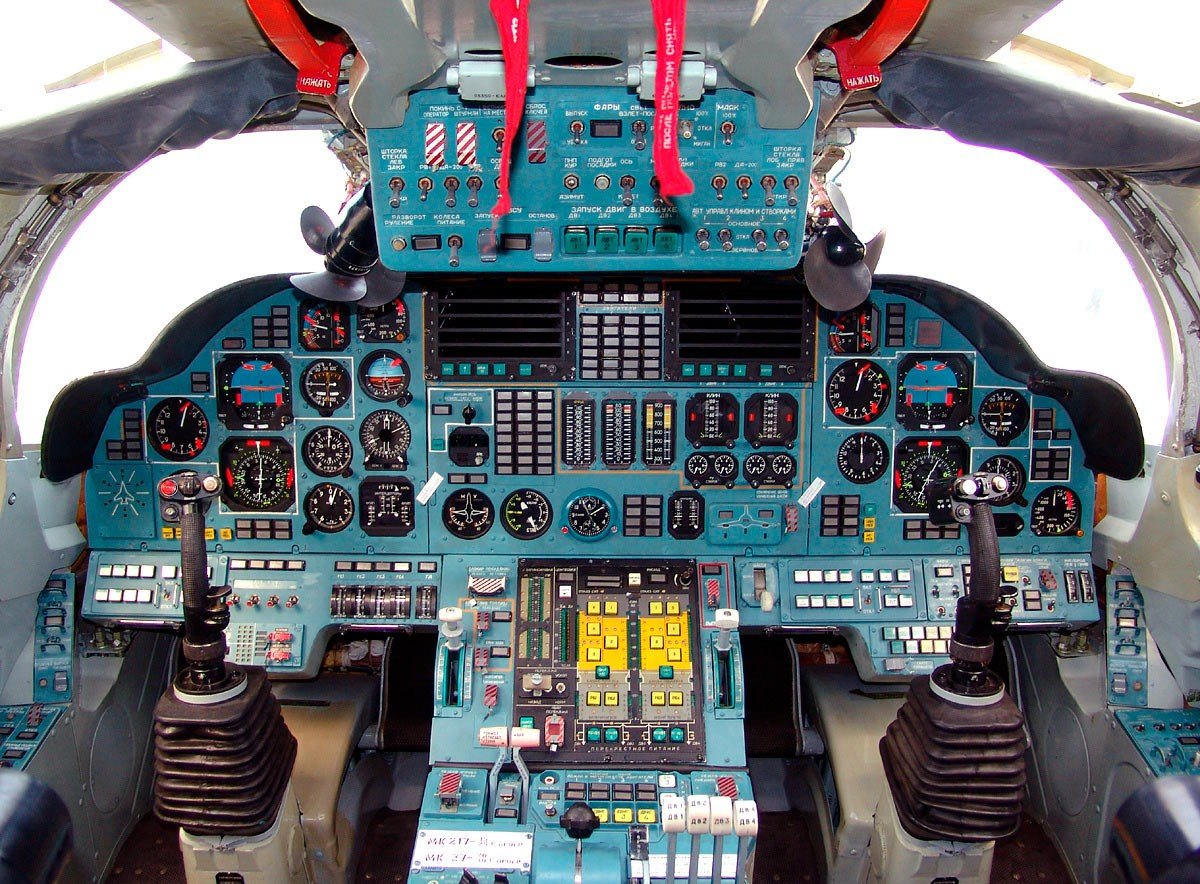
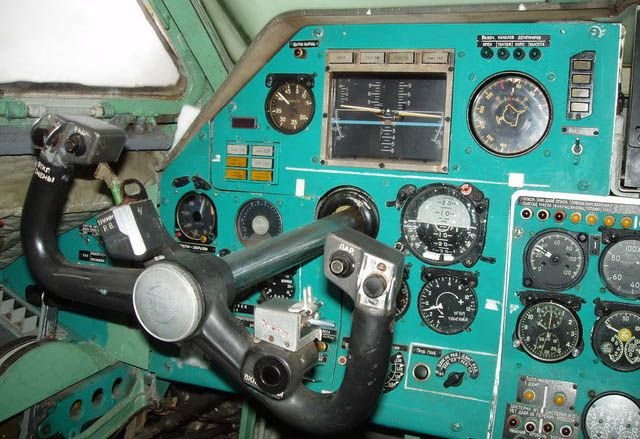
Cockpit of the Tu-160 strategic bomber. The AChS-1 equips this supersonic flight deck alongside the long-range navigation instrumentation.
Moving from the light fighter to the strategic bomber changes nothing about the instrument. The AChS-1 of the Tu-160 is exactly the same as that of the MiG-23. Same case, same calibre, same dial. This standardisation, particularly pronounced in Soviet industrial doctrine, largely explains the production volumes reached by Molnija. At its peak, in 1988, the factory produced more than 1.4 million horological instruments a year, all categories combined, and exported to some thirty countries. Across the decades of production, the cumulative total of AChS-1 clocks and their derivatives runs into tens of thousands of examples.
The AChS-1M, or the 72-hour version
As generations of fighters and helicopters evolved towards longer missions, the need for a more generous power reserve and an extended chronograph became apparent. Molnija responded by developing a modernised version of the АЧС-1, designated АЧС-1М. Externally, the case remains very close to the original piece, same dimensions, same dial architecture, same controls. But the internal mechanics bring two notable changes: a declared reserve raised to seventy-two hours, that is three full days between windings, and a chronograph counter reduced to thirty minutes instead of the sixty minutes of the original АЧС-1.
A third difference, more discreet but documented by the factory’s technical manual, concerns the sweep hand at the centre of the dial. On the АЧС-1, this hand is the seconds hand of the main movement: it turns permanently, and allows the current time to be read in hours, minutes and seconds. On the АЧС-1М, the same hand becomes the chronograph seconds hand exclusively, and therefore only runs when the chronograph is activated. The practical consequence is that the АЧС-1М simply does not display the seconds of the current time. At rest, the central sweep hand is stationary and the time is read only in hours and minutes. When the pilot engages the ПУСК crown, the hand starts moving, but it then indicates chronograph seconds, read together with the СЕК sub-dial for the chronograph minutes.
On the latest pieces, the AChS-1M is found in the cockpits of the MiG-29, the Su-27, the Tu-160 and the Ka-52, sometimes alongside more recent digital instruments. For a collector, telling an AChS-1 from an AChS-1M takes a trained eye: the М mention is generally stamped next to the АЧС inscription on the back of the case, and some models carry the updated reserve mention on the dial.
Beyond the cockpit: the ekranoplan and Baikonur
Cockpit of a Soviet ekranoplan. The AChS-1 is among the instruments on the panel, to the right of the flight controls.
The AChS-1 was not limited to aircraft in the classic sense. It is also found aboard the ekranoplans, those hybrid ground-effect craft developed during the Cold War, the most emblematic of which remains the KM, known as the Caspian Sea Monster. The ekranoplans flew a few metres above the surface of the water, at speeds exceeding five hundred kilometres per hour, in a flight geometry radically different from that of a conventional aircraft. But their cockpits borrowed heavily from standard Soviet aeronautical instrumentation, and the AChS-1 quite naturally found its place there.
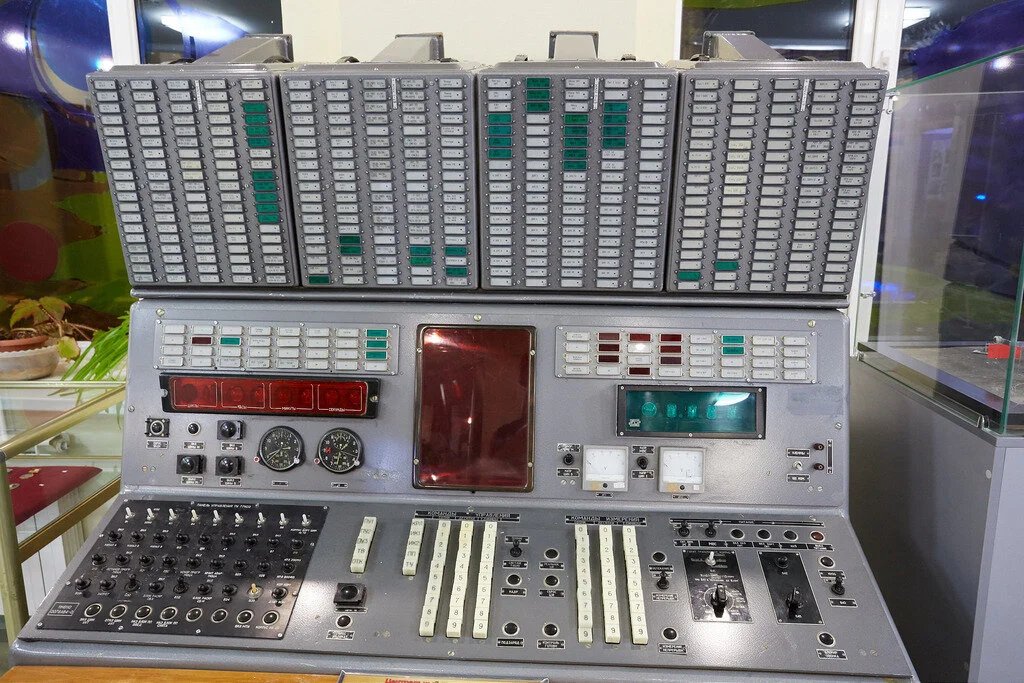
Central control console 11Н6110 preserved at the Baikonur museum. Two AChS-1 clocks are visible in the middle of the panel, below the red digital indicators.
And then there is Baikonur. On the central control console 11Н6110, today preserved at the cosmodrome museum, two АЧС-1 clocks are built into the command panel. This console was used to test the onboard electronics of the Soyuz spacecraft and of the modules of the Salyut and Mir stations, as well as the Zarya functional cargo block, which since 1998 has been one of the founding compartments of the International Space Station.
The same AChS-1 is therefore found in radically distant contexts: a supersonic fighter cockpit, the flight deck of a ground-effect ekranoplan, and the ground test console of a cosmodrome, which served to validate the spacecraft that took cosmonauts to Mir and the ISS. The same clock, the same calibre, the same dial. It is exactly the kind of industrial standardisation that characterises Soviet technical horology.
From instrument to gift: a clock that does not stand on its own
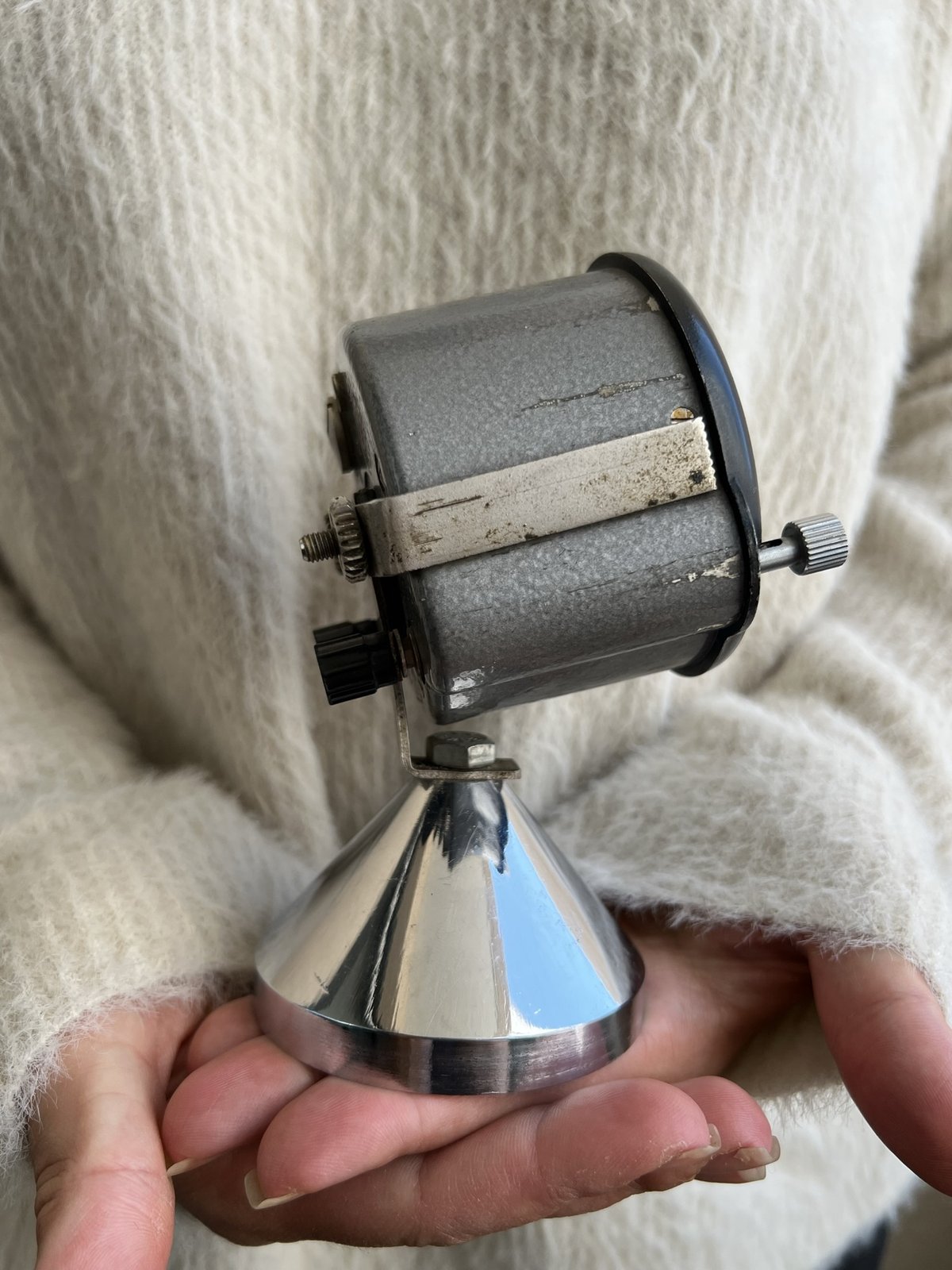
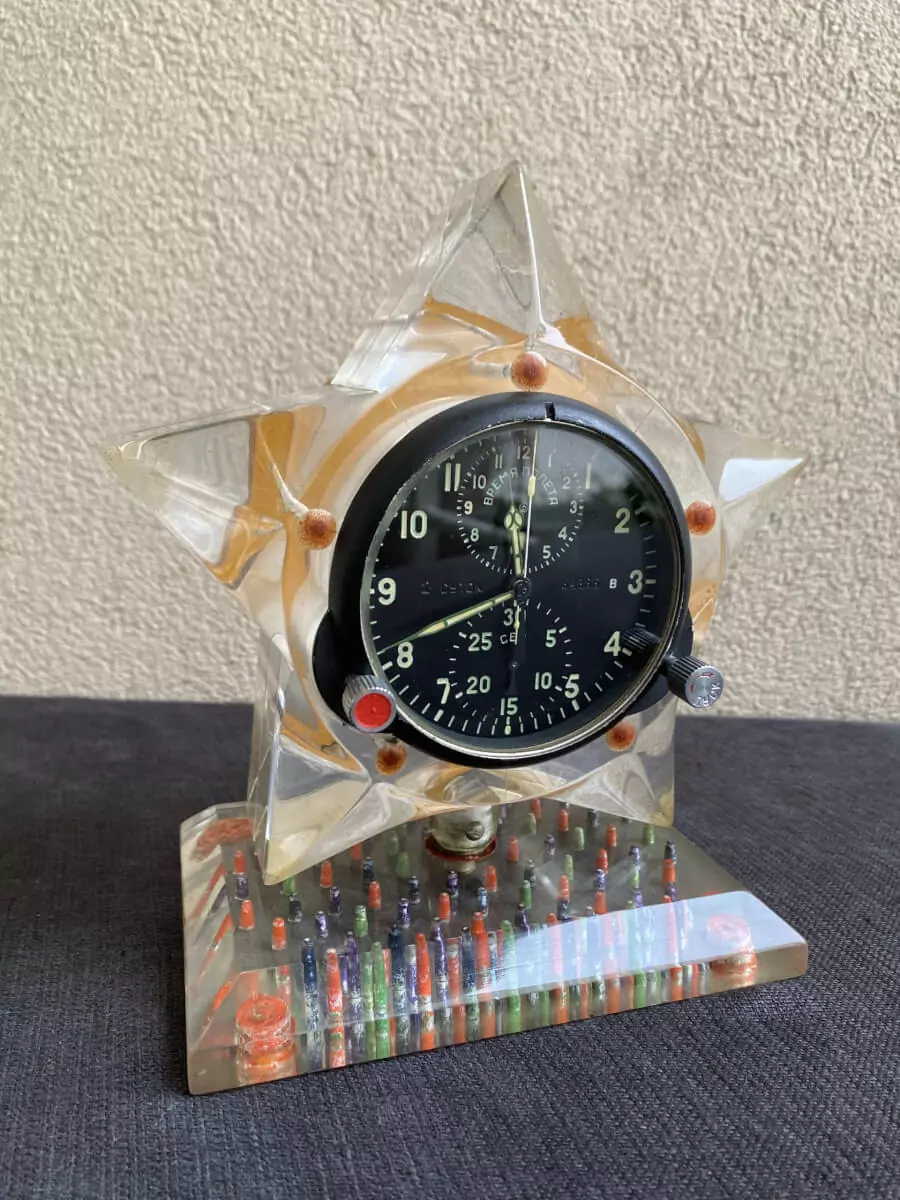
The АЧС-1 is designed to be fitted into an instrument panel, not to sit on a table. Its aluminium case has a perfectly rounded lower part, an extension of the movement cylinder, which makes the piece unstable as soon as it is laid flat. In Soviet practice, this particularity gave rise to a discreet tradition: when a clock left a cockpit for good, either to be withdrawn from service or to be offered as a gift to a pilot or a senior officer, a custom-made stand was produced for it. These display bases, generally in polished metal or turned wood, turned the military instrument into a decorative object without touching the original case.
АЧС-1 number 23774 B mounted on a chromed cast iron plate, engraved with technical views of Soviet fighters. This is one of the two stands we had made to stabilise the pieces outside their original cockpit.
For the pieces we offer today at Soviet in Paris, we had two types of modern stands made, inspired by this tradition. The first is a matt black plate stand, with an openwork aircraft silhouette, which directly evokes the original context of the piece and allows it to be presented vertically, as it would be seen behind a cockpit. The second is a vertical chromed cast iron plate, engraved with technical views of Soviet fighters (MiG-23, MiG-29, Su-27, Su-30 depending on the model), which places the clock in a genuine aeronautical setting without touching the original case. Both stands hold the piece perfectly steady, require no modification to the case, and allow the object to regain a visual presence at eye level, outside its initial aeronautical context.
How to choose an АЧС-1 today
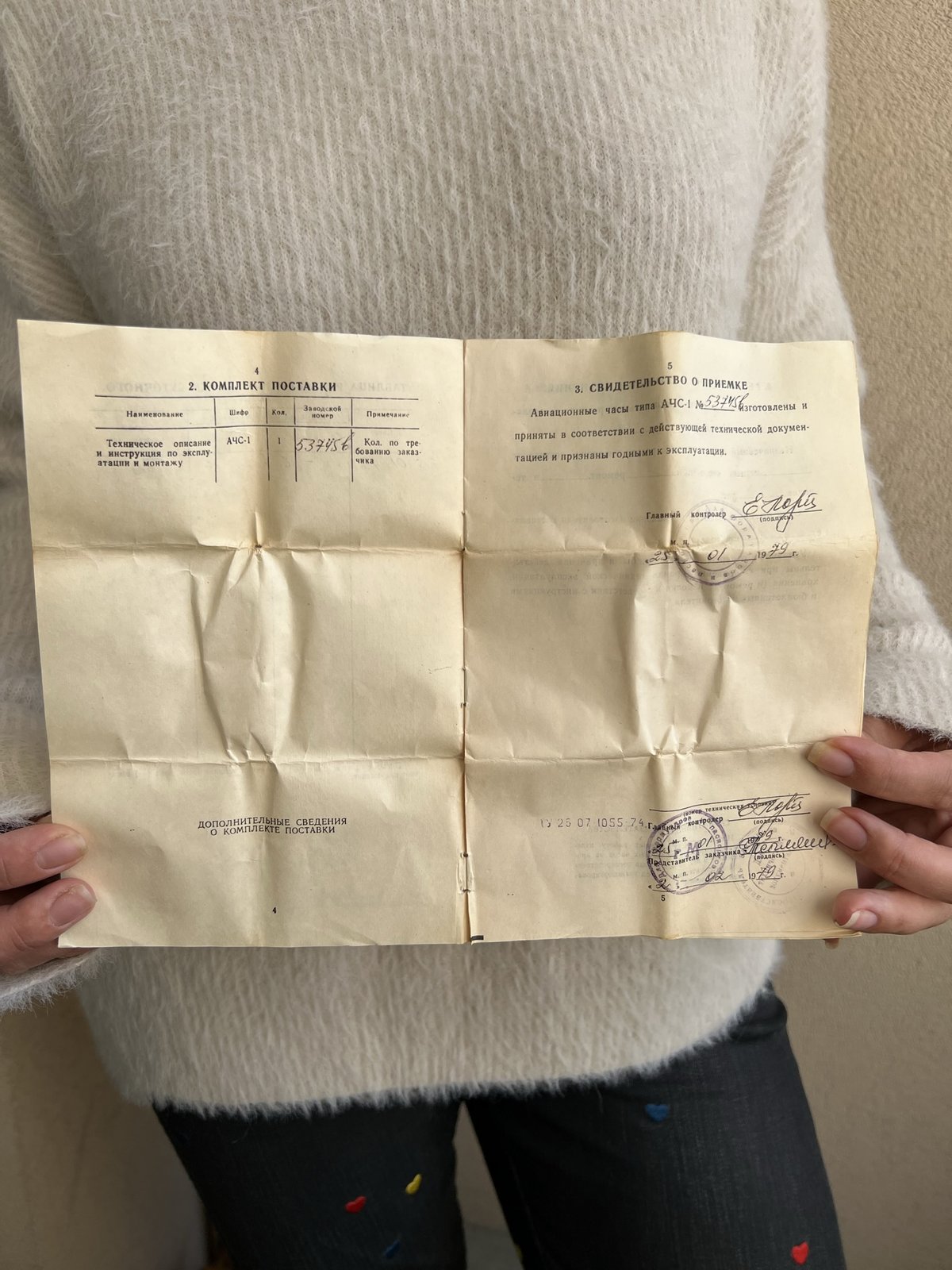
Original passport of an AChS-1 produced in 1979 to the TУ 25 07 1055-74 standard. The double signature, chief inspector and representative of the military customer, attests to a delivery compliant with the Soviet defence supply chain.
For a collector or an enthusiast discovering this piece, several criteria deserve attention.
The first thing to check is the consistency between dial, case and controls. A factory AChS-1 carries the same numeral font, the same Cyrillic typography for the ВРЕМЯ ПОЛЕТА, СЕК and ПУСК inscriptions, and the same matt finish on the dial. The hands should be leaf-shaped with an even factory luminescence, not obviously repainted. The red paint on the left crown should be clean, and the ПУСК crown should retain its factory inscription.
The second check concerns the back and the technical markings. The case, a single moulded aluminium piece, should carry the АЧС-1 inscription (or АЧС-1М for the modified version) produced by the casting, the serial number, the 27V mention, and the two bakelite terminals. The adjustment screws and the triangular quality control markings (often in red, with a figure inside) are markers of Soviet military production.
Two further technical details on the back deserve particular attention. The first is the large circular screw located at the top of the case, to the left of the central marking. It does not serve to fix the piece to the instrument panel: it closes off access to the mechanism. By unscrewing it carefully, a watchmaker reaches the rate regulator directly and can adjust the accuracy of the clock. This opening was provided from the outset for the periodic servicing carried out by Soviet military workshops.
The second detail, and probably the most important for authenticating a piece, is the green resin factory seals visible on the surface of the case, generally two of them. These pellets were applied at the end of the production line, stamped with Molnija’s quality control triangle, and seal screws on the back. As long as the seals are intact, they certify that the clock has never been opened since it was made. It is one of the hardest markers of authenticity to reproduce, and it becomes particularly valuable when combined with the presence of the original passport.
Rear view of an АЧС-1М. The large circular screw at the top gives access to the rate regulator for precision adjustments. The two green resin pellets stamped with the Molnija triangle are the original factory seals: as long as they are intact, they certify that the piece has never been opened since it left the production line.
A detail that untrained eyes almost always miss then deserves attention: the parallel wear marks sometimes seen on the side of the case. These two fine, elongated, strictly parallel grooves are not a defect. They are the mark left by the instrument panel mounting inserts, when the clock was fitted into and then removed from a cockpit, sometimes several times over its career. When they are visible, these grooves are the most direct and the hardest to falsify proof that the piece led a real operational life in an aircraft, and that it did not simply come out of a never-opened military stock.
Side view of an АЧС-1. The two parallel wear marks on the flank of the case are the characteristic mark of a clock fitted into and then removed from a cockpit. It is one of the most telling proofs of a real operational life.
One often overlooked detail finally concerns the scale of the СЕК sub-dial at six o’clock, which identifies the generation of the clock in a second. If you read the figure 30 at the bottom position, it is an original АЧС-1, fitted with a sixty-minute chronograph. If the figure 15 occupies that position, the clock is an АЧС-1М, the modified version with a thirty-minute counter and a seventy-two hour power reserve.
But the criterion that changes everything, when it is present, is the presence of the original passport. Every AChS-1 coming off the Chelyabinsk lines was accompanied by an official document, the Паспорт АЧС-1 ПС, listing the serial number, the date of acceptance, compliance with the technical standard TУ 25 07 1055-74, and bearing the signatures and stamps of the chief inspector and of the representative of the military customer. An AChS-1 supplied with its original passport, like example number 53745 shown above, dated 25 January 1979, guarantees not only the authenticity of the piece but also its traceability down to a precise month of production. On the market, this kind of documented provenance easily moves a piece into the higher category.
A word finally about the crystal. It is a flat, thick glass, mounted flush with the steel bezel, and designed to withstand cabin conditions. Its strength is remarkable: among the hundreds of АЧС-1 clocks we have examined over the years, we have never come across a single broken or cracked glass. The most frequent flaw is limited to a few surface scratches, the result of handling in the cockpit.
Good news for buyers: the АЧС-1 is almost never counterfeited. The piece is too widespread on the genuine second-hand market for a copy to have any economic interest, and its mechanics are too complex (two barrels in parallel, chronograph, movement stop function, integrated 27V heating) for a forger to make the work pay. The examples in circulation are, in the vast majority of cases, factory pieces. The real risk with this clock does not come from fakes but from mechanical condition.
The АЧС-1 is indeed a calibre of high complexity, designed to withstand the extreme conditions of flight, but which, like any old chronograph, requires periodic servicing. A complete overhaul, involving dismantling the movement, cleaning the components, checking both barrels, lubricating with modern watch oils and regulating the accuracy, represents several hours of work for a specialist watchmaker. Spare parts (springs, arbors, jewels) still exist on the military surplus market, but the expertise to reassemble them correctly, and above all to handle the specifics of the twin barrel and of the stop function via the ПУСК crown, is not found at just any watchmaker.
Our recommendation comes down to one sentence: buying an АЧС-1 in perfect working order, with a written guarantee, is almost always preferable to acquiring a piece of uncertain mechanical condition with the intention of having it serviced afterwards. The cost of a full overhaul at a competent watchmaker frequently exceeds the price difference between an already serviced piece and one sold without a guarantee.
If you already own an АЧС-1 or an АЧС-1М that needs work, our Soviet Times service handles the servicing and restoration of these calibres. Our master watchmaker in Ukraine, who works exclusively on our pieces, has serviced more than one thousand eight hundred Soviet watches and clocks over the past five years. He follows the original assembly protocols, cleans the movements in an Elma Solvex SE ultrasonic machine, and lubricates them with Swiss watch oils.
The AChS-1 is not a rare piece. It was produced in very large numbers, it still equips certain Russian military aircraft in service today, and the second-hand market offers it regularly. It is not its rarity that appeals, it is everything it condenses into a single compact instrument.
A series-production Soviet mechanical clock, with its factory Cyrillic inscriptions, its integrated 27V heating, and its two springs hidden under a dial that announces less than it holds. A direct descent from an order placed in Paris in the 1930s, acknowledged as such in Molnija’s official documentation. A presence in every cockpit of Soviet aviation, from the MiG-15 to the contemporary Tu-160, and beyond, as far as a test console at Baikonur that helped validate the spacecraft which joined Mir and the ISS. For such a plainly industrial object, that is a fairly uncommon trajectory.
All the АЧС-1 and АЧС-1М clocks we offer at Soviet in Paris are period pieces, in perfect working order, and exclusively of the B and K variants, therefore free of any radioactive paint. Each example is thoroughly tested, over several days, on the timegrapher and by hand, to verify its rate accuracy. As these clocks are remarkably reliable, most arrive already in perfect working order; when a fault appears, the piece goes to our master watchmaker in Ukraine for servicing. The full selection, accompanied where it survives by the original production passport, is gathered in our cockpit category.
The ДП-5В (DP-5V) is the field radiometer of Soviet civil defence: a green Bakelite console, a probe with a rotating gamma, beta and check-source shield, headphones and a manual that explains operation and maintenance. The one in this article served in an industrial bakery in Chișinău and was serviced in March 1991. Its owner shared his photos and documents with us, and we turned them into a tool that lets you operate it on screen, step by step.
The Moscow Games, from 19 July to 3 August 1980, boycotted by some sixty countries, produced more objects than any Soviet event: a bear cub, Misha, drawn by Viktor Chizhikov, an emblem made of running tracks, five thousand torches, watches from every factory, platinum coins, rings, tea glass holders, posters. This guide tells the story of the Games and reviews the objects, with the marks that authenticate them and the prices.
The 3017 chronograph of the First Moscow Watch Factory carries a five-digit number on the balance cock. The most common dating method reads it as a single series, from 1959 to 1979. Four factory passports show there are two, and that the same number can point to two watches made ten years apart. Here is how to read the number, the dial, the logo and the bridge, with a decoder to date your Strela, Poljot or Sekonda.
This website uses cookies to improve your experience while you navigate through the website.
Out of these cookies, the cookies that are categorised as necessary are stored on your browser as they are essential for the working of basic functionalities of the website.
We also use third-party cookies that help us analyse and understand how you use this website.
These cookies will be stored in your browser only with your consent.
You also have the option to opt out of these cookies.
But opting out of some of these cookies may affect your browsing experience.
Necessary cookies are absolutely essential for the website to function properly. This category only includes cookies that ensure basic functionalities and security features of the website. These cookies do not store any personal information.
Cookies that are not strictly necessary for the website to work and that are used specifically to collect personal data through analytics, ads and other embedded content are called non-necessary cookies. User consent is required before these cookies run on the website.
✕
Soviet in Paris
Offline right now. Leave your message and your email, we reply within 24 hours.
Hello 👋 A question about an item, an order or shipping? Write to us.
Your email is used only to reply to you.
Subscribe to our newsletter and get 10% off your first order.
Subscribe
★ New pieces before anyone else
★ New blog articles
★ Soviet in Paris news and updates
Join the Party
10% off your first order
Receive your welcome card and our next arrivals.
Your code appears here and is also sent to you by email. You can leave the Party in one click, at any time.





 Strane Mira