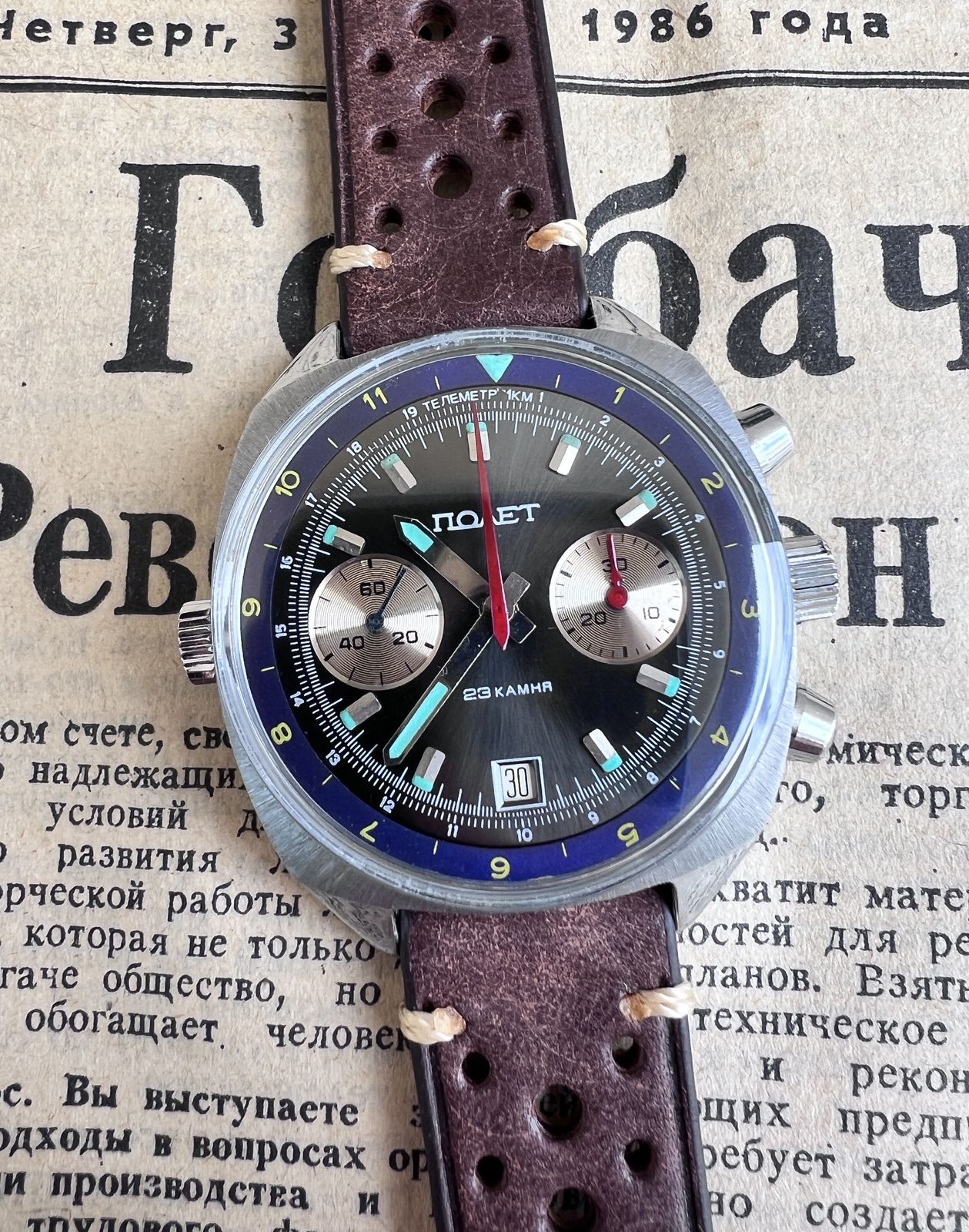
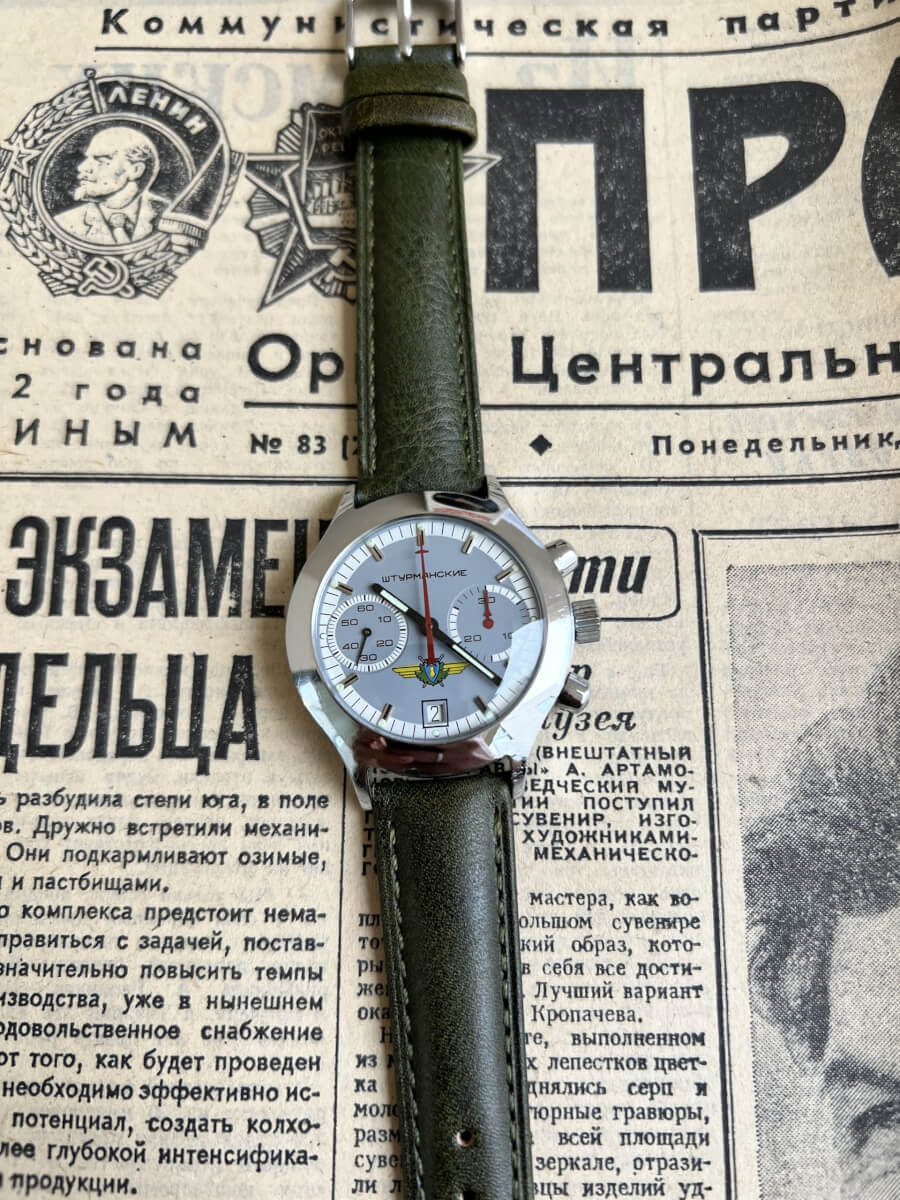
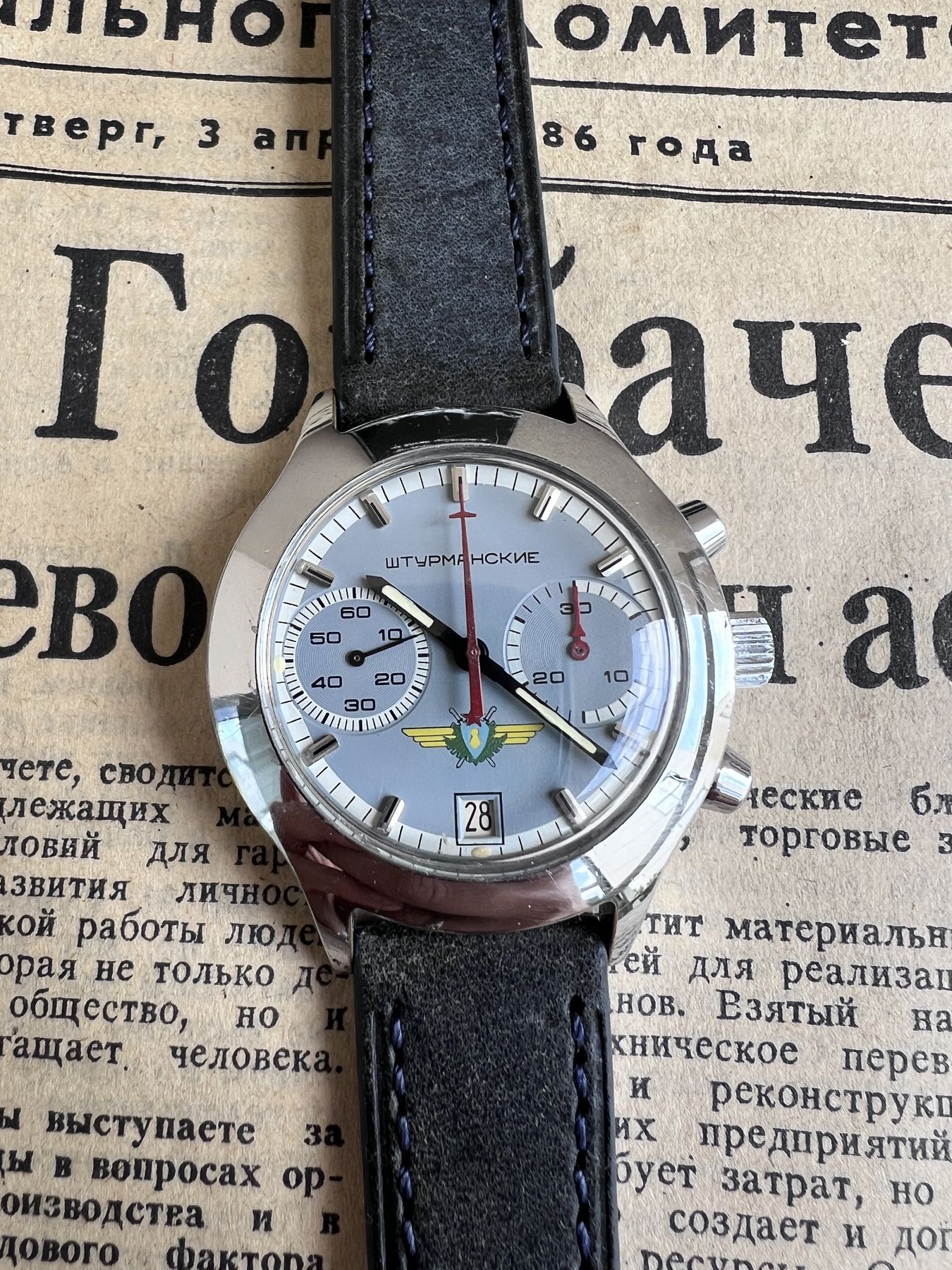
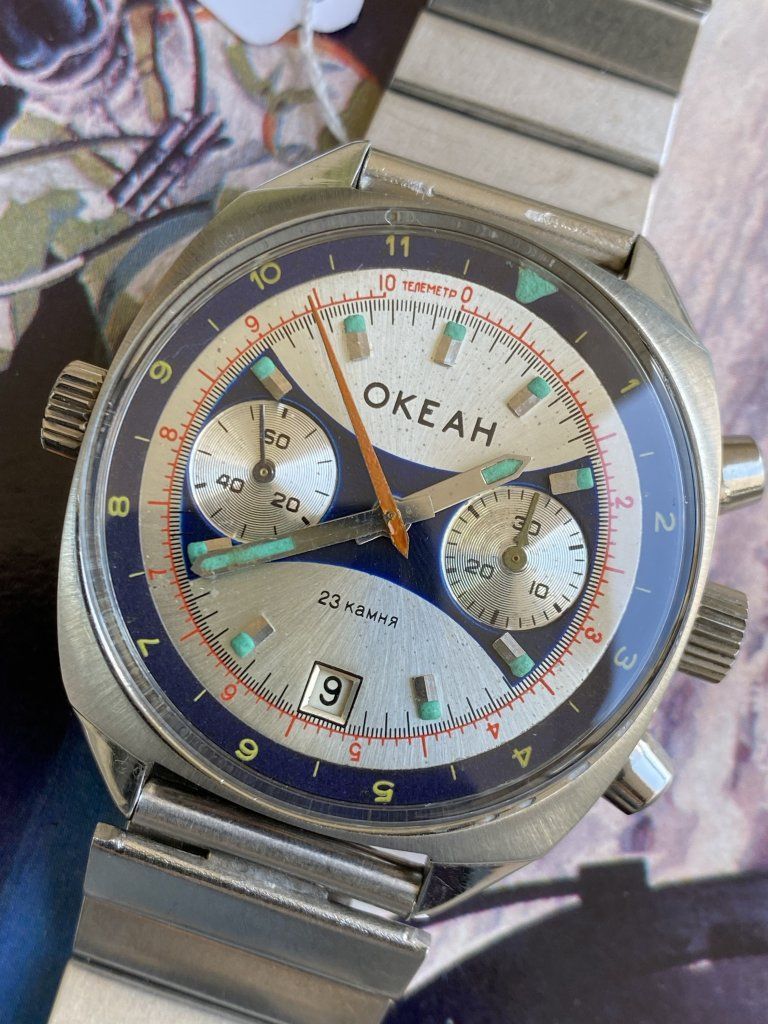
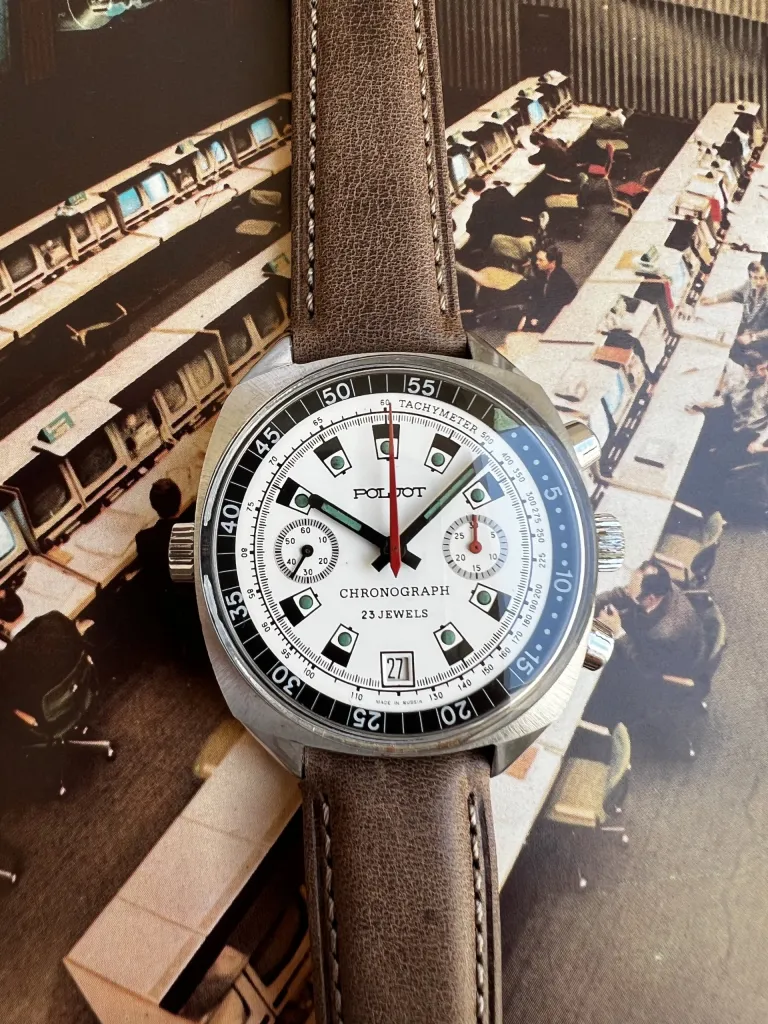
The Poljot 3133 calibre from the First Moscow Watch Factory powered Soviet, then Russian, chronographs for close to thirty years. One movement, very different watches: Poljot models sold in shops, Shturmanskie pieces that went through military acceptance, the Okean for the Navy, and later the 31659 made for air force crews. This guide covers where the calibre comes from, what sets these versions apart, and what to check on a watch before buying it.
OCTOBER 2026•10 MINUTE READ
by Marwen Yahyaoui
Listings often mix up the names Poljot, Shturmanskie and Okean. Telling them apart can mean a threefold difference in price.
A Swiss chronograph that moved to Moscow
The 3133 is derived from the Swiss Valjoux 7734. In the mid-1970s the First Moscow Watch Factory took over the tooling for that calibre and reworked it: 23 jewels instead of 17, 21,600 beats per hour instead of 18,000, and shock protection on the balance staff. The chronograph is cam-operated, with no column wheel. Production started in 1976. Poljot made it until the end of 2004, then MakTime bought the line in 2005 and stopped it in 2011.
The lineage goes further back. The starting point is the Venus 188, made from 1949 to 1966. Valjoux took over its tooling, built it as the 7730 until 1968, then developed the 7733 and the 7734, the latter with a date. In 1974 Valjoux dropped the 7734 to launch the 7750 and sold the tooling to Moscow.
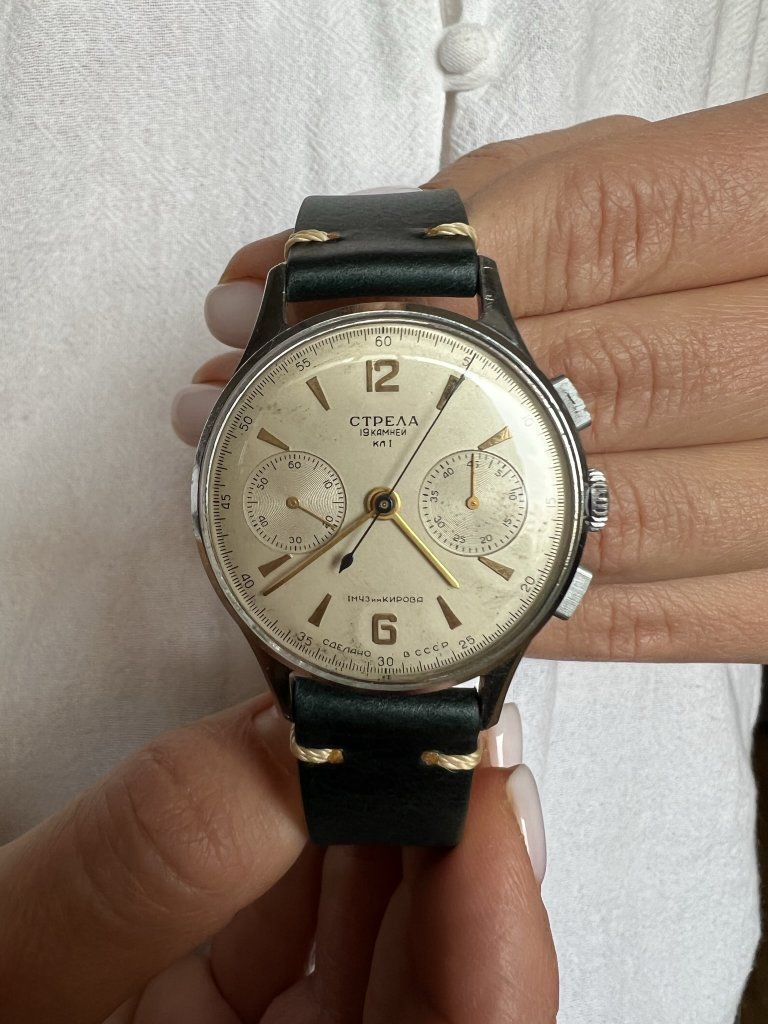
In Moscow the 3133 was meant to replace the 3017 calibre of the Strela, a column-wheel chronograph that cost more to make. Besides the jewels and the beat rate, Soviet engineers raised the main plate and fitted a smaller balance. The movement is 31 mm across and 7.35 mm high. The 1992 Poljot catalogue gives a power reserve of 43 hours with the chronograph stopped, 37 hours with it running, and a rate of -10 to +20 seconds a day.
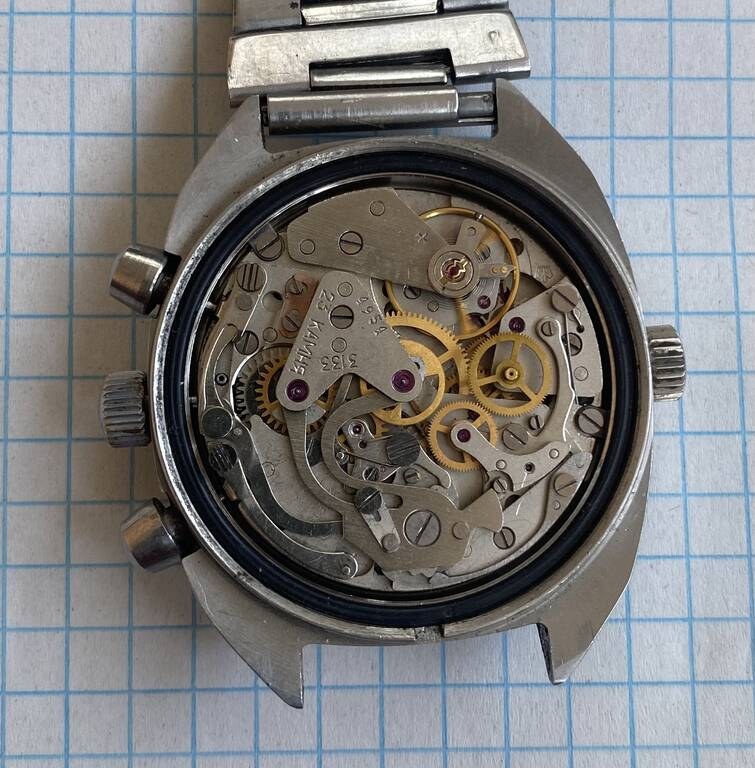
The 3133 calibre of a 1985 Shturmanskie, before servicing.
Okean and Shturmanskie 3133: the military series
The first 3133 watches were not sold to the public. The Okean was made for the Navy, the Shturmanskie for the air force. Both have a time-zone scale under the crystal, turned by a second crown at 9 o’clock. The Okean has a steel case, a caseback stamped « ВМФ Командирские » and a telemeter scale in nautical miles. The Shturmanskie exists in steel and in chrome-plated brass.
Shturmanskie 31659 in a steel case.
The calibre also went to space: Valery Rozhdestvensky wore an Okean on Soyuz 23, from 14 to 16 October 1976, a flight cut short after it failed to dock with the Salyut 5 station.
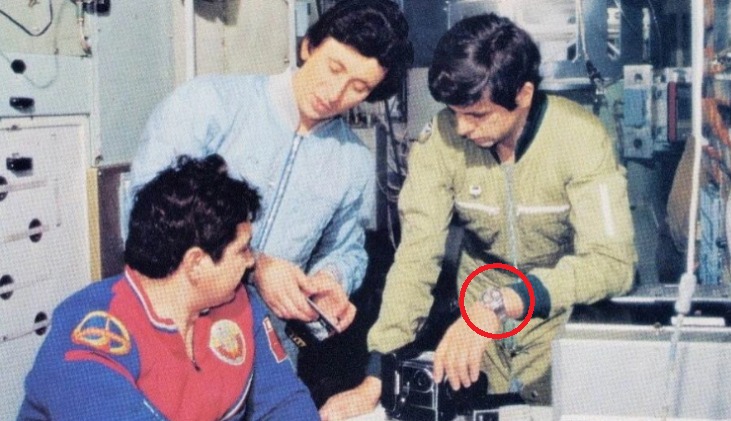
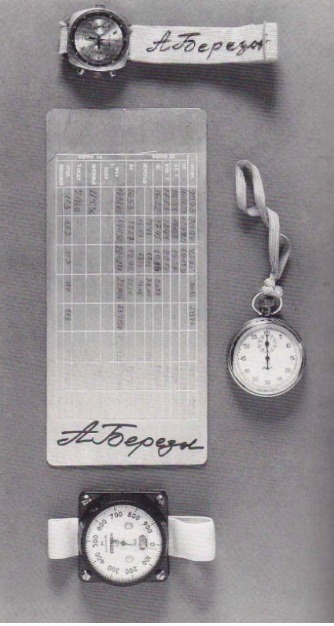
Cosmonauts had no assigned watch: they obtained these chronographs themselves, at a time when the public could not buy them. Anatoly Berezovoy wore one, reference 1981706, on Soyuz T-5 and aboard Salyut 7, from 13 May to 10 December 1982. Photographs taken in orbit show it.
Aboard Salyut 7 in 1982, with the chronograph on the wrist.Berezovoy’s chronograph with his flight equipment.
A black-dial example, reference 1981704, was sold by Sotheby’s as the watch Viktor Gorbatko wore on Soyuz 24, from 7 to 25 February 1977. No photograph confirms it. A Shturmanskie 31659 also flew with the Japanese journalist Toyohiro Akiyama on Soyuz TM-11, on 2 December 1990. You will sometimes read that Gagarin wore a 3133. He could not have: he flew in 1961 with a 17-jewel Shturmanskie, fifteen years before this calibre existed.
1982-1983: the Poljot 3133 reaches the shops
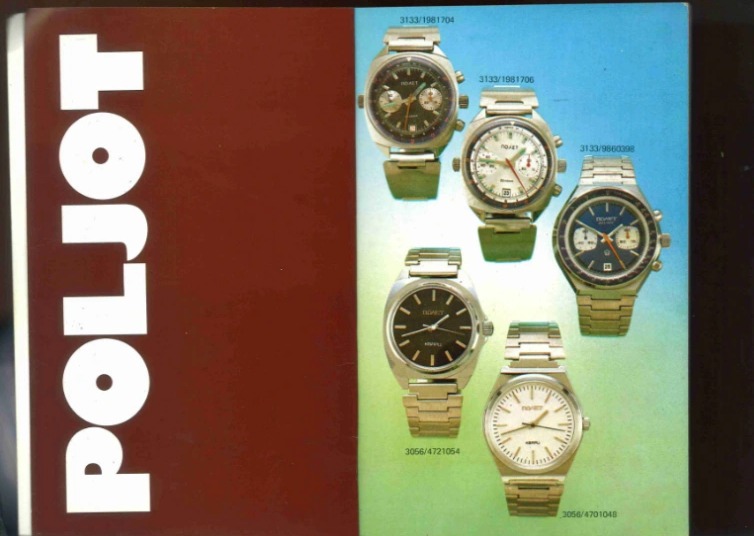
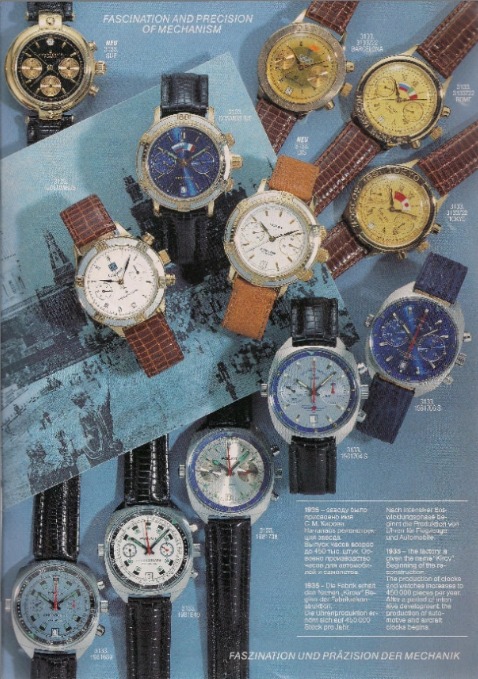
The 3133 chronographs are on the cover of the 1982 Poljot catalogue. Public sales most likely began in 1982 or 1983, under the Poljot name. These civilian versions have chrome-plated brass cases. The price printed on the passports is 130 roubles.
Cover of the 1982 Poljot catalogue, with references 3133/1981704 and 3133/1981706.
Civilian Poljot 3133 with a telemeter scale.
Civilian Shturmanskie 3133 in a chrome-plated brass case.
The average Soviet monthly wage was 190.1 roubles in 1985, so a 3133 chronograph cost about 68% of a month’s pay. Applied to the 2024 French average gross salary of €3,602, that comes to roughly €2,460 today.
Output stayed small. Four-digit serial numbers point to a few thousand movements a year until 1989, probably around 5,000. They go to five digits in 1989, which in all likelihood means more than 10,000 a year. The calibre was also cased for export under other names, such as Jules Delas, Pryngeps or Evilard.
The 3133 chronographs in the 1992 Poljot catalogue.
The Shturmanskie 31659, for aircrew only
The 31659 appeared in late 1986 and was made until 1992. It adds a hacking seconds hand, which stops when the crown is pulled, so that a crew can set their watches to the same second. Its passport states it plainly: « для летного состава ВВС » (for air force flight personnel).
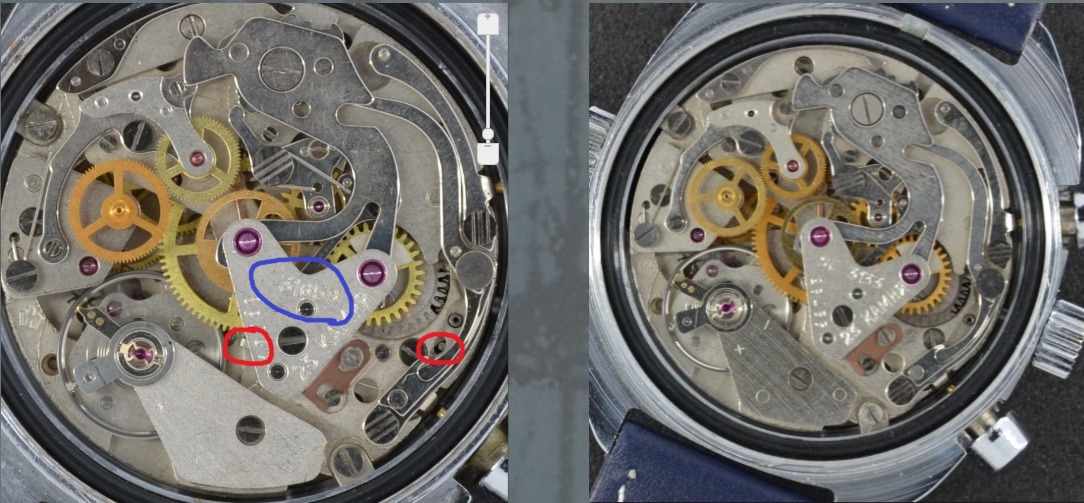
It has no crown at 9 o’clock: its inner ring is fixed. A 31659 is identified by the stamp on the chronograph bridge. That bridge is interchangeable with the 3133 one, and it is not rare to find an ordinary 3133 wearing a bridge stamped 31659.
A 31659, left, with its identifying points circled, and a 3133, right.
Collector Ilya Mironov lists eight variants.
« Black Raven », from the fourth quarter of 1986 to the first quarter of 1987. Green lume.
Early 1987. Same dial, yellow lume.
All grey, mid-1987 to 1988.
Blue dial, 1989.
Grey-blue with a white railroad track, 1990.
Grey with a white railroad track, late 1990. This is the most common one.
Smooth chrome-plated case, late 1990 to 1992.
Final batch, 1992, assembled from whatever parts were on hand. The bridge reads « SU3133 » and « 23 Jewels » in Latin letters.
The 31659 appears in no catalogue meant for the public.
Caseback of the Shturmanskie 31659.
What the passports tell you
The factory passport is the best way to know which channel a watch went through. There are two forms.
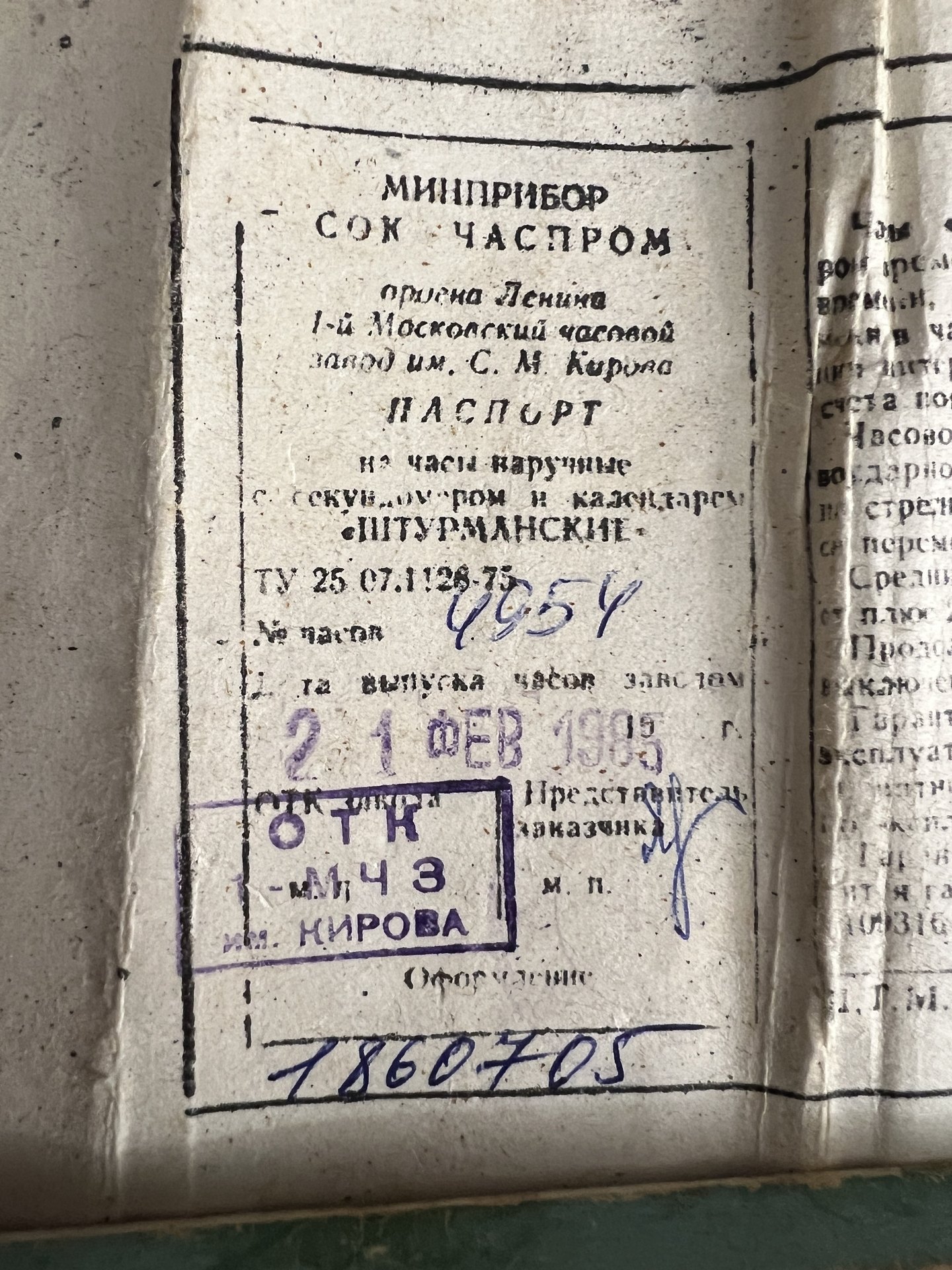
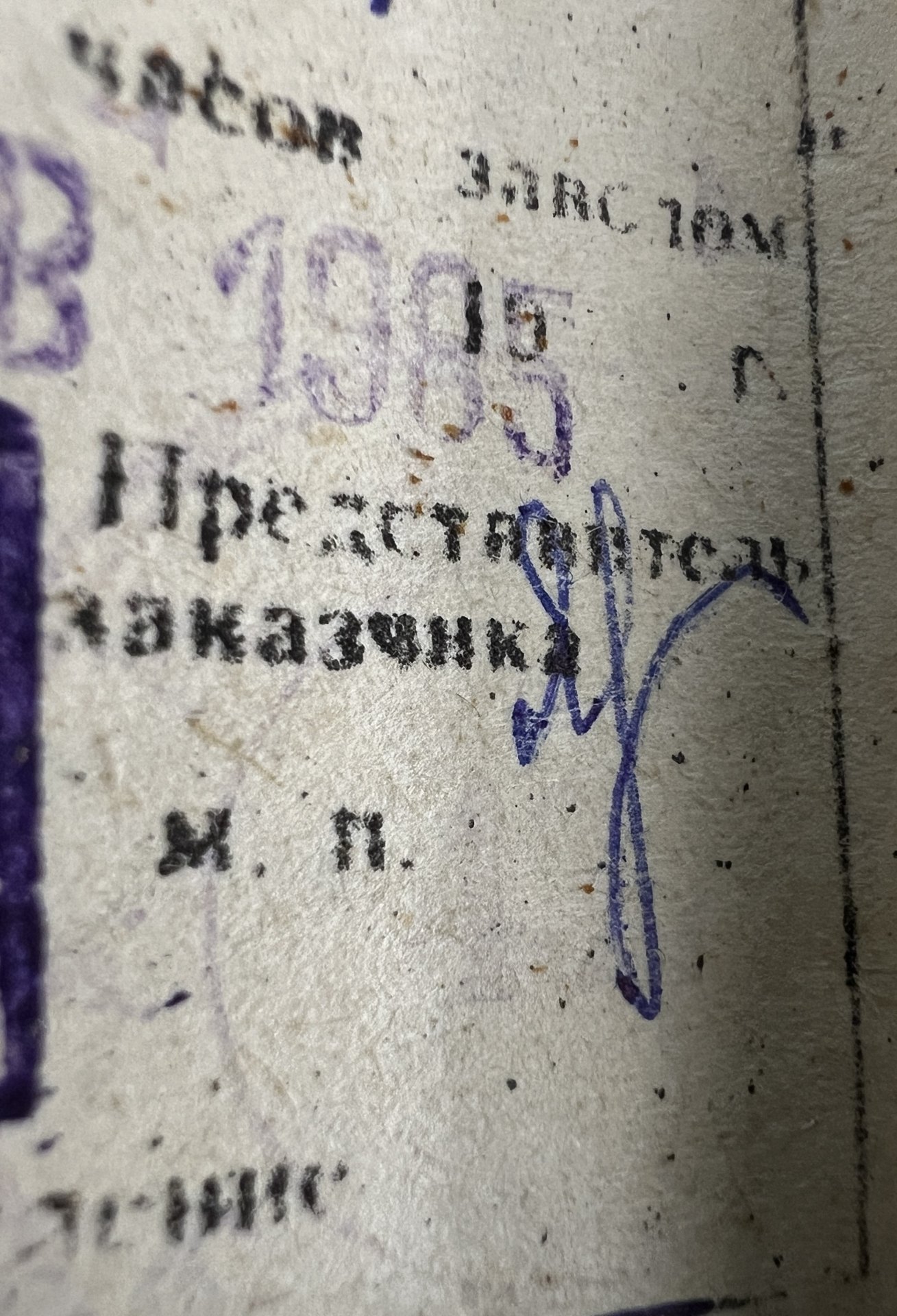
The military form has a box marked « Представитель заказчика » (customer’s representative). On the examples we compared, dated 1981, 1985, 1988, 1990 and 1991, that box carries a round stamp numbered 437, the mark of military acceptance.
The civilian Poljot form is laid out as a table, with tear-off warranty coupons and no box for a customer’s representative.
The 130-rouble price appears on both, so it does not tell a civilian watch from a military one.
Passport of a Shturmanskie 3133, dated 21 February 1985.The customer’s representative box, with the round stamp.
What the instruction leaflet says
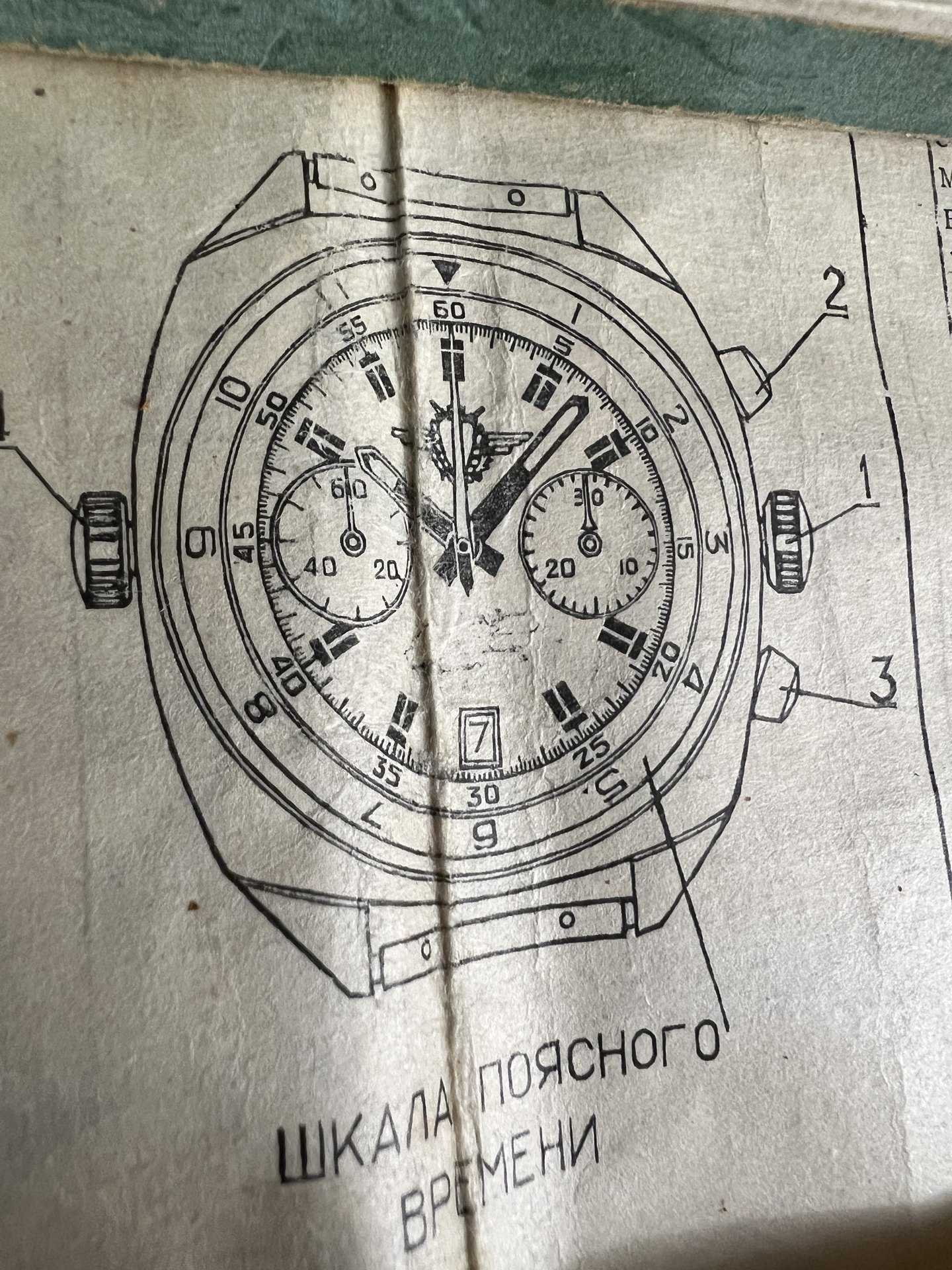
The leaflet of a 1985 military Shturmanskie describes four controls. Crown 1 winds and sets the time. Pusher 2 starts and stops the chronograph. Pusher 3 resets it, only once it has been stopped. To add up several intervals, you restart and stop with pusher 2 without returning to zero.
The leaflet diagram: crowns 1 and 4, pushers 2 and 3, and the time-zone scale.
Crown 4, at 9 o’clock, turns the time-zone scale under the crystal. You set its triangular index to the local time: the hands keep the main time, the scale gives the local time.
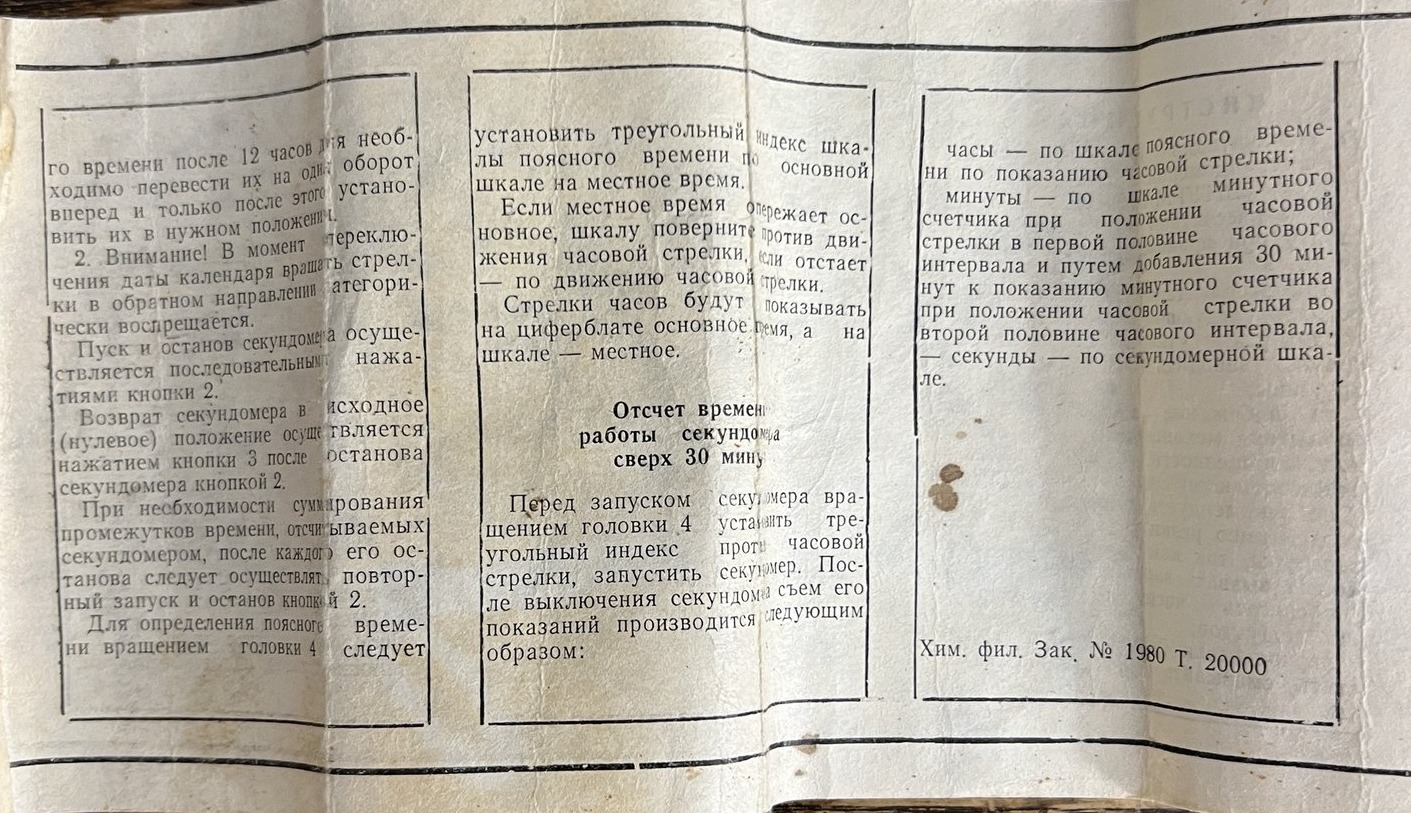
The chronograph counter stops at 30 minutes, and the leaflet gives a whole chapter to the problem. Before starting the chronograph, you line up the triangular index with the hour hand. Once it is stopped, you read the elapsed hours on the time-zone scale, then the minutes on the counter, then the seconds on the chronograph hand.
The leaflet, chapter on timing beyond 30 minutes.
There is no quick-set date. You pull the crown and move the hands from 1 o’clock to 10 o’clock and back to 1: each round trip advances the date by one day. Under a « Внимание! » the leaflet warns that it is “categorically forbidden” to turn the hands backwards while the date is changing. It asks the owner to wind the watch once a day at the same time, and to have it cleaned, oiled and regulated every two or three years.
Dating a Poljot 3133 movement
The movement changed in small steps, and those details place it within a few years. The points below come from the guide by Polmax3133, the reference on this calibre. Dates are approximate.
The logo. A pentagon on prototypes, around 1975. A Poljot crown on the chronograph bridge from 1976 to about 1981. After that a much smaller crown on the main plate, next to the escapement.
The chronograph wheels. Steel-coloured from 1976 to about 1982, gold-coloured afterwards. A mix of the two points to a repair or an assembled watch.
The serial number. Five digits on the very first ones, four digits from about 1979 to 1989, five digits again from 1989.
The reset hammer. Two-piece until 1986, one-piece afterwards.
The date disc. Bold numerals at first, thin tall numerals from 1987.
The bridge stamp. « 3133 » until 1990, « SU 3133 » from the third quarter of 1990, « P3133 » from 1997.
The balance. Brass until 1992, a silver-coloured alloy afterwards.
The jewel count. Written in Cyrillic, « 23 камня », until 1997. The only known exception is the final batch of 31659 watches, in 1992.
A silver balance on a movement with steel-coloured wheels therefore brings together parts made ten years apart.
What to check before buying
These chronographs have often been reassembled: dials, hands and movements circulate as spare parts. Four things can be checked from photographs.
The lume on the hands and on the dial should match in colour and age.
The dial, the scale and the subdials should line up.
The number on the passport should be the number on the watch.
Movement bridges were often replaced during servicing, so they are not enough to date a piece.
To tell steel from chrome-plated brass without opening the watch: steel is matt and does not throw light back. On a chrome-plated brass case, the slightest scratch shows the brass underneath. Steel models have a pressed steel caseback with the VVS emblem and the word Shturmanskie.
The most common fault on the market is a watch that was never serviced and whose chronograph does not run. Servicing a 3133 is expensive and few watchmakers take it on. Once serviced, the movement does not need attention at fixed intervals: it goes back to the bench when a problem shows up. Breakages almost always come from using the pushers in the wrong order. Start and stop with the top pusher, reset with the bottom one, and only after stopping. The factory manual says the same: do not press reset while the chronograph is running, and do not touch the crown or pushers when the watch is wet.
Practise on the drawing below: press the two pushers in the right order. It refuses the press that can break the mechanism of a real watch.
Vostok also fitted the 3133: it is the only chronograph sold under the Vostok name, in the late 1980s, for export to Italy. In all likelihood its making was shared: the movement came from the First Moscow Watch Factory, the case, dial, hands and perhaps the box came from Vostok in Chistopol, and the final assembly, the strap and the sale fell to the Italian importer. A former Time Trend employee, quoted by the site Finestraweb, places that assembly in Milan. According to the Italian site Finestraweb, the order came from the importer Time Trend, around 1989, in two models, one naval and one for aviation, delivered in a wooden box. The movement is a Moscow-made 3133 with the Vostok name on the balance bridge.
Vostok chronograph with the 3133 calibre, made for Italy.
Fake dials and remade parts
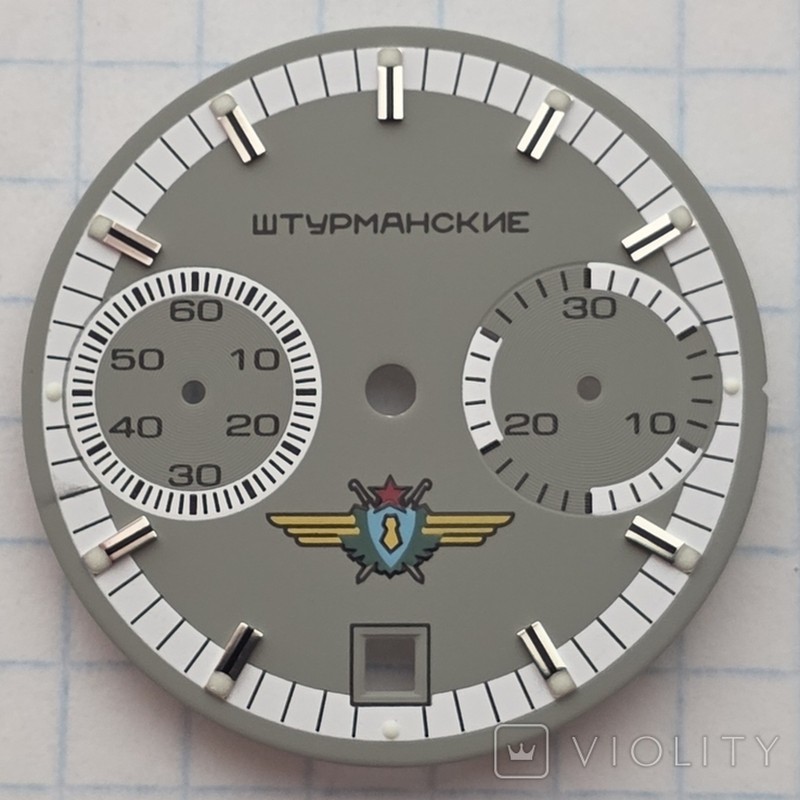
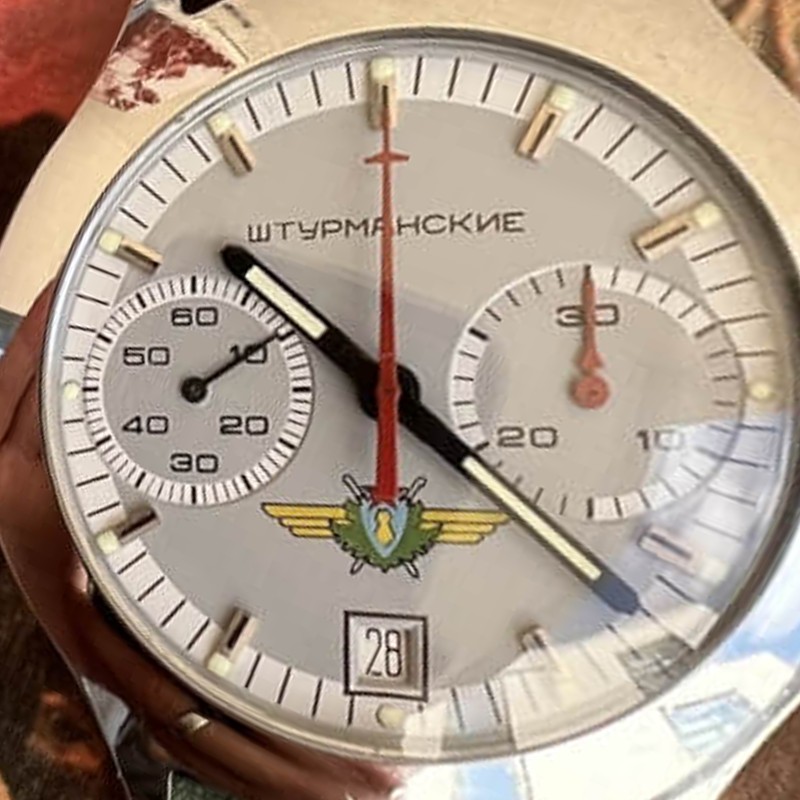
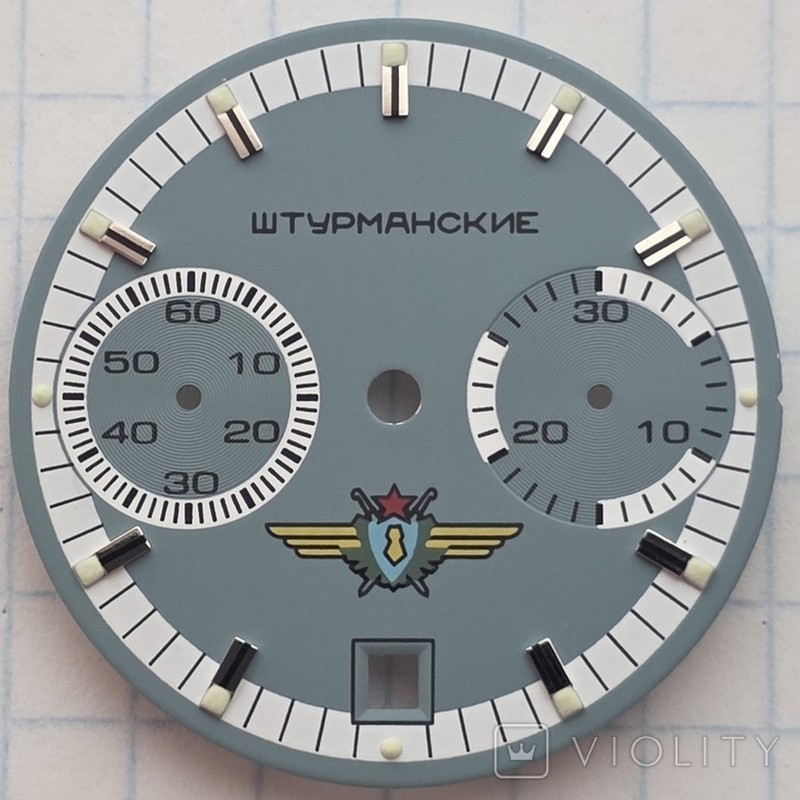
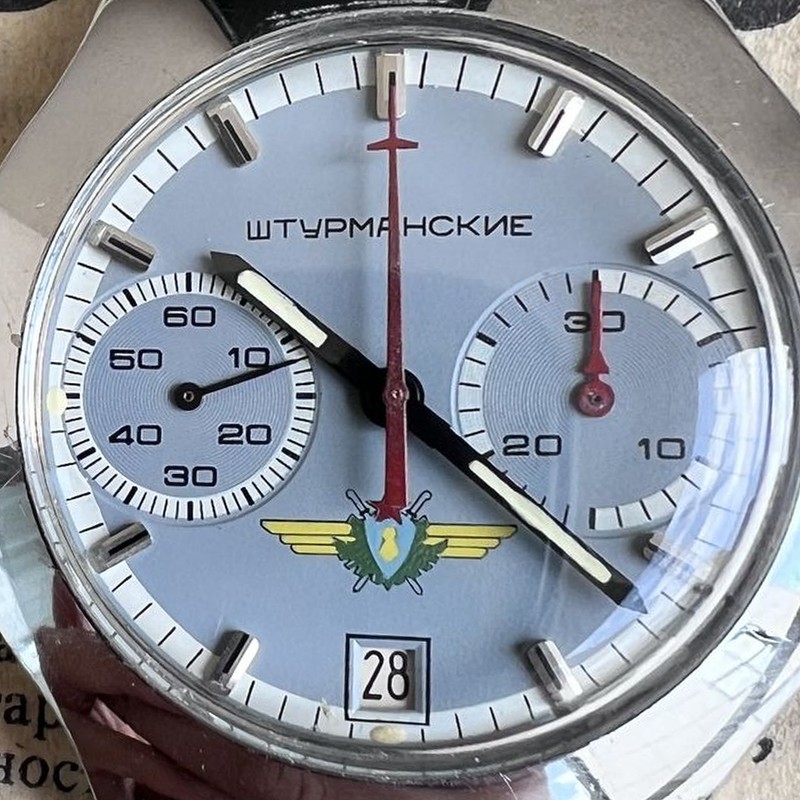
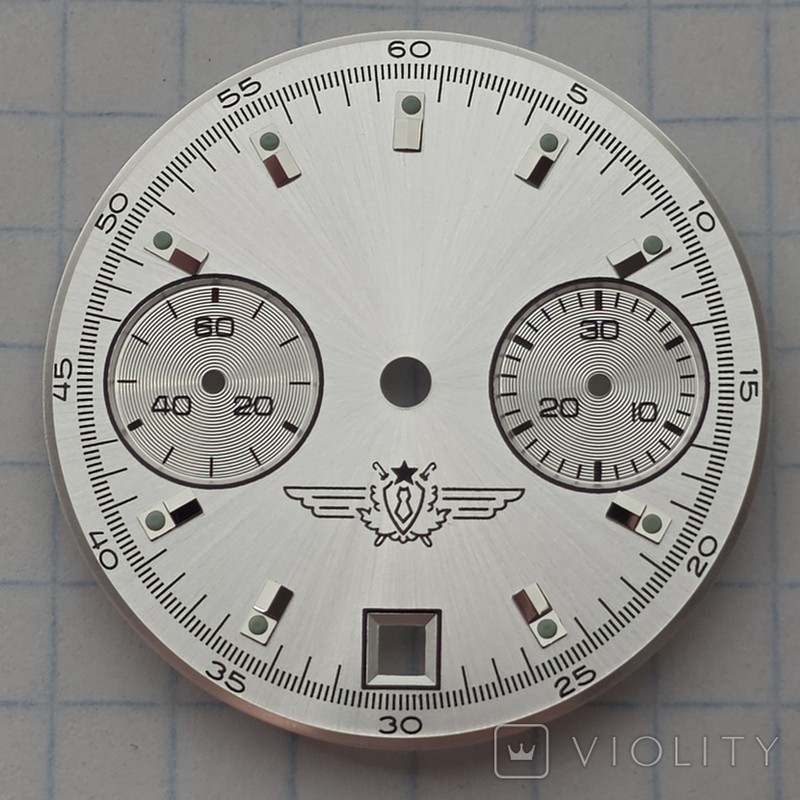
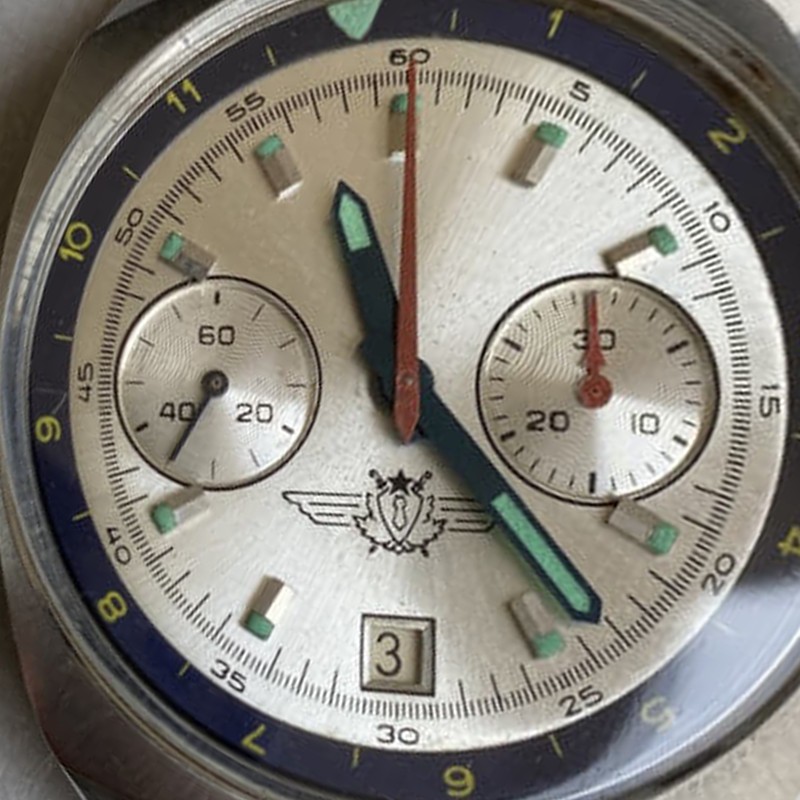
Recently made Shturmanskie dials are sold new, one by one, in several colours. They make it possible to build a watch around any 3133 movement. The Okean, the most sought after, is the most affected: there are period 3133 watches fitted with a new dial, sometimes very well made, and reissues produced after 1991. On an early Okean the caseback is stamped. On reissues it is laser-engraved.
Period dialRemade dial
Period dialRemade dial
Period dialRemade dial
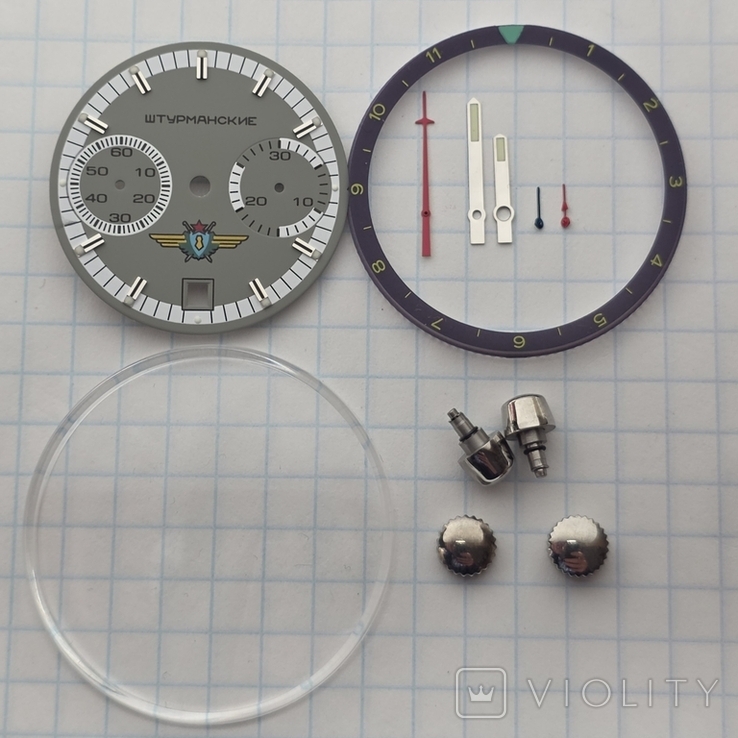
They are also sold as a full set, in all likelihood made in China: dial, hands, time-zone ring, crystal, crowns and pushers. A watch where all these parts look new on a worn case should raise a flag.
Set of new parts: dial, hands, ring, crystal, crowns and pushers.
How to use the chronograph
The diagram below shows the two pushers of a 3133: the upper one starts and stops the measurement, the lower one resets it, always after stopping. The two tabs show how to read the telemeter and the tachymeter.
The ДП-5В (DP-5V) is the field radiometer of Soviet civil defence: a green Bakelite console, a probe with a rotating gamma, beta and check-source shield, headphones and a manual that explains operation and maintenance. The one in this article served in an industrial bakery in Chișinău and was serviced in March 1991. Its owner shared his photos and documents with us, and we turned them into a tool that lets you operate it on screen, step by step.
The Moscow Games, from 19 July to 3 August 1980, boycotted by some sixty countries, produced more objects than any Soviet event: a bear cub, Misha, drawn by Viktor Chizhikov, an emblem made of running tracks, five thousand torches, watches from every factory, platinum coins, rings, tea glass holders, posters. This guide tells the story of the Games and reviews the objects, with the marks that authenticate them and the prices.
The 3017 chronograph of the First Moscow Watch Factory carries a five-digit number on the balance cock. The most common dating method reads it as a single series, from 1959 to 1979. Four factory passports show there are two, and that the same number can point to two watches made ten years apart. Here is how to read the number, the dial, the logo and the bridge, with a decoder to date your Strela, Poljot or Sekonda.
This website uses cookies to improve your experience while you navigate through the website.
Out of these cookies, the cookies that are categorised as necessary are stored on your browser as they are essential for the working of basic functionalities of the website.
We also use third-party cookies that help us analyse and understand how you use this website.
These cookies will be stored in your browser only with your consent.
You also have the option to opt out of these cookies.
But opting out of some of these cookies may affect your browsing experience.
Necessary cookies are absolutely essential for the website to function properly. This category only includes cookies that ensure basic functionalities and security features of the website. These cookies do not store any personal information.
Cookies that are not strictly necessary for the website to work and that are used specifically to collect personal data through analytics, ads and other embedded content are called non-necessary cookies. User consent is required before these cookies run on the website.
✕
Soviet in Paris
Online. We answer in person, no AI and no chatbot. Reply right away, 20 min at most.
Hello 👋 A question about an item, an order or shipping? Write to us.
Your email is used only to reply to you.
Subscribe to our newsletter and get 10% off your first order.
Subscribe
★ New pieces before anyone else
★ New blog articles
★ Soviet in Paris news and updates
Join the Party
10% off your first order
Receive your welcome card and our next arrivals.
Your code appears here and is also sent to you by email. You can leave the Party in one click, at any time.