A chronograph is a watch that also measures durations: two pushers control a large central hand, independent of the time. This guide explains how to start, stop, resume and reset a measurement, how to read the result, and what the telemeter and tachymeter scales are for. An animated Poljot 3133 chronograph lets you try each operation, with an atomic explosion and a racing car to practise on.
OCTOBER 2026•5 MINUTE READ
by Marwen Yahyaoui
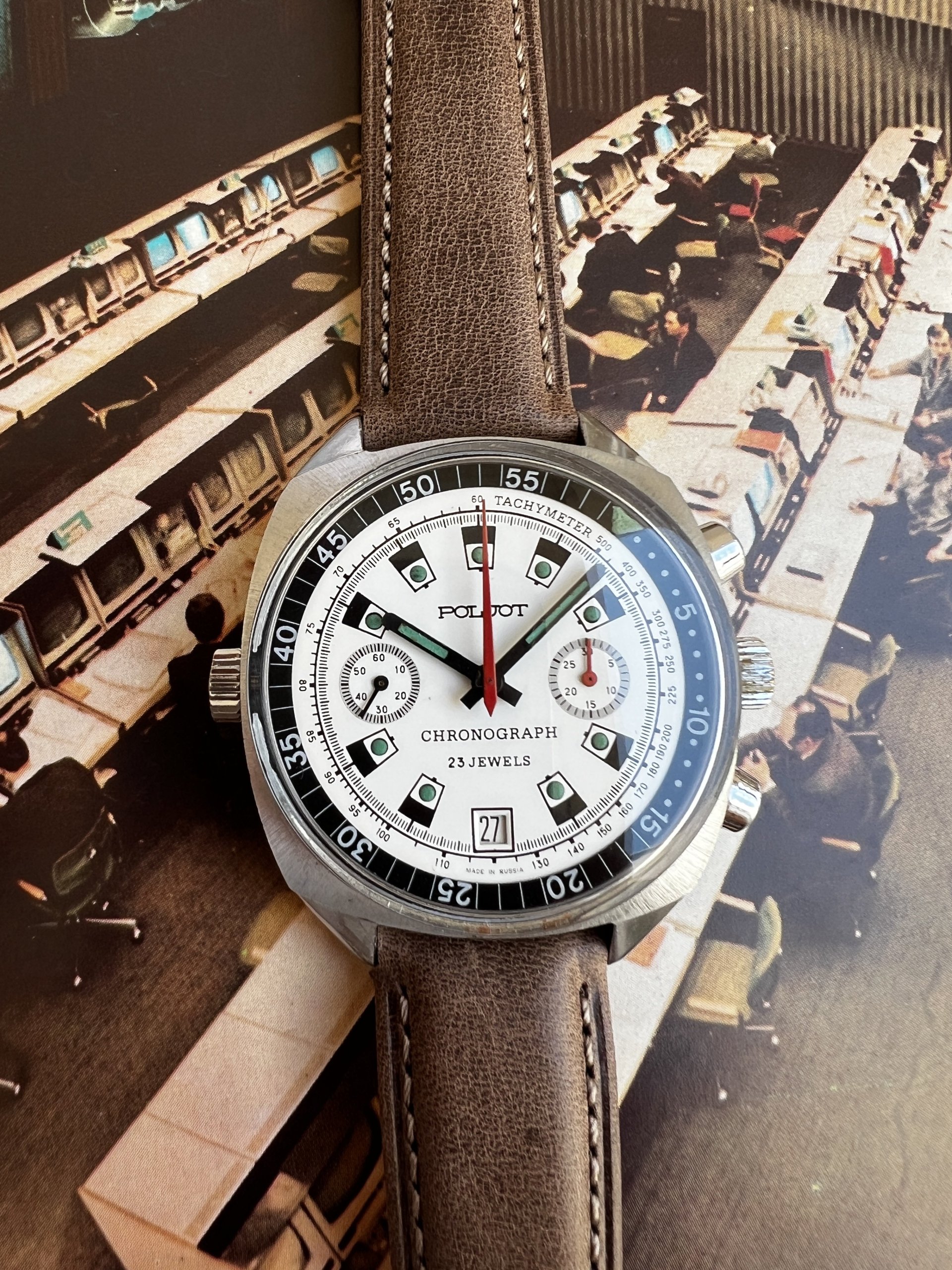
Poljot chronograph with the 3133 calibre and a tachymeter scale.
The examples use the Soviet Poljot 3133 calibre, but the principle applies to most mechanical two-pusher chronographs.
The controls of a chronograph
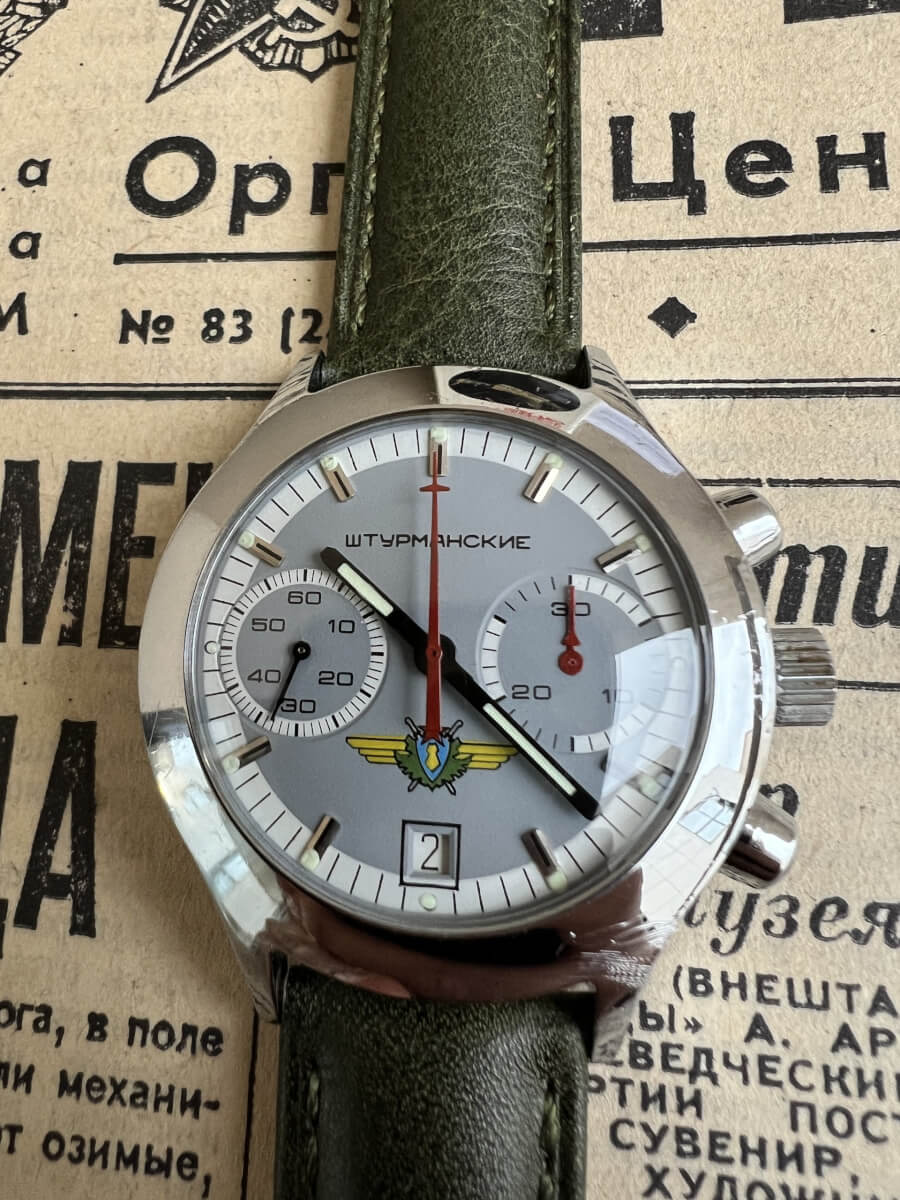
A 3133 chronograph has five hands. The two large ones, the hour and minute hands, give the time. The small hand in the left sub-dial, at 9 o’clock, is the running seconds of the watch: it turns all the time. The large central hand belongs to the chronograph: at rest it stays still on the 12. The right sub-dial, at 3 o’clock, counts the timed minutes, up to 30.
The top pusher, at 2 o’clock, starts and stops the measurement. The bottom pusher, at 4 o’clock, resets the chronograph hands to zero. The crown, between the two, winds the watch and sets the time.
The two pushers, on either side of the crown.
Start, stop, resume, reset
Start: press the top pusher once. The large hand starts.
Stop: press the top pusher again. The large hand stops and you can read the time.
Resume: another press on the top pusher restarts the measurement where it stopped. Several times can be added up this way.
Reset: with the chronograph stopped, press the bottom pusher. The large hand and the minute counter return to zero.
Never reset while the chronograph is running. On a 3133 this can damage the mechanism, and the repair is expensive. Always stop the measurement with the top pusher before pressing the bottom one.
Try it on the chronograph below: both pushers respond to a finger or a click, and a message tells you at each step what you can do.
The large hand gives the seconds around the dial, graduated in fifths of a second. At each full turn, the hand of the right counter moves forward one minute. The measured time is therefore read in two parts: minutes on the counter, seconds on the large hand. Beyond 30 minutes the counter starts again from zero.
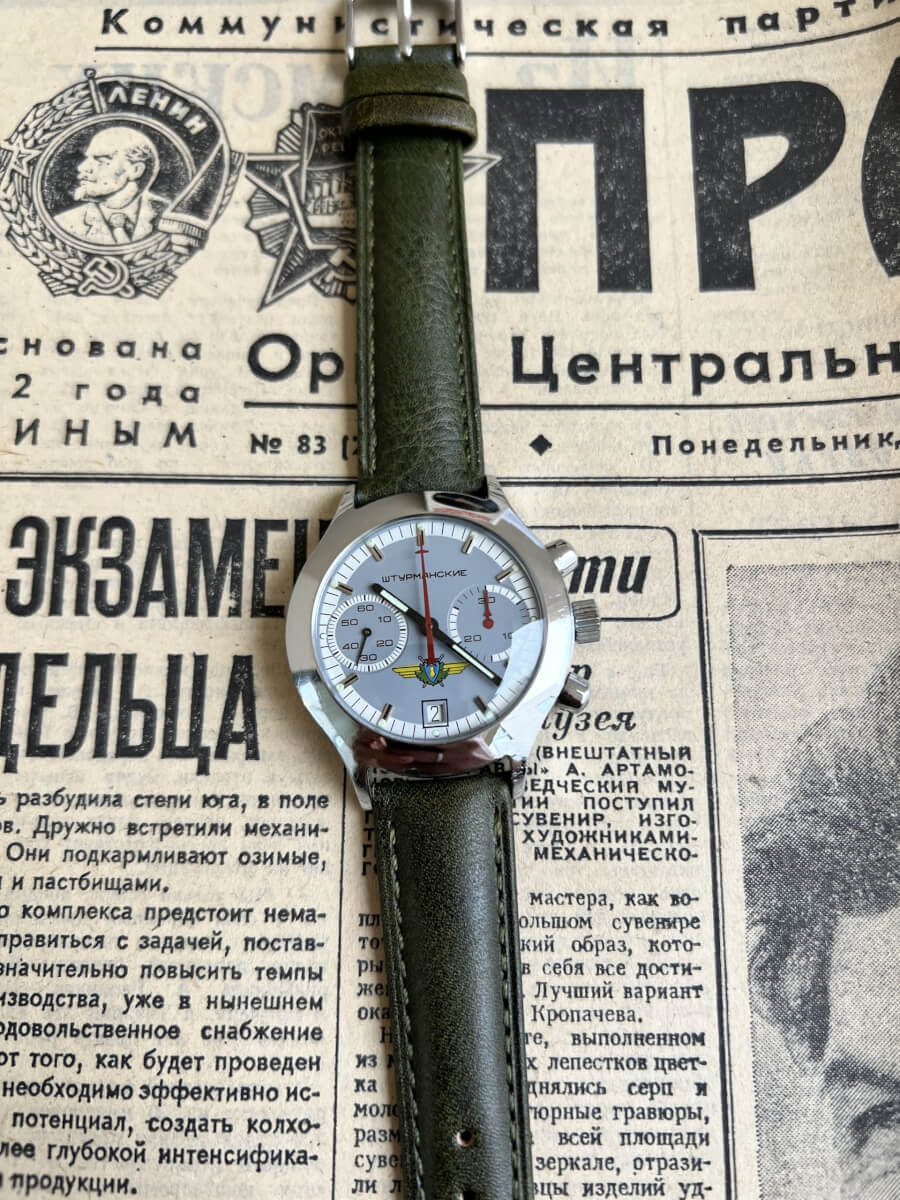
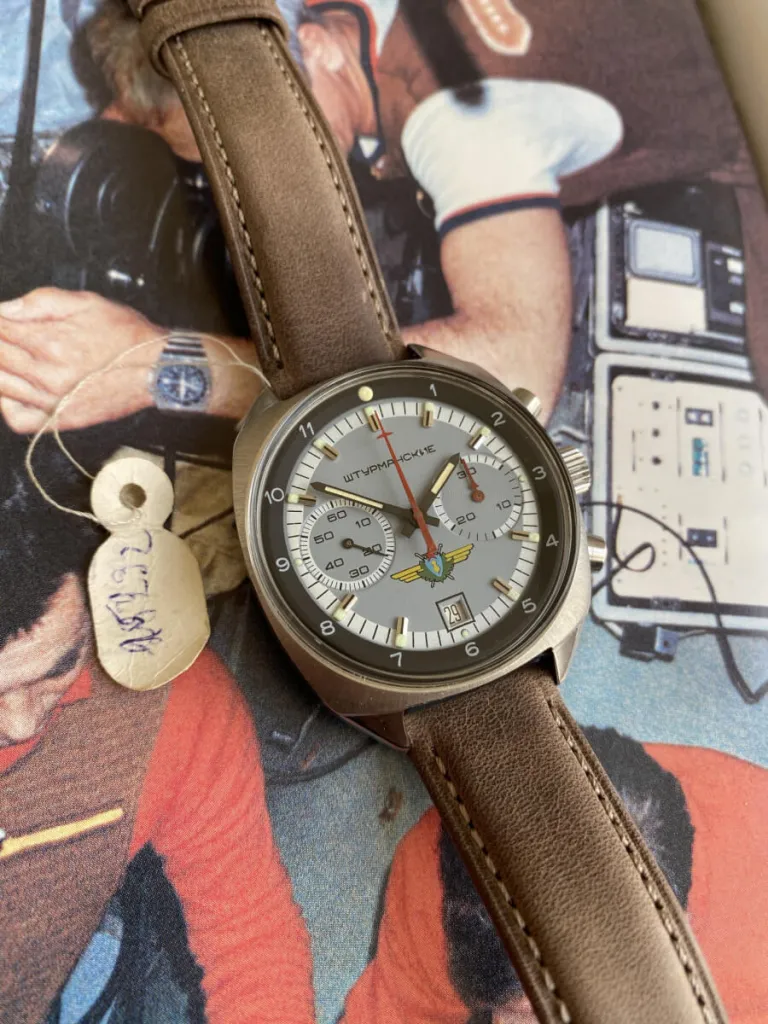
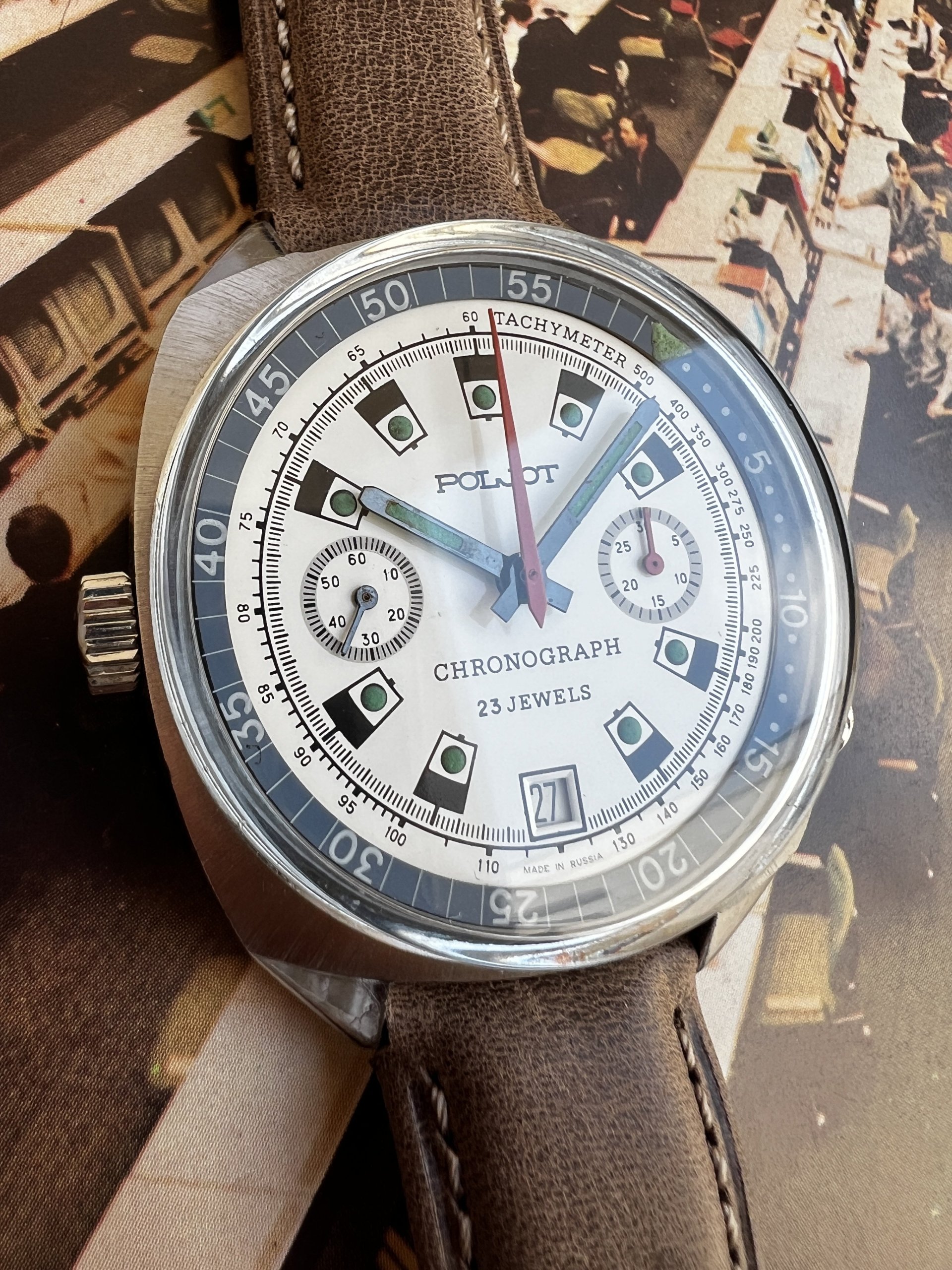
Poljot Shturmanskie 3133: running seconds on the left, 30-minute counter on the right.
The telemeter scale: measuring a distance
The telemeter measures the distance of an event that is seen before it is heard. It was used in particular by artillerymen, to locate an enemy gun. Light arrives almost instantly, while sound travels about 340 metres per second. Start the chronograph when you see the muzzle flash, stop it when you hear the report, and the large hand shows the distance in kilometres directly on the scale. Six seconds between the flash and the report is about 2 kilometres. The same method works for a storm, between lightning and thunder.
In the diagram, choose the “Telemeter” tab and simulate an atomic explosion to practise: start the chronograph at the flash, stop it when the sound arrives.
The tachymeter scale: measuring a speed
The tachymeter gives an average speed over a known distance, usually one kilometre. Start the chronograph at the first marker, stop it at the second, and the large hand shows the speed in kilometres per hour. One kilometre covered in 30 seconds is 120 km/h, in 45 seconds 80 km/h.
The scale only works for durations between about 7 seconds and one minute. It can also measure a rate: if an operation takes 20 seconds, the hand points to 180, meaning 180 operations per hour.
In the diagram, choose the “Tachymeter” tab and simulate a racing car: it covers the kilometre in about ten seconds.
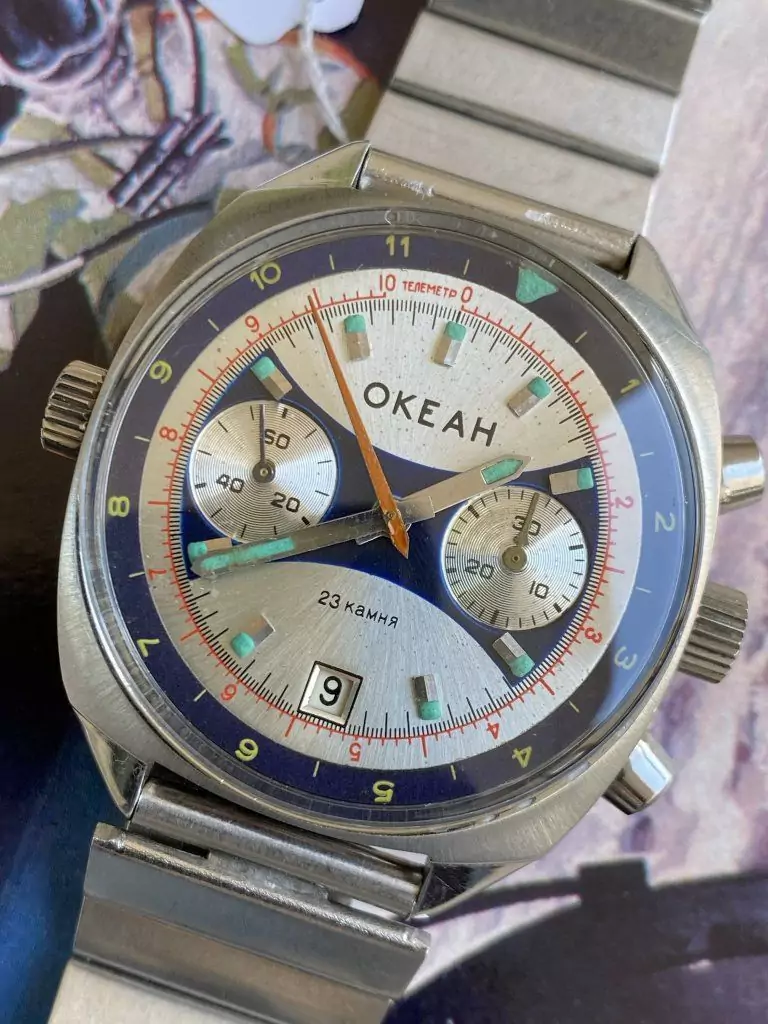
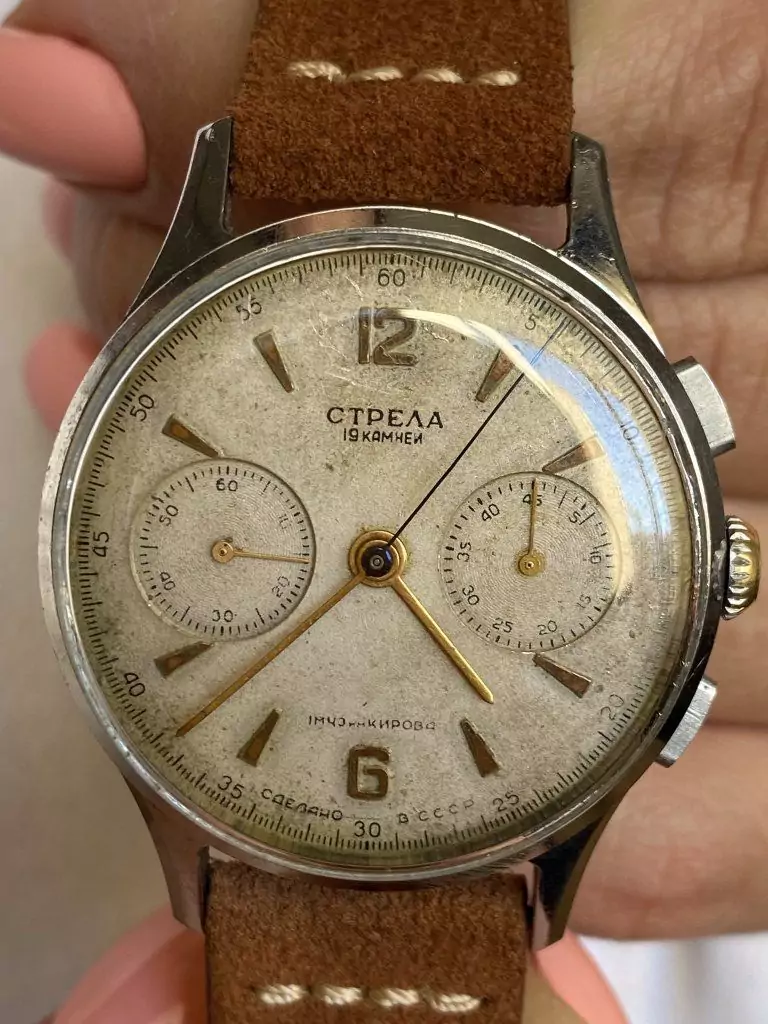
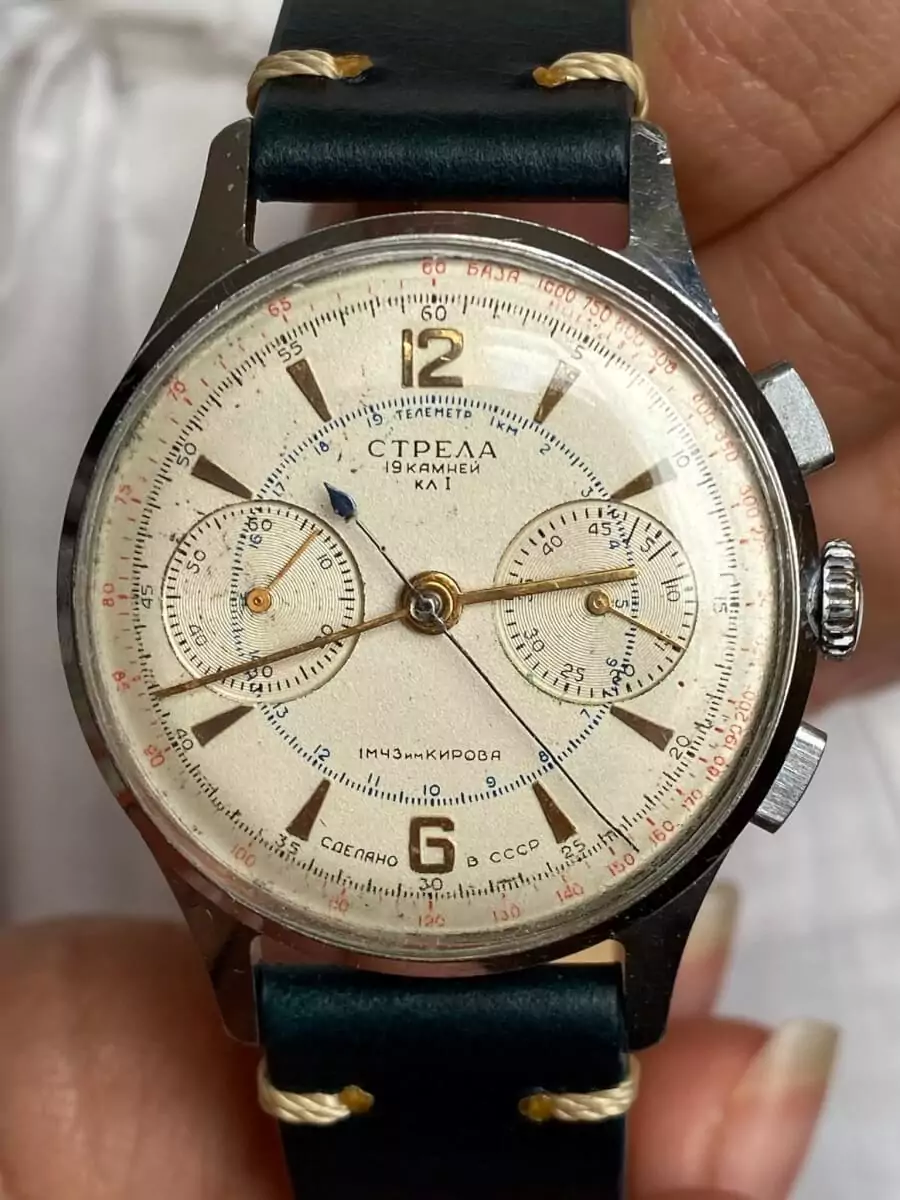
1960s Strela, calibre 3017: red tachymeter scale at the edge of the dial, blue telemeter scale inside it.
The 3133 calibre in brief
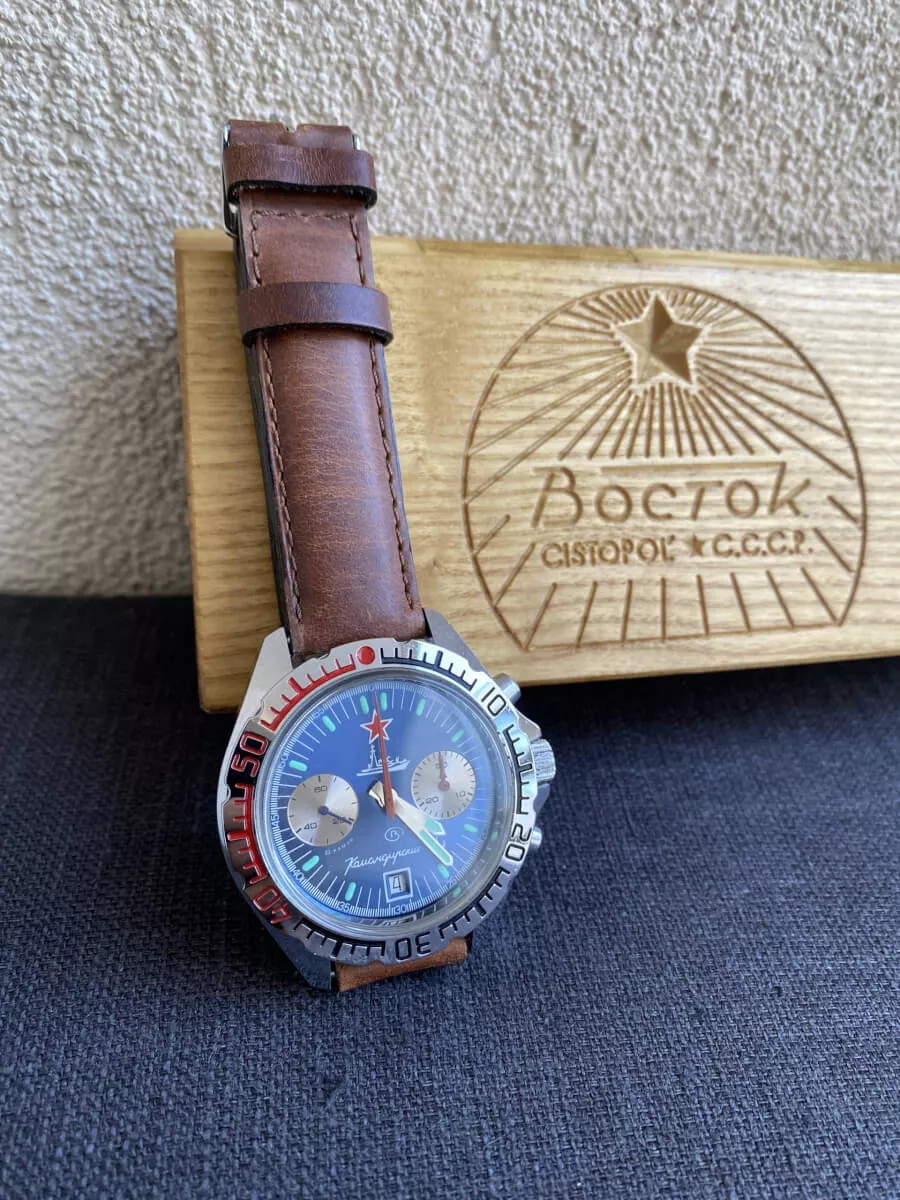
The 3133 is the Soviet mechanical chronograph made by the First Moscow Watch Factory from 1976. It has 23 jewels and beats at 21,600 beats per hour. It powers the Poljot, the pilots’ Shturmanskie, the navy’s Okean and Vostok chronographs. Its history, versions and buying tips are covered in our guide to the Poljot 3133 chronograph.
3133 calibre seen from the case back, on a 2003 Strela reissue.
Frequently asked questions
The large seconds hand does not move, is my watch broken?
No. On a chronograph the large central hand belongs to the chronograph: it only moves during a measurement. The running seconds of the watch is the small hand in the left sub-dial. If it turns, the watch is running.
The large hand does not return exactly to 12
The reset mechanism needs adjusting. Do not force the pushers: this is a watchmaker’s job, which we take on in our repair workshop.
How do I know whether my chronograph has a telemeter or a tachymeter?
Look at the scale around the dial. If its figures rise from 1 to about 20, it is a telemeter, graduated in kilometres. If they fall from 500 to 60, it is a tachymeter, graduated in kilometres per hour. Some chronographs have neither.
How do I wind a 3133 chronograph?
Like a hand-wound mechanical watch: crown clockwise, about 20 to 30 turns, until you feel resistance. How a mechanical movement works is explained in our guide mechanical, automatic or quartz watch.
The ДП-5В (DP-5V) is the field radiometer of Soviet civil defence: a green Bakelite console, a probe with a rotating gamma, beta and check-source shield, headphones and a manual that explains operation and maintenance. The one in this article served in an industrial bakery in Chișinău and was serviced in March 1991. Its owner shared his photos and documents with us, and we turned them into a tool that lets you operate it on screen, step by step.
The Moscow Games, from 19 July to 3 August 1980, boycotted by some sixty countries, produced more objects than any Soviet event: a bear cub, Misha, drawn by Viktor Chizhikov, an emblem made of running tracks, five thousand torches, watches from every factory, platinum coins, rings, tea glass holders, posters. This guide tells the story of the Games and reviews the objects, with the marks that authenticate them and the prices.
The 3017 chronograph of the First Moscow Watch Factory carries a five-digit number on the balance cock. The most common dating method reads it as a single series, from 1959 to 1979. Four factory passports show there are two, and that the same number can point to two watches made ten years apart. Here is how to read the number, the dial, the logo and the bridge, with a decoder to date your Strela, Poljot or Sekonda.
This website uses cookies to improve your experience while you navigate through the website.
Out of these cookies, the cookies that are categorised as necessary are stored on your browser as they are essential for the working of basic functionalities of the website.
We also use third-party cookies that help us analyse and understand how you use this website.
These cookies will be stored in your browser only with your consent.
You also have the option to opt out of these cookies.
But opting out of some of these cookies may affect your browsing experience.
Necessary cookies are absolutely essential for the website to function properly. This category only includes cookies that ensure basic functionalities and security features of the website. These cookies do not store any personal information.
Cookies that are not strictly necessary for the website to work and that are used specifically to collect personal data through analytics, ads and other embedded content are called non-necessary cookies. User consent is required before these cookies run on the website.
✕
Soviet in Paris
Online. We answer in person, no AI and no chatbot. Reply right away, 20 min at most.
Hello 👋 A question about an item, an order or shipping? Write to us.
Your email is used only to reply to you.
Subscribe to our newsletter and get 10% off your first order.
Subscribe
★ New pieces before anyone else
★ New blog articles
★ Soviet in Paris news and updates
Join the Party
10% off your first order
Receive your welcome card and our next arrivals.
Your code appears here and is also sent to you by email. You can leave the Party in one click, at any time.







 Strane Mira, our second shop, offers