Poljot watches come from the First Moscow Watch Factory, founded in 1930 with the machinery of an American manufacturer. The factory made the Pobeda, the pilots' Sturmanskie, the first Soviet automatic, the first alarm wristwatch and an ultra-thin watch awarded in Leipzig, before bringing its whole output under the Poljot name in 1964. This guide traces that history, presents the models and their calibres, and gives the points to check before buying.
OCTOBER 2026•9 MINUTE READ
by Marwen Yahyaoui
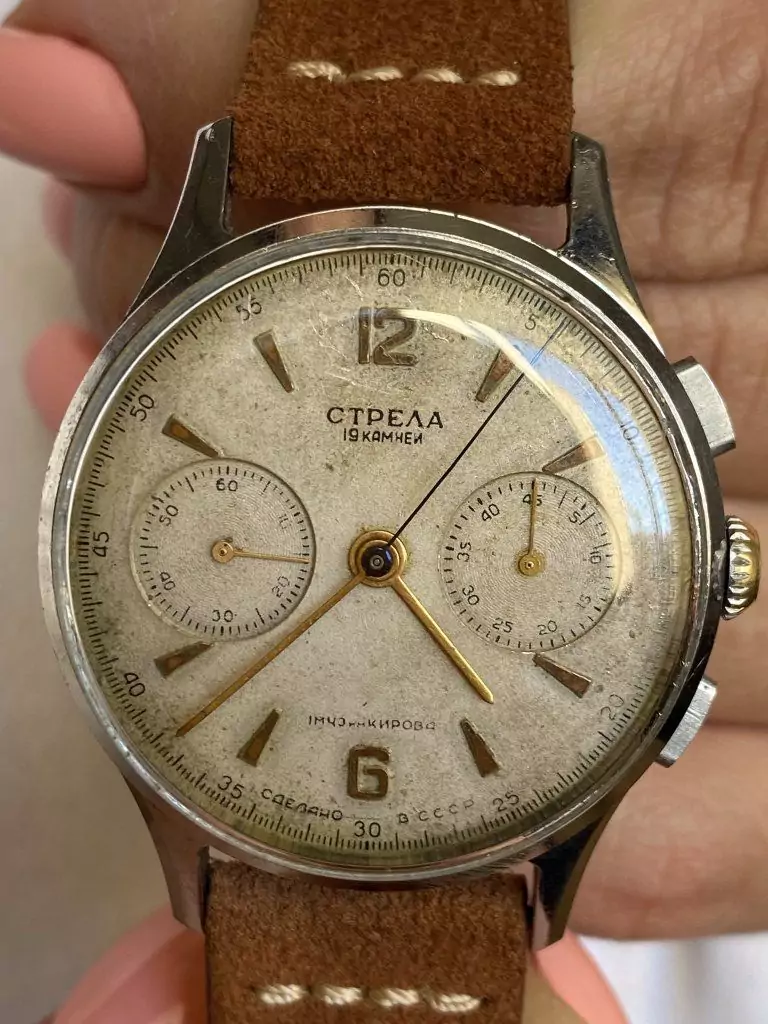
Poljot Strela chronograph, calibre 3017.
A Poljot watch comes from the First Moscow Watch Factory. « Полёт » means “flight”. From 1964 the factory put this name on everything it made: ultra-thin dress watches, automatics, alarm watches, divers, chronographs.
Before 1964 the same workshops had already produced the Pobeda, the pilots’ Sturmanskie and the first Soviet automatic. This guide follows the brand in order, model by model.
1930: an American factory in Moscow
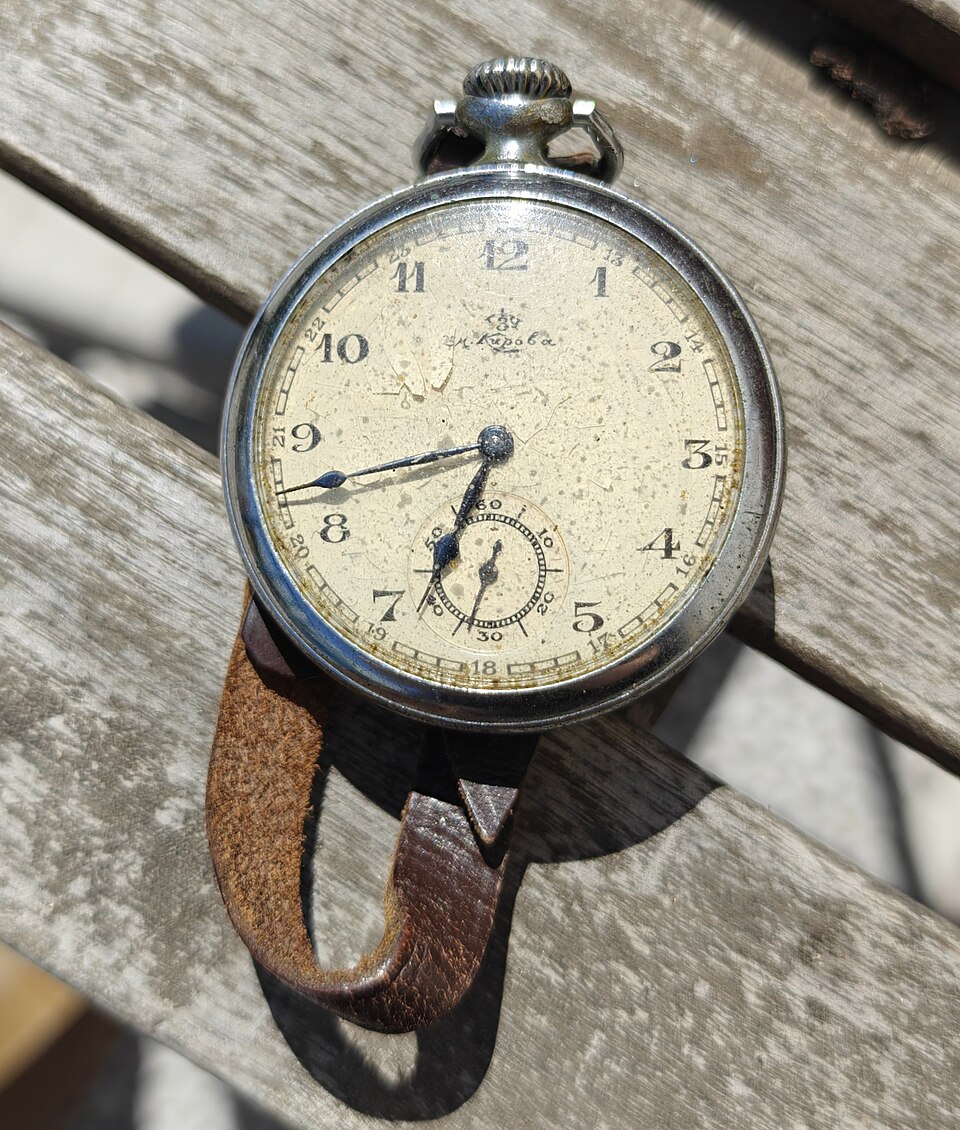
Pocket watch from the First Factory, 1930s, signed « им. Кирова ». Photo Anastasiya Lvova, Wikimedia Commons, CC BY-SA 4.0.
The decision to create a state watch factory dates from 1929, as part of the first five-year plan. The USSR did not start from nothing: it bought a whole factory. The American manufacturer Dueber-Hampden, in Canton, Ohio, was bankrupt. Through the Amtorg company, two contracts were signed on 26 April 1929: 325,000 dollars for the machinery, 125,000 dollars for the spare parts and unfinished watches.
On 25 February 1930 some twenty former Dueber-Hampden employees, watchmakers, engravers and technicians, left Canton for Moscow. They came to install the machines and teach the trade to Soviet workers. In April 1930 the equivalent of 28 freight cars of machinery and parts followed, by ship.
Everything then moved fast. Work began on 1 October 1930. On 7 November, for the anniversary of the Revolution, the first 50 pocket watches were finished. Their movement was the Dueber-Hampden one, later known as the Type 1.
In the workshops, assembly was entrusted very largely to women. In photographs of Soviet watch and clock factories, they are almost the only ones seen at the assembly benches.
The factory opened in Moscow in 1930, on the site of a former tobacco factory. It first made pocket watches. In 1935 it was named after Sergei Kirov, hence the popular nickname “Kirovka” for its watches.
1940: the first Soviet chronograph
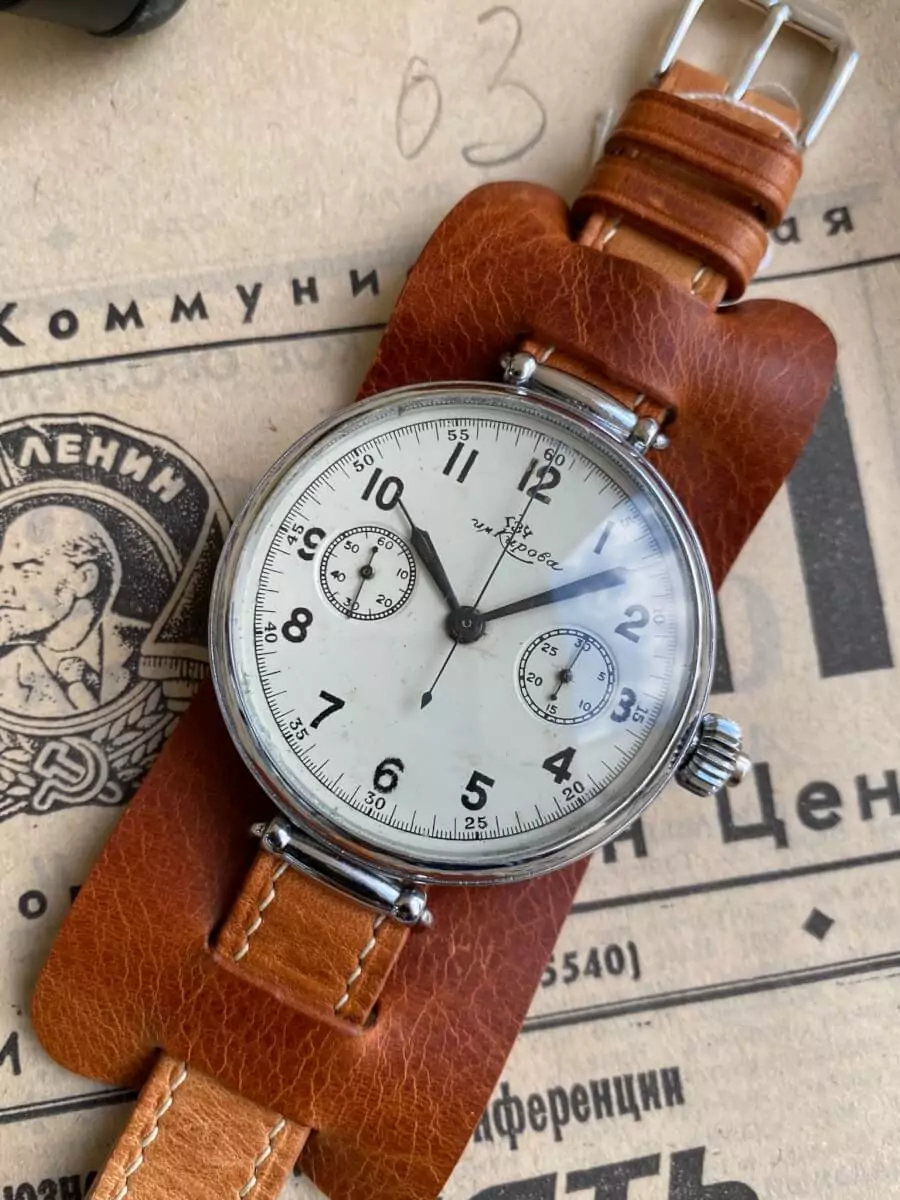
Between 1936 and 1938 the Soviet watch industry modernised and bought new machinery in Western Europe. It was used to produce the first chronograph made in the USSR, intended for the high command of the air force. Only about 1,000 pieces left the factory before the war.
Chronograph from the Kirov factory, second quarter of 1940.
In the autumn of 1941 the factory was evacuated to Zlatoust, with 1,260 machines and 296 watchmakers and technicians. It resumed work in Moscow in 1942.
Pobeda and Kirovskie
From 1946 the factory made the Pobeda, “Victory”, the wristwatch of the post-war years. It produced it until 1961.
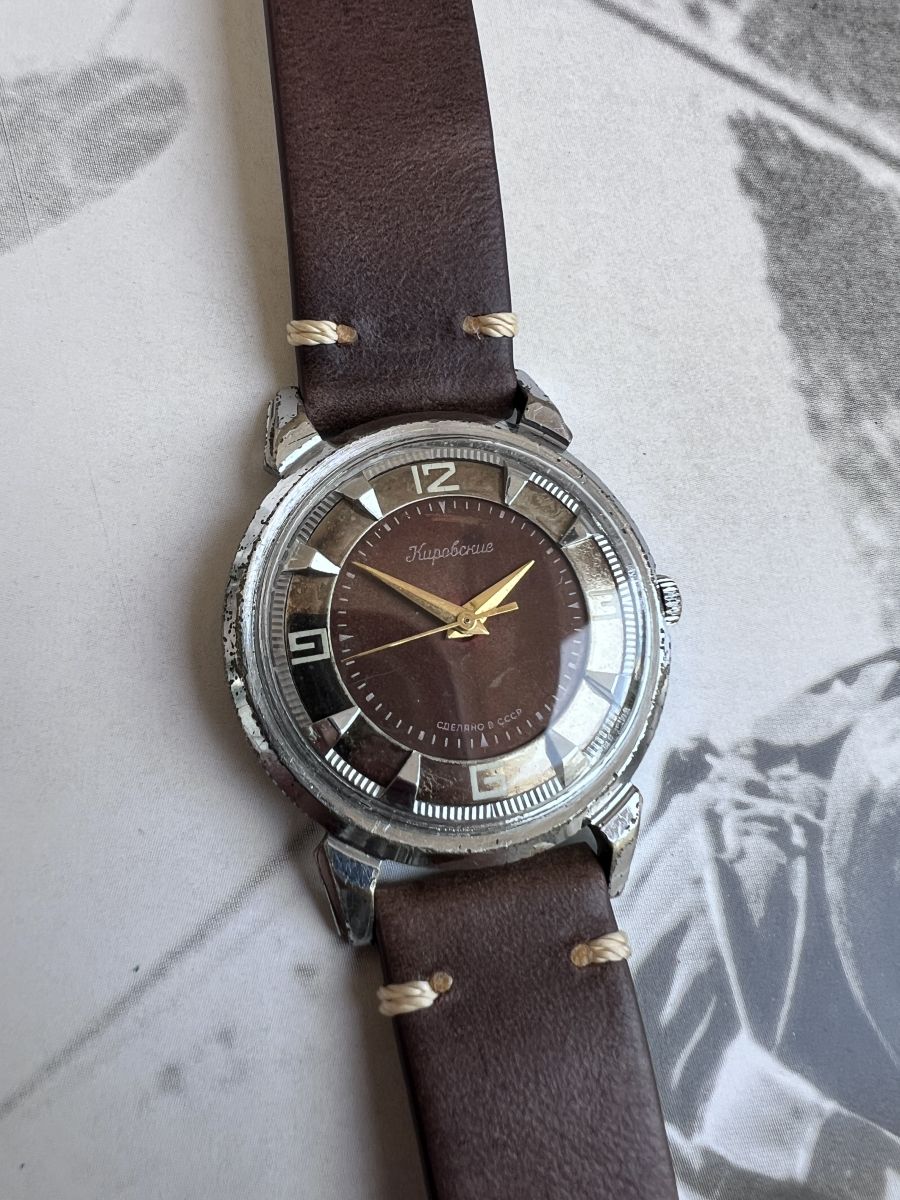
The Kirovskie of the 1950s received a centre seconds hand and more elaborate dials.
Kirovskie with copper dial and “crab” case.
Sturmanskie: the pilots’ watch
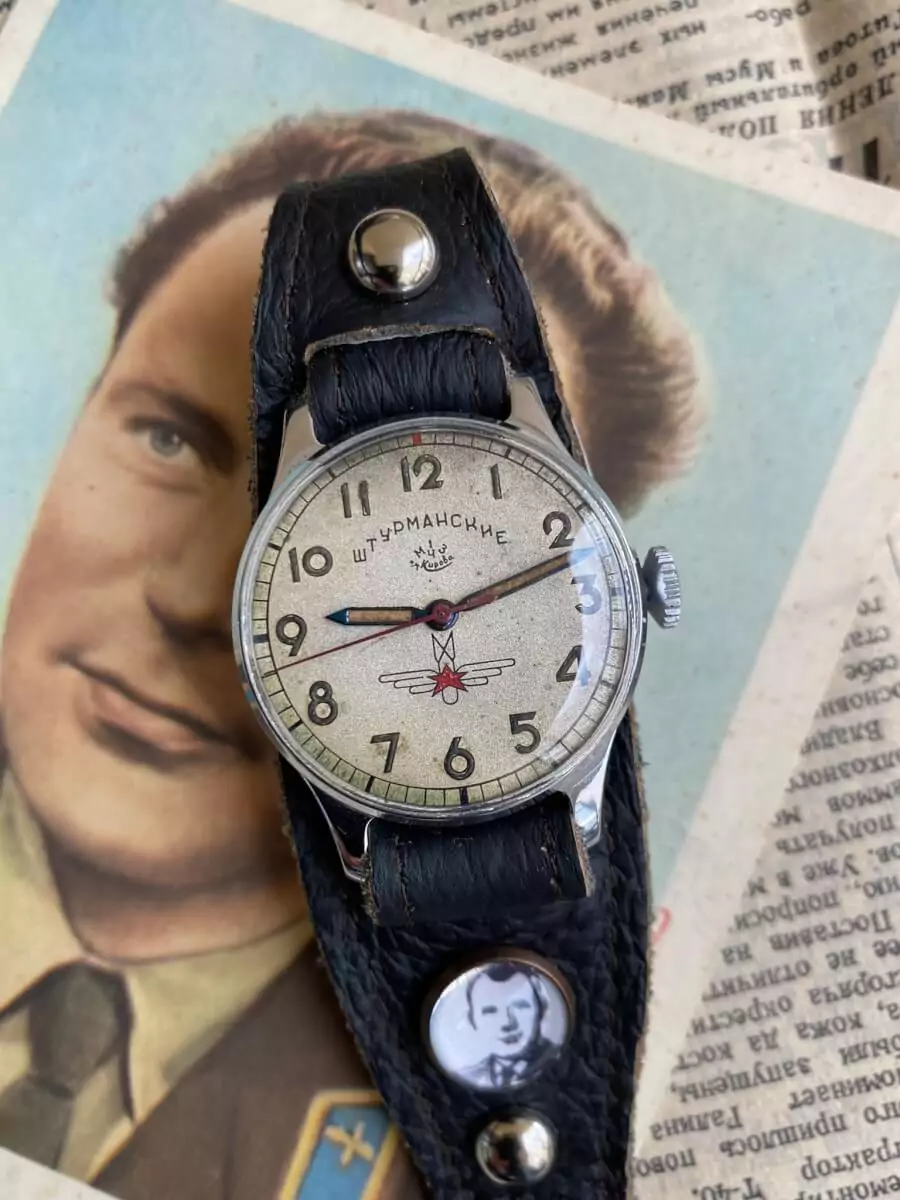
Sturmanskie type 1, 15 jewels.
In 1949 the factory launched the Sturmanskie, “navigators’”. It has a device that stops the seconds hand, to set the watch to the second. It was reserved for the air force and never sold in shops.
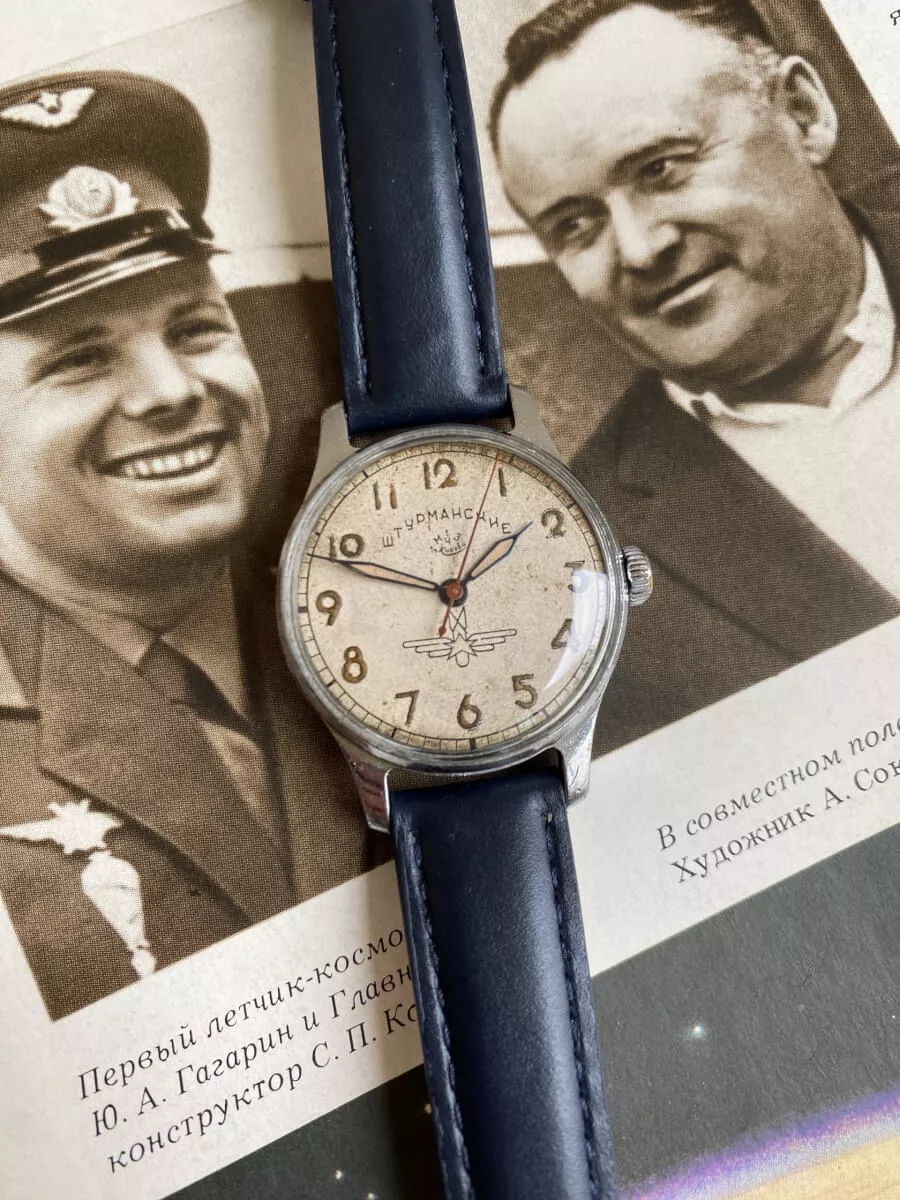
It was a Sturmanskie that Yuri Gagarin wore on 12 April 1961, the first watch in space.
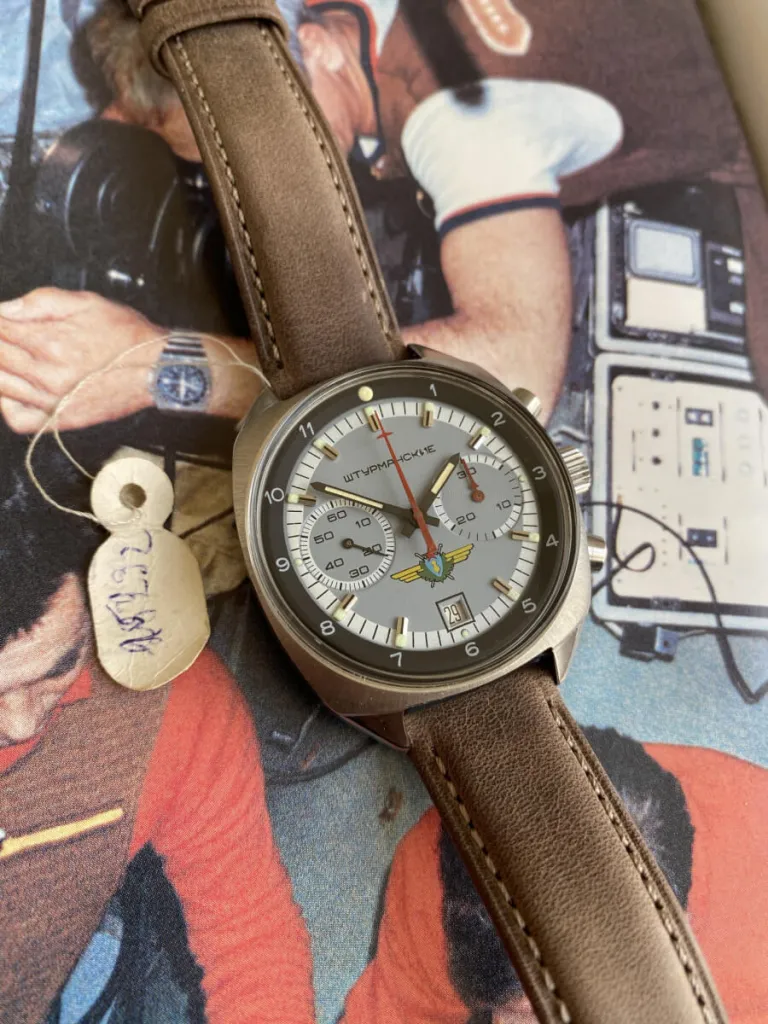
Sturmanskie type 2, 17 jewels, Gagarin’s model.
The first automatic and the first alarm watch
In 1956 the factory released the Rodina, the first Soviet self-winding watch, on 22 jewels.
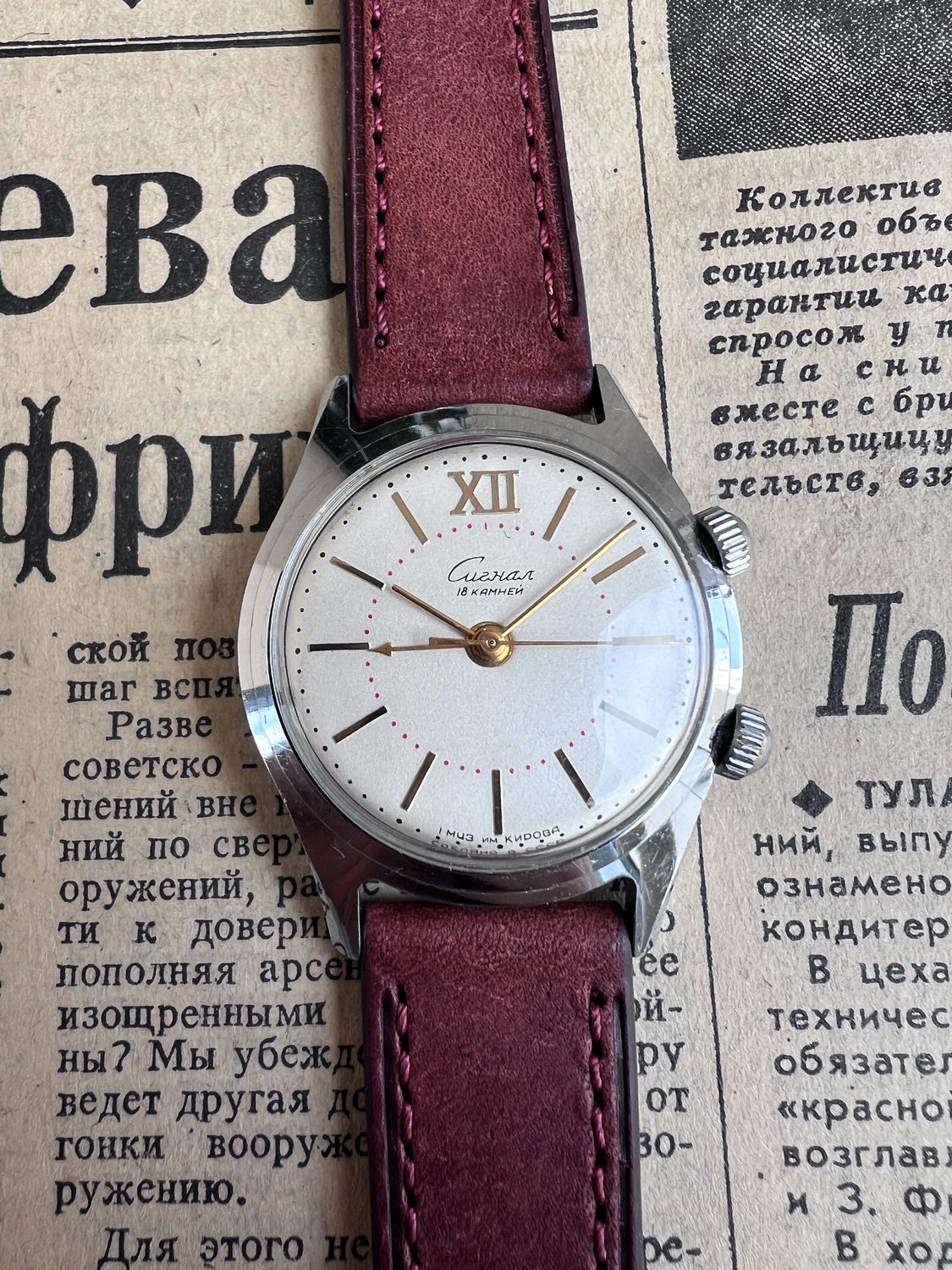
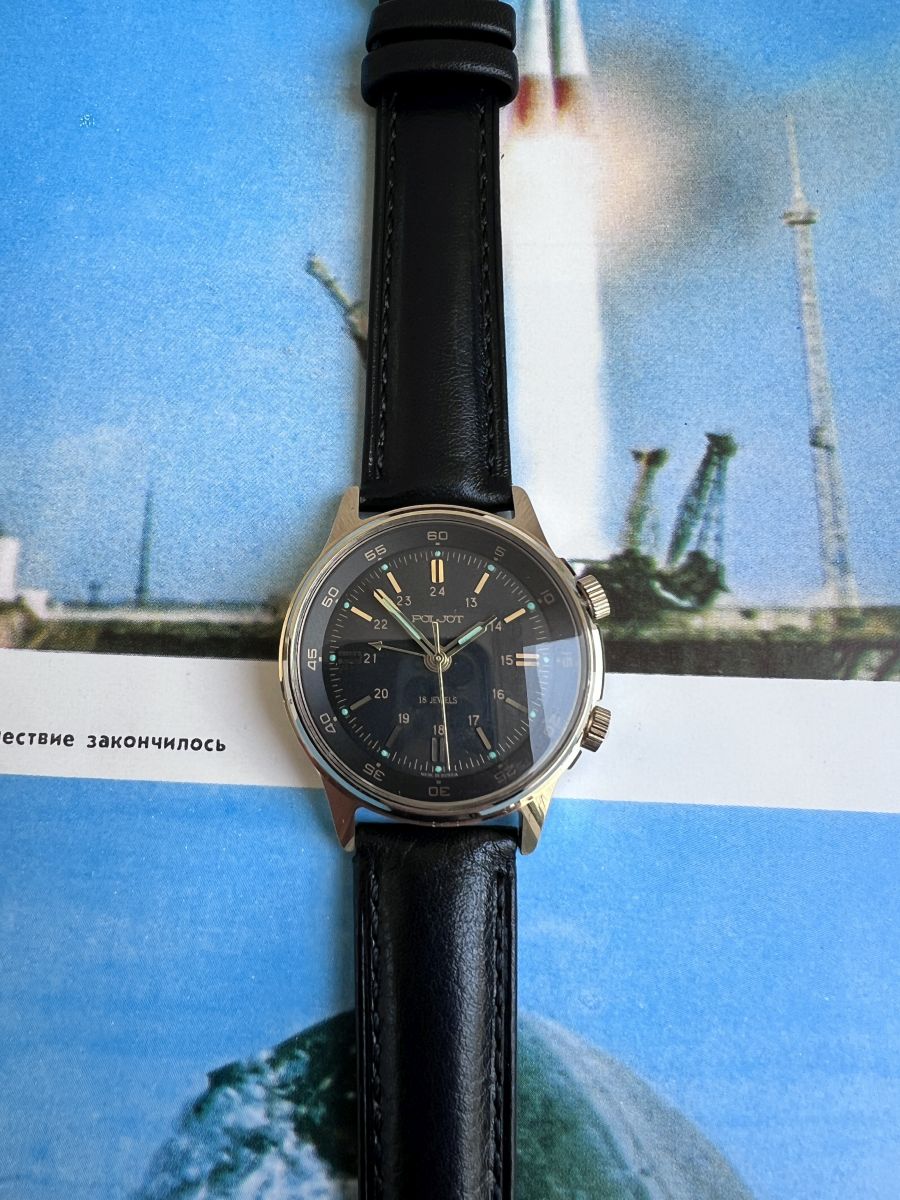
In 1959 it launched the first Soviet alarm wristwatch, the Signal. Its calibre 2612 has 18 jewels and two barrels, one for the going train, one for the alarm. Two crowns control it.
First-generation Signal, two crowns, with a dedication from 1964.
The Signal stayed in the catalogue for decades, under the Poljot name.
Poljot Signal with black dial, calibre 2612.1.
The ultra-thin watch of Leipzig
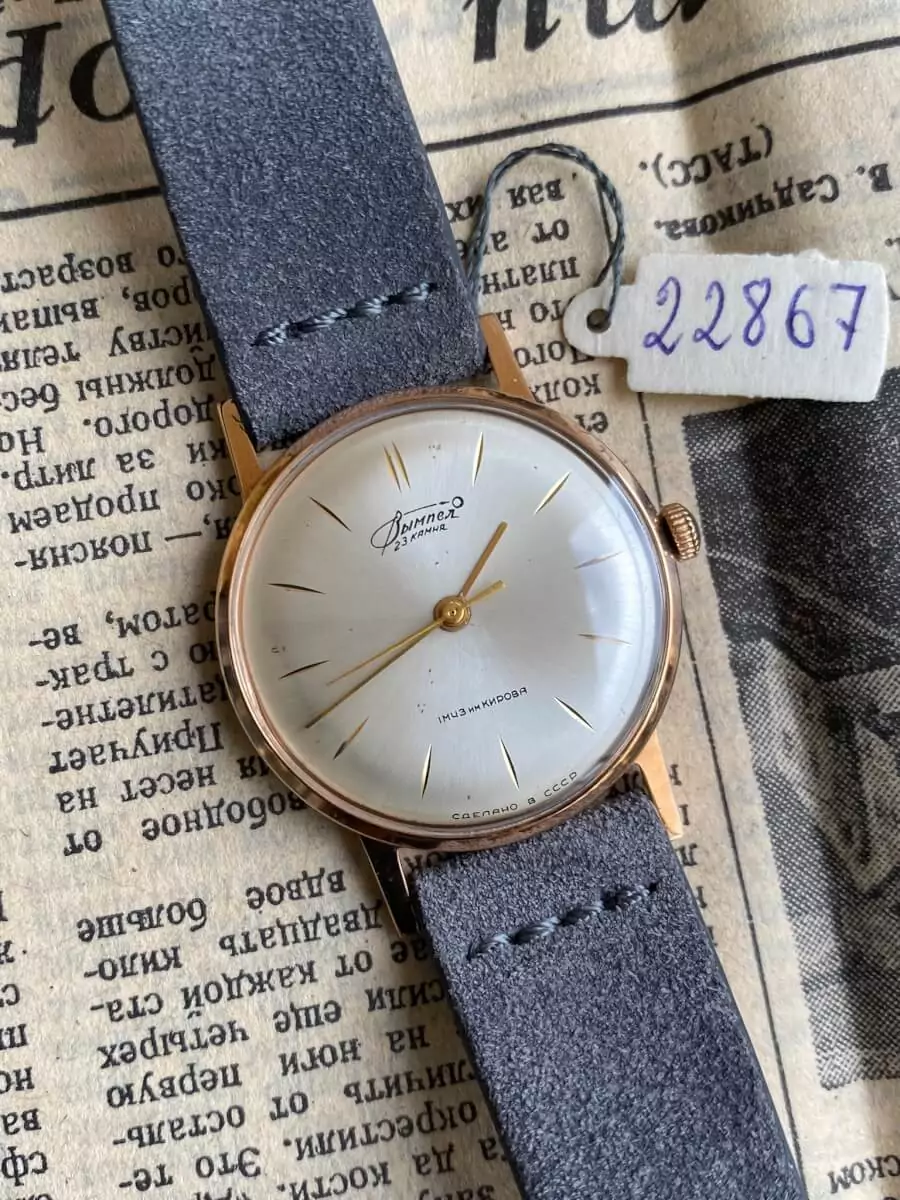
Vympel in 14-carat gold, calibre 2209 with 23 jewels.
Calibre 2209 measures 22 mm across and 2.9 mm high, with 23 jewels and centre seconds. The first watches fitted with it were called Vympel, “pennant”. In 1963 the Vympel received a diploma and a gold medal at the Leipzig fair.
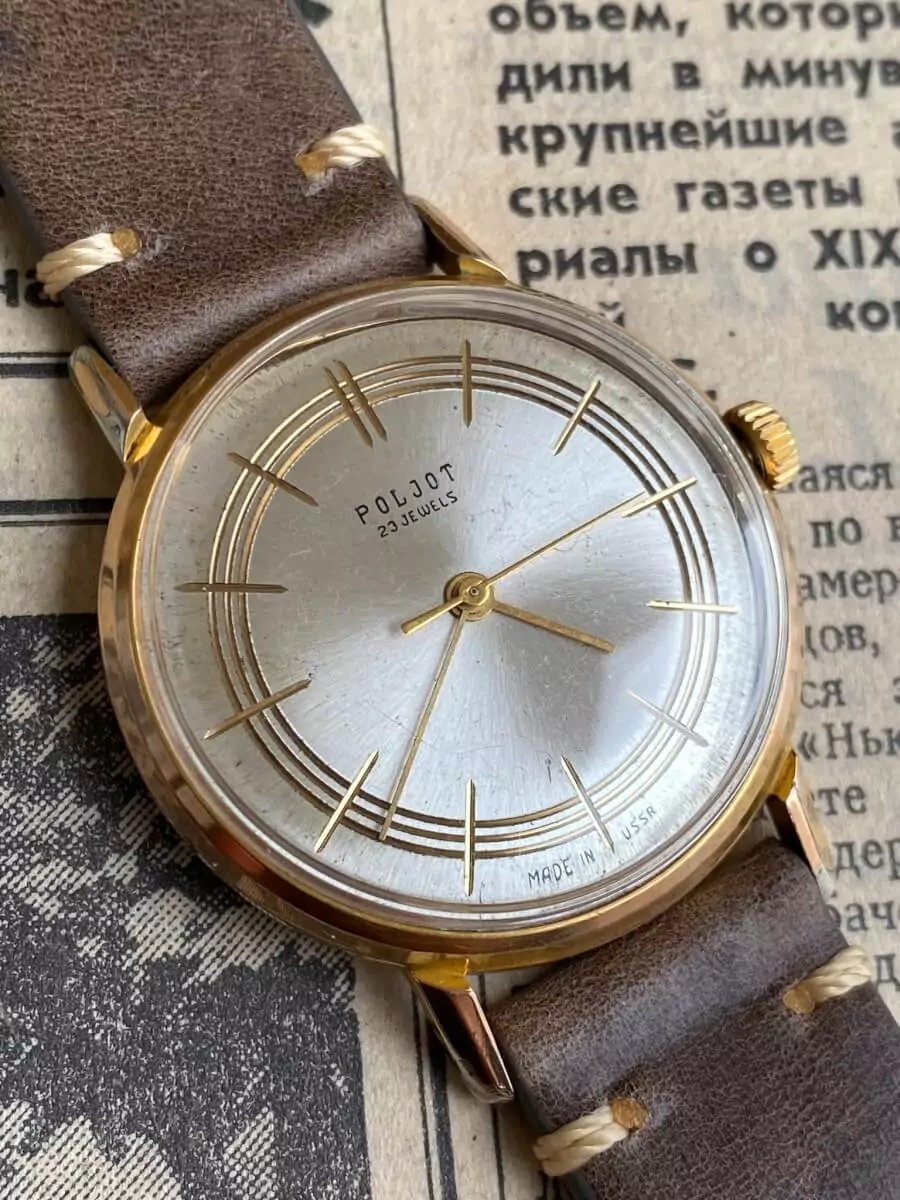
The same movement then went into the thin Poljots of the 1960s.
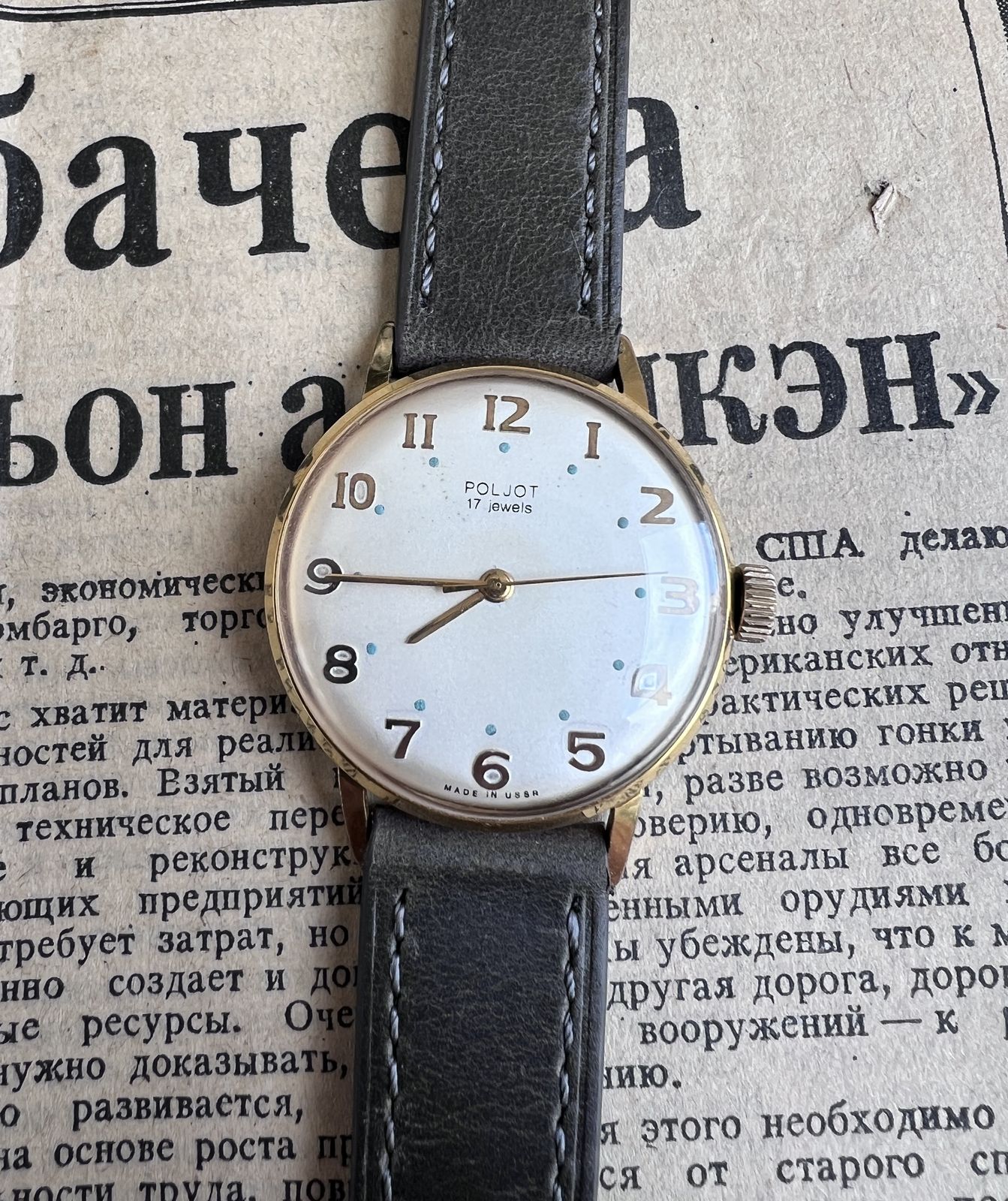
Poljot with calibre 2209, 1960s.
1964: everything becomes Poljot
In 1964 the factory’s watches began to carry a single registered brand, Poljot. The earlier names left the dials.
It is often said that the name honours Gagarin’s flight. The dates say otherwise: the factory released a first watch called Poljot in 1960, a year before the flight of 12 April 1961. The brand was then registered and extended to the whole output in 1964.
The automatics of the 1960s
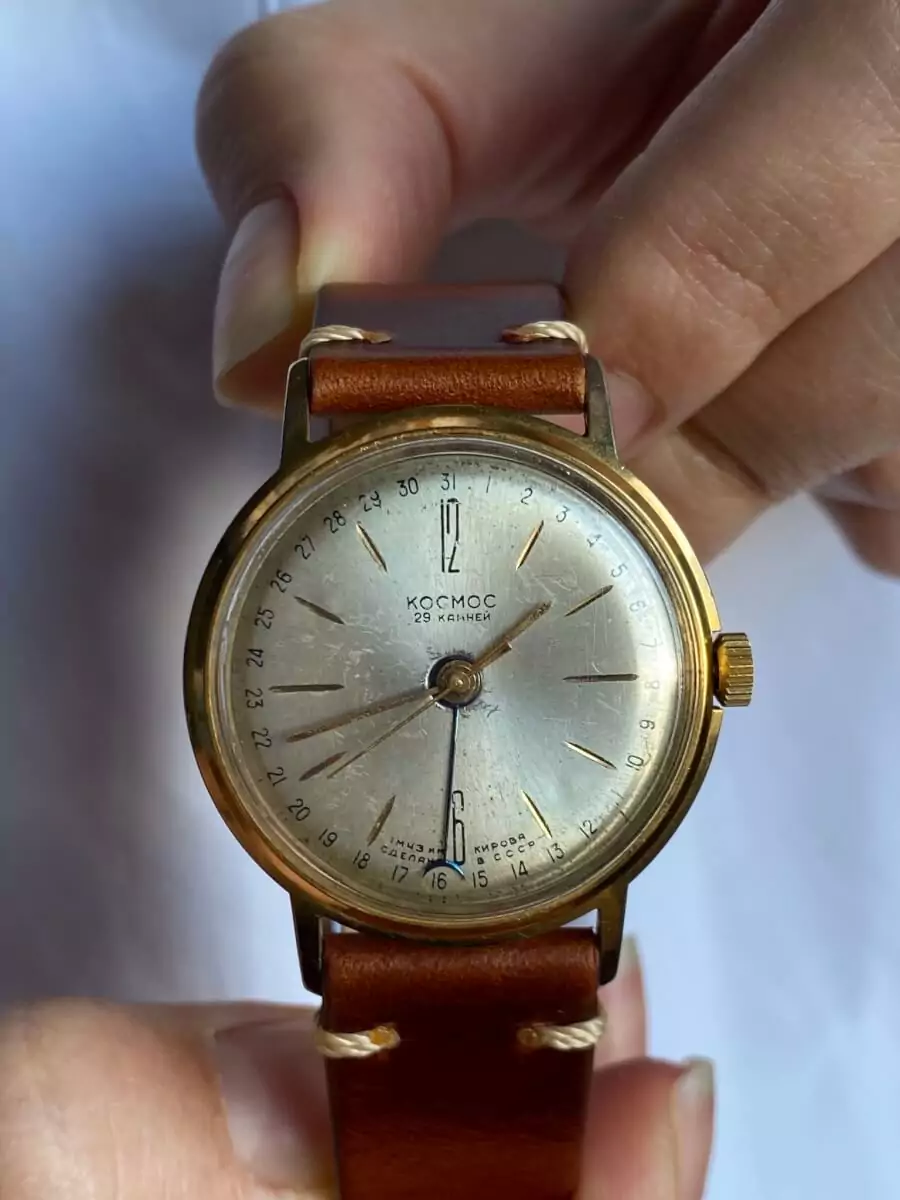
Kosmos automatic, 29 jewels, date shown by a crescent.
Two automatics mark the decade. Calibre 2415, with 29 jewels, is very thin: 3.9 mm. Calibre 2416 adds the date. It powers the Kosmos, where the date is first shown by a small crescent moving around the dial.
After 1964 these watches were signed Poljot. The finest carry the words De Luxe.
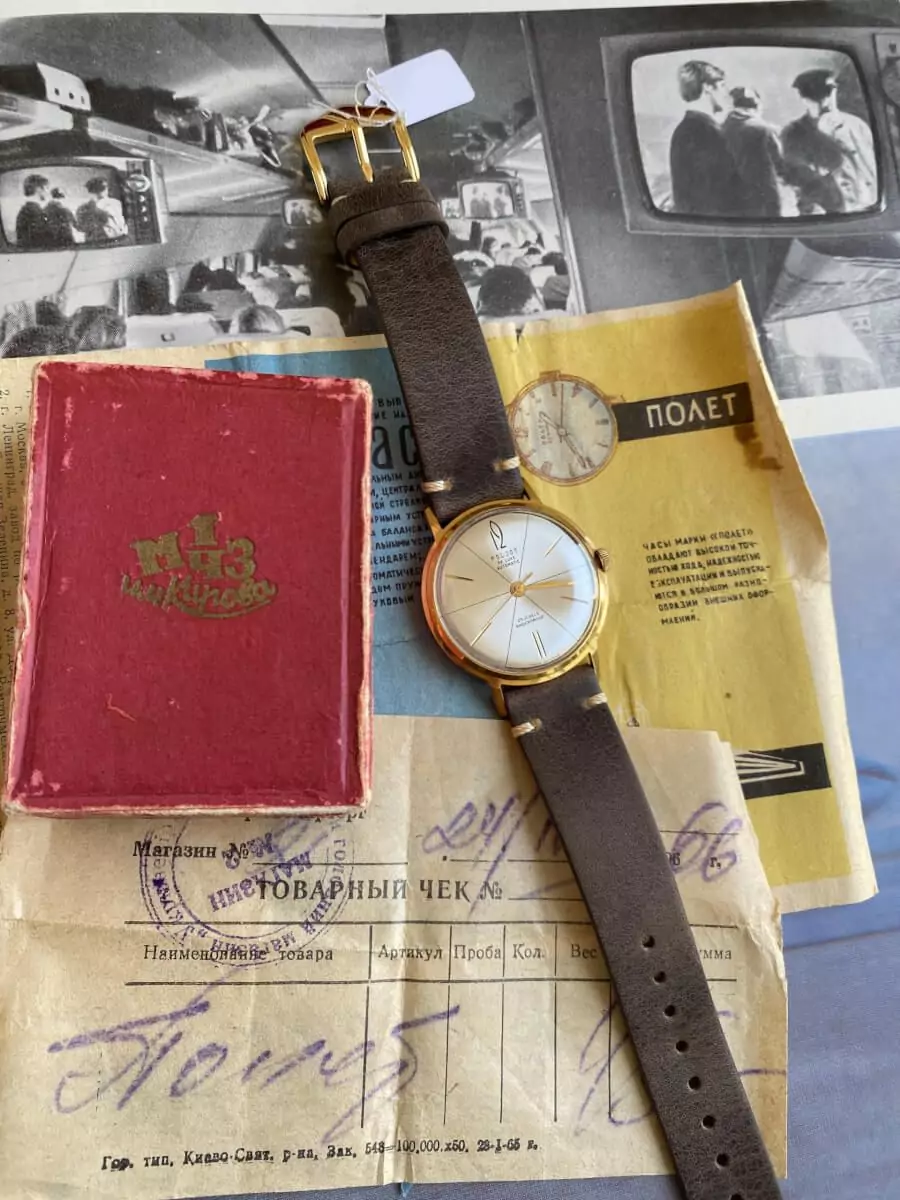
Poljot De Luxe automatic from 1966, with its papers.
The 1970s: export and new calibres
In the early 1970s the factory was rebuilt. In 1972 it made 2.7 million mechanical watches, a large share of which went abroad. They are found under the Poljot name and under export brands such as Sekonda in the United Kingdom, Cornavin, Exacta in Sweden or Cardinal in Canada.
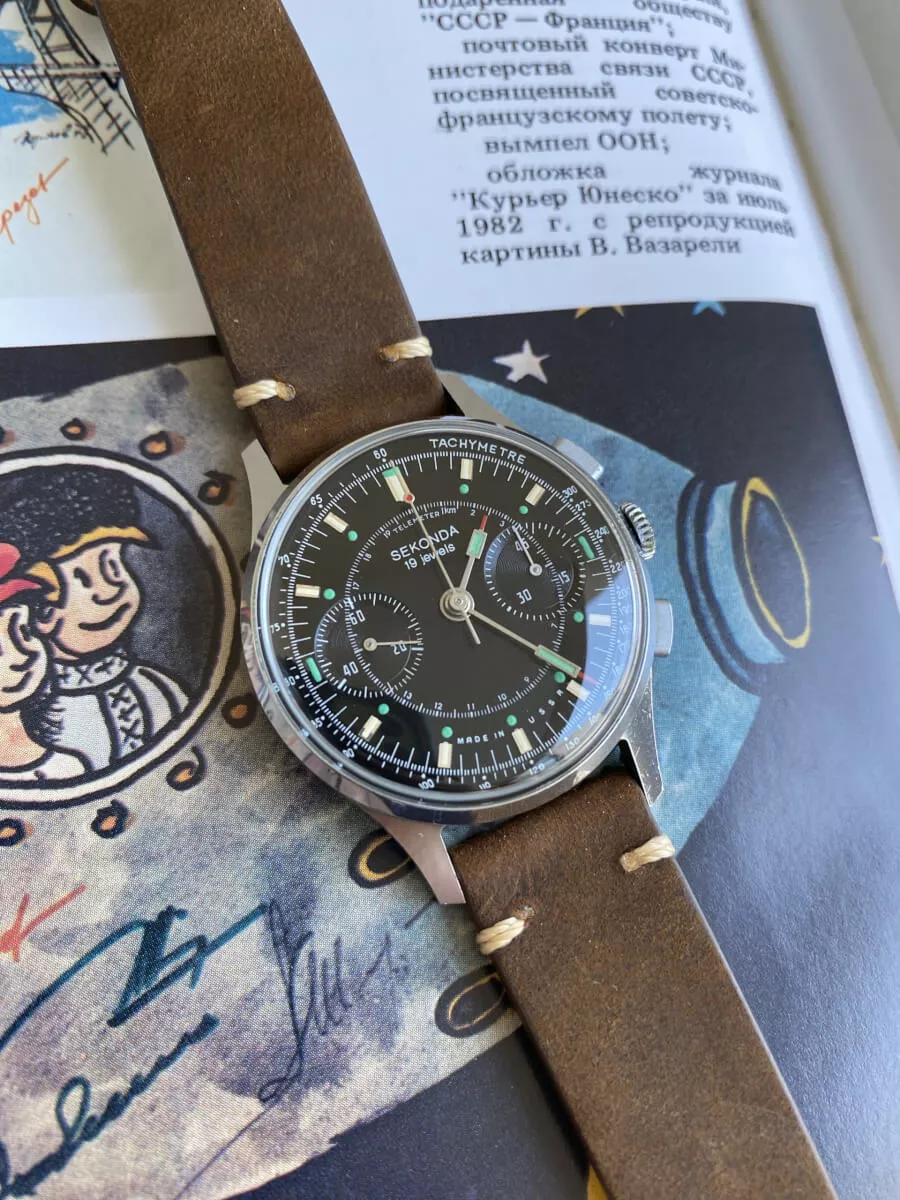
Sekonda chronograph with calibre 3017, the export version of the factory’s chronograph.
A new family of calibres arrived in 1972, recognisable by the letter Н: the 2614.2Н with date, the automatics 2616.1Н and 2616.2Н.
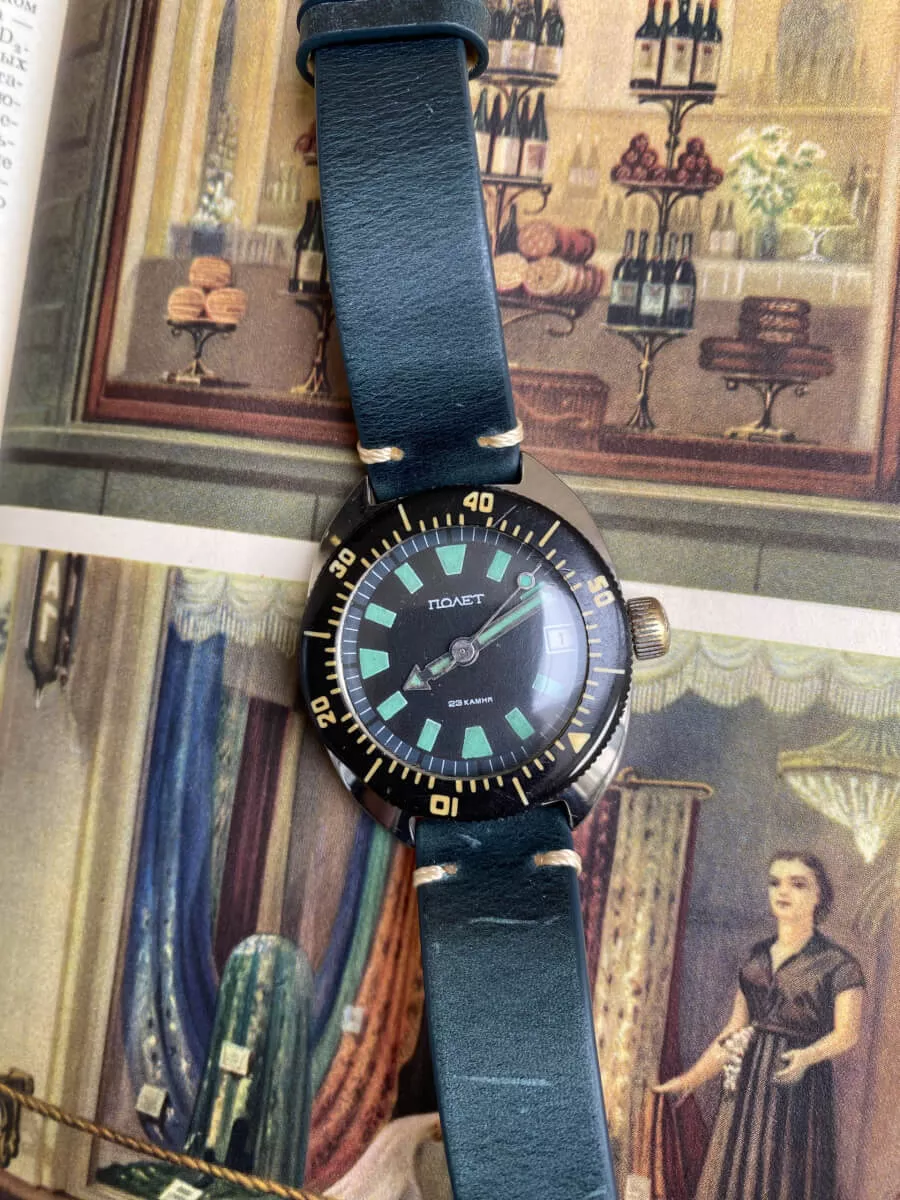
This is also the time of the Poljot Amphibia, an automatic diver with a rotating bezel.
Poljot Amphibia automatic, calibre 2616.2Н.
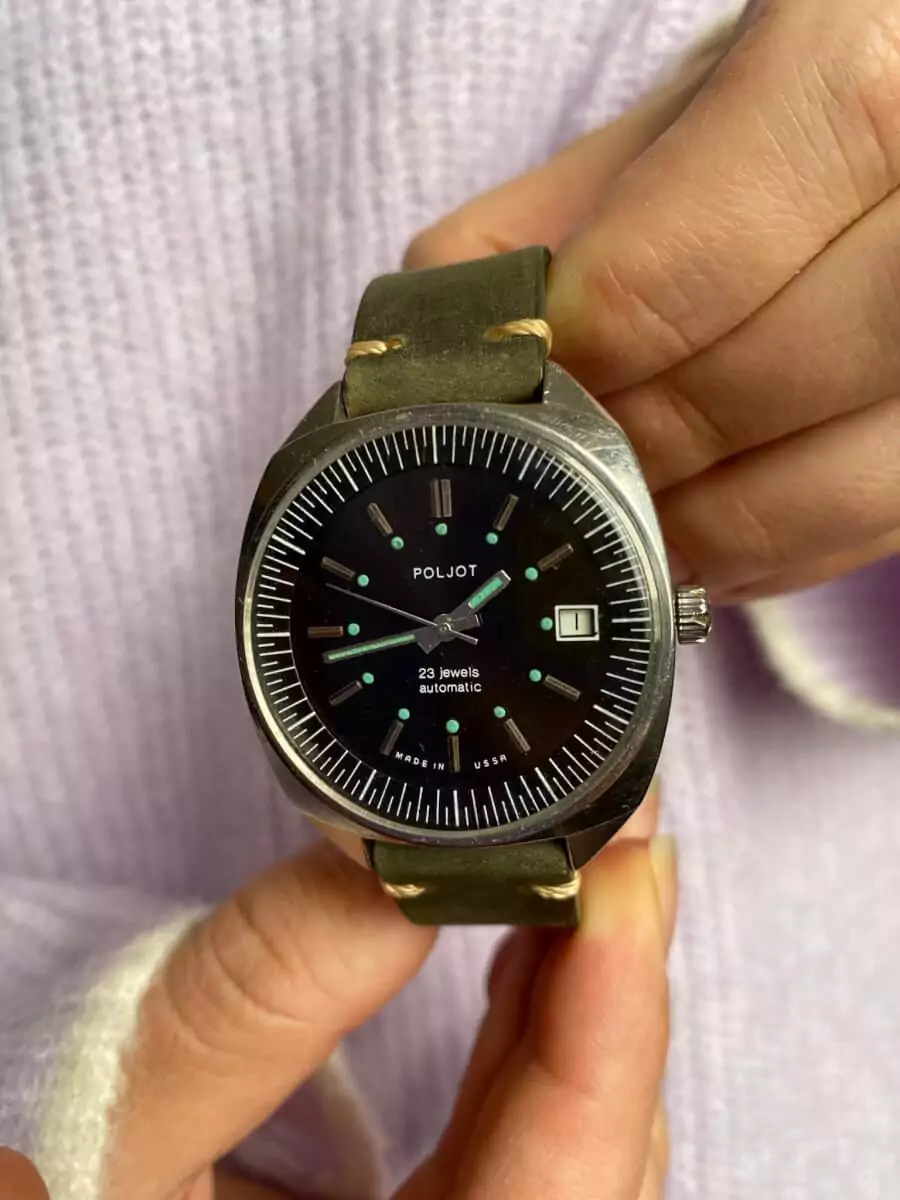
Poljot automatic, 23 jewels, presented in 1981.
The 3017 and 3133 chronographs
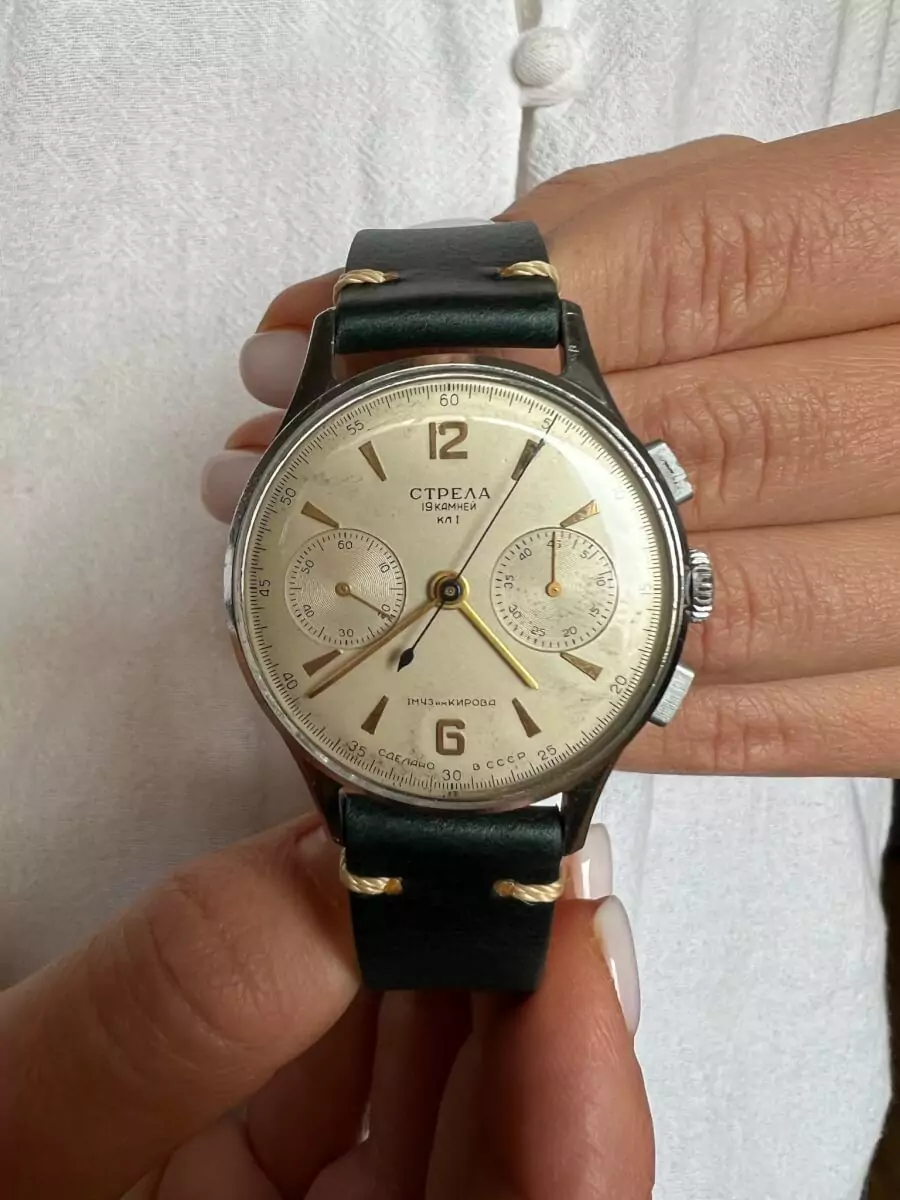
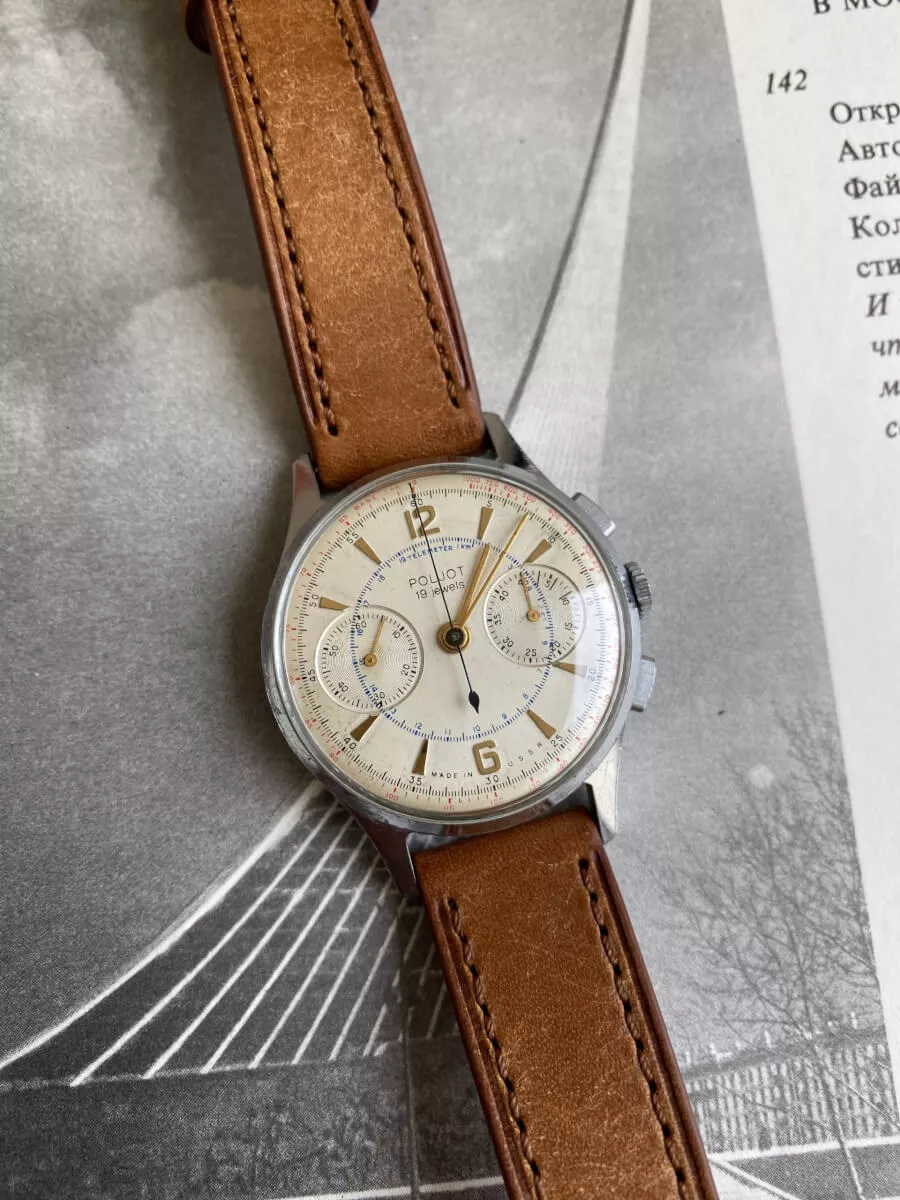
The first post-war wrist chronograph was the 3017, with 19 jewels, derived from the Swiss Venus 150 calibre. It counts 45 minutes and was intended for air force officers and cosmonauts. It is known as the Strela.
Poljot chronograph with calibre 3017, export dial marked “19 jewels”.
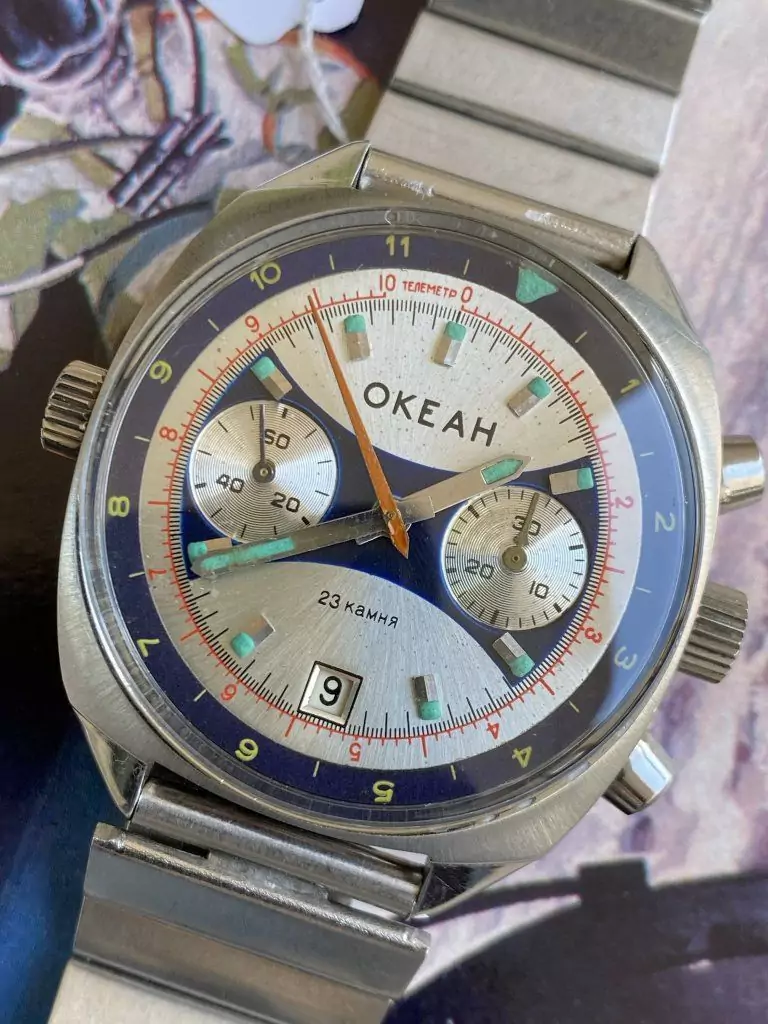
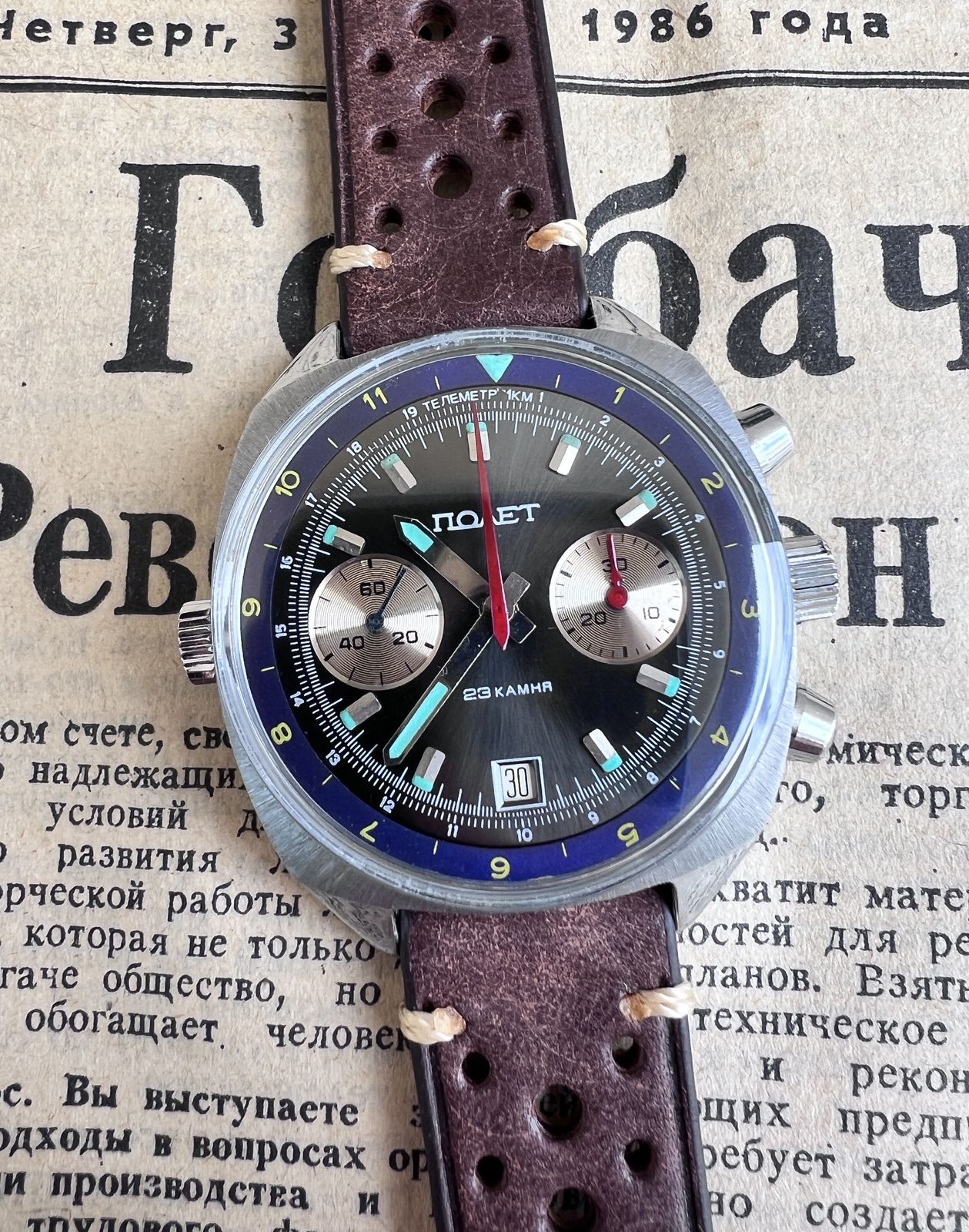
In 1976 the factory began producing the 3133 chronograph, with 23 jewels, for which its engineers received the USSR State Prize. It powers the navy’s Okean, the air force’s Sturmanskie, then civilian models.
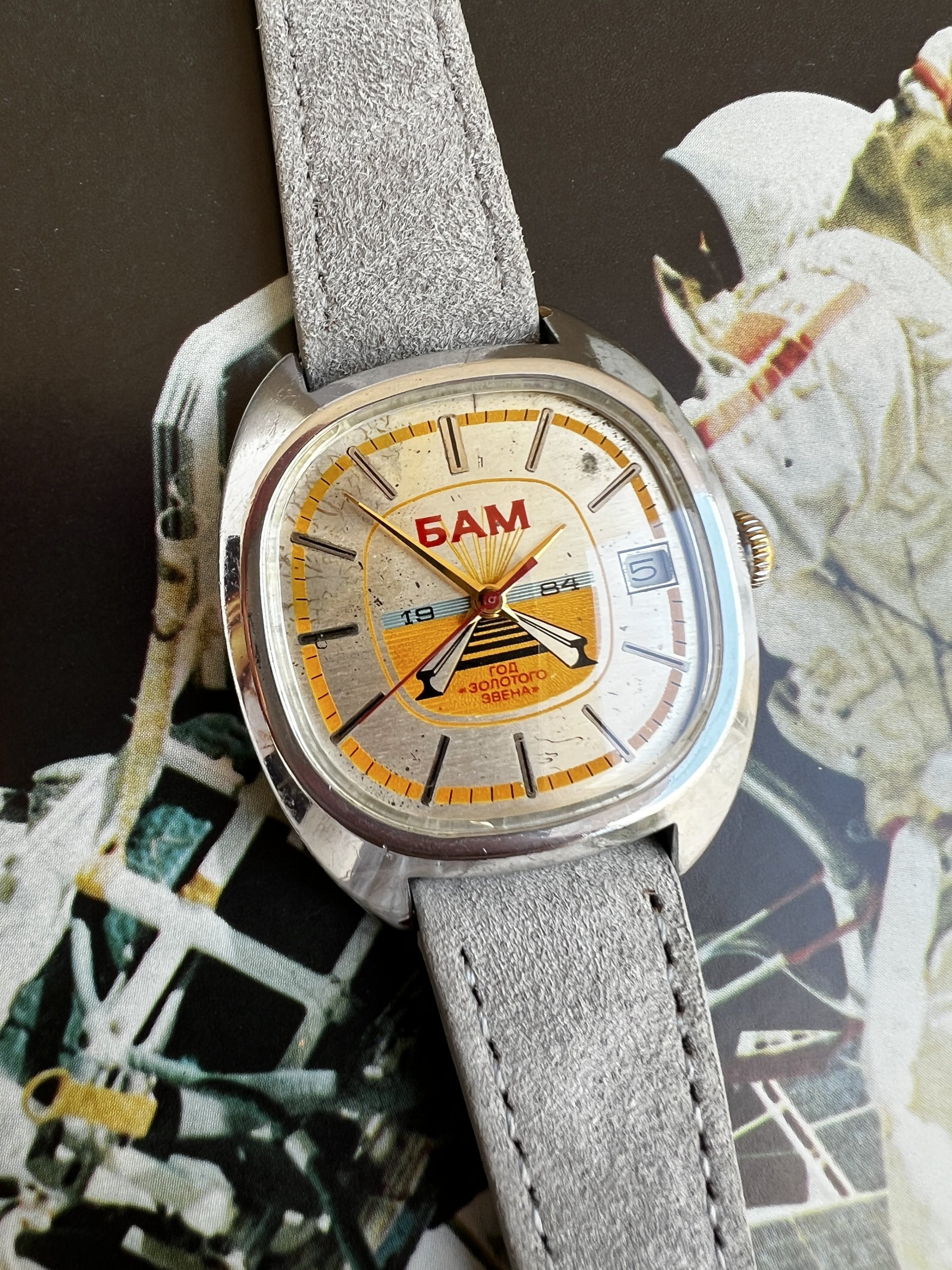
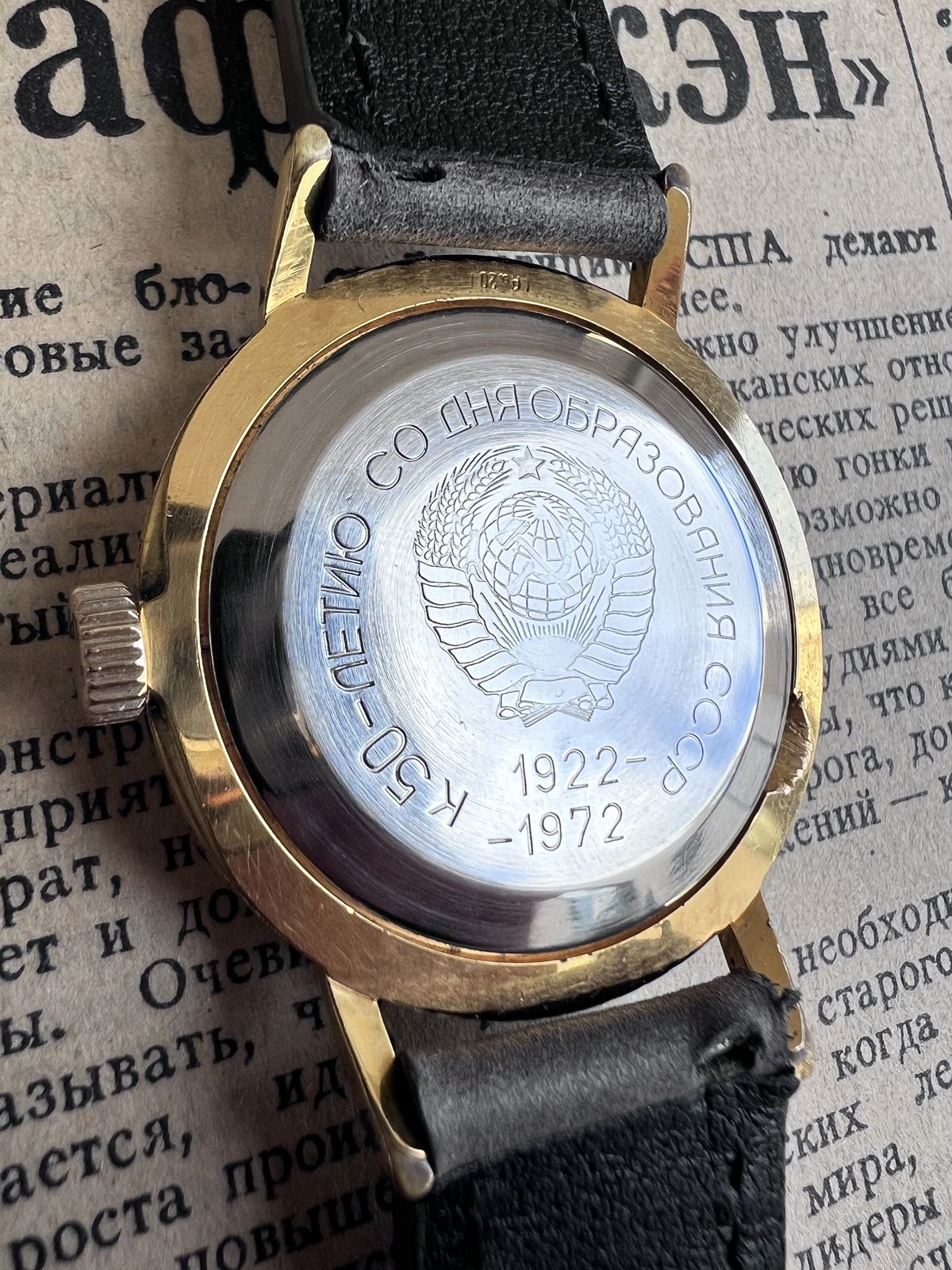
Poljot made many watches for anniversaries and great construction projects. They carry their subject on the dial or on the case back.
Poljot « БАМ », for the completion of the Baikal-Amur line in 1984.
Engraved caseback of a gold-plated Poljot: « К 50-летию со дня образования СССР, 1922-1972 », for the 50 years of the USSR.
Space returns often, down to the last years.
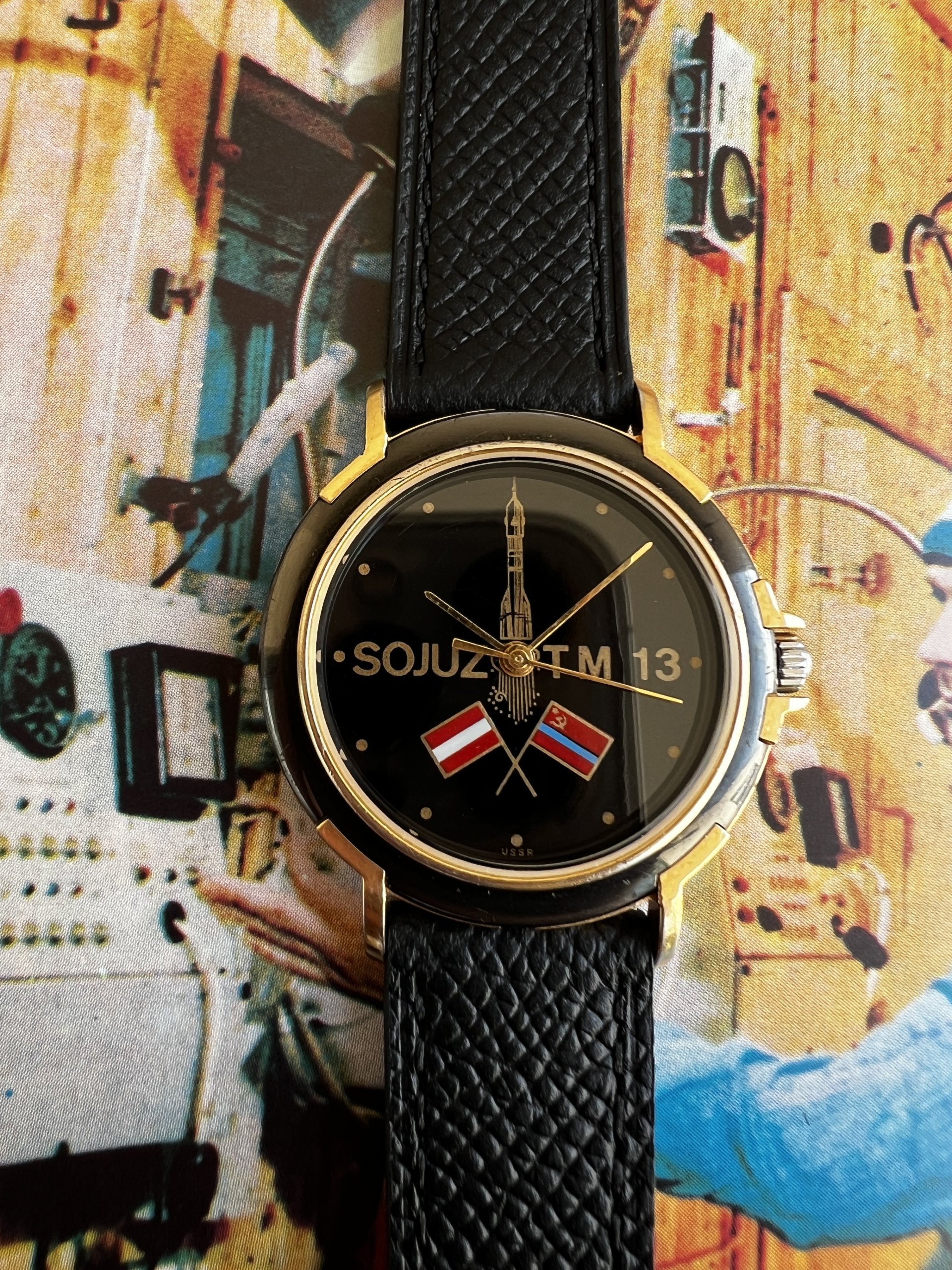
Quartz Poljot for the Soyuz TM-13 flight, 1991.
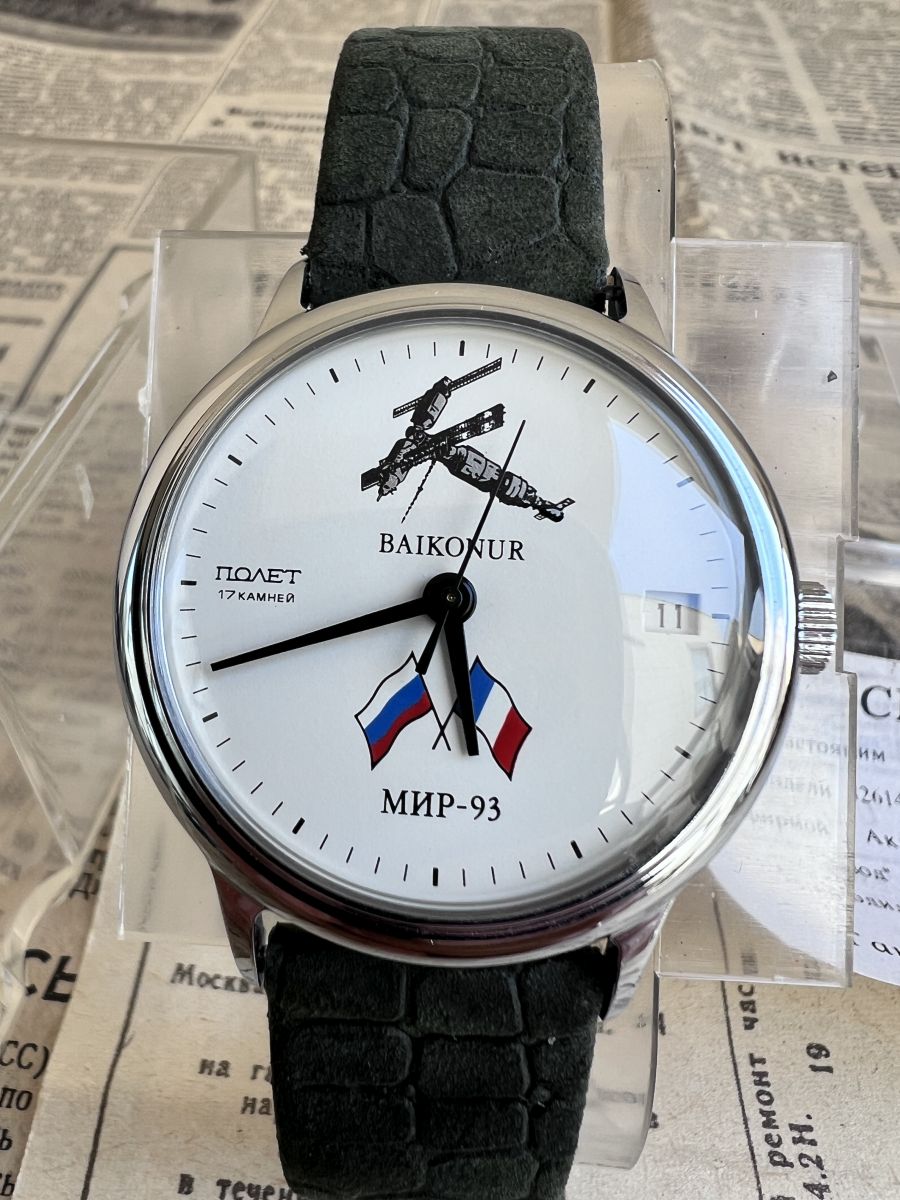
Poljot “Mir-93”, limited series for the Franco-Russian mission of 1993.
Ship and aircraft chronometers
The factory did not only make wristwatches. It also supplied the navy and the air force with precision instruments.
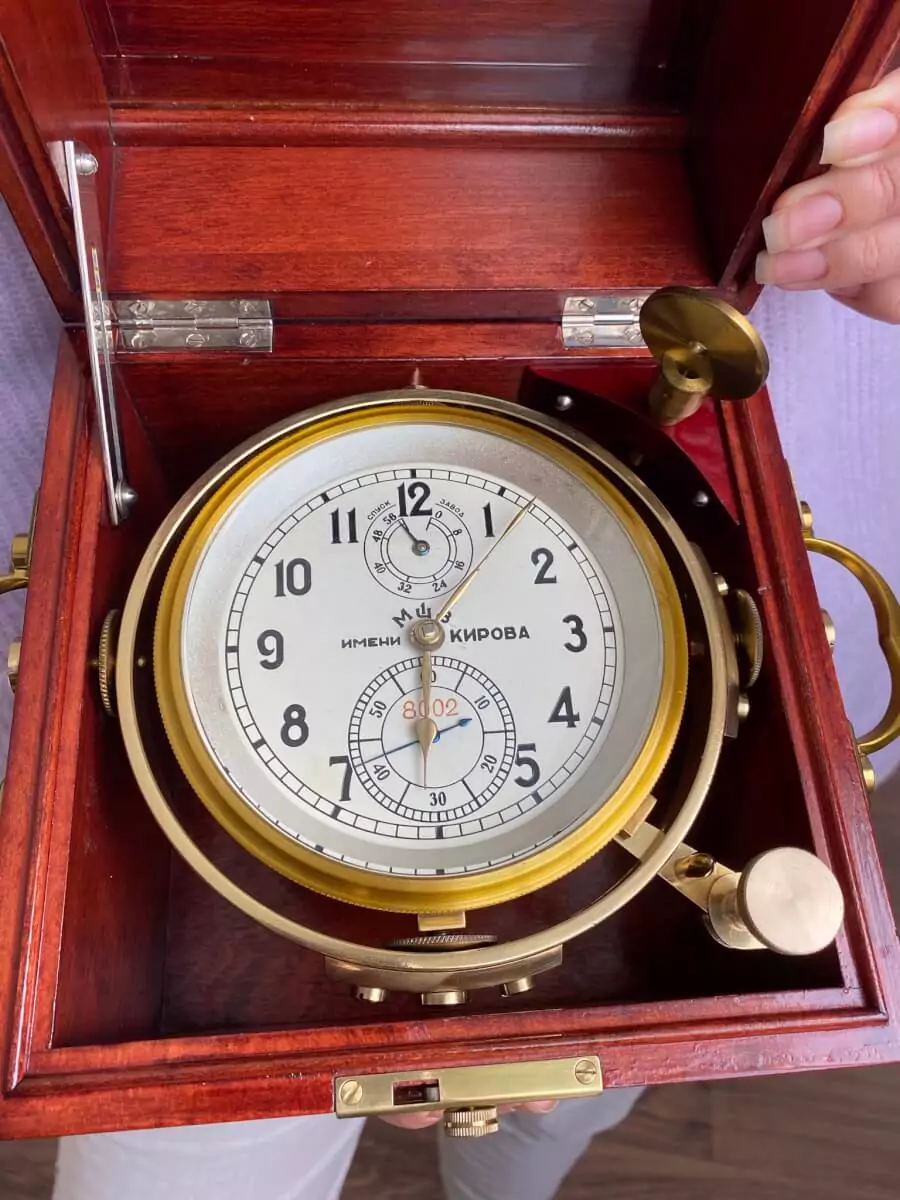
The most accomplished is the marine chronometer: a fusee movement, which keeps the force of the spring constant, a 56-hour power reserve with an indicator on the dial, the whole suspended in a mahogany box.
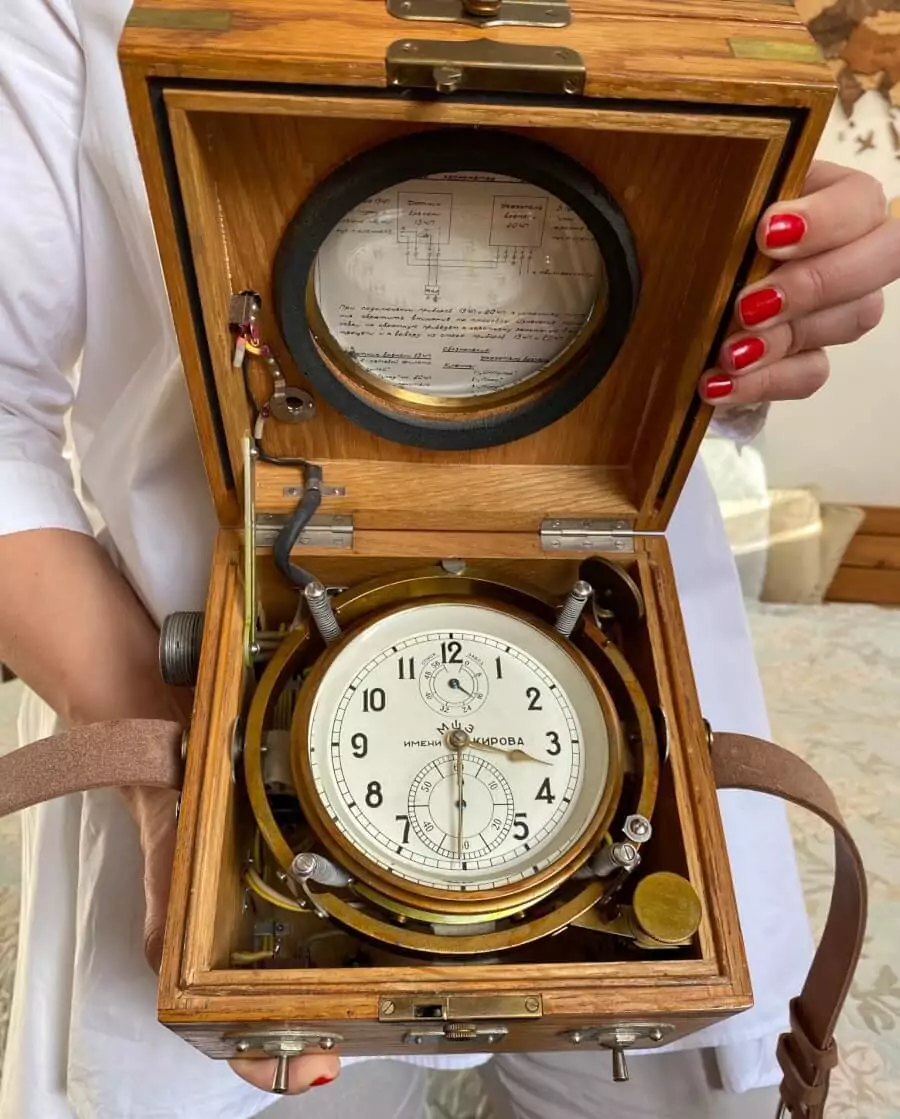
Marine chronometer from the Kirov factory, 1963, in its mahogany box.
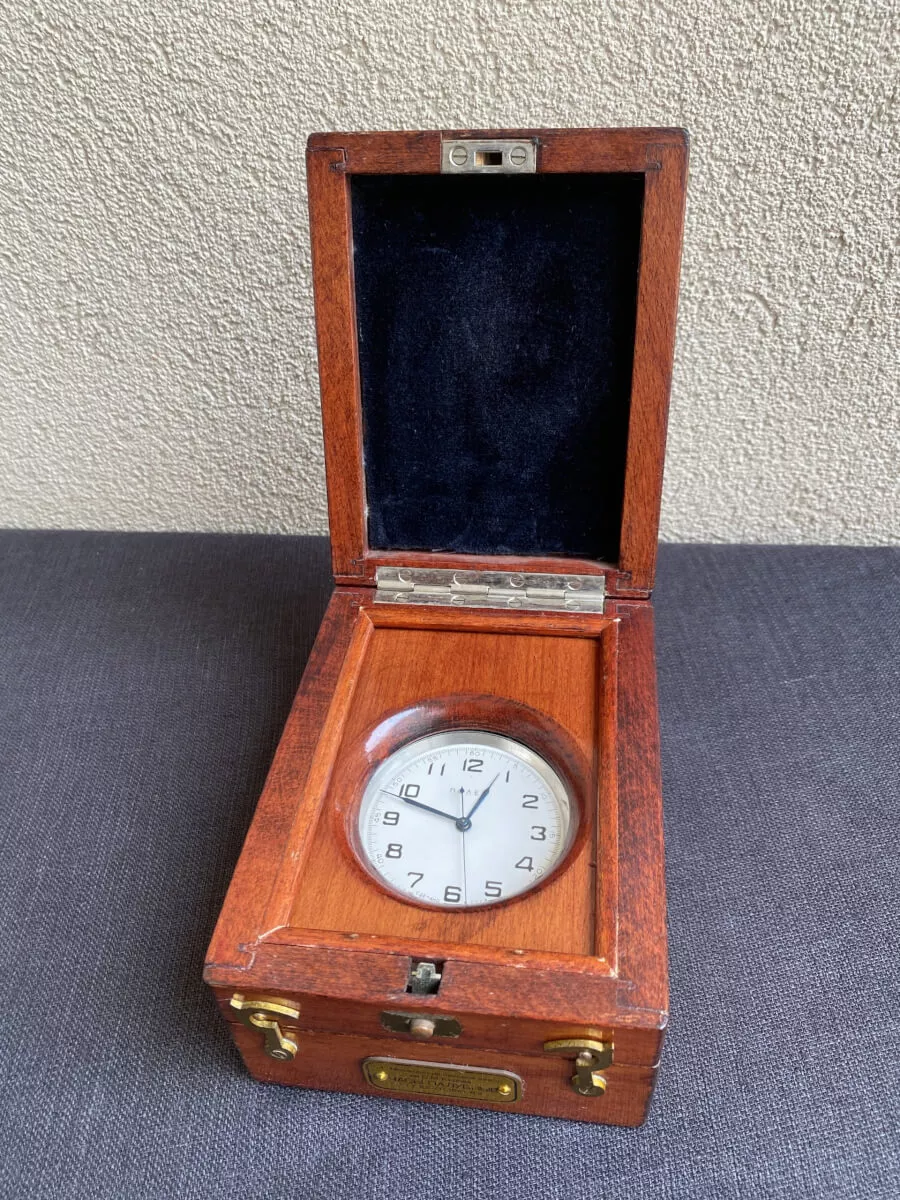
Poljot deck watch of the Soviet navy, in its box.
13ЧП aviation chronometer from the Kirov factory, 1961.
After 1991
The factory became a joint-stock company in February 1992. In 2005 the MakTime group bought the machinery and the production of the 3133. The First Factory then stopped making watches, and its premises are rented out.
The Aviator, Buran and Sturmanskie brands were taken over by Volmax, a company founded by former employees. Poljot International is a German brand, separate from the factory.
Before buying
The most sought-after models are also the most tampered with. Two examples, to compare with the slider.
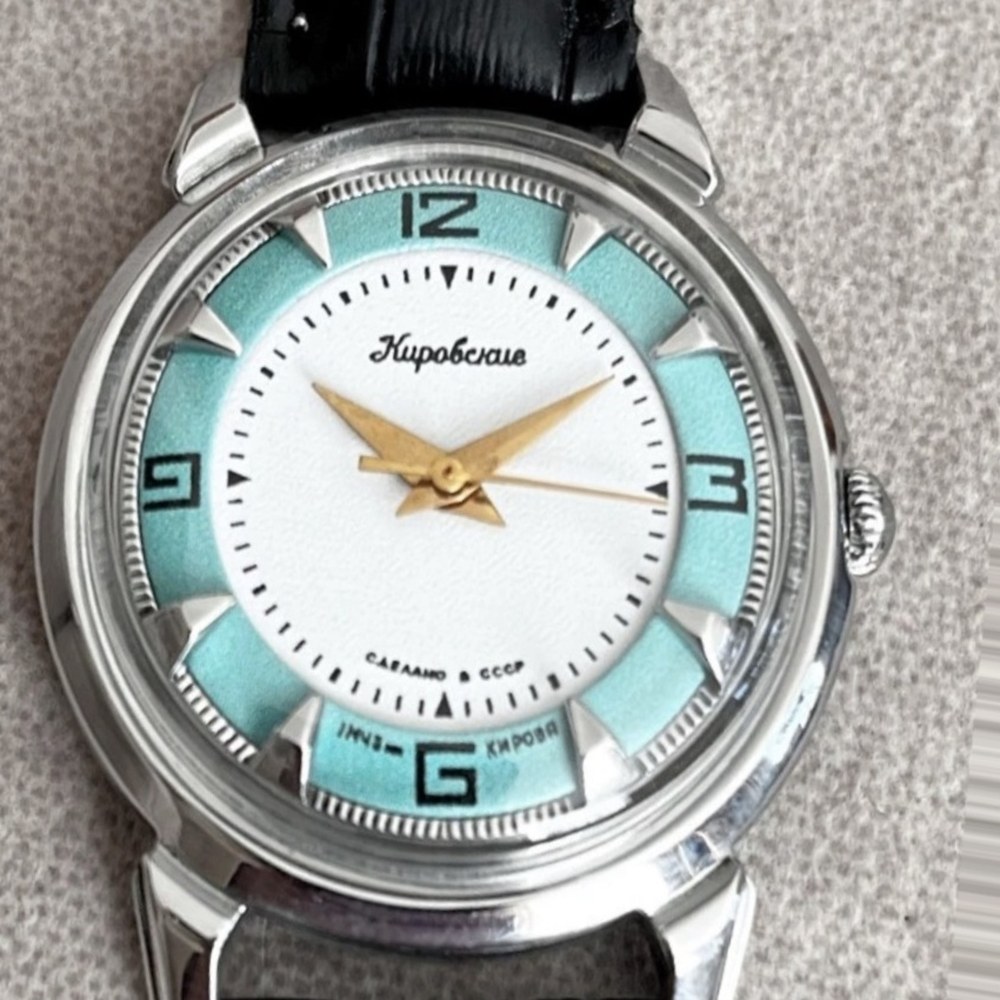
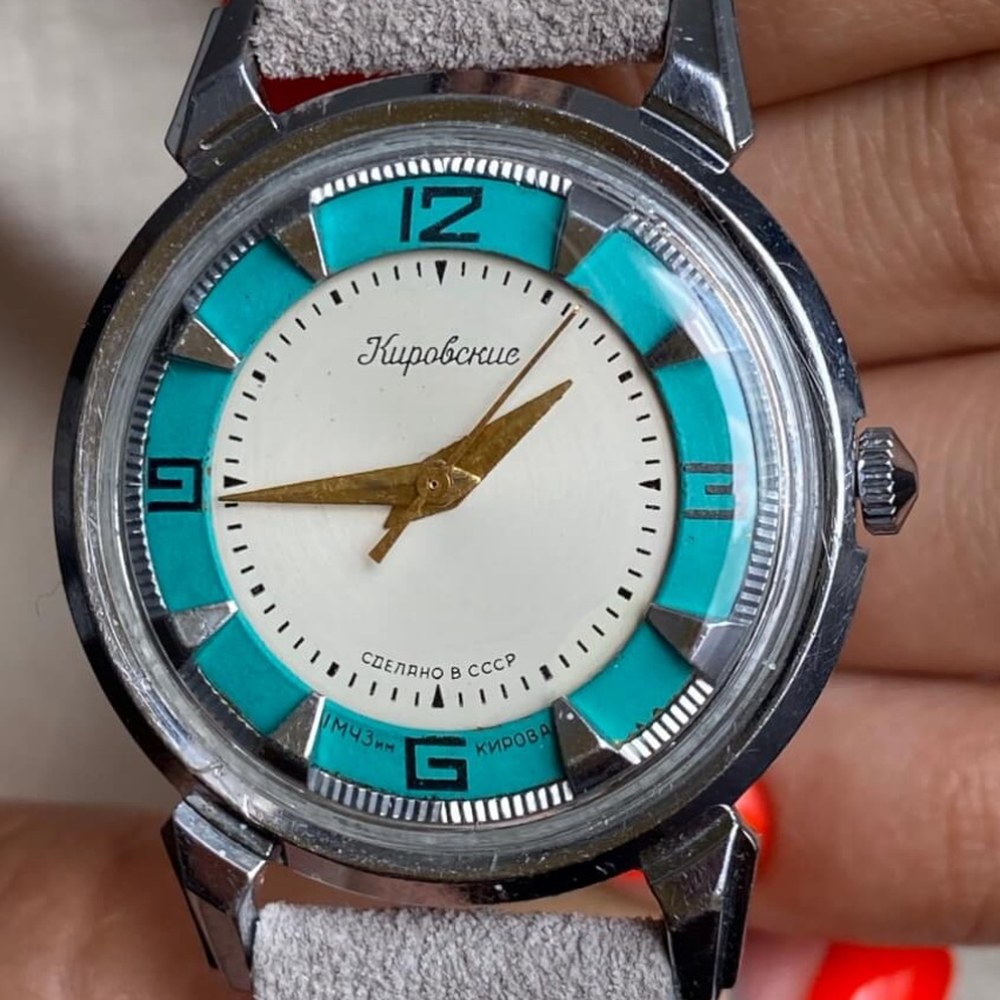
The turquoise Kirovskie is often sold with a repainted dial.
Period dialRepainted dial
1The white. A perfectly white centre, without the slightest flaw, on a watch from the 1950s: the dial has been repainted.
2The lettering. « Кировские » and « Сделано в СССР » are fine on the period dial. They are thicker on the repainted dial, because they were redone.
3The blue. The shade of the ring is not the factory one on the repainted dial.
These points apply to the copies shown here. Others exist. A few general rules:
Sturmanskie and “Gagarin” watches: fakes are rare. The risk comes from the reissues, which are very numerous and must not be taken for period watches.
Strela and 3133 chronographs: there are watches assembled from parts, with reprinted dials. Sekonda dials of the 3017 are copied too: see the real or fake comparator in our article on dating the Strela 3017.
Gold plating: it is thick in the 1960s, marked Au20, and much thinner on late watches.
Poljot, Volmax and Poljot International are not the same thing. A recent watch signed Poljot is not a Soviet watch.
The most important thing is to do thorough research before buying. Compare the watch with several examples of the same model. Rely on trusted sources: the sites of collectors who show their collection, and buying guides.
The ДП-5В (DP-5V) is the field radiometer of Soviet civil defence: a green Bakelite console, a probe with a rotating gamma, beta and check-source shield, headphones and a manual that explains operation and maintenance. The one in this article served in an industrial bakery in Chișinău and was serviced in March 1991. Its owner shared his photos and documents with us, and we turned them into a tool that lets you operate it on screen, step by step.
The Moscow Games, from 19 July to 3 August 1980, boycotted by some sixty countries, produced more objects than any Soviet event: a bear cub, Misha, drawn by Viktor Chizhikov, an emblem made of running tracks, five thousand torches, watches from every factory, platinum coins, rings, tea glass holders, posters. This guide tells the story of the Games and reviews the objects, with the marks that authenticate them and the prices.
The 3017 chronograph of the First Moscow Watch Factory carries a five-digit number on the balance cock. The most common dating method reads it as a single series, from 1959 to 1979. Four factory passports show there are two, and that the same number can point to two watches made ten years apart. Here is how to read the number, the dial, the logo and the bridge, with a decoder to date your Strela, Poljot or Sekonda.
This website uses cookies to improve your experience while you navigate through the website.
Out of these cookies, the cookies that are categorised as necessary are stored on your browser as they are essential for the working of basic functionalities of the website.
We also use third-party cookies that help us analyse and understand how you use this website.
These cookies will be stored in your browser only with your consent.
You also have the option to opt out of these cookies.
But opting out of some of these cookies may affect your browsing experience.
Necessary cookies are absolutely essential for the website to function properly. This category only includes cookies that ensure basic functionalities and security features of the website. These cookies do not store any personal information.
Cookies that are not strictly necessary for the website to work and that are used specifically to collect personal data through analytics, ads and other embedded content are called non-necessary cookies. User consent is required before these cookies run on the website.
✕
Soviet in Paris
Online. We answer in person, no AI and no chatbot. Reply right away, 20 min at most.
Hello 👋 A question about an item, an order or shipping? Write to us.
Your email is used only to reply to you.
Subscribe to our newsletter and get 10% off your first order.
Subscribe
★ New pieces before anyone else
★ New blog articles
★ Soviet in Paris news and updates
Join the Party
10% off your first order
Receive your welcome card and our next arrivals.
Your code appears here and is also sent to you by email. You can leave the Party in one click, at any time.






 Strane Mira