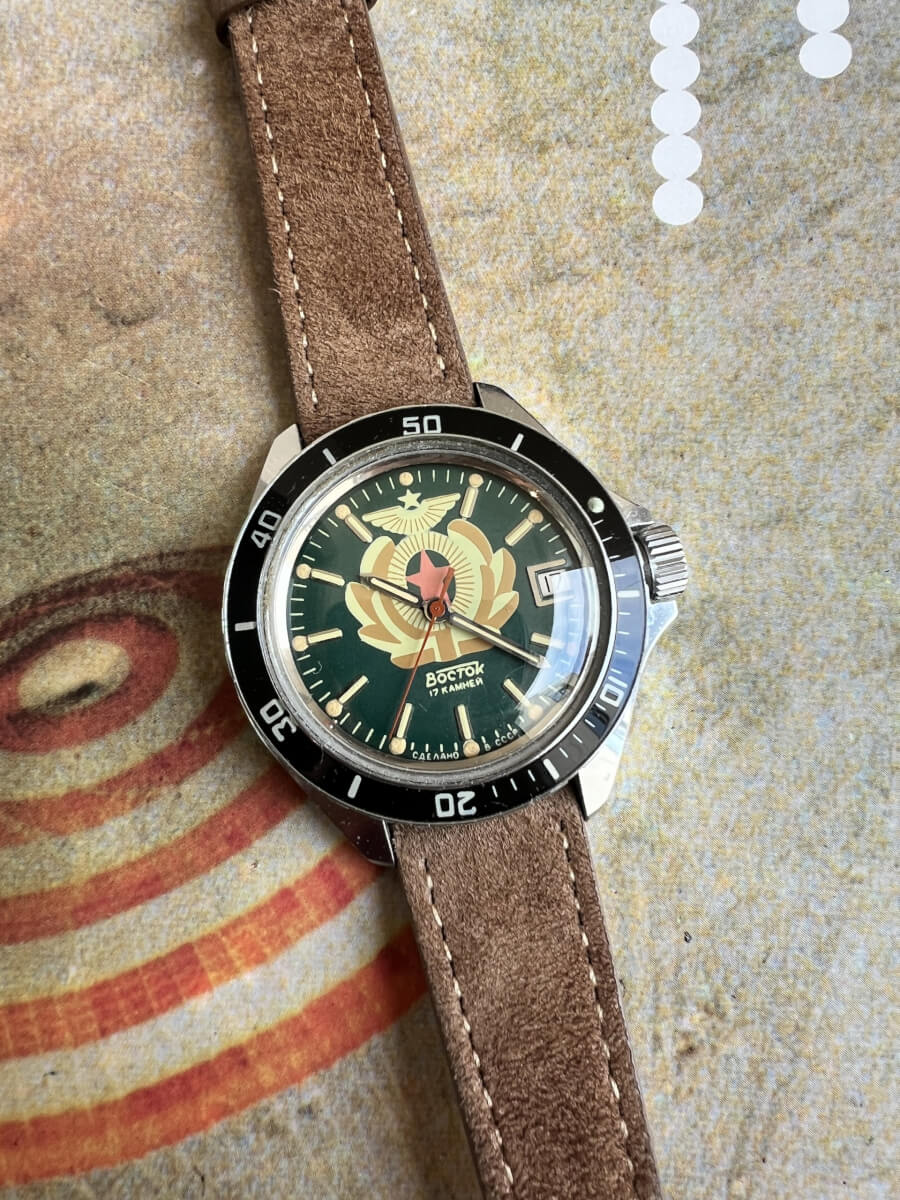
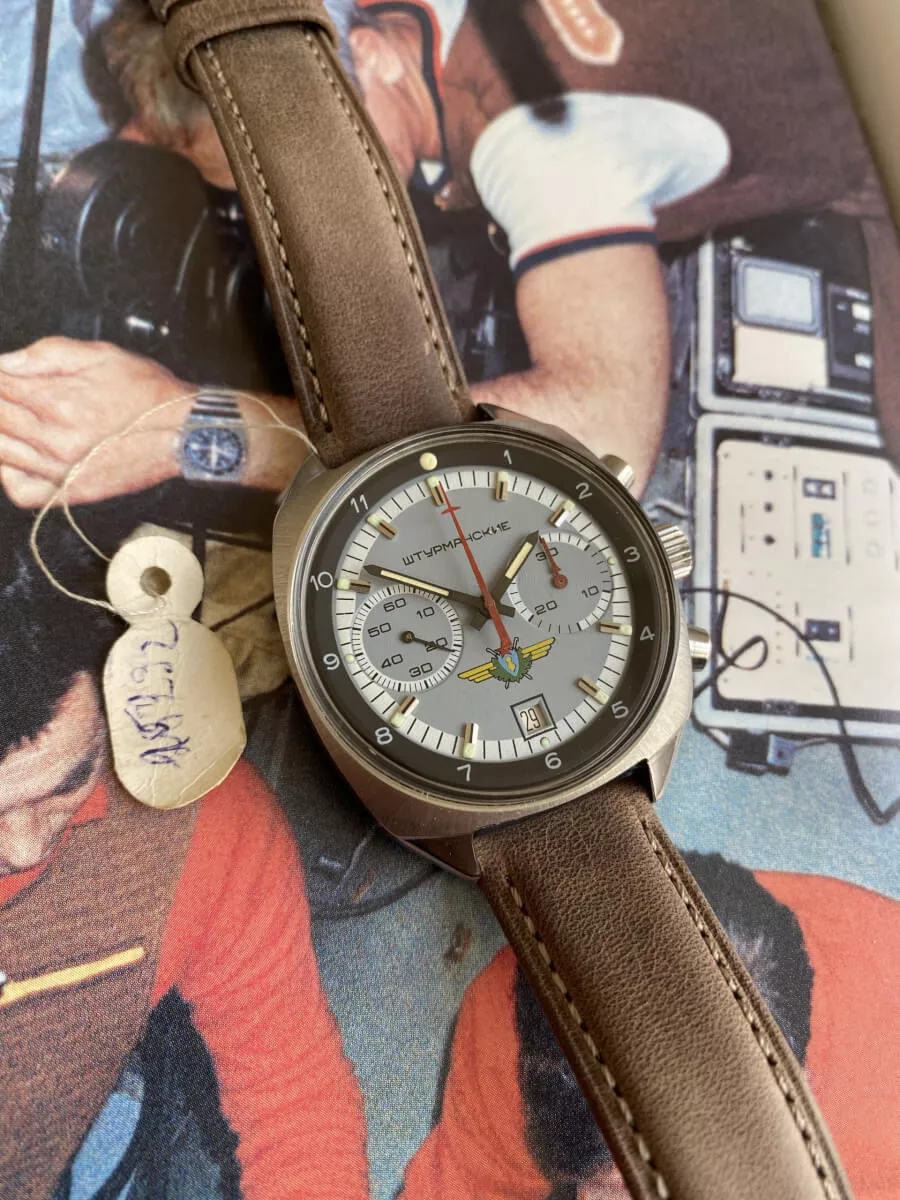
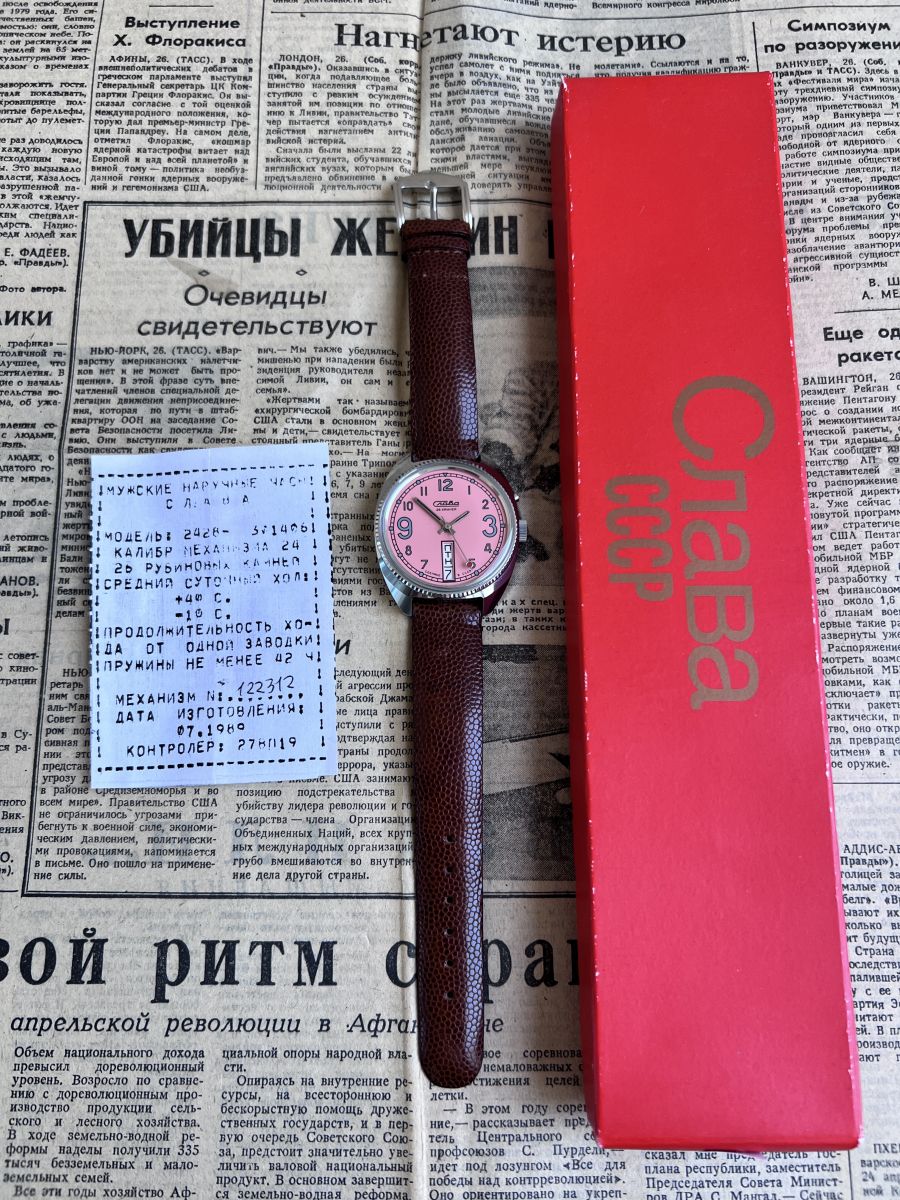
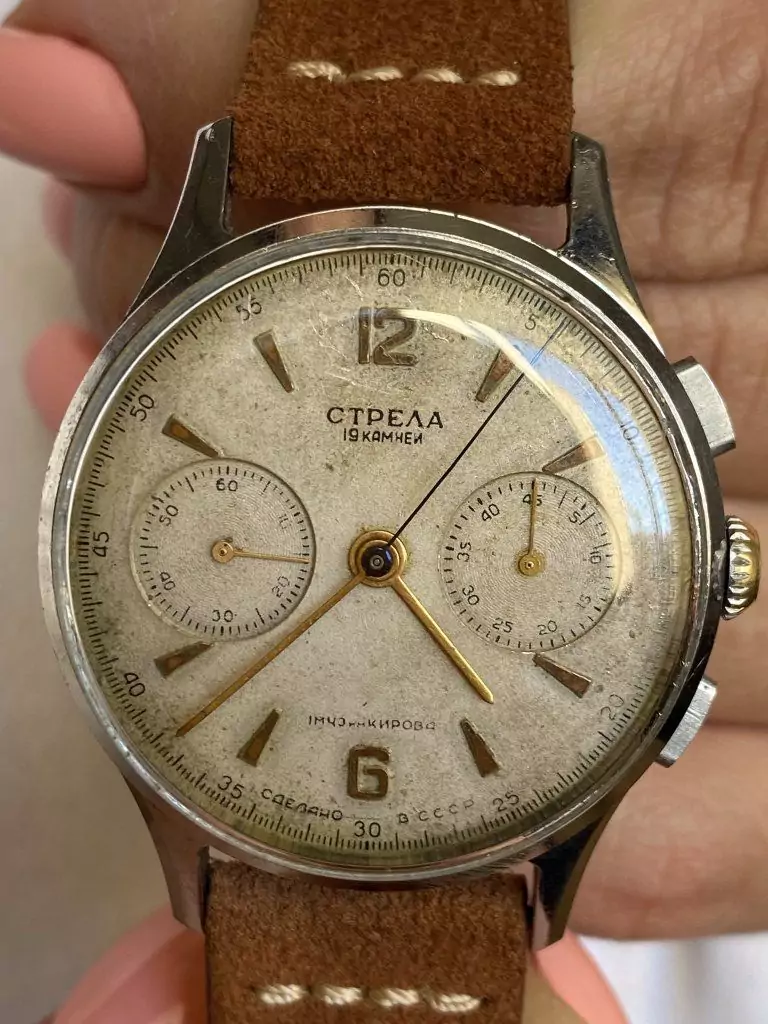
A Soviet watch that stops is almost never dead: nine times out of ten, its oils have dried. This guide translates each symptom, says which parts can still be found and which cannot, gives the real prices of a service, a crystal or a crown, explains what you should never do yourself, and how to send the watch to our Soviet Times workshop.
NOVEMBER 2026•7 MINUTE READ
by Marwen Yahyaoui
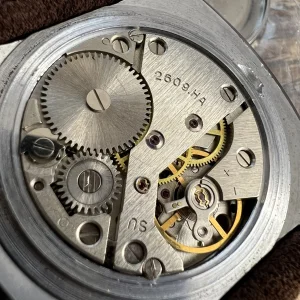
A serviced Raketa 2623 calibre, seen through the open back: the movement of an Antarctic expedition Raketa that runs as on its first day.
A Russian watch that no longer runs is almost never a dead watch. Soviet calibres were designed to be repaired everywhere, from Kaliningrad to Vladivostok, by neighbourhood watchmakers with simple tools. What they lack today is not repairability, it is the watchmaker who knows them. This guide translates the symptoms, says what can still be found as parts, gives real prices and explains how to send the watch in.
What the symptom says
It stops after a few hours, or only starts if shaken. The oils have dried and gummed on the pivots. This is the most common case, and the most benign: a full service is enough. A watch that has slept thirty years in a drawer is in this case, even if it seems to run.
It gains several minutes a day. The hairspring is magnetised, or its coils stick together through migrated oil. A pass through a demagnetiser fixes the first case in a minute; the second needs a cleaning.
It loses a lot or stops when fully wound. The mainspring is tired or broken, or the barrel oil has set. The spring can be changed; Soviet barrels are standard.
Winding is hard, grinds, or the crown turns freely. Worn or broken winding stem, damaged sliding pinion. A common part on Vostok, Raketa, Slava, Poljot. Never force it.
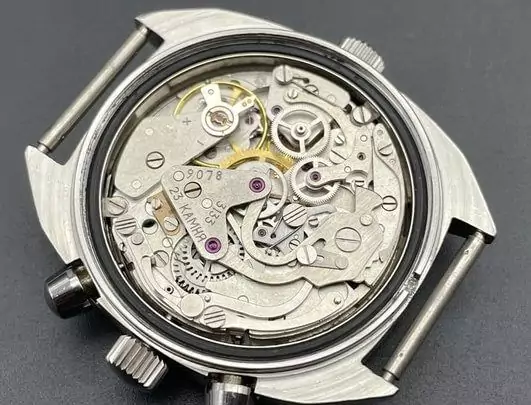
The chronograph does not reset, or the hands no longer line up. Worn hammers or cams on a 3133, column wheel on a 3017: a job for a specialist watchmaker, not a general repairer.
Mist under the crystal. Dead case back or crown gasket. It must be opened quickly, dried and the gaskets changed before rust settles on the movement.
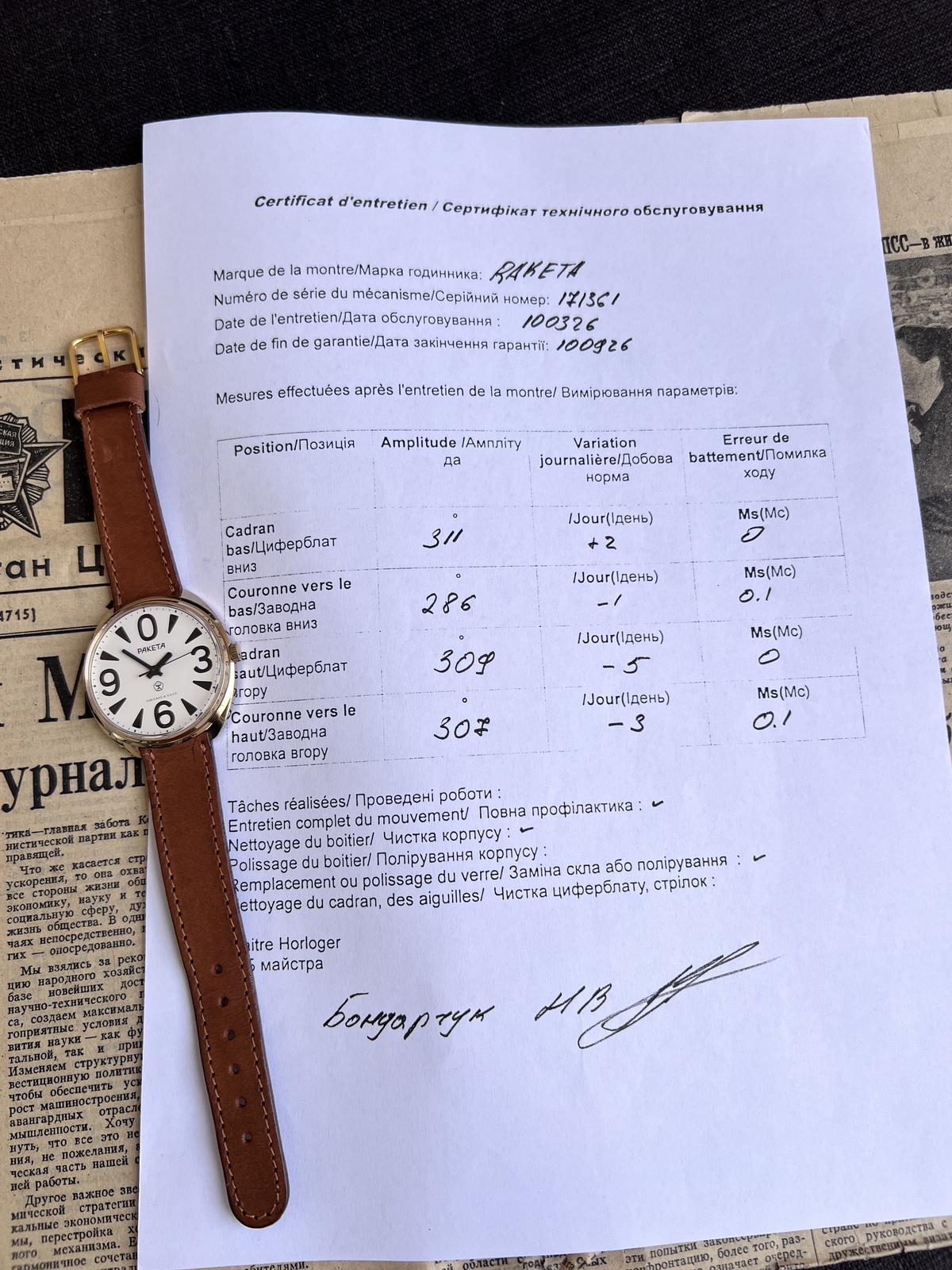
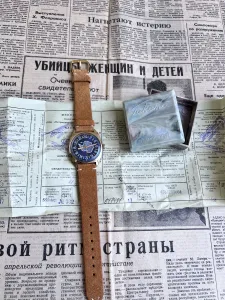
The service certificate that follows a service: amplitude, rate variation, water resistance, signed.
An open Poljot 3133 calibre: 23 jewels, chronograph hammers and cams, the part that needs a specialist.
What a service includes
A service is not a drop of oil. The watch is photographed on arrival, then diagnosed, fully dismantled, cleaned in an ultrasonic machine, relubricated with Swiss oils, reassembled, regulated on a timing machine and checked. Water resistance is tested when the case allows it. Gaskets are changed. The service certificate records the balance amplitude and the rate variation in several positions.
What a service does not do: restore a dial, polish a case, repair a strap. A patinated dial stays patinated, and that is preferable, because a period dial, even marked, is what collectors look for.
Parts: what can be found, what no longer can
The Soviet factories produced movements by the tens of millions, and parts are not lacking for the common calibres. For Vostok, 2409, 2414, 2416, the Chistopol plant still manufactures, and new parts exist. For Raketa 2609 and 2623, Slava 2414 and 2427, Poljot 2609 and 2614, Pobeda 2602, period stocks and donor watches supply everything, balance included. Plexiglass crystals are made to size.
What is missing: parts for the 3017 chronograph, whose column wheels and hammers are found only on other 3017s; dials, which are never replaced; bezels and crowns of certain export models; the movements of LED Elektronikas, whose circuits are rarely repairable. Soviet quartz watches, Luch, Chaika, Slava, are rarely repaired: the module costs more than the watch.
A Komandirskie crown: the stem and pinion are changed, the original crown is kept.
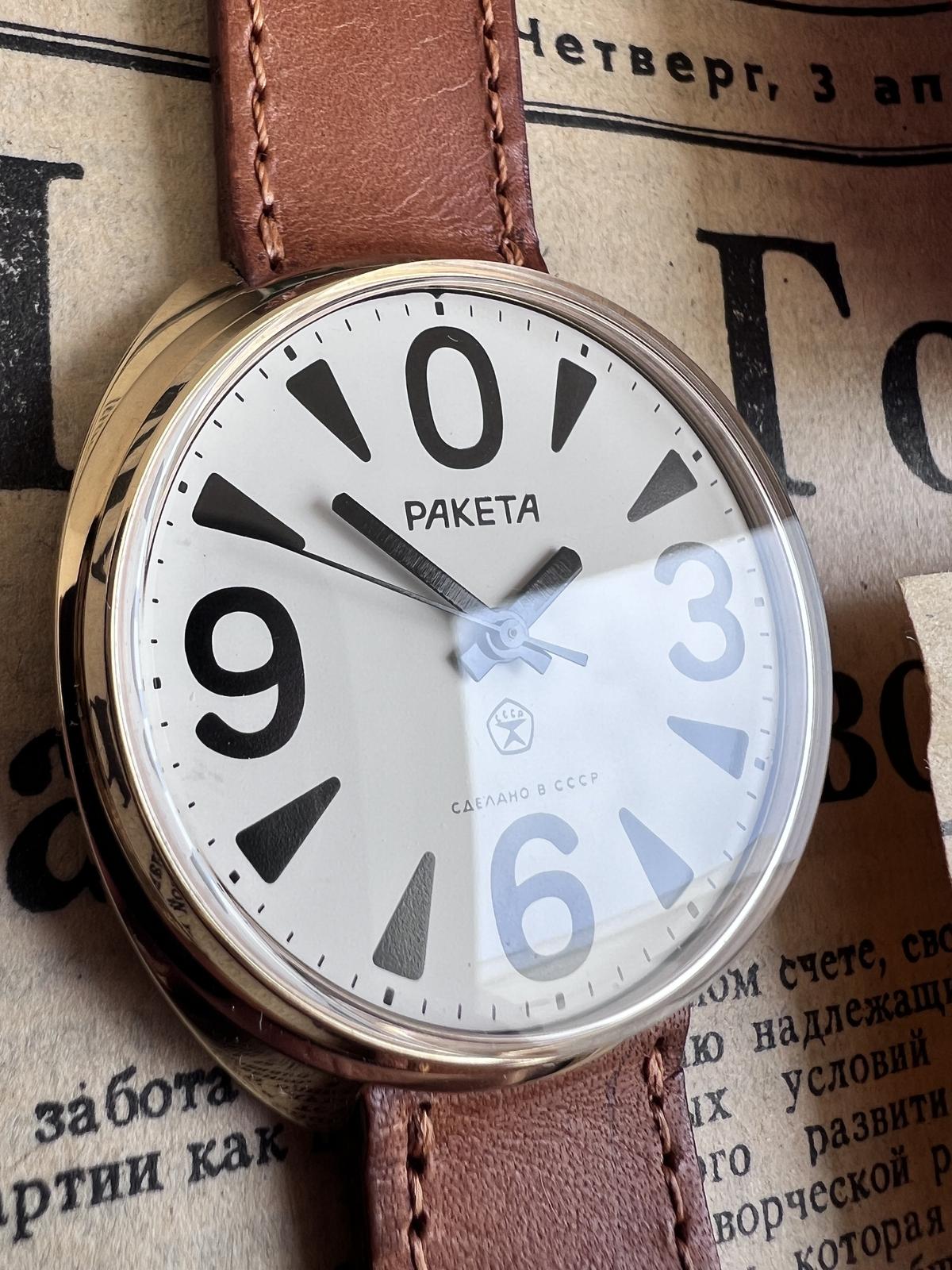
The domed plexiglass crystal of a Raketa: replaced to size, 25 to 40 euros.
Real prices
At Soviet Times, the Soviet in Paris workshop, a full service of a hand-wound watch costs 80 to 120 euros, an automatic 120 to 150, a 3017, 3133 or Shturmanskie chronograph 220 to 350. A plexiglass crystal, 25 to 40 euros. A seconds hand or a missing part, on quote. Table clocks and small clocks, on quote, except radium dials, which are not accepted. The quote is free and without obligation, and payment is due only once the watch is back in France.
These prices set the repair against the value: a 100 euro service on a Komandirskie worth 250 is reasonable, a 300 euro service on a 3133 worth 700 too. A service on a women’s watch worth 60 euros is not, unless the watch has sentimental value, which is often the case, and which cannot be calculated.
What not to do
Do not open the back to « have a look ». A screw back opened with a knife is scratched forever, and a snap back reopened without a gasket lets in moisture. Never spray lubricant into a movement: it dissolves the remaining oils, sets within months and makes the service longer. Do not wind a stuck watch by force: the stem breaks. Do not pull the crown of an Amphibia without unscrewing it. Do not entrust a 3133 or a 3017 to a watchmaker who has never opened one: the movement has its peculiarities, and lost parts cannot be replaced.
The crown of a Strela 3017: fragile, and unobtainable if it breaks.
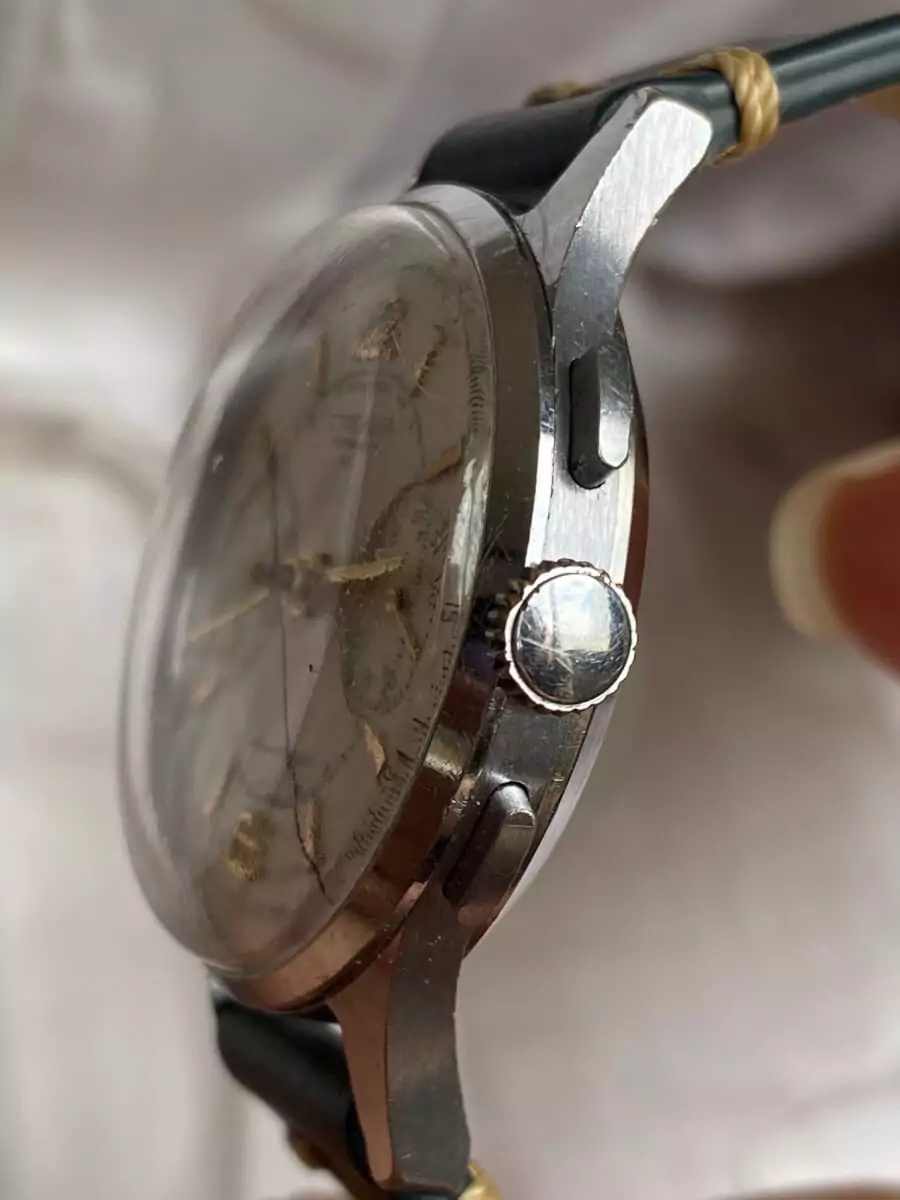
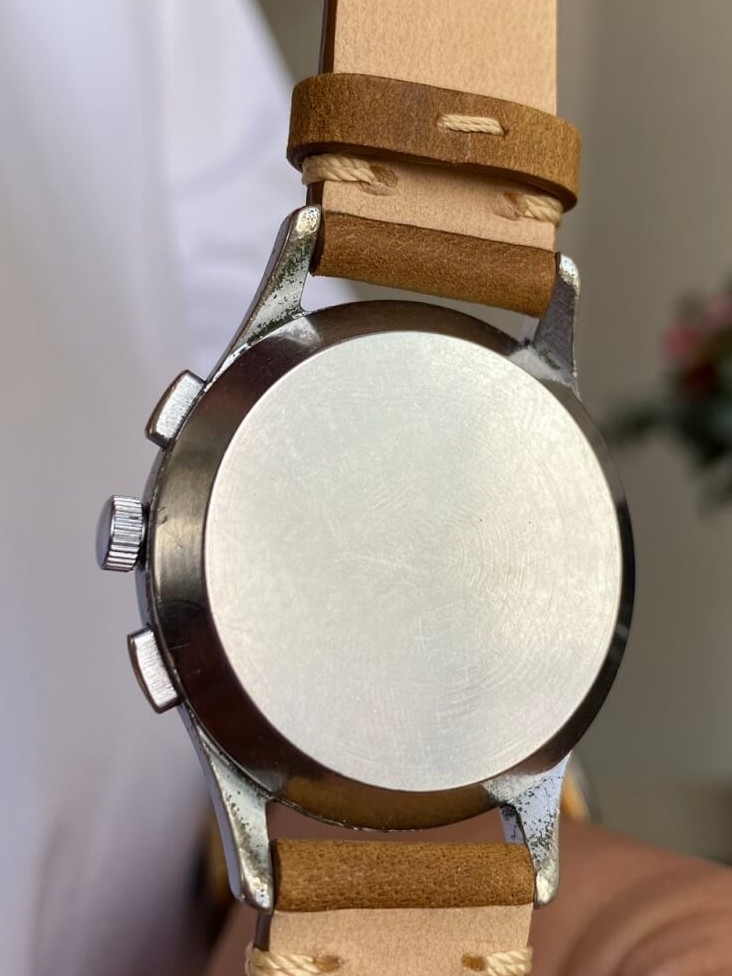
The snap back of a Strela, to be opened with the tool, never with a blade.
How to send the watch in
Soviet Times receives watches from all over France and Europe. A quote is requested through the form on the watch repair page, with the brand, the movement type, a description of the problem and up to five photos; reply within 48 working hours. The watch is then sent in a rigid box, never an envelope, by tracked Colissimo or Chronopost, or dropped off in Paris 19e, métro Crimée, by appointment. It is photographed on arrival, the quote is confirmed after diagnosis, and no work is started without agreement. The average turnaround is six to eight weeks, sometimes more if a part has to be found. The watch comes back by tracked post or by hand, and every intervention is guaranteed for twelve months. Optional insurance covers watches declared above 250 euros, up to 5,000 euros.
The workshop works on Soviet watches above all, and accepts other brands case by case.
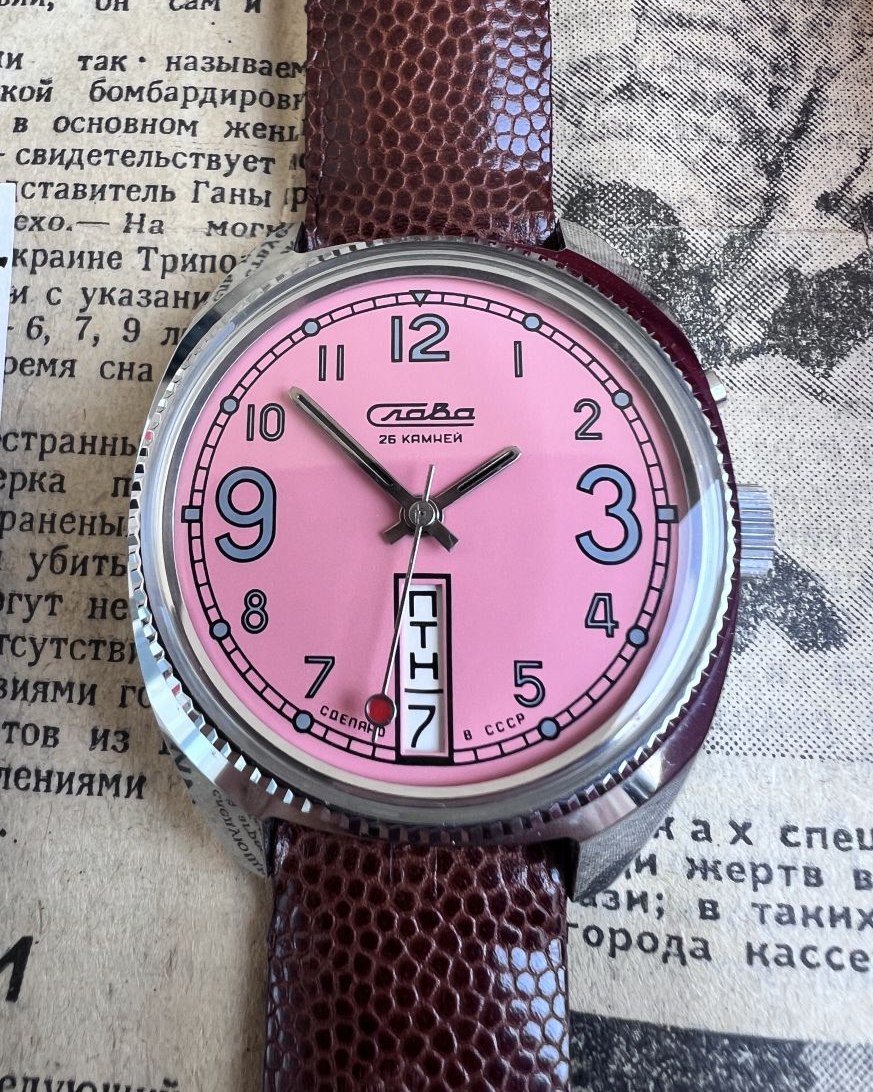
A new old stock Slava after service: the period oils were replaced even though the watch had never been worn.
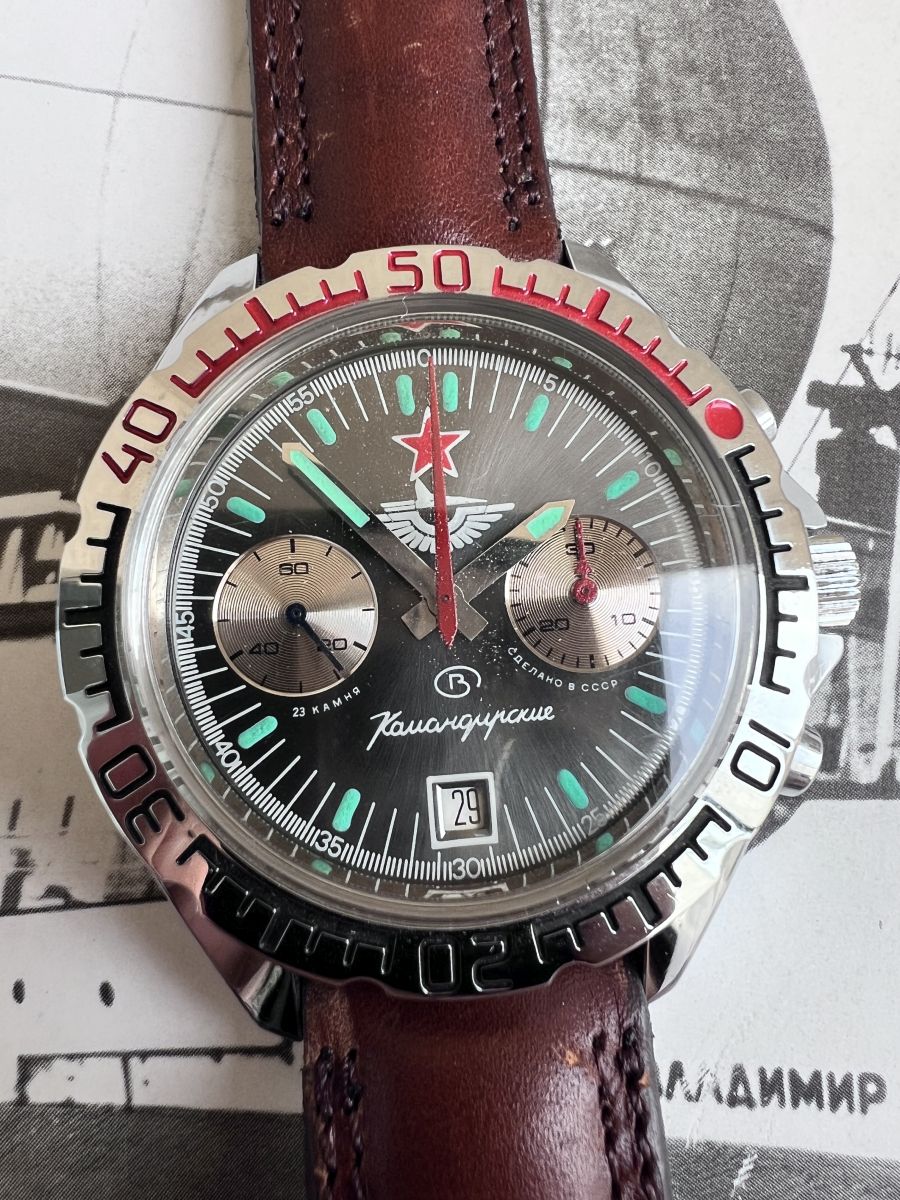
A serviced Vostok 3133 chronograph: the model few watchmakers accept.
Care after the service
A serviced mechanical watch asks for little: wind it every morning, without forcing, until resistance; do not set it between 9 pm and 3 am if it has a date; keep it away from magnets, loudspeakers, bag clasps; wipe it after rain. A service every five to ten years if worn, at the first warning sign otherwise. We have covered the subject in Servicing a Soviet mechanical watch.
Frequently asked questions
My Soviet watch no longer runs, can it be repaired?
Almost always. The common calibres have their parts, and a watch stopped for thirty years starts again after a service.
How much does repairing a Russian watch cost?
From 80 to 120 euros for a hand-wound watch service, 120 to 150 for an automatic, 220 to 350 for a chronograph. The quote is free.
Can parts still be found?
Yes for Vostok, Raketa, Slava, Poljot, Pobeda. With difficulty for the 3017 chronograph and never for dials.
Can a Soviet quartz watch be repaired?
Rarely. The module costs more than the watch, and LED Elektronikas are rarely repairable.
Can I service my Soviet watch myself?
No, not without training and tools. You can wind it, set it and demagnetise it; everything else requires opening the movement.
The ДП-5В (DP-5V) is the field radiometer of Soviet civil defence: a green Bakelite console, a probe with a rotating gamma, beta and check-source shield, headphones and a manual that explains operation and maintenance. The one in this article served in an industrial bakery in Chișinău and was serviced in March 1991. Its owner shared his photos and documents with us, and we turned them into a tool that lets you operate it on screen, step by step.
The Moscow Games, from 19 July to 3 August 1980, boycotted by some sixty countries, produced more objects than any Soviet event: a bear cub, Misha, drawn by Viktor Chizhikov, an emblem made of running tracks, five thousand torches, watches from every factory, platinum coins, rings, tea glass holders, posters. This guide tells the story of the Games and reviews the objects, with the marks that authenticate them and the prices.
The 3017 chronograph of the First Moscow Watch Factory carries a five-digit number on the balance cock. The most common dating method reads it as a single series, from 1959 to 1979. Four factory passports show there are two, and that the same number can point to two watches made ten years apart. Here is how to read the number, the dial, the logo and the bridge, with a decoder to date your Strela, Poljot or Sekonda.
This website uses cookies to improve your experience while you navigate through the website.
Out of these cookies, the cookies that are categorised as necessary are stored on your browser as they are essential for the working of basic functionalities of the website.
We also use third-party cookies that help us analyse and understand how you use this website.
These cookies will be stored in your browser only with your consent.
You also have the option to opt out of these cookies.
But opting out of some of these cookies may affect your browsing experience.
Necessary cookies are absolutely essential for the website to function properly. This category only includes cookies that ensure basic functionalities and security features of the website. These cookies do not store any personal information.
Cookies that are not strictly necessary for the website to work and that are used specifically to collect personal data through analytics, ads and other embedded content are called non-necessary cookies. User consent is required before these cookies run on the website.
✕
Soviet in Paris
Online. We answer in person, no AI and no chatbot. Reply right away, 20 min at most.
Hello 👋 A question about an item, an order or shipping? Write to us.
Your email is used only to reply to you.
Subscribe to our newsletter and get 10% off your first order.
Subscribe
★ New pieces before anyone else
★ New blog articles
★ Soviet in Paris news and updates
Join the Party
10% off your first order
Receive your welcome card and our next arrivals.
Your code appears here and is also sent to you by email. You can leave the Party in one click, at any time.