Before Gagarin, there were the dogs. Laika, a Moscow street dog, the first creature in orbit on 3 November 1957, dead within hours; Belka and Strelka, the first to come back alive on 19 August 1960, one of whose puppies ended up at the White House. The USSR made heroines of them, and objects by the million: pins, sweet tins, alarm clocks, postcards, tapestries. This guide tells the flights, then reviews the objects, with dates and prices.
NOVEMBER 2026•8 MINUTE READ
by Marwen Yahyaoui
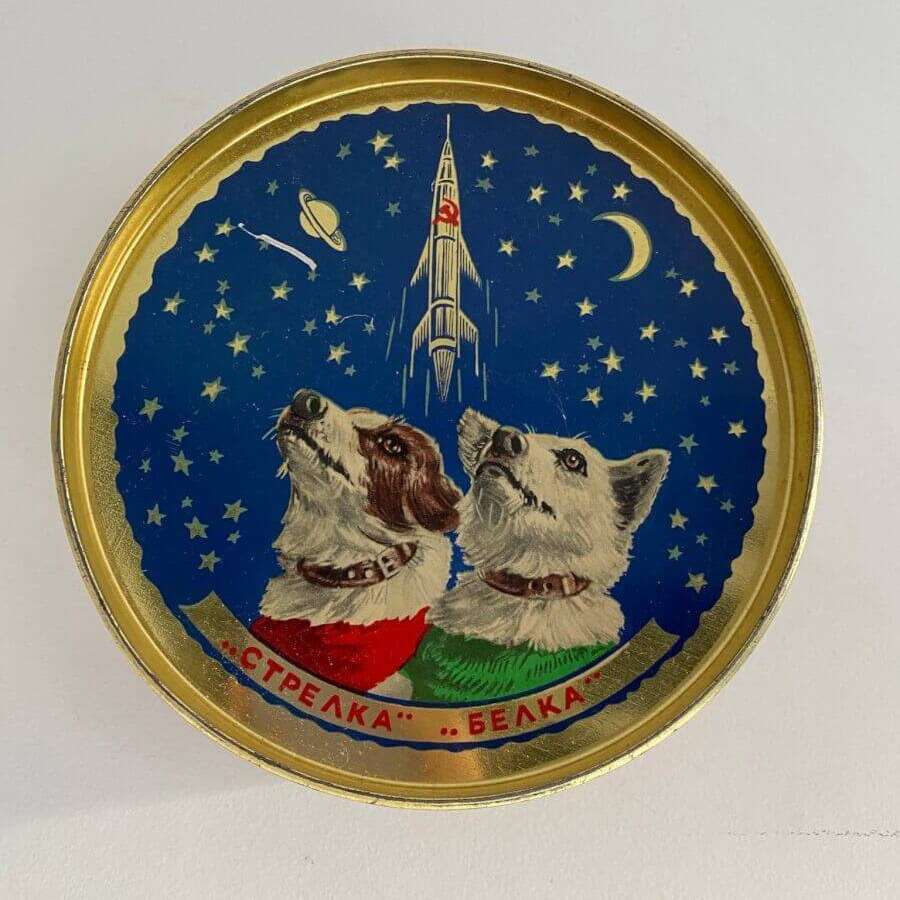
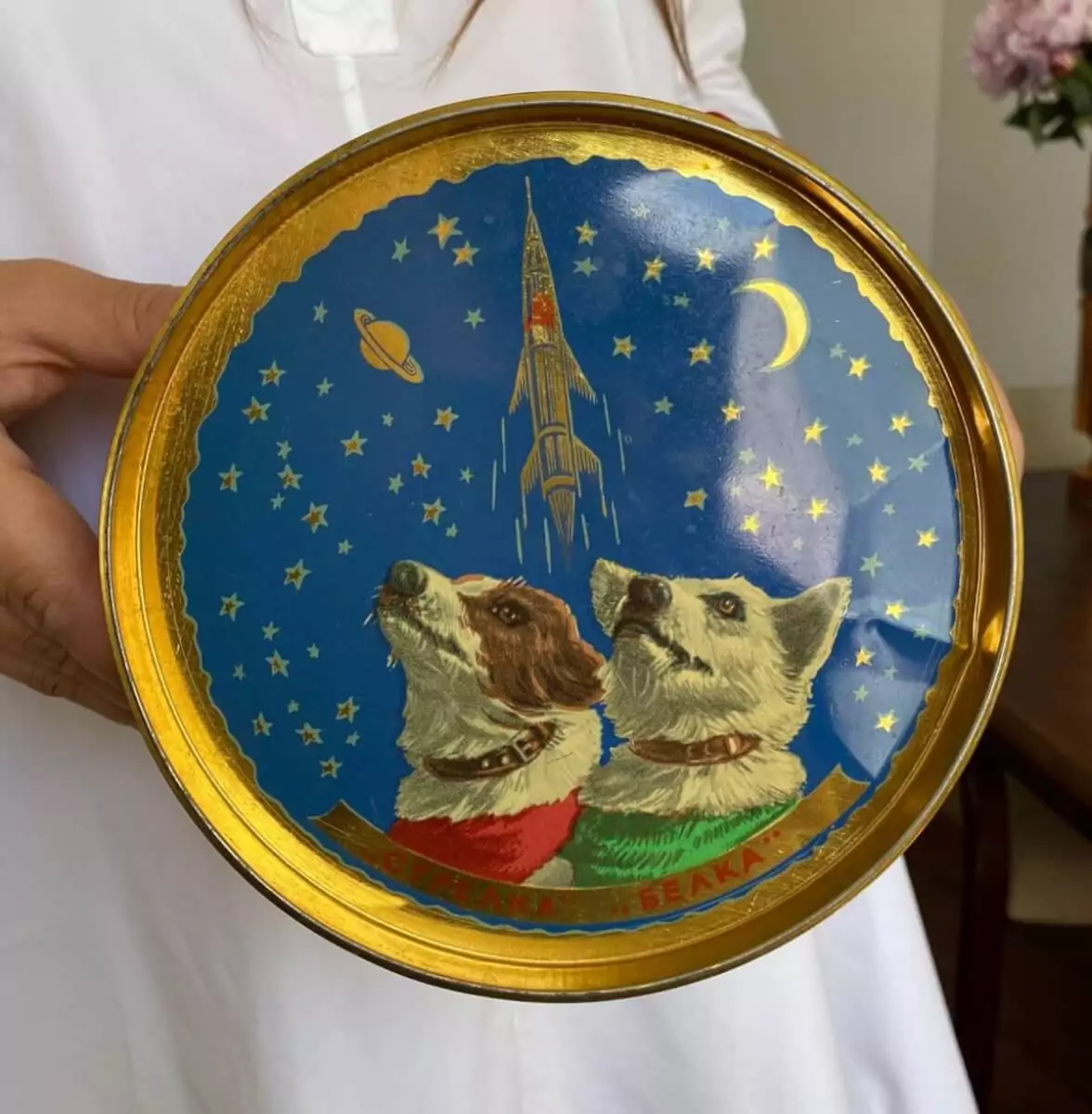
Lid of a 1960s sweet tin: Belka and Strelka, the imaginary rocket and the stars, the most widespread motif of the Soviet space conquest.
The first Soviet cosmonauts had no surname. They were called Laika, Belka, Strelka, and the USSR celebrated them as heroes, on stamps, sweet tins and alarm clocks, before celebrating Gagarin. These objects are today the most touching of the space conquest, and the most accessible. This guide first tells the flights, as the archives have established them, then reviews the objects.
Before Laika: the rocket dogs
The programme began in 1951. On 22 July, two dogs, Dezik and Tsygan, rose to 100 km in an R-1 rocket and came back alive by parachute: the first living beings to reach space, without entering orbit. About thirty suborbital flights followed in the 1950s, with dogs chosen from the streets of Moscow, small, female because the suit and the waste collector are simpler, and light-coloured for the cameras. None of this was public, and no object keeps a trace of it.
Laika, 3 November 1957
A month after Sputnik 1, Khrushchev wanted a second launch for the fortieth anniversary of the Revolution. Sputnik 2 was built in four weeks, and carried Kudryavka, « little curly », renamed Laika, « the barker », a three-year-old dog picked up in Moscow. Vladimir Yazdovsky, the doctor who chose her ten days before the launch, took her home to play with his children, because she had little time left to live. There was no return system: the flight was one-way from the start, and the Soviets said so. What they did not say for forty-five years is how she died.
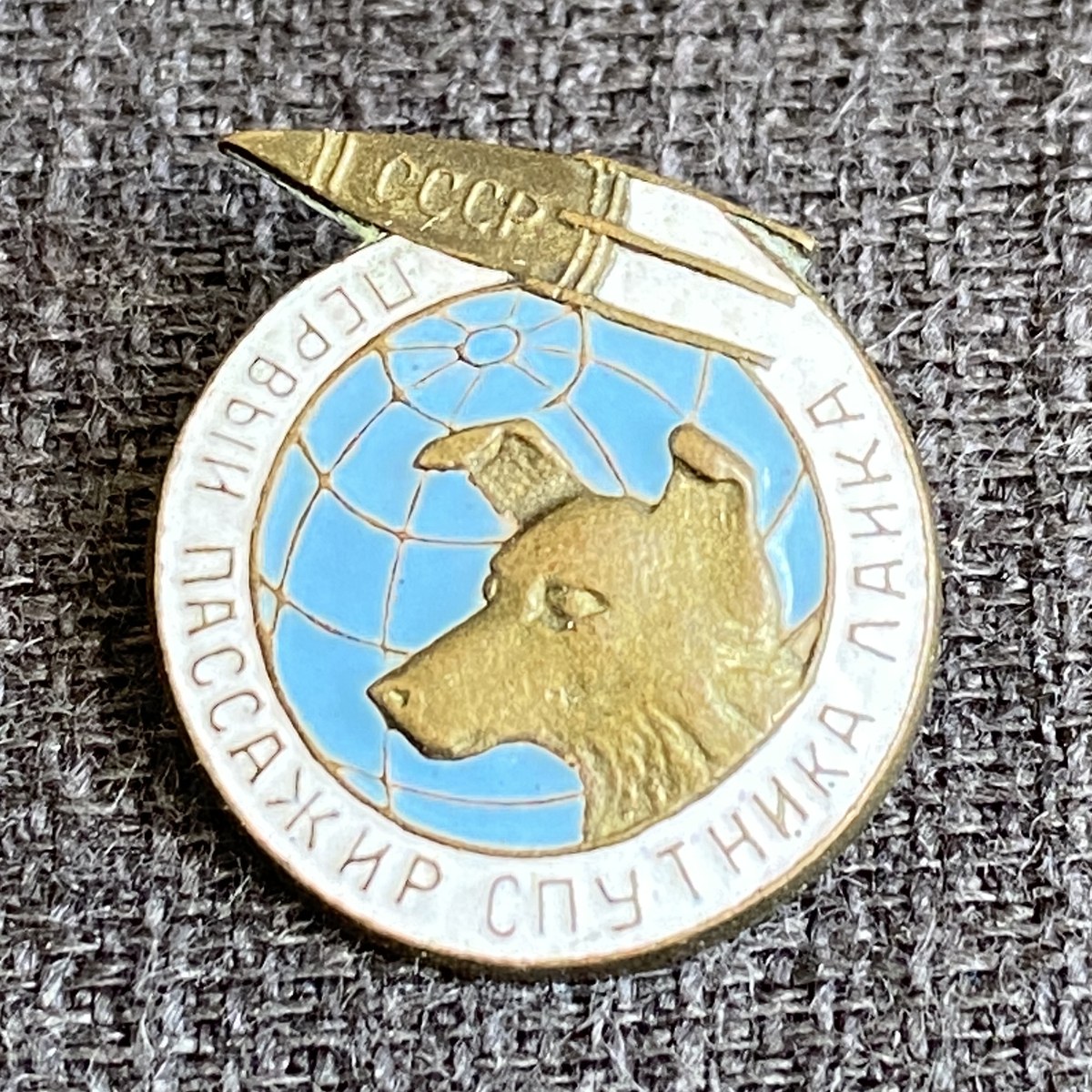
Laika immediately became a world icon. Stamps in every Eastern bloc country, chocolates, « Laika » cigarettes in the USSR, enamelled brass pins with her profile from 1957, and, later, plates, sculptures, tins.
Enamelled brass Laika pin, 1957: the first object, produced in the weeks after the flight.
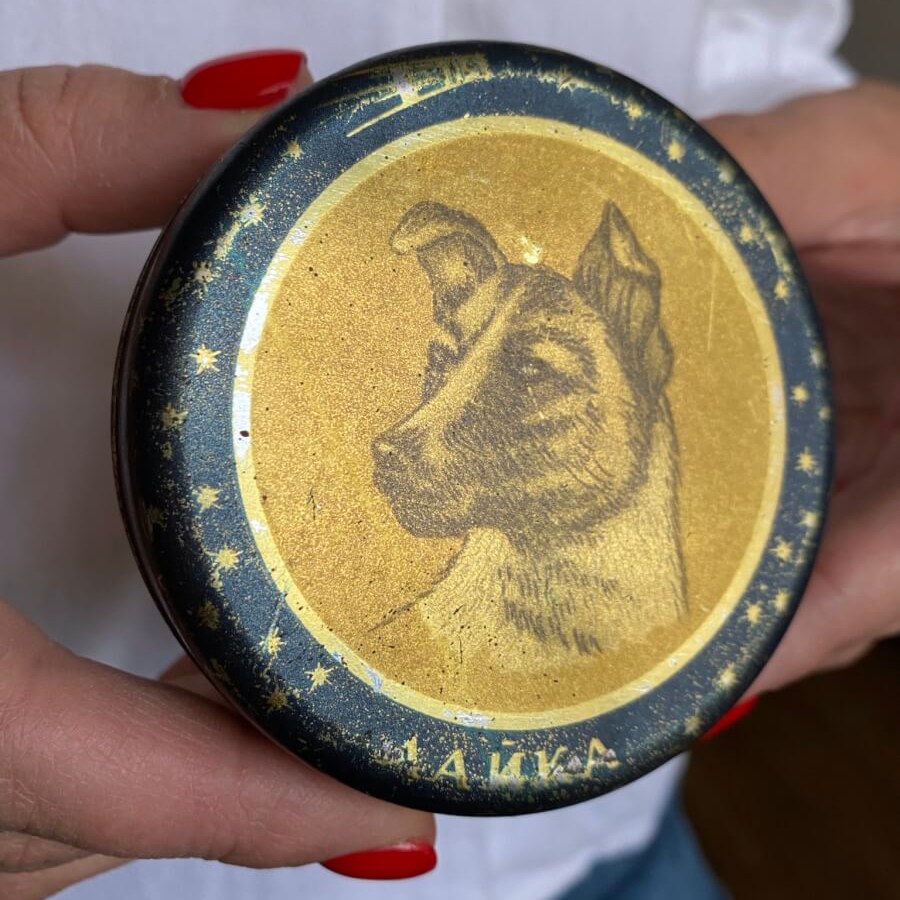
« ЛАЙКА » halva tin, the dog’s portrait on a gold ground and the starry sky.
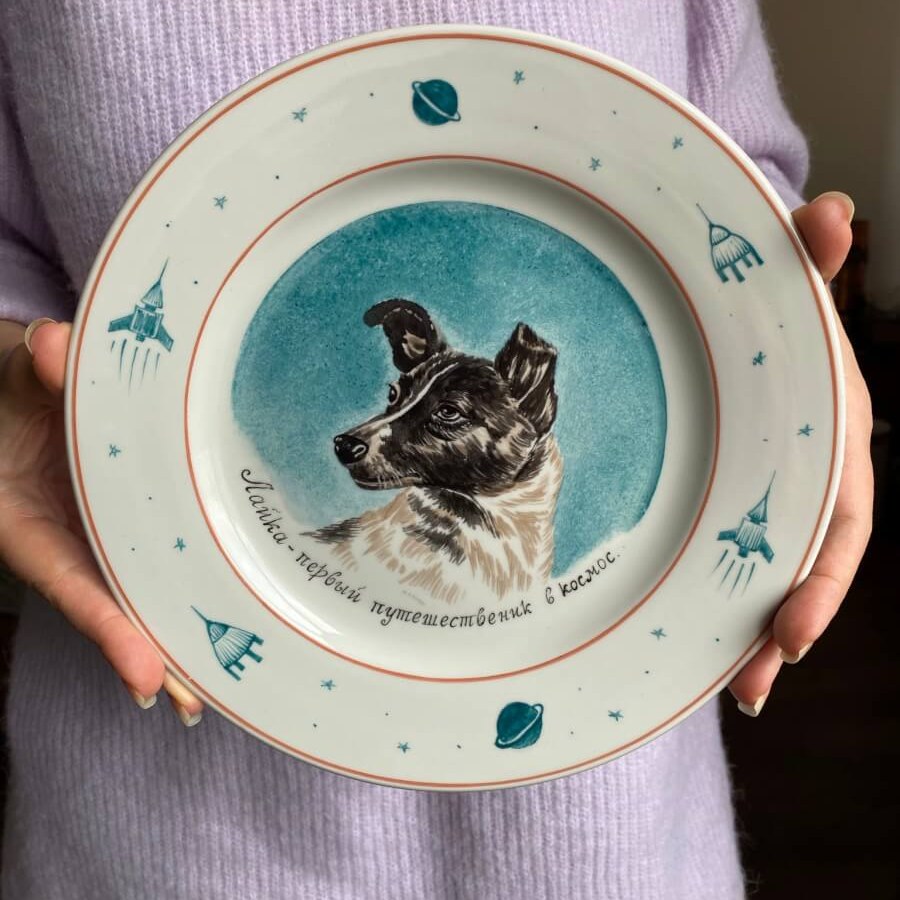
Painted porcelain plate, « Laika, first traveller in space », 1980s, signed.
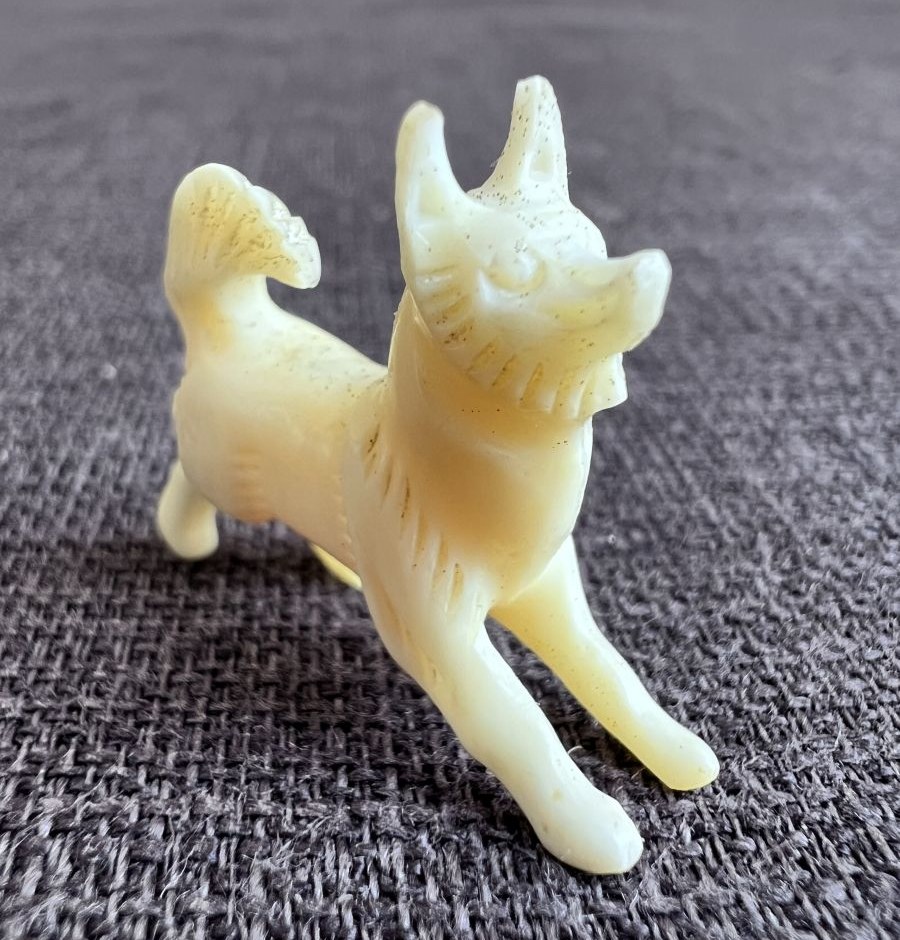
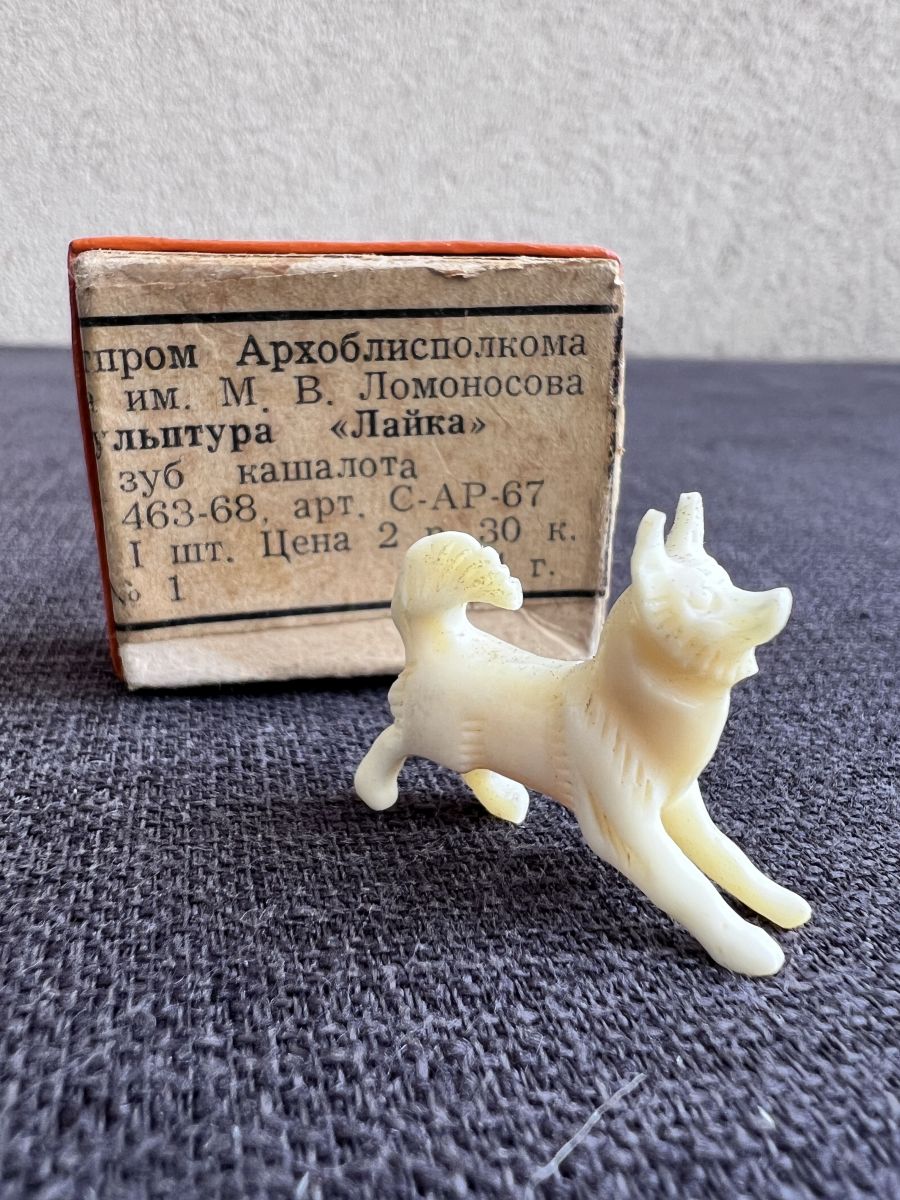
Laika carved in a sperm whale tooth, craft work from Arkhangelsk.
How did Laika die?
Her death has had several versions, and the USSR gave several of them itself. The plan was to put her to sleep with a last serving of poisoned food: the craft carried food for seven days. For years the official statements contradicted each other: she had died of asphyxia when the batteries failed, or she had been euthanised before the oxygen ran out. In the West it was long repeated that she lived six days, until the oxygen was exhausted. As late as 1999, several Russian sources had her die of heat on the fourth day.
The established version dates from October 2002. At the World Space Congress in Houston, Dimitri Malashenkov, one of the programme’s scientists, presented the telemetry. At lift-off Laika’s heart rate rose from 103 to 240 beats per minute, and it took three hours of weightlessness to come back down to 102, three times longer than in ground tests. The core of the R-7 rocket had not separated from the satellite as planned, part of the thermal insulation had torn away, and the cabin reached 40 °C. The first readings show her agitated, but eating. Between five and seven hours after launch, on the fourth orbit of the Earth, no more signs of life came through. Malashenkov put it plainly: in four weeks it was practically impossible to build a reliable temperature control system.
Sputnik 2 went on circling with her body for more than five months, 2,570 orbits, before breaking up on re-entry on 14 April 1958. In 1998 Oleg Gazenko, one of those in charge of the programme, said he regretted letting her die, and that the mission had not taught enough to justify the dog’s death. On 11 April 2008 a monument to Laika, standing on a rocket, was unveiled in Moscow, at the military research institute that had prepared her for the flight.
Belka and Strelka, 19 August 1960
Three years later, the Vostok programme needed to prove that a living being could come back. On 19 August 1960, Korabl-Sputnik 2, which the press called Sputnik 5, carried Belka, « squirrel », and Strelka, « little arrow », with forty mice, two rats, plants and flies. Seventeen orbits, one day, and a successful re-entry: the two dogs came back alive, the first creatures to return from orbit. They never flew again. Strelka had puppies the following year, and Khrushchev gave one of them, Pushinka, to President Kennedy’s daughter, whose descendants lived at the White House. Belka and Strelka, stuffed, are displayed at the Museum of Cosmonautics in Moscow.
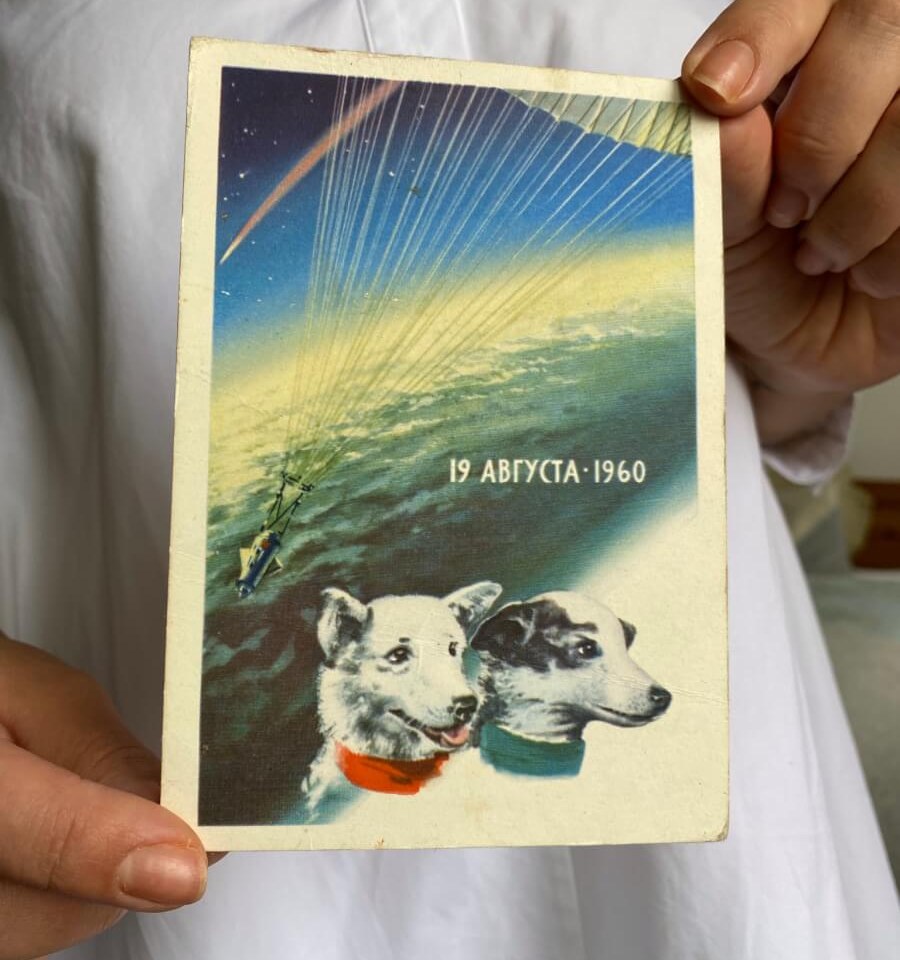
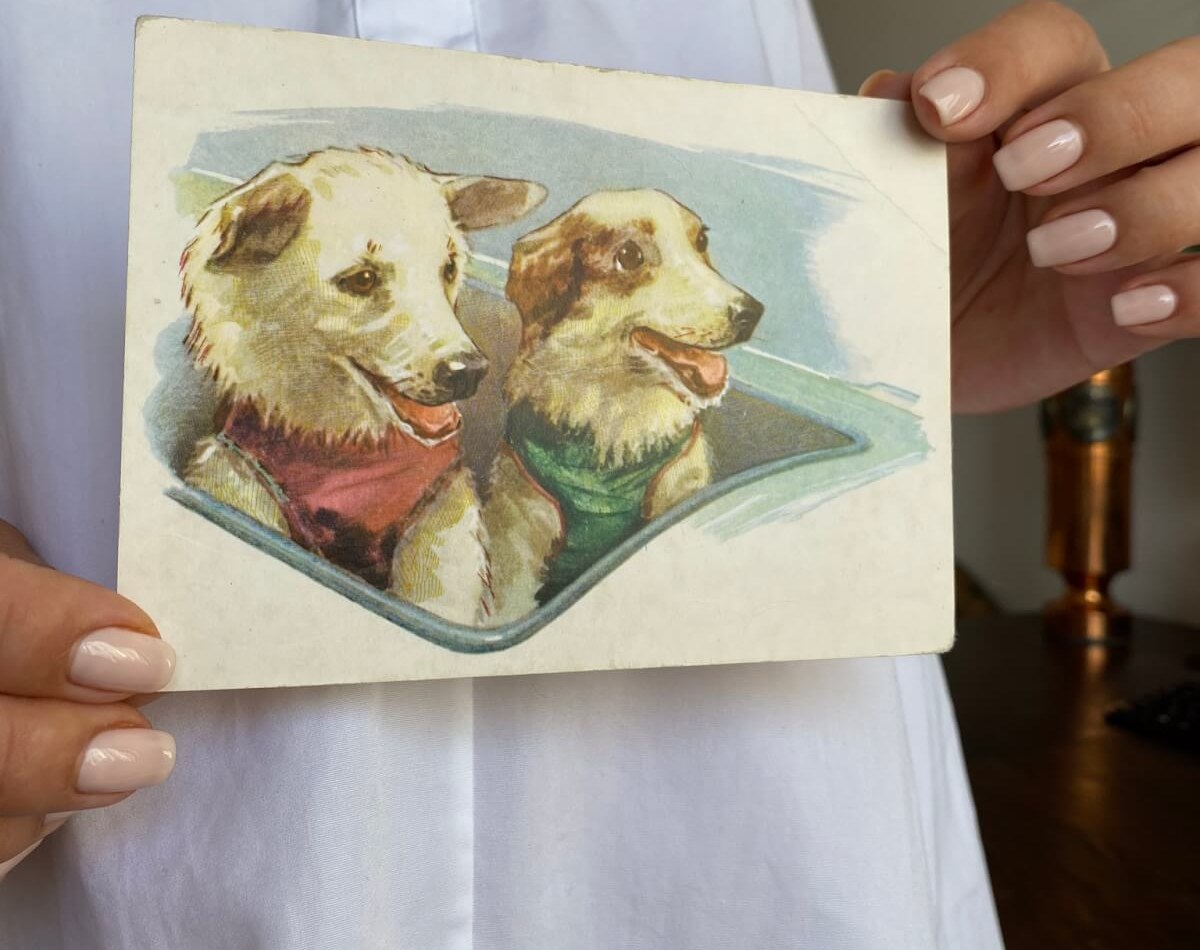
The success was total, and visible: unlike Laika, the two dogs appeared on television, at a press conference, and their portraits side by side, one white, the other spotted, became the most reproduced space motif of the USSR between August 1960 and April 1961, until Gagarin took their place.
Postcard « 19 August 1960 », the two dogs and the Earth: the date of the flight is printed.
Postcard with the two portraits side by side, written in 1962.
The Belka and Strelka objects
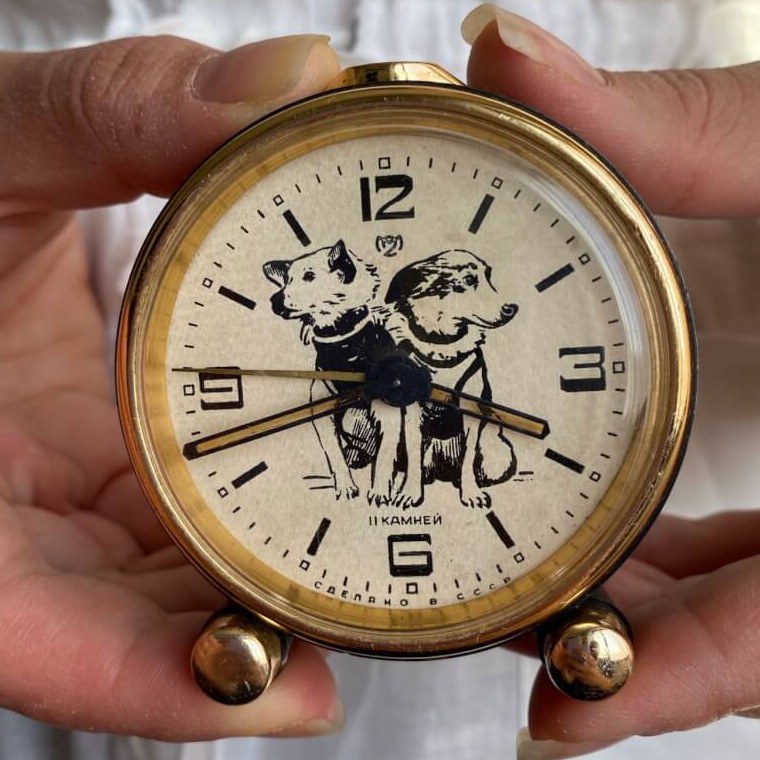
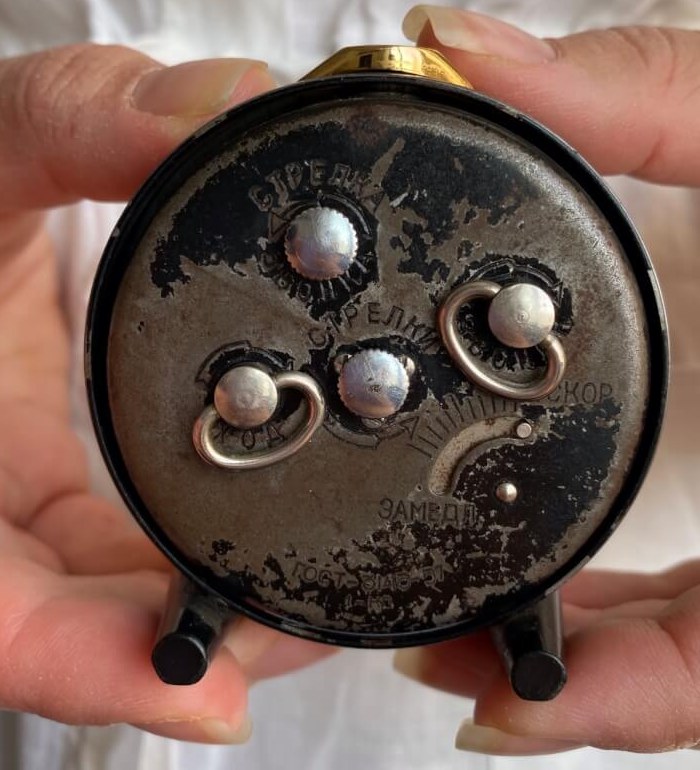
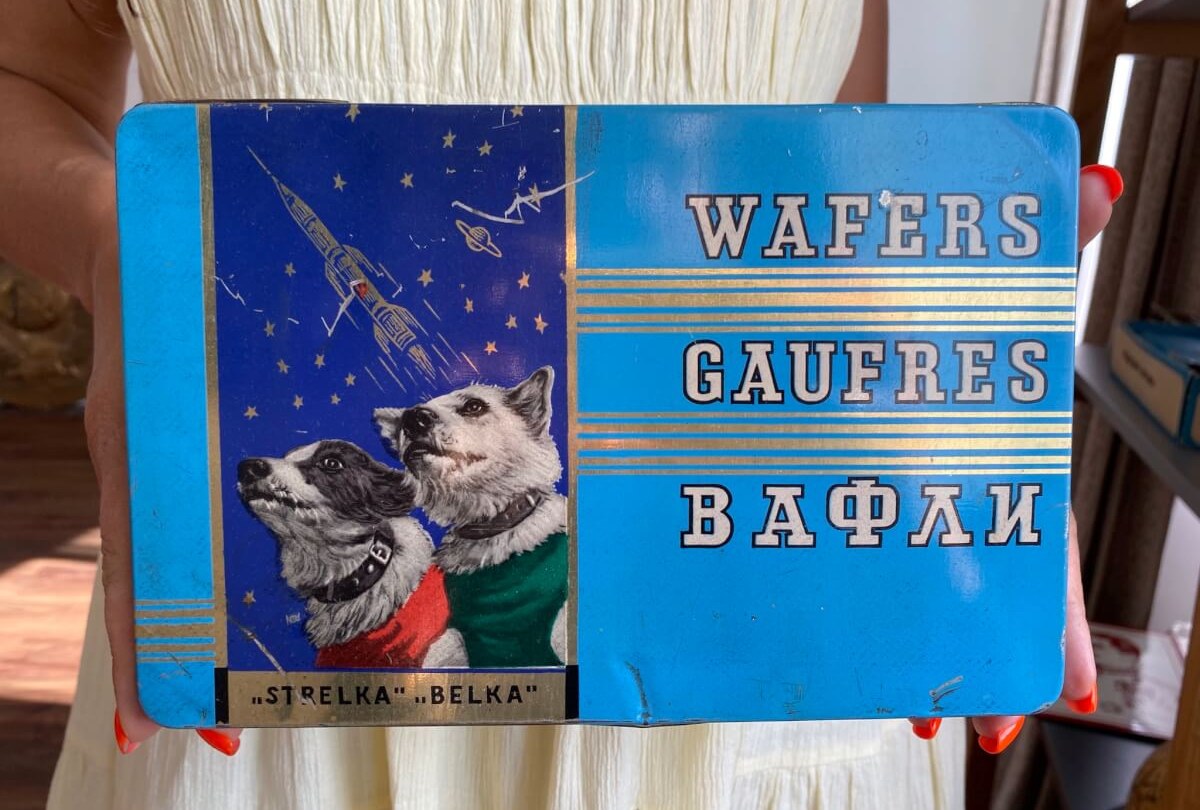
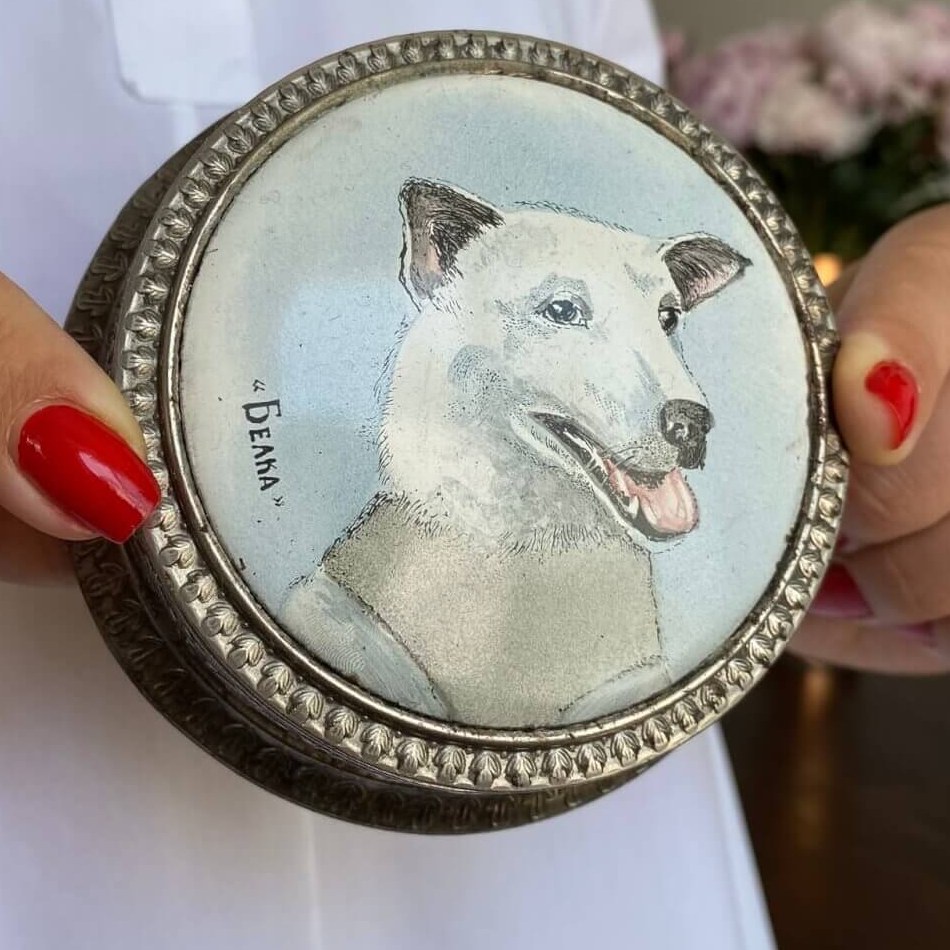
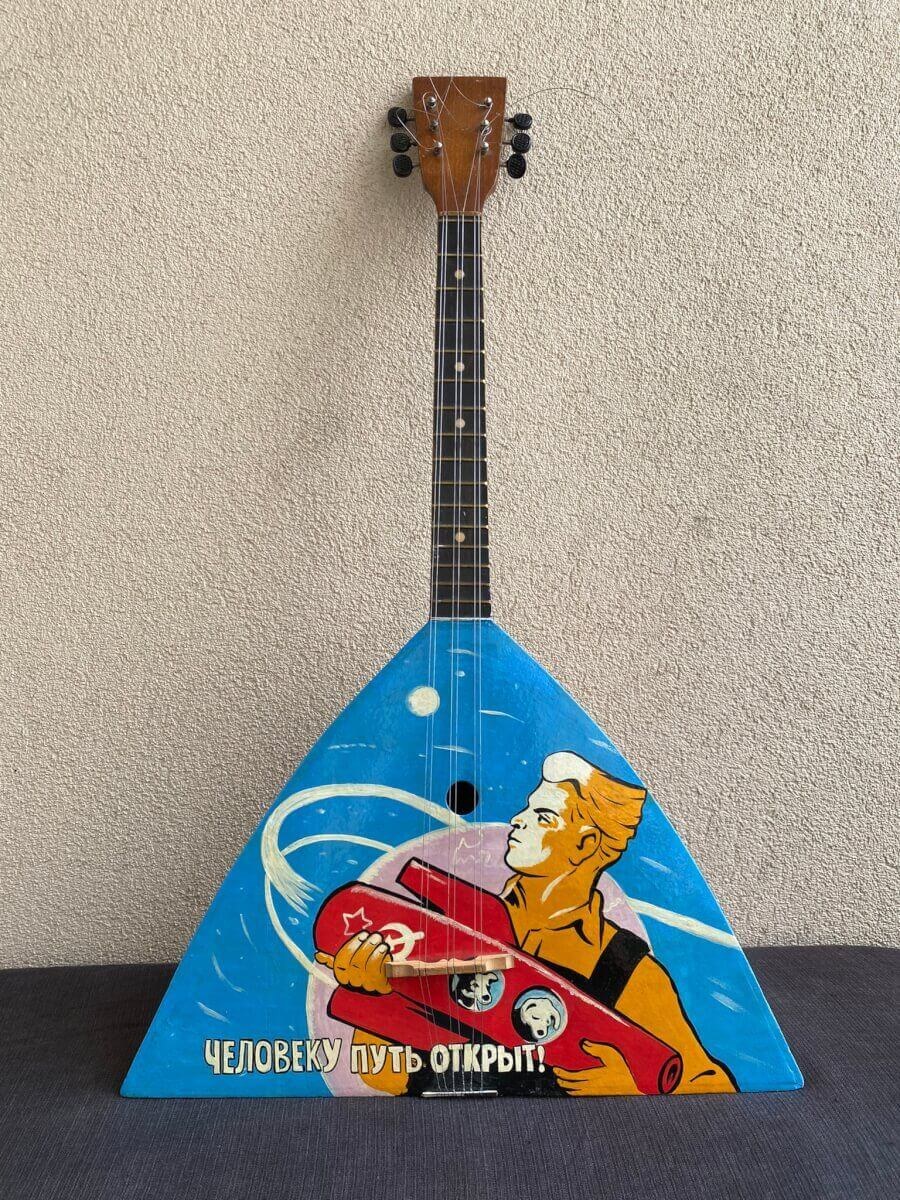
Sweet tins first: round lithographed lids, the two dogs under an imaginary rocket and a moon, sometimes dated by the New Year, « С Новым 1961 годом », in tinplate, the most common and the most beautiful. Wafer tins for export, marked in Latin letters « STRELKA » « BELKA » and « Made in USSR ». Metal powder boxes with Belka’s portrait. Mechanical alarm clocks with 11 jewels and the two dogs drawn on the dial, each name engraved on the back. Tapestries and printed fabrics with the rocket man and the two medallions. Postcards, stamps, toys. A balalaika hand-painted in the 1980s still shows the two dogs in a red rocket.
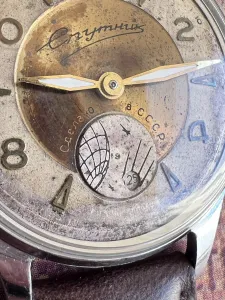
Mechanical alarm clock with 11 jewels, Belka and Strelka on the dial, serviced.
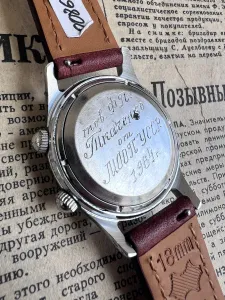
The back of the alarm clock: the names « Стрелка » and « Белка » engraved near the winders.
Wafer tin for export, « STRELKA » and « BELKA » in Latin letters, « Gaufres » written in French.
Powder box with Belka’s portrait, metal, 1960s.
Early 1960s tapestry, the rocket man and the two dogs in medallions.
Hand-painted balalaika, Chernihiv factory, 1980s: the two dogs in the rocket, « the way is open to man ».
Dating the objects
A Laika object is later than 3 November 1957; a Belka and Strelka object, than 19 August 1960. The enamelled brass Laika pins date from the months that followed, and often carry the satellite and the date. Sweet tins are from 1960 to 1963, after which Gagarin, Titov and Tereshkova replaced them on the lids; a New Year date dates them to the year. Tins with Latin lettering are exports, from the same period. The painted porcelain Laika plates are later, from the 1970s and 1980s, when the dog had become a subject of nostalgia and folk art. The portraits are codified: Laika has a dark coat and a light chest, Belka is white, Strelka is light with brown patches; a tin showing two dogs side by side is always Belka and Strelka, never Laika, who flew alone.
Prices
A 1957 Laika pin, 70 to 95 euros. A postcard, 35 to 45. A Belka and Strelka sweet tin, 110 to 250 depending on condition and lid. A powder box, 90. A serviced Belka and Strelka alarm clock, 110 to 190. A tapestry, 190. A painted Laika plate, 220. Large pieces, painted balalaika, sculptures, 190 to 280.
Frequently asked questions
Did Laika come back to Earth?
No. Sputnik 2 had no return system. She died of heat between five and seven hours after launch, which was only made public in 2002; the official version spoke of a later death.
Did Belka and Strelka come back alive?
Yes, on 20 August 1960 after seventeen orbits. They are the first creatures to return alive from an orbital flight, and afterwards lived in Moscow, at the programme’s institute.
How do you tell Belka from Strelka on an object?
Belka is white, Strelka is light with brown patches. They are almost always shown together.
What is a Laika object worth?
From 70 euros for a period pin to 220 for a painted plate. Belka and Strelka sweet tins, 110 to 250.
Are there fakes?
Few. Pins are sometimes restruck, recognisable by their too-glossy enamel and modern clasp. Tinplate boxes are not copied.
The ДП-5В (DP-5V) is the field radiometer of Soviet civil defence: a green Bakelite console, a probe with a rotating gamma, beta and check-source shield, headphones and a manual that explains operation and maintenance. The one in this article served in an industrial bakery in Chișinău and was serviced in March 1991. Its owner shared his photos and documents with us, and we turned them into a tool that lets you operate it on screen, step by step.
The Moscow Games, from 19 July to 3 August 1980, boycotted by some sixty countries, produced more objects than any Soviet event: a bear cub, Misha, drawn by Viktor Chizhikov, an emblem made of running tracks, five thousand torches, watches from every factory, platinum coins, rings, tea glass holders, posters. This guide tells the story of the Games and reviews the objects, with the marks that authenticate them and the prices.
The 3017 chronograph of the First Moscow Watch Factory carries a five-digit number on the balance cock. The most common dating method reads it as a single series, from 1959 to 1979. Four factory passports show there are two, and that the same number can point to two watches made ten years apart. Here is how to read the number, the dial, the logo and the bridge, with a decoder to date your Strela, Poljot or Sekonda.
This website uses cookies to improve your experience while you navigate through the website.
Out of these cookies, the cookies that are categorised as necessary are stored on your browser as they are essential for the working of basic functionalities of the website.
We also use third-party cookies that help us analyse and understand how you use this website.
These cookies will be stored in your browser only with your consent.
You also have the option to opt out of these cookies.
But opting out of some of these cookies may affect your browsing experience.
Necessary cookies are absolutely essential for the website to function properly. This category only includes cookies that ensure basic functionalities and security features of the website. These cookies do not store any personal information.
Cookies that are not strictly necessary for the website to work and that are used specifically to collect personal data through analytics, ads and other embedded content are called non-necessary cookies. User consent is required before these cookies run on the website.
✕
Soviet in Paris
Online. We answer in person, no AI and no chatbot. Reply right away, 20 min at most.
Hello 👋 A question about an item, an order or shipping? Write to us.
Your email is used only to reply to you.
Subscribe to our newsletter and get 10% off your first order.
Subscribe
★ New pieces before anyone else
★ New blog articles
★ Soviet in Paris news and updates
Join the Party
10% off your first order
Receive your welcome card and our next arrivals.
Your code appears here and is also sent to you by email. You can leave the Party in one click, at any time.