Railway regulations required the Soviet railway emblem on passenger coaches and locomotives. Each one carries the letters СССР, the state arms and a hammer crossed with a wrench, the sign of the railwaymen. This guide explains where it was placed, how to read it, how to date it by its ribbons, and what sets apart the models found today.
OCTOBER 2026•8 MINUTE READ
by Marwen Yahyaoui
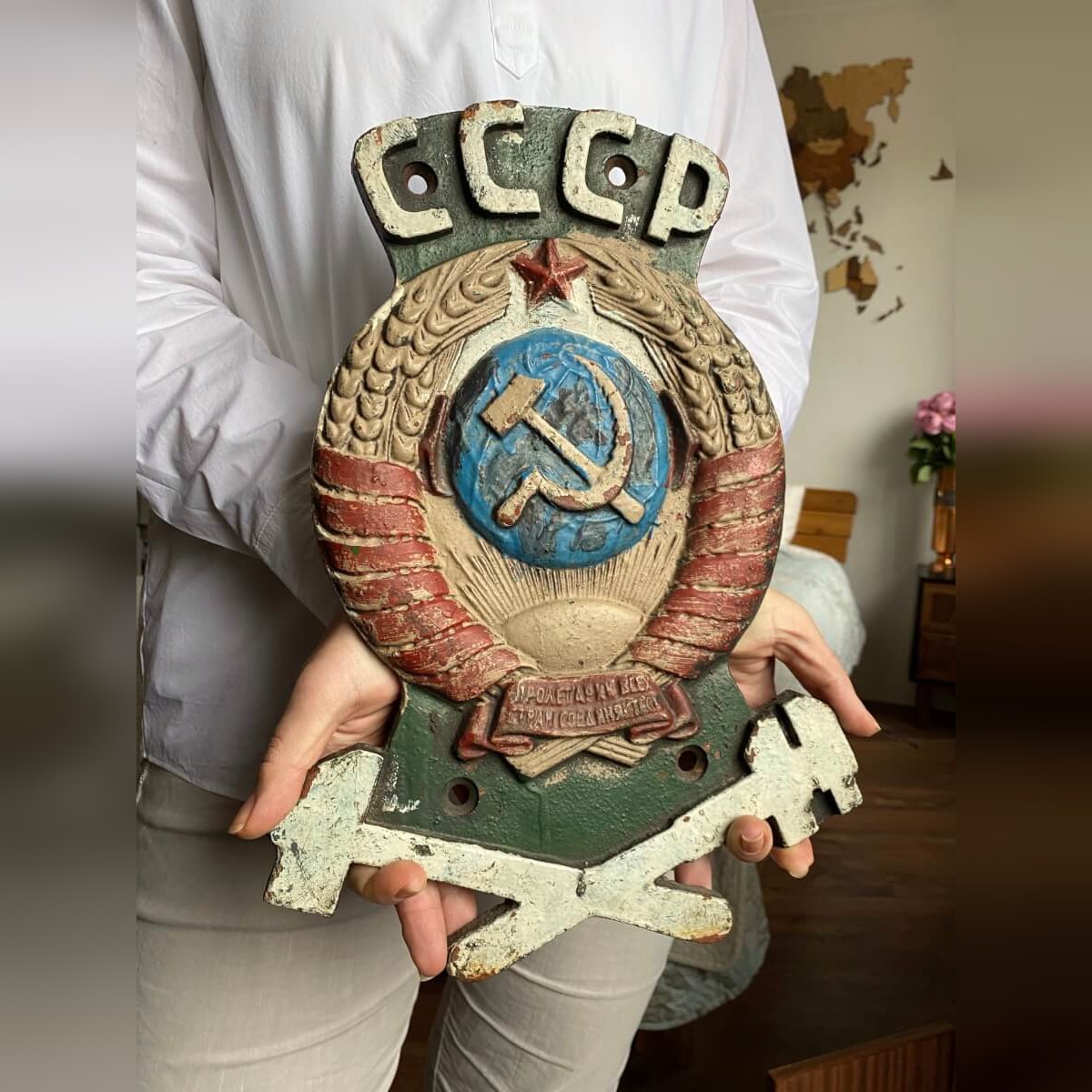
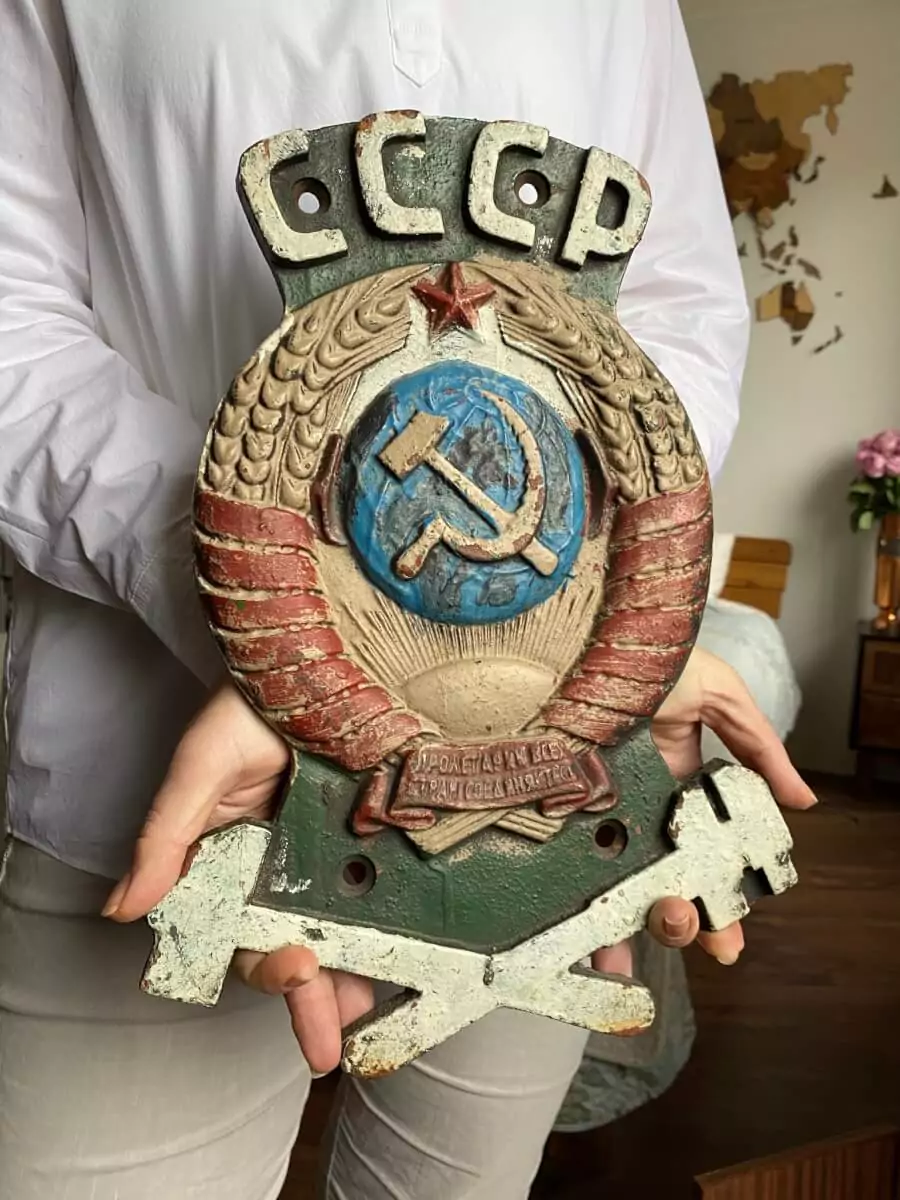
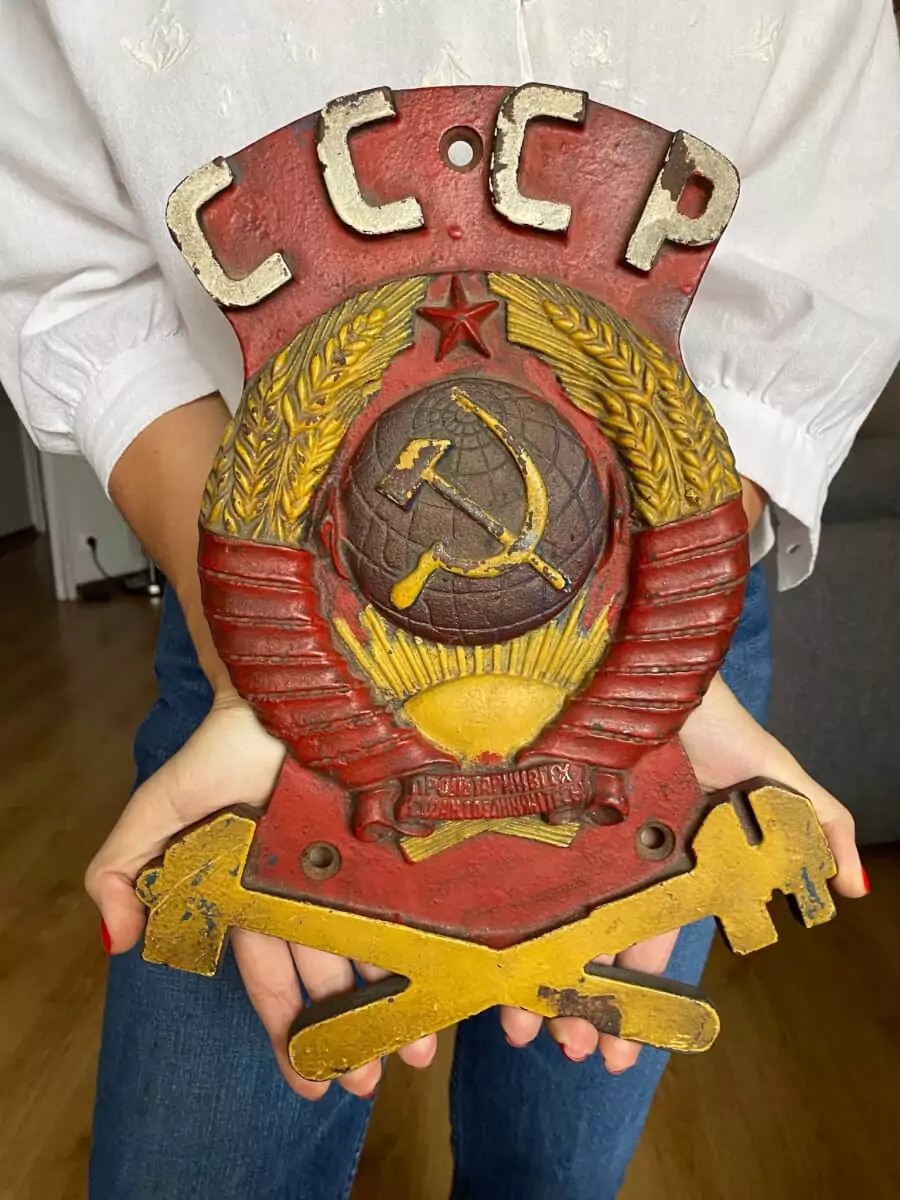
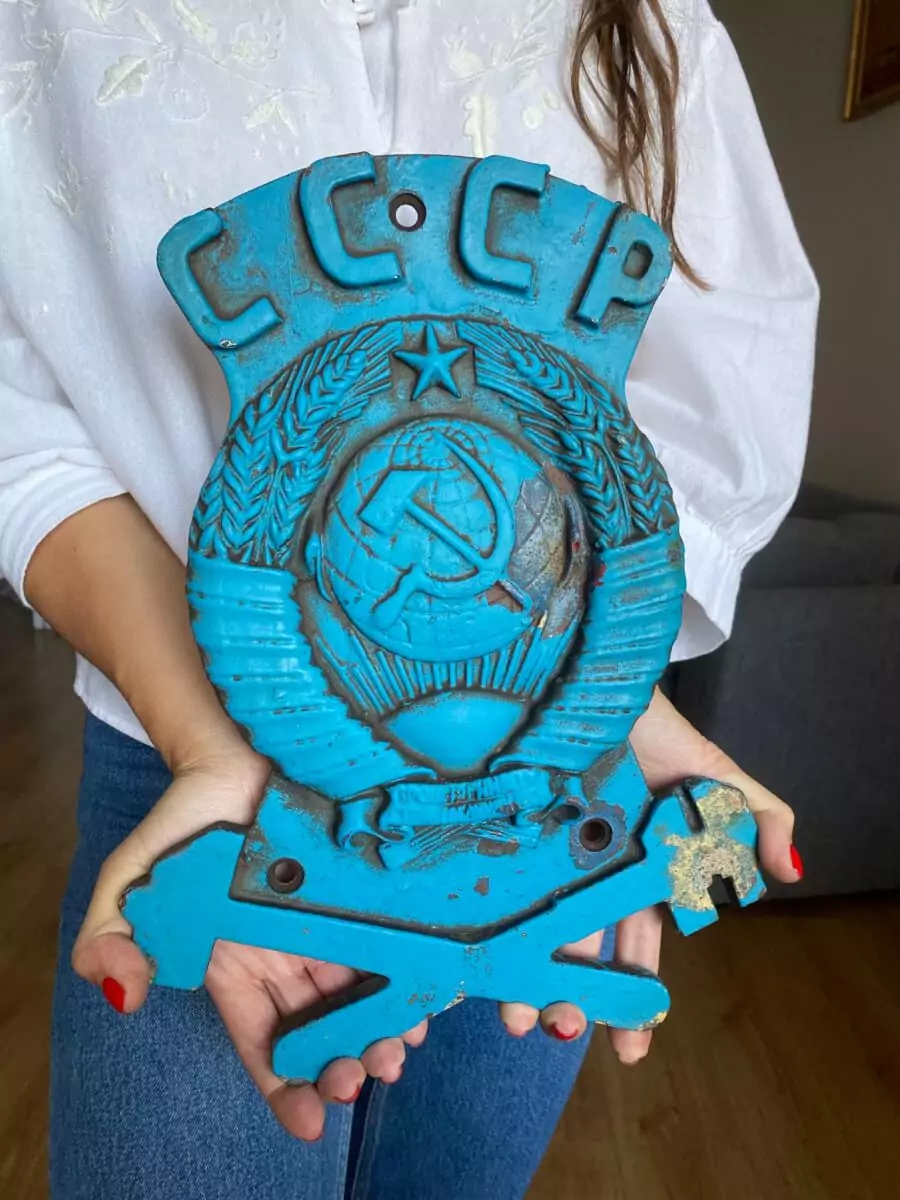
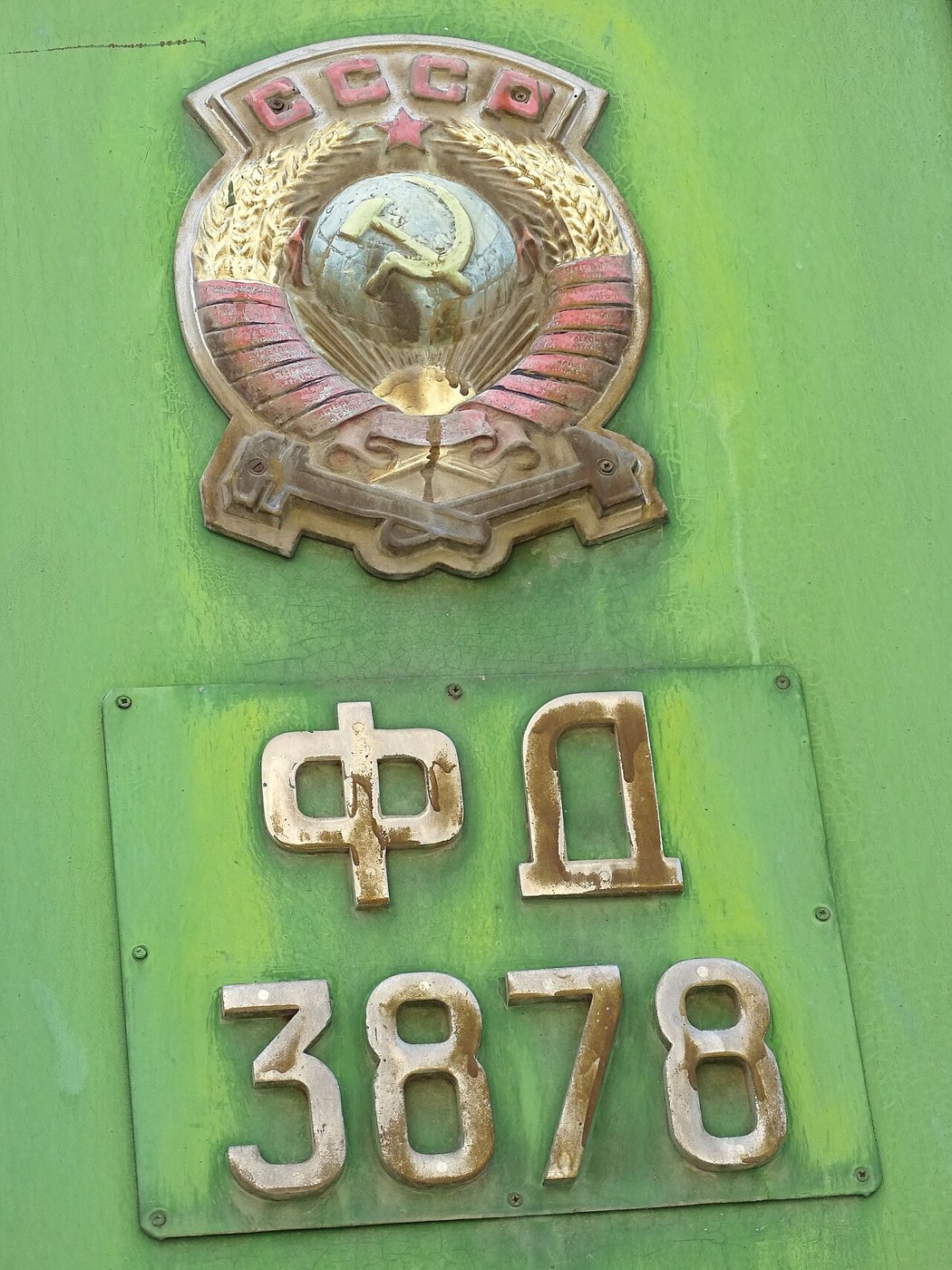
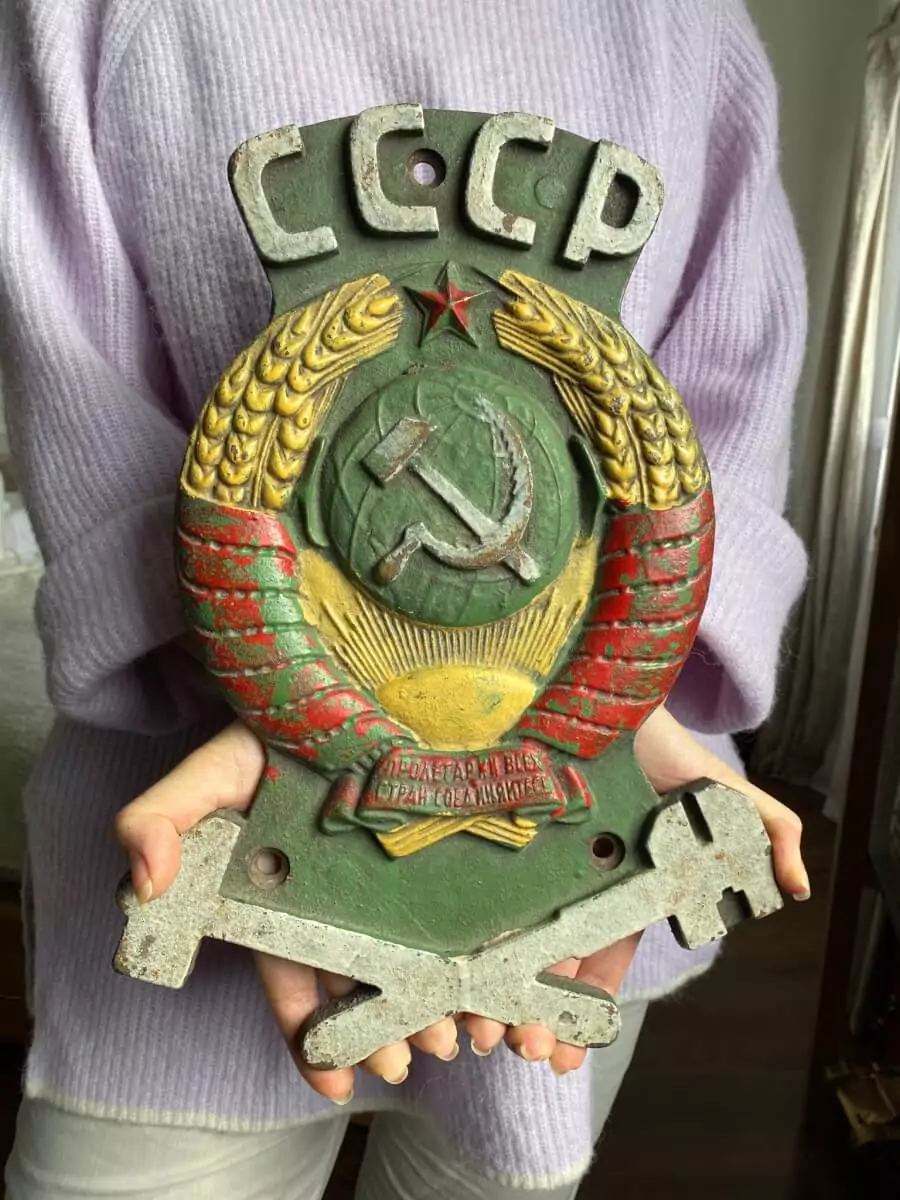
Soviet railway emblem in painted cast iron: the letters СССР, the coat of arms, the hammer and the wrench.
The Soviet railway emblem is a cast plaque bearing the state coat of arms of the USSR. It was fixed to the rolling stock of Soviet Railways, above all to passenger coaches. Millions of travellers walked past it on platforms from Brest to Vladivostok, and as far as Paris, Berlin or Helsinki.
These plaques were taken down after 1991. Several dozen have passed through our shop. This guide brings together what the regulations, period photographs and the pieces themselves tell us.
What the regulations say
The coat of arms was not decoration. The 1964 Rules of Technical Operation of the railways of the USSR list the signs every unit of rolling stock must carry: the state coat of arms and the initials of its home railway, except on freight wagons, the sign of the Ministry of Railways, the number and the builder’s plate.
The 1986 edition is more precise. The state coat of arms goes on locomotives, on passenger coaches and on the cars of electric and diesel multiple units. The rules fix neither the material nor the exact position.
Where the emblem was fixed
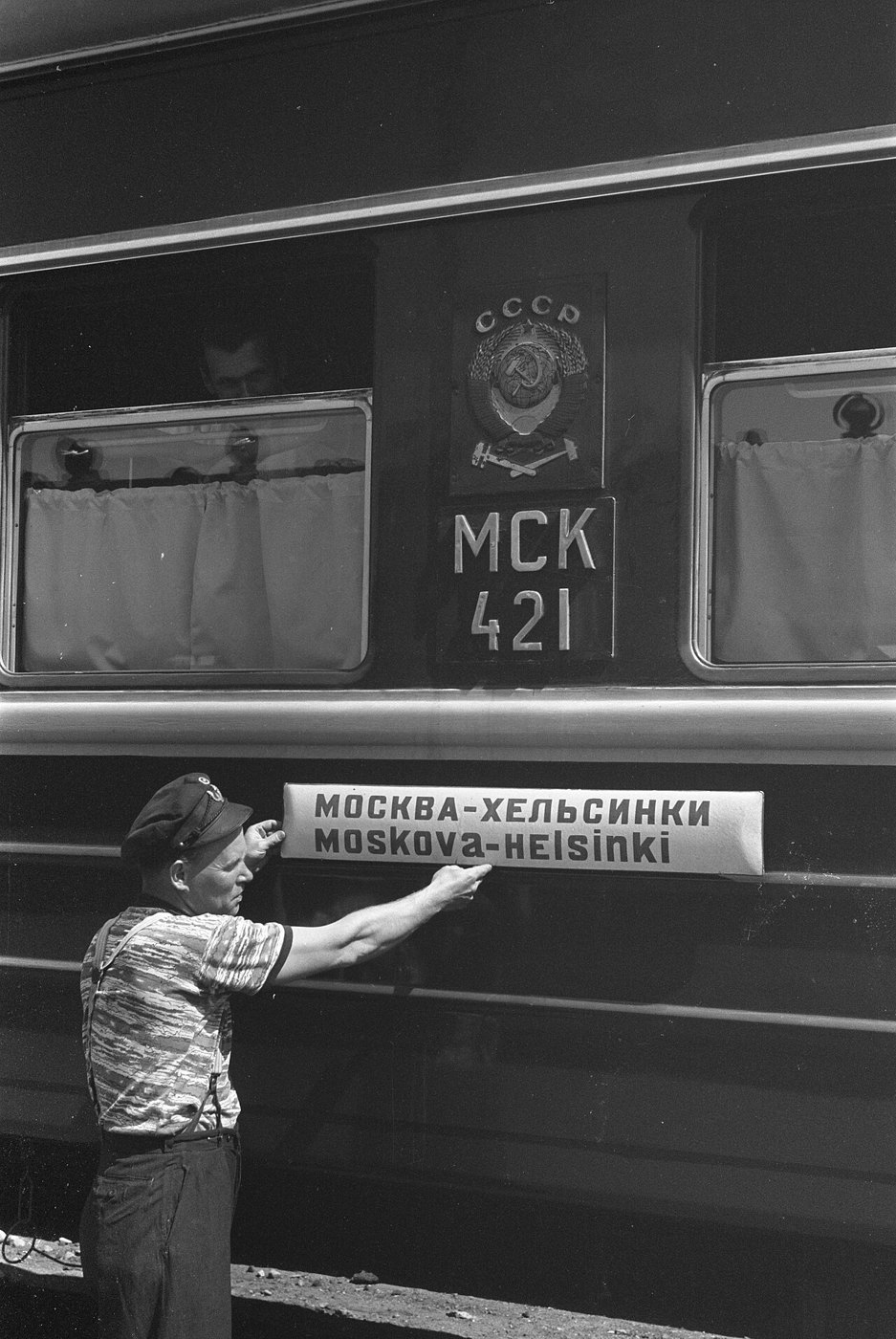
The Moscow-Helsinki train at Helsinki station, 5 July 1967: the coat of arms between two windows, above the initials МСК. Photo Anefo, Nationaal Archief, CC0.
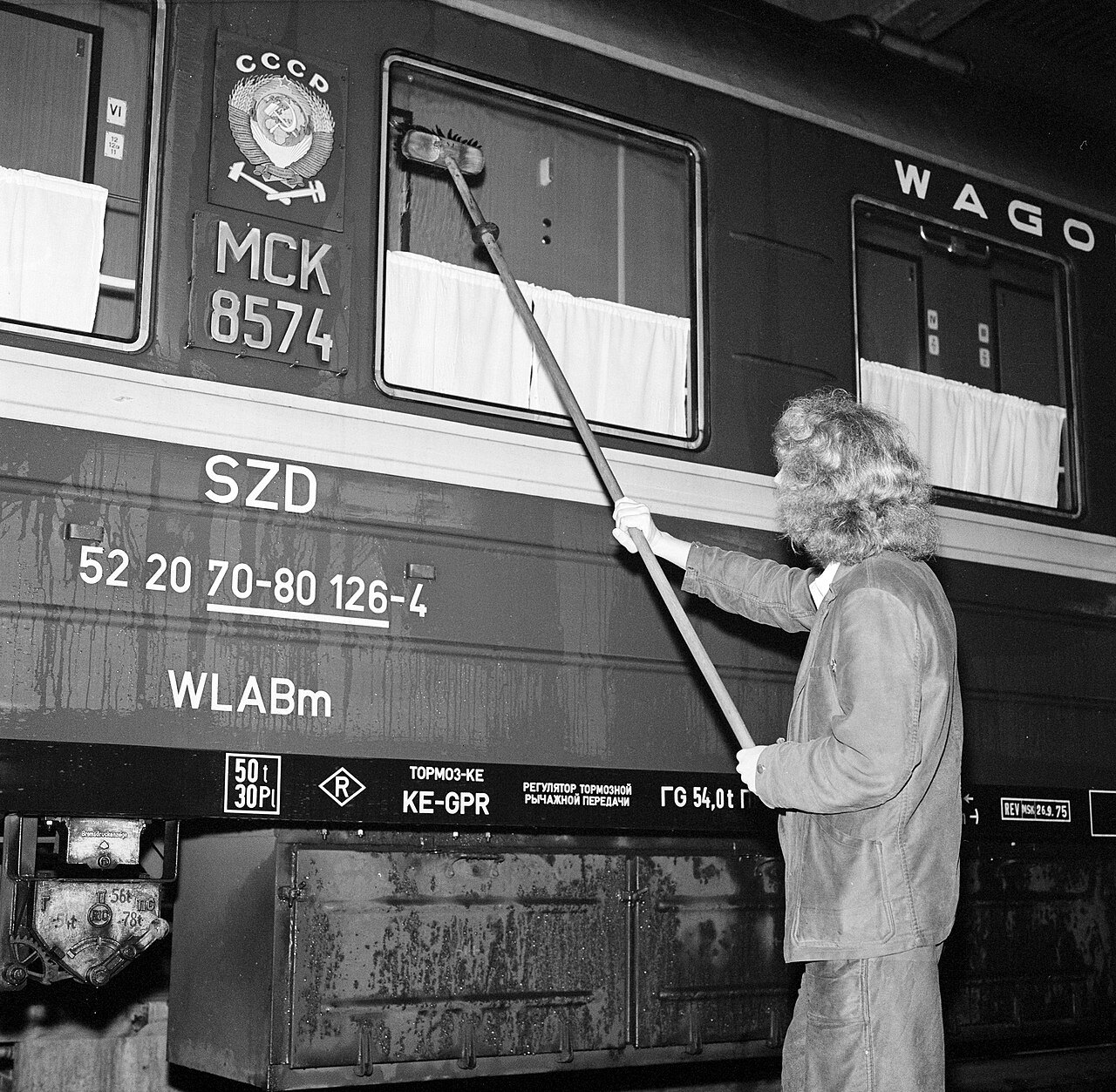
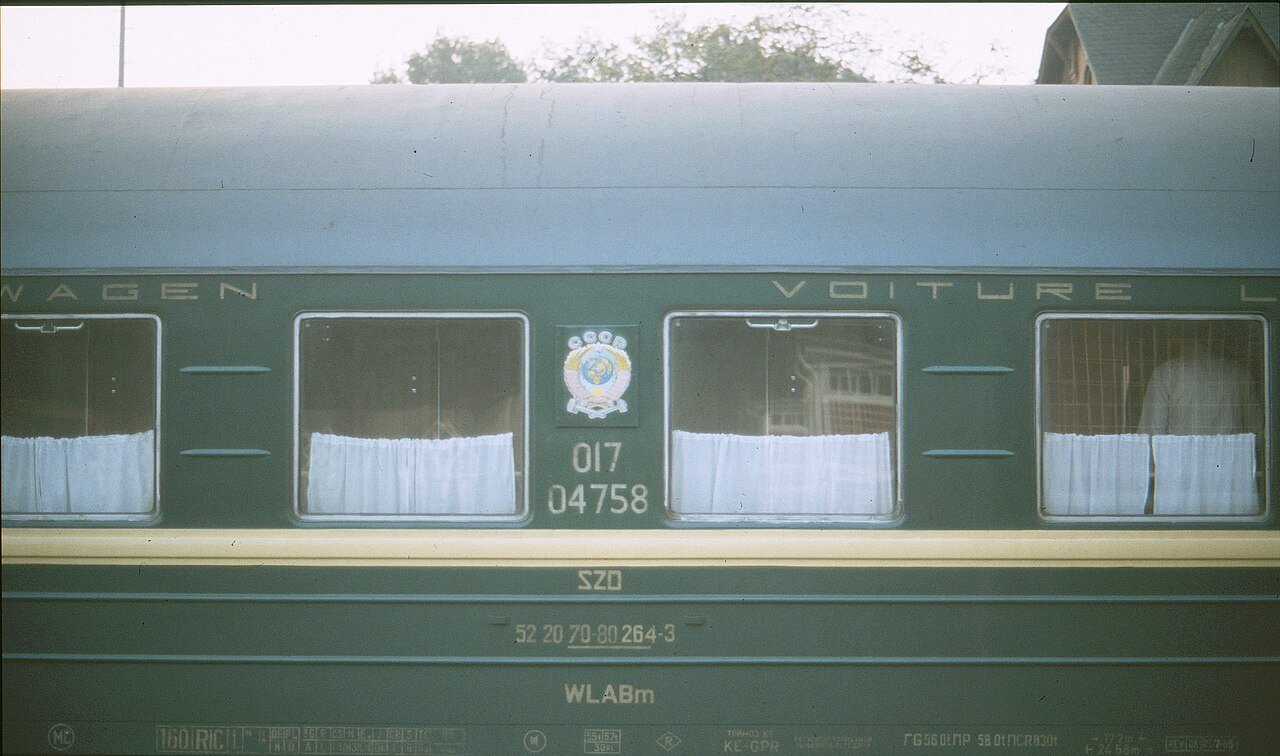
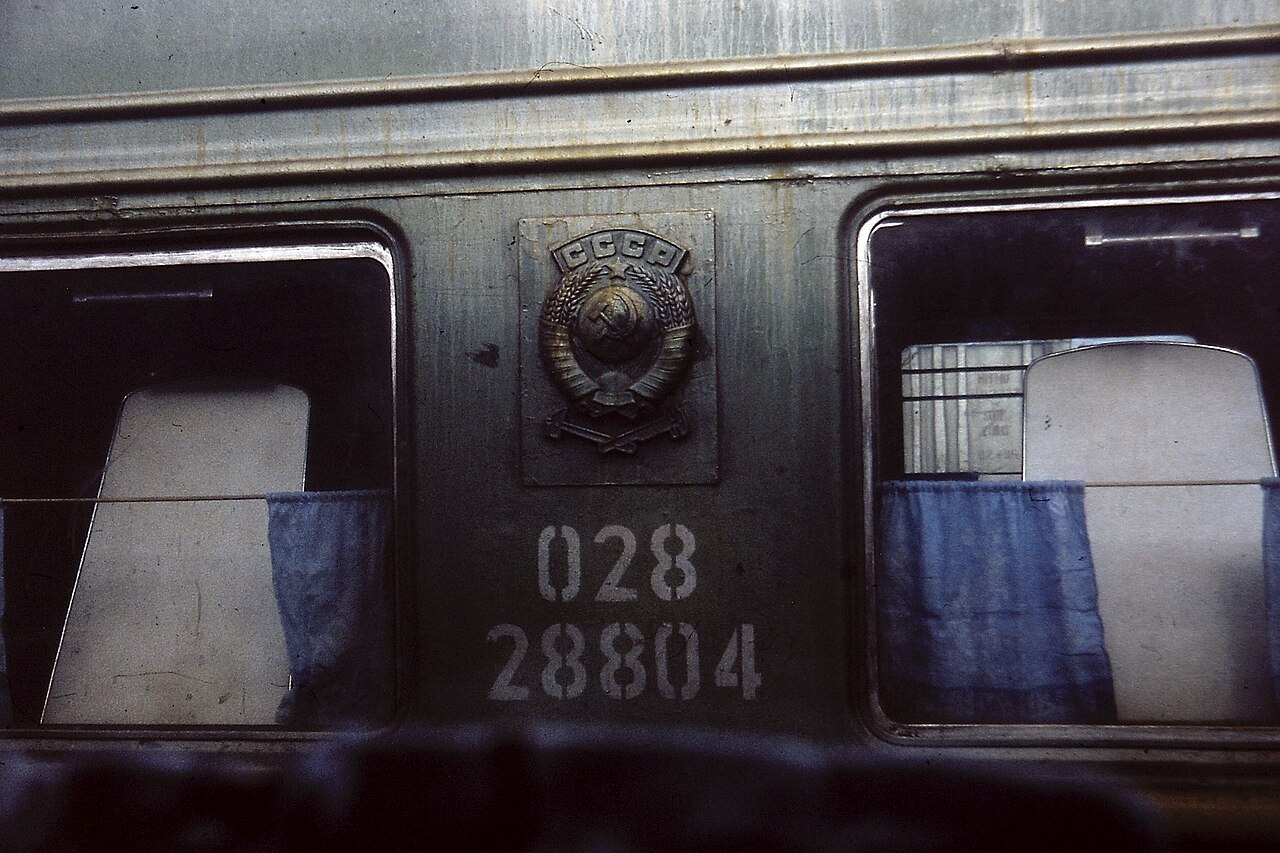
Period photographs all show the same arrangement. On a passenger coach the emblem sits in the middle of the side, between two windows, one on each side. The letters СССР are above. Below come the railway’s initials and the number: МСК for the Moscow Railway, ОК for the October Railway in Leningrad.
Soviet sleeping car being washed at Hagalund, Stockholm, 4 November 1975. Photo Seved Walther, Järnvägsmuseet, CC BY-SA 4.0.
For locomotives the sources are thinner. Russian collectors have themselves removed emblems of this size from passenger coaches, and from ТЭ3 diesel locomotives. On the small narrow-gauge ТУ2 locomotives it was fitted on the side, under the cab.
Reading a Soviet railway emblem
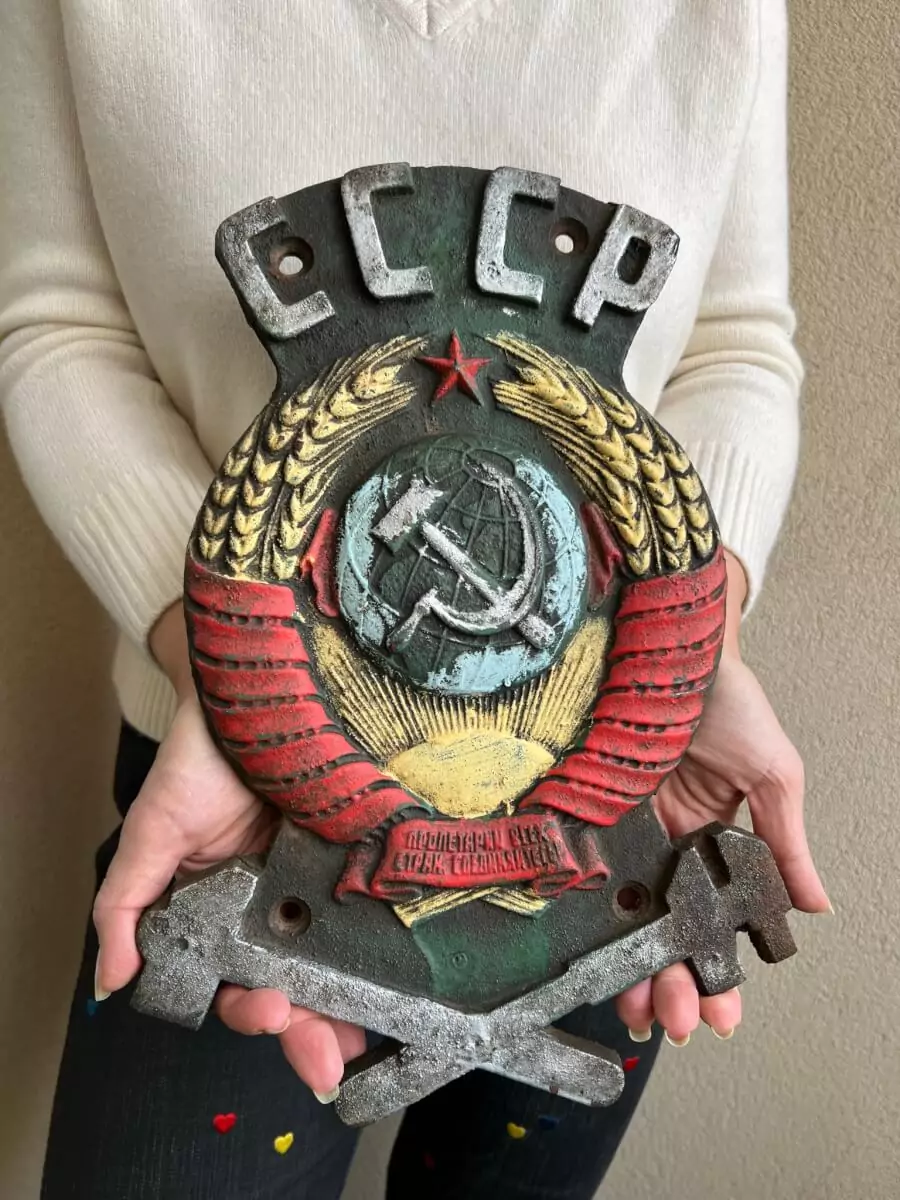
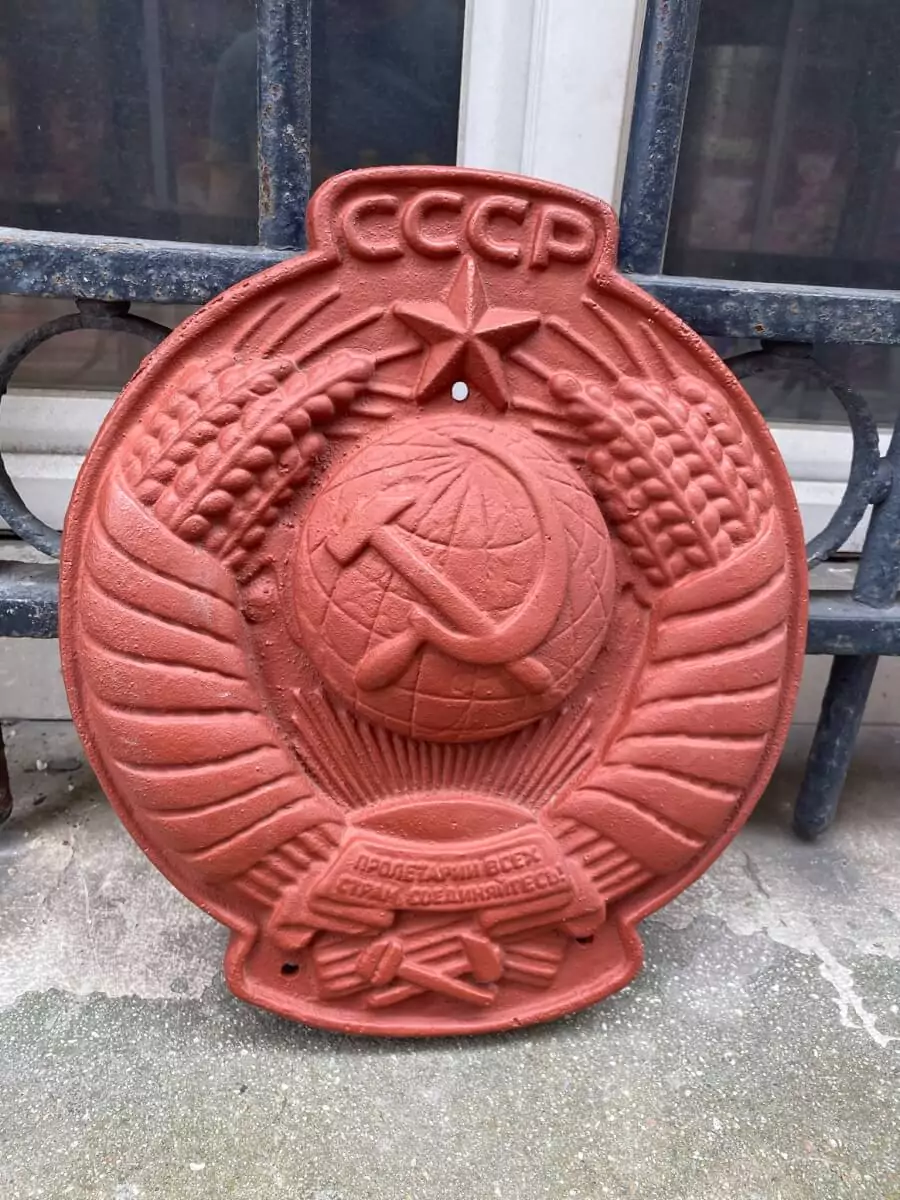
Painted cast iron: red ground, yellow ears of wheat, yellow wrench and hammer.
The plaque reads from top to bottom.
The letters СССР, in an arc above the coat of arms.
The state coat of arms: the globe with the hammer and sickle, the rising sun, the star, and the ears of wheat wrapped in ribbons.
The central ribbon, which carries in Russian the motto “Workers of the world, unite!”.
A hammer crossed with an adjustable wrench. This is the sign of Soviet Railways, the one the regulations call the sign of the Ministry.
That last detail sets the railway emblem apart from other Soviet coats of arms. A plaque from a building, a ship or a border post carries the arms alone. Russian collectors report one exception: on mail coaches the emblem had no hammer and wrench.
Cast iron or aluminium: the two common models
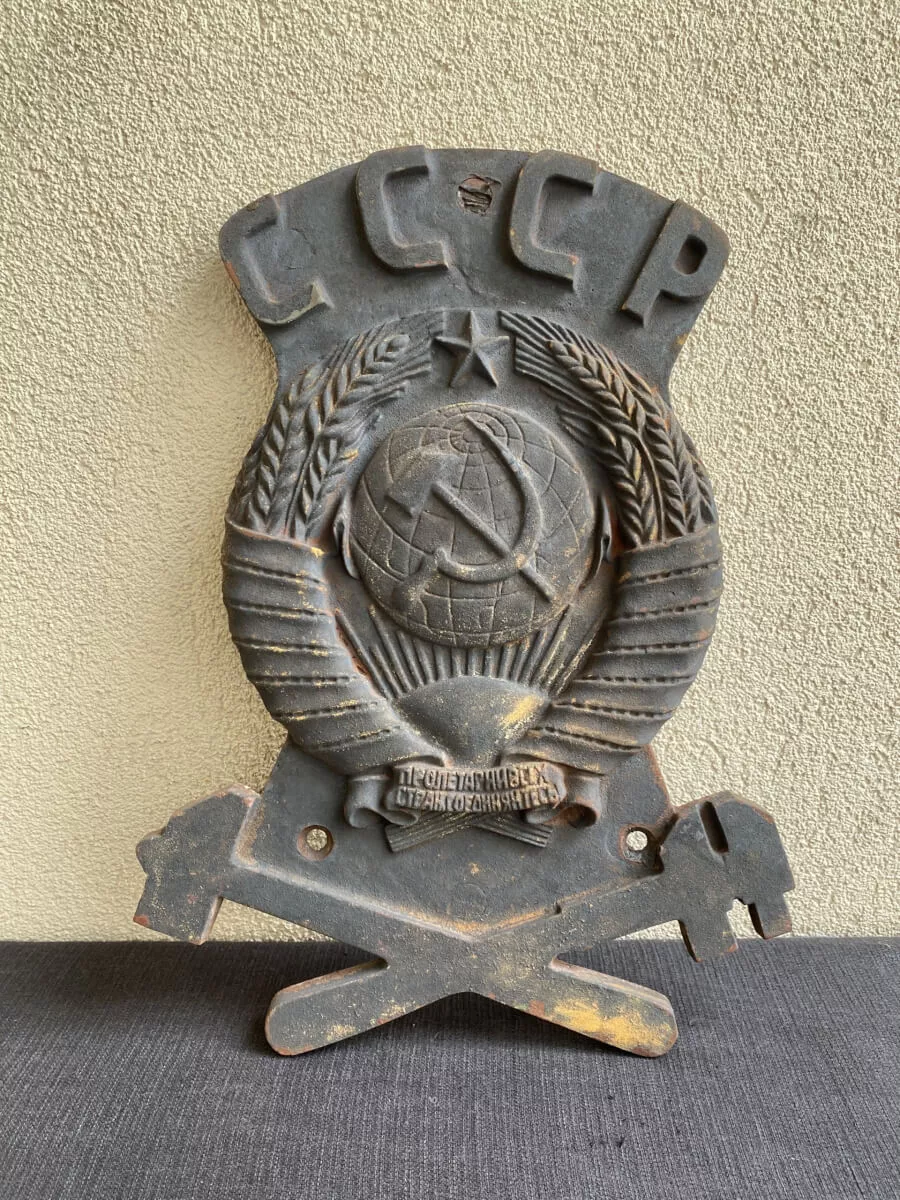
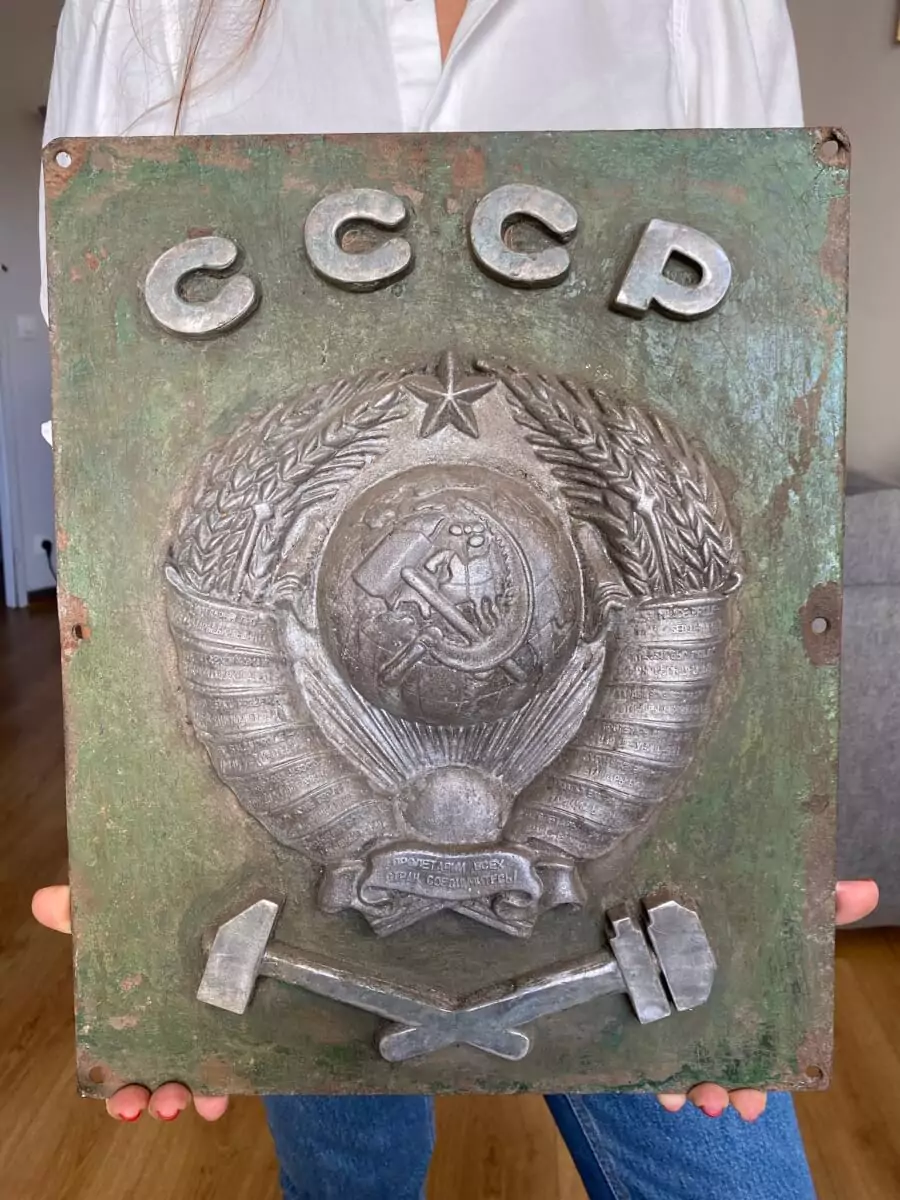
The cast-iron model, about 40 x 30 cm, here in plain grey.
The first model is cast iron. It measures about 40 cm high by 30 cm wide and 2 cm thick, and weighs 4 to 6 kg. The letters СССР, the coat of arms, the hammer and the wrench are cast in one piece.
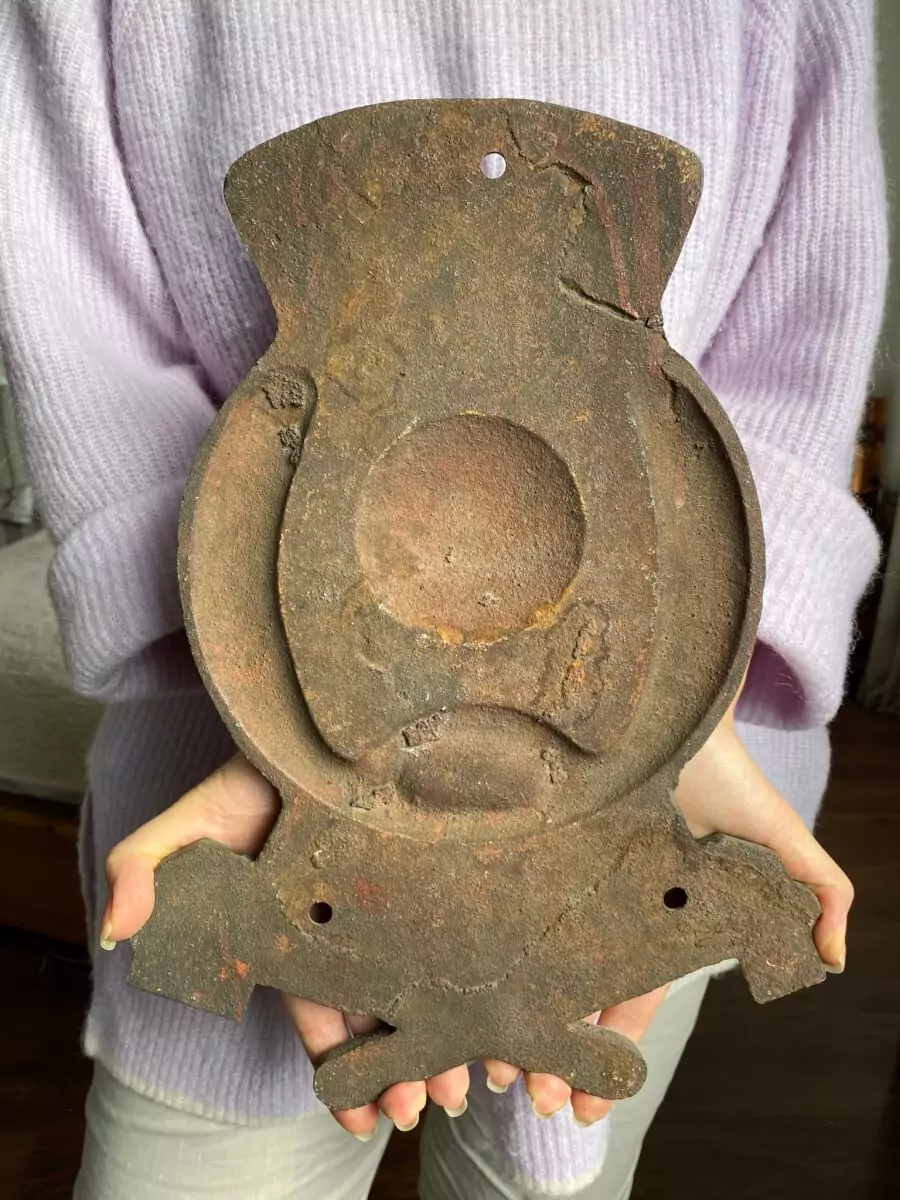
The back of a cast-iron plaque, with its fixing holes.
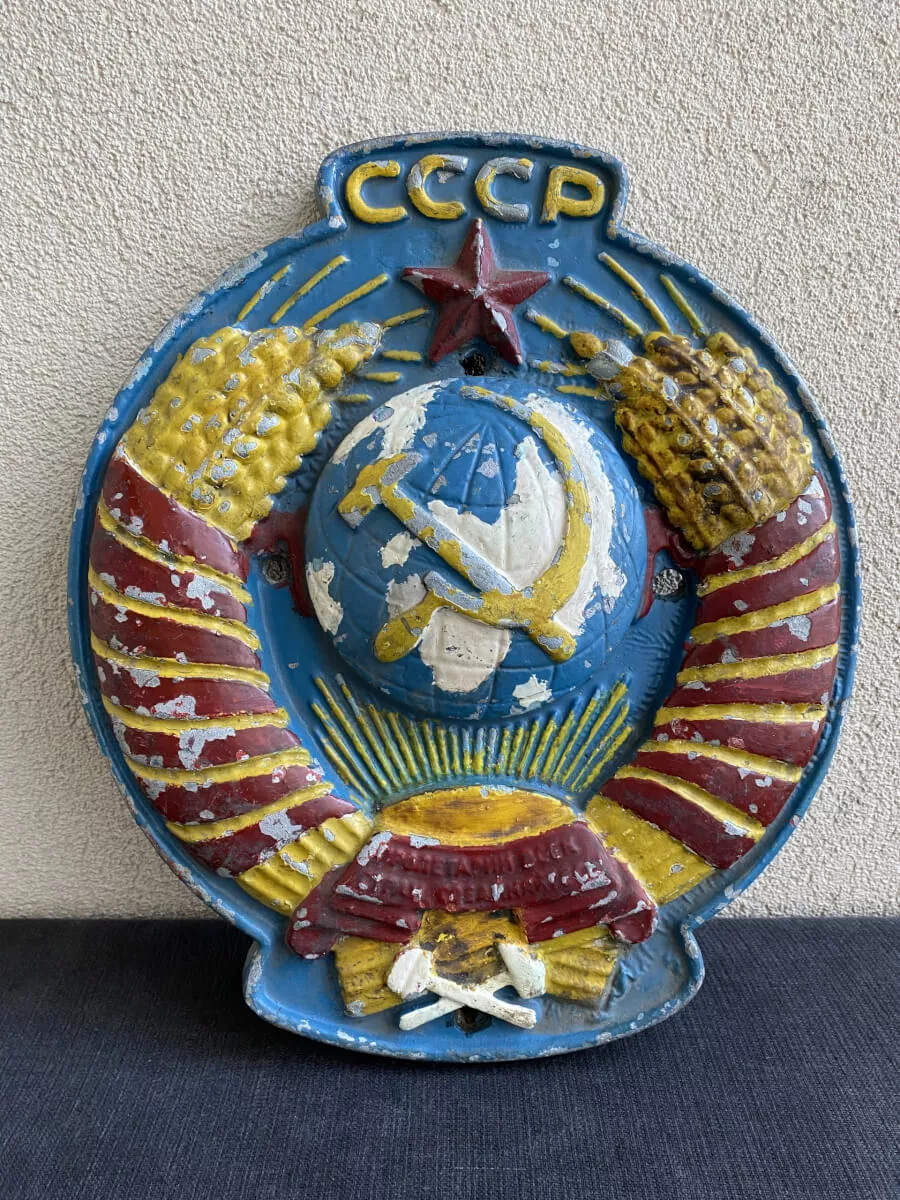
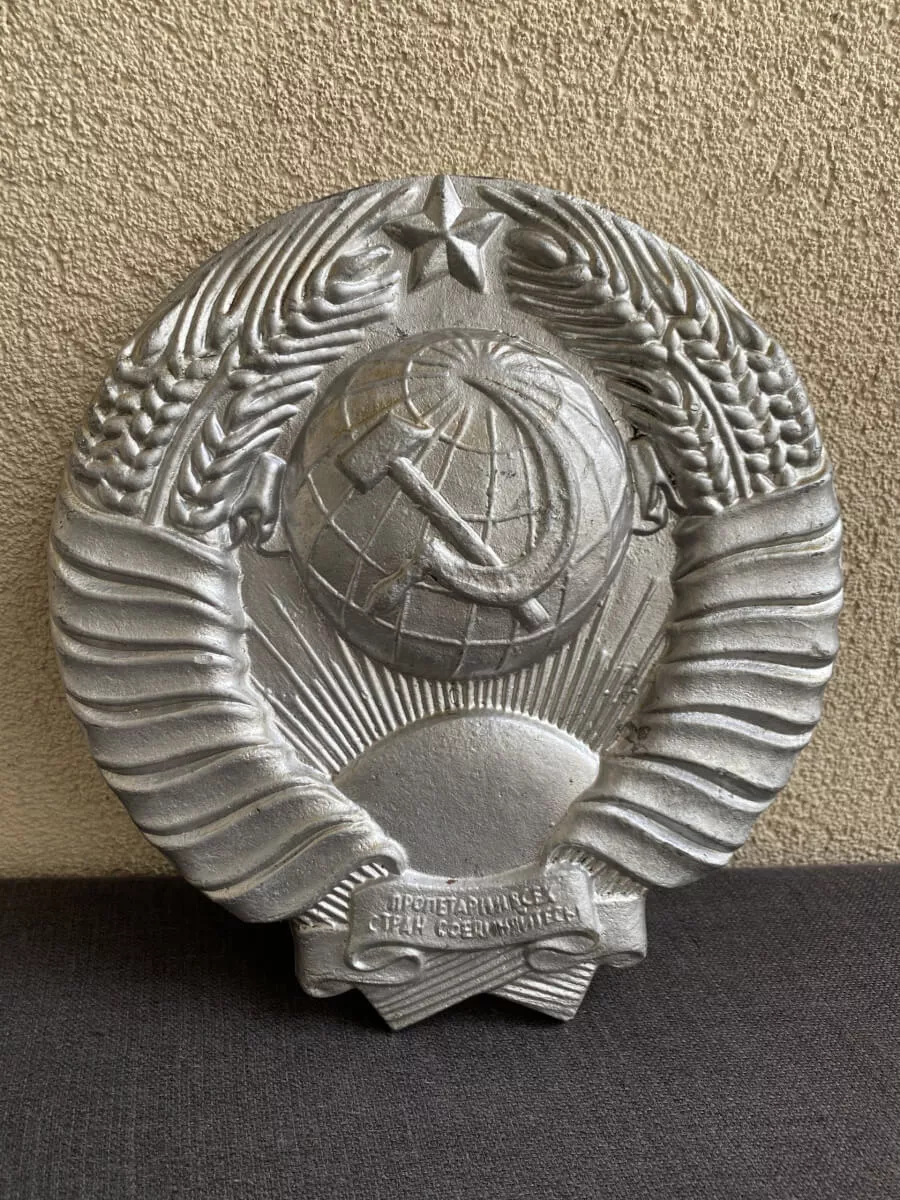
The second model is cast aluminium. It is round, about 30 cm across, and weighs around 2.5 kg. The hammer and wrench are smaller, set under the central ribbon. Aluminium does not rust, which is why the paint is often better preserved.
The round cast-aluminium model, about 30 cm: yellow wheat, blue globe.
The same model in bare aluminium, unpainted.
Counting the ribbons to date it
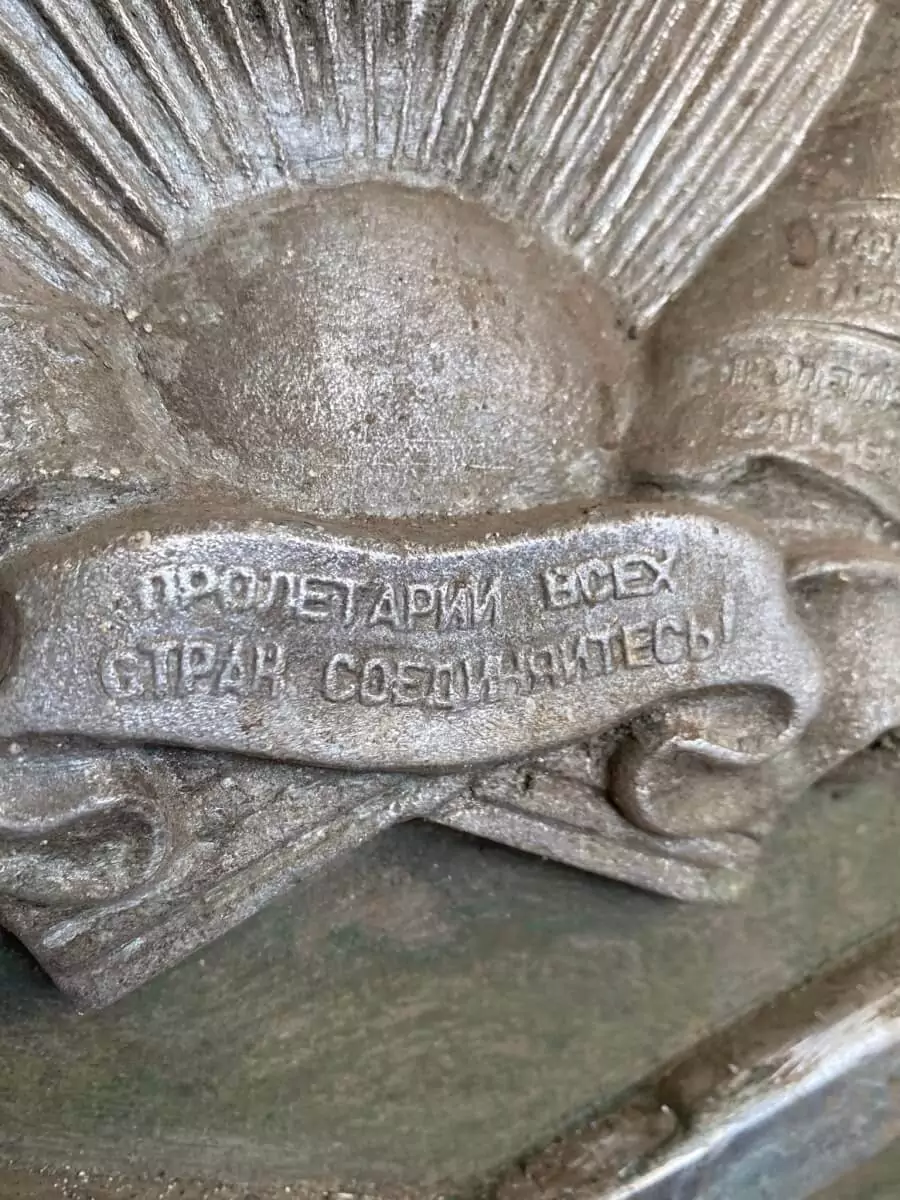
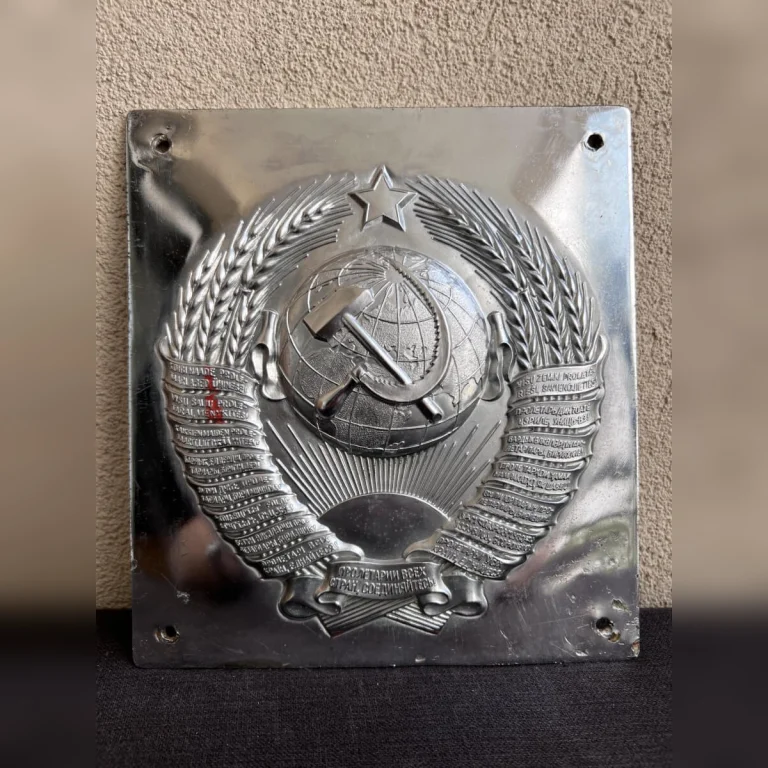
The ribbons wrapped around the wheat follow the political map of the Union: each repeats the motto in the language of one republic. There were six in 1923, then seven, eleven after the 1936 Constitution, sixteen in 1946, and fifteen from September 1956, when the Karelo-Finnish republic became an autonomous republic.
Plaque from the 1950s, steel and cast iron, with sixteen ribbons.
A plaque with sixteen ribbons was therefore cast between 1946 and 1956. A plaque with fifteen ribbons is later than 1956. That is the case for the great majority of railway emblems found today.
The central ribbon of a sixteen-ribbon plaque: « Пролетарии всех стран, соединяйтесь! ».
The paint: no two emblems are alike
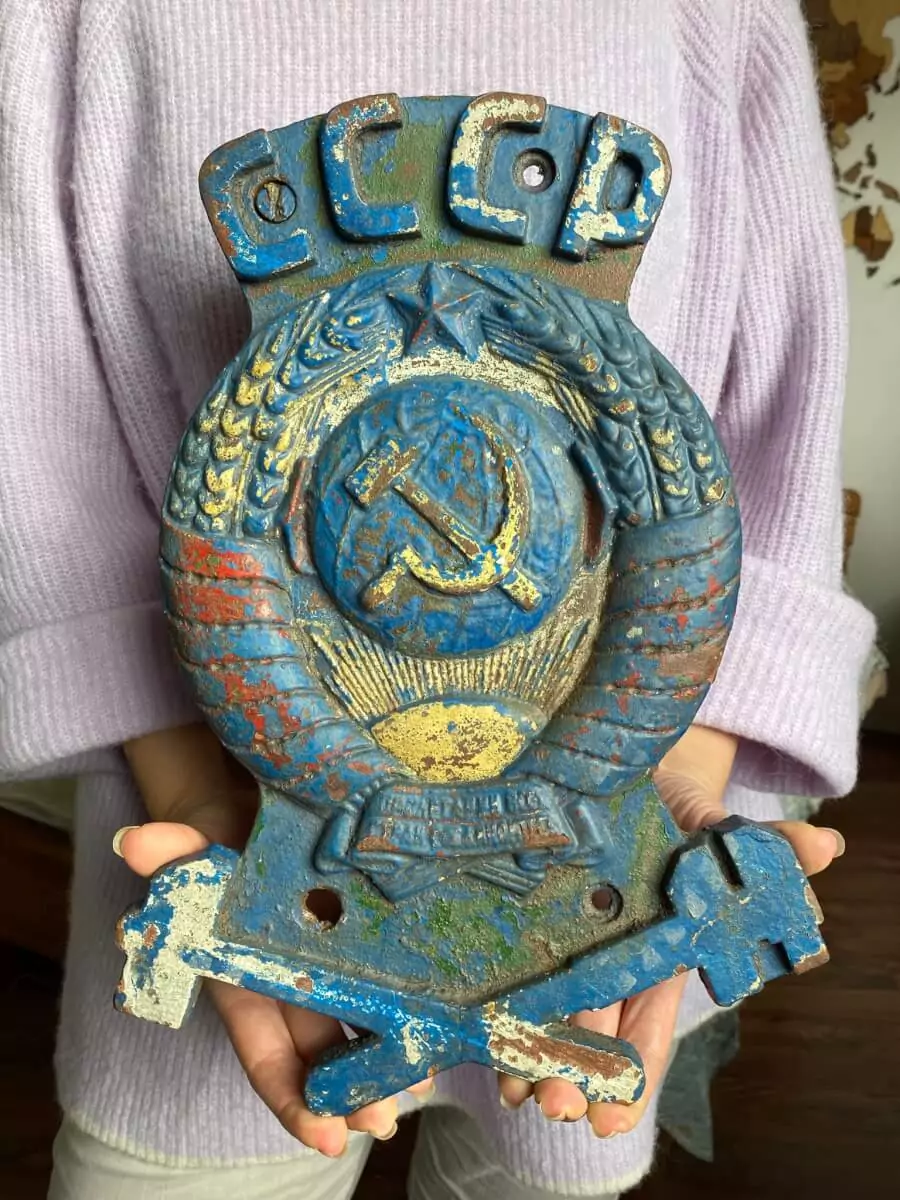
Cast iron painted blue, yellow wheat.
Each emblem is unique in its paint. It was generally the staff of stations and depots who painted them on receipt, then repainted them. Some plaques are a single colour, blue, green, grey or red, and others are painted in detail, with the globe, the wheat and the ribbons in different colours.
Grey base, coat of arms painted in detail.
Plain blue, a single coat of paint.
The rare variants
Back of a 23 cm aluminium emblem, with its marking.
Some emblems stand out. One aluminium model 23 cm across carries a manufacturing mark and a standard on the back. Another, in cast iron, weighs 8 kg instead of the usual 2 or 3 kg, for a diameter of 36 cm, under its red paint.
Cast-iron emblem weighing 8 kg, 36 cm, red paint.
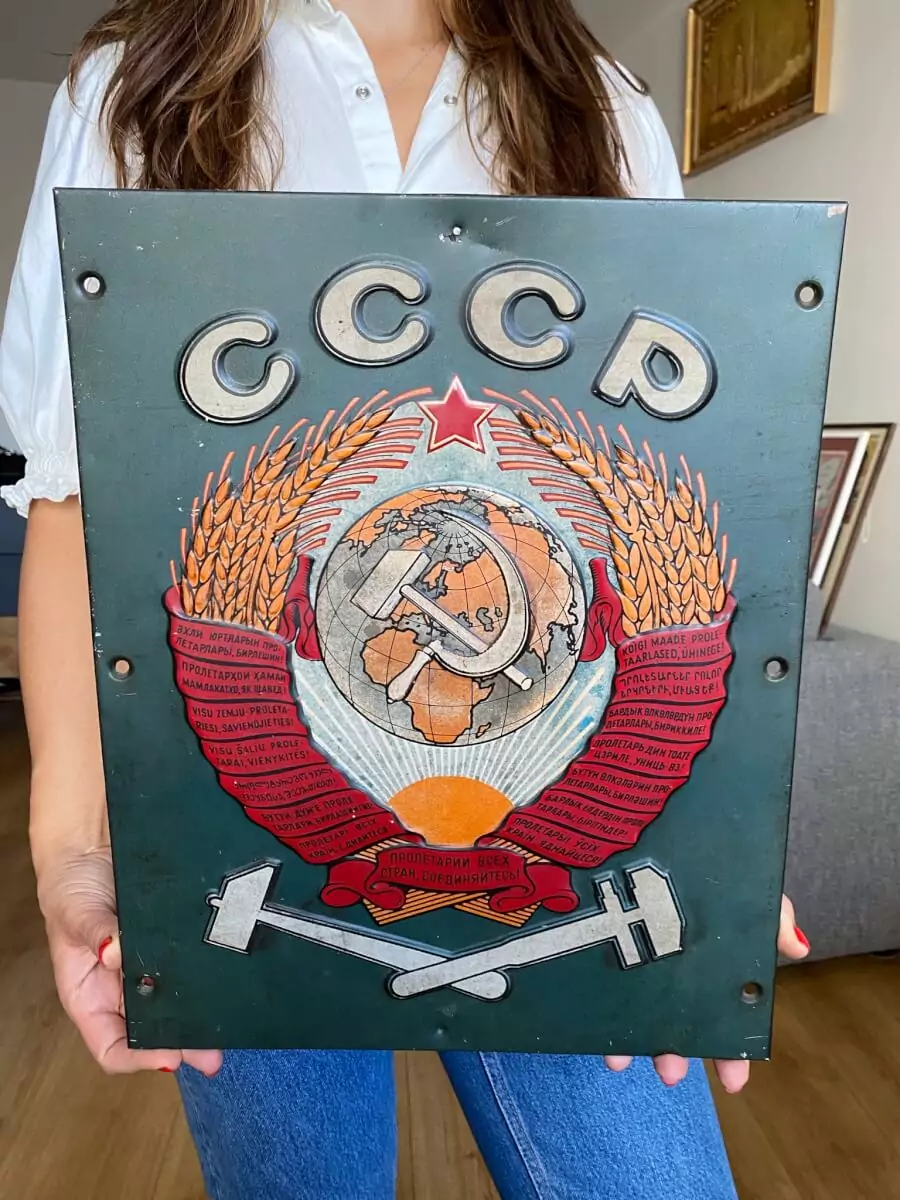
The third type is a thin rectangular plate of painted aluminium, with the coat of arms in low relief. It can be seen on the Leningrad-Helsinki train in the early 1970s.
Thin painted aluminium plate, 1970s.
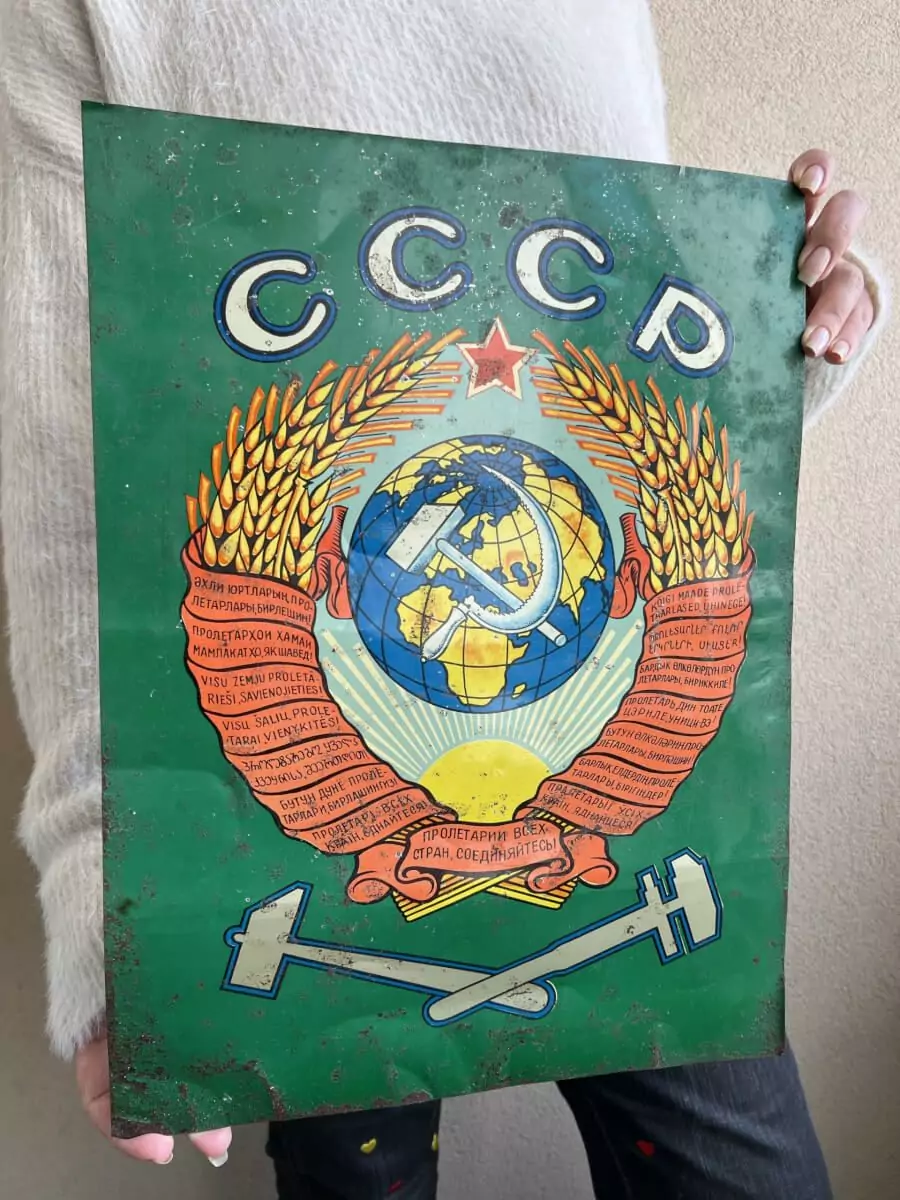
By the late 1980s the emblem was no more than a thin painted metal sheet.
Train plate of the late 1980s, in painted sheet metal.
On international trains
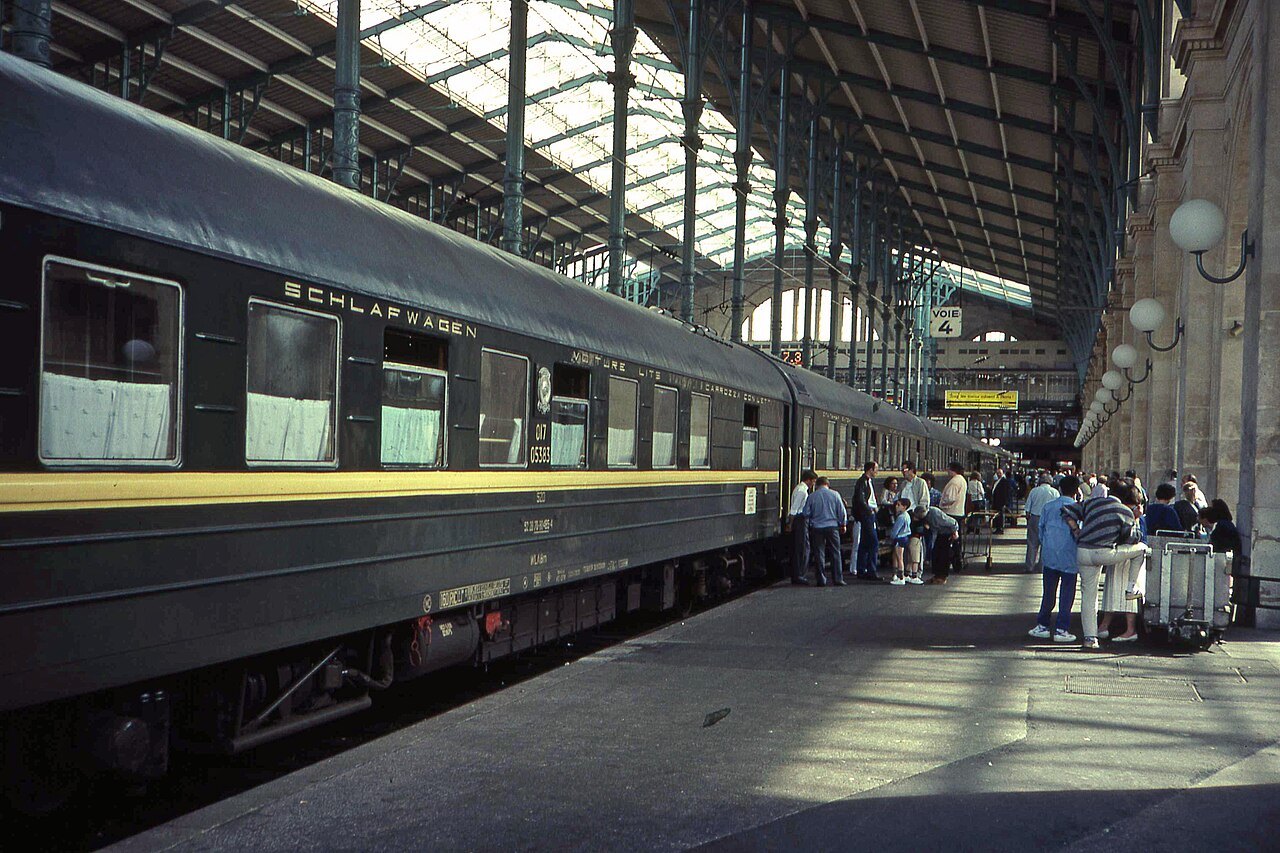
Soviet sleeping cars in Paris, Gare du Nord, March 1988. The emblem is between the windows. Photo Smiley.toerist, Wikimedia Commons, CC BY-SA 3.0.
Soviet sleeping cars ran as far as Paris. Their lettering was in four languages: Russian, German, French and Italian. The emblem sat in the same place as on domestic trains.
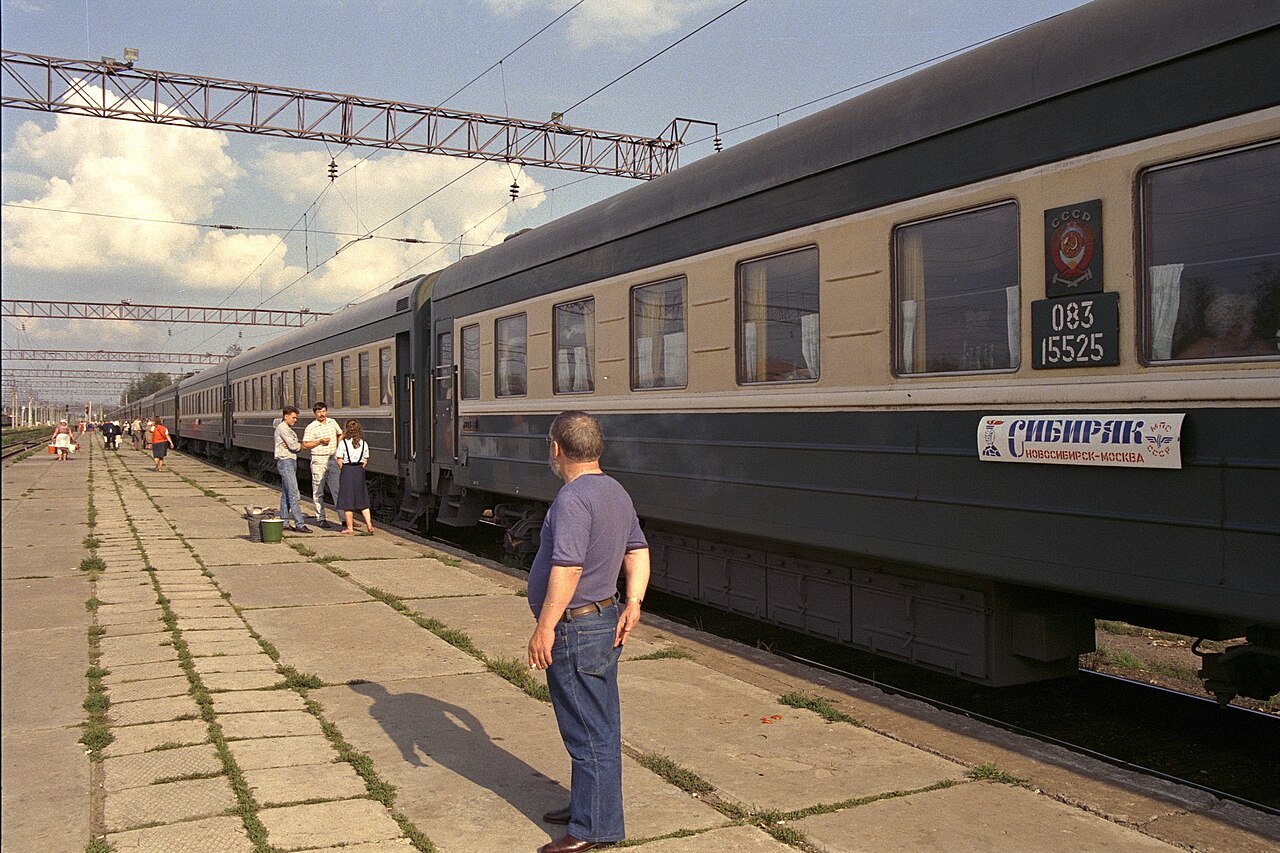
Sleeping car of the Ost-West-Express at Berlin-Wannsee, 30 September 1985. Photo Harald Knauer, Staatsarchiv Ludwigsburg, CC BY 4.0.The “Sibiryak” train from Novosibirsk to Moscow, August 1989: the emblem painted red on every coach. Photo Peter Kersten, Wikimedia Commons, CC BY-SA 4.0.
The enamel route plates
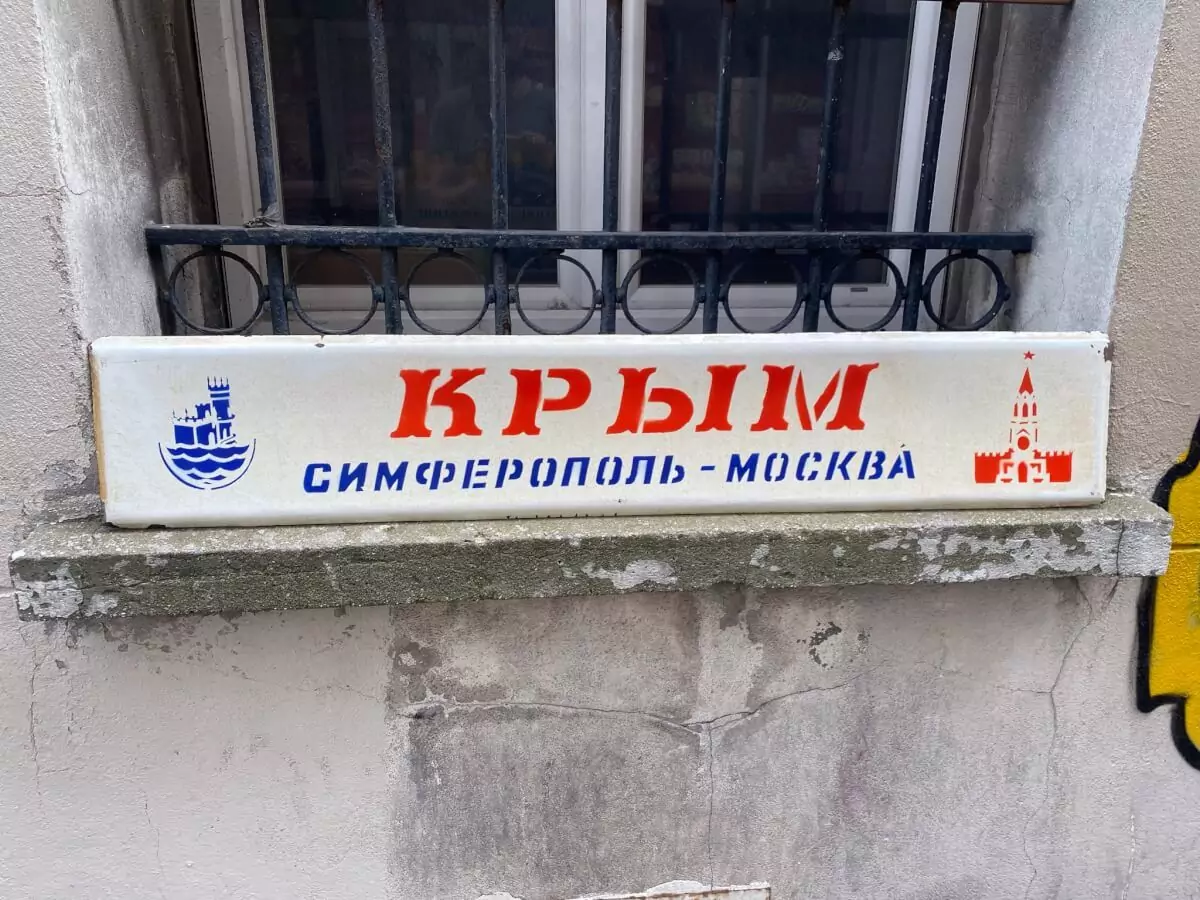
Enamel plate of the « Крым » (Crimea) train, Simferopol-Moscow, 1970s.
Below the emblem a second plate gave the route. It told travellers waiting on the platform where the train was going, and was fitted only for the length of the journey. These plates are enamelled sheet steel, long and narrow.
The great trains had a name. On their plate the name is written large, the route underneath, with a drawing for each city. The one from the « Крым » train shows a castle for Simferopol and a Kremlin tower for Moscow. It was fixed to the restaurant car.
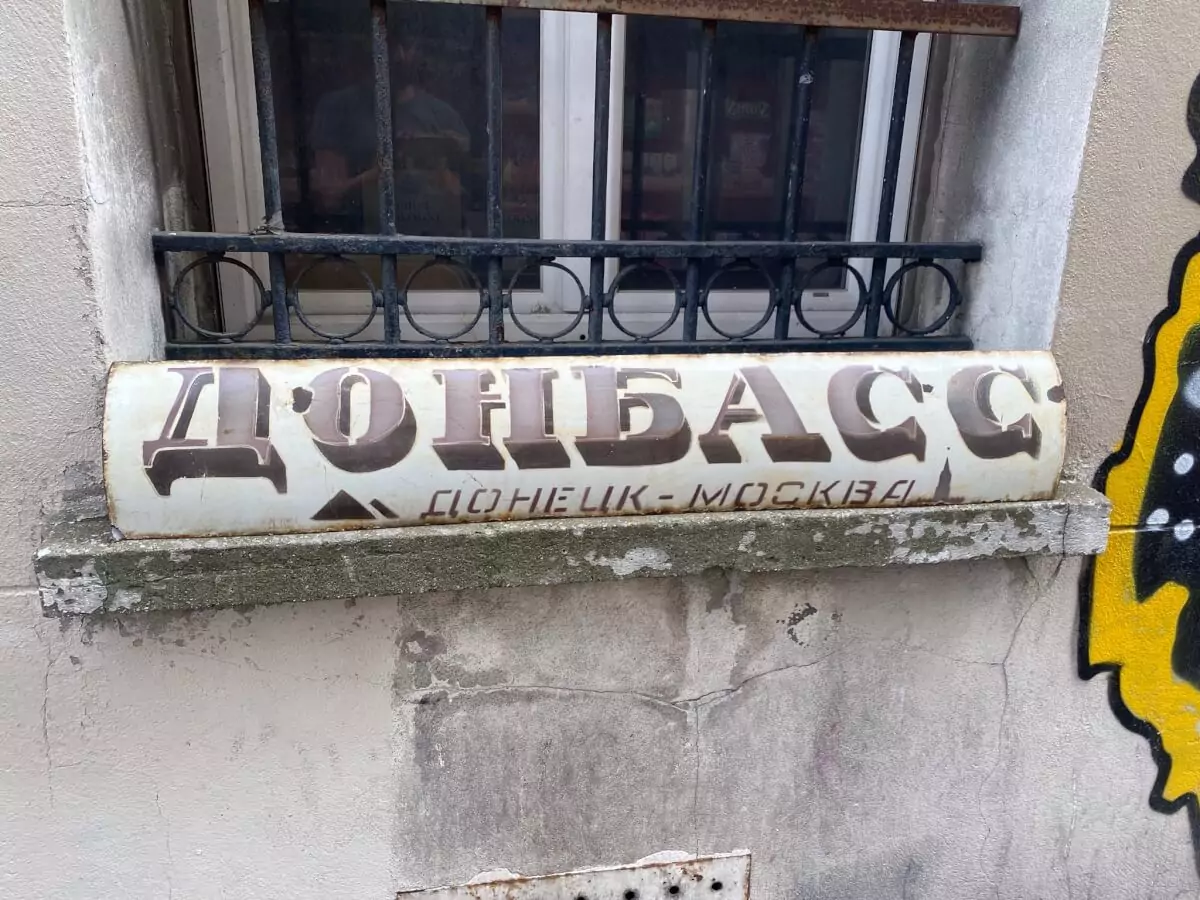
Enamel plate of the « Донбасс » train, Donetsk-Moscow: a slag heap for Donetsk, the Kremlin for Moscow.
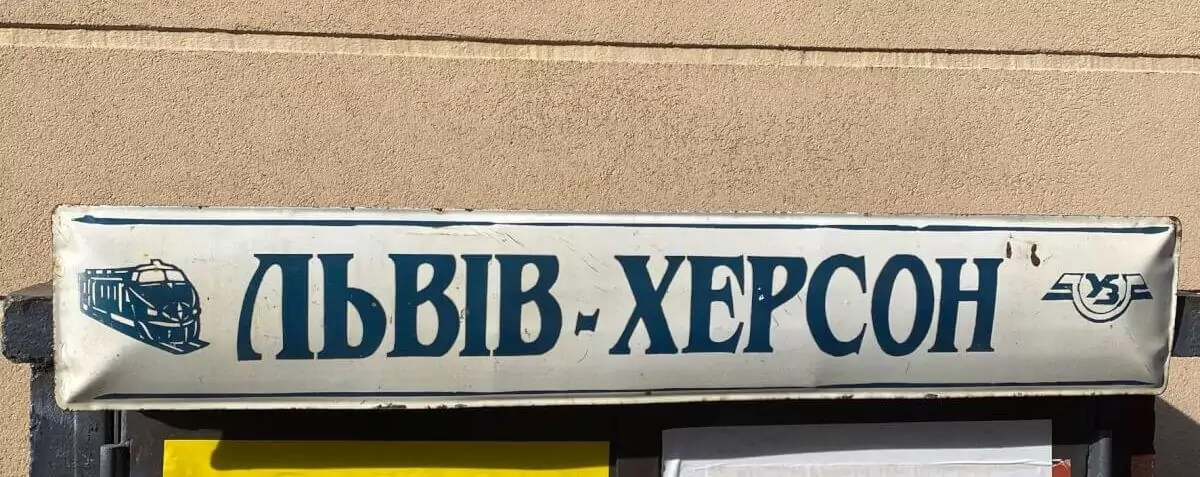
Enamel plate Lviv-Kherson, with a locomotive and the Ukrainian Railways logo: it dates from after 1991.
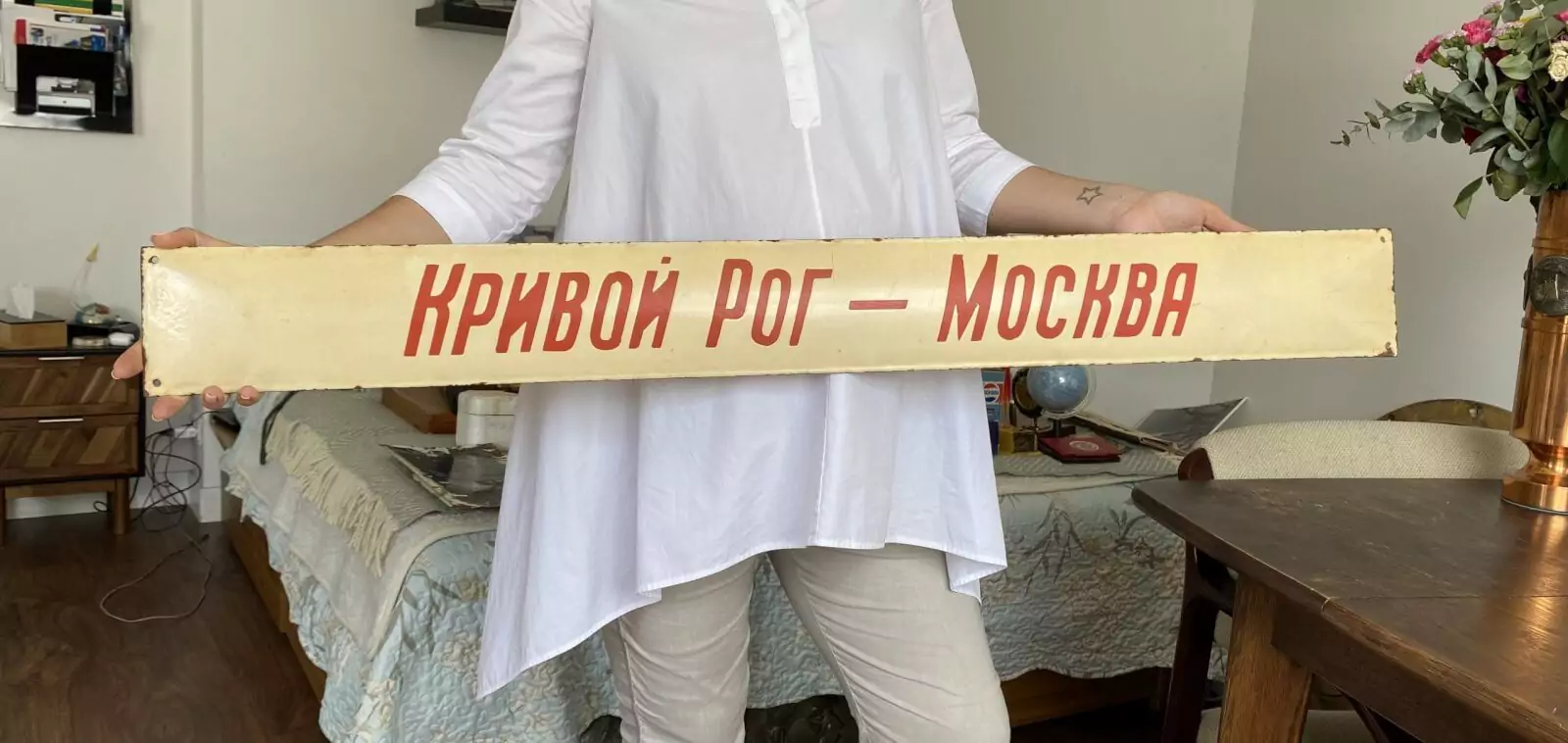
Ordinary trains carried only the names of the two cities.
Enamel route plate “Krivoy Rog – Moscow”.
What the locomotives carried
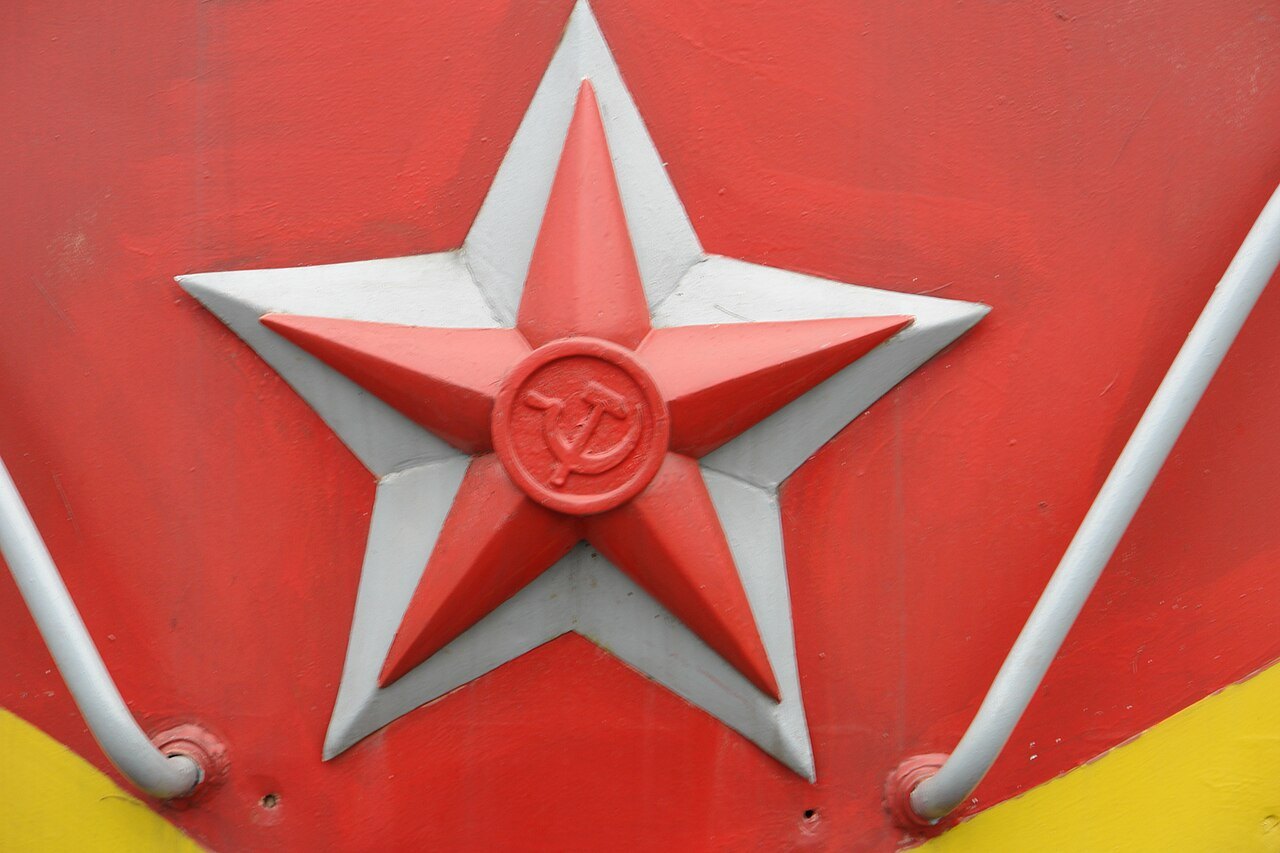
The cast star on the front of diesel locomotive М62-1. Photo George Shuklin, Wikimedia Commons, CC BY-SA 2.5.
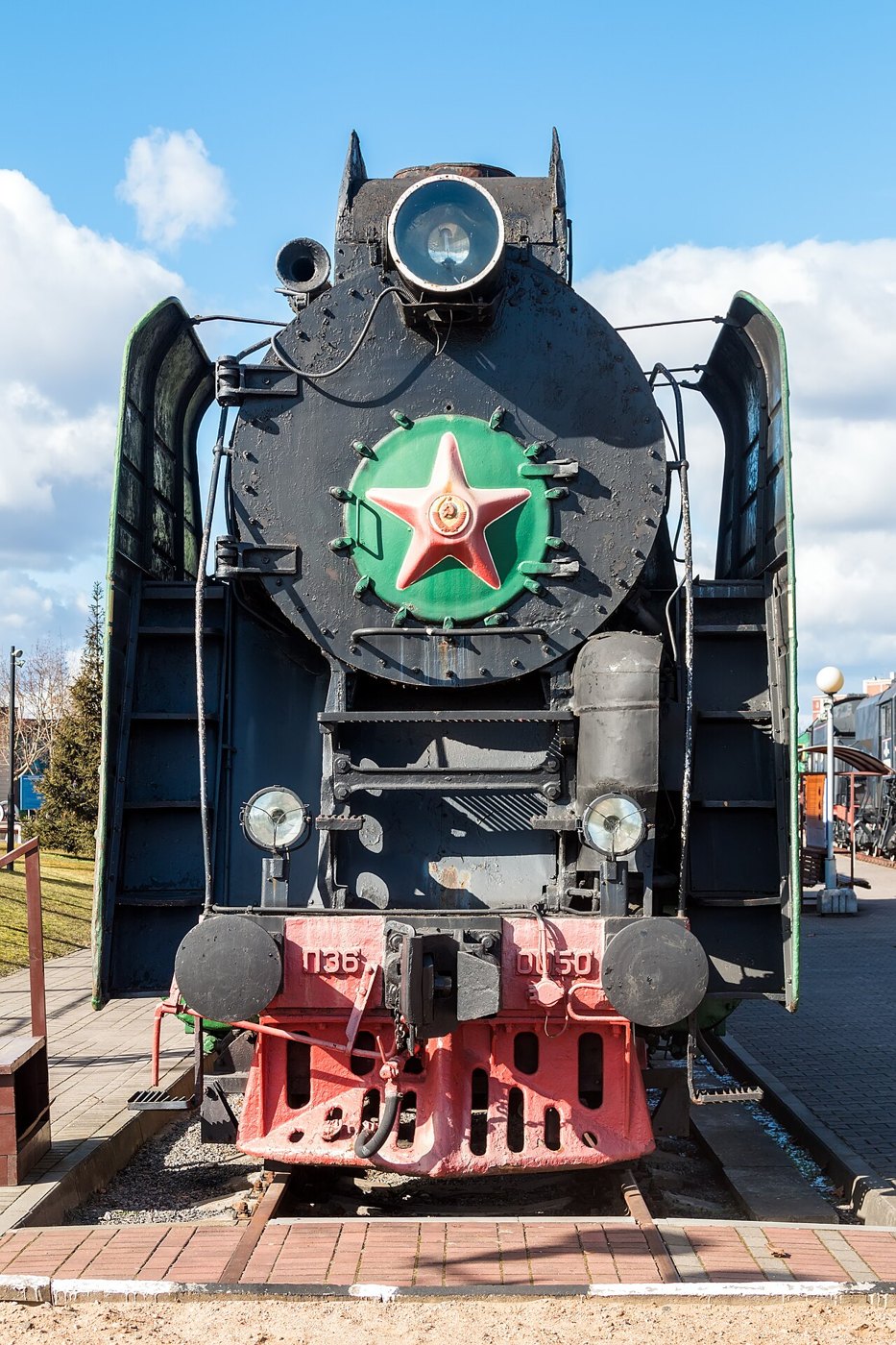
On the front of locomotives the usual emblem was the red star. On the П36 passenger steam locomotives built in the 1950s, the star carried at its centre a bas-relief of Lenin and Stalin. After de-Stalinisation that medallion was replaced, most often by the coat of arms of the USSR.
Steam locomotive П36-0050 at the Brest railway museum. Photo Mike1979 Russia, Wikimedia Commons, CC BY-SA 3.0.
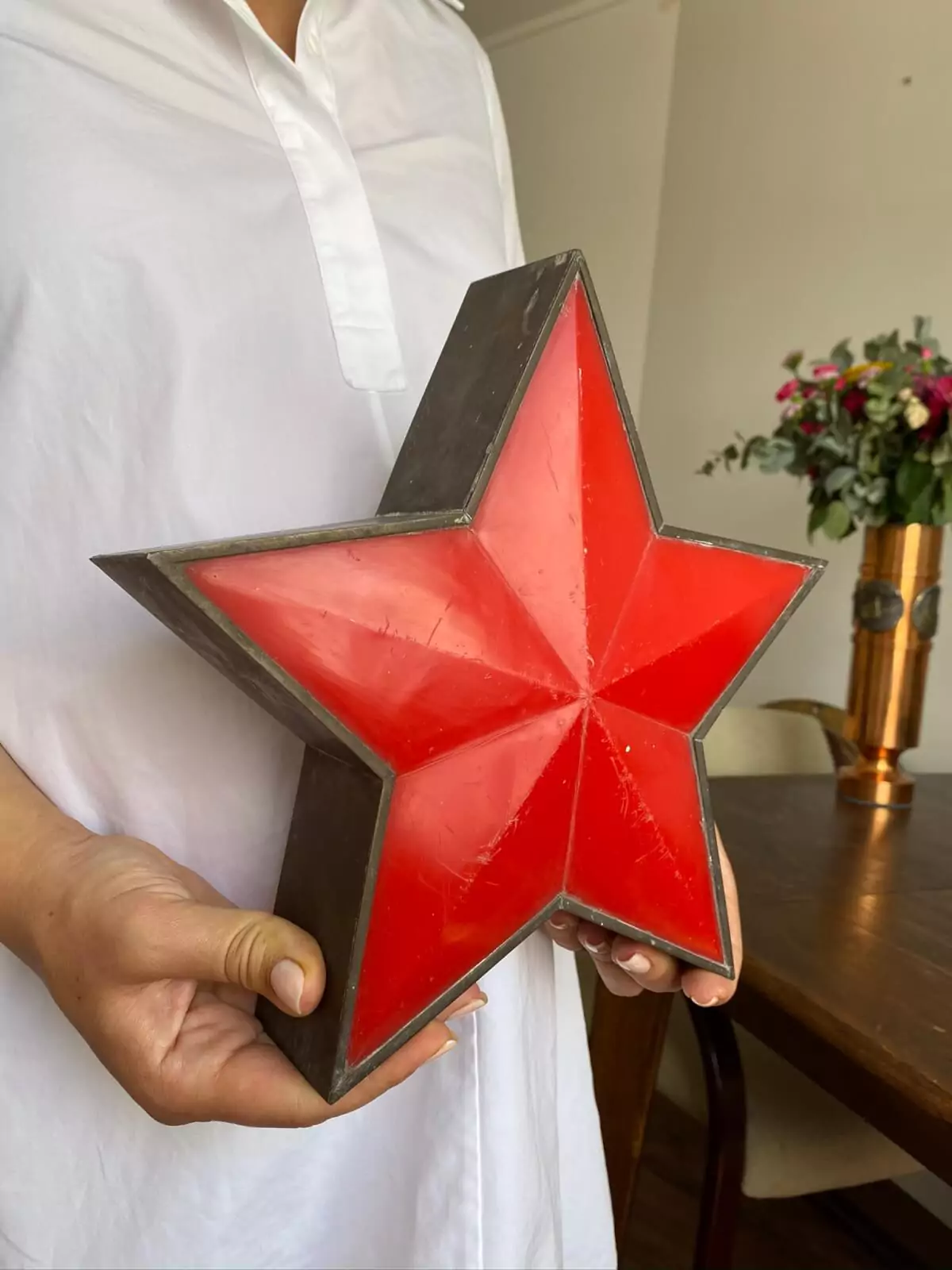
Soviet train star in brass and resin.
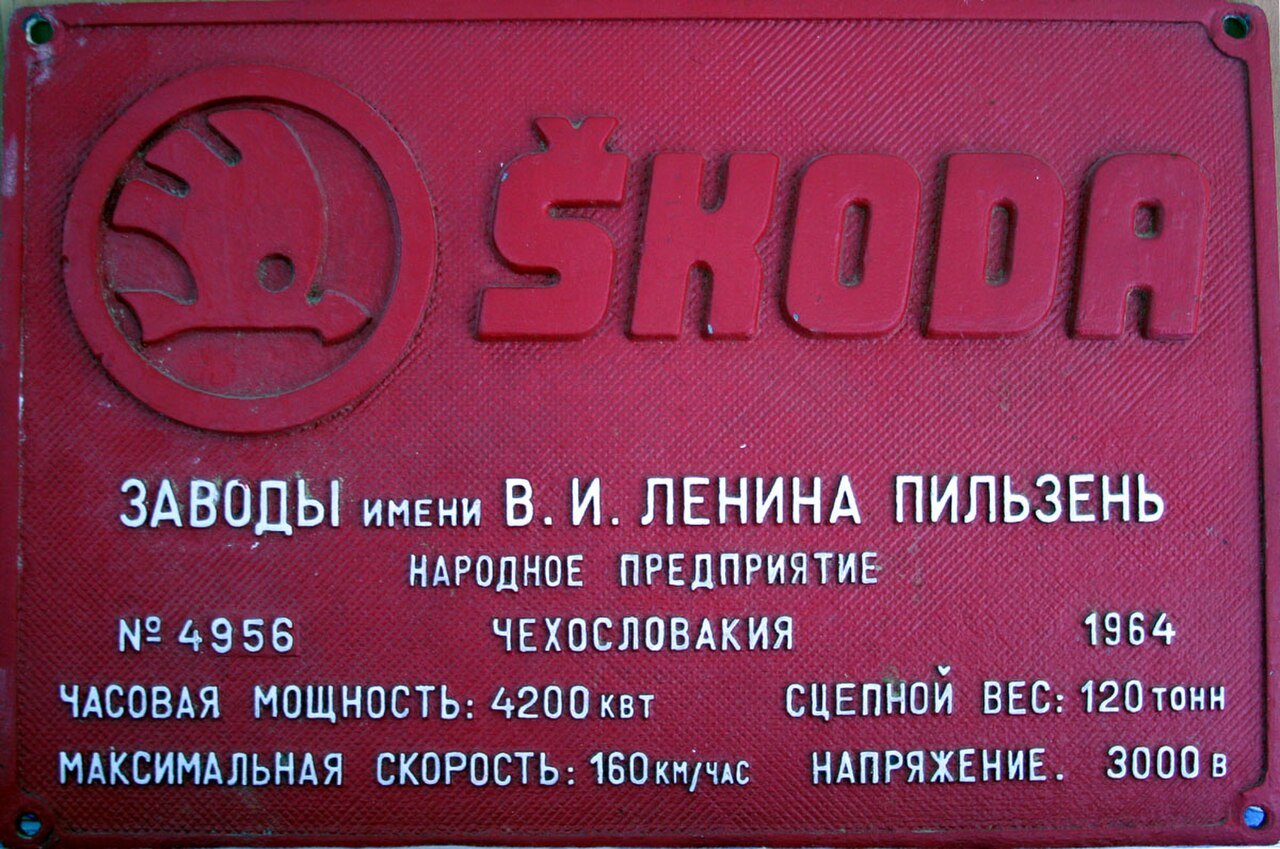
Locomotives also carried their builder’s plate, required by the regulations, with the place and date of construction.
Builder’s plate of a ЧС2 electric locomotive: Škoda, Plzeň, 1964. Photo Zimin.V.G, Wikimedia Commons, CC BY-SA 3.0.
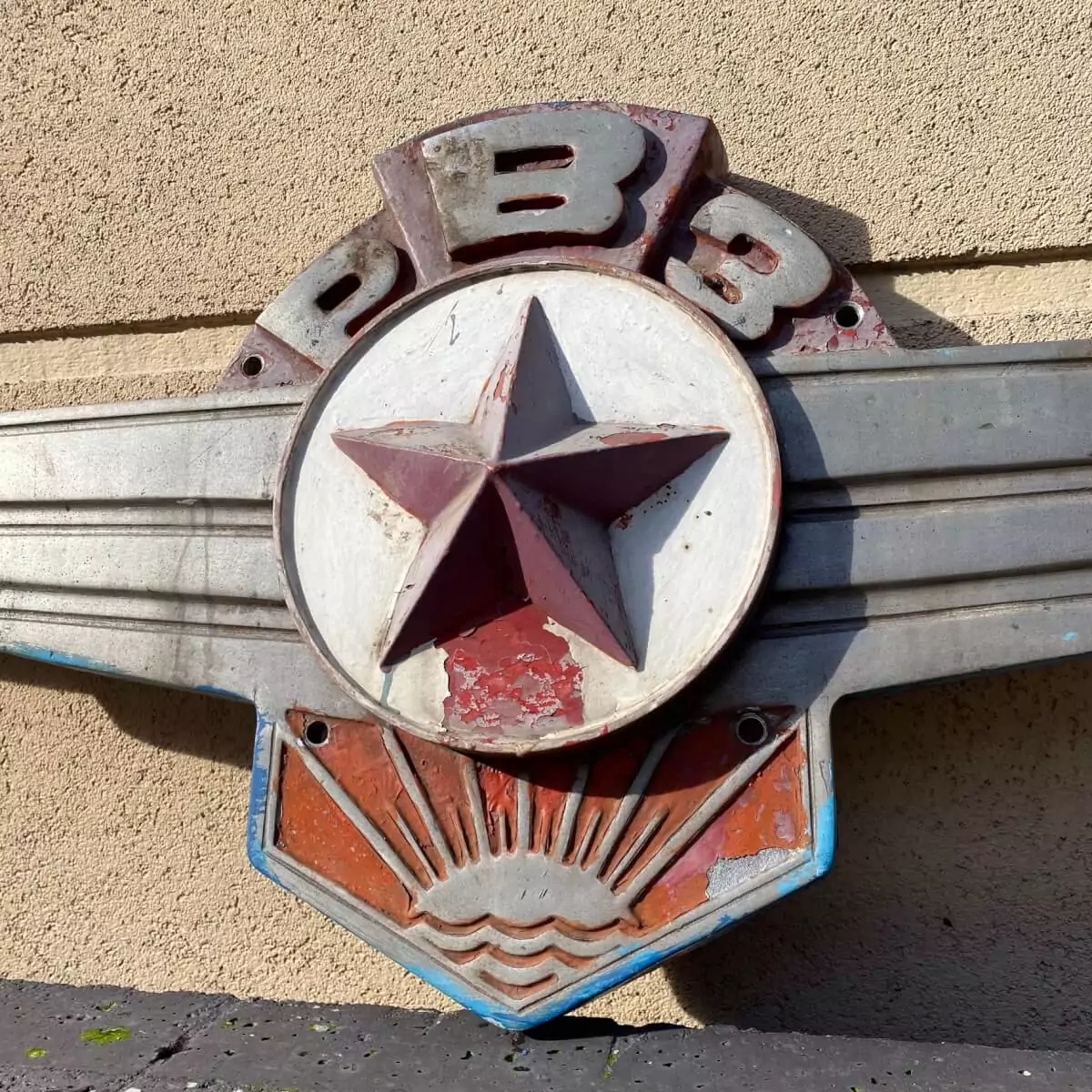
The electric trains built in Riga carried the emblem of their works, РВЗ.
Emblem of the Riga carriage works, РВЗ, 1970s.
Other plaques rewarded an engine. This one reads « Лучшему паровозу депо Люботин »: to the best steam locomotive of the Lyubotin depot.
“To the best steam locomotive of the Lyubotin depot”.
After 1991
Russia, summer 1993: the USSR coat of arms still in place on a coach in service. Photo lelebella, Wikimedia Commons, CC BY 2.0.
The USSR disappeared in December 1991, but the emblems were not removed in a day. In 1993 coaches were still running with the Soviet arms. The Russian regulations later replaced the state coat of arms with the sign of Russian Railways, and coaches received the arms of the Federation in the same position.
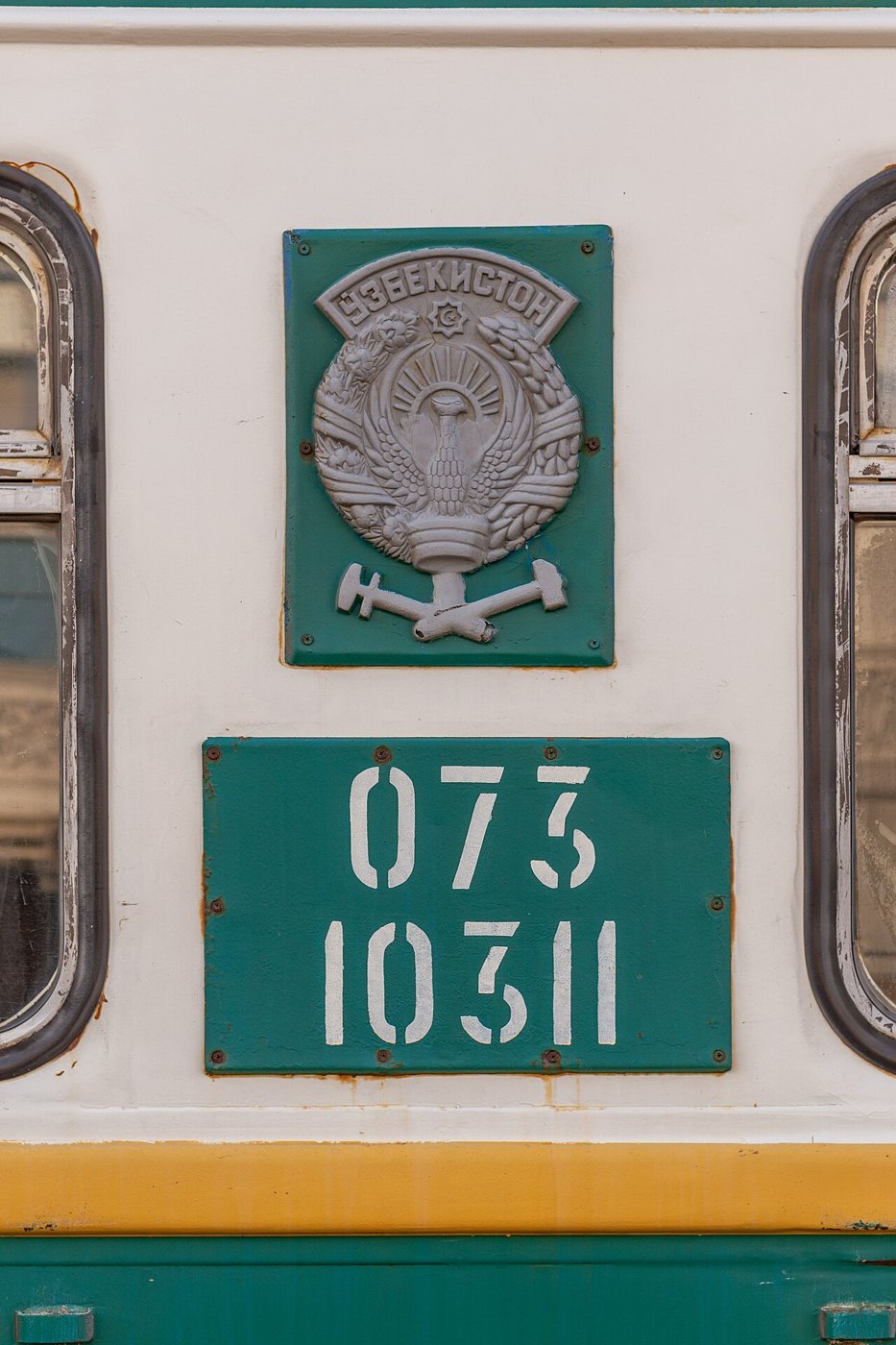
In the other republics the position stayed the same and the emblem changed.
Tashkent, August 2025: the Uzbek emblem, with the hammer and wrench, in place of the Soviet coat of arms. Photo Nikolai Bulykin, Wikimedia Commons, CC BY-SA 4.0.
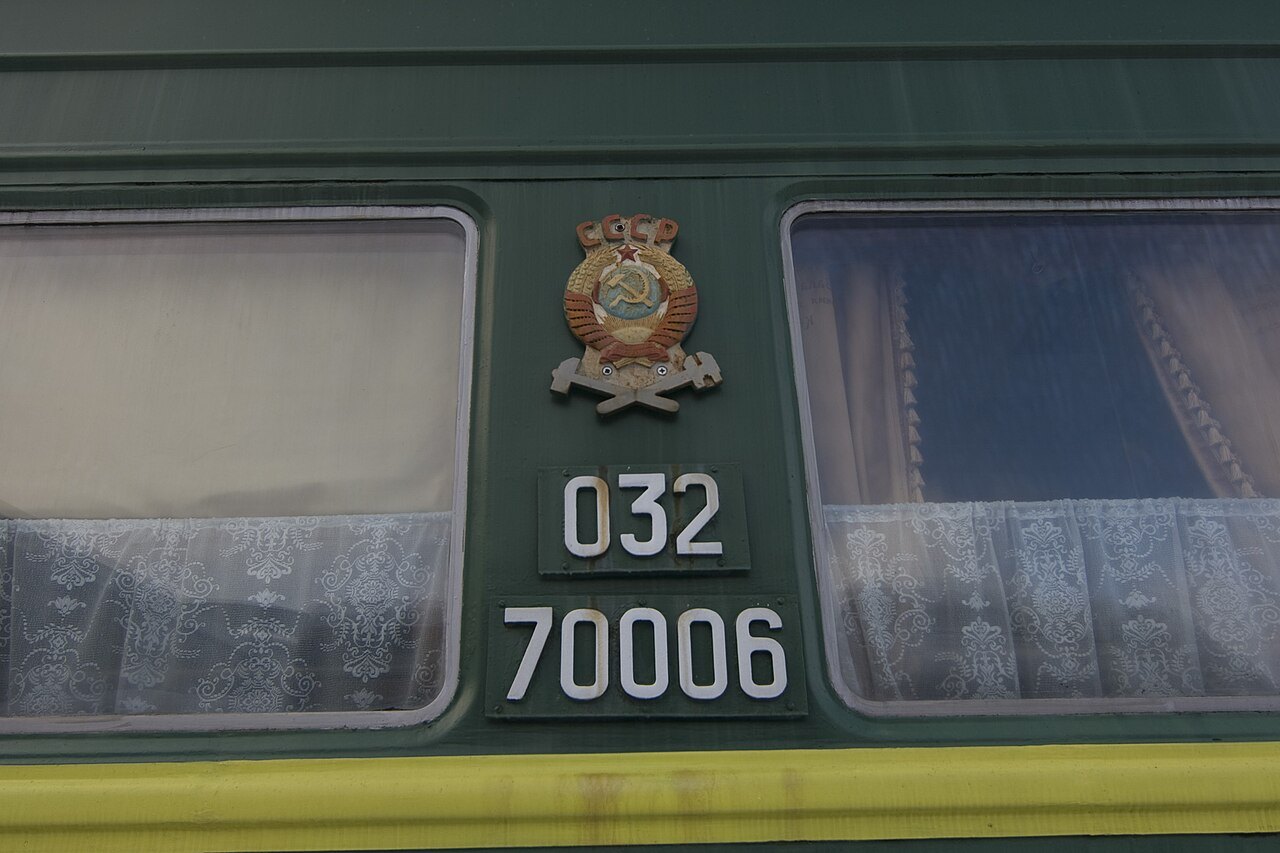
A few coaches kept in museums still carry their original emblem.
Saloon coach 70006 on display in Kyiv, 2013. Photo Maksym Kozlenko, Wikimedia Commons, CC BY-SA 4.0.Stalin’s railway carriage at the Gori museum, Georgia. Photo Adam Jones, Wikimedia Commons, CC BY-SA 2.0.
Available at Soviet in Paris
Each Soviet railway emblem in our shop is photographed individually. Weight and dimensions are given on each product page.
The ДП-5В (DP-5V) is the field radiometer of Soviet civil defence: a green Bakelite console, a probe with a rotating gamma, beta and check-source shield, headphones and a manual that explains operation and maintenance. The one in this article served in an industrial bakery in Chișinău and was serviced in March 1991. Its owner shared his photos and documents with us, and we turned them into a tool that lets you operate it on screen, step by step.
The Moscow Games, from 19 July to 3 August 1980, boycotted by some sixty countries, produced more objects than any Soviet event: a bear cub, Misha, drawn by Viktor Chizhikov, an emblem made of running tracks, five thousand torches, watches from every factory, platinum coins, rings, tea glass holders, posters. This guide tells the story of the Games and reviews the objects, with the marks that authenticate them and the prices.
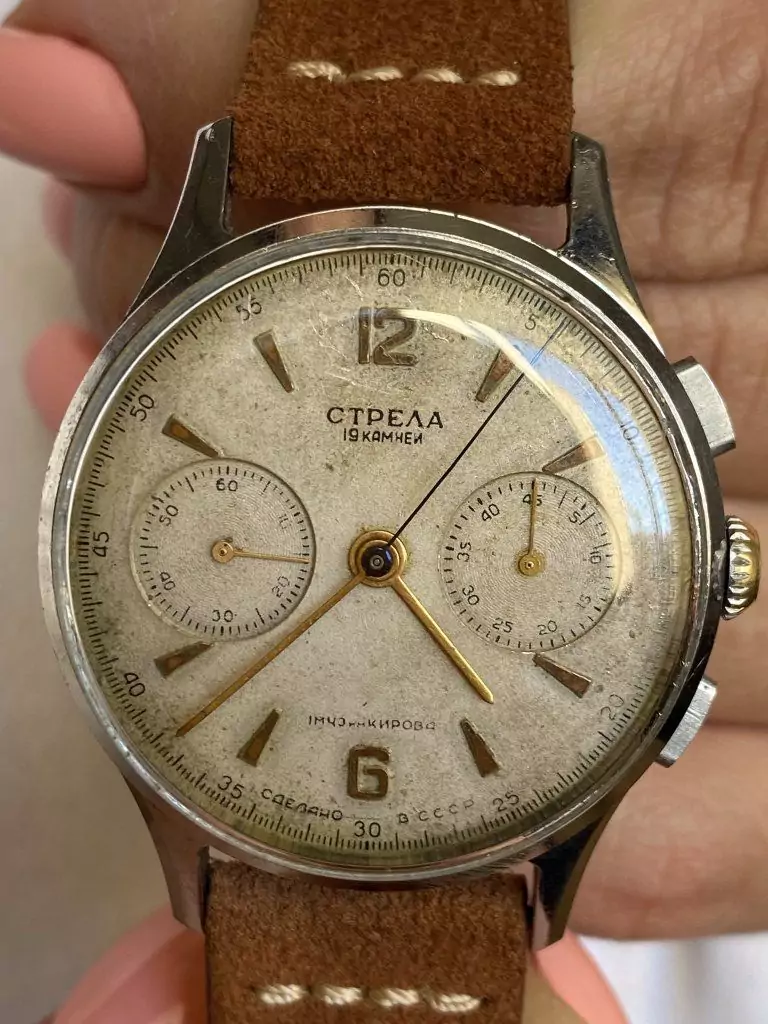
The 3017 chronograph of the First Moscow Watch Factory carries a five-digit number on the balance cock. The most common dating method reads it as a single series, from 1959 to 1979. Four factory passports show there are two, and that the same number can point to two watches made ten years apart. Here is how to read the number, the dial, the logo and the bridge, with a decoder to date your Strela, Poljot or Sekonda.
This website uses cookies to improve your experience while you navigate through the website.
Out of these cookies, the cookies that are categorised as necessary are stored on your browser as they are essential for the working of basic functionalities of the website.
We also use third-party cookies that help us analyse and understand how you use this website.
These cookies will be stored in your browser only with your consent.
You also have the option to opt out of these cookies.
But opting out of some of these cookies may affect your browsing experience.
Necessary cookies are absolutely essential for the website to function properly. This category only includes cookies that ensure basic functionalities and security features of the website. These cookies do not store any personal information.
Cookies that are not strictly necessary for the website to work and that are used specifically to collect personal data through analytics, ads and other embedded content are called non-necessary cookies. User consent is required before these cookies run on the website.
✕
Soviet in Paris
Offline right now. Leave your message and your email, we reply within 24 hours.
Hello 👋 A question about an item, an order or shipping? Write to us.
Your email is used only to reply to you.
Subscribe to our newsletter and get 10% off your first order.
Subscribe
★ New pieces before anyone else
★ New blog articles
★ Soviet in Paris news and updates
Join the Party
10% off your first order
Receive your welcome card and our next arrivals.
Your code appears here and is also sent to you by email. You can leave the Party in one click, at any time.