On 26 April 1986 at 1.23 in the morning, reactor no. 4 of the Lenin power station exploded in the north of Soviet Ukraine. For ten days, the burning graphite released four hundred times the radioactivity of Hiroshima. Six hundred thousand liquidators were called in to put out the fire, build a sarcophagus and clean up the exclusion zone. Forty years later, the objects the USSR left behind, medals, canteen tableware, bolts from the Novarka arch, tell the story of a disaster that is still unfinished.
MAY 2026•9 MINUTE READ
by Marwen Yahyaoui
On 26 April 1986 at 1.23 in the morning, in the Ukrainian night, reactor no. 4 of the Lenin power station at Chernobyl exploded. The blast lifted the reactor’s 1,200 tonne steel lid. Over the ten days that followed, the burning graphite released into the atmosphere the equivalent of four hundred times the Hiroshima bomb in terms of radioactivity.
Forty years on, the thirty kilometre exclusion zone around the power station is still there, and with it tens of thousands of objects that were never taken away. The staff canteen, the medals handed to the liquidators, the bolts of the sarcophagus, the Geiger counters manufactured in response to the accident. These pieces are not aesthetic relics. They are the material traces of an industrial collapse and of a human mobilisation without precedent in peacetime.
The fortieth anniversary of the accident is a good moment to look at a few of them more closely.
One night, one explosion, ten days of fire
The accident itself lasted a few minutes. A badly conducted safety test, the instability of an RBMK reactor that was not designed to run at such low power, an uncontrolled chain reaction. At 1.23 and 40 seconds in the morning, two successive explosions lifted the reactor slab and threw irradiated fuel onto the roof. The graphite fire that followed was more dangerous still than the explosion itself: it burned for ten days and it was this fire that drove radioactive particles to high altitude, where they were carried by the winds as far as Scandinavia, central Europe and France.
The firefighters of Pripyat were the first on the scene. Twenty-eight firefighters and plant workers would die in the following weeks of acute radiation syndrome. The town of Pripyat, fifty thousand inhabitants a kilometre and a half from the power station, was not evacuated until thirty-six hours after the explosion. The buses only arrived on the morning of 27 April.
The USSR would wait eighteen days, and a televised appearance by Mikhail Gorbachev, before publicly acknowledging the scale of the disaster.
Six hundred thousand liquidators
The word “liquidator” is a Soviet invention. It refers to the men and women sent to the site to clean, bury, concrete over and dismantle. Firefighters, engineer corps soldiers, engineers, miners, scientists, excavator drivers, helicopter pilots. Their total number is estimated at six hundred thousand people between 1986 and 1990, mobilised in successive waves on short tours to limit the dose received.
Most came from far away. Conscripts from the Caucasus and Central Asia, reservists called up without notice, engineers seconded from Leningrad or Chelyabinsk. The most exposed were the “bio-robots” sent onto the reactor roof to shovel by hand the pieces of fuel thrown out by the explosion, in places where remote-controlled robots had their electronics burned out by the radiation within minutes. In April 2004, a commemorative text from the Ukrainian embassy in Belgium reported more than twenty-five thousand deaths among these veterans since 1986.
The liquidator medal, struck then interrupted
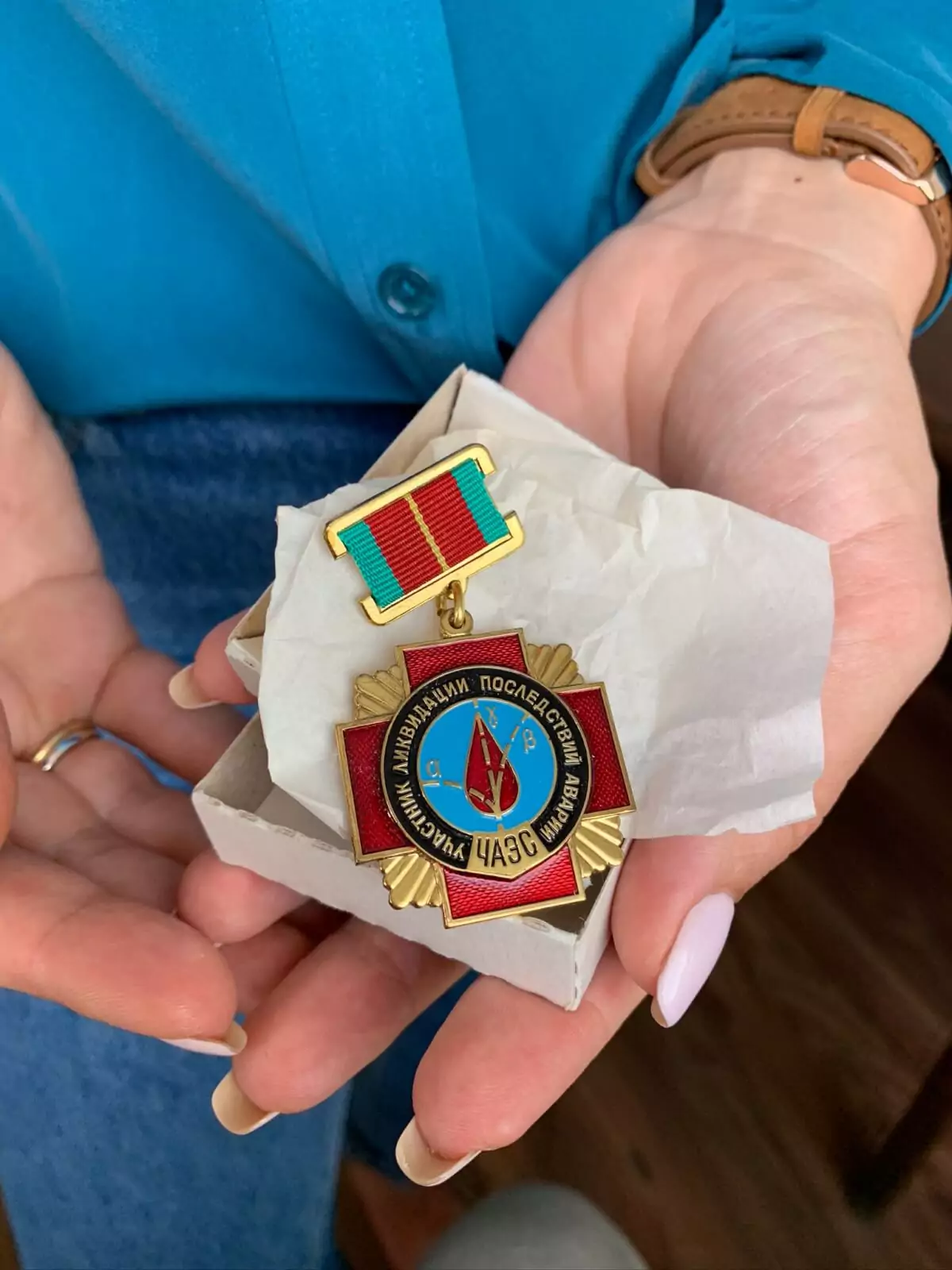
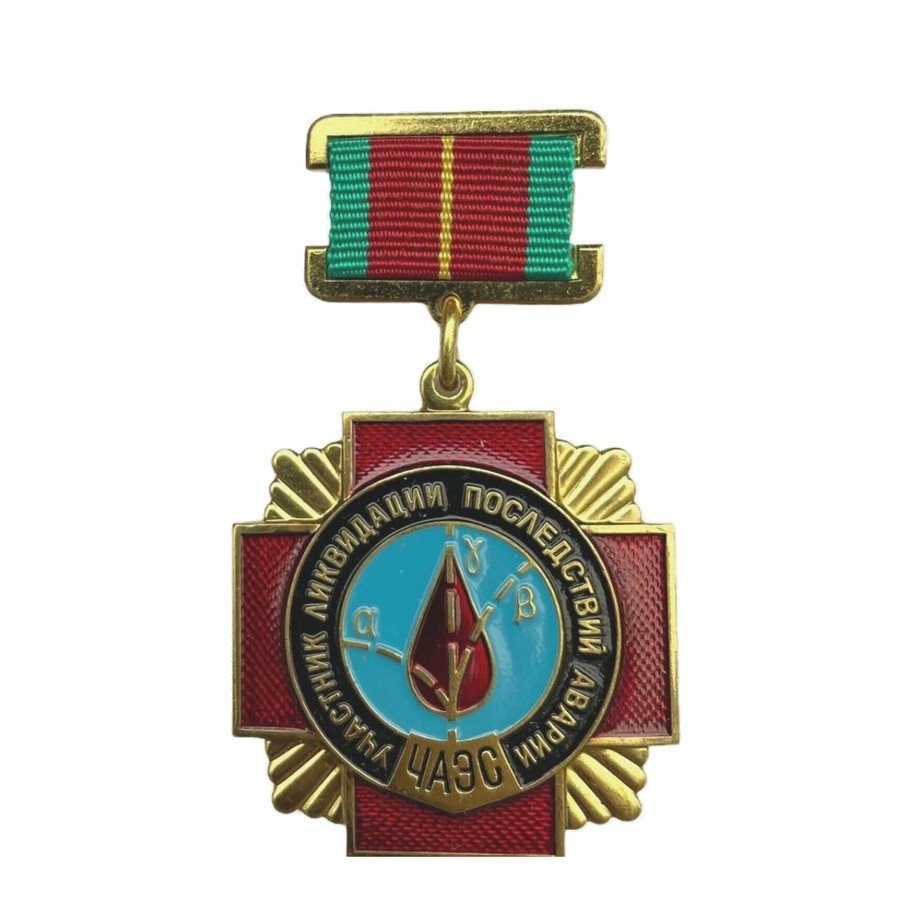
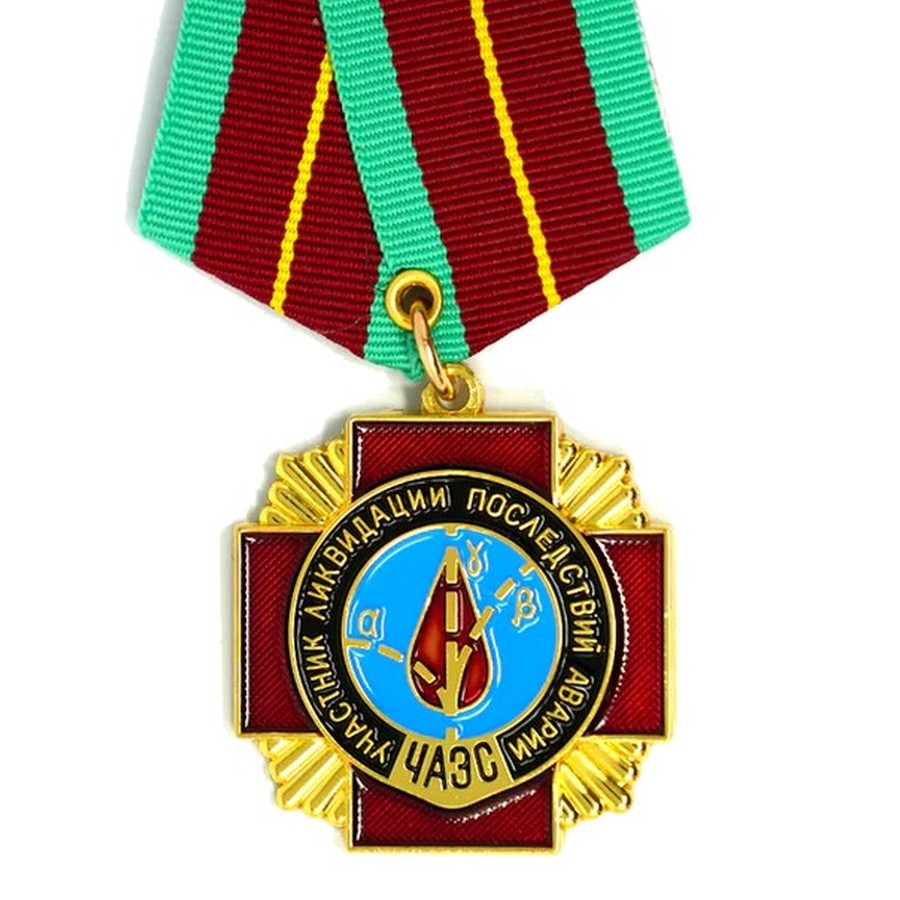
The liquidator medal was created by decree no. 1/1-П of 20 March 1987 of the Presidium of the Supreme Soviet of the USSR, almost a year to the day after the accident. It is made of enamelled brass. On the reverse, the inscription УЧАСТНИКУ ЛИКВИДАЦИИ ПОСЛЕДСТВИЙ АВАРИИ ЧАЭС (To the participant in the liquidation of the consequences of the accident at the Chernobyl nuclear power station) surrounds a cyan blue disc 1.8 centimetres in diameter. At the centre, a drop of blood topped by the trajectories of alpha, beta and gamma particles, an explicit allusion to Rutherford’s well-known experiment on the deflection of radiation. The drop stands for the health consequences of irradiation on the liquidators’ bodies. The medal is worn on a red ribbon edged with turquoise green, with two thin yellow bands.
A detail that is rarely noted: the trajectories engraved on the medal contain a physical error. The alpha particle is shown as being deflected more than the beta particle, whereas in reality it is the other way round, the beta being deflected almost twenty-four times more in the same magnetic field. A study published in 2019 in the journal J (McIntire and Luczaj, University of Wisconsin-Green Bay) suggests that the artist probably swapped the two particles, influenced by textbook diagrams that exaggerate the deflection of the alpha for teaching purposes. The detail was never corrected and now appears on tens of thousands of examples.
Original examples reached the liquidator in a small beige cardboard box, held in place by a sheet of oiled paper that protected the enamel. The presence of this packaging is one of the clues, among others such as the quality of the enamel and the striking of the reverse, that helps identify an awarded medal of the USSR period.
Distribution of the medal was disrupted by the fall of the USSR in December 1991. The central award system collapsed with it, and a number of liquidators never received the medal their status entitled them to. Independent Ukraine subsequently struck its own commemorative decorations, but the pace slowed considerably. Some of the awarded medals circulate today on the collectors’ market, mainly through sellers based in Ukraine, without it always being possible to trace their path between the period striking and their arrival on the market.
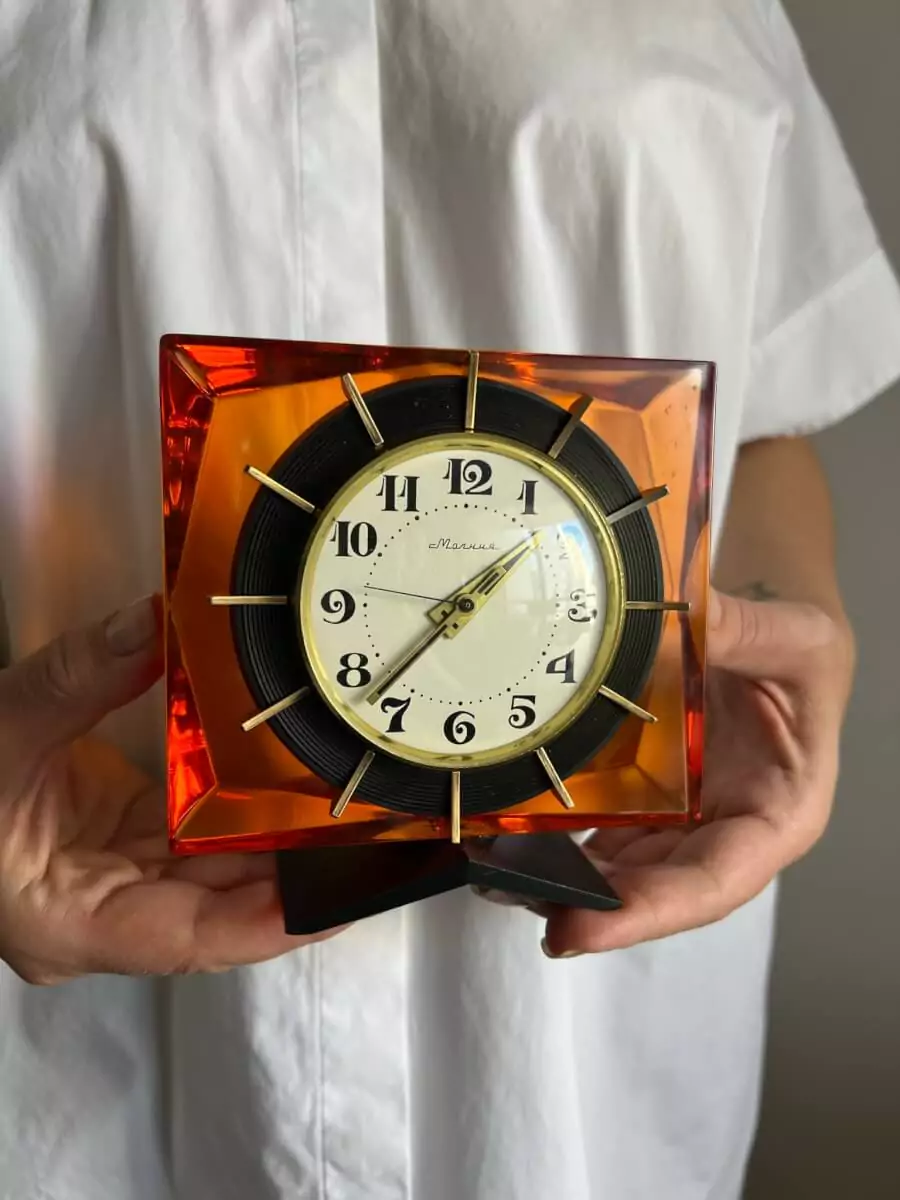
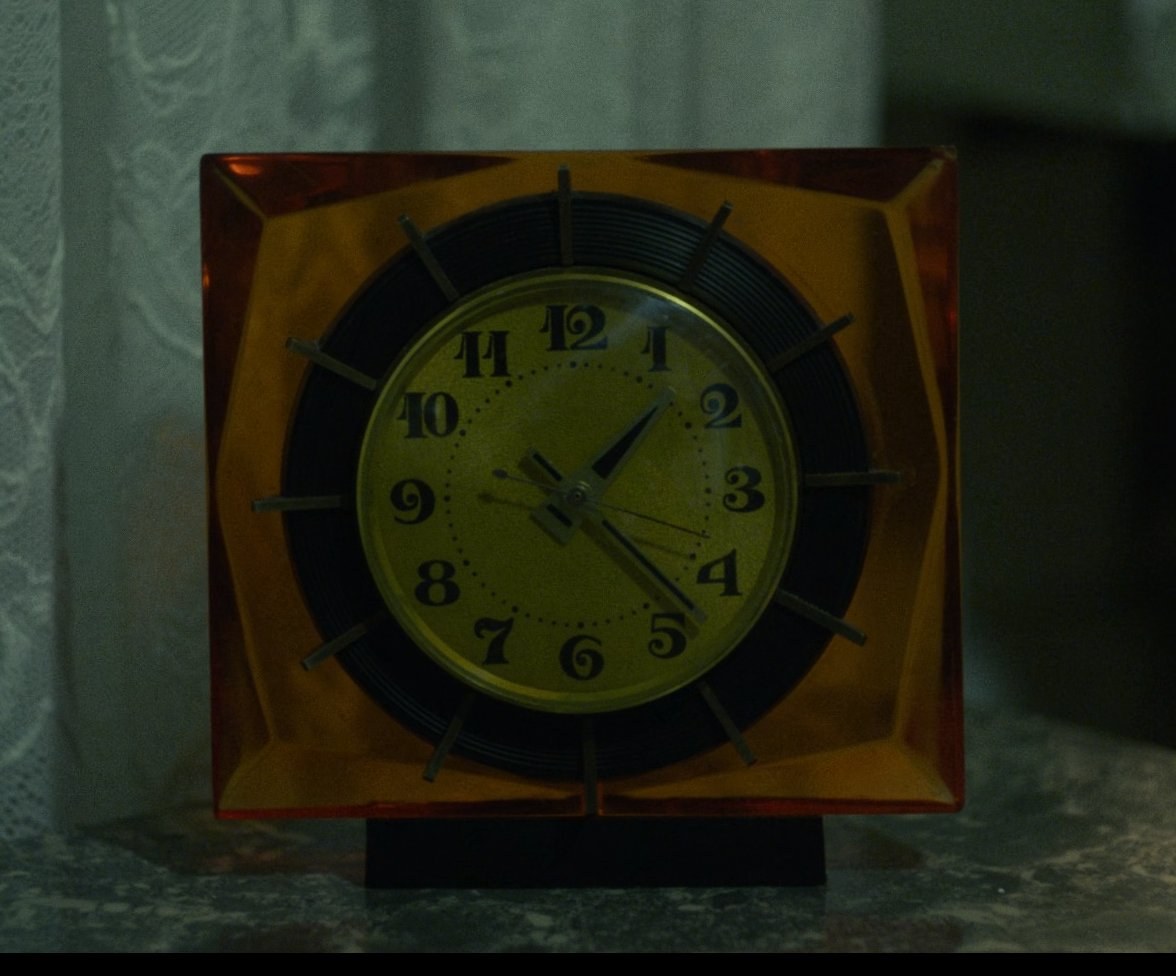
The series Chernobyl, broadcast by HBO in 2019, helped revive interest in the objects of the disaster beyond the circle of militaria collectors. The documentary care taken over the set design brought several modest Soviet pieces into popular culture. The desk clock from the Molnija factory (Челябинск), for example, appears several times in the series. A mechanical model wound daily, square amber plexiglass case measuring 13 by 13 centimetres, six hundred grams: it was found in the 1970s and 1980s in the homes and offices of Soviet engineers and managers, often as a work gift, and it is likely that some of the power station’s engineers owned one at home in Pripyat. An iconic detail of the series, the clock appears stopped at 1.23:45, the exact time at which reactor no. 4 exploded. The version made for the Soviet domestic market, signed Молния on the dial, is rarer today than the export version with an English dial.
OriginalCopy
Drag the slider to compare. The most visible difference is the size of the ribbon: a small horizontal rectangle on the original award, a wide triangular V on the copy. Note also the more pronounced shine of the metal and the thickness of the lines on the copy.
Over the past few years, poor quality copies have appeared, mainly on Chinese sales platforms such as AliExpress and then on eBay. Rough striking, badly fired enamel, modern polyester ribbon, cardboard box with no oiled paper. These copies are recognised immediately once you have held a period piece in your hand. Their existence says a great deal about the current state of the market: demand for Chernobyl objects, driven by the 2019 HBO series and then by the renewed visibility of Ukraine from 2022, far exceeds the supply of period pieces still available.
From the concrete sarcophagus to the metal tomb
In the weeks that followed the explosion, the authorities decided to cover the gutted reactor. The project, carried out in haste, mobilised ninety thousand men and poured two hundred and fifty thousand cubic metres of concrete around block no. 4. The result, named the sarcophagus, was delivered in November 1986. It was designed to last thirty years.
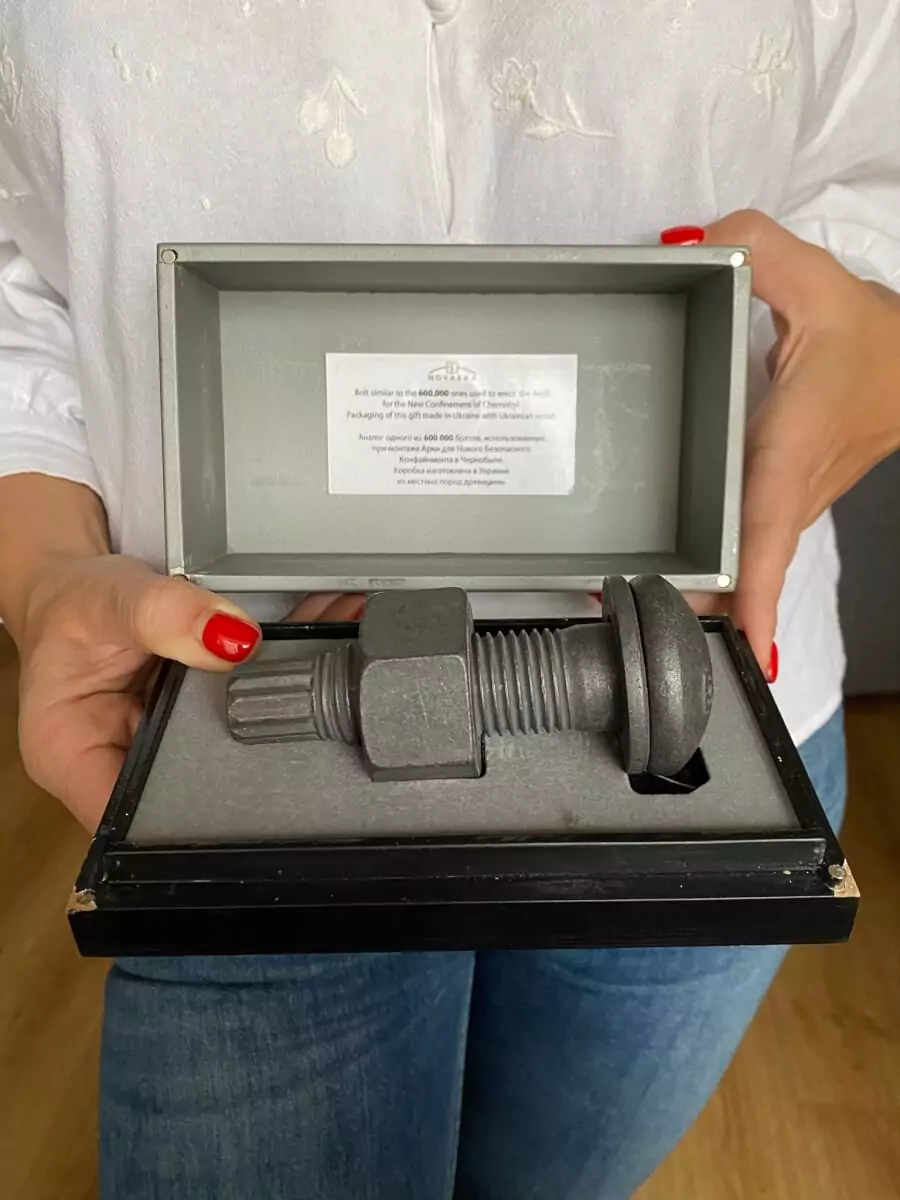
Thirty years later, in 2016, this sarcophagus was covered by a giant metal arch, the New Safe Confinement, built by Novarka, the French consortium Vinci-Bouygues that led its construction. One hundred and eight metres high, two hundred and fifty-seven metres in span, thirty-six thousand tonnes of stainless steel. The largest mobile structure ever built by human hands. It was assembled three hundred metres from the reactor, then slid along rails until it covered the gutted building, in November 2016. Its stated service life is one hundred years.
The bolts that hold the Novarka framework together carry a specific marking. A few, set aside during the works, survived the change of ownership at the time of the Russian invasion of 2022 and the brief occupation of the site by Russian forces. These bolts, heavy, more than two hundred grams each, are among the rare material pieces of a site that will outlast most nations.
Ordinary life at the power station, before and during
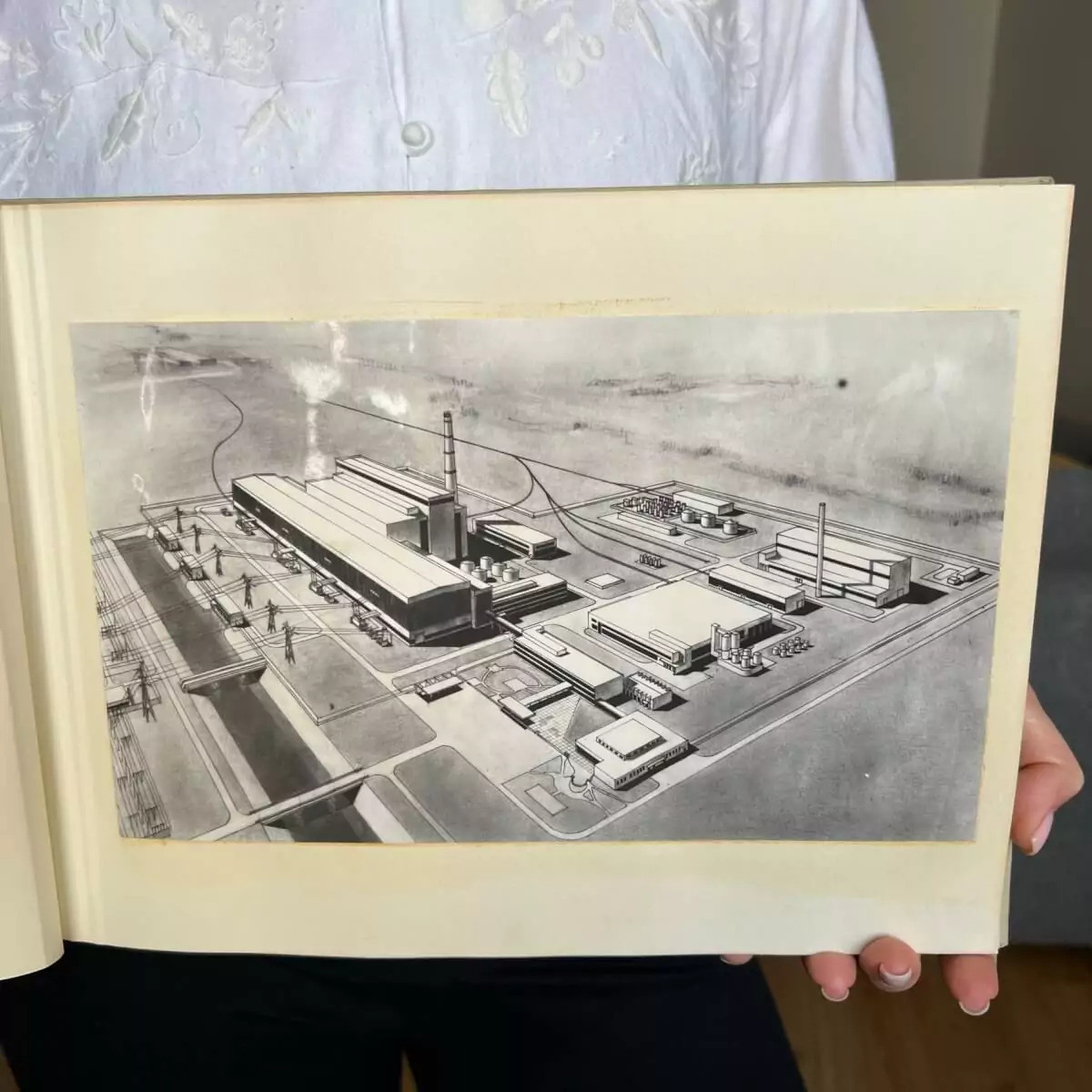
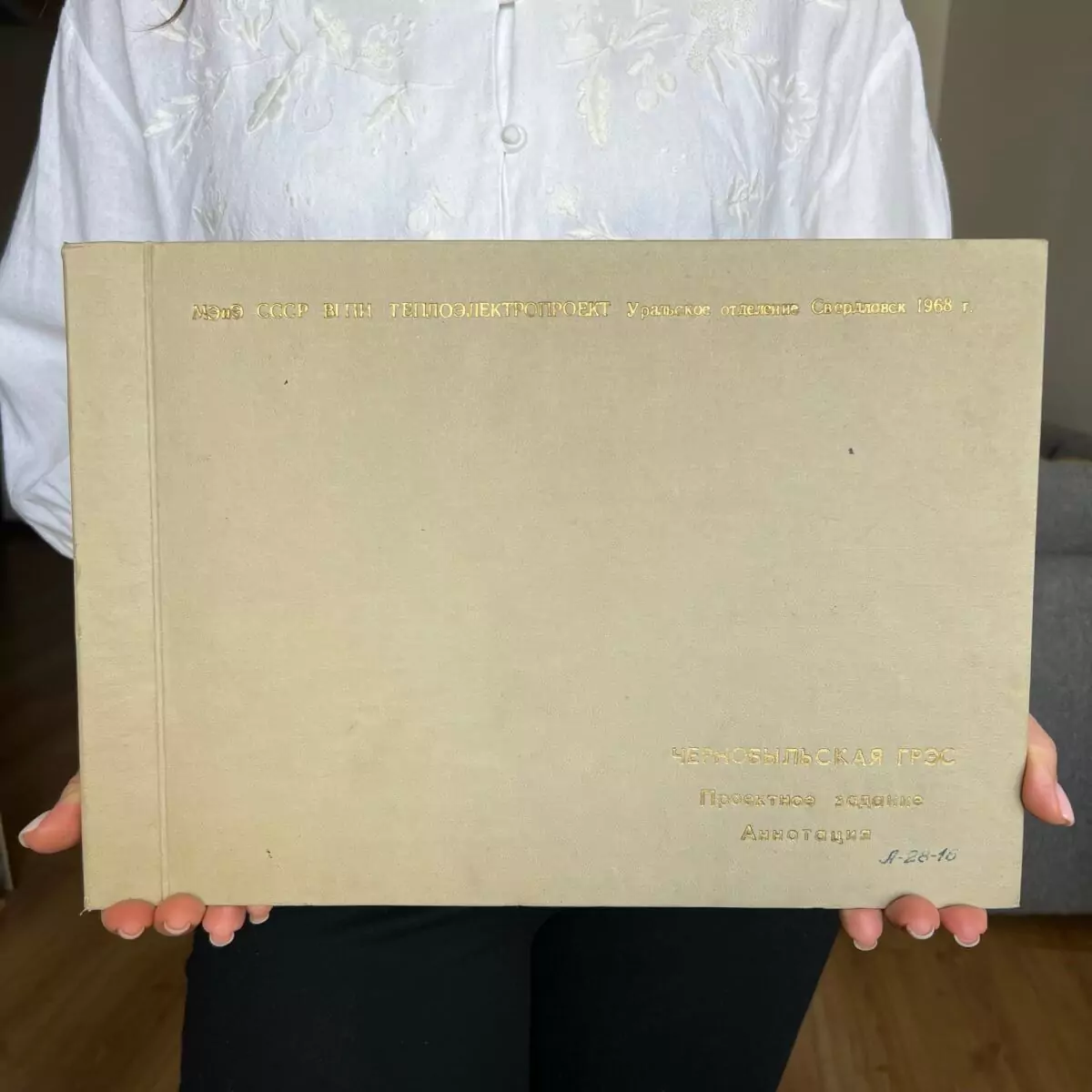
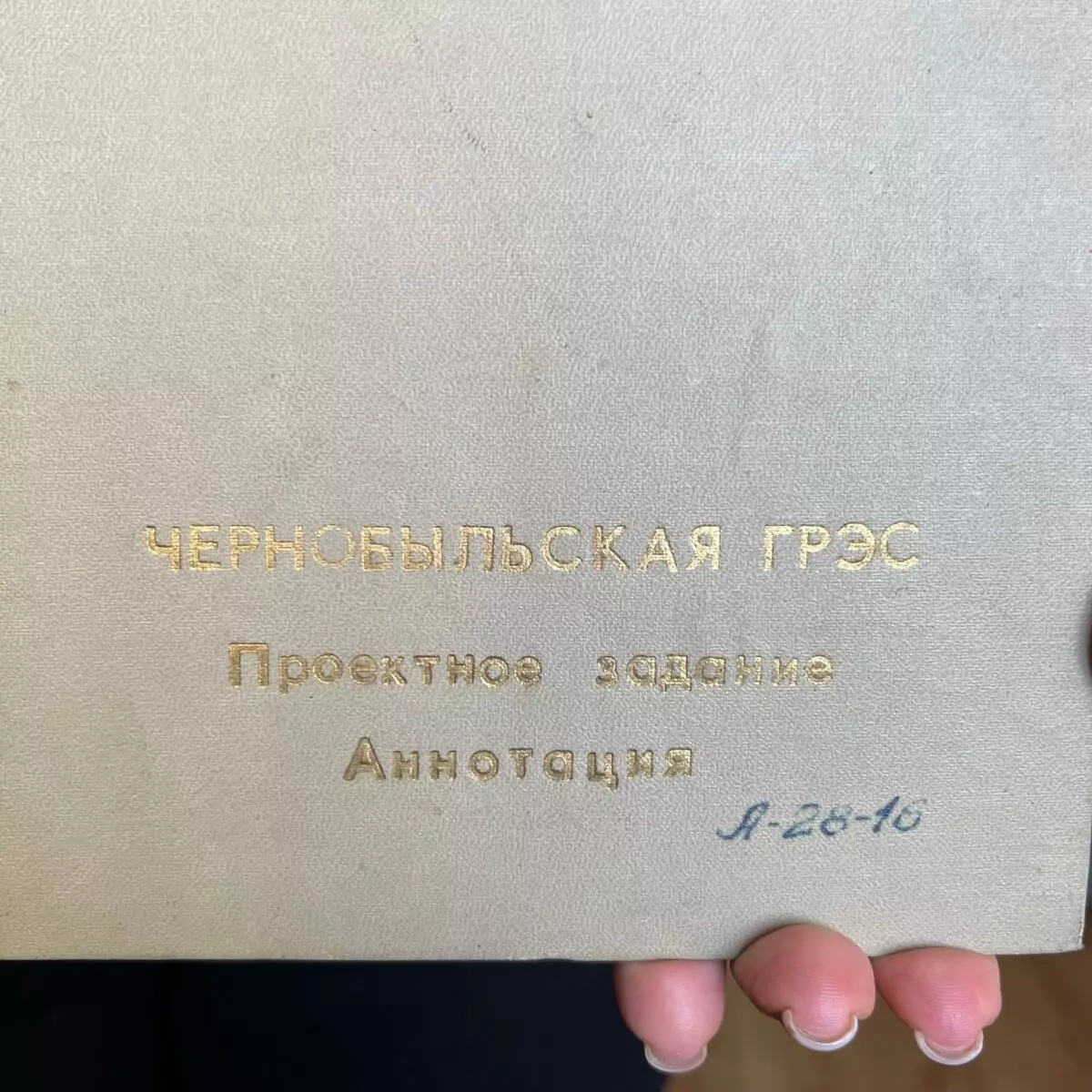
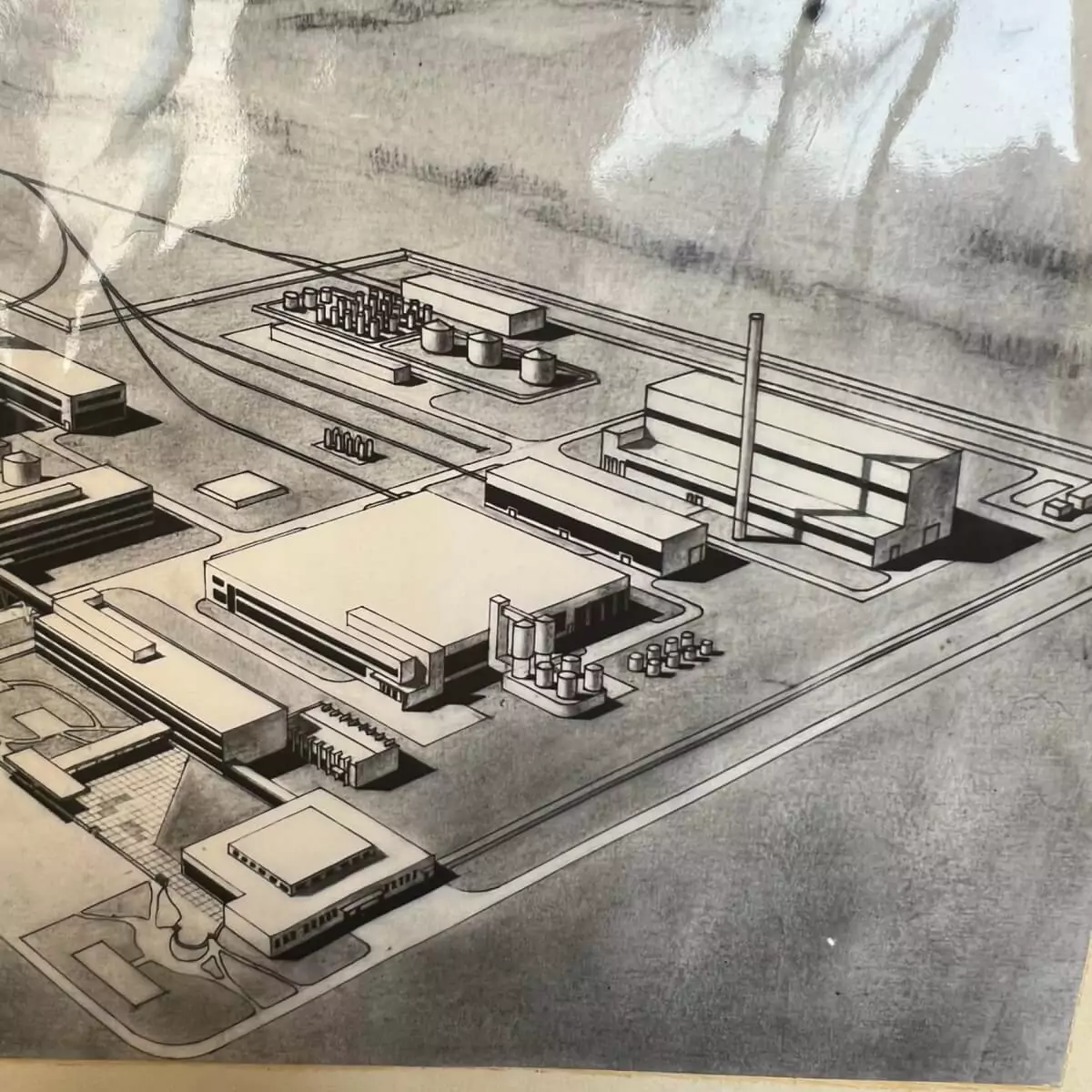
The power station project goes back to 1968, eighteen years before the accident. That year, a presentation portfolio was printed and signed at Sverdlovsk by the director of the city’s research department, the chief engineer and the project’s chief engineer, then sent to Ukraine for approval by the political bureau of the Ukrainian branch of the communist party. Thirteen photographs, ten pages of text, format 37 by 26 centimetres. A document classified secret, in which the word “nuclear” is never used, although the transport of uranium-bearing material appears explicitly. One example of this portfolio passed through our catalogue a few years ago; to our knowledge it is the only example recorded to date in a collector’s hands.
Before 1986, the Lenin power station was a Soviet source of pride. Four reactors in service, two more under construction, close to five thousand employees on site. A model town, Pripyat, created from nothing to house them, with its nurseries, its gymnasiums, its Universam department store, and its staff canteen serving up to two thousand meals a day.
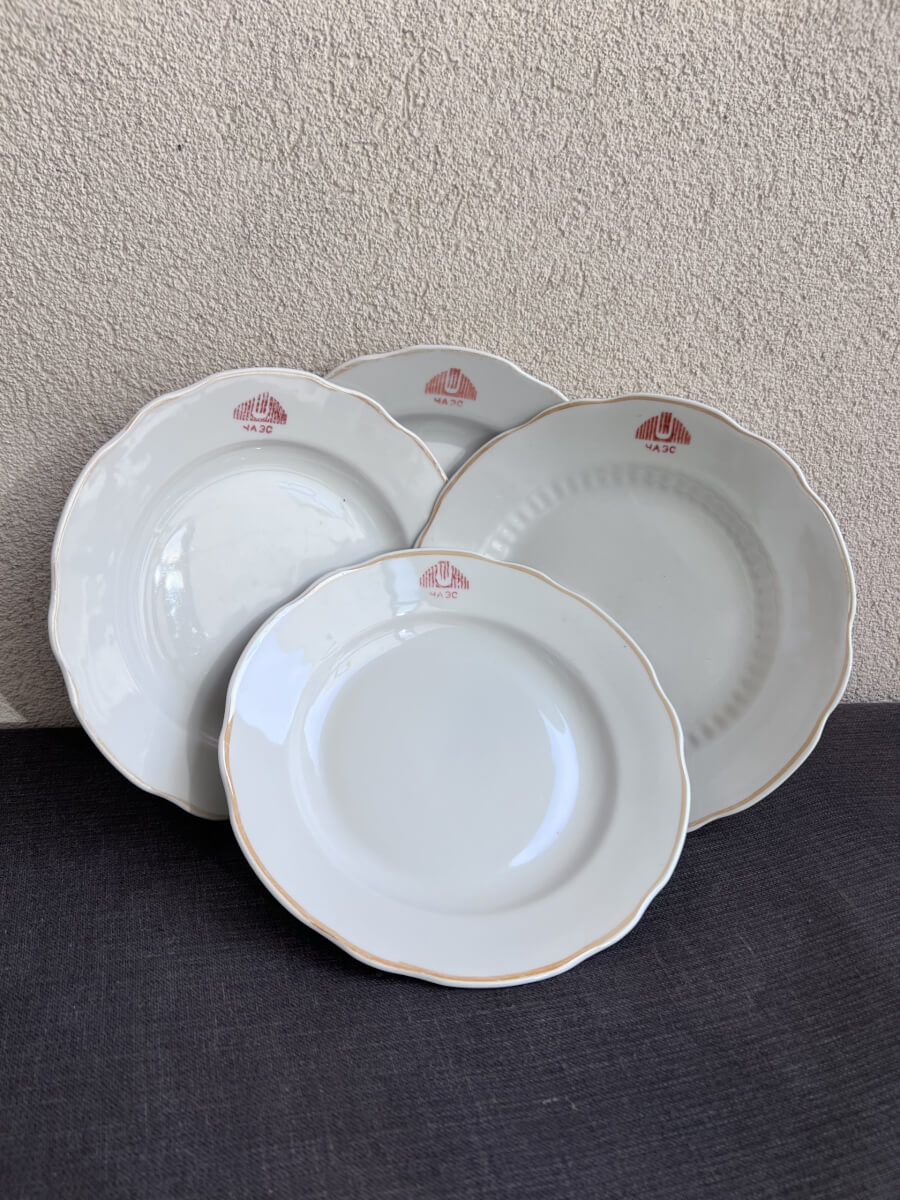
The tableware from that canteen is one of the quietest and most moving traces of the disaster. Soviet porcelain plates, marked with a green ЧАЭС РК stamp (ЧАЭС = Chernobyl Atomnaya Elektrostantsiya, Chernobyl nuclear power station, РК = staff canteen). Smoked crystal tea glasses. All of it stayed in use, in the power station’s administrative buildings, which remained in operation after the accident for the maintenance of the sarcophagus. The three other reactors, for their part, ran until 1991, 1996 and 2000.
These objects are not relics of the accident. They are witnesses to the ordinary life that carried on around it, in a zone where the water of the fountain on Pripyat’s central square today shows doses a hundred times higher than natural background radioactivity.
The ДП-5В (DP-5V) is the field radiometer of Soviet civil defence: a green Bakelite console, a probe with a rotating gamma, beta and check-source shield, headphones and a manual that explains operation and maintenance. The one in this article served in an industrial bakery in Chișinău and was serviced in March 1991. Its owner shared his photos and documents with us, and we turned them into a tool that lets you operate it on screen, step by step.
The Moscow Games, from 19 July to 3 August 1980, boycotted by some sixty countries, produced more objects than any Soviet event: a bear cub, Misha, drawn by Viktor Chizhikov, an emblem made of running tracks, five thousand torches, watches from every factory, platinum coins, rings, tea glass holders, posters. This guide tells the story of the Games and reviews the objects, with the marks that authenticate them and the prices.
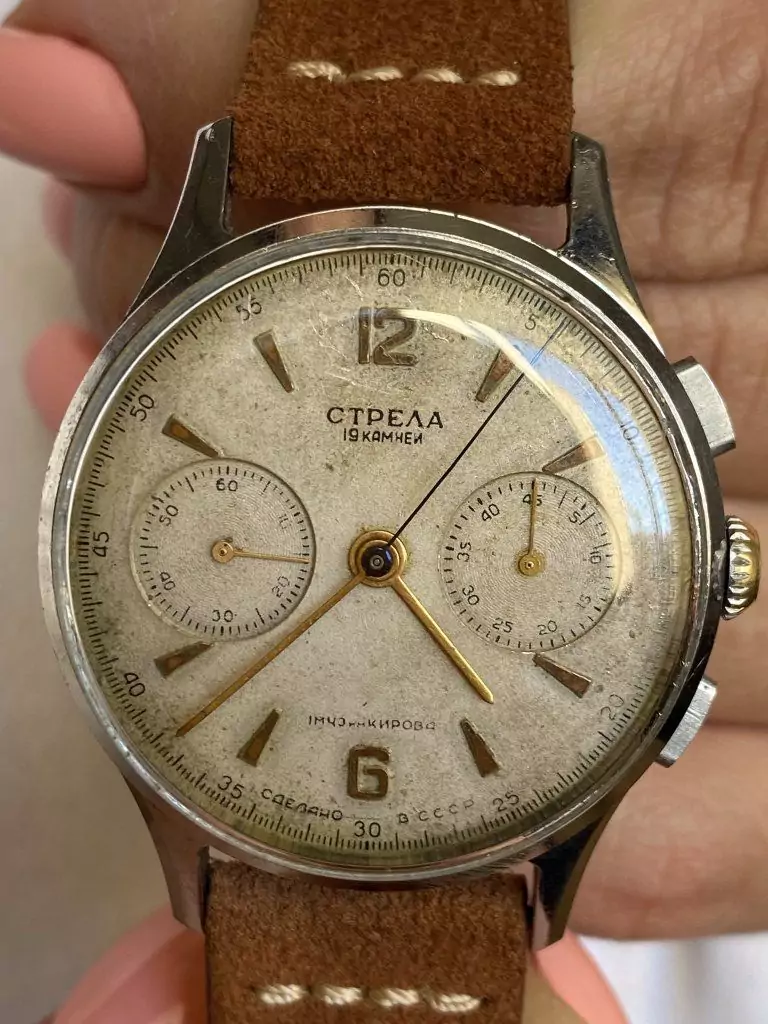
The 3017 chronograph of the First Moscow Watch Factory carries a five-digit number on the balance cock. The most common dating method reads it as a single series, from 1959 to 1979. Four factory passports show there are two, and that the same number can point to two watches made ten years apart. Here is how to read the number, the dial, the logo and the bridge, with a decoder to date your Strela, Poljot or Sekonda.
This website uses cookies to improve your experience while you navigate through the website.
Out of these cookies, the cookies that are categorised as necessary are stored on your browser as they are essential for the working of basic functionalities of the website.
We also use third-party cookies that help us analyse and understand how you use this website.
These cookies will be stored in your browser only with your consent.
You also have the option to opt out of these cookies.
But opting out of some of these cookies may affect your browsing experience.
Necessary cookies are absolutely essential for the website to function properly. This category only includes cookies that ensure basic functionalities and security features of the website. These cookies do not store any personal information.
Cookies that are not strictly necessary for the website to work and that are used specifically to collect personal data through analytics, ads and other embedded content are called non-necessary cookies. User consent is required before these cookies run on the website.
✕
Soviet in Paris
Offline right now. Leave your message and your email, we reply within 24 hours.
Hello 👋 A question about an item, an order or shipping? Write to us.
Your email is used only to reply to you.
Subscribe to our newsletter and get 10% off your first order.
Subscribe
★ New pieces before anyone else
★ New blog articles
★ Soviet in Paris news and updates
Join the Party
10% off your first order
Receive your welcome card and our next arrivals.
Your code appears here and is also sent to you by email. You can leave the Party in one click, at any time.