Turn a Soviet plate over: under the foot ring you find a letter, a circle, sometimes a rooster or a teapot, a number, the words 1 с. These backstamps tell you which factory made the piece, roughly when, which quality grade it received, and whether it was meant for export. This guide reads them on pieces that passed through Soviet in Paris, from Korosten to Leningrad, with the dates published by museums, and shows what separates a Soviet-era piece from one made after the USSR.
OCTOBER 2026•15 MINUTE READ
by Marwen Yahyaoui
Cosmonauts plate.
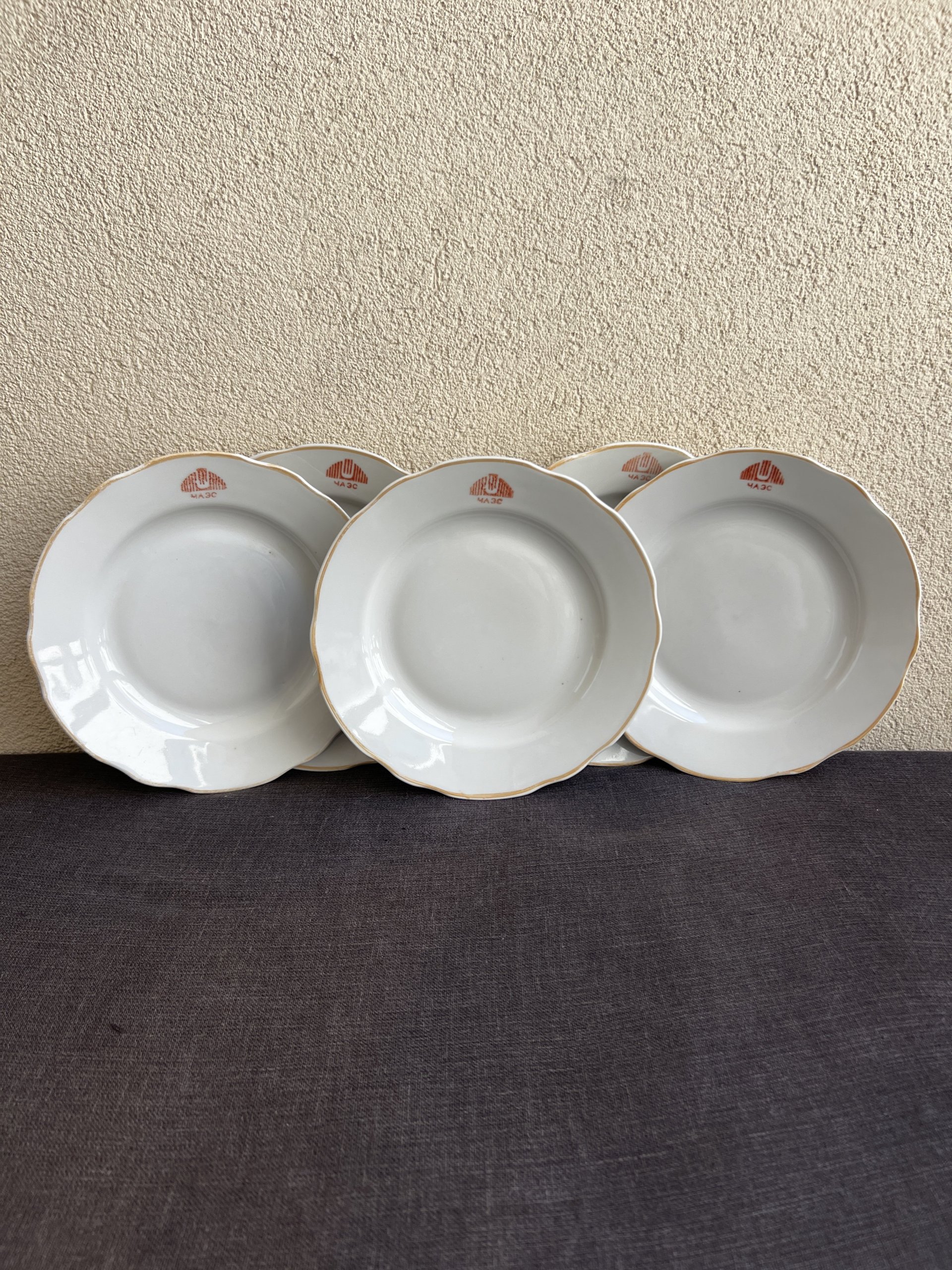
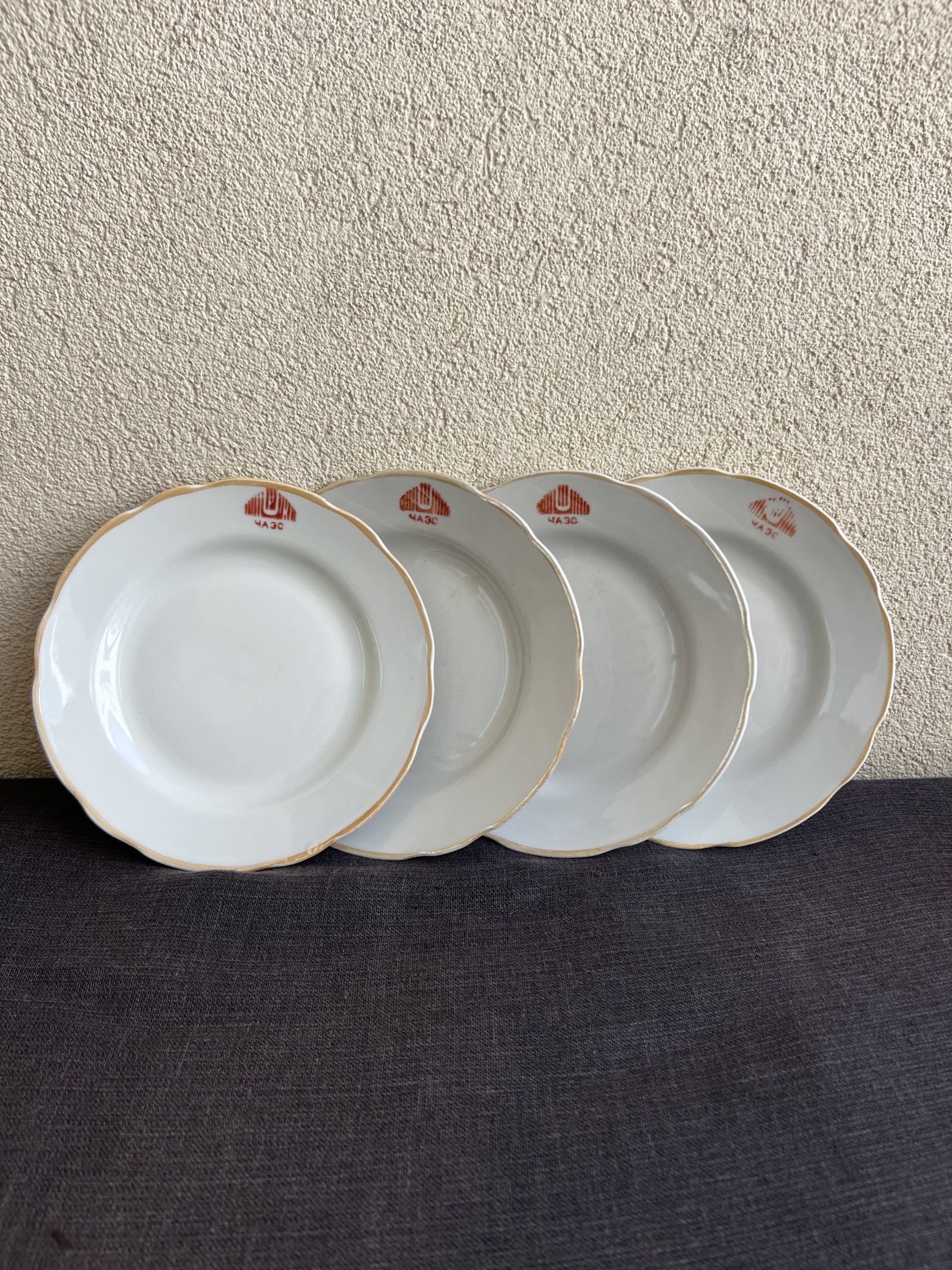
Plates from the Chernobyl power plant canteen, Korosten factory.
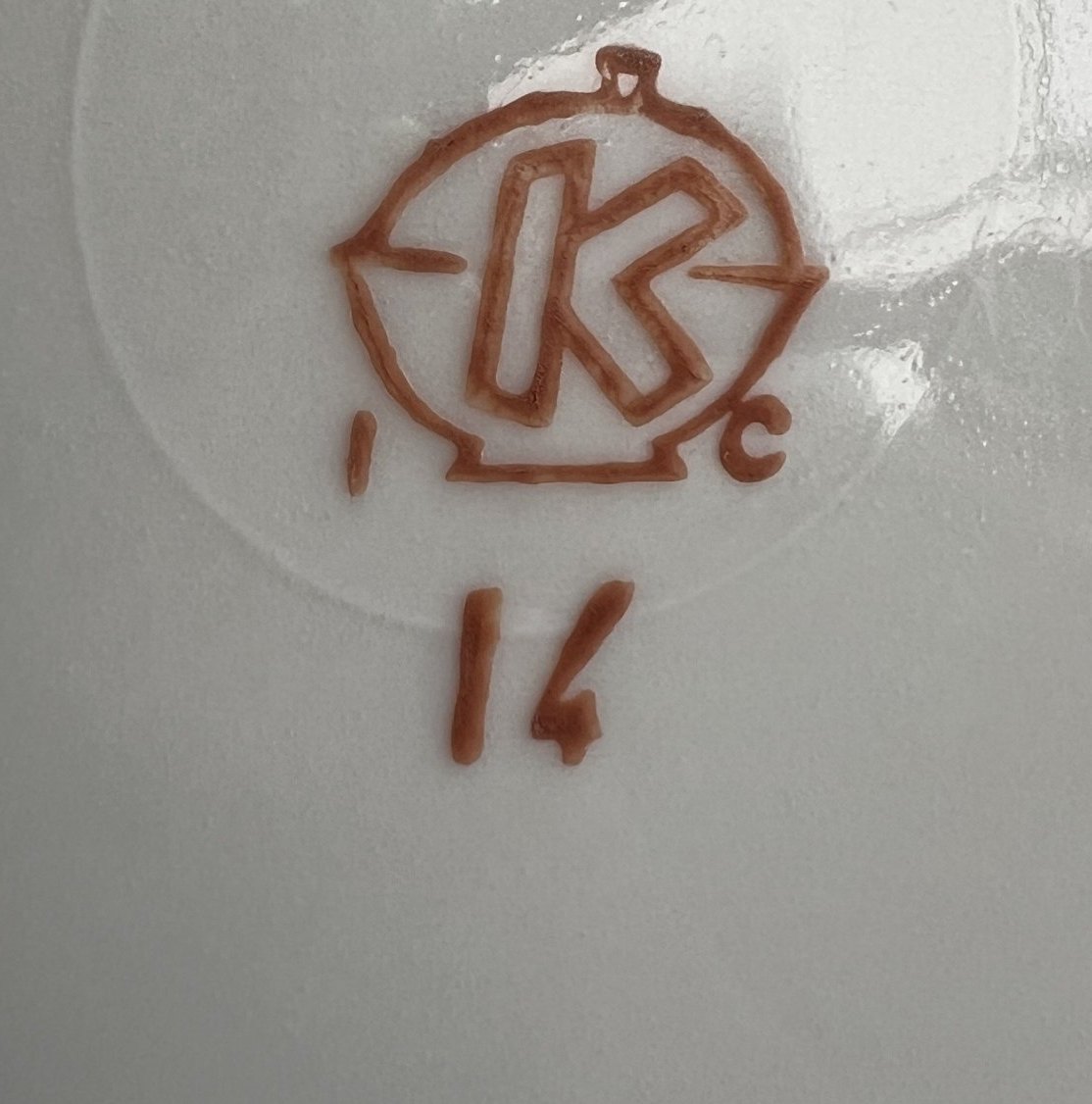
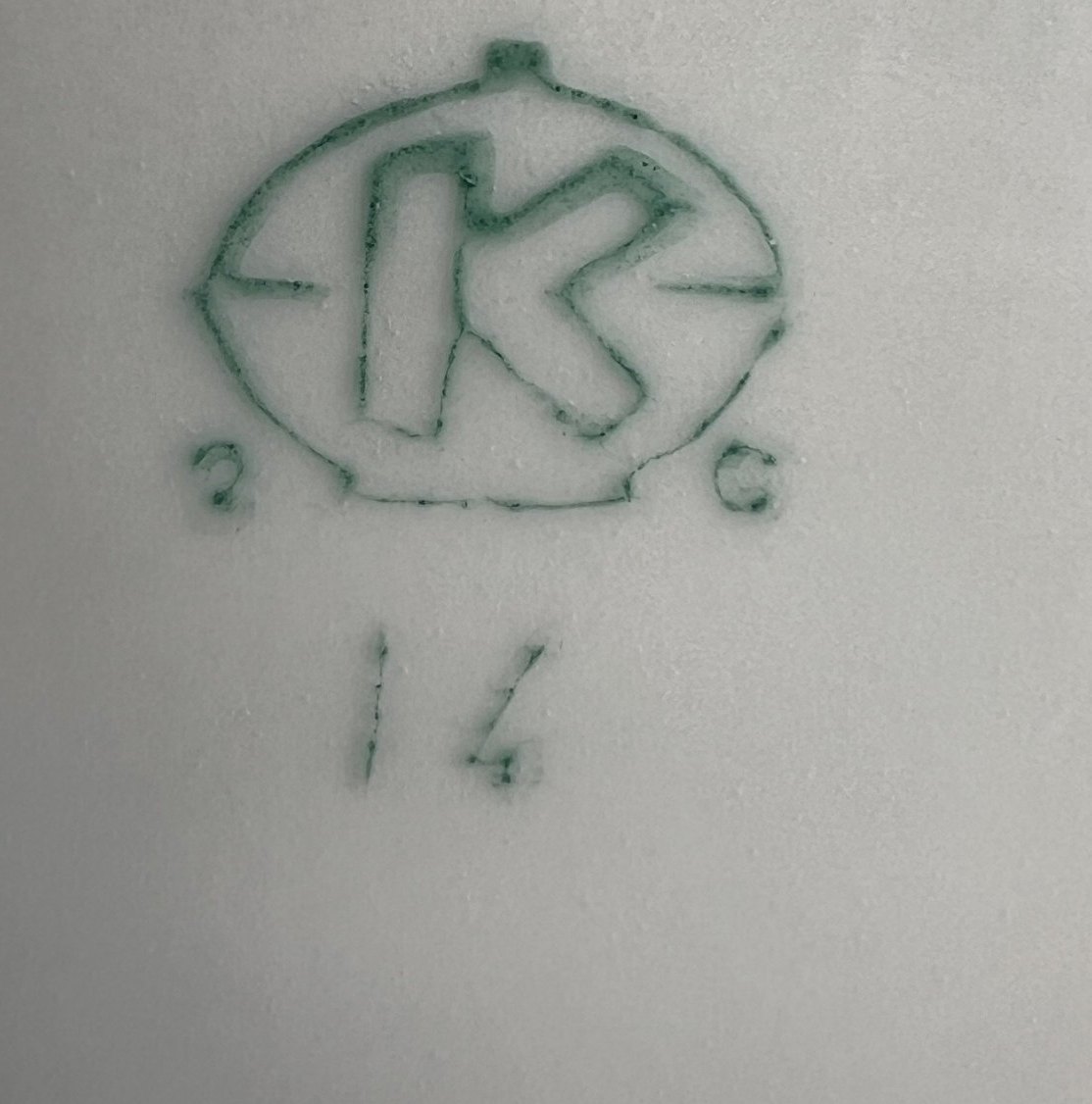
These white plates with a scalloped edge and a gold line were used in the canteen of the Chernobyl nuclear power plant. On the rim, the red logo of the plant. Underneath, the mark of the Korosten factory in Ukraine: a large К (K) at the centre of a stylised lidded pot. Below the mark, two indications. On one plate the mark is red and reads “1 с” with the number 14. On another it is green and reads “2 с” with the same number.
The Korosten mark in red, with 1 с and the number 14.
The same mark in green, with 2 с and the number 14.
A factory mark, клеймо (kleymo) in Russian, gives the factory, often the quality grade, sometimes the year. It does not tell you everything, but it places a piece more reliably than its decoration. The letters are Cyrillic: our guide to reading Cyrillic on a Soviet watch dial gives the alphabet.
What a Soviet porcelain mark tells you
The Kuznetsk Fortress Museum has published the Soviet marks in its collections, dated one by one. It sums up how they changed. After the revolution, factories dropped the symbols of the Empire: they used abbreviations or a slightly altered pre-1917 mark. In the 1920s and 1930s, marks carried the name of the organisations the factory answered to, with the hammer and sickle, ears of wheat or the globe. By the 1950s most gave the factory name and the town, in an ever simpler design. From the early 1960s many factories adopted a stylised emblem, an animal or a plant.
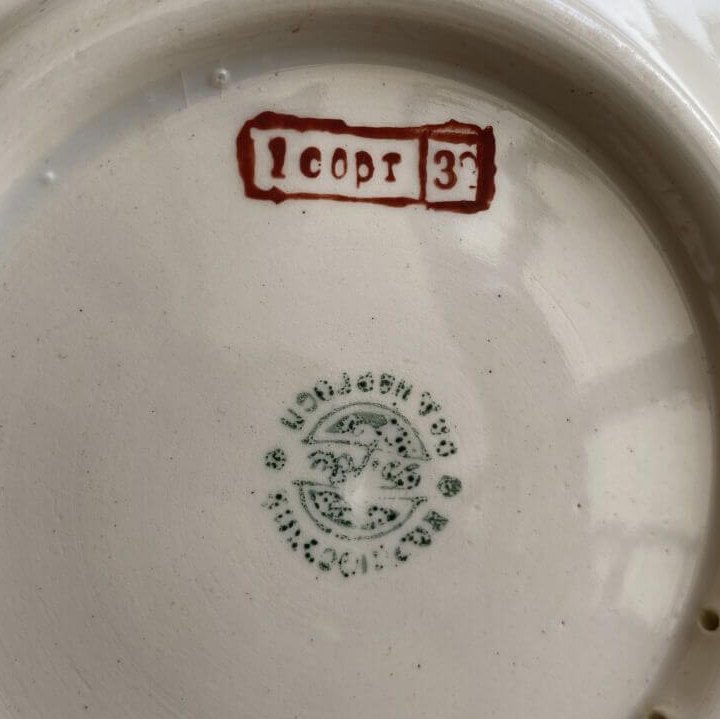
Under the Cosmonauts of the USSR plate: the red 1 сорт stamp above the green factory stamp.
Most Soviet marks, the museum writes, also give the quality grade, сорт (sort) in Russian: 1 с for first grade, 2 с for second, 3 с for third. Under our “Cosmonauts of the USSR” plate, from the Budy factory, a red stamp spells it out: “1 сорт”. Other marks add the year. The museum shows a Dulevo cup marked “1 с-51 г.”, first grade, 1951, and a Konakovo plate marked 56, for 1956.
The grade sometimes shows in the colour as well, but the code differs from one factory to the next. The three Dulevo marks in the museum are blue with 1 с (1951), green with 2 с (1954) and brown with 3 с (1953). Under our Korosten plates, red goes with 1 с and green with 2 с, whereas the collectors’ site Raritetus reserves Korosten red for a top grade and gives blue to first grade. Read the grade written under the mark, and use the colour only as a cross-check.
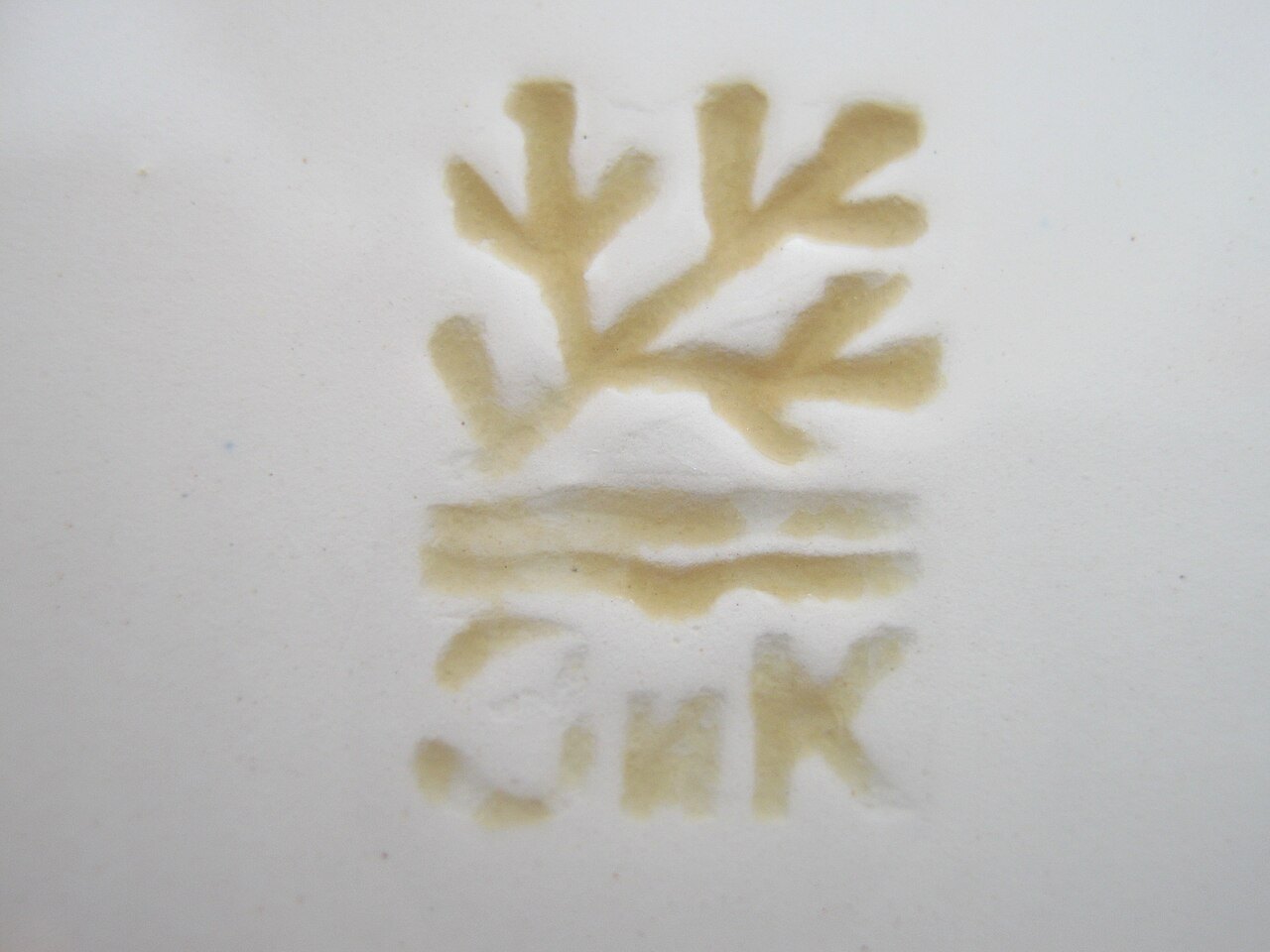
A mark impressed into the body, Konakovo faience factory: a plant motif above the letters ЗиК (ZiK). Photo ПростоУчастник, Wikimedia Commons, CC0.
Two techniques coexist, as described by the Imperial Porcelain Factory in St Petersburg. An underglaze mark is applied to the biscuit before the high-temperature firing: trapped under the glaze, its edges soften slightly. An overglaze mark is applied after that firing and fixed by a cooler decoration firing: the line is sharper and sits on the surface. A third kind is impressed into the body.
On pieces meant for export, a line in Latin letters is added to the mark: MADE IN USSR. The Kuznetsk museum notes that these export marks were standardised.
Korosten, Baranivka, Dovbysh, Budy: Soviet Ukrainian porcelain marks
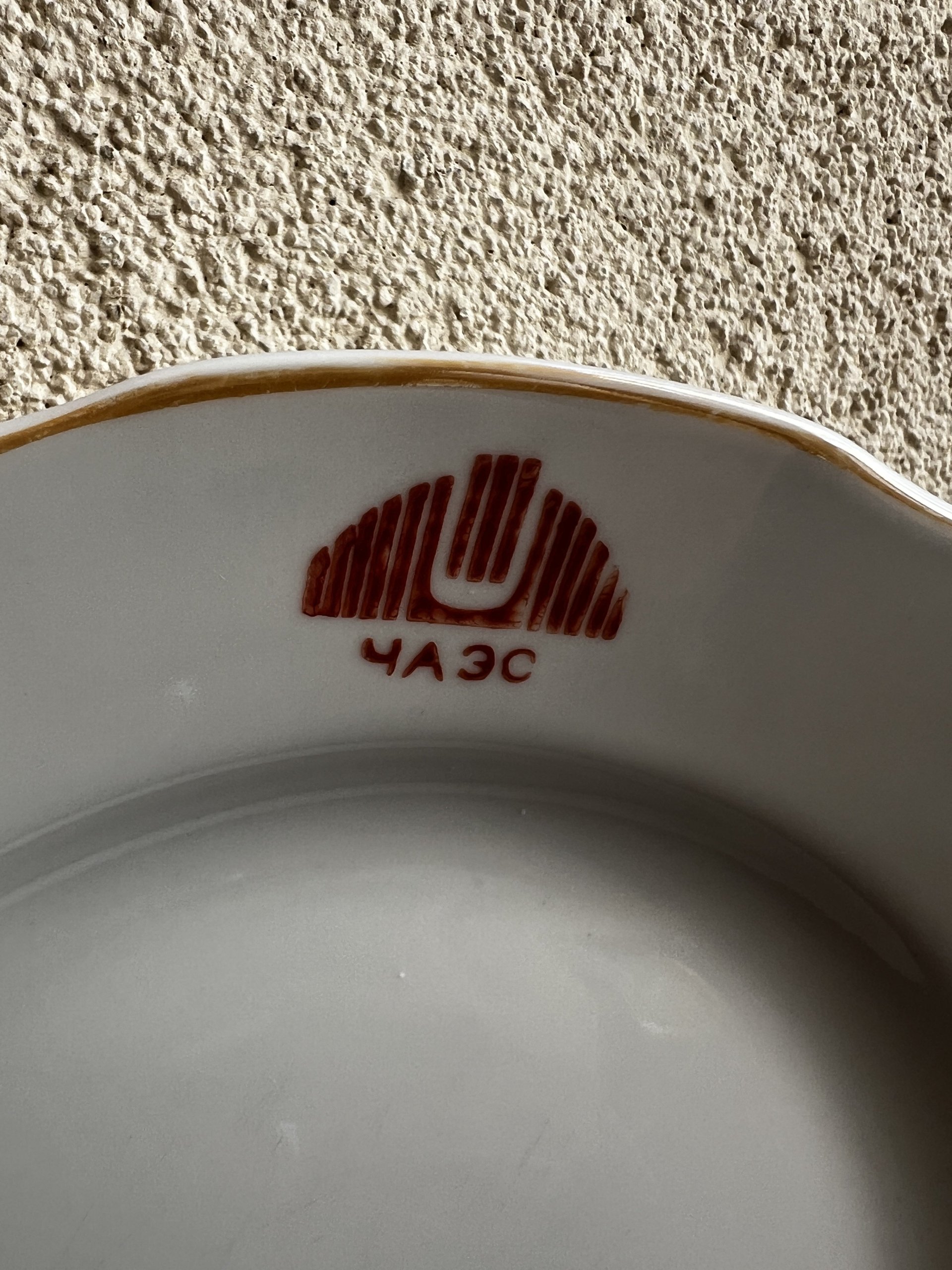
The ЧАЭС logo of the Chernobyl power plant on the rim of a Korosten plate.
A large share of the Soviet porcelain that passes through our shop comes from Ukraine. The Korosten porcelain factory, Коростенский фарфоровый завод (Korostensky farforovy zavod), in the Zhytomyr region, was built by the Pole Przybylski, in 1904 according to the Kuznetsk museum, in 1909 according to Russian Wikipedia. Until the revolution it made white porcelain that was decorated in Poland. By early 2012 it was no longer operating. It supplied the tableware for the canteen of the Chernobyl power plant: the plates carry on the rim the red logo ЧАЭС (ChAES), Чернобыльская атомная электростанция (Chernobylskaya atomnaya elektrostantsiya), Chernobyl nuclear power plant. They also appear in our article Chernobyl, forty years on.
The Kuznetsk museum holds an earlier mark of the factory: the letters КФЗ (KFZ) in an oval, in blue, on a plate it dates to 1934-1937. The К in a lidded pot on our plates is, according to Raritetus, the mark of the 1960s. A dancer in Ukrainian dress modelled at Korosten by Valentina Tregubova in 1957, now at the Victoria and Albert Museum in London, carries something else again: MADE in USSR stamped under the base.
Marquetry portrait of Felix Dzerzhinsky, presented in 1977 to the workers of the Korosten porcelain factory.
The factory had its place in the official life of the region. In 1977, for the centenary of Felix Dzerzhinsky’s birth, the Chekists of the Zhytomyr region presented the factory’s workers with a marquetry portrait of Dzerzhinsky, together with an engraved plaque.
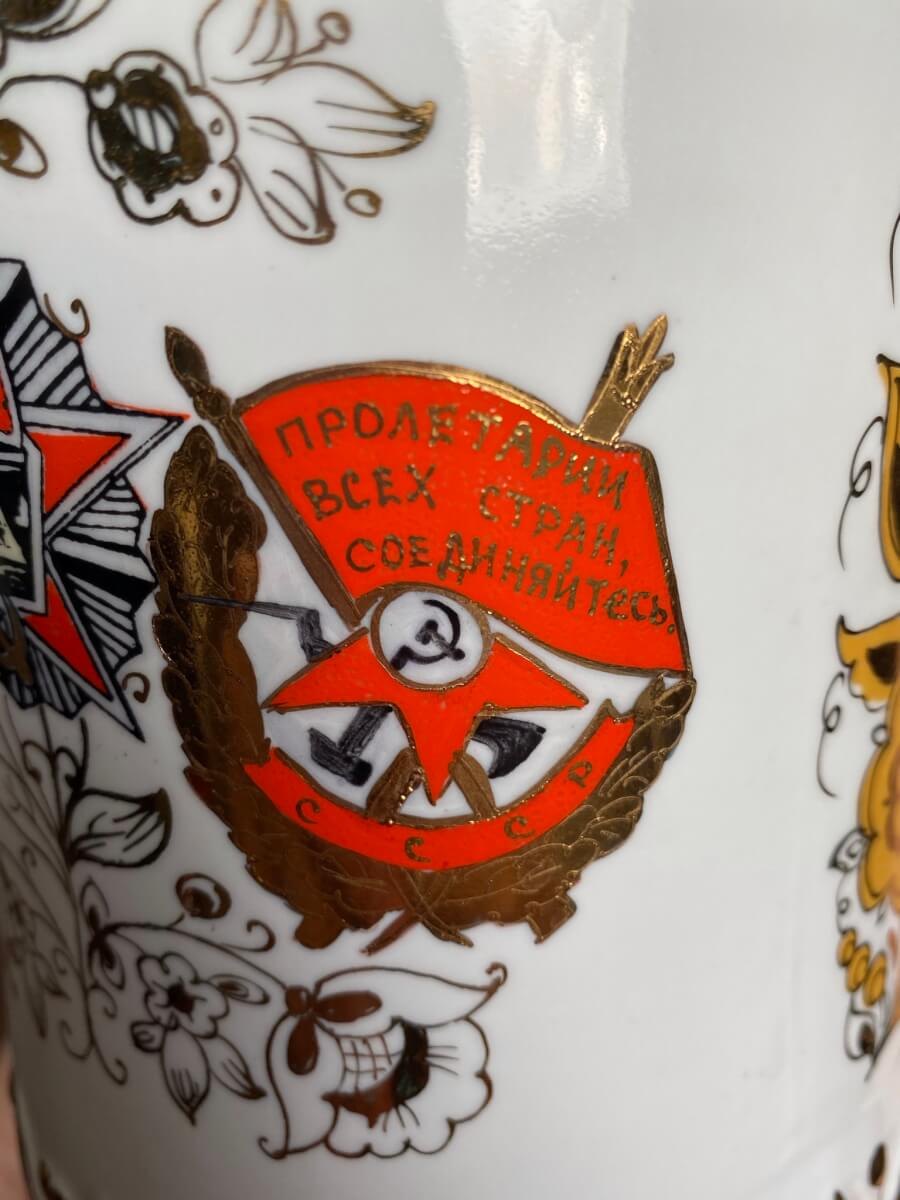
Baranivka vase, 1970s: the Order of the Red Banner, painted and gilded.
Baranivka, in the same region, is the oldest of these factories. The Mezer brothers founded it in 1802. It was named after Lenin in 1922, stopped in 2009 and was declared bankrupt in 2013. It made propaganda vases like this one, from the 1970s, as well as colourful tableware.
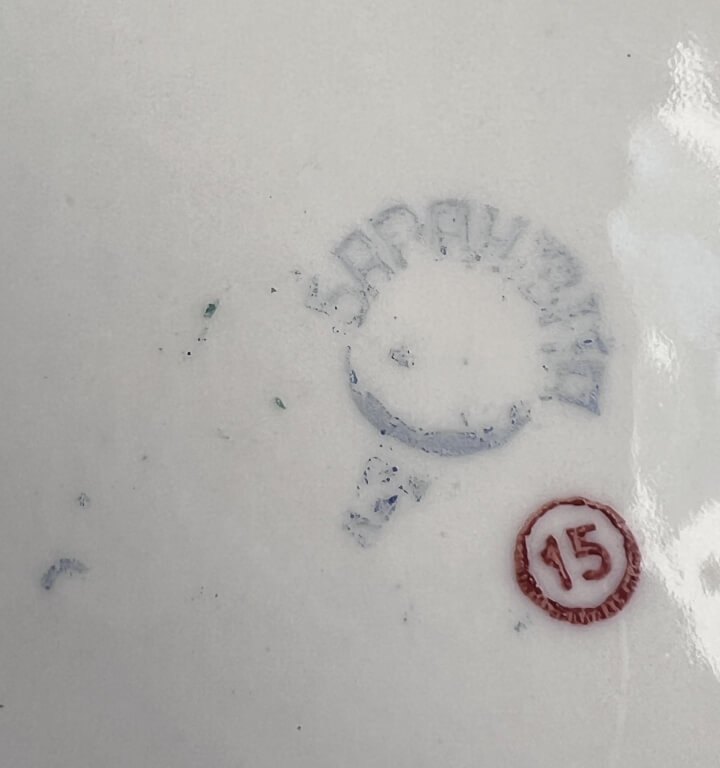
Under a sugar bowl: Баранівка in an arc, in blue, and a red stamp 15.
Under the vase: the letter Б and its sign, in blue.
Under the 1987 plate: the same mark, in red.
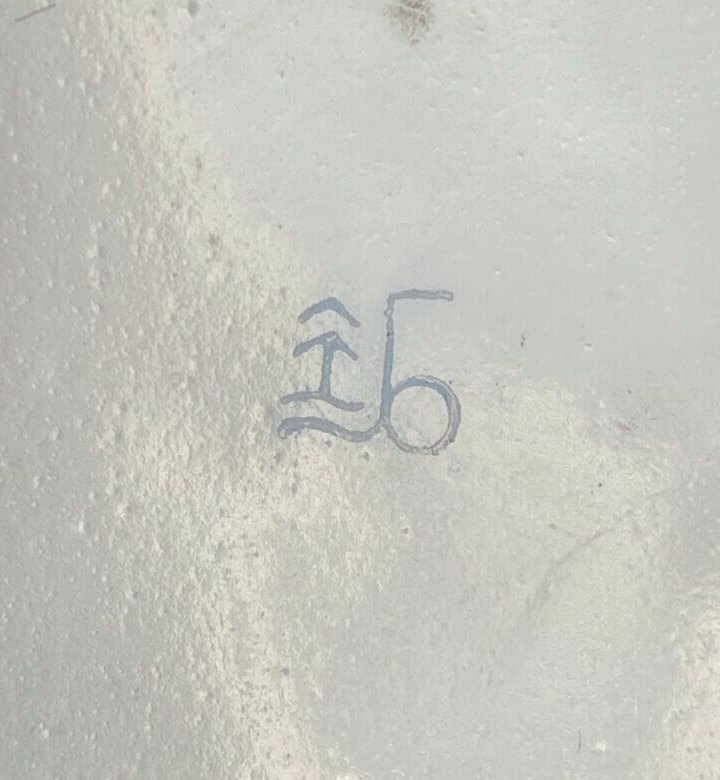
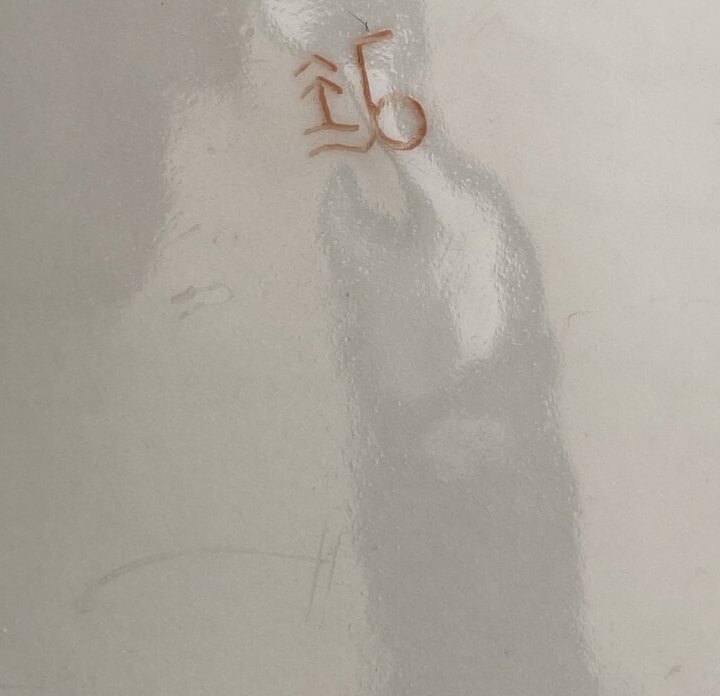
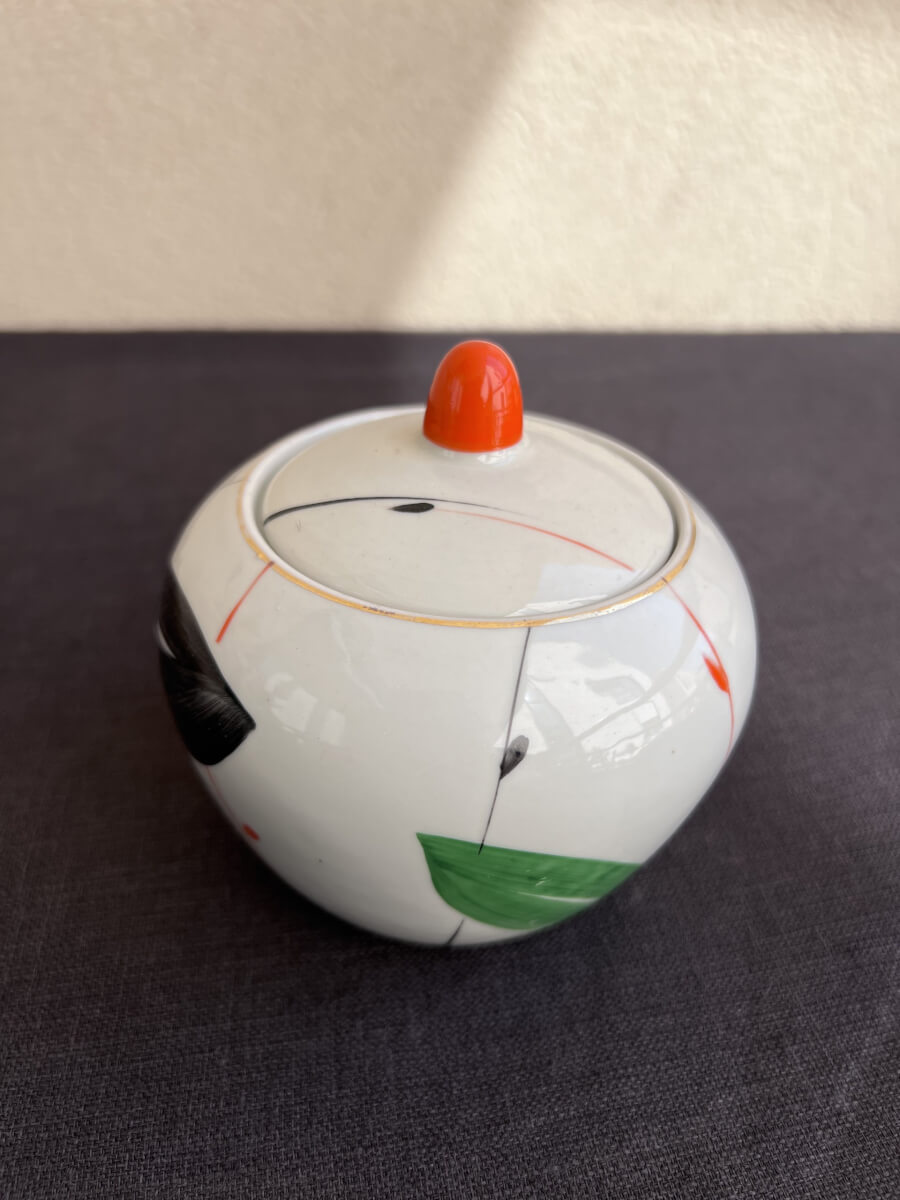
After the war, according to Raritetus, its marks carry the town name in Ukrainian, Баранівка (Baranivka), in stylised letters. Under our sugar bowl it is set in an arc. The vase carries another mark: the letter Б (B) joined to a small sign. The same mark, in red, is found under our plate for the 70th anniversary of the October Revolution, from 1987, which therefore also comes from Baranivka.
Dovbysh tea set, red with white polka dots.
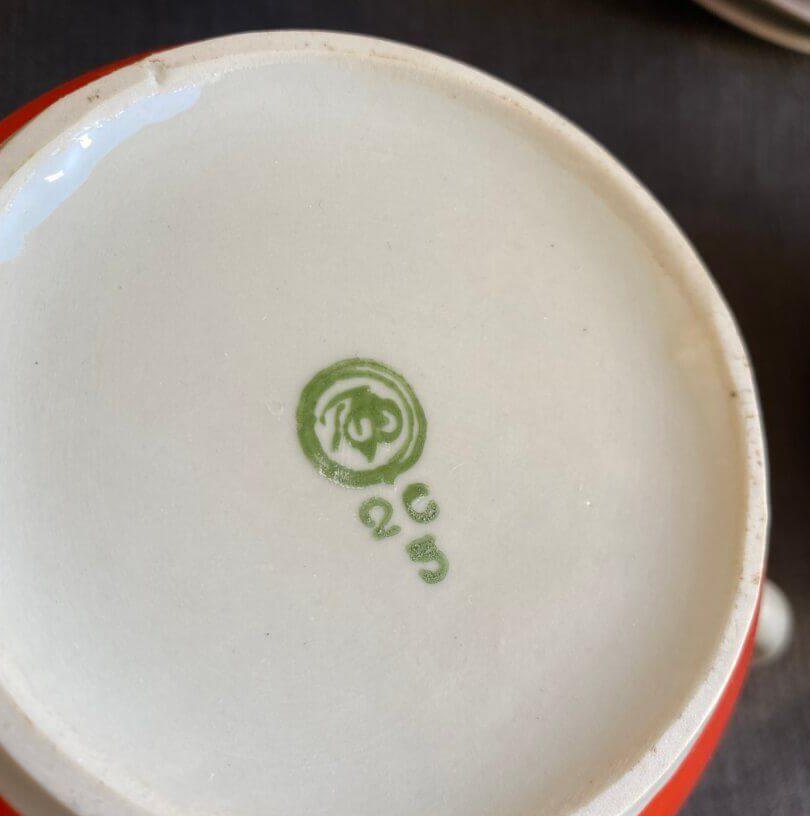
Its mark: the green factory monogram, 2 с and a number.
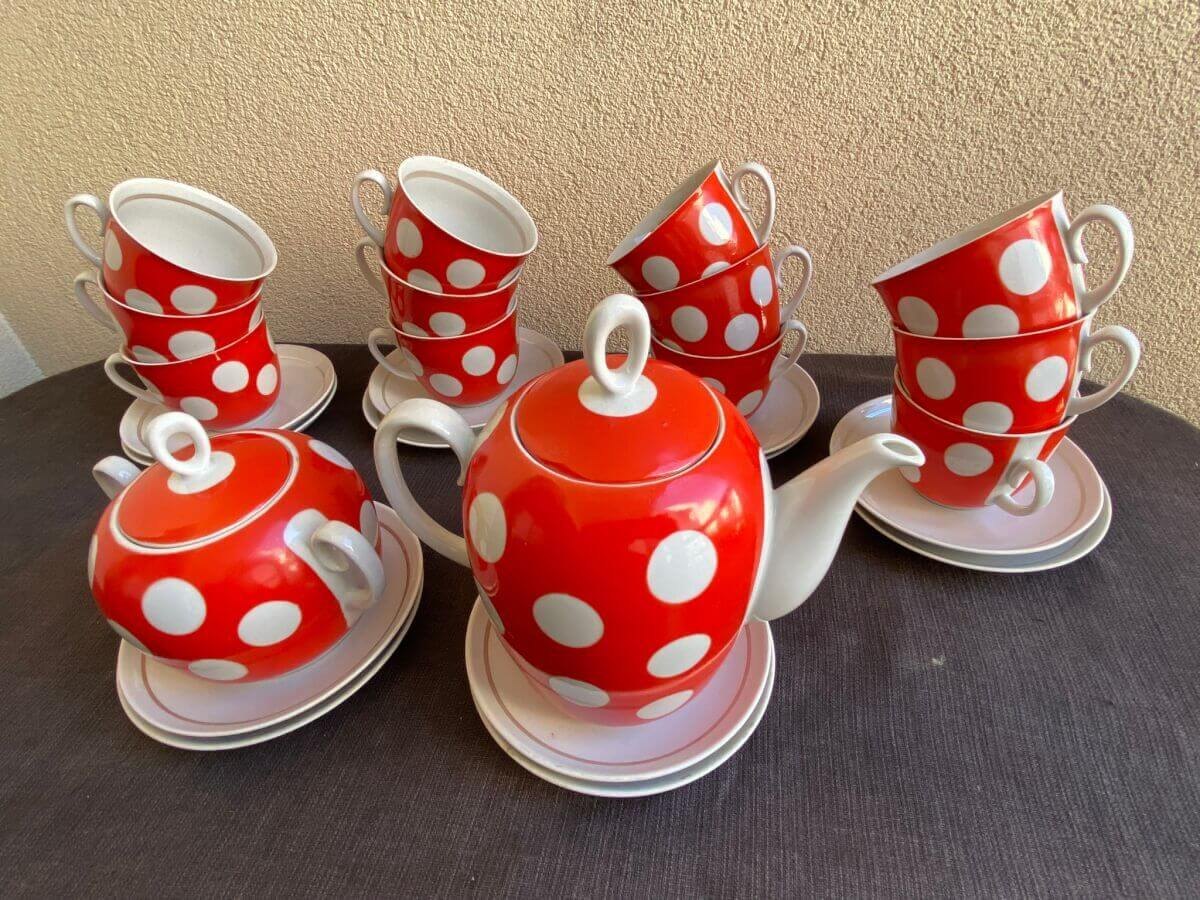
The factory at Довбыш (Dovbysh), also in the Zhytomyr region, was founded in 1823. According to Raritetus it was named after Marchlewski from 1925, then after Felix Kon in the 1930s; the town name entered the mark in the 1940s and gave way in the 1970s to a stylised letter Д (D). The set above, from the 1960s, carries a green monogram in a double circle, with 2 с and a number. In the same photo the foot ring is left unglazed, matt next to the glossy base.
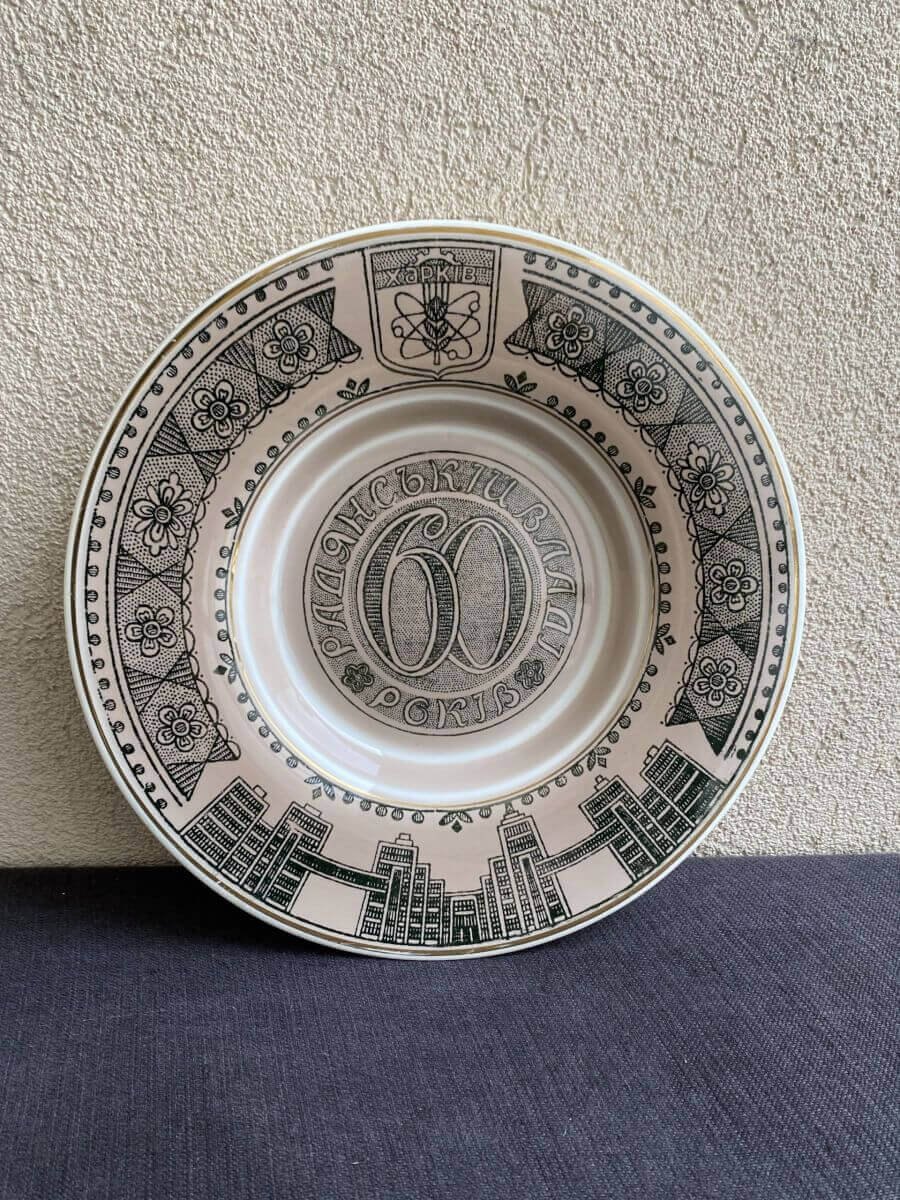
Budy plate for 60 years of Soviet power, with the arms of Kharkiv.
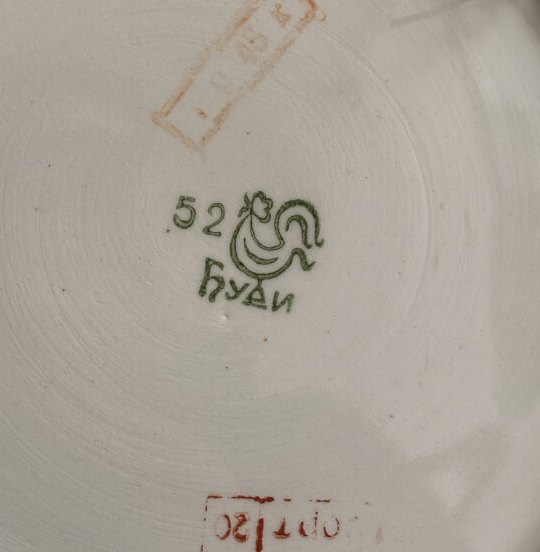
Underneath: the green rooster, the name Буди and the number 52.
Further east, near Kharkiv, the Budy factory, Будянский фаянсовый завод (Budyansky fayansovy zavod), grew out of a faience works that Matvey Kuznetsov set up in Bayrak in 1867 and moved to Budy in 1886; it made porcelain from 1894. The Kuznetsk museum holds two of its pre-war marks, one dated 1923-1929, the other, in blue, 1934-1946 with the grade 2 с. The rooster became its emblem in the early 1960s, according to Russian Wikipedia. Under a 1977 plate that passed through our shop it is green, above the town name in Ukrainian, Буди (Budy). On export pieces, Made in USSR was added in a half-circle under the rooster; after 1991, Made in Ukraine. The factory was declared bankrupt in 2006.
Verbilki, Dulevo, Konakovo: the marks from around Moscow
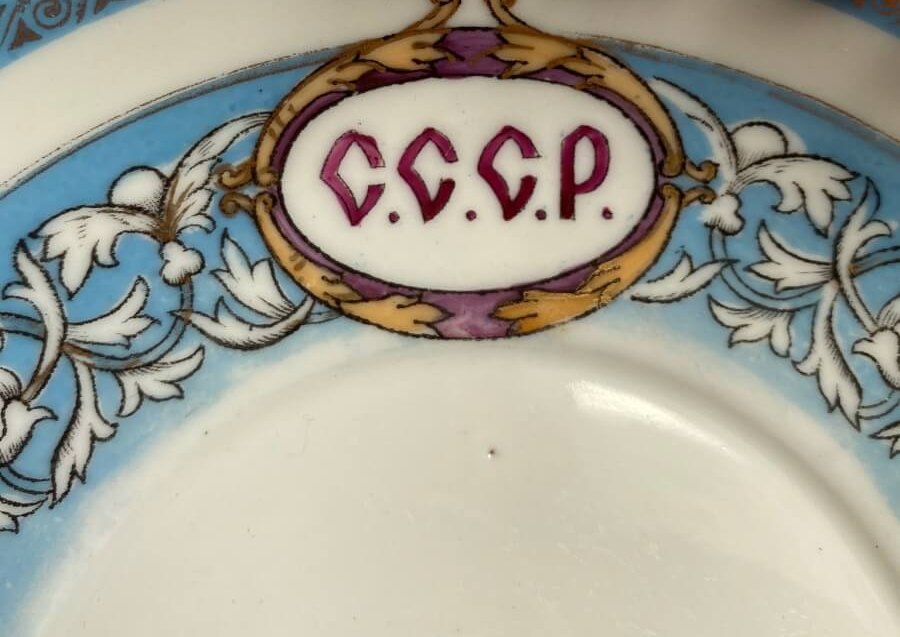
Verbilki saucer, 1930s: the С.С.С.Р. cartouche.
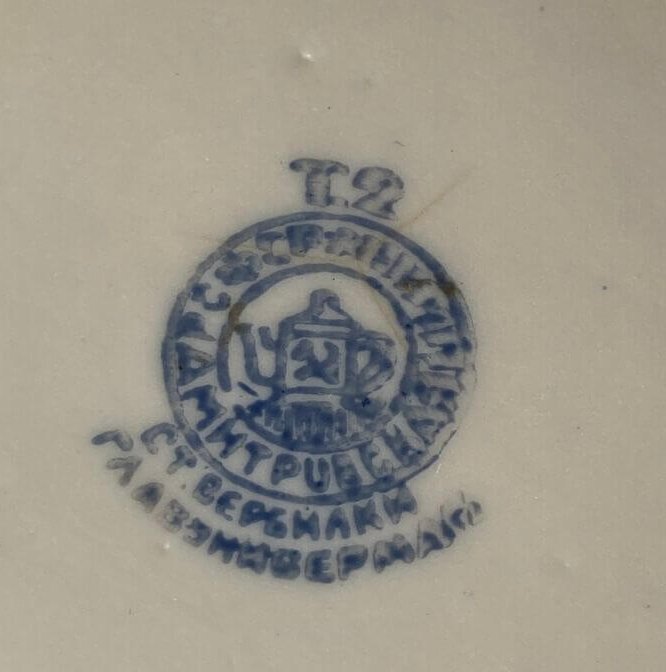
Its mark: Т.2, a teapot with hammer and sickle, РСФСР НКМП Дмитровская, ст. Вербилки.
The factory at Вербилки (Verbilki), north of Moscow, was founded in 1766 by Francis Gardner and belonged from 1892 to 1917 to Matvey Kuznetsov’s company. Nationalised, it became the Dmitrov porcelain factory. Our “Moscow” cup and saucer, from the 1930s, carry a round blue mark: in the centre, a teapot bearing the hammer and sickle; around it, “РСФСР НКМП Дмитровская” (RSFSR NKMP Dmitrovskaya); above, “Т.2”; below, “ст. Вербилки” (st. Verbilki), Verbilki railway station. НКМП stands for the People’s Commissariat of Local Industry. The Kuznetsk museum describes the same mark, element by element, on a cup in its collections and dates it to 1934-1946.
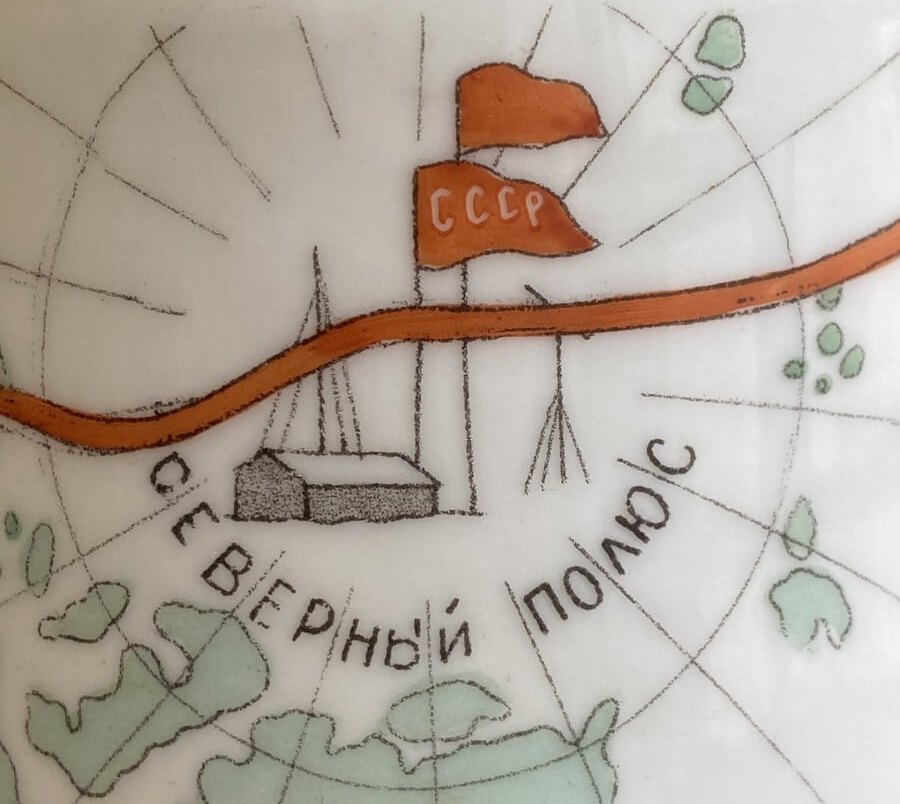
Dmitrov factory cup for the 1937 Moscow, North Pole, San Jacinto flight: crossing the Pole.
The same mark is found under our cup for the non-stop flight Moscow, North Pole, San Jacinto, the distance record set in 1937 by Mikhail Gromov, Andrei Yumashev and Sergei Danilin. The decoration gives the year, the mark gives the factory. According to the museum, the factory then marked in red ДФЗ (DFZ) above the name Вербилки, from 1954 to 1965, and from 1965 took an elk’s head as its emblem.
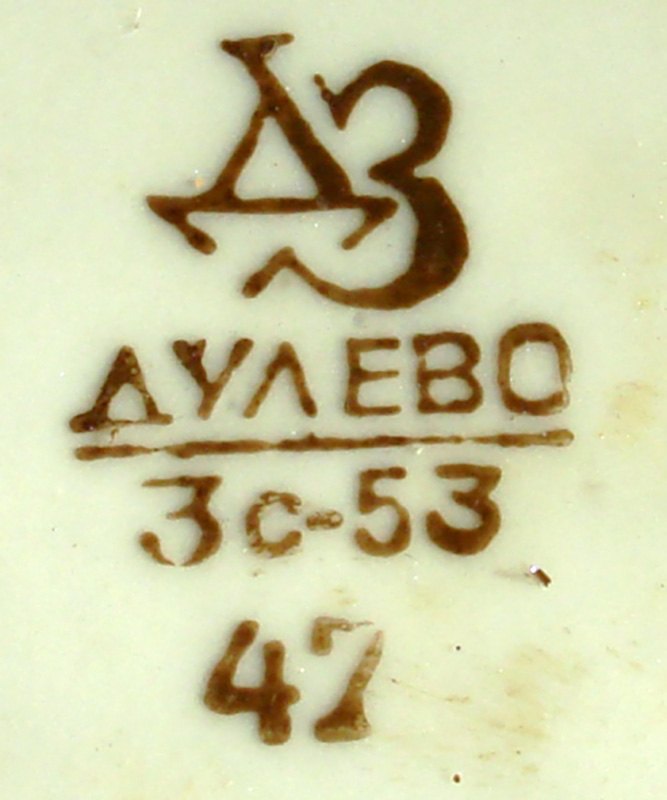
Dulevo mark under a deep plate of 1953: ДЗ (DZ), ДУЛЕВО, 3 с-53 and the number 47. Photo Kuznetsk Fortress museum-reserve, Novokuznetsk (КП 1767), kuzn-krepost.ru.
Dulevo, Дулёво (Dulyovo), was founded in 1832 by Terenty Kuznetsov and in Soviet times bore the name of the newspaper Pravda. The Kuznetsk museum dates its round marks with grade and year, such as “1 с-51 г.”, to 1948-1952, then the letters ДЗ (DZ) above “ДУЛЕВО” to 1952-1964. Alexei Sotnikov’s sculpture “The Falcon”, Grand Prix at the 1958 World’s Fair, then became the factory emblem, in 1962 according to Russian Wikipedia.
The Konakovo faience factory was founded in 1809 by F.-Kh. Brinner in the village of Kuznetsovo and passed in 1870 to Matvey Kuznetsov. It was named after Mikhail Kalinin in 1923, and the village became Konakovo in 1929. In the 1950s its mark shrank to the letters ЗиК (ZiK), for “Kalinin factory”, with the town name and sometimes the year; the museum dates this mark to 1952-1959.
Leningrad: from the tsar’s cypher to the LFZ mark
The St Petersburg factory, founded in 1744, marked its pieces with the cypher of the reigning monarch throughout the Imperial period. Nationalised, it became the State Porcelain Factory, ГФЗ (GFZ), placed in 1918 under the People’s Commissariat for Education. Its task, in the words of the history it publishes today: agitation porcelain, агитационный фарфор (agitatsionny farfor), “revolutionary in content, perfect in form, flawless in technical execution”.
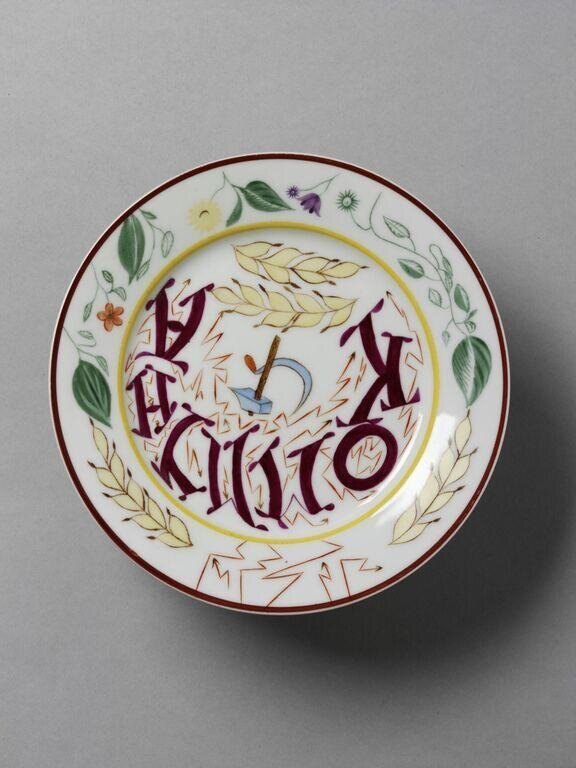
In 1917 the factory held a stock of white pieces, glazed but undecorated, marked with the cypher of one of the last three tsars. The specialist Nina Lobanov-Rostovsky tells what followed in Apollo magazine: the pieces were decorated for propaganda, the cypher was covered with a patch of green or black paint, and the new hammer, sickle and cog mark, designed by Alexei Karev, was painted alongside with the year. After 1921 the cypher was often left uncovered. A plate at the Victoria and Albert Museum, designed by Pyotr Vychegzhanin, carries both marks according to its record: the Imperial mark obliterated with green enamel, and a hammer, sickle, cog and the date 1920.
The factory took the name of Leningrad in 1924, then that of Mikhail Lomonosov in 1925, for the bicentenary of the Academy of Sciences. Hammer and sickle marks stayed in use until 1936. The letters ЛФЗ (LFZ), for Leningradsky farforovy zavod, then replaced them, in a design by Anna Yatskevich according to Russian Wikipedia. A 1950s-1960s figure at the Victoria and Albert Museum, a Yakut girl modelled by S. B. Velikhova, carries the factory mark and MADE IN USSR printed in red: a piece made for export.
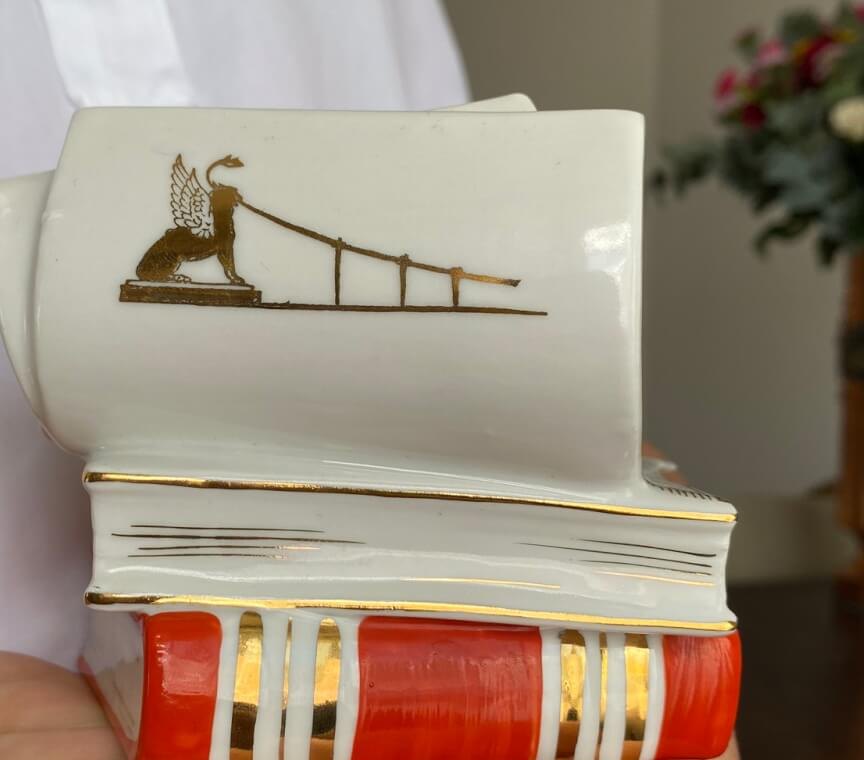
“Leningrad” inkwell: stacked books and a gilded griffin.
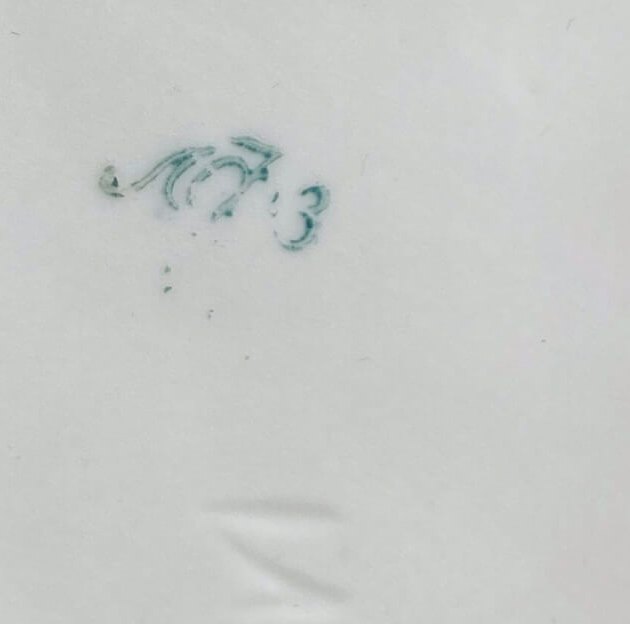
Underneath: ЛФЗ hand-drawn in green, the figure 3, and a sign impressed into the body.
Our “Leningrad” inkwell carries a green hand-drawn mark: ЛФЗ, followed by the figure 3. Lower down, a sign is impressed into the body. The tables of marks we reread do not date this hand-drawn variant.
The war left an unusual mark on the factory’s history. On 22 August 1941, two months after the German invasion, most of its equipment and the thousands of pieces in its museum were evacuated to Irbit, in the Sverdlovsk region, where the equipment was soon put to making spark plugs for tank engines. In Leningrad, three warships moored on the Neva in front of the factory, and its painters helped camouflage them with porcelain paints. As long as fuel lasted, the factory made tableware for the hospitals of the besieged city.
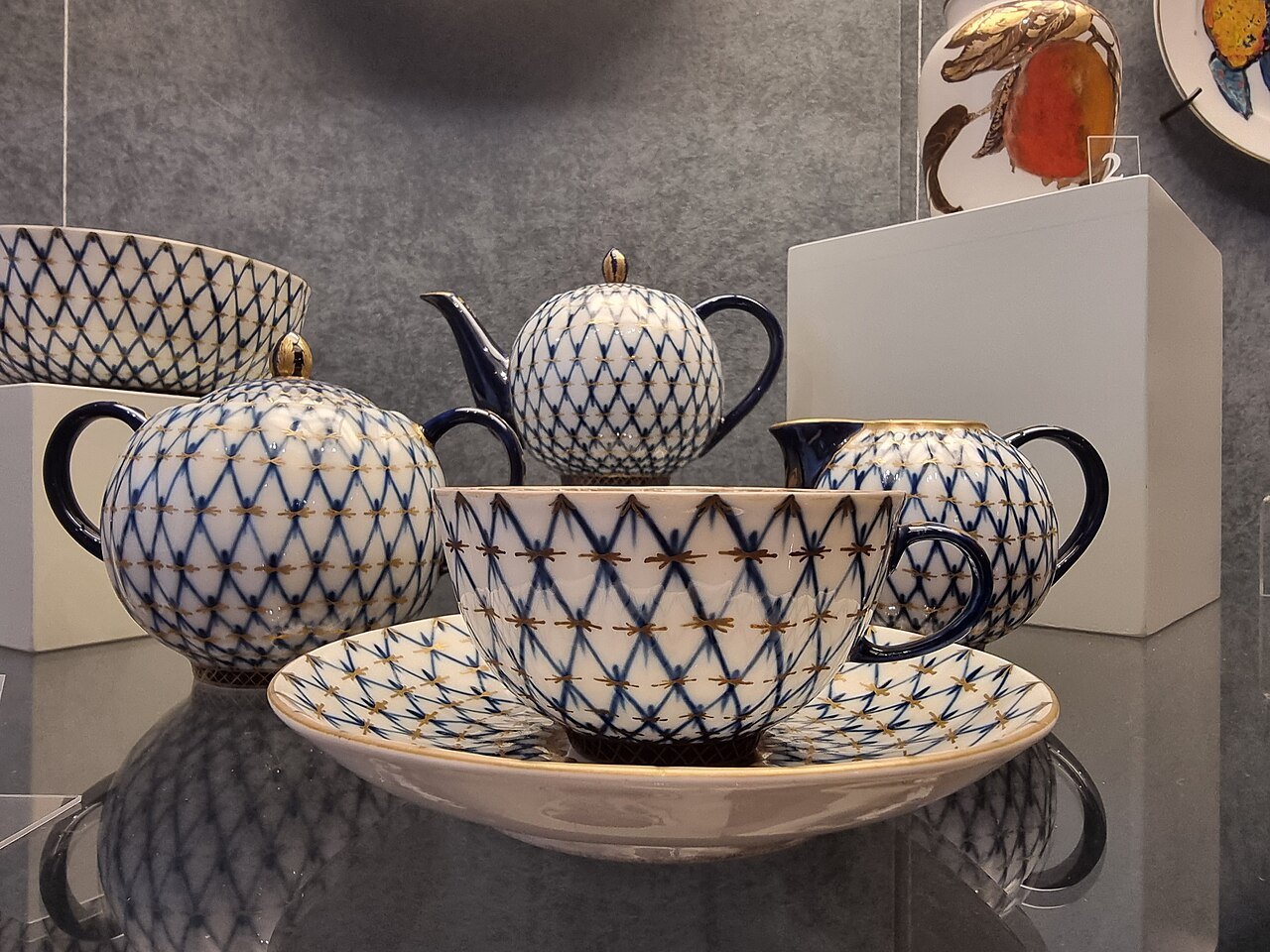
Cobalt net tea service by the Lomonosov factory (ЛФЗ), in a museum display case in Moscow, 2023. Photo A.Morgunovskaya, Wikimedia Commons, CC BY-SA 4.0.
The cobalt net, кобальтовая сетка (kobaltovaya setka), the factory’s best-known pattern, is the work of Anna Yatskevich (1904-1952). The idea dates from 1944 according to Russian Wikipedia; the pattern first appeared in 1949 according to English Wikipedia. The factory still makes it: on a cobalt net cup, only the mark tells you whether it is Soviet or recent.
Painters’ signatures and inscriptions
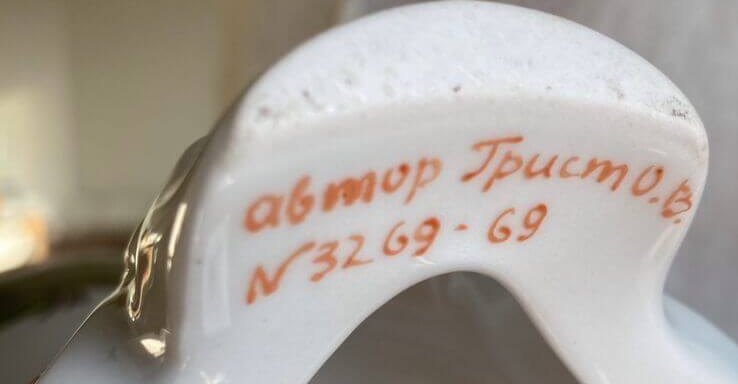
Under the foot of the “For the Power of the Soviets” vase: автор Грист О.В., N 3269-69.
Besides the factory mark, many propaganda pieces carry the name of their painter. The hand-painted vase “For the Power of the Soviets” decorated the Communist Party offices of a town in the Luhansk region. It is signed under the foot “автор Грист О.В.” (avtor Grist O.V.), author Grist O.V., above a number ending in 69, for 1969.
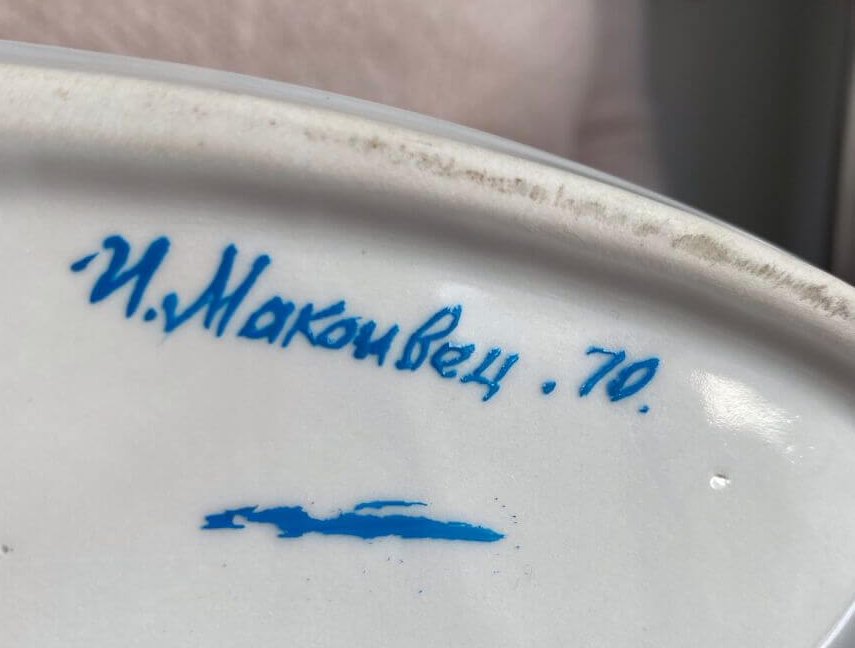
Under the Valentina Tereshkova vase: И. Макоивец .70.
The Valentina Tereshkova vase carries “И. Макоивец .70” (I. Makoivets, 1970) under its base, brushed in blue.
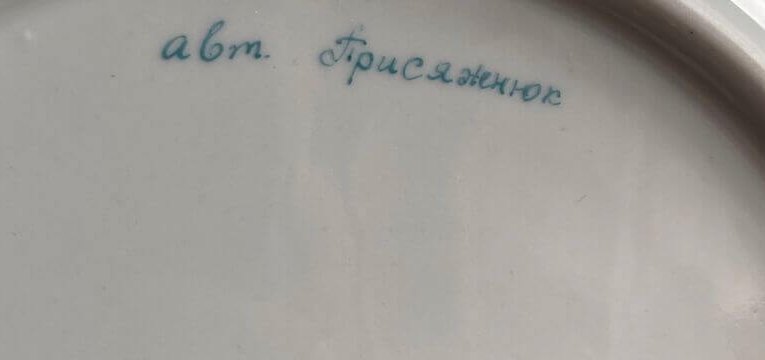
On the back of the Laika plate: авт. Присяжнюк.
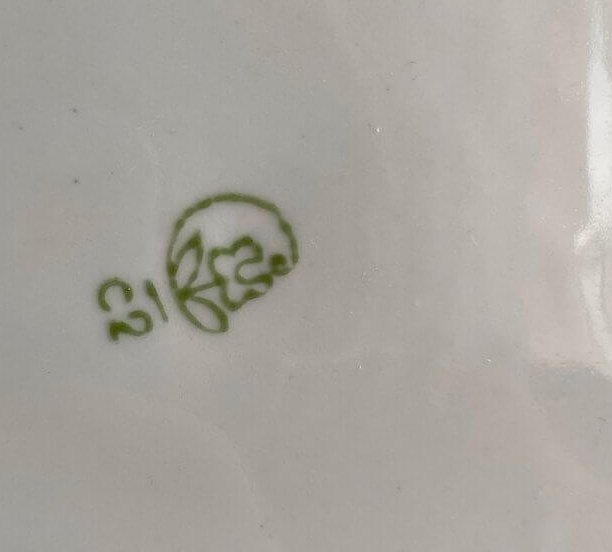
Its factory mark, green, with the number 21.
On the back of the plate dedicated to the space dog Laika you read “авт. Присяжнюк” (avt. Prisyazhnyuk), and lower down a small round green mark followed by the number 21.
A call to our readers
The mark on the Laika plate is a small green motif set in a circle, perhaps a flower or a bouquet, followed by the number 21. We did not find it in any of the tables of marks we consulted.
If you recognise this mark and the factory that used it, write to us at inquiries@sovietinparis.com. Any serious lead will be added to this article and credited.
Back of the 1917-1977 decorative plate: the maker’s inscription, in Ukrainian.
An inscription sometimes adds to the mark, or replaces it. Our 1977 decorative plate, a one-off piece in stoneware, has no factory mark. Its maker wrote on the back, in Ukrainian: his name, Гудак Василь (Gudak Vasyl), born in 1948; the title, decorative plate “1917-1977”; the materials, stoneware body, enamels and salts; the diameter, 33 cm; the year it was made, 1977. Above, the name of the city of Lviv. A signature does not replace the factory mark, but when it carries a year, it dates the piece.
Before you buy: Soviet-era piece or later production?
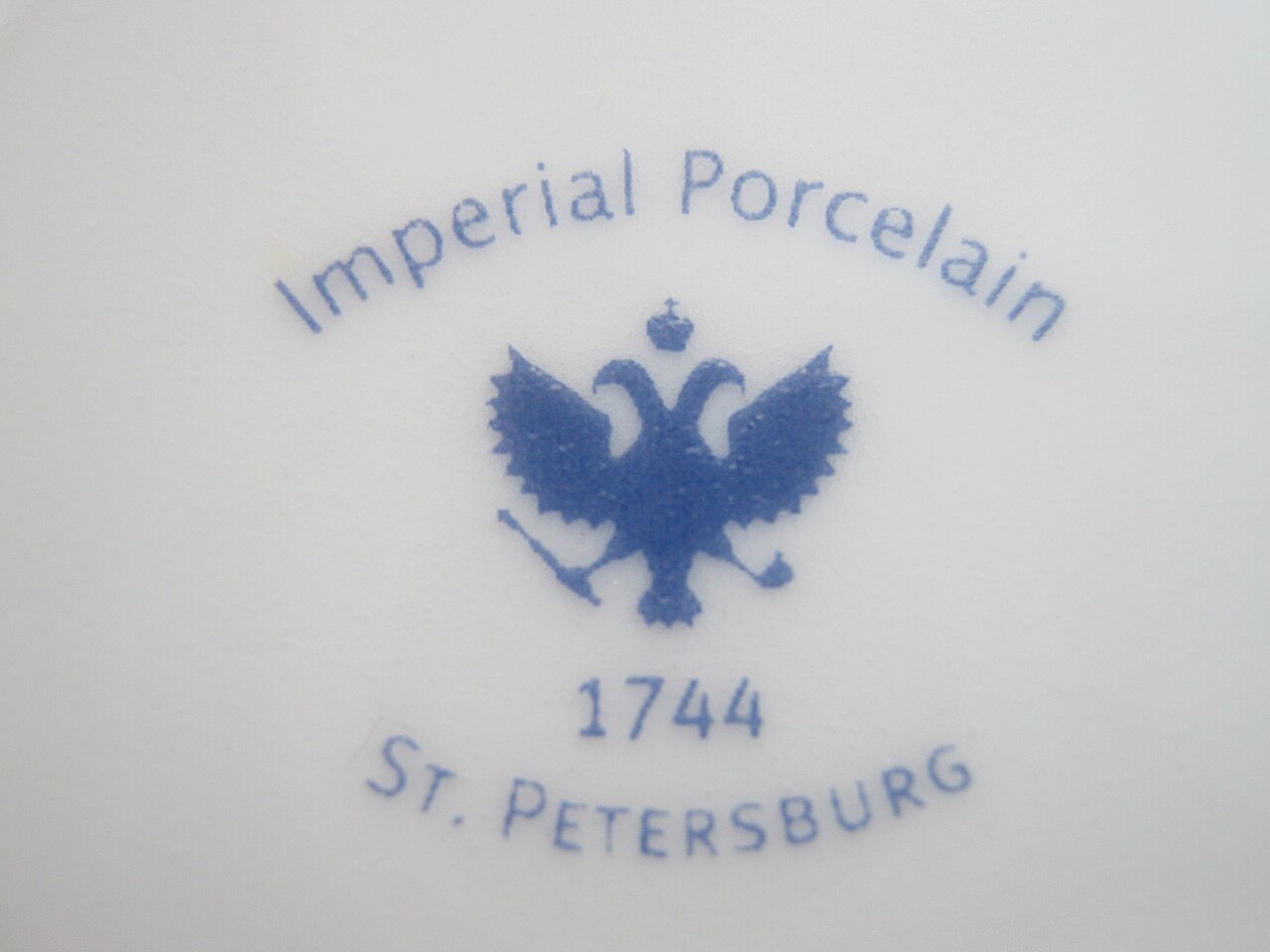
The mark used after 2005: Imperial Porcelain, the double-headed eagle, 1744, St. Petersburg. Photo ПростоУчастник, Wikimedia Commons, CC0.
Leningrad marks after the USSR. They changed quickly. The first post-Soviet export backstamp is a red LFZ monogram with Made in Russia. After 2002 comes Hand Decorated, 1744, St. Petersburg, Russia. In 2005 the factory took back the Imperial Porcelain name, and its pieces then read Imperial Porcelain, 1744, St. Petersburg under the double-headed eagle. A piece marked this way was made after the USSR, even if its pattern dates from the 1950s. Made in Russia alone is not enough: an online catalogue of marks records it on exports of the 1920s and 1930s already. The design of the mark is what settles it.
Imitations and fakes. The Imperial Porcelain Factory warns against imitations of its current products, especially cobalt net pieces and pieces with the Imperial Porcelain 1744 logo sold outside its shops. For 1920s propaganda porcelain, Nina Lobanov-Rostovsky writes that fakes abound. A covered Imperial cypher or a 1920 mark calls for a specialist’s opinion. For the tableware and series pieces of Korosten, Baranivka, Dovbysh or Budy, we found no reported copy.
Old models remade by the factories. The Kuznetsk museum notes that in the late 1990s the Verbilki factory turned to reproducing old models. Dulevo now sells a range called Восстановленная скульптура (vosstanovlennaya skulptura), “restored sculpture”, which includes models by Alexei Sotnikov, a sculptor at the factory from 1934 to 1968. For these pieces, the mark on the base is what separates a Soviet-era cast from a recent one.
Judging a mark. The Imperial Porcelain Factory gives several pointers:
An overglaze mark is easier to fake than an underglaze one.
A mark impressed into the body is almost impossible to imitate.
An underglaze line is slightly blurred, an overglaze line is sharper; modern paint is often thicker.
The foot ring is left unglazed: over the years it dulls and holds dust. A base dirtied on purpose does not look like that wear.
Some workshops decorated other factories’ pieces: a piece can carry two marks.
As with any collector’s piece, research thoroughly, compare several examples and rely on trusted collectors’ sites and buying guides.
The ДП-5В (DP-5V) is the field radiometer of Soviet civil defence: a green Bakelite console, a probe with a rotating gamma, beta and check-source shield, headphones and a manual that explains operation and maintenance. The one in this article served in an industrial bakery in Chișinău and was serviced in March 1991. Its owner shared his photos and documents with us, and we turned them into a tool that lets you operate it on screen, step by step.
The Moscow Games, from 19 July to 3 August 1980, boycotted by some sixty countries, produced more objects than any Soviet event: a bear cub, Misha, drawn by Viktor Chizhikov, an emblem made of running tracks, five thousand torches, watches from every factory, platinum coins, rings, tea glass holders, posters. This guide tells the story of the Games and reviews the objects, with the marks that authenticate them and the prices.
The 3017 chronograph of the First Moscow Watch Factory carries a five-digit number on the balance cock. The most common dating method reads it as a single series, from 1959 to 1979. Four factory passports show there are two, and that the same number can point to two watches made ten years apart. Here is how to read the number, the dial, the logo and the bridge, with a decoder to date your Strela, Poljot or Sekonda.
This website uses cookies to improve your experience while you navigate through the website.
Out of these cookies, the cookies that are categorised as necessary are stored on your browser as they are essential for the working of basic functionalities of the website.
We also use third-party cookies that help us analyse and understand how you use this website.
These cookies will be stored in your browser only with your consent.
You also have the option to opt out of these cookies.
But opting out of some of these cookies may affect your browsing experience.
Necessary cookies are absolutely essential for the website to function properly. This category only includes cookies that ensure basic functionalities and security features of the website. These cookies do not store any personal information.
Cookies that are not strictly necessary for the website to work and that are used specifically to collect personal data through analytics, ads and other embedded content are called non-necessary cookies. User consent is required before these cookies run on the website.
✕
Soviet in Paris
Offline right now. Leave your message and your email, we reply within 24 hours.
Hello 👋 A question about an item, an order or shipping? Write to us.
Your email is used only to reply to you.
Subscribe to our newsletter and get 10% off your first order.
Subscribe
★ New pieces before anyone else
★ New blog articles
★ Soviet in Paris news and updates
Join the Party
10% off your first order
Receive your welcome card and our next arrivals.
Your code appears here and is also sent to you by email. You can leave the Party in one click, at any time.