In Soviet towns, street names, the entrance of the savings bank and the warning on an electricity pole were written in glass. An enamel sign is not painted: every colour is a layer of glass fired onto the metal. This guide explains how Soviet enamel signs were made, how to read the inscription and the back, and which clues help you date one before buying, using the signs that have passed through our shop.
OCTOBER 2026•10 MINUTE READ
by Marwen Yahyaoui
«Прячьте спички от детей!» (Pryachte spichki ot detey): hide matches from children. Enamel fire safety sign.
The Russian term is эмалированная табличка (emalirovannaya tablichka). They come in every size, from a 30 cm door plate to a sign a metre long, and they nearly always say where they come from: a street, an office, a train, a workshop. Eighty-five are in stock in our shop as we write, and every photo in this guide shows a piece that has passed through it.
An enamel sign is made of glass
Vitreous enamel, also called porcelain enamel, is powdered glass, known as frit, fused onto metal in a kiln. It is not paint. Two things follow that matter to a collector: enamel does not fade under ultraviolet light, and it breaks like glass when the metal underneath is bent or struck.
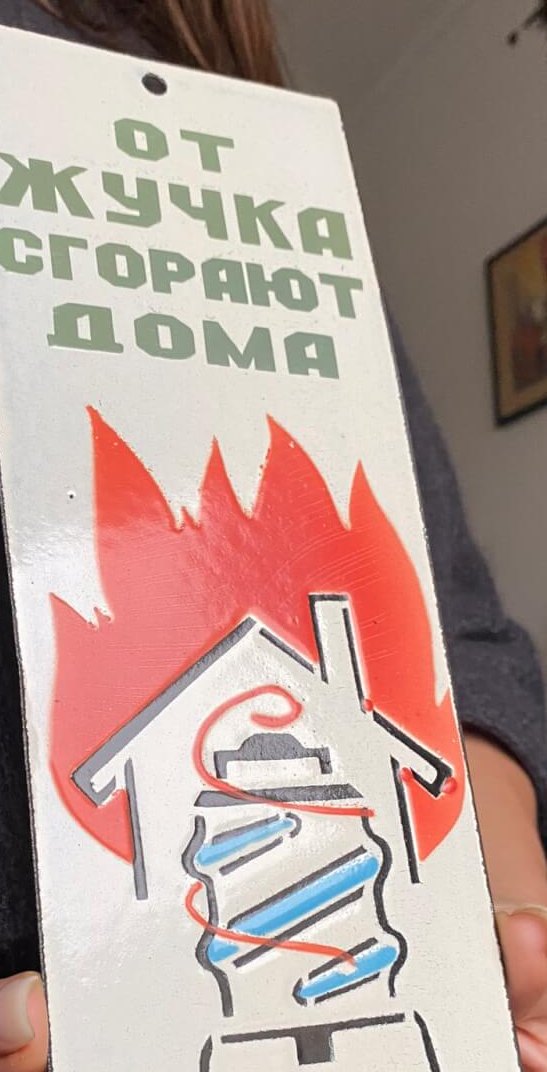
A fire prevention sign: the enamel is smooth and glossy, and each colour has a sharp outline.
This explains how a sign looks after thirty or fifty years on a wall: a surface that is still glossy, and clean-edged chips where it took knocks, most often along the edges and around the fixing holes. Where the enamel has gone, the bare metal rusts. Where it remains, it still protects.
How a Soviet enamel sign was made: ground coat, white, colours
The diagram shows the sign in cross-section, layer by layer.
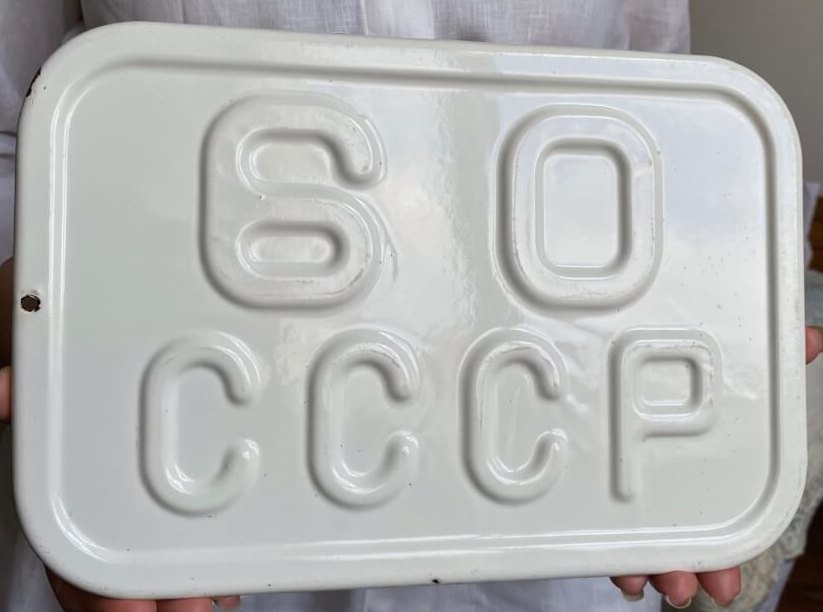
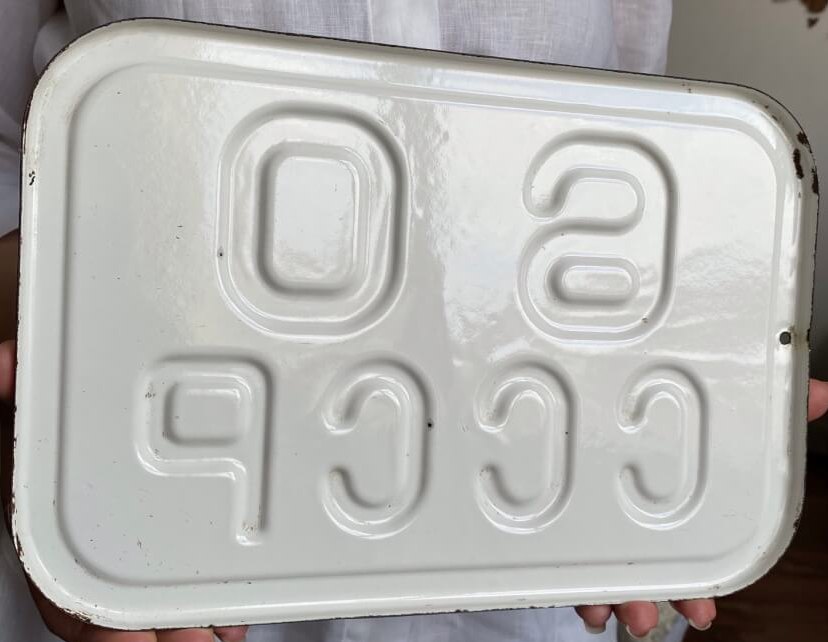
The metal. The Soviet chemical encyclopedia states that technical enamels are applied to cast iron, steel, aluminium and light alloys. The plate can be pressed to carry raised letters: the sign for the 60th anniversary of the USSR, made in 1982, is pressed sheet metal and shows its figures raised on the front and hollow on the back. Other signs in our shop are cast iron.
Sign for the 60 years of the USSR, 1982: raised figures and letters.
The back of the same sign: the relief shows hollow.
The ground coat. The first layer, грунтовая эмаль (gruntovaya emal, ground enamel), is made to grip the metal. The same encyclopedia notes that “adhesion oxides” are added to it, cobalt and nickel among them. According to the Russian magazine TechInsider, these oxides are what turned the ground coat of Soviet enamel kitchenware black, the layer that shows as the dark rim of mugs and pans. The piece goes into the kiln, at 750 to 950 °C depending on the source, and the powder melts into a skin of glass.
The cover coat. Next come the cover enamels, покровная эмаль (pokrovnaya emal), opaque, white or coloured. On a street sign, this is the white or blue field behind the letters. Another firing.
Letters and pictures. Each colour is laid through a stencil, then fired, and the process is repeated for every colour. A safety sign in four or five colours therefore went through the kiln far more often than a black-on-white street sign.
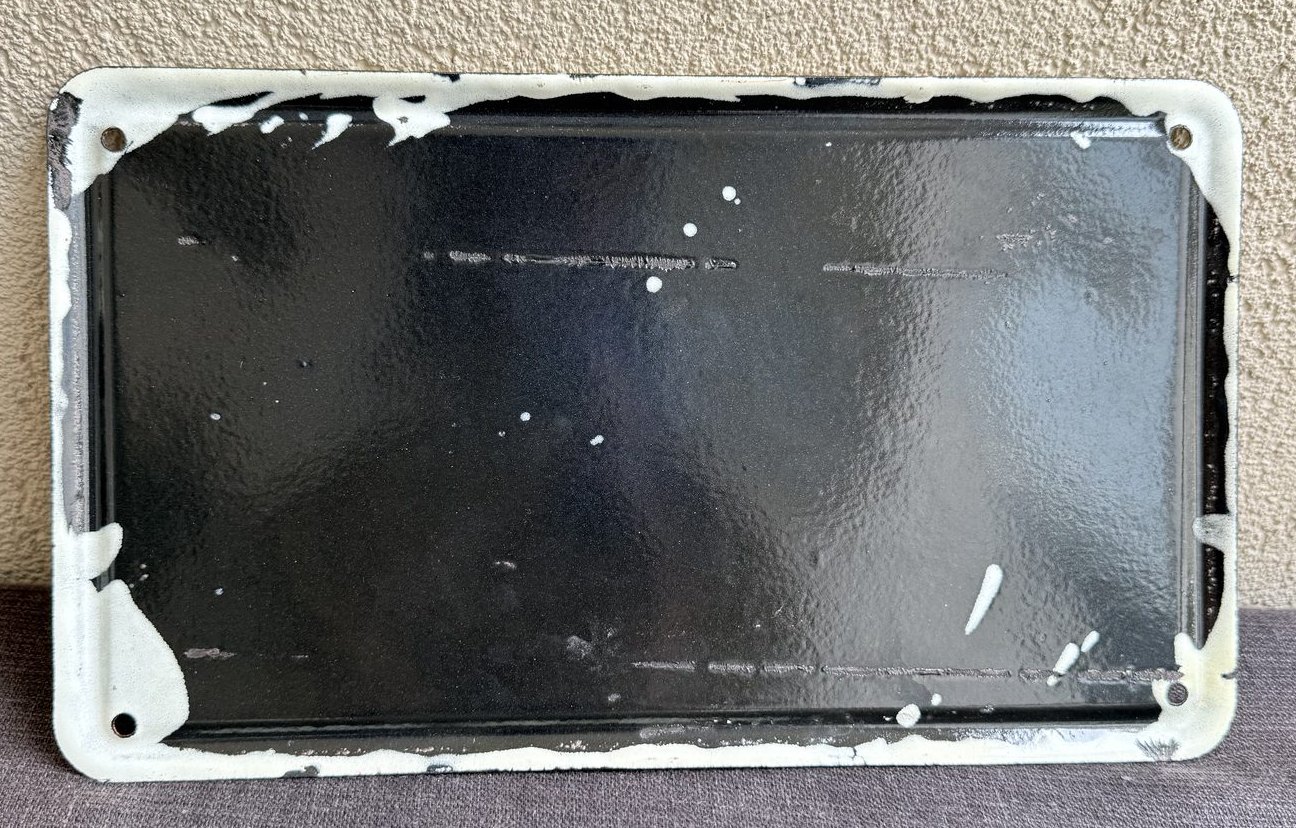
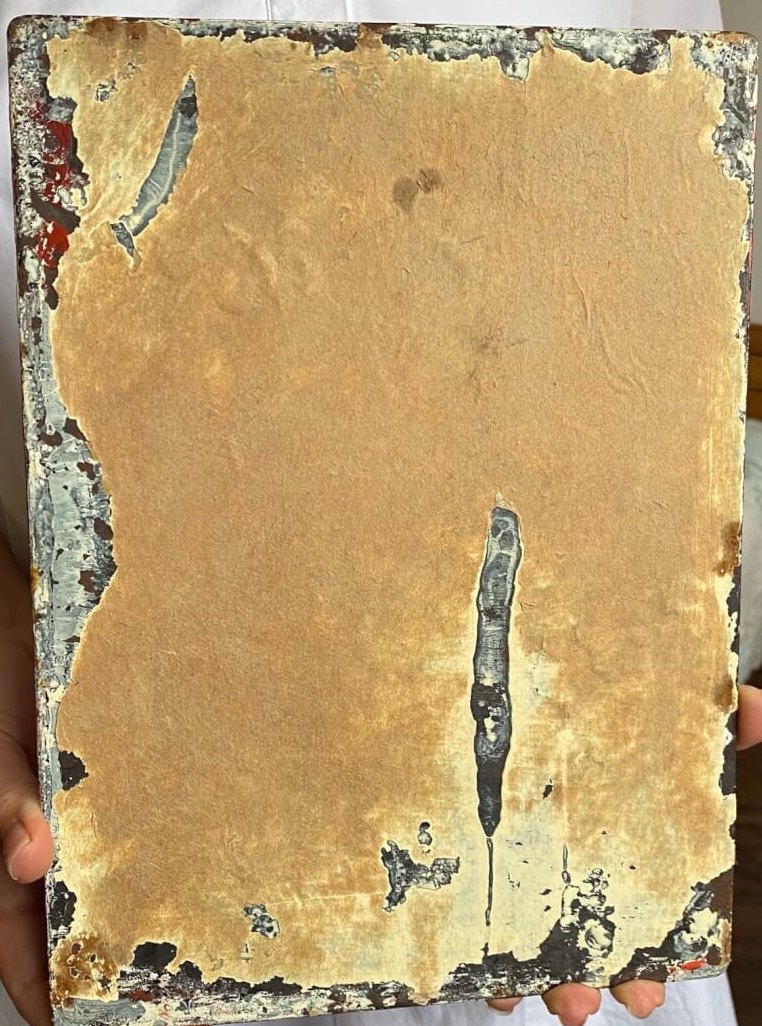
The back of a building sign: black enamel, with the white of the front spilling over along the edges.
The back. The reverse of a piece is enamelled too, so that both faces expand in the same way under heat. On many of our signs the back is plain black enamel. On some, the white of the front has spilled or run over that black.
What you find: streets, shop signs, danger, portraits
Soviet street signs
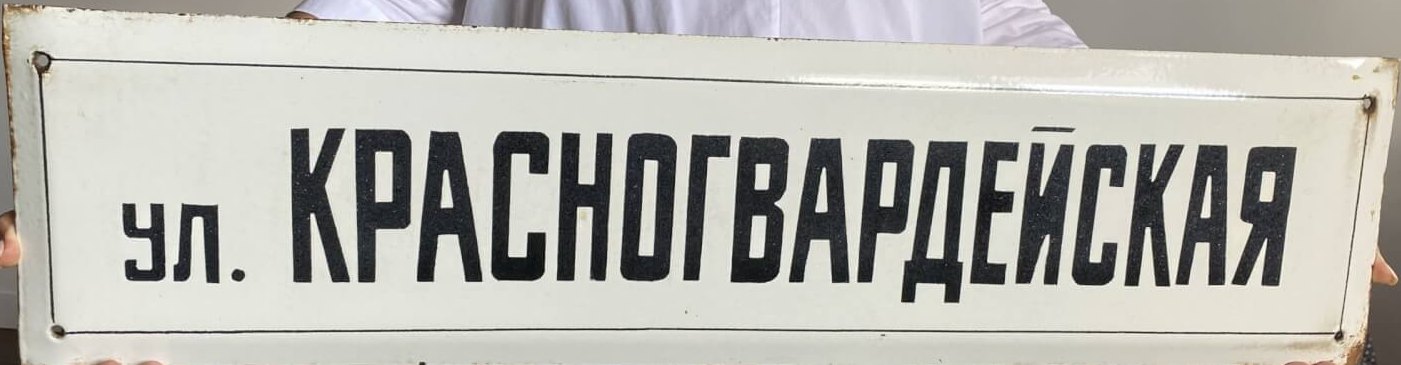
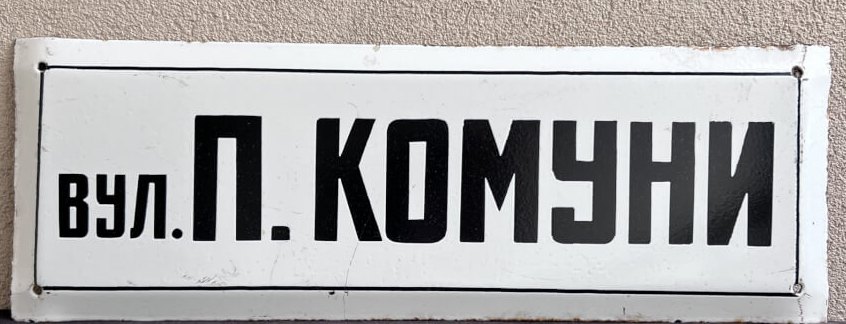
This is the largest group. The street name follows the abbreviation ул. (ul., for улица, ulitsa, street). On signs in Ukrainian it becomes вул. (vul., for вулиця, vulytsia). The names come from the Soviet calendar: the Red Guard, the October Revolution, the cosmonaut Titov. And, more surprising for a Western reader, the Paris Commune, which gave its name to streets in many Soviet towns: seven of these signs have passed through our shop.
«ул. Красногвардейская» (ul. Krasnogvardeyskaya), Red Guard Street, 91 x 23 cm.
«вул. П. Комуни» (vul. P. Komuny), Paris Commune Street, in Ukrainian, 64 x 22 cm.
Shop signs and institutions
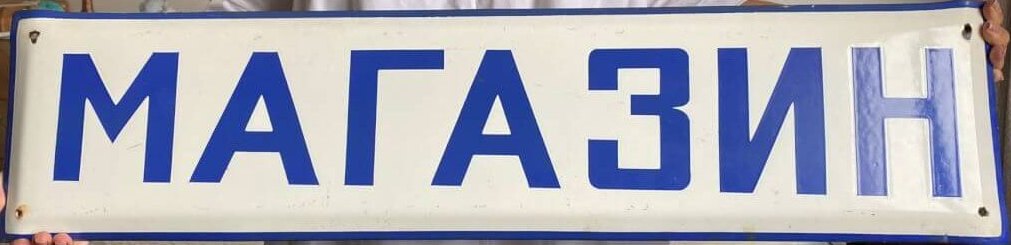
Shop, savings bank, post office, railway station safety post, workshop exit: every place had its sign. The large savings bank signs measure 70 x 50 cm and weigh about 8 kg. They hung at the entrance, with the number of the branch.
«Магазин» (magazin, shop): the sign of a food shop.
Danger and safety signs
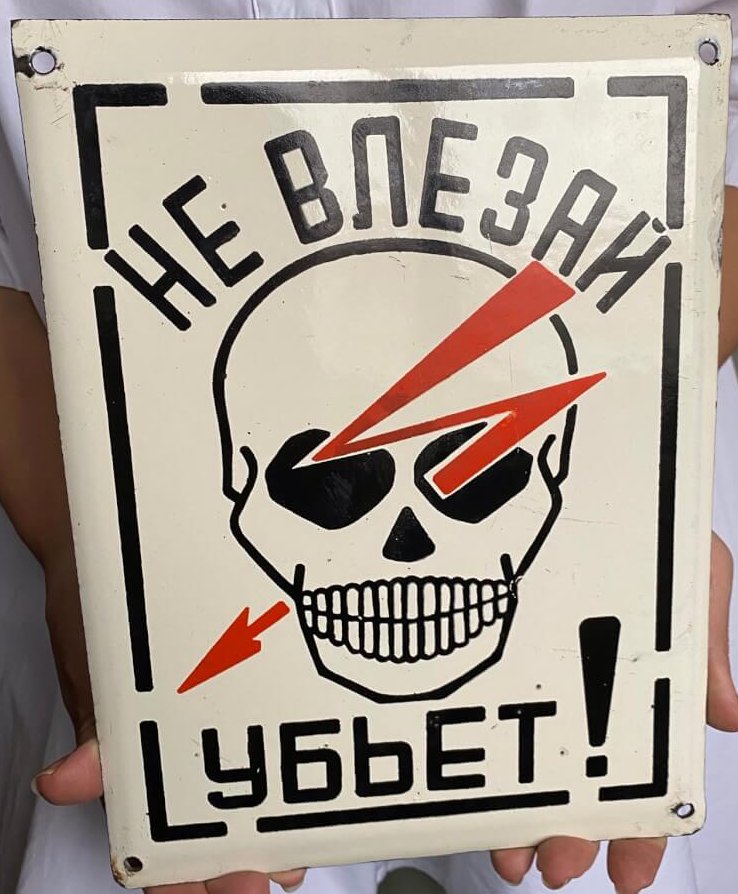
The best known danger sign is «Не влезай, убьёт» (Ne vlezay, ubyot, “Do not climb, it kills”), with its skull struck by a red lightning bolt. A Soviet electrical safety manual, archived by the Russian site forca.ru, says where it goes: in inhabited areas, on the poles of overhead lines above 1,000 volts, 2.5 to 3 metres above the ground.
«Не влезай, убьёт»: the skull and the lightning bolt, 30 x 22 cm.
«Уходя, выключайте электроприборы» (Ukhodya, vyklyuchayte elektropribory): switch off electrical appliances when you leave.
Other signs were aimed at the home. One asks you to hide matches from children, another to switch off electrical appliances when you leave. «От жучка сгорают дома» (Ot zhuchka sgorayut doma), on the sign shown further up, means “the zhuchok burns houses down”. The жучок (zhuchok) is the wire bridge fitted in place of a blown fuse to restore the power, a forbidden practice and a frequent cause of fires. The drawing shows the fuse wrapped in wire.
Portraits and commissions
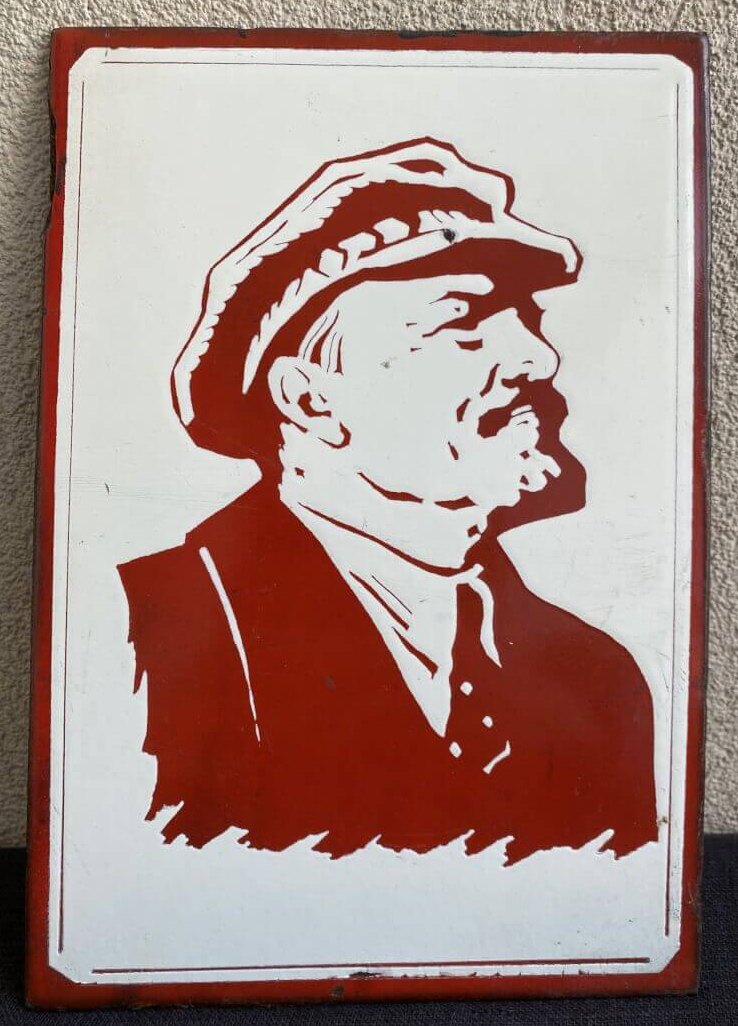
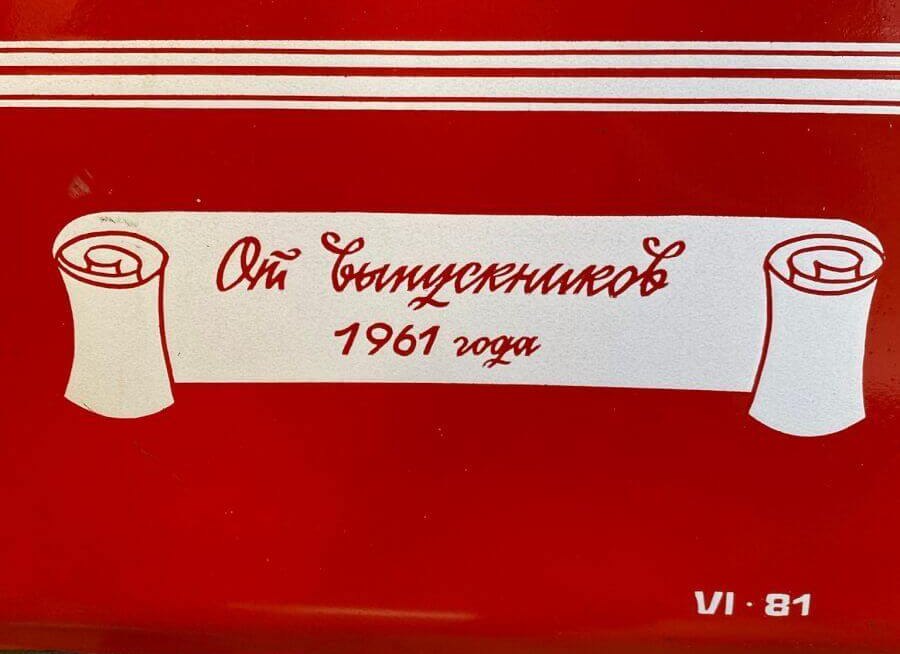
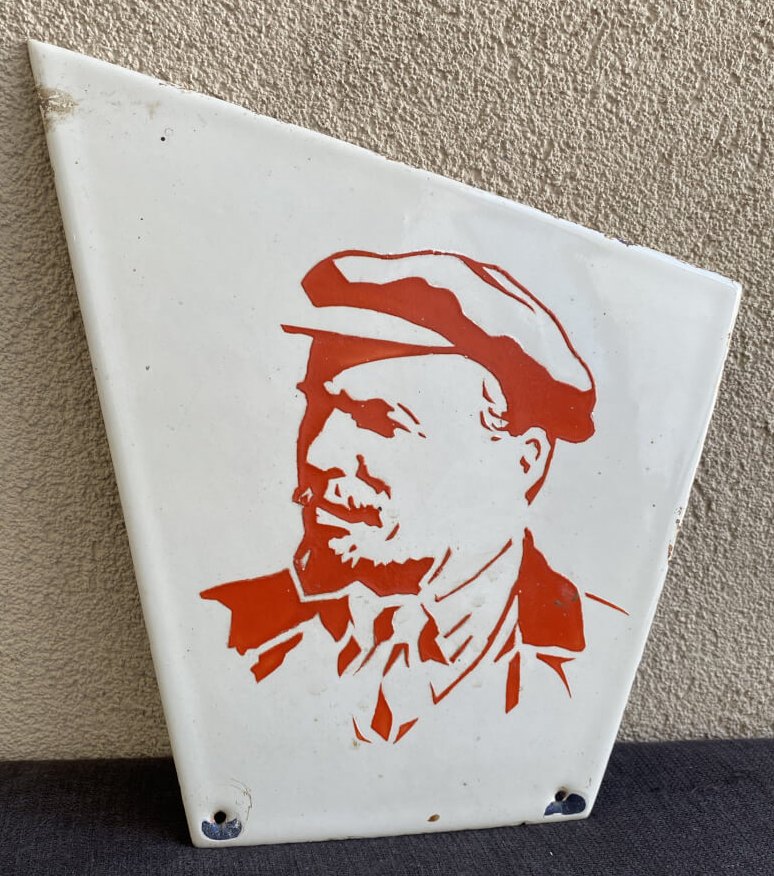
Enamel portraits of Lenin, with rounded edges, decorated the offices of Party officials. They come with a red background, or in red on white. Other plaques were private commissions. One of ours reads «От выпускников 1961 года» (Ot vypusknikov 1961 goda, “From the graduates of 1961”): former students gave it to their university professor twenty years after graduating. In the corner, the mark “VI·81” most likely reads June 1981.
Lenin portrait, red on white, 25 x 20 cm.
«От выпускников 1961 года» and, in the corner, VI·81.
Soviet train signs
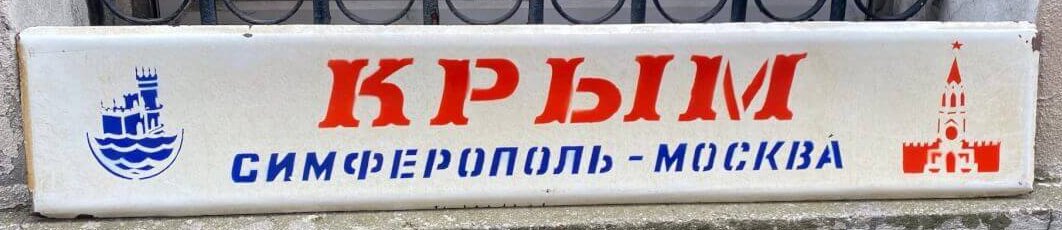
Hung on the side of the carriages by metal brackets fixed to the back, they gave the route, and for the main trains their name: «Крым» (Krym, Crimea) between Simferopol and Moscow, «Донбасс» (Donbass) between Donetsk and Moscow. They are described, together with the cast coats of arms the same carriages carried, in our article on the Soviet railway coat of arms. The Ukrainian Railways logo on a route plate points to a date after 1991: that is the case of our Lviv-Kherson plate.
Sign of the «Крым» train, Simferopol-Moscow, 1970s.
How to date a Soviet enamel sign: the inscription, then the back
An enamel sign rarely carries a date. It is dated first by what it says.
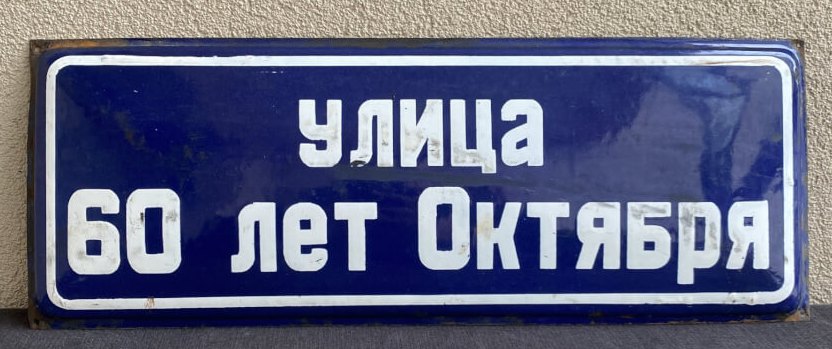
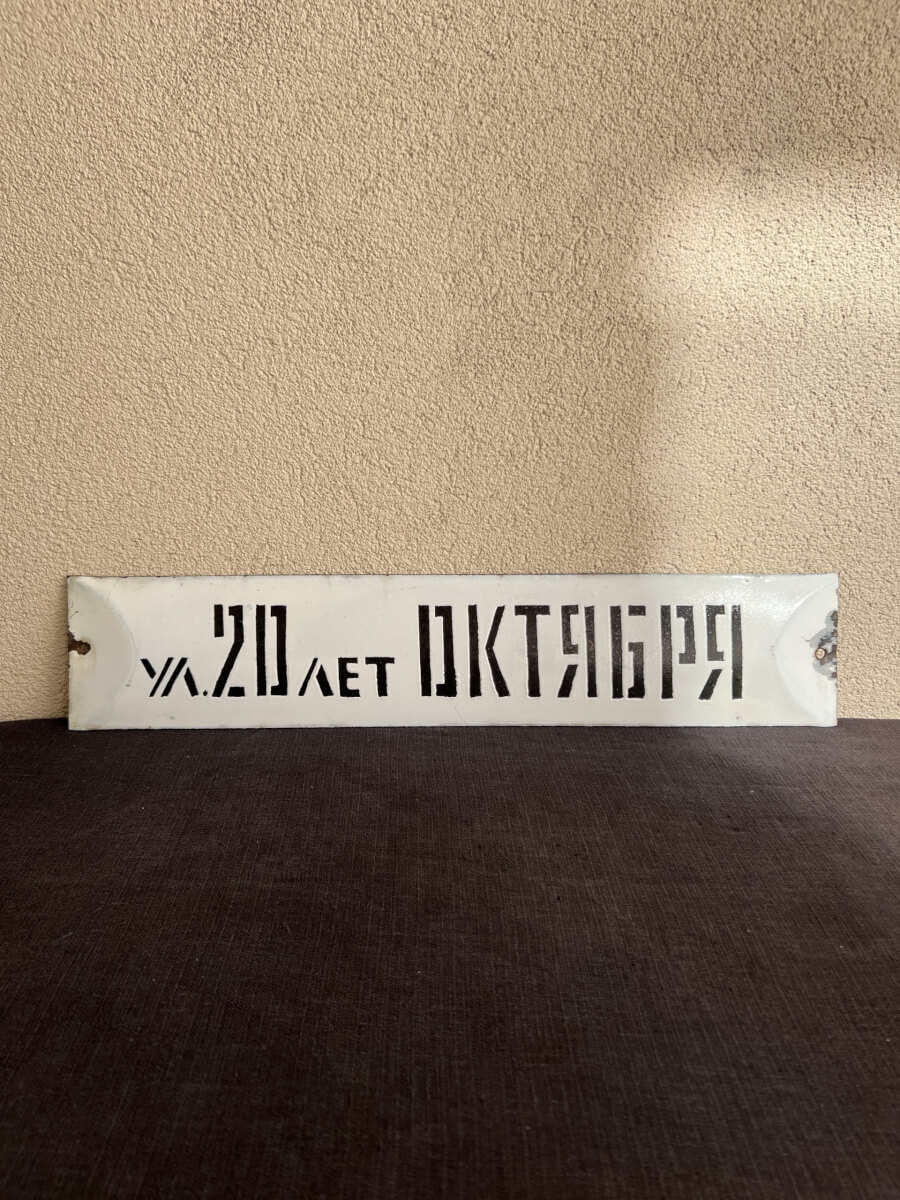
Anniversaries. Official anniversaries gave their names to streets, and the figure gives the year: 20 Years of October for 1937, 60 Years of October for 1977, 60 years of the USSR for 1982. Our «ул. 20 лет Октября» (ul. 20 let Oktyabrya) sign, which we date to 1937, is the oldest we have found so far.
«улица 60 лет Октября» (ulitsa 60 let Oktyabrya): 60 Years of October Street, 1977.
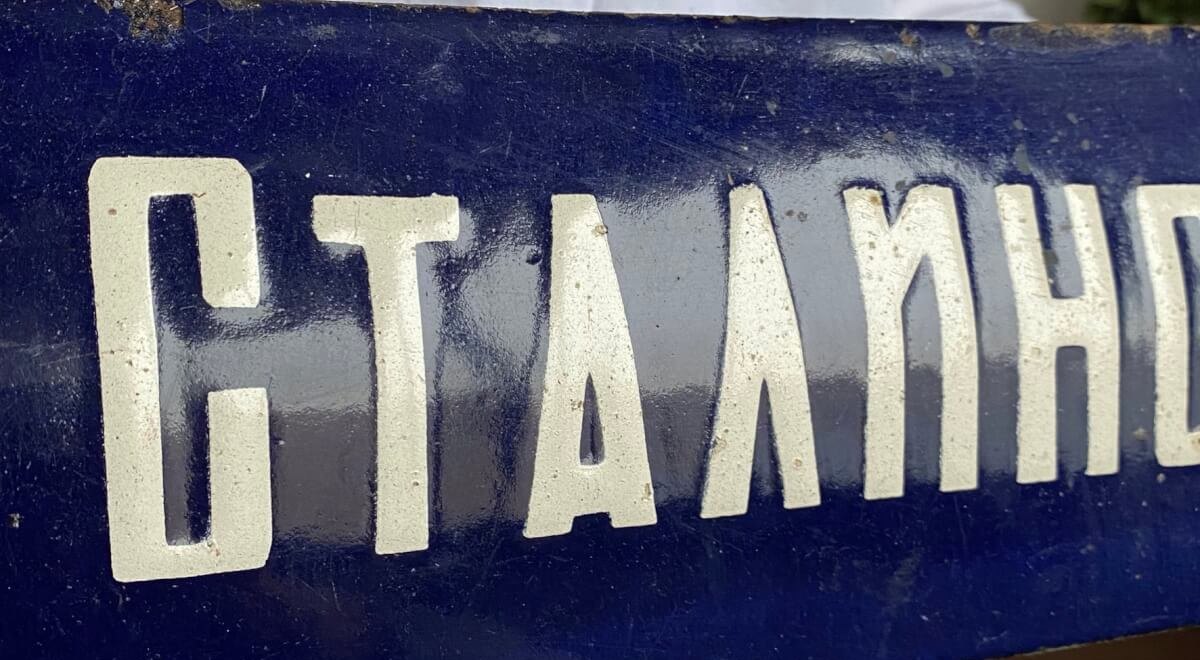
Names. A Titov Street sign was made after 6 August 1961, the date of the Vostok 2 flight. A train sign reading Донецк (Donetsk) is later than November 1961: until then the city was called Сталино (Stalino). The other way round, a Stalin Street sign is earlier than the end of 1961. Stalin streets were renamed from the mid-1950s, after the 20th Party Congress of 1956, and the last of them in the autumn of 1961, when Stalin’s body left the mausoleum and Stalingrad became Volgograd. In Kaliningrad near Moscow, now Korolyov, Maria Mironova, on the town’s history website, finds the last mention of “Stalin Street” in minutes dated 25 November 1961; by 28 December addresses read “Tsiolkovsky Street”.
The lettering of the «ул Сталинская» (ul Stalinskaya, Stalin Street) sign, 1930s or 1940s.
The signs that were taken down were destroyed or hidden away. It took us seven years of searching to find ours, «ул Сталинская», of an unusual shape, made in the 1930s or 1940s.
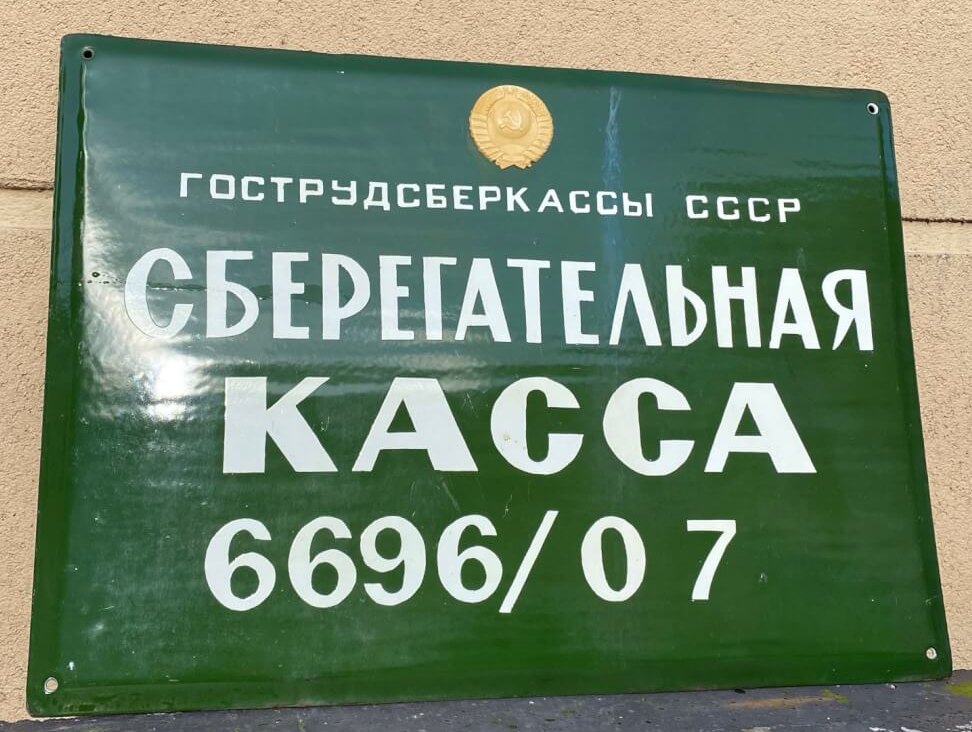
Institutions. Our savings bank sign is headed «ГОСТРУДСБЕРКАССЫ СССР» (Gostrudsberkassy SSSR), short for the State Labour Savings Banks of the USSR, above «Сберегательная касса» (Sberegatelnaya kassa, savings bank) and the number 6696/07. That name was used from 1925 to 1987, when the network was reorganised into a bank. Its Soviet coat of arms is made of Bakelite, fixed onto the enamel. Another sign in our shop, in Ukrainian, is headed «Державний банк СРСР» (Derzhavnyi bank SRSR, State Bank of the USSR). Since the savings banks were placed under the State Bank on 1 January 1963, this sign was most likely made after that date.
Savings bank sign no. 6696/07: headed «ГОСТРУДСБЕРКАССЫ СССР», with a Bakelite coat of arms.
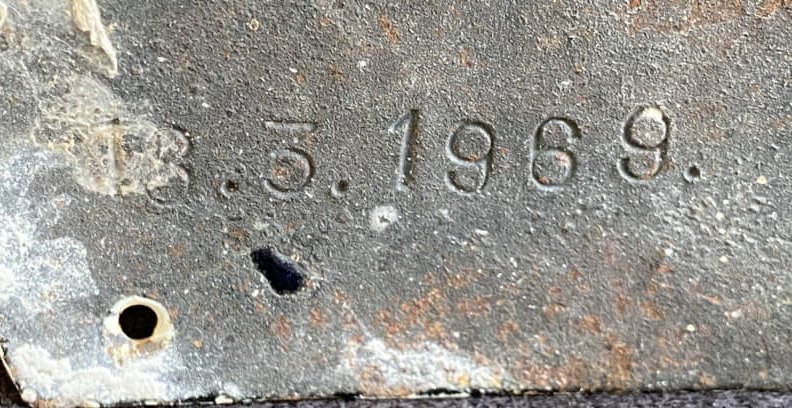
Sometimes the back. On one of our Lenin plaques, a date is punched into the back: the month and year, 3.1969, read clearly, the day is partly worn away. It is the first sign dated on the back that we have come across.
Lenin plaque, about 35 x 20 cm.
On the back of the same plaque, the punched date: March 1969.
Language alone is not a clue. A sign in Ukrainian was not necessarily made after 1991: Soviet Ukraine put up signs in its own language, as the one headed State Bank of the USSR shows. Cross the language with the street name and the abbreviations. To decipher the inscriptions, our guide to reading Cyrillic on a Soviet watch dial gives the full alphabet.
Before you buy a Soviet enamel sign
Make sure it is enamel. Enamel is glass: smooth, hard and glossy. A chip has sharp edges, like broken window glass, and shows the layers underneath, often the black ground coat under the white. Colour and patina, on the other hand, will not tell you whether a sign is a copy.
Copies and recent production. The most sought-after signs are remade today, and many of these recent productions are sold as period pieces. There are also new house signs inspired by Soviet models of the 1940s and 1950s. One workshop in Tomsk, Retroznak, makes them from 0.7 mm sheet steel coated with powder paint baked at 220 °C, with an off-white field it describes itself as an imitation of old enamel. These are decorative objects, sold as such: paint, not a layer of glass.
Read the chips. Chips around the fixing holes and along the edges are usual on a sign that was in use. Rust only appears where the metal is bare. Since enamel breaks when the metal bends, a sign that was bent and straightened keeps cracks or chips at that spot.
The back of a Lenin portrait: remains of wallpaper.
Look at the back. The back shows how a sign was fixed: screw holes, brackets, glue. One of our Lenin portraits still has remains of wallpaper on it.
As with any collector’s piece, research thoroughly, compare several examples and rely on trusted collectors’ sites and buying guides.
For another family of Soviet plates, where copies are common, see our article on the Soviet border post plate. All our signs are in the Enamel signs category, and street signs in Street signs.
The ДП-5В (DP-5V) is the field radiometer of Soviet civil defence: a green Bakelite console, a probe with a rotating gamma, beta and check-source shield, headphones and a manual that explains operation and maintenance. The one in this article served in an industrial bakery in Chișinău and was serviced in March 1991. Its owner shared his photos and documents with us, and we turned them into a tool that lets you operate it on screen, step by step.
The Moscow Games, from 19 July to 3 August 1980, boycotted by some sixty countries, produced more objects than any Soviet event: a bear cub, Misha, drawn by Viktor Chizhikov, an emblem made of running tracks, five thousand torches, watches from every factory, platinum coins, rings, tea glass holders, posters. This guide tells the story of the Games and reviews the objects, with the marks that authenticate them and the prices.
The 3017 chronograph of the First Moscow Watch Factory carries a five-digit number on the balance cock. The most common dating method reads it as a single series, from 1959 to 1979. Four factory passports show there are two, and that the same number can point to two watches made ten years apart. Here is how to read the number, the dial, the logo and the bridge, with a decoder to date your Strela, Poljot or Sekonda.
This website uses cookies to improve your experience while you navigate through the website.
Out of these cookies, the cookies that are categorised as necessary are stored on your browser as they are essential for the working of basic functionalities of the website.
We also use third-party cookies that help us analyse and understand how you use this website.
These cookies will be stored in your browser only with your consent.
You also have the option to opt out of these cookies.
But opting out of some of these cookies may affect your browsing experience.
Necessary cookies are absolutely essential for the website to function properly. This category only includes cookies that ensure basic functionalities and security features of the website. These cookies do not store any personal information.
Cookies that are not strictly necessary for the website to work and that are used specifically to collect personal data through analytics, ads and other embedded content are called non-necessary cookies. User consent is required before these cookies run on the website.
✕
Soviet in Paris
Online. We answer in person, no AI and no chatbot. Reply right away, 20 min at most.
Hello 👋 A question about an item, an order or shipping? Write to us.
Your email is used only to reply to you.
Subscribe to our newsletter and get 10% off your first order.
Subscribe
★ New pieces before anyone else
★ New blog articles
★ Soviet in Paris news and updates
Join the Party
10% off your first order
Receive your welcome card and our next arrivals.
Your code appears here and is also sent to you by email. You can leave the Party in one click, at any time.