This guide covers the history of the Soviet border post and its coat-of-arms plaque, the German photograph of 22 June 1941, how to date a plaque by its ribbons, the versions that have passed through our shop, and what survives today in Belarus and Russia.
OCTOBER 2026•11 MINUTE READ
by Marwen Yahyaoui
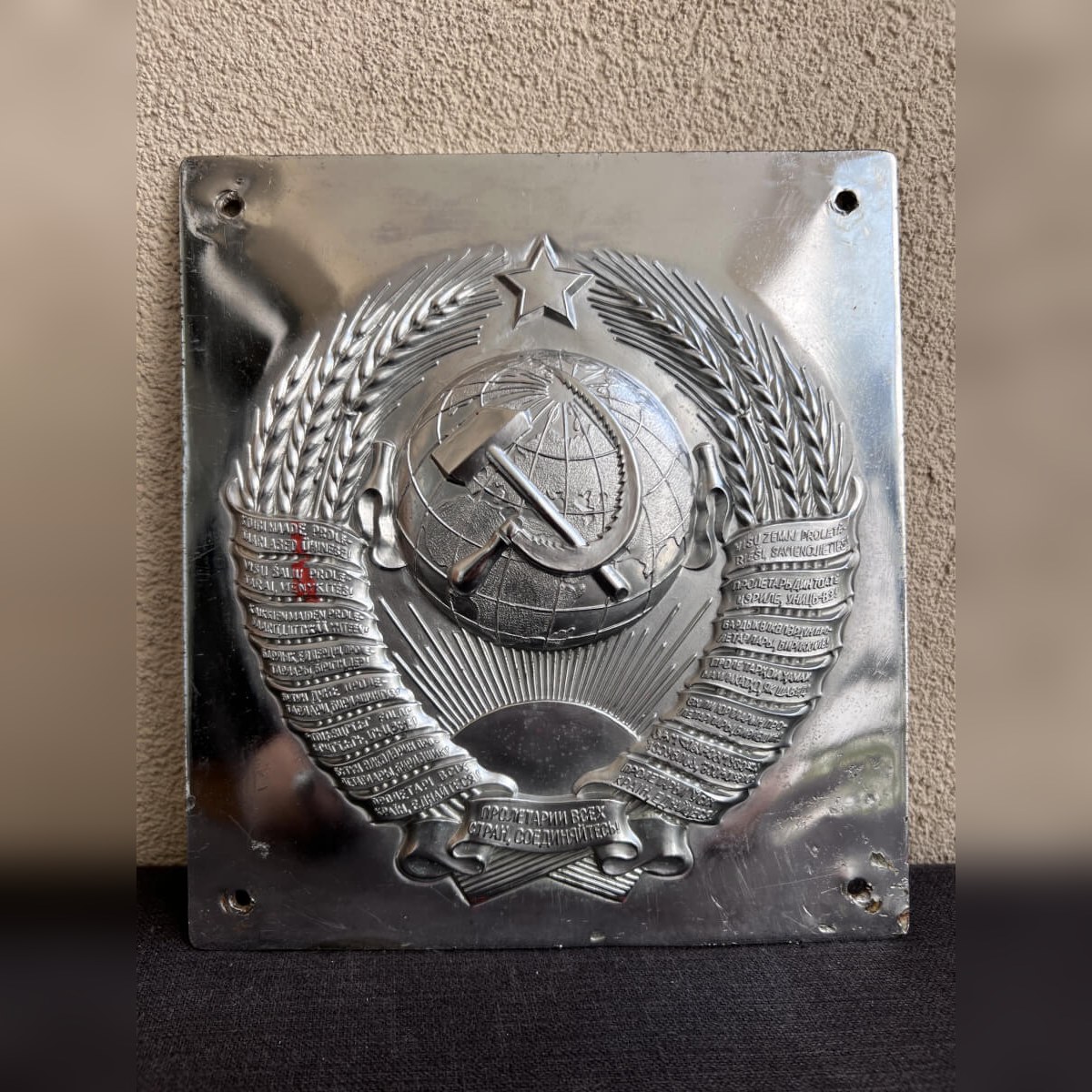
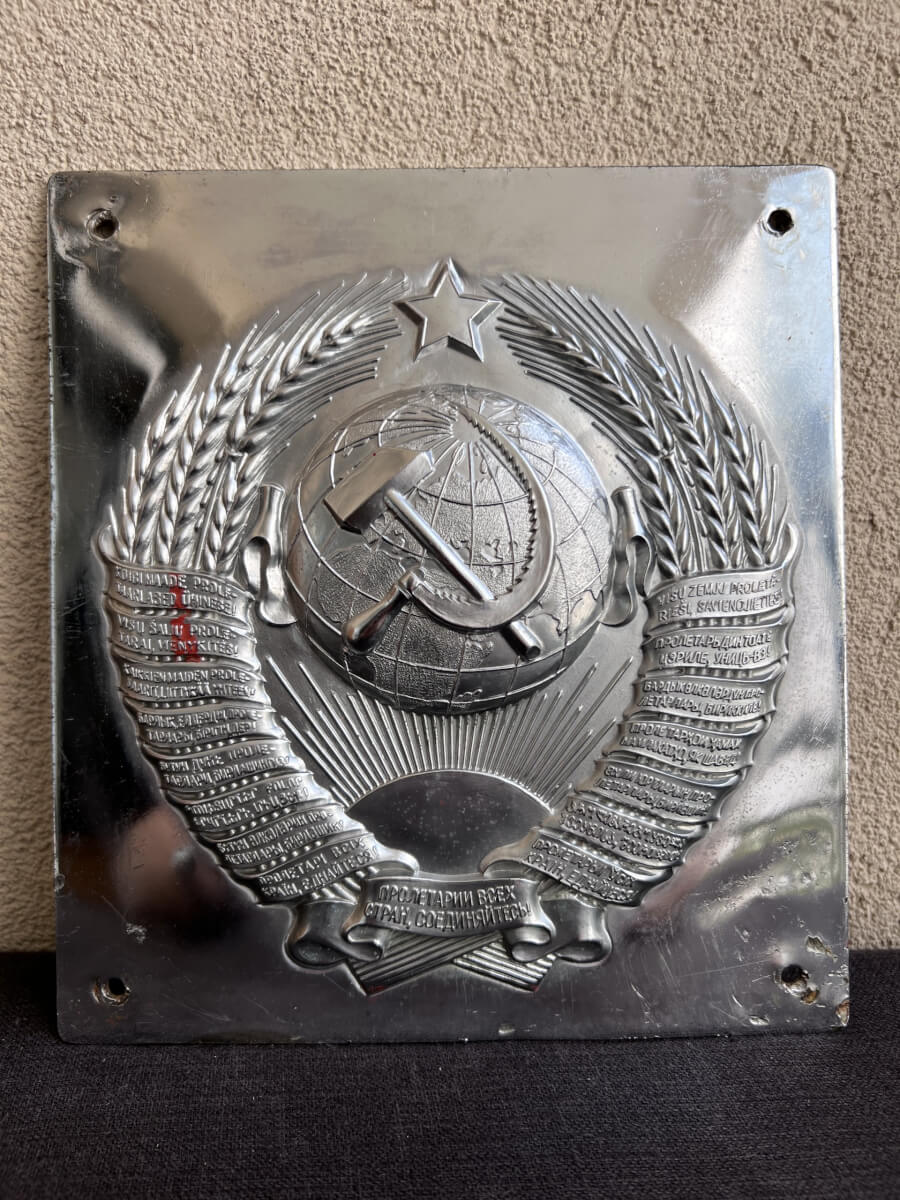
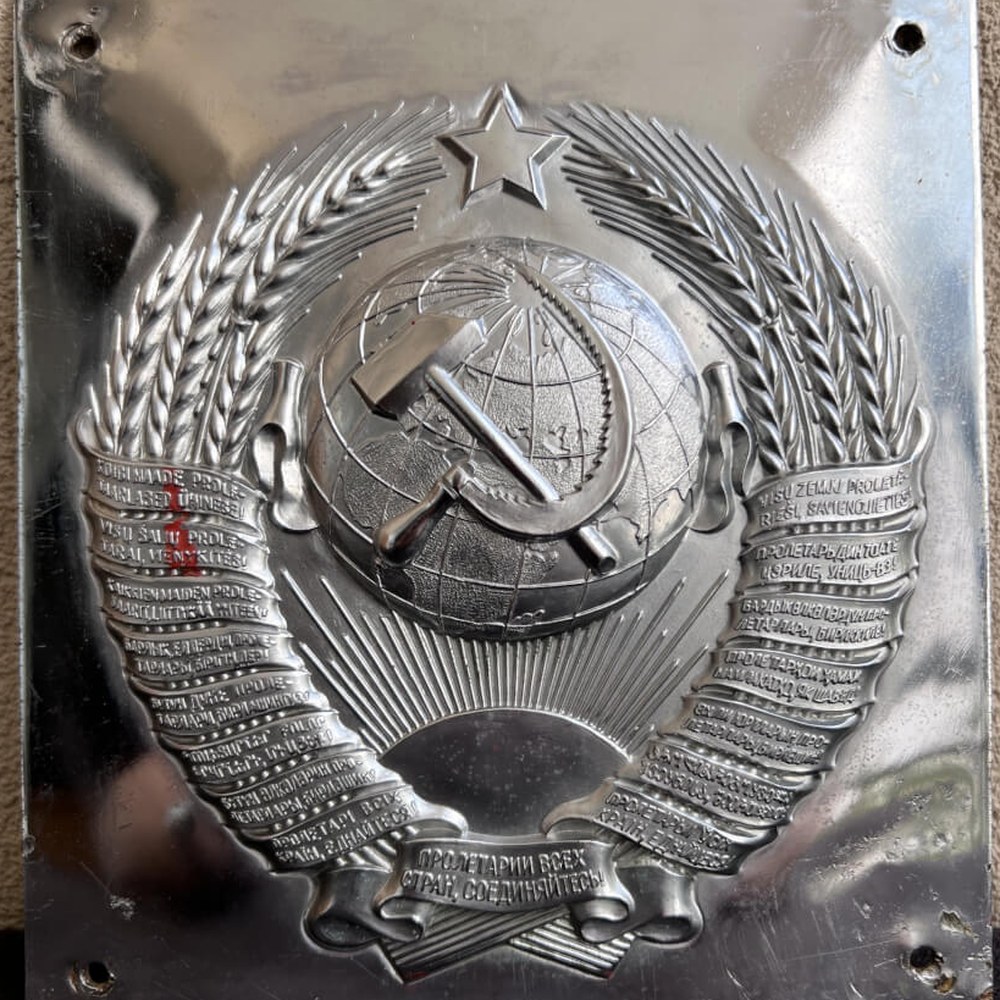
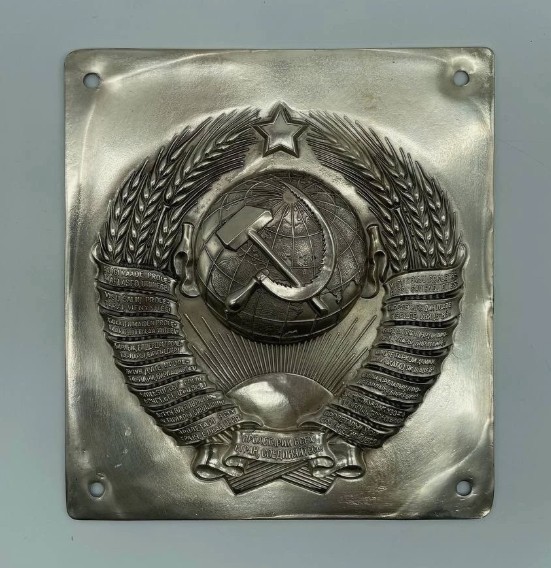
Soviet border plaque in nickel-plated copper alloy: the coat of arms of the Soviet Union and four fixing holes.
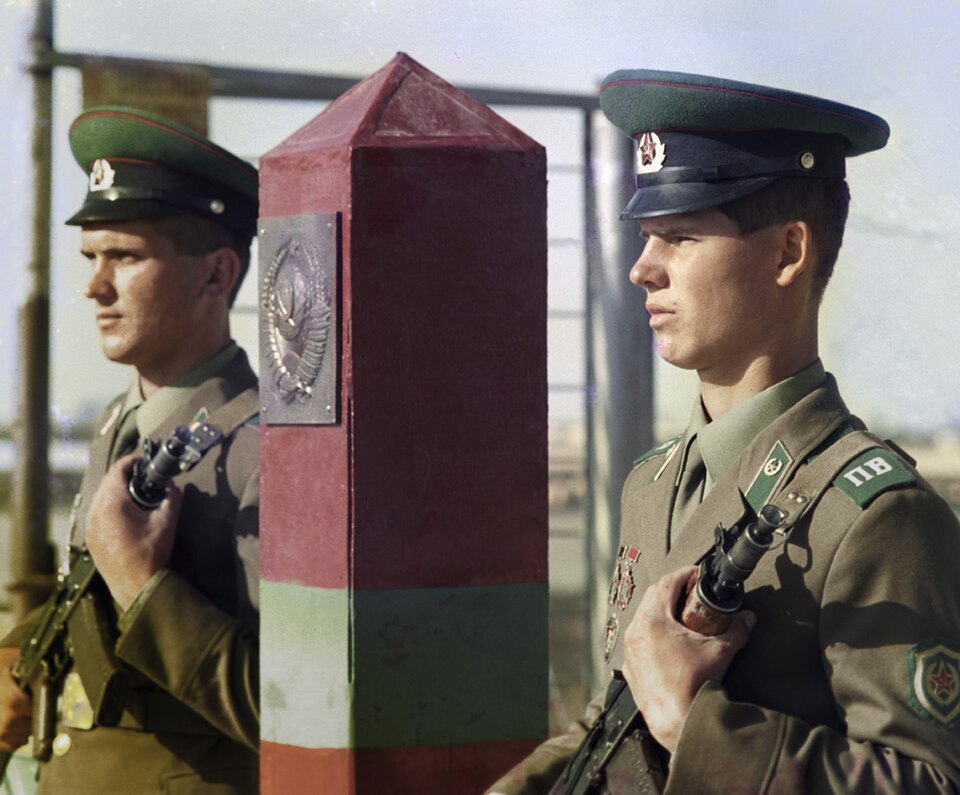
The Soviet border plaque is a metal plate bearing the coat of arms of the Soviet Union. It was screwed to the top of the red and green posts set along the state border, facing the neighbouring country. Anyone arriving from Finland, Poland, Turkey or Afghanistan saw it before anything else.
Around fifteen have passed through our shop, in several versions. This guide gathers what the legal texts, period photographs and the pieces themselves tell us.
The red and green post
Soviet-Afghan border, 1 June 1988: the nickel-plated plaque with the coat of arms at the top of the post. Photo V. Kiselev, RIA Novosti, Wikimedia Commons, CC BY-SA 3.0.
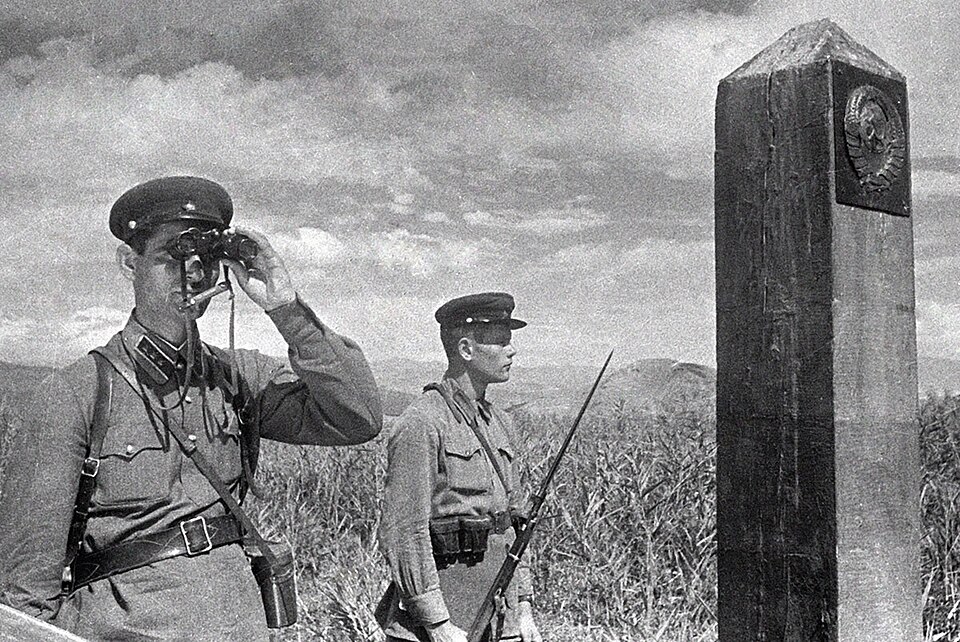
The Russian Empire already marked its border with posts, painted white, red and black to a pattern approved in 1905. According to a study published in 2024 by E. Ryabova and L. Ternovaya, it was in 1938 that the USSR began installing red and green posts bearing its coat of arms along its whole border.
The State Border Committee of Belarus describes the principle: wooden posts painted in red and green bands, with a metal plate bearing the coat of arms fixed near the top.
Soviet texts say little. The 1960 statute only states that the border is marked by “clearly visible” signs: posts, pyramids, mounds or buoys. The 1982 law refers shapes and dimensions to other texts and to treaties with neighbouring states. Each post carried a number.
Armenia, Turkish border, August 1940: the coat of arms in relief on a post. Photo Dmitri Debabov, public domain.
22 June 1941
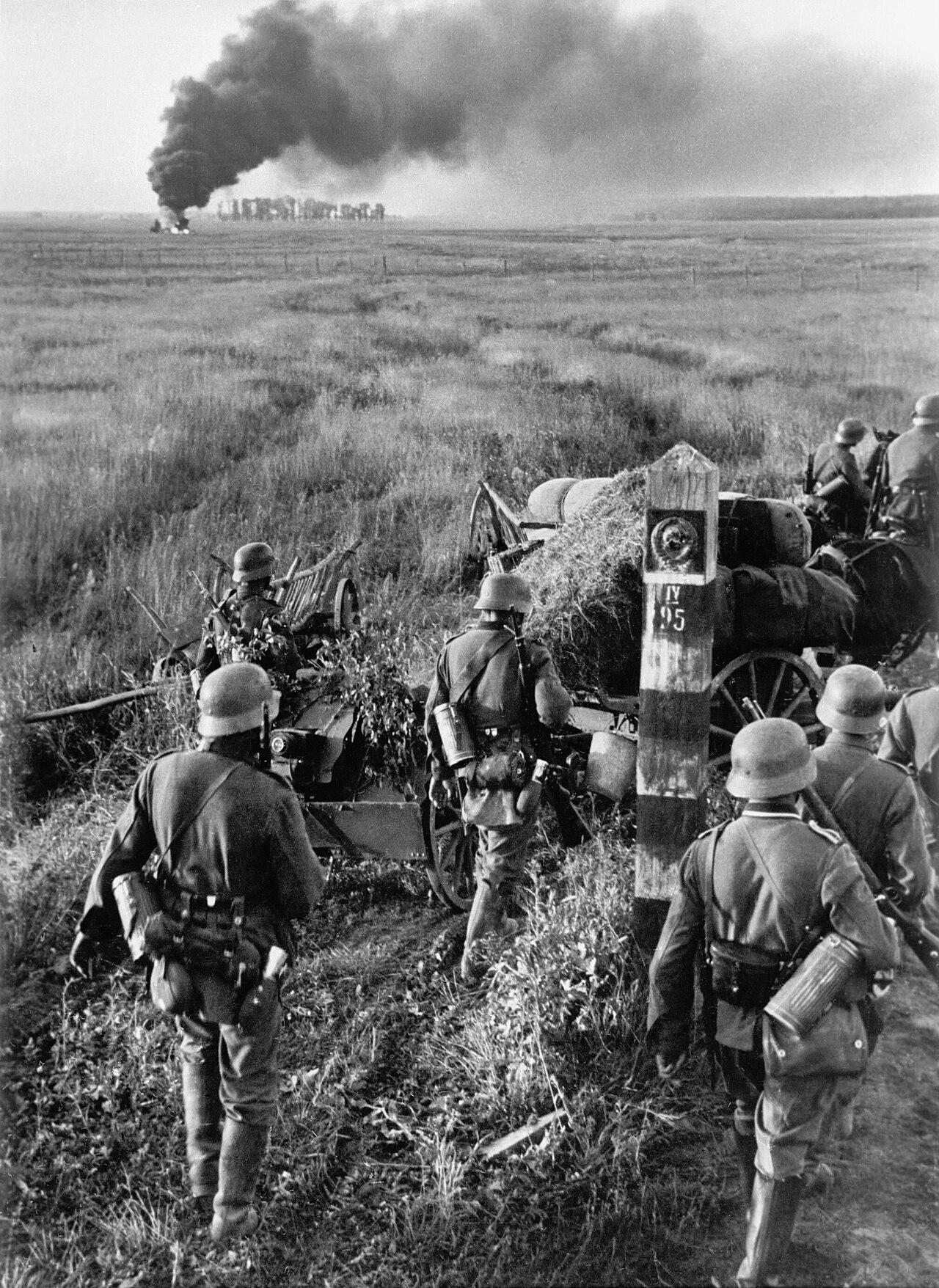
22 June 1941: German soldiers pass Soviet border post no. IV/95. Photo attributed to Johannes Hähle, Propaganda Company 637, public domain.
The best-known photograph of a Soviet border post was taken by the invader. It shows a German column, a horse-drawn infantry gun, and in the foreground post number IV/95. Black smoke rises on the horizon.
It is attributed to Johannes Hähle, photographer of Propaganda Company 637. A Russian association of former border guards searched for the location from the number. It places the post on the right bank of the Solokiya, near Krystynopol, in what is now Lviv region, in a sector guarded by the Rava-Ruska border detachment.
In this picture the coat of arms stands in relief on a dark square field. The bright nickel-plated plate of later decades is not visible. The official 1941 coat of arms had eleven ribbons, as in the 1937 design.
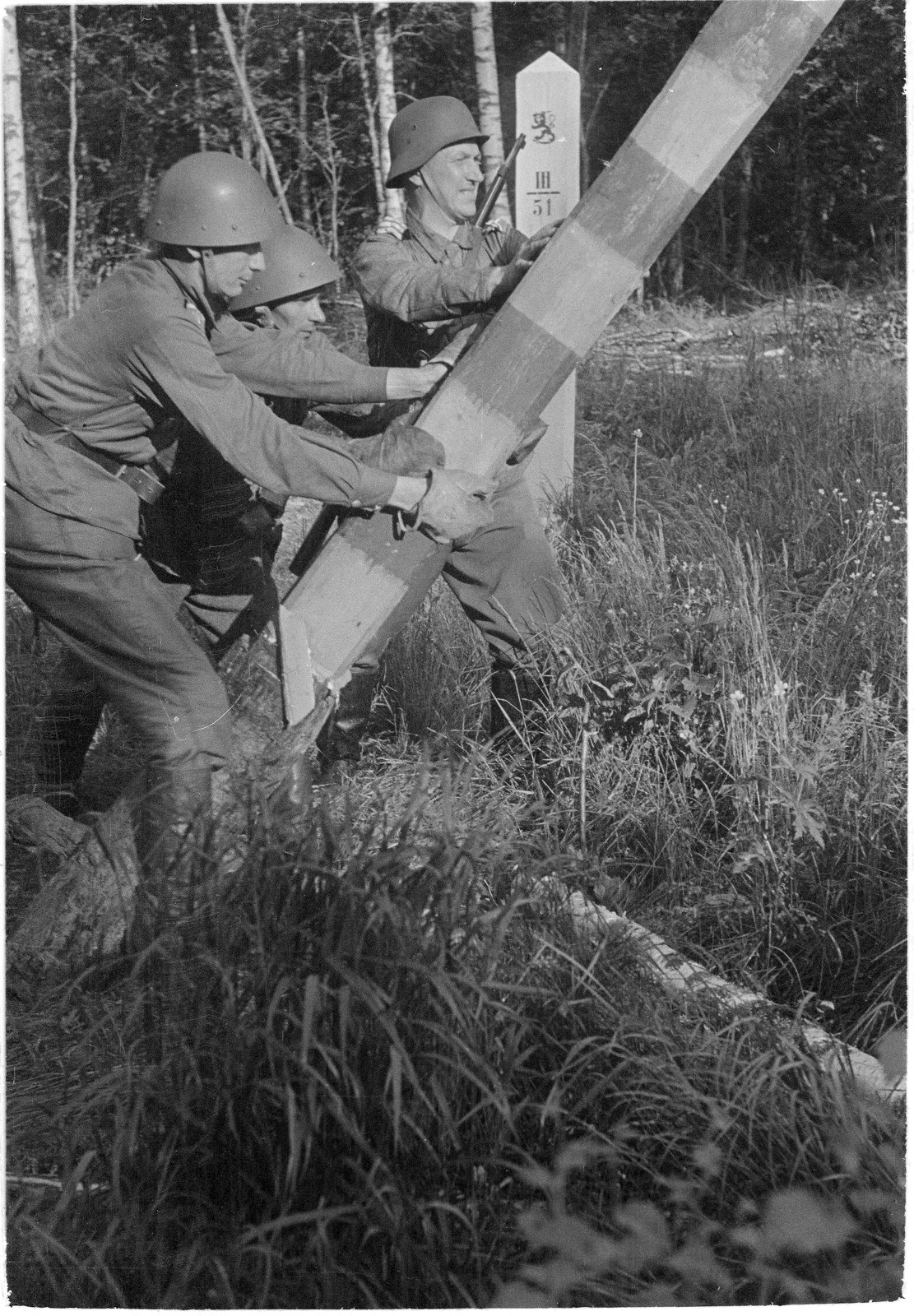
On the Finnish side, army photographers recorded the same scene a few weeks later.
11 September 1941: Finnish soldiers topple a Soviet post. Behind, the Finnish post with the lion. Photo Esko Manninen, SA-kuva, CC BY 4.0.
Before the war: the cast plaque
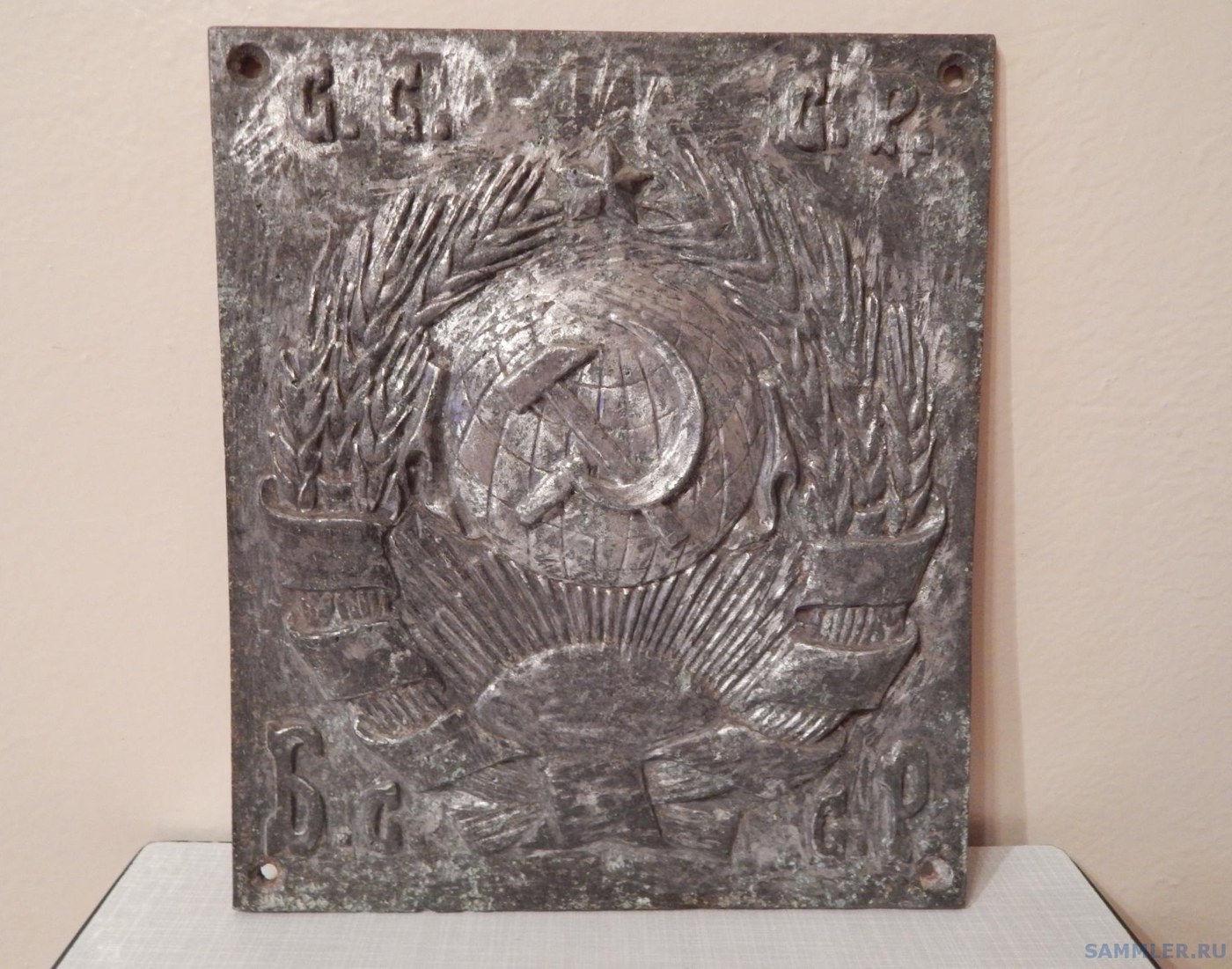
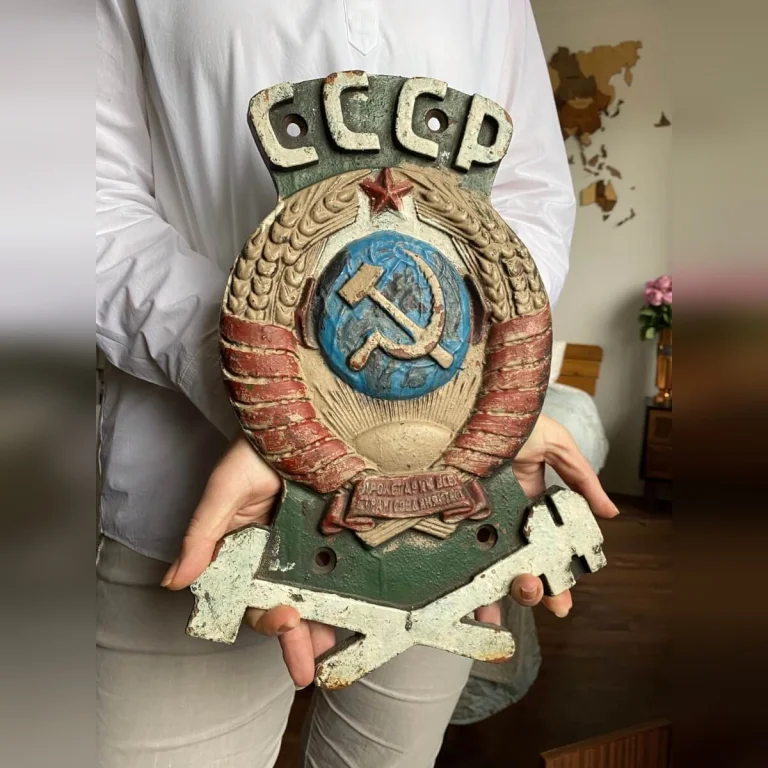
Pre-war plaque: the letters С.С.С.Р. at the top, Б.С.С.Р. at the bottom, for the Belarusian republic. Photo West60, Sammler.ru forum.
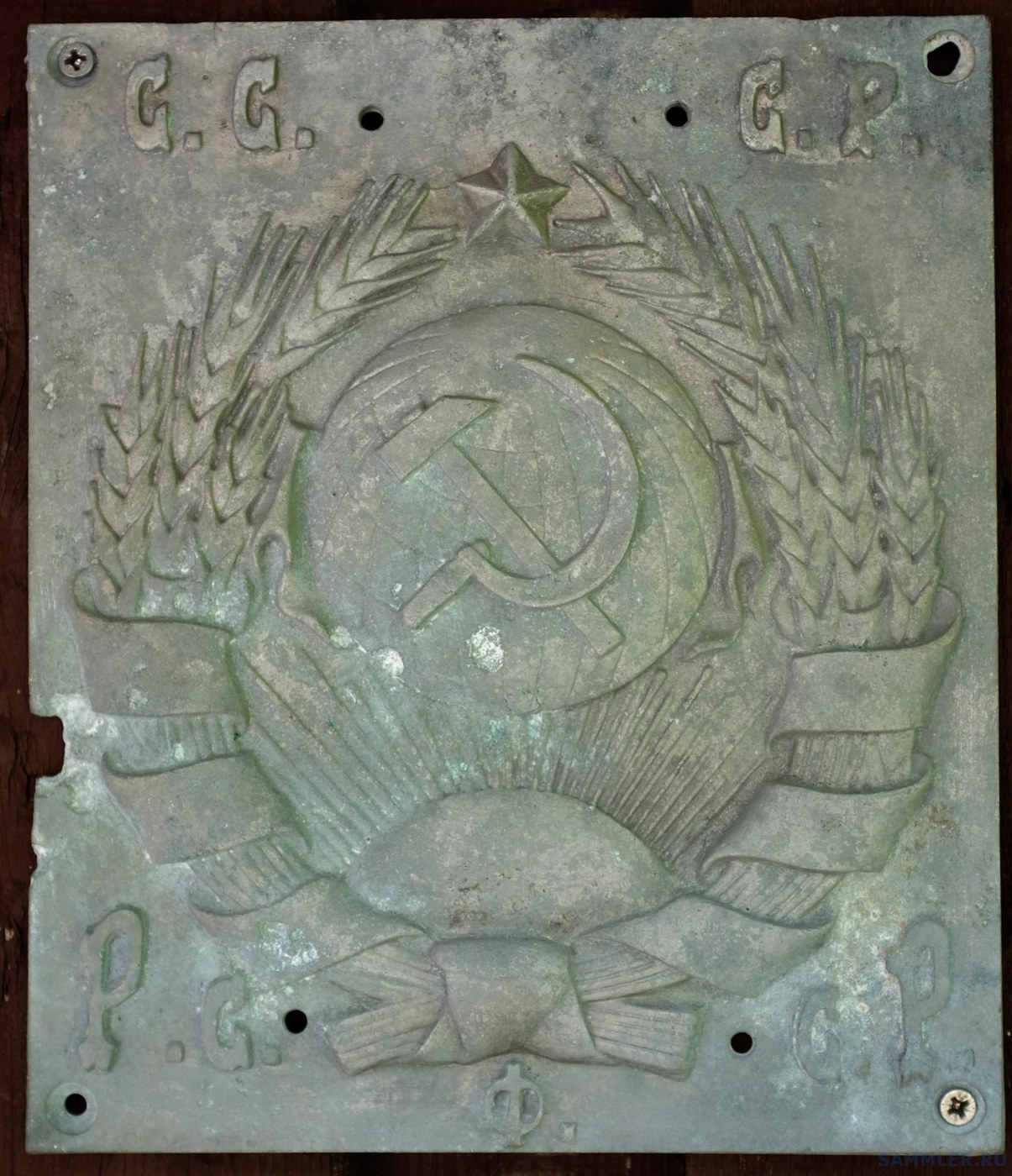
Plaques from before the Second World War were made differently. They are cast, thick, with no bright nickel plating. Collectors who have posted them on the Russian forum Sammler describe them as aluminium, 23 x 27 cm, 4 mm thick, weighing about 1 kg. The letters С.С.С.Р. are moulded above the coat of arms. At the bottom are the initials of the republic whose border the post guarded: Б.С.С.Р. for Belarus, Р.С.Ф.С.Р. for Russia.
The coat of arms has seven ribbons. This is the design in force from 1931 to 1936, when the Union had seven republics. In all likelihood this is the type of plaque seen in the photograph of 22 June 1941.
Pre-war plaque with the initials Р.С.Ф.С.Р., for the Russian republic. Photo PVN18, Sammler.ru forum.
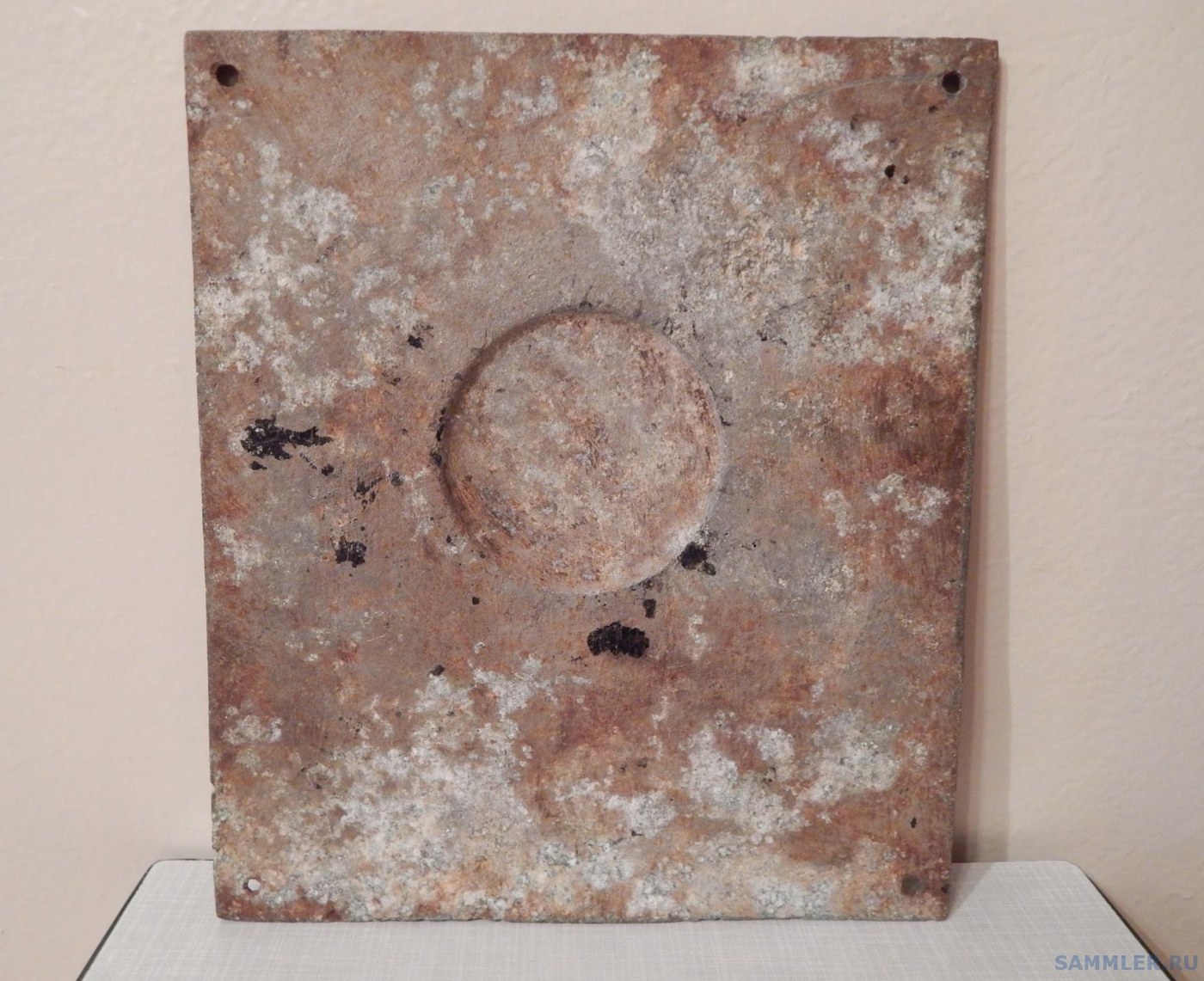
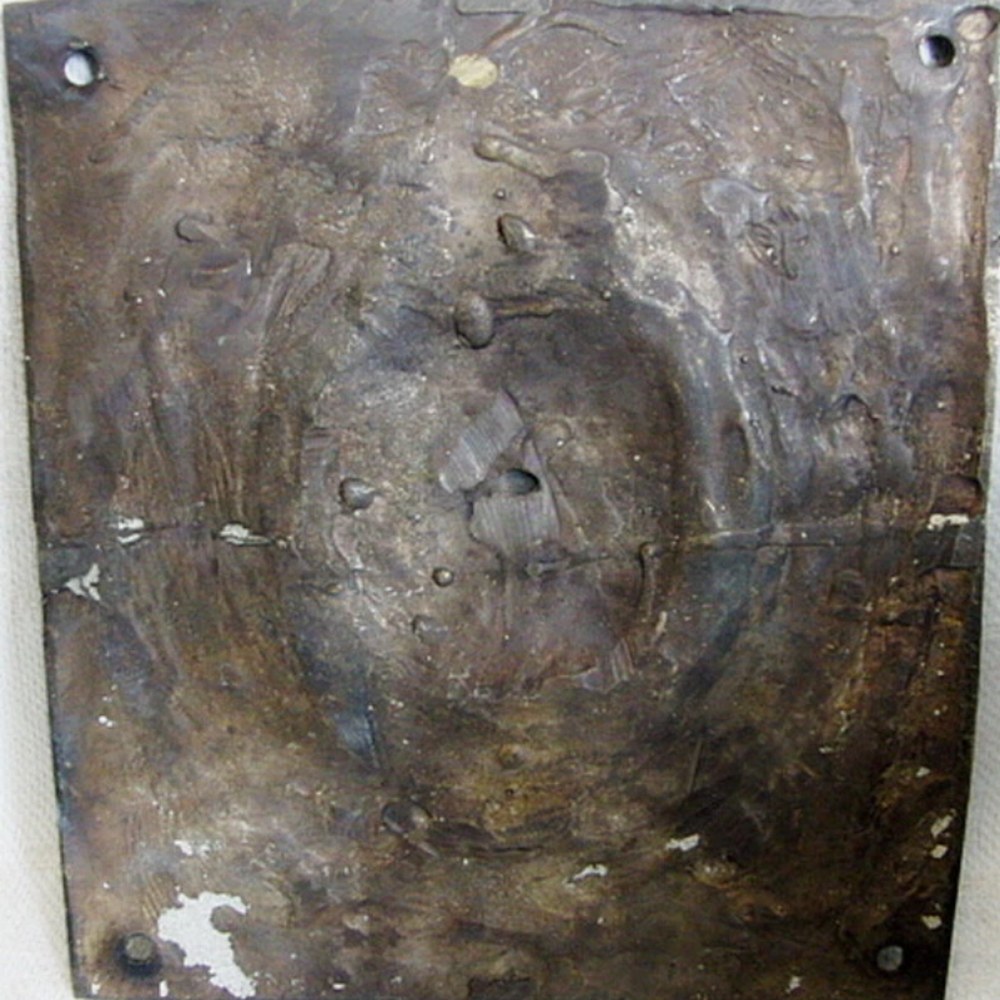
The back is flat, with a plain round hollow behind the globe.
These plaques were found on farms near the former border, on the Latvian side and near Polotsk. The one with the initials Р.С.Ф.С.Р. has four extra holes. According to its finder, it had been refixed to a concrete stele about three metres high.
The back of the Б.С.С.Р. plaque. Photo West60, Sammler.ru forum.
Who guarded the border
The border troops changed hands several times. They came under the OGPU in the 1920s, the NKVD from 1934, then the MVD and the MGB after the war. They were transferred to the KGB by an order of 2 April 1957 and stayed there until December 1991.
This is why the piece is commonly called a “KGB plaque”. The sixteen-ribbon examples were designed before that date. They were guarded by the MVD and the MGB, then by the KGB.
Demobilisation album of a border guard, Iranian border, 1974-1976: each soldier poses next to the post.
The post was the symbol of these troops. Conscripts had their picture taken beside it, and it appears on the covers of their demobilisation albums.
Cover of a border guard’s demobilisation album, late 1970s: the red and green post.
Reading a Soviet border plaque
All the metal plaques we have handled are built the same way.
A rectangular plate with a hole at each corner.
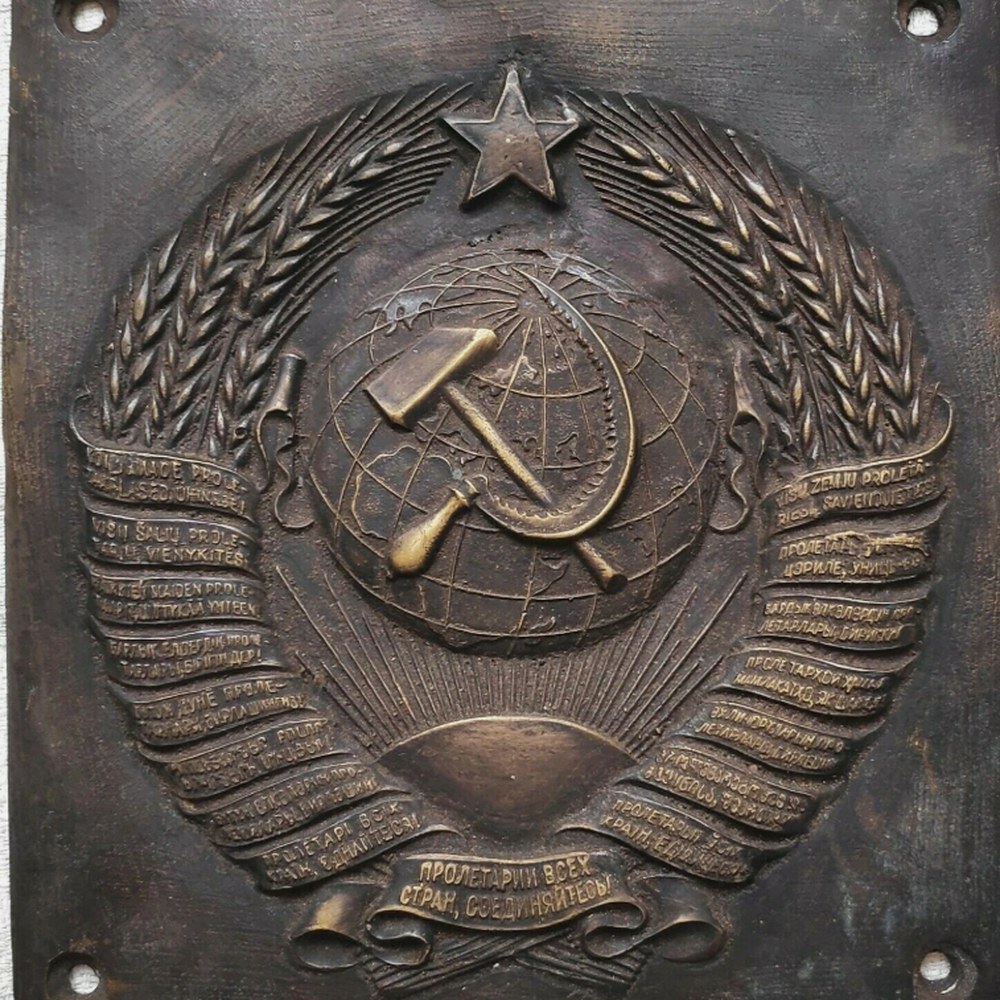
The USSR coat of arms in high relief: the globe, hammer and sickle, rising sun, ears of wheat and star.
The motto “Workers of the world, unite!” on the ribbons, in the language of each republic.
A nickel-plated front and a bare back.
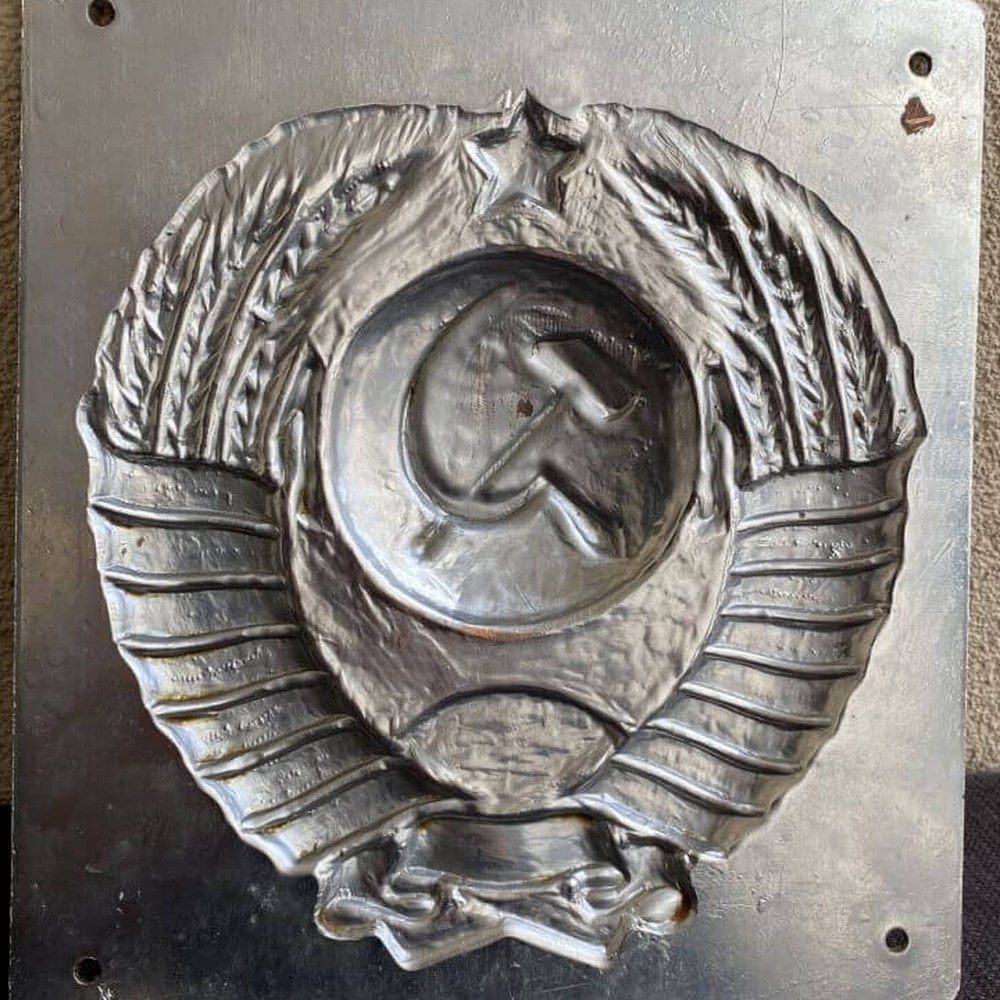
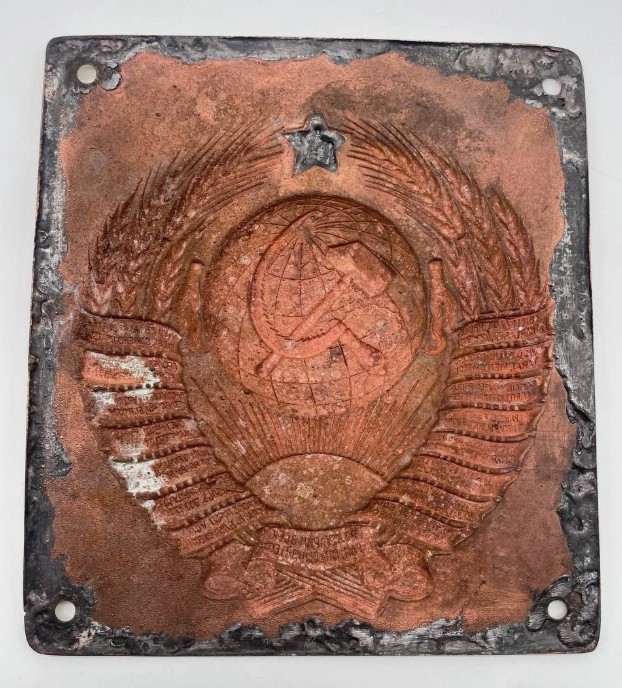
The relief is pressed: the back shows the coat of arms in reverse. The metal is a copper alloy, nickel-plated on the surface, weighing about 1 kg. Where the nickel is worn, the coppery tint shows through.
The back: the coat of arms in reverse, bare metal.
The back carries small stamps struck near a fixing hole, often a digit in a frame. A second stamp, shaped like a butterfly, goes with it. These are the maker’s stamps.
Maker’s stamp on the back of a plaque, near a fixing hole.
The second stamp, shaped like a butterfly.
Counting the ribbons to date it
The USSR coat of arms changed with the number of republics: eleven ribbons from 1937 to 1946, sixteen from 1946 to 1956, fifteen from 1956 to 1991.
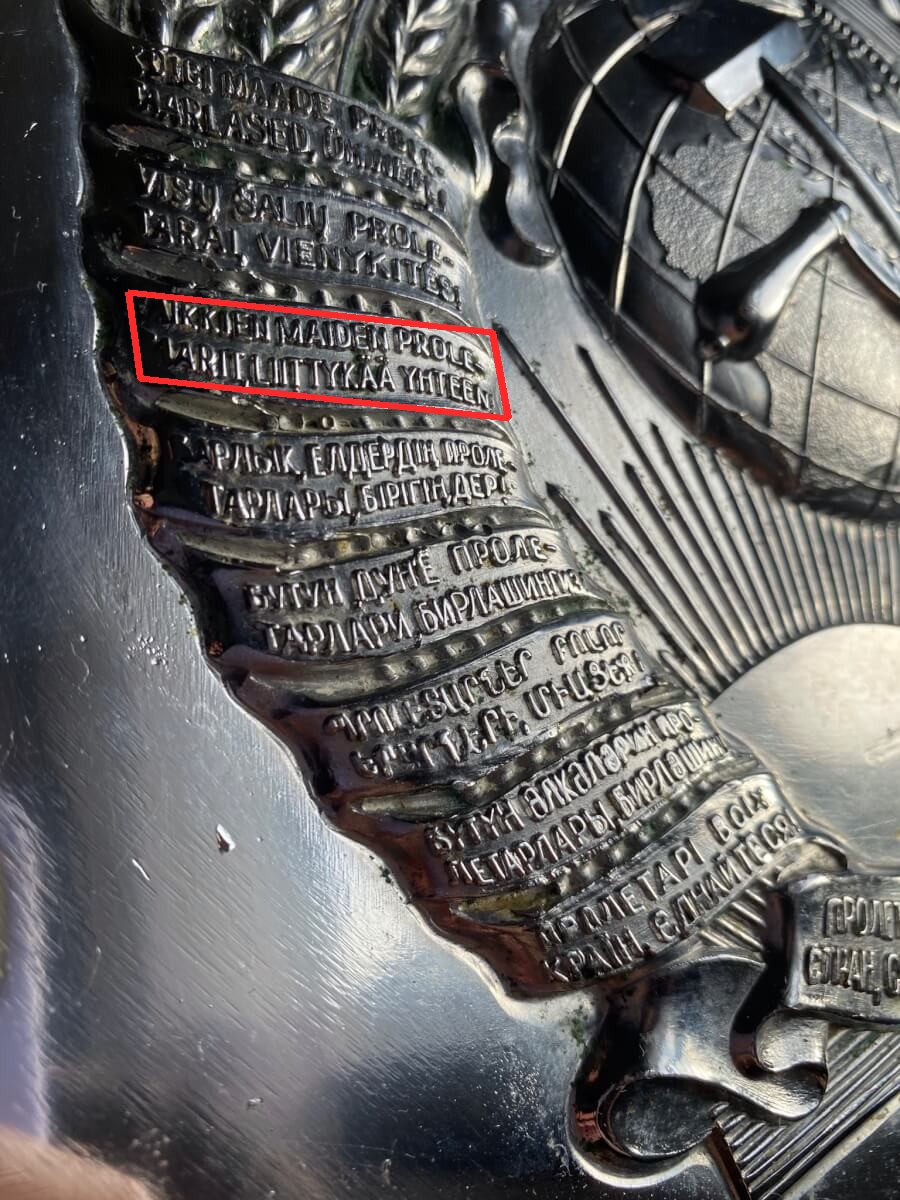
The sixteenth ribbon belongs to the Karelo-Finnish republic, merged into Russia in 1956. Its motto is in Finnish. It is the simplest marker: on the left side, the third ribbon from the top reads “Kaikkien maiden proletaarit, liittykää yhteen!”, below the Estonian and the Lithuanian.
Framed in red, the third ribbon is in Finnish: the plaque follows the sixteen-ribbon coat of arms of 1946-1956.
Every nickel-plated plaque we have been able to check from photographs carries this Finnish ribbon. Their design therefore dates from 1946-1956. That does not tell us when each plaque left its post. Nothing indicates they were replaced as early as 1956.
Traces of paint
Runs of red paint on the back, starting from the top edge: the plaque stayed in place while the post was repainted.
The top of the post was painted red, and the plaque was fixed at that height. The post was repainted without removing it. The red paint then ran down from above, over the top edge and the back of the plaque.
Many plaques still show it. It is another sign of authenticity: these runs come from the years spent on the post.
The versions
The common version is the one described above: rectangular, nickel-plated, four holes.
One variant has rounded corners and no holes. It was held by solder, traces of which show on the back. It is lighter, about 800 g, and also has sixteen ribbons.
Variant with rounded corners and no fixing holes.
The last version dates from the late 1980s and early 1990s. It is made of rigid plastic covered with a layer of copper, with a ribbed back.
Last version, late 1980s: copper-coated rigid plastic.
The ribbed back of the plastic version.
Some plaques had a second life. This one was mounted on a wooden stand and presented to Lieutenant General Nikolai Lavrinenko for his sixtieth birthday.
Plaque mounted on wood, a birthday gift to a lieutenant general.
Before the USSR, and across the line
We have had a plaque from the Russian Empire: the double-headed eagle in painted cast iron, 5 kg, a pattern of the mid or late 19th century.
Cast-iron border plaque of the Russian Empire: the double-headed eagle.
The neighbours marked their side in the same way. This Romanian plaque carries the letters RPR, for Romanian People’s Republic, on the three colours of the flag.
Romanian border post plaque, letters RPR.
This Turkish bronze plaque, 25 x 22 cm and 3.3 kg, carries the crescent, the star and the initials T.C. of the Republic of Turkey. We do not know how it reached the USSR.
Turkish border plaque in bronze, initials T.C.
The post on the desk
The border post recurs on service gifts and officers’ desk pieces. This sculpture combines the post with the shield and sword, emblems of the KGB, with the name Brest on the base.
Desk sculpture: border post, shield and sword, inscription “Брест”.
Miniature border post on a block of acrylic imitating ice.
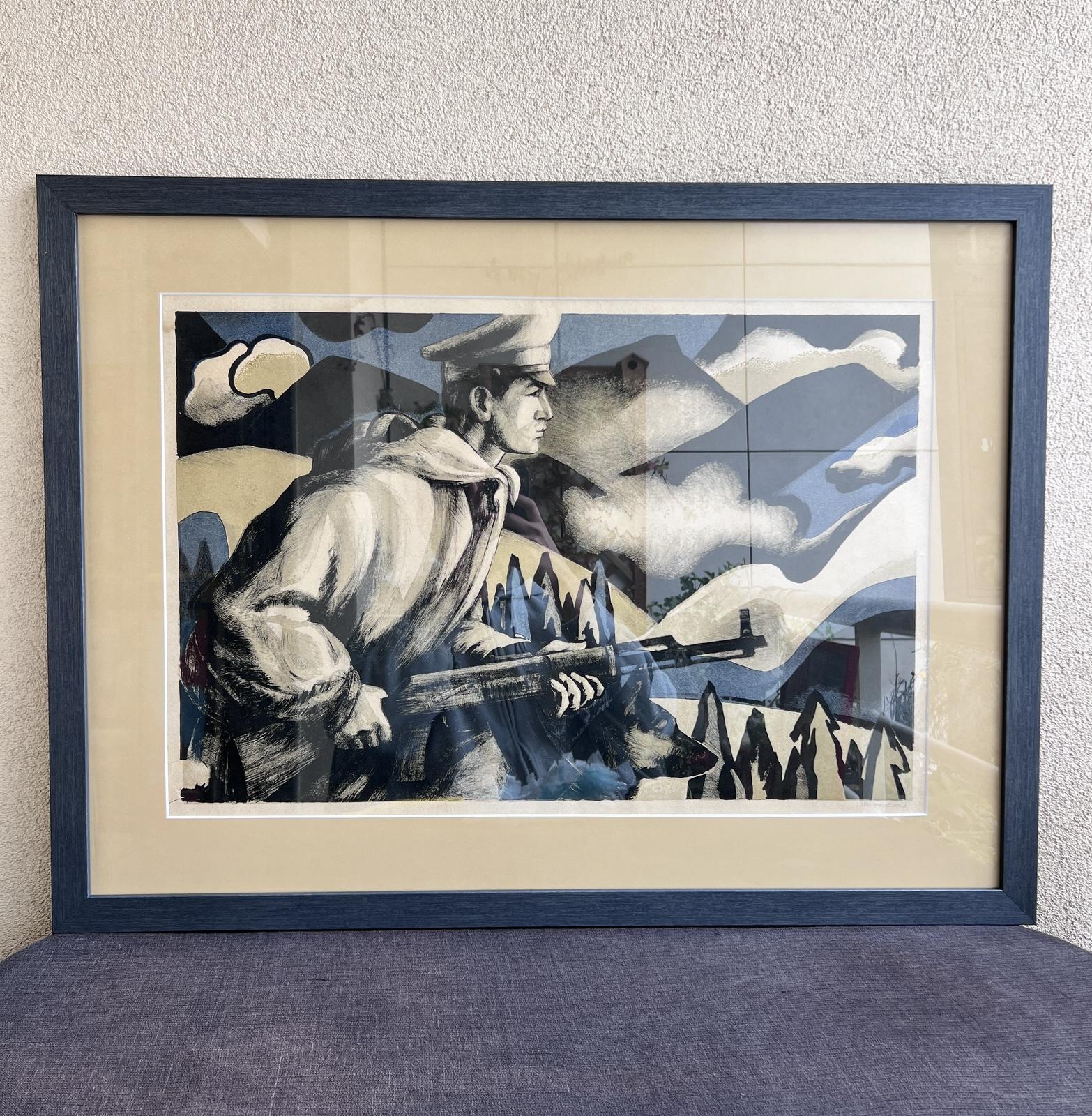
It also recurs in official art, with the guard and his dog.
Soviet linocut: a border guard and his dog, signed I. Katrushchenko.
Belarus and Russia: the post lives on
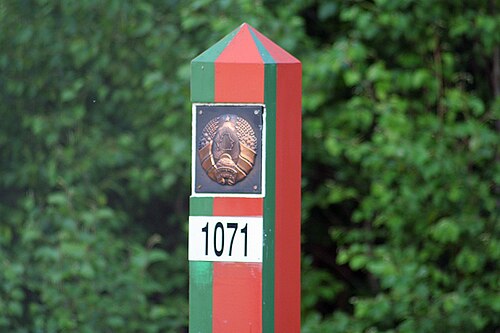
Belarusian post no. 1071 on the Lithuanian border, 2008: the coat of arms of Belarus on a square plate. Photo jo.sau, Wikimedia Commons, CC BY 2.0.
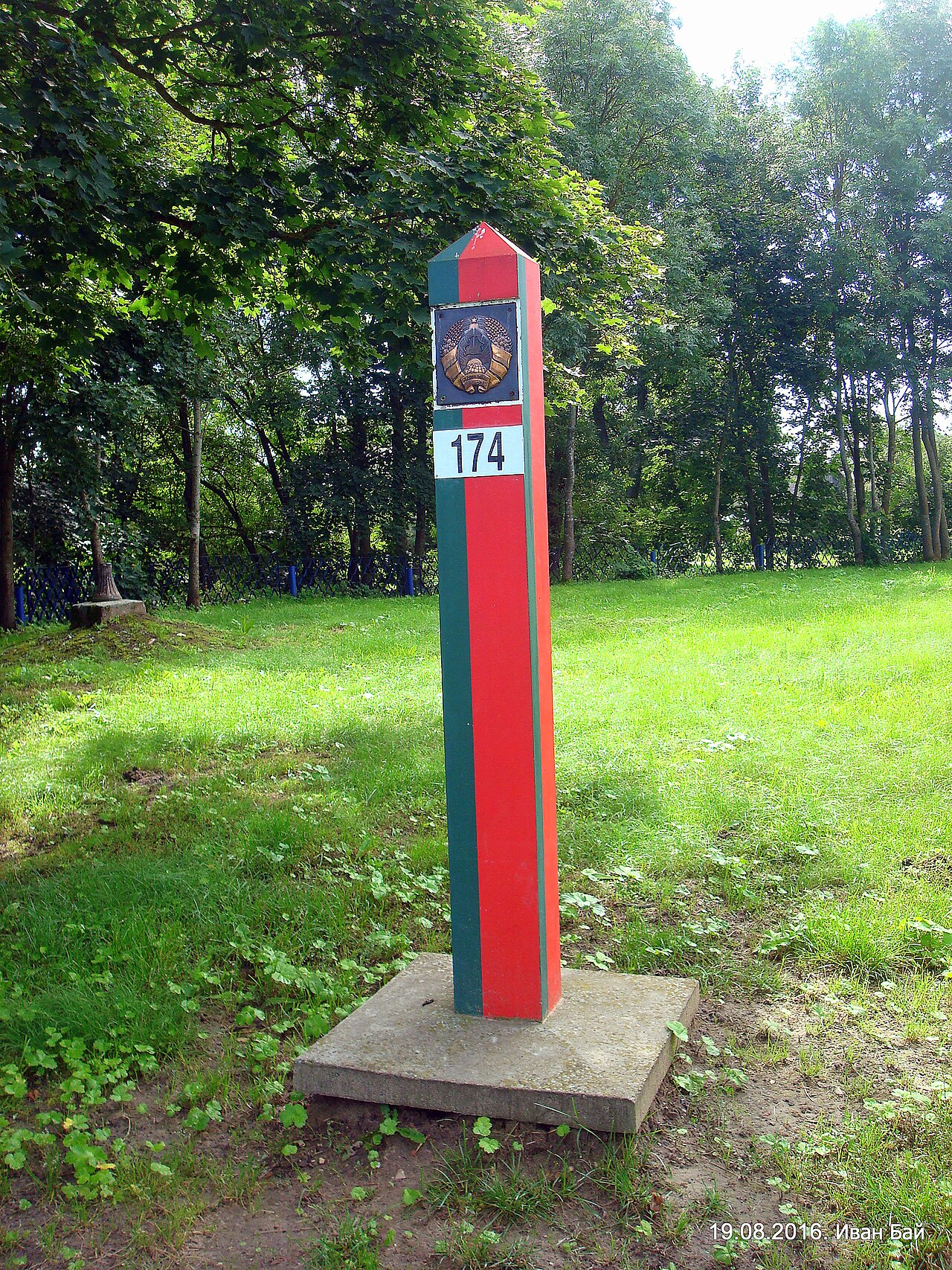
Belarus kept the principle. As early as September 1992 a decree approved the new coat of arms for the post. The text in force, a 2009 resolution of the Council of Ministers, describes a post 1.90 m high in the colours of the flag, red and green, in vertical bands. It carries a shield of 220 x 200 mm with the arms of the republic in relief, pierced with four holes at the corners, “made of plastics or metals”.
Belarusian post no. 174 at Druya, facing Latvia. Photo Ivan Bai, Wikimedia Commons, CC BY-SA 3.0.
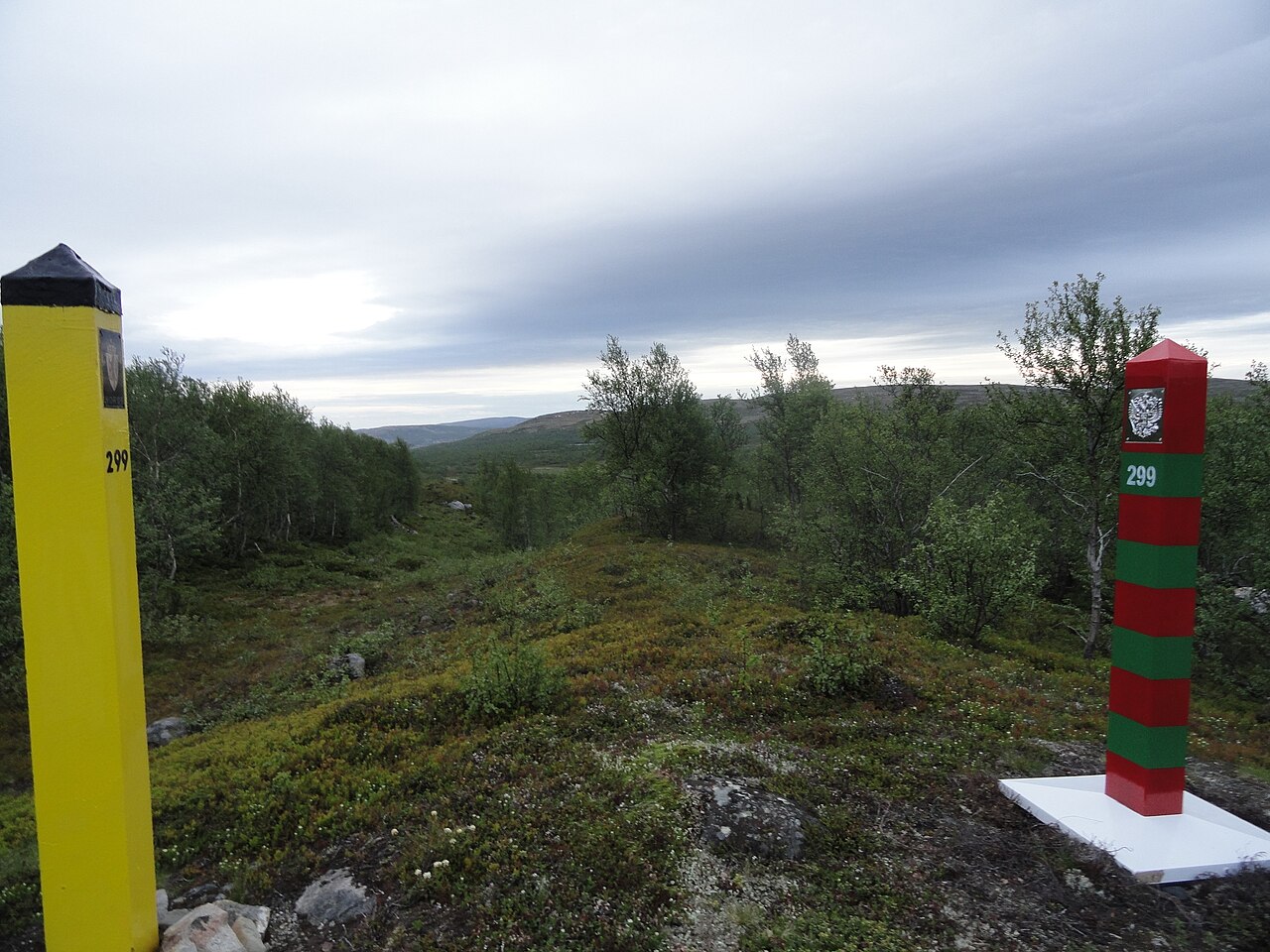
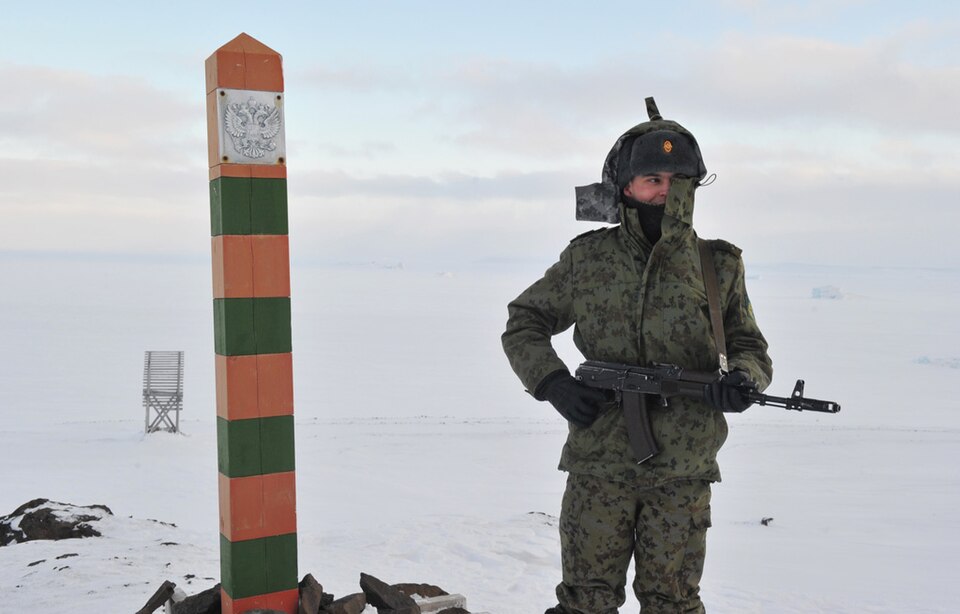
Russia kept the horizontal red and green bands of the Soviet post. Only the coat of arms changed: the double-headed eagle replaced the globe and the wheat.
Border between Norway and Russia, 2012: the yellow Norwegian post and Russian post no. 299. Photo Blyngre, Wikimedia Commons, CC BY-SA 3.0.Alexandra Land, Russian Arctic, April 2010. Photo Vladimir Baranov, RIA Novosti, Wikimedia Commons, CC BY-SA 3.0.
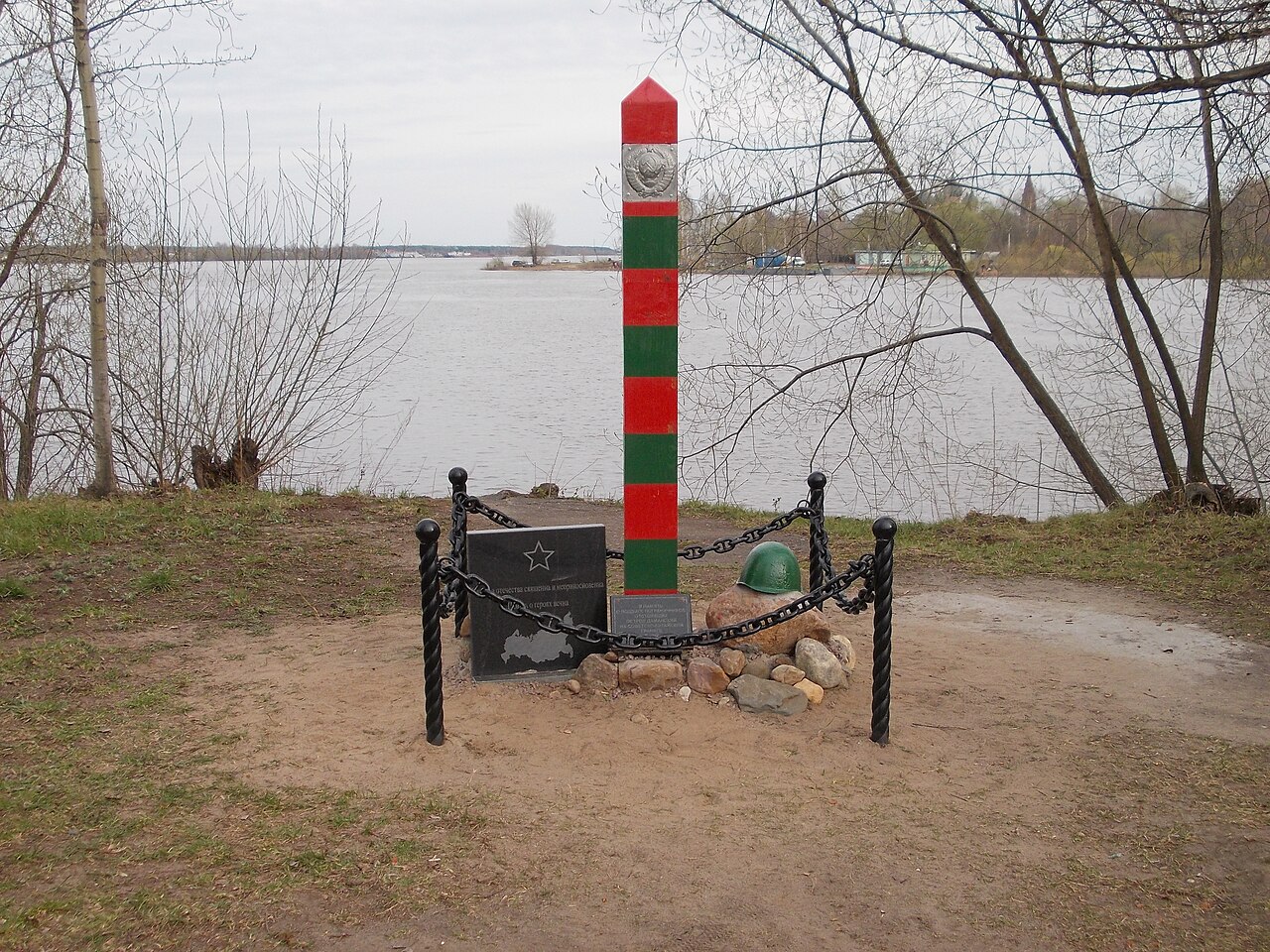
In Russia, posts bearing the Soviet coat of arms serve as memorials. Former border guards gather there on 28 May, their annual day.
Memorial to the border guards in Yaroslavl, 2013. Photo Monedula, Wikimedia Commons, CC0.
Copies
These plaques have long been copied. Russian makers sell replicas in copper, brass, bronze, aluminium or resin, some of them moulded from a period plaque.
There are several types of copies. A yellow metal and a weight close to 1 kg are therefore not enough.
The reflection is the first clue. A period plaque reflects light almost like a mirror. Copies are matt, or nearly matt.
The back tells even more, because the manufacturing technique is not the same. The first check is on the back: period plaques carry the maker’s stamps, copies do not. The second is the red paint from the post, which ran down from the top of the plaque. Finally we look at the wear of the nickel plating.
Here is a bronze-coloured copy, next to a period plaque.
Period plaqueCopy
1The reflection. Almost a mirror on the period plaque, which is nickel-plated. Matt, brown, bronze-coloured, with no plating on the copy.
2The relief. Crisp and fine on the period plaque, which is pressed. Thicker and softer on the copy, which is cast.
3The paint. A run of red paint from the post on the period plaque. No trace on the copy.
Period plaqueCopy
1The hollow. The coat of arms shows in reverse on the back of the period plaque. The back of the copy is solid and uneven, with drops of metal.
2The stamps. A framed digit and a butterfly, struck near a fixing hole on the period plaque. Absent on the copy.
Another type of copy imitates the front better, with a matt nickel finish. The back gives it away: a grainy copper surface, edged with a ridge of metal, with no stamp and no crisp coat of arms in reverse.
Another type of copy, front: the nickel finish is matt, with no mirror effect.The same copy, back: grainy copper and a ridge of metal around the edge.
Available at Soviet in Paris
Each Soviet border plaque in our shop is photographed front and back, with its stamps.
The ДП-5В (DP-5V) is the field radiometer of Soviet civil defence: a green Bakelite console, a probe with a rotating gamma, beta and check-source shield, headphones and a manual that explains operation and maintenance. The one in this article served in an industrial bakery in Chișinău and was serviced in March 1991. Its owner shared his photos and documents with us, and we turned them into a tool that lets you operate it on screen, step by step.
The Moscow Games, from 19 July to 3 August 1980, boycotted by some sixty countries, produced more objects than any Soviet event: a bear cub, Misha, drawn by Viktor Chizhikov, an emblem made of running tracks, five thousand torches, watches from every factory, platinum coins, rings, tea glass holders, posters. This guide tells the story of the Games and reviews the objects, with the marks that authenticate them and the prices.
The 3017 chronograph of the First Moscow Watch Factory carries a five-digit number on the balance cock. The most common dating method reads it as a single series, from 1959 to 1979. Four factory passports show there are two, and that the same number can point to two watches made ten years apart. Here is how to read the number, the dial, the logo and the bridge, with a decoder to date your Strela, Poljot or Sekonda.
This website uses cookies to improve your experience while you navigate through the website.
Out of these cookies, the cookies that are categorised as necessary are stored on your browser as they are essential for the working of basic functionalities of the website.
We also use third-party cookies that help us analyse and understand how you use this website.
These cookies will be stored in your browser only with your consent.
You also have the option to opt out of these cookies.
But opting out of some of these cookies may affect your browsing experience.
Necessary cookies are absolutely essential for the website to function properly. This category only includes cookies that ensure basic functionalities and security features of the website. These cookies do not store any personal information.
Cookies that are not strictly necessary for the website to work and that are used specifically to collect personal data through analytics, ads and other embedded content are called non-necessary cookies. User consent is required before these cookies run on the website.
✕
Soviet in Paris
Online. We answer in person, no AI and no chatbot. Reply right away, 20 min at most.
Hello 👋 A question about an item, an order or shipping? Write to us.
Your email is used only to reply to you.
Subscribe to our newsletter and get 10% off your first order.
Subscribe
★ New pieces before anyone else
★ New blog articles
★ Soviet in Paris news and updates
Join the Party
10% off your first order
Receive your welcome card and our next arrivals.
Your code appears here and is also sent to you by email. You can leave the Party in one click, at any time.