The Ilyich Bulb is the bare bulb hanging from the ceiling of Soviet interiors. Its story is that of the electrification of the USSR and of the ideological light bulbs that came out of it.
SEPTEMBER 2025•4 MINUTE READ
by Marwen Yahyaoui
In this article we will look first at the history of the electrification of the USSR, then at the highly unusual phenomenon of ideological light bulbs in the Soviet Union.
Let us start with the term “Ilyich’s bulb”, used in the USSR for a plain bulb hanging from the ceiling and lighting a room without a shade.
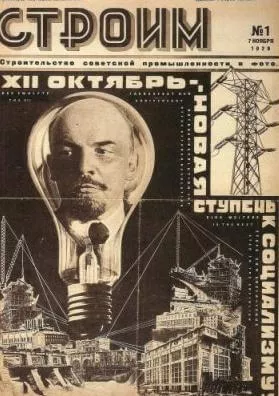
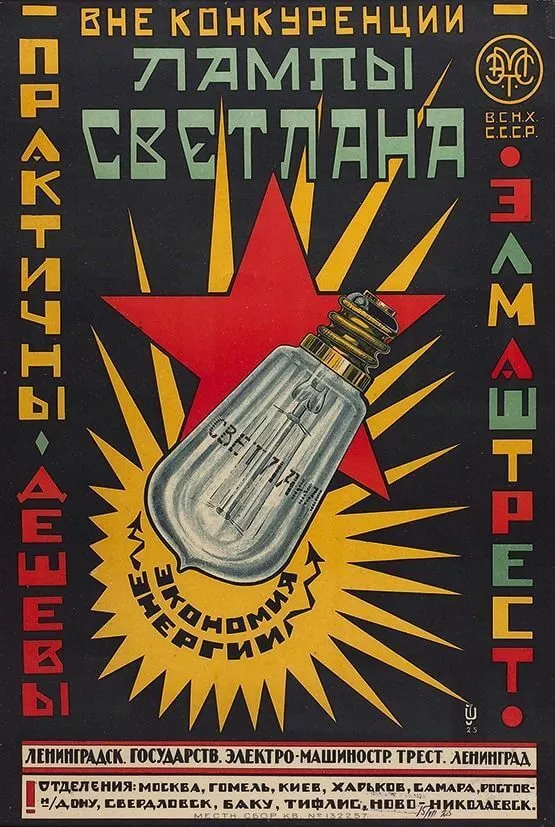
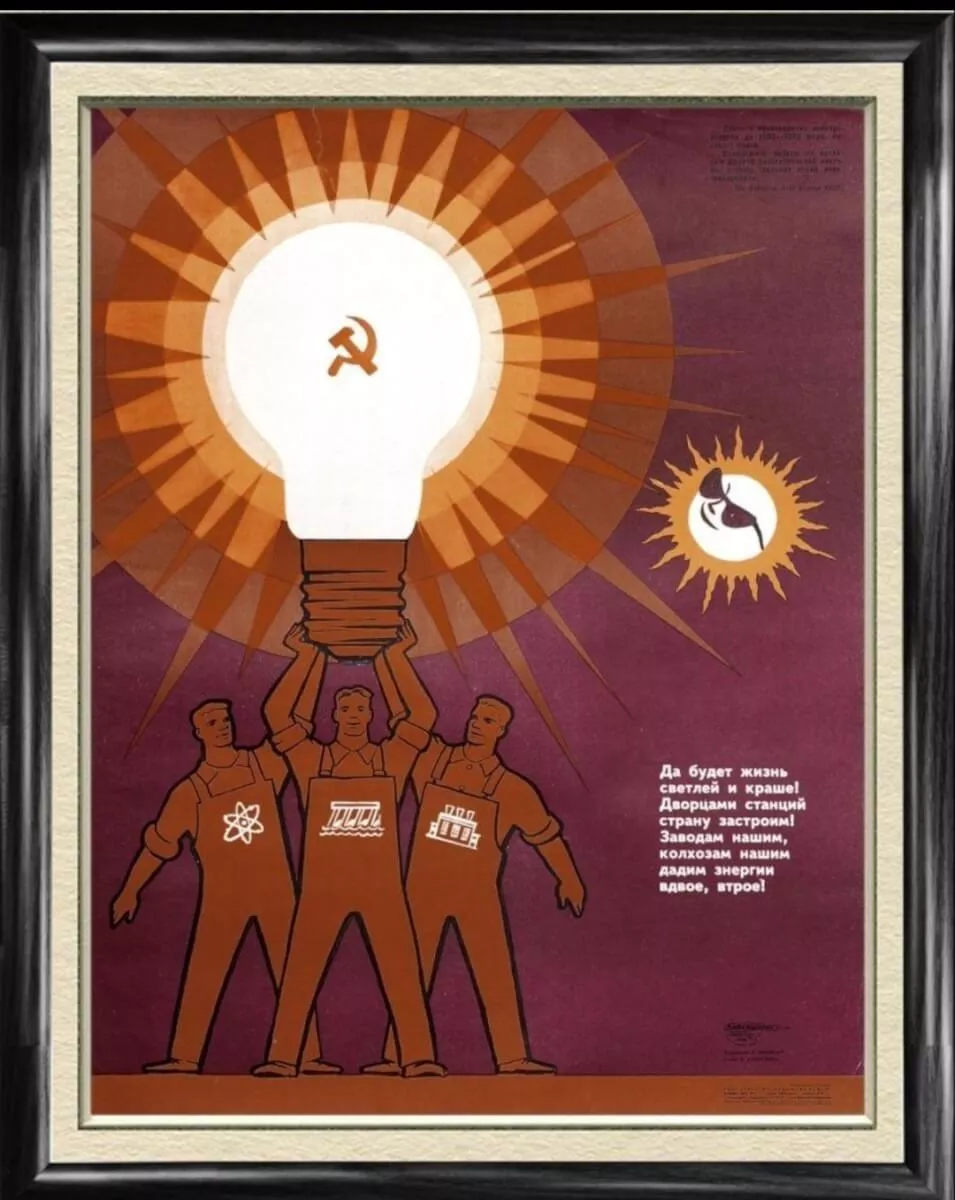
Ilyich’s bulb is a stock image of official Soviet propaganda. In the collections of “proverbs of the Soviet people” published during the Soviet period, the following line was used to contrast the pre-revolutionary and the Soviet periods: “There was an oil lamp and a candle; now here is Ilyich’s lamp”.
The expression appeared after Lenin’s visit to the village of Kashino in 1920, to mark the launch of a local power station with a distribution network built from old telegraph wires. At first, the phrase “Ilyich’s bulb” referred to the electrification of the USSR, particularly in rural areas.
The classic “Ilyich’s bulb” is a domestic incandescent lamp whose socket hangs from the ceiling on a cord and is left free. At the time, the switch was housed in the socket casing and the wiring was a twisted two-wire cable, each wire insulated with rubber and a metal braid.
What was “GOELRO”?
In the first years after the Revolution, the question of electricity was perhaps the most pressing of all. In early 1920, the State Commission for the Electrification of Russia (GOELRO) was created to tackle the problem.
Later came the GOELRO plan, which covered not only the electrification of the country but also the development of its economy as a whole. The “Ilyich’s bulb” became the distinctive symbol of that plan.
The history of the idea itself and of its implementation is full of uncertainties. According to some sources, large-scale plans to electrify the country had already been considered under the tsars, and only the considerable cost and the difficulties of the First World War (1914-1918) prevented them from being fully carried out.
The country was only able to take on the problem in earnest in December 1920, after the GOELRO plan was approved at the 9th All-Russian Congress of Soviets.
The leader’s own words served as its motto: “Communism is Soviet power plus the electrification of the whole country.” For all the utopian character of his communist ideas, Lenin fully understood how important energy was to national development.
The ambitious Bolshevik plan was carried out successfully and exceeded. New factories were founded, industrial territories (the Donbass, the Kuzbass) were developed and, of course, many power stations were built, creating an energy infrastructure unique to the USSR.
Transport and communications were given a powerful boost, and large-scale construction projects appeared in several regions of the country.
The GOELRO plan is held to have laid the foundations of industrialisation, allowing the country to reach a radically new level of development. Even so, as late as the 1980s, “Ilyich’s bulb” was still a distant hope in many places across the USSR.
The first Soviet propaganda light bulbs
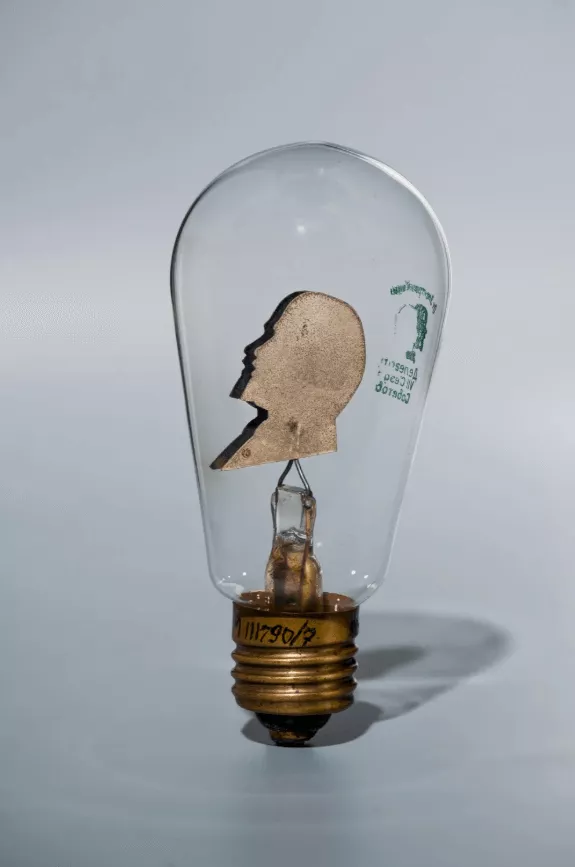
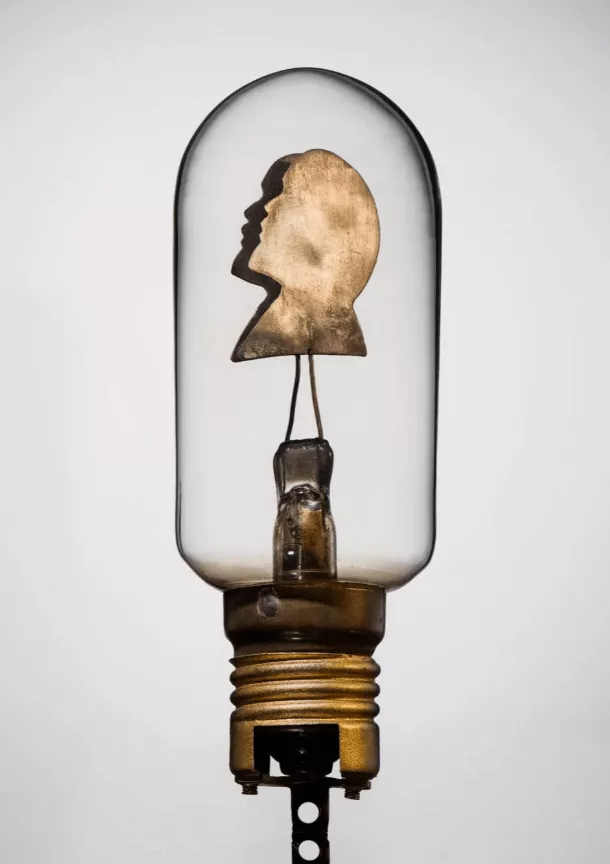
The first Soviet propaganda light bulbs appeared in the years that followed, and were given in particular to the delegations attending Communist Party congresses. They often carried the profile of Vladimir Lenin.
One of the earliest lamps, made in the RSFSR in 1922, was a half-watt bulb whose filament took the shape of Lenin’s silhouette. Before the October Revolution of 1917, lamps of that rating were imported from abroad.
According to the story, this lamp, one of the first achievements of Soviet industry, was presented to the 12th Congress of the RCP(b) by a delegation of non-party workers from the first and second electric lamp factories, at a special meeting at the Bolshoi Theatre on 23 April 1923. After the congress it was transferred to the First Section of the Central Committee of the All-Union Communist Party (Bolsheviks), and from there to the Museum of History and the Revolution in Moscow.
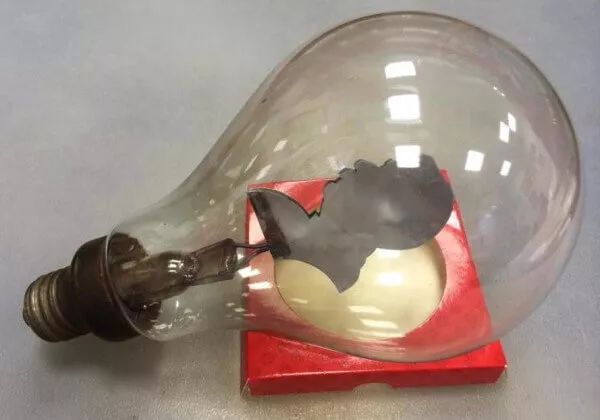
Bulb bearing the likeness of V.I. Lenin Glass, metal, 12.0 cm × 7.0 cm On the ink stamp: “To the delegate of the 7th Congress of Soviets” In place of a filament, a profile representation of V.I. Lenin. On a glass bulb: a stamp with the portraits of V.I. Lenin and I.V. Stalin.
In the 1930s the profile of Joseph Stalin starts to appear, at first alongside that of Vladimir Lenin, then on its own. These bulbs were not sold to the public, they were made to order only, for instance to be fitted in a tramway or a palace of congresses.
Electric tramway lamp bearing the likeness of Lenin (1930s). Glass, metal, 12.5 × 5.5. In place of a filament, Lenin in profile.
Bulb showing the profile of Joseph Stalin It was sold at auction in Russia for around 1,800 euros.
Commemorative and political bulbs after the Second World War
After a period during which few consumer goods were produced, fairly rare examples start to turn up again in the 1950s and the early 1960s. The themes are very often commemorative, honouring an industry, a man, an institution or an event.
Most of the bulbs were made by the Lviv lamp factory in Ukraine. They were sold in souvenir shops to locals and foreign visitors alike, right across the Soviet Union.
The price was 60 kopecks, the equivalent of four loaves of bread. That was not a large sum, but these bulbs were not produced in great quantity, so you still had to find one.
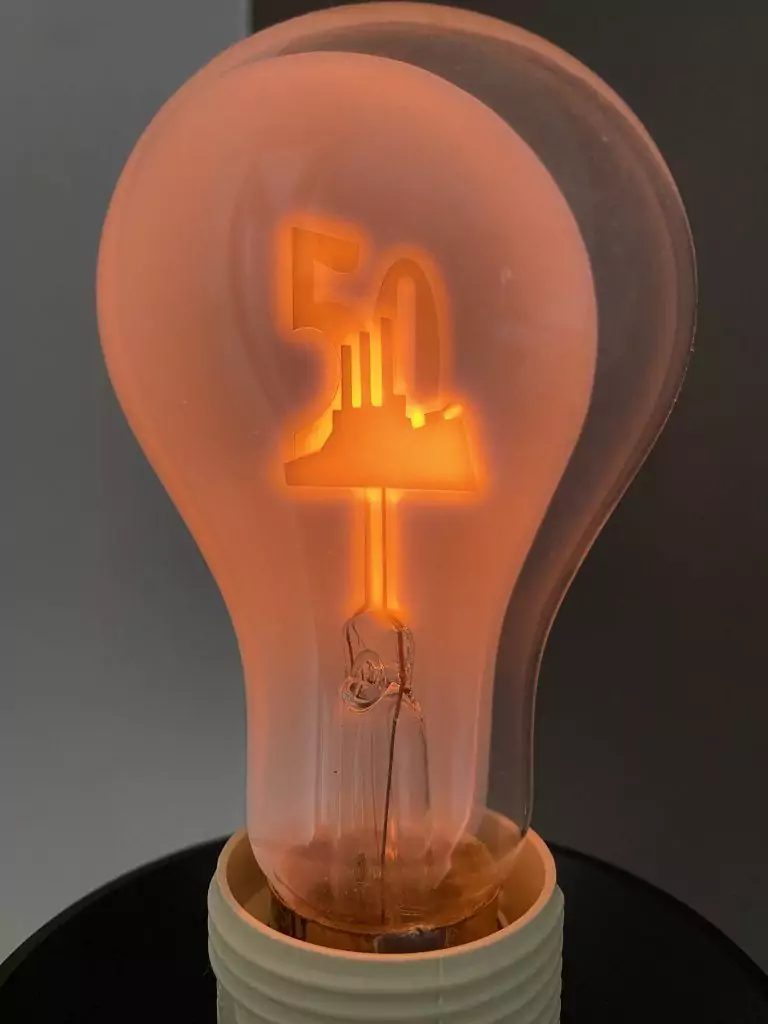
Incandescent bulbcommemorating the 50th anniversary of the October Revolution of 1917, made in 1967.
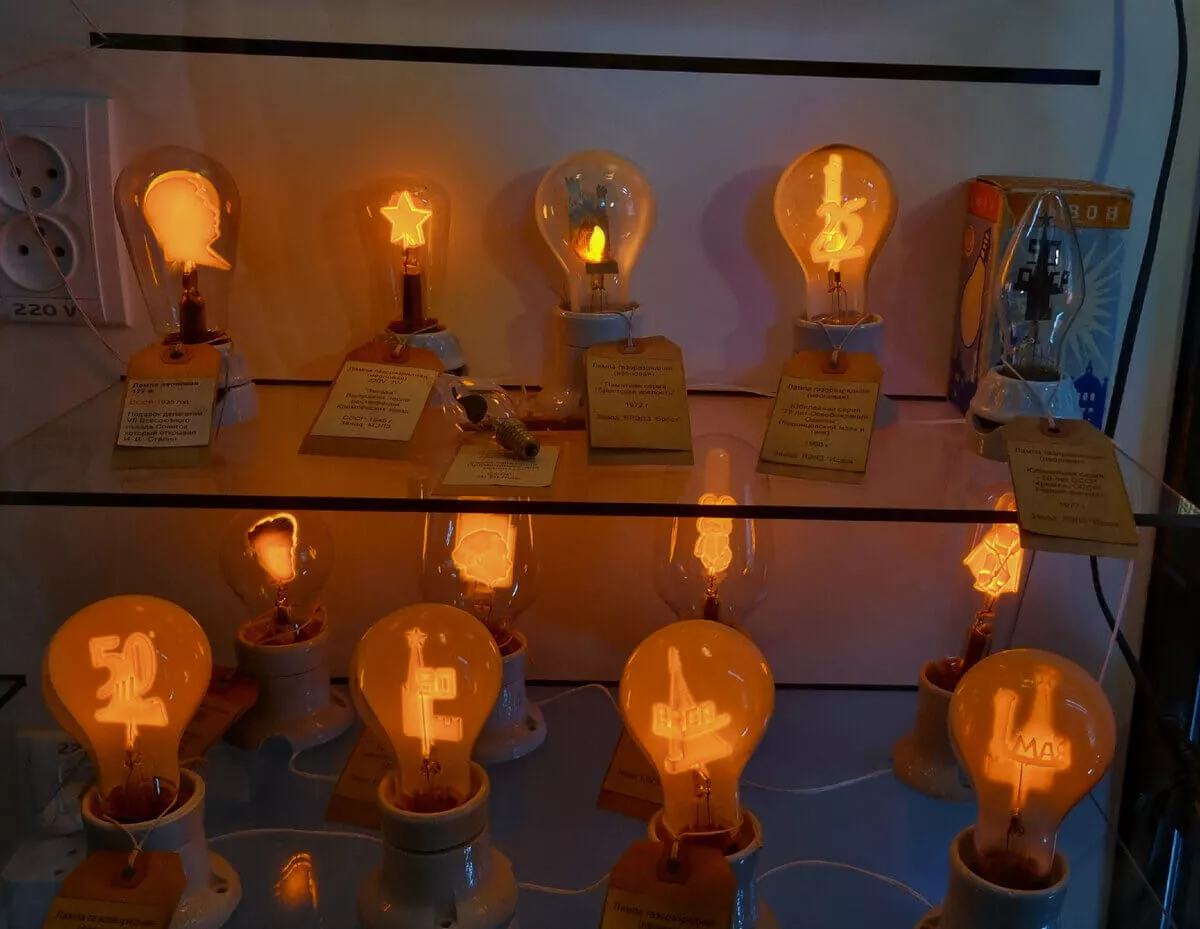
We put the number of bulb models made in the post-Second World War era at around a hundred, so collecting them is a real challenge.
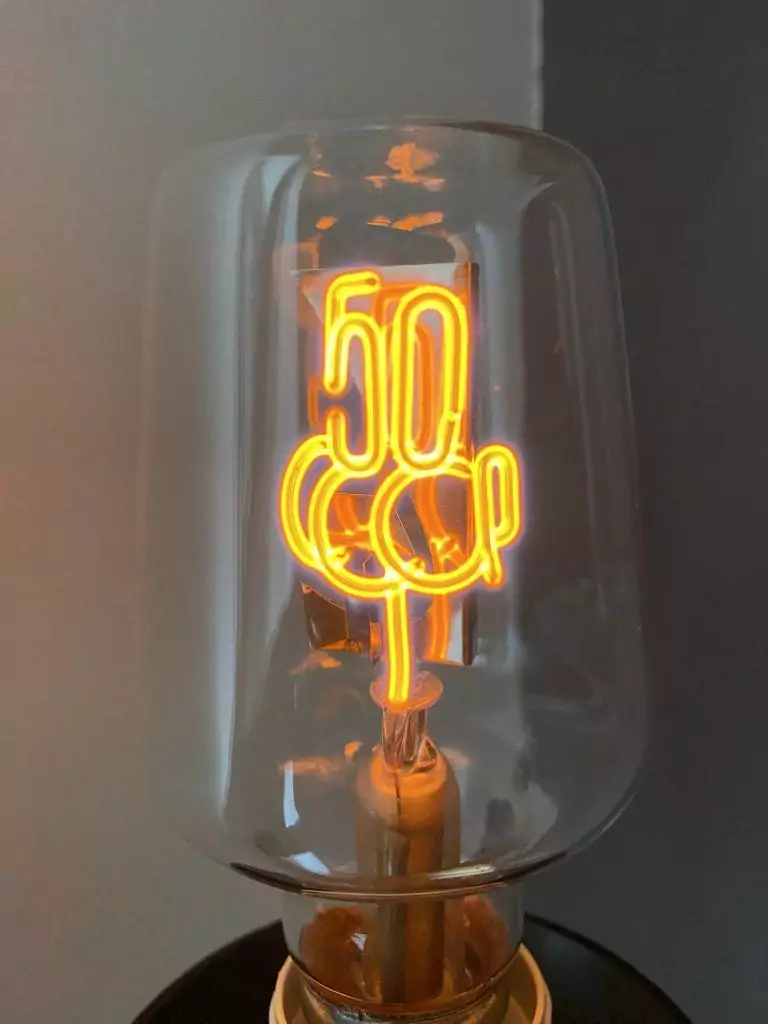
Rare incandescent bulb celebrating the 50th anniversary of the founding of the USSR in 1972
Exhibition at the Museum of Lighting in Moscow.
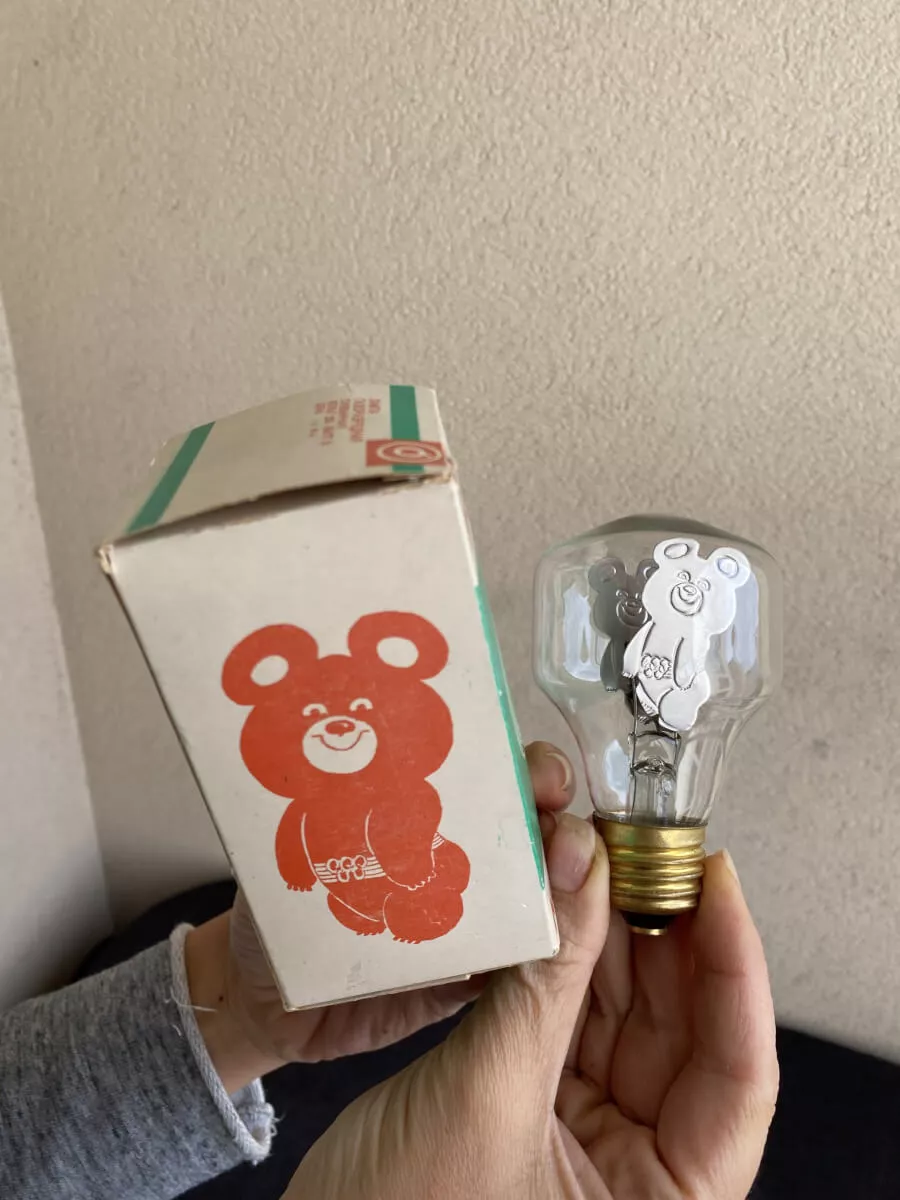
Discharge bulb commemorating the Moscow Olympic Games with its mascot Mishka.
An unusual way to discover the USSR
To conclude, ideological or propaganda bulbs are a way of discovering the USSR and its history, much as watches, sculptures or posters are.
We only sell these bulbs when they are in working order. They are very durable and run on 220 volts, which makes them useful as well.
The ДП-5В (DP-5V) is the field radiometer of Soviet civil defence: a green Bakelite console, a probe with a rotating gamma, beta and check-source shield, headphones and a manual that explains operation and maintenance. The one in this article served in an industrial bakery in Chișinău and was serviced in March 1991. Its owner shared his photos and documents with us, and we turned them into a tool that lets you operate it on screen, step by step.
The Moscow Games, from 19 July to 3 August 1980, boycotted by some sixty countries, produced more objects than any Soviet event: a bear cub, Misha, drawn by Viktor Chizhikov, an emblem made of running tracks, five thousand torches, watches from every factory, platinum coins, rings, tea glass holders, posters. This guide tells the story of the Games and reviews the objects, with the marks that authenticate them and the prices.
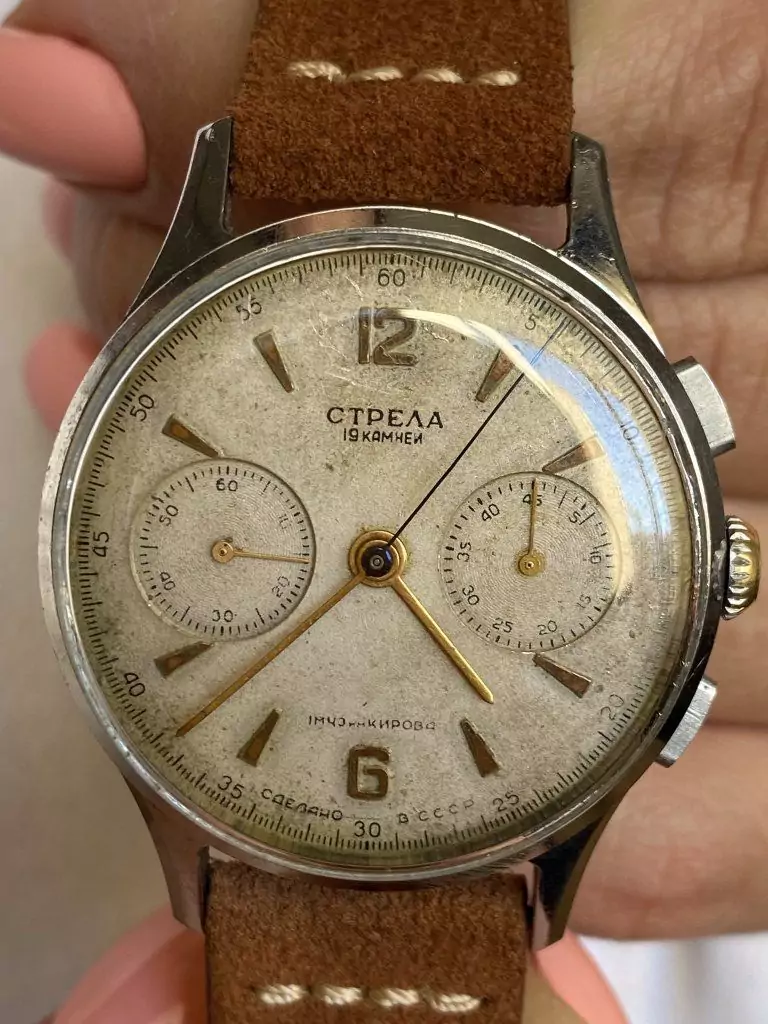
The 3017 chronograph of the First Moscow Watch Factory carries a five-digit number on the balance cock. The most common dating method reads it as a single series, from 1959 to 1979. Four factory passports show there are two, and that the same number can point to two watches made ten years apart. Here is how to read the number, the dial, the logo and the bridge, with a decoder to date your Strela, Poljot or Sekonda.
This website uses cookies to improve your experience while you navigate through the website.
Out of these cookies, the cookies that are categorised as necessary are stored on your browser as they are essential for the working of basic functionalities of the website.
We also use third-party cookies that help us analyse and understand how you use this website.
These cookies will be stored in your browser only with your consent.
You also have the option to opt out of these cookies.
But opting out of some of these cookies may affect your browsing experience.
Necessary cookies are absolutely essential for the website to function properly. This category only includes cookies that ensure basic functionalities and security features of the website. These cookies do not store any personal information.
Cookies that are not strictly necessary for the website to work and that are used specifically to collect personal data through analytics, ads and other embedded content are called non-necessary cookies. User consent is required before these cookies run on the website.
✕
Soviet in Paris
Online. We answer in person, no AI and no chatbot. Reply right away, 20 min at most.
Hello 👋 A question about an item, an order or shipping? Write to us.
Your email is used only to reply to you.
Subscribe to our newsletter and get 10% off your first order.
Subscribe
★ New pieces before anyone else
★ New blog articles
★ Soviet in Paris news and updates
Join the Party
10% off your first order
Receive your welcome card and our next arrivals.
Your code appears here and is also sent to you by email. You can leave the Party in one click, at any time.







 For vintage lamps, see