Slava is the watch of the Second Moscow Watch Factory, founded in 1924 on American machines. Its 24 mm twin-barrel calibre, its doctor’s models, its export dials for Italy and its Besançon plant, which sold up to 300,000 watches a year in France, set the brand apart. This guide gives the signs for recognising, dating and choosing a Slava.
OCTOBER 2026•9 MINUTE READ
by Marwen Yahyaoui
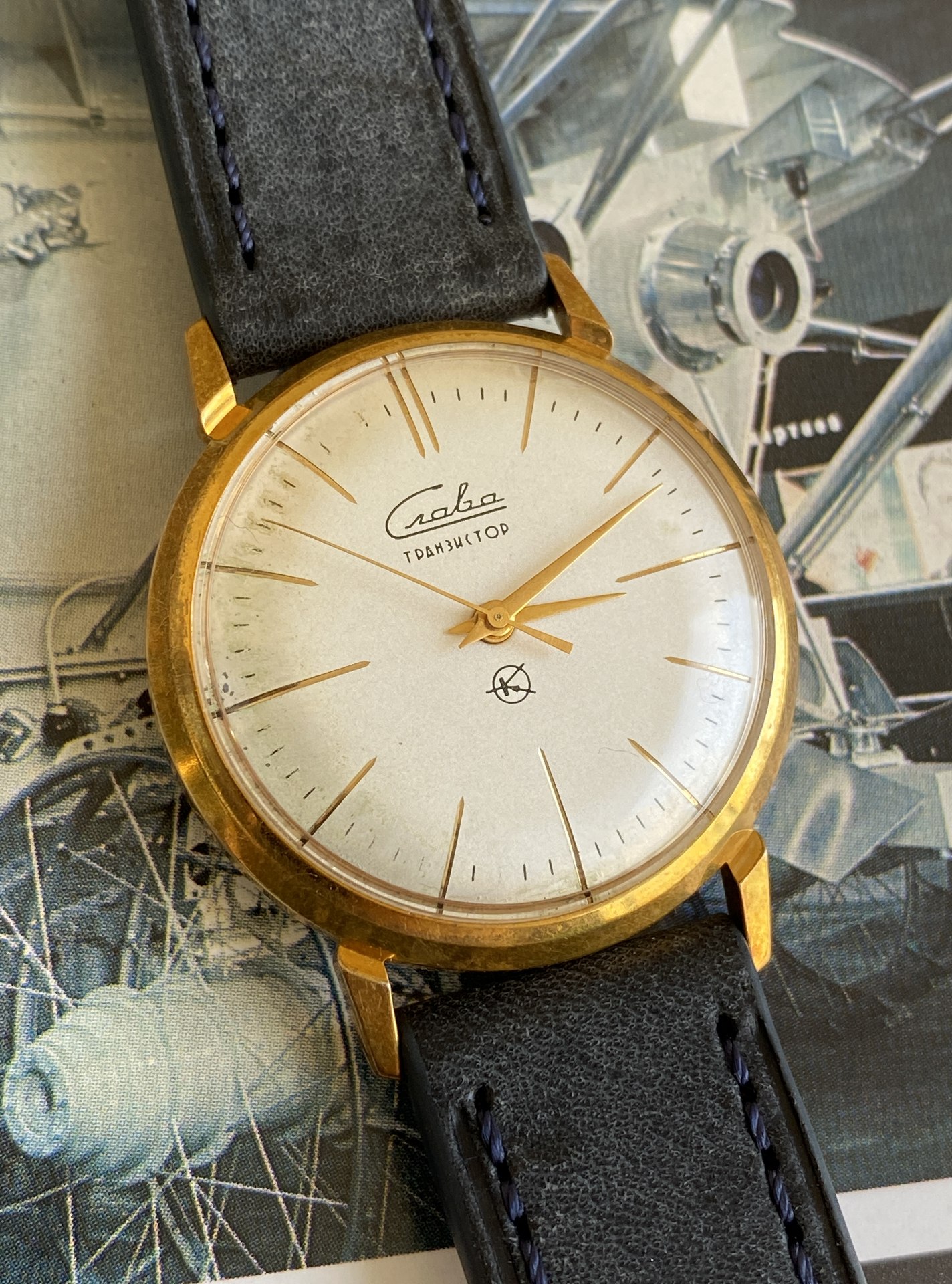
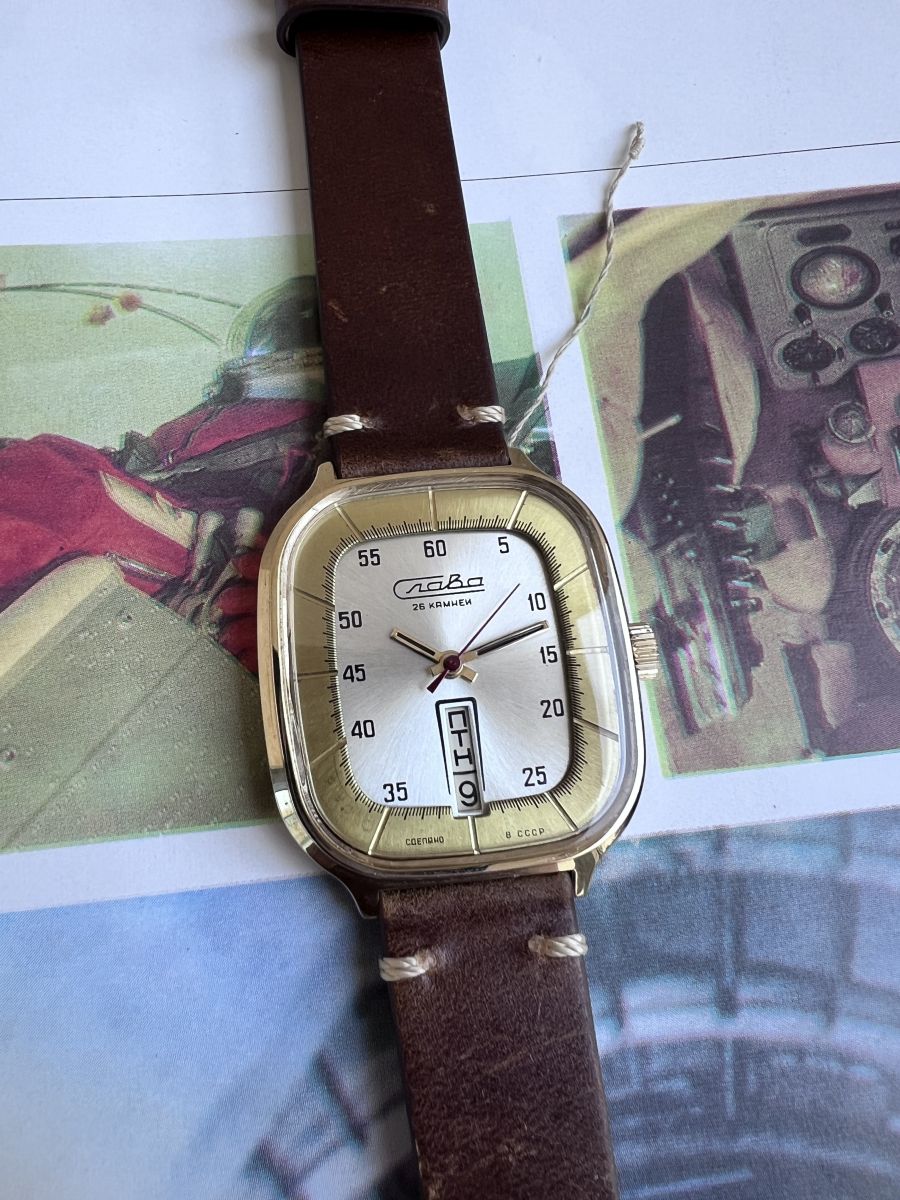
Slava Transistor, gold-plated case, silvered dial: the electromechanical watch of the Second Moscow factory, serviced.
Slava, Слава, means glory. It is the brand of the Second Moscow Watch Factory, and it is, with Raketa, Vostok and Poljot, one of the four great Soviet brands found in France. It has one feature the other three lack: a plant in France, in Besançon, which put hundreds of thousands of Slavas on French wrists, often without their owners knowing. This guide tells the story of the factory, the calibres, the models that matter, and gives the signs for dating a Slava.
1924: the second Moscow factory
The factory was founded in 1924 in Moscow, in a three-storey building, with 125 workers. Western European firms refused to help the Soviets set up watch production, and in 1929 the government bought two bankrupt American factories. The tooling of Ansonia, a clockmaker from Connecticut, went to the Moscow electromechanical plant, which in 1930 became the Second Moscow Watch Factory, 2МЧЗ. It began with street clocks and alarm clocks, made its first pocket watches in 1937, was evacuated to Chistopol in October 1941, where it founded what would become Vostok, and returned to Moscow. After the war it produced the Pobeda from 1951, then women’s watches, Эра (Era), Звезда (Zvezda), Заря (Zaria).
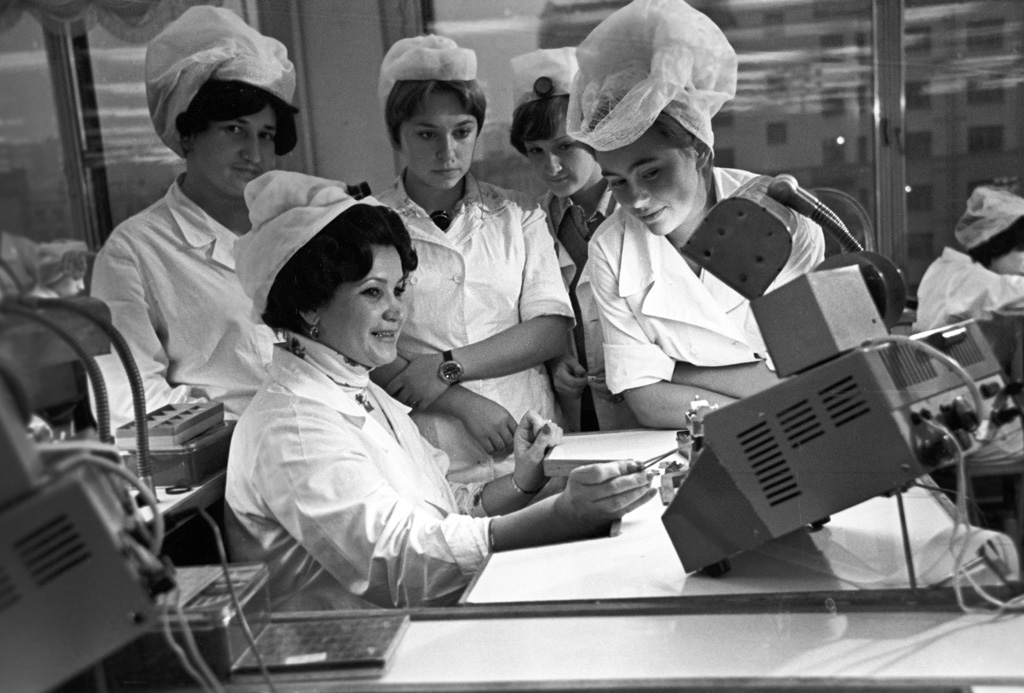
Workers of the Second Moscow Watch Factory in July 1980. Seated, the assembler T. Sizova, a State Prize winner. Photo Yaroslavtsev, RIA Novosti archive, CC BY-SA 3.0.
The Slava name appeared on dials in the second half of the 1950s, and soon became the main production. Until 1969 a Soviet dial name designated a model, not a factory: from that date, everything leaving 2МЧЗ was called Slava.
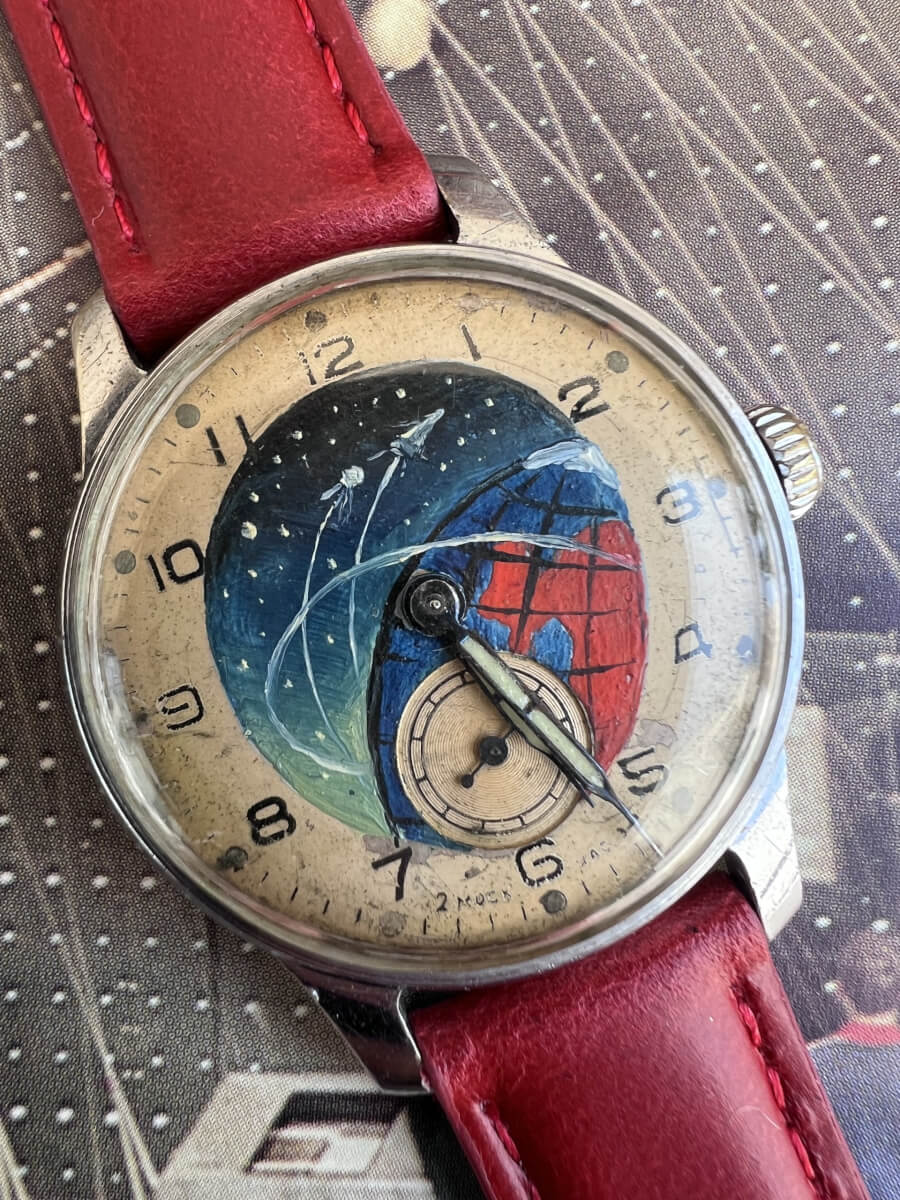
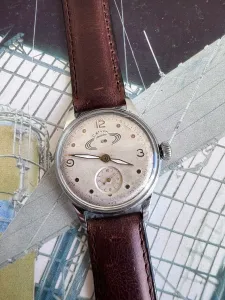
Early Slava, small seconds at 6 o’clock and a painted dial, Sputnik and Vostok rocket, the first years of the space conquest.
The twin-barrel calibre
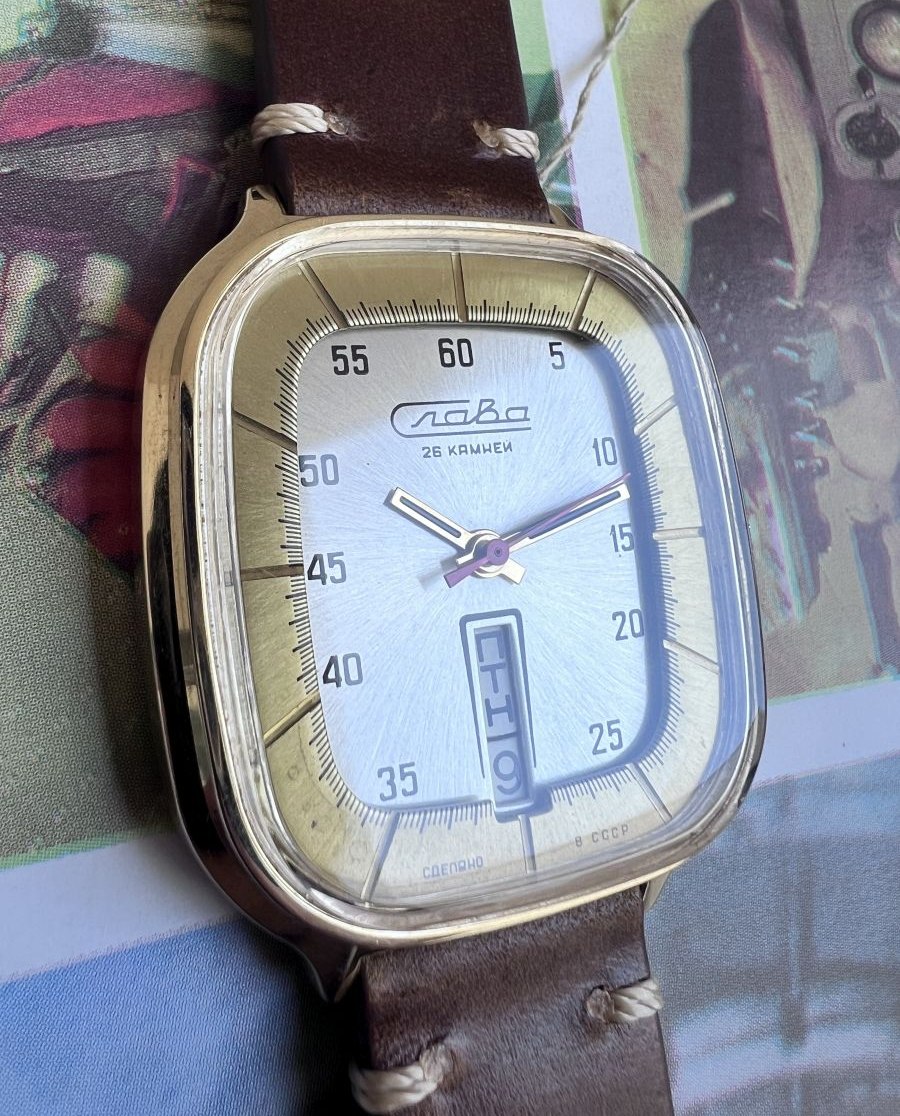
What sets a Slava apart from its cousins is its movement. In the 1960s and 1970s the factory developed a family of 24 mm calibres, the 24 series: the hand-wound 2414 with date, the automatic 2427 with day and date, the hand-wound 2428 with day and date, and in 1989 the automatic 2416. All have two mainspring barrels mounted in parallel, which is rare in mass-produced watchmaking. Two shorter springs instead of one long one, for a steadier torque and a power reserve of about 40 hours. The rotor of the automatics is held by a single screw, which also contributed to the brand’s reputation for robustness. The dial reads 26 jewels, 26 камней, and it is this unusual figure that lets you recognise a Slava from across the room.
This calibre received a gold medal at the Brno exhibition in 1974 and powers the vast majority of men’s Slavas you will see, from the 1970 models to the last of 1991.
Slava TV, square case of the 1970s and 1980s, 26 jewels, day and date at 3 o’clock.
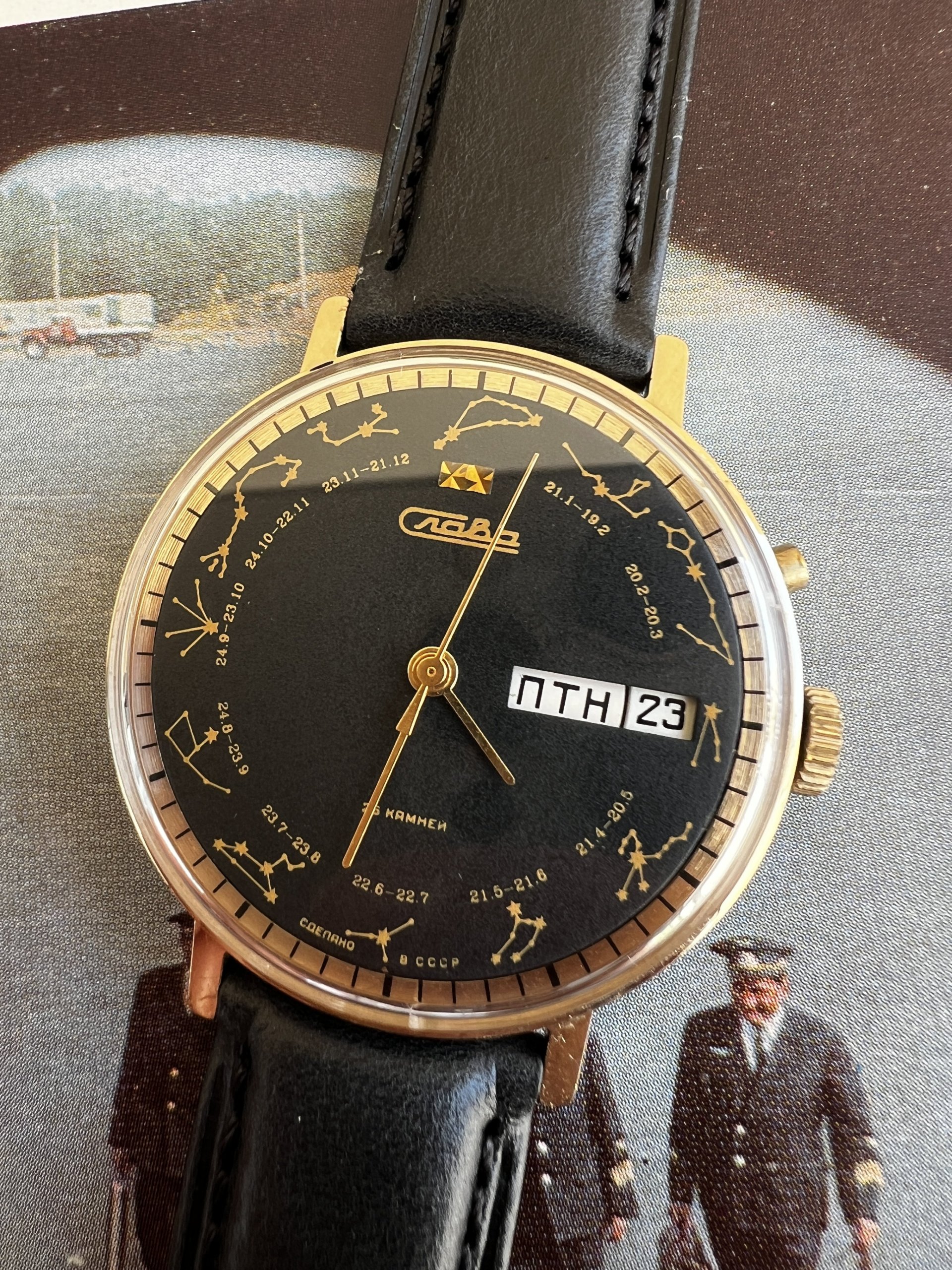
Slava Constellations, black dial with the signs of the zodiac, gold-plated, day and date.
The Transistor, an electromechanical watch
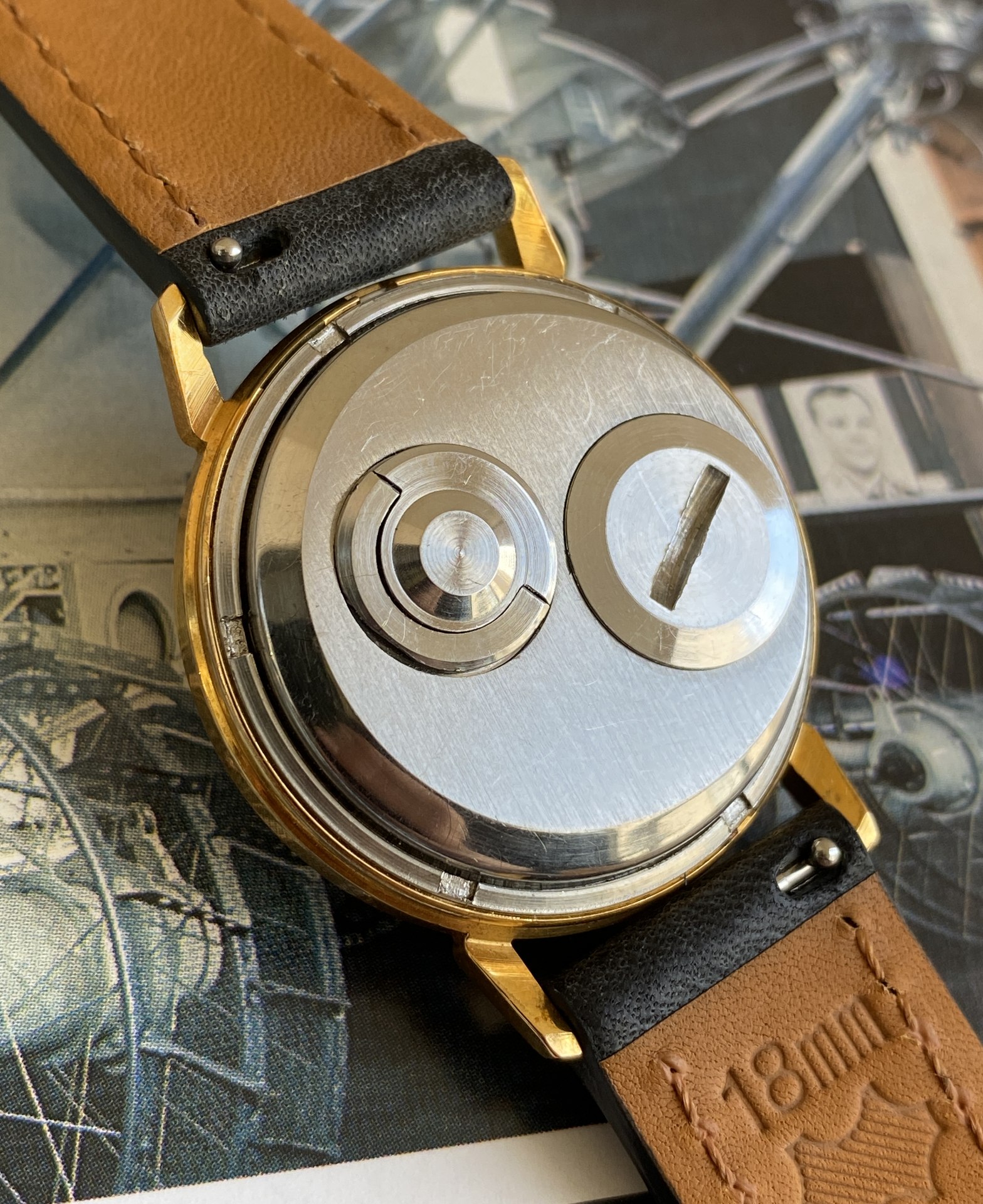
In the mid-1960s the factory produced a battery-powered balance-wheel watch, the Транзистор (Transistor), whose name is spelled out under the brand. The balance is driven by a coil and a transistor, not by a mainspring: there is no crown to wind. The watch won a prize at the Leipzig fair, in 1963 or 1964 depending on the source. It is the rarest Slava in the ordinary catalogue, and one of the few Soviet watches that can be called technically new for its time: the American Bulova Accutron dates from 1960, and few factories in Europe mastered electromechanics.
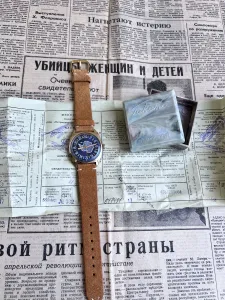
The dial, marked Слава Транзистор under the indices.
The case opened: the electromechanical movement and its battery compartment.
The export dials: Italy, England, Canada
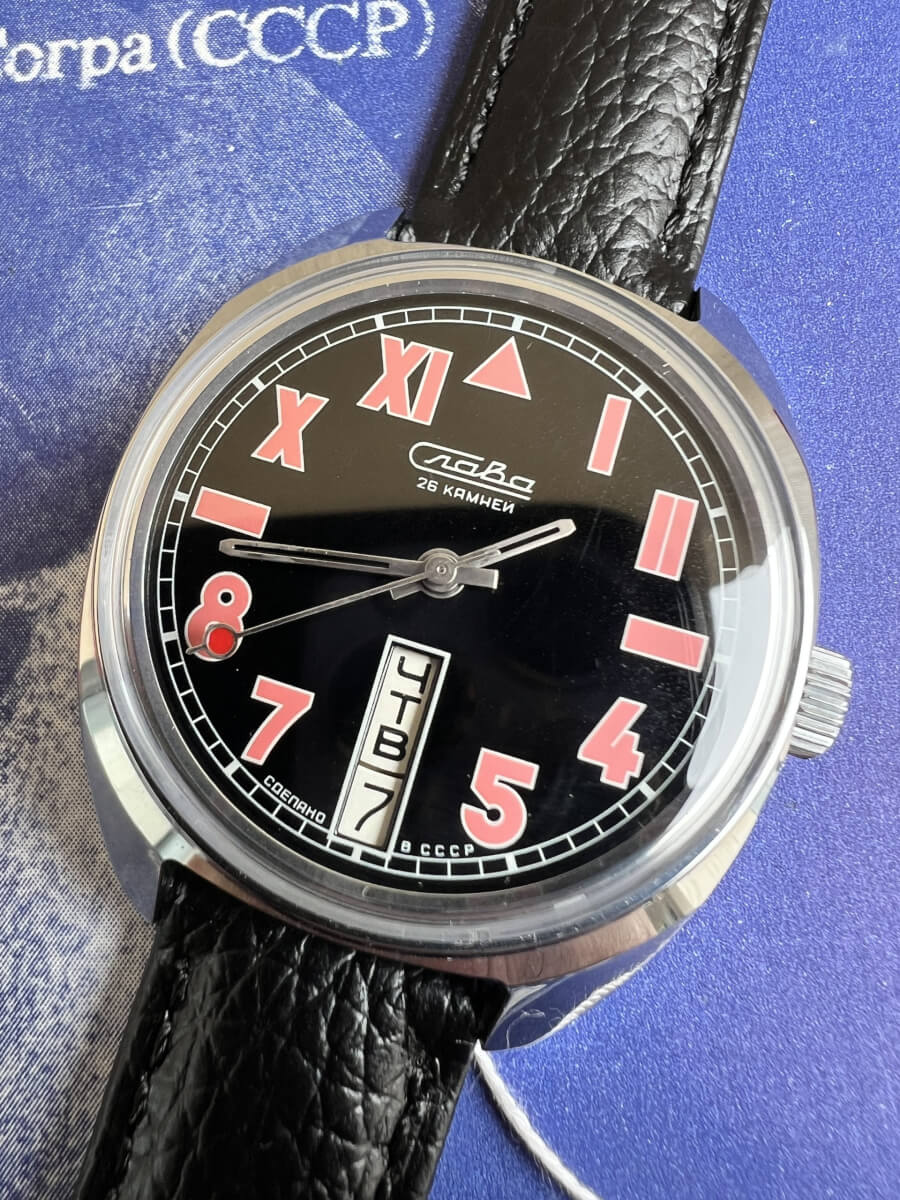
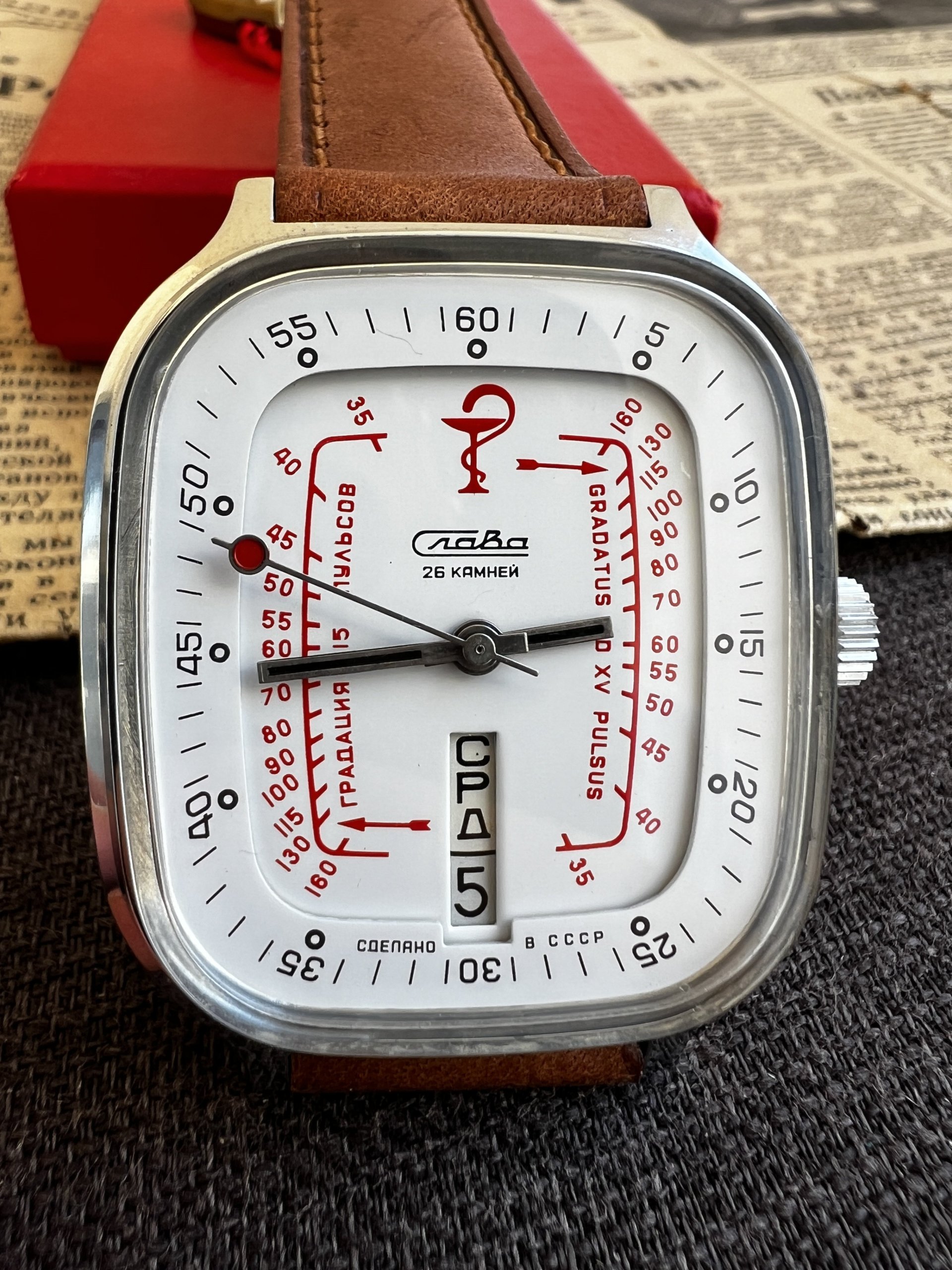
Slava exported a great deal, up to half its production in some years. The Italian market had its own models, including the California, a black dial with mixed Roman and Arabic numerals, and the Medical with a pulsometer scale, sold to doctors with its red case. Versions for English-speaking countries read SLAVA in Latin letters and « Made in USSR ». Versions for the USSR keep the Cyrillic and « Сделано в СССР ».
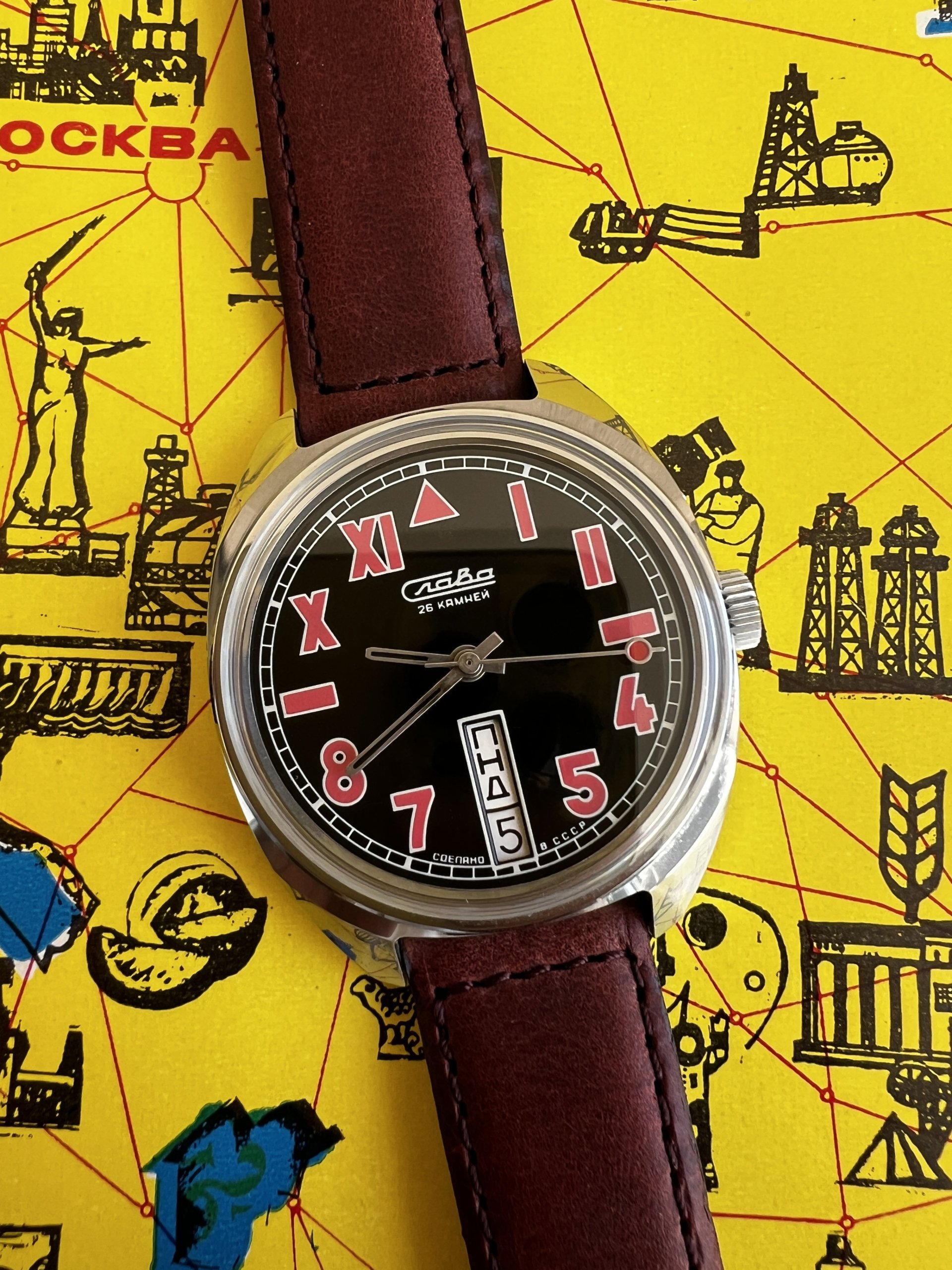
Slava California, black dial, Roman and Arabic numerals: the Italian export model.
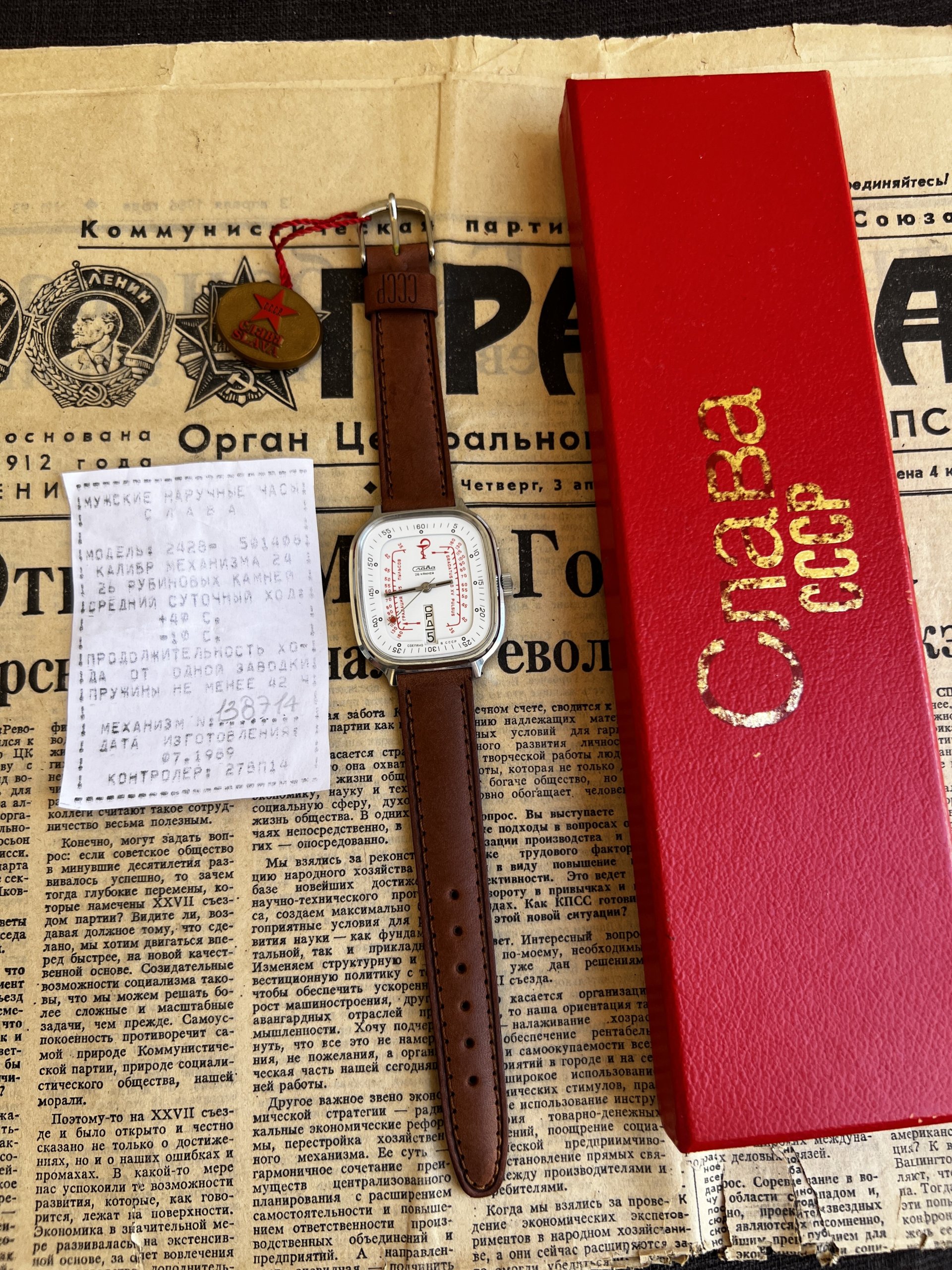
Slava Medical, red pulsometer scale, Italian export, price tag in lire.
The women’s watches
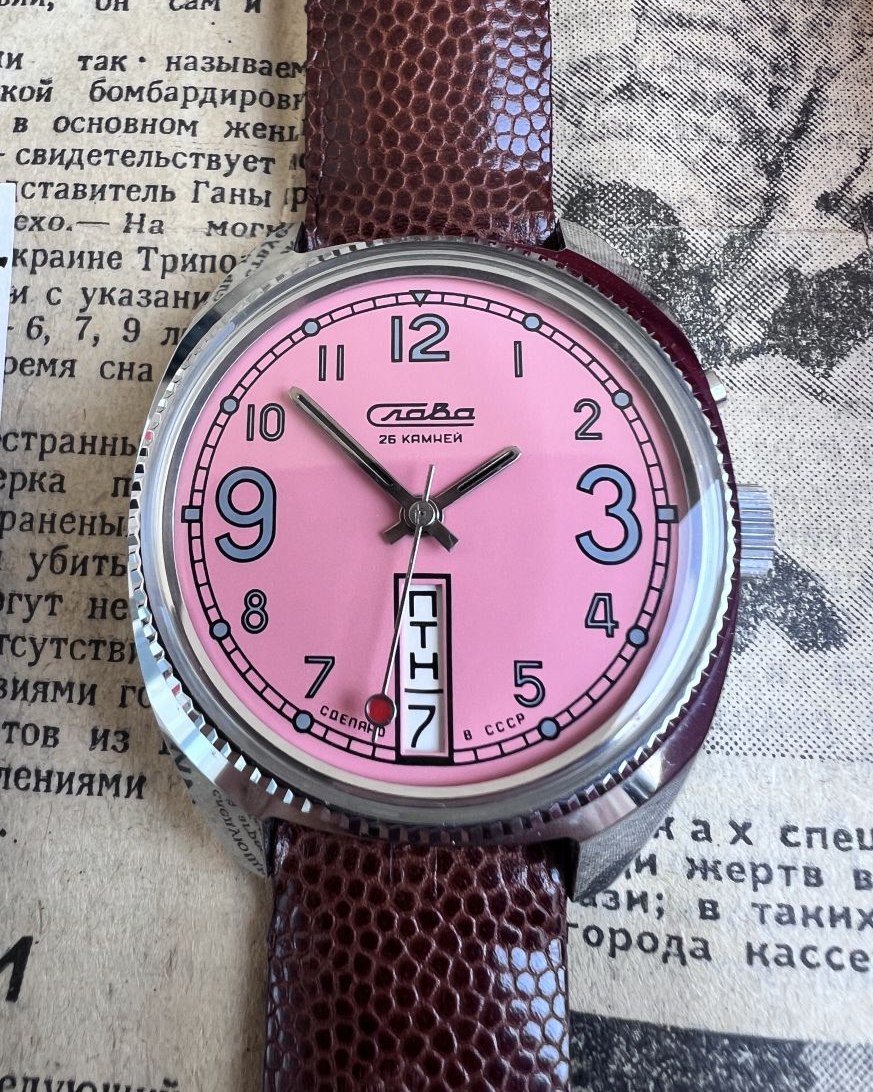
The Second factory was also the leading Soviet maker of women’s watches. The small 1600 and 1601 calibres, often 17 jewels, power millions of watches in chrome-plated or gold-plated cases, worn on a strap, on a cord or as a pendant. The coloured dials of the late 1980s, watermelon pink, blue, red, are the most sought after today.
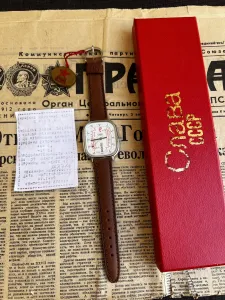
Slava with a « watermelon » pink dial, new old stock with its box and passport.
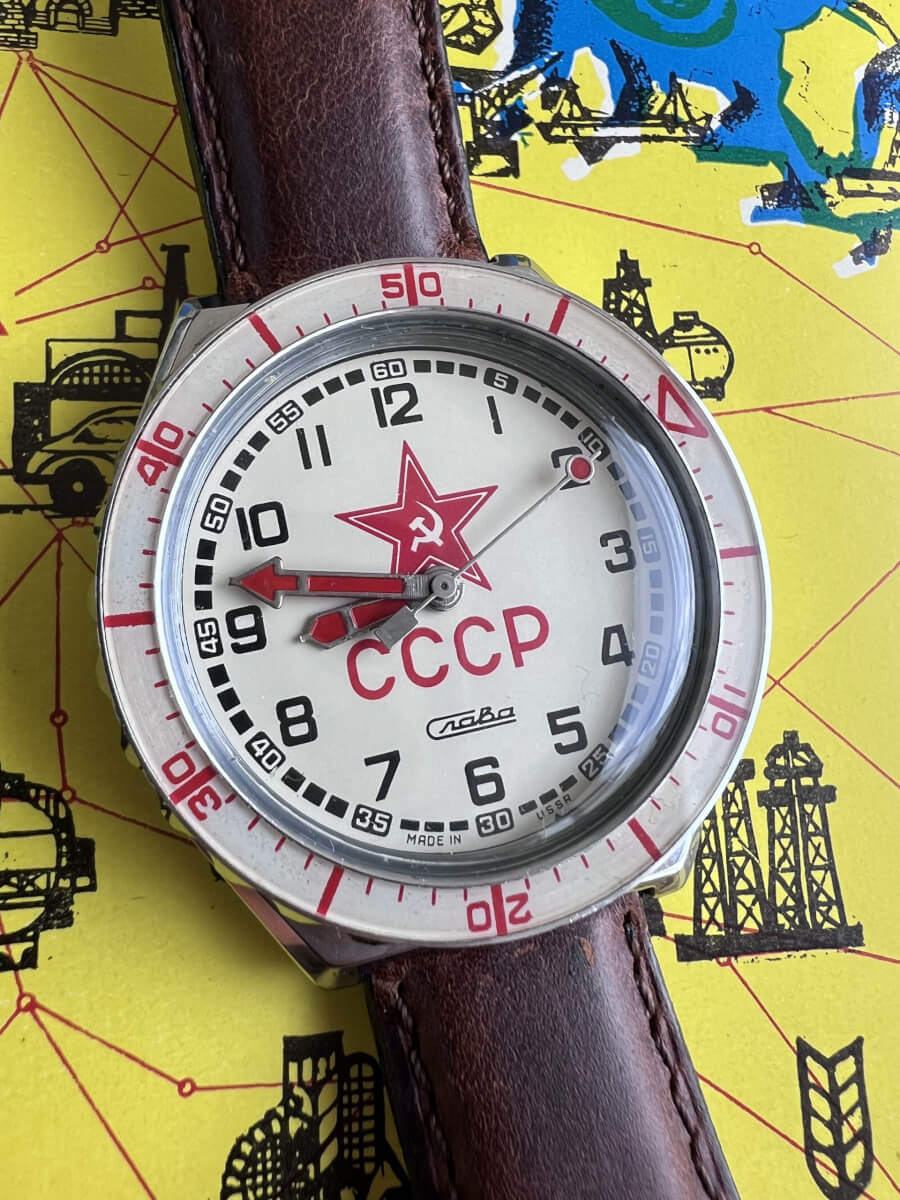
Quartz Slava of the final years, red star and CCCP on the dial.
The commemorative watches: from Perestroika to Mir
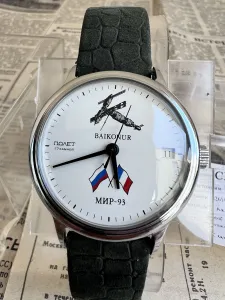
From 1985 to 1991 Slava produced dials that tell the story of the time. The Перестройка (Perestroika) watch, red star and red lettering, is the best known. The Буран (Buran) shuttle, which flew only once on 15 November 1988, has its black dial. After 1991 the factory made the watches of the Mir station missions: Mir-92 for the flight of the German Klaus-Dietrich Flade, Altaïr for the flight of the Frenchman Jean-Pierre Haigneré in 1993, with the flags of both countries and Baikonur on the dial.
Slava Buran, the shuttle on a black ground, new with its box.
Slava Altaïr, 1993, Mir station, French and Russian flags, the Franco-Russian mission.
Slava in Besançon: the French plant
This is the story the other guides do not tell. In 1961 a Besançon company that exported supplies to the USSR became the société anonyme Slava, with mainly Soviet capital. In 1964 Maurice Dejean, former French ambassador in Moscow, joined its management. In the early 1970s the company came fully under Soviet control, and in 1976 it opened a new plant at 7 rue Auguste Jouchoux in Besançon, with about 70 employees for casing, quality control and after-sales service.
The figures are considerable: 280,000 to 300,000 watches sold a year under the Slava brand in France, of which 80,000 were imported finished from the USSR and the rest cased in Besançon with Soviet movements, Slava, Raketa 2609, Zaria 1509 and 2004, Poljot 2614 and even the Poljot 3133 chronograph, dressed for the Geneva house Van der Bauwede. These watches often read « механизм СССР », USSR movement, on the dial. In 1990 the company became Slava Précision, 24 employees in 2004, liquidated on 12 June 2006. Many of the Slavas and Raketas found in French drawers came from there.
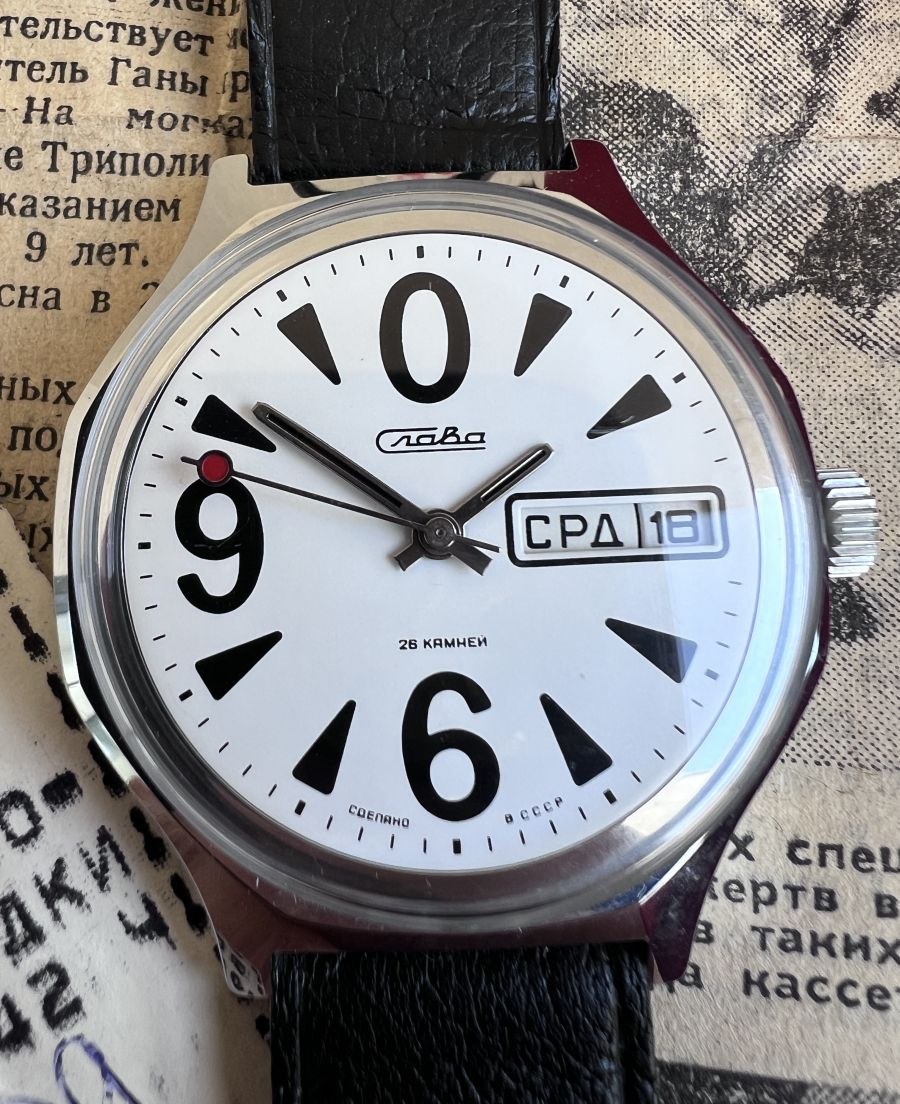
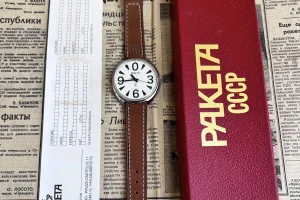
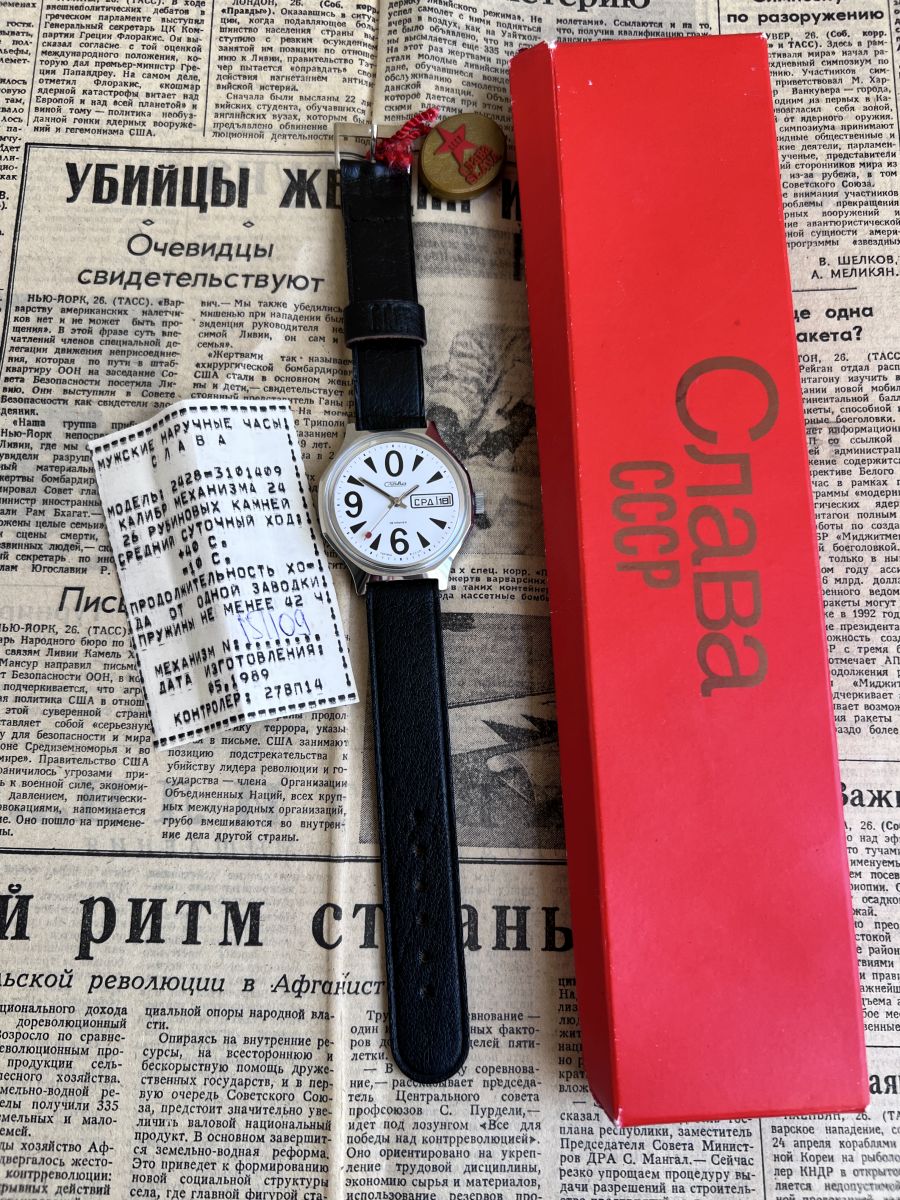
Slava Big Zero from 1989, the model the Besançon plant also distributed in France, with box and passport.
Slava alarm clocks
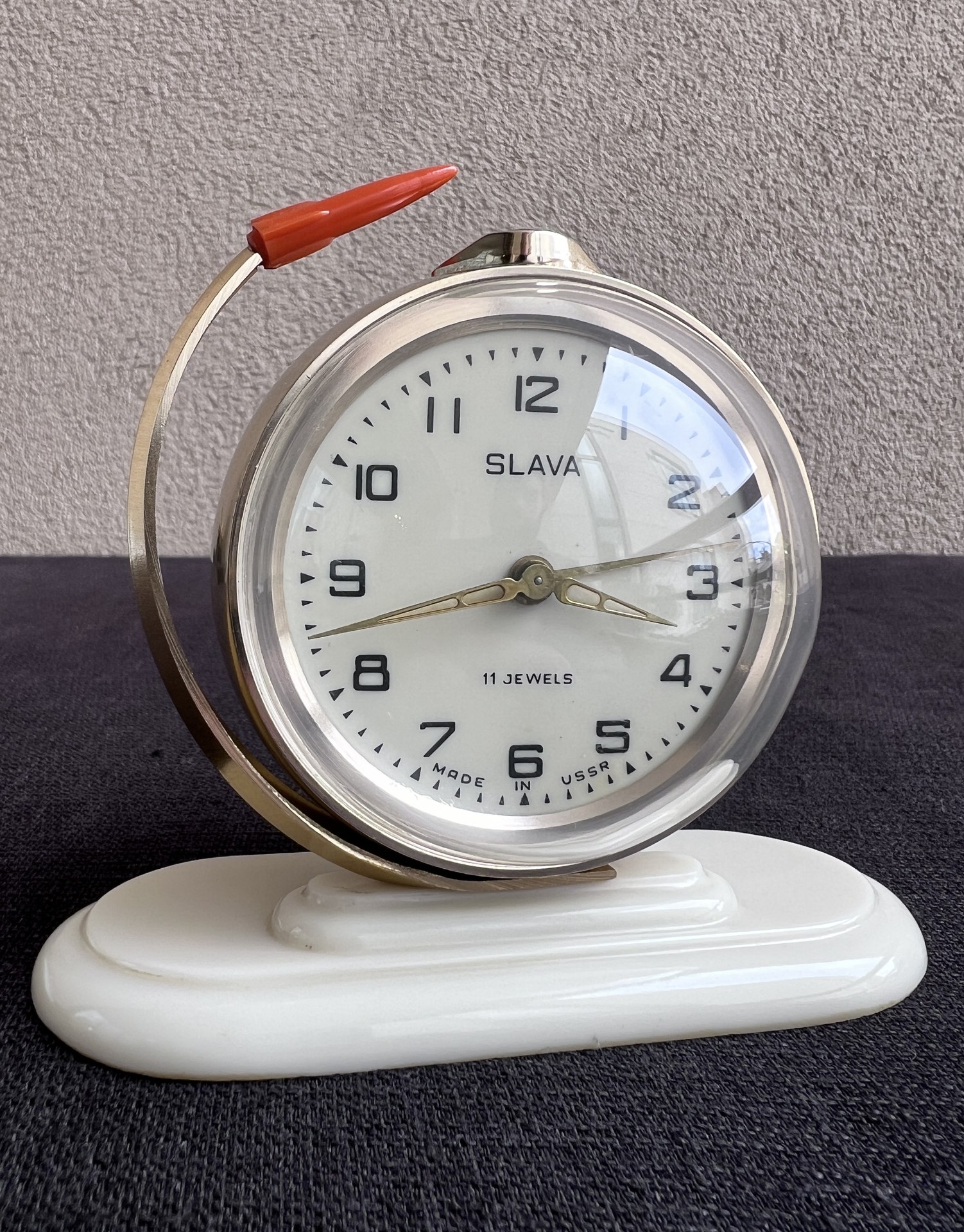
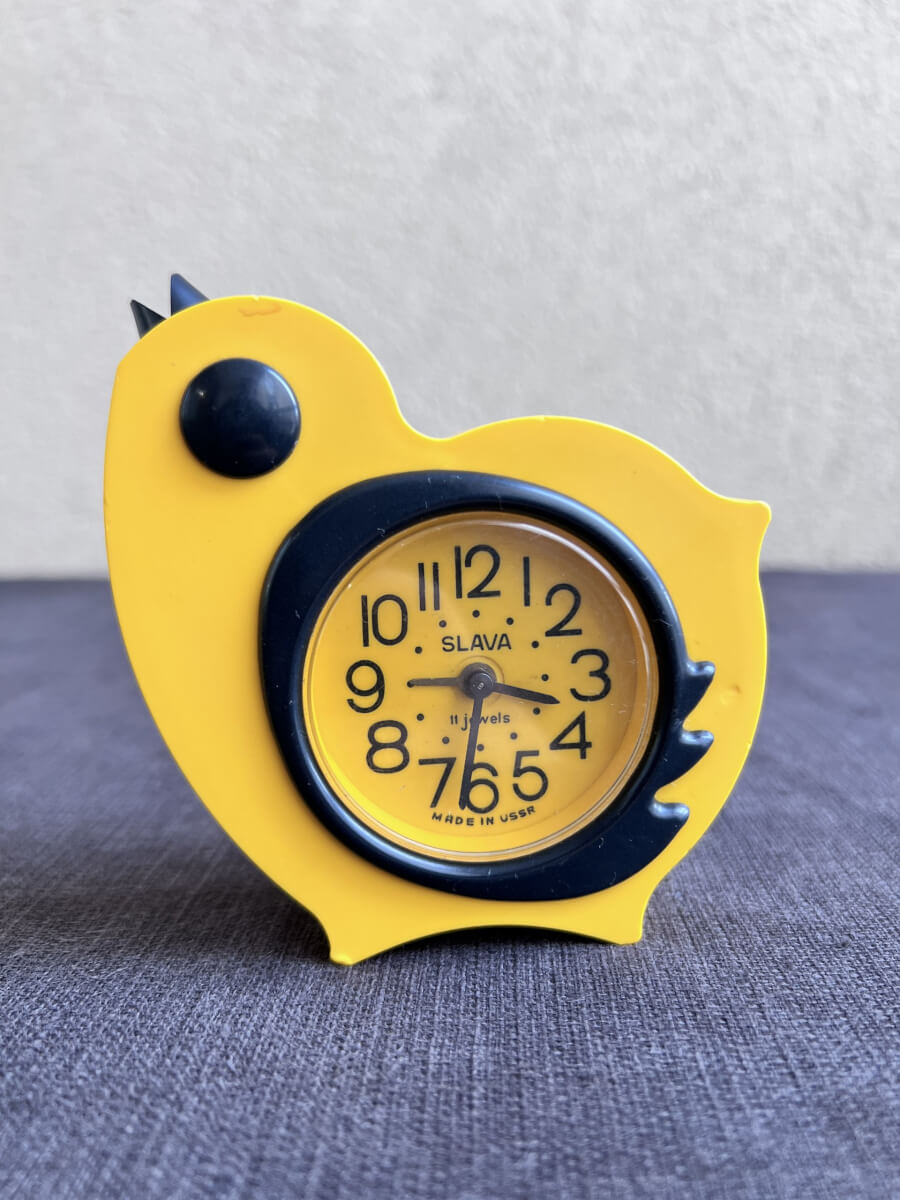
The factory began with alarm clocks and never gave them up. Mechanical Slava alarm clocks, 11 jewels, are recognised by their shapes: the terrestrial globe with a Vostok rocket, the gilt square, the children’s clocks shaped like a chick or an animal. They ring loudly, are wound every day and can still be repaired.
Slava globe alarm clock, red Vostok rocket as the alarm hand, white base.
Slava yellow chick alarm clock, for children, 1980s.
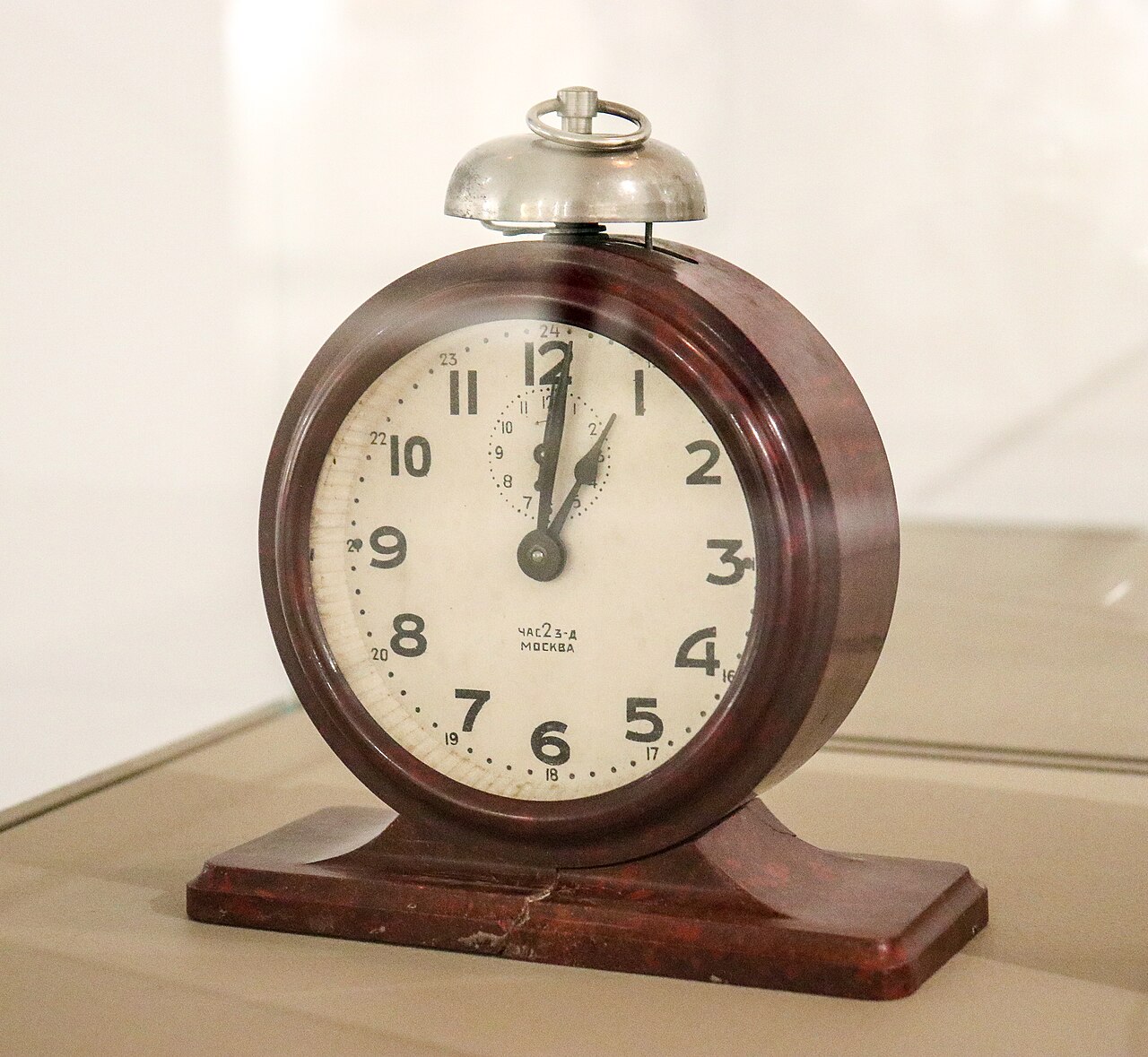
Б-8 (B-8) alarm clock of the Second Moscow factory, 1940s-1950s, carbolite case, dial marked Час 2 з-д Москва (Chas 2 z-d Moskva). Moscow Design Museum, photo Stolbovsky, CC BY-SA 3.0.
Dating a Slava
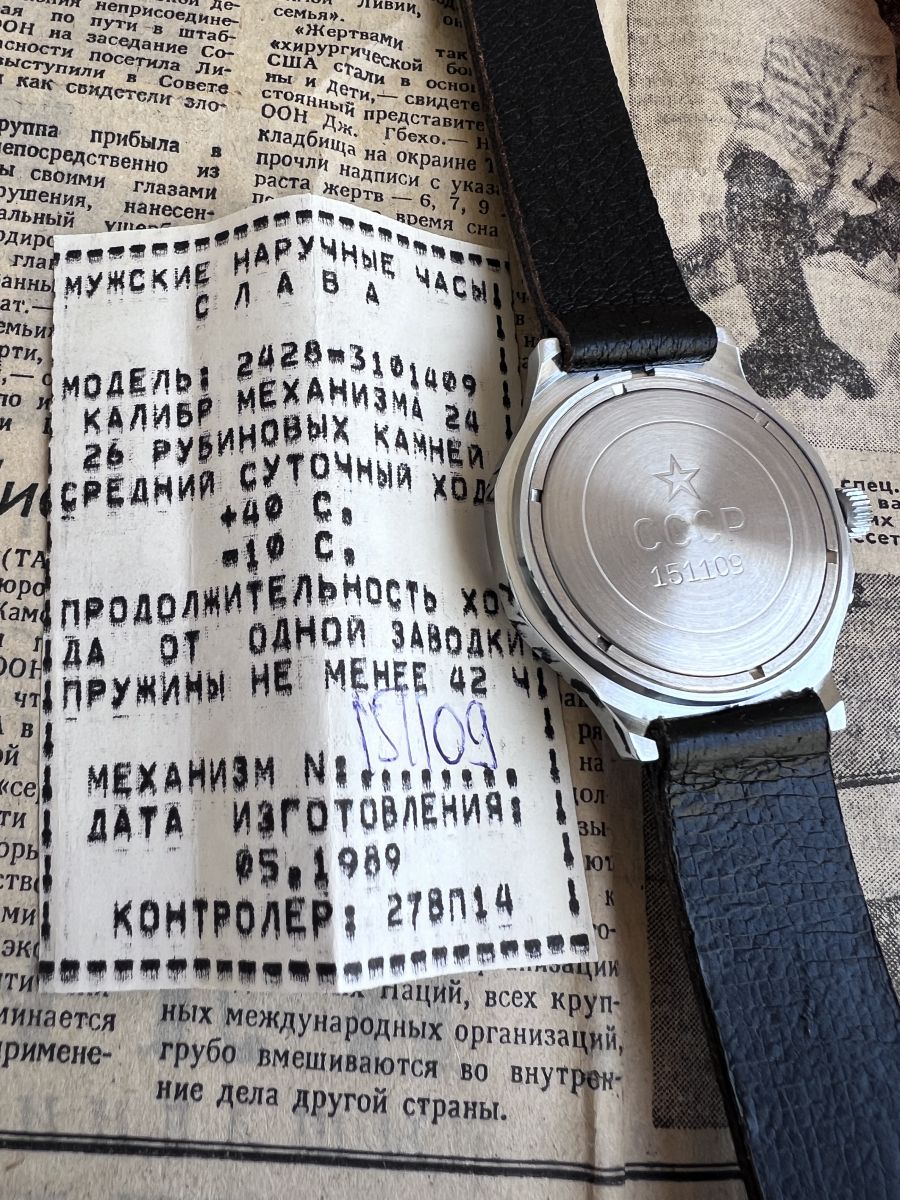
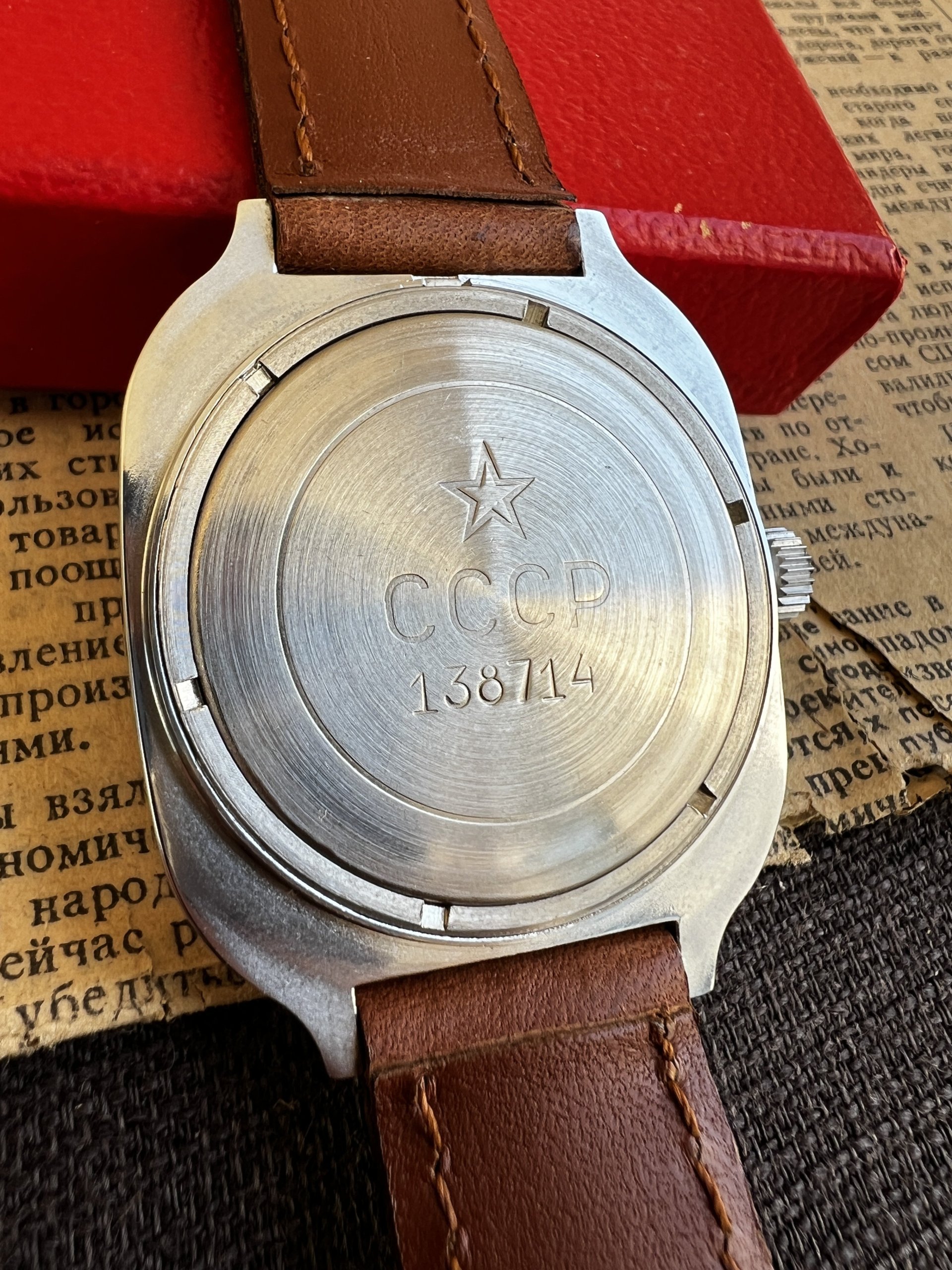
The dial first: « Сделано в СССР » places the watch before 1992, « Made in USSR » marks an export, « Made in Russia » or « Россия » a watch from after 1991. A dial with small seconds at 6 o’clock and 17 or 21 jewels predates the 24 series: 1950s and 1960s. A dial with 26 jewels, day and date, is from 1970 to 1991. The passport next: watches sold new old stock sometimes have their passport with the inspection stamp and the date, to be read on the last page. The back last: a serial number, sometimes the factory symbol, never a date before the 1990s.
A Slava passport: the movement number and the inspection date, May 1989.
The back of an export Slava, CCCP and serial number engraved.
Prices
A men’s Slava with 26 jewels, serviced and guaranteed, sells for between 110 and 300 euros. Women’s models, between 90 and 150 euros. Export dials, California or Medical, new old stock and complete, between 700 and 900 euros. The Transistor, rare and serviced, exceeds 1,500 euros. Alarm clocks, between 70 and 140 euros.
Before buying
Slavas are rarely counterfeited. A twin-barrel movement is reliable, but the single-screw rotor sometimes works loose, and a free-rotor noise is fixed in a few minutes by a watchmaker. Do your research, compare several examples, rely on collectors’ sites that show their pieces.
Frequently asked questions
Which factory is Slava?
The Second Moscow Watch Factory, 2МЧЗ, founded in 1924. The Slava name appeared in the 1950s and designates its whole production from 1969.
Why 26 jewels?
Because the 24 mm calibre has two barrels, each mounted on jewels, and a day and a date. It is a real figure, not a sales pitch.
Are the Besançon Slavas Soviet?
Their movement, yes. They were cased in France between 1976 and 2006 with movements from the USSR and then Russia, and often read « mécanisme URSS » on the dial.
What is a Slava worth?
From 110 to 300 euros for a serviced men’s watch, more for complete export models and the Transistor.
Does Slava still exist?
Yes. The Moscow factory was sold in 2006 and demolished, but the brand was taken over and has been making watches again in Russia since 2019.
The ДП-5В (DP-5V) is the field radiometer of Soviet civil defence: a green Bakelite console, a probe with a rotating gamma, beta and check-source shield, headphones and a manual that explains operation and maintenance. The one in this article served in an industrial bakery in Chișinău and was serviced in March 1991. Its owner shared his photos and documents with us, and we turned them into a tool that lets you operate it on screen, step by step.
The Moscow Games, from 19 July to 3 August 1980, boycotted by some sixty countries, produced more objects than any Soviet event: a bear cub, Misha, drawn by Viktor Chizhikov, an emblem made of running tracks, five thousand torches, watches from every factory, platinum coins, rings, tea glass holders, posters. This guide tells the story of the Games and reviews the objects, with the marks that authenticate them and the prices.
The 3017 chronograph of the First Moscow Watch Factory carries a five-digit number on the balance cock. The most common dating method reads it as a single series, from 1959 to 1979. Four factory passports show there are two, and that the same number can point to two watches made ten years apart. Here is how to read the number, the dial, the logo and the bridge, with a decoder to date your Strela, Poljot or Sekonda.
This website uses cookies to improve your experience while you navigate through the website.
Out of these cookies, the cookies that are categorised as necessary are stored on your browser as they are essential for the working of basic functionalities of the website.
We also use third-party cookies that help us analyse and understand how you use this website.
These cookies will be stored in your browser only with your consent.
You also have the option to opt out of these cookies.
But opting out of some of these cookies may affect your browsing experience.
Necessary cookies are absolutely essential for the website to function properly. This category only includes cookies that ensure basic functionalities and security features of the website. These cookies do not store any personal information.
Cookies that are not strictly necessary for the website to work and that are used specifically to collect personal data through analytics, ads and other embedded content are called non-necessary cookies. User consent is required before these cookies run on the website.
✕
Soviet in Paris
Offline right now. Leave your message and your email, we reply within 24 hours.
Hello 👋 A question about an item, an order or shipping? Write to us.
Your email is used only to reply to you.
Subscribe to our newsletter and get 10% off your first order.
Subscribe
★ New pieces before anyone else
★ New blog articles
★ Soviet in Paris news and updates
Join the Party
10% off your first order
Receive your welcome card and our next arrivals.
Your code appears here and is also sent to you by email. You can leave the Party in one click, at any time.