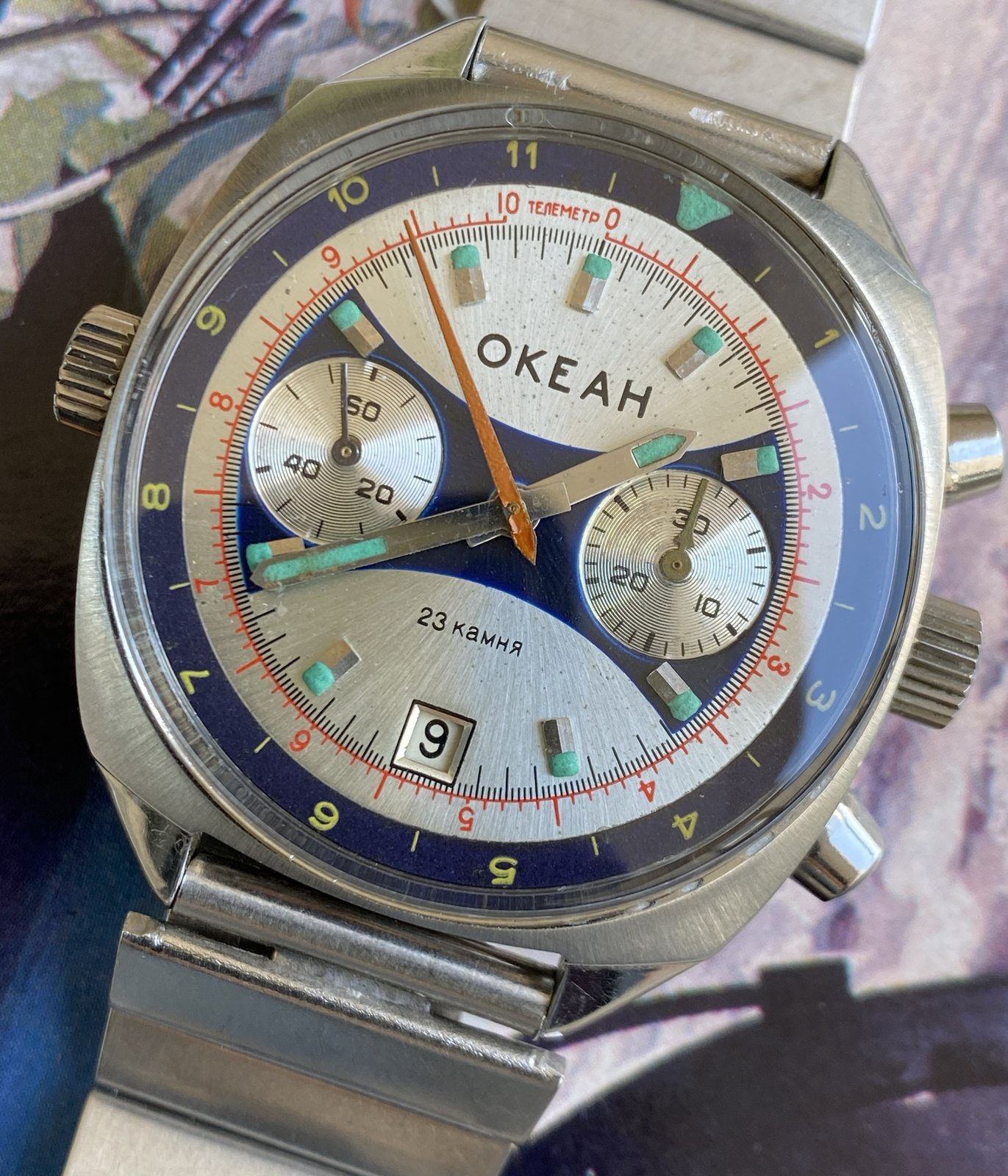
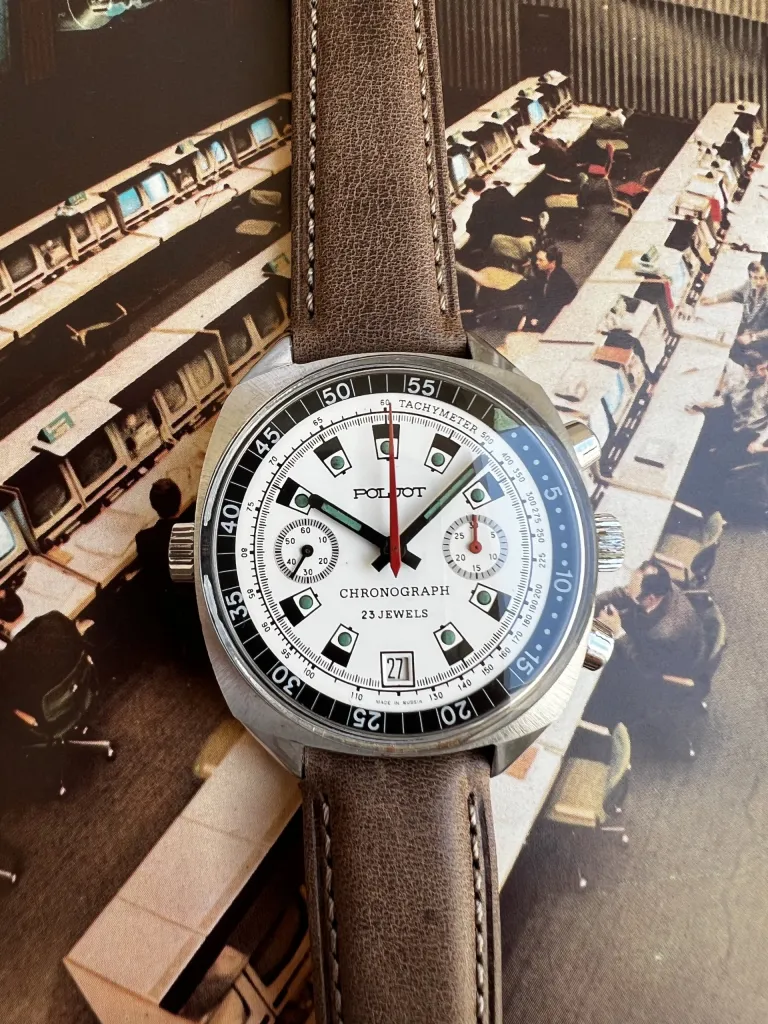
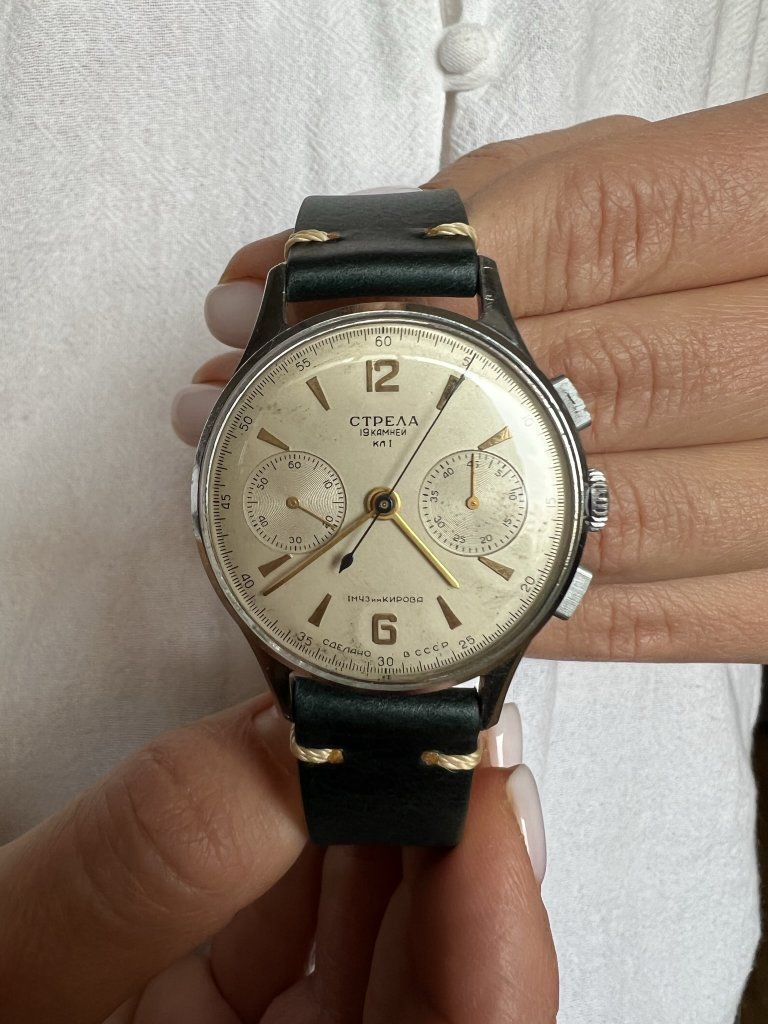
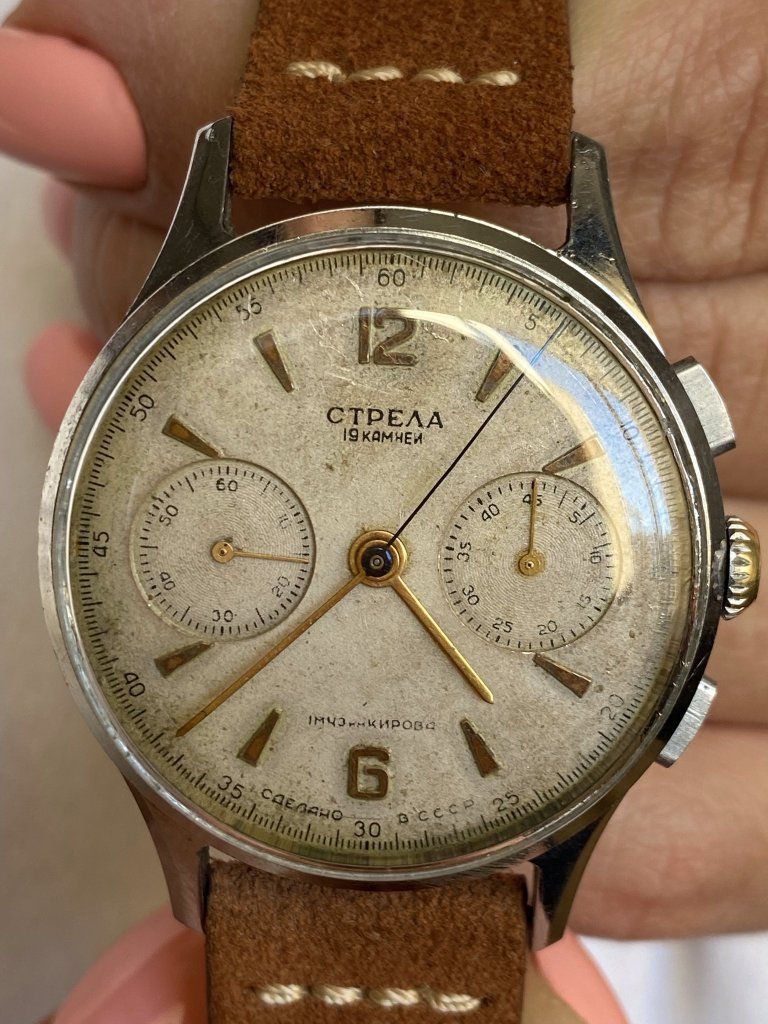
The Okean is the chronograph of the Soviet Navy. Released in 1976 by the First Moscow Watch Factory, it is one of the very first models fitted with the calibre 3133 and was never sold in shops. That same year it went into space with the crew of Soyuz 23 and ended the mission in a frozen lake in Kazakhstan. This guide tells its story, explains its dial, telemeter and rotating ring, and shows what separates a period watch from a copy.
OCTOBER 2026•8 MINUTE READ
by Marwen Yahyaoui
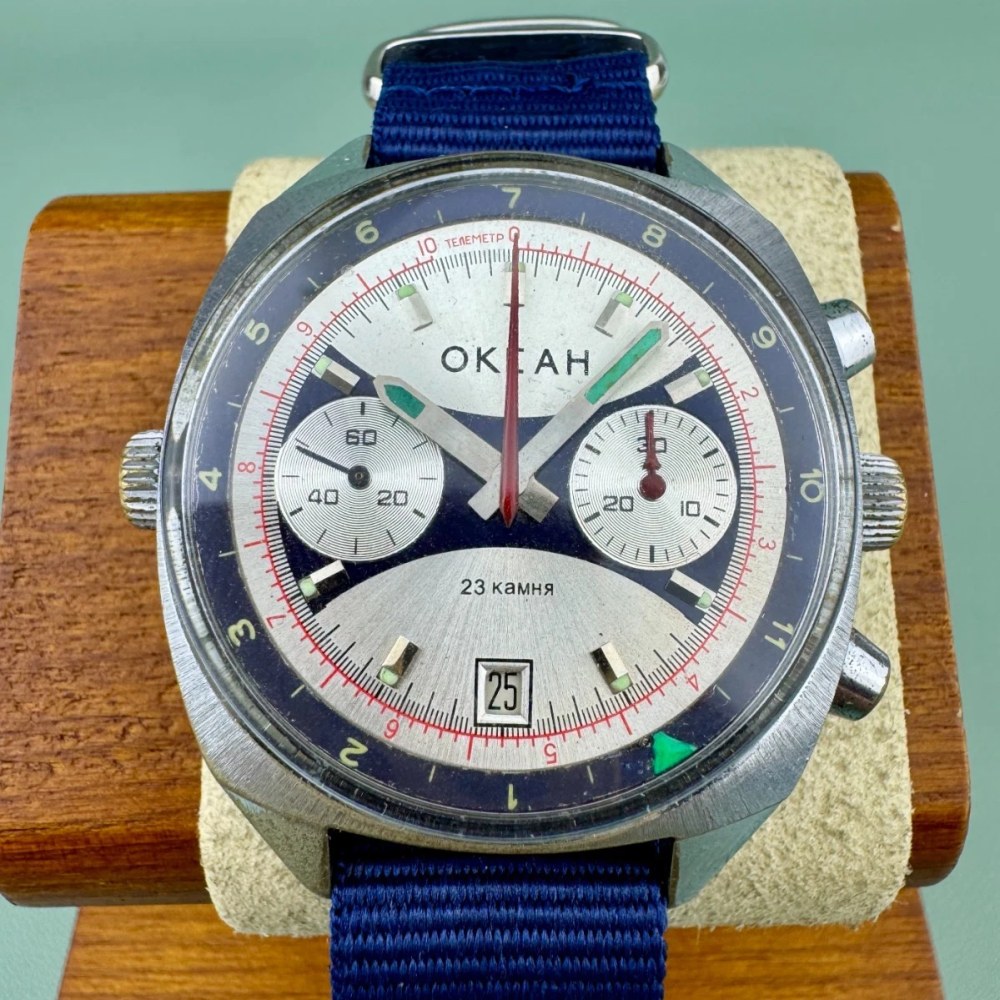
Okean chronograph, First Moscow Watch Factory, calibre 3133.
« Океан » (Okean) means ocean. The name is printed alone on the dial: no Poljot brand, no factory logo. Yet the watch comes from the First Moscow Watch Factory, the one that signs the rest of its production Poljot. It was designed for the officers of the Soviet Navy and did not go through the shops.
The case back says it in full: « Командирские ВМФ » (Komandirskie VMF), a commander’s watch of the Navy, around an anchor and a star.
Case back of an Okean: « Командирские ВМФ », the anchor and the star.
A watch for the officers of the fleet
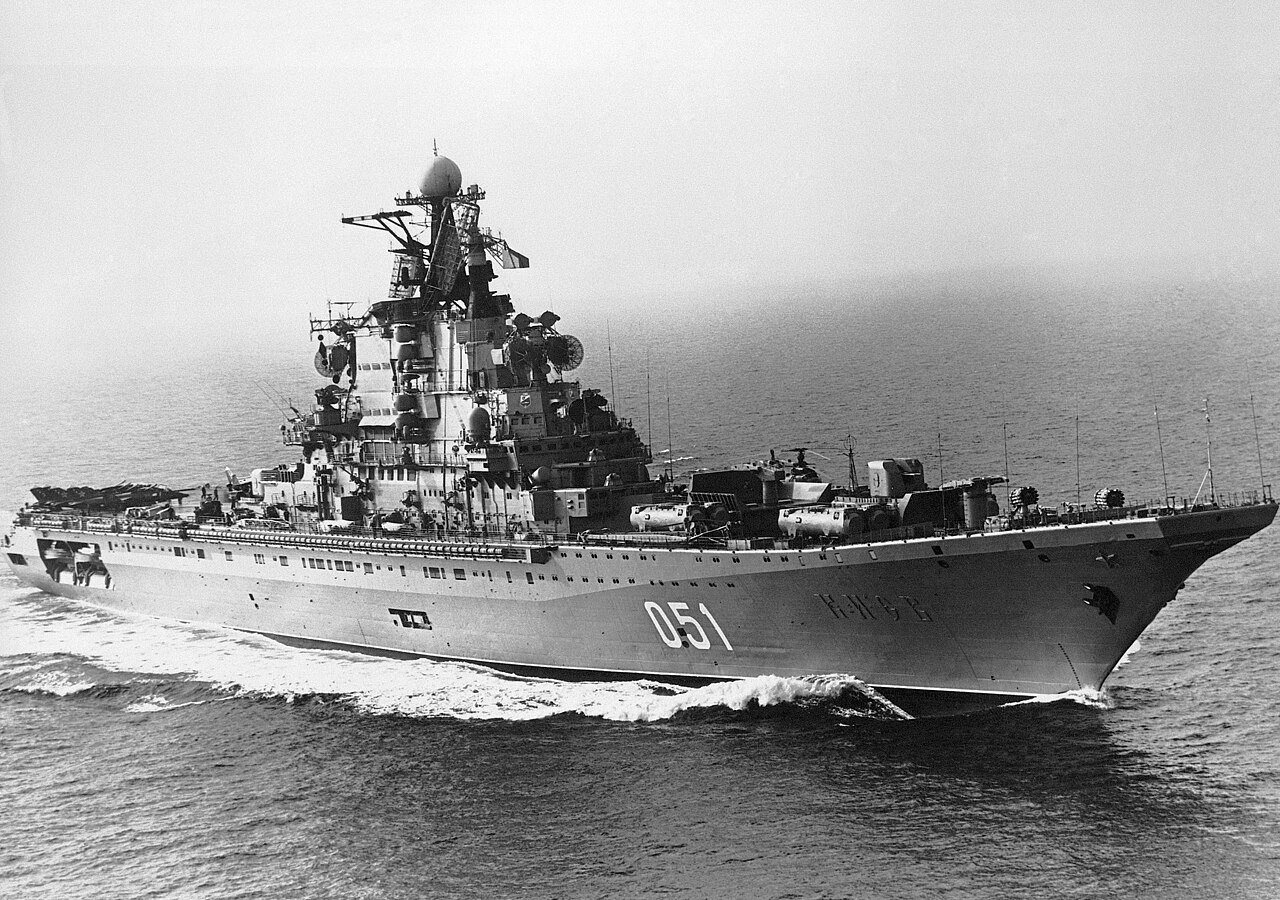
The Okean arrived as the Soviet Navy was becoming a blue-water fleet. The Kiev, its first aircraft-carrying cruiser, was commissioned at the end of 1975. Squadrons sailed in the Mediterranean, the Indian Ocean and the Pacific, far from their bases and across several time zones.
The aircraft-carrying cruiser Kiev underway, 29 April 1986. Photo: US Department of Defense, DN-SN-86-06146, public domain.
The Okean appears in no known factory catalogue. It went through the Navy, not through retail. The public only gained access to the calibre 3133 in 1983, under the Poljot name and in a chrome-plated brass case. The case of the Okean is steel, with a matt finish: 45 mm by 39, 37 mm in diameter, 14 mm thick.
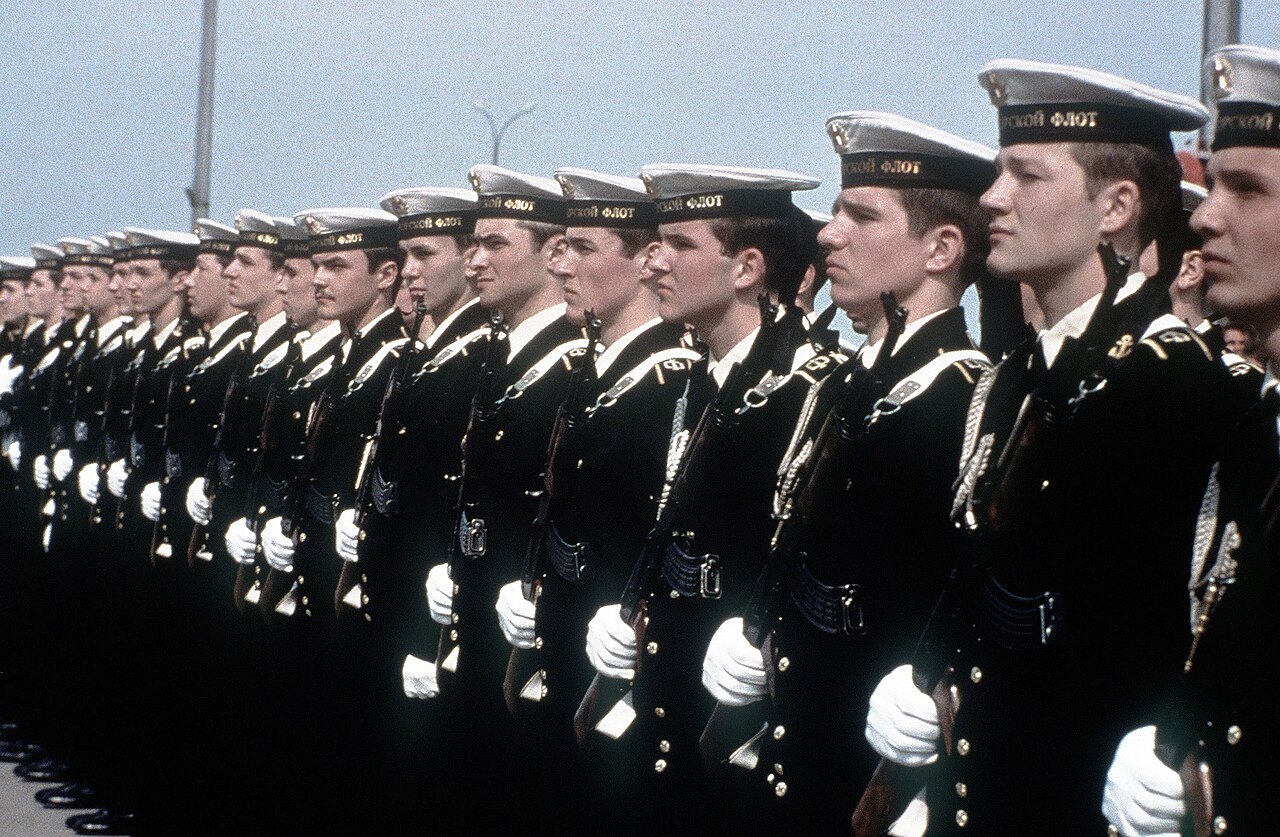
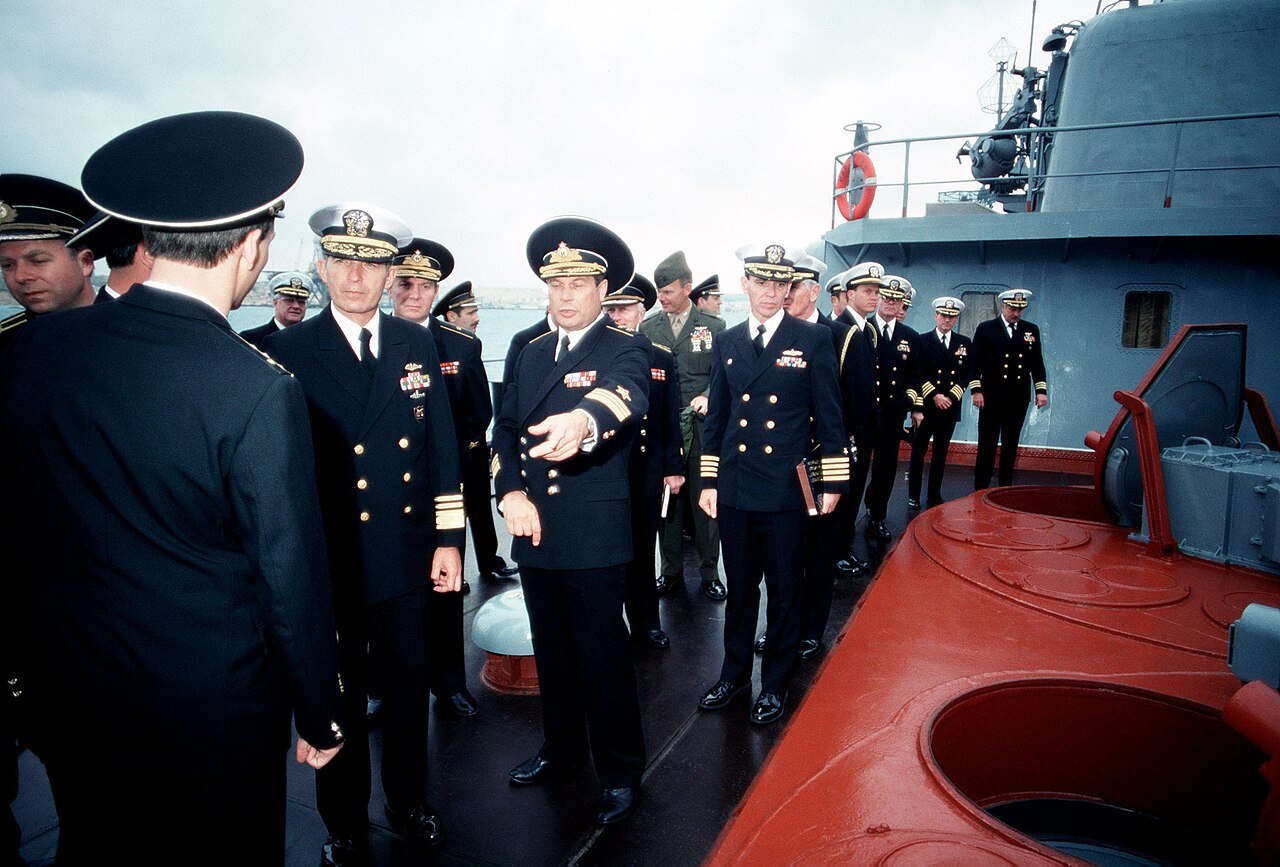
Soviet sailors standing at attention, March 1982. Photo: US Department of Defense, public domain.Soviet and American officers aboard the cruiser Slava, 29 November 1989. Photo: JO1 Kip Burke, US Department of Defense, public domain.
The calibre 3133, a Valjoux reworked in Moscow
In 1974 the Swiss maker Valjoux discontinued its chronograph calibre 7734. The USSR bought the tooling. The First Factory did not reproduce it as it was: the movement went from 17 to 23 jewels, from 18,000 to 21,600 beats per hour, and received a shock protection. Its designers were awarded a State Prize for this work.
The 3133 is a hand-wound chronograph: small seconds at 9, 30-minute counter at 3, date at 6, about forty hours of power reserve. A full wind takes 20 to 30 turns of the crown.
Calibre 3133 of an Okean. The bridge reads « 23 камня » (23 kamnya), 23 jewels.
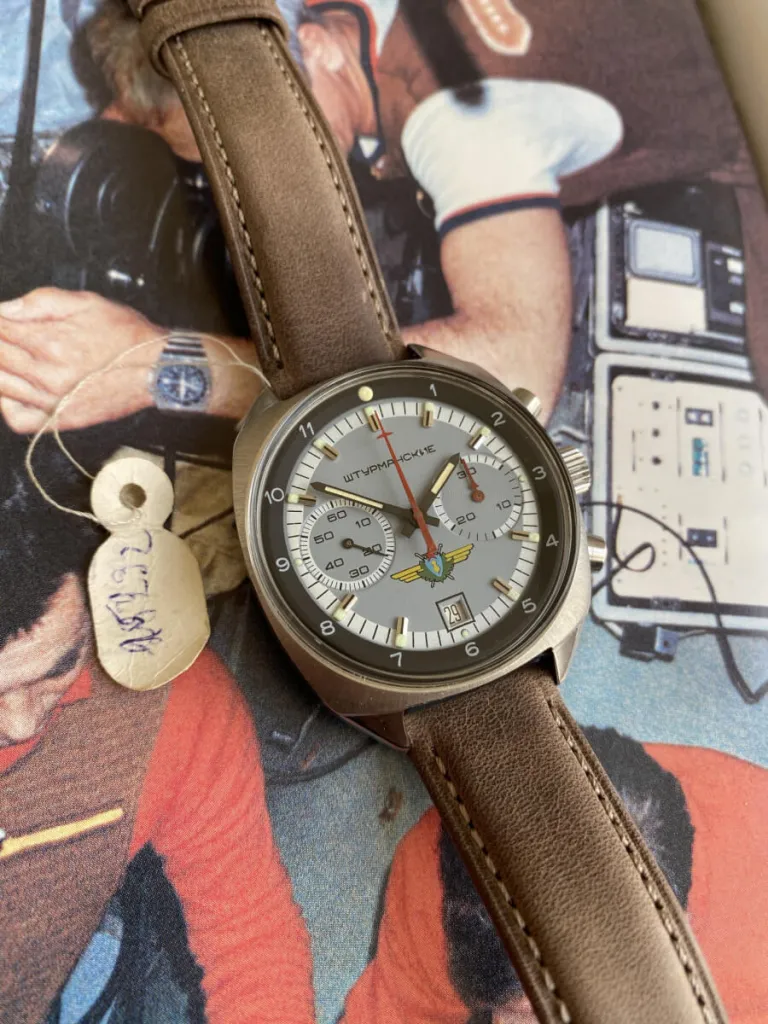
Two dials inaugurated this movement: the Okean for the Navy and the Shturmanskie for the Air Force. One rule applies to every 3133: never reset the chronograph while it is running, it can break the mechanism. The rest of the family is described in our guide to the Poljot 3133.
How to read the Okean dial
The red scale carries the word « ТЕЛЕМЕТР » (telemeter) and runs from 0 to 10. It is graduated in nautical miles. Start the chronograph at the flash of a gun, stop it when the sound arrives: the long chronograph hand gives the distance. Sound takes about five and a half seconds to travel one nautical mile, which puts the 10 a little before the end of the lap. Try it on the watch below: the top pusher starts and stops the chronograph, the bottom one resets it.
The blue ring numbered 1 to 12 is used to read a second time zone. It turns under the crystal, driven by the left-hand crown, at 9 o’clock. Offset it by the number of hours between the two zones, then read the time of the second zone on the ring, opposite the hour hand. The ring is not linked to the movement: it is set by hand and stays where it was put.
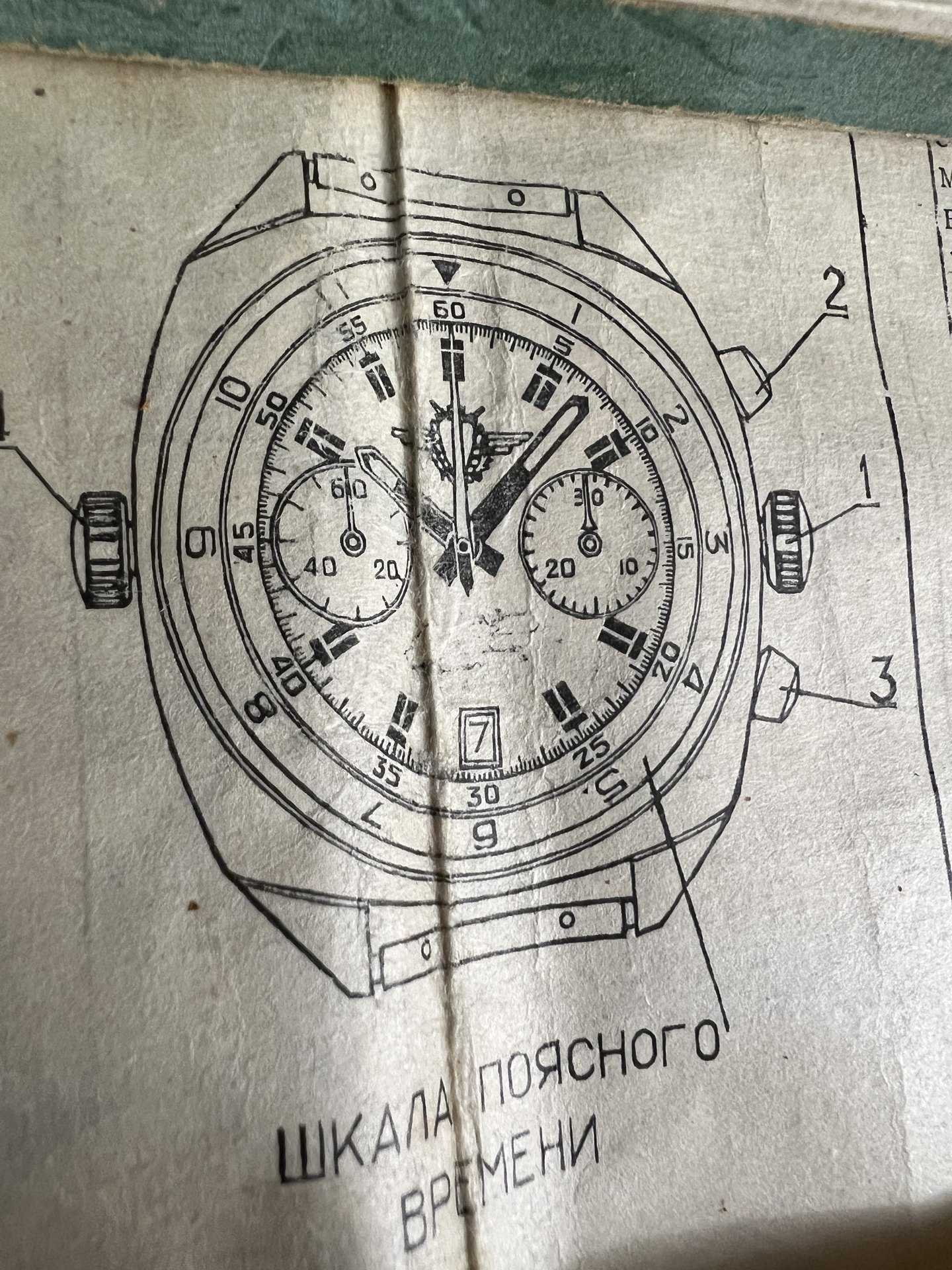
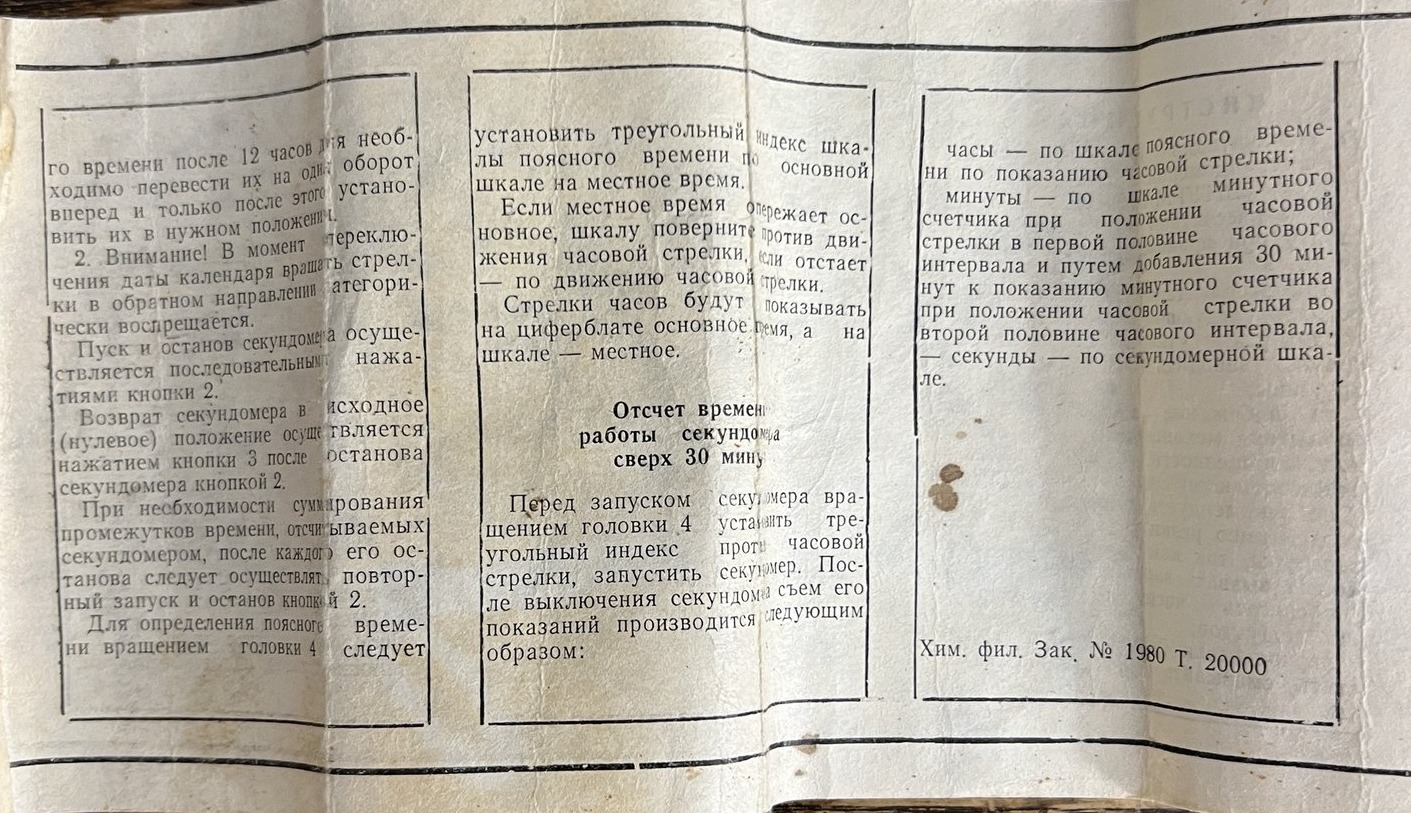
The leaflet of a 1985 Shturmanskie 3133, the other 3133 with a rotating ring, describes the same crown and the same ring. Its diagram numbers the left-hand crown 4 and calls the ring « шкала поясного времени » (shkala poyasnogo vremeni), the time-zone scale. It gives the direction of the setting: if local time is ahead of the main time, turn the scale anticlockwise; if it is behind, clockwise. The hands keep the main time on the dial, and the hour hand shows local time on the scale.
Diagram from the leaflet of a 1985 Shturmanskie 3133. 1: winding and setting crown. 2: chronograph start and stop. 3: reset. 4: crown of the time-zone scale.
Ring offset: the triangle is no longer at 12. The left-hand crown turns it.
The same crown is used to time more than 30 minutes, the limit of the counter. The leaflet gives it a chapter, « Отсчет времени работы секундомера сверх 30 минут » (Otschyot vremeni raboty sekundomera sverkh 30 minut), counting chronograph time beyond 30 minutes. Before starting the chronograph, use crown 4 to bring the triangle of the ring opposite the hour hand. Once it is stopped, read the elapsed hours on the ring, at the hour hand. The minutes are read on the 30-minute counter, adding 30 if the hour hand is in the second half of the interval between two numbers. The seconds are read at the long chronograph hand.
The leaflet of the Shturmanskie 3133: setting the time-zone scale, then the chapter on timing beyond 30 minutes.
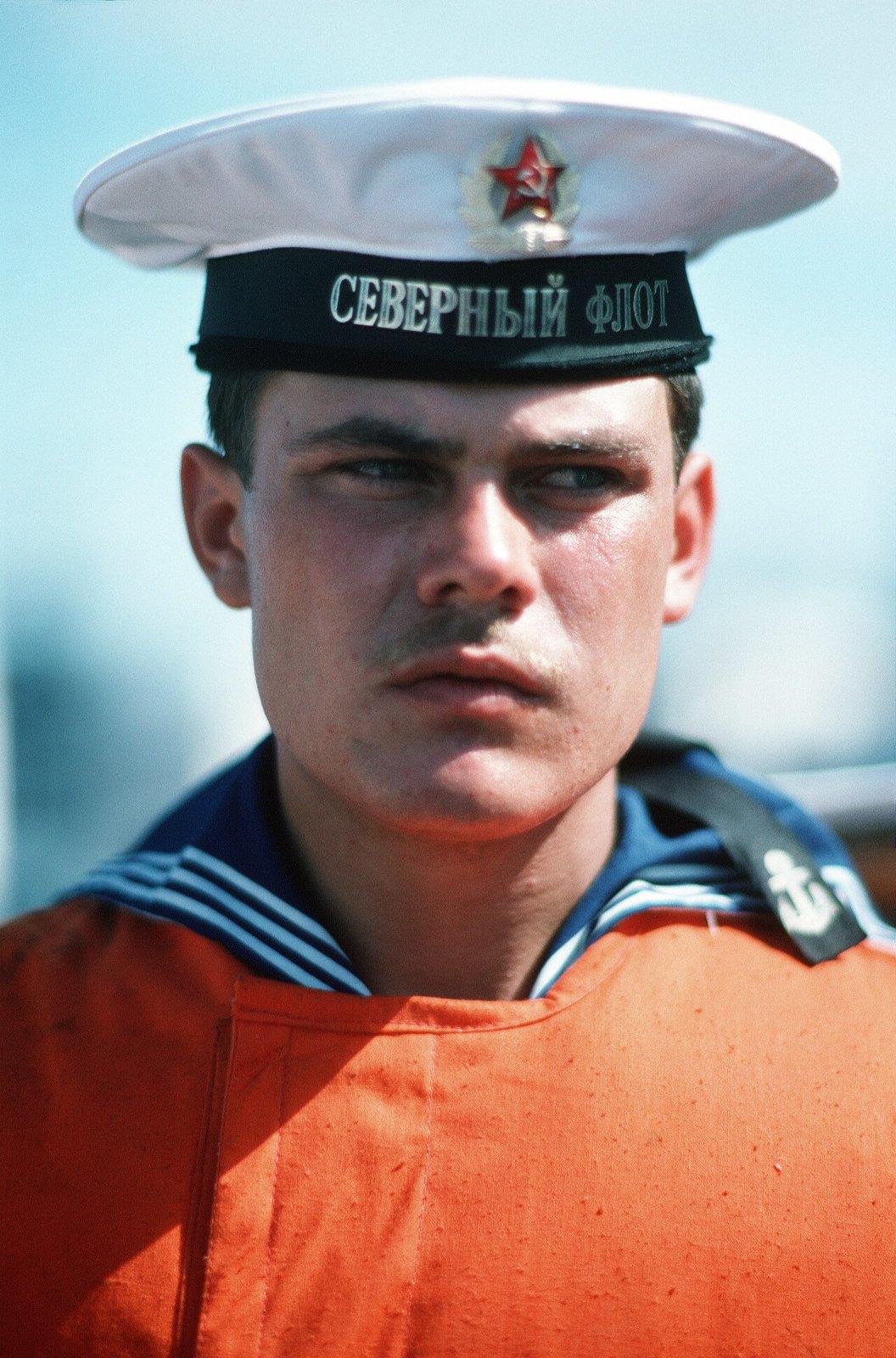
Sailor of the Northern Fleet, 21 July 1989. On the cap ribbon: « Северный флот » (Severnyy flot). Photo: PH1 Scott M. Allen, US Navy, National Archives, public domain.
October 1976: two Okeans in a frozen lake
On 14 October 1976, Soyuz 23 lifted off with Vyacheslav Zudov and Valery Rozhdestvensky. Docking with the Salyut 5 station failed and the crew came home. On 16 October, at night and in a snowstorm, the capsule came down in Lake Tengiz, Kazakhstan, 8 km from the shore, at 22 degrees below zero. It took nine hours to bring it to the bank. It remains the only splashdown of a Soviet crew.
Rozhdestvensky was well prepared for it. A naval engineer, he had commanded a diving unit of the Baltic Fleet from 1961 to 1965.
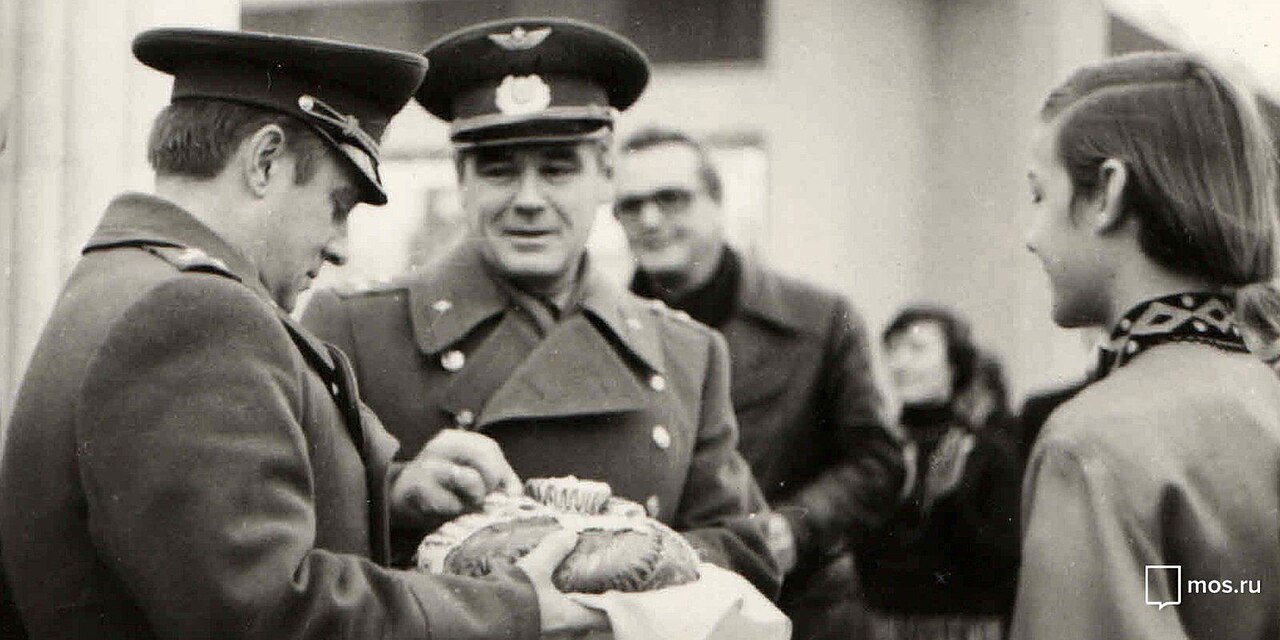
Valery Rozhdestvensky (left) and Vasily Lazarev in Moscow, 8 December 1979. Photo: S. Koptsov, Moscow Glavarkhiv, CC BY 4.0.
Both flown watches were later sold at Sotheby’s, in the sales devoted to Russian space history. According to the catalogues, as quoted by collectors, both men wore an Okean. Zudov’s is said to have stopped in the lake after a knock against the instrument panel. Rozhdestvensky stated in writing, in 1993, that his had been used for the whole flight and then, after the splashdown, to keep track of time.
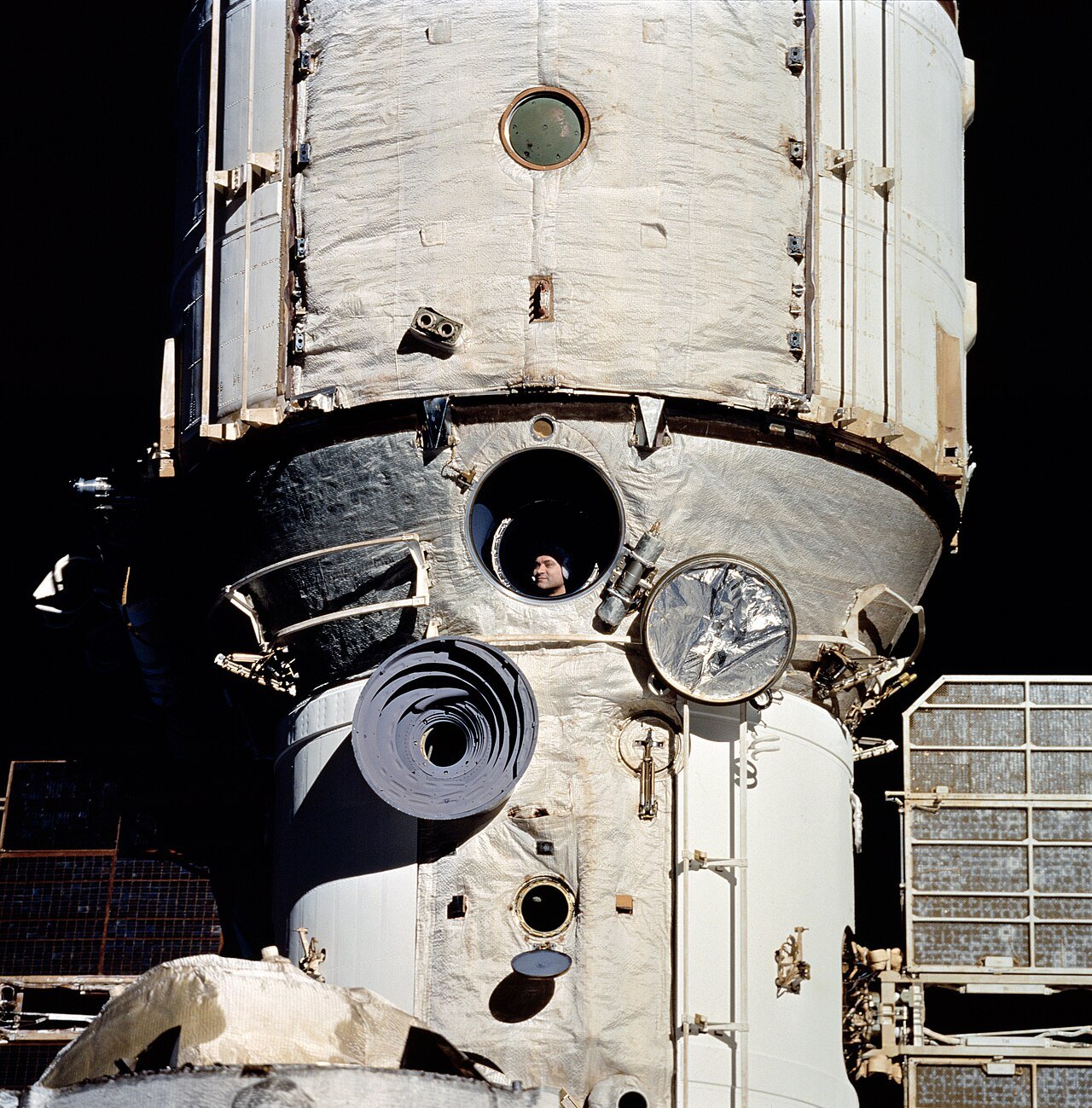
The 3133 chronograph also holds the record for the longest stay in space: 437 days aboard the Mir station, on the wrist of Valeri Polyakov, from January 1994 to March 1995.
Valeri Polyakov at a window of the Mir station, 6 February 1995. Photo: NASA, public domain.
Two versions and a few variants
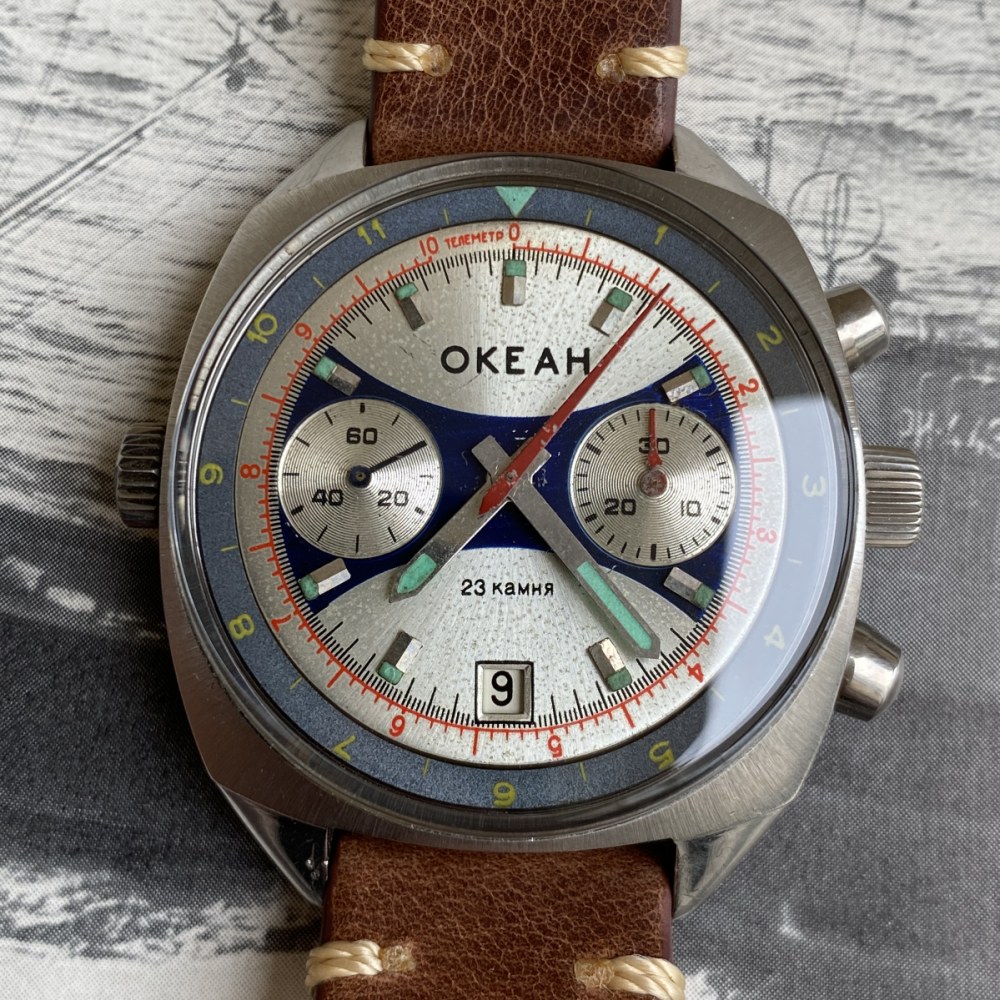
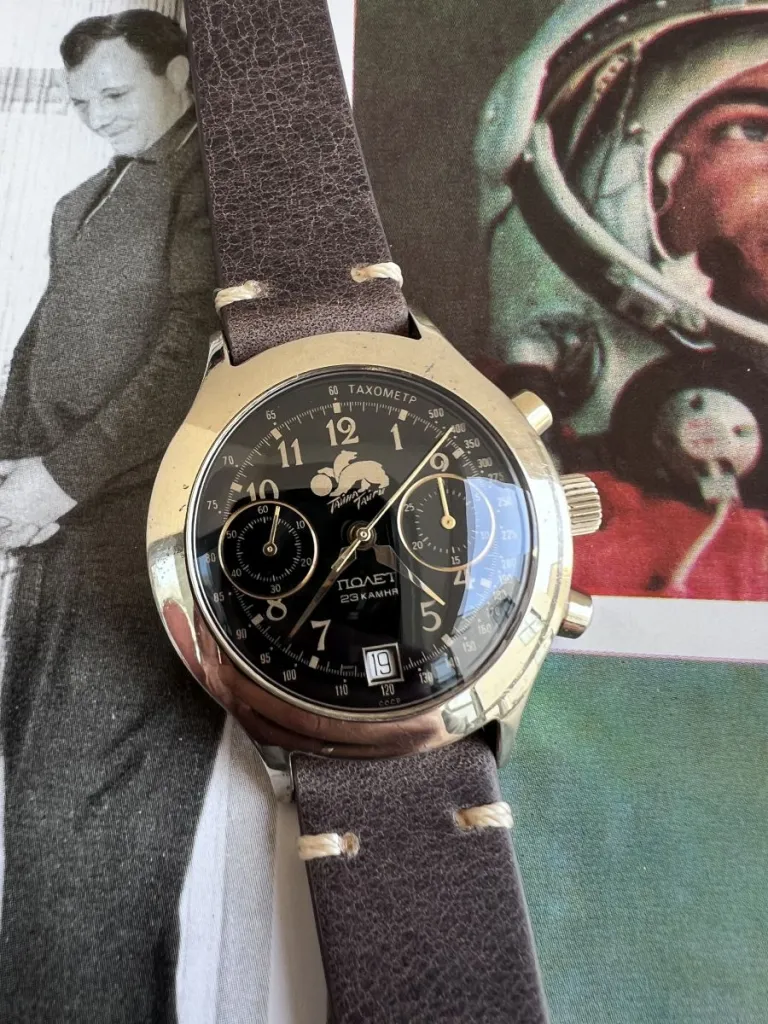
Most of the Okeans that have passed through the shop have a blue ring with yellow figures. Another had a pale ring with red figures. The chronograph hand is red or orange depending on the watch.
Collectors distinguish two versions. The first, from 1976 to 1980, has a slightly smaller « Океан » name and red figures on the ring. The second, in the early 1980s, changes the design of the letters. Production stopped in the course of the 1980s.
Okean with a pale ring and red figures, orange chronograph hand.
A 1985 dedication: the crew of the Kompas
An Okean we are preparing for the shop carries an engraved dedication on its back: « Костюкову В.М. в день 50-летия от экипажа ГиСу “Компас” 24.07.85 г. » That is: to V. M. Kostyukov, on his 50th birthday, from the crew of the hydrographic survey ship « Компас » (Kompas), 24 July 1985.
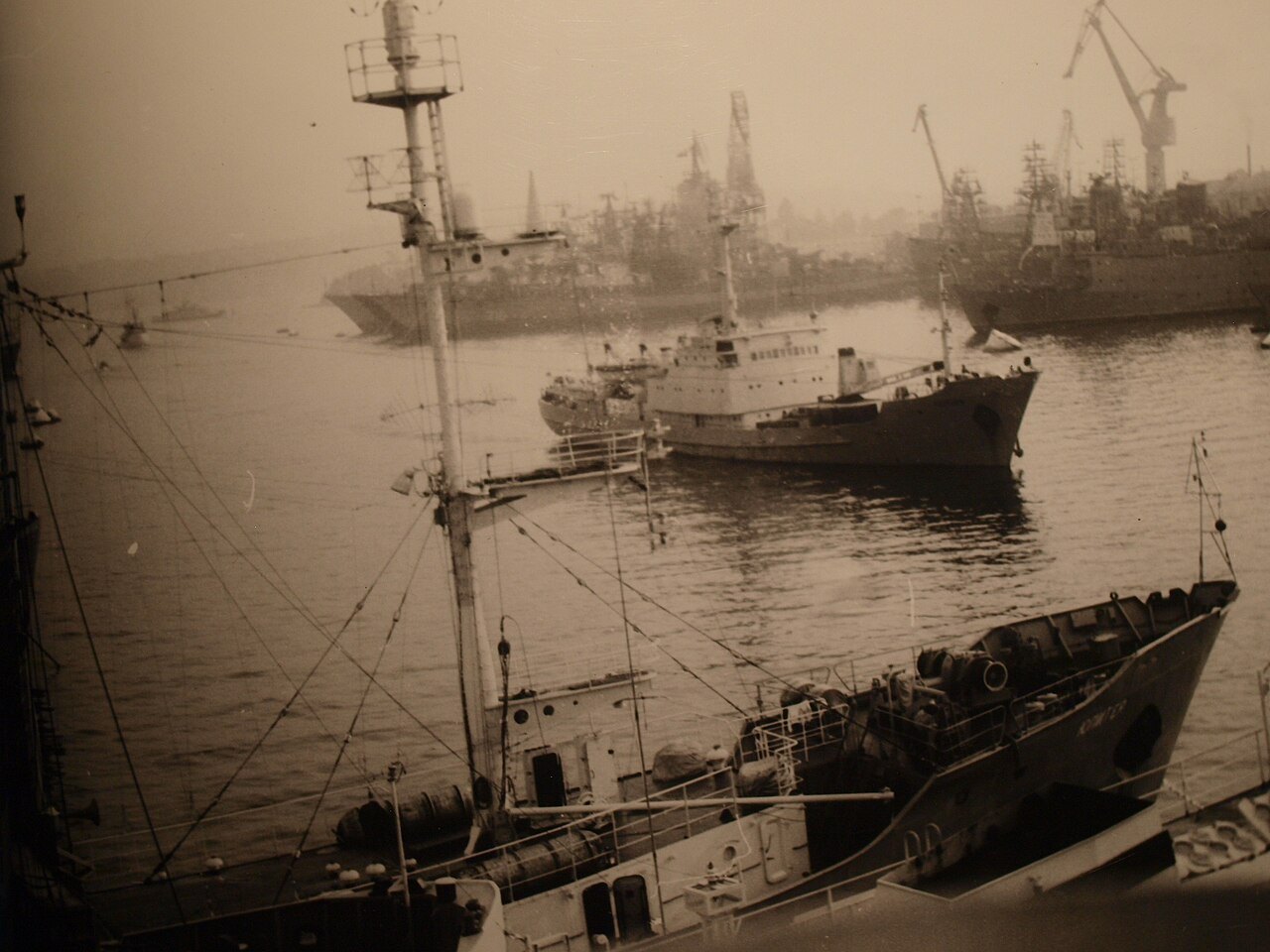
The Kompas was a Project 860 survey ship, built in Gdańsk and commissioned in 1964 in the Baltic Fleet: a crew of 43 and 10 hydrographers. The officer Boris Uspensky recalls in his memoirs that in February 1968 the Kompas shadowed a West German intelligence ship for three days, in a storm, at the edge of Soviet waters. The ship was struck off in 1995. Of V. M. Kostyukov, this dedication is all we have found.
Soviet hydrographic survey ship in the South Bay of Sevastopol, Black Sea Fleet. This is not the Kompas, which served in the Baltic. Photo: Mikhail Babkin, CC BY-SA 4.0.
How to recognise a period Okean
A period Okean is rare and expensive. So copies exist: a redone dial fitted in an old case. There are also assembled watches, made of parts from several chronographs. Copies now far outnumber period watches. On 10 October 2026, seven Okeans were listed on eBay: all seven were copies. That day, across all the sites we checked, we counted about thirty copies and not a single period watch. The comparator below overlays an Okean that passed through the shop and a copy. There are several types of copies: the points apply to the one shown.
Period watchCopy
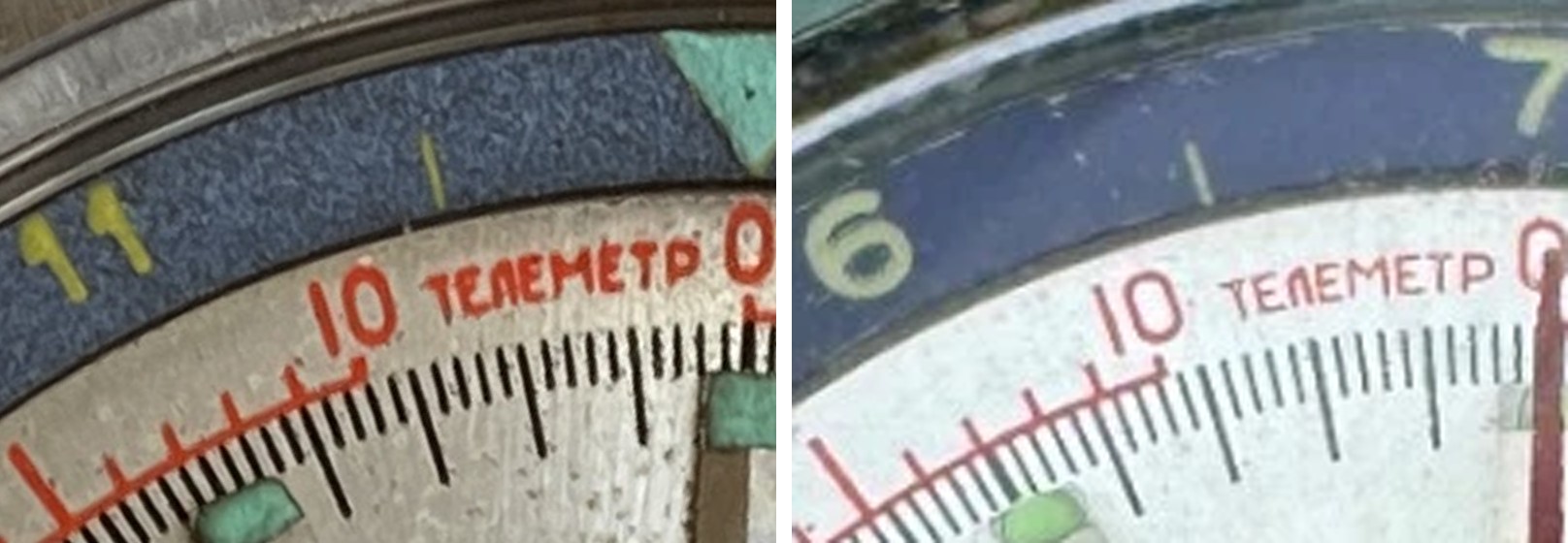
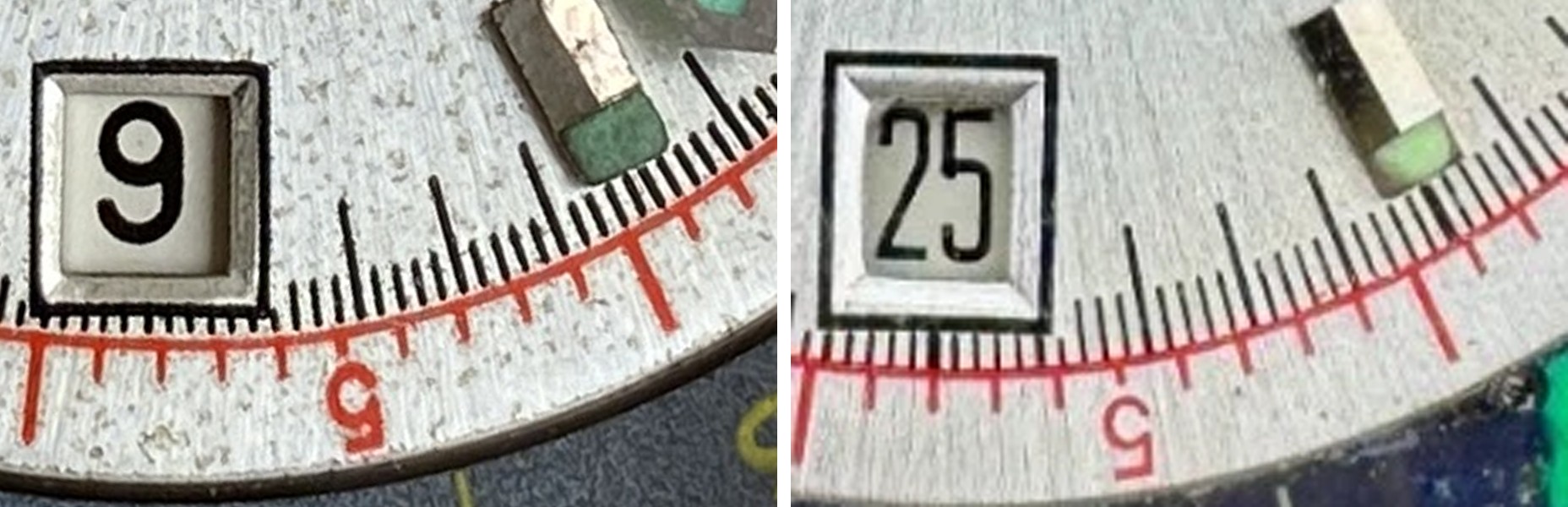
1The condition. The watch on the right is in a catastrophic state, and its dial is perfect. Such a gap between the case and the dial points to a redone dial.
2The 10 of the telemeter. On the period dial, the scale mark placed under the 10 falls exactly in the middle of the number. On the copy it is off-centre.
3The 5 of the telemeter. On the period dial, the 5 is thick and compact. On the copy it is thin and larger.
The 10 of the telemeter. Left, the period dial. Right, the copy.The 5 of the telemeter. Left, the period dial. Right, the copy.
Before buying, also test the chronograph: start, stop, reset. An Okean that has not been serviced often has a faulty chronograph, servicing a 3133 is expensive and few watchmakers do it. Take the time to do thorough research, compare several examples and rely on collectors’ sites and buying guides.
Available at Soviet in Paris
Okeans do not stay in stock for long. Two other calibre 3133 chronographs are available: the Vostok Komandirskie chronograph, a commercial model with a naval dial made for Italy, and a Poljot with a telemeter scale. According to a former employee of the Italian importer Time Trend, quoted by the site Finestraweb, the Vostok is said to have been assembled in Milan and not in Chistopol.
The ДП-5В (DP-5V) is the field radiometer of Soviet civil defence: a green Bakelite console, a probe with a rotating gamma, beta and check-source shield, headphones and a manual that explains operation and maintenance. The one in this article served in an industrial bakery in Chișinău and was serviced in March 1991. Its owner shared his photos and documents with us, and we turned them into a tool that lets you operate it on screen, step by step.
The Moscow Games, from 19 July to 3 August 1980, boycotted by some sixty countries, produced more objects than any Soviet event: a bear cub, Misha, drawn by Viktor Chizhikov, an emblem made of running tracks, five thousand torches, watches from every factory, platinum coins, rings, tea glass holders, posters. This guide tells the story of the Games and reviews the objects, with the marks that authenticate them and the prices.
The 3017 chronograph of the First Moscow Watch Factory carries a five-digit number on the balance cock. The most common dating method reads it as a single series, from 1959 to 1979. Four factory passports show there are two, and that the same number can point to two watches made ten years apart. Here is how to read the number, the dial, the logo and the bridge, with a decoder to date your Strela, Poljot or Sekonda.
This website uses cookies to improve your experience while you navigate through the website.
Out of these cookies, the cookies that are categorised as necessary are stored on your browser as they are essential for the working of basic functionalities of the website.
We also use third-party cookies that help us analyse and understand how you use this website.
These cookies will be stored in your browser only with your consent.
You also have the option to opt out of these cookies.
But opting out of some of these cookies may affect your browsing experience.
Necessary cookies are absolutely essential for the website to function properly. This category only includes cookies that ensure basic functionalities and security features of the website. These cookies do not store any personal information.
Cookies that are not strictly necessary for the website to work and that are used specifically to collect personal data through analytics, ads and other embedded content are called non-necessary cookies. User consent is required before these cookies run on the website.
✕
Soviet in Paris
Online. We answer in person, no AI and no chatbot. Reply right away, 20 min at most.
Hello 👋 A question about an item, an order or shipping? Write to us.
Your email is used only to reply to you.
Subscribe to our newsletter and get 10% off your first order.
Subscribe
★ New pieces before anyone else
★ New blog articles
★ Soviet in Paris news and updates
Join the Party
10% off your first order
Receive your welcome card and our next arrivals.
Your code appears here and is also sent to you by email. You can leave the Party in one click, at any time.