On a Soviet telephone, three details nearly always place the piece. The dial, or the blanking plate fitted in its place, tells you what kind of exchange it was wired to. The plate or the moulding gives the model. The year is stamped under the base or on the plate. From Bakelite desk sets to battery-free ship phones and mine phones, this guide shows how they worked and what to check before you buy one.
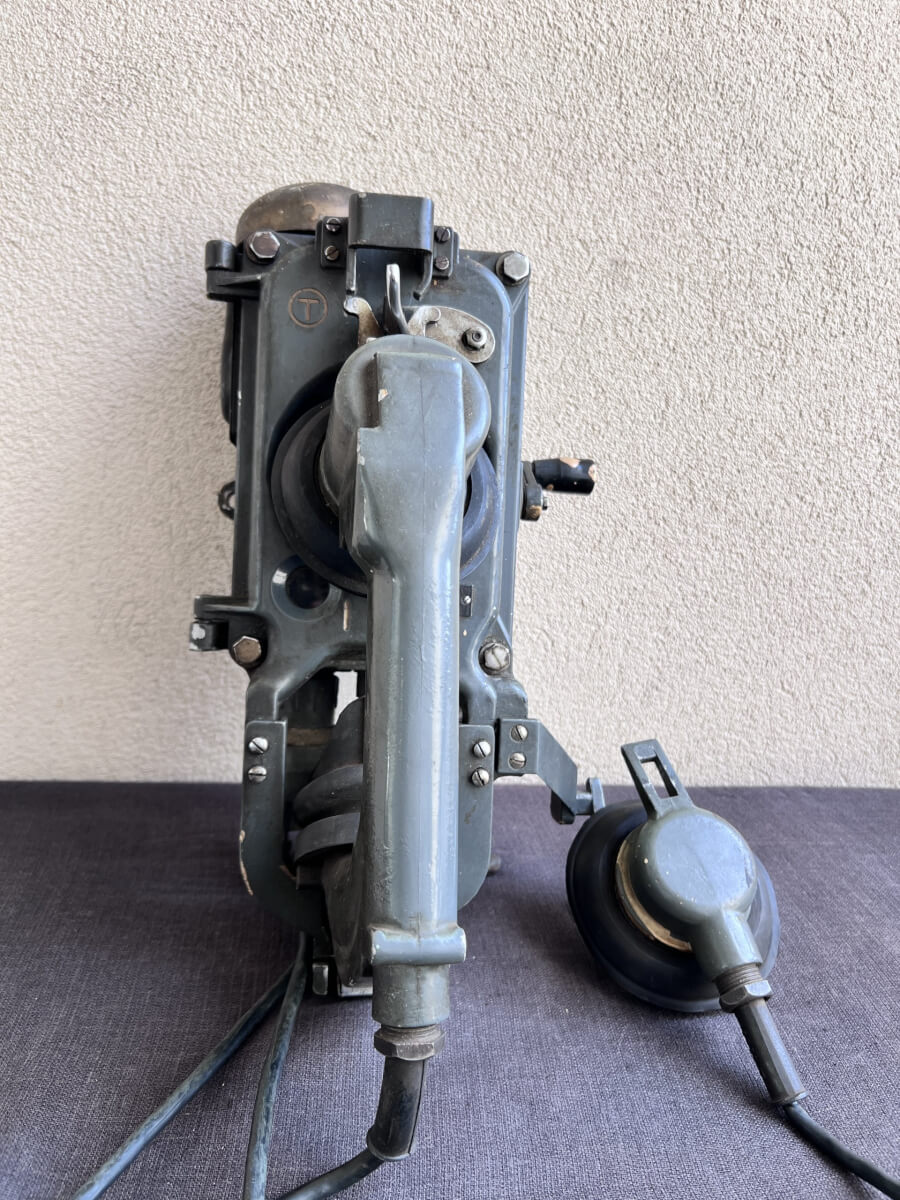
The Soviet telephones that have passed through our shop fall into four families. Black desk sets in карболит (karbolit), Soviet Bakelite, from the 1950s and 1960s. Ivory sets with a coat of arms, from the 1980s. Grey aluminium ship phones, which call with a crank and have no battery. And ТА-200 (TA-200) wall sets, which our product pages call bunker phones and which Russian museums describe as mine telephones.
The dial, the дисковый номеронабиратель (diskovy nomeronabiratel), does not send digits. It breaks the line current as many times as the digit dialled, and the exchange counts the breaks. The number goes out while the wheel returns, never while your finger winds it: a centrifugal governor keeps the pace whatever the force of the pull. The Soviet telephone standard, ГОСТ 7153-85 (GOST), sets the period at 100 milliseconds, ten pulses per second, with a tolerance of 5 or 10 milliseconds depending on the class of the set, and a break at least 1.4 times as long as the make that follows. Dial 1 and you send one pulse, 9 sends nine, 0 sends ten.
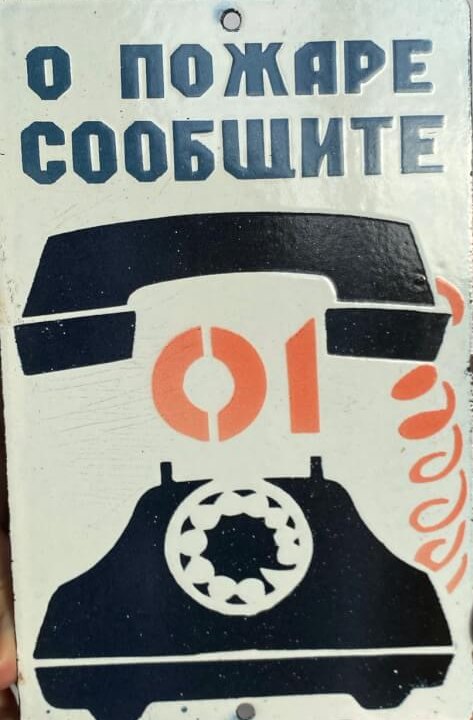
Enamel sign from our shop: О ПОЖАРЕ СООБЩИТЕ, a rotary telephone and the number 01.
01, the fire brigade, has been in use in Moscow since 1932, according to the Moscow city government. Its first digit needs the longest pull of the dial, ten pulses, and its second the shortest. Our enamel sign, which its product page places in apartment-block lobbies of the 1950s and 1960s, reads О ПОЖАРЕ СООБЩИТЕ (O pozhare soobshchite), “Report a fire”, above a rotary telephone and the number 01.
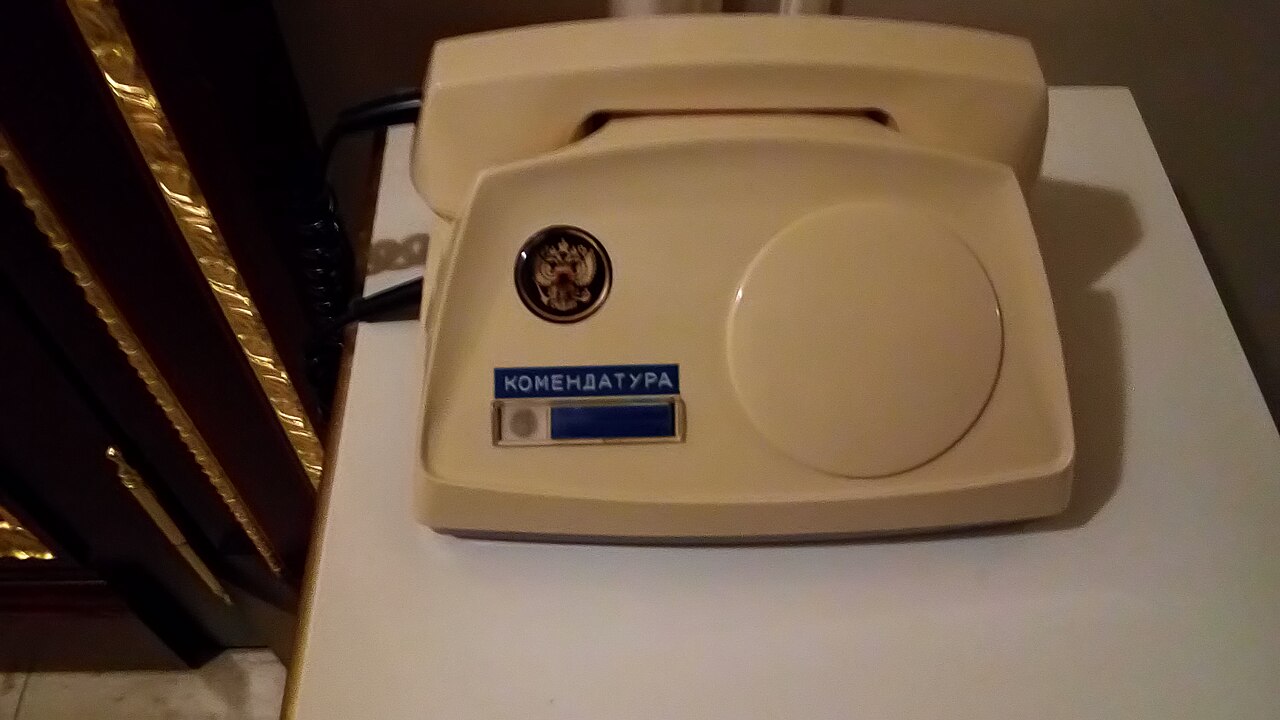
Dial-less telephone with the Russian coat of arms, labelled Комендатура (Komendatura, commandant’s office), Constantine Palace, 2015. Photo Rakoon, Wikimedia Commons, CC0.
The dial gave its nickname to the telephone network of Soviet power. On 17 February 1922, reports the Военно-исторический журнал (Voenno-istorichesky zhurnal), the military history journal of the Russian Ministry of Defence, Avel Yenukidze, secretary of the Presidium of the Central Executive Committee, announced that the Kremlin’s automatic exchange was ready: a 200-line station supplied by Siemens & Halske, which Soviet engineers converted from three-wire to two-wire working. Subscribers dialled each other without an operator, and their sets became known as the вертушка (vertushka), “the spinner”. The journal also reports, as a mere version, the words Lenin is said to have exclaimed while turning the dial: “What a splendid vertushka!” The Volgograd Regional Museum, which keeps one of these sets, describes a small metal badge with the USSR coat of arms on the dial, replaced by the Russian arms after 1991.
With or without a dial: ТАН-5 and ТАН-6
1958 ТАН-6 (TAN-6): a round blanking plate in place of the dial.
1956 telephone: on the blanking plate, a chrome medallion with the USSR coat of arms.
A Soviet telephone with no dial is not missing anything. On a manual exchange you lifted the handset and the operator answered. The ТАН (TAN) desk sets, short for телефонный аппарат настольный (telefonny apparat nastolny), desk telephone set, therefore came in two versions in the same case: the ТАН-5, with a dial, for automatic exchanges, and the ТАН-6, with a round blanking plate where the dial would be, for manual exchanges and direct lines.
The 1958 ТАН-6 in stock is a direct-line set: lifting the handset was enough to reach the other end. The 1956 telephone sold by the shop carries a chrome medallion with the USSR arms on the same blanking plate. Both have the year stamped under the base.
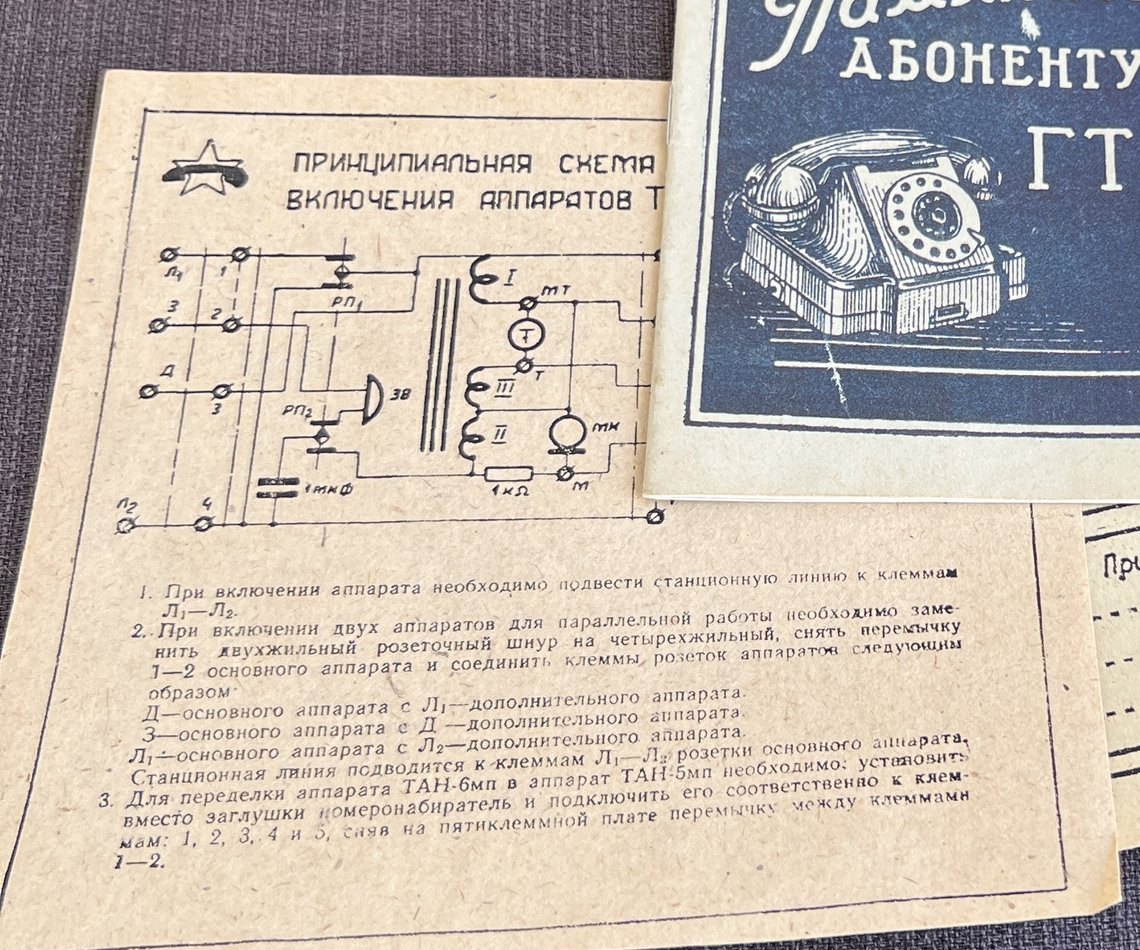
Reprint of the ТАН wiring diagram: point 3 explains how to turn a ТАН-6мп into a ТАН-5мп.
The ТАН wiring diagram, a reprint of which came with our 1959 ТАН-5, gives the procedure for going from one version to the other: fit a dial in place of the заглушка (zaglushka), the blanking plate, and connect it to terminals 1 to 5 of the terminal strip.
KGB phones: the coat of arms, the plate, and what they tell you
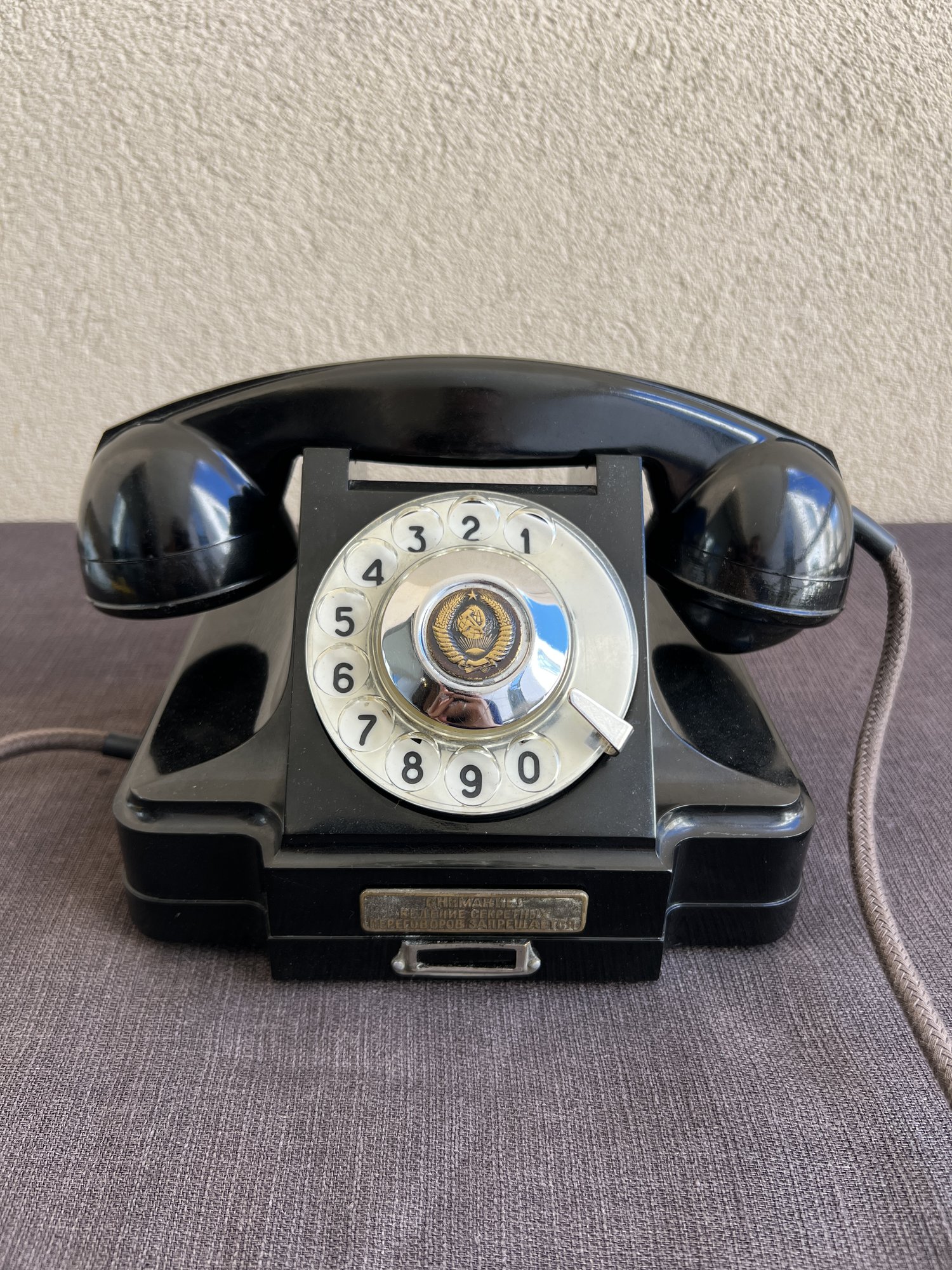
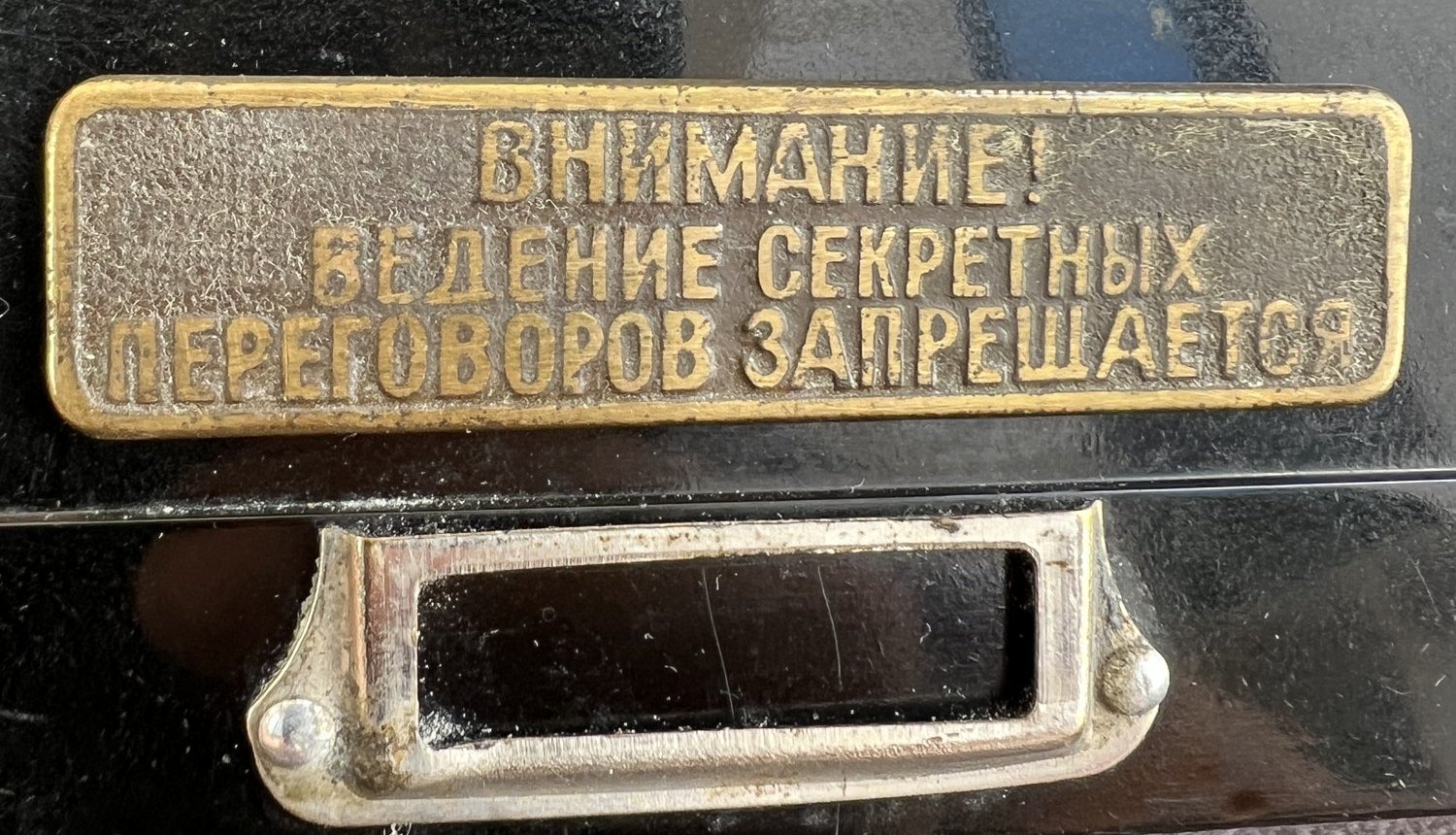
The plate on the 1959 ТАН-5: ВНИМАНИЕ! ВЕДЕНИЕ СЕКРЕТНЫХ ПЕРЕГОВОРОВ ЗАПРЕЩАЕТСЯ.
The plate on the front of the 1959 ТАН-5 reads ВНИМАНИЕ! ВЕДЕНИЕ СЕКРЕТНЫХ ПЕРЕГОВОРОВ ЗАПРЕЩАЕТСЯ (Vnimanie! Vedenie sekretnykh peregovorov zapreshchaetsya), “Warning! Secret conversations are forbidden”. It reminded the staff of government offices and enterprises that the ordinary line was not protected against eavesdropping. Posters of the 1950s repeat the same instruction: “Не болтай у телефона! Болтун – находка для шпиона!” (Ne boltay u telefona! Boltun, nakhodka dlya shpiona), “Don’t chatter on the phone! A chatterbox is a gift to a spy”. According to the Rambler website, the slogan takes up that of a poster by the artist Alexei Radakov, issued in late June 1941.
Protected calls went over another network, the ВЧ-связь (VCh-svyaz), the high-frequency link. According to the history published in 2016 for the 85th anniversary of government long-distance communications, Stalin asked the OGPU for it in 1928, the first stations opened in 1931 in Kharkiv and Leningrad, and the network had 116 stations and 735 subscribers in 1941. The same text quotes Marshal Vasilevsky: as Chief of the General Staff, he “could not do without it for a single minute”.
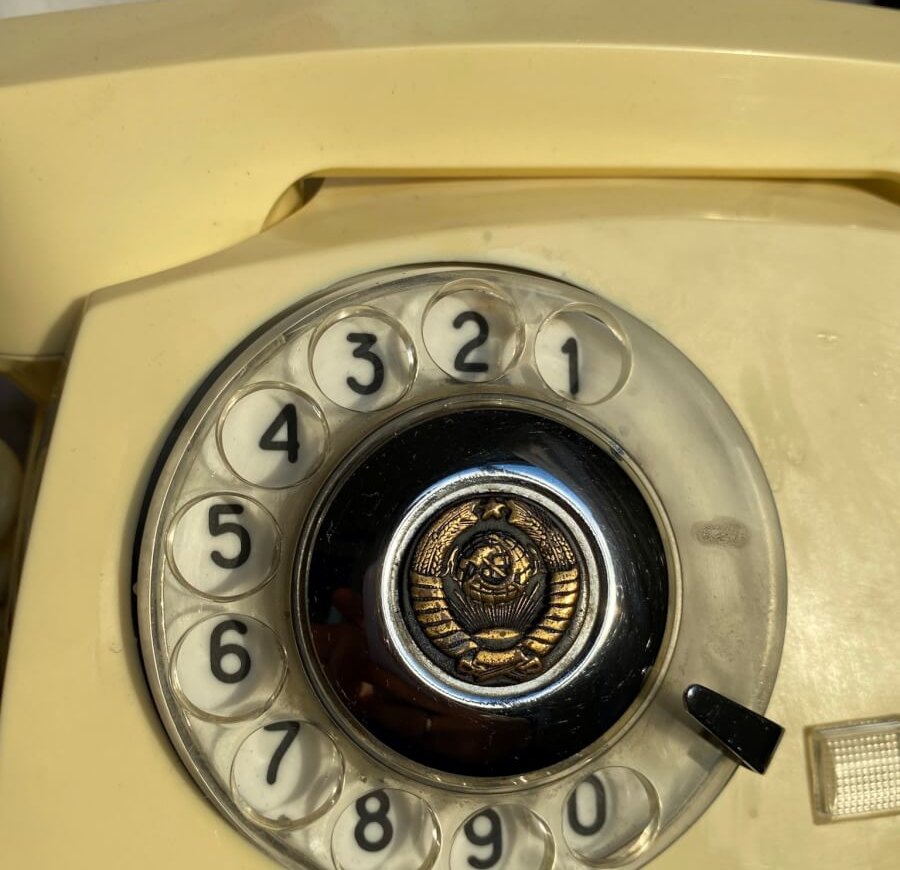
Ivory set from our shop: the USSR coat of arms in the centre of the dial.
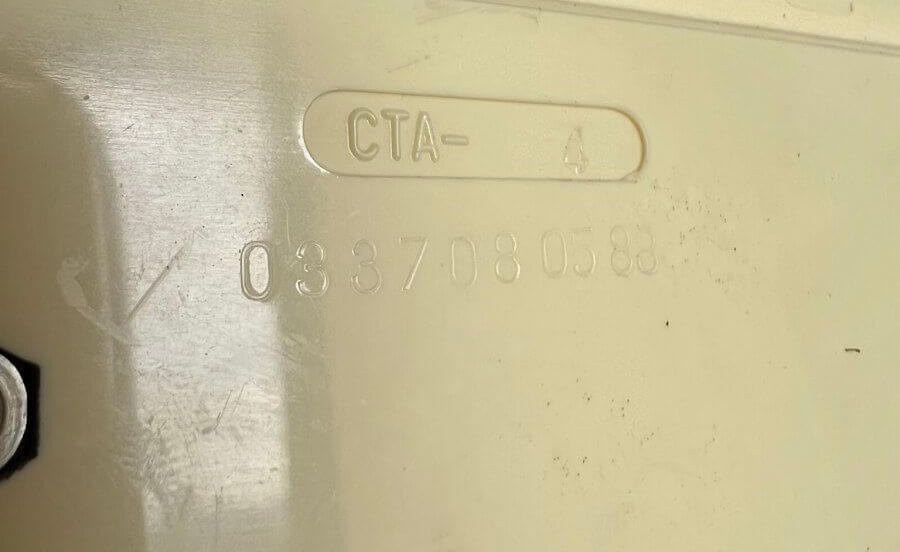
Under the case of another ivory set, the type СТА-4 (STA-4).
The ivory coat-of-arms sets in our shop are secure-communication telephones, used by the KGB among other state services. One of them has the type СТА-4 (STA-4) moulded under its case. A Russian book on special communications, “Специальные виды связи” (Spetsialnye vidy svyazi), quoted by the sverdlovskavia blog without author or year, states that subscribers on these networks were given shielded sets of the ТАЭ (TAE) and СТА types, made at the VEF plant in Riga, with the case, handset and cord shielded. The 1989 ТАЭ-4 shown on that blog comes with a terminal box; one of our two ivory sets in stock also comes with a box, which its product page calls a switching box.
Soviet navy ship phones: no battery, a crank to call
1984 ship telephone: the ringing crank is on the right-hand side of the case.
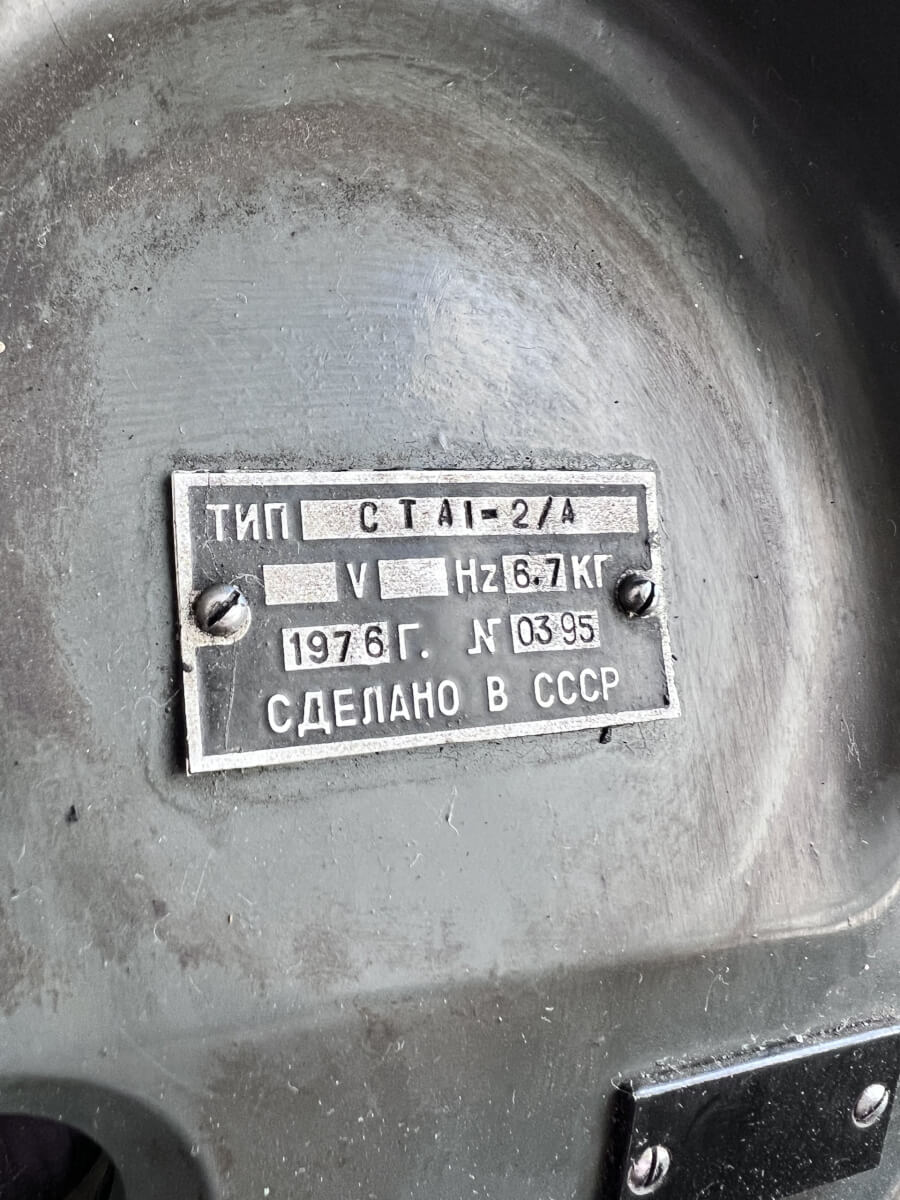
Type plate: СТА1-2/А, 6.7 kg, 1976, no. 0395, Сделано в СССР.
The grey telephones we list as cabin phones carry a type plate. The 1984 one is a СТА3-2/А (STA3-2/A), no. 0221, 6.7 kg. The 1976 one is a СТА1-2/А, no. 0395, 6.7 kg, marked “Сделано в СССР” (Sdelano v SSSR), made in the USSR. These letters СТА have nothing to do with the СТА-4 of the ivory sets.
According to a Russian marine electrician’s handbook, the СТА-1, СТА-2 and СТА-3 are the sets of the безбатарейная (bezbatareynaya), battery-free, telephone link on ships, what English speakers call sound-powered telephones. Microphone and earpiece are built the same way: your voice moves a diaphragm in front of a magnet, which generates the speech current, and that current drives the earpiece at the other end. To call, you turn the crank of an индуктор (induktor), a small magneto, and a neon lamp lights as the call goes out. The same text states that the rules of the Maritime Register provide for a link of this kind between the wheelhouse and the main engine control station.
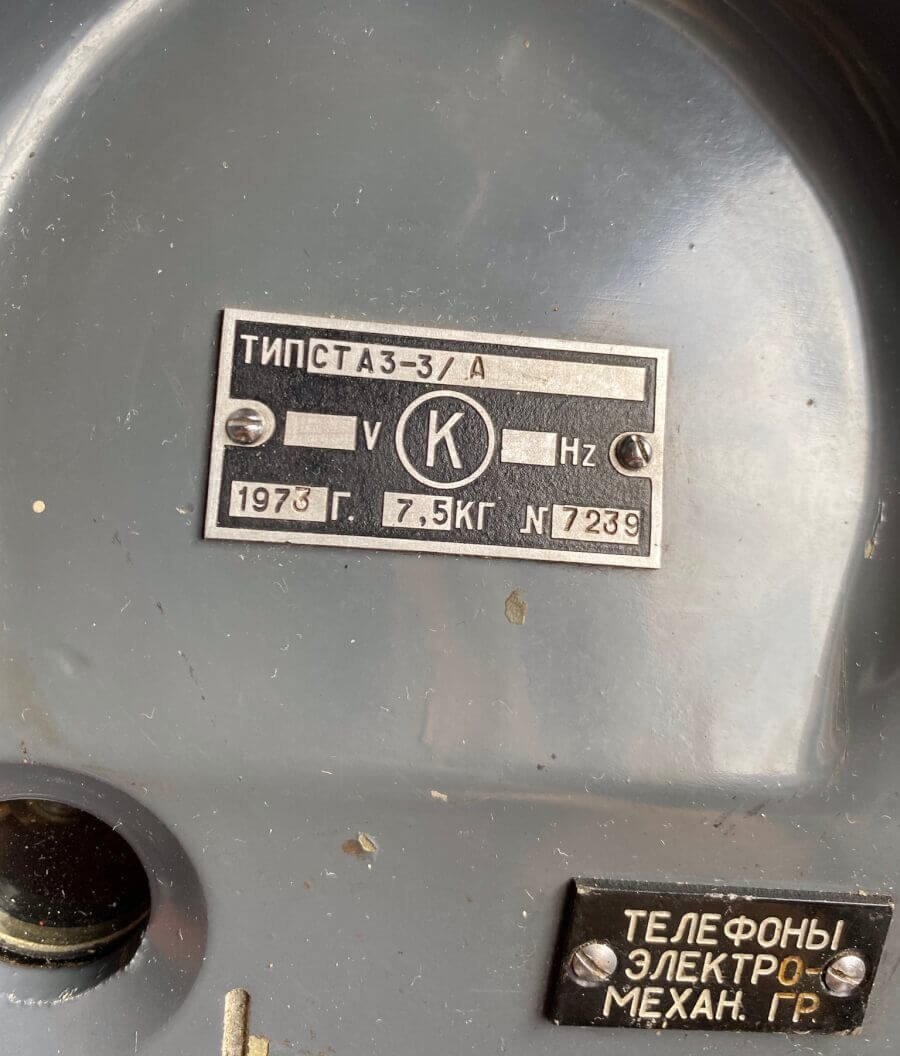
On a 1973 set sold by the shop: plate СТА3-3/А, 7.5 kg, no. 7239, and plate ТЕЛЕФОНЫ ЭЛЕКТРО-МЕХАН. ГР.
A third set, now sold, carried the plate СТА3-3/А, 1973, 7.5 kg, no. 7239. A second plate, screwed below it, says which shipboard circuit it belonged to: “ТЕЛЕФОНЫ ЭЛЕКТРО-МЕХАН. ГР.” (Telefony elektro-mekhan. gr.), which we read as “telephones of the electromechanical group”. On the two sets in stock, that plate was left blank.
ТАС-М (TAS-M) ship dial telephone no. 4958, dated 12-89, with its carton.
On the same ship, the ТАС (TAS) dial telephones belong to another family: the handbook gives them as the wall sets of the ship’s automatic exchange. The shop sold a ТАС-М still new in its carton, its plate stamped number 4958 and dated 12-89.
Soviet ТА-200 mine phones, the so-called bunker phones
ТА-200 from our shop: the dial, and above it the lever and its plate ВЫЗЫВАЯ ДИСПЕТЧЕРА НАЖМИ РЫЧАГ ВНИЗ.
The bunker phones in our shop have the type ТА-200 moulded below the dial. The Sverdlovsk Regional Museum, which holds one from the 1960s, describes it as a set from the Perm telephone factory built for mines and quarries, protected against explosion, damp, dust and shocks. It has a dial, and a lever that sends an emergency signal to the dispatcher’s desk. The museum gives its weight as 8 kg. The plate by the lever reads ВЫЗЫВАЯ ДИСПЕТЧЕРА НАЖМИ РЫЧАГ ВНИЗ (Vyzyvaya dispetchera, nazhmi rychag vniz), “To call the dispatcher, press the lever down”. We have three sets of this model in stock, two grey and one khaki.
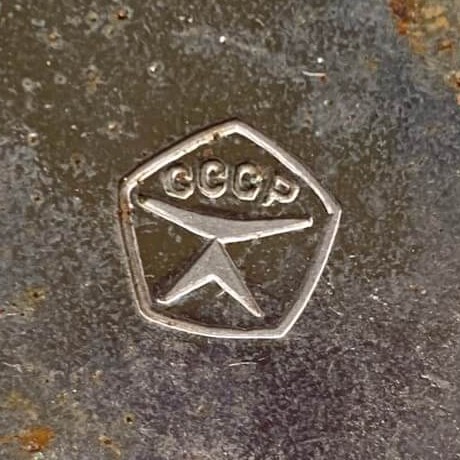
The USSR State quality mark, stamped on the dial plate of a ТА-200.
On several ТА-200s that have passed through the shop, the dial plate is stamped with the Знак качества (Znak kachestva), the USSR State quality mark: a pentagon, the letters СССР (SSSR) and a letter K lying on its side. The mark was created in 1967: a piece that carries it is no earlier.
The Soviet ТА-57 field telephone
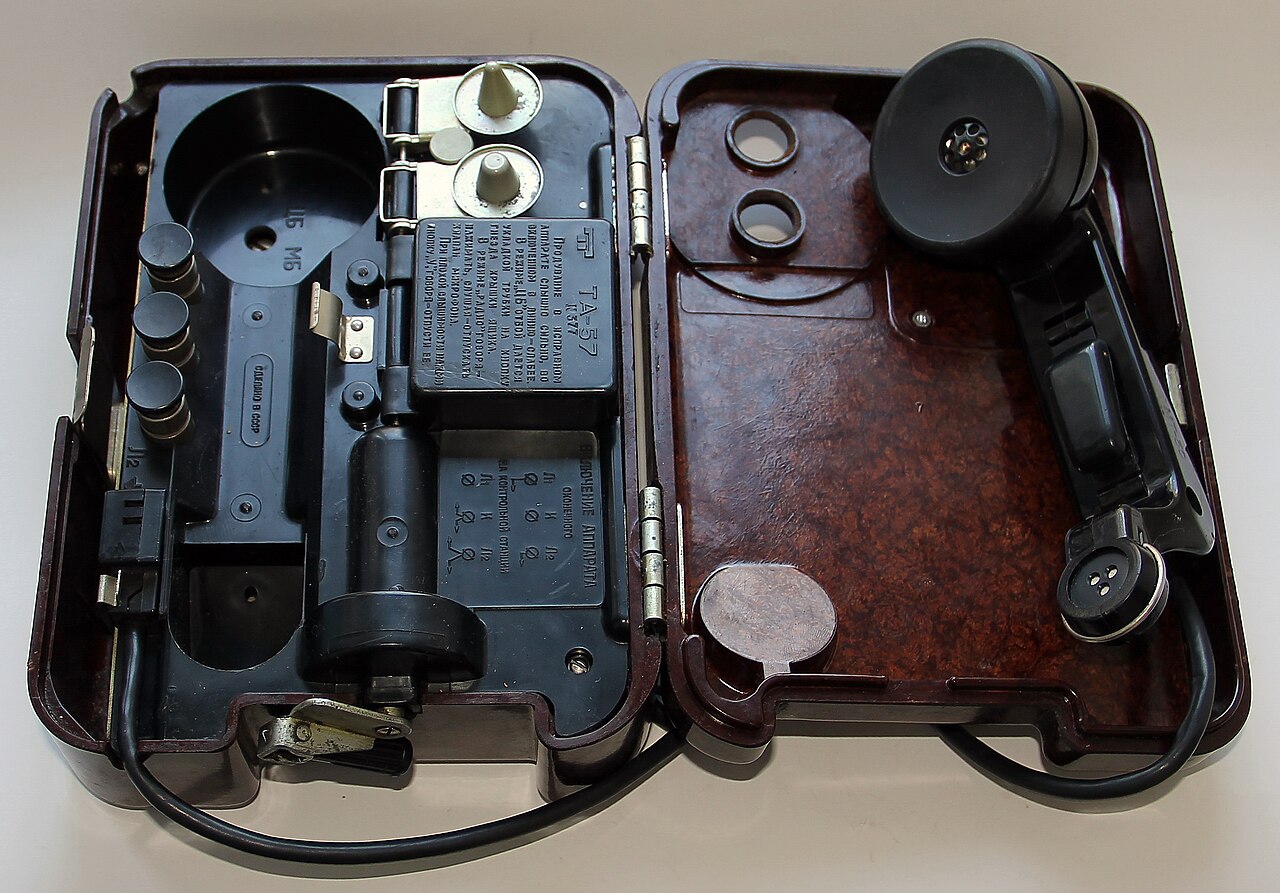
ТА-57 field telephone, open, a 1977 example. Photo Sergeev Pavel, Wikimedia Commons, CC0.
The ТА-57 (TA-57) is the Soviet army field telephone, introduced in 1957: according to English Wikipedia, a Bakelite case weighing 2.8 kg, with handset, ringing crank and battery. It calls like the ship phones, with a magneto, but its conversation is powered by the battery. We have none in stock at the moment. The “Field” button of the magneto diagram shows the difference.
The ТА-57 has also been used as a torture device. Its magneto, the one that rings the other set, produces a current as soon as the crank is turned: wired to a person, it delivers an electric shock. In 2023 the independent Russian outlet Mediazona told the story of Ivan Kudryashov, questioned in 2022 in the basement of the FSB building in Tver with a ТА-57 on the table. A lawyer from the human rights group Команда против пыток (Komanda protiv pytok), the Crew Against Torture, explains in the article that the device delivers a painful shock without leaving noticeable traces. The same article lists other cases where it was used, and the nicknames given to this torture, among them the “phone call to Putin”.
Since the invasion of Ukraine, former Ukrainian prisoners have described the same device, which they call тапик (tapik). In March 2025, at the presentation of an Amnesty International report, former prisoner of war Maksym Kolesnikov said that another detainee had been tied to it while the crank was turned for a full hour. The Kharkiv Human Rights Protection Group publishes a photograph of a ТА-57 presented as a torture device by the Kharkiv regional prosecutor’s office.
Who made Soviet telephones
The star crossed by a handset, moulded on the back of the 1958 ТАН-6.
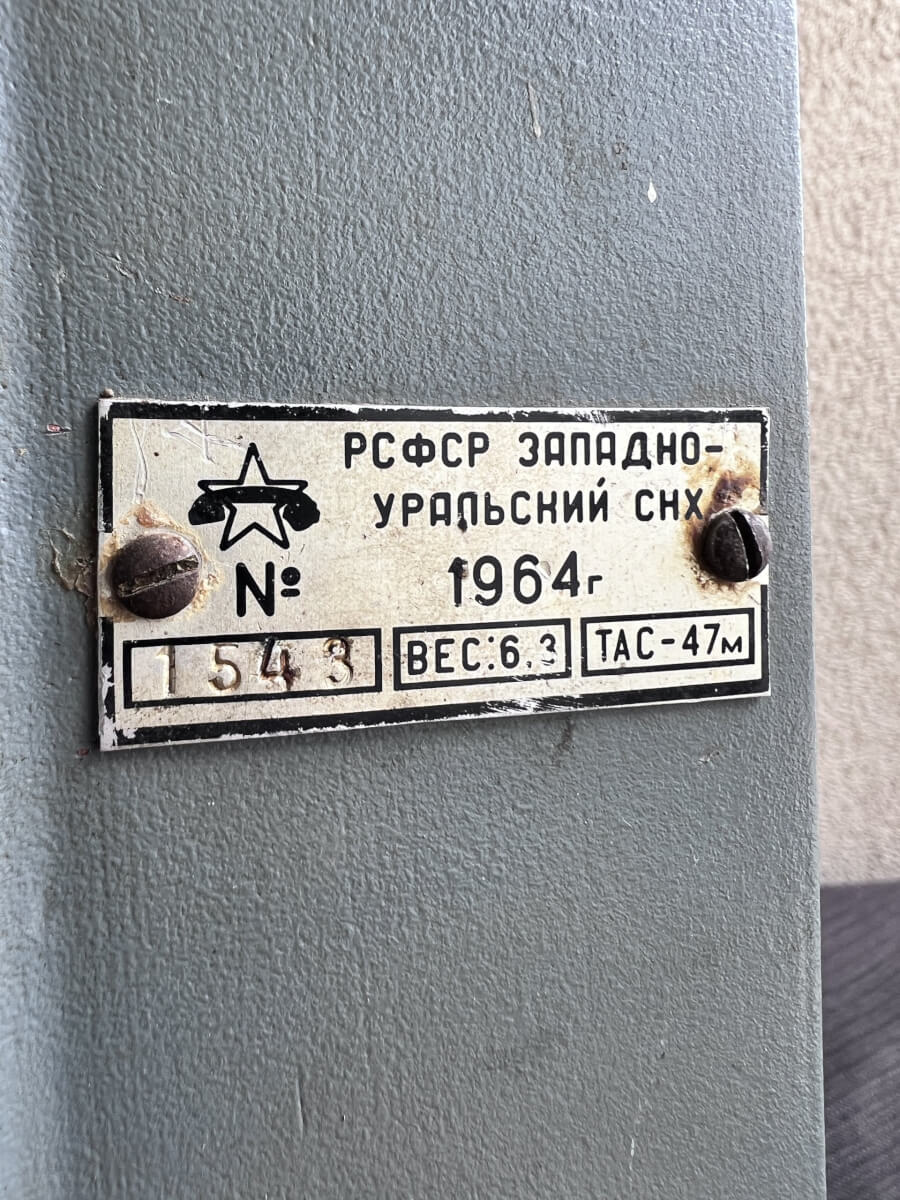
Plate of a 1964 ТАС-47м wall telephone: the same star, and РСФСР Западно-Уральский СНХ.
The five-pointed star crossed by a handset, moulded into the Bakelite of our ТАН sets, is the logo of the Perm telephone factory at that time. It appears again on the plate of a 1964 ТАС-47м (TAS-47m) wall telephone, no. 1543, next to the words “РСФСР Западно-Уральский СНХ” (RSFSR, Zapadno-Uralsky SNKh), the West Ural Economic Council.
The factory was born of the war. On 9 August 1941, Kommersant reports, an evacuation train reached Molotov, as Perm was then called, with the equipment of a division of the Leningrad plant Красная заря (Krasnaya Zarya), “Red Dawn”, and 109 of its staff. The first sets left for the front in October 1941. Still according to Kommersant, one telephone in two installed in the country after the war came from the Perm factory.
Krasnaya Zarya is the former Ericsson works in Petrograd, nationalised. According to the military history journal quoted above, in the 1920s it assembled Swedish-system automatic exchanges, put into service in Rostov-on-Don, Moscow and Leningrad.
Before you buy a Soviet telephone
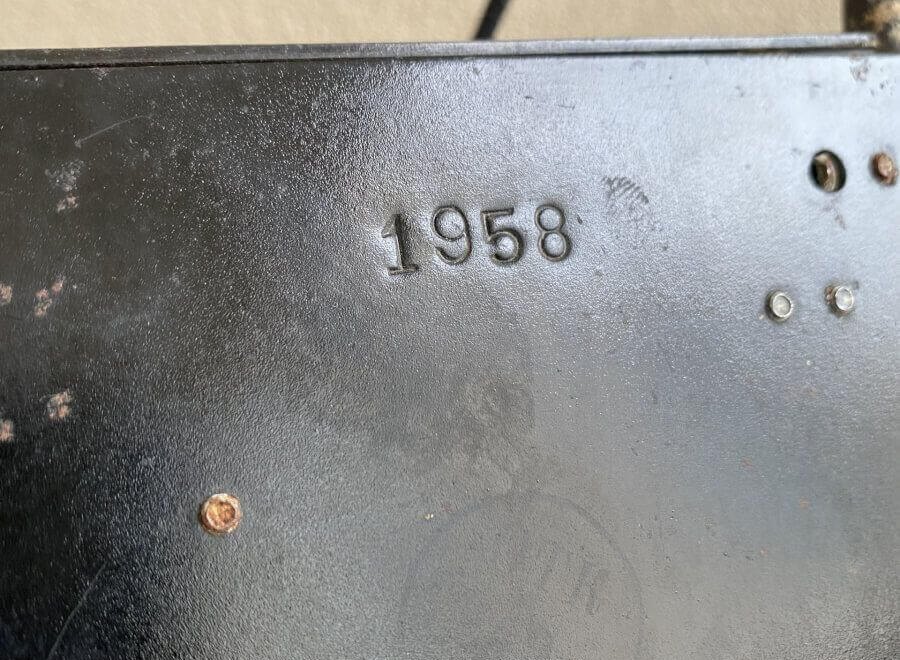
The year 1958, stamped under the base of the ТАН-6.
The date. Desk sets have the year stamped under the base: 1956, 1958 and 1959 on our pieces. Ship phones have a plate with type, year, weight and serial number. A совнархоз (sovnarkhoz) name, or СНХ, places a piece between 1957, when these regional economic councils were created, and 1965, when they were abolished. The State quality mark places it in 1967 at the earliest.
The model. Read the plate or the moulding: СТА followed by figures on a battery-free ship phone, ТАС on a ship dial phone, ТА-200 on a mine phone, СТА-4 under an ivory set. A set with no dial has not necessarily lost it: the ТАН-6 was built with a blanking plate.
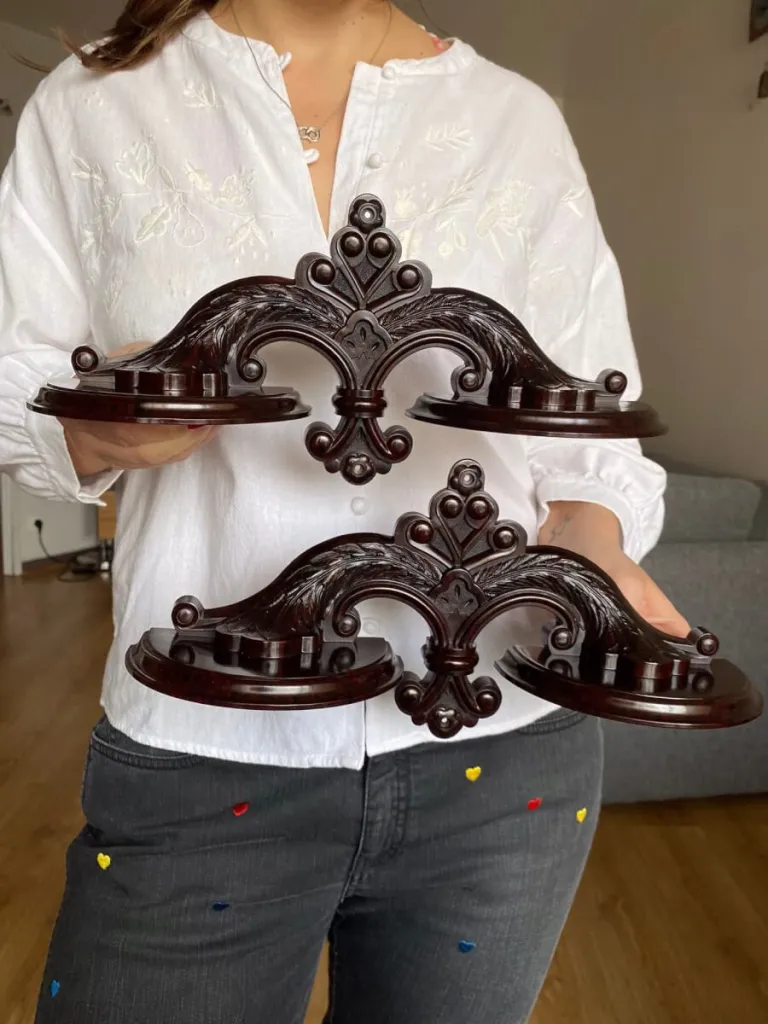
A USSR coat-of-arms medallion, sold on its own by the shop.
The medallion. Coat-of-arms medallions also turn up on their own: the shop has sold two. A medallion alone does not tell you which network a set served on. The type moulded under the case, the plate and the papers of the piece count for more. No piece in our shop is presented as having belonged to a particular service or person without a document.
Weight. The 1956 desk telephone weighs 1.8 kg. The СТА ship phones weigh 6.7 or 7.5 kg according to their plates, the ТАС-47м 6.3 kg, a ТА-200 about 8 kg: worth knowing for wall mounting and for shipping.
Connecting it. Each product page says what has been checked or adapted: the 1959 ТАН-5, for example, had been fitted with a modern modular plug, its dial, medallion and plate remaining period parts. Before connecting an old set to a line or an installation, have it checked by a professional.
Paperwork. Manuals and factory inspection slips are rare. When a set comes with reprints, the product page should say so, as ours did for the ТАН-5.
Copies and remade pieces. We found no reported copy of these telephones.
As with any collector’s piece, research thoroughly, compare several examples and rely on trusted collectors’ sites and buying guides.
The ДП-5В (DP-5V) is the field radiometer of Soviet civil defence: a green Bakelite console, a probe with a rotating gamma, beta and check-source shield, headphones and a manual that explains operation and maintenance. The one in this article served in an industrial bakery in Chișinău and was serviced in March 1991. Its owner shared his photos and documents with us, and we turned them into a tool that lets you operate it on screen, step by step.
The Moscow Games, from 19 July to 3 August 1980, boycotted by some sixty countries, produced more objects than any Soviet event: a bear cub, Misha, drawn by Viktor Chizhikov, an emblem made of running tracks, five thousand torches, watches from every factory, platinum coins, rings, tea glass holders, posters. This guide tells the story of the Games and reviews the objects, with the marks that authenticate them and the prices.
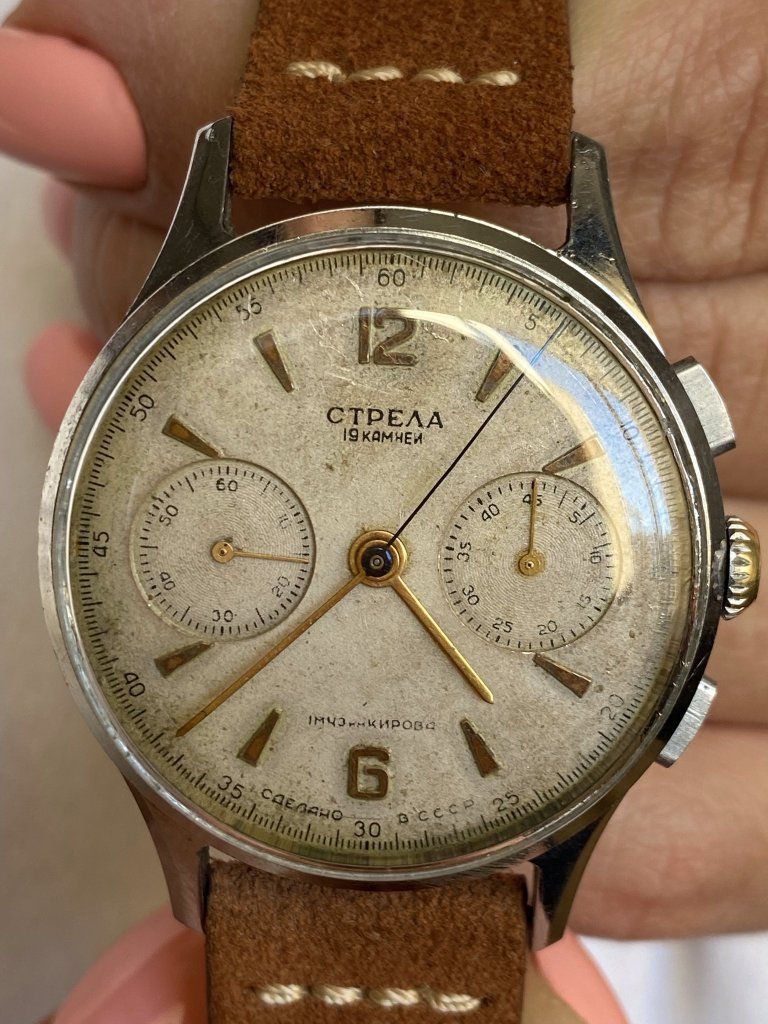
The 3017 chronograph of the First Moscow Watch Factory carries a five-digit number on the balance cock. The most common dating method reads it as a single series, from 1959 to 1979. Four factory passports show there are two, and that the same number can point to two watches made ten years apart. Here is how to read the number, the dial, the logo and the bridge, with a decoder to date your Strela, Poljot or Sekonda.
This website uses cookies to improve your experience while you navigate through the website.
Out of these cookies, the cookies that are categorised as necessary are stored on your browser as they are essential for the working of basic functionalities of the website.
We also use third-party cookies that help us analyse and understand how you use this website.
These cookies will be stored in your browser only with your consent.
You also have the option to opt out of these cookies.
But opting out of some of these cookies may affect your browsing experience.
Necessary cookies are absolutely essential for the website to function properly. This category only includes cookies that ensure basic functionalities and security features of the website. These cookies do not store any personal information.
Cookies that are not strictly necessary for the website to work and that are used specifically to collect personal data through analytics, ads and other embedded content are called non-necessary cookies. User consent is required before these cookies run on the website.
✕
Soviet in Paris
Online. We answer in person, no AI and no chatbot. Reply right away, 20 min at most.
Hello 👋 A question about an item, an order or shipping? Write to us.
Your email is used only to reply to you.
Subscribe to our newsletter and get 10% off your first order.
Subscribe
★ New pieces before anyone else
★ New blog articles
★ Soviet in Paris news and updates
Join the Party
10% off your first order
Receive your welcome card and our next arrivals.
Your code appears here and is also sent to you by email. You can leave the Party in one click, at any time.