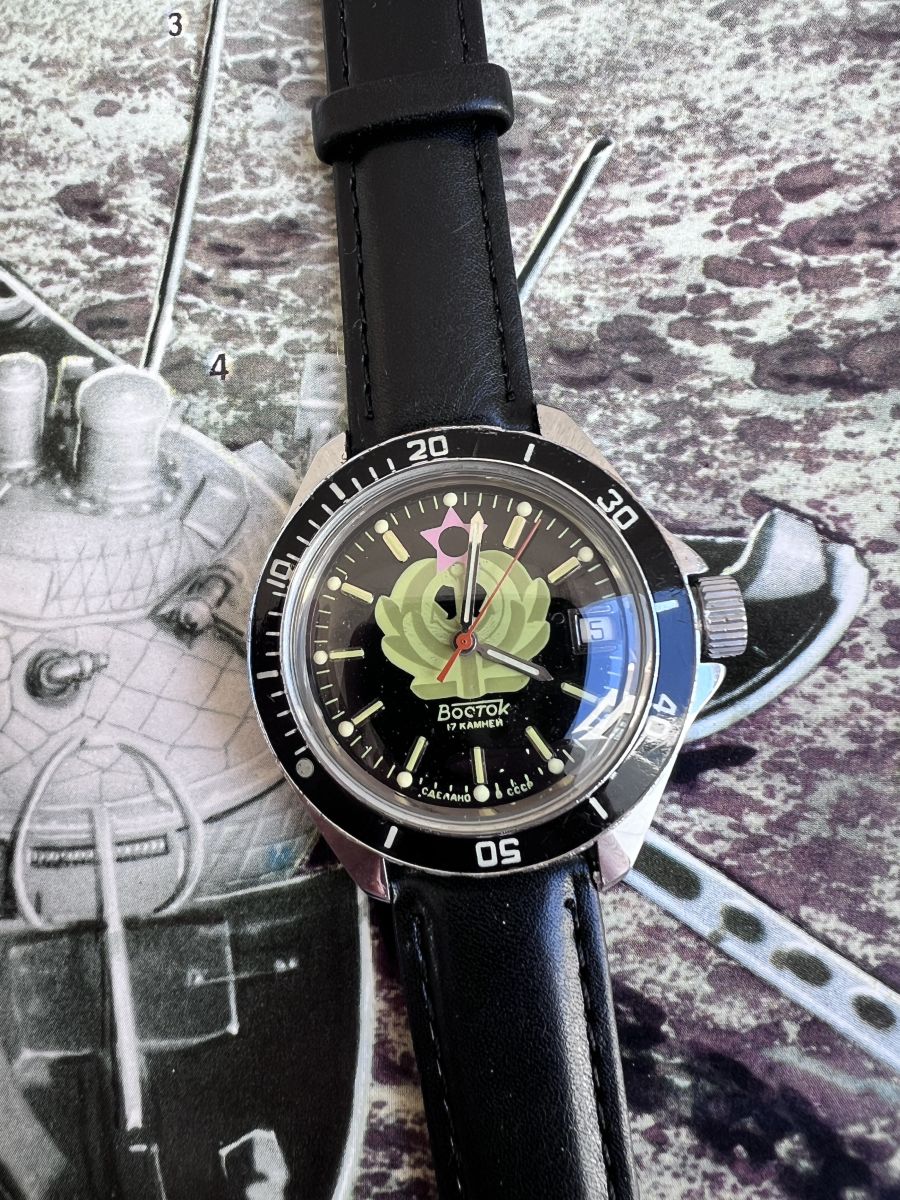
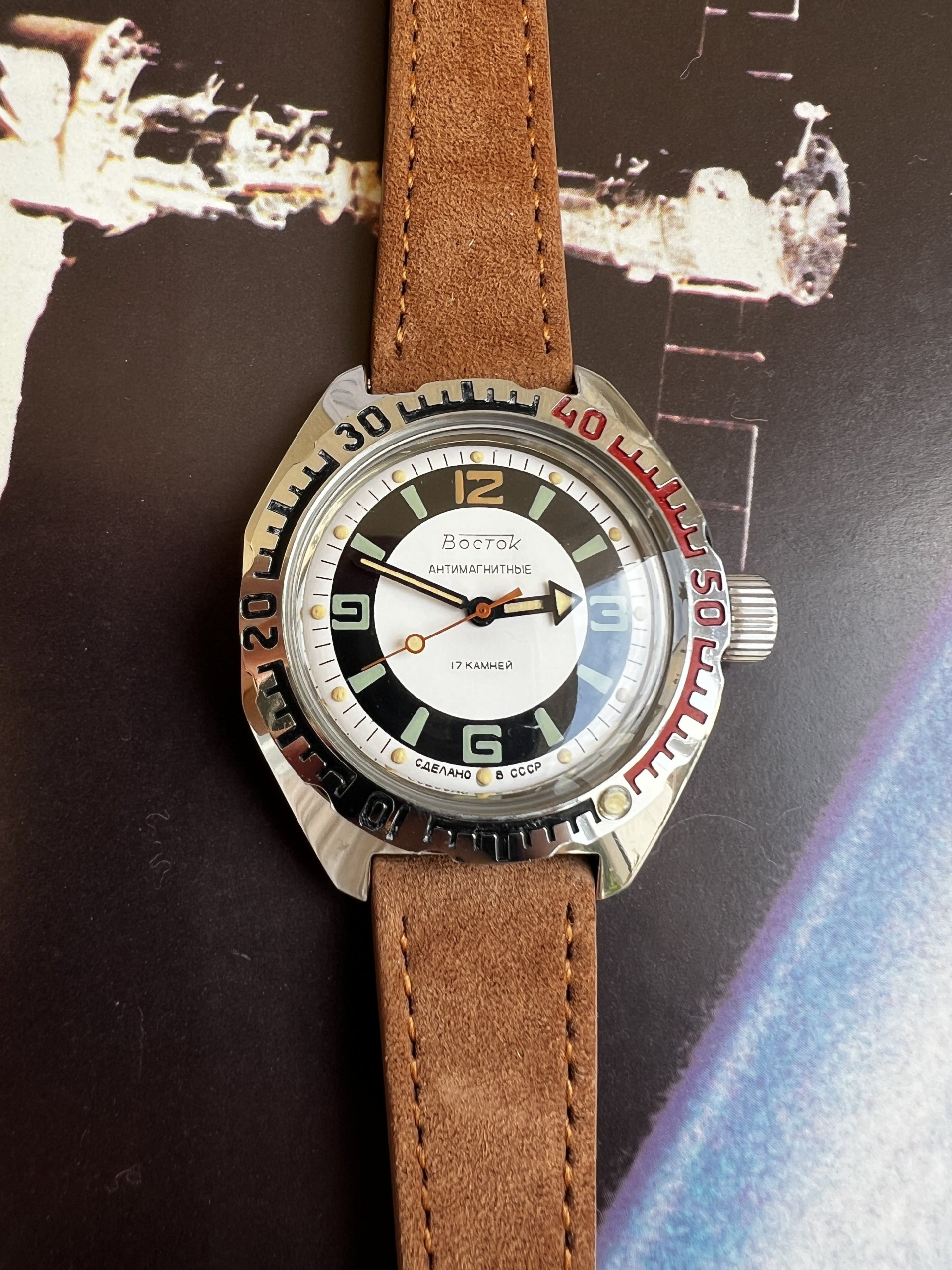
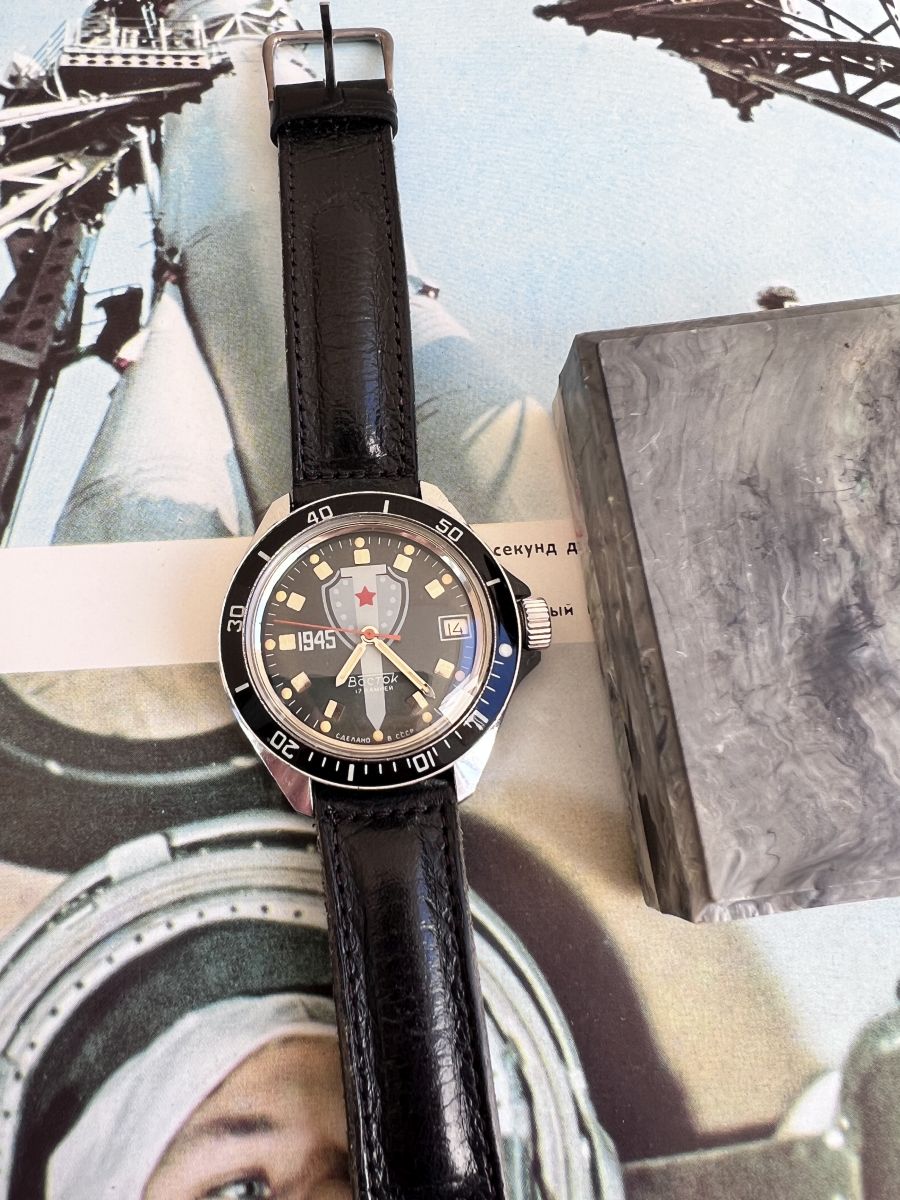
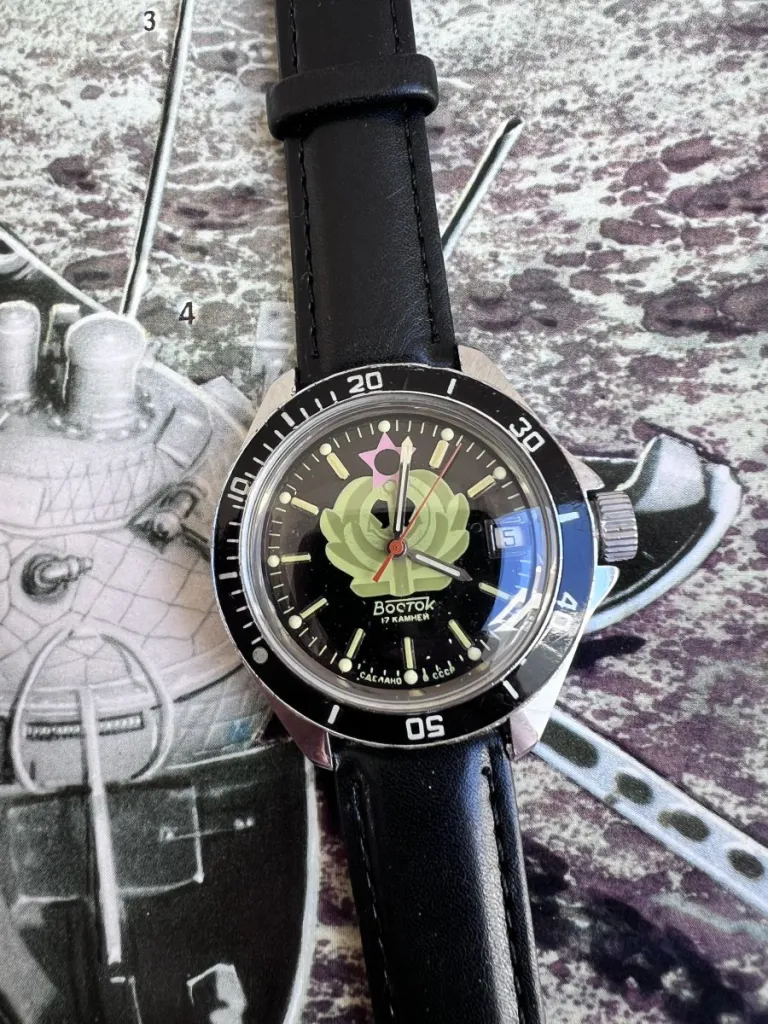
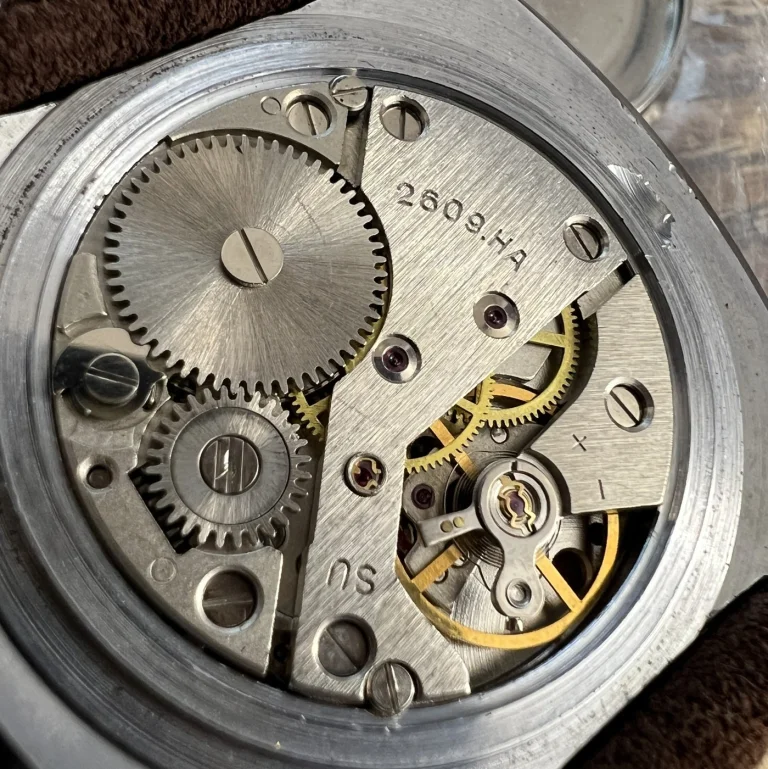
The case back of a Vostok Amphibia reads "200 м", but that figure describes the watch when new. This guide explains how its designers reached 200 metres without copying the Swiss, with an animated diagram of the case, what time changes, and what you can reasonably do today with an Amphibia or a Komandirskie.
OCTOBER 2026•6 MINUTE READ
by Marwen Yahyaoui
Vostok Amphibia, screw-down crown at 3 o’clock.
What “200 м” means
On a watch, the water-resistance figure indicates the static pressure applied during tests to new examples. It does not mean the watch can be used at that depth. Movement in the water adds little pressure: a gesture at 10 metres per second, faster than the best swimmers manage, is equivalent to only about 5 extra metres of depth.
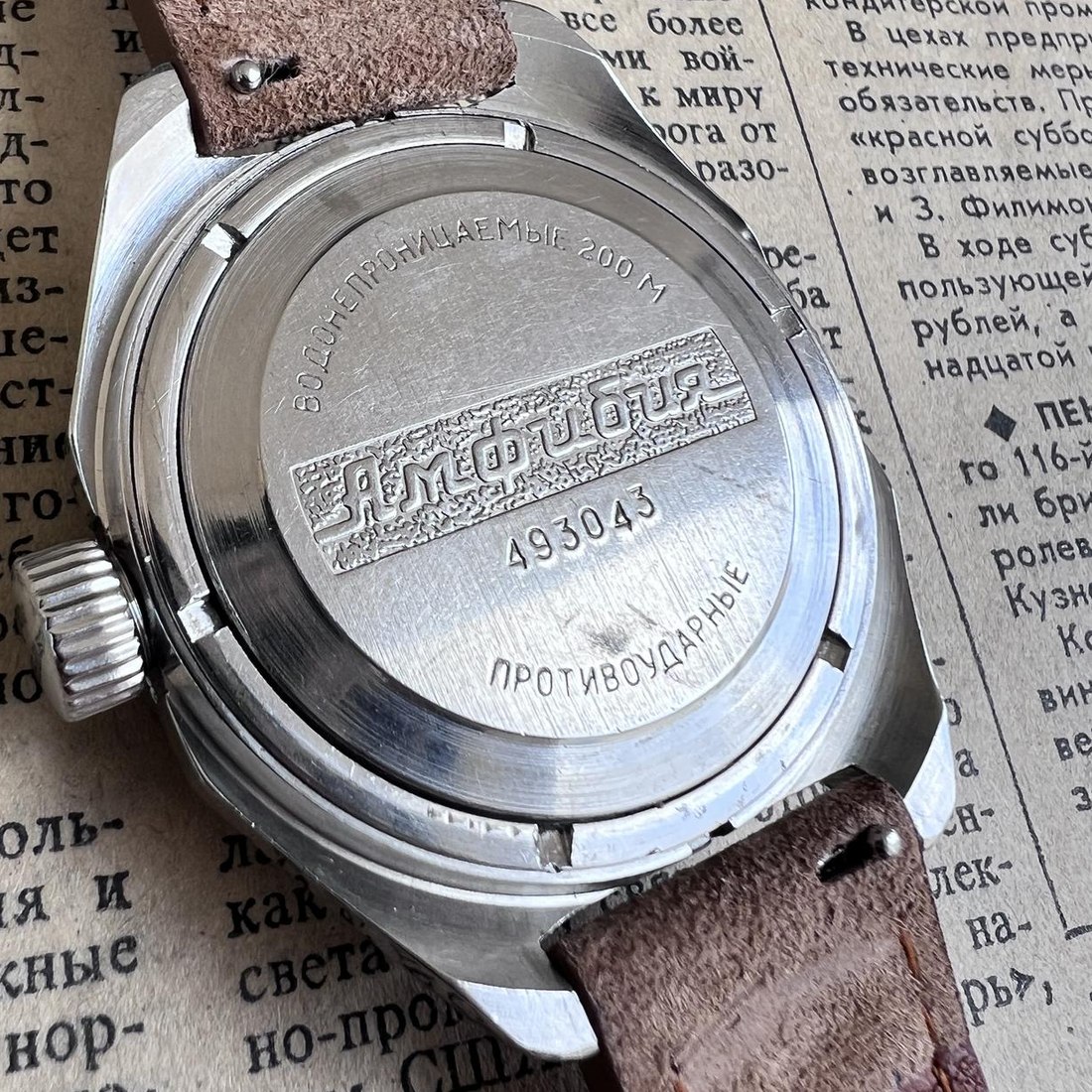
The Soviet standard for wristwatches, ГОСТ 10733-79, gives the exact meaning of the words. “Водонепроницаемые” alone means the watch withstands immersion at one metre for thirty minutes. Followed by a figure, it means the watch also withstands the corresponding pressure. The figure says nothing about the age of the gaskets, the knocks the watch has taken, or the condition of the crystal.
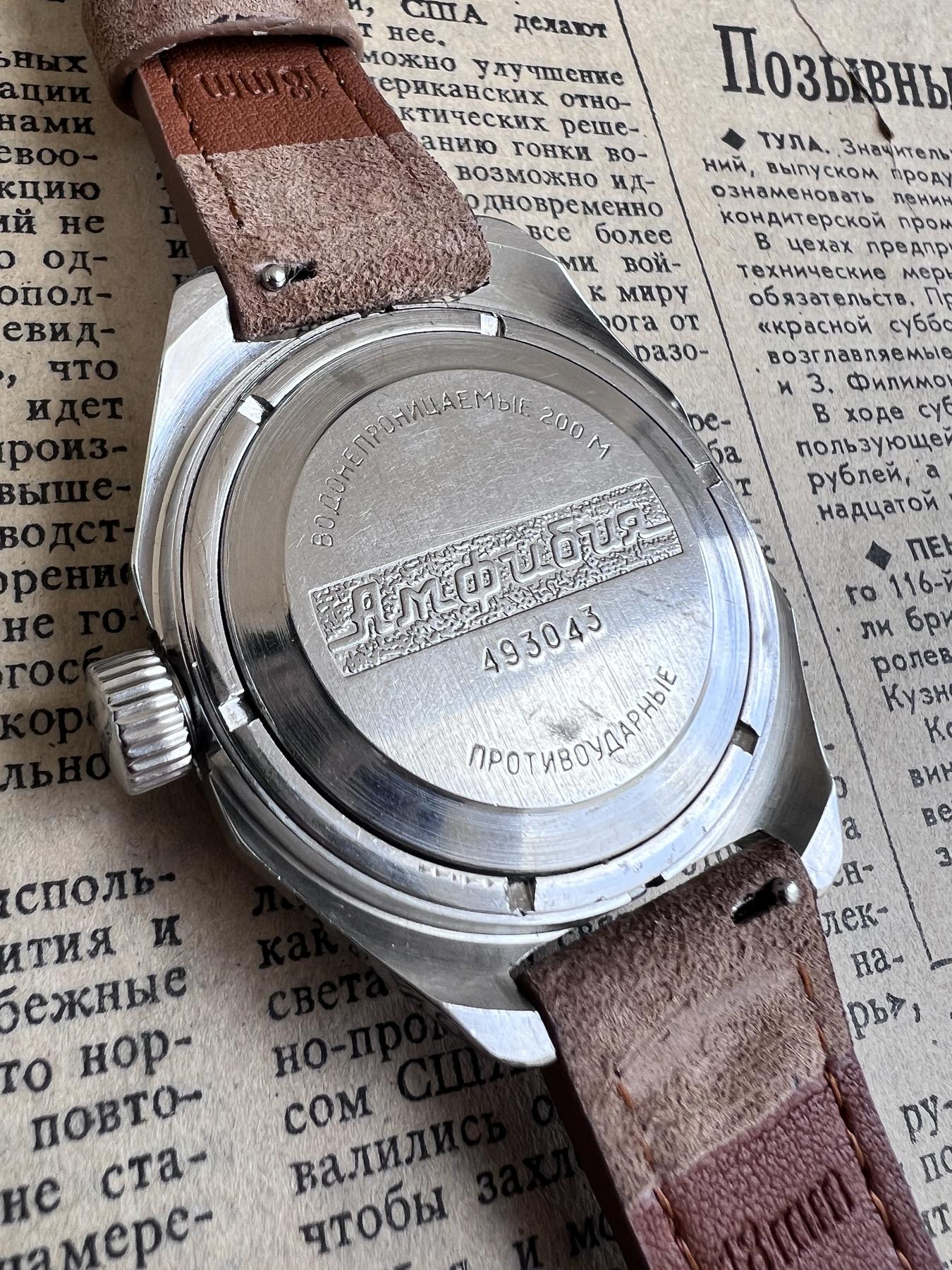
Case back of an Amphibia: “Водонепроницаемые 200 м” and “Противоударные”, shockproof.
1967: matching the Swiss without copying them
The Amphibia was designed in Chistopol by Mikhail Novikov, head of the New Developments Bureau, and Vera Belova. They told the story in 2001 in the Russian trade magazine “Часовой Бизнес”. The brief: a watch that works down to 200 metres, despite swings in pressure and temperature.
Swiss solutions existed. Novikov explains why they were out of reach: the factory’s machines lacked the necessary precision, and almost all those designs were protected by patents. The USSR bought neither patents nor licences. So he studied the whole patent class for waterproof watches to find a solution that repeated nobody else’s.
That solution is to let the water close the case. Move the slider to take the watch down.
Each part required special work, which the two designers describe.
The crystal. It is 3 mm thick, more than on a Komandirskie. It is not just moulded: its edge is turned and then polished, because the slightest scratch on that edge would let water through. Under 20 kg/cm² it flexes by 0.5 mm without touching the seconds hand.
The gasket. It is about 0.75 mm thick, against 0.5 mm on an ordinary watch. At 20 atmospheres it is squeezed by 20 to 30% and must recover its exact shape. Off-the-shelf gaskets failed: the factory made its own from raw rubber, and even tried an ion treatment borrowed from the space industry.
The case back. It is 1 mm thick instead of 0.5 mm, and the ring that holds it is reinforced.
The crown. The Amphibia was the factory’s first watch with a screw-down crown and a rotating bezel.
In 1967 the newspapers described a Volga car driving over the watch. Novikov points out that this demonstration was no test at all: the pressure of a tyre and that of water do not act in the same way and cannot be compared.
The screw-down crown is the third seal of the case. Its stem can disengage: this is why it seems to float once unscrewed.
The Amphibia has a military version, the НВЧ-30 (NVCh-30). According to Novikov, the navy had approached the watch research institute for a diver’s watch, and the institute sent them to Chistopol, which already produced a similar model. To reach 30 atmospheres the factory changed the crystal, thickened the case back and designed a special strap attachment.
The acceptance trials took place during fleet exercises. A diesel submarine settled on the bottom, at 120 to 130 metres, to simulate an accident, and divers wearing the watch worked at that depth. Novikov adds that the watch was not really made for them: in heavy diving gear, with a permanent radio link, nobody looks at their wrist. It served scuba divers and combat swimmers. The equipment of Soviet heavy divers is described in our diving helmet guide.
What time changes
Rubber gaskets age. The manufacturer Vostok writes today that after two to three years a watch may lose its water resistance because of gasket ageing, and asks for it to be checked at that interval. For a Soviet piece, which has often not been checked for a long time, the recommendation applies all the more.
A plastic crystal that is scratched, cracked or deformed no longer seats in its recess as it did originally: in all likelihood it compromises water resistance. A crown left unscrewed compromises it too: water then bypasses the gaskets.
One sign of water getting in: mist or moisture under the crystal.
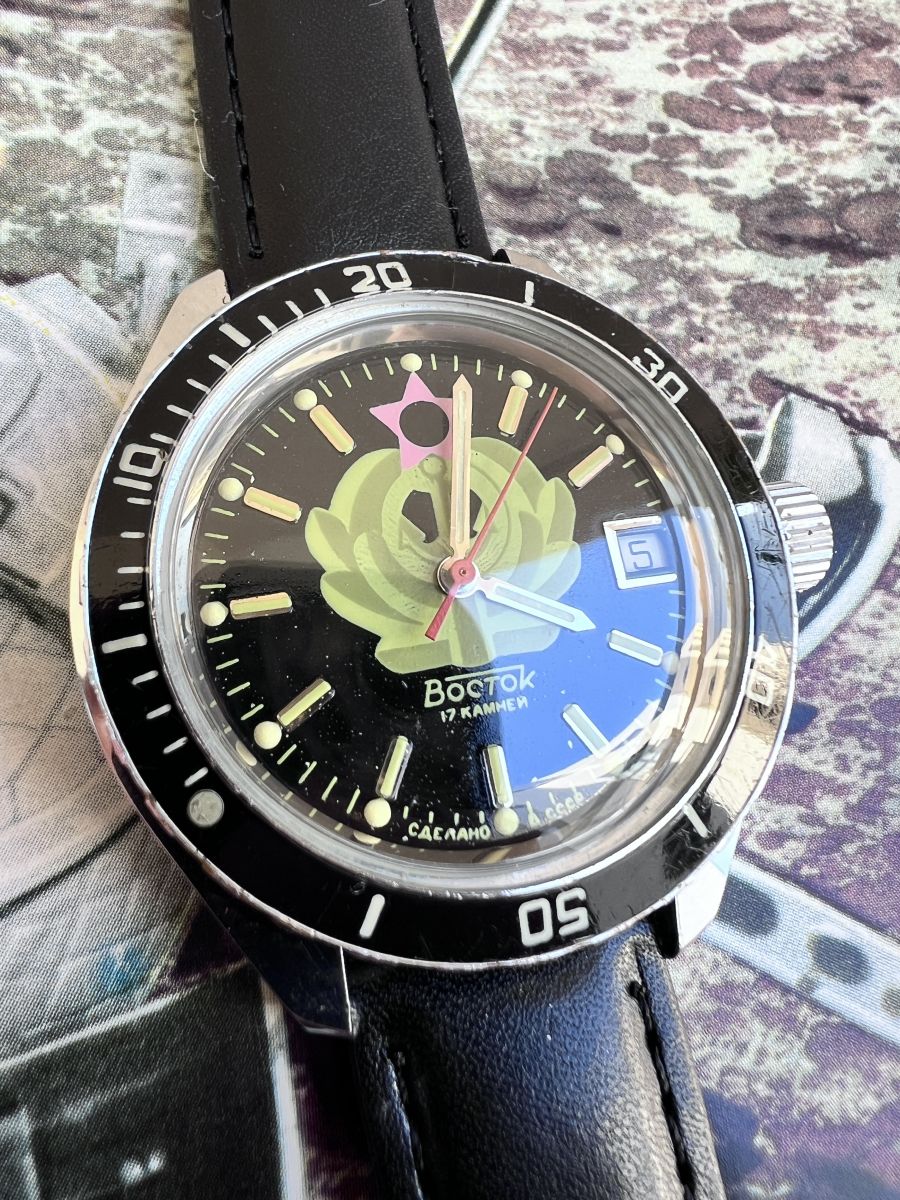
Vostok Amphibia “Scuba Dude” with a bakelite bezel.
What about the Komandirskie?
The Komandirskie is not an Amphibia. Its crystal is 2 mm thick and its case is chrome-plated brass. According to the Raritetus site, ordinary Komandirskie watches were less watertight than the Amphibia. The passport of a 1990s Komandirskie 2414A states a water resistance “up to 20 m”, with two instructions: do not put the watch in water unless the crown is screwed down, and check that the crown is firmly screwed down to prevent misting under the crystal.
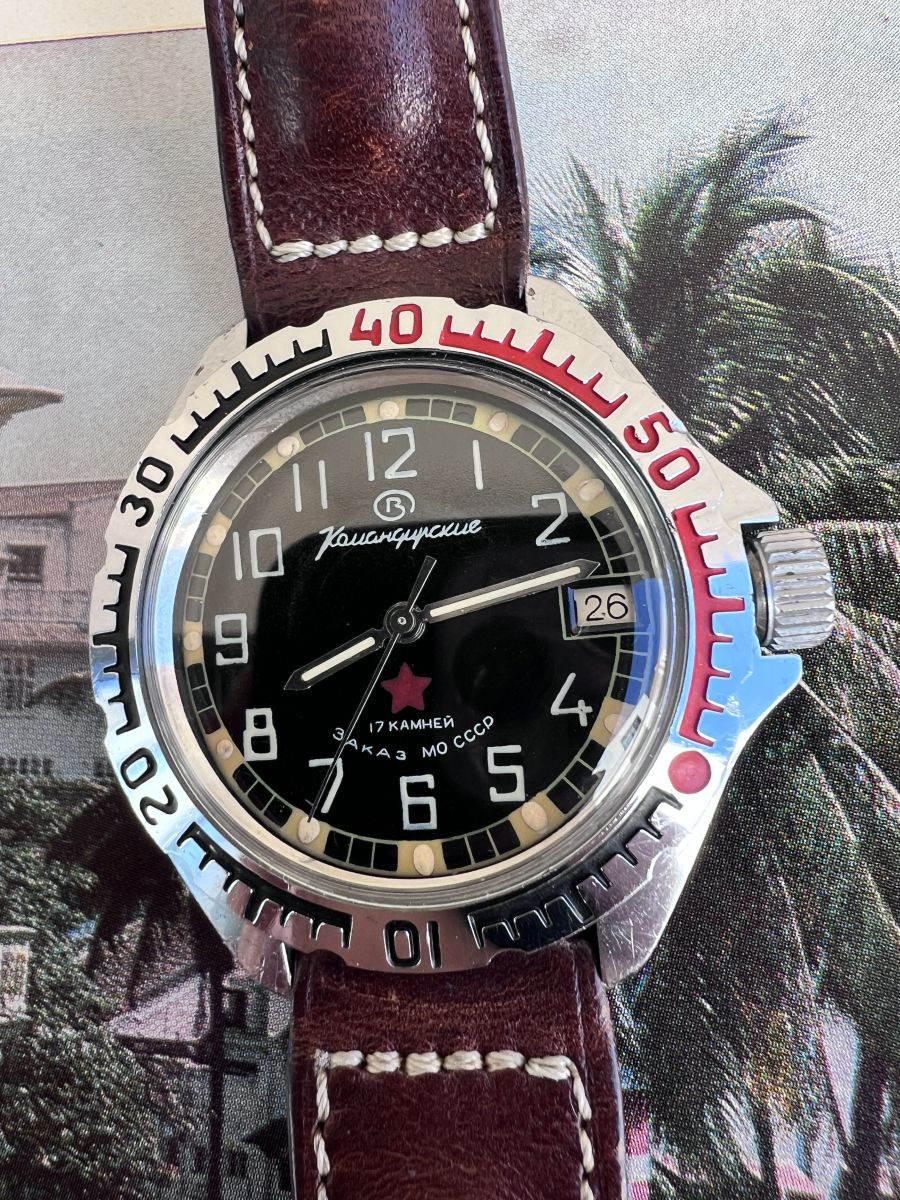
Many dials carry no water-resistance marking at all: this is the case of Komandirskie No. 891604, whose dial reads “Командирские”, “17 КАМНЕЙ” and “ЗАКАЗ МО СССР”. Without a marking, it is wiser to keep it away from water. Its versions are detailed in the Komandirskie guide.
Komandirskie No. 891604: no water-resistance marking on the dial.
What you can do
Screw the crown down. The manufacturer states that during any contact with water the crown and all pushers must be screwed down. The instructions are in our crown guide.
Avoid hot water. The manufacturer advises against wearing a Vostok watch in a sauna, a bath or a hot shower: heat and moisture can damage the case and the gaskets.
Be wary of soap and steam. Seiko, for example, states that steam and soap may accelerate the loss of water resistance.
Rinse after the sea. Vostok notes that salt water harms the finish of most watches, even waterproof ones.
Have the water resistance checked. It is tested in a workshop, with a device that puts the watch under vacuum and then under air pressure, before a possible test in water. Our Soviet Times workshop tests water resistance and replaces the gaskets fitted during a full service.
Swimming, diving: what to conclude
Swimming or diving with an Amphibia from 1967 or 1990 without a prior check is not reasonable: the 200 metre value describes the watch when new, in a static test, and time has worn the gaskets.
Frequently asked questions
Can I wash my hands wearing an Amphibia?
A splash is the lowest risk. But without checking the condition of the gaskets, a watch of this age cannot be guaranteed, and hot water and soap are best avoided.
There is mist under the crystal, what should I do?
It is a sign that moisture has got in. Stop wearing it in water. In the meantime, unscrew and pull out the crown, then leave the watch in a dry, warm place, away from direct heat: no radiator, no hairdryer. Then have it examined without delay, as moisture rusts the movement. Our workshop’s quote is free and without obligation, through the watch repair page.
Is the “20 ATM” on the case back of an export Amphibia reliable today?
It is the same value as “200 М” on pieces made for the home market, 20 atmospheres, and the same caveat applies: it describes the watch when new.
The ДП-5В (DP-5V) is the field radiometer of Soviet civil defence: a green Bakelite console, a probe with a rotating gamma, beta and check-source shield, headphones and a manual that explains operation and maintenance. The one in this article served in an industrial bakery in Chișinău and was serviced in March 1991. Its owner shared his photos and documents with us, and we turned them into a tool that lets you operate it on screen, step by step.
The Moscow Games, from 19 July to 3 August 1980, boycotted by some sixty countries, produced more objects than any Soviet event: a bear cub, Misha, drawn by Viktor Chizhikov, an emblem made of running tracks, five thousand torches, watches from every factory, platinum coins, rings, tea glass holders, posters. This guide tells the story of the Games and reviews the objects, with the marks that authenticate them and the prices.
The 3017 chronograph of the First Moscow Watch Factory carries a five-digit number on the balance cock. The most common dating method reads it as a single series, from 1959 to 1979. Four factory passports show there are two, and that the same number can point to two watches made ten years apart. Here is how to read the number, the dial, the logo and the bridge, with a decoder to date your Strela, Poljot or Sekonda.
This website uses cookies to improve your experience while you navigate through the website.
Out of these cookies, the cookies that are categorised as necessary are stored on your browser as they are essential for the working of basic functionalities of the website.
We also use third-party cookies that help us analyse and understand how you use this website.
These cookies will be stored in your browser only with your consent.
You also have the option to opt out of these cookies.
But opting out of some of these cookies may affect your browsing experience.
Necessary cookies are absolutely essential for the website to function properly. This category only includes cookies that ensure basic functionalities and security features of the website. These cookies do not store any personal information.
Cookies that are not strictly necessary for the website to work and that are used specifically to collect personal data through analytics, ads and other embedded content are called non-necessary cookies. User consent is required before these cookies run on the website.
✕
Soviet in Paris
Offline right now. Leave your message and your email, we reply within 24 hours.
Hello 👋 A question about an item, an order or shipping? Write to us.
Your email is used only to reply to you.
Subscribe to our newsletter and get 10% off your first order.
Subscribe
★ New pieces before anyone else
★ New blog articles
★ Soviet in Paris news and updates
Join the Party
10% off your first order
Receive your welcome card and our next arrivals.
Your code appears here and is also sent to you by email. You can leave the Party in one click, at any time.