In August 1976, in Mogadishu, officers of the Somali army presented an engraved desk set to their chief Soviet military adviser. Fifteen months later the Soviet-Somali alliance collapsed and Moscow's weapons were turned against Somalia. The story of an object sealed just before the break, and of the riddle of General Borisov.
JUNE 2026•5 MINUTE READ
by Marwen Yahyaoui
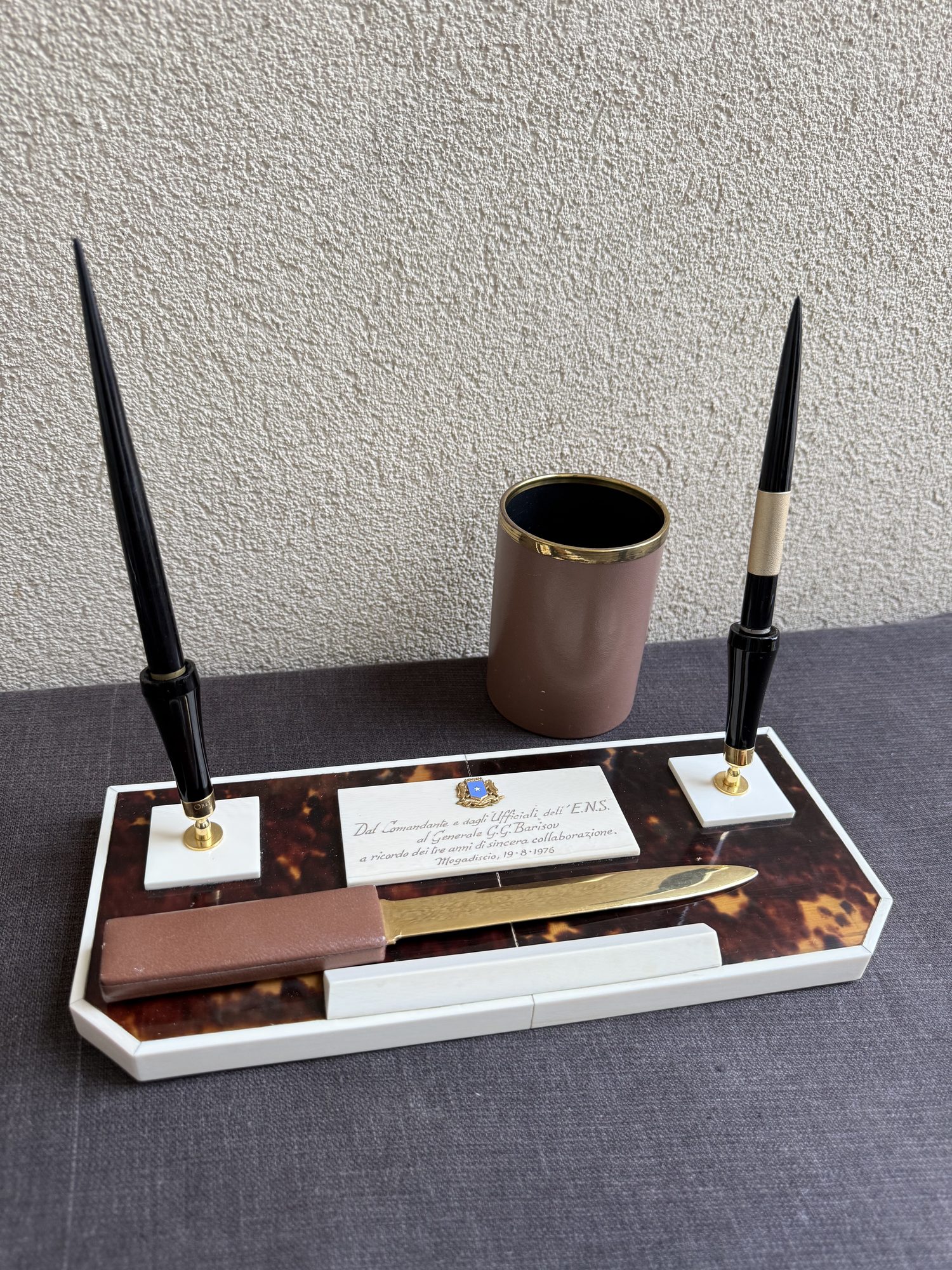
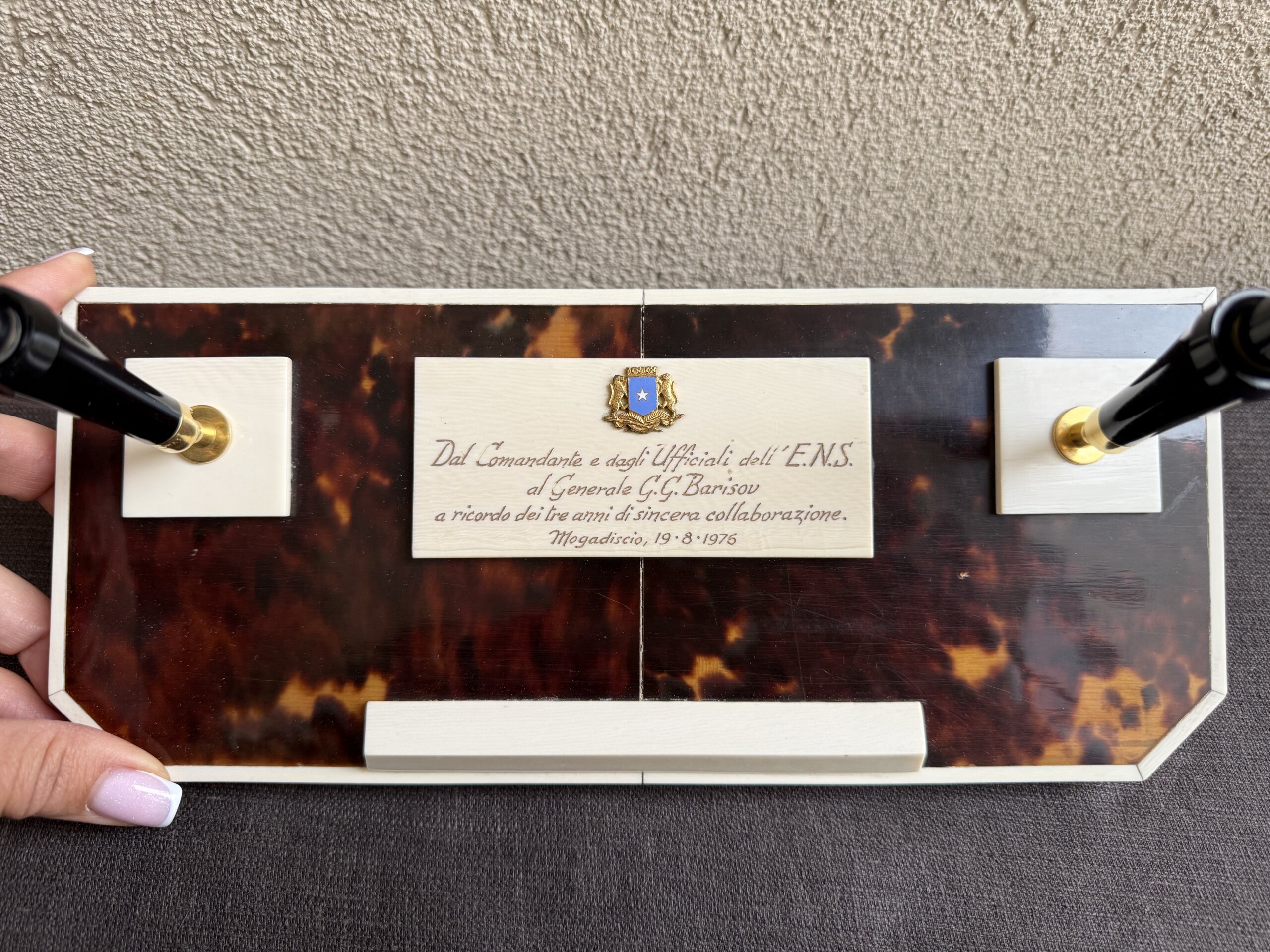
Desk set presented to General Borisov, Mogadishu, 19 August 1976.
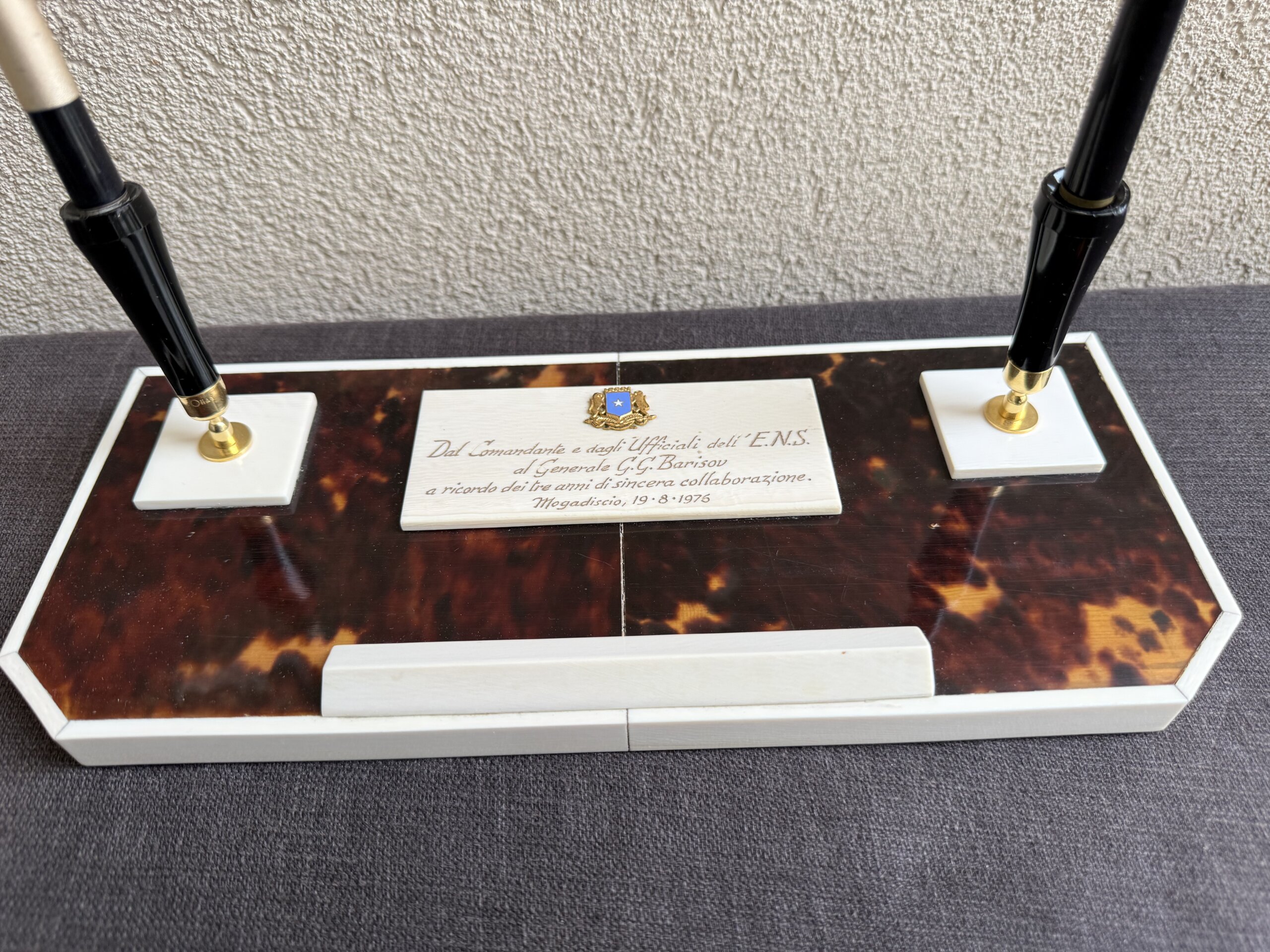
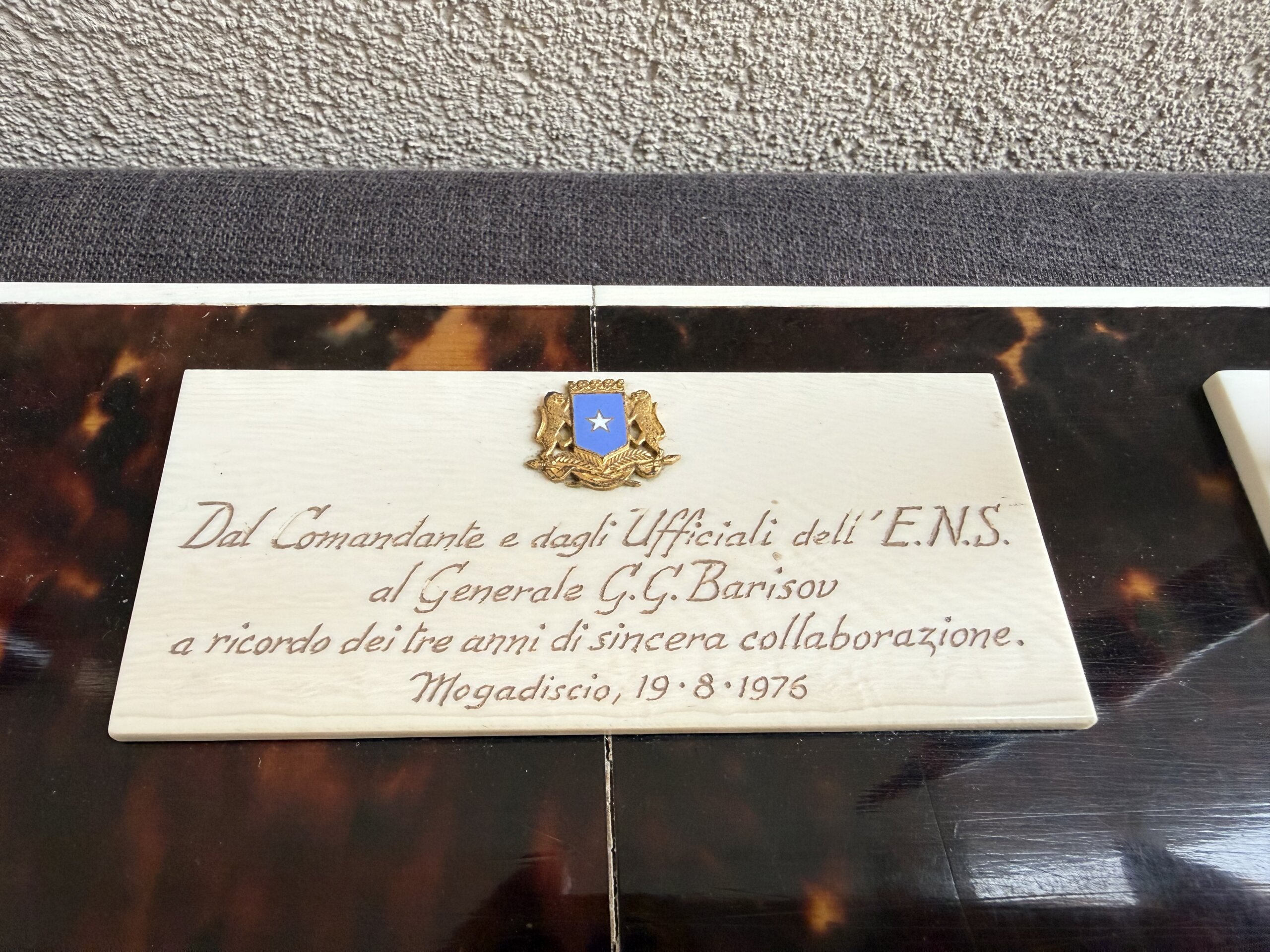
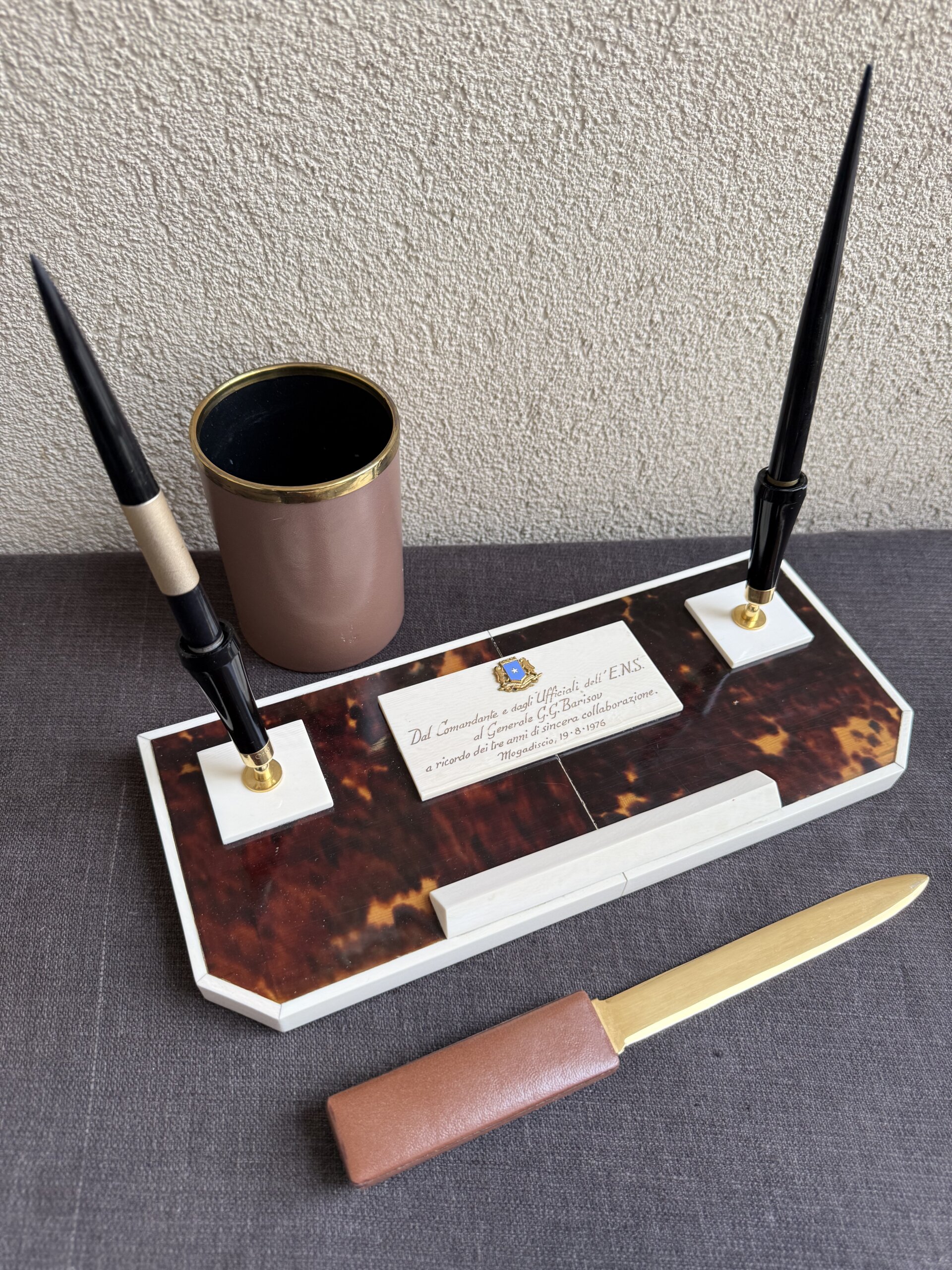
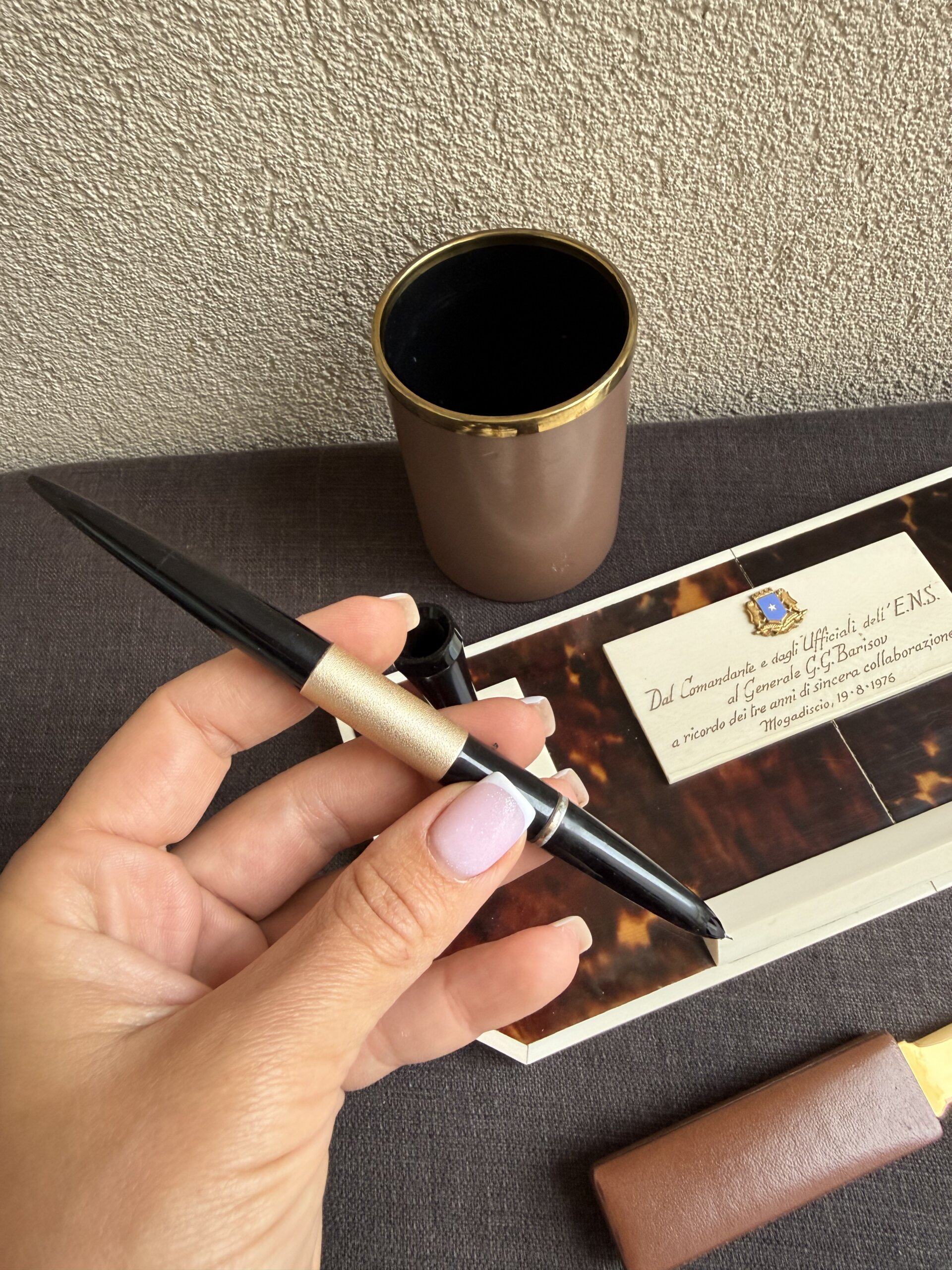
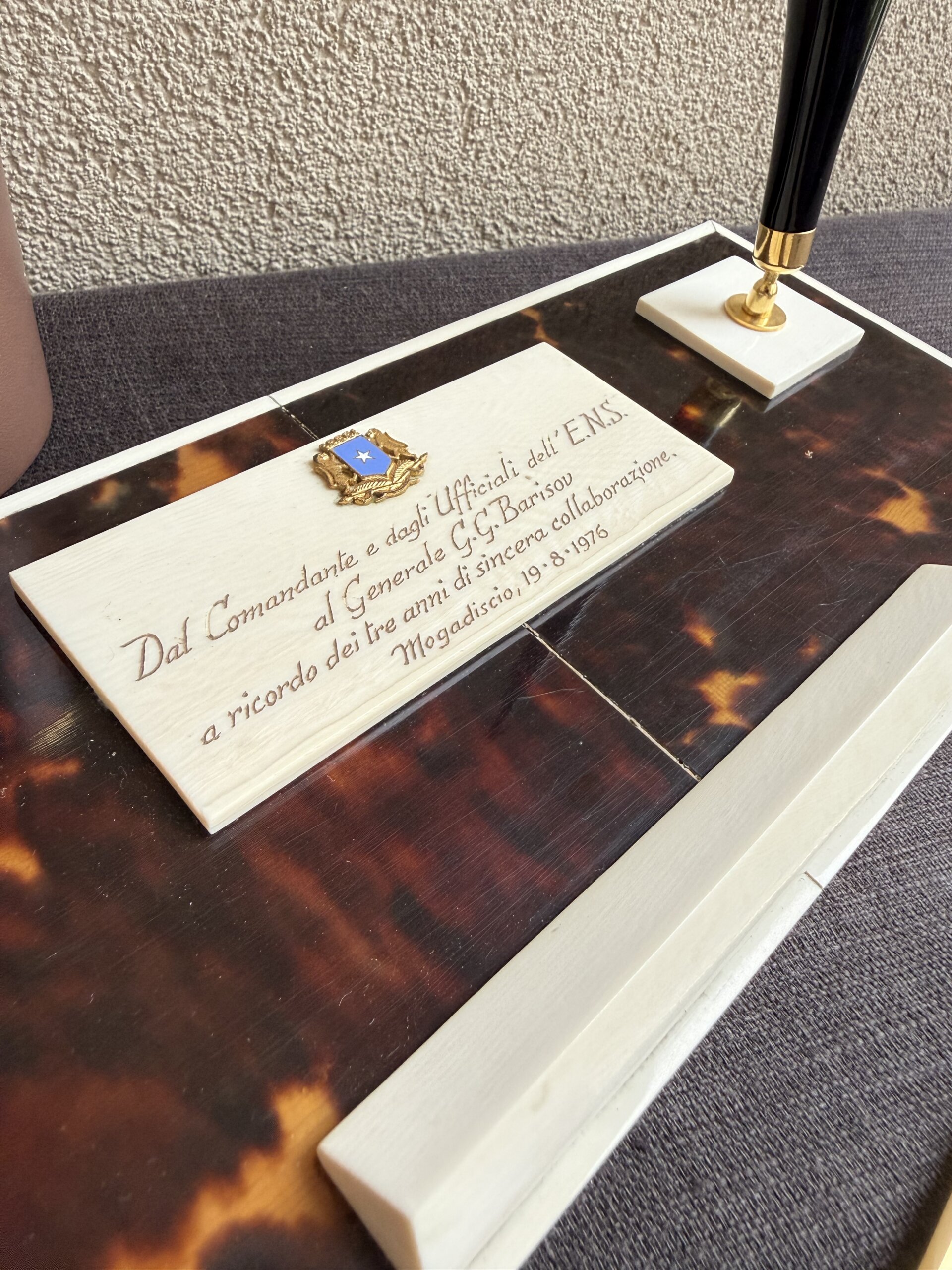
The desk set fits in your hands. A wooden base 28.5 centimetres wide, covered with a plexiglass plate imitating tortoiseshell and edged with a pale material, in all likelihood ivory, though without absolute certainty. Two black bakelite pen holders, a cylindrical pencil pot ringed with a gilt band, a gilt metal letter opener. At the centre, an engraved plate topped by the enamelled coat of arms of the Republic of Somalia, and a dedication in Italian dated “Mogadiscio, 19 August 1976”.
The Italian is not out of place. Southern Somalia was an Italian colony, then an Italian trust territory until independence in 1960, and the language remained in use in the administration and the army. So it was in Italian that the command of the Esercito Nazionale Somalo had its thanks engraved to a general sent from Moscow.
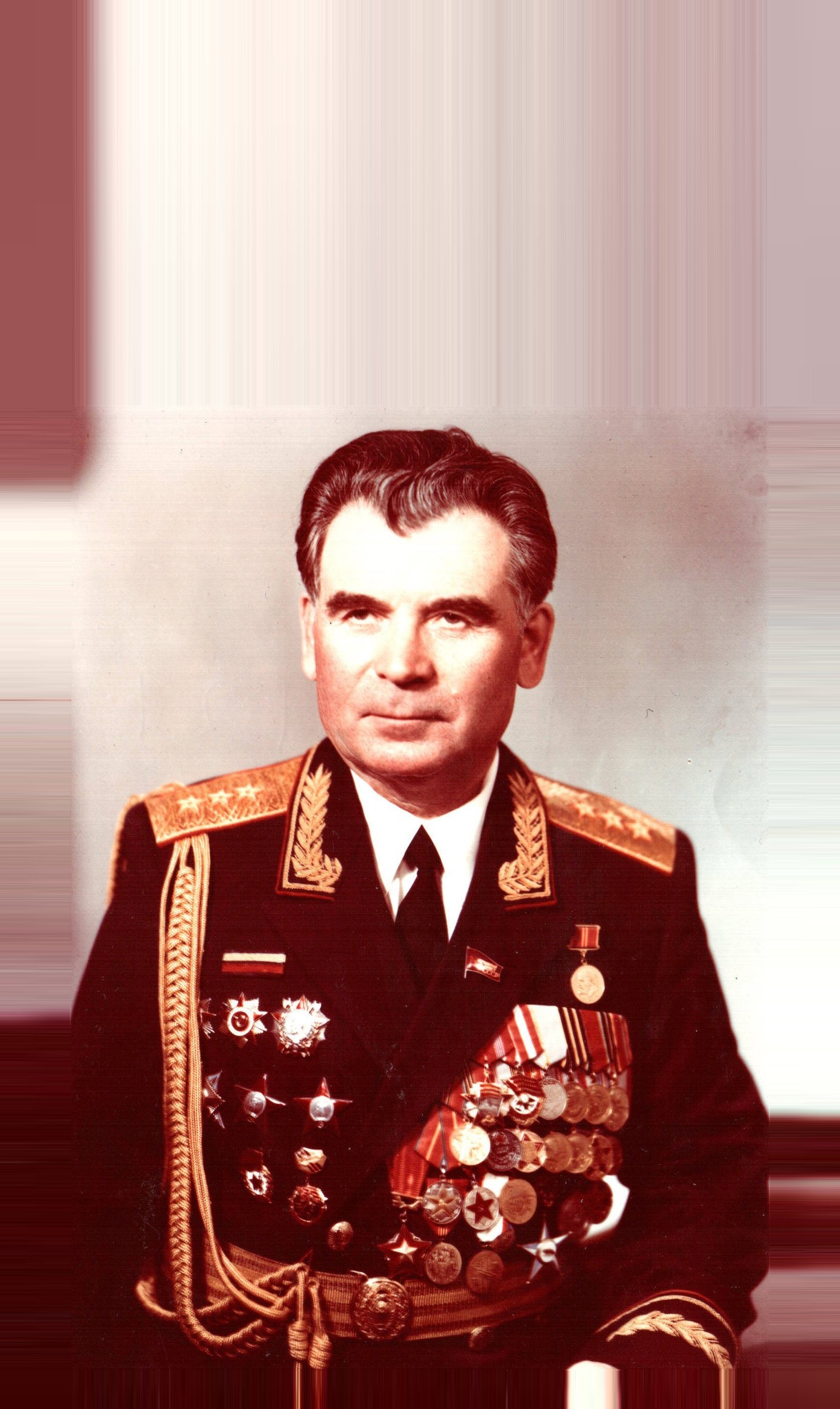
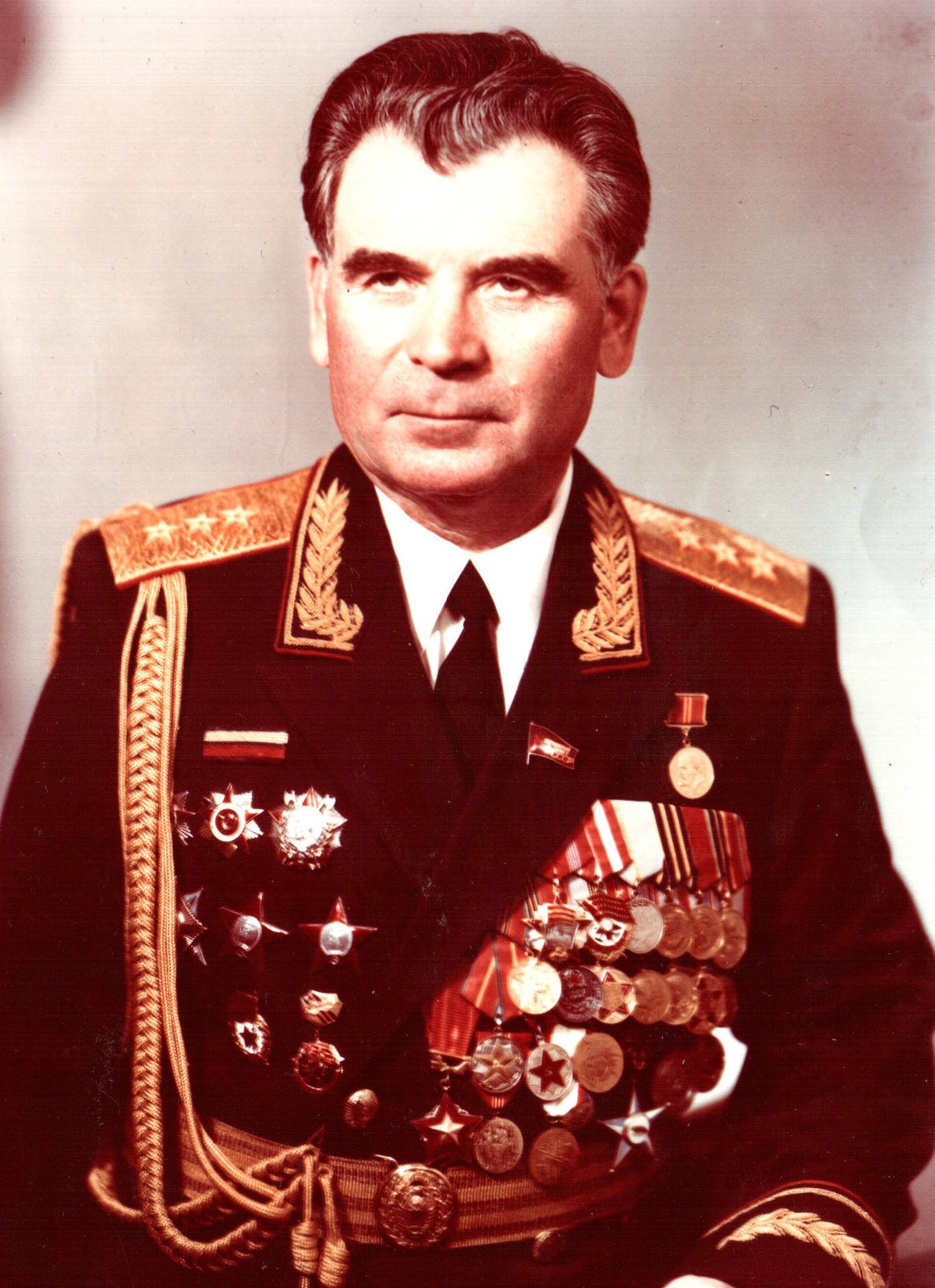
That general was Grigory Grigoryevich Borisov (1924-2019). A veteran of the Great Patriotic War, he served as chief Soviet military adviser to the Somali army from 1973 to 1976. The object dates precisely from the end of his mission. At the scale of an officer’s desk, it documents an episode now largely forgotten: the moment when the Soviet Union held the Horn of Africa through Somalia, a few months before losing it all and starting again on the opposite side.
The desk set from different angles: base, bakelite pen holder, pencil pot, letter opener.
How the USSR arrived in Somalia
The story begins well before Borisov. As early as 1962, an agreement between the young Somali Republic and the Soviet Union opened the way for the Soviets to modernise the port of Berbera. In 1963, Moscow agreed to equip and train the Somali army, where the West had proved reluctant. In 1965, the USSR helped Somalia build a navy.
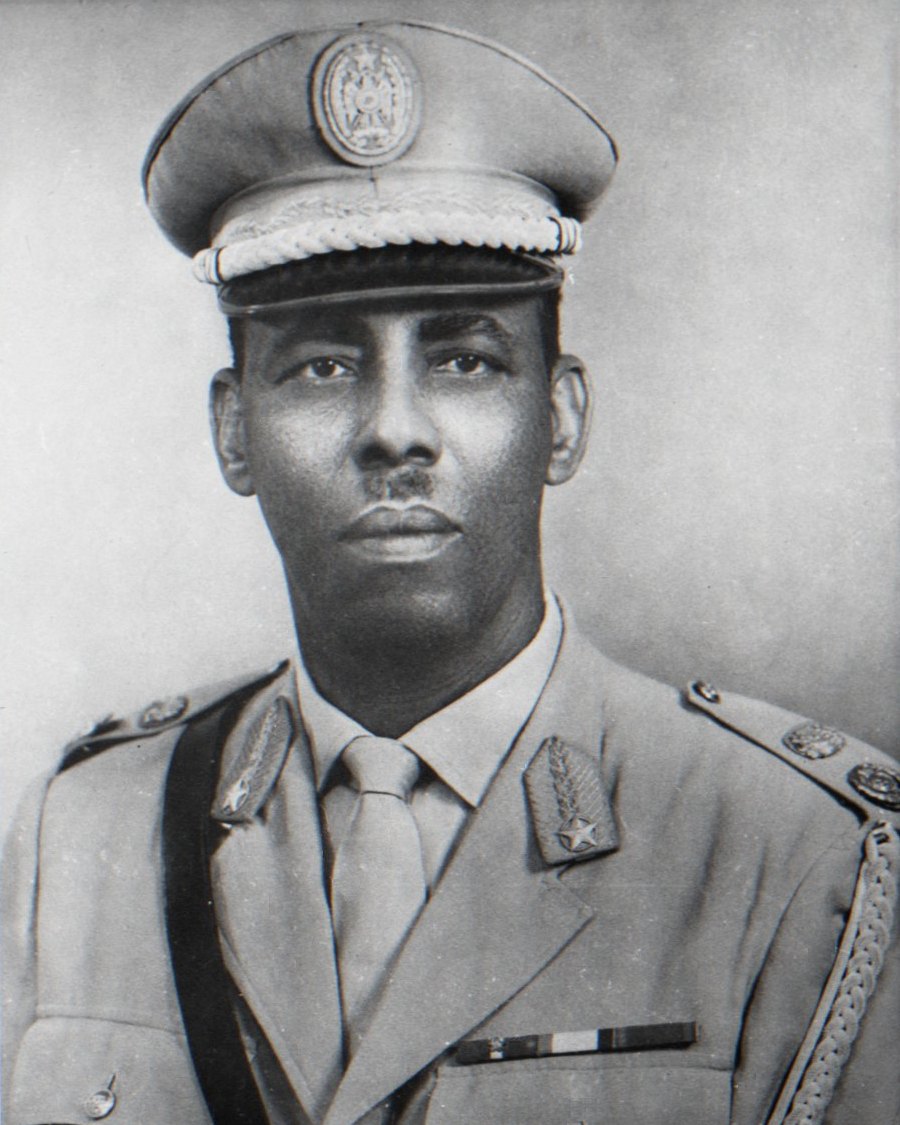
The decisive turning point was the coup of October 1969. General Mohamed Siad Barre took power in Mogadishu, suspended parliamentary democracy and set the country on a course of socialism aligned with Moscow. Soviet aid intensified. Military advisers, equipment, credit lines: Somalia became one of the Soviet Union’s main clients in sub-Saharan Africa.
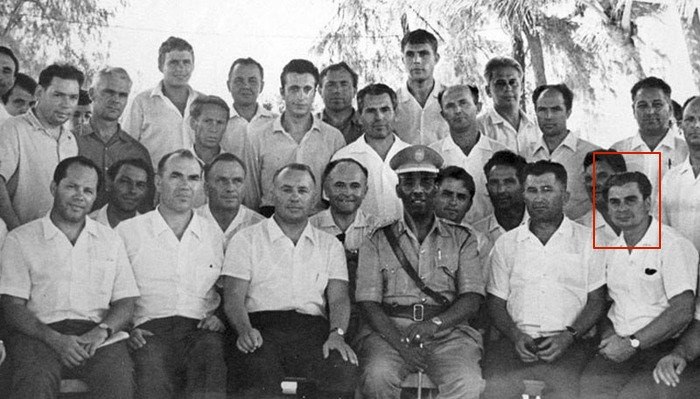
Mohamed Siad Barre, in power in Mogadishu from 1969 to 1991. (Government of Somalia / Library of Congress, public domain)Siad Barre, in uniform, and General Grigory Borisov (boxed), among a group of Soviet military instructors in Somalia. (Public domain / Wikimedia Commons)
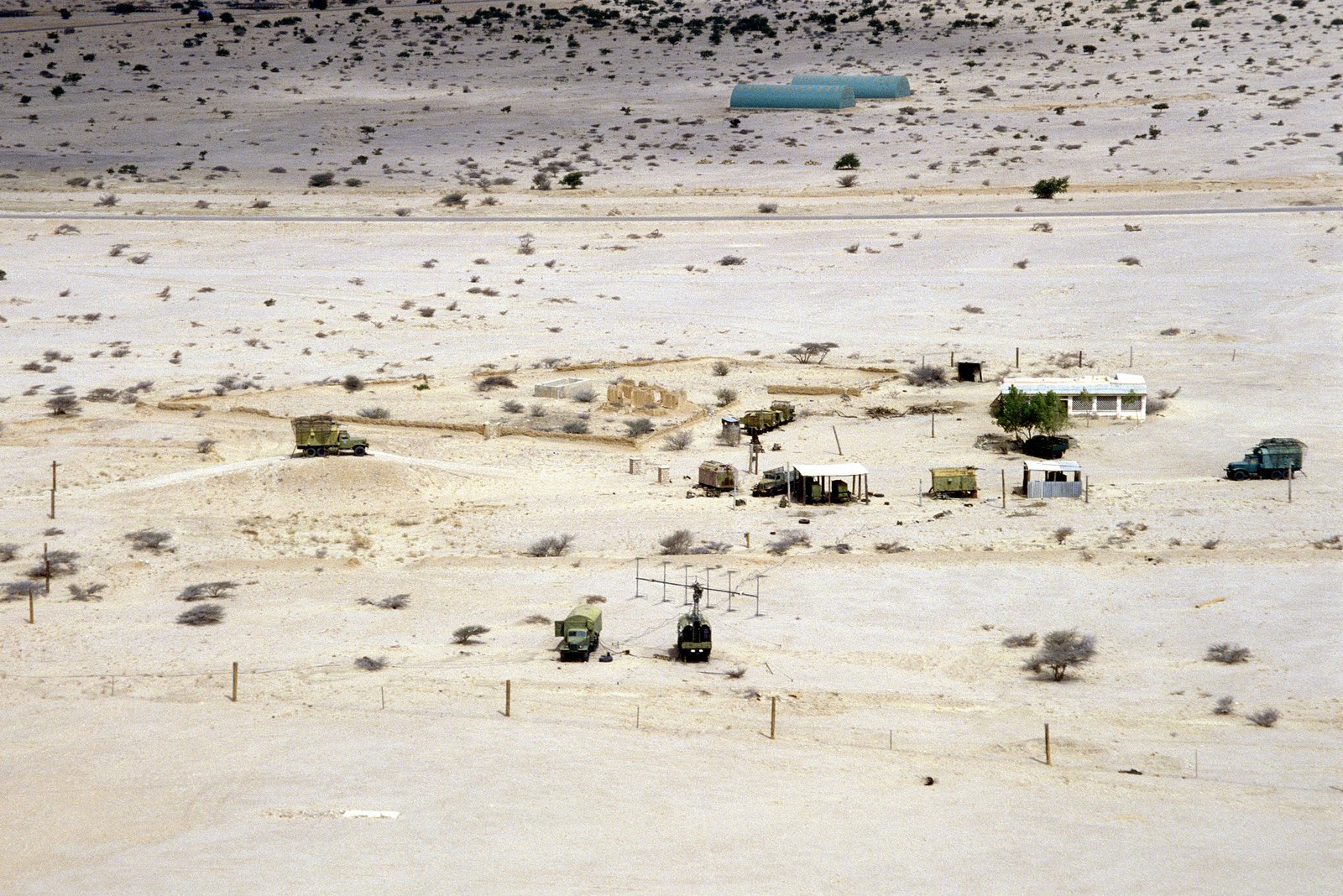
The strategic anchor point was Berbera, on the Gulf of Aden. The Soviets developed a naval and air base there, a long runway, a missile storage site. For a Soviet navy seeking a lasting presence in the Indian Ocean, Berbera was a key asset: a foothold from which to watch the Bab el-Mandeb strait and the oil routes of the Gulf, without having to return to Vladivostok every month.
Radar installation at Berbera airport: a Soviet-made P-12 “Spoon Rest” early warning radar is visible at the centre. (US Marine Corps, public domain)
General Borisov, chief adviser
General Grigory Grigoryevich Borisov, chief Soviet military adviser in Somalia from 1973 to 1976. (BorisovaGalina / Wikimedia Commons, CC BY-SA 4.0)
It was in this context that Grigory Borisov arrived in Mogadishu in 1973. As chief military adviser, he oversaw the training and organisation of an army equipped entirely along Soviet lines. His mission coincided with the high point of the relationship between the two countries.
In July 1974, the USSR and Somalia signed a treaty of friendship and cooperation. Siad Barre’s Somalia was then Moscow’s model African ally. Borisov rose through the ranks: promoted colonel general in 1981, he went on to hold senior posts in the Soviet general staff. Late in life he devoted a volume of memoirs to this period, published in Odessa in 2004 under a title that says it all: “The Chief Military Adviser. Memoirs. War Was Brewing in the Horn of Africa”.
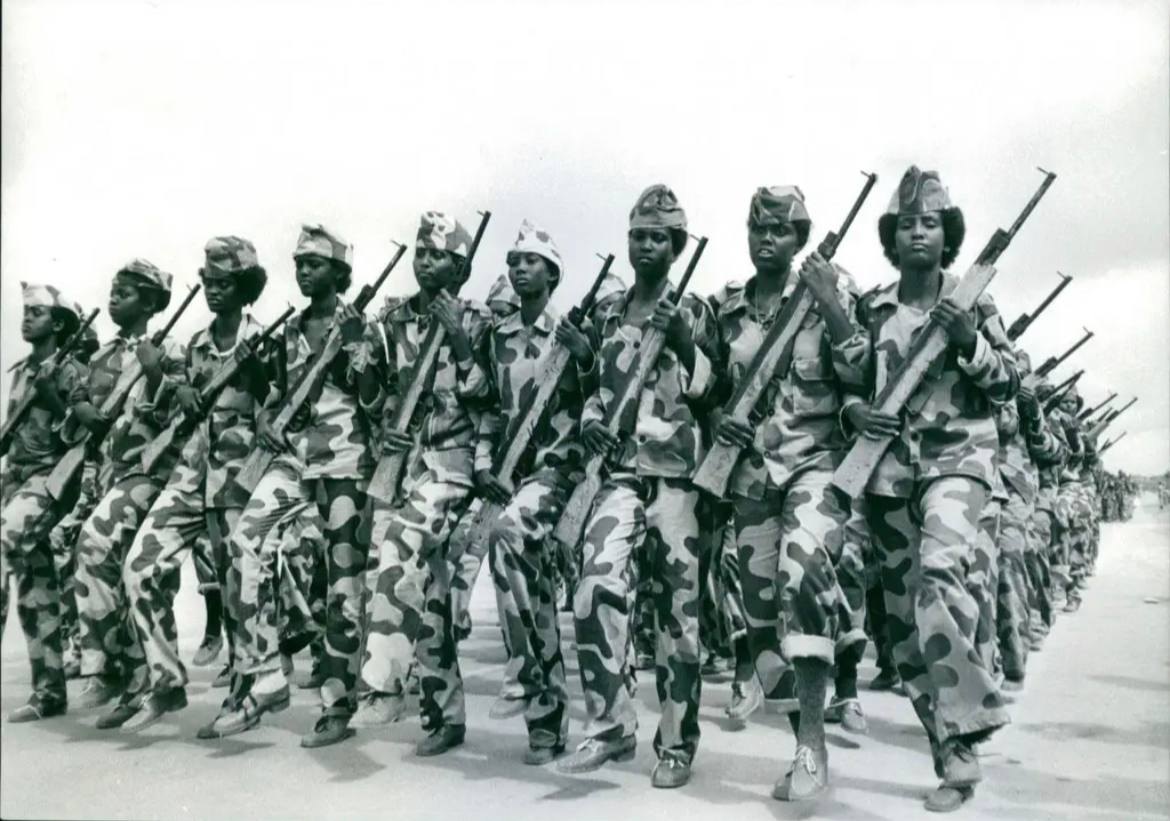
Somali National Army parade, 1978. An army equipped and trained along Soviet lines. (Public domain / Wikimedia Commons)
War was indeed brewing. And this is where the story turns.
1977, the break
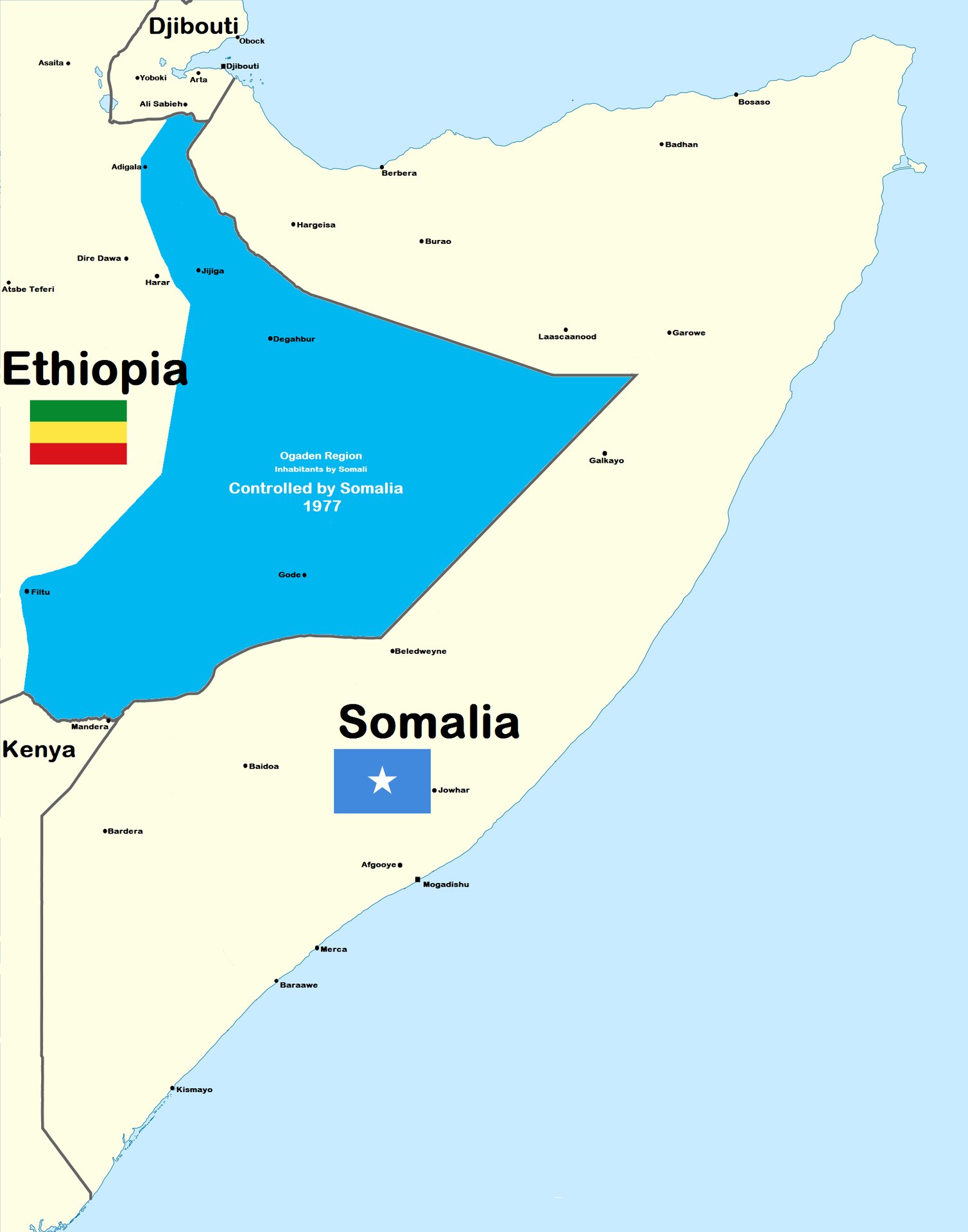
The Ogaden War, 1977: the Somali offensive in the contested region of eastern Ethiopia. (Skilla1st / Wikimedia Commons, CC BY-SA 3.0)
Siad Barre had a project: Greater Somalia, the union of all Somali-populated territories, including the Ogaden region in eastern Ethiopia. In 1974, neighbouring Ethiopia in turn moved into the socialist camp after the fall of Emperor Haile Selassie and the arrival of the Derg, the Marxist junta of Mengistu Haile Mariam.
Moscow now had two hostile clients in the same theatre. Brezhnev, like Castro, dreamed of a socialist federation bringing together Ethiopia, Somalia and South Yemen. Barre’s demands over the Ogaden, set as a precondition, sank the plan. More importantly, the Soviet Union explicitly advised against the invasion: its diplomats pressed Barre not to attack, and even assured the Ethiopians that they could restrain their Somali client. In February 1977, Barre was still denying any invasion plans to the Soviet ambassador in Mogadishu.
In July 1977, in defiance of Moscow’s warnings, the Somali National Army, equipped and trained by the Soviets, invaded the Ogaden. The Soviet Union then had to choose, and it chose Ethiopia, judged more important in demographic and strategic weight. It began by drastically cutting arms deliveries to Barre in order to push him back.
Furious and betrayed, Siad Barre broke off relations. On 13 November 1977 he renounced the 1974 friendship treaty, expelled the Soviet military advisers and closed the Berbera base. Overnight, the ally became the adversary. Moscow shifted arms, advisers and logistics to Addis Ababa.
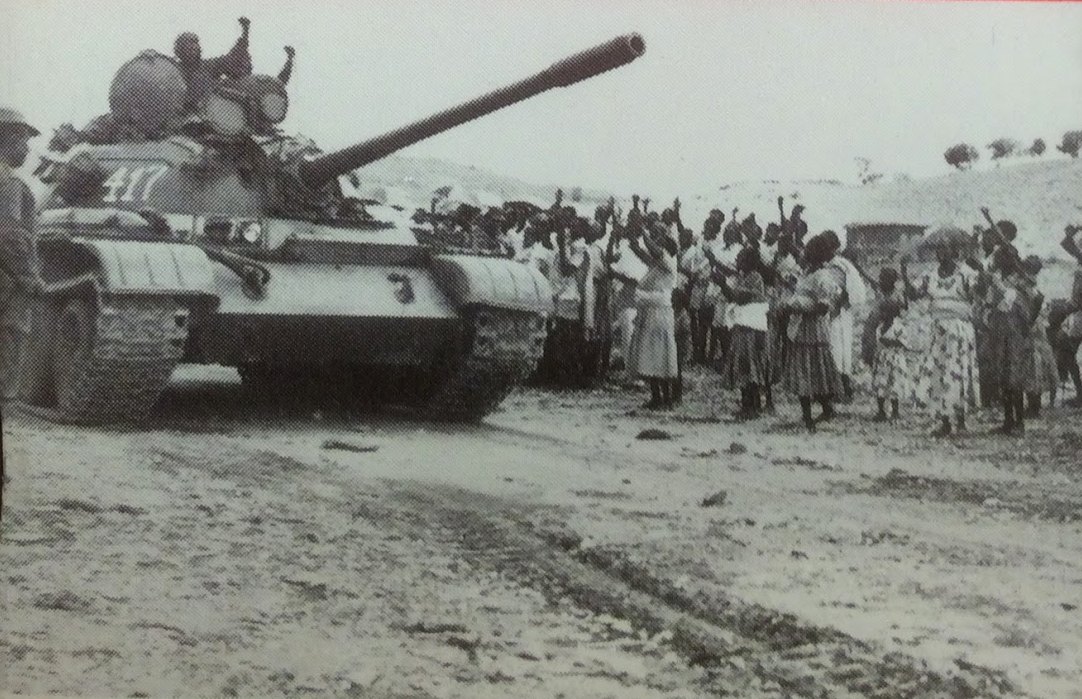
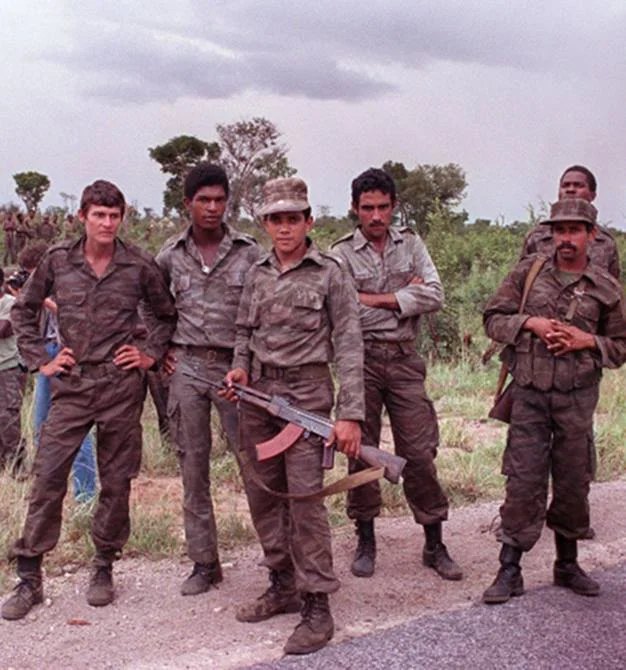
Ethiopian army T-55 tank, supplied by the USSR, presumed to be in the Ogaden, 1977-78. (Public domain / Wikimedia Commons)Cuban soldiers during the Ogaden War, 1977-78. The Cuban expeditionary force fought alongside Ethiopia. (Public domain / Wikimedia Commons)
What followed was brutal. Backed by a massive Soviet airlift, by 1,500 Soviet advisers and by a Cuban expeditionary force of around 16,000 men, the Ethiopian army counter-attacked in early 1978 and crushed the Somali forces. In March 1978, Somalia withdrew its troops from the Ogaden. The Soviet tanks Somalia knew so well were now facing it across the line. The Greater Somalia project was buried in the sands of the Ogaden.
Did Borisov command the armies that crushed the one he had trained?
This is where the story of our desk set takes a murkier turn.
At the height of the counter-offensive, reports coming out of Mogadishu claimed that the Soviet officer directing Ethiopian operations was none other than General Grigory Borisov, the very man who had been advising the Somali army a few months earlier. The accusation is stark in its cruelty: the man to whom Somali officers presented this desk set in August 1976 would have returned, barely a year later, to command the armies that ground them down.
The accusation does not entirely hold up against the facts. For Washington as for Moscow, the Soviet officer who led Ethiopian forces in the Ogaden was General Vasily Petrov. Borisov’s official biography places him elsewhere from December 1976: on the staff of the Volga Military District, far from the Horn of Africa at the time of the war. In all likelihood, the Somali reports confused two generals, or credited Borisov with a role he did not play.
The object remains. Sealed in August 1976, at the peak of a friendship no one believed was near its end, this desk set fixed a moment that history swept away fifteen months later. The officers who gave it and the general who received it found themselves, the following year, on opposing sides of a war Moscow had chosen to win for the other camp. The object itself carries only the date from before the break.
The ДП-5В (DP-5V) is the field radiometer of Soviet civil defence: a green Bakelite console, a probe with a rotating gamma, beta and check-source shield, headphones and a manual that explains operation and maintenance. The one in this article served in an industrial bakery in Chișinău and was serviced in March 1991. Its owner shared his photos and documents with us, and we turned them into a tool that lets you operate it on screen, step by step.
The Moscow Games, from 19 July to 3 August 1980, boycotted by some sixty countries, produced more objects than any Soviet event: a bear cub, Misha, drawn by Viktor Chizhikov, an emblem made of running tracks, five thousand torches, watches from every factory, platinum coins, rings, tea glass holders, posters. This guide tells the story of the Games and reviews the objects, with the marks that authenticate them and the prices.
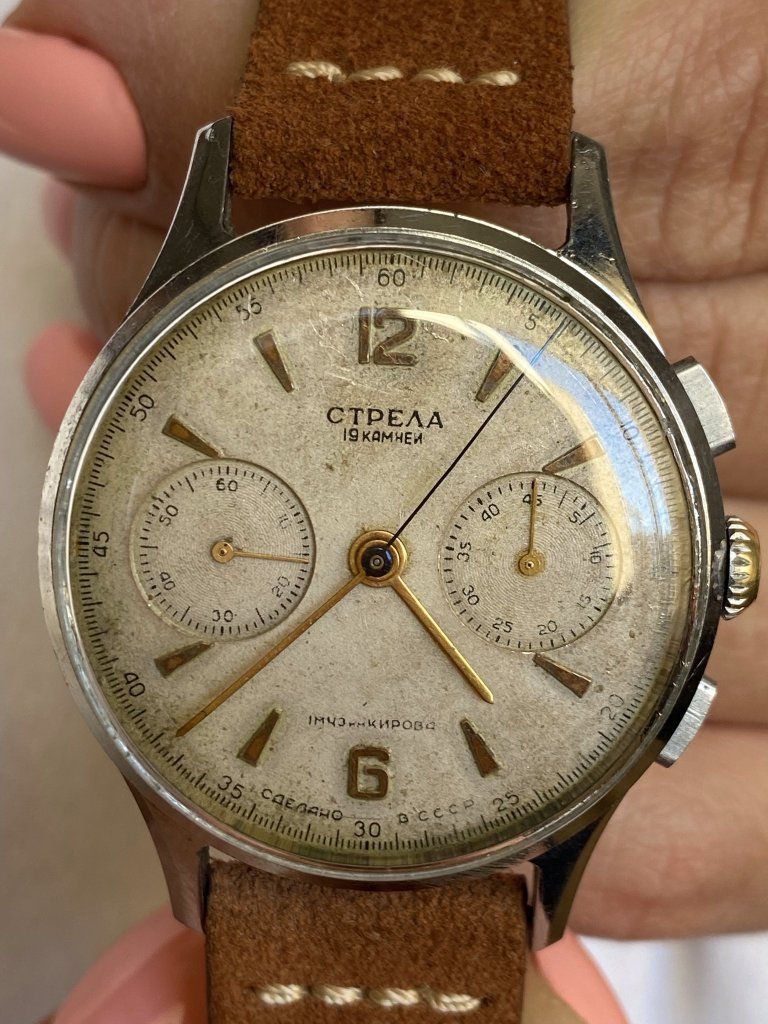
The 3017 chronograph of the First Moscow Watch Factory carries a five-digit number on the balance cock. The most common dating method reads it as a single series, from 1959 to 1979. Four factory passports show there are two, and that the same number can point to two watches made ten years apart. Here is how to read the number, the dial, the logo and the bridge, with a decoder to date your Strela, Poljot or Sekonda.
This website uses cookies to improve your experience while you navigate through the website.
Out of these cookies, the cookies that are categorised as necessary are stored on your browser as they are essential for the working of basic functionalities of the website.
We also use third-party cookies that help us analyse and understand how you use this website.
These cookies will be stored in your browser only with your consent.
You also have the option to opt out of these cookies.
But opting out of some of these cookies may affect your browsing experience.
Necessary cookies are absolutely essential for the website to function properly. This category only includes cookies that ensure basic functionalities and security features of the website. These cookies do not store any personal information.
Cookies that are not strictly necessary for the website to work and that are used specifically to collect personal data through analytics, ads and other embedded content are called non-necessary cookies. User consent is required before these cookies run on the website.
✕
Soviet in Paris
Offline right now. Leave your message and your email, we reply within 24 hours.
Hello 👋 A question about an item, an order or shipping? Write to us.
Your email is used only to reply to you.
Subscribe to our newsletter and get 10% off your first order.
Subscribe
★ New pieces before anyone else
★ New blog articles
★ Soviet in Paris news and updates
Join the Party
10% off your first order
Receive your welcome card and our next arrivals.
Your code appears here and is also sent to you by email. You can leave the Party in one click, at any time.