Three January 1968, thirty miles north of Hanoi: a Vietnamese MiG-21 shoots down the F-105D of Colonel James Bean, a Second World War veteran and second in command of an American fighter-bomber unit. A Vietnamese trophy sculpture, presented that same year in all likelihood to a Soviet specialist, preserves the trace of that duel. Its polished plate still shows the five letters "Nguyen".
MAY 2026•10 MINUTE READ
by Marwen Yahyaoui
On 3 January 1968, at ten in the morning, four F-105D Thunderchiefs took off from Korat air base in Thailand. Their target was a strategic bridge in North Vietnam. Leading them, in the flight leader’s cockpit, was a colonel of the U.S. Air Force who had already known war twenty-five years earlier, in the skies over France and Germany. Thirty miles north of Hanoi, the formation was intercepted. An infrared homing missile fired from a MiG-21 struck the lead aircraft. The pilot pulled his ejection seat handle and reached the ground alive. His war ended there. His captivity would last five years, two months and eleven days.
Fifty-eight years later, in the outskirts of Kharkiv, a small metal sculpture resurfaced on the ground, among the odds and ends of a neighbourhood flea market. Two aircraft models, welded onto a fragment of aluminium sheet. A commemorative plate polished to erase an inscription, of which only five letters remain: NGUYEN. This object, presented in 1968 to a Soviet specialist on assignment in Vietnam, is in all likelihood the material trace of that particular duel.
The object and its enigma
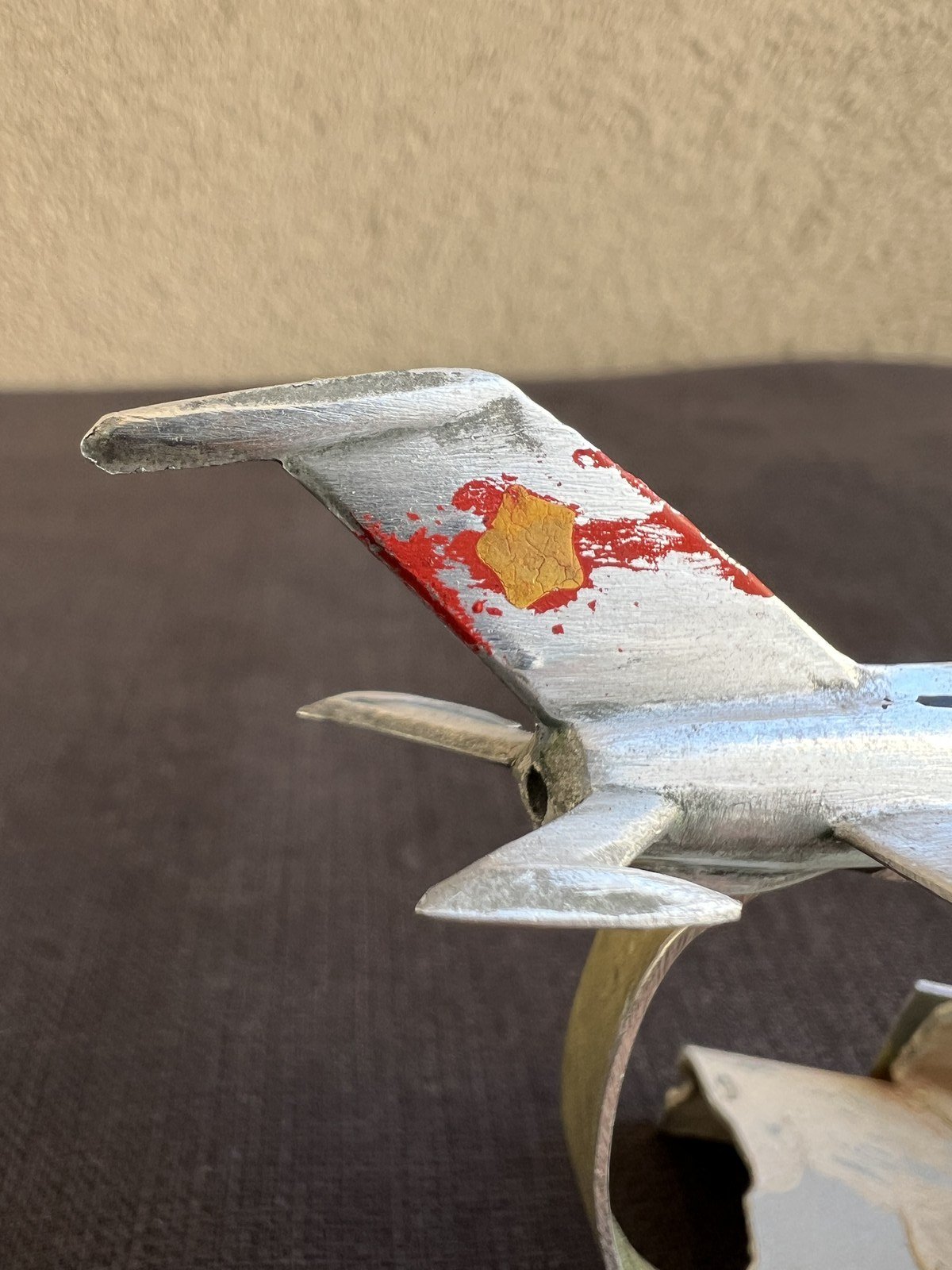
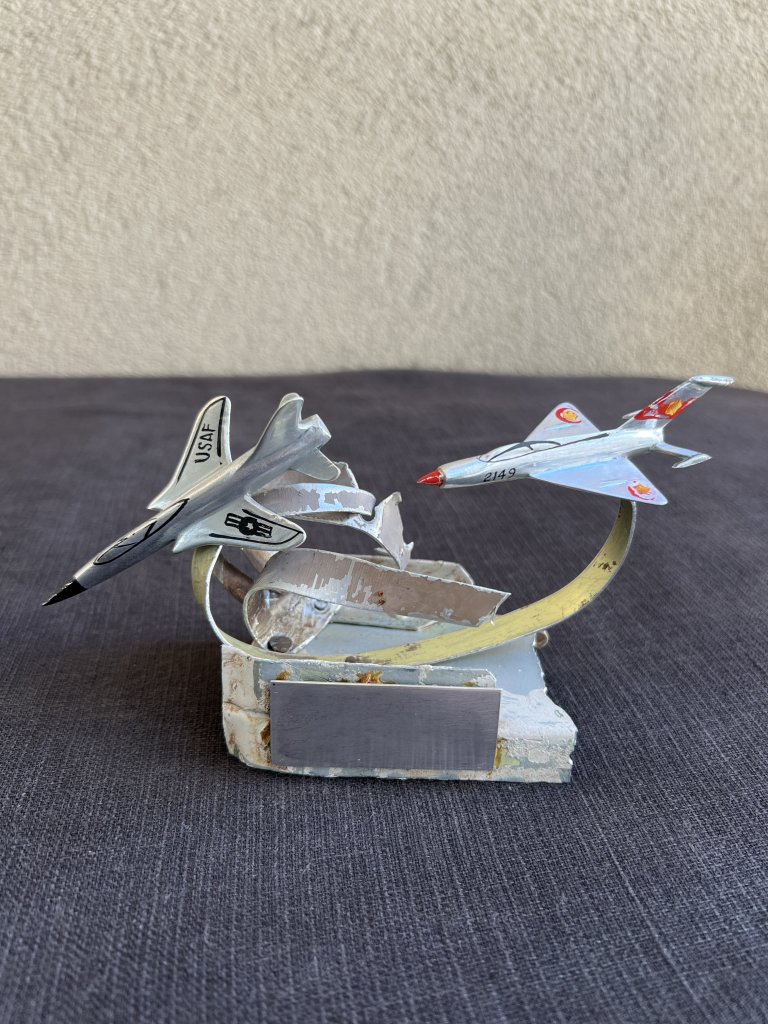
The sculpture is small, its base measuring eight centimetres by six. The sheet-metal fragment that forms that base comes, according to the account passed down with the object, from the fuselage of the downed American aircraft: a piece of victory, kept and then turned into a gift. Onto this base two fighter aircraft models have been welded, one raised above the other, in the exact posture of an air duel. The silhouettes are identifiable: vertical, a Soviet MiG-21, narrow and streamlined; below it, a Republic F-105D Thunderchief, recognisable by its swept air intakes at the wing roots, its characteristic wasp waist and its heavy fighter-bomber fuselage.
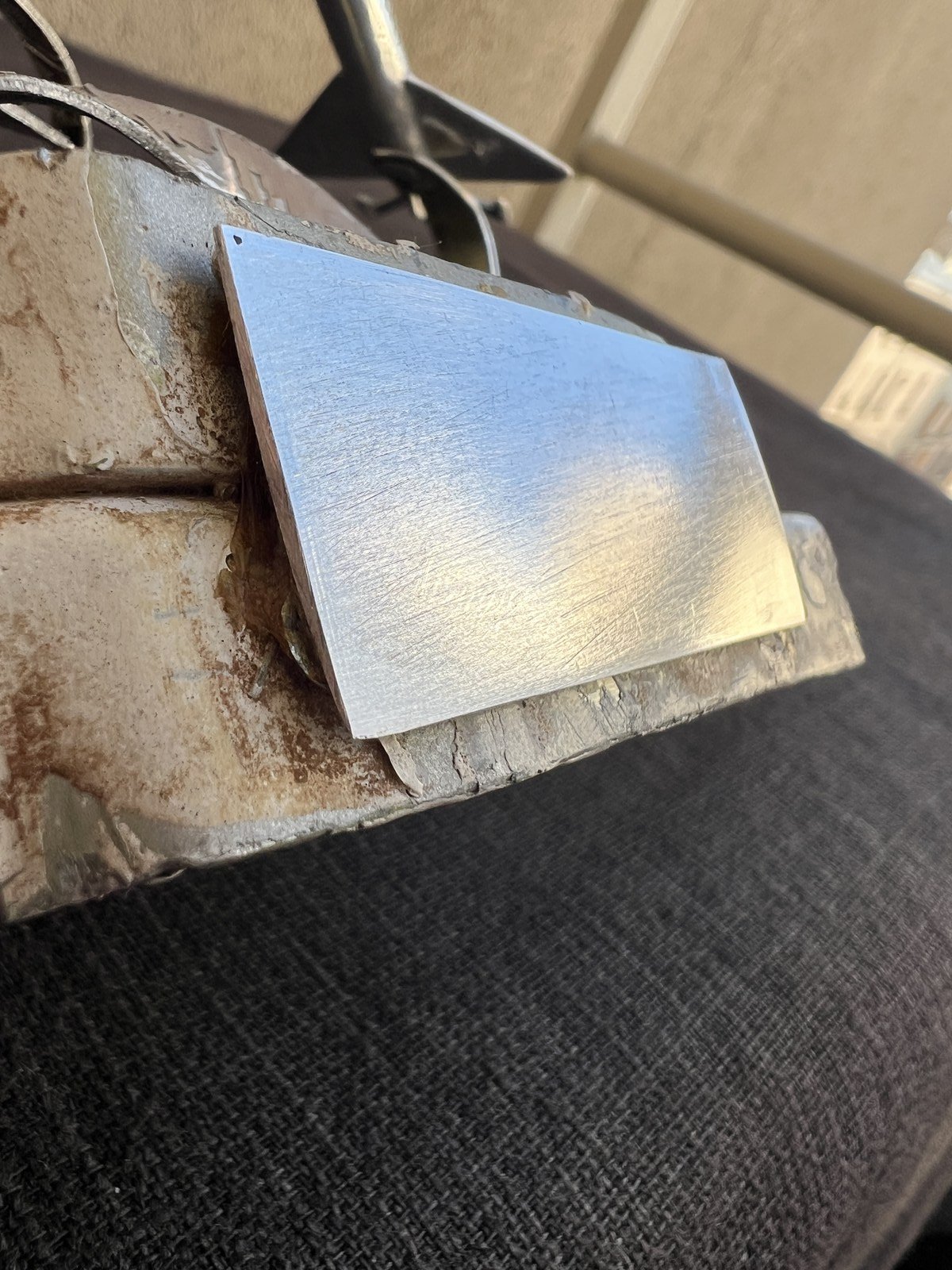
The plate screwed to the front of the base has been polished. The act was deliberate and meticulous: the inscription originally there has been erased, leaving only five letters that resisted the polishing, Nguyen. The rest, whether a first name, a rank or a dedication, has gone. What this erasure tells us is not the identity of the dedicatee, it is that at some point someone thought it prudent to make that detail illegible.
The fighter pilot from Kentucky
The pilot of the F-105D shot down that morning was James Ellis Bean. He was born on 5 December 1923 in Coxs Creek, Kentucky, a rural township where one does not expect a future Air Force colonel to be born. At eighteen, in November 1942, he enlisted in the Army Air Corps reserve. Three months later he was an aviation cadet; in January 1944, at twenty, he received his pilot’s wings and his second lieutenant’s commission at Foster Field, Texas.
The year 1944 sent him to Europe, at the controls of a Republic P-47 Thunderbolt, a large radial-engined fighter whose winged-bathtub silhouette worked wonders in ground strafing. He flew forty-one combat missions over France and Germany. He returned to the United States in 1947 with an Air Medal cross on his chest and the experience of a man who had brushed against death in a dive. With peace restored, he stayed in military aviation and spent the next twelve years testing the new jets of the fledgling U.S. Air Force. In 1960 he was at Nellis, Nevada, setting up the F-105 training programme for every Air Force unit. He would briefly join the Thunderbirds, the American display team, and take part, alongside Chuck Yeager, in one of the test programmes on the sound barrier.
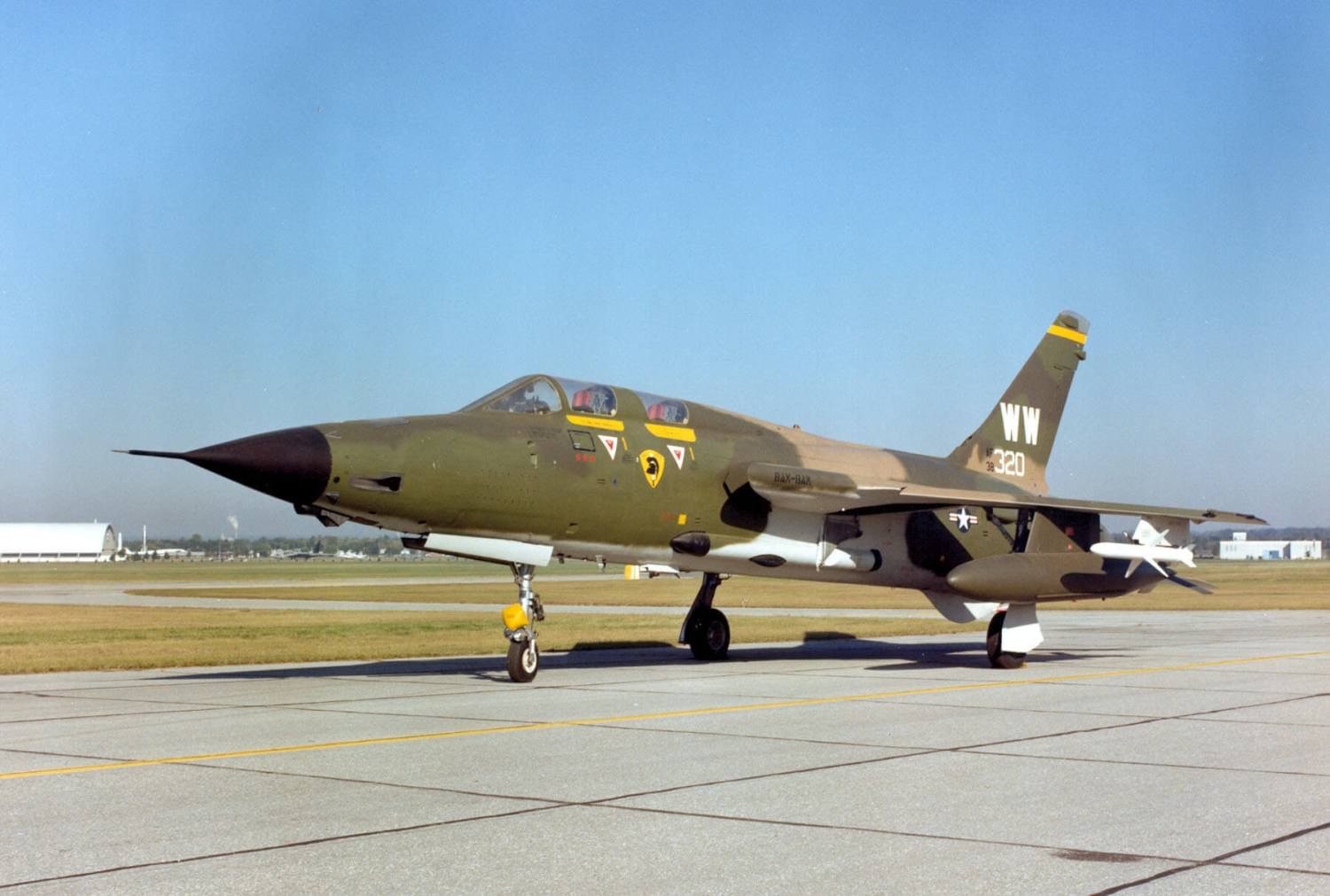
Republic F-105D Thunderchief of the U.S. Air Force. This is the aircraft James Bean helped bring into service at Nellis in 1960, and which he flew over North Vietnam until the morning of 3 January 1968. Source: National Museum of the U.S. Air Force
In the mid-sixties his career took him closer to Washington: he became a duty officer at the Pentagon in 1966. He stayed there a little over a year, pushing files and signing memos. The Vietnam War was bogging down. In October 1967 he did something few colonels of his rank do: he asked to go into combat. He was posted to the 388ᵗʰ Tactical Fighter Wing, at Korat Royal Thai Air Force Base in Thailand, as Deputy Commander for Operations, second in operational command of an F-105D unit engaged in the intensive bombing of North Vietnam. On the assignment list, his aircraft carries the serial 58-1157, an F-105D-5-RE of the 469th Tactical Fighter Squadron.
On 18 December 1967 he led a formation of four Thunderchiefs against a strategic bridge in North Vietnam. His aircraft was badly damaged by anti-aircraft fire as he arrived over the objective. He chose to press on, completed the mission, then brought his aircraft back to base. He would be decorated with the Silver Star for that mission. A fortnight later he took off on what would be his last flight on the American side.
Hanoi’s top ace
On the other side of the front, the most decorated Vietnamese pilot of the war was a man almost twenty years younger than James Bean: Nguyễn Văn Cốc was born in December 1942 in Việt Yên district, Bắc Giang province, north of Hanoi. When he was five, his father Nguyen Van Bay, president of the district Việt Minh, and his uncle were killed by the French. His mother moved the family to safety. He spent his childhood near Chu air base, and it was there that he acquired his taste for aircraft, watching the Soviet Yaks take off.
Enlisted in 1961 in the Quan Chung Khong Quan (the Vietnam People’s Air Force), he was selected for pilot training in the Soviet Union. He went to the base at Bataysk, then Krasnodar, in southern Russia. One hundred and twenty young Vietnamese began the course. Only twenty-three finished it. Cốc was one of them. Assigned on his return to the Đoàn không quân Sao Đỏ, the “Red Star division”, the elite unit of the young VPAF, he flew the MiG-17 at first. Spotted as a promising pilot, he was sent back to the USSR to convert onto the MiG-21, the very latest Soviet interceptor in service. He returned in 1965, in the middle of the build-up of operation Rolling Thunder, the large American bombing campaign over North Vietnam.
His first battle went badly. On 2 January 1967, the American colonel Robin Olds set a trap, operation Bolo, passing off his F-4 Phantoms as slow, bomb-laden F-105s. Five MiG-21s fell that day. Cốc escaped by a narrow margin. But four months later, on 30 April 1967, he shot down his first aircraft: an F-105D flown by Captain Robert A. Abbott of the 355th Tactical Fighter Wing, who was taken prisoner. Others followed: an F-4D on 23 August, an F-105D on 7 October, another F-105D on 18 November, his fifth victory, which made him an ace in the classic sense of the word.
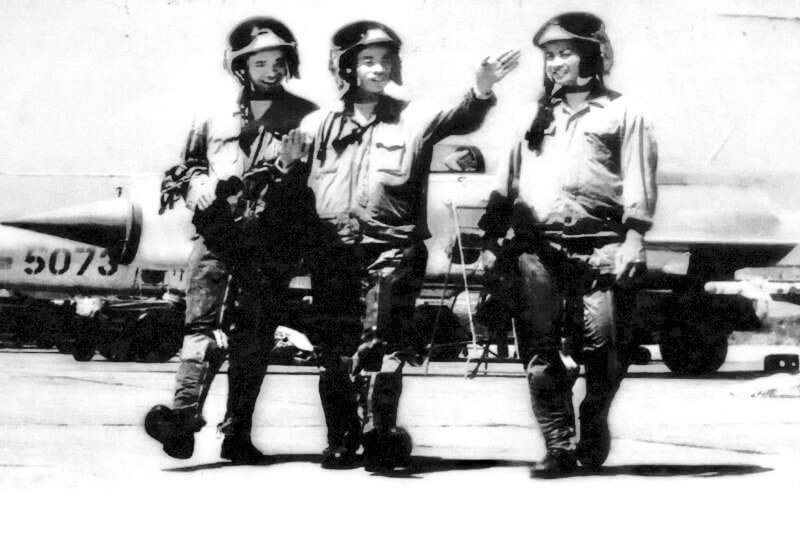
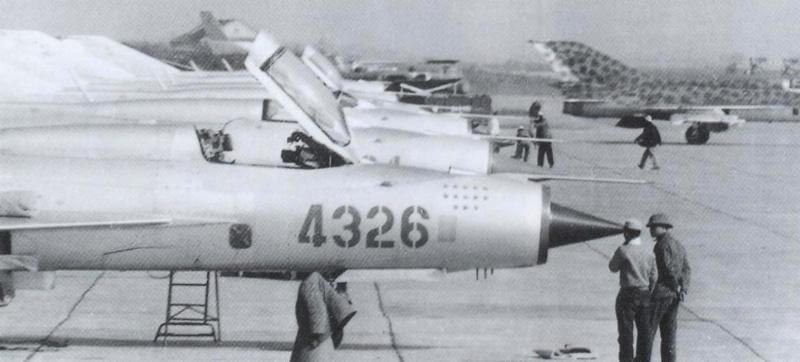
Senior Lieutenant Nguyễn Văn Cốc (right) with two fellow pilots of the 921st regiment, in front of a MiG-21PF of the Sao Đỏ division. Source: VPAF, via thisdayinaviation.com
Of the nine official victories credited to him by the VPAF, seven are acknowledged by the U.S. Air Force itself. He flew a MiG-21PF of the 921st fighter regiment, the famous Sao Đỏ, and his kills were all obtained with the same type of weapon: the R-3S Atoll missile, the Soviet copy of an American Sidewinder captured in China in 1958 and reverse-engineered in Moscow. No American pilot would exceed five victories during the war. Cốc accumulated nine. He is, mathematically, the top ace of the conflict.
Korat, Rolling Thunder, and the MiG trap
James Bean’s unit, the 388ᵗʰ TFW, was one of the two large American Thunderchief formations engaged over North Vietnam. It operated from the Korat Royal Thai Air Force Base, about eight hundred kilometres south-west of Hanoi. Every combat mission meant a thousand-kilometre outbound raid, an air-to-air refuelling over Laos, a low-altitude penetration to slip under the radar, the attack itself, the return leg, and often a second refuelling. The round trip lasted three to four hours. The F-105D, originally designed for lightning nuclear strikes, was used in Asia as a conventional bomber: it took off at maximum weight, six tonnes of bombs under the wings, at the limit of its capabilities.
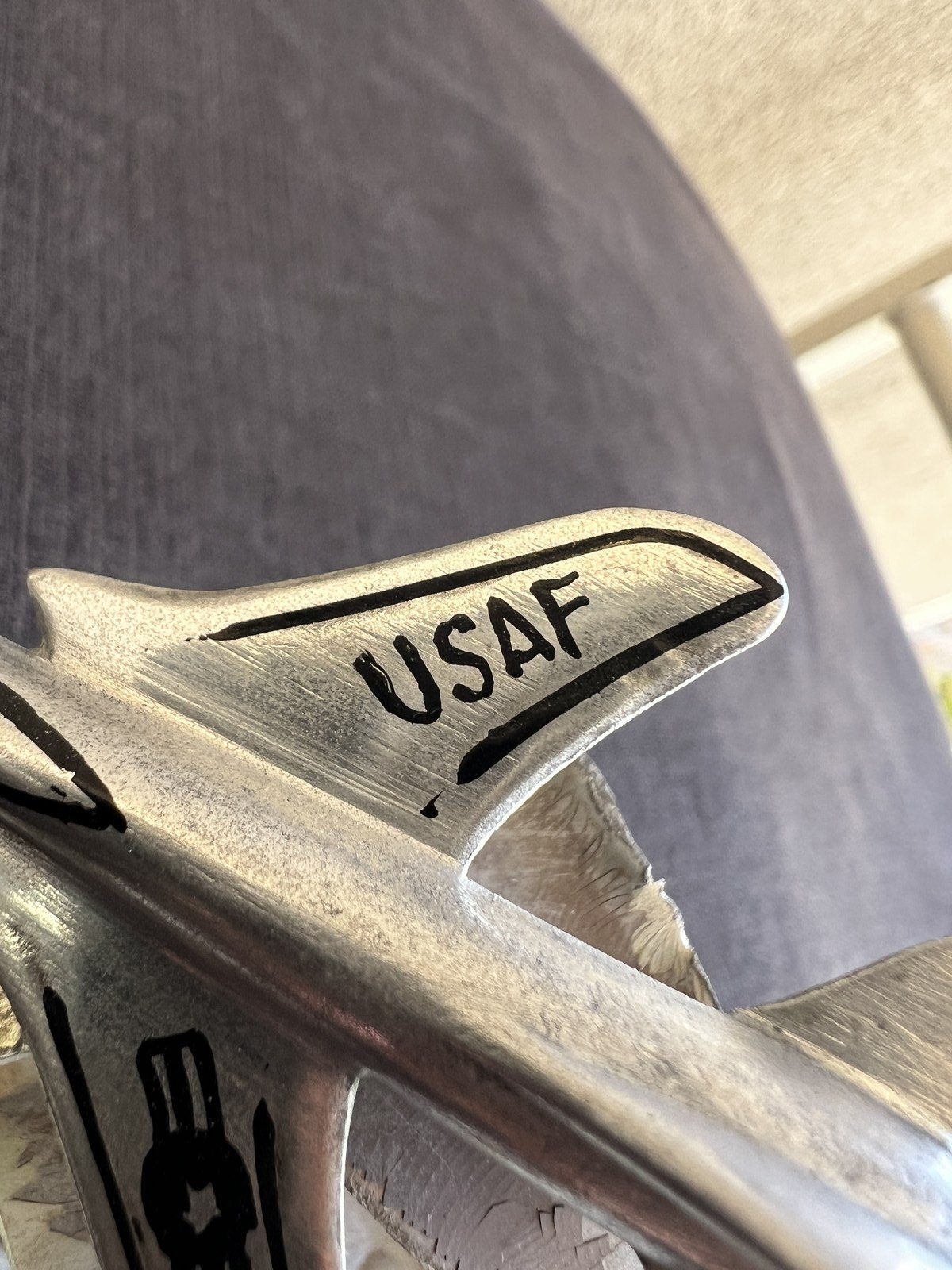
The USAF lettering applied by hand, next to the star and bar, leaves no doubt about which side the Thunderchief belonged to.
On the Vietnamese side the strategy was the opposite. The MiG-21s of the 921st regiment were few, fewer than a hundred in 1968, and their pilots were under the constant control of ground radar. The doctrine was Soviet: the pilot is only a firing platform, the ground controller guides him to the target. The MiGs attacked in a dive from behind, in pairs, out of the sun where possible, fired their missiles, and dived for the safety of their own anti-aircraft defences before the escorting Phantoms could react. The method worked. In December 1966, those same MiG-21s of the 921st claimed fourteen F-105s shot down without a single loss. For Bean’s 388ᵗʰ TFW, 1967 and the start of 1968 were a bloodletting. The loss of their second in operational command on 3 January 1968 was its most visible illustration.
MiG-21PF of the 921st Sao Đỏ (Red Star) regiment, the elite VPAF unit based at Phúc Yên and later Noi Bai, equipped and trained by the USSR. Source: Lyon Air Museum
And then, behind all of this, there was the Soviet presence. The USSR was not officially fighting, but it supplied absolutely everything: the MiG-21s themselves (an aircraft barely off the Mikoyan production lines), the R-3S Atoll missiles, the S-75 air defence radars (the famous SA-2s that would bring down so many Thunderchiefs), the pilot training missions at Krasnodar, and a permanent technical staff on site. Hundreds of Soviet specialists, engineers, mechanics, missile instructors, lived in North Vietnam for the whole duration of the war. It was to one of them, or to one of their superiors, that the sculpture we are concerned with was handed over in 1968.
What the plate says
The name Nguyen, alone on the polished plate, is probably the signature of the Vietnamese pilot credited with the kill. In the VPAF of the period it was one of the most common surnames: Nguyễn is to the Vietnamese what Smith is to the British. The context, though, is more precise: a MiG-21 against an F-105D, in 1968, striking an aircraft of the 388ᵗʰ TFW. Only one pilot named Nguyễn flew MiG-21s that year with a score that would justify a commemorative sculpture intended for an allied dignitary: the top ace of the war, Nguyễn Văn Cốc.
The plate screwed to the front of the base, polished to the point that only five letters still resist: Nguyen.
The act of erasing the rest of the inscription is harder to date. It probably happened later, as the object passed from hand to hand, or perhaps from the very start: Soviet-Vietnamese military cooperation was officially secret, and naming a Soviet dedicatee on a war trophy was exposing him. The polished plate is, in a sense, the missing signature of a history that no one wanted written too clearly.
James Bean returned to the United States on 14 March 1973, released under the Paris accords, after five years spent in North Vietnamese prisons, including the one American pilots nicknamed the Hanoi Hilton. He retired from the Air Force in September 1974 with the rank of colonel. He died at Coxs Creek, in his native Kentucky, on 3 January 2006, exactly thirty-eight years after the morning of his capture. Nguyễn Văn Cốc was withdrawn from combat in 1970 to train the new generation of Vietnamese pilots, one of whom, Nguyễn Đức Soát, would himself become an ace with six victories in 1972. He retired in 2002, with the rank of chief inspector of the Vietnamese People’s Air Force.
A technical detail: the stampings on the base
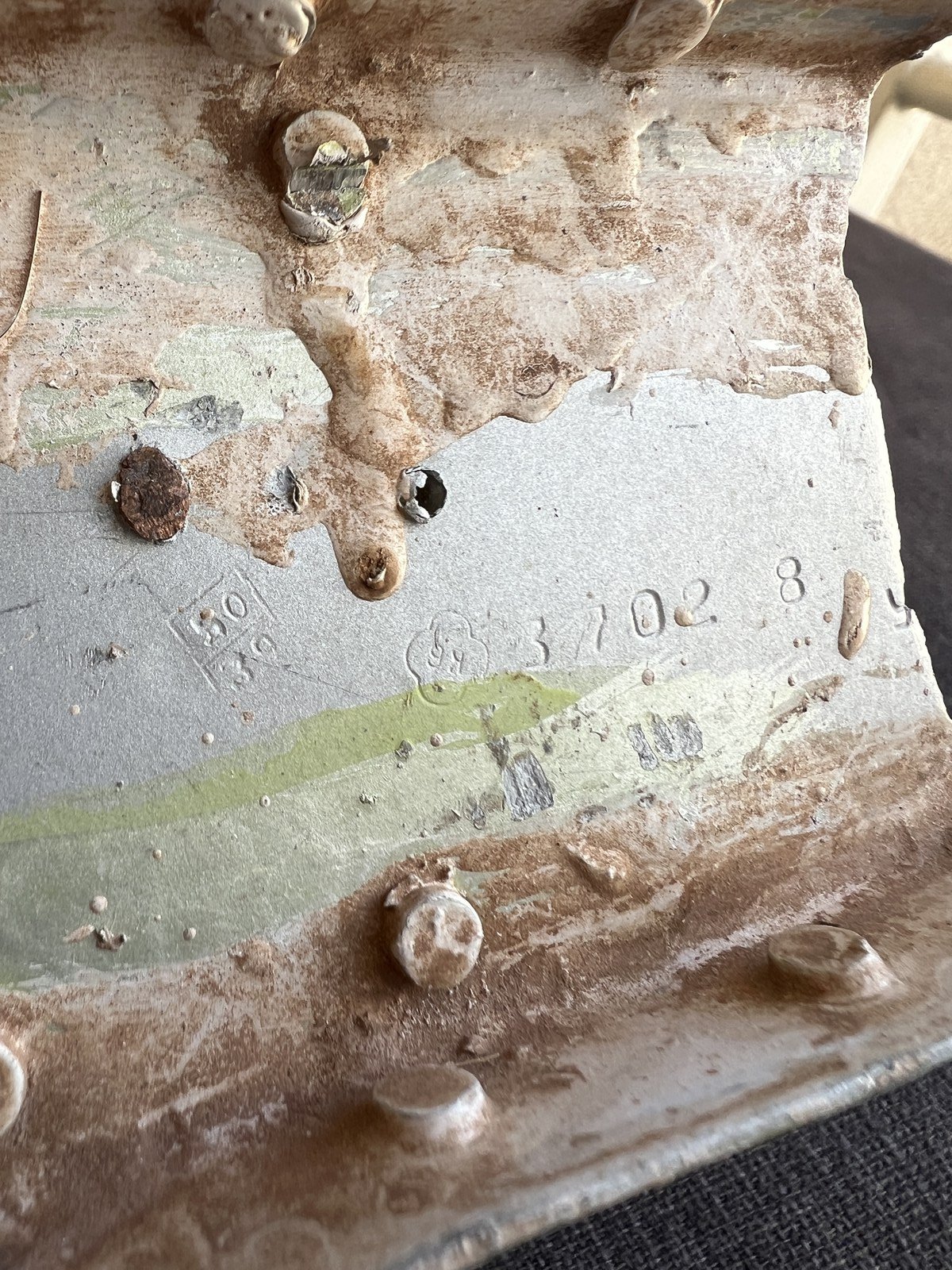
Examining the sheet-metal fragment that forms the base of the sculpture closely, one finds, almost worn away by fifty years of oxidation, a series of industrial markings stamped directly into the metal. Three elements can still be read: a square cartouche containing the figures “50/39”, a line reading “3702 8”, and a cross-shaped stamp bearing the number “66”. This type of marking, specific to aviation aluminium sheet, usually indicates a part drawing number, a production batch, and an inspection or year code.
A call to our readers
The aluminium fragment that serves as the base carries three stamped industrial markings, still legible despite fifty years of oxidation: a square cartouche containing “50/39”, a line reading “3702 8”, and a third, smaller stamp, in a cross-shaped cartouche, which reads “66”.
The account passed down with the object holds that it is a fragment from the fuselage of the aircraft shot down on 3 January 1968, and therefore, on our hypothesis, from the F-105D 58-1157 flown by Colonel Bean. But the question remains open: do these stampings follow the American standards of Republic Aviation, the manufacturer of the F-105D? Or the Soviet conventions used on the MiGs? The answer would shift the provenance of the metal from a hypothesis to a material certainty.
If you recognise these markings, or if you have the expertise to tie them to a specific aircraft type (Republic F-105D or 1960s Soviet MiG-21), write to us at inquiries@sovietinparis.com. Any serious lead will be added to this article and credited.
Available at Soviet in Paris
This sculpture, a fuselage fragment and two aircraft silhouettes welded onto eight centimetres by six, is currently part of our selection. It is a rare object: an individual war trophy, made in the heat of a Vietnamese workshop in 1968, presented to a member of the wide-ranging Soviet military cooperation of the period. We found it on the ground, at a flea market in the outskirts of Kharkiv, lost among a few unrelated objects. The erased plate probably protected it for five decades, making it an unremarkable item in the eyes of anyone who did not know its story. Today it resurfaces, intact, and its story with it.
The ДП-5В (DP-5V) is the field radiometer of Soviet civil defence: a green Bakelite console, a probe with a rotating gamma, beta and check-source shield, headphones and a manual that explains operation and maintenance. The one in this article served in an industrial bakery in Chișinău and was serviced in March 1991. Its owner shared his photos and documents with us, and we turned them into a tool that lets you operate it on screen, step by step.
The Moscow Games, from 19 July to 3 August 1980, boycotted by some sixty countries, produced more objects than any Soviet event: a bear cub, Misha, drawn by Viktor Chizhikov, an emblem made of running tracks, five thousand torches, watches from every factory, platinum coins, rings, tea glass holders, posters. This guide tells the story of the Games and reviews the objects, with the marks that authenticate them and the prices.
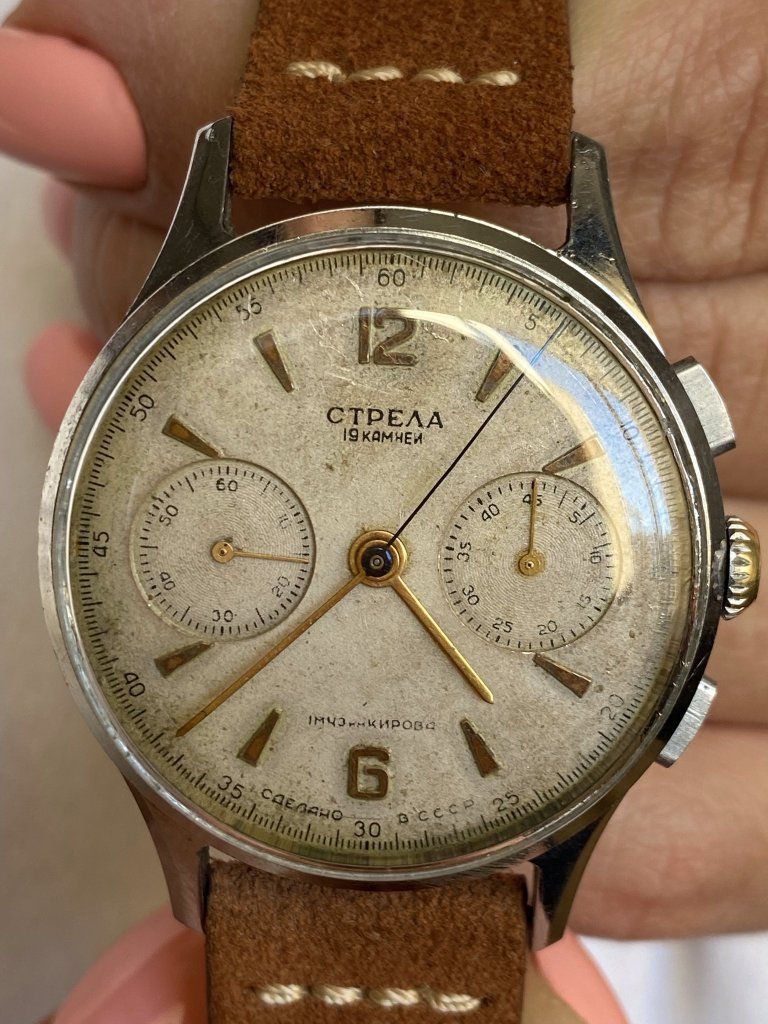
The 3017 chronograph of the First Moscow Watch Factory carries a five-digit number on the balance cock. The most common dating method reads it as a single series, from 1959 to 1979. Four factory passports show there are two, and that the same number can point to two watches made ten years apart. Here is how to read the number, the dial, the logo and the bridge, with a decoder to date your Strela, Poljot or Sekonda.
This website uses cookies to improve your experience while you navigate through the website.
Out of these cookies, the cookies that are categorised as necessary are stored on your browser as they are essential for the working of basic functionalities of the website.
We also use third-party cookies that help us analyse and understand how you use this website.
These cookies will be stored in your browser only with your consent.
You also have the option to opt out of these cookies.
But opting out of some of these cookies may affect your browsing experience.
Necessary cookies are absolutely essential for the website to function properly. This category only includes cookies that ensure basic functionalities and security features of the website. These cookies do not store any personal information.
Cookies that are not strictly necessary for the website to work and that are used specifically to collect personal data through analytics, ads and other embedded content are called non-necessary cookies. User consent is required before these cookies run on the website.
✕
Soviet in Paris
Online. We answer in person, no AI and no chatbot. Reply right away, 20 min at most.
Hello 👋 A question about an item, an order or shipping? Write to us.
Your email is used only to reply to you.
Subscribe to our newsletter and get 10% off your first order.
Subscribe
★ New pieces before anyone else
★ New blog articles
★ Soviet in Paris news and updates
Join the Party
10% off your first order
Receive your welcome card and our next arrivals.
Your code appears here and is also sent to you by email. You can leave the Party in one click, at any time.