On the night of 30 to 31 August 1935, a 29-year-old hewer cut 102 tonnes of coal in under six hours in a Donbass mine. Two weeks later his name stood for a national movement. The Stakhanovite movement gave the USSR its labour heroes, posters, sculptures and diplomas, and gave English a word still in use. This is the story of the record, how it was staged, and the objects it left behind.
NOVEMBER 2026•12 MINUTE READ
by Marwen Yahyaoui
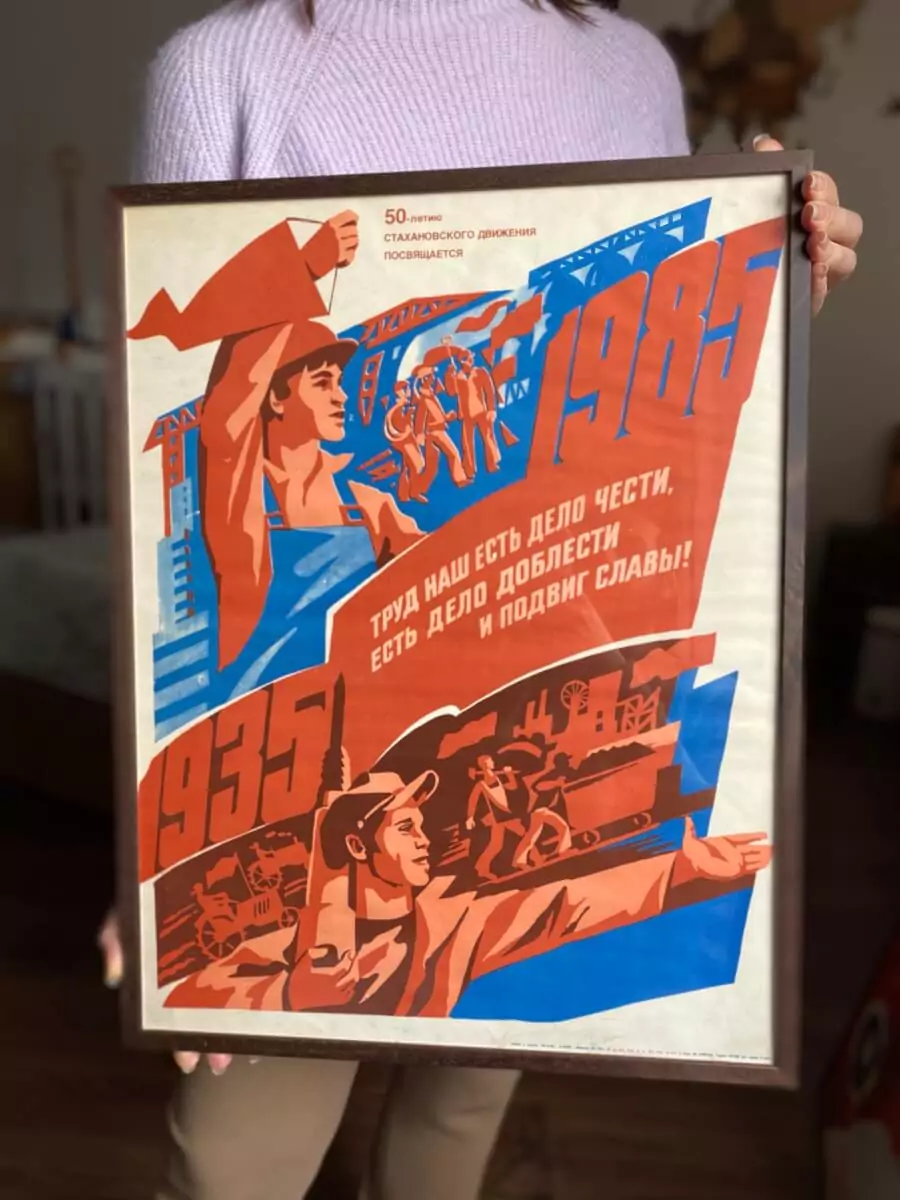
Soviet poster printed in 1984 for the fiftieth anniversary of the Stakhanovite movement.
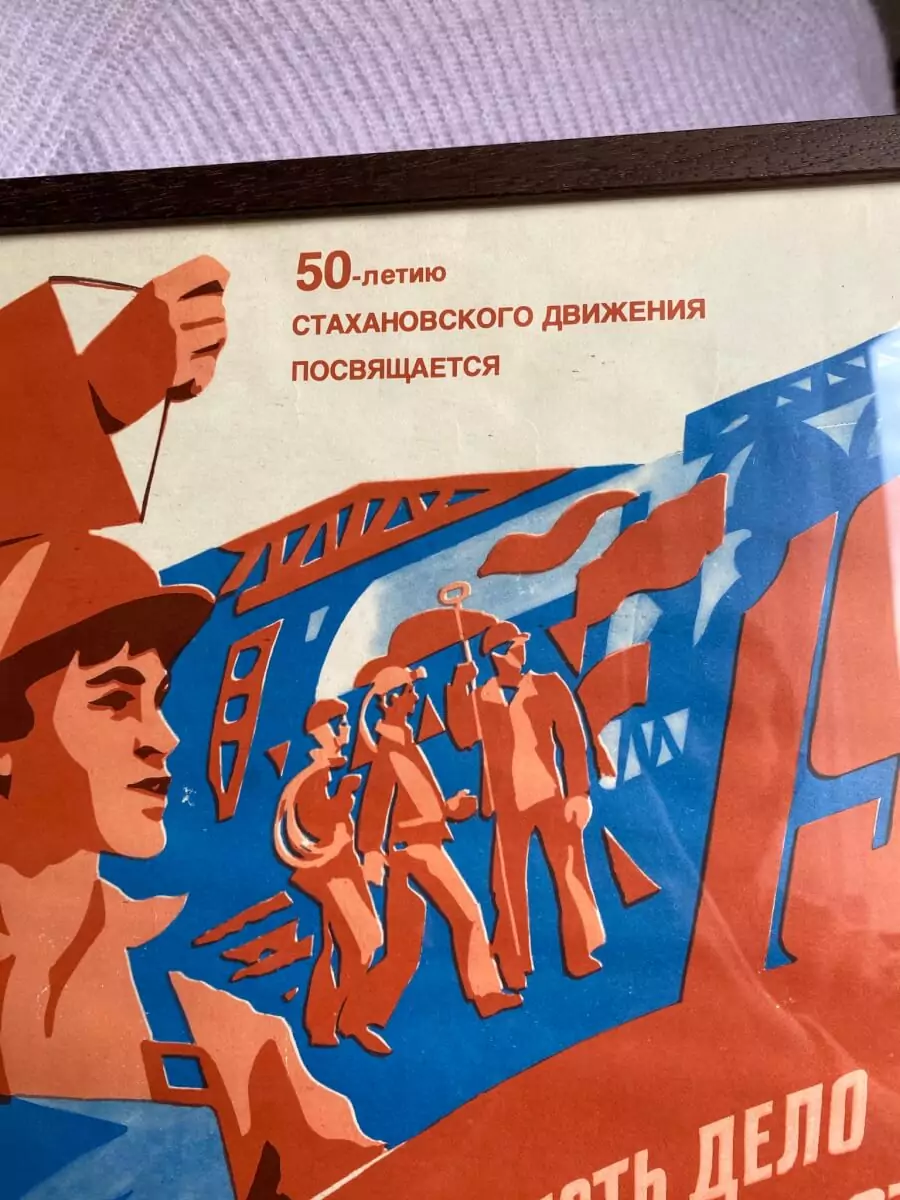
The poster above was printed in 1984 for the 1985 jubilee. At the bottom, the year 1935, a young miner and tractors. At the top, 1985 and the building sites of the day. In between, one sentence: « Труд наш есть дело чести, есть дело доблести и подвиг славы! » (Trud nash yest delo chesti, yest delo doblesti i podvig slavy), “Our labour is a matter of honour, a matter of valour and a feat of glory!”. It echoes a phrase Stalin used at the 16th Party Congress in 1930. Fifty years after the night at Irmino, the regime was still celebrating the same man, in the same words.
Stakhanovite: meaning
The Stakhanovite movement was launched in the USSR in the autumn of 1935 to reward and publicise workers who far exceeded their production norm. It takes its name from Alexei Stakhanov, a coal hewer in the Donbass. The title of Stakhanovite soon replaced that of udarnik, the “shock worker” of the first five-year plans. The word stayed in English: a Stakhanovite is someone who works with excessive zeal, usually said with some irony.
Who was Alexei Stakhanov?
Alexei Grigoryevich Stakhanov was born on 3 January 1906 (21 December 1905 in the old calendar) in the village of Lugovaya, in Oryol province. The son of poor peasants, he came in 1927 to the Центральная-Ирмино (Tsentralnaya-Irmino) mine, near Kadievka, in the Donbass coalfield. He worked first as a brakeman, then as a pit-pony driver. He later said he only meant to save enough to buy a horse and go back to his village. From 1933 he worked with a pneumatic pick, and in 1935 he took the mine’s hewer course.
The night of 30 to 31 August 1935 at Tsentralnaya-Irmino
On 30 August 1935, at 10 p.m., six men went down the mine. Stakhanov, two timbermen, Gavrila Shchigolev and Tikhon Borisenko, the section chief Nikolai Mashurov, the mine’s Party secretary Konstantin Petrov, and Mikhailov, editor of the mine newspaper, who kept the time. The date was not chosen at random: the night came before International Youth Day.
The idea was a new division of labour. Normally a hewer cut coal, then stopped to prop the roof with timber himself to prevent a collapse. That night Stakhanov only cut, and the two timbermen propped behind him. In 5 hours 45 minutes he cut 102 tonnes. A hewer’s norm was 7 tonnes per shift: the figure comes to fourteen and a half norms.
For that night Stakhanov earned 220 roubles. In March 1935, the wage census published in « Труд в СССР » (Trud v SSSR, Labour in the USSR) counted 23.2 million wage earners and a monthly wage bill of 4.1 billion roubles, about 177 roubles per person per month. One shift of Stakhanov’s was worth a little more than a month’s average wage. Applied to the average gross French salary of 2024 (€3,602, INSEE), that is about €4,500 for one night’s work. Pravda wrote 200 roubles.
The norm against the record, in one chart
Stakhanov’s record stayed the highest for only a few days. The chart below puts a hewer’s norm next to the records announced in the Donbass in the following two weeks. The “In norms” button gives the multiple of the norm, as the press presented it.
Three days after Stakhanov, Miron Dyukanov, the other candidate Petrov had in mind, cut 115 tonnes in the same mine. On 5 September, Dmitry Kontsedalov announced 125 tonnes. On 11 September Nikita Izotov, at Gorlovka, reached 240 tonnes. Izotov had been a model since 1932: Pravda had printed an article under his name called « Мой метод » (Moy metod, My method).
From Pravda to the Kremlin: how a record became a movement
On 1 September 1935 at 6 a.m., the mine’s Party committee met. It decided to put Stakhanov on the board of honour, pay him a bonus of one month’s wages, give him a furnished flat with a telephone before 3 September, two reserved seats at the club for him and his wife, and a horse-drawn carriage with a driver.
On 2 September, Pravda printed a short dispatch from its Stalino correspondent on its last page, « Рекорд забойщика Стаханова » (Rekord zaboyshchika Stakhanova, The record of hewer Stakhanov). It speaks only of “comrade Stakhanov”, with no first name. The People’s Commissar for Heavy Industry, Sergo Ordzhonikidze, had pushed the story to the paper. On 11 September, Pravda announced the Stakhanovite movement.
From 14 to 17 November 1935, the first conference of Stakhanovites in industry and transport met in the Kremlin. Delegates described their records, their methods, and what they would buy with their bonuses. On 17 November Stalin spoke the words that became the movement’s motto: « Жить стало лучше, жить стало веселее » (Zhit’ stalo luchshe, zhit’ stalo veseleye, Life has become better, life has become happier). In December 1935, Stakhanov’s portrait was on the cover of Time magazine.
A first name changed by a Pravda misprint?
A story has it that Stakhanov was really called Andrei, and that Pravda renamed him Alexei by mistake, Stalin refusing to correct the paper. No document supports it. The 2 September dispatch gives no first name, his daughter Violetta always denied it, and the Russian fact-checking site Provereno.media concluded in 2021 that the anecdote more likely belongs to Nikita Izotov, registered at birth as Nikifor.
Before the Stakhanovite, the udarnik
The movement did not come from nowhere. Since the late 1920s, socialist competition, « социалистическое соревнование » (sotsialisticheskoye sorevnovaniye), had set workers, brigades and factories against each other. Those who beat the plan received the title of « ударник » (udarnik), shock worker. By the mid-1930s, 20 to 30% of industrial workers officially held that title.
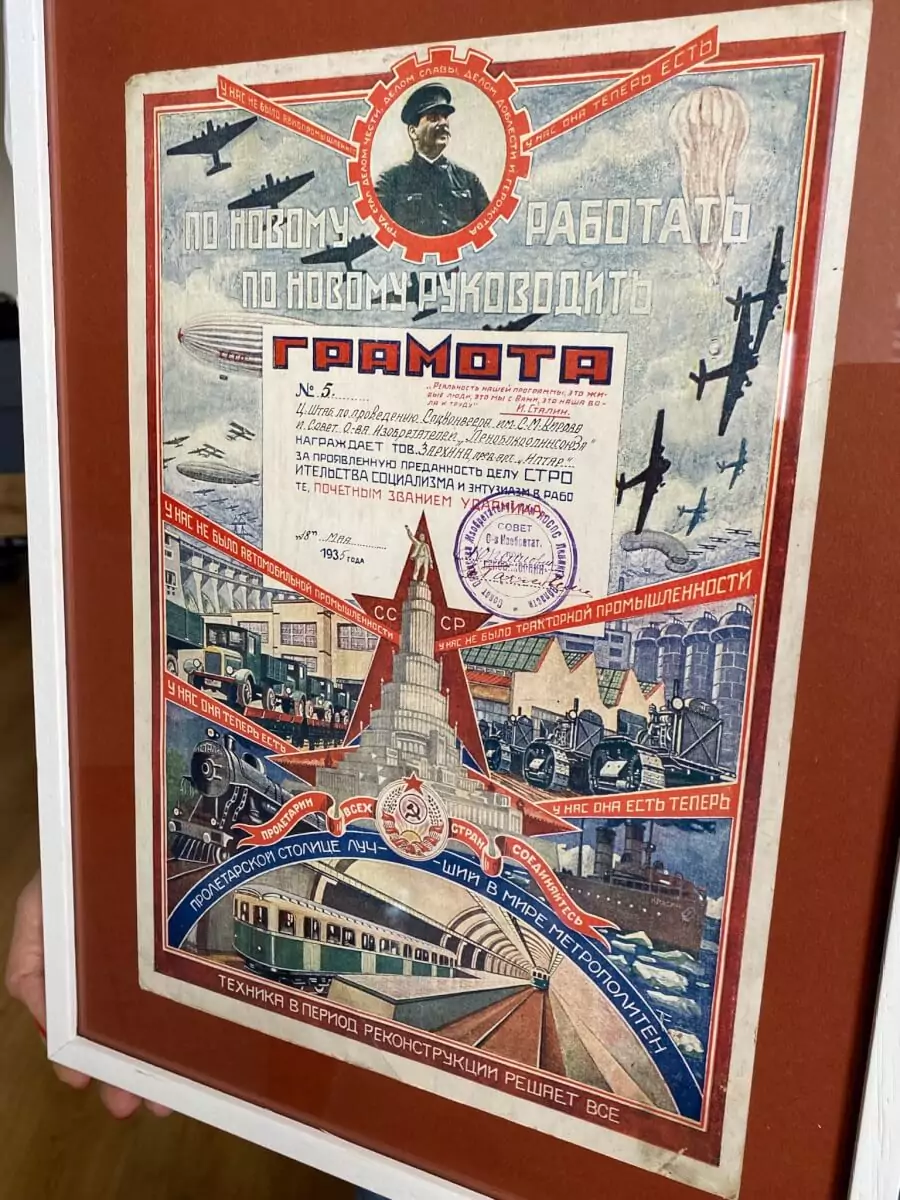
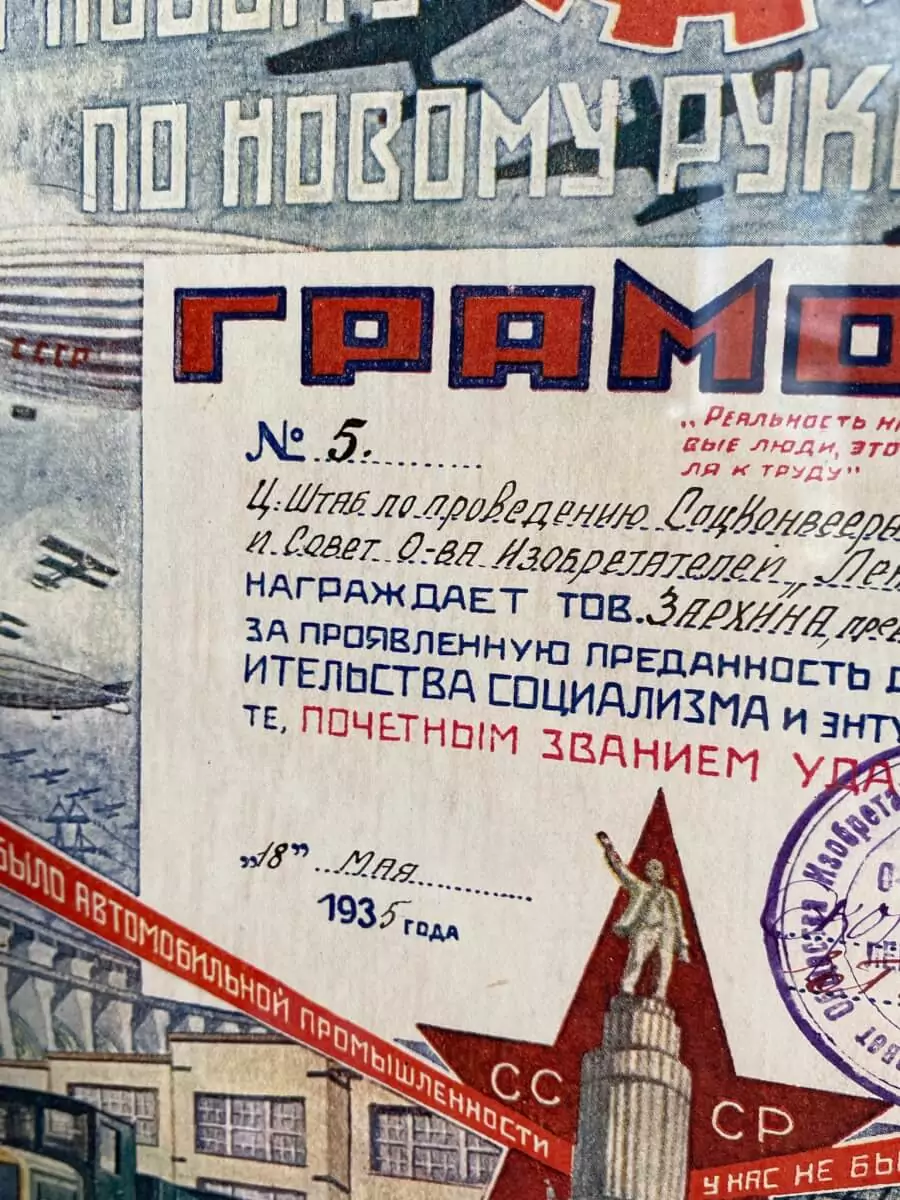
This diploma, which passed through Soviet in Paris, is a direct witness. It is a « грамота » (gramota) awarding a comrade the “honorary title of udarnik”. It is dated 18 May 1935, three and a half months before the night at Irmino. The picture sums up the promises of the second five-year plan: airships, bombers, the metro, a locomotive, tractor factories and, in the centre, the Palace of Soviets, the skyscraper crowned by a statue of Lenin that was never built.
Udarnik diploma of 1935, framed.
The udarnik title and the date, 18 May 1935.
Stakhanovites in other trades
Within weeks every industry had its Stakhanov. At the Gorky car plant, the smith Alexander Busygin and his brigade forged 966 crankshafts in one shift, against a norm of 675. On the railways, the engine driver Pyotr Krivonos pushed the speeds of his locomotives. In textiles, Evdokia and Maria Vinogradova ran up to 284 looms. At Mariupol, the steelmaker Makar Mazai broke his furnaces’ output records. In machine tools, Ivan Gudov claimed to have beaten his norm by 1,430%.
The countryside had its heroines: the tractor driver Pasha Angelina, Maria Demchenko and her sugar beet, and Mamlakat Nakhangova, an eleven-year-old cotton picker photographed with Stalin. The pattern was the same everywhere: a record, a photograph, a bonus, a round of meetings.
What the record hid
The record was prepared like a staged performance. Petrov picked his man from several candidates, on experience and physique. The mine director, Iosif Zaplavsky, opposed a one-off feat that would disrupt regular work. He was arrested soon afterwards and died in detention. The figure of 102 tonnes is Stakhanov’s alone: the two timbermen, without whom he would have had to stop and prop the roof, are left out of the sum.
For other workers the movement had a cost. In early 1936 production norms were raised across industry, and what had been a record became everyone’s target. The historian Lewis Siegelbaum reports that workers resented Stakhanovites, insulted them and sometimes beat them. Foremen and engineers complained of « рекордомания » (rekordomaniya), record mania, which wrecked supplies. When results fell short, they were the ones accused of sabotage. In June 1936 Ordzhonikidze still dismissed those accusations at a plenum. A year later the Great Purge reached the factories.
The figures do not tell everything either. Gudov’s parts, made without any order, sat in a warehouse. In metallurgy, work accidents rose by about 20% in 1936 compared with 1935.
The Stakhanovite movement in objects: posters, sculptures, diplomas
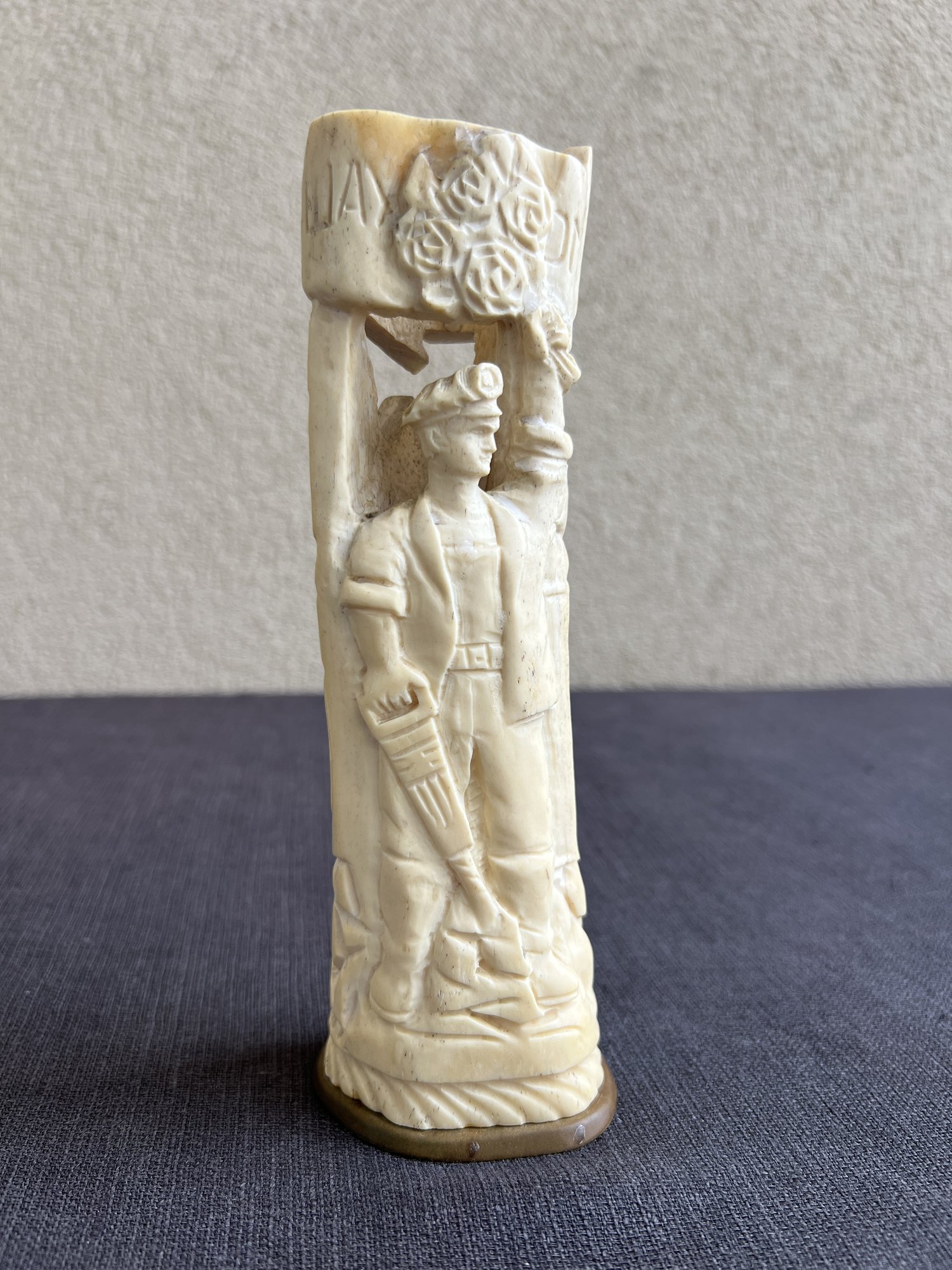
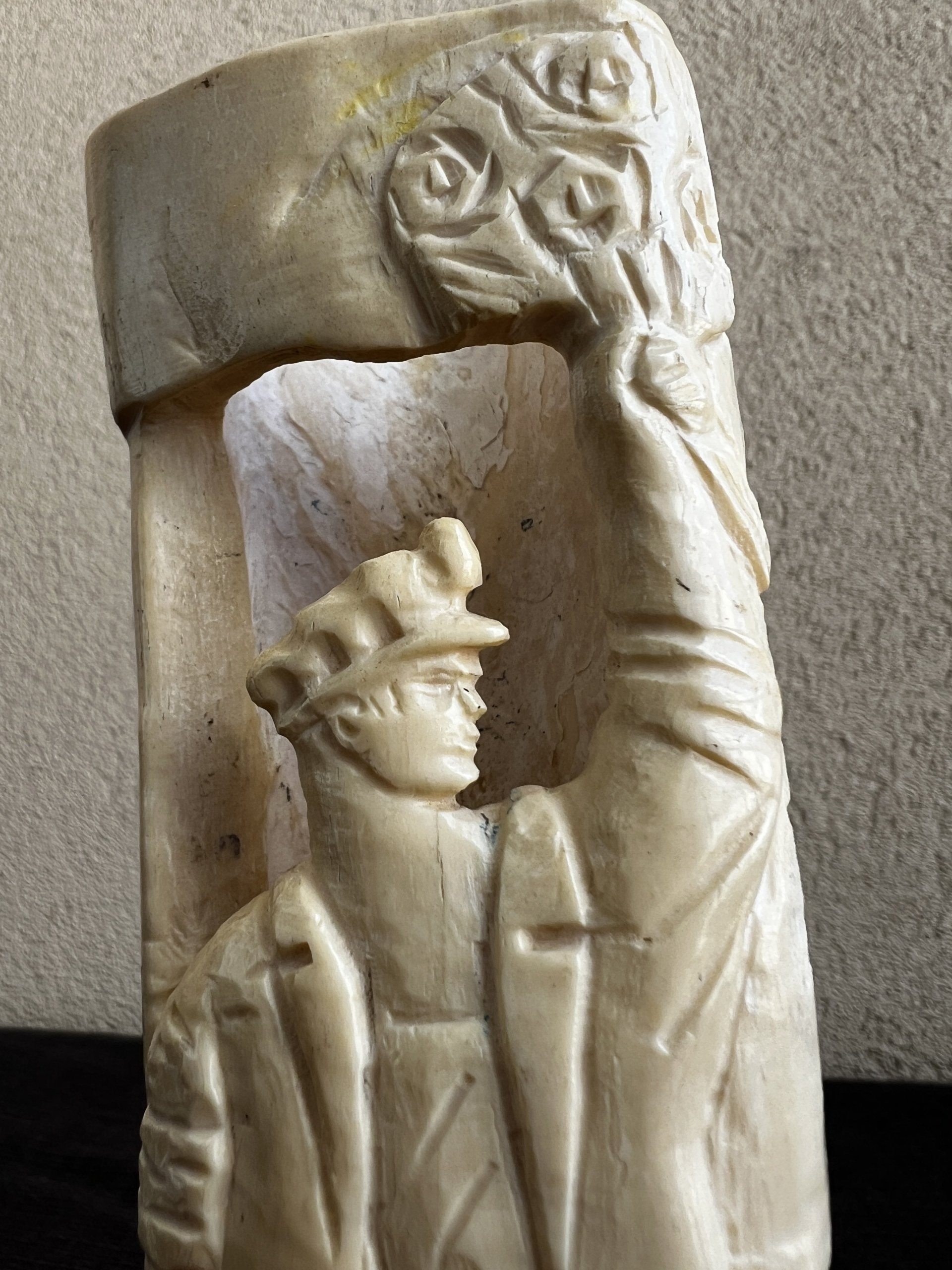
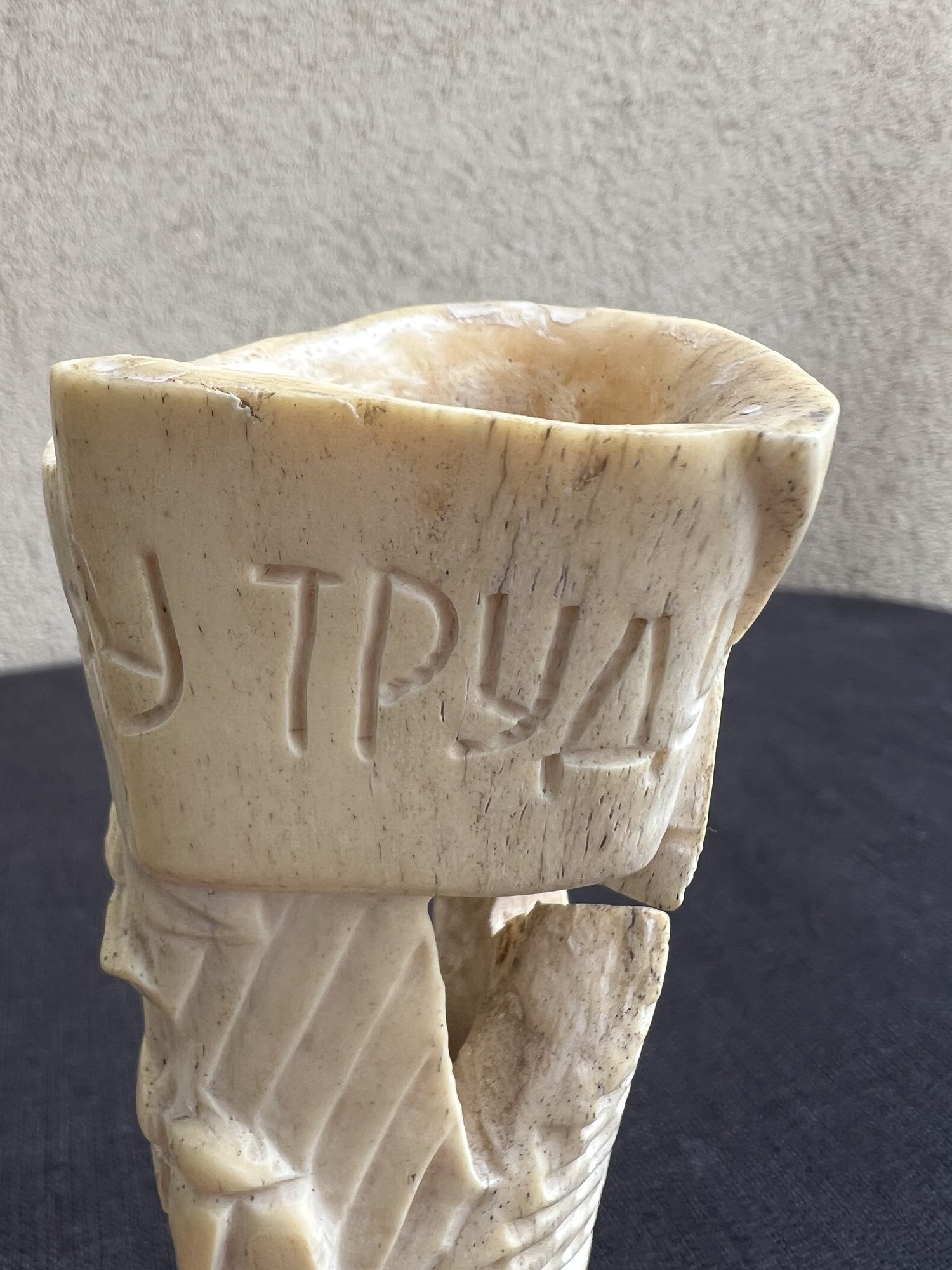
The movement produced a mass of objects, and the Donbass made the miner its emblem, down to the mine sets shown in our guide to Soviet telephones. The two sculptures below are carved from cow bone and mounted on Bakelite bases. They show an underground miner, helmet lamp and pneumatic pick, the figure of Stakhanov. On the first, the banner reads « ШАХТЁРСКОМУ ТРУДУ СЛАВА » (Shakhtyorskomu trudu slava, Glory to the miners’ labour).
Stakhanov carved in bone, Bakelite base.
Another bone carving, the miner and his tools.
The word ТРУД (trud, labour) on the banner.
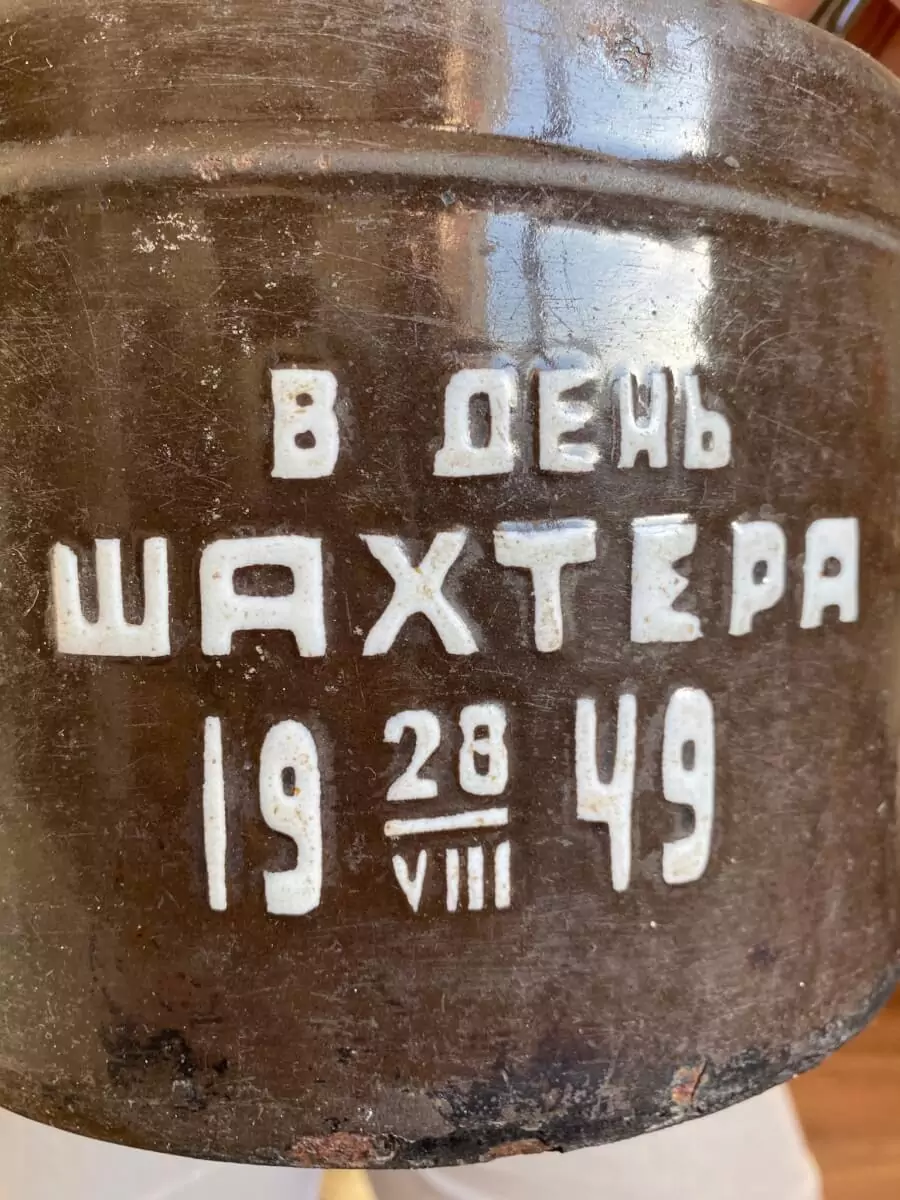
The cult of the miner also entered the calendar. On 10 September 1947 a decree created Miner’s Day, « День шахтёра » (Den’ shakhtyora), held on the last Sunday of August, a few days before the anniversary of the record. This teapot was given to a group of Donbass miners for Miner’s Day on 28 August 1949, which was indeed the last Sunday of the month.
« В день шахтёра, 28 VIII 1949 »: the Miner’s Day teapot.
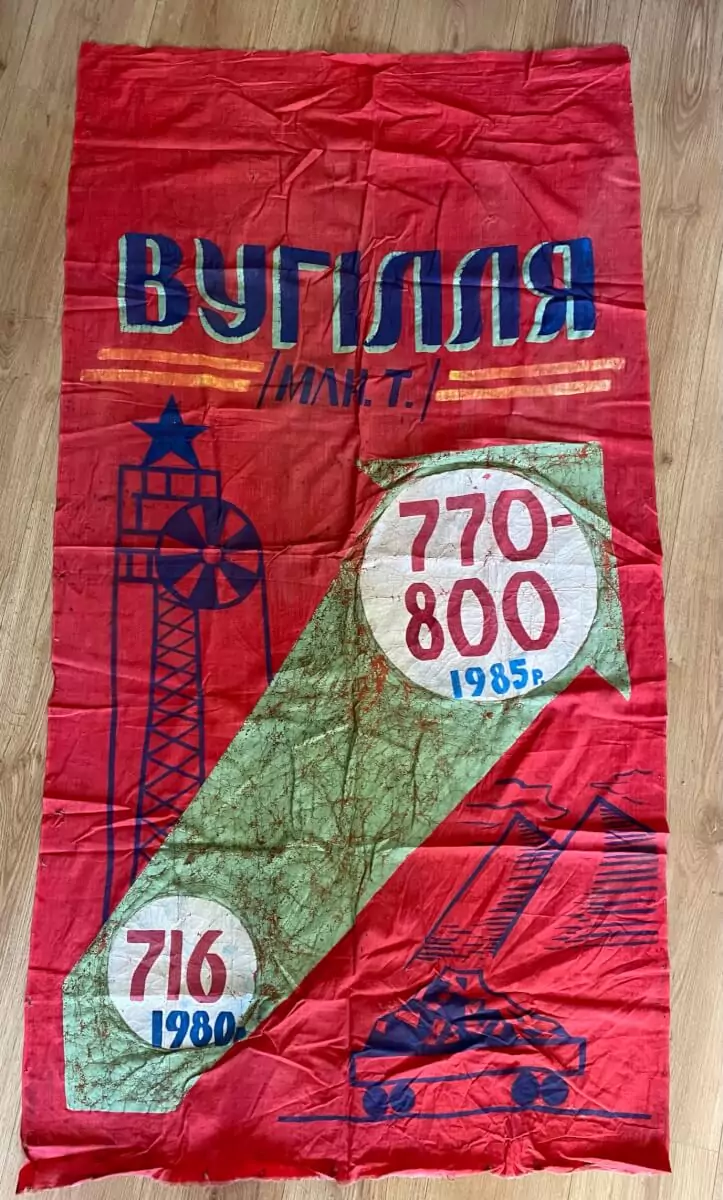
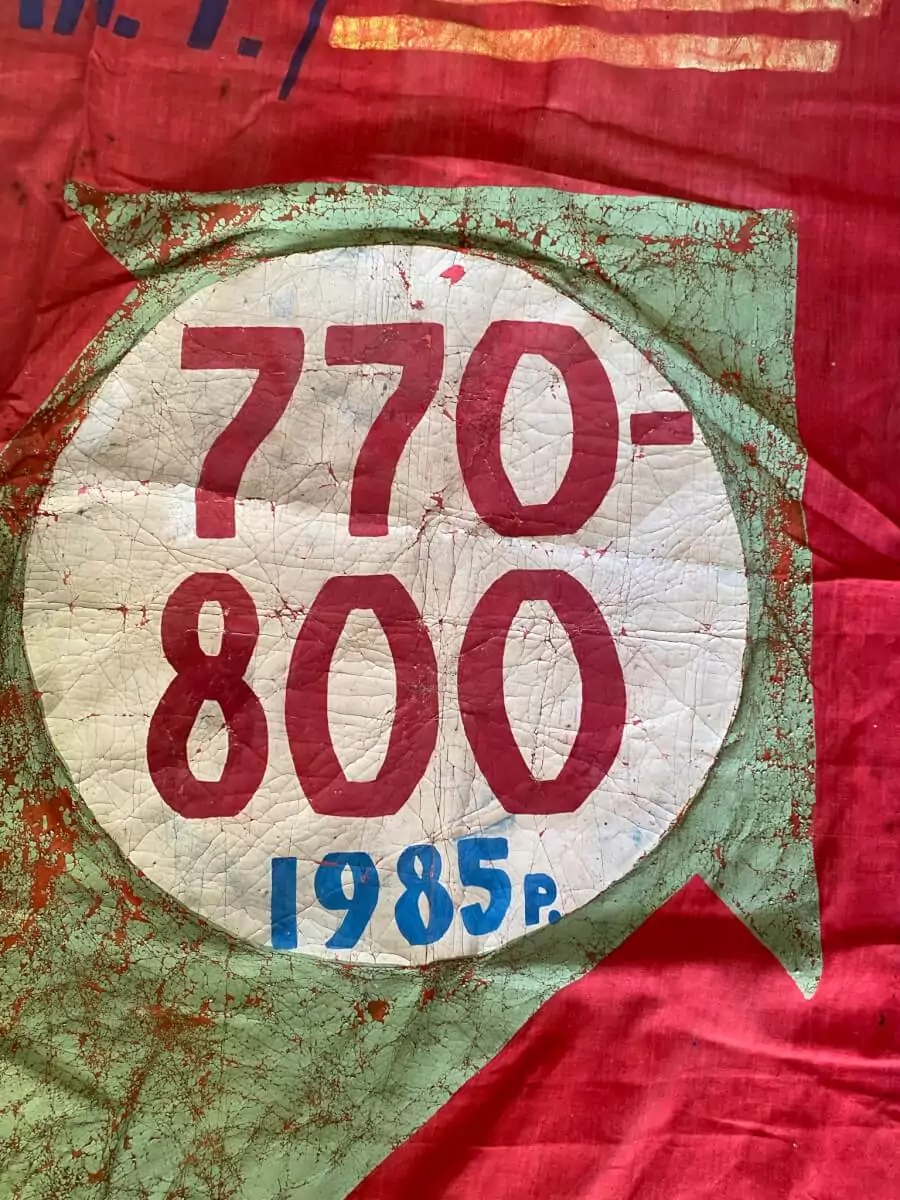
On the walls, posters followed the plan. This poster painted on cloth, in Ukrainian, gives a mine’s coal targets, « вугілля » (vuhillia, coal): 716 in 1980, 770 to 800 in 1985.
Cloth poster, the plan’s coal targets.
770 to 800 for 1985.
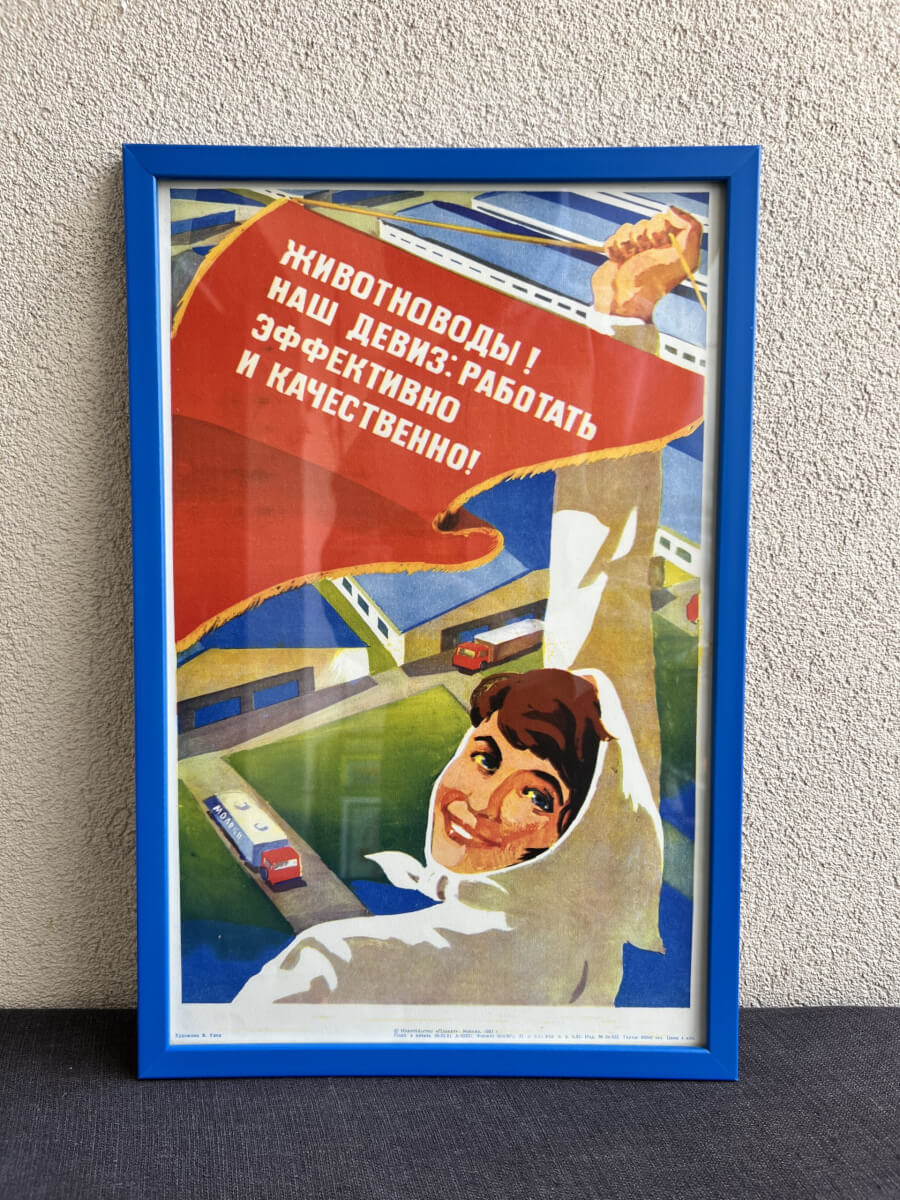
The movement’s vocabulary survived until the end of the USSR. In 1981 a series of farm posters was still called “shock unit”. To date and read a poster of this kind, the printer’s line at the bottom of the sheet gives the date, the print run and the price: we explain it in our guide to Soviet posters. The 1984 poster at the top of this article was printed in 377,538 copies.
« 50-летию стахановского движения посвящается » (Dedicated to the fiftieth anniversary of the Stakhanovite movement).
Farm poster of 1981, “shock unit” series.
After 1935: Stakhanov’s life and the town that bore his name
Stakhanov hardly ever went back underground. He joined the Party without a candidate stage in 1936, became a deputy of the Supreme Soviet in 1937, studied at the Industrial Academy in Moscow and lived in the House on the Embankment, the building of the Soviet elite. In 1941 he ran Mine No. 31 at Karaganda, then returned to Moscow in 1943, to the Ministry of the Coal Industry, in the socialist competition department.
In 1957, under Khrushchev, he was sent back to the Donbass, to Torez, where he held deputy posts. He was made a Hero of Socialist Labour on 23 September 1970 and retired in 1974. He died in Torez on 5 November 1977. On 15 February 1978, Kadievka was renamed Stakhanov. In 2016 the Ukrainian parliament gave it back the name Kadiivka.
Frequently asked questions
What does Stakhanovite mean?
It refers to the Soviet movement, launched in 1935, that rewarded workers who far exceeded their production norm. By extension, in English, a Stakhanovite is someone who works with excessive dedication.
When was Stakhanov’s record?
On the night of 30 to 31 August 1935, at the Tsentralnaya-Irmino mine in the Donbass. Pravda announced it on 2 September 1935.
How much coal did Stakhanov mine?
102 tonnes in 5 hours 45 minutes, against a norm of 7 tonnes per hewer, about fourteen norms. Two timbermen propped the roof behind him.
How is it different from Taylorism?
Taylorism organises work through time study and the division of tasks, under the authority of engineers. The Stakhanovite movement started from an individual record promoted by the Party, which other workers were called on to copy. Yet Stakhanov’s record itself rested on a division of tasks, between the hewer and the timbermen.
Was the Stakhanovite movement successful?
It served propaganda and raised the norms of every worker. Its effect on output is debated: isolated records, disrupted supplies, unwanted parts and more accidents came with it. It lasted until the war, came back afterwards, and was exported to Eastern Europe.
Available at Soviet in Paris
No Stakhanov piece is in stock today. These two pieces carry the story on, one through the socialist competition of the 1980s, the other through the miner’s trade. All our posters are in the Posters category, and other pieces in Propaganda.
The ДП-5В (DP-5V) is the field radiometer of Soviet civil defence: a green Bakelite console, a probe with a rotating gamma, beta and check-source shield, headphones and a manual that explains operation and maintenance. The one in this article served in an industrial bakery in Chișinău and was serviced in March 1991. Its owner shared his photos and documents with us, and we turned them into a tool that lets you operate it on screen, step by step.
The Moscow Games, from 19 July to 3 August 1980, boycotted by some sixty countries, produced more objects than any Soviet event: a bear cub, Misha, drawn by Viktor Chizhikov, an emblem made of running tracks, five thousand torches, watches from every factory, platinum coins, rings, tea glass holders, posters. This guide tells the story of the Games and reviews the objects, with the marks that authenticate them and the prices.
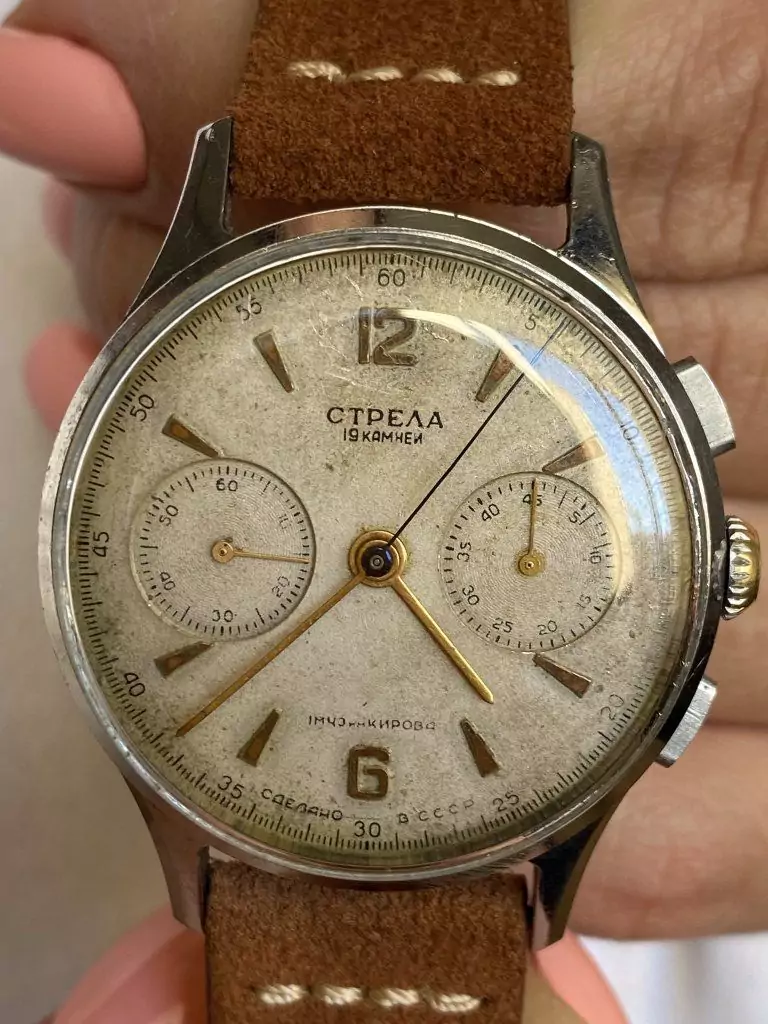
The 3017 chronograph of the First Moscow Watch Factory carries a five-digit number on the balance cock. The most common dating method reads it as a single series, from 1959 to 1979. Four factory passports show there are two, and that the same number can point to two watches made ten years apart. Here is how to read the number, the dial, the logo and the bridge, with a decoder to date your Strela, Poljot or Sekonda.
This website uses cookies to improve your experience while you navigate through the website.
Out of these cookies, the cookies that are categorised as necessary are stored on your browser as they are essential for the working of basic functionalities of the website.
We also use third-party cookies that help us analyse and understand how you use this website.
These cookies will be stored in your browser only with your consent.
You also have the option to opt out of these cookies.
But opting out of some of these cookies may affect your browsing experience.
Necessary cookies are absolutely essential for the website to function properly. This category only includes cookies that ensure basic functionalities and security features of the website. These cookies do not store any personal information.
Cookies that are not strictly necessary for the website to work and that are used specifically to collect personal data through analytics, ads and other embedded content are called non-necessary cookies. User consent is required before these cookies run on the website.
✕
Soviet in Paris
Offline right now. Leave your message and your email, we reply within 24 hours.
Hello 👋 A question about an item, an order or shipping? Write to us.
Your email is used only to reply to you.
Subscribe to our newsletter and get 10% off your first order.
Subscribe
★ New pieces before anyone else
★ New blog articles
★ Soviet in Paris news and updates
Join the Party
10% off your first order
Receive your welcome card and our next arrivals.
Your code appears here and is also sent to you by email. You can leave the Party in one click, at any time.