The Soviet chess sets found today are mass-produced objects: magnetic or peg travel sets, plastic sets from Kiev or Kishinev, pressed amber pieces from Kaliningrad, Yantar (Jantar) tournament clocks. This guide goes through them using pieces from our shop, shows the marks that date a box or a clock, standard number, price and stamps, and ends with a board on which to replay three games, including the one played in orbit in 1970.
OCTOBER 2026•12 MINUTE READ
by Marwen Yahyaoui
Pressed amber chess set from the Kaliningrad Amber Combine, on its 41 cm oak board.
The Riga chess magazine Шахматы (Shakhmaty), no. 18 of 1979, photographed with the amber set.
The editorial page: no. 18 (474), September 1979, and the table of the Riga Interzonal.
The amber set in our shop is photographed with an issue of “Шахматы” (Shakhmaty, “Chess”), the Riga chess magazine: no. 18 (474), September 1979. Its editorial page says it is published by the sports committee of the Latvian SSR and by the republic’s chess federation, twice a month since 1960, and since 1959 in Latvian. The editor-in-chief is A. Gipslis, and M. Tal sits on the editorial board as consultant. The facing page gives the table of the Riga Interzonal, played from 4 September to 1 October 1979, with Mikhail Tal on the first line.
A Soviet chess set is almost never signed. Its date is read on what comes with it: a label, a standard number, a price moulded into the plastic, a stamp under a clock. According to the Russian site Raritetus, demand for wooden sets was close to a million a year in 1968, against a production plan of 405,000. The large factories supplying state shops were in Leningrad, Vyborg and Orlov, called Khalturin in Soviet times, whose factory turned out about 60,000 sets a year.
Soviet tournament chess sets and their sizes
The Soviet club set was sold as “Турнирные” (Turnirnye, “tournament”), a name later replaced by “Гроссмейстерские” (Grossmeysterskie, “grandmaster”). Again according to Raritetus, the first-grade tournament set of the Perkhushkovo factory cost six roubles in 1967, and the same price is still printed on a set of 1985.
The collector Arlindo Vieira, quoted by Chuck Grau, sorts these sets into four styles. The first is very plain: flat crowns, a knight cut from a board, a smooth rook with no battlements. The second has bulbous bases and an onion-shaped bishop. The third, the closest to the Staunton pattern, has straight lines, a cross on the king and crisp battlements; its first examples date from the 1950s, with variants in Estonia and Georgia. The fourth is its simplified version, from the 1970s to the 1990s, with a moulded plastic knight.
Sizes vary a great deal. The Chess Museum, a private collection documented online, describes an everyday set of the early 1960s with a 94 mm king, in light wood, the black side blackened, with felted unweighted bases and king and queen finials made as separate pieces of wood slotted into a hole. It also shows a children’s set with a 62 mm king and a floor set with a 254 mm king. The diagram puts them at the same scale as the amber set in our shop.
Soviet travel chess sets: magnets, pegs and books
Magnetic travel set: the СИМЗА (Simza) mark is printed on the edge of the board.
The cardboard box of an unused set: Шахматы дорожные магнитные (Shakhmaty dorozhnye magnitnye), magnetic travel chess.
The travel set is the most common form. The magnetic sets in our shop are of the “Симза” (Simza) type, made in the 1970s in the Chelyabinsk region: a red leatherette case of 18 × 10.5 cm, a printed board, round hard plastic discs 1.5 cm across, each with a magnet under its base. The figure is moulded in relief on the disc. Two are in stock, one of them unused in its cardboard box.
Wooden travel set of the 1980s: every piece pegs into a hole in the board. Inside the lid, the State Quality Mark.
The other family holds by pegs: each piece ends in a pin that fits a hole drilled in the middle of the square. The two all-wood travel sets of the 1980s that went through our shop are of this kind, in a hinged box with the board set into one half. Raritetus reports that the pegs often broke and were replaced with a piece of matchstick.
Bakelite lid of a travel set: 1917, 1957 and Москва (Moskva).
Leningrad travel set: Misha, the bear of the Moscow Games, on the pouch.
Some peg sets date themselves. The Bakelite one of 1957 has a flag, the years 1917 and 1957 and the word “Москва” (Moskva, Moscow) moulded on its lid: it was made for the fortieth anniversary of the October Revolution. A Leningrad set has Misha, the mascot of the Moscow Games, on its green vinyl pouch: it dates from 1979 or 1980.
A peg set was used in orbit. On 9 June 1970, during the flight of Soyuz 9, Andriyan Nikolayev and Vitaly Sevastyanov played by radio against General Nikolai Kamanin and cosmonaut Viktor Gorbatko on the ground. According to the daily Moskovsky Komsomolets, the game lasted about six hours, the time of four orbits, and ended in a draw on move 35. The set had been designed by the engineer Mikhail Klevtsov, of the institute of aviation and space medicine: magnets might not have been allowed on board, so each piece had a spring-loaded pin sliding in grooves between the squares. The whole set weighed about 300 grams, and one example was given to the Museum of Cosmonautics in Moscow. The game can be replayed on the board further down.
Travel set from Kishinev: the pieces are tabs slipped into slots.
The back of the same set: Артикул МОЛД-21, Цена 80 коп. (Artikul MOLD-21, Tsena 80 kop.).
Kishinev, in Moldavia, produced in the 1970s a set that closes like a 10 × 14 cm book. The board is card and cloth, and the pieces are printed plastic tabs slipped into a slot in the square. The back carries the article number and the price: 80 kopecks.
Pressed amber chess sets from Kaliningrad
The king: flared cup and black spire, 10.1 cm.
Pawn, knight and rook of the light side.
The amber set comes from the Kaliningrad Amber Combine, at Yantarny on the Baltic. The combine extracts up to 400 tonnes of amber a year, in a region that holds about 90% of the world’s extractable amber. The pieces are not carved from blocks. Amber was ground to powder and placed in a mould; at a pressure of 1,000 atmospheres and a temperature of 180 to 220 °C the powder turned into a viscous mass, to which dyes were added to vary colour and structure. The result is called ambroid. It is 100% fossil resin and is classed as amber of reduced grade, not as an imitation. About 120,000 sets of this kind were made in the USSR; Raritetus places the start of production in Kaliningrad in the early 1980s. The process is no longer used because of its energy cost.
The board is oak, 41 × 41 × 3 cm, with its letters and figures, and the whole set weighs 2,029 g. The king stands 10.1 cm and weighs 31.6 g, the queen 9.1 cm, the knight 7.4 cm, the rook 6.2 cm, the pawn 5.1 cm. Every base is 3.6 cm across. Each piece sits on a ball-shaped body. The king has a flared cup and a spire in the opposite colour, black on the light side, pale on the brown side; the queen, a small ball in the opposite colour; the bishop ends in a point; the rook is a crenellated shaft.
Soviet chess clocks: Yantar (Jantar)
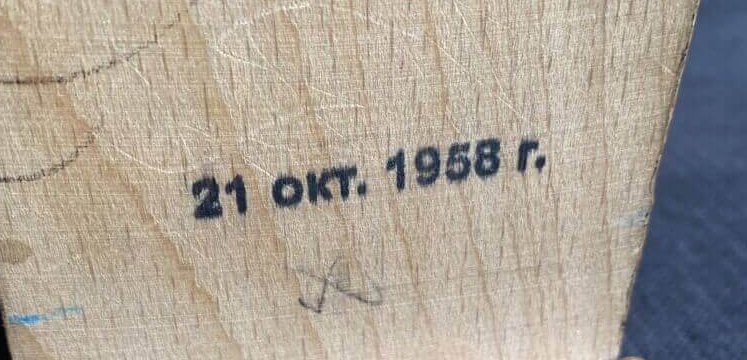
Wooden tournament clock from our shop, dated 21 October 1958 by a stamp under the base.
The chess clock was first used in competition at the London tournament of 1883. In the USSR the Second Moscow Clock Factory was making them in 1930, alongside its alarm clocks and table clocks. The Chess Museum describes the model that was, in its words, the Soviet tournament standard from the 1930s to the 1960s: a large double clock in a wooden case, very quiet, with a massive movement, the stopper in the middle and a long button travel, descended from older German clocks. It credits it to the Moscow factory and to Jantar.
The wooden clocks in our shop are of this model: wood, brass and iron, 28 × 17 × 7 cm, 1.5 kg, made in the 1950s and used in competition until the late 1960s. Each dial carries a knight standing on a chessboard and the name Янтарь (Yantar, “amber”). It is the brand of the Oryol clock factory. According to the Oryol regional library, the factory was created by a ministry order of 5 September 1950, assembled its first 8,000 alarm clocks at the end of November 1950 and went on to export to 44 countries.
Yantar clock in black Bakelite, early 1960s.
The same movement was fitted in a case of black Bakelite with grey highlights. The one in our shop was made in the early 1960s in Oryol. It measures 27 × 15 × 7 cm and weighs 1.1 kg, larger than it looks in photos, and its dial reads “Made in USSR” under the knight. This is the model seen in the series The Queen’s Gambit. Eight have gone through our shop; one is in stock.
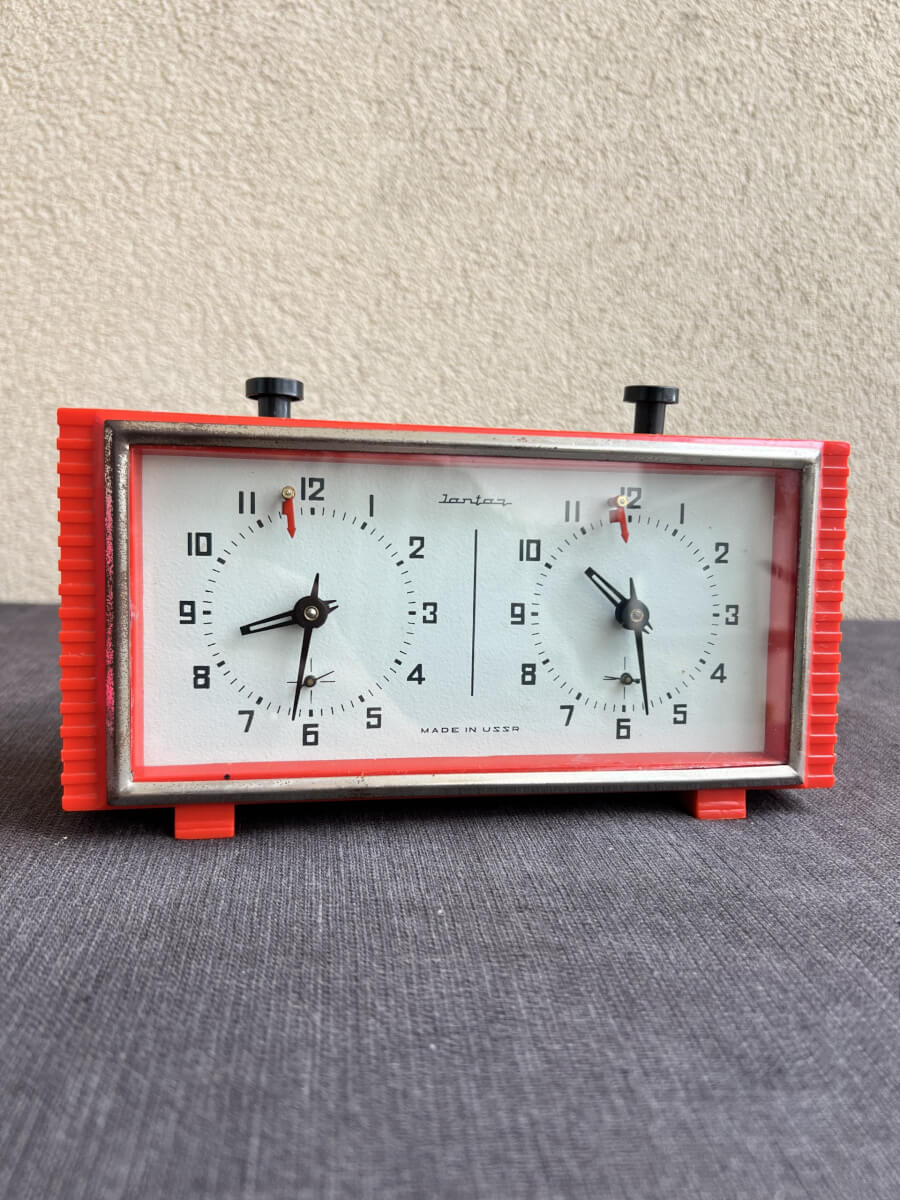
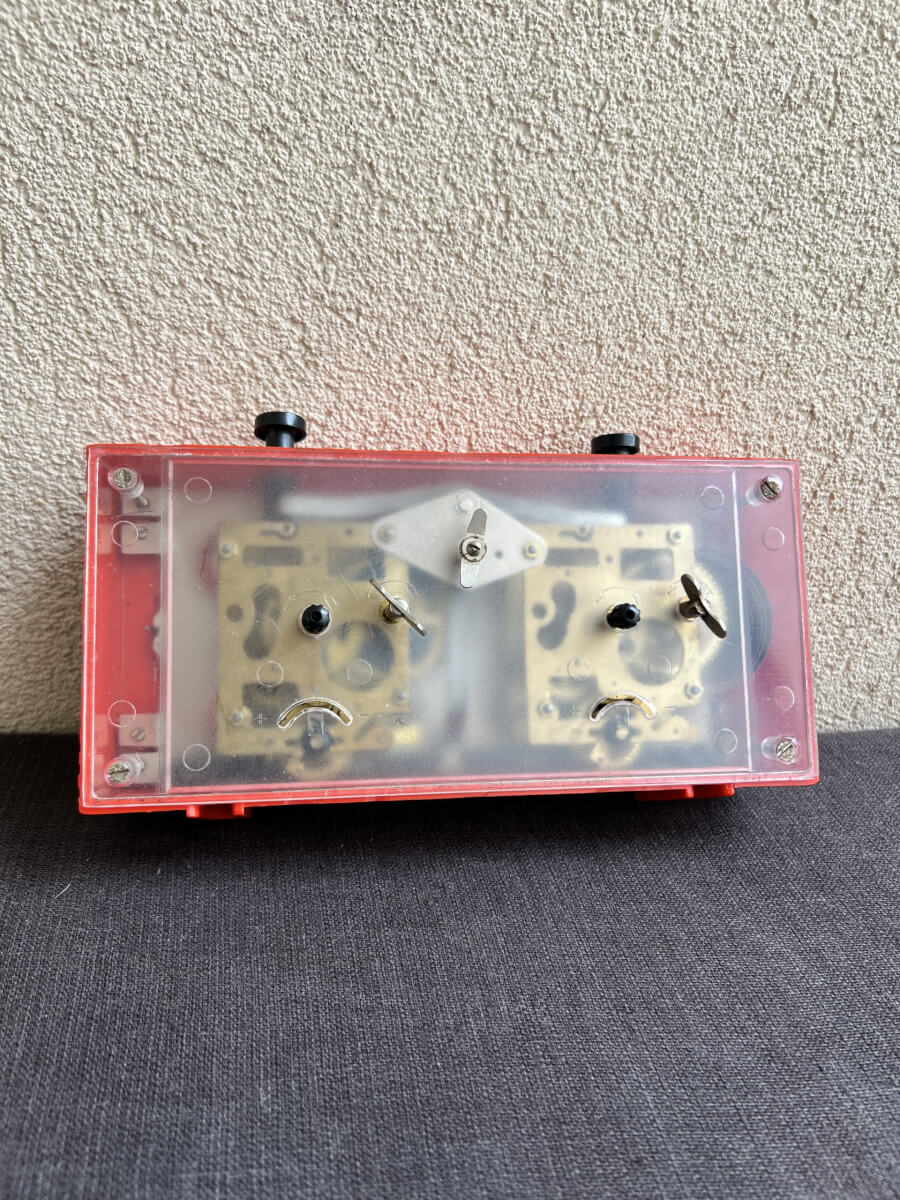
Yantar in red plastic: dial marked Jantar and Made in USSR.
The transparent back of the same clock shows both movements.
The plastic Yantar clocks of the 1970s to 1990s close the series. Their dial reads “Jantar” and “Made in USSR”. Our shop has sold examples from 1975, 1986, 1989 and 1992; there remains a 1991 clock, unused, with its box and its document, and a rare version in a red case, normally beige, whose transparent back shows both movements. Other Soviet clocks are in the Clocks category.
Replay three games, including the one played in orbit
The board replays three games move by move. The first is Mikhail Botvinnik against José Raúl Capablanca in round 11 of the AVRO tournament, Rotterdam, 22 November 1938: the future world champion beats the former one in a Nimzo-Indian Defence, after the sacrifice 30.Ba3 followed by 31.Nh5+. The second is the Soyuz 9 against Earth game of 9 June 1970. The third is game 16 of the 1985 World Championship between Anatoly Karpov and Garry Kasparov, at the Tchaikovsky Concert Hall in Moscow, where a black knight stays on d3 from move 16 to move 34.
Copies and reproductions. We found no reported copy of a travel set, an amber set or a Yantar clock. Wooden tournament sets, however, are reproduced: an Indian dealer sells a collection of “reproduced” Soviet pieces, after Latvian models of the 1950s or the 1961 Baku championship, in boxwood and rosewood. They are sold as reproductions, but may later change hands without that word. The everyday period set described by the Chess Museum is in light wood, unweighted, felted, with one side blackened.
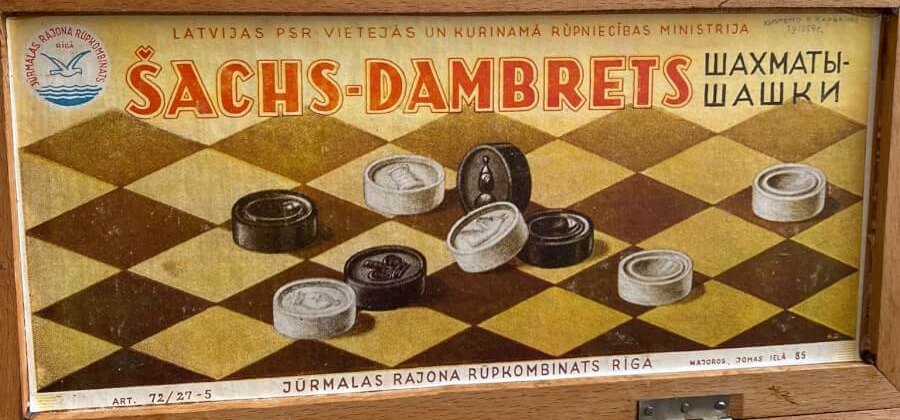
Label of a 1959 draughts and chess set from Riga: industrial combine of the Jūrmala district, article 72/27-5.
The label. When there is one, it names the maker. The label of the 1959 draughts and chess set from Riga, glued inside the lid, is bilingual: “Šachs-Dambrets” in Latvian, “Шахматы-шашки” (Shakhmaty-shashki) in Russian. It names the Latvian Ministry of Local and Fuel Industry, the industrial combine of the Jūrmala district, its address and the article number.
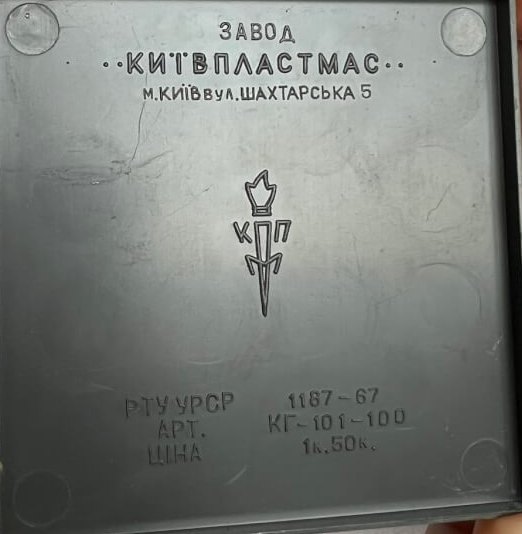
Box bottom of a pocket set from Kiev: factory, standard РТУ УРСР 1187-67, article, price 1 к. 50 к.
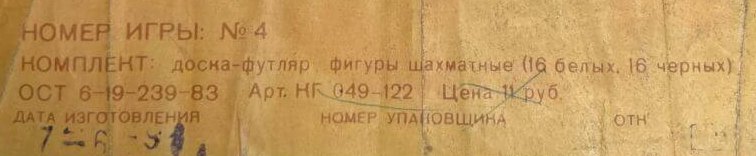
Label of a 1991 set from Kiev: standard ОСТ 6-19-239-83, article, price of 11 roubles struck out.
The standard and the price. The plastic sets from Kiev carry everything on the box. The bottom of a 1970s pocket set, marked “Шахи” (Shakhy) and “Шашки” (Shashky), chess and draughts in Ukrainian, gives the factory “Київпластмас” (Kyivplastmas), its address at 5 Shakhtarska street, the standard РТУ УРСР 1187-67 (RTU URSR), the article number and the moulded price, 1 к. 50 к. (1 k. 50 k.), one rouble fifty. The label of a 1991 set from the same factory, this time in Russian, “Киевпластмасс” (Kievplastmass), states “16 white, 16 black”, the standard ОСТ 6-19-239-83 (OST) and a price of 11 roubles, struck out in pen. The last two digits of a standard are the year it was adopted, 1967 and 1983 here: the set cannot be older. Since the monetary reform of 1 January 1961, ten old roubles equal one new rouble, which helps to place a price.
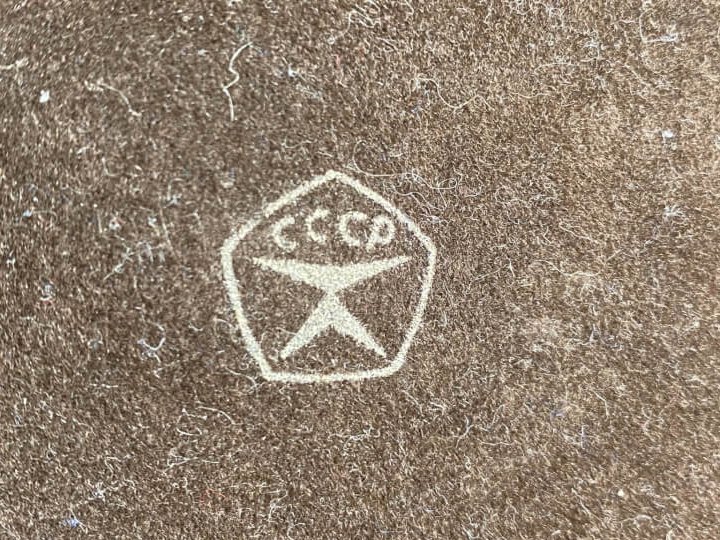
The State Quality Mark inside the lid of a wooden travel set.
The quality mark. The pentagon of the Знак качества (Znak kachestva), the State Quality Mark, was created in 1967. A set that carries it is later than that date. To read the other inscriptions, our guide to Cyrillic on a Soviet dial gives the alphabet.
Under a wooden clock: 21 окт. 1958 г. (21 okt. 1958 g.), 21 October 1958.
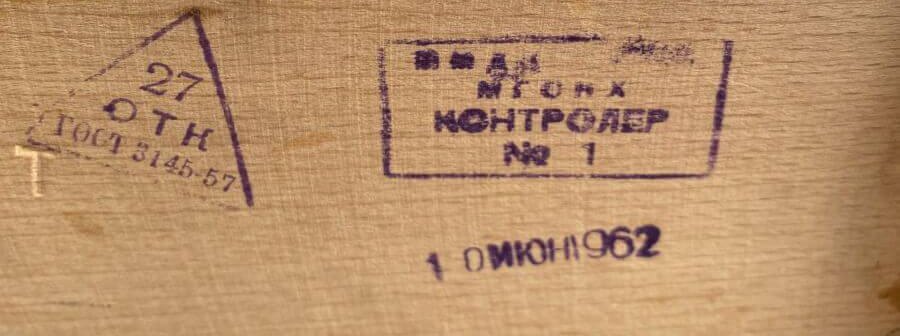
Under another: ОТК (OTK) stamp, ГОСТ 3145-57 (GOST), Контролер № 1 (Kontroler no. 1), June 1962.
The stamps on clocks. Turn a wooden clock over: the inspection date is often stamped under the base. Two clocks in our shop carry “21 окт. 1958 г.” and a date of June 1962, next to the triangular stamp of the ОТК (OTK), the factory’s technical control, and that of the inspector.
A complete set. Count 16 pieces a side, and check that the pieces of one side share the same shade and the same base. On a magnetic set every disc must hold to the board; on a peg set, look at the pins one by one. For a clock, ask whether both movements run and whether the flags fall.
As with any collector’s piece, research thoroughly, compare several examples and rely on trusted collectors’ sites and buying guides.
Our sets are in the Toys category, our tournament clocks in the Chess category.
The ДП-5В (DP-5V) is the field radiometer of Soviet civil defence: a green Bakelite console, a probe with a rotating gamma, beta and check-source shield, headphones and a manual that explains operation and maintenance. The one in this article served in an industrial bakery in Chișinău and was serviced in March 1991. Its owner shared his photos and documents with us, and we turned them into a tool that lets you operate it on screen, step by step.
The Moscow Games, from 19 July to 3 August 1980, boycotted by some sixty countries, produced more objects than any Soviet event: a bear cub, Misha, drawn by Viktor Chizhikov, an emblem made of running tracks, five thousand torches, watches from every factory, platinum coins, rings, tea glass holders, posters. This guide tells the story of the Games and reviews the objects, with the marks that authenticate them and the prices.
The 3017 chronograph of the First Moscow Watch Factory carries a five-digit number on the balance cock. The most common dating method reads it as a single series, from 1959 to 1979. Four factory passports show there are two, and that the same number can point to two watches made ten years apart. Here is how to read the number, the dial, the logo and the bridge, with a decoder to date your Strela, Poljot or Sekonda.
This website uses cookies to improve your experience while you navigate through the website.
Out of these cookies, the cookies that are categorised as necessary are stored on your browser as they are essential for the working of basic functionalities of the website.
We also use third-party cookies that help us analyse and understand how you use this website.
These cookies will be stored in your browser only with your consent.
You also have the option to opt out of these cookies.
But opting out of some of these cookies may affect your browsing experience.
Necessary cookies are absolutely essential for the website to function properly. This category only includes cookies that ensure basic functionalities and security features of the website. These cookies do not store any personal information.
Cookies that are not strictly necessary for the website to work and that are used specifically to collect personal data through analytics, ads and other embedded content are called non-necessary cookies. User consent is required before these cookies run on the website.
✕
Soviet in Paris
Offline right now. Leave your message and your email, we reply within 24 hours.
Hello 👋 A question about an item, an order or shipping? Write to us.
Your email is used only to reply to you.
Subscribe to our newsletter and get 10% off your first order.
Subscribe
★ New pieces before anyone else
★ New blog articles
★ Soviet in Paris news and updates
Join the Party
10% off your first order
Receive your welcome card and our next arrivals.
Your code appears here and is also sent to you by email. You can leave the Party in one click, at any time.







 For French and German chess clocks, see