On a two-crown Raketa 24-hour watch, the second crown does not set the time: it turns a ring placed under the crystal. The factory passport describes three versions of it, the first to time a four-hour watch at sea, the second to read the hour of a second time zone, the third to read the hour in twenty-four cities of the world. Here is how to use each of them, with three watches you can set on screen.
OCTOBER 2026•11 MINUTE READ
by Marwen Yahyaoui
Raketa 24-hour watch with the watch-shift ring, calibre 2623.Н, marked Сделано в СССР (Sdelano v SSSR, made in the USSR).
The story of these watches, from polar stations to submarines, is told in Soviet 24-hour watches. This page is only about using them: reading the dial, then using the ring driven by the second crown.
Reading the time on a 24-hour dial
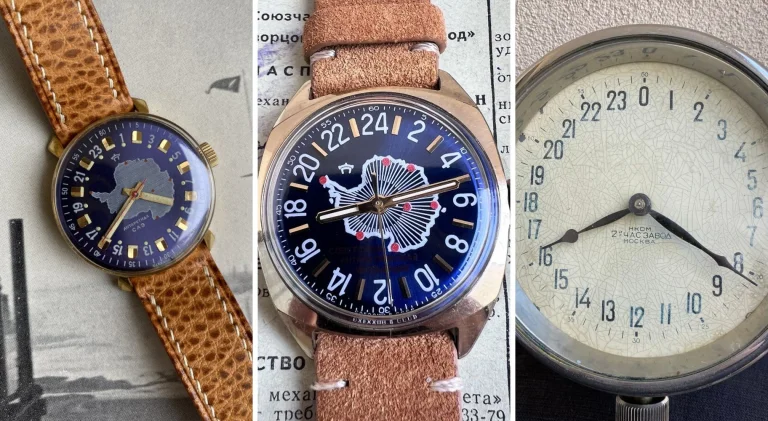
The hour hand makes one turn a day instead of two. 24 is at the top, 6 on the right, 12 at the bottom and 18 on the left. Noon is therefore read at the bottom of the dial, where an ordinary watch shows 6 o’clock. The minute hand and the seconds hand are read as on any watch.
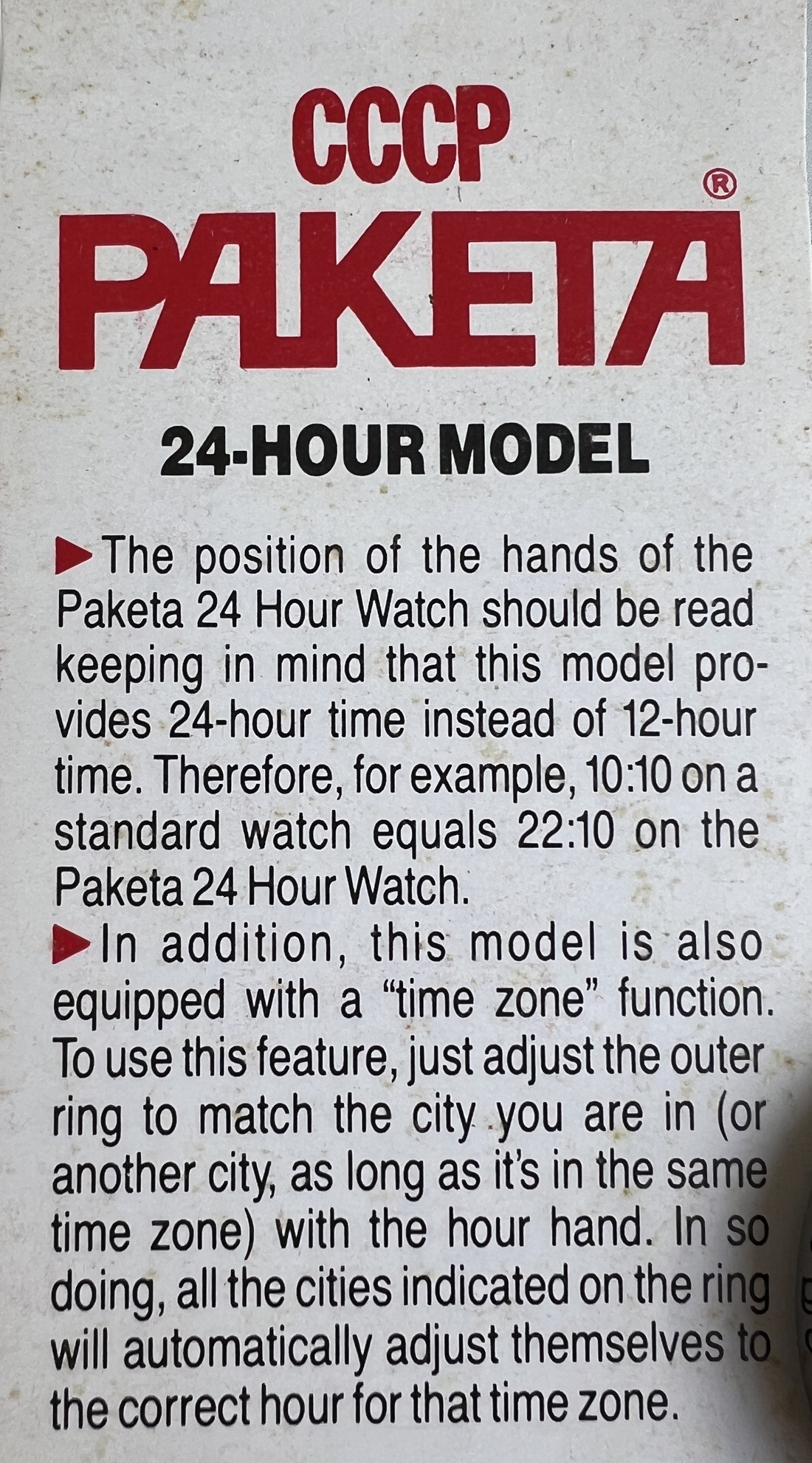
The leaflet the factory enclosed with exported watches sums it up: the 10:10 position of an ordinary watch equals 22:10 on the Raketa 24-hour watch. When setting the watch, you therefore need to know whether it is morning or afternoon. At 15:00, the hour hand points to the lower left, between 12 and 18.
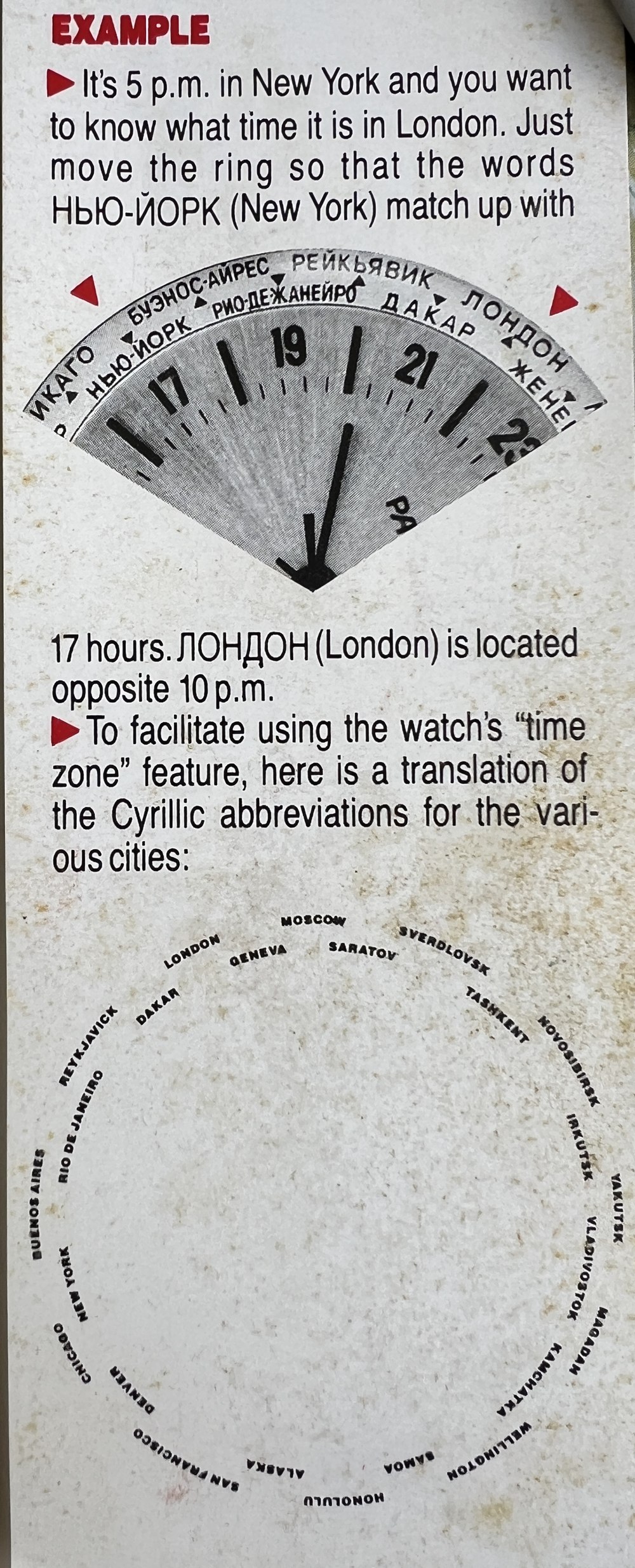
The export leaflet, headed 24-Hour Model, supplied with a Raketa Navy watch from our stock.
Depending on the model, the dial prints only the even hours, only the odd hours, or one hour in four. The others are marked by an index.
Two crowns: what the one at 4 o’clock does
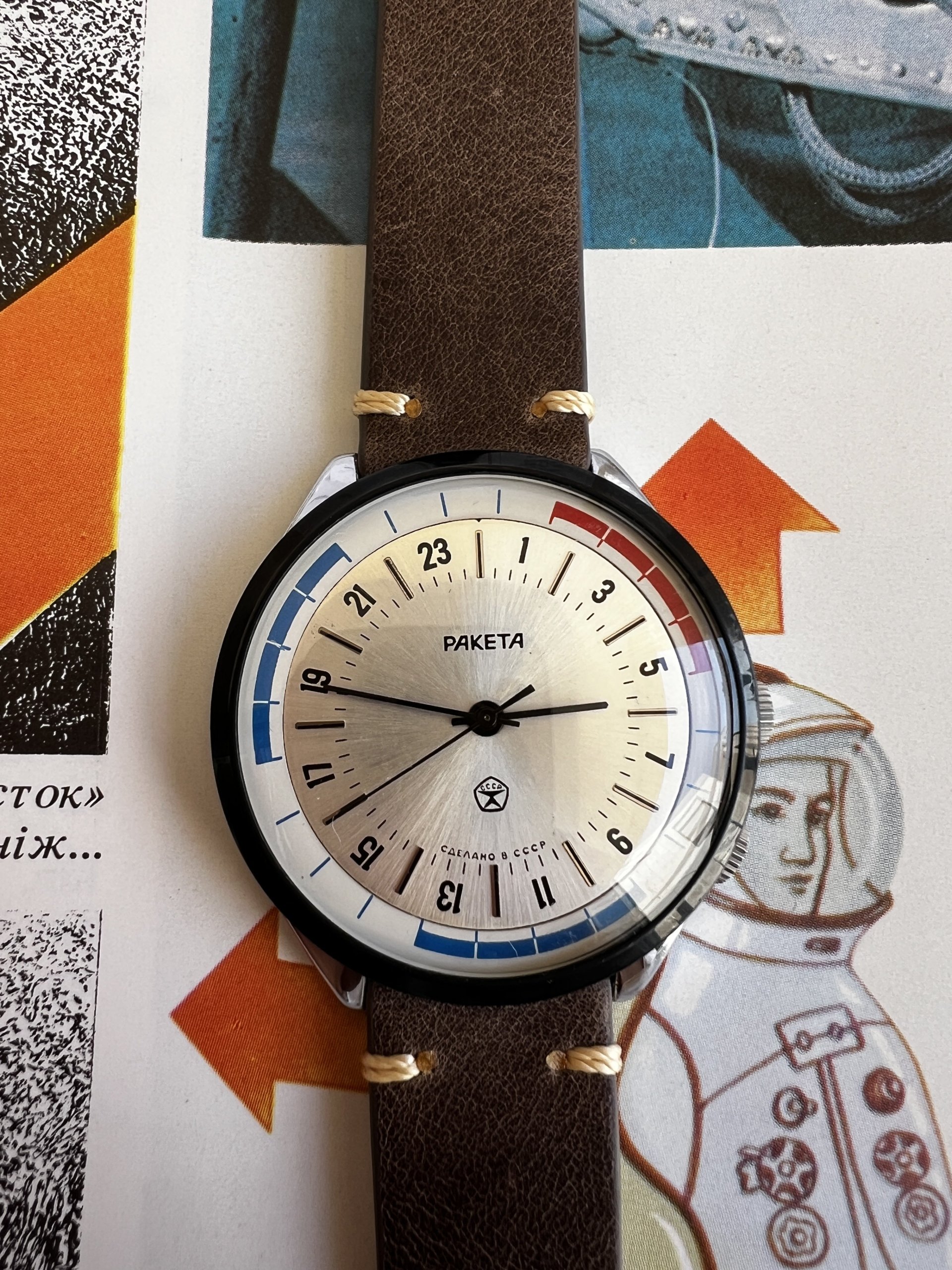
The crown at 3 o’clock winds the movement and sets the hands. The second one, placed near 4 o’clock, has no effect on the time: it turns a ring housed under the crystal, around the dial. Raketa watches with a rotating ring measure 40 mm without the crown and carry the hand-wound calibre 2623.Н.
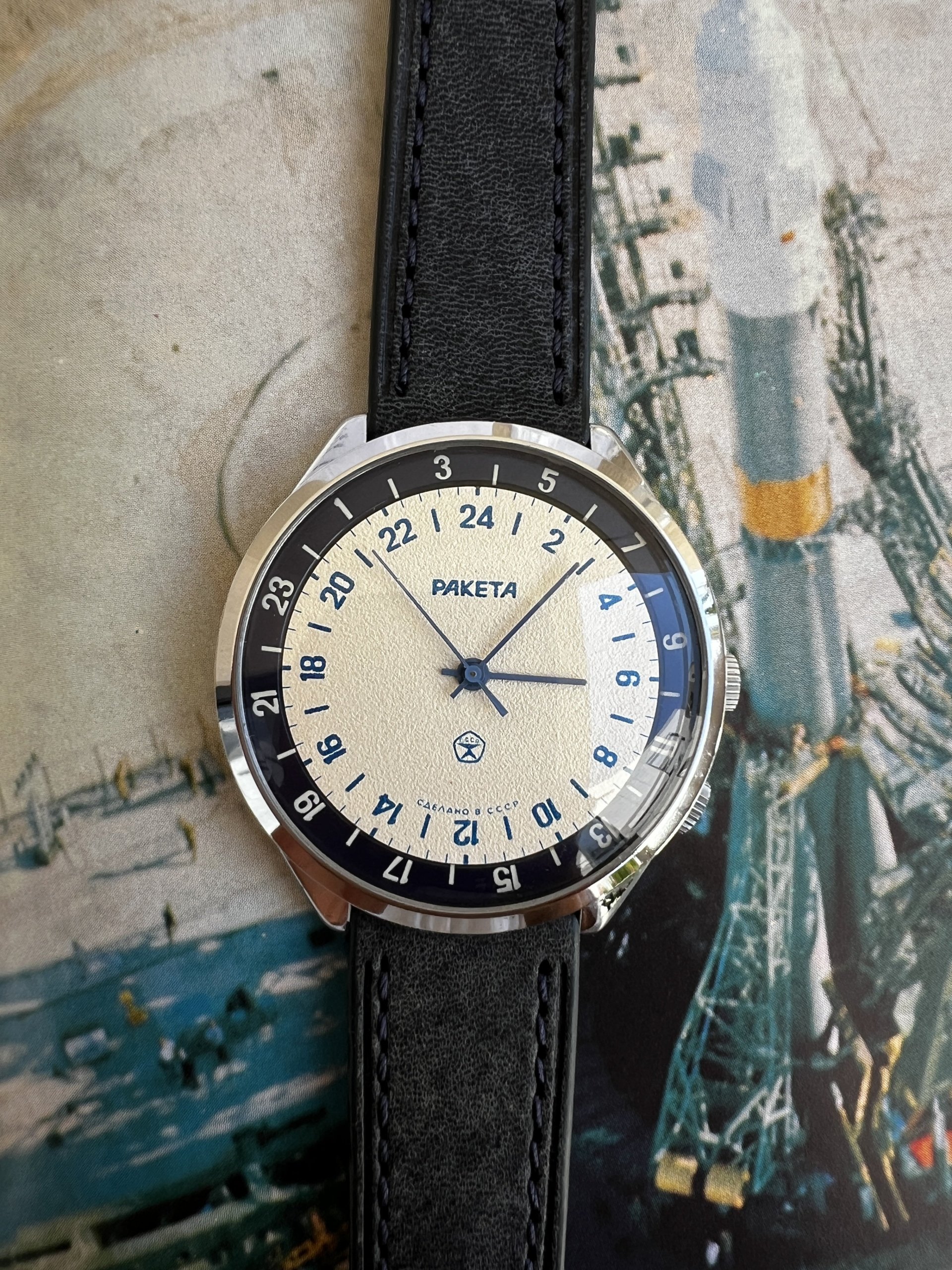
Raketa Arctic Circle: winding crown at 3 o’clock, ring crown at 4 o’clock.
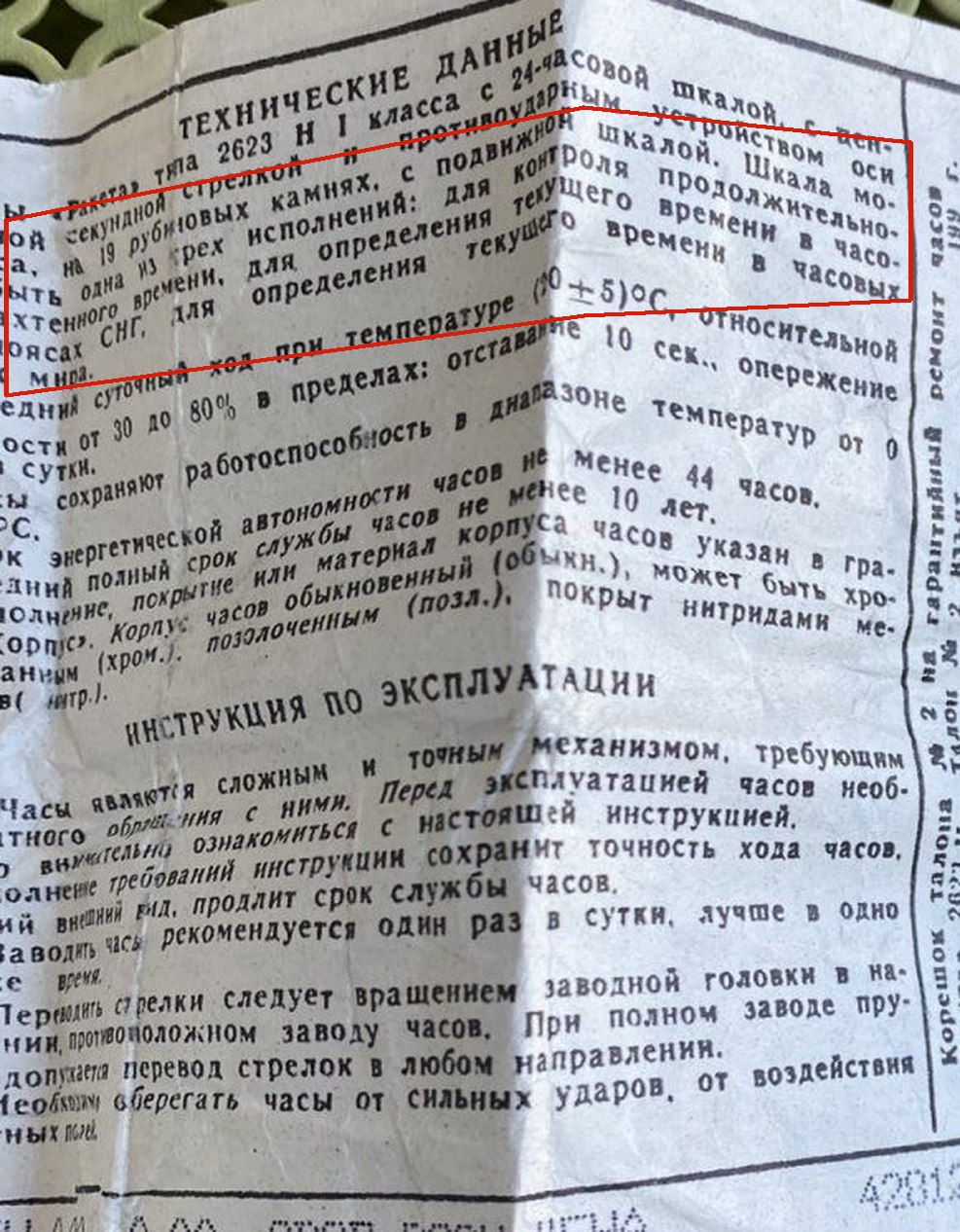
The factory passport calls this ring a «подвижная шкала» (podvizhnaya shkala, movable scale). It states that it exists in three versions: to monitor the length of a watch on duty, to tell the time in the time zones of the country, and to tell the time in the time zones of the world. On the 1993 passport reproduced here, the country is written «СНГ» (SNG), the Commonwealth of Independent States.
Passport of a Raketa 2623.Н inspected on 4 November 1993. Framed in red, the sentence listing the three versions of the movable scale.
The ring is not linked to the movement: it only moves when you turn the 4 o’clock crown. It is a scale you place by hand, then read. All three rings are turned in the same way. What changes is what you read on them. On the passports of the watches photographed for this article, the inspection dates run from 1991 to 1993.
The hours ring: a second time zone
On the Arctic Circle, the dial carries the even hours and the dark blue ring the odd hours. At rest, the ring completes the dial: its 1 falls between 24 and 2. As soon as you turn it, its numbers shift, and the hour hand shows two times at once, one on the dial and one on the ring.
Set the watch to the time of the place where you are.
Count the difference with the second time zone. Vladivostok, for example, is 7 hours ahead of Moscow.
Turn the 4 o’clock crown until the ring shows, opposite the hour hand, the hour of the second time zone.
Read both hours opposite the hand: the one on the dial and the one on the ring. The minutes are shared.
The USSR stretched across eleven time zones, and the passport intends this ring for the time in the zones of the country. Today it serves a traveller in the same way: home time on the dial, local time on the ring, or the other way round.
Gold-plated Arctic Circle with its box and its passport, inspected on 24 September 1991.
The watch-shift ring: four hours on duty
The passport intends this version for monitoring the length of the watch on duty, «вахтенного времени» (vakhtennogo vremeni). On board a ship, duty is divided into watches. According to a history of ship watches published in 2007 by the newspaper «Рыбак Приморья» (Rybak Primorya, The Primorye Fisherman), the day holds six watches of four hours. With three teams, each one stands two watches a day: 08:00 to 12:00 and 20:00 to 24:00 for the first, 12:00 to 16:00 and midnight to 04:00 for the second, the two remaining watches for the third.
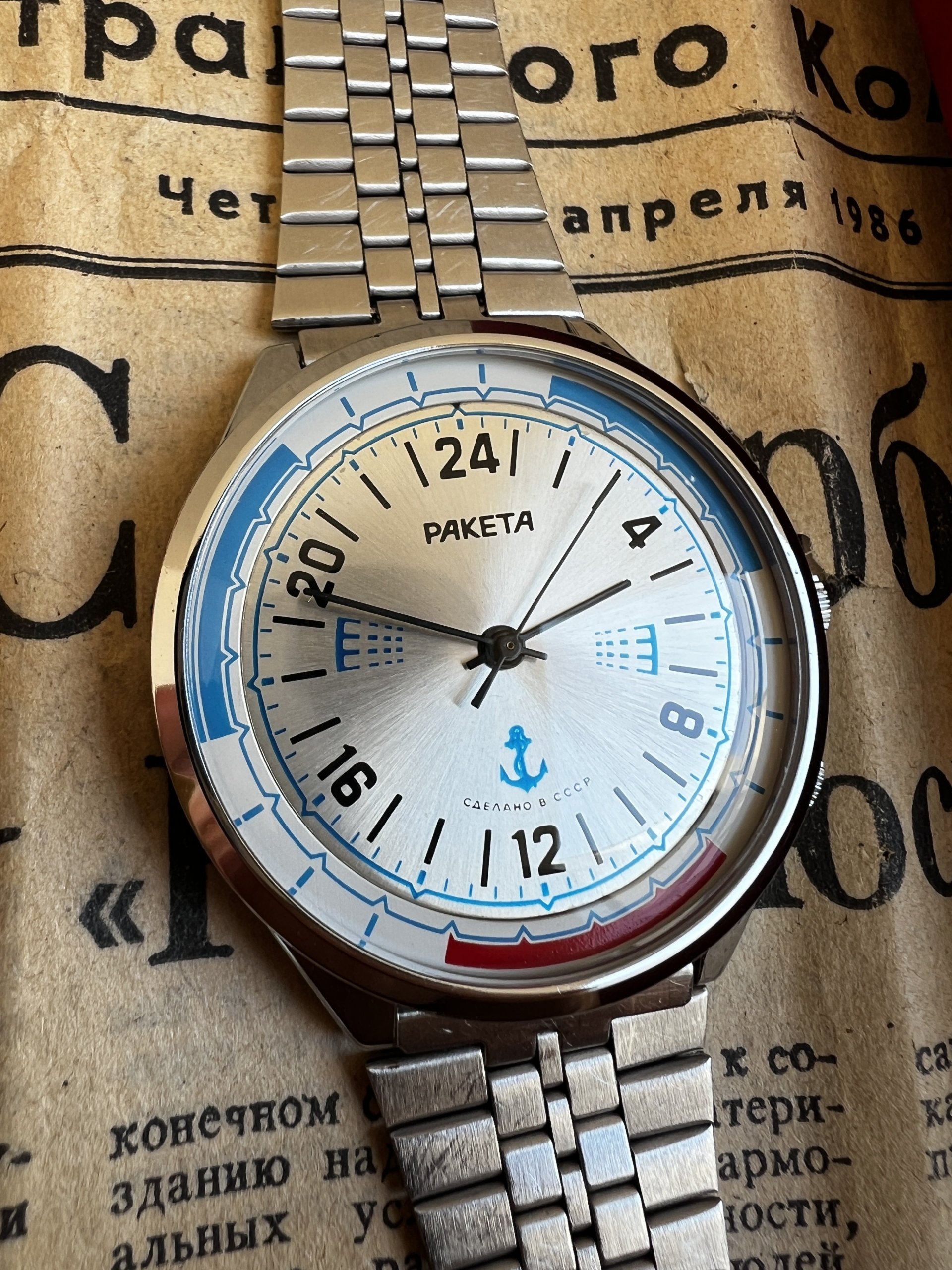
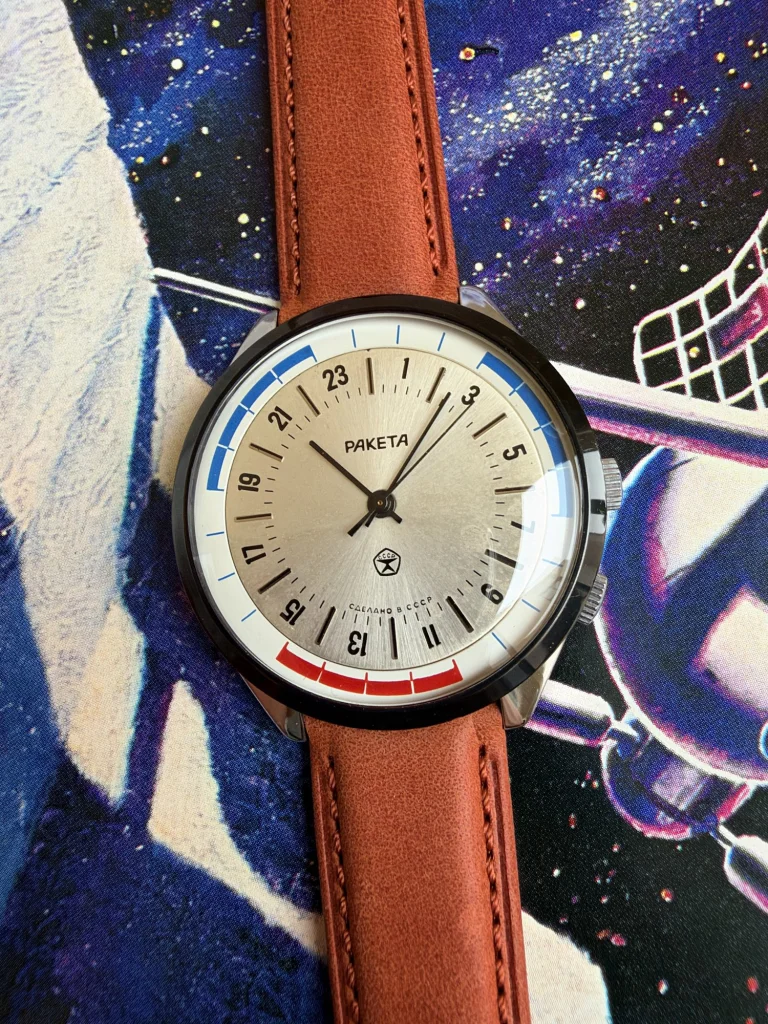
Raketa fitted two watch-shift rings. The more common one, on our Navy and submariner watches, carries three coloured sectors, two blue and one red. Each one covers four hours and is divided into four one-hour boxes. Between two sectors, a four-hour gap is marked by thin blue lines. The ring therefore cuts the 24 hours into six equal parts, every other one in colour. The other ring, on the Raketa watches of the icebreaker Sibir, has only two sectors. It is described further down, and the diagram lets you switch from one to the other.
The passport does not describe the procedure. With four-hour sectors, it follows naturally:
When you go on watch, turn the 4 o’clock crown to bring the start of a coloured sector opposite the current hour.
As long as the hour hand is moving through the sector, the watch is in progress. Each box crossed is one hour.
When the hand reaches the end of the sector, the four hours are up: it is time for the relief.
No factory document known to us explains why one of the three sectors is red. The division itself has not changed: on its current models made for submariners, Raketa still splits the edge of the dial into six parts, so that each crew member can keep track of his watches.
Raketa Navy with anchor: the dial carries only six numbers, 24, 4, 8, 12, 16 and 20, the relief hours of four-hour watches.
Two red sectors: the ring of the Raketa Sibir watches
Raketa of the nuclear icebreaker Sibir, No. 745: two red four-hour sectors, twelve hours apart. On the dial, the year 1987 and the drifting stations СП-27 and СП-29 (SP-27 and SP-29).
On the Raketa watches of the nuclear icebreaker «Сибирь» (Sibir), the ring carries only two sectors, both red. Each one covers four hours, in four boxes, and they sit twelve hours apart. The rest of the ring is marked with one blue line per hour. Four of the five Sibir watches that have passed through our shop have this ring, including No. 808. The fifth carries the three-sector ring, like the two designs on the sheet kept in the Raketa archives.
This division is that of duty on board Soviet civilian ships. The service regulations for ships of the USSR Ministry of the Merchant Marine, approved in January 1976, set the sea watches of the deck officers: the chief mate from 04:00 to 08:00 and from 16:00 to 20:00, the second mate from midnight to 04:00 and from 12:00 to 16:00, the third mate from 08:00 to 12:00 and from 20:00 to 24:00. Each of them therefore stands two four-hour watches a day, twelve hours apart, with eight hours of rest in between.
The Sibir, a civilian icebreaker based in Murmansk, belonged to that fleet. She left her port on 8 May 1987 under Captain Z. A. Vibakh to evacuate the drifting station СП-27 (SP-27) and set up СП-29 (SP-29), and reached the geographic North Pole on 25 May. The rhythm has not changed since: on board the nuclear icebreaker Yamal, most crew members stand four hours of watch followed by eight hours of rest, wrote «Страна Росатом» (Strana Rosatom), the newspaper of the Rosatom group, in 2023.
In all likelihood, the two red sectors therefore mark the two daily watches of one sailor: bring one sector to the hour of your watch, and the other falls twelve hours later. The three-sector ring, one watch every eight hours, would rather match duty in two teams, four hours on watch then four hours of rest.
The cities ring: twenty-four time zones
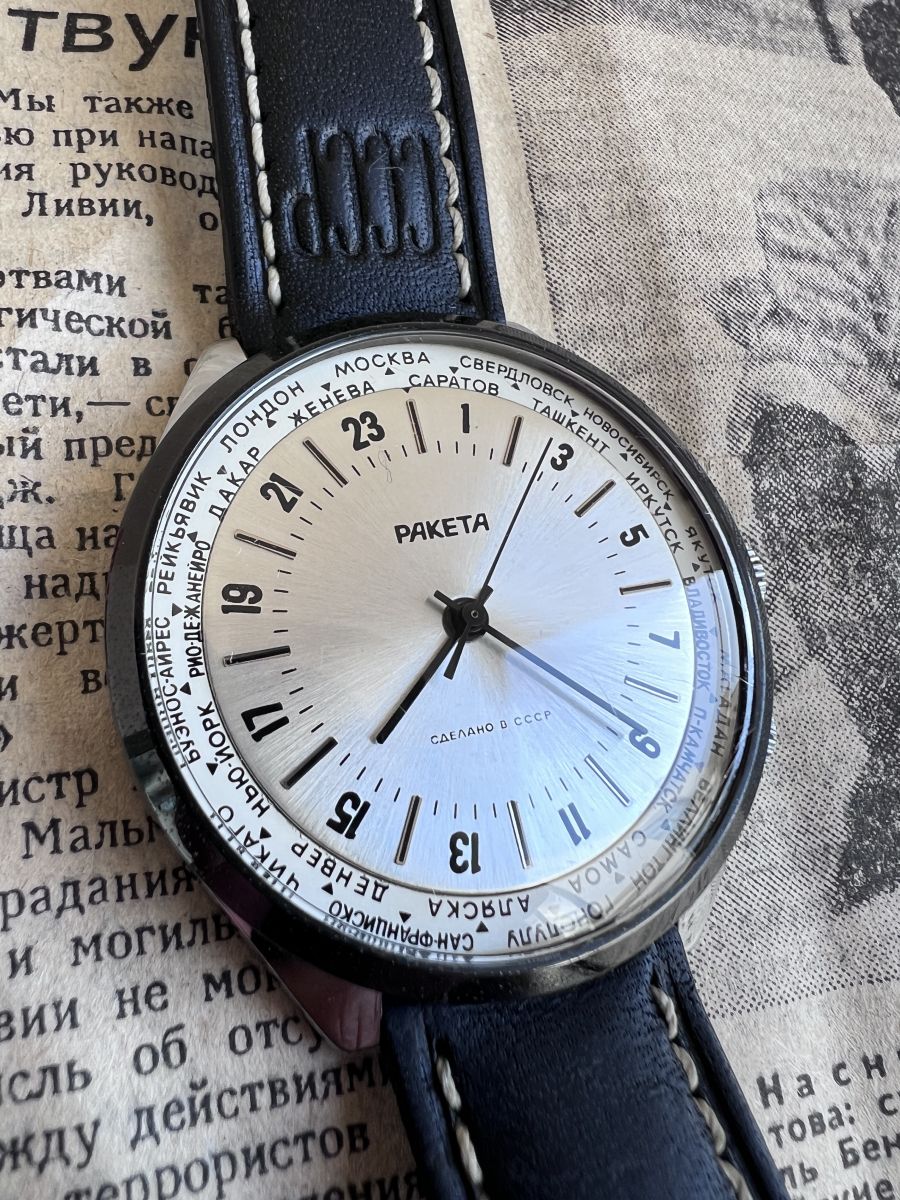
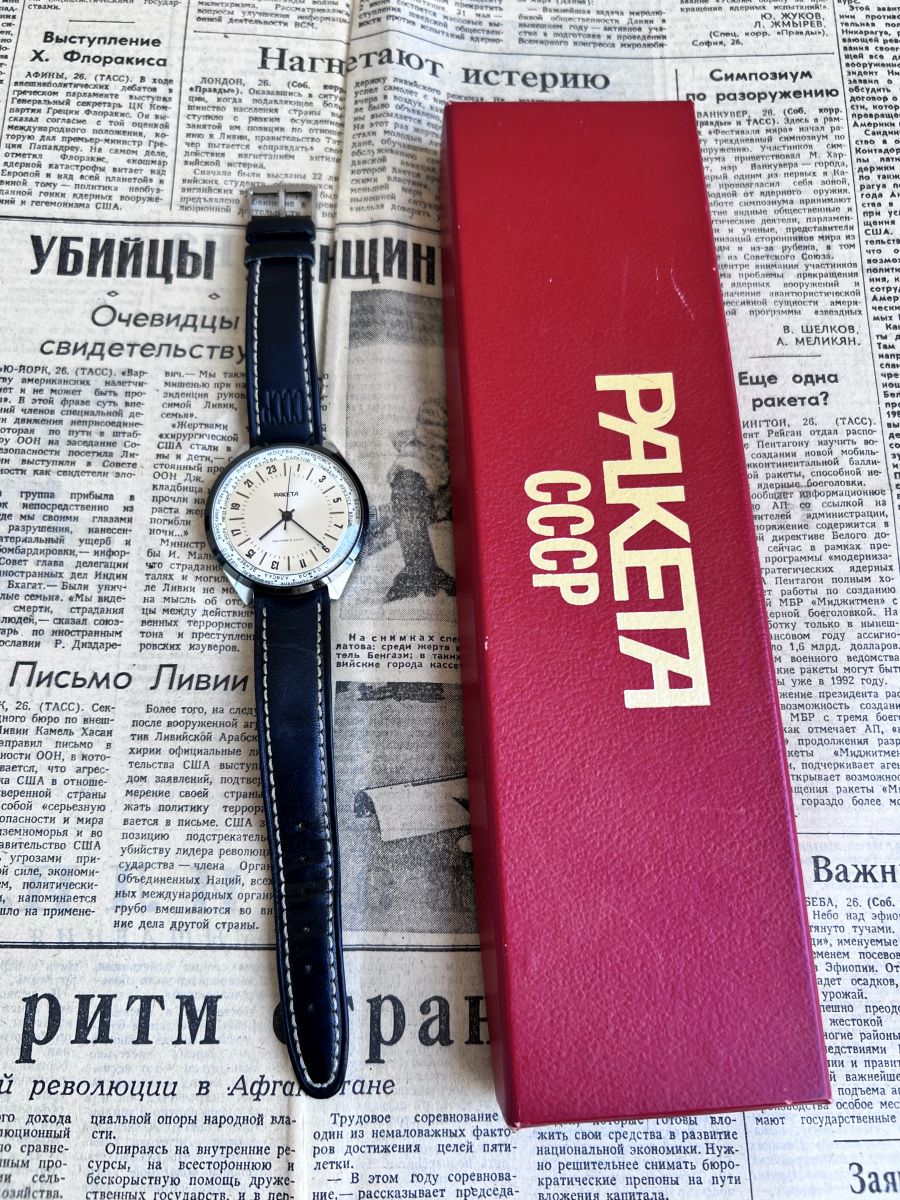
This is the ring of the «Города мира» (Goroda mira, Cities of the World), sold for export as the World Time, and one of our best-selling models. It carries twenty-four names, one per time zone, in two rows. A small triangle marks the exact position of each city.
The export leaflet gives the rule: bring the city you are in, or a city in the same time zone, opposite the hour shown by the hour hand. Every city on the ring then sits opposite its own hour.
Read the hour on the dial, 17 for example.
Turn the 4 o’clock crown to bring your city opposite 17.
Read the hour of each city on the dial, opposite its triangle. The minutes are the same everywhere.
The ring does not follow the hand. An hour later, move it by one step before reading again.
The example in the leaflet: НЬЮ-ЙОРК (New York) opposite 17, ЛОНДОН (London) is read opposite 22. Below it, the translation of the twenty-four cities.
The names are in Cyrillic. Here are the twenty-four cities in the order of the ring, with their pronunciation and the offset the ring gives them from London.
On the ring
Pronunciation
City
Offset from London
ЛОНДОН
London
London
0
ЖЕНЕВА
Zheneva
Geneva
+1 h
МОСКВА
Moskva
Moscow
+2 h
САРАТОВ
Saratov
Saratov
+3 h
СВЕРДЛОВСК
Sverdlovsk
Sverdlovsk, now Yekaterinburg
+4 h
ТАШКЕНТ
Tashkent
Tashkent
+5 h
НОВОСИБИРСК
Novosibirsk
Novosibirsk
+6 h
ИРКУТСК
Irkutsk
Irkutsk
+7 h
ЯКУТСК
Yakutsk
Yakutsk
+8 h
ВЛАДИВОСТОК
Vladivostok
Vladivostok
+9 h
МАГАДАН
Magadan
Magadan
+10 h
П-КАМЧАТСК
P-Kamchatsk
Petropavlovsk-Kamchatsky
+11 h
ВЕЛЛИНГТОН
Vellington
Wellington
+12 h
САМОА
Samoa
Samoa
−11 h
ГОНОЛУЛУ
Gonolulu
Honolulu
−10 h
АЛЯСКА
Alyaska
Alaska
−9 h
САН-ФРАНЦИСКО
San-Frantsisko
San Francisco
−8 h
ДЕНВЕР
Denver
Denver
−7 h
ЧИКАГО
Chikago
Chicago
−6 h
НЬЮ-ЙОРК
Nyu-York
New York
−5 h
БУЭНОС-АЙРЕС
Buenos-Ayres
Buenos Aires
−4 h
РИО-ДЕ-ЖАНЕЙРО
Rio-de-Zhaneyro
Rio de Janeiro
−3 h
РЕЙКЬЯВИК
Reykyavik
Reykjavik
−2 h
ДАКАР
Dakar
Dakar
−1 h
The ring gives one hour per time zone, with no summer time. Legal times sometimes differ. Between London and Moscow the ring counts two hours, whereas Moscow time is now three hours ahead of London in winter and two in summer. Paris is not on it: its time is that of Geneva. When the ring is one hour off for the city you care about, move it by one step.
One name helps to date these watches: a Soviet version carries Свердловск (Sverdlovsk), a Russian version Екатеринбург (Yekaterinburg). The two are compared in our article on Soviet 24-hour watches.
Soviet Cities of the World: Свердловск (Sverdlovsk) on the ring, Сделано в СССР on the dial.
The World Time with an outer bezel
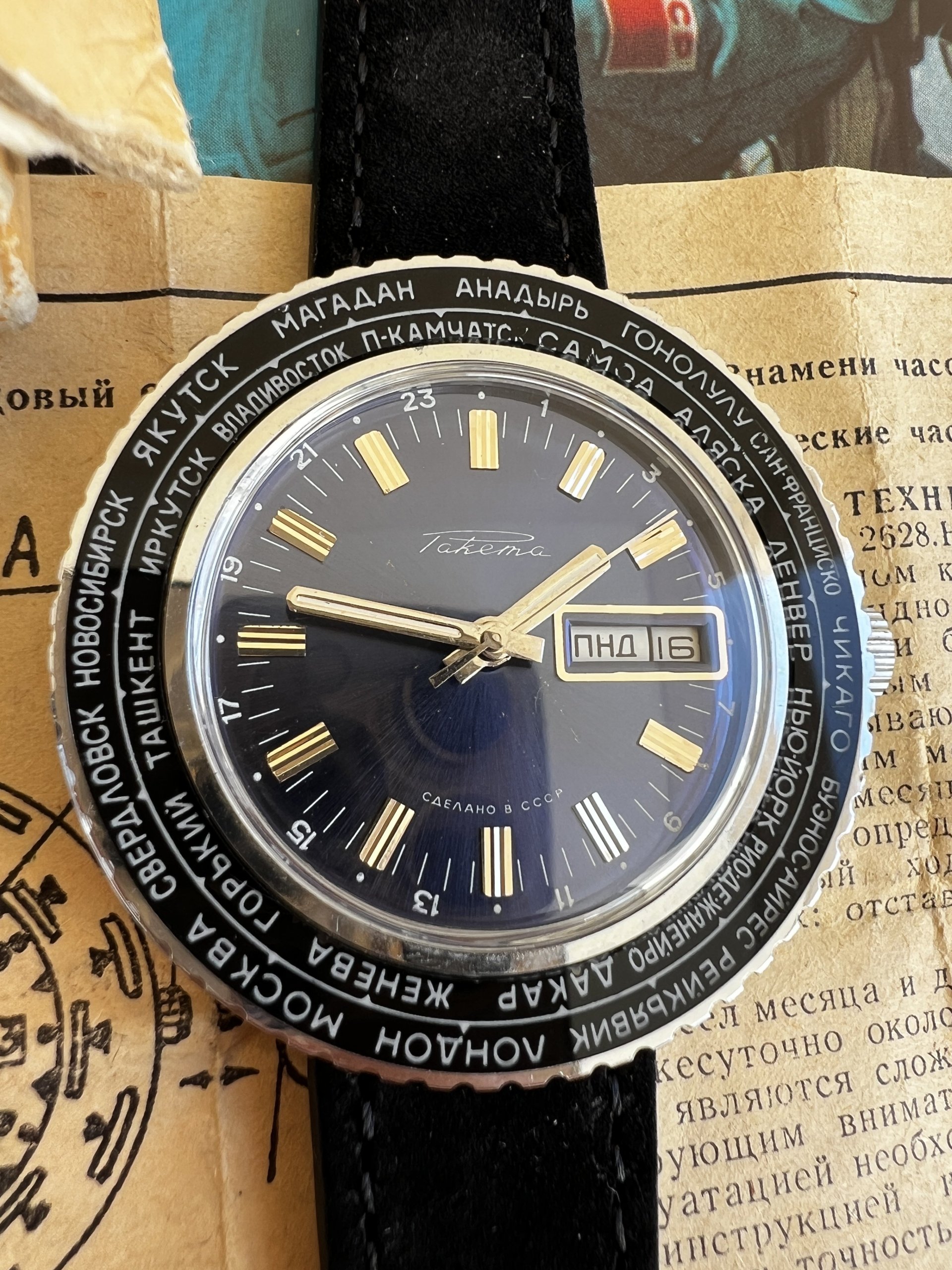
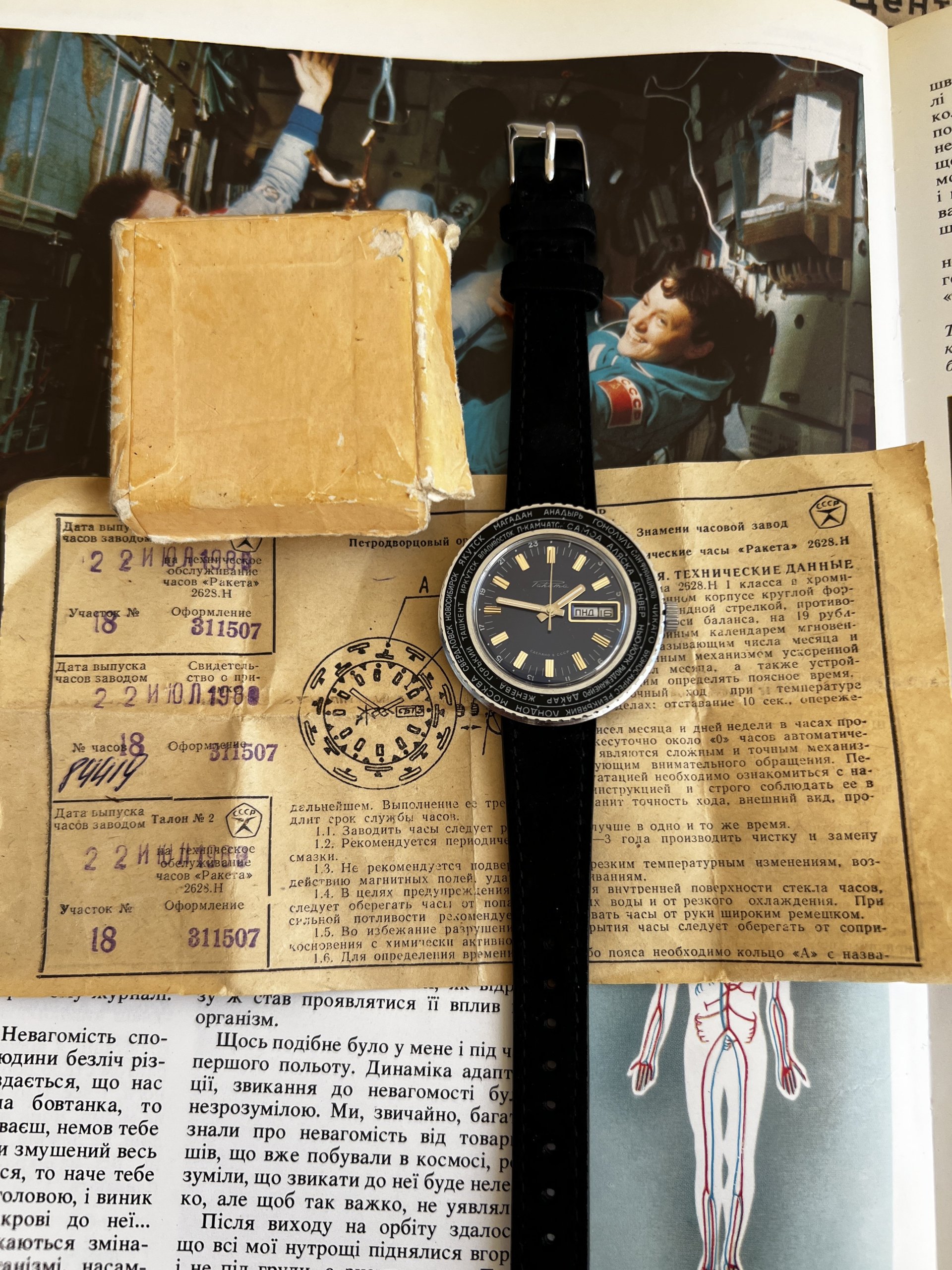
Raketa also placed the cities on the outside, on a rotating bezel, around a watch with an ordinary 12-hour display, day and date, and the calibre 2628.Н. A 24-hour scale is printed on the edge of the dial. Here the hour hand plays no part in the reading: the city is lined up with a number on the scale.
World Time with Cyrillic bezel, calibre 2628.Н, from our stock.
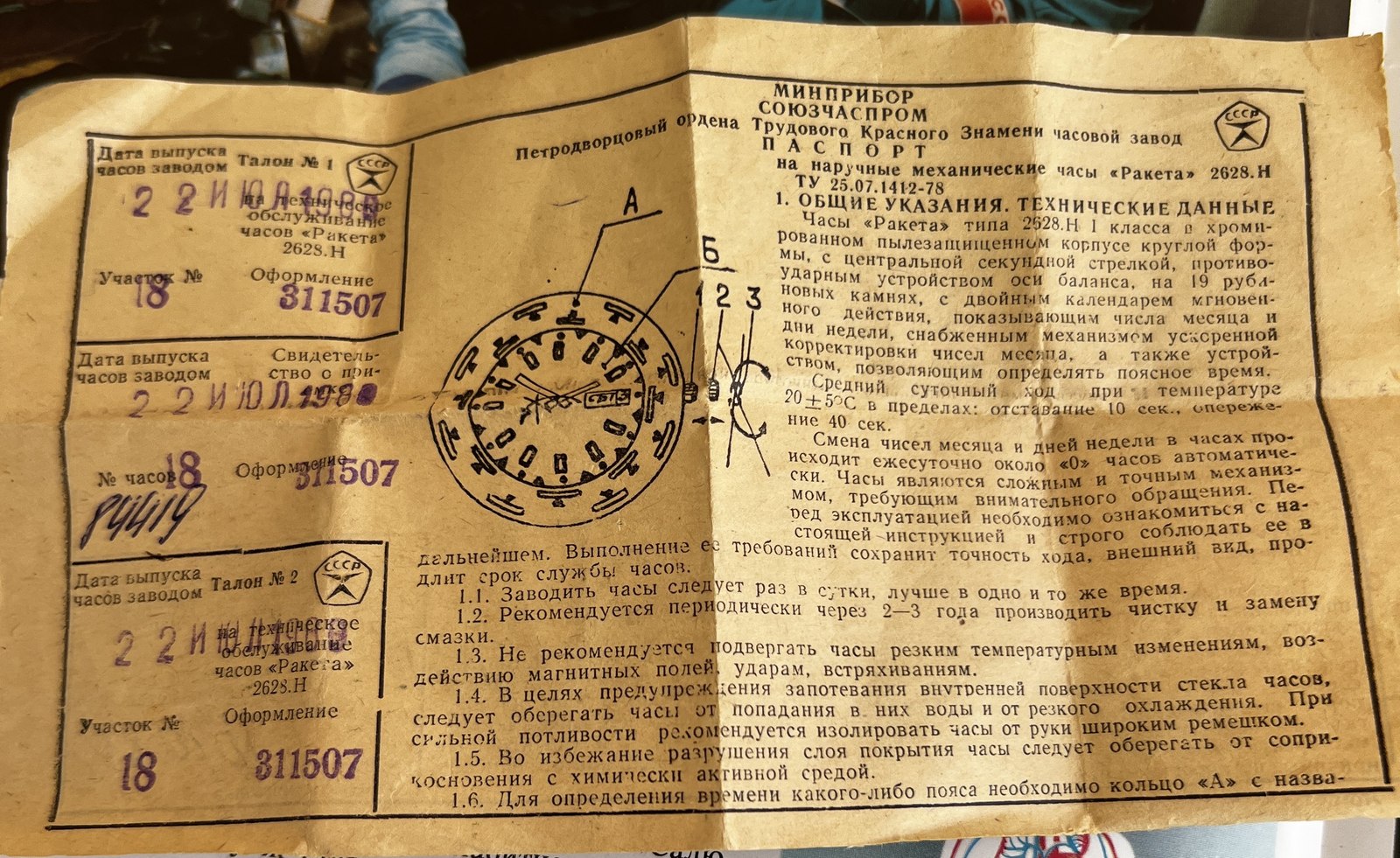
The Soviet passport of this watch, which left the factory on 22 July 1980, speaks of a device for determining zone time, «поясное время» (poyasnoye vremya). It asks you to turn the cities ring until the city of the local zone faces the current hour on the 24-hour scale, then to read the hour of each city opposite its name. Its example: it is 14:00 in Vologda, in the Moscow zone. To find the time in Zlatoust, in the Sverdlovsk zone, bring «Москва» (Moskva) to 14 and read opposite «Свердловск» (Sverdlovsk).
The 1980 passport. Its diagram marks the cities ring (А) and the 24-hour scale of the dial (Б).
The Polar watches and their minutes ring
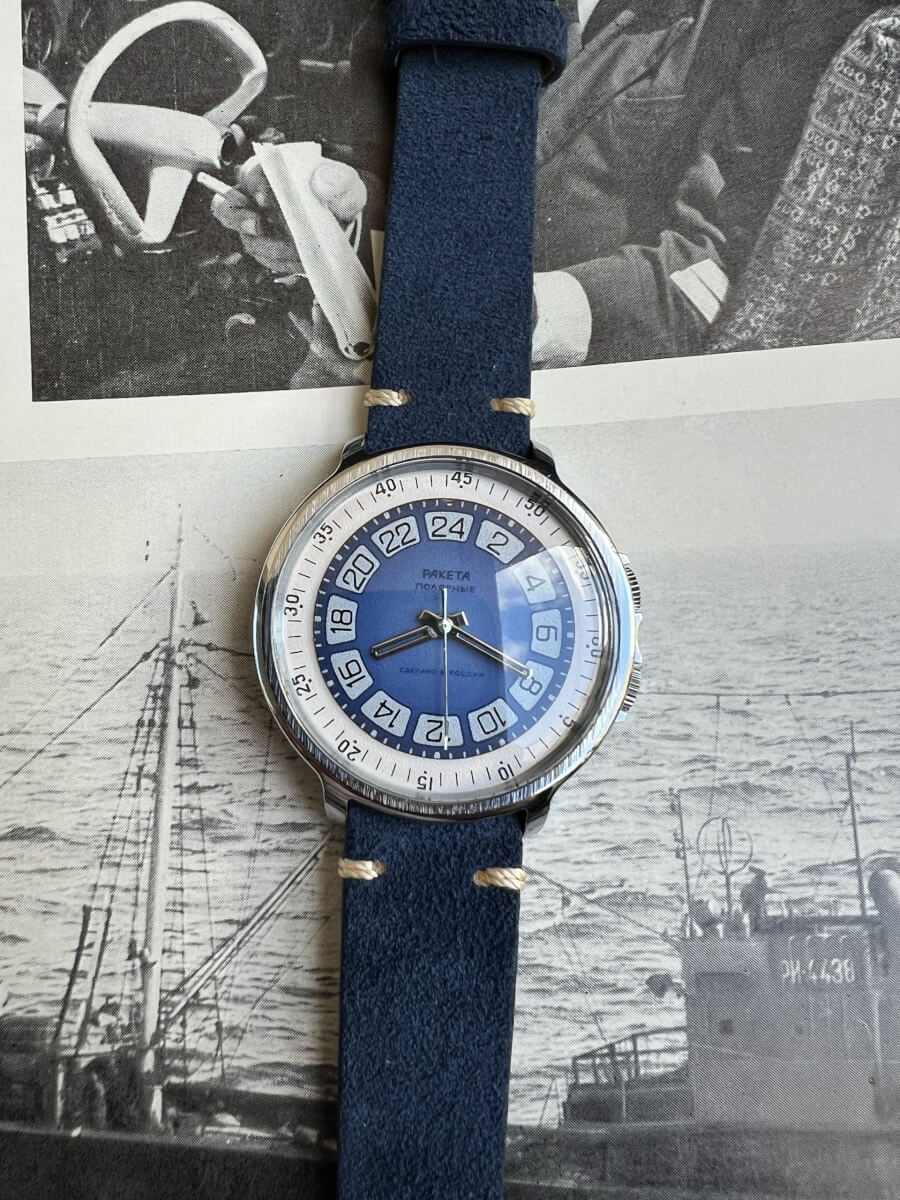
The «Полярные» (Polyarnye, Polar) carry a fourth ring, graduated from 5 to 60, which the passport does not list among its three versions. It is used to time an event, like the rotating bezel of an Amphibia or of a diving watch: bring the 60 opposite the minute hand at the start, then read the minutes elapsed.
Raketa Polar: «Полярные» on the dial, ring graduated from 5 to 60.
Winding and setting the time
The passport of the calibre 2623.Н gives these instructions.
Wind the watch once a day, preferably at the same time. The stated power reserve is at least 44 hours.
Set the time by turning the crown in the direction opposite to winding. With the mainspring fully wound, either direction is allowed.
Protect the watch from hard shocks and magnetic fields.
Accepted rate: from 10 seconds slow to 40 seconds fast per day.
The ДП-5В (DP-5V) is the field radiometer of Soviet civil defence: a green Bakelite console, a probe with a rotating gamma, beta and check-source shield, headphones and a manual that explains operation and maintenance. The one in this article served in an industrial bakery in Chișinău and was serviced in March 1991. Its owner shared his photos and documents with us, and we turned them into a tool that lets you operate it on screen, step by step.
The Moscow Games, from 19 July to 3 August 1980, boycotted by some sixty countries, produced more objects than any Soviet event: a bear cub, Misha, drawn by Viktor Chizhikov, an emblem made of running tracks, five thousand torches, watches from every factory, platinum coins, rings, tea glass holders, posters. This guide tells the story of the Games and reviews the objects, with the marks that authenticate them and the prices.
The 3017 chronograph of the First Moscow Watch Factory carries a five-digit number on the balance cock. The most common dating method reads it as a single series, from 1959 to 1979. Four factory passports show there are two, and that the same number can point to two watches made ten years apart. Here is how to read the number, the dial, the logo and the bridge, with a decoder to date your Strela, Poljot or Sekonda.
This website uses cookies to improve your experience while you navigate through the website.
Out of these cookies, the cookies that are categorised as necessary are stored on your browser as they are essential for the working of basic functionalities of the website.
We also use third-party cookies that help us analyse and understand how you use this website.
These cookies will be stored in your browser only with your consent.
You also have the option to opt out of these cookies.
But opting out of some of these cookies may affect your browsing experience.
Necessary cookies are absolutely essential for the website to function properly. This category only includes cookies that ensure basic functionalities and security features of the website. These cookies do not store any personal information.
Cookies that are not strictly necessary for the website to work and that are used specifically to collect personal data through analytics, ads and other embedded content are called non-necessary cookies. User consent is required before these cookies run on the website.
✕
Soviet in Paris
Offline right now. Leave your message and your email, we reply within 24 hours.
Hello 👋 A question about an item, an order or shipping? Write to us.
Your email is used only to reply to you.
Subscribe to our newsletter and get 10% off your first order.
Subscribe
★ New pieces before anyone else
★ New blog articles
★ Soviet in Paris news and updates
Join the Party
10% off your first order
Receive your welcome card and our next arrivals.
Your code appears here and is also sent to you by email. You can leave the Party in one click, at any time.