The Cyrillic markings on a dial, a case back or a passport help identify a Soviet watch and place it in time. This guide explains each of them on three tap-to-read photos, decodes the four-digit calibre code and sets out what the Soviet standard actually required to be written.
OCTOBER 2026•6 MINUTE READ
by Marwen Yahyaoui
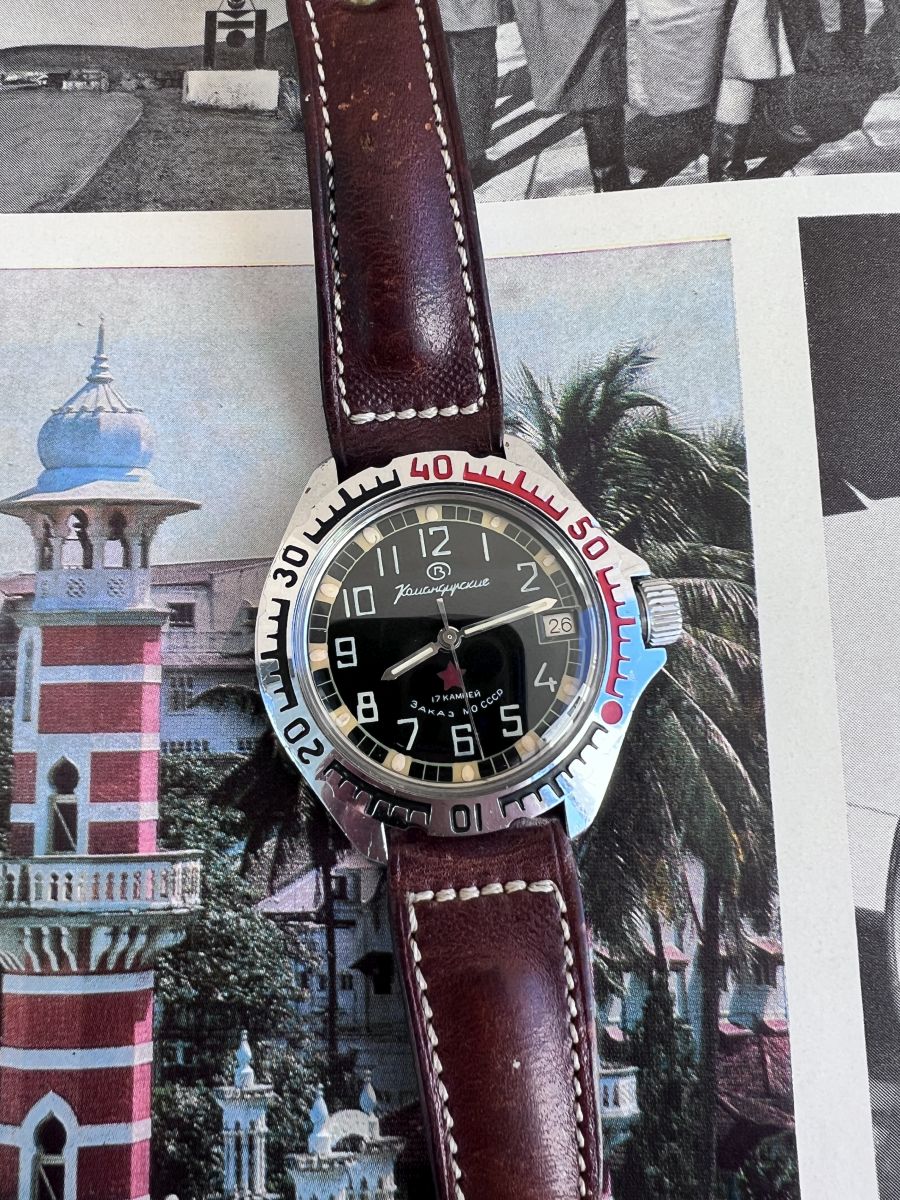
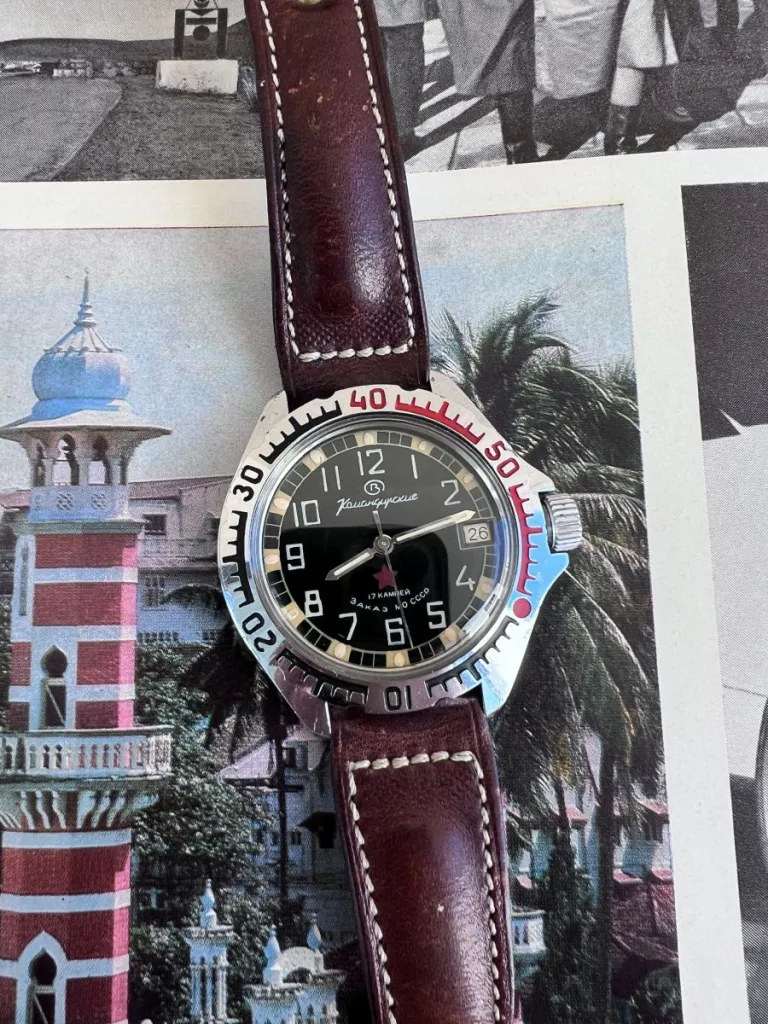
Tap the numbers on the photo to read each marking on this Komandirskie.
The main trap is letters that look Latin but are pronounced differently. Reading becomes simple once you know them.
“В” reads v, “Н” reads n, “Р” reads r, “С” reads s, “У” reads u, “Х” reads kh.
“ВОСТОК” therefore reads Vostok, not “BOCTOK”.
“СССР” reads S-S-S-R. This is why listings say “CCCP”: the Latin C and P look like the Cyrillic С and Р.
“Й” is an “И” with a mark above it, and a different sound. That difference matters for spotting fakes, see below.
In cursive script, as in the word “Командирские” on the dial above, т is written like an m and д like a g.
Cyrillic is not reserved for the home market
It is often said that Cyrillic means a watch sold in the USSR and Latin letters an export watch. The Soviet standard for wristwatches, ГОСТ 10733-79, is less clear-cut. It requires only one marking on the dial: the maker’s trademark. The jewel count and “Сделано в СССР” (sdelano v SSSR) are optional, and may be written in Russian or in a foreign language.
On the movement or the case back, the same standard requires the watch number, the calibre code, the factory trademark and the letters “SU”, the code for the USSR.
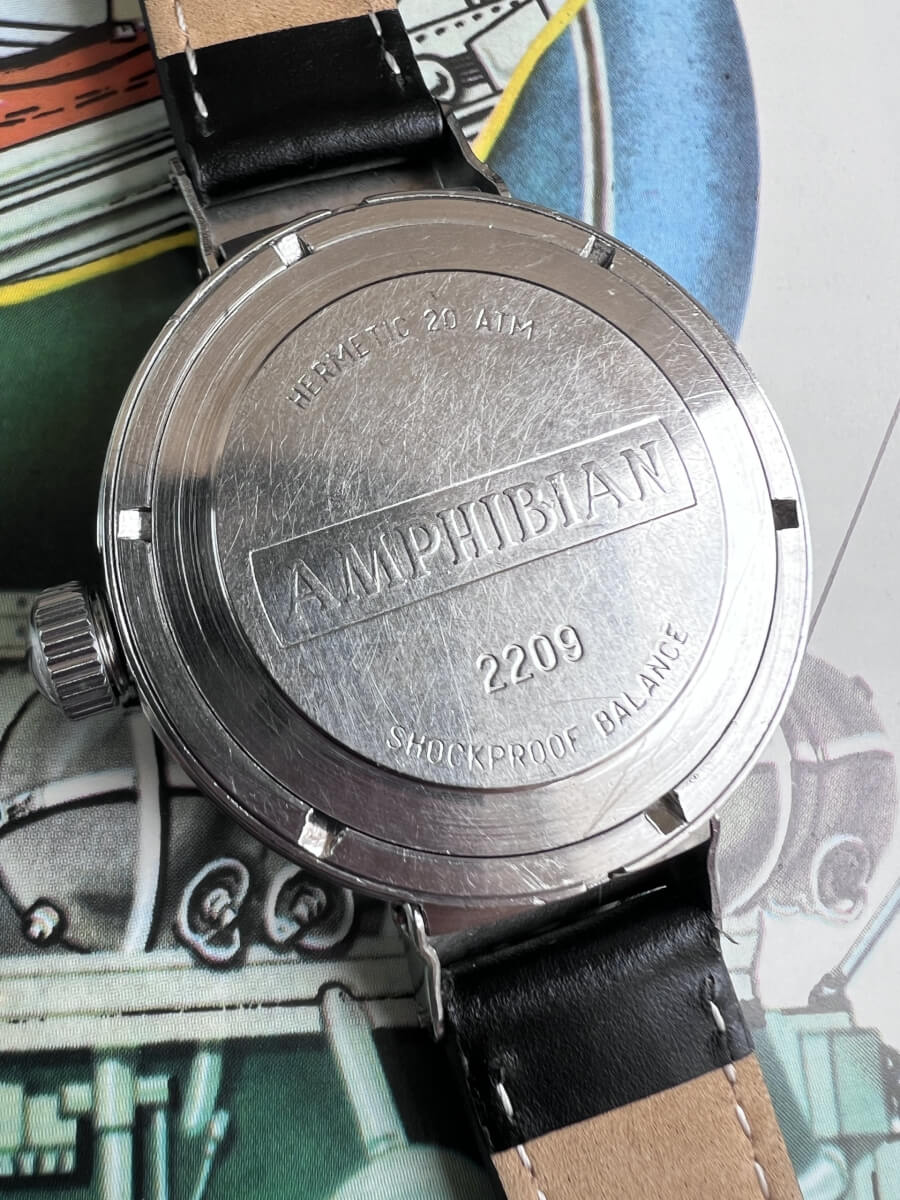
Case back of an export Amphibia: “Hermetic 20 ATM”, “Amphibian”, “Shockproof balance” and the calibre code, 2209.
The brand and the model name
Until 1969 the name on a Soviet dial designated the movement or the model, not the factory: a “Победа” could come from several plants. After that each factory received its own brand. Almost all these names are everyday words.
Marking
Reads
Means
Победа
Pobeda
victory
Восток
Vostok
east
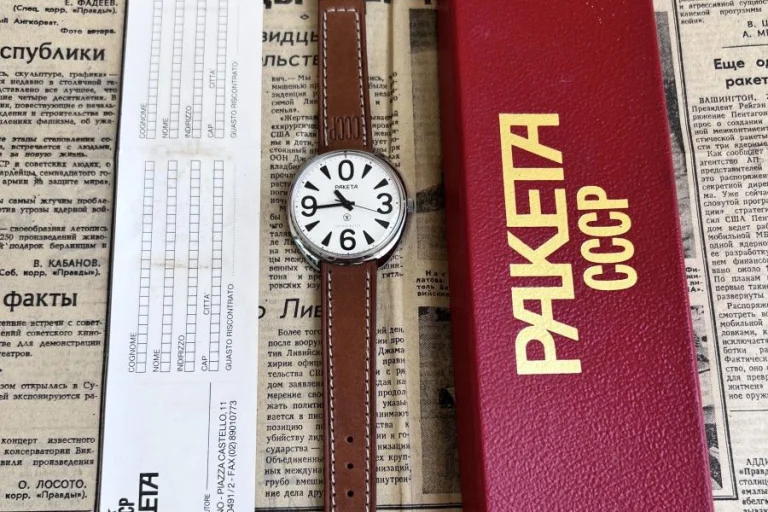
Ракета
Raketa
rocket
Полёт
Polyot
flight
Слава
Slava
glory
Луч
Luch
ray
Чайка
Chaika
seagull
Молния
Molniya
lightning
Командирские
Komandirskie
commander’s
Штурманские
Shturmanskie
navigator’s
Амфибия
Amfibiya
amphibian
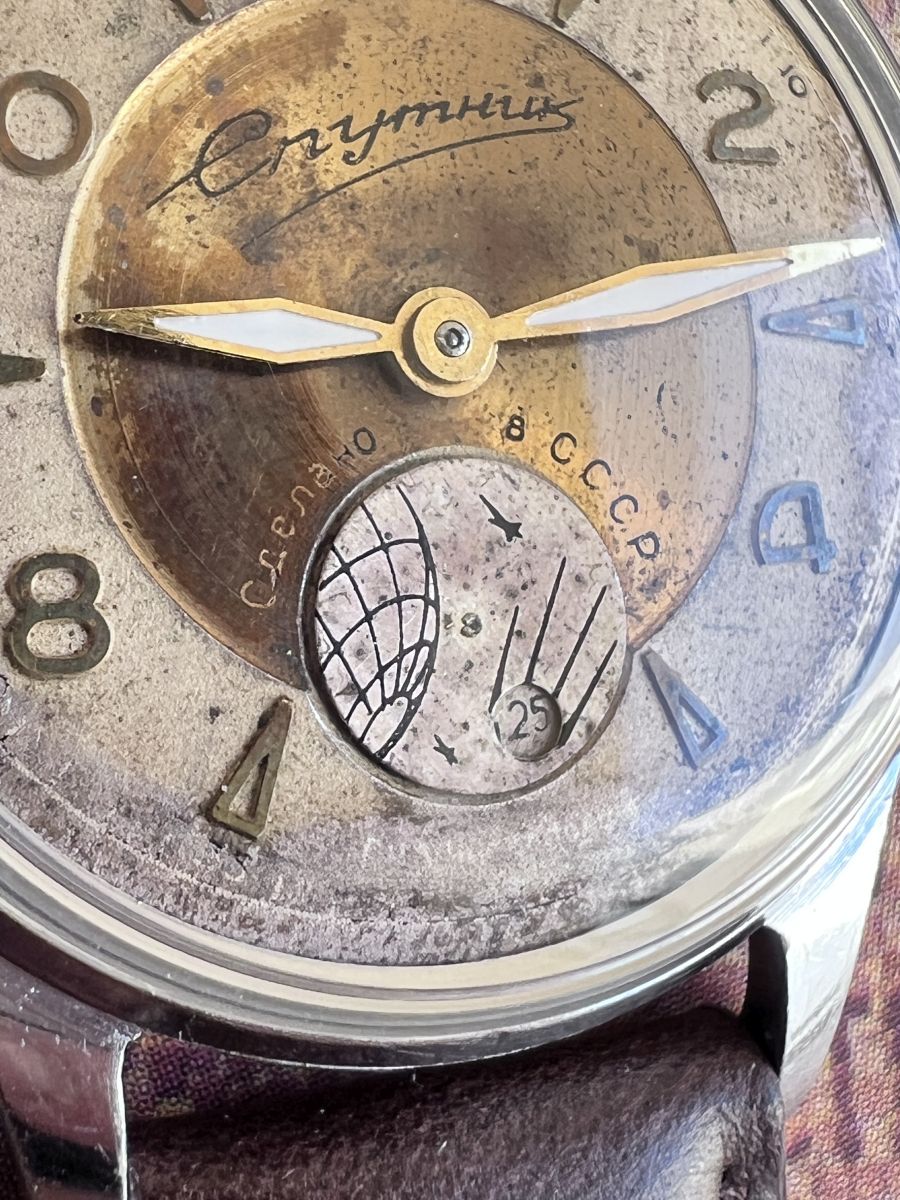
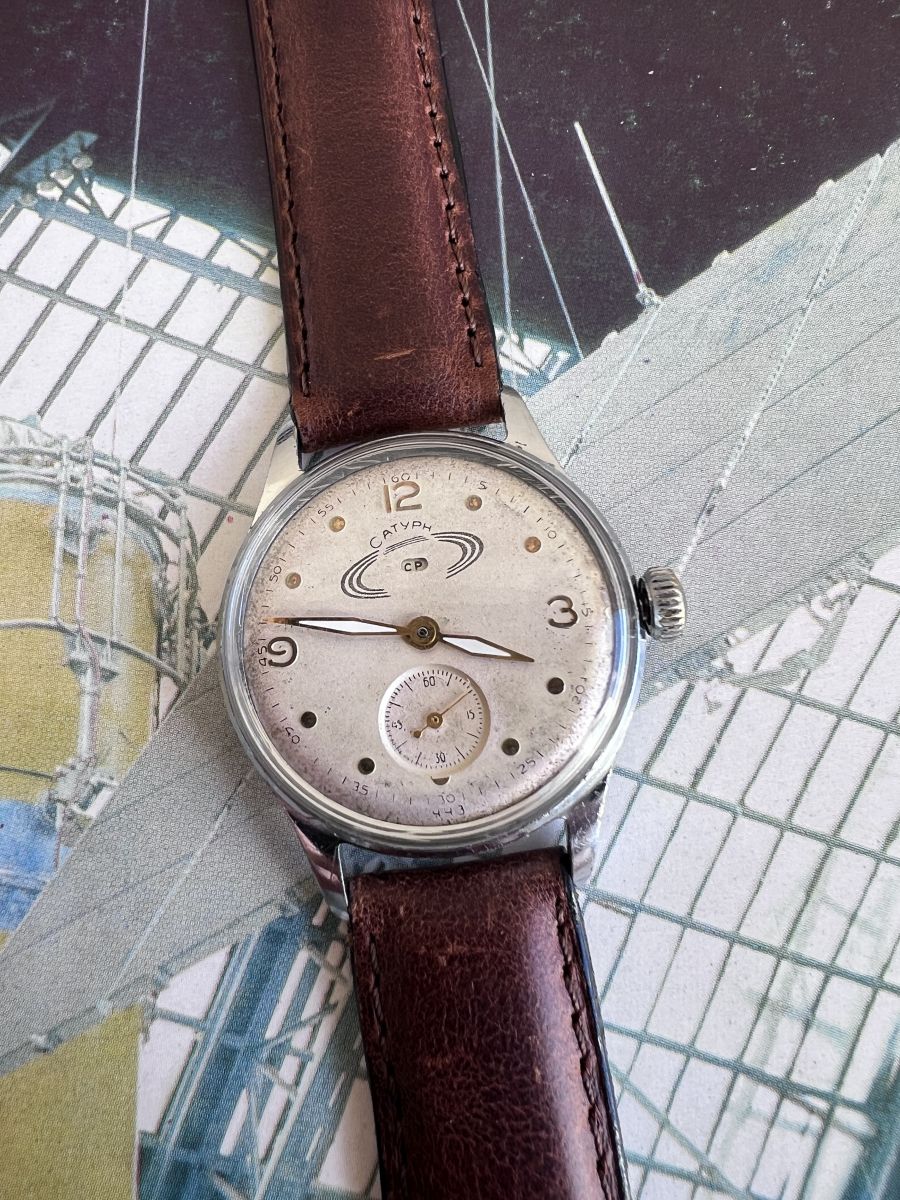
Watches from the Chistopol factory are marked “Восток” for the home market and “Wostok” for export. Before 1969 its dials carried a model name, “Сатурн” (saturn), “Спутник” (sputnik) or “Кама” (kama). For the history of the factory, see our article on Vostok and Chistopol.
“Спутник”, Sputnik, in cursive script, and “Сделано в СССР” around the seconds disc.
Where and when: “Сделано в СССР” and “Заказ МО СССР”
“Сделано в СССР” means “made in the USSR”. It marks a Soviet piece, so one made before the end of 1991. After that date dials read “Сделано в России” (sdelano v Rossii), made in Russia. There are exceptions: dials printed in 1991 with “Сделано в СССР” may have been fitted in 1992 or 1993.
“Заказ МО СССР” (zakaz MO SSSR) means “order of the Ministry of Defence of the USSR”. It is printed in place of “Сделано в СССР” on Komandirskie watches. It disappeared after 1991. The details are in our Komandirskie guide.
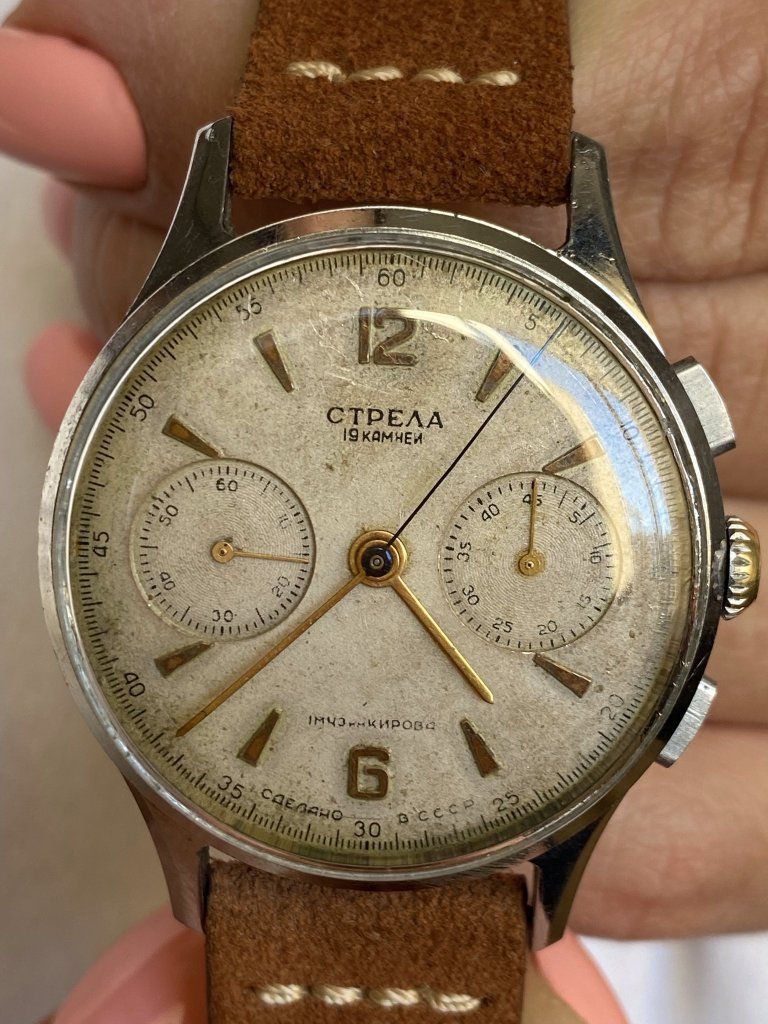
Jewels: “камень”, “камня”, “камней”
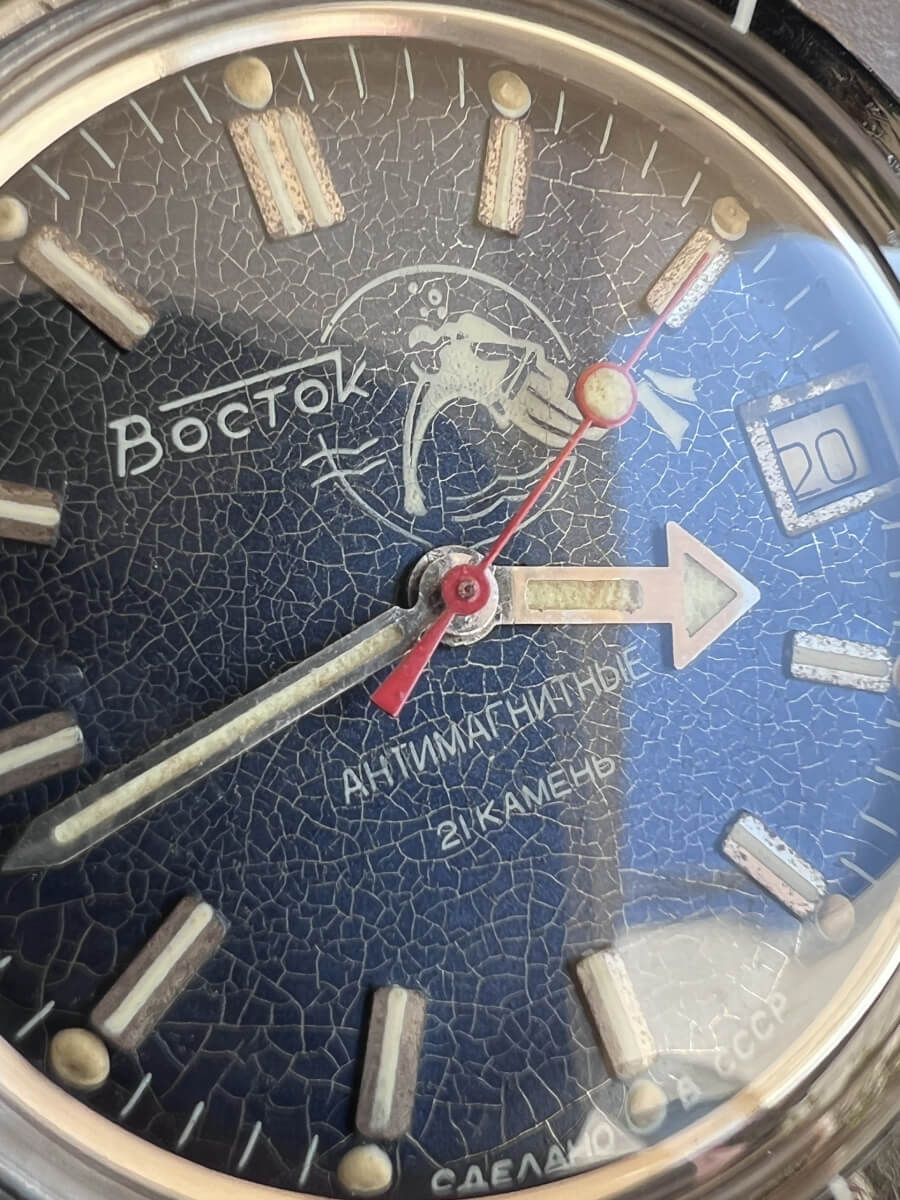
“Камень” (kamen) means “stone”, that is the jewel that serves as a bearing in the movement. In Russian the ending changes with the number: you write “21 камень” (kamen), “23 камня” (kamnya) and “17 камней” (kamney). The rule follows the last digit: 1 gives “камень”, 2 to 4 give “камня”, 5 to 20 give “камней”.
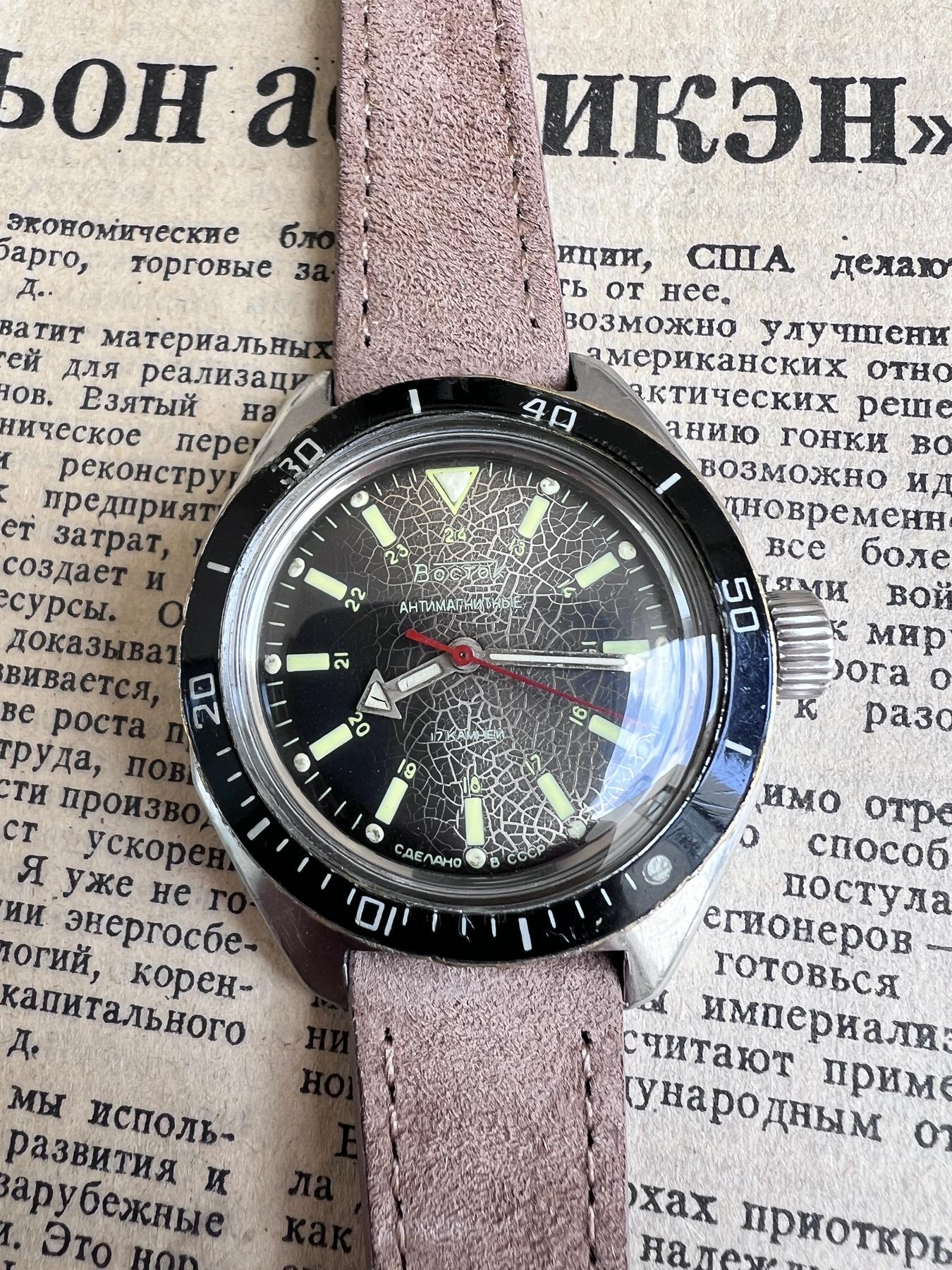
Dial of a Vostok automatic: “Антимагнитные”, antimagnetic, and “21 камень”.
The jewel count helps identify the calibre: 18 jewels for the Vostok 2209, 17 for the 2409A and 2414A, 31 for the automatic 2416Б. A Poljot 3133 reads “23 камня”, a marking that stayed in Cyrillic on these chronographs until 1997, as explained in our Poljot 3133 guide.
On a Komandirskie the “Й” in “КАМНЕЙ” works as a test. An old type of copy replaces this “Й” with a Latin “N”, and writes “МОСССР” without a space.
The calibre code: four digits
The number engraved on a Soviet movement, 2209, 2414 or 3133, is not a serial number. It is a code. The first two digits give the diameter of the movement in millimetres, the last two its functions. The system comes from a watch-industry standard of 1962.
Code
Functions
08
centre seconds
09
centre seconds, shock protection
14
centre seconds, shock protection, calendar
16
centre seconds, shock protection, calendar, automatic winding
17
chronograph
23
hour hand making one turn in 24 hours, shock protection, centre seconds
33
chronograph with calendar
A 2209 is therefore a 22 mm movement with centre seconds and shock protection, a 2414 a 24 mm movement with calendar, a 2416 its automatic version, and the 2623 of the 24-hour watches a 26 mm movement whose hour hand turns once a day. The letter that follows, А or Б, distinguishes versions of the same calibre.
The 3133 of Poljot chronographs reads the same way: 31 for a 31 mm movement, 33 for its functions, those of a chronograph with calendar. That code is not in the 1962 list, since the calibre entered production in 1976. Its predecessor, the 3017, is a 30 mm movement carrying the code 17, the chronograph code.
Water, shocks, magnetism: markings on the case back and dial
The standard also fixes the vocabulary. “Противоударные” (protivoudarnye) means shockproof, “Антимагнитные” (antimagnitnye) antimagnetic, “Автоподзавод” (avtopodzavod) automatic winding, “Кварц” (kvarts) quartz. To understand the difference between mechanical, automatic and quartz, see our mechanical, automatic or quartz guide.
“Водонепроницаемые” (vodonepronitsaemye), waterproof, means less than one might think: the word alone guarantees immersion at one metre for thirty minutes. It only gains its value when followed by a figure, in metres or bars. Tap the numbers to read the case back of this Amphibia.
“Знак качества СССР” (znak kachestva SSSR) is the USSR quality mark, a pentagon containing the word “СССР”. The watch standard reserves it for pieces of the “highest quality category”: it appears on their passport and their box, and their warranty is six months longer, two and a half years instead of two for a man’s watch. It is also found printed on some dials.
The USSR quality mark on the dial of a 1983 marine clock.
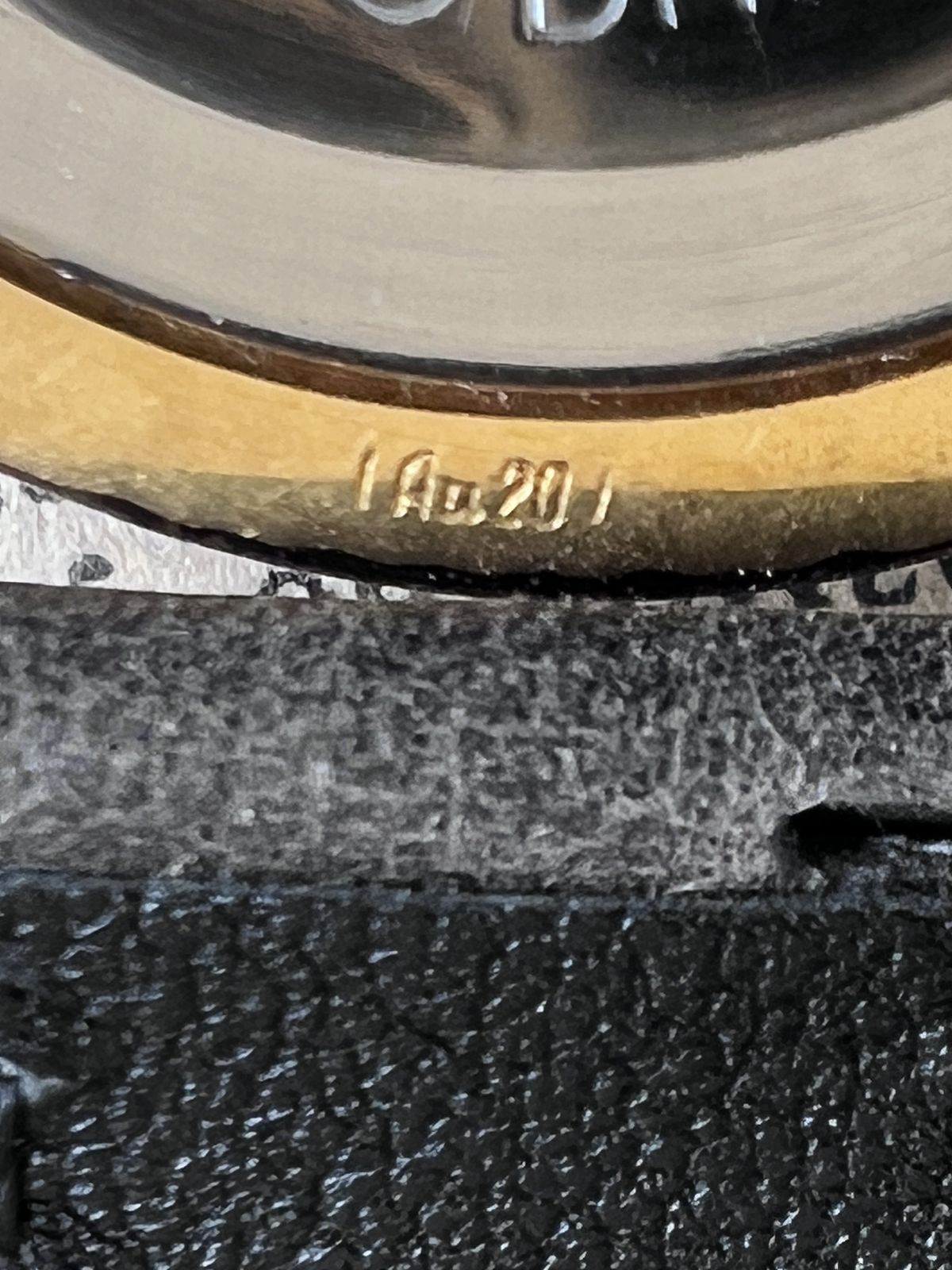
On plated cases, “Au” followed by a number gives the thickness of the gold plating in microns: “Au20” for 20 microns.
“Au 20”, stamped on the case band of a 1972 Poljot: 20-micron gold plating.
Twenty microns is two hundredths of a millimetre. Russian precious-metal recyclers estimate that a man’s case marked “Au20” carries between a quarter and half a gram of gold, and the layer is not pure gold. At 2026 prices, around €120 a gram, that is roughly €30 to €60, before the cost of recovering it. These figures are trade estimates, not measurements. The value of a plated watch lies in the watch, not in its gold.
Reading a passport
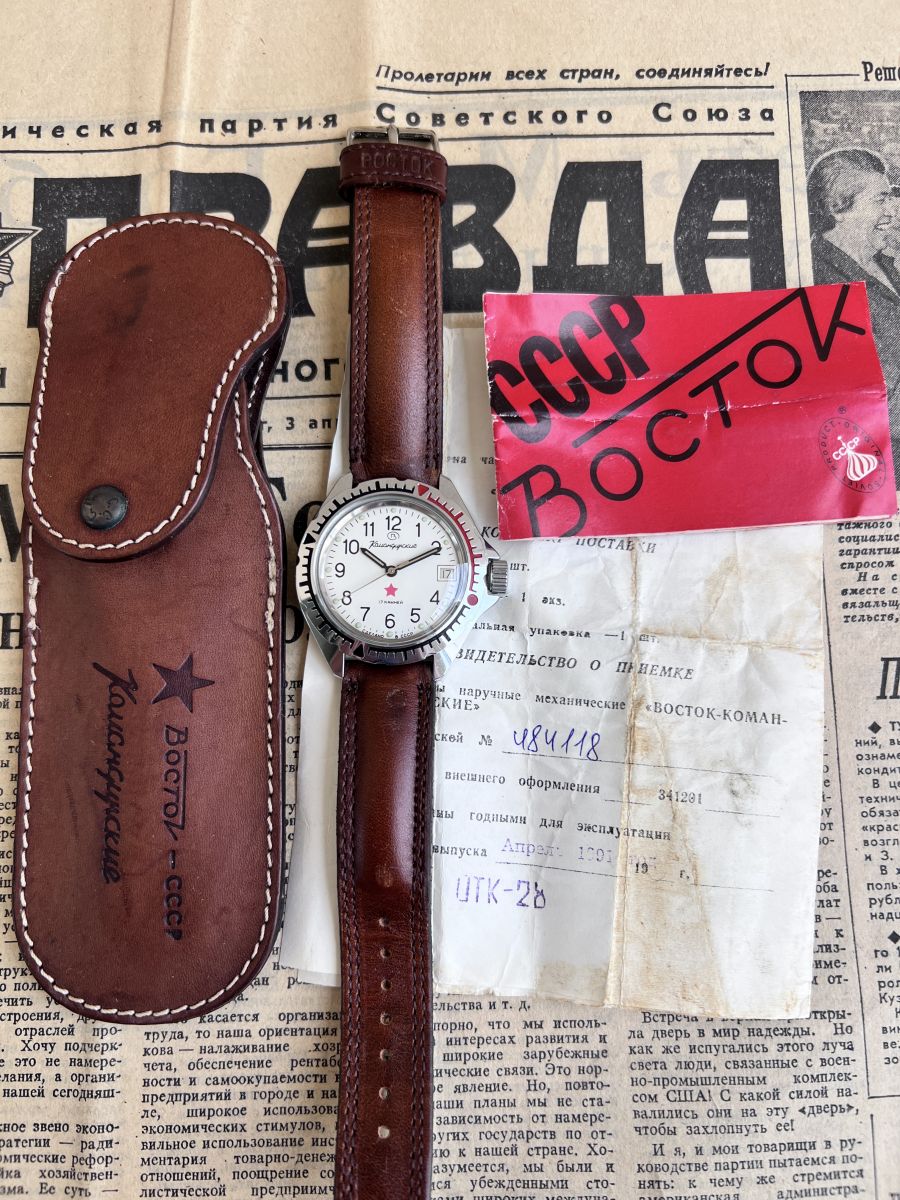
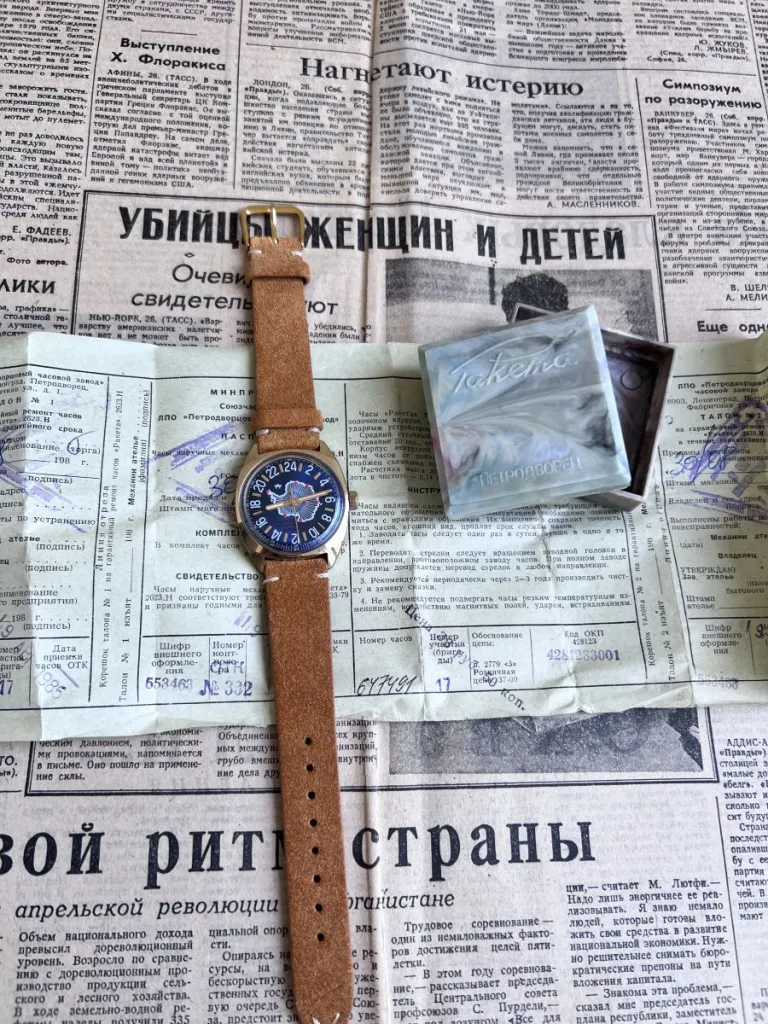
Every Soviet watch left the factory with a passport. The standard set its contents: the maker’s name and address, the watch number, the movement code, the guaranteed rate, the inspector’s number and the acceptance date, the length of the warranty, the instructions and the retail price. The shop added its stamp and the date of sale. Tap the numbers to read this 1991 passport.
The abbreviation “ОТК” (O-T-K) appears on every passport: it is the factory’s technical inspection department. The passport is also the best way to date a piece, provided its number matches the one on the case back.
To check what you have retained, here are ten markings taken from this article. Choose the meaning of each one.
The case-back number helps estimate the age of a watch, but exact dating often remains difficult without a passport. A dial marking fixes a period, not a year. If you are unsure about a piece, you can write to us through the contact page.
The ДП-5В (DP-5V) is the field radiometer of Soviet civil defence: a green Bakelite console, a probe with a rotating gamma, beta and check-source shield, headphones and a manual that explains operation and maintenance. The one in this article served in an industrial bakery in Chișinău and was serviced in March 1991. Its owner shared his photos and documents with us, and we turned them into a tool that lets you operate it on screen, step by step.
The Moscow Games, from 19 July to 3 August 1980, boycotted by some sixty countries, produced more objects than any Soviet event: a bear cub, Misha, drawn by Viktor Chizhikov, an emblem made of running tracks, five thousand torches, watches from every factory, platinum coins, rings, tea glass holders, posters. This guide tells the story of the Games and reviews the objects, with the marks that authenticate them and the prices.
The 3017 chronograph of the First Moscow Watch Factory carries a five-digit number on the balance cock. The most common dating method reads it as a single series, from 1959 to 1979. Four factory passports show there are two, and that the same number can point to two watches made ten years apart. Here is how to read the number, the dial, the logo and the bridge, with a decoder to date your Strela, Poljot or Sekonda.
This website uses cookies to improve your experience while you navigate through the website.
Out of these cookies, the cookies that are categorised as necessary are stored on your browser as they are essential for the working of basic functionalities of the website.
We also use third-party cookies that help us analyse and understand how you use this website.
These cookies will be stored in your browser only with your consent.
You also have the option to opt out of these cookies.
But opting out of some of these cookies may affect your browsing experience.
Necessary cookies are absolutely essential for the website to function properly. This category only includes cookies that ensure basic functionalities and security features of the website. These cookies do not store any personal information.
Cookies that are not strictly necessary for the website to work and that are used specifically to collect personal data through analytics, ads and other embedded content are called non-necessary cookies. User consent is required before these cookies run on the website.
✕
Soviet in Paris
Online. We answer in person, no AI and no chatbot. Reply right away, 20 min at most.
Hello 👋 A question about an item, an order or shipping? Write to us.
Your email is used only to reply to you.
Subscribe to our newsletter and get 10% off your first order.
Subscribe
★ New pieces before anyone else
★ New blog articles
★ Soviet in Paris news and updates
Join the Party
10% off your first order
Receive your welcome card and our next arrivals.
Your code appears here and is also sent to you by email. You can leave the Party in one click, at any time.