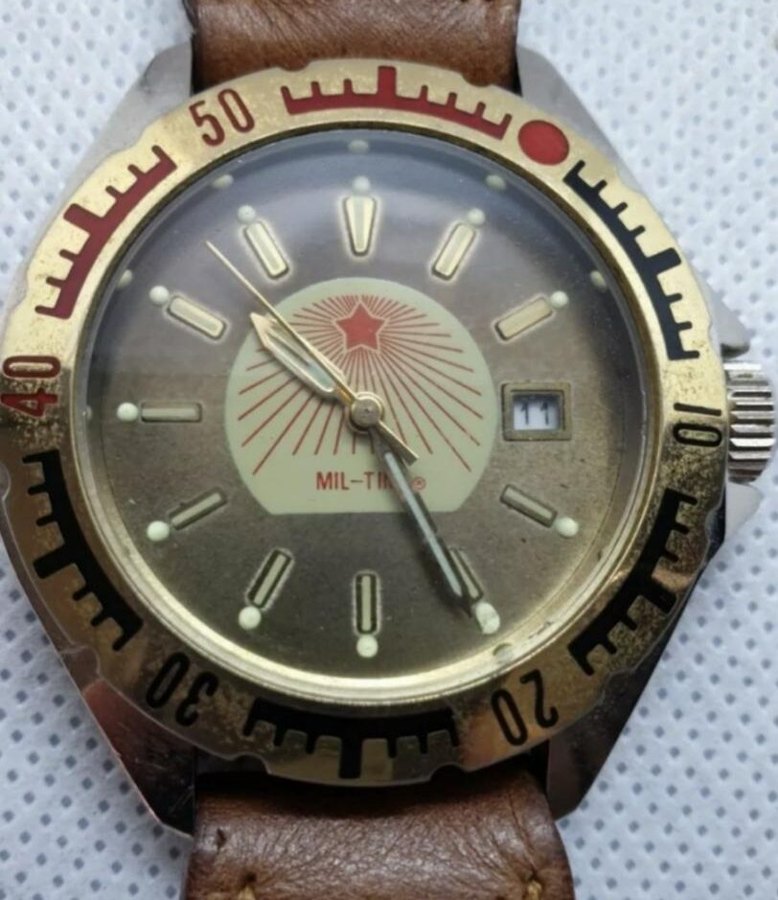
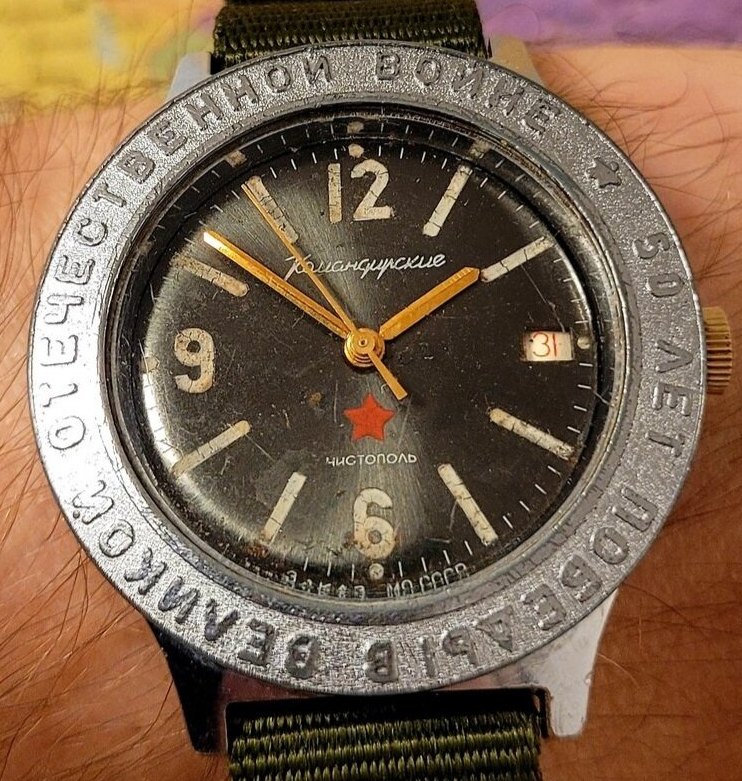
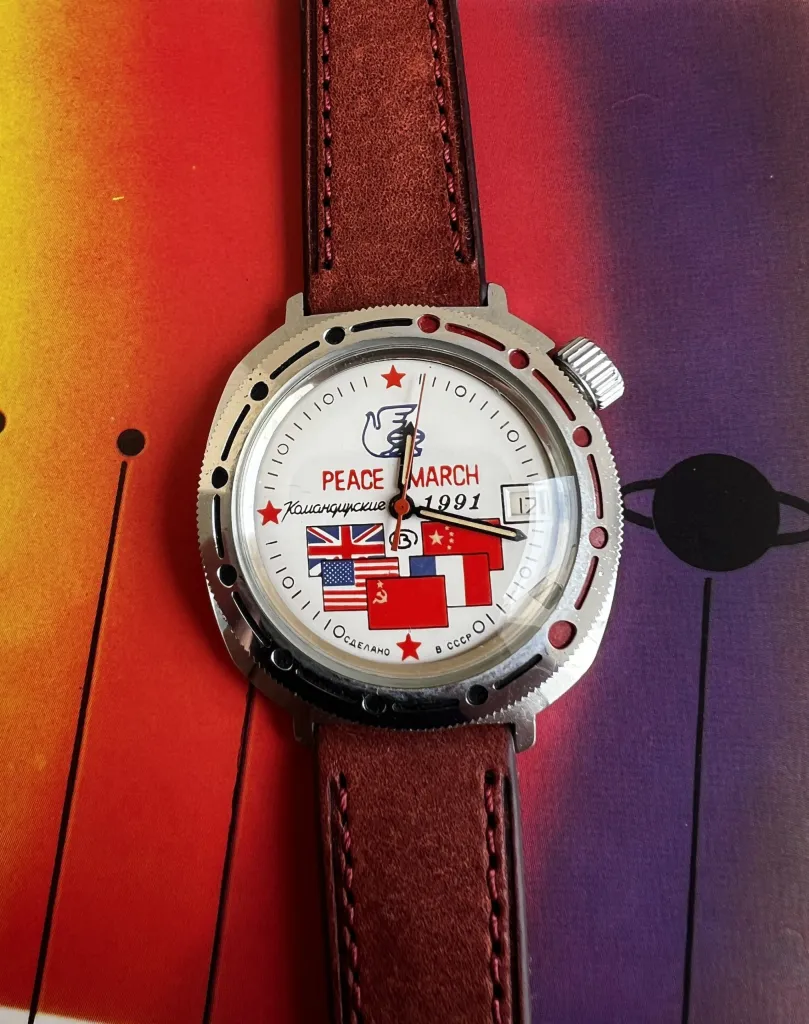
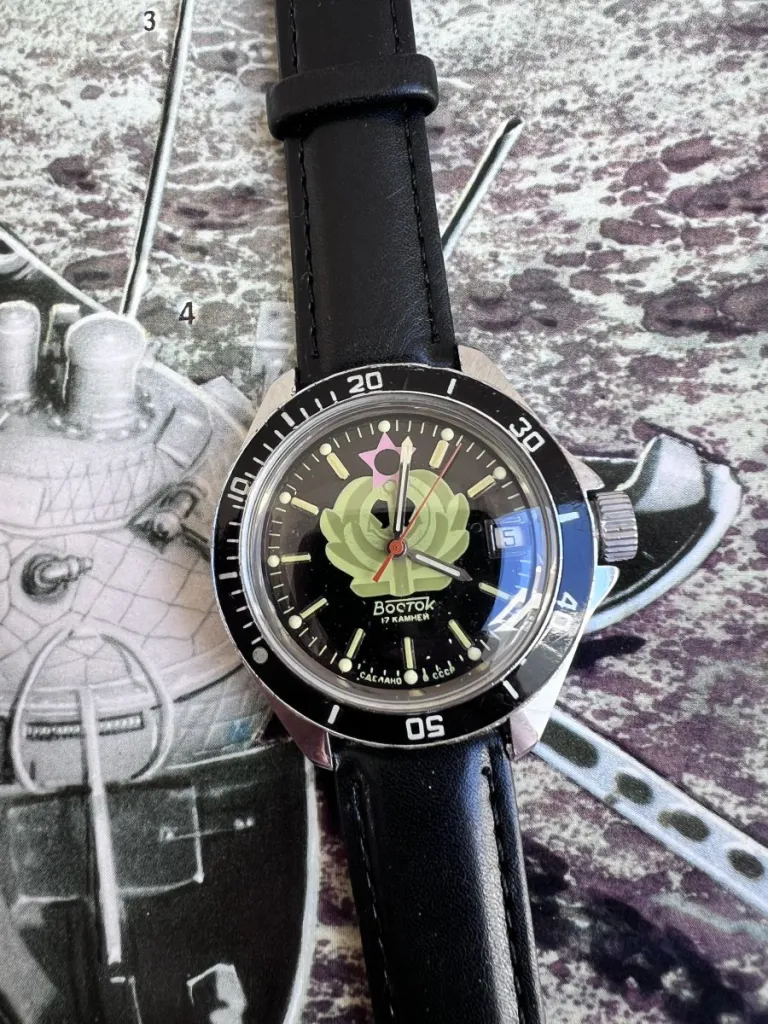
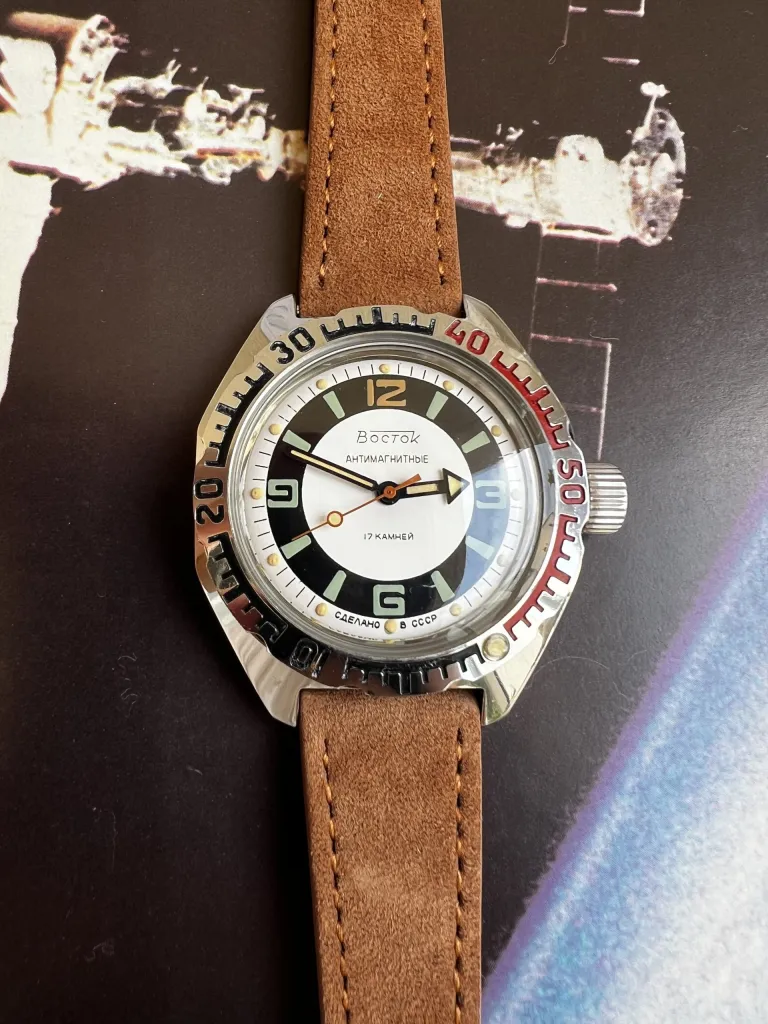
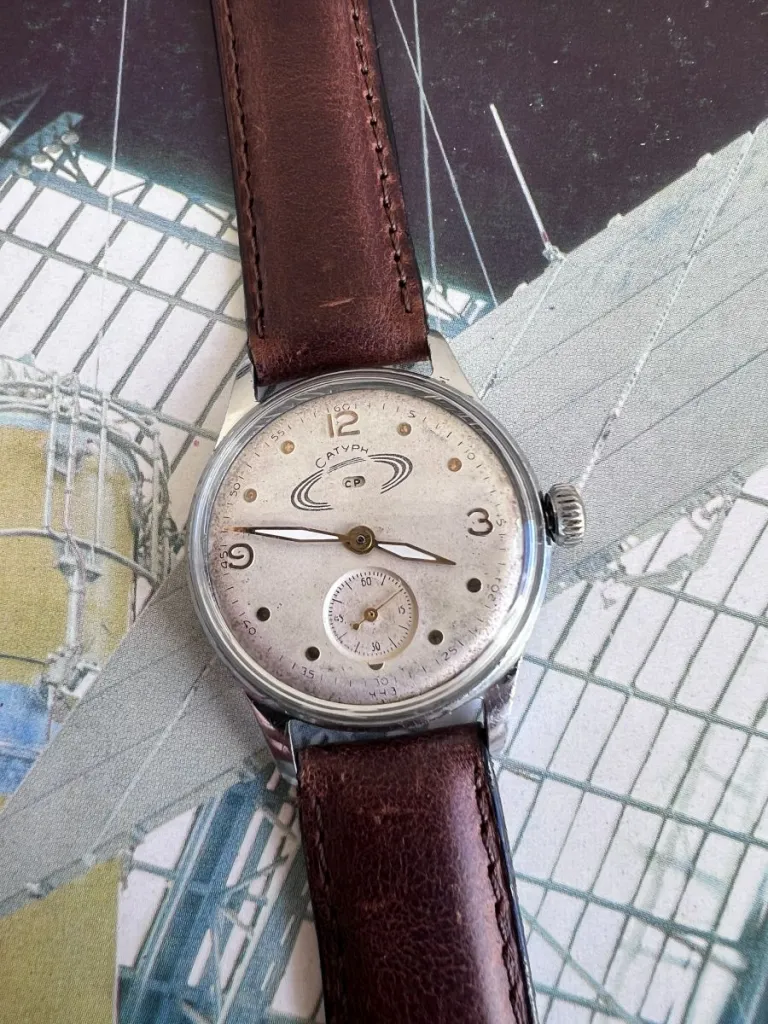
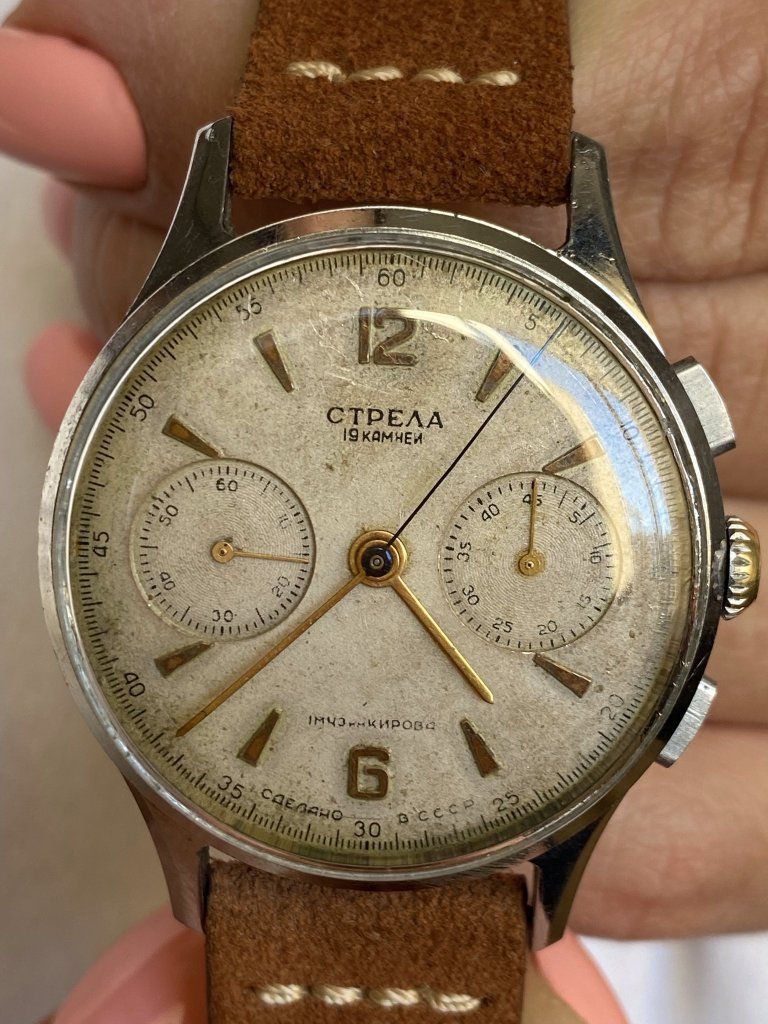
In 1965 the Chistopol factory became the official watch supplier to the Soviet Ministry of Defence. The Komandirskie, literally the commander's watch, was born that year. Some carry the dial marking « Заказ МО СССР », ordered by the USSR Ministry of Defence. This guide explains what the marking means, how the watch changed up to 1991, and what sets a period piece apart.
OCTOBER 2026•5 MINUTE READ
by Marwen Yahyaoui
Chistopol, a factory born of evacuation
On 15 October 1941 a decree ordered the Second Moscow Watch Factory to be evacuated to Chistopol, in Tatarstan. The factory counts 1 July 1942 as its date of birth. About 500 Moscow workers and engineers were joined by some 1,500 local teenagers. During the war the factory made clockwork mechanisms for mines. Its first watch, the K-43 « Кировские », came out in 1943, the « Победа » in 1949. From 1969 all its watches carried a single brand name: Vostok.
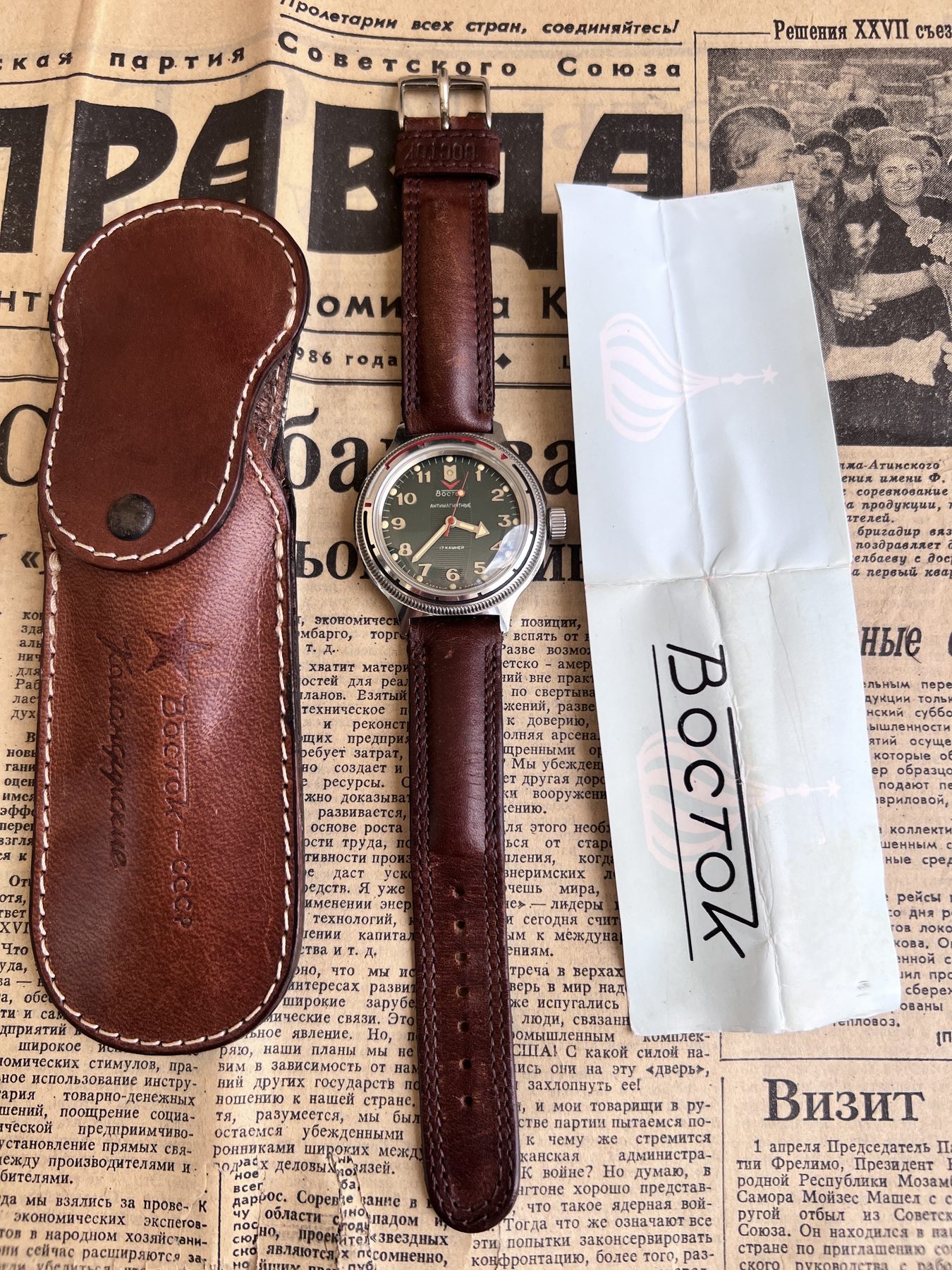
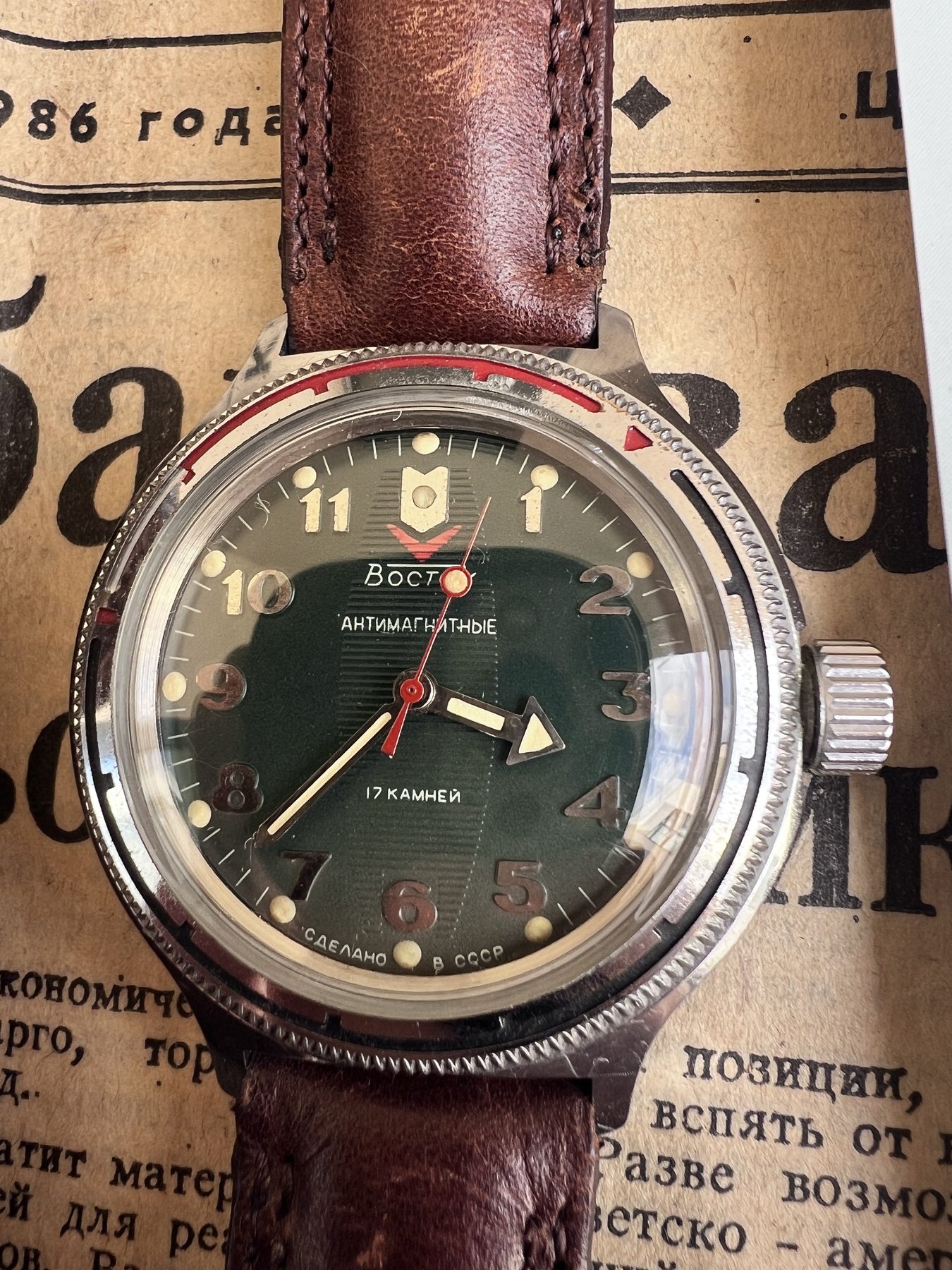
New old stock Komandirskie with its leather case and Vostok wrapping paper.
1965: the first Vostok Komandirskie
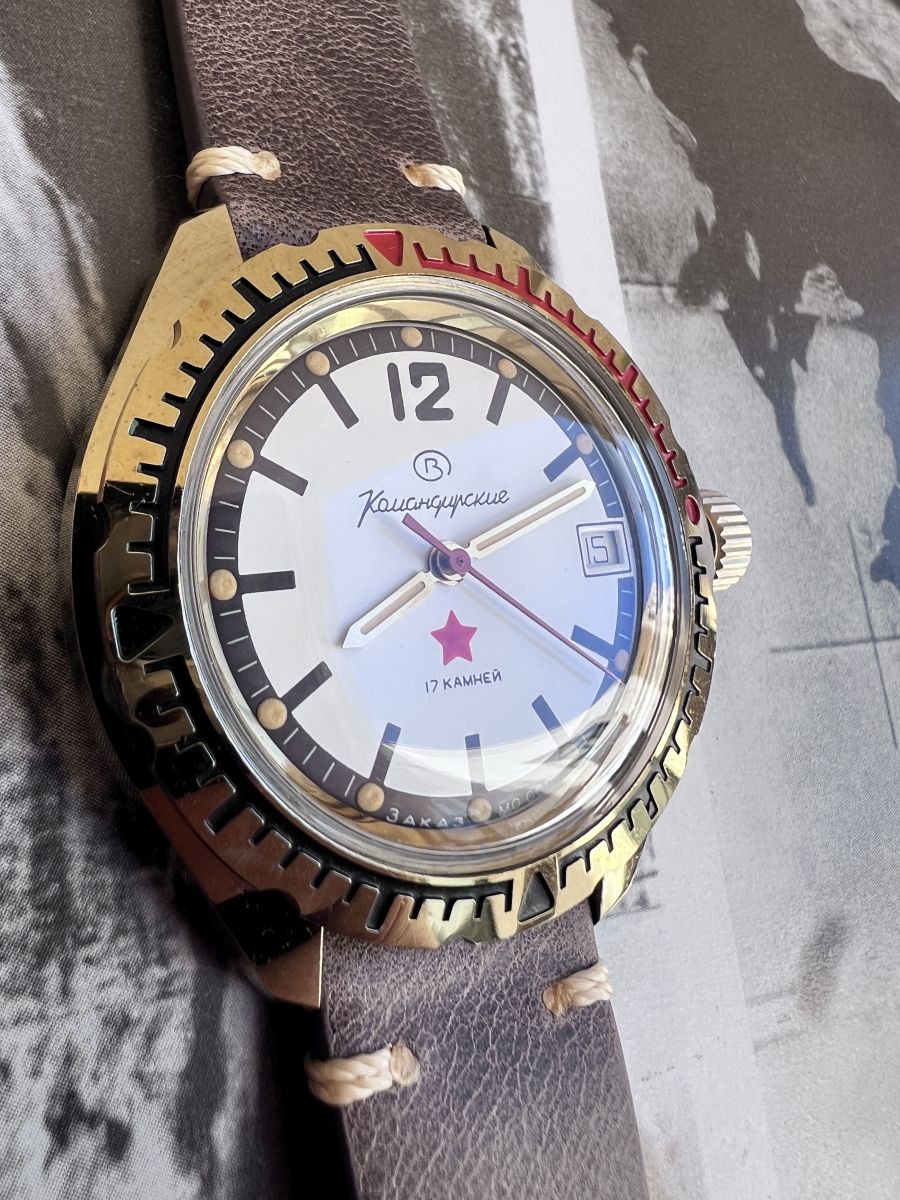
The army wanted a sturdy watch for its officers. The chosen base was one of the factory’s own watches, the « Мир », with its 2214 calibre: 18 jewels, shock protection, and a seconds hand that stops when the crown is pulled. From the start the case came in chrome and in gilt. According to the Russian site Raritetus, the specification dates from June 1964 and about a hundred pieces were made before the end of that year.
In 1965 the Ministry of Defence trade directorate printed a poster for its shops: “A novelty for officers! Hurry to buy it!”
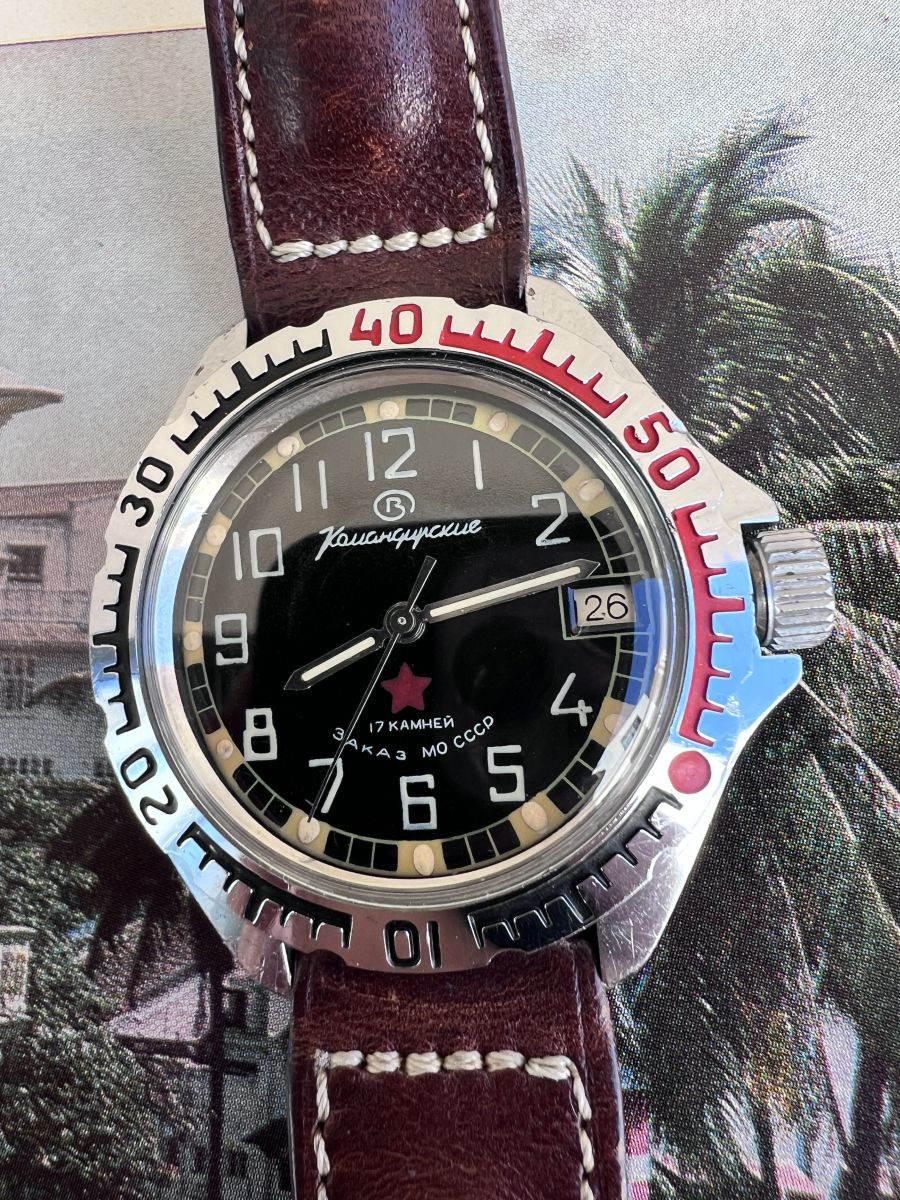
Komandirskie with a gilt case and red star.
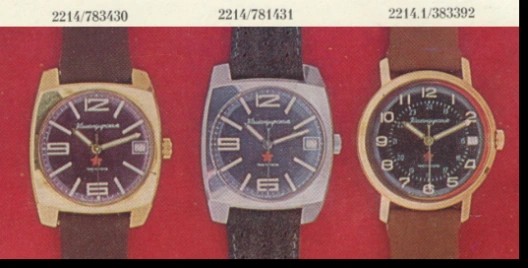
Three Komandirskie watches in a 1974 catalogue. Source: Finestraweb.
« Заказ МО СССР » and the Voentorg
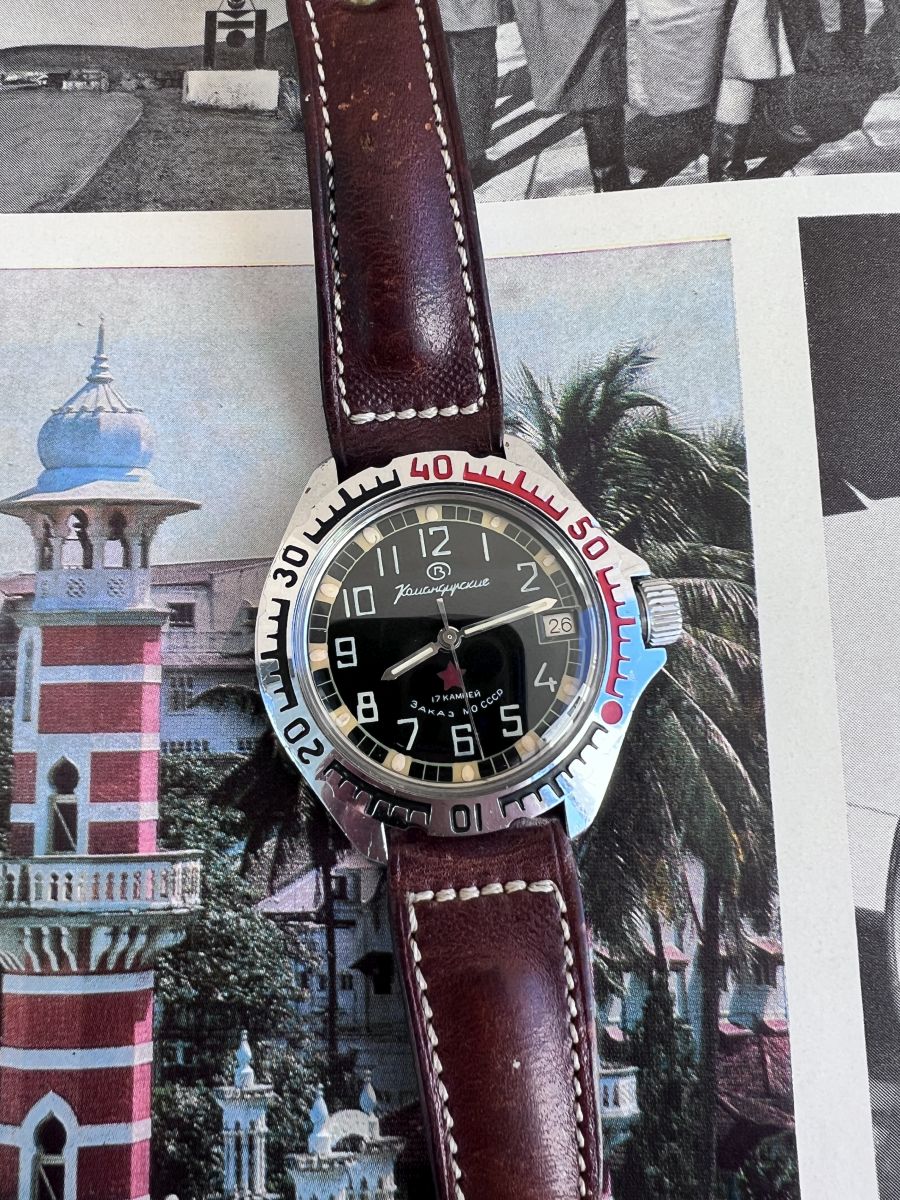
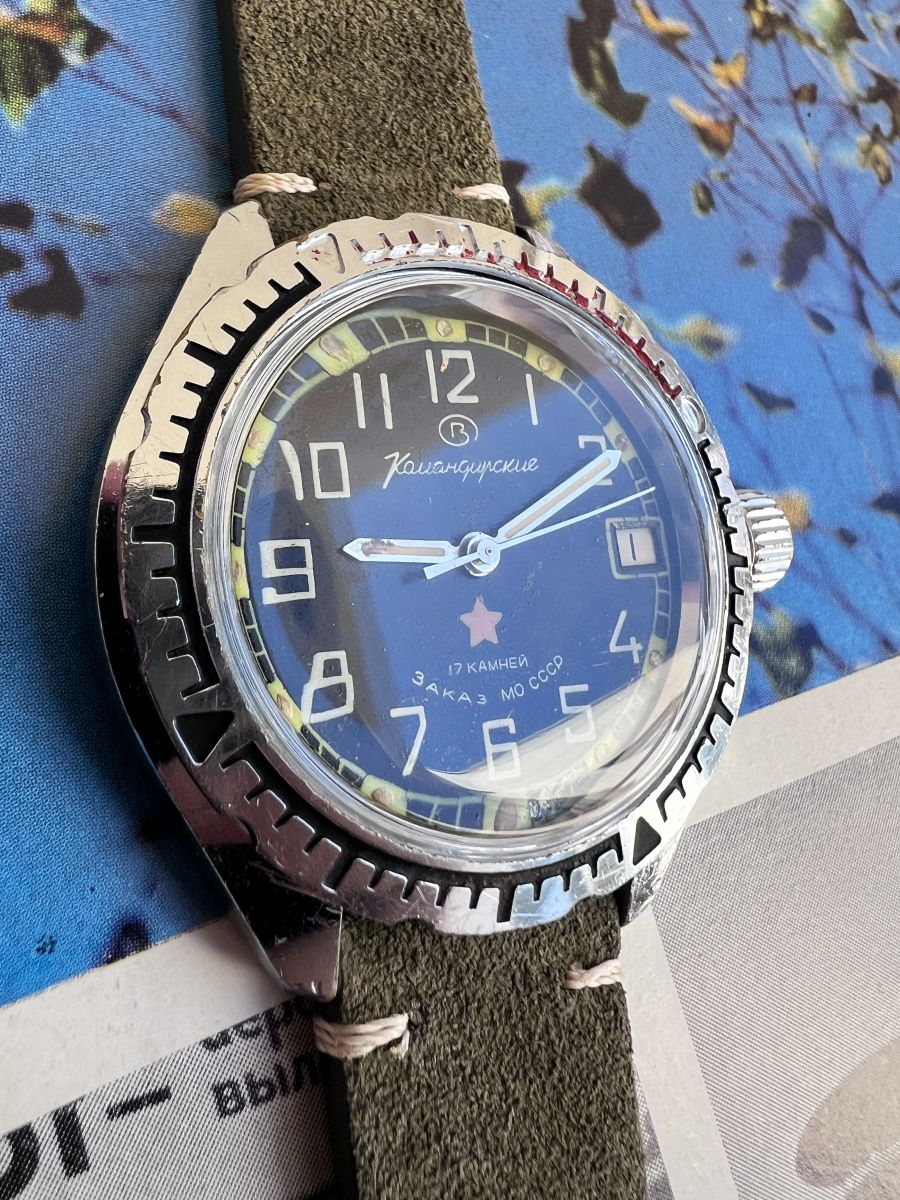
The words mean “order of the USSR Ministry of Defence”. They are printed on the dial in place of « Сделано в СССР » (made in the USSR). These watches were not on open sale. They went through the Voentorg, the army’s own retail network, founded in 1918, where purchases were made on showing an officer’s service book. Some were given as awards.
Komandirskie « Заказ МО СССР » No. 891604.
Tap the marking asked for on the photo of this Komandirskie: six questions to read its dial and its case back.
Batches arrived at the end of a quarter or a year and sold out in two or three hours. A civilian could only get one through contacts in the army. Quoted prices run from 27 roubles for a chrome one to 45 roubles. That last figure is close to a quarter of the average Soviet monthly wage of 1985, or roughly €850 when applied to the 2024 French average gross salary.
The marking gave rise to a legend: that of an issued watch, with a tank dial for tank crews and a submarine dial for submariners. It was not. The Komandirskie was sold, not handed out with the uniform. By the late 1980s it could be found in shops open to tourists, and from 1989 much of the output went for export.
After 1991 the marking disappears. It is the simplest dating clue.
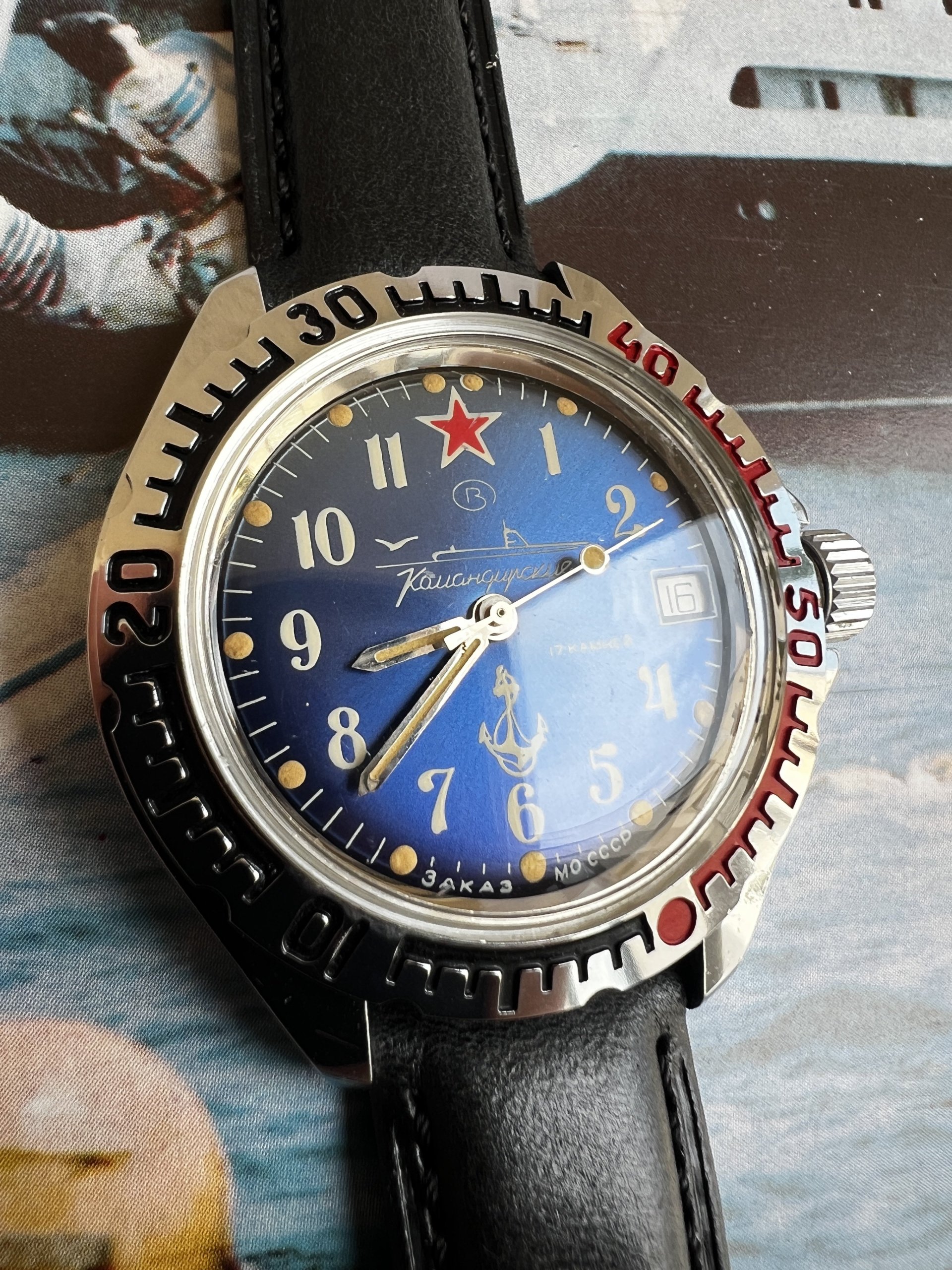
Submarine-dial Komandirskie marked « Заказ МО СССР ».
Komandirskie calibres and cases
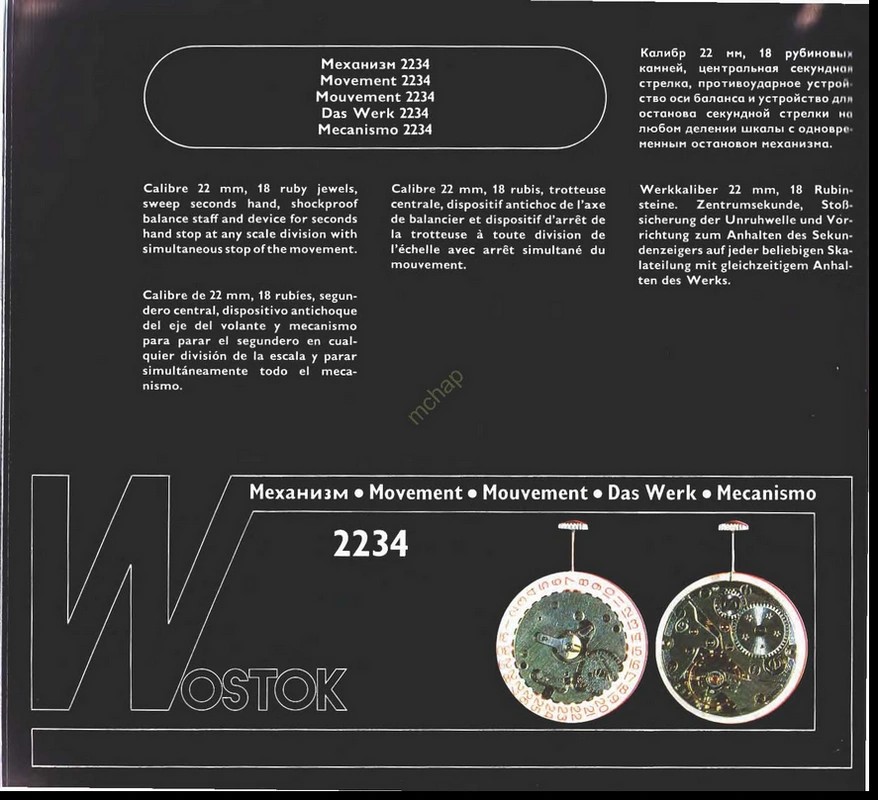
The calibre of the first Komandirskie kept the code 2214 until July 1970. It then received its own code, 2234, with no change in construction. The trade magazine « Часовой Бизнес », in 2000, nevertheless gives the code 2234 from the first pieces of 1965. In 1972 the factory launched its 24 mm calibres. The Komandirskie got the hand-wound 2414A, 17 jewels, 19,800 beats per hour, with a date, then in the 1980s the automatic 2416Б.
Komandirskie from April 1991.
The 2234 calibre in a 1976 export catalogue. Source: Finestraweb.
Two cases dominate the Soviet period: the round one, with the crown at 3 o’clock and its shoulder, and the cushion one, with the crown at 2 o’clock. They are chrome-plated brass, or gilt with titanium nitride. Some Zakaz watches have a screw-down crown, like the Amphibia.
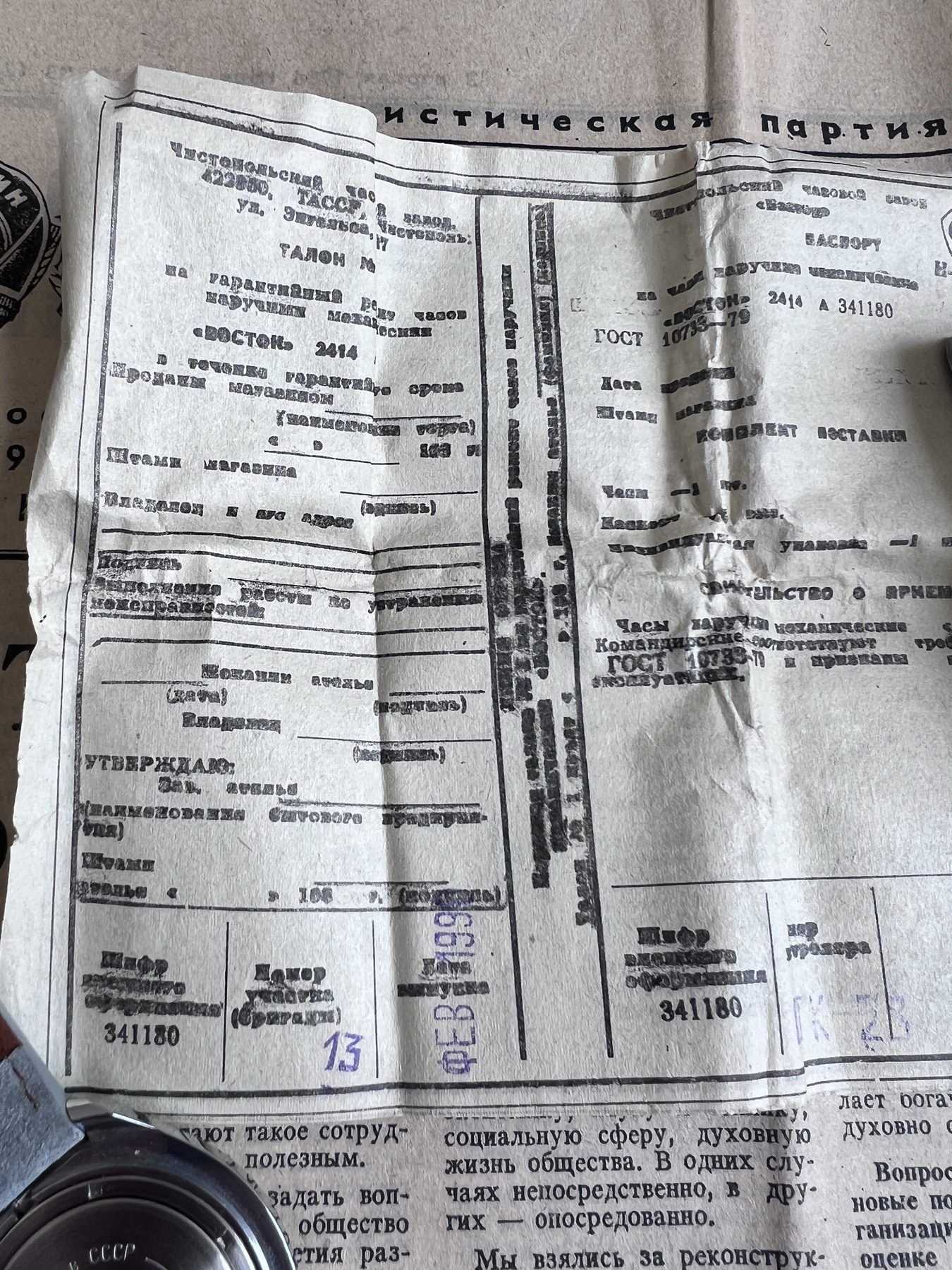
Passport of a 1990 Komandirskie.
Service-branch dials, Italy and the United States
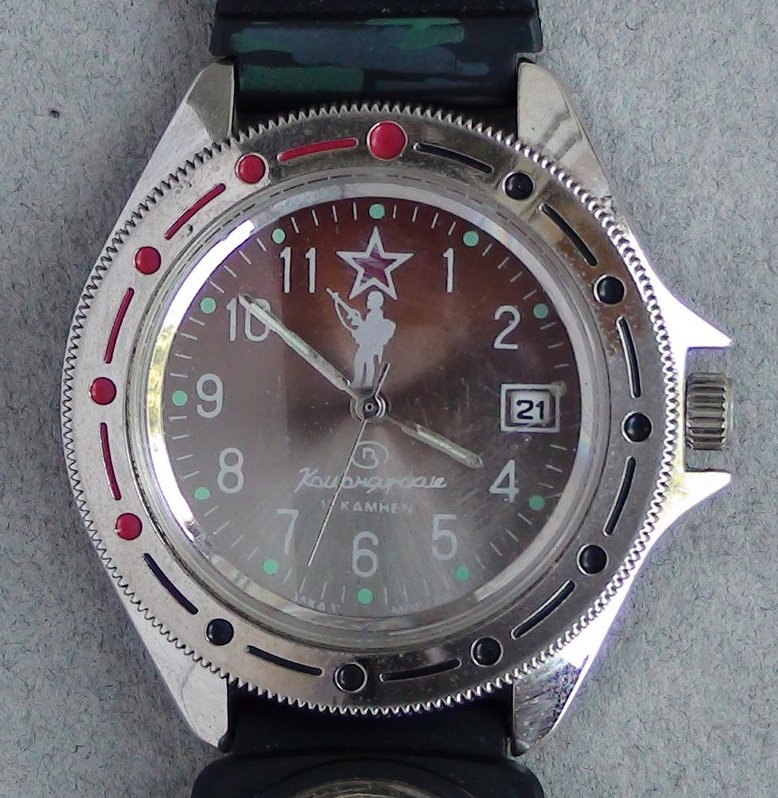
Dials with service-branch emblems appear in the 1980s: tank, submarine, airborne forces parachute.
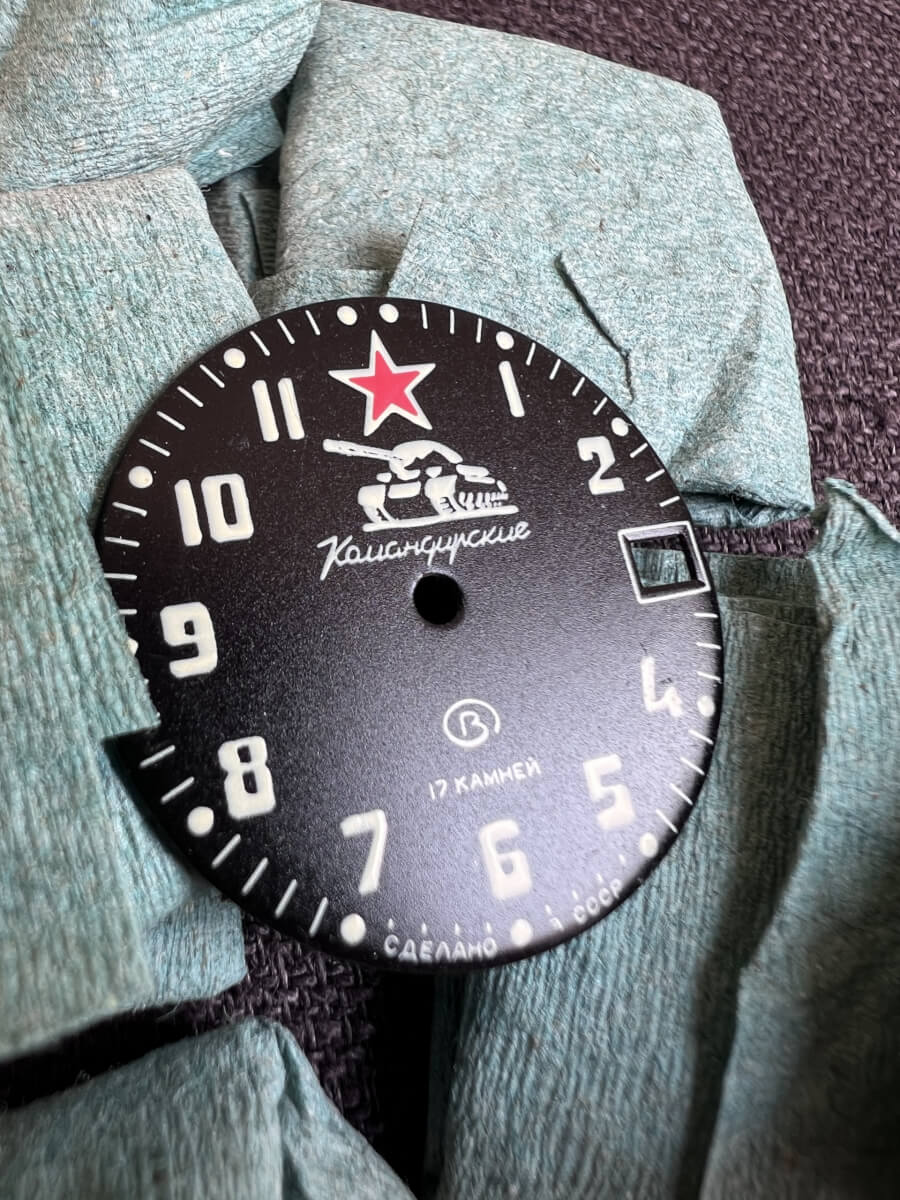
Period Komandirskie tank dial, new old stock.
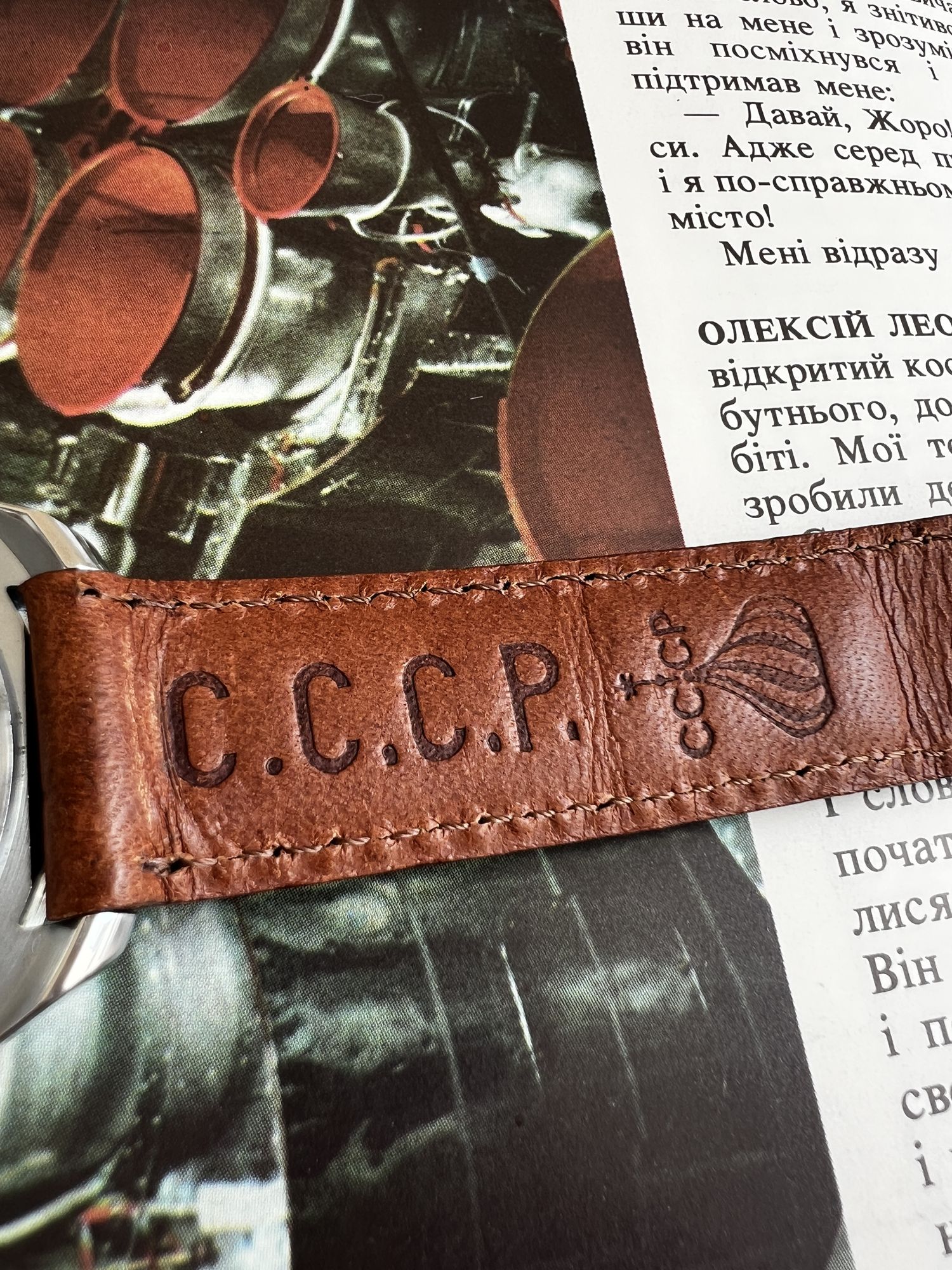
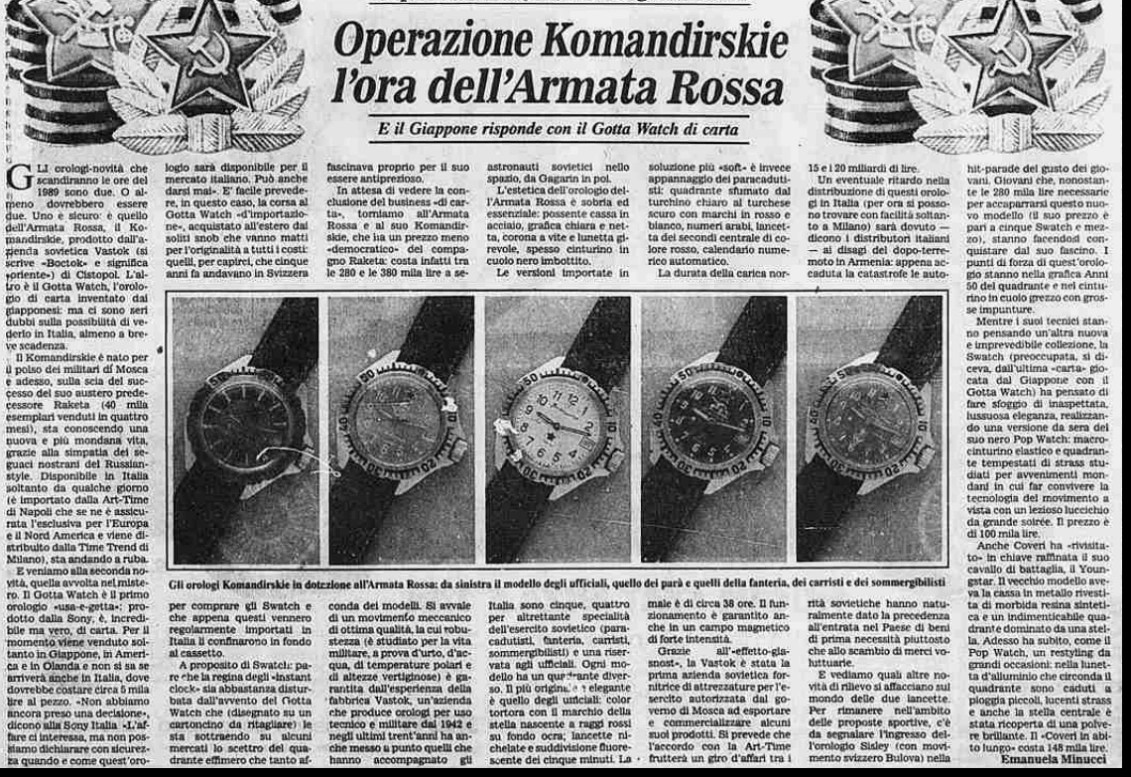
Part of that output was exported, mostly to Italy. The importer Time Trend launched the Komandirskie there in 1989, with an advertisement in La Stampa in January and the slogan “the watches of the Red Army”. They were sold with a leather strap stamped « Восток » and « СССР » and a leather case.
Original leather strap, stamped « С.С.С.Р. ».
« Operazione Komandirskie, l’ora dell’Armata Rossa », La Stampa, 17 January 1989. Source: Finestraweb.
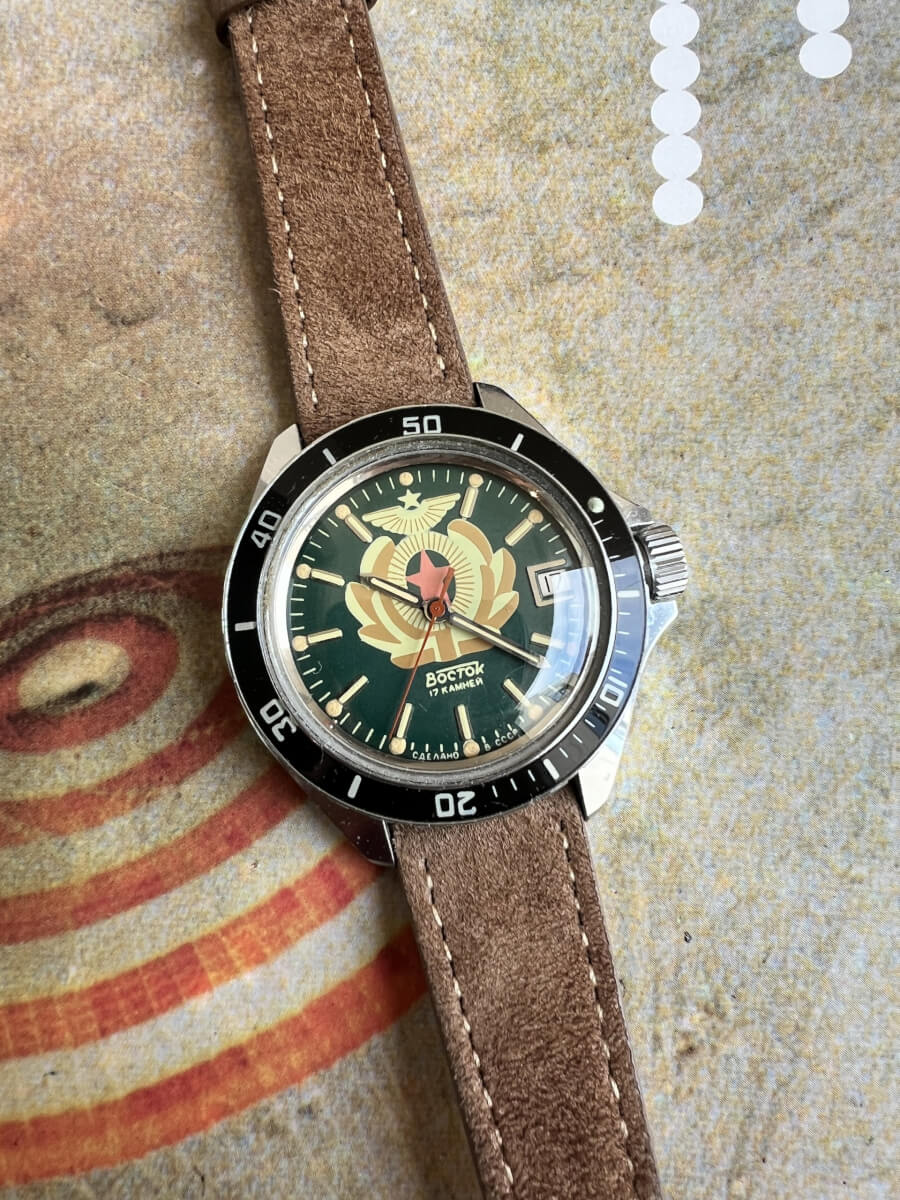
Time Trend also, in all likelihood, had dials made that did not exist in the USSR, such as the air force officers’ cockade.
Air force cockade dial, made for Italy.
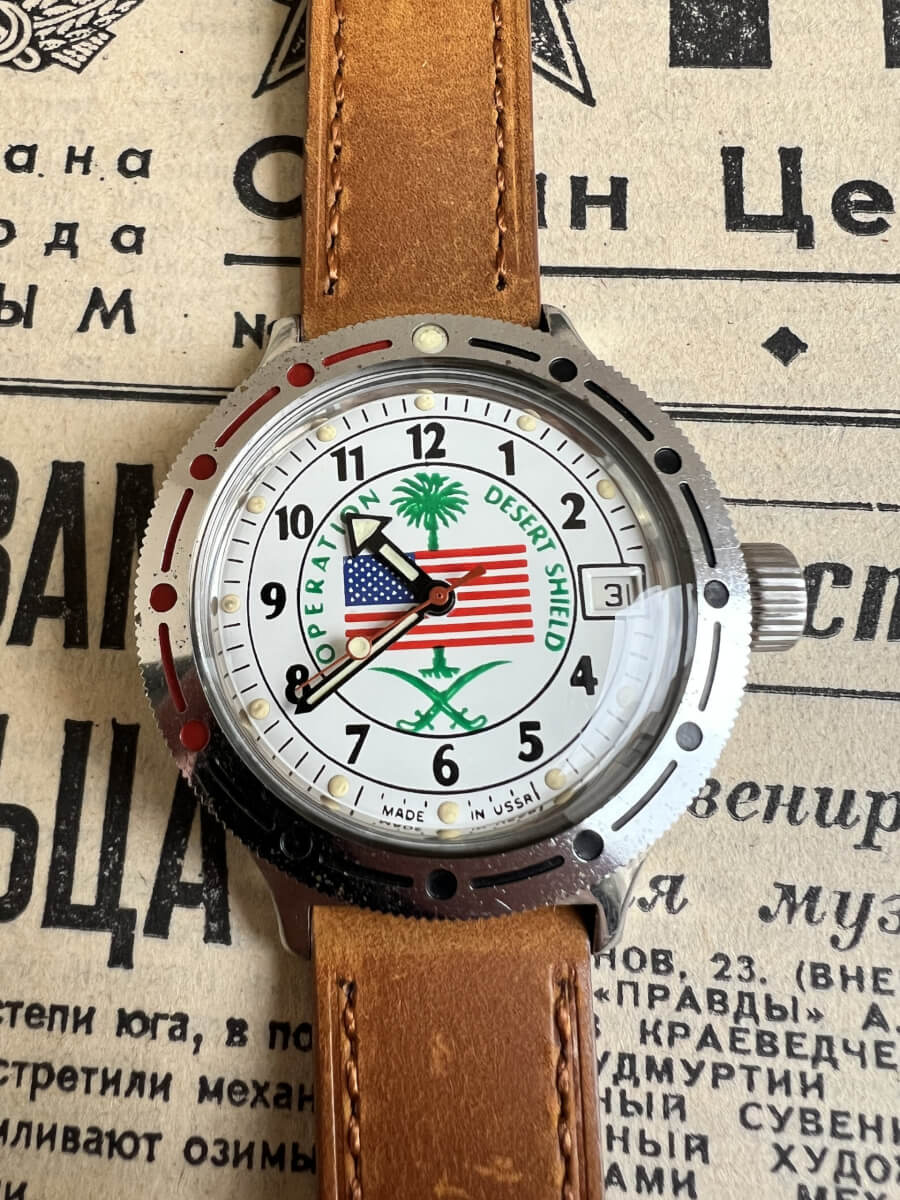
In the United States a « Desert Shield » Komandirskie was sold in 1991 by the company Timepeace. It is often said to have been issued to American soldiers in the Gulf War. It was a commercial venture.
Vostok « Desert Shield », 1991.
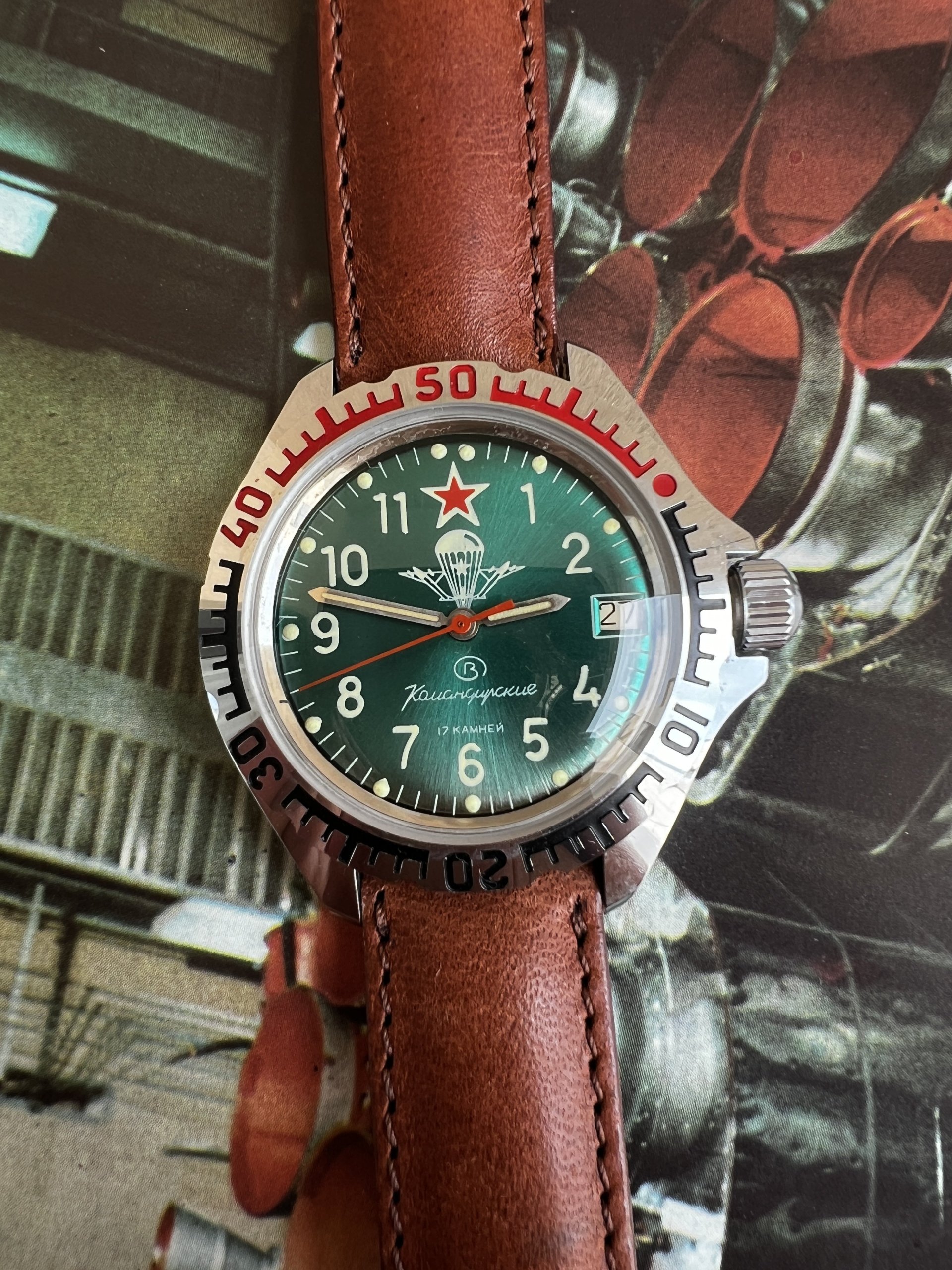
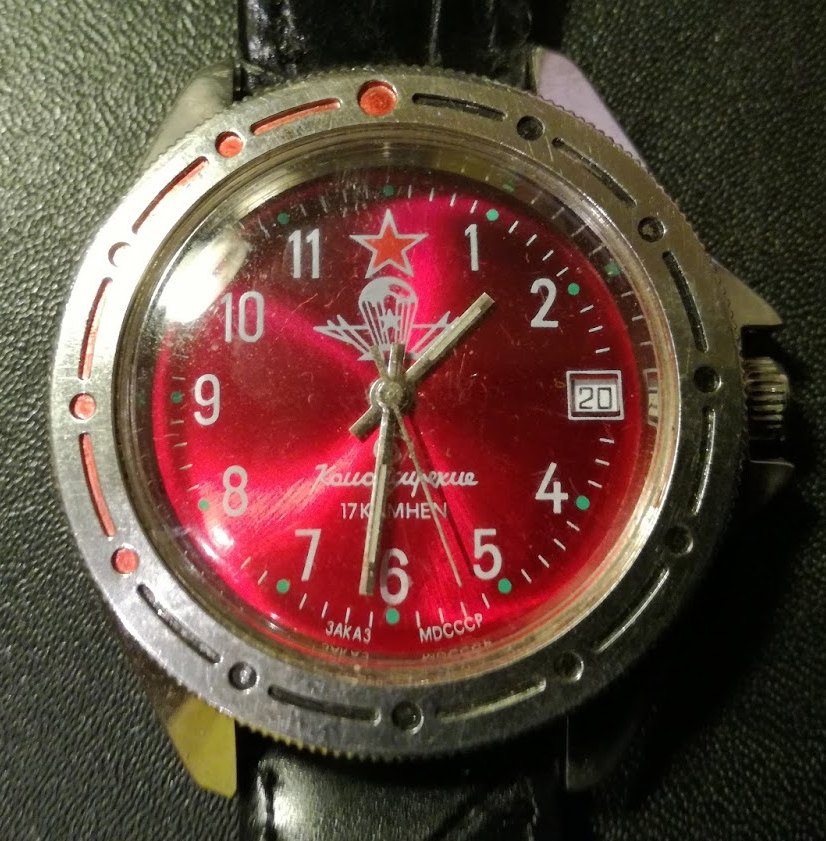
The parachute emblem went on being produced in Russia after 1991: a VDV dial is dated by its other markings.
Komandirskie VDV with the parachute emblem.
How to spot a fake Komandirskie
The line at the bottom of the dial: « Заказ МО СССР » or « Сделано в СССР » for a Soviet piece.
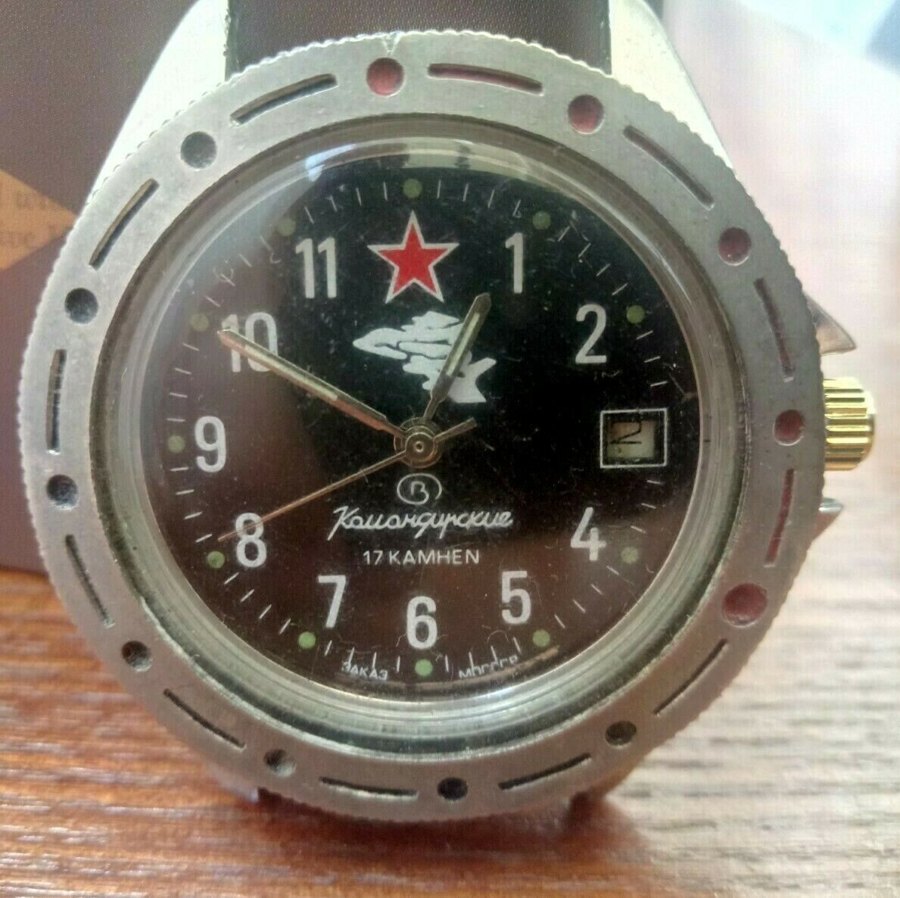
The spelling. An old copy gives itself away with a Latin “N” in place of the « Й » in « КАМНЕЙ », and « МОСССР » written without a space.
The markers. On star dials, the stars are silver from the factory. Stars painted red or reworked lume point to a retouched dial.
The movement. A Chinese imitation mass-produced in the mid-1990s copies the Komandirskie caseback around a Chinese movement.
The crown. A dial made for a crown at 3 o’clock inside a case with the crown at 2 o’clock gives an assembled watch away.
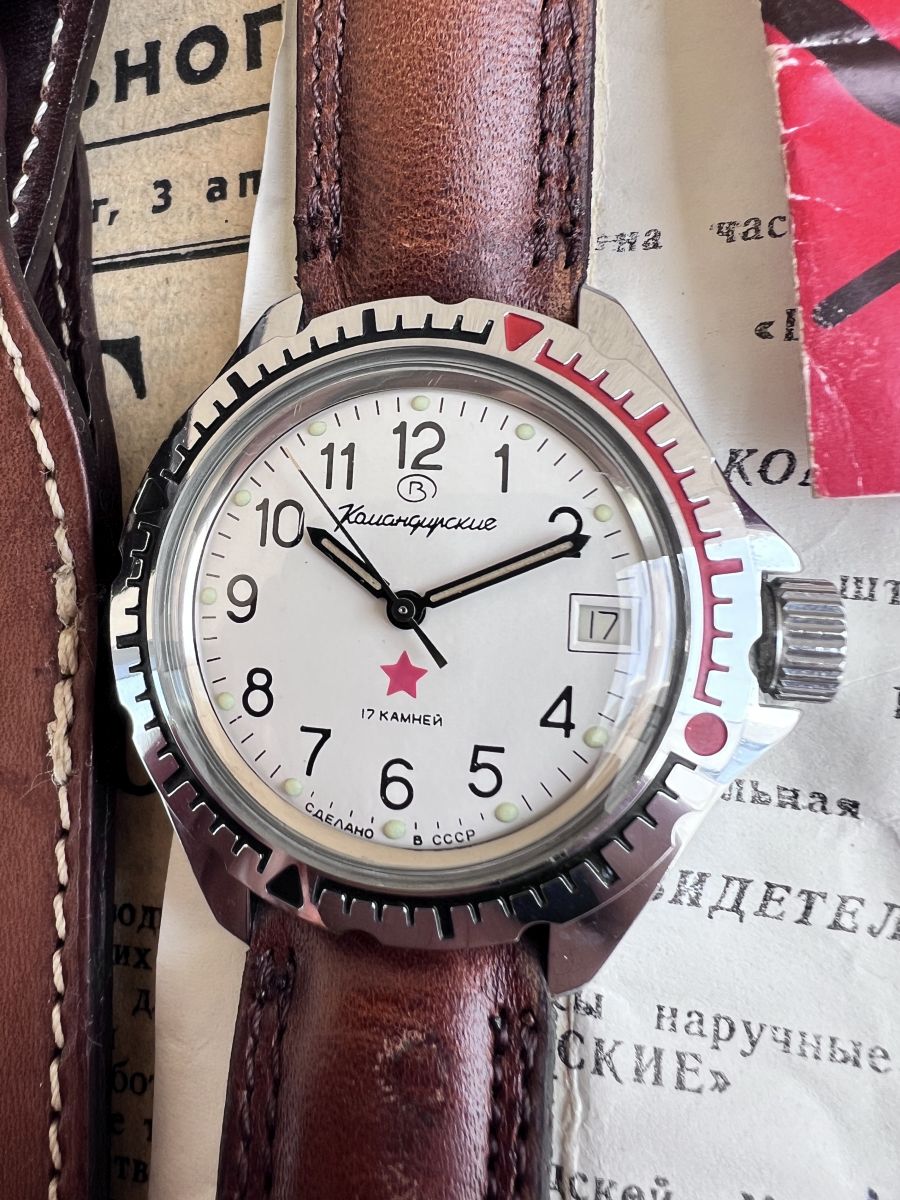
Dial of an unworn Soviet Komandirskie.
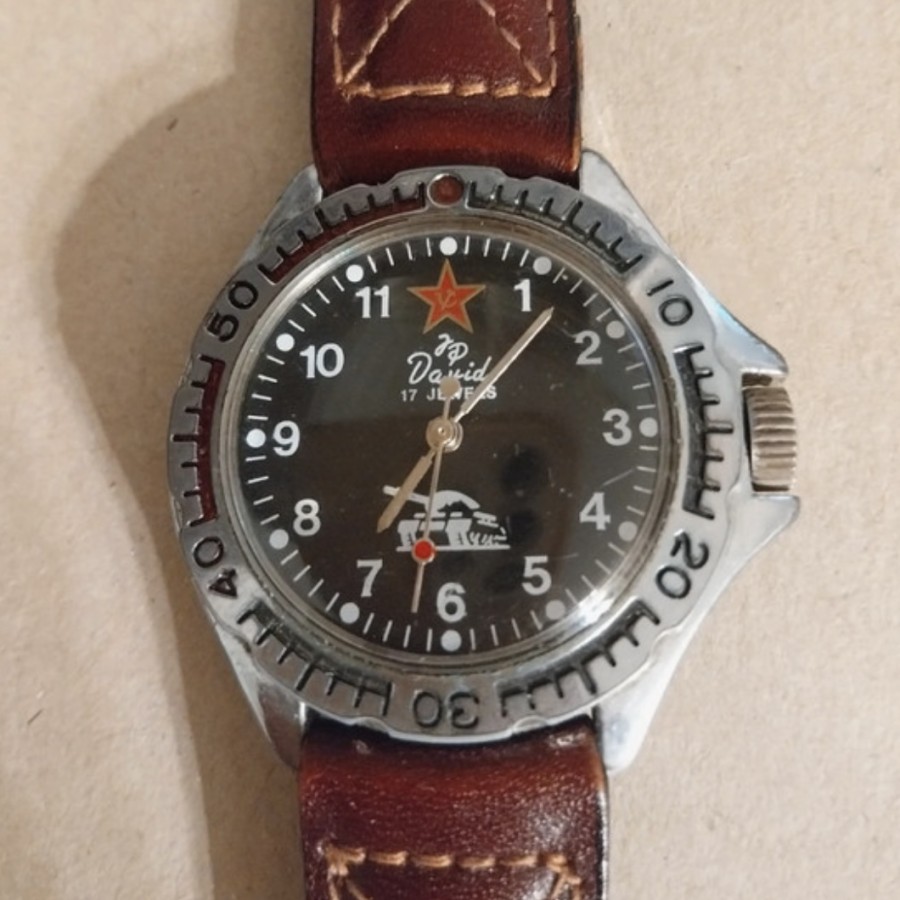
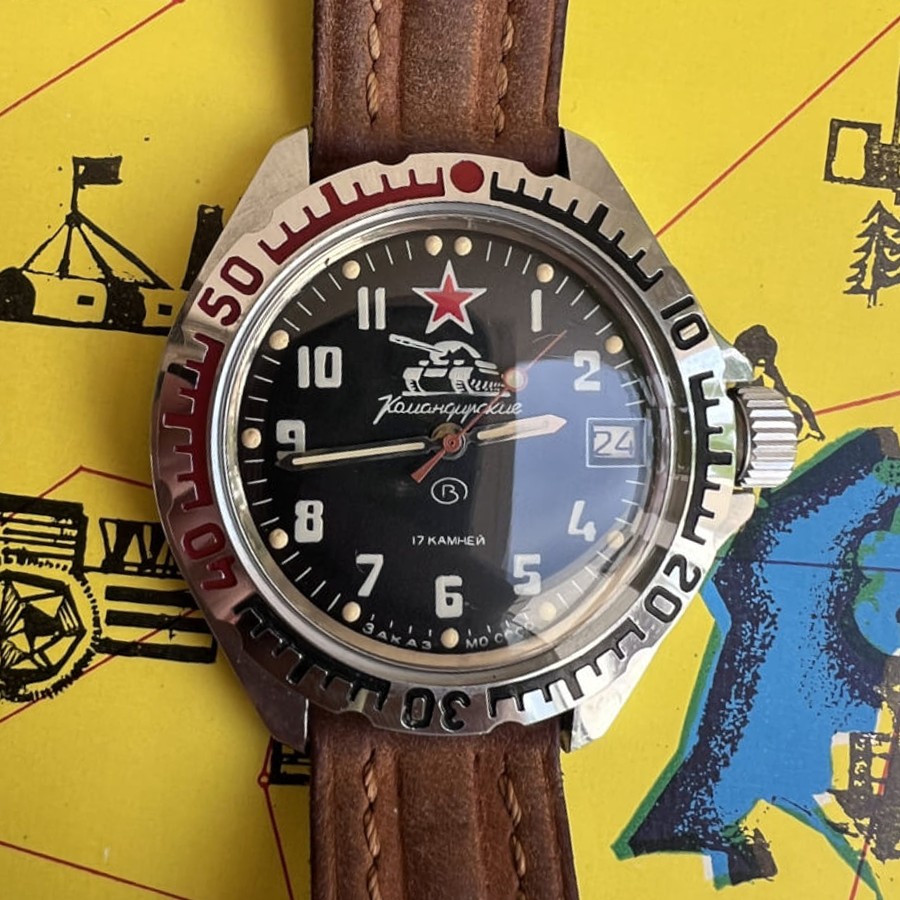
Here is a Soviet Komandirskie tank next to a copy signed “David” in Latin letters. These copies are rare, the genuine ones are far more common. The points apply to the copy shown, there are other types of fake dials.
Soviet KomandirskieCopy
1The wording. The genuine dial is entirely in Cyrillic: « Командирские » under the tank, « 17 КАМНЕЙ » above the « ЗАКАЗ МО СССР » line. The copy carries “David” and “17 JEWELS” in Latin letters, and nothing at the bottom of the dial.
2The tank. On the genuine dial, the tank is drawn above the name, just under the star. On the copy, it sits at the bottom of the dial, below the centre.
3The hands. On the genuine dial, the hour and minute hands are broad and end in an arrowhead. The copy has thin hands.
The comparator above shows only one type of copy. There are others, often sold as period Komandirskie. A “franken” is a watch assembled from parts of different watches. The photos in this section come from URSS Watch.
Chinese imitations. Mass-produced in the mid-1990s, this series copies the Komandirskie caseback around a Chinese movement. It exists in an “aircraft”, a “soldier” (armed with an M-16) and a “paratrooper” version.
“Aircraft” version. Source: URSS Watch.
“Soldier” version. Source: URSS Watch.
“Paratrooper” version. Source: URSS Watch.
A Chinese dial on a Soviet case. Here the case and the movement are Soviet, only the dial is Chinese. The dial inscription checks given above help to spot it.
Chinese dial on a Soviet case and movement. Source: URSS Watch.
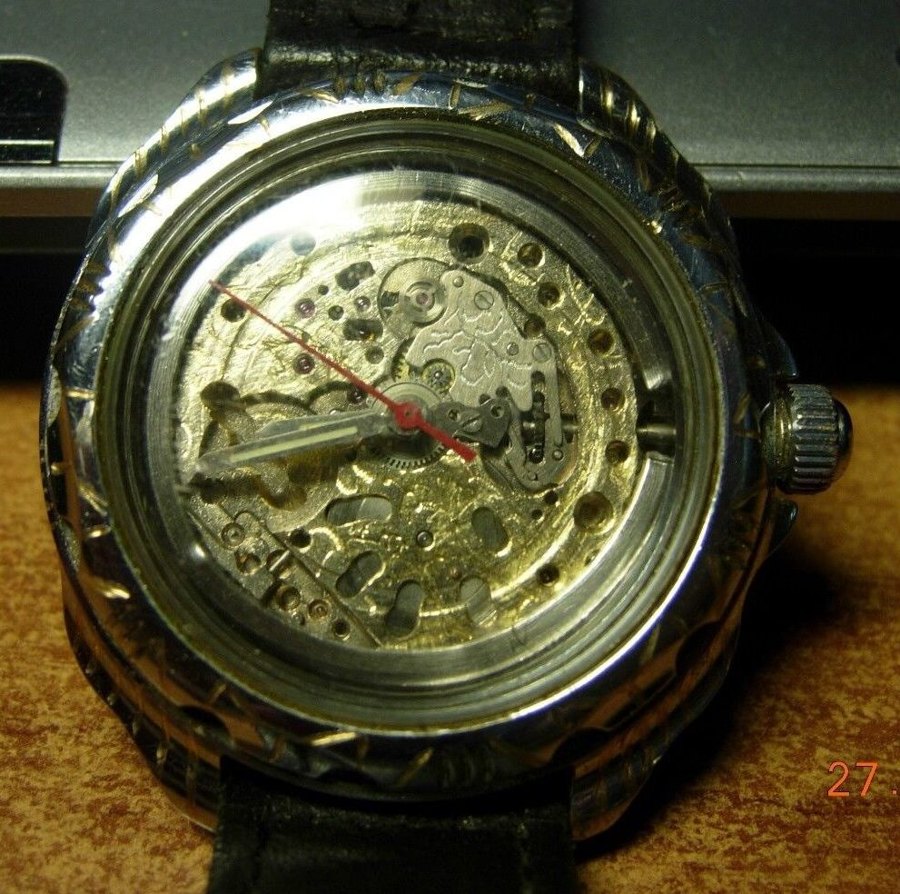
The “skeleton” Komandirskie. Some sellers remove the dial from an ordinary Komandirskie and sell it as a factory skeleton model. A watch without a dial therefore needs checking before you buy.
Komandirskie with the dial removed, sold as a skeleton. Source: URSS Watch.
The Eaglemoss tribute. The company Eaglemoss produced a collection of tribute military watches, including a tribute to the Komandirskie. As a tribute, the watch is fine. The problem starts when online sellers present it as a period piece.
Eaglemoss tribute to the Komandirskie. Source: URSS Watch.
Frankens. Cases recorded include a Breitling-style seconds hand fitted on a Vostok, a movement and dial set with the crown at 3 o’clock placed in a case with the crown at 2 o’clock and photographed from the side to hide the anomaly, and a Komandirskie “Chistopol” dial mounted in a Slava case. New dials of this kind are also sold separately online.
“Chistopol” dial in a Slava case. Source: URSS Watch.
The Slava the case came from. Source: URSS Watch.
How to use the screw-down crown
The Vostok crown is linked to the stem by a clutch: once unscrewed it has play, which is normal. The cutaway below shows the six positions, from the screwed-down crown to setting the time.
The ДП-5В (DP-5V) is the field radiometer of Soviet civil defence: a green Bakelite console, a probe with a rotating gamma, beta and check-source shield, headphones and a manual that explains operation and maintenance. The one in this article served in an industrial bakery in Chișinău and was serviced in March 1991. Its owner shared his photos and documents with us, and we turned them into a tool that lets you operate it on screen, step by step.
The Moscow Games, from 19 July to 3 August 1980, boycotted by some sixty countries, produced more objects than any Soviet event: a bear cub, Misha, drawn by Viktor Chizhikov, an emblem made of running tracks, five thousand torches, watches from every factory, platinum coins, rings, tea glass holders, posters. This guide tells the story of the Games and reviews the objects, with the marks that authenticate them and the prices.
The 3017 chronograph of the First Moscow Watch Factory carries a five-digit number on the balance cock. The most common dating method reads it as a single series, from 1959 to 1979. Four factory passports show there are two, and that the same number can point to two watches made ten years apart. Here is how to read the number, the dial, the logo and the bridge, with a decoder to date your Strela, Poljot or Sekonda.
This website uses cookies to improve your experience while you navigate through the website.
Out of these cookies, the cookies that are categorised as necessary are stored on your browser as they are essential for the working of basic functionalities of the website.
We also use third-party cookies that help us analyse and understand how you use this website.
These cookies will be stored in your browser only with your consent.
You also have the option to opt out of these cookies.
But opting out of some of these cookies may affect your browsing experience.
Necessary cookies are absolutely essential for the website to function properly. This category only includes cookies that ensure basic functionalities and security features of the website. These cookies do not store any personal information.
Cookies that are not strictly necessary for the website to work and that are used specifically to collect personal data through analytics, ads and other embedded content are called non-necessary cookies. User consent is required before these cookies run on the website.
✕
Soviet in Paris
Offline right now. Leave your message and your email, we reply within 24 hours.
Hello 👋 A question about an item, an order or shipping? Write to us.
Your email is used only to reply to you.
Subscribe to our newsletter and get 10% off your first order.
Subscribe
★ New pieces before anyone else
★ New blog articles
★ Soviet in Paris news and updates
Join the Party
10% off your first order
Receive your welcome card and our next arrivals.
Your code appears here and is also sent to you by email. You can leave the Party in one click, at any time.