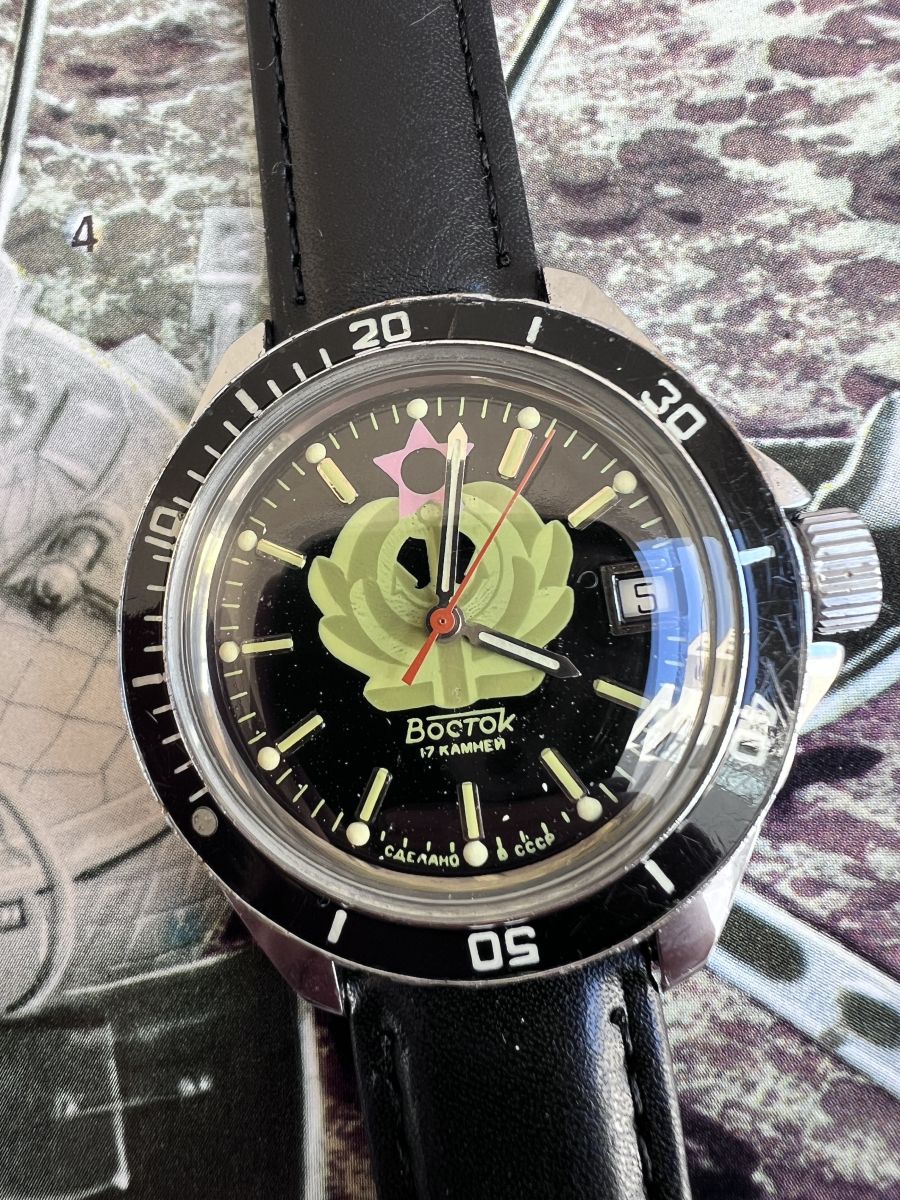
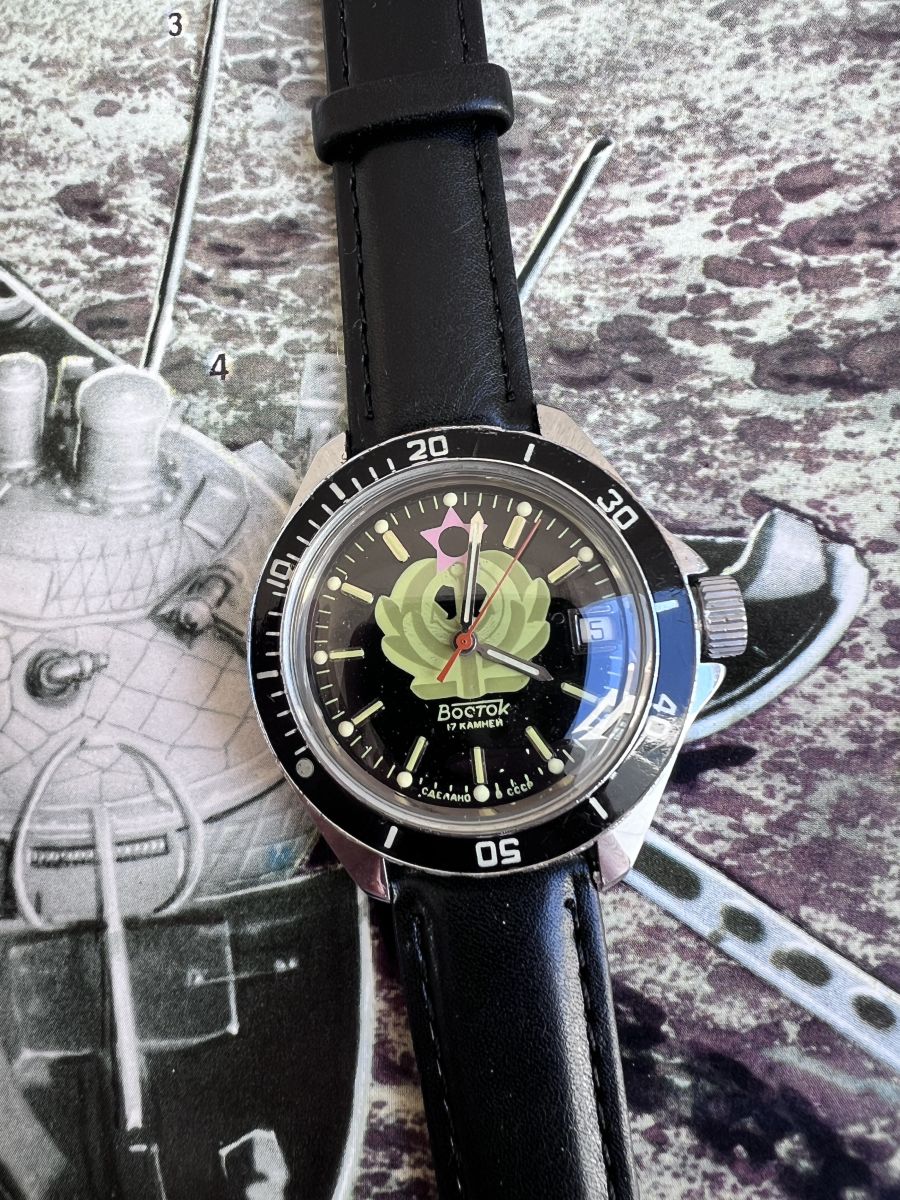
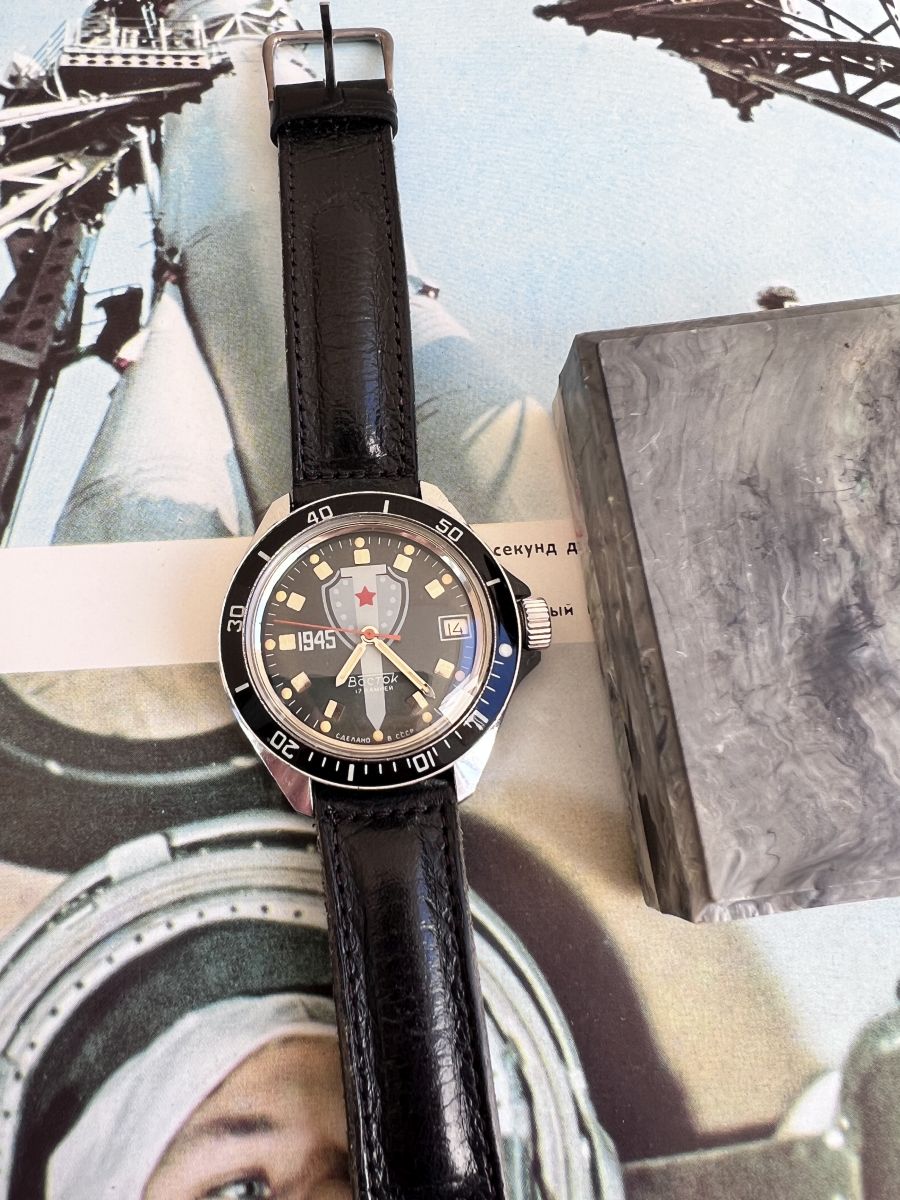
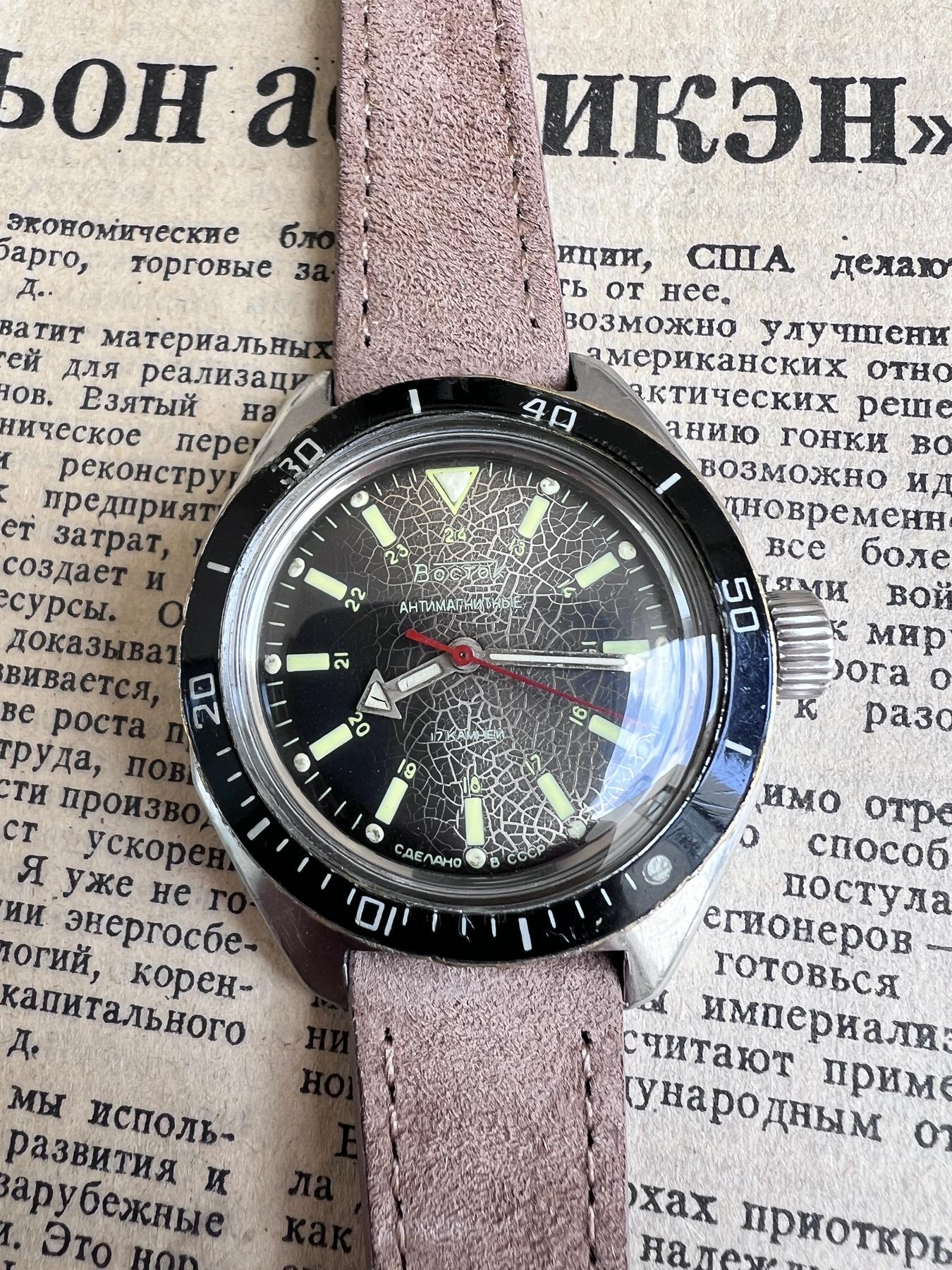
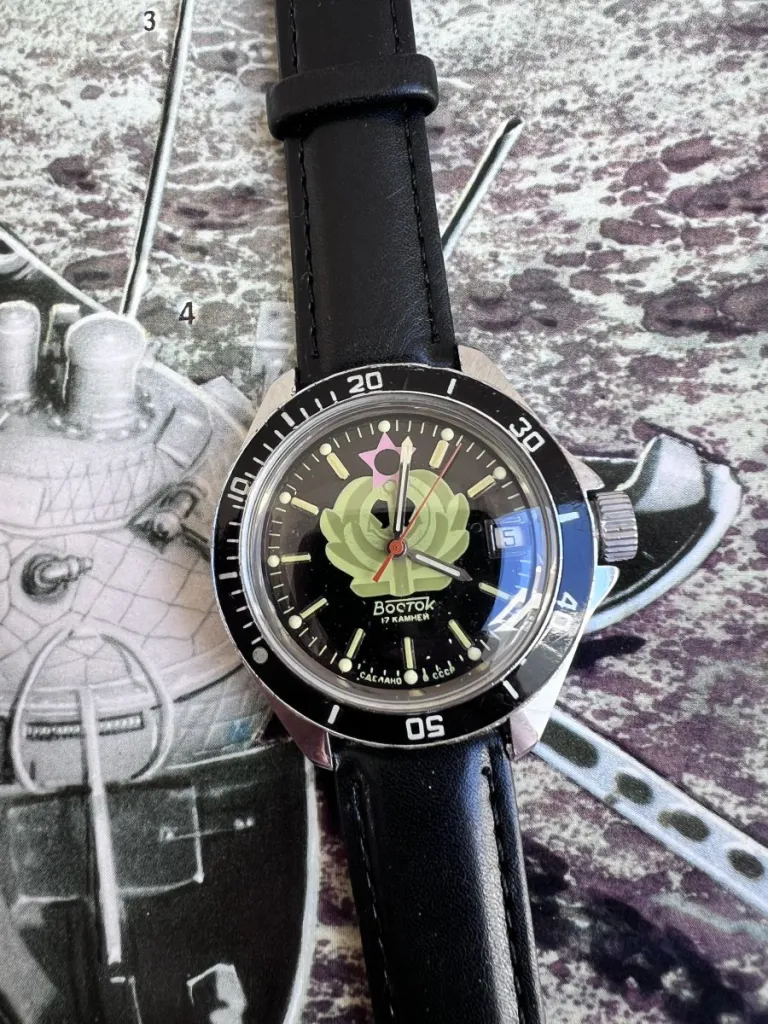
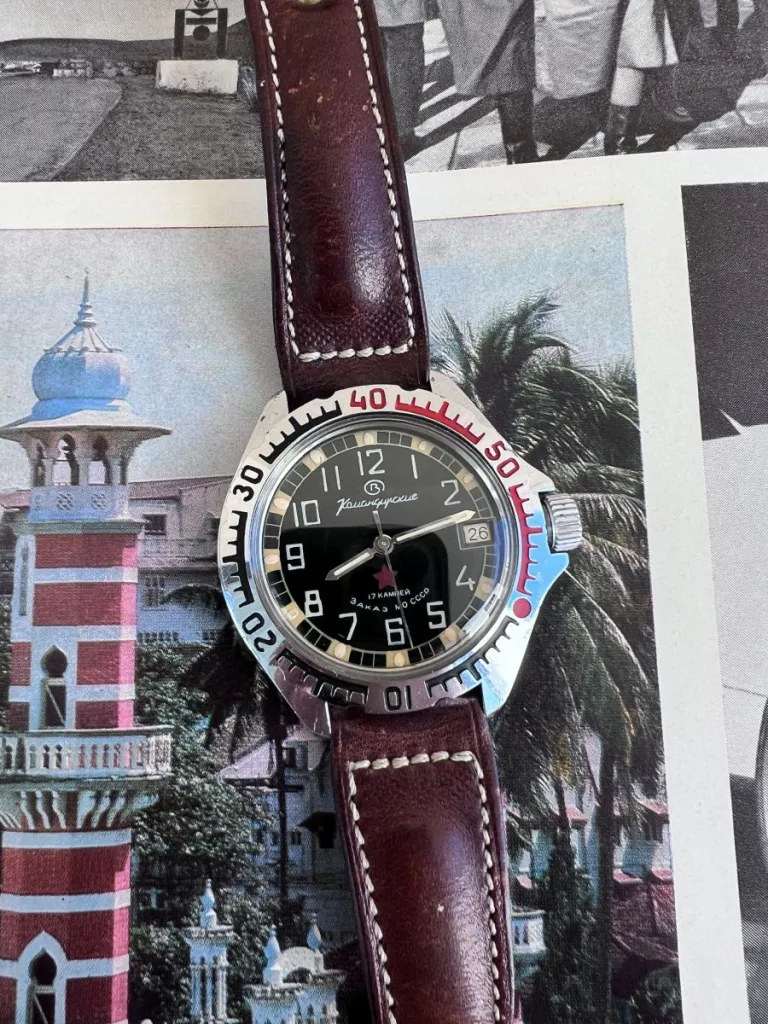
In 1967 the Chistopol factory designed a dive watch that turned the problem around: instead of resisting water pressure, the case uses it to seal itself. The Amphibia was made through the last Soviet decades and then in Russia, under dozens of dials. This guide covers where it comes from, its main versions, and what separates a Soviet piece from a later one.
OCTOBER 2026•6 MINUTE READ
by Marwen Yahyaoui
The Amphibia’s name was chosen in a contest among factory employees.
Vostok Amphibia: a case that water closes
The watch is the work of Mikhail Novikov, head of the new developments office, and Vera Belova. The brief called for a watch on a par with foreign models that would work at 200 metres. Novikov later explained why the factory did not copy Swiss cases: its machines could not reach the precision required, and almost all those designs were covered by patents.
So he turned the problem around. The deeper the watch goes, the harder the water presses the crystal and the caseback onto their gaskets. The crystal is plastic, 3 mm thick, more than on a Komandirskie. It flexes by half a millimetre under 20 atmospheres and presses against the case. A mineral crystal would crack.
The caseback does not screw in. It sits on a wide, flat gasket and is clamped by a threaded ring, so the gasket is compressed without being sheared. The back is twice as thick as on an ordinary watch, and the case is stainless steel, a first for a factory that had worked in brass until then.
The crown screws down. Its stem has a clutch: until the crown is pulled out, it is not engaged with the movement and it wobbles under the finger. That play is intended. It protects the stem from side impacts.
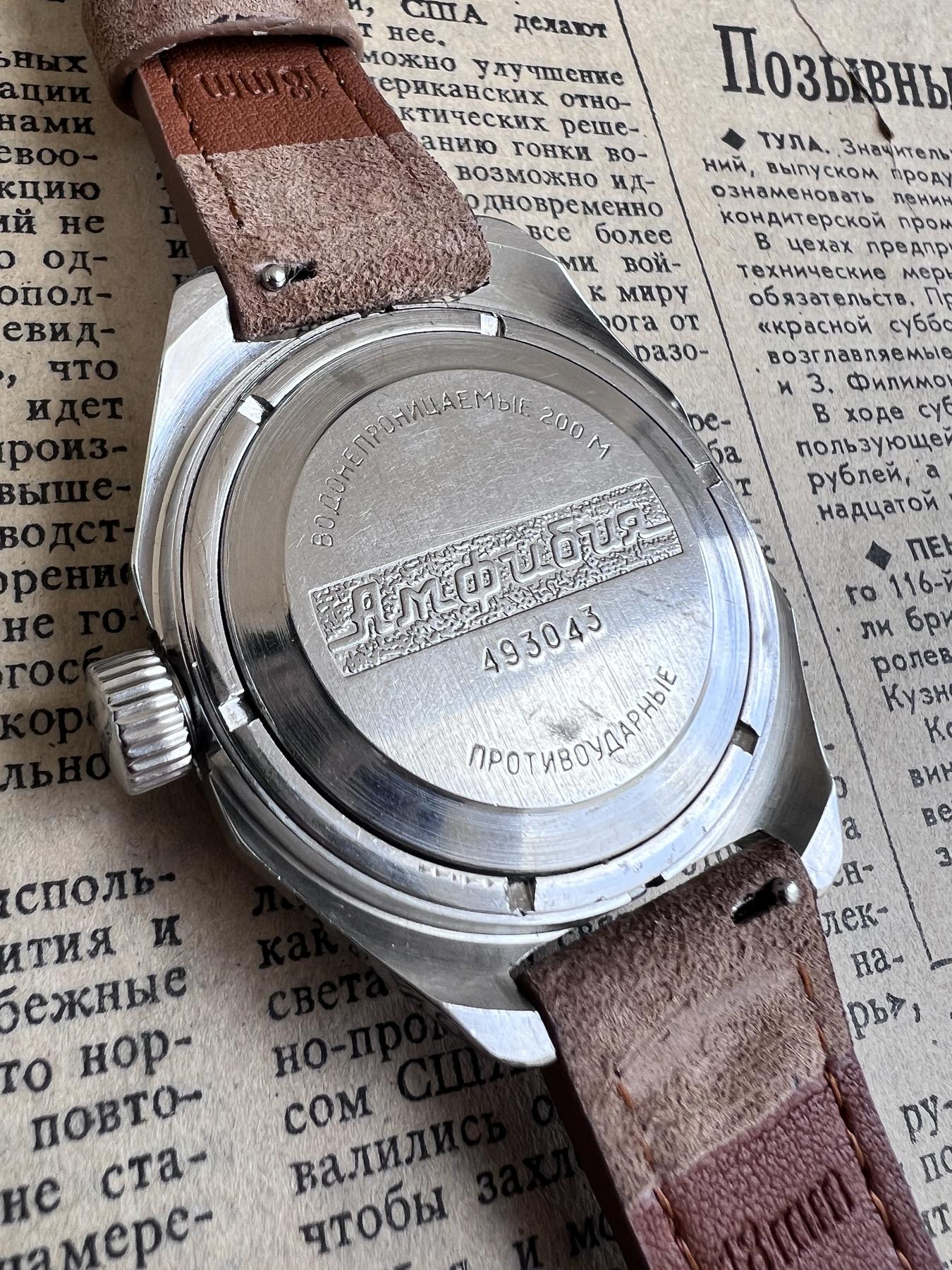
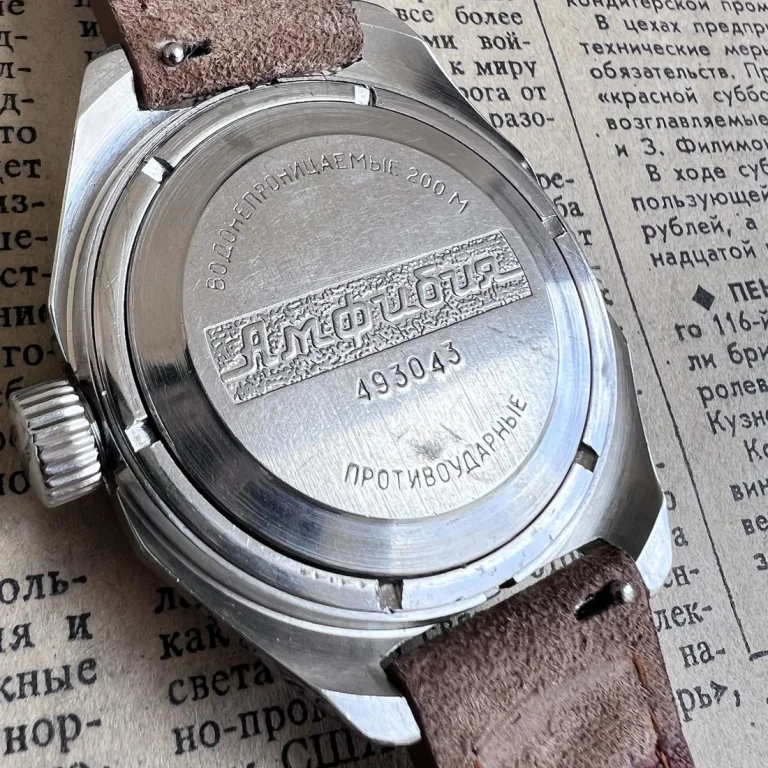
The caseback of period pieces carries a six-digit number and the engravings « АМФИБИЯ », « ВОДОНЕПРОНИЦАЕМЫЕ 200 М » (waterproof to 200 metres) and « ПРОТИВОУДАРНЫЕ » (shock-resistant).
Engraved caseback of a Soviet Amphibia.
In 1975 the cosmonaut Georgy Grechko wore an Amphibia on Soyuz 17, bound for the Salyut 4 station.
The NVCh-30, the Amphibia for military divers
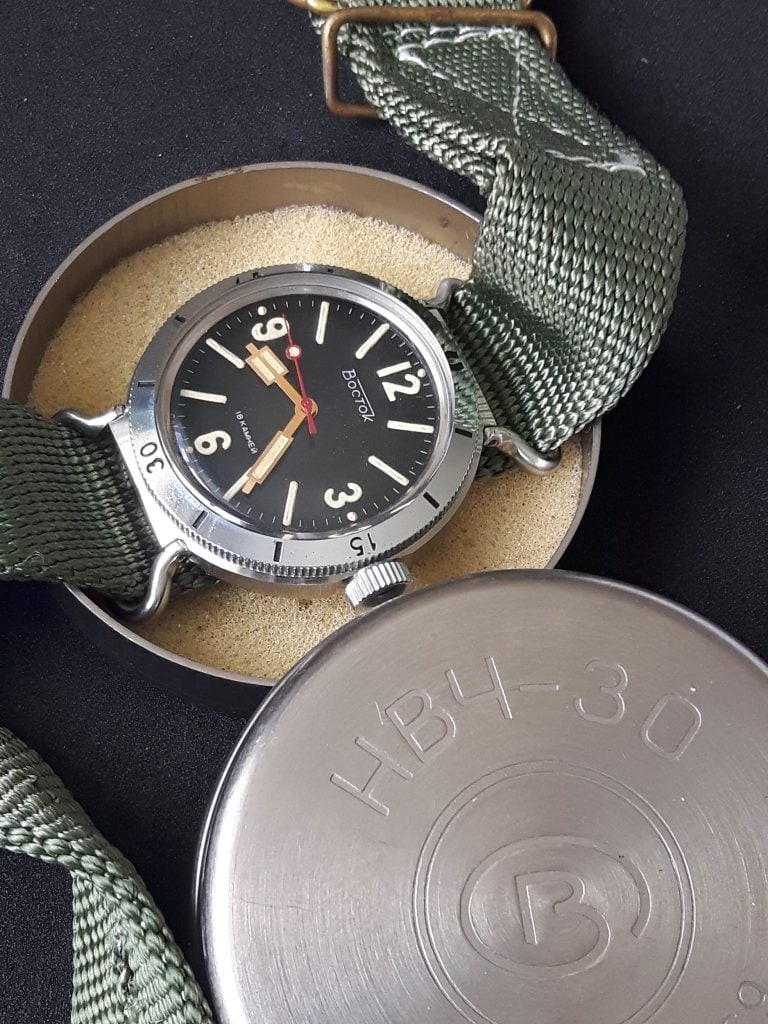
The Amphibia’s success led to a version for 30 atmospheres, or 300 metres: the НВЧ-30, « наручные водолазные часы », a diver’s wristwatch. Its crystal and caseback are thicker. According to Novikov, its acceptance trials took place during fleet manoeuvres, with a submarine resting on the seabed at 120 to 130 metres. Collectors identify three generations, from the 1970s to 1990, and place its introduction in 1969 or 1971 depending on the source. Production figures are not known. A 1980 training manual for army engineer divers lists it among the equipment.
It is the НВЧ-30, not the Amphibia sold in shops, that is an issued watch in the strict sense.
НВЧ-30 with its transport tin. Photo: Vintage Watch Inc.
Calibres and cases of the Soviet Amphibia
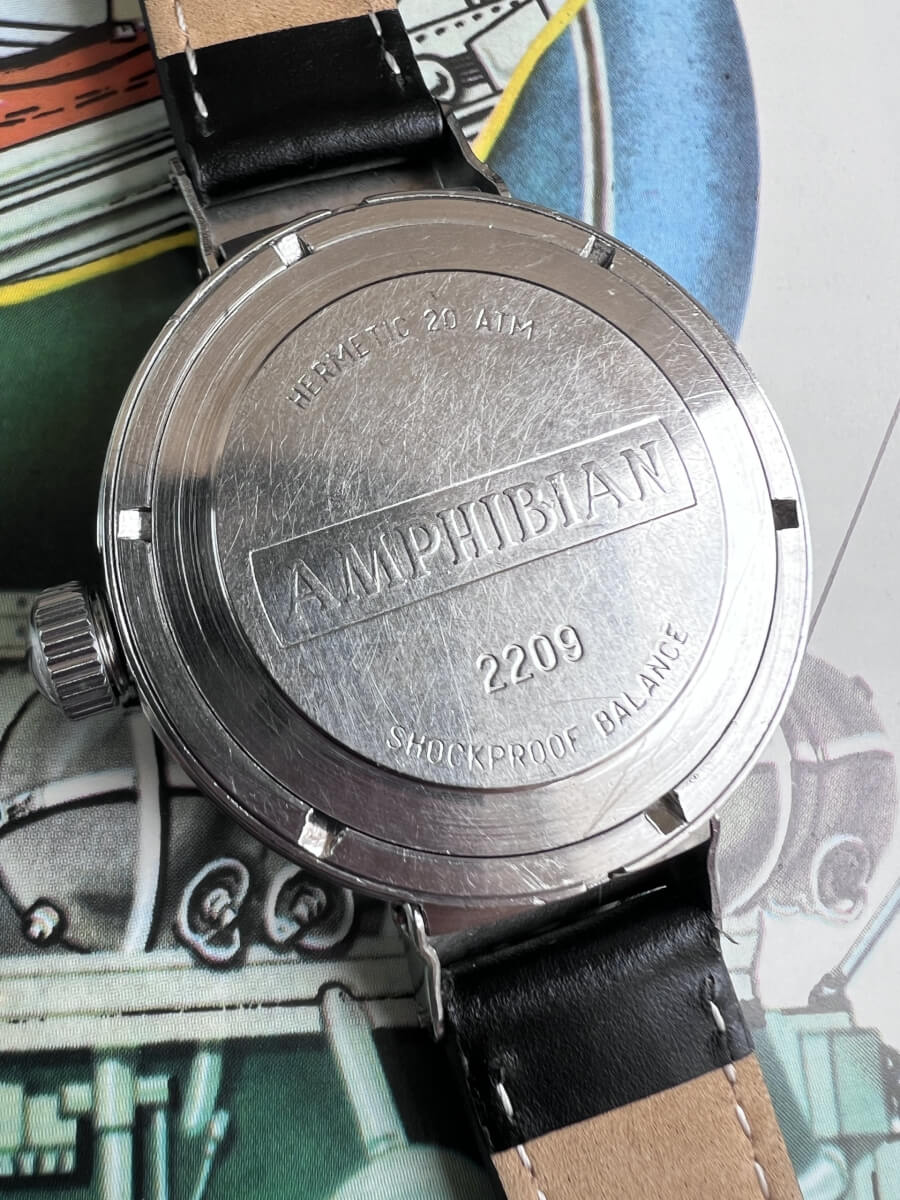
The first Amphibias use the hand-wound 2209 calibre: 18 jewels, 18,000 beats per hour, 3.3 mm thick. Next come the hand-wound 2409A, 17 jewels, 19,800 beats per hour, the 2414A with a date, and in the 1980s the automatic 2416Б.
Caseback of an export Amphibia with the 2209 calibre: « Hermetic 20 ATM », « Amphibian ».
The cases follow in this order.
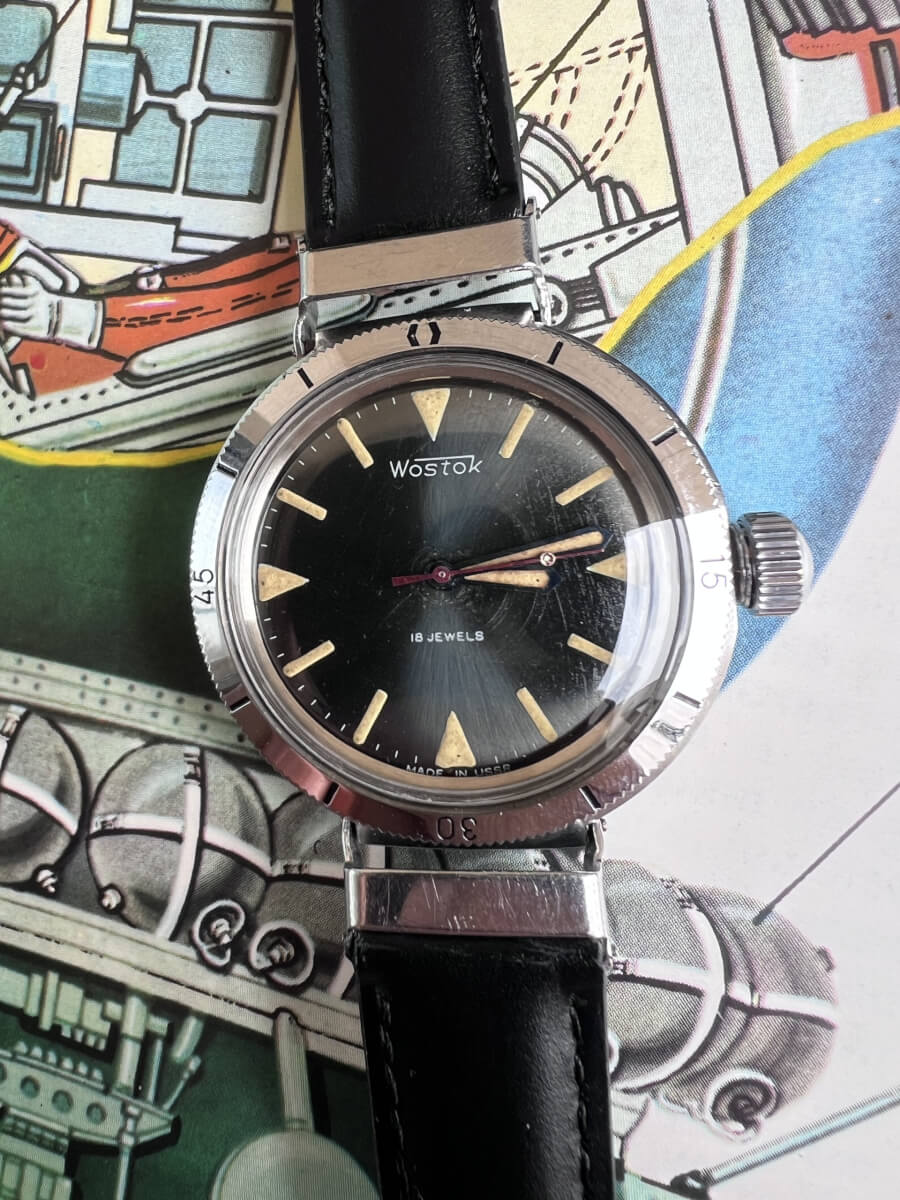
The 350, round with swing lugs, which Russian collectors call « Ушастая » (the one with ears). It was made from 1967 to the second half of the 1970s and still appears in the 1976 and 1977 Vostok catalogues.
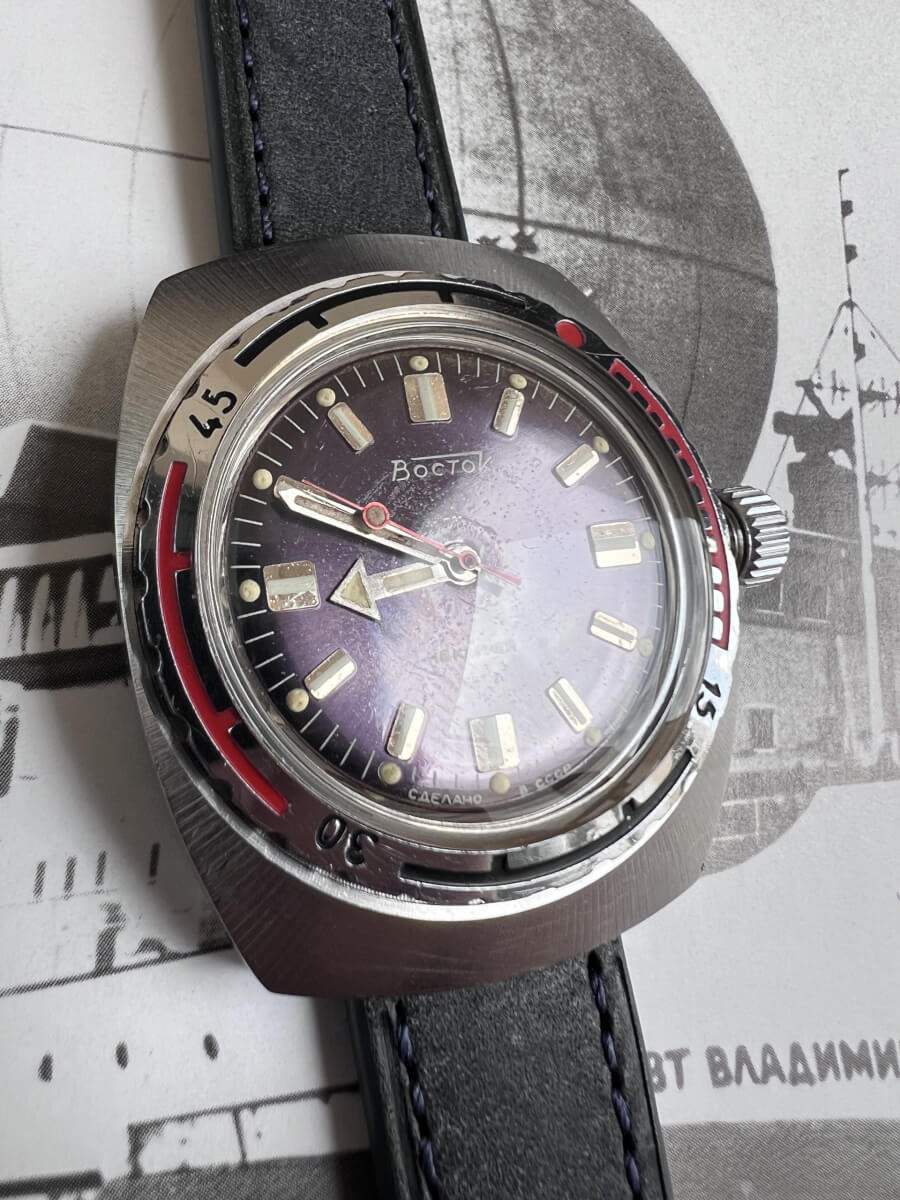
The 119 barrel case, « Бочка ». Late 1970s and 1980s, with a bezel in red and black sectors. The paddle hands of early examples give way to arrow hands.
The brushed octagonal 470 and its polished twin the 320, « Восьмигранка » (the octagonal one), sometimes « Гайка » (the nut). Late 1980s and early 1990s, with the 2409A calibre.
The 710, known as « Министерская » (the ministerial one), which is uncommon.
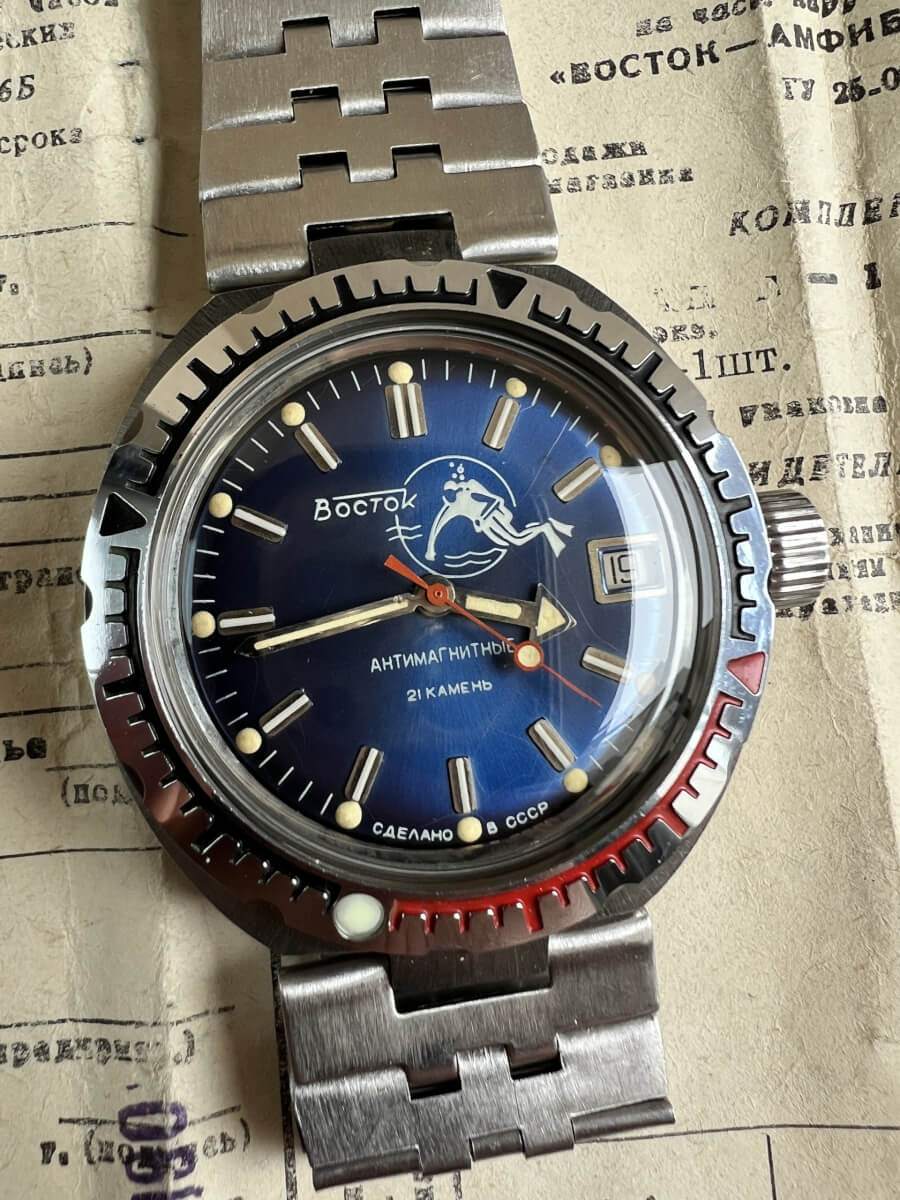
The « Neptune » case of the Scuba Dude, in the mid-1980s, with the 2416Б.
Round case with swing lugs, export version marked « Wostok », 18 jewels.
Barrel case, 2209 calibre, No. 383190.
1990 Scuba Dude, new old stock with its papers.
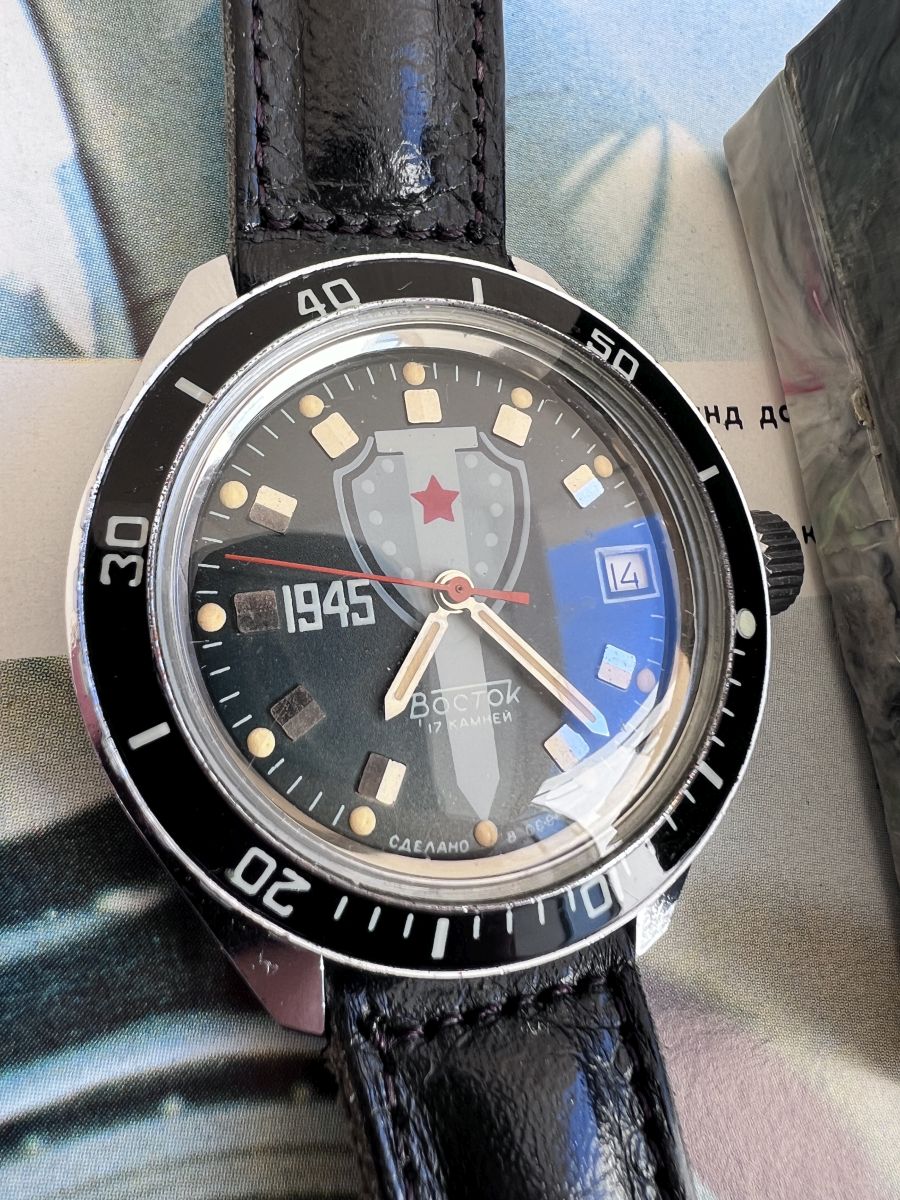
Bakelite bezels are of the period. Modern remakes also exist. Watches for the home market are marked « Восток », export ones « Wostok ».
Amphibia with a bakelite bezel.
The rotating bezel is used to time an event: a dive, something in the oven, a parking period. Try it on the drawing below.
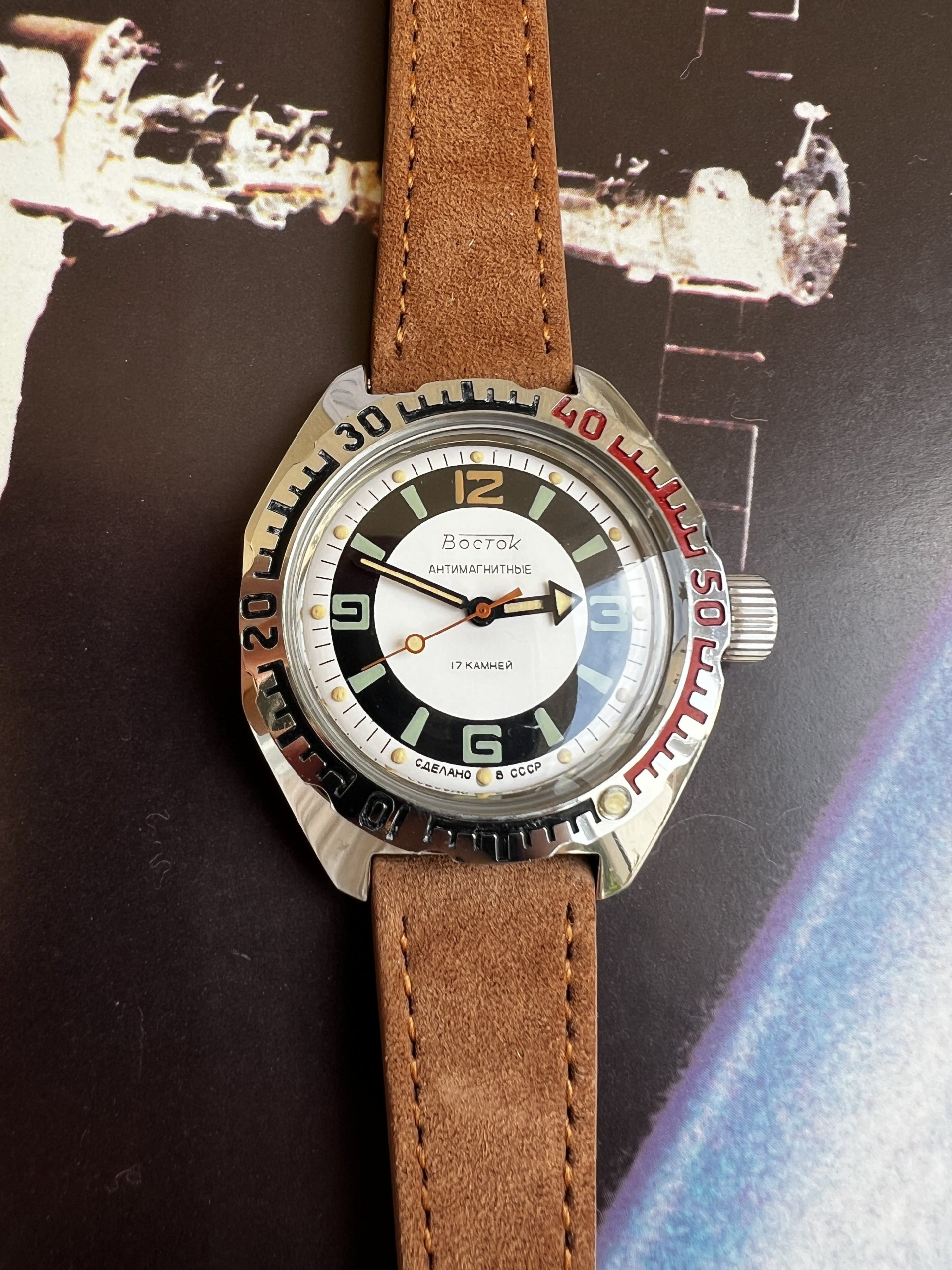
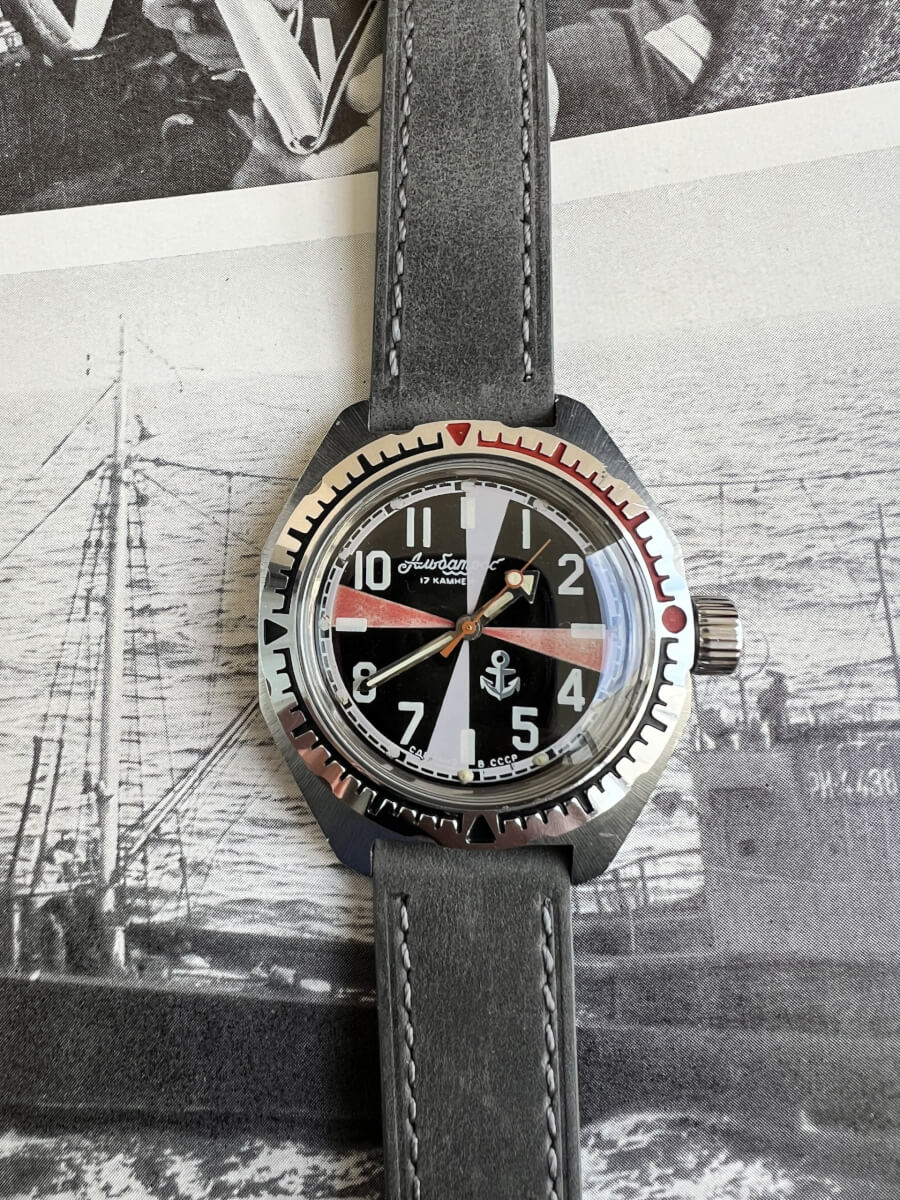
The dial known as Radio Room has four coloured sectors. They copy those on ships’ radio room clocks and mark the radio silence periods, when operators listened on the distress frequencies. From minute 15 to 18 and from 45 to 48, the watch was kept on 500 kHz, in telegraphy. From 0 to 3 and from 30 to 33, on 2182 kHz, in voice. The rule goes back to the aftermath of the Titanic disaster. It ended with the satellite distress system.
First-series Vostok Radio Room.
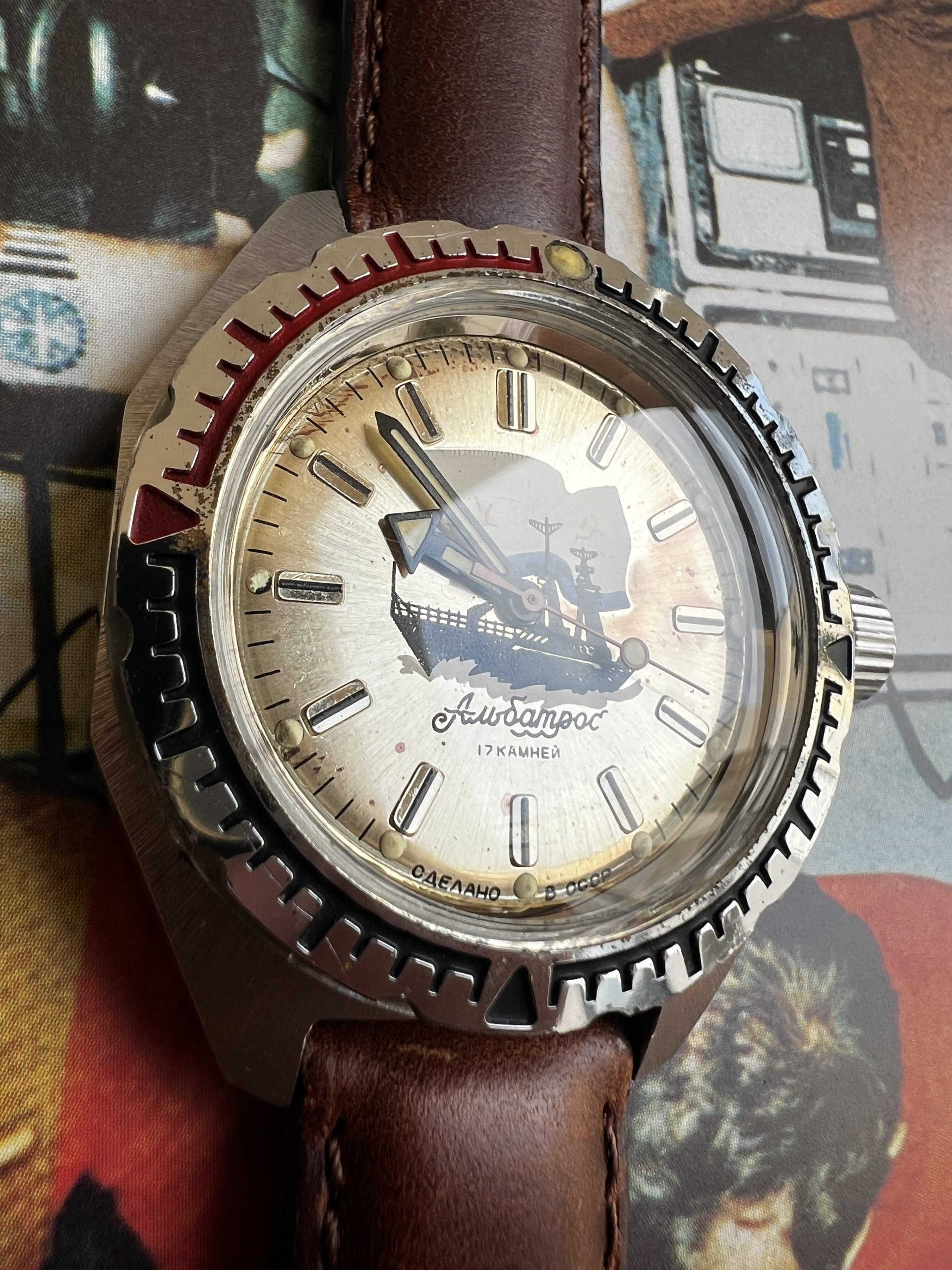
The Radio Room belongs to the Albatros series, Amphibias with the 470 case and the 2409A calibre, with the name « Альбатрос » written in script on the dial. The series has four dials, referenced 470444 to 470447. The first is the Radio Room, whose first batch dates from February 1990. The last shows a warship, a corvette of the class NATO calls Grisha and the Soviets called Albatros.
Amphibia Albatros with the warship dial.
On the first series, the dial reads « Альбатрос » with the jewel count. On the second, the Vostok logo replaces the jewel count. Copies give themselves away by missing lume dots, poor printing and a badly drawn anchor. Later on these dials were fitted to other cases, to the point where factory builds and assembled watches are hard to tell apart.
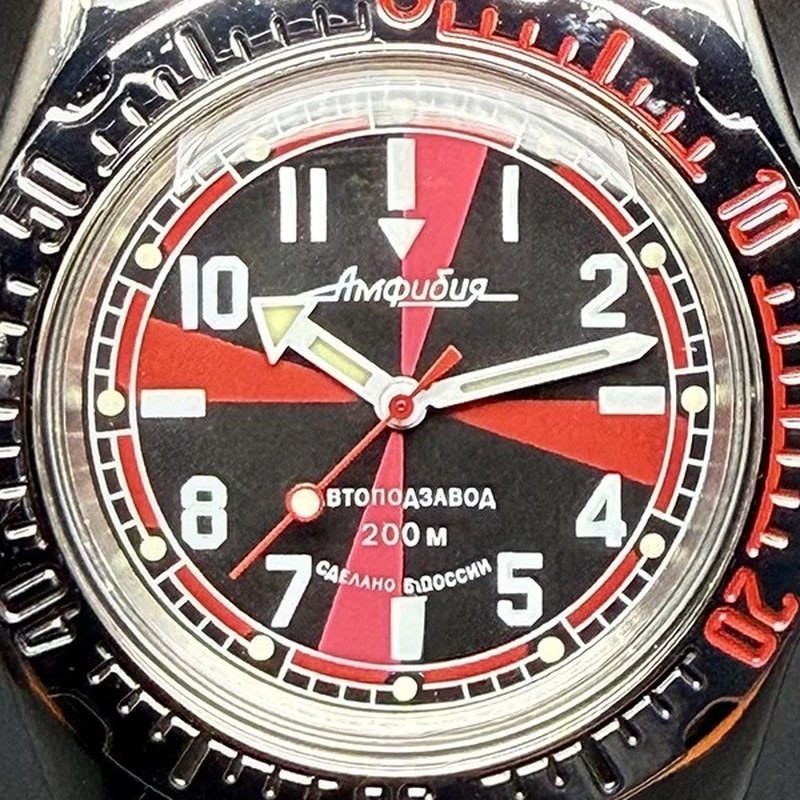
Vostok now makes Amphibias in Russia that reuse this sector dial. They are easy to tell from a 1990 Albatros at a glance.
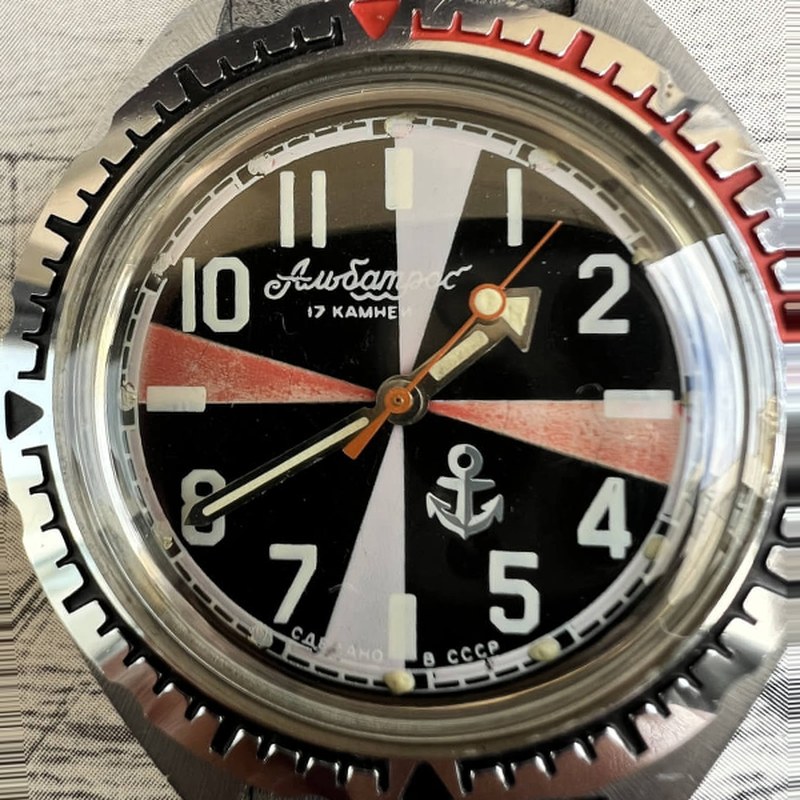
Albatros, 1990Recent Russian Amphibia
1The name. « Альбатрос » and « 17 камней » on the 1990 watch. « Амфибия » on the recent version.
2The bottom line. « Сделано в СССР » (made in the USSR) on the 1990 watch. « Сделано в России » (made in Russia) on the recent version.
3The anchor. At 5 o’clock on the 1990 watch. Replaced by « автоподзавод 200 м » on the recent version, which is automatic.
4The sectors. Red from the factory on the 1990 watch, they have faded with age. They are bright red on the recent version.
The dial. A Soviet piece reads « СДЕЛАНО В СССР » (made in the USSR). The word « Russia » means a watch made after 1991.
The case type, which should match the period of the dial. The Russian factory no longer makes the octagonal 470 and 320 cases: an octagonal watch is either of the period or assembled.
The movement. A 350 or 119 case holds an 18-jewel 2209. An automatic 2416Б in a barrel case points to a rebuild.
The passport when there is one: the year is written on it.
Soviet Amphibia with the air force insignia.
How to use the screw-down crown
The Vostok crown is linked to the stem by a clutch: once unscrewed it has play, which is normal. The cutaway below shows the six positions, from the screwed-down crown to setting the time.
The ДП-5В (DP-5V) is the field radiometer of Soviet civil defence: a green Bakelite console, a probe with a rotating gamma, beta and check-source shield, headphones and a manual that explains operation and maintenance. The one in this article served in an industrial bakery in Chișinău and was serviced in March 1991. Its owner shared his photos and documents with us, and we turned them into a tool that lets you operate it on screen, step by step.
The Moscow Games, from 19 July to 3 August 1980, boycotted by some sixty countries, produced more objects than any Soviet event: a bear cub, Misha, drawn by Viktor Chizhikov, an emblem made of running tracks, five thousand torches, watches from every factory, platinum coins, rings, tea glass holders, posters. This guide tells the story of the Games and reviews the objects, with the marks that authenticate them and the prices.
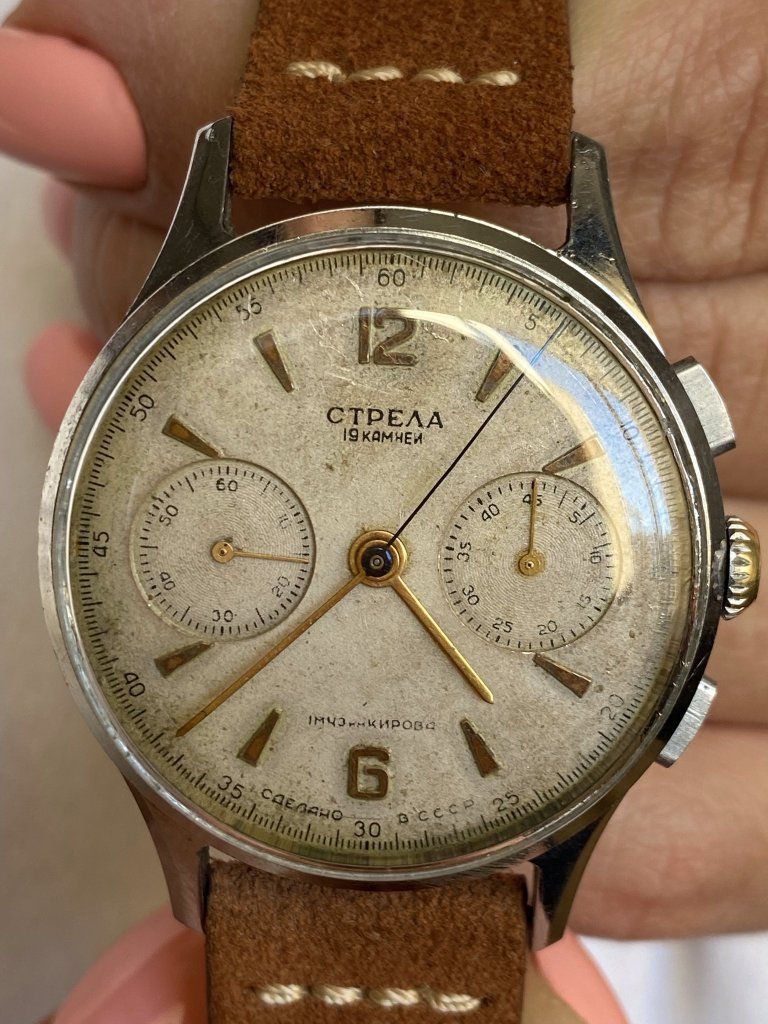
The 3017 chronograph of the First Moscow Watch Factory carries a five-digit number on the balance cock. The most common dating method reads it as a single series, from 1959 to 1979. Four factory passports show there are two, and that the same number can point to two watches made ten years apart. Here is how to read the number, the dial, the logo and the bridge, with a decoder to date your Strela, Poljot or Sekonda.
This website uses cookies to improve your experience while you navigate through the website.
Out of these cookies, the cookies that are categorised as necessary are stored on your browser as they are essential for the working of basic functionalities of the website.
We also use third-party cookies that help us analyse and understand how you use this website.
These cookies will be stored in your browser only with your consent.
You also have the option to opt out of these cookies.
But opting out of some of these cookies may affect your browsing experience.
Necessary cookies are absolutely essential for the website to function properly. This category only includes cookies that ensure basic functionalities and security features of the website. These cookies do not store any personal information.
Cookies that are not strictly necessary for the website to work and that are used specifically to collect personal data through analytics, ads and other embedded content are called non-necessary cookies. User consent is required before these cookies run on the website.
✕
Soviet in Paris
Online. We answer in person, no AI and no chatbot. Reply right away, 20 min at most.
Hello 👋 A question about an item, an order or shipping? Write to us.
Your email is used only to reply to you.
Subscribe to our newsletter and get 10% off your first order.
Subscribe
★ New pieces before anyone else
★ New blog articles
★ Soviet in Paris news and updates
Join the Party
10% off your first order
Receive your welcome card and our next arrivals.
Your code appears here and is also sent to you by email. You can leave the Party in one click, at any time.