Raketa is, with Vostok, the most common Soviet watch brand on the French market, and the most copied. Every one of them came out of a single factory in Petrodvorets, near Leningrad, which produced millions of pieces between 1961 and 1991. This guide gathers what you need to know before buying one: the history of the factory, the calibres and how to read them on the bridge, the models that matter, how to date a piece, the copies to avoid and the prices we see. It links to our detailed guides, model by model.
NOVEMBER 2026•17 MINUTE READ
by Marwen Yahyaoui
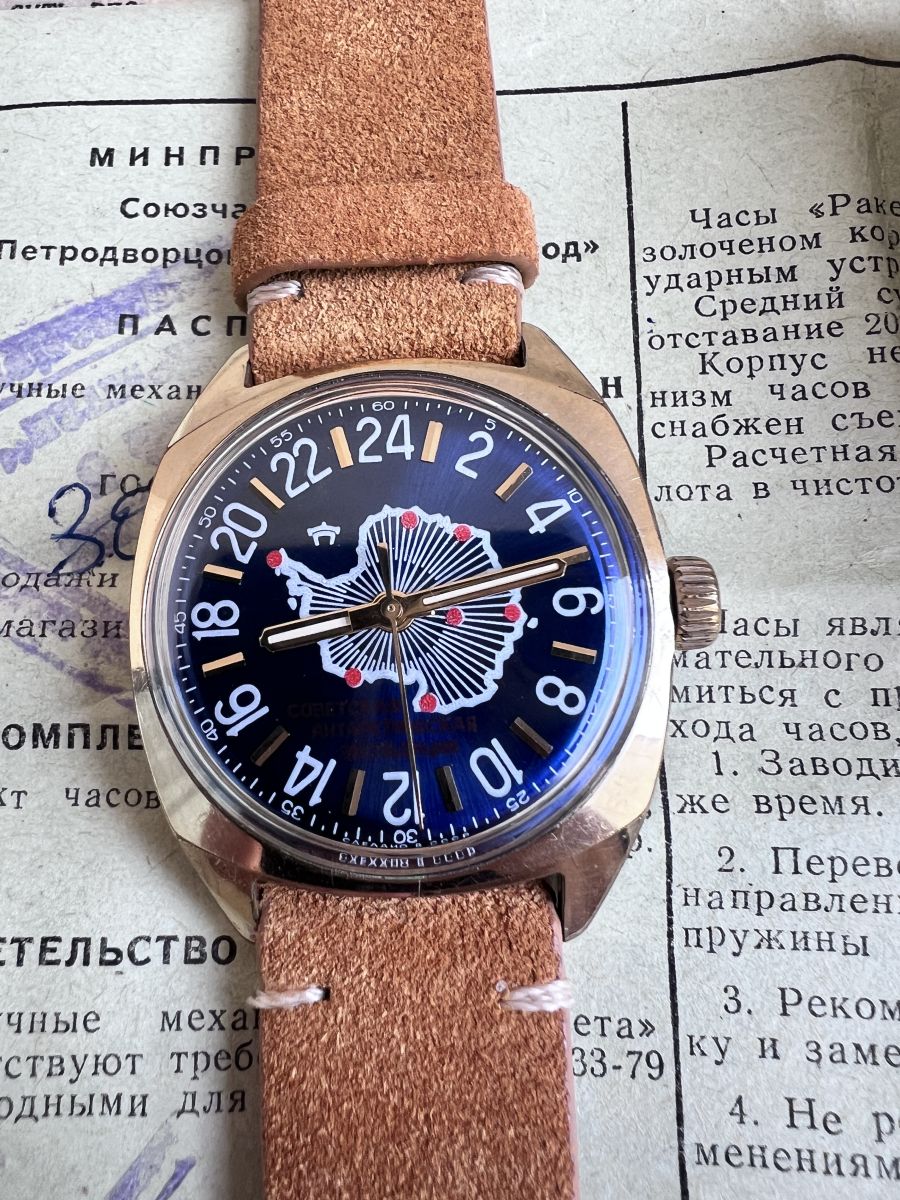
Raketa Antarctic 16 SAE, first-type 2623 calibre, early 1970s: the rarest Raketa that has passed through our hands.
We have been selling Raketa watches for seven years. More than six hundred have passed through the shop, from 90-euro civilian pieces to the Antarctic watch of the 16th expedition. What follows comes from the factory catalogues, from the passports that travel with the watches, from the press of the period and from what we see with the pieces in hand. The subjects that deserve a guide of their own have one, and the link is given each time.
A 1721 workshop that has only made watches since 1946
The Petrodvorets factory stands in Peterhof, thirty kilometres from Leningrad, next to the summer palace of the tsars. Peter the Great founded it in 1721 to cut the hard stones of the palaces: jasper, malachite, marble. For more than two centuries it never made a watch.
Destroyed during the siege of Leningrad, it was rebuilt from 1944. The first wristwatches came out in 1946 under the Звезда (Zvezda, star) and Победа (Pobeda, victory) names, with calibres made elsewhere. In 1949 the plant officially became a watch factory, Петродворцовый часовой завод (Petrodvortsovy chasovoy zavod). The dials of those years read Победа, Звезда, then Балтика (Baltika) and Ленинград (Leningrad), like the Sputnik watch of the late 1950s below.
Leningrad watch, model ЧН-1126К (ChN-1126K), late 1950s: a gilt globe in the centre of the black dial, for the launch of Sputnik.
The factory catalogue page describing this model: chrome-plated 32.6 mm case, stainless steel back, domed crystal.
The name Ракета (Raketa, rocket) appeared in 1961, the year of Yuri Gagarin’s flight. The factory has kept it to this day. According to the figures published by the manufacture, it employed up to 8,000 people and produced up to 4.5 million watches a year, for Soviet citizens, the army and export. Inside, women assembled the watches, a choice made from the start and kept until the end of the USSR.
Raketa Propeller from the 1960s, calibre 2209: the dial shows an aircraft propeller, the case measures 34 mm.
The calibres: how to read the bridge
Every Soviet Raketa has a movement made in Petrodvorets. The number engraved on the bridge follows the Soviet nomenclature: the first two digits give the diameter in millimetres, the next two the type of mechanism. A 2609 is a 26 mm calibre with centre seconds, a 2614 the same with a date, a 2623 a version whose hour hand goes round once in 24 hours, a 2628 a version with day and date. A 2209 is a thin 22 mm calibre, the one in the slim Raketas of the 1960s.
An integrated manufacture, hairspring included
A point buyers often overlook: Petrodvorets made everything. Plates and bridges, wheels and pinions, arbors, synthetic rubies, the balance and its hairspring all came out of the factory’s own workshops, with no outside supplier. The other large Soviet factories, Chistopol for Vostok and the Second Moscow Watch Factory for Slava, were organised the same way and produced their movements in full.
What makes this remarkable is the hairspring. This coiled wire, 0.02 to 0.05 mm thick and about 0.15 mm wide, governs the rate of the watch: it opens and closes 18,000 times an hour, nearly 500 million times a year, and a deviation of one thousandth of a millimetre in its thickness can make the watch gain or lose up to thirty minutes a day. Almost all of Swiss watchmaking buys it from a single supplier, Nivarox, owned by the Swatch Group.
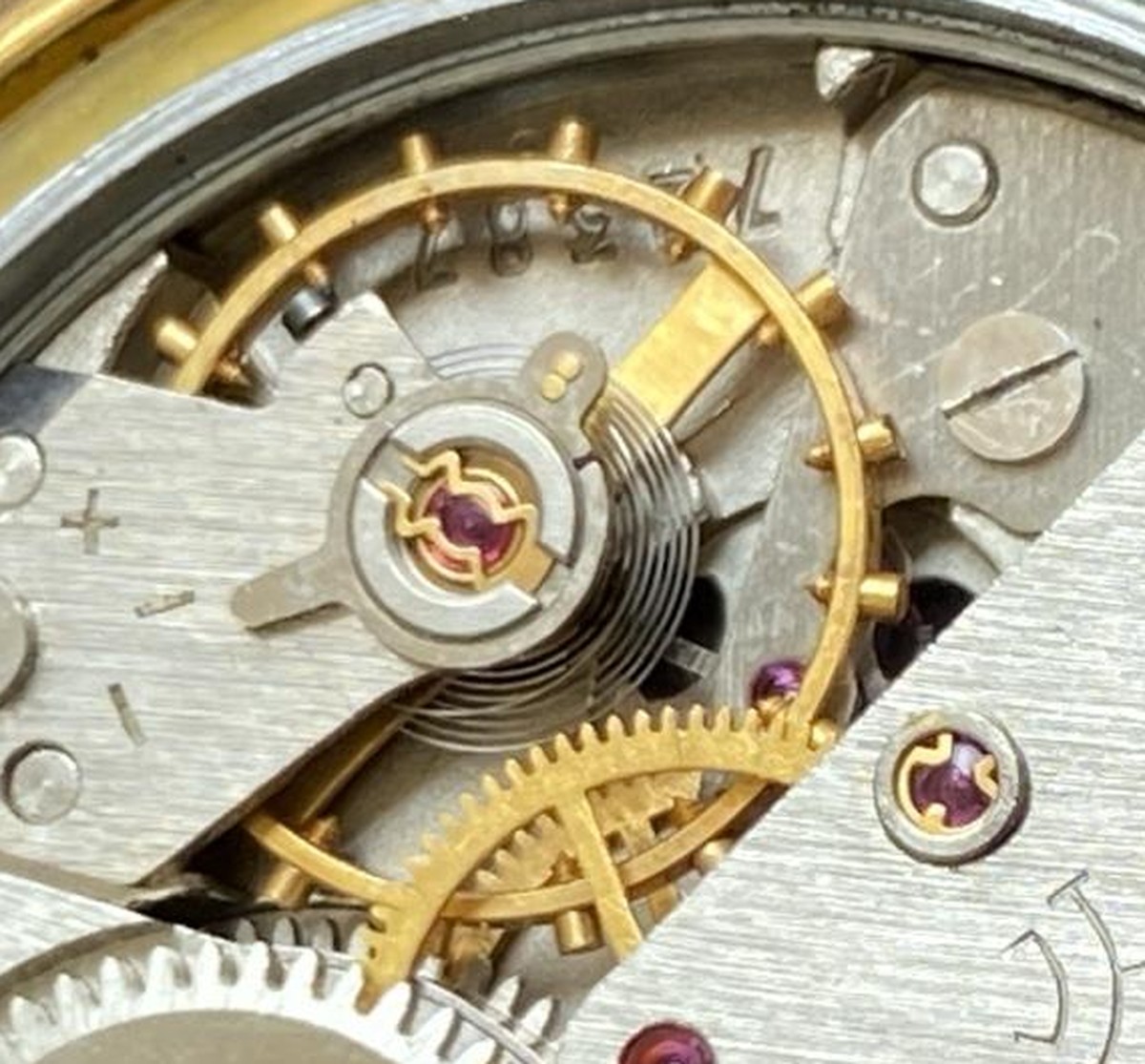
The balance and its hairspring in the 2623 calibre of the Antarctic 16 SAE: the coiled wire in the centre, under the cock, was made in Petrodvorets. The circle of houses that make their own hairspring is very small: Rolex, which launched its Parachrom in the early 2000s, the Richemont group for Lange and Jaeger-LeCoultre, Minerva in Villeret for its tourbillons, a few specialist workshops such as Atokalpa or Precision Engineering, Seiko in Japan, and Raketa. The Moscow Times wrote in 2014 that eight companies in the world produced balance springs; Jacques von Polier, who runs the brand, counted in 2018 only four makers holding their own secret alloy, Rolex, the Swatch Group, Seiko and Raketa, and five companies able to make a movement from start to finish.
The factory kept this know-how without interruption. The Raketa hairspring is drawn from a steel and aluminium alloy whose composition remains secret, passed from one generation of workers to the next. According to von Polier, about a hundred kilos of that alloy are enough for a century of production, and he himself did not know the factory held this knowledge when he bought it. Today the manufacture reports 242 parts per movement, fourteen production stages, from stamping to final regulation, and 103 specialists. When you open the back of a Soviet Raketa and watch the balance beat, everything you see was made in Peterhof.
The 2609 family descends from an older line. The first Soviet round calibre, the K-26, came from the R26 of the French firm Lip, whose licence was transferred to Penza in 1936. Its descendants carried the numbers 2602 then 2603, the latter with shock protection, and the 2603 is what Petrodvorets fitted in its first Raketas. The 2609 adds a through jewel under the centre wheel, and the 2609.НА (2609.NA) of the 1970s and 1980s a screwless balance and a flat hairspring, bringing the height down to 3.9 mm.
The first-type 2623 calibre, with chamfered edges, in the Antarctic 16 SAE: 21 jewels, seen through the open back.
Calibre
Function
Jewels
Power reserve
2609.1
Centre seconds, shock protection
17
36 h
2609.НА
Screwless balance, flat hairspring
19
42 h
2609.НП
Same base, higher accuracy class
19
44 h
2614 and 2614.Н
Instant date
19
40 h
2623.Н
Hour hand on 24 hours
19
44 h
2628.Н
Day and date, perpetual calendar
19
40 h
2601.Н
No seconds hand, watch for the blind
19
42 h
2616 and 2627
Automatic winding, date or day and date
29
43 h
2356
Quartz, doctor’s watch
7
18-month battery
The figures come from factory documentation relayed by Russian collectors. The catalogues themselves vary: the 2609.НА is given 19 jewels in the 1991 export catalogue and 16 in the 1992 one. After 1991 the stocks of components were used up in no particular order, and you find movements with 16, 17, 18 or 19 jewels under the same number. That alone is not a sign of a copy.
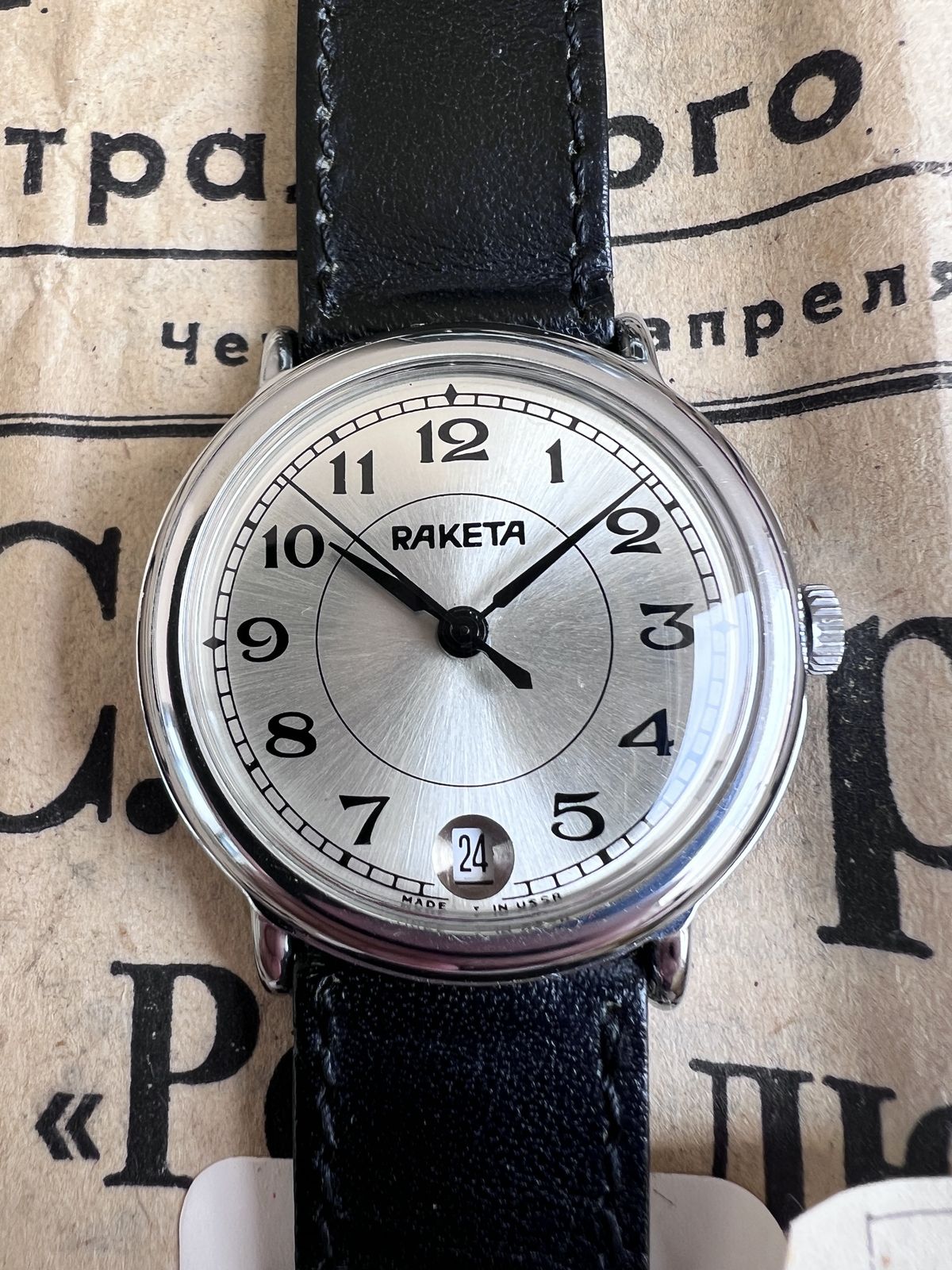
Civilian Raketa from 1991, calibre 2614.Н with date: the dated version of the 2609.
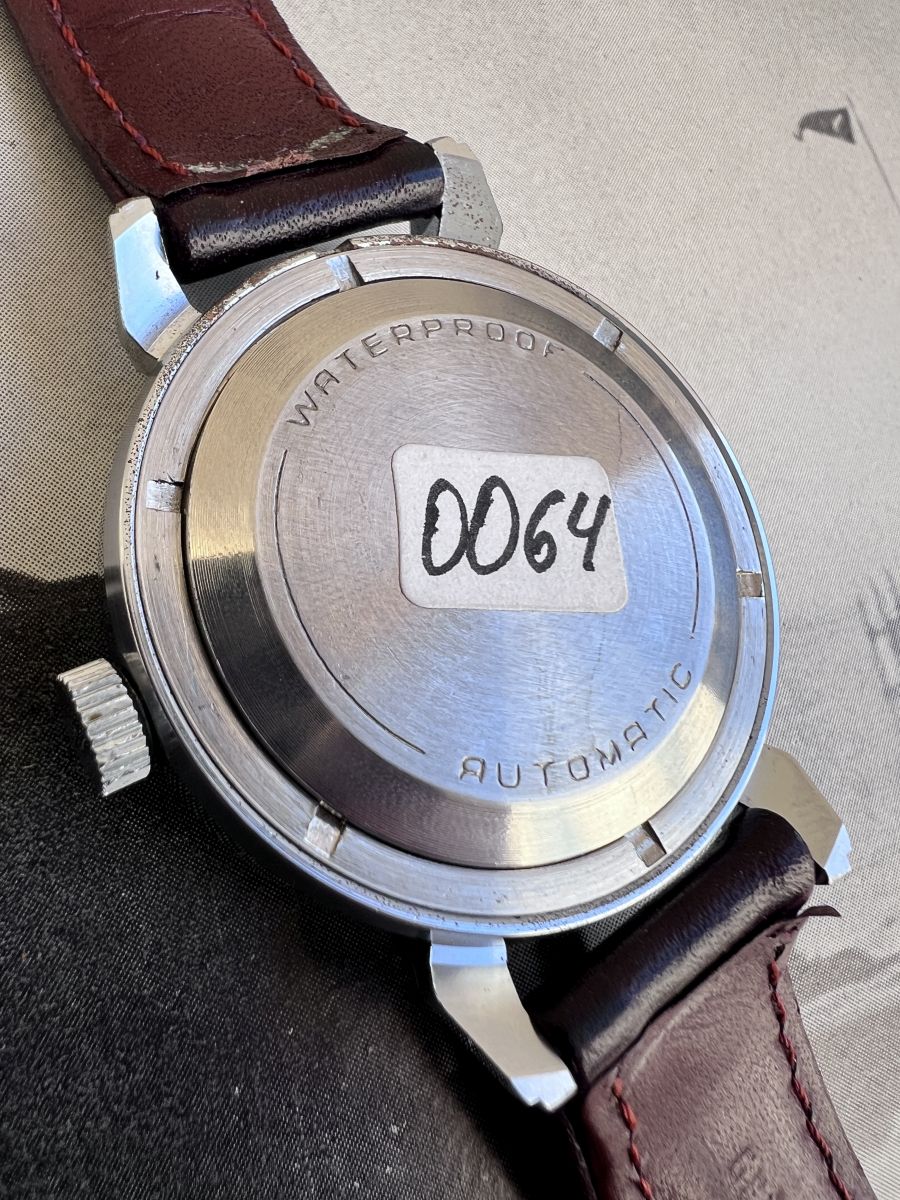
Automatic Raketa: a Vostok movement from Chistopol under a Raketa dial, a rare collaboration between the two factories.
Two calibres fall outside the 26 mm rule. The thin 2209 powers the slim watches of the 1960s, including the Propeller above. Automatics are rare: the factory produced its own 2616 and 2627 self-winding calibres in small numbers, and some automatic Raketas carry a movement from the Vostok factory in Chistopol, like the one above. Then there are the quartz pieces, with the 7-jewel 2356 calibre of the doctor’s watch and of the day-night Sputniks.
The models that make the brand
Petrodvorets almost never named its watches. The catalogues designate them by a code, the calibre followed by a case and dial reference, such as 2609НА/516632 for the Big Zero. The names we use come from collectors. Here are the main ones, with a link to the detailed guide when there is one.
The 24-hour watches: Polar, Antarctic, Navy, World Time
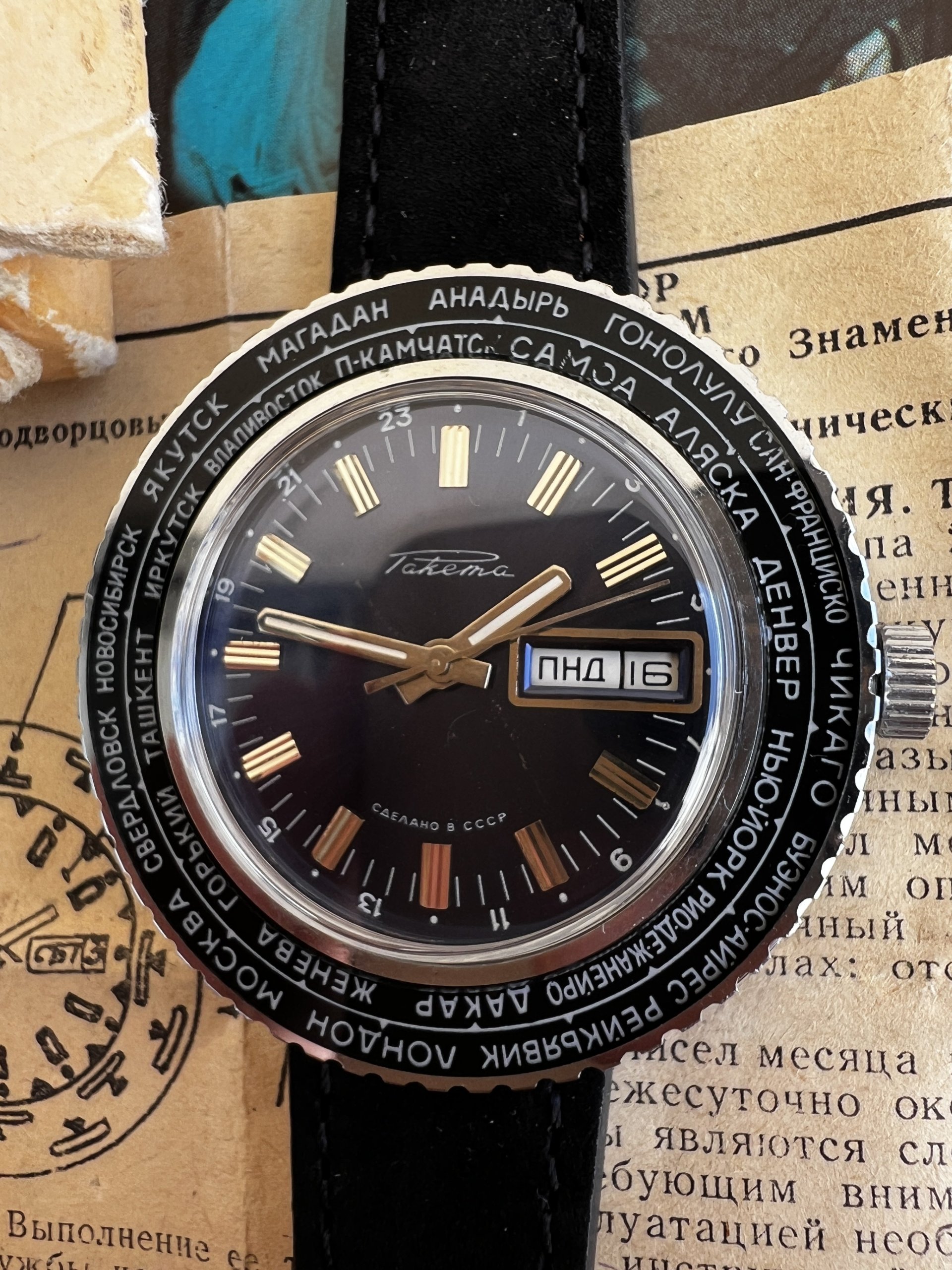
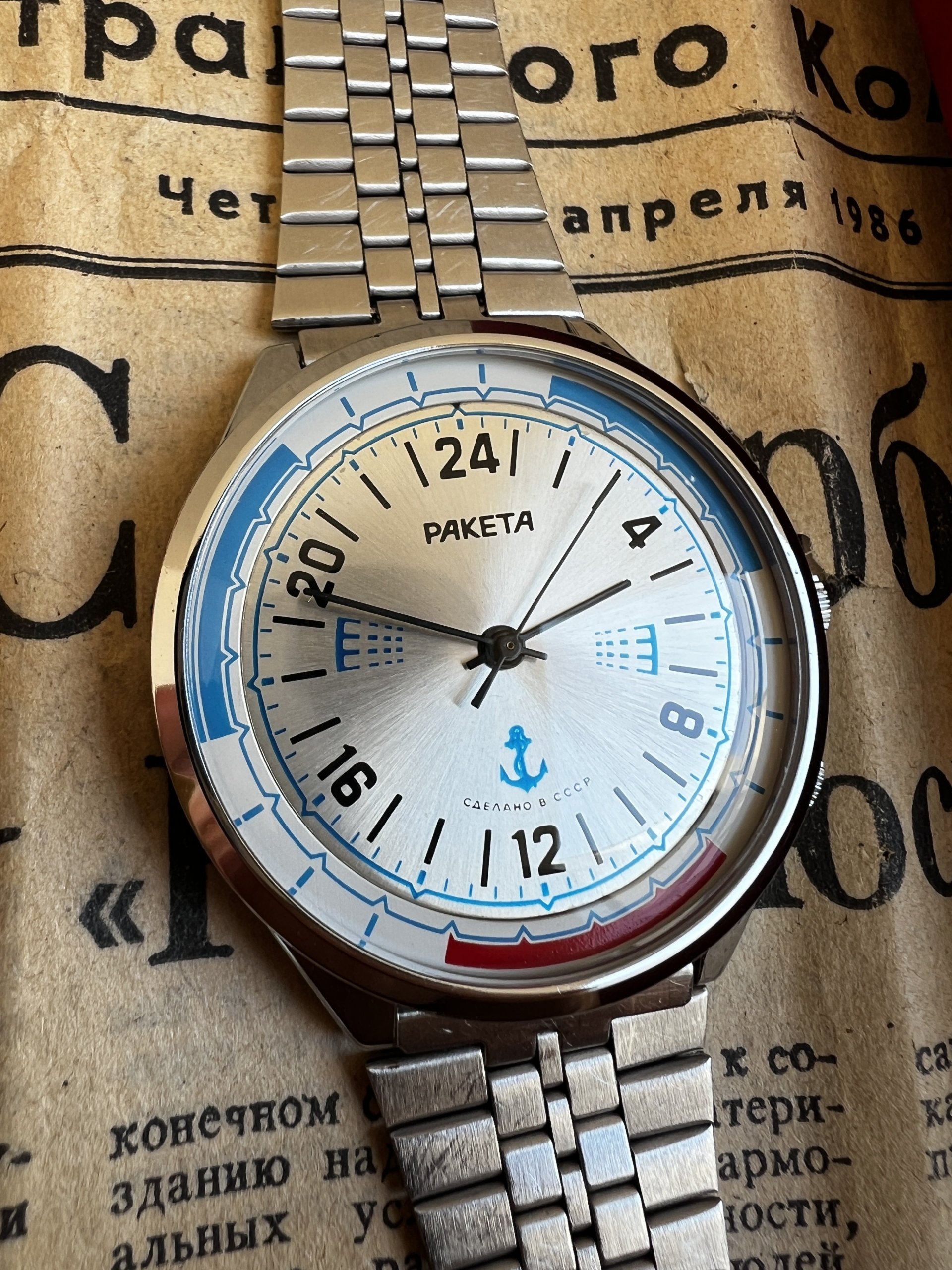
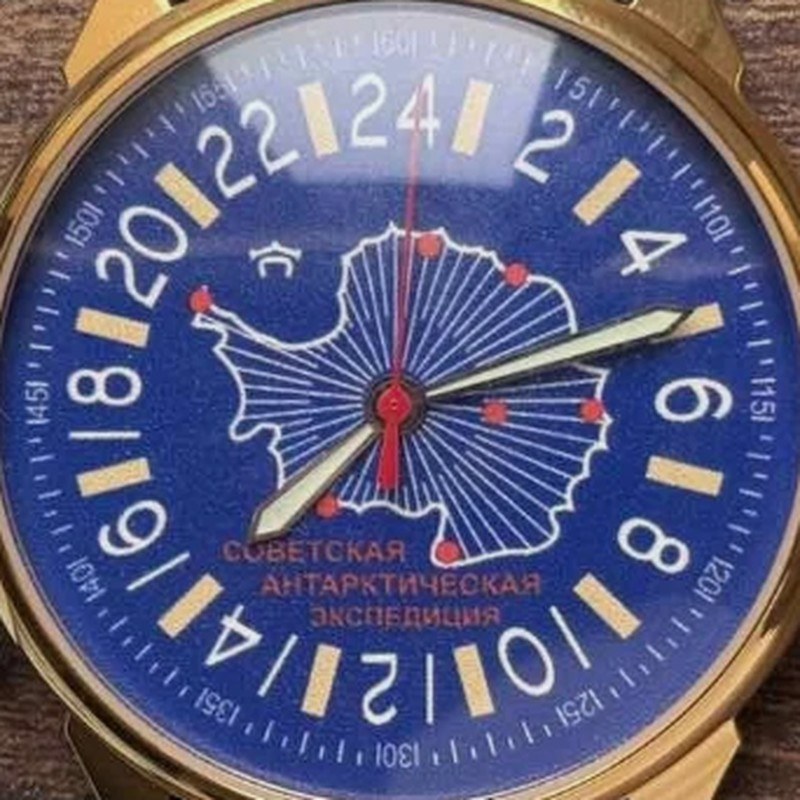
This is the most sought-after Raketa family. The factory developed its first 24-hour watch in 1969, the Полярные (Polyarnye, polar), selected in 1970 for the equipment of the 16th Soviet Antarctic Expedition. Then came the Antarctic dials with a map of the continent, from 1971, the civilian versions of the 1972 and 1977 catalogues, the submariner dials, the World Cities with a rotating ring and the World Time with an outer bezel. All of them have a 2623 or 2623.Н calibre. We have written two guides on this family: the history of Soviet 24-hour watches, from the poles to the submarines, and how to use the rotating ring and the second crown.
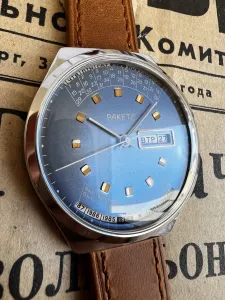
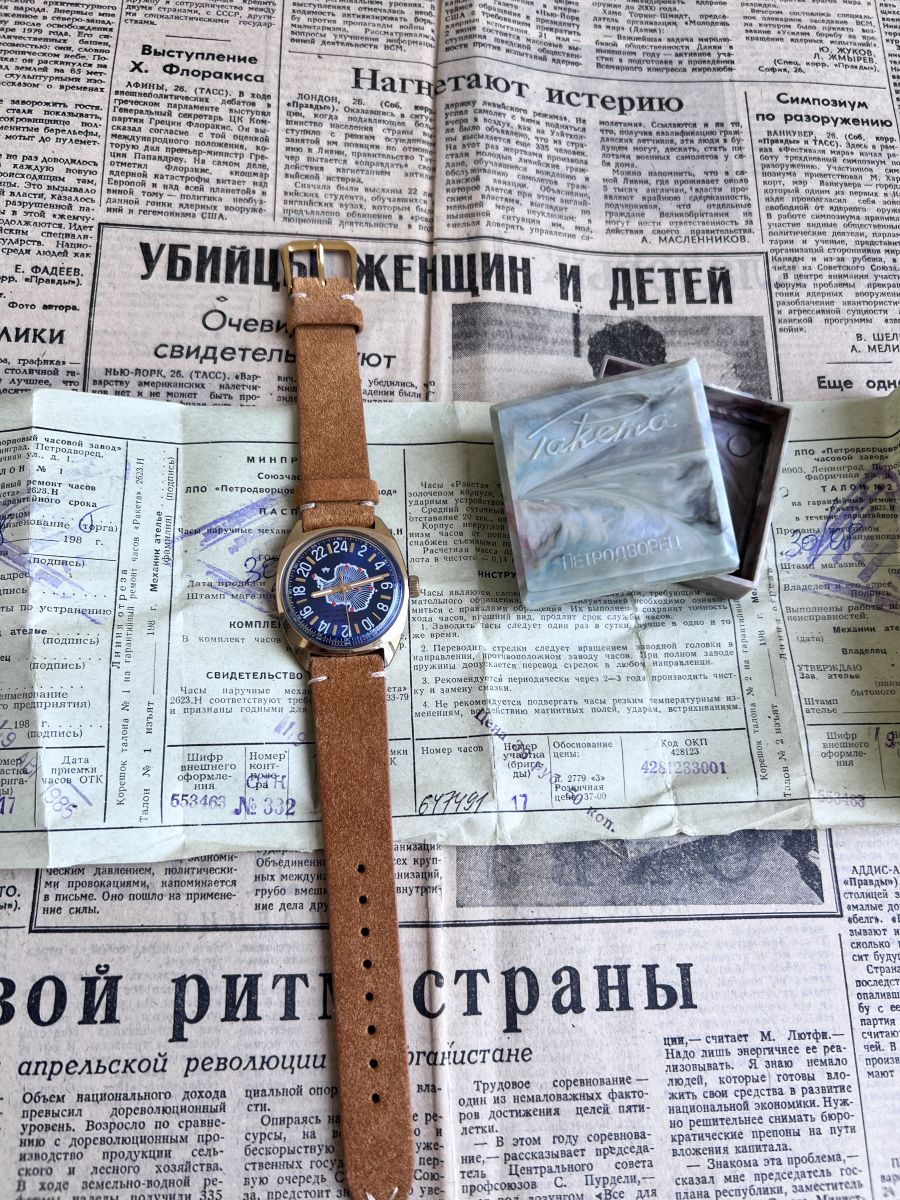
Antarctic 24-hour, blue seven-dot dial, inspected in April 1985.
World Cities, rotating ring of the twenty-four time zones, black dial.
Navy 24-hour with anchor dial, calibre 2623.Н.
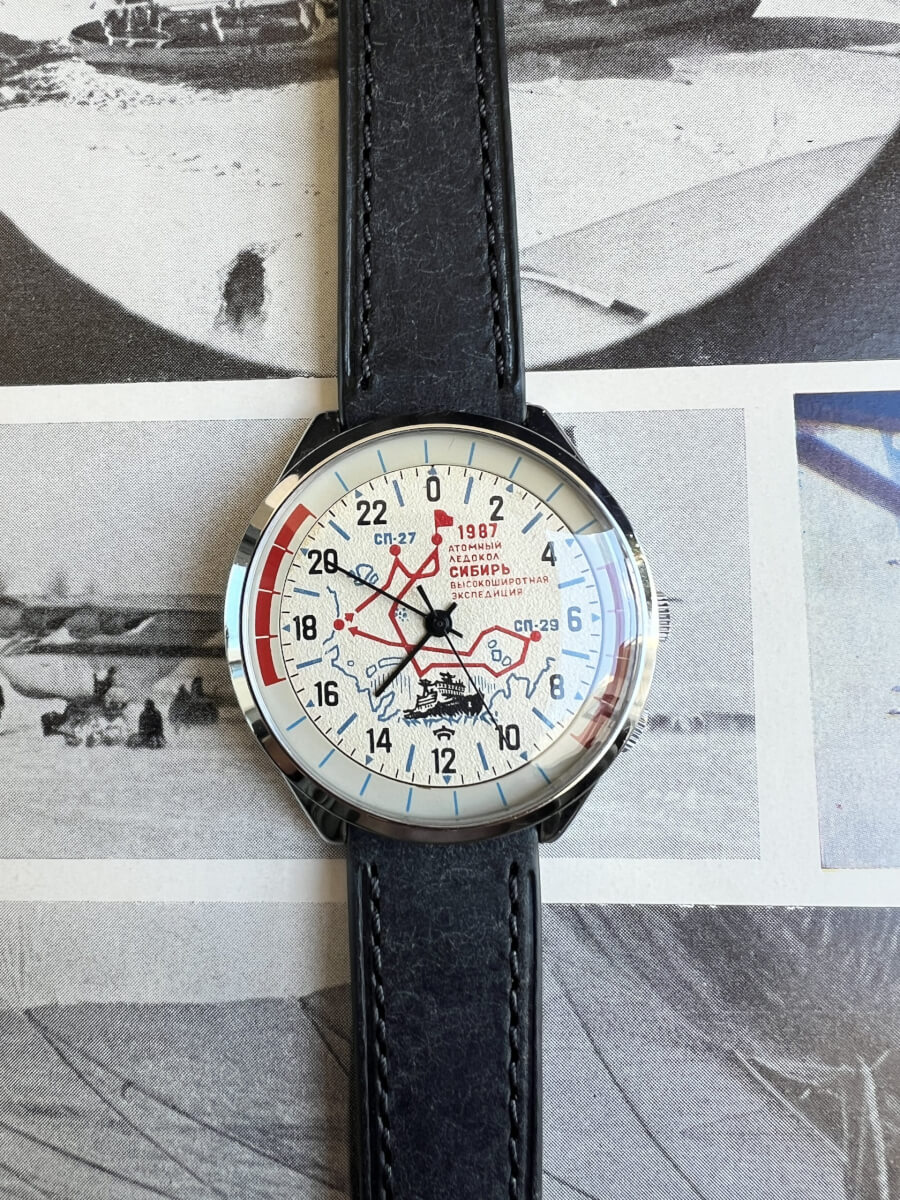
Raketa of the nuclear icebreaker Sibir, 1987: the ring carries only two red sectors, the watches of the ship’s chief mate.
The Copernicus
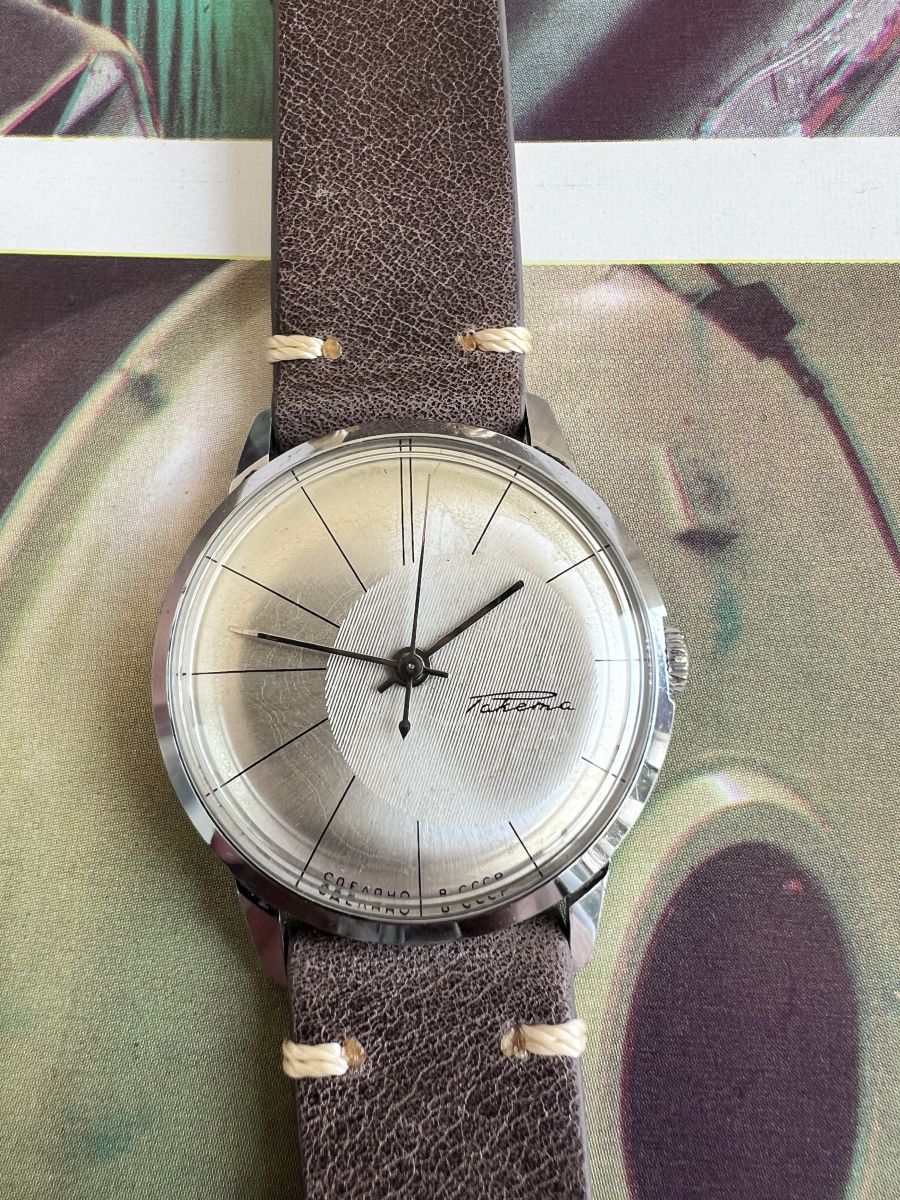
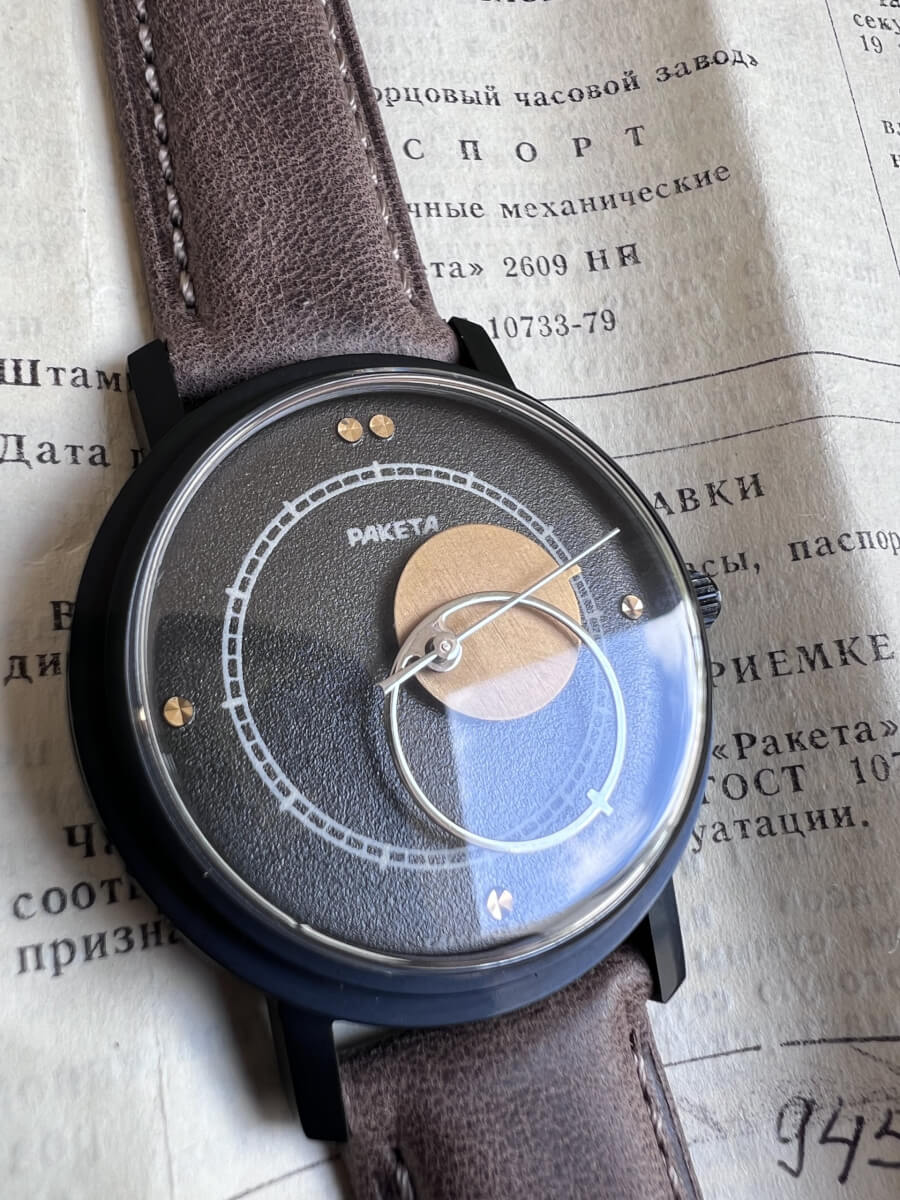
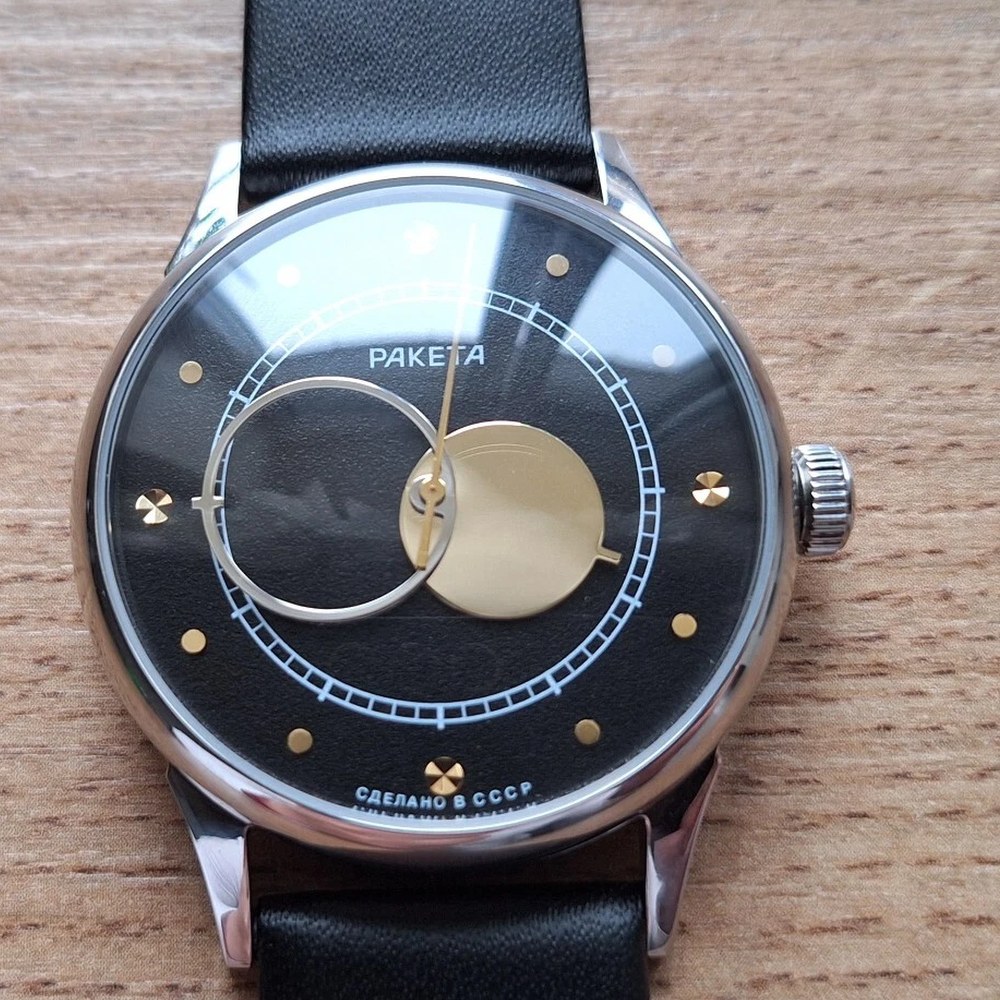
Petrodvorets traces the model back to 1965: a first watch with a radiating dial, still fitted with ordinary hands. The Copernicus with disc and ring arrived in 1980 with the black dial, the silver version followed in 1986 and the white one appears in the 1989 catalogue. All of them take the 2609.НП calibre. We estimate that nine Copernicus watches out of ten on sale are fake: our guide explains how to read the hands, the versions and how to avoid the fakes.
First-version Copernicus, 1970s: the radiating dial and ordinary hands.
Black Copernicus with disc and ring, new old stock.
The Big Zero
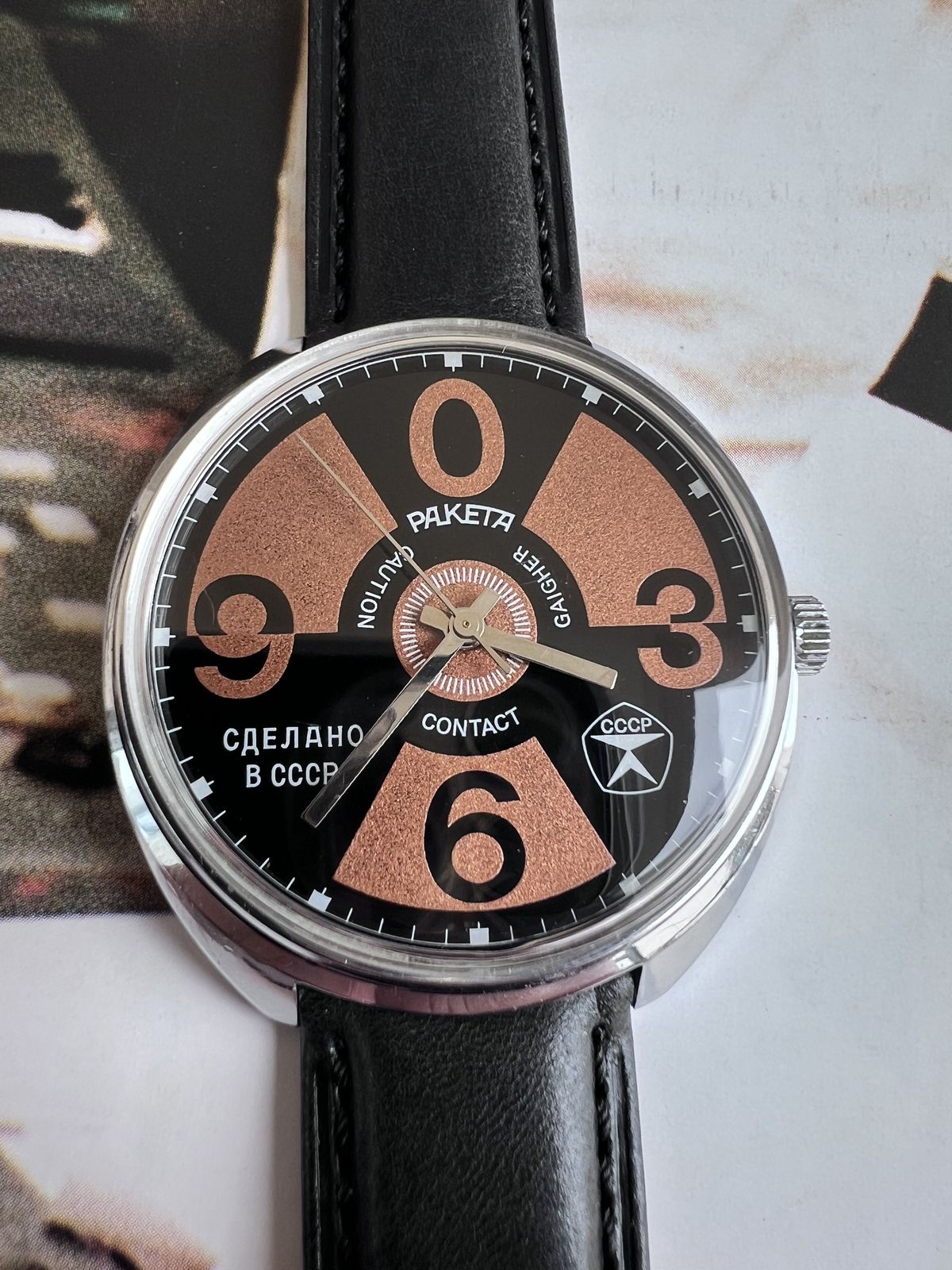
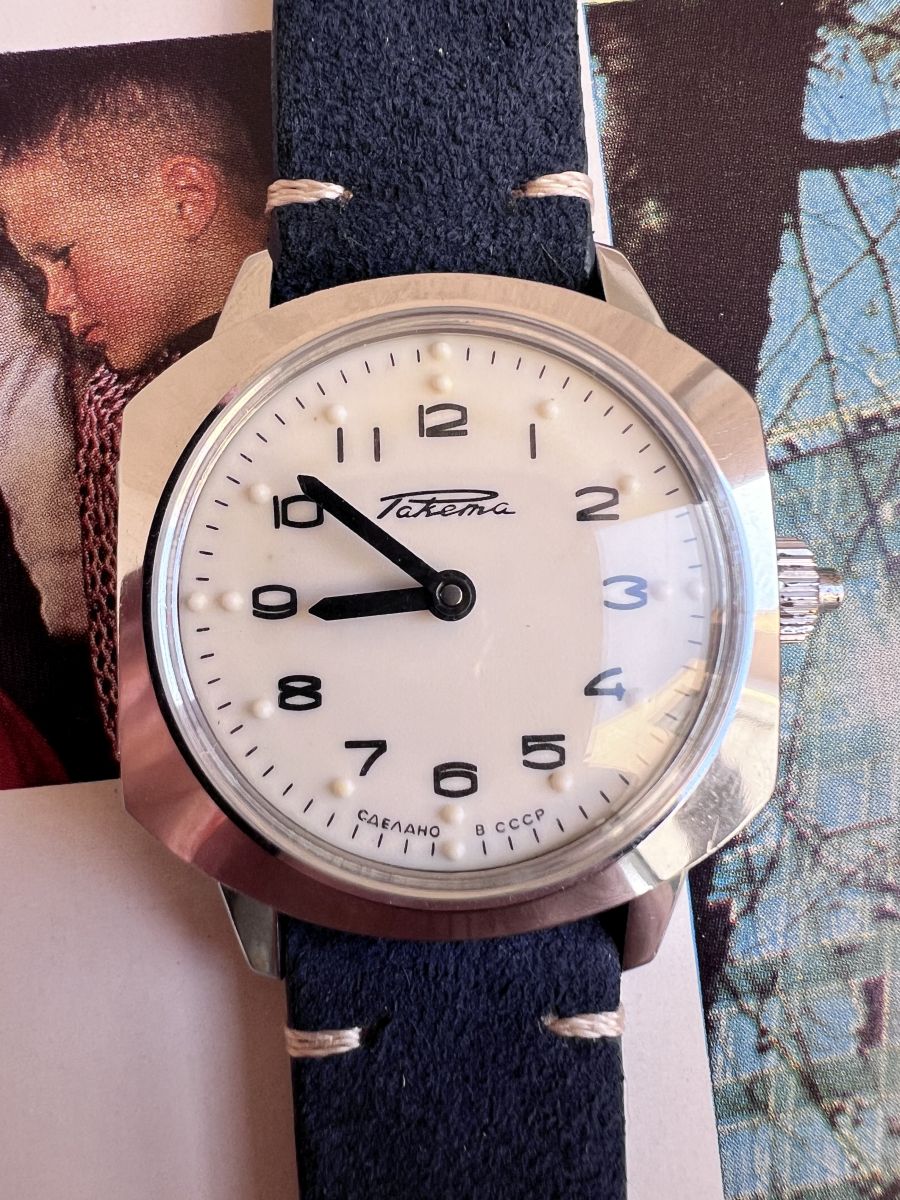
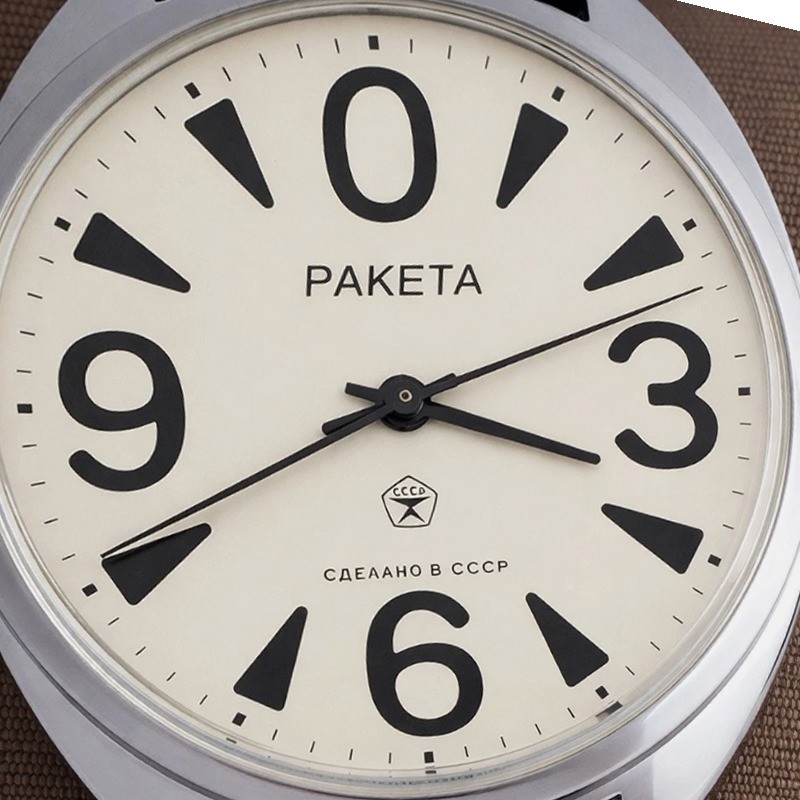
Four black numerals on a white dial, and a zero where every other watch has a 12. The dial is said to have been designed around 1984 or 1985 for people with weak eyesight, alongside the watch for the blind with the 2601.Н calibre. In 1988 it became the symbol of perestroika in Italy, where 40,000 Raketas sold in four months. Fake dials are the plague of the model. Our Big Zero guide tells the history, the versions and the fakes.
Big Zero « Gaigher » for the Italian market, dial with four ochre sectors.
The watch for the blind from the 1960s: raised numerals, hinged crystal, the ancestor of the Big Zero.
The perpetual calendar
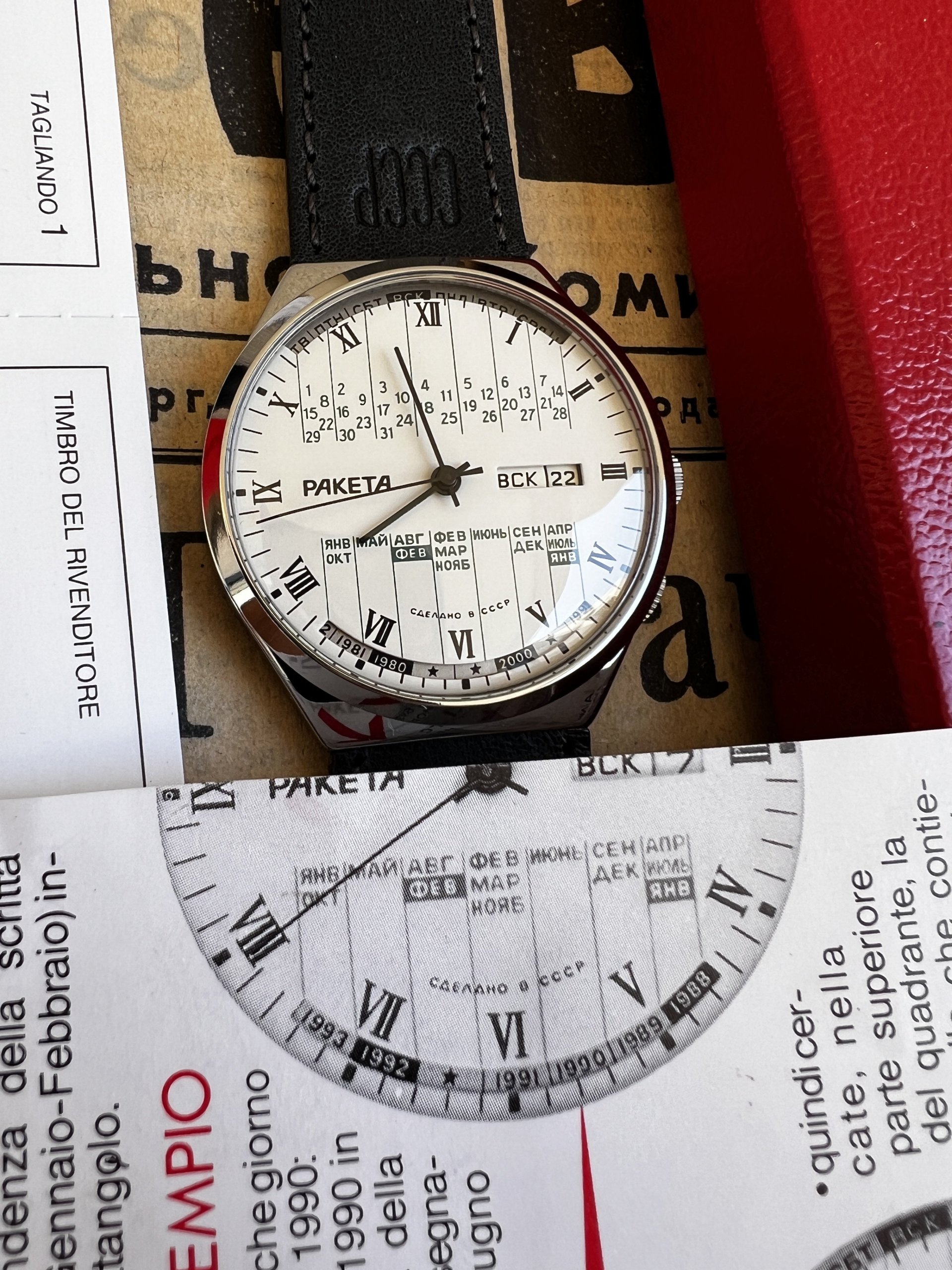
Two crowns, a table of dates at the top, a table of months at the bottom, and a disc of years running from 1980 to 2000. The calibre is the 2628.Н, production runs from the mid-1980s into the 1990s. Collectors call it the « College ». The guide explains how it works and offers a simulator you can set yourself.
Perpetual calendar, new old stock, with its Italian « Model 2000 » leaflet.
The Hammer and Sickle
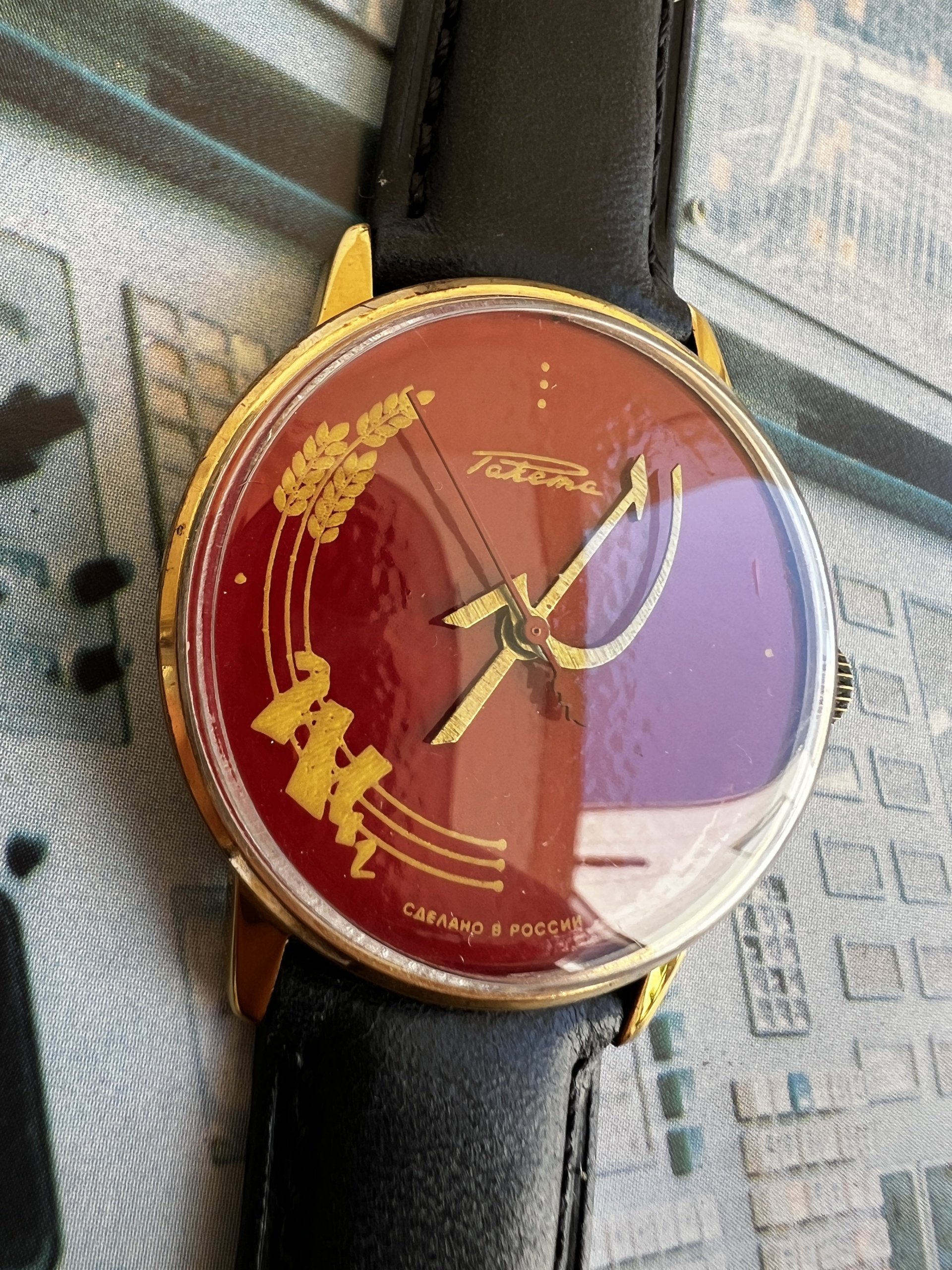
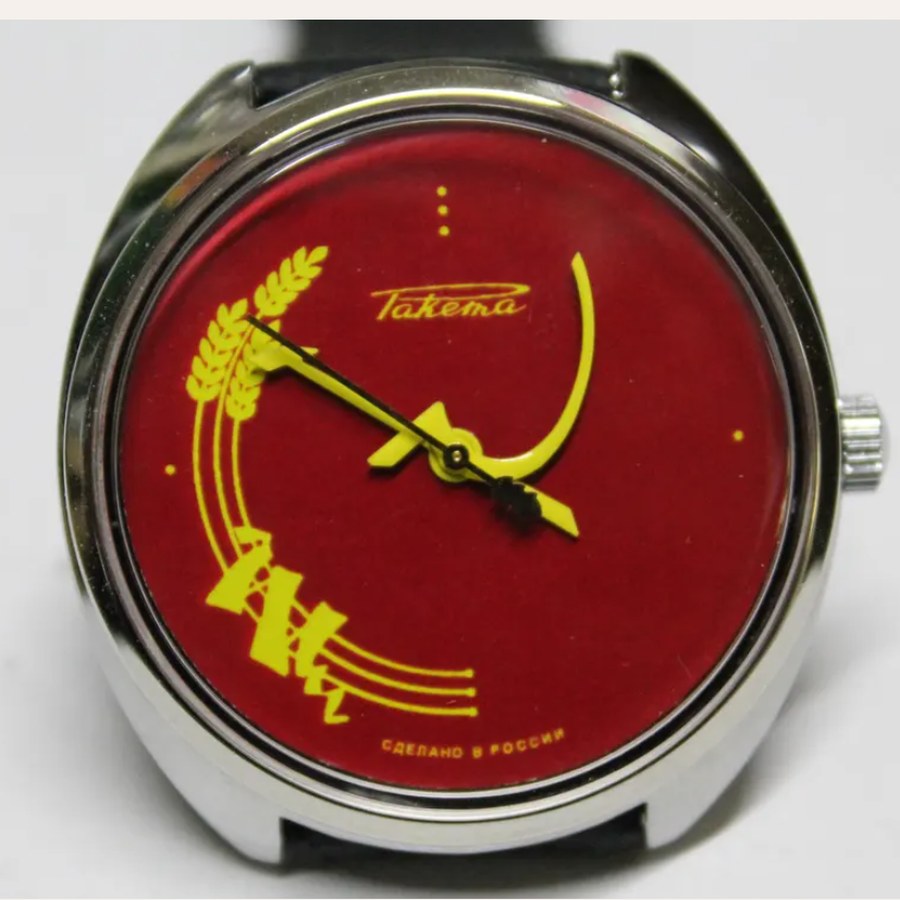
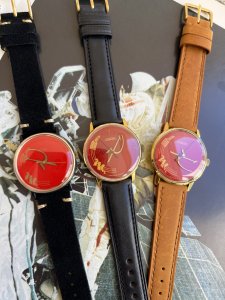
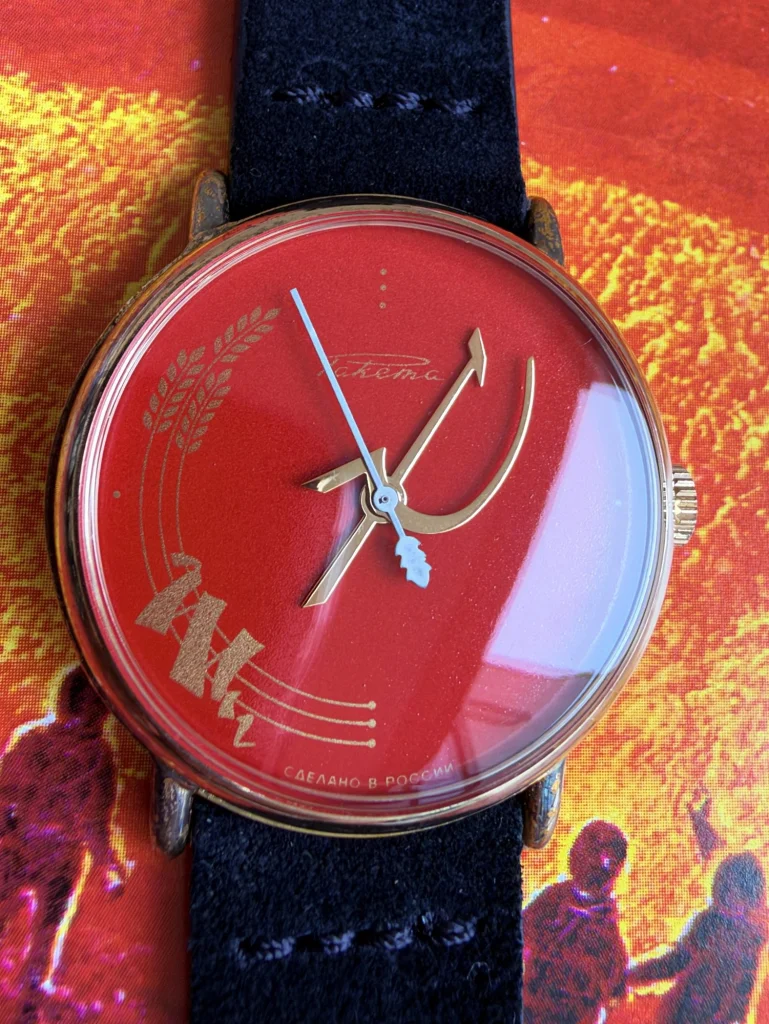
The hour hand is a hammer, the minute hand a sickle. The model appears in the 1992 catalogue, in the last years of the factory, and no earlier date is documented. It is heavily copied. Our guide to spotting a genuine Raketa Hammer and Sickle.
Hammer and Sickle with red dial, gold-plated case.
Civilian, commemorative and curious
The bulk of production was civilian watches with a 2609 or 2614 calibre: silver, gilt or black dials, Arabic or Roman numerals, chrome-plated or gold-plated cases. These are the cheapest Raketas and the easiest to find. Alongside them the factory produced commemorative dials for anniversaries, units, ships and companies: the Moscow Games of 1980, the 50th anniversary of Victory, a pharmaceutical laboratory, an air base. And a few curiosities: the quartz doctor’s watch with its pulse scale, the Wind Rose with a compass dial, the Jeans with a denim dial, the TV with its rectangular case.
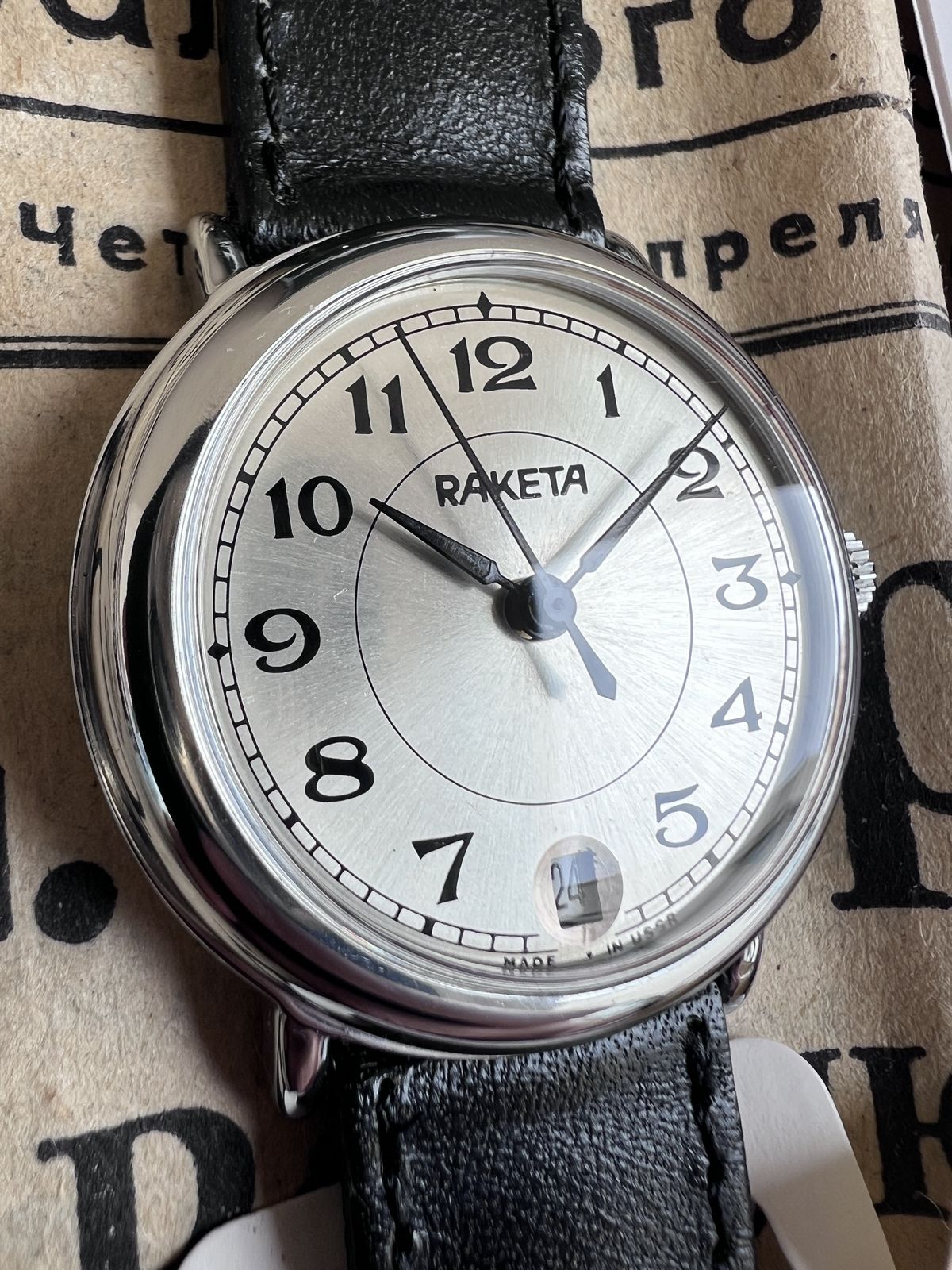
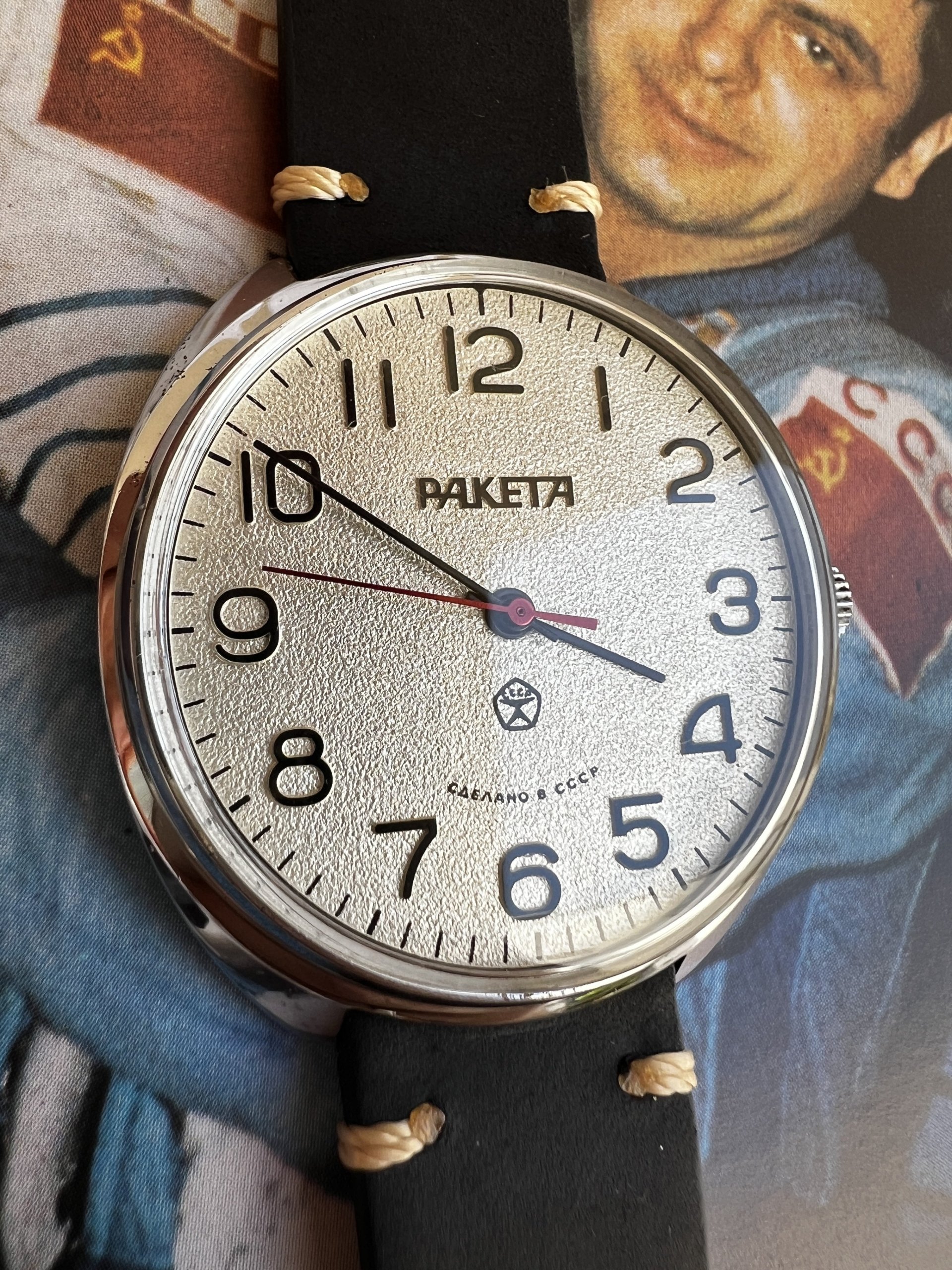
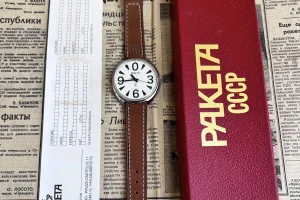
Civilian watch with a large 40 mm silver dial, Arabic numerals.
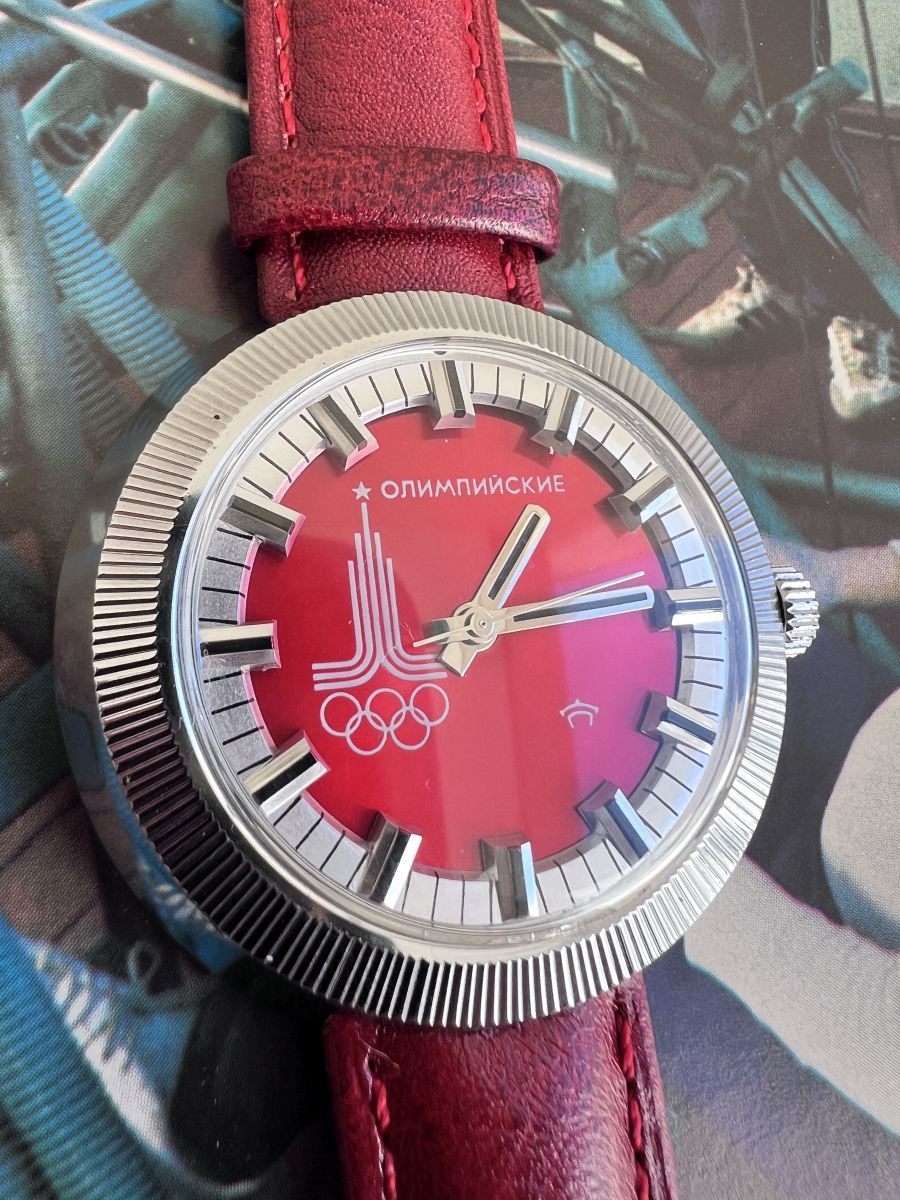
Red dial of the Moscow Olympic Games, 1980.
Quartz doctor’s watch, calibre 2356, pulse scale on the dial.
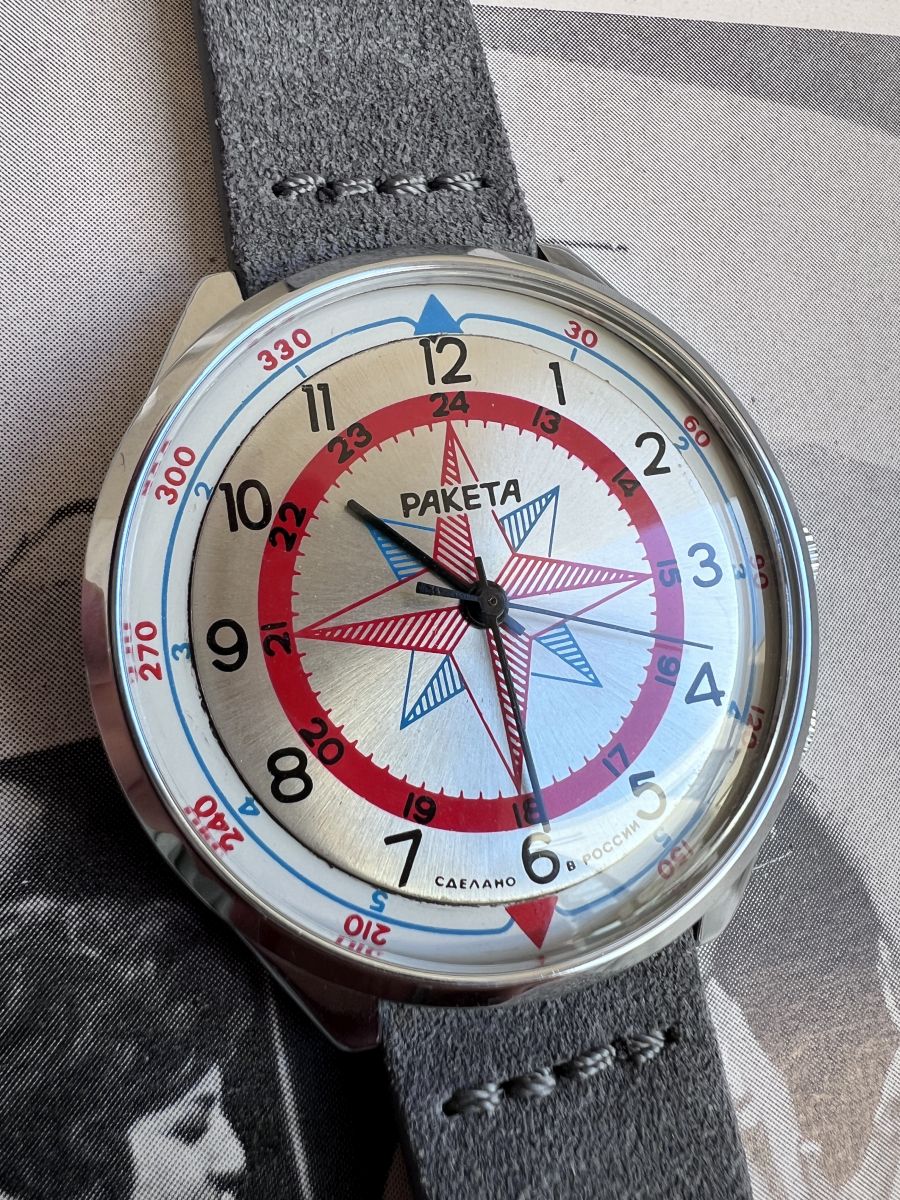
Wind Rose: a compass painted on the dial.
Jeans: graduated blue dial, fluted bezel.
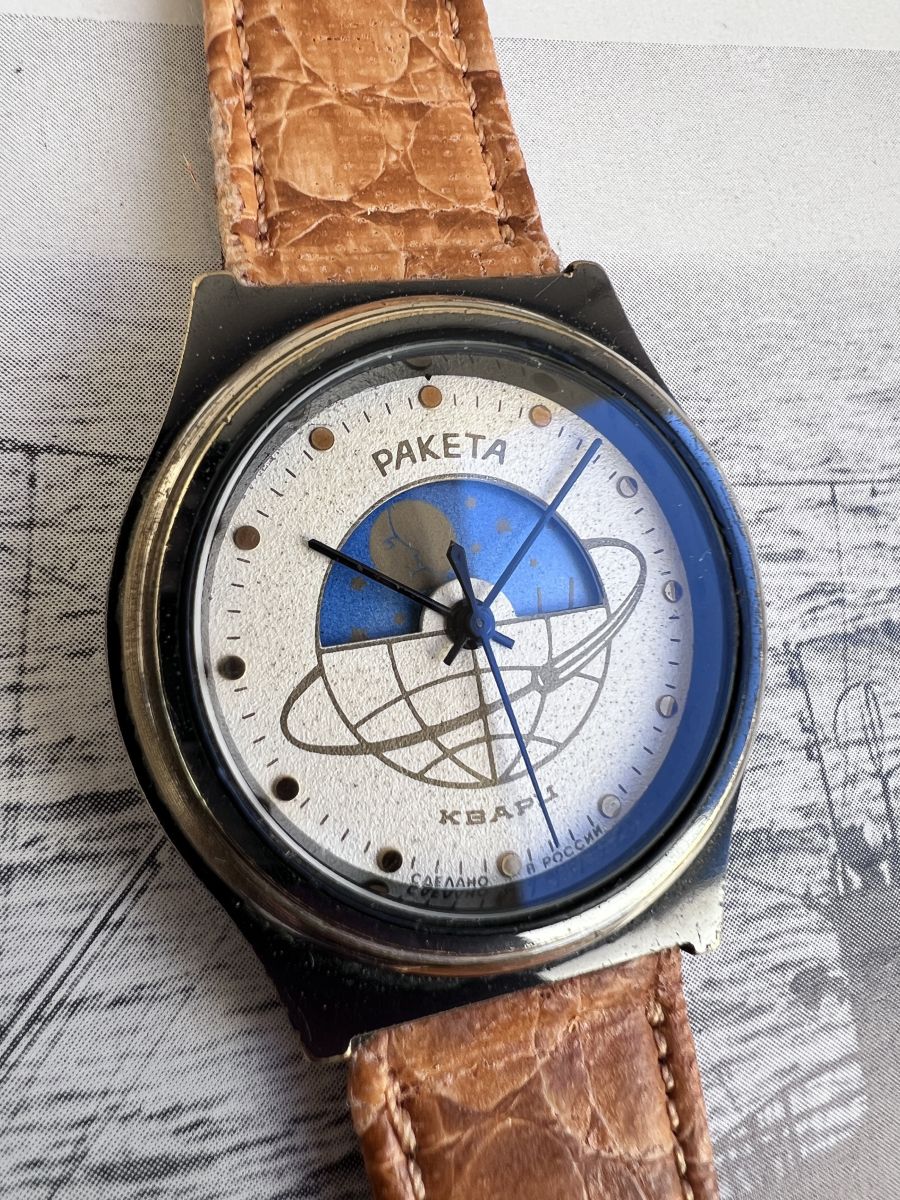
Day-night quartz Sputnik: the blue and white disc turns once in 24 hours.
How to date a Raketa
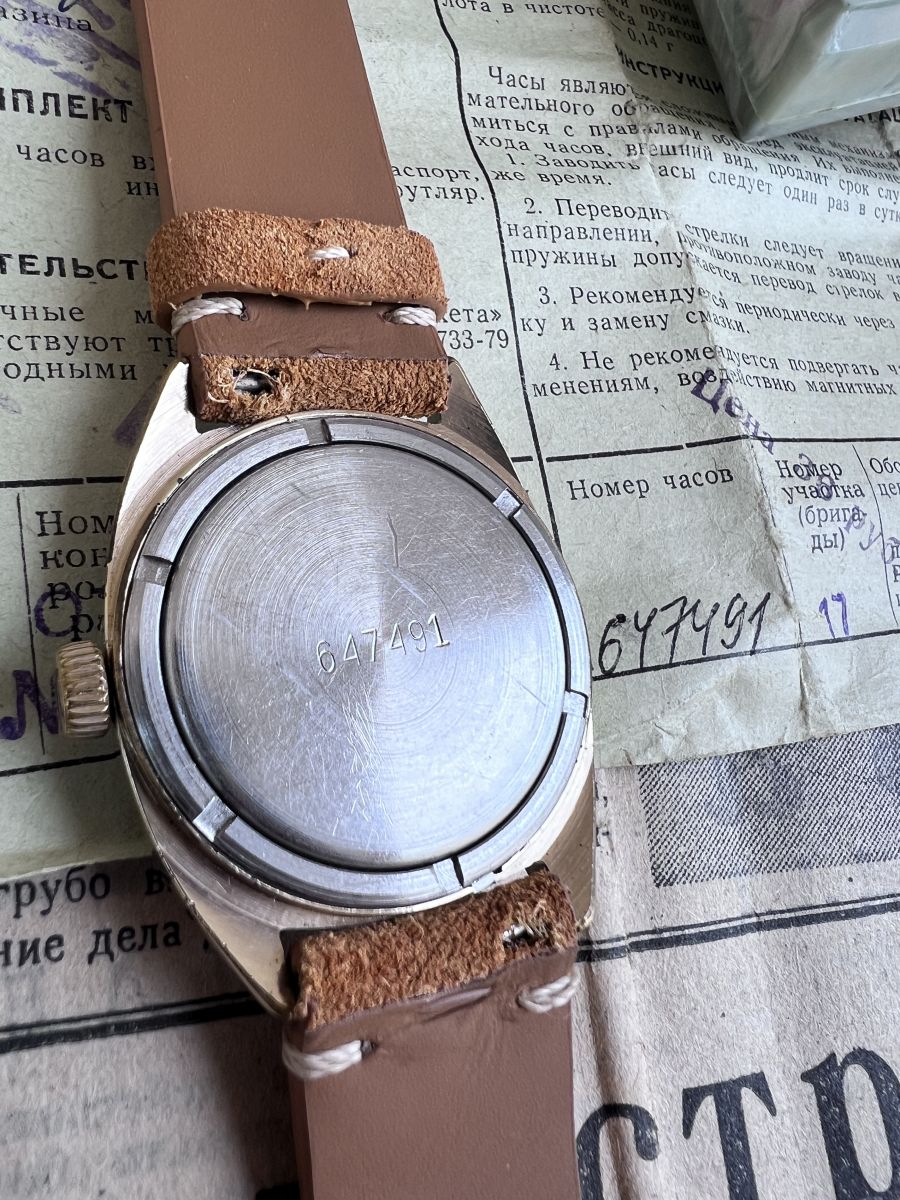
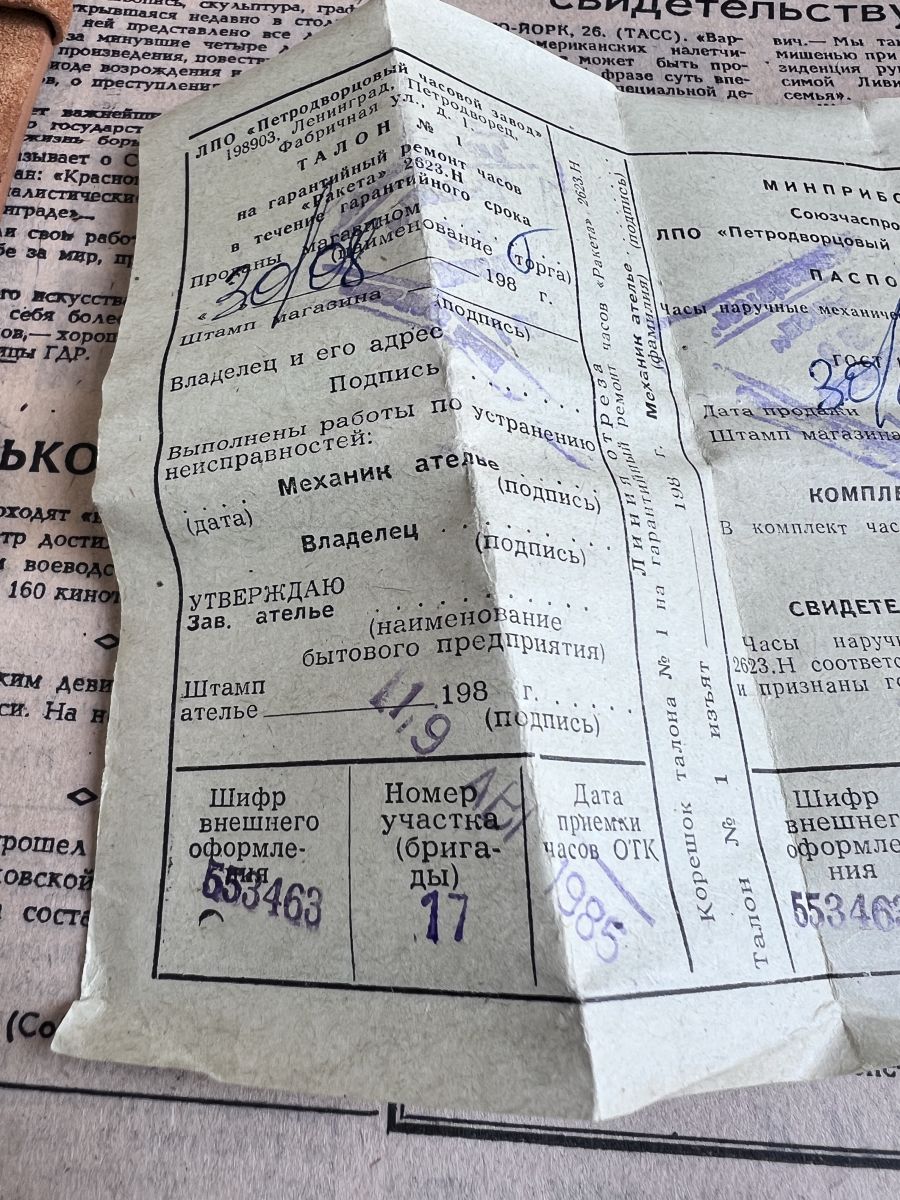
The passport first. Every watch left the factory with a passport, a booklet in which quality control (ОТК, OTK) stamped the inspection date and the movement number. That number is engraved on the case back: if it is the same on the passport and on the back, the passport belongs to the watch. A passport alone proves nothing, printed copies are in circulation.
The number 647491 engraved on the back of the 1985 Antarctic.
The same number on its passport, with the inspector’s stamp and the April 1985 date.
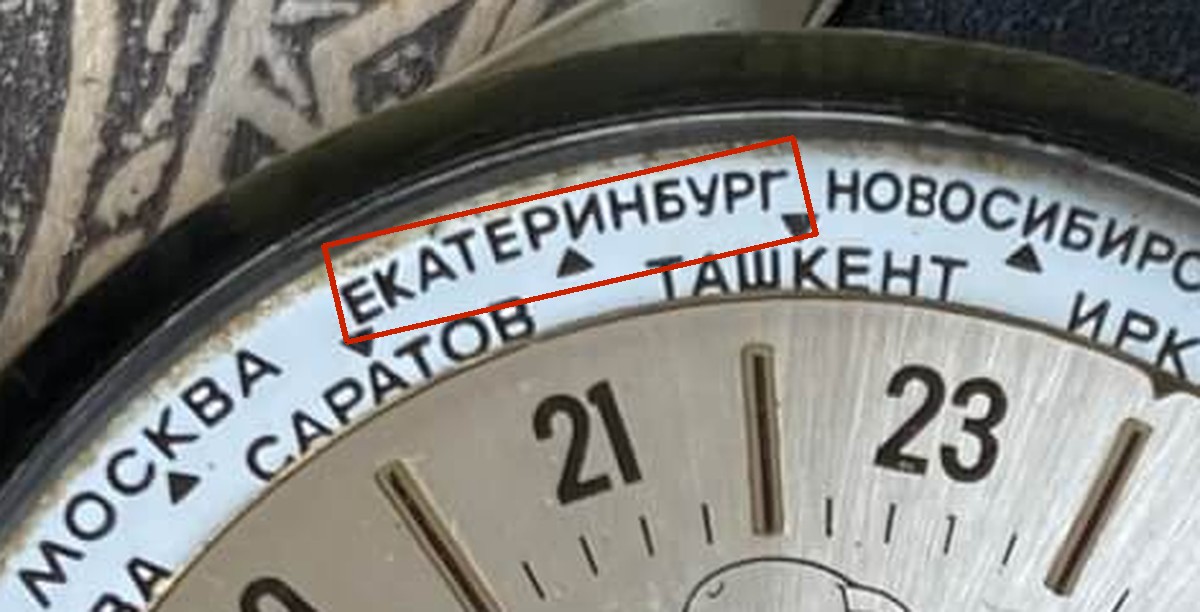
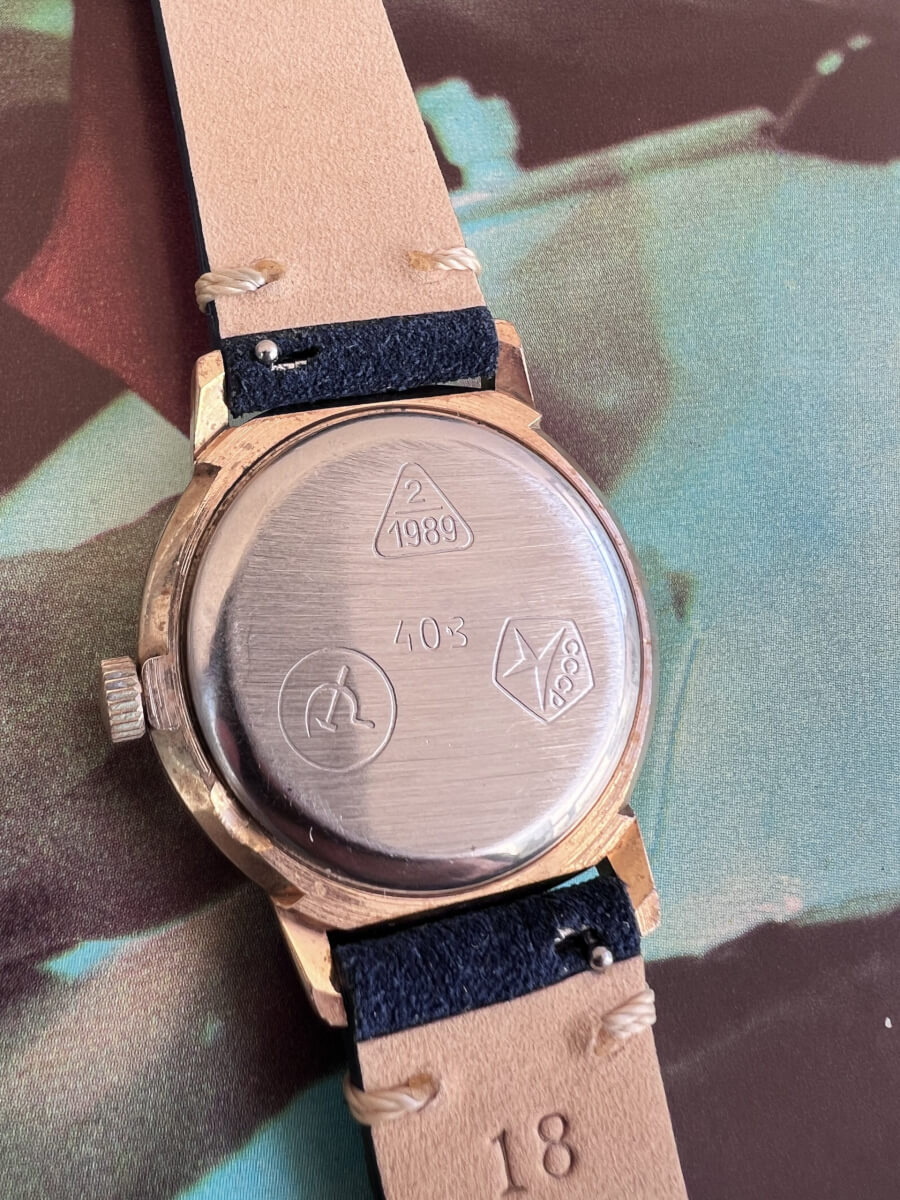
Without a passport, the dial speaks. Сделано в СССР (Sdelano v SSSR, made in the USSR) or Made in USSR means production before the end of 1991. The passports of 1992 and 1993 read СНГ (SNG), the Commonwealth of Independent States, and the later dials Сделано в России. Be careful: the factory kept printing CCCP after 1991, because it sold better than Russia. City names help too: a World Cities ring that reads Свердловск (Sverdlovsk) predates September 1991, when the city took back the name Yekaterinburg, and a document that writes Saint Petersburg cannot be earlier than September 1991.
Екатеринбург (Yekaterinburg) on the cities ring: this 24-hour watch of the Strategic Missile Forces is from 1994.
Back of a Raketa Sekonda: the factory mark and the year 1989.
The movement last. A 2609 with chamfered edges is a finish abandoned around 1982, and case 51 of the Big Zero only appeared around 1985: a chamfered calibre in that case betrays a reassembled watch. The pentagon of the Знак качества (Znak kachestva, the State quality mark), created in 1967, appears on the dials and backs of the pieces that earned it, and on some passports. And a bridge marked SU, for Soviet Union, denotes a movement intended for export.
Export: Sekonda, Exacta, Paketa
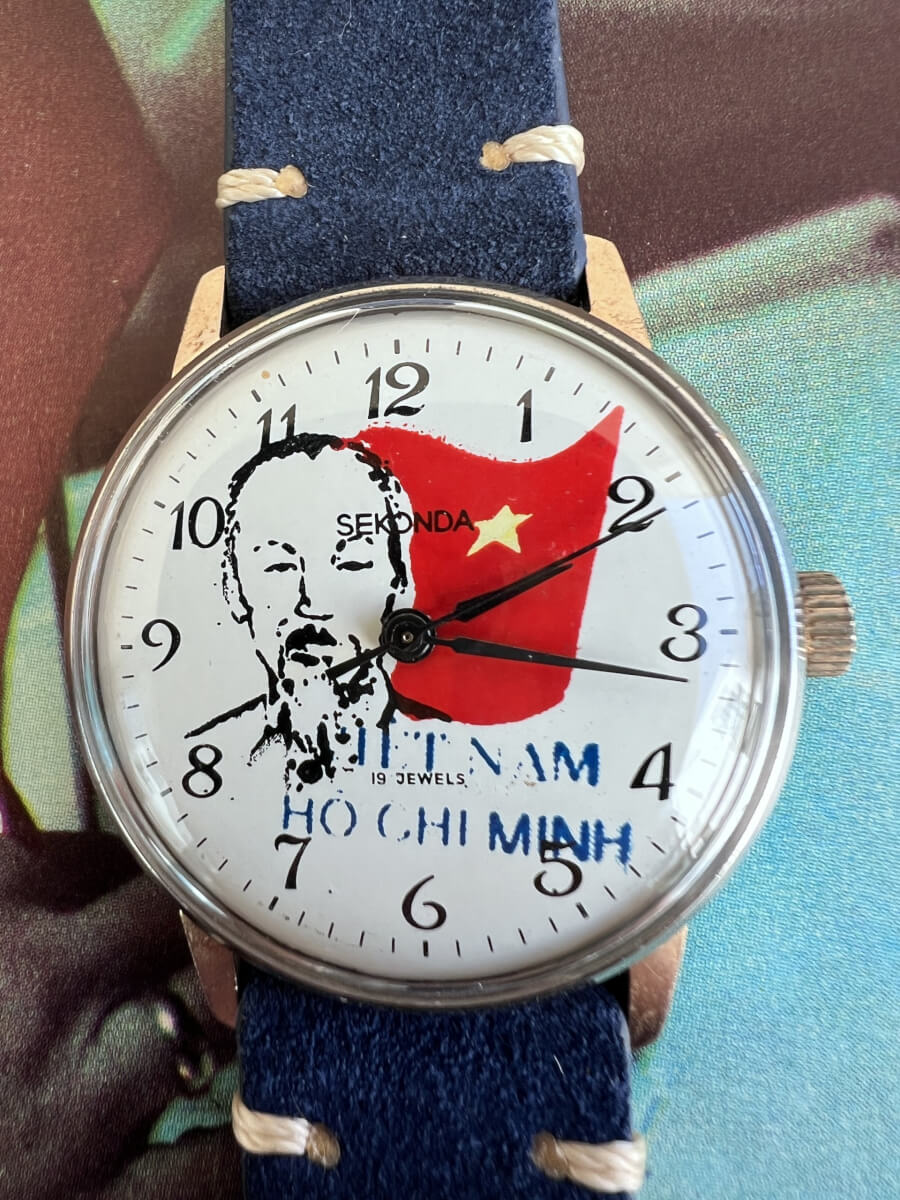
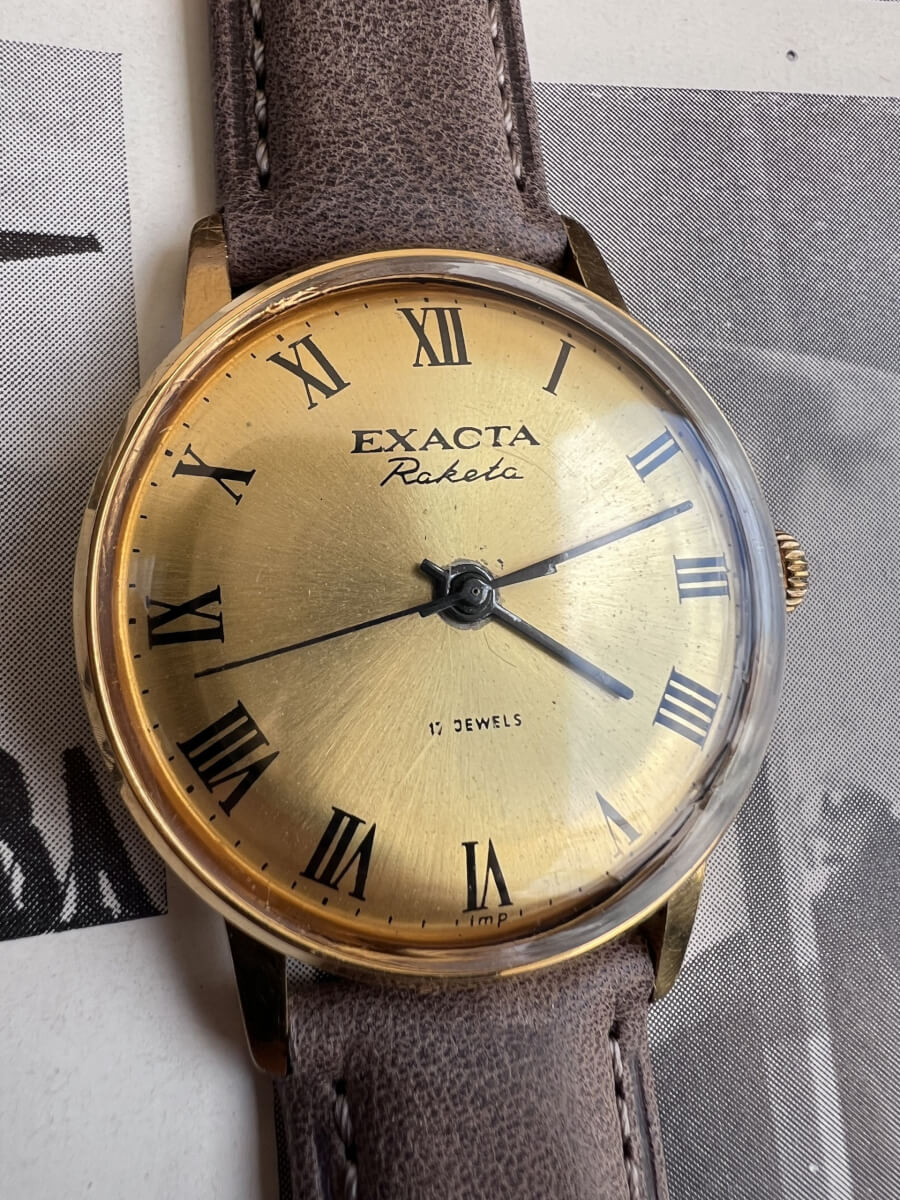
Raketa exported a great deal, under its own name or under others. The Sekonda brand, created in 1966 by the Soviet watch trade organisation for the best watches of the USSR’s factories, dressed Raketas for the United Kingdom and for more distant markets, like this Ho Chi Minh dial made in 1989 for Vietnam. In Sweden, Raketas carried the name Exacta, with « Imp » at the bottom of the dial, which made it possible to comply with import law without writing USSR.
Raketa under the Sekonda brand, Ho Chi Minh dial for Vietnam, 1989.
Raketa under the Exacta brand for Sweden, « Imp » at the bottom of the dial.
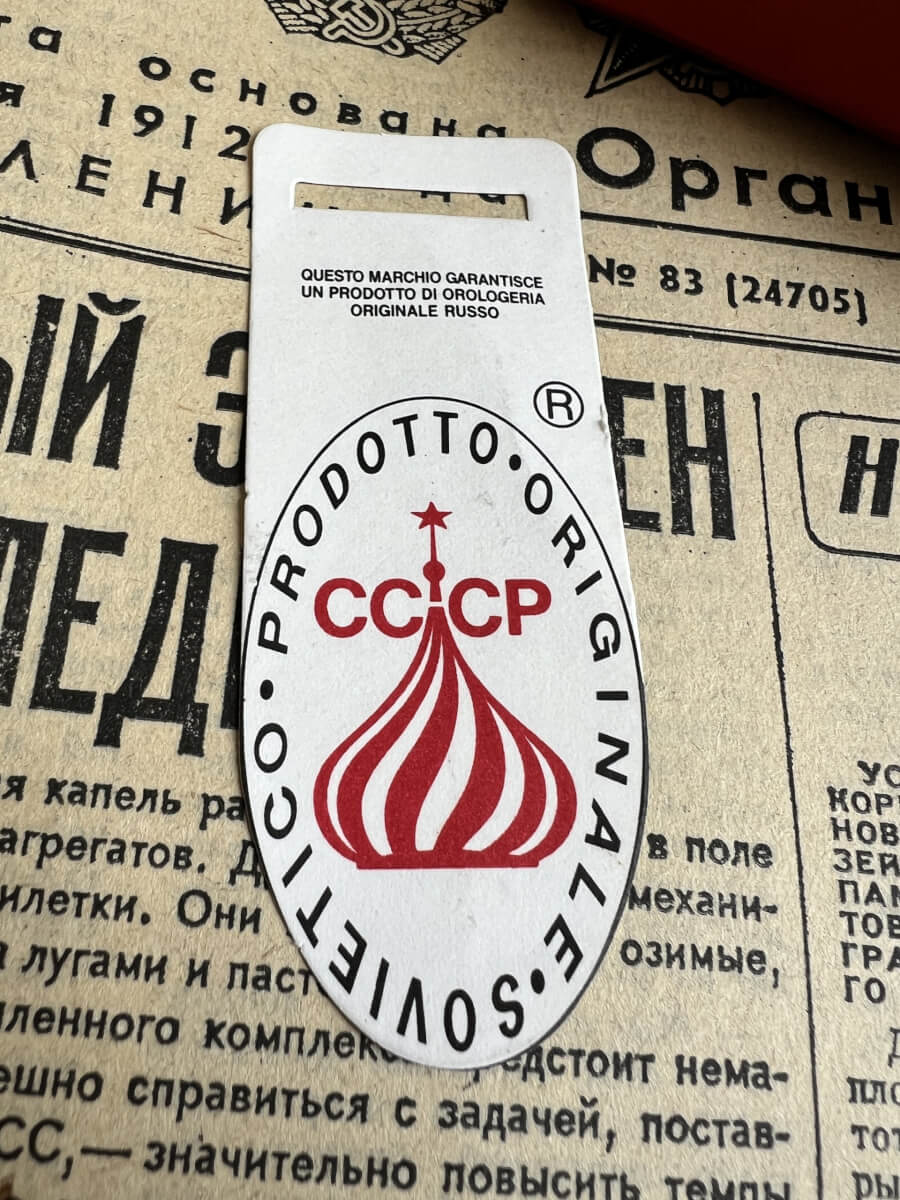
The market that made the brand’s fortune was Italy. Between 1988 and 1990 the Big Zero was the fashion there: La Stampa counted fifty thousand « Soviet missiles » entering in 1988 and expected four hundred thousand for 1989. Italians read the Cyrillic their own way and said « Paketa ». The watches arrived with an oval « Prodotto originale sovietico » label, sometimes trilingual, and importers such as Mirabilia dressed Raketa movements with Italian dials, including the « Gaigher » Big Zero. Those pieces are Soviet in everything but the dial.
The Italian « Prodotto originale sovietico » label of a Big Zero pocket watch: proof that a watch went through the importers of the late 1980s.
Fake, repainted, reassembled
Three different things circulate under the Raketa name. The entirely fake watch is rare: making a case costs too much. The replacement dial is the real problem: Copernicus, Big Zero or Hammer and Sickle dials sell for a few euros from parts dealers, and 2609 movements are plentiful, hence the number of reassembled watches. Factory dials to which a decoration was added, a tank, a MiG, a KGB crest, are a third category: we call them enhanced dials, they are not fake watches, and we sell them as such.
Each model guide gives the tell-tale signs for that model, and our Soviet watches genuine or fake page puts a period piece and its copy side by side under a slider for the Big Zero, the Copernicus, the Antarctic and the Hammer and Sickle. Before buying, research thoroughly, compare several examples and rely on collectors’ sites that show their pieces, not on a single listing.
After 1991: the fall, then the 2010 buyout
After the end of the USSR the factory was privatised, largely for its land. Production became chaotic, the stocks of components were used up in no order, and the brand shrank to a small business of souvenir watches sold to tourists for about a hundred dollars. Custom dials for Western companies date from those years. Of some fifty production lines, including one for hairsprings, a single one was saved by a small group of former employees.
New old stock civilian watch inspected in August 1991, a few weeks before the dissolution of the USSR.
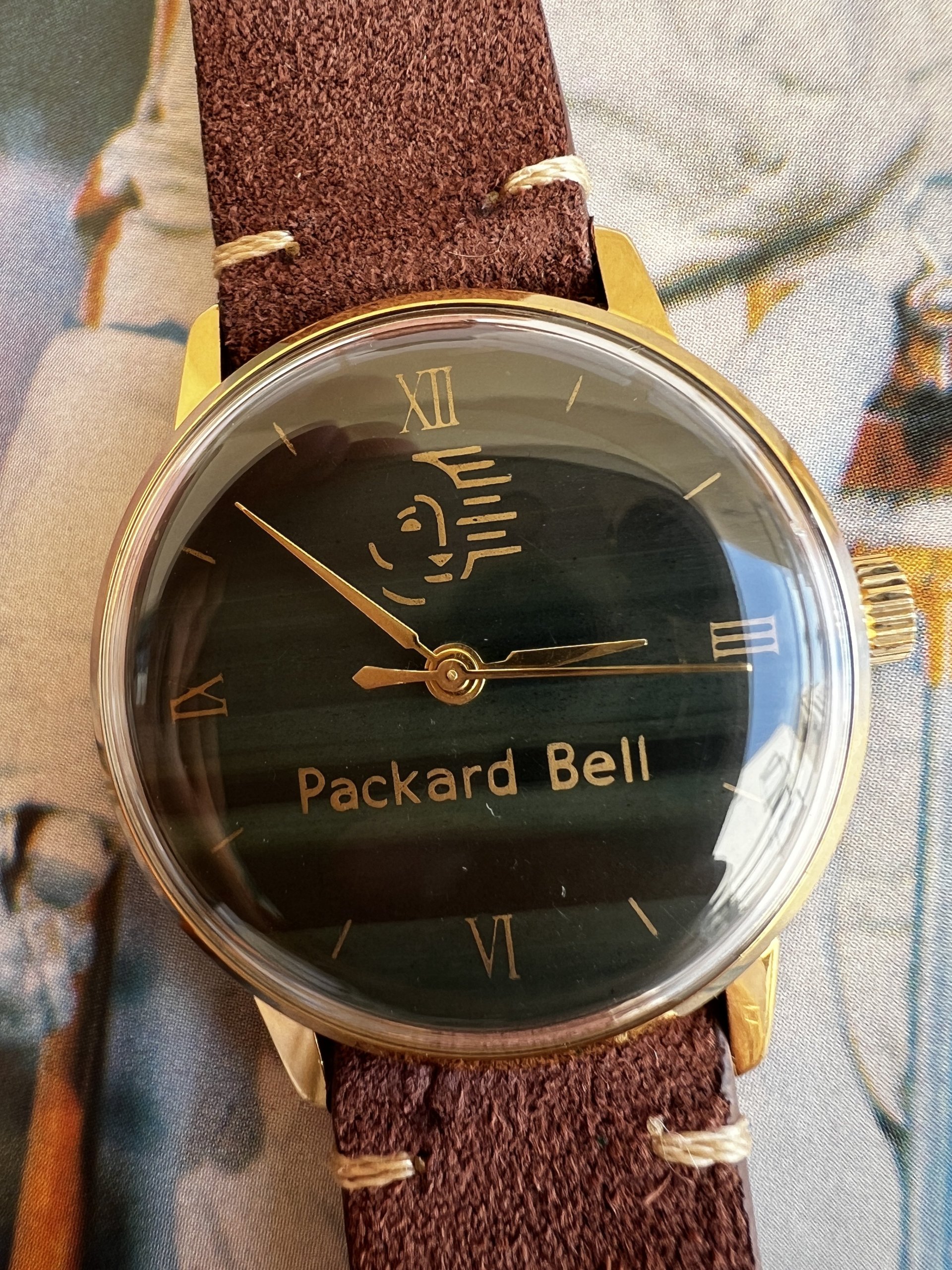
Packard Bell custom dial: a promotional series from the years after 1991.
In 2010 David Henderson-Stewart and a group of investors, including the designer Jacques von Polier, bought the brand and what was left of the factory: about twenty elderly workers, broken windows, but intact archives and drawings, and watches that still ran. The in-house movements were modernised. The first models came out in 2011, and for six months no shop in Russia agreed to stock them. In 2020 the company had about a hundred employees, France was its largest foreign market, and the Copernicus reissued since 2017 sells for around 2,500 euros. Today’s Raketas are another story: a Soviet piece costs five to ten times less.
What a Soviet Raketa costs
Here are the prices at which we have offered and sold Raketas in recent years, exceptional pieces aside. A working civilian watch with a 2609 or 2614 calibre goes for 90 to 260 euros. Civilian 24-hour watches, World Cities, Navy or Arctic Circle, range from 150 to 500 euros depending on condition, box and passport. A period Big Zero sells for 145 to 480 euros, a Copernicus for 165 to 550 euros, a perpetual calendar for 140 to 390 euros, a Hammer and Sickle for 490 to 690 euros. Expedition pieces are a category of their own: the Sibir watches of the 1987 nuclear icebreaker sold for 390 to 950 euros, and the first-type Antarctic watches of the 16th expedition for 1,590 to 2,350 euros.
To measure what the watch meant at the time: in 1985 an Antarctic cost a little under one fifth of the average Soviet monthly wage, 190 roubles gross that year. Set against today’s average French gross salary, that is about 700 euros. A Raketa was not a trivial purchase.
Frequently asked questions
Is Raketa a good watch brand?
For a Soviet watch, yes. The 2609.НА was produced for decades without major change, parts are available, and a serviced watch runs ten years or more without attention when worn regularly. Factory accuracy is in the order of 20 seconds slow to 40 seconds fast a day; after servicing, our watches stay within a narrower band.
Which Raketa should I buy first?
A serviced civilian watch with a 2609 calibre, between 150 and 250 euros, or a 24-hour World Cities if the dial speaks to you. Do not start with a cheap Copernicus or Big Zero: they are the most reassembled models.
How do I know whether my Raketa is a period piece?
Passport and number on the case back first, dial next (СССР, СНГ or Россия, city names), movement last. The detailed signs are in each model’s guide and on the comparator page.
Can I wear a Raketa every day?
Yes, for a serviced watch with a 2609 or 2623 calibre. It is not water-resistant in the modern sense: no shower, no swimming pool. Wind it every morning, about twenty turns.
Where were Raketa watches made?
In Petrodvorets, today Peterhof, near Saint Petersburg, and nowhere else. A Raketa « made in Moscow » does not exist.
The ДП-5В (DP-5V) is the field radiometer of Soviet civil defence: a green Bakelite console, a probe with a rotating gamma, beta and check-source shield, headphones and a manual that explains operation and maintenance. The one in this article served in an industrial bakery in Chișinău and was serviced in March 1991. Its owner shared his photos and documents with us, and we turned them into a tool that lets you operate it on screen, step by step.
The Moscow Games, from 19 July to 3 August 1980, boycotted by some sixty countries, produced more objects than any Soviet event: a bear cub, Misha, drawn by Viktor Chizhikov, an emblem made of running tracks, five thousand torches, watches from every factory, platinum coins, rings, tea glass holders, posters. This guide tells the story of the Games and reviews the objects, with the marks that authenticate them and the prices.
The 3017 chronograph of the First Moscow Watch Factory carries a five-digit number on the balance cock. The most common dating method reads it as a single series, from 1959 to 1979. Four factory passports show there are two, and that the same number can point to two watches made ten years apart. Here is how to read the number, the dial, the logo and the bridge, with a decoder to date your Strela, Poljot or Sekonda.
This website uses cookies to improve your experience while you navigate through the website.
Out of these cookies, the cookies that are categorised as necessary are stored on your browser as they are essential for the working of basic functionalities of the website.
We also use third-party cookies that help us analyse and understand how you use this website.
These cookies will be stored in your browser only with your consent.
You also have the option to opt out of these cookies.
But opting out of some of these cookies may affect your browsing experience.
Necessary cookies are absolutely essential for the website to function properly. This category only includes cookies that ensure basic functionalities and security features of the website. These cookies do not store any personal information.
Cookies that are not strictly necessary for the website to work and that are used specifically to collect personal data through analytics, ads and other embedded content are called non-necessary cookies. User consent is required before these cookies run on the website.
✕
Soviet in Paris
Offline right now. Leave your message and your email, we reply within 24 hours.
Hello 👋 A question about an item, an order or shipping? Write to us.
Your email is used only to reply to you.
Subscribe to our newsletter and get 10% off your first order.
Subscribe
★ New pieces before anyone else
★ New blog articles
★ Soviet in Paris news and updates
Join the Party
10% off your first order
Receive your welcome card and our next arrivals.
Your code appears here and is also sent to you by email. You can leave the Party in one click, at any time.