The Elektronika 1 is the Soviet watch with red digits. No hands, no ticking: a dark screen that lights up when a button is pressed, then goes out. It descends from an American watch of 1972, it was developed in a semiconductor institute in Moscow, and in 1981 it sold for 121 roubles, about two thirds of a month's wages. This guide tells where it comes from, shows its two cases, explains its five buttons with a simulator, and says what to know before buying one.
OCTOBER 2026•9 MINUTE READ
by Marwen Yahyaoui
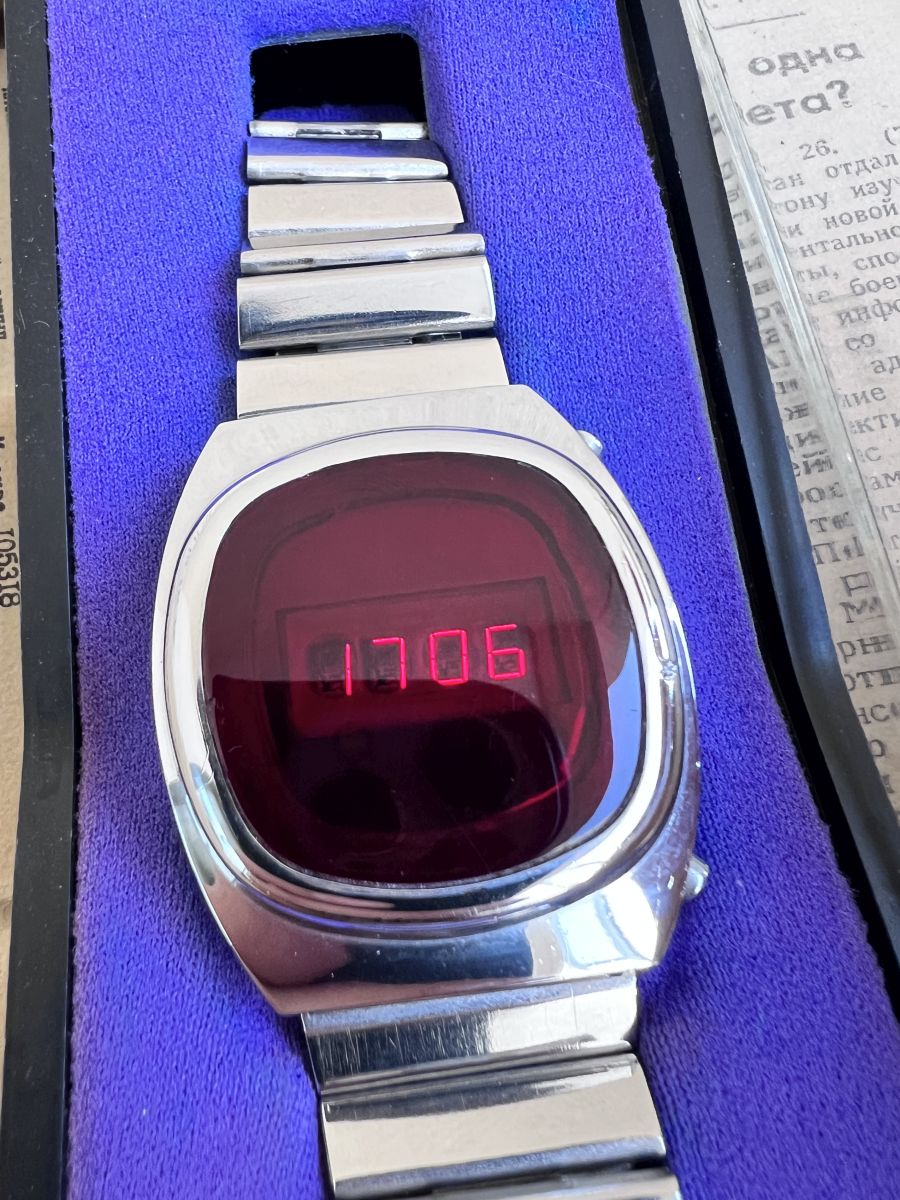
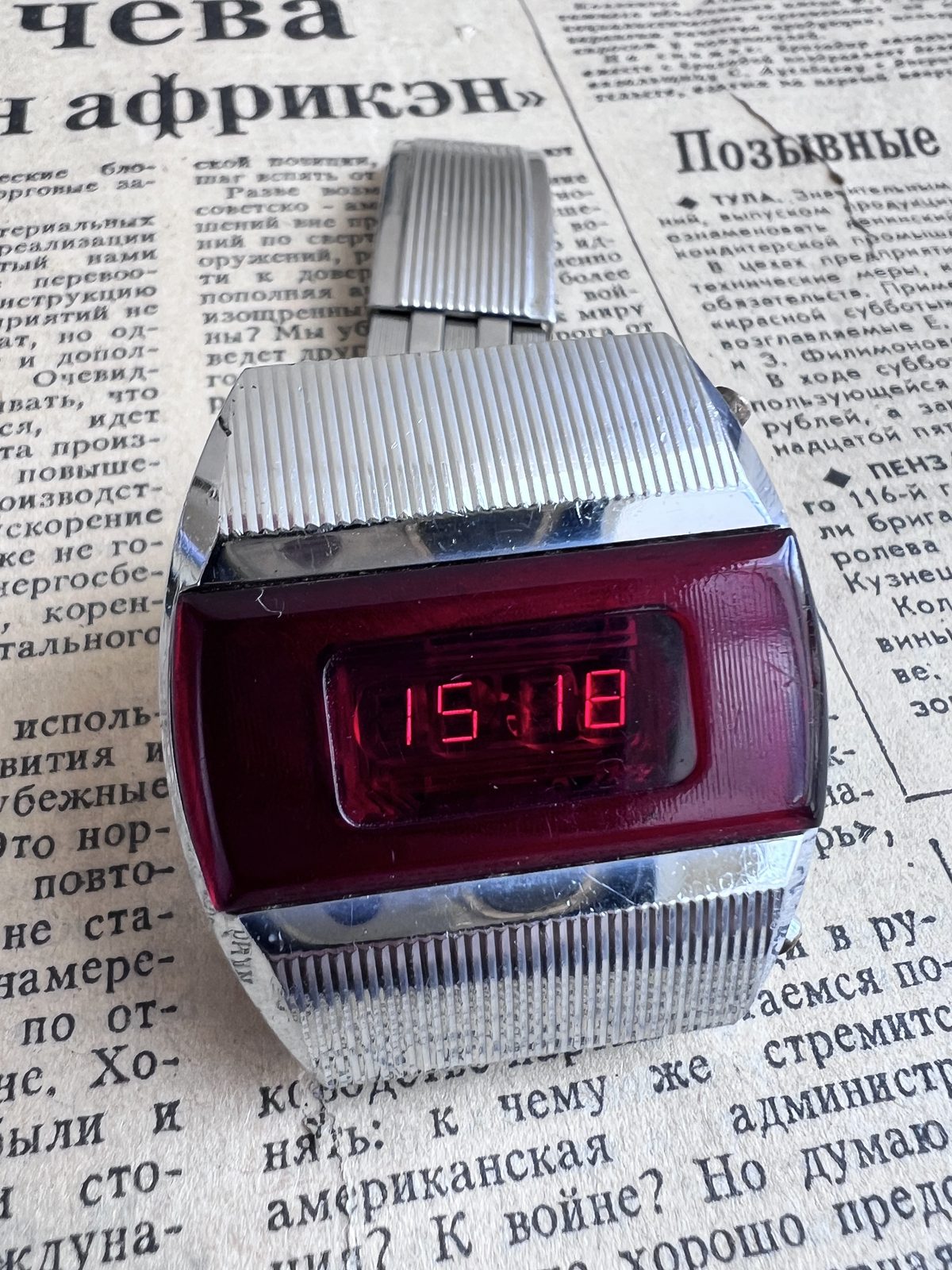
1981 Elektronika 1, cushion case, display lit at 17:06.
An Elektronika 1 has no mechanical part at all. A quartz crystal gives the beat, an integrated circuit counts, and four light-emitting diode digits show the result behind a red crystal. The factory leaflet presents it as the first Soviet timekeeping device of an entirely new kind.
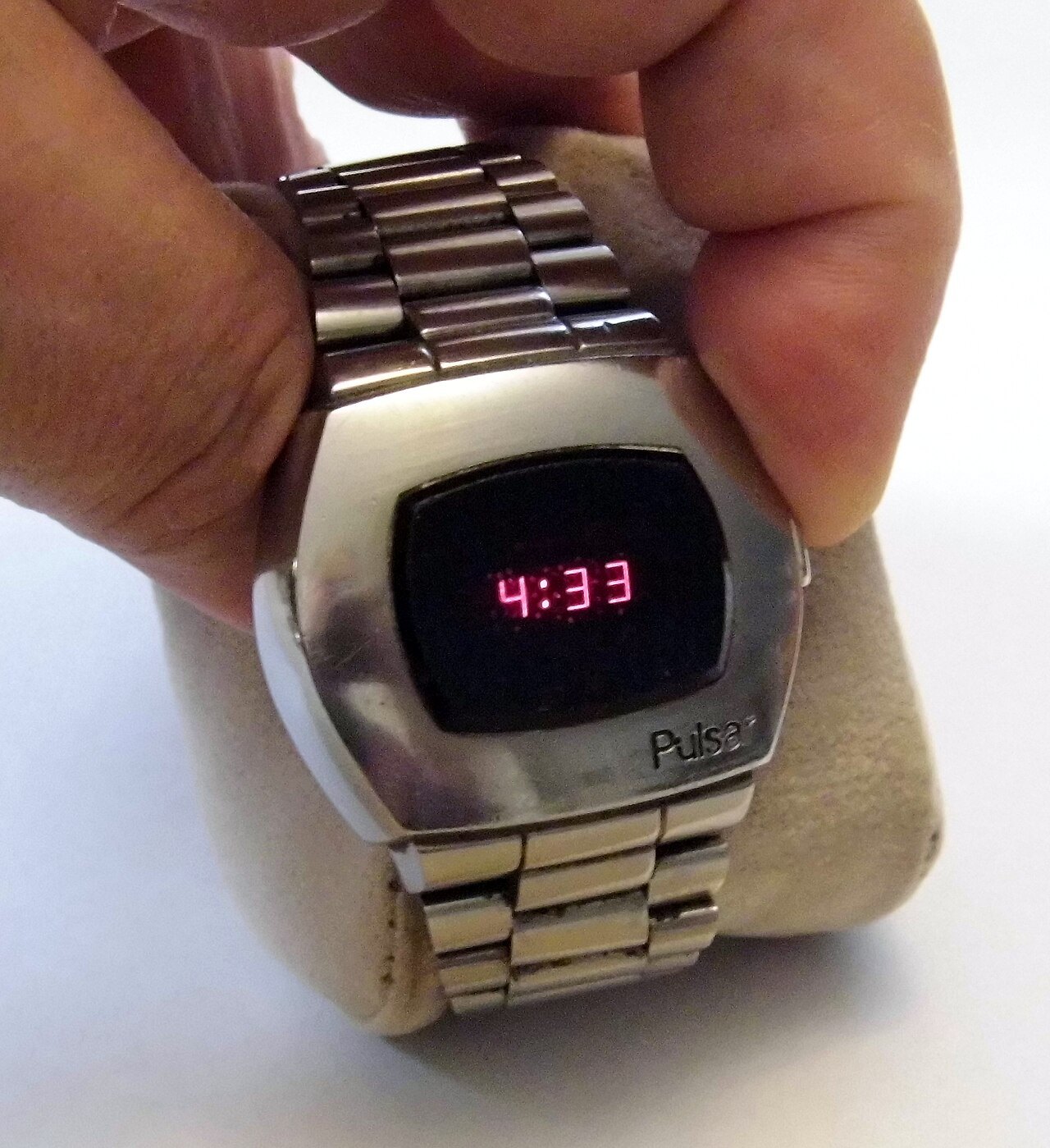
The watch with glowing digits was born in the United States. The Hamilton Watch Company announced the Pulsar in 1970 and put it on sale on 4 April 1972: 18-carat gold case, red diode display, 2,100 dollars. It was the first electronic watch with a digital display.
Pulsar P2 “Time Computer”, United States, 1970s. Photo: Joe Haupt, Wikimedia Commons, CC BY-SA 2.0.
Its display drew so much current that it could not stay on. You pressed a button, the time appeared for a moment, then the display went dark. The Elektronika 1 takes over that principle unchanged. In 1973 a Pulsar was on James Bond’s wrist in Live and Let Die.
Moscow, 1973: the Pulsar institute
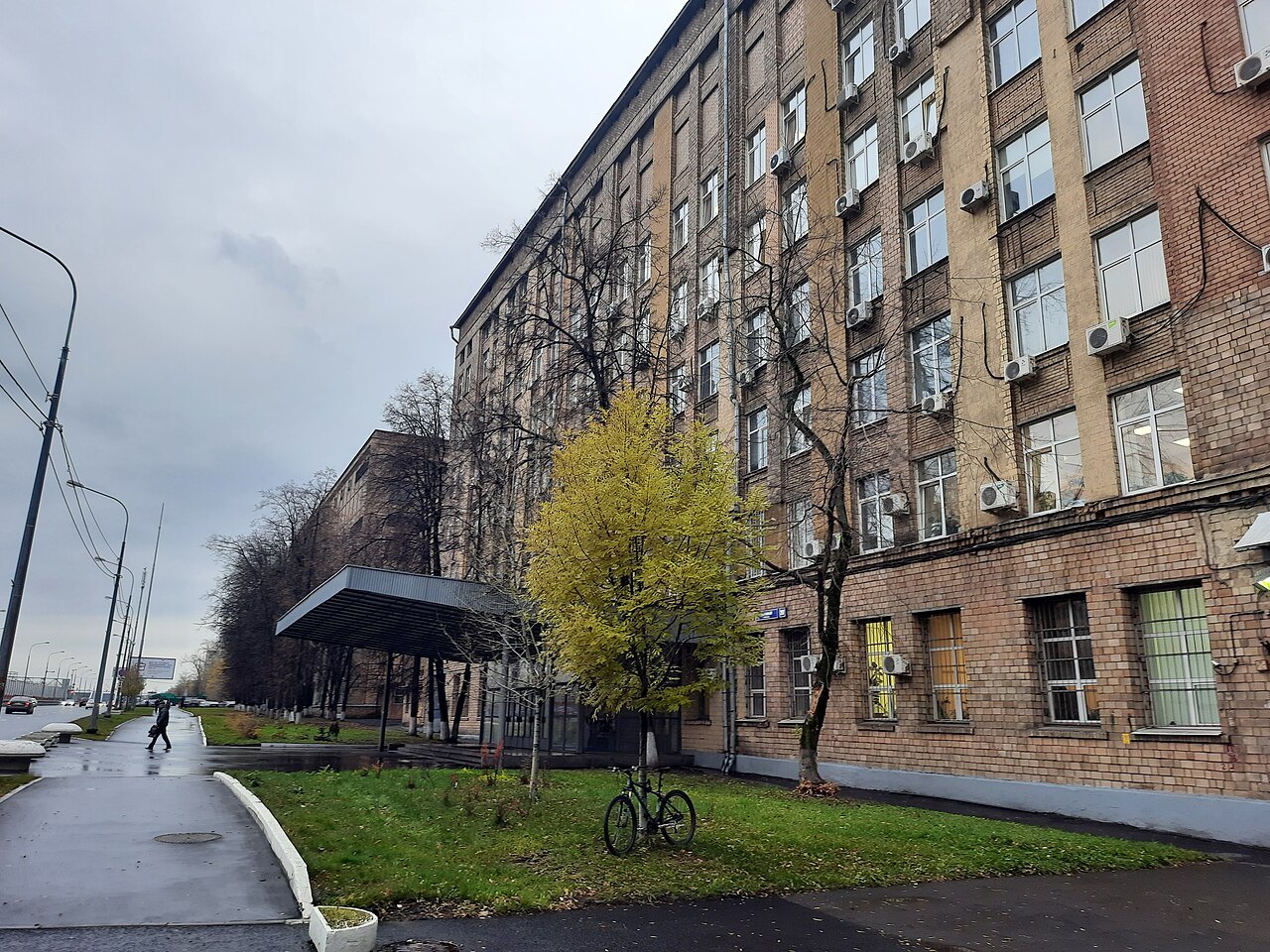
In the Soviet Union, the electronic watch was not given to a watch factory. It went to the Ministry of the Electronics Industry, to a semiconductor research institute founded in Moscow in 1953, the first branch institute of the country’s electronics industry. Its pilot plant is called Пульсар (Pulsar). The American watch and the Soviet plant bear the same name, and nothing shows that one comes from the other.
The building of the Pulsar company in Moscow, Okruzhnoy proyezd, 27, in October 2021. Photo: Kotofey2016, Wikimedia Commons, CC BY-SA 4.0.
Work on the circuits began in 1973. The institute developed the first Soviet set of integrated circuits made in series for a watch, including a divider that brings the 32,768 beats per second of the quartz down to 64. According to the company history published in 2008, the work was carried out in department No. 4, headed by V. K. Nevezhin, and at the pilot plant. This chip set was one of the first applications of CMOS technology taken all the way to production in the USSR.
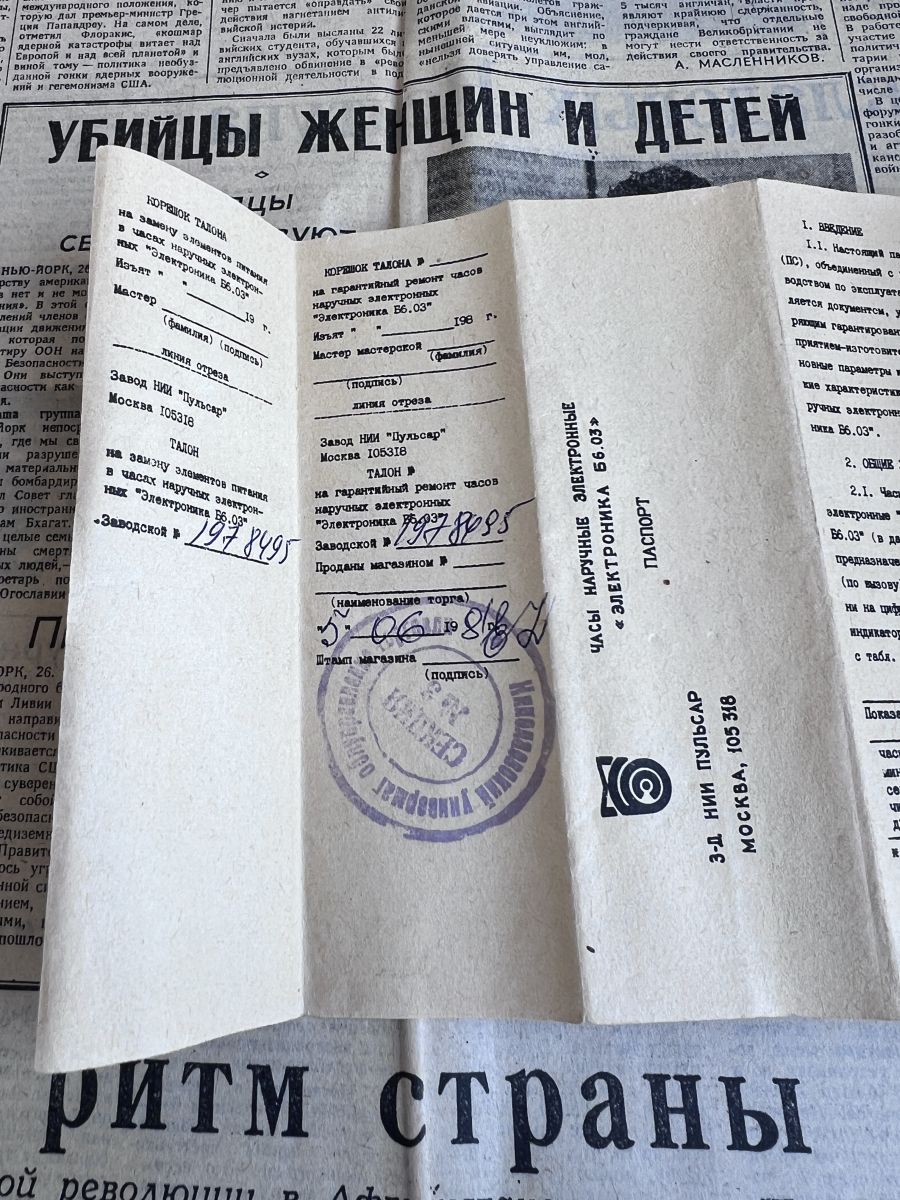
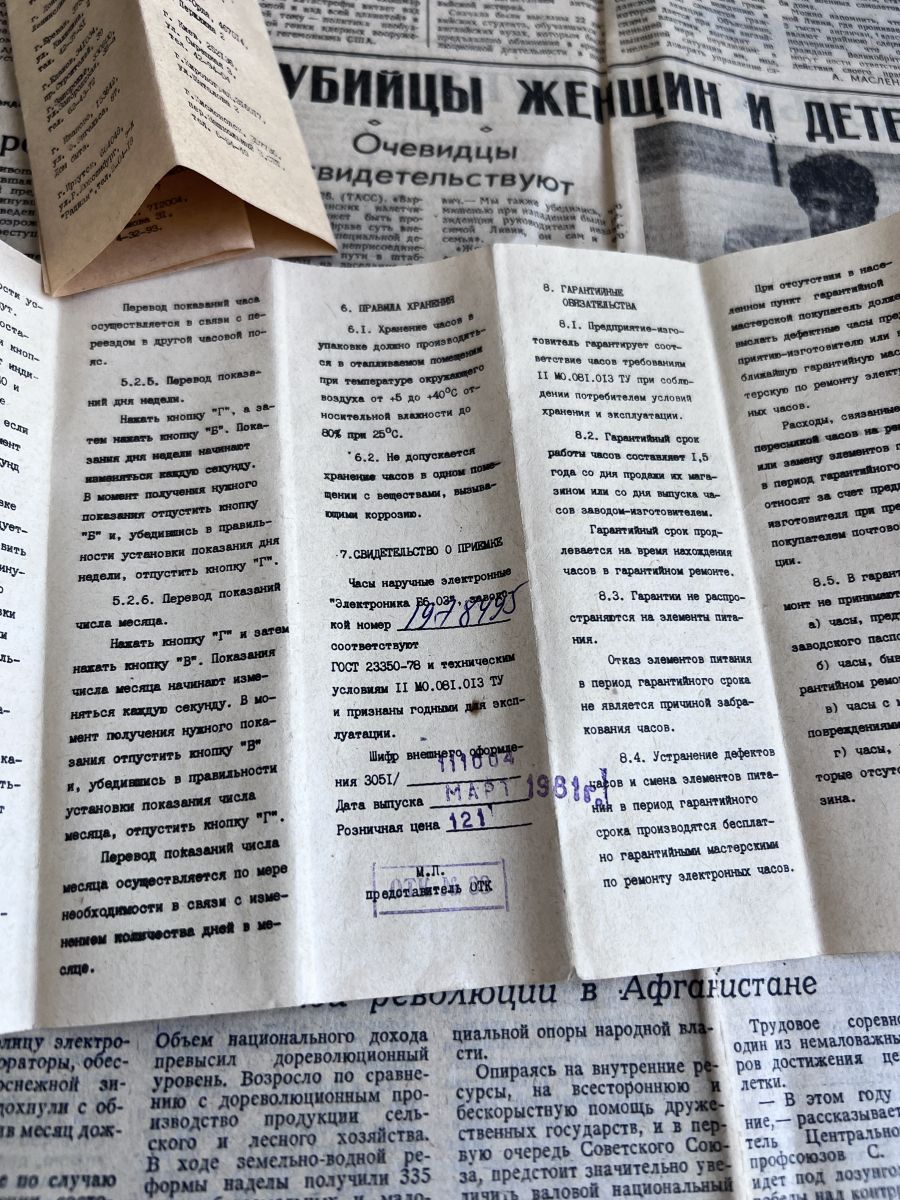
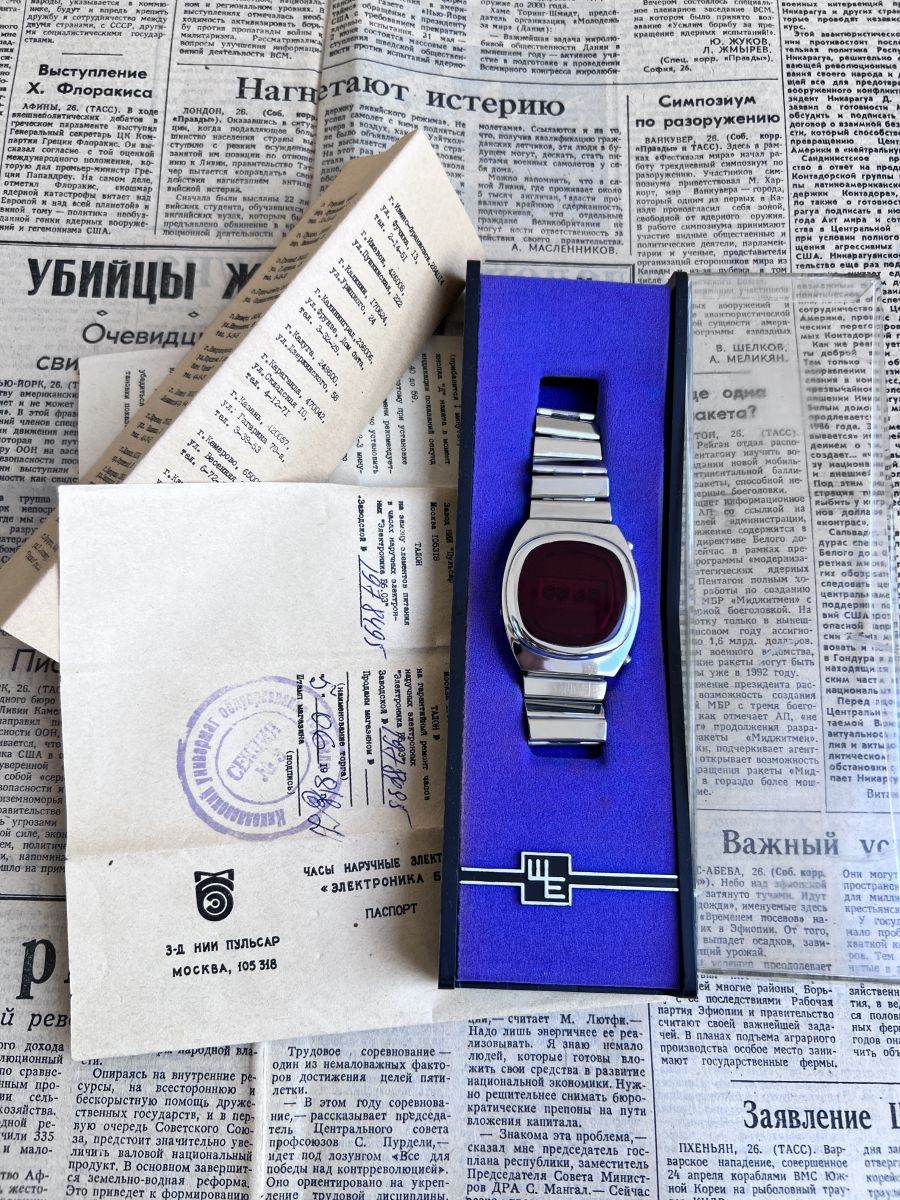
The passport of a 1981 Elektronika: “Часы наручные электронные Электроника Б6.03”, plant of the Pulsar institute, Moscow, 105318.
Mock-ups and experimental models
Two paths were studied at the same time: a liquid crystal display, always readable and frugal, and a diode display, bright but dark most of the time. The liquid crystal path went to Minsk, to the site of the Tranzistor plant, later the Elektronika factory of the Integral association.
The beginnings there were hard. A workshop No. 48 was set up on 12 April 1973. Its first two mock-ups did not reach the required specifications and did not last. On 3 August, four trial pieces were assembled under the working name Секунда (Sekunda), “Second”: three boards per watch and about fifty assembly operations. The model was shown at the VDNKh exhibition in Moscow on 1 June 1974.
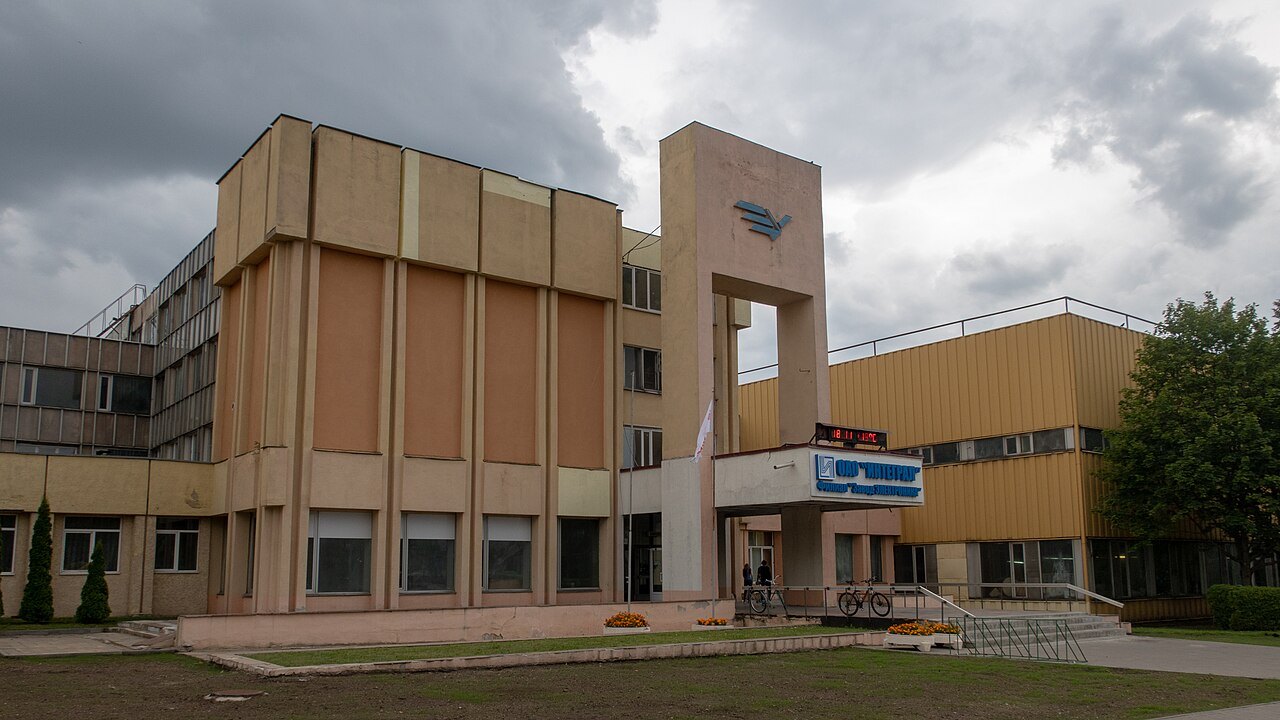
The Integral headquarters in Minsk in July 2019. Photo: Homoatrox, Wikimedia Commons, CC BY-SA 3.0.
The liquid crystal watch that came out of it, the Elektronika Б6-02 (B6-02), appears in the April 1975 price list at 105 roubles in a chrome-plated case and 120 roubles in a gilt case. Ten thousand watches were assembled in Minsk that year. It sold poorly: by March 1979 it had already been withdrawn from production.
The diode path stayed in Moscow. It gave the Elektronika 1, module Б6-03 (B6-03), reference 3051, produced from 1976 to 1989 according to Russian sources. Many websites credit the Elektronika 1 to Minsk. The passports of the watches that went through the shop say otherwise: they bear the name of the plant of the Pulsar institute, in Moscow, and its emblem.
The two cases that went through the shop
The electronic module changed very little over the whole production. What changes is the case. Some collectors count four of them. Two went through the shop, about twenty watches in all.
Cushion case: a large rounded red crystal set in a polished frame.
Fluted case: the red crystal runs across the case, between two ribbed blocks.
The first is a cushion with rounded corners, close to the American Pulsar. The second is more angular: two blocks of fluted metal, and between them a band of red crystal that overhangs the sides. Collectors call it the “Terminator”. Ours measures 41 mm by 35.
Both carry on the back “ЭЛЕКТРОНИКА 1” (Elektronika 1) and “СДЕЛАНО В СССР” (Sdelano v SSSR), made in the USSR. A small round hatch gives access to the batteries without opening the rest of the case.
Hand-engraved back: “To my dear son Gavryusha for your 30th birthday, from your mum”, 24 July 1978, Berdyansk.
Unworn fluted case in its box, with its factory tag.
What the passport of a 1981 Elektronika says
One of the shop’s Elektronikas has kept its box and its passport. The document gives the model, “Электроника Б6.03”, the serial number, 1978495, the GOST 23350-78 standard, the code of the case design, 3051/111004, and the date it left the factory: March 1981. The stamp of the department store dates the sale to 5 June 1981.
The acceptance certificate: number 1978495, March 1981, retail price 121 roubles, stamp of the quality control department.
The retail price is printed: 121 roubles. The average Soviet monthly wage was 168.9 roubles gross in 1980 and 190.1 roubles in 1985. The watch was therefore worth between two thirds and three quarters of a month’s wages. Set against the average gross wage in France today (€3,602 a month in the private sector in 2024, according to Insee), that comes to roughly €2,300 to €2,600.
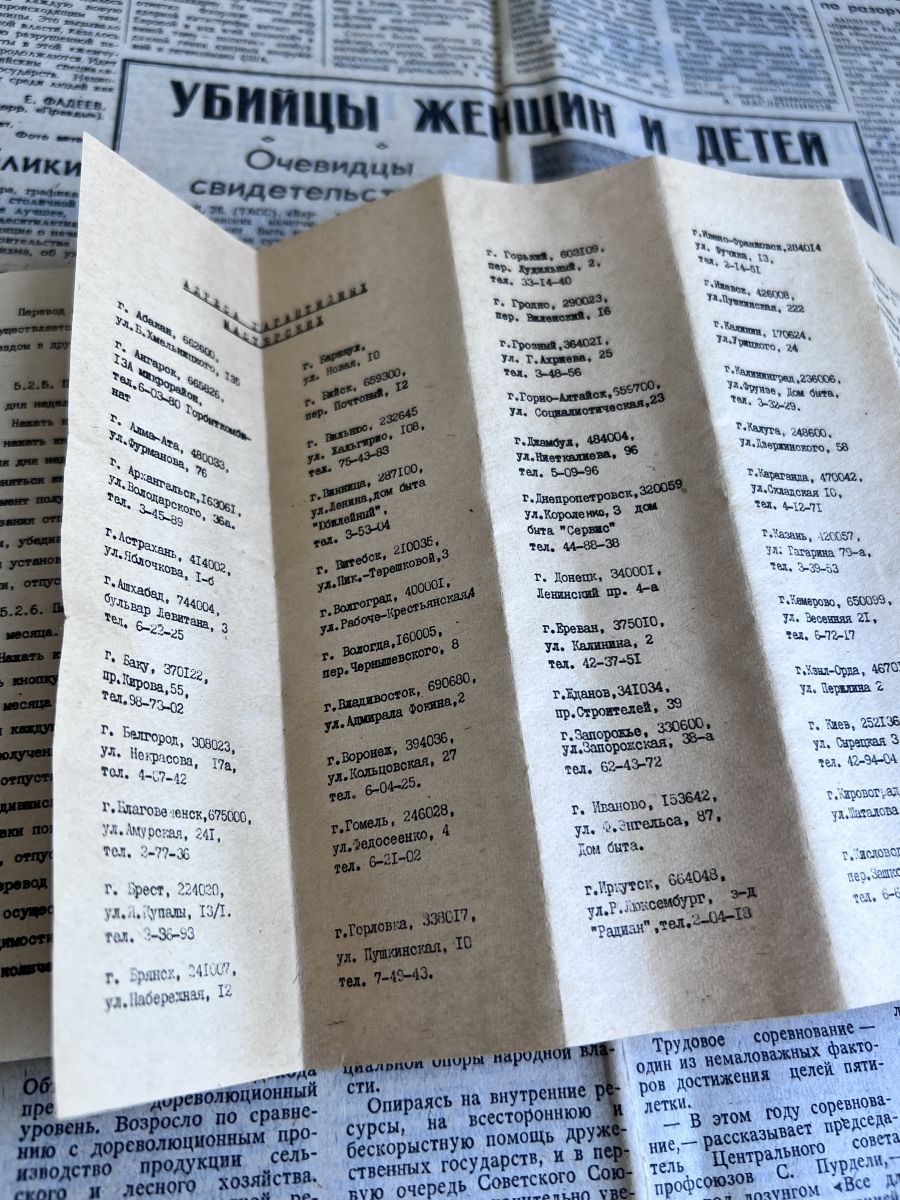
The guarantee runs for eighteen months and does not cover the batteries. The passport ends with the list of guarantee workshops, from Abakan to Vladivostok, where the watch was to be sent in case of failure.
The addresses of the guarantee workshops, town by town.
How the Elektronika 1 works
The leaflet describes the electronic block in five elements: a quartz resonator, a CMOS integrated circuit that it calls a “microminiature computer” and that does all the calculations, two circuits that drive the display, a diode display in seven-segment digits, and two batteries. The stated accuracy is half a second a day at 25 °C, or about fifteen seconds a month.
The display is off by default. Each activation draws heavily on the batteries, and the leaflet says so in plain words: at 20 to 25 activations a day, the batteries last a year. The original batteries are СЦ-0,18 (STs-0.18) cells. Today they are replaced by SR44 cells, also sold under the reference 357.
Reading the time, the seconds and the date
The case carries five buttons, which the leaflet names after the first five letters of the Russian alphabet: А (A), Б (B), В (V) and Г (G) on the right flank, from top to bottom, and Д (D) on the left flank. А and Г stand out from the case. The other three are recessed and are only used for setting. They are too small for a finger: they are pressed with a point. A wooden toothpick does the job, it scratches neither the chrome nor the nickel of the case.
A short press on А shows the hours and minutes for 1.6 seconds.
А held for more than a second and a half: the hours disappear and the seconds run for as long as the button stays pressed.
A press on Г shows the date on the left and the day of the week on the right, from 1 for Monday to 7 for Sunday.
Button Г: “25 2”, the 25th of the month, second day of the week, a Tuesday.
The leaflet asks for a short pause between a press on А and a press on Г, otherwise the display may be upset.
Setting the Elektronika 1
All the setting is done with the same buttons. For as long as the button is pressed, the figure goes up by 1 every second. You release when the right figure shows.
Minutes: hold Б, release on the right value, then check with А.
Hours: hold В. This is the setting to change when moving to another time zone.
Day of the week: press Г, then Б. Release Б, then Г.
Date: press Г, then В. The watch always counts to 31: it is corrected by hand after a shorter month.
Seconds: press А, then Д, and release Д at the start of the sixth pip of the radio time signal. The seconds restart from zero.
Resetting the seconds rounds to the nearest minute: under 30 seconds the minute does not move, above it the watch moves on to the next minute. The leaflet therefore advises setting the minutes two or three minutes early first, synchronising the seconds on the pip, then finishing the minutes.
Every setting lights the display. The leaflet asks not to set the watch without need, to spare the batteries.
Fragile electronics, hard to repair
One thing to know before buying: an Elektronika 1 is a piece of 1970s electronics, fragile and very hard to repair. Choosing this watch means accepting a risk. It can stop working at any time, and a failure of the module is often final.
The leaflet already forbade opening the case. It asked the owner to avoid water, shocks, magnetic and electric fields, corrosive products, heat and cold. A mechanical watch of the same period can be taken apart, cleaned and set running again. An integrated circuit or a display that fails cannot be repaired: these components have not been made for a long time, and the usual fix is a part taken from another watch.
The red crystal and the display of a fluted case: four diode digits under a window.
A few precautions limit the risk. Respect the polarity of the batteries. Take the batteries out of a watch that stays in a drawer for a long time, because a forgotten battery ends up leaking onto the circuit. Do not light the display or change the settings just for fun. Keep the watch away from water: the case is not water resistant.
Before buying
Ask the seller for a photo or a video of the display lit, time then date, and check that every segment of the four digits lights up. Look at the battery compartment: a green or white trace points to an old leak. Check that the two protruding buttons respond. Do thorough research, compare several examples and rely on collectors’ websites and buying guides.
At Soviet in Paris, each Elektronika is tested before sale. That does not change the nature of the object: a watch of this family is bought knowingly. The other Soviet watches are in the watches category.
The ДП-5В (DP-5V) is the field radiometer of Soviet civil defence: a green Bakelite console, a probe with a rotating gamma, beta and check-source shield, headphones and a manual that explains operation and maintenance. The one in this article served in an industrial bakery in Chișinău and was serviced in March 1991. Its owner shared his photos and documents with us, and we turned them into a tool that lets you operate it on screen, step by step.
The Moscow Games, from 19 July to 3 August 1980, boycotted by some sixty countries, produced more objects than any Soviet event: a bear cub, Misha, drawn by Viktor Chizhikov, an emblem made of running tracks, five thousand torches, watches from every factory, platinum coins, rings, tea glass holders, posters. This guide tells the story of the Games and reviews the objects, with the marks that authenticate them and the prices.
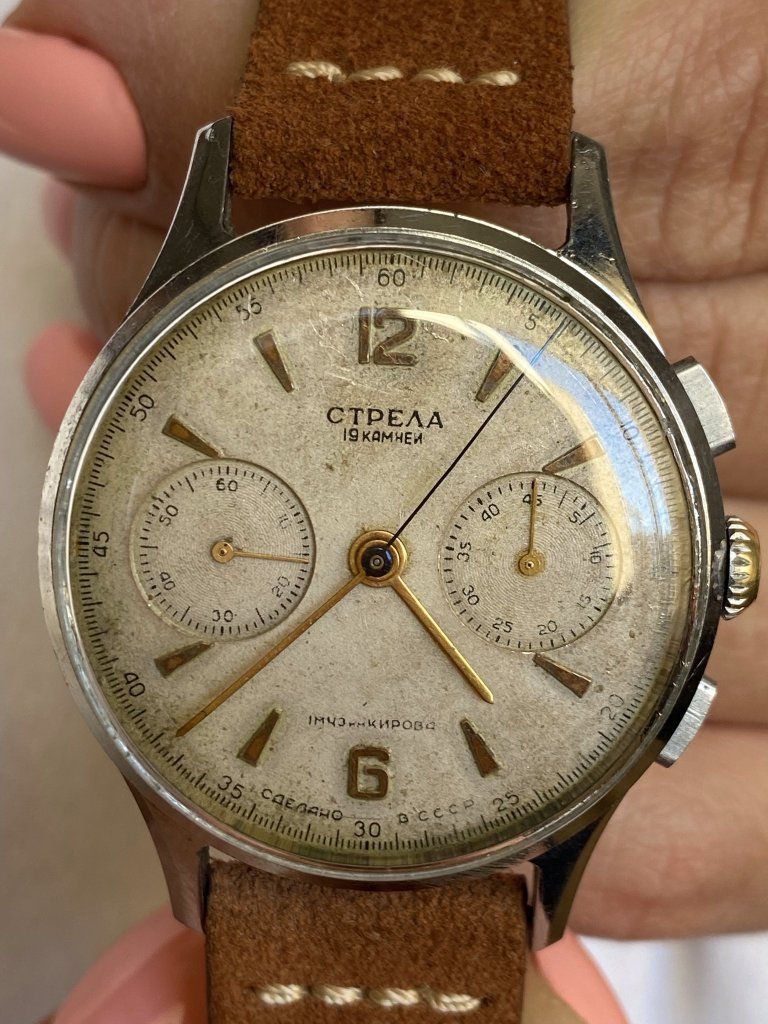
The 3017 chronograph of the First Moscow Watch Factory carries a five-digit number on the balance cock. The most common dating method reads it as a single series, from 1959 to 1979. Four factory passports show there are two, and that the same number can point to two watches made ten years apart. Here is how to read the number, the dial, the logo and the bridge, with a decoder to date your Strela, Poljot or Sekonda.
This website uses cookies to improve your experience while you navigate through the website.
Out of these cookies, the cookies that are categorised as necessary are stored on your browser as they are essential for the working of basic functionalities of the website.
We also use third-party cookies that help us analyse and understand how you use this website.
These cookies will be stored in your browser only with your consent.
You also have the option to opt out of these cookies.
But opting out of some of these cookies may affect your browsing experience.
Necessary cookies are absolutely essential for the website to function properly. This category only includes cookies that ensure basic functionalities and security features of the website. These cookies do not store any personal information.
Cookies that are not strictly necessary for the website to work and that are used specifically to collect personal data through analytics, ads and other embedded content are called non-necessary cookies. User consent is required before these cookies run on the website.
✕
Soviet in Paris
Online. We answer in person, no AI and no chatbot. Reply right away, 20 min at most.
Hello 👋 A question about an item, an order or shipping? Write to us.
Your email is used only to reply to you.
Subscribe to our newsletter and get 10% off your first order.
Subscribe
★ New pieces before anyone else
★ New blog articles
★ Soviet in Paris news and updates
Join the Party
10% off your first order
Receive your welcome card and our next arrivals.
Your code appears here and is also sent to you by email. You can leave the Party in one click, at any time.