Four coloured sectors cut across the dial of a Soviet radio room clock. Twice an hour the ship's radio operator had to stop transmitting for three minutes and listen on the distress frequency: the red sectors for telegraphy, the pink ones for telephony. This guide gives the texts that set the rule, shows how to read the dial with an animated diagram, then goes through the Chistopol and Glashütte clocks in our shop and what to check before buying.
OCTOBER 2026•12 MINUTE READ
by Marwen Yahyaoui
1992 5-ЧМ (5-ChM) radio room clock, new, in its box.
This ship’s clock comes from the Chistopol watch factory, in Tatarstan. Grey-painted aluminium case, 21 cm across, 2.7 kg, a glazed door that locks with a key. The dial reads СДЕЛАНО В СССР (sdelano v SSSR, “made in the USSR”). This one was never installed: it stayed in its box, with its two keys and its factory paper.
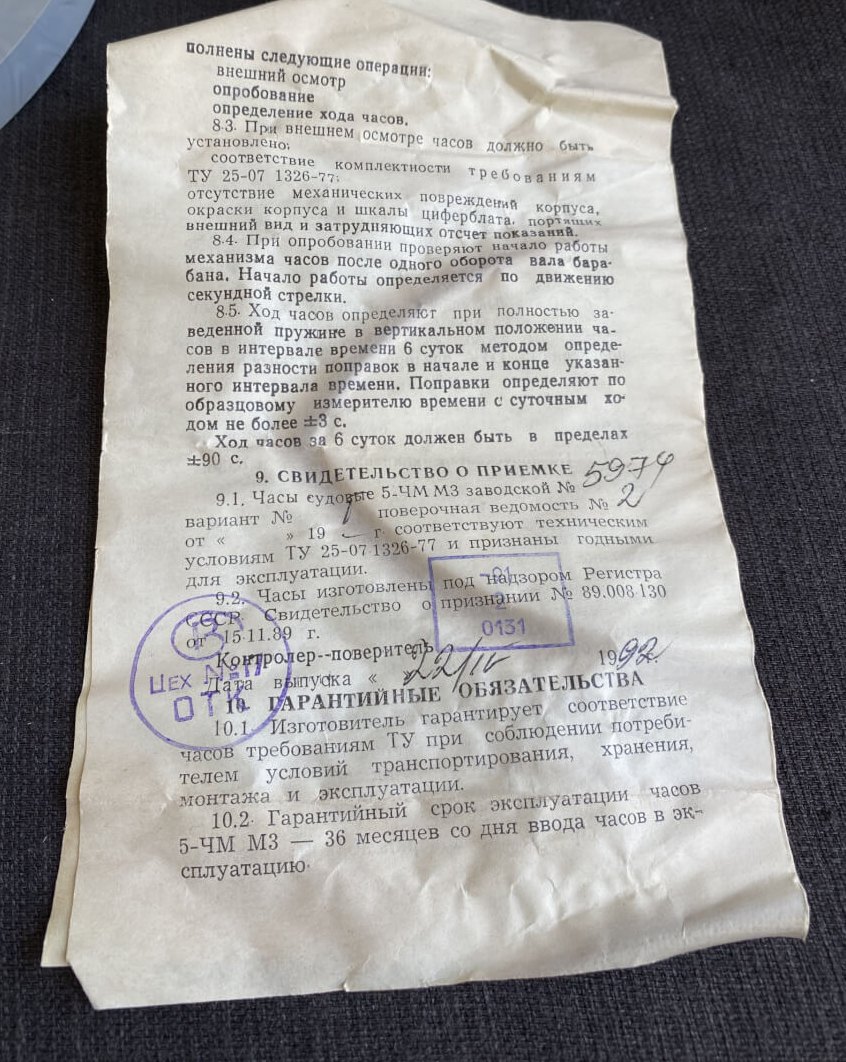
The paper of clock No. 5977
The acceptance certificate: 5-ЧМ ship’s clock No. 5977, release date 22/IV 1992.
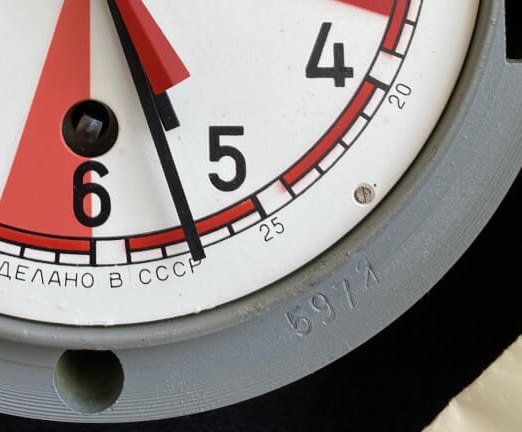
The same number, 5977, stamped on the case.
The paper folded in the box ends with a свидетельство о приёмке (svidetelstvo o priyomke), an acceptance certificate. It states that the часы судовые 5-ЧМ (chasy sudovye 5-ChM), “ship’s clock 5-ЧМ”, factory number 5977, meets technical conditions ТУ 25-07 1326-77 and is passed fit for service. The number is written by hand, and the same one is stamped on the case. The text adds that the clock was made under the supervision of the Регистр СССР (Registr SSSR), the USSR Register of Shipping, under an approval dated 15 November 1989.
The inspector wrote the release date by hand: 22/IV 1992. The bezel is stamped “92-2”, second quarter of 1992. By then the USSR had been gone for four months. The dial and the form are still the old ones.
The same paper gives the rate tolerance: fully wound and standing upright, the clock must not drift by more than 90 seconds in six days. The guarantee runs for 36 months from the day it enters service.
The rule of silence: 500 kHz and 2182 kHz
Chistopol radio room clock, second quarter of 1970: red sectors at 3 and 9 o’clock, pink at 12 and 6.
The coloured sectors come from international radio law. The regulations annexed to the London Radiotelegraph Convention, signed on 5 July 1912, less than three months after the Titanic sank, already asked coast stations sending long radiotelegrams to stop at the end of every fifteen-minute period and stay silent for three minutes.
The Washington regulations of 1927 turned this into a general rule at fixed times (Article 17). Every station of the maritime mobile service listens on the distress wave, 500 kHz, twice an hour for three minutes, starting at the 15th and the 45th minute, Greenwich time. Stations working with ships remain silent during these periods.
On the night of the sinking, the steamer Birma, registered in Libau under the Russian flag, was about a hundred miles from the Titanic. Her operator logged the distress call at 11:55 pm ship’s time, and the ship turned towards the position. A call is only useful if it is heard: the silence periods give weak signals a window in which nobody covers them.
Radiotelephony brought a second frequency. The Atlantic City Radio Regulations of 1947 made 2182 kHz the calling and distress frequency for telephony. For Region 1, which covers Europe and the USSR, they set a three-minute watch twice an hour, starting at minute 0 and minute 30. During these periods all transmissions between 2167 and 2197 kHz cease, except distress, urgency and safety traffic.
So that the operator has nothing to work out, these periods are painted on the dial of the clock in the радиорубка (radiorubka), the radio room. On every Chistopol clock that has passed through our shop, the 500 kHz sectors, from minute 15 to minute 18 and from minute 45 to minute 48, are red. The 2182 kHz sectors, from minute 0 to minute 3 and from minute 30 to minute 33, are pink. Elsewhere the second colour changes: the 2182 kHz sectors are often green or blue.
Soviet texts repeat the rule. The “Справочник по управлению кораблём” (Spravochnik po upravleniyu korablyom), a shiphandling manual published in Moscow in 1974 by the military publisher Voenizdat, requires ships at sea to keep a watch on 500 kHz on one of their receivers from the 15th to the 18th and from the 45th to the 48th minute of every hour. It calls these periods три минуты молчания (tri minuty molchaniya), “the three minutes of silence”.
The diagram runs one hour in three minutes. When the minute hand enters a sector, the receiver is tuned to the distress frequency and the Morse of normal traffic stops. The “Alarm signal” button shows the other use of the dial, that of the seconds ring. With sound on, the Morse traffic is made of random letter groups, and the alarm signal is sped up four times, like the animation.
The seconds ring and the alarm signal
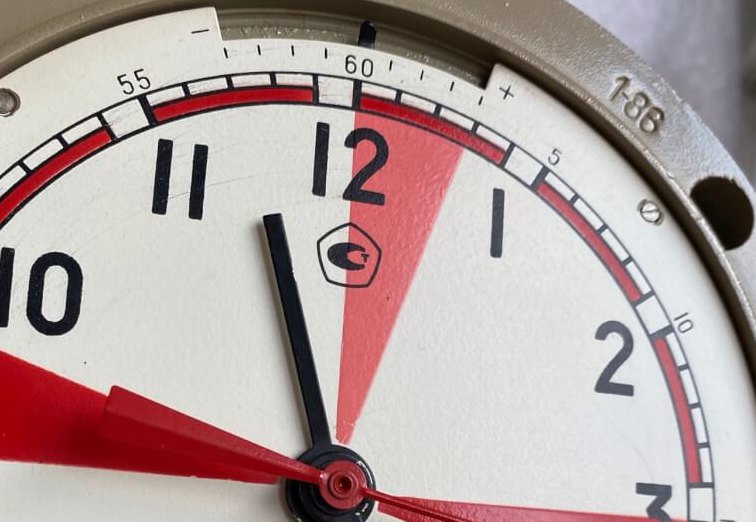
The seconds ring of a 1986 clock: four seconds of red, one second of white. Above it, the rate regulator window, between the minus and the plus sign.
A ship does not always have an operator listening. The 1927 Washington regulations therefore recognise an alarm signal: twelve four-second dashes, one second apart, sent in one minute. It comes before the distress call and only serves to trigger the automatic receivers, the auto alarms, which raise the alert on board when nobody is wearing the headphones.
The 1974 Soviet manual describes the same signal, “12 тире по 4 секунды с интервалом в 1 секунду” (12 tire po 4 sekundy s intervalom v 1 sekundu), twelve dashes of 4 seconds at 1-second intervals. It is sent by an automatic device or with the telegraph key, checked against a stopwatch.
On the seconds ring of the radio room clocks in our shop, a red band runs in four-second segments, each followed by a one-second white cell. This is the rhythm of the alarm signal. In all likelihood the ring is there to send it by hand: key down while the seconds hand crosses the red, pause on the white, twelve times. English Wikipedia describes the red and white bars of radio room clocks in this way. We have found no factory document that says so.
The Chistopol 5-ЧМ clocks
The 1991 5-ЧМ with its door open and the key in the winding hole. At the top of the bezel, the date 91-3.
The Chistopol watch factory was born from the evacuation of the Second Moscow Watch Factory, ordered on 15 October 1941. Its official timeline says that in 1946 it began making stopwatches, car clocks and marine clocks, and that in 1965 it launched marine clocks with a central seconds hand. This is the factory of Vostok watches, whose story is told in our guide Vostok watches: the history of the Chistopol factory.
The Chistopol radio room clocks that have passed through our shop all share the format of No. 5977. They were fitted in the radio rooms of warships. The same key opens the glazed door and winds the spring. A Russian dealer in marine clocks, waterradio.ru, gives the 5-ЧМ a 12-jewel lever movement, a running time of at least seven days and a splash-proof duralumin case.
At the top of the dial, a window shows the rate regulator lever. It moves between a minus and a plus sign. On the 1970 and 1983 clocks the signs are replaced by the letters У (u) and П (p), for убавить (ubavit, “slow down”) and прибавить (pribavit, “speed up”).
The date is stamped on the bezel, to the quarter: “2-70” for the second quarter of 1970, then “2-74”, “1-83”, “3-84”, “3-85”, “1-86”. On the last two the year comes first: “91-3” and “92-2”. The 1974 clock is an anti-magnetic version. According to waterradio.ru, this version has an extra protective shield around the escapement.
A hand-painted clock
Clock from the first quarter of 1983: the pink sector and the red band painted by hand, the letters У and П, the Знак качества (Znak kachestva).
The 1983 clock is an exception. Its dial is that of an ordinary marine clock, with a plain track of tick marks. The four sectors and the red seconds band were added by hand, with great precision, in the 1980s. It is the first time we have seen this modification, no doubt made to replace a failed radio room clock in a hurry. Below the 12, the pentagon is the Знак качества, the Soviet State Quality Mark.
The Glashütte clocks
Glashütte radio room clock, 1970s: only two sectors, at 3 and 9 o’clock.
On the case of the other example: the triangle with a 1 and the number 12/0396.
The two Glashütte clocks in our shop come from Soviet ships. Made in East Germany in the 1970s, they have a brown Bakelite case 21 cm across and carry the GUB, Glashütte/SA logo on the dial. Their movements have been serviced.
Their dials carry only two sectors, in an orange red, from minute 15 to minute 18 and from minute 45 to minute 48: the 500 kHz ones. There are no sectors for 2182 kHz. The seconds ring follows the same rhythm as on the Chistopol clocks, four coloured cells then one white cell.
The case of one of them is stamped with a triangle containing the figure 1. This is the Gütezeichen 1, one of East Germany’s quality marks, introduced in 1950 for high-quality products at the average level of the world market. The number below it, 12/0396, is as a rule the maker’s company number.
On board, until 1999
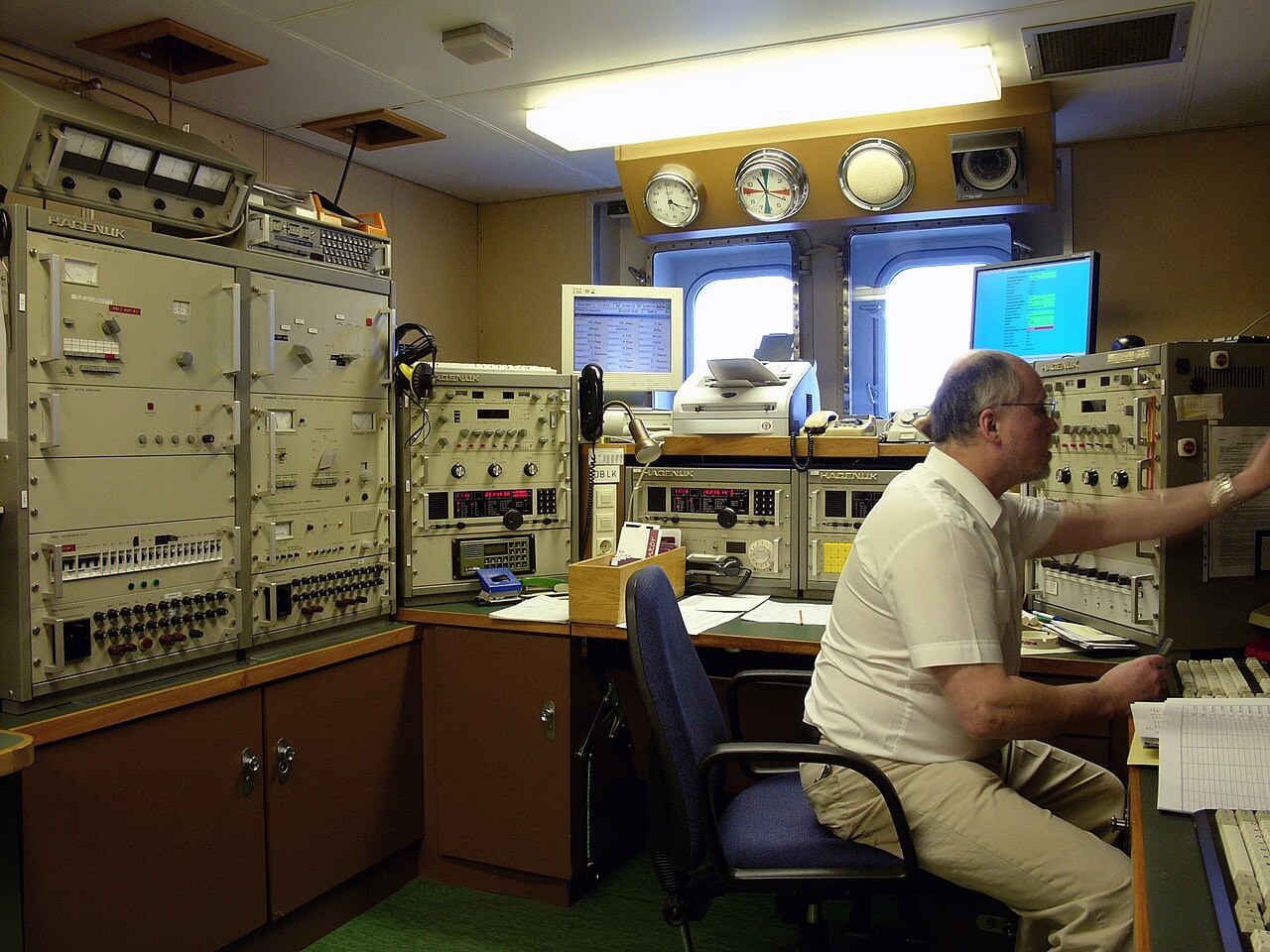
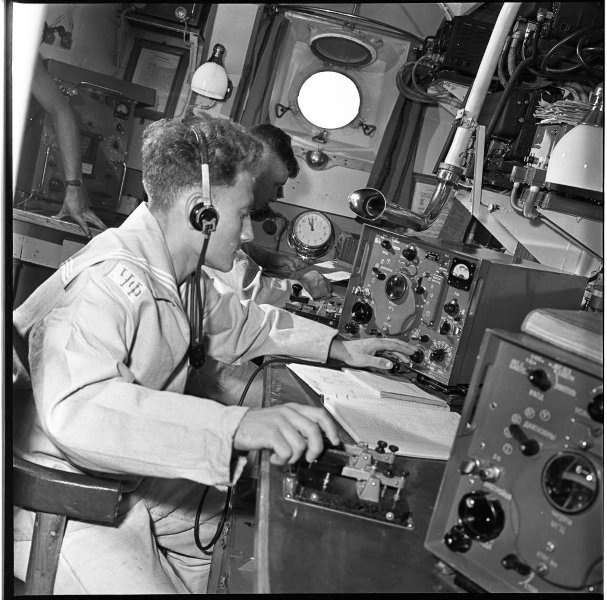
Radio room of the German research vessel Polarstern, 2007: a clock with red and green sectors above the portholes. Photo Hannes Grobe, Alfred Wegener Institute, Wikimedia Commons, CC BY 2.5.Radio room aboard a ship of the Black Sea Fleet, 1958: an operator with headphones, hand on the Morse key, and a clock fixed to the bulkhead below the porthole. Photo Dmitry Kozlov, MAMM / MDF, russiainphoto.ru.
On a Soviet ship the radio came under the начальник радиостанции (nachalnik radiostantsii), the chief of the radio station. G. A. Voronin, a master mariner who left the Vladivostok maritime school in 1956, describes the service of his day in a text published by the Vladivostok branch of the Russian Geographical Society. On large ships, three men: the chief, a first and a second radio operator. The watch was kept day and night, four hours on and eight off. He notes that few people today know what the pink and red sectors of these clocks are for.
Those three minutes gave their title to a novel by Georgy Vladimov, “Три минуты молчания” (Three Minutes of Silence), which appeared in 1969 in the magazine Новый мир (Novy Mir), about life aboard a trawler.
The rule ended with the Global Maritime Distress and Safety System, GMDSS, fully implemented on 1 February 1999 according to the International Maritime Organization. The Morse watch on 500 kHz was given up in those years. The US Coast Guard ended its 2182 kHz watch on 1 August 2013, and the 2019 World Radiocommunication Conference allocated the 500 kHz band to NAVDAT, a data broadcast service to ships.
On the wrist: the Vostok Radio Room
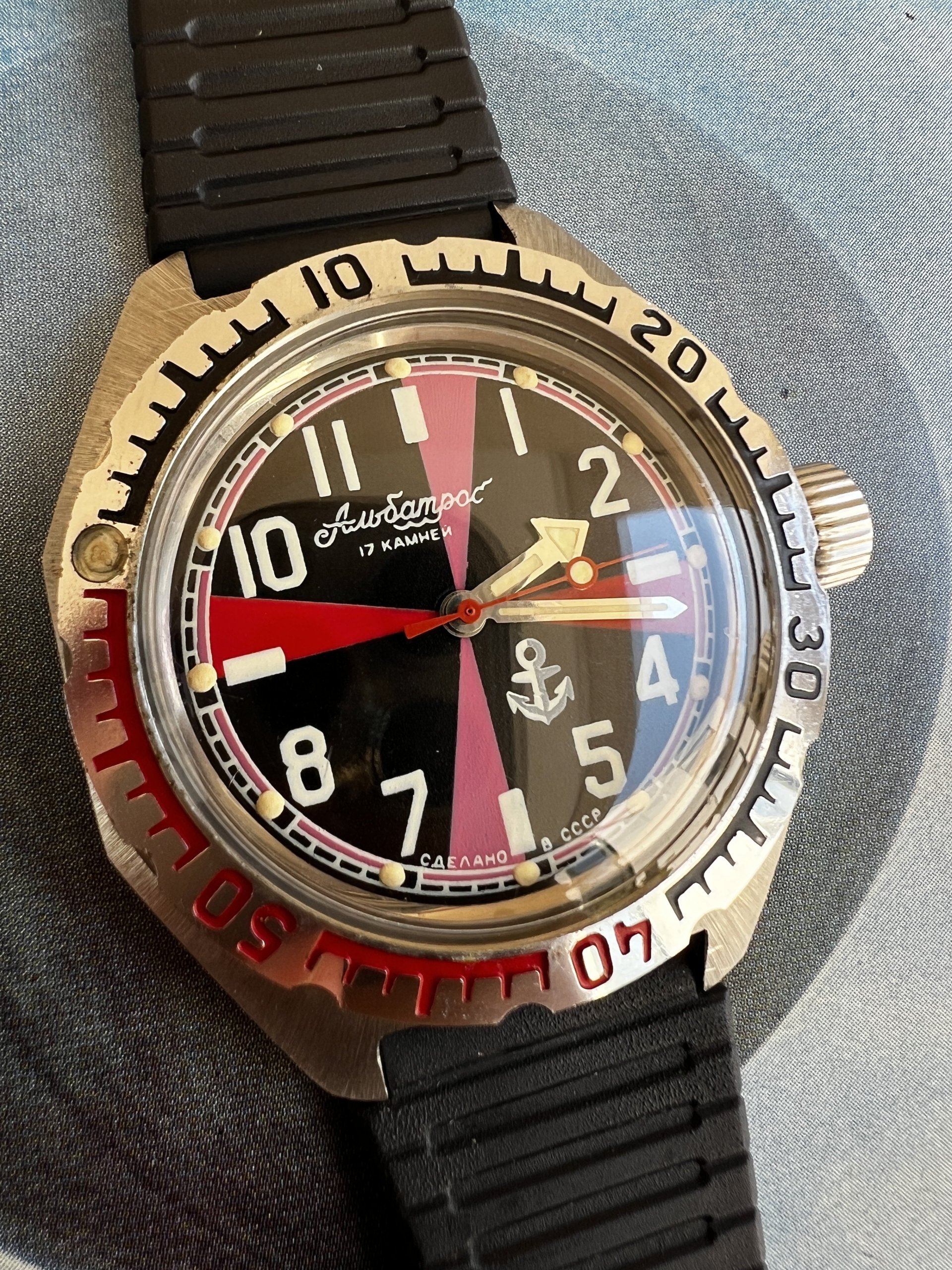
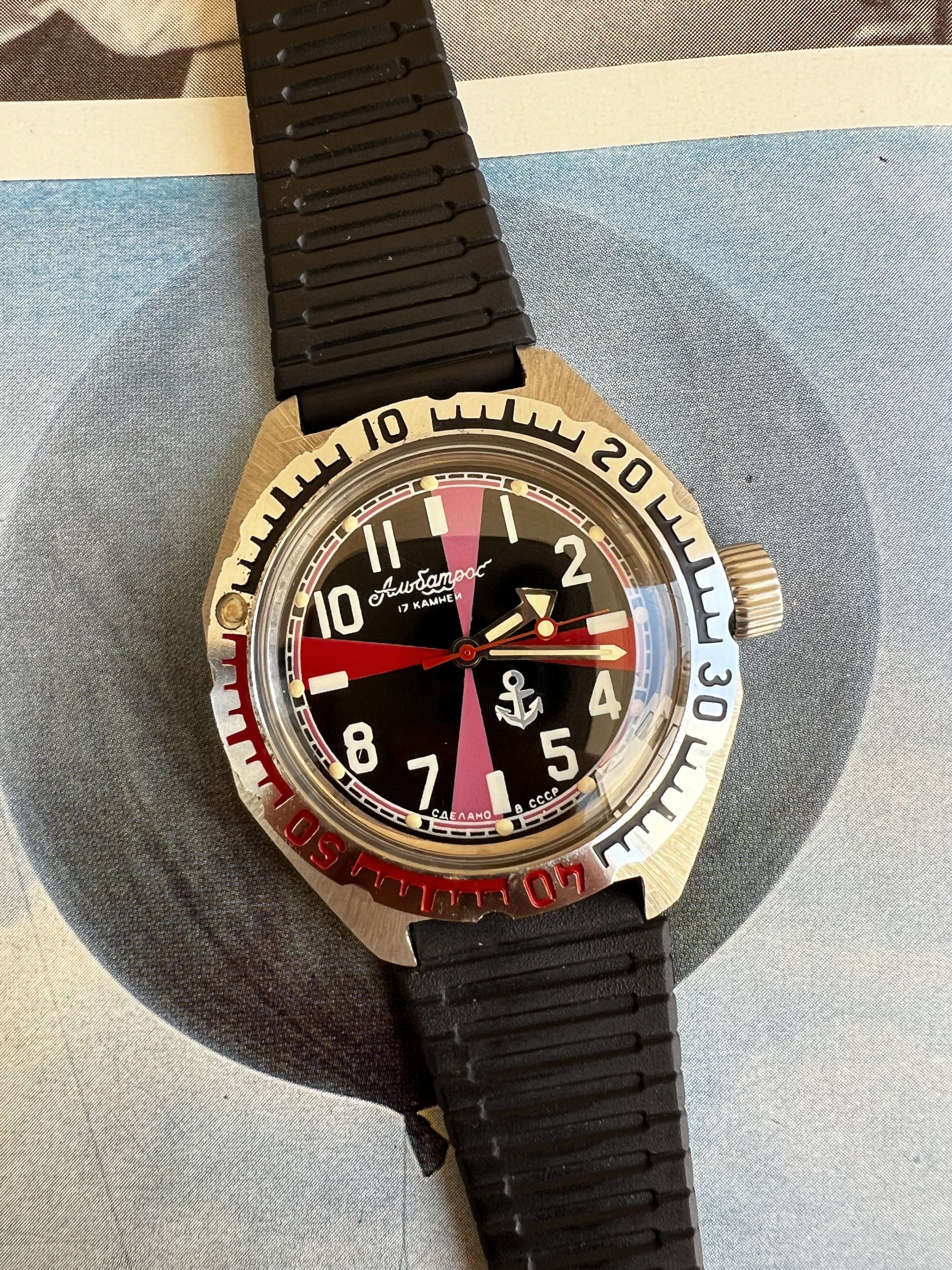
Vostok Albatros known as the Radio Room, first series, No. 553845: red sectors at 3 and 9 o’clock, pink at 12 and 6.
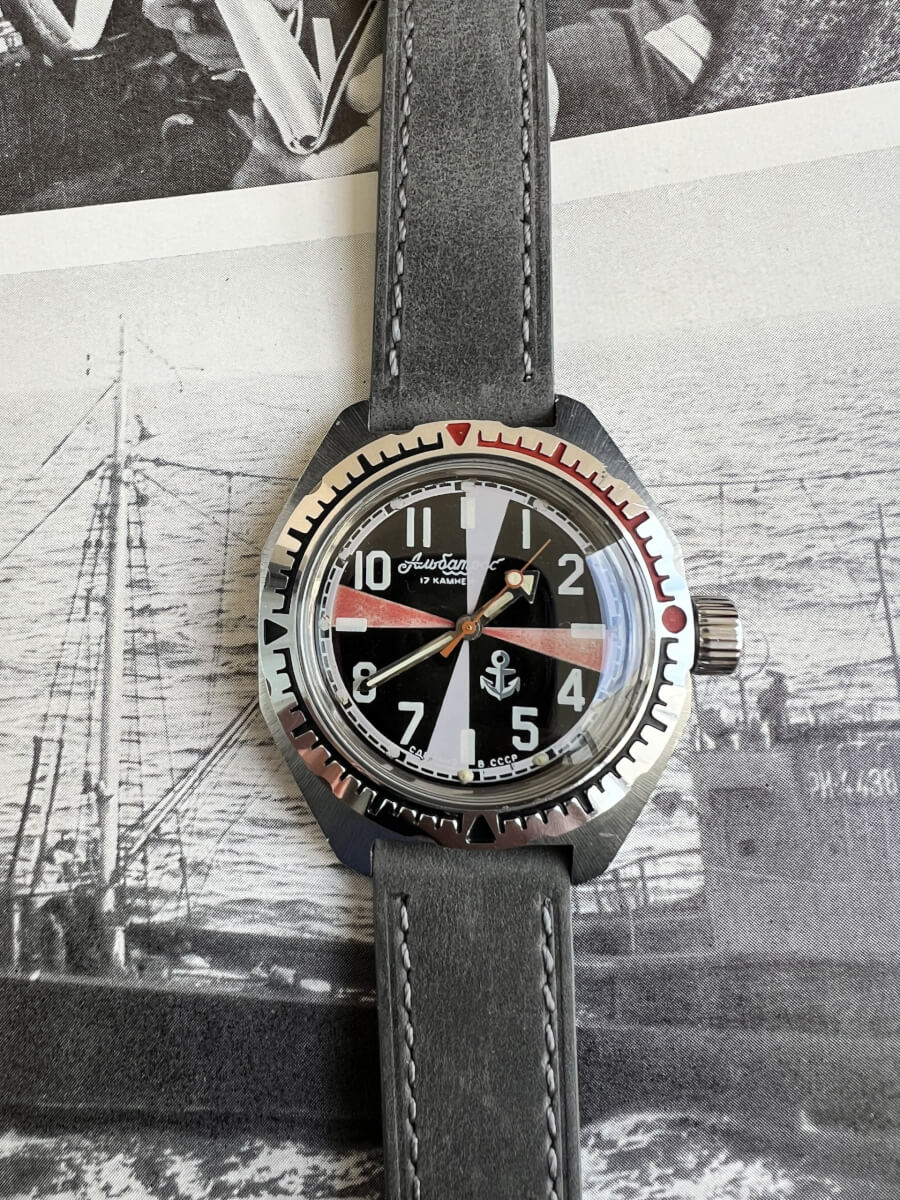
The Chistopol factory put this dial on a watch. The Vostok Альбатрос (Albatros), which collectors call the Radio Room, carries the same sectors on a black dial: red from 15 to 18 and from 45 to 48, pink from 0 to 3 and from 30 to 33. The first batch is dated February 1990. The versions, the copies and the recent Russian Amphibia watches with a sector dial are covered in our Vostok Amphibia guide.
Model. Chistopol: 5-ЧМ clock, 21 cm aluminium case, 2.7 kg, glazed door and winding with the same key. Glashütte: 21 cm brown Bakelite case, GUB logo on the dial.
Date and number. On a Chistopol clock the date is stamped on the bezel and the number on the case. A clock that stayed new keeps its two keys, its box and its acceptance certificate, which repeats the number and gives the release date.
Sectors. On a radio room 5-ЧМ: red from 15 to 18 and from 45 to 48, pink from 0 to 3 and from 30 to 33, and a seconds ring in four-second segments. On a Glashütte: only the two sectors from 15 to 18 and from 45 to 48.
Movement. The clock must run. Ask whether it has been serviced, and when.
Recent production and replacement dials. The 5-ЧМ is still made. A Russian retailer offers it with a “Сектор молчания” (sektor molchaniya, “silence sector”) dial. According to waterradio.ru, the bottom of the dial reads “СДЕЛАНО В СССР” or “СДЕЛАНО В РОССИИ” (sdelano v Rossii, “made in Russia”), and a new dial can be ordered with whatever inscription is wanted. Enthusiasts also repaint ordinary 5-ЧМ clocks as radio room clocks: a Russian radio amateur showed his in 2024, under the word “Реплика” (replika), replica. We found no reported copy of the Glashütte clocks. A dial alone is therefore not enough to date a clock: compare it with the date on the bezel and with the condition of the case.
As with any collector’s piece, research thoroughly, compare several examples and rely on trusted collectors’ sites and buying guides.
Our ship’s clocks are in the Marine clocks category, the watches in the Vostok category.
The ДП-5В (DP-5V) is the field radiometer of Soviet civil defence: a green Bakelite console, a probe with a rotating gamma, beta and check-source shield, headphones and a manual that explains operation and maintenance. The one in this article served in an industrial bakery in Chișinău and was serviced in March 1991. Its owner shared his photos and documents with us, and we turned them into a tool that lets you operate it on screen, step by step.
The Moscow Games, from 19 July to 3 August 1980, boycotted by some sixty countries, produced more objects than any Soviet event: a bear cub, Misha, drawn by Viktor Chizhikov, an emblem made of running tracks, five thousand torches, watches from every factory, platinum coins, rings, tea glass holders, posters. This guide tells the story of the Games and reviews the objects, with the marks that authenticate them and the prices.
The 3017 chronograph of the First Moscow Watch Factory carries a five-digit number on the balance cock. The most common dating method reads it as a single series, from 1959 to 1979. Four factory passports show there are two, and that the same number can point to two watches made ten years apart. Here is how to read the number, the dial, the logo and the bridge, with a decoder to date your Strela, Poljot or Sekonda.
This website uses cookies to improve your experience while you navigate through the website.
Out of these cookies, the cookies that are categorised as necessary are stored on your browser as they are essential for the working of basic functionalities of the website.
We also use third-party cookies that help us analyse and understand how you use this website.
These cookies will be stored in your browser only with your consent.
You also have the option to opt out of these cookies.
But opting out of some of these cookies may affect your browsing experience.
Necessary cookies are absolutely essential for the website to function properly. This category only includes cookies that ensure basic functionalities and security features of the website. These cookies do not store any personal information.
Cookies that are not strictly necessary for the website to work and that are used specifically to collect personal data through analytics, ads and other embedded content are called non-necessary cookies. User consent is required before these cookies run on the website.
✕
Soviet in Paris
Offline right now. Leave your message and your email, we reply within 24 hours.
Hello 👋 A question about an item, an order or shipping? Write to us.
Your email is used only to reply to you.
Subscribe to our newsletter and get 10% off your first order.
Subscribe
★ New pieces before anyone else
★ New blog articles
★ Soviet in Paris news and updates
Join the Party
10% off your first order
Receive your welcome card and our next arrivals.
Your code appears here and is also sent to you by email. You can leave the Party in one click, at any time.