The Raketa perpetual calendar is a Soviet watch whose dial carries a full calendar: a movable disc, set by a second crown, gives the day of the week for any date. The printed years stop at 2000, but the calendar still works, because each year has a twin on the disc. This guide explains how it works step by step, with a simulator, and shows which year to set up to 2040.
OCTOBER 2026•8 MINUTE READ
by Marwen Yahyaoui
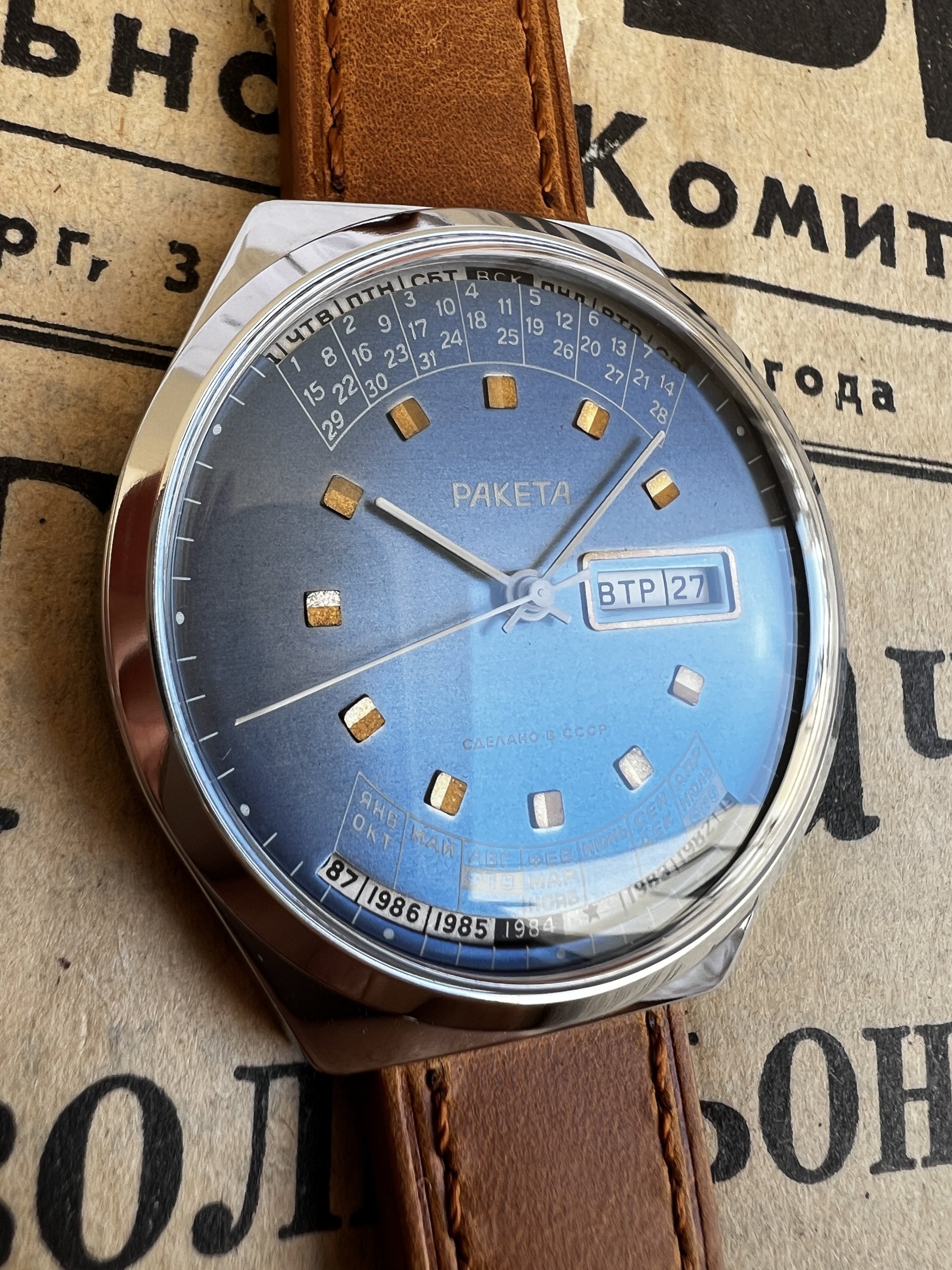
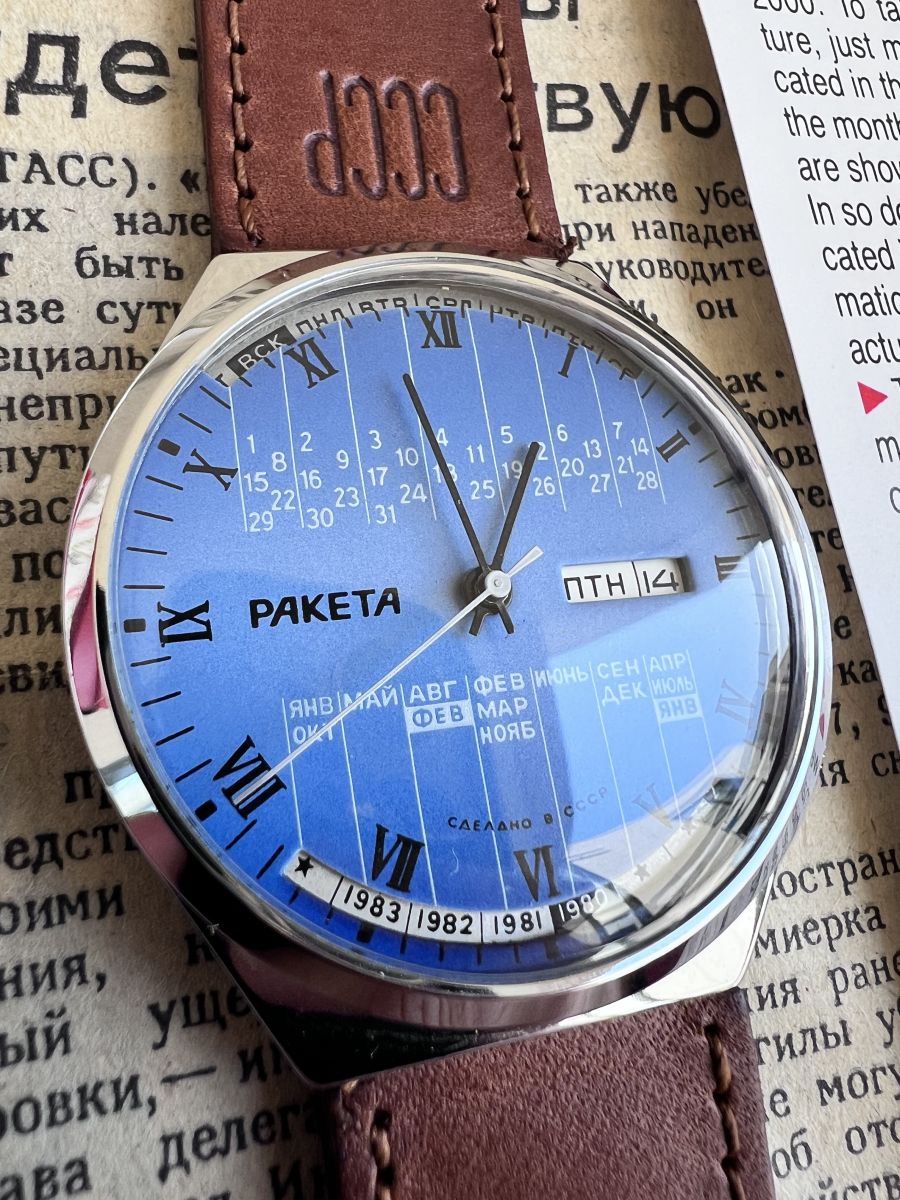
Raketa perpetual calendar, blue dial: the table of dates at the top, the table of months at the bottom.
The Raketa perpetual calendar is one of the most recognisable Soviet watches. Its dial carries two tables and two arc-shaped windows. A second crown, at 4 o’clock, turns a disc hidden under the dial. Once set, this disc gives the day of the week for any date.
The factory leaflet calls it “Model 2000”, because the printed years run up to 2000. Collectors call it the “College”. The calendar does not stop in 2000. This guide explains how it works and how to use it today.
What the dial shows
The four parts of the calendar: days of the week, dates, months, years.
The calendar has four parts. Two are printed on the dial and do not move. Two are on the movable disc and are read through the windows.
At the top, in the arc-shaped window: the days of the week. They are on the disc.
Just below: the dates from 1 to 31, arranged in seven columns. They are fixed.
At the bottom of the dial: the twelve months, also arranged in seven columns. They are fixed.
At the very bottom, in the second window: the years. They are on the disc.
The days and the years are on the same disc. When you turn the 4 o’clock crown, both windows move together. That is the whole principle.
The window at 3 o’clock is that of an ordinary watch. It shows the current day and date, driven by the movement.
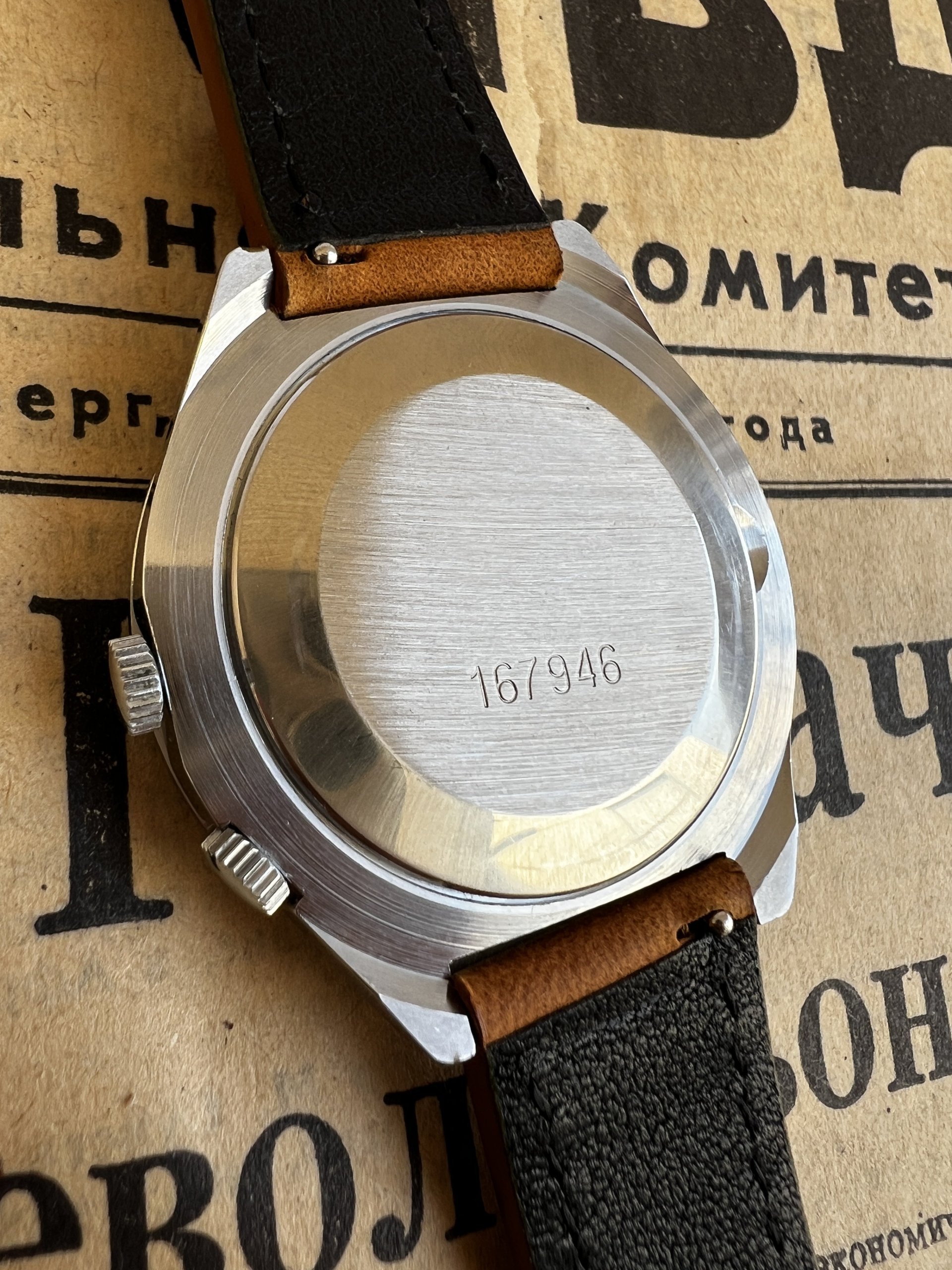
The two crowns: the one at 3 o’clock for the watch, the one at 4 o’clock for the calendar disc.
Instructions in two steps
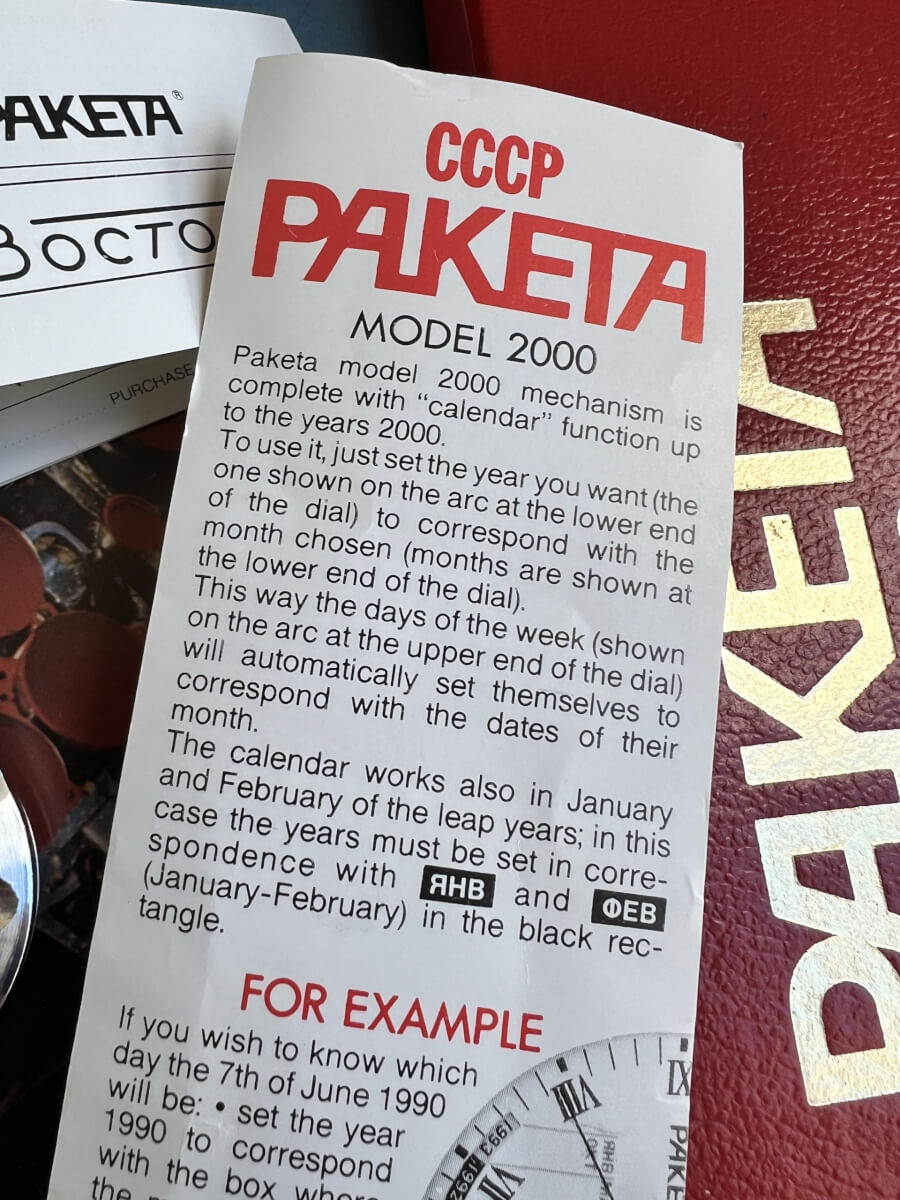
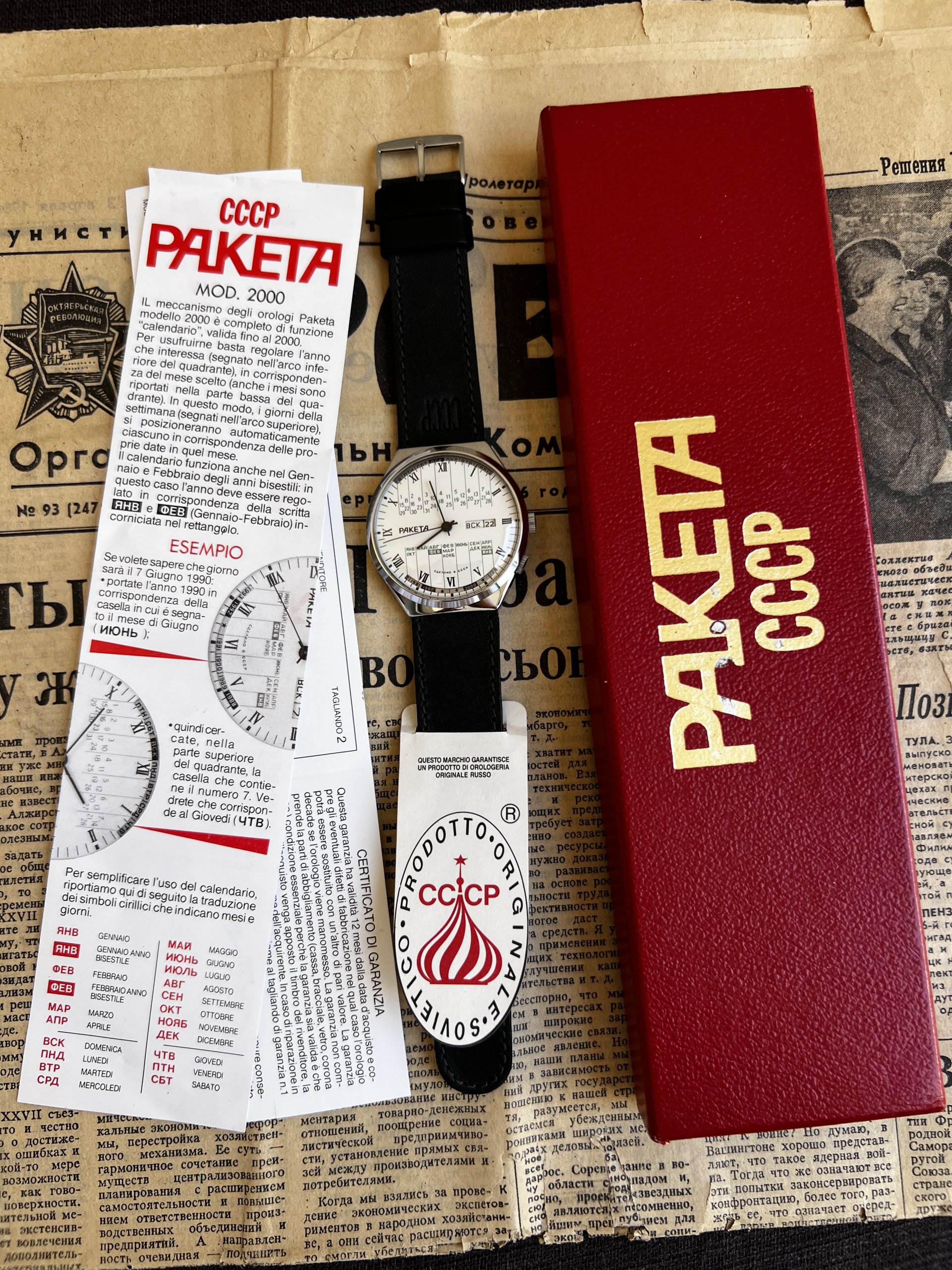
The factory leaflet for the “Model 2000”, here in its English export version.
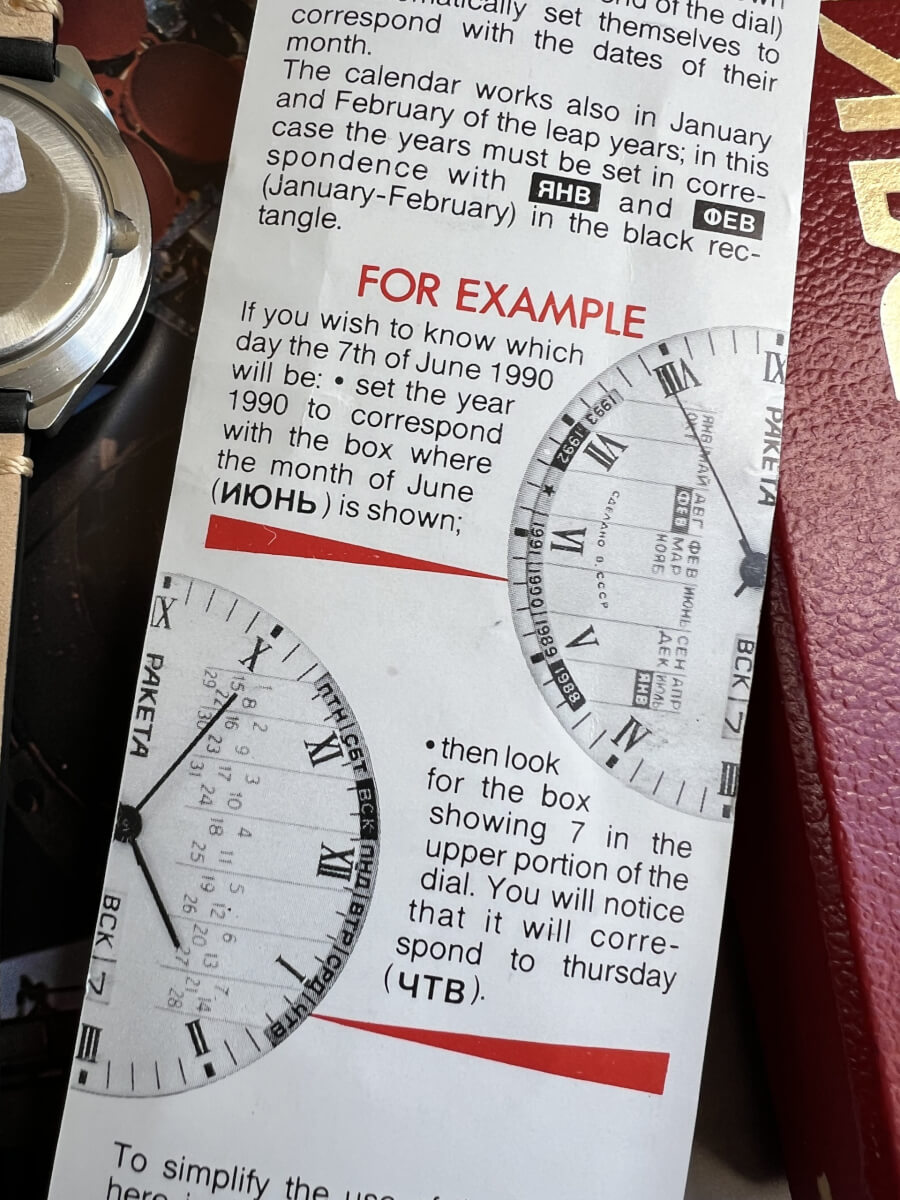
The factory leaflet says it in two sentences. Set the year you want under the box of the month you want. The days of the week then place themselves above the dates of that month.
It gives an example: which day was 7 June 1990?
Turn the 4 o’clock crown until 1990 is under the box ИЮНЬ, June.
Find 7 in the upper table and read the day above its column: ЧТВ, Thursday.
The leaflet’s example: 1990 under ИЮНЬ, then 7 under ЧТВ.
Try it: the simulator
Your turn to set it. The simulator gives you a date. Turn the 4 o’clock crown, by clicking it or with the two buttons, until the year is under the month box. When the setting is right, the day of the week lights up above the date. You can also choose your own date. Below the diagram, a second exercise has you set the window at 3 o’clock with the 3 o’clock crown: each pull moves the date forward one day.
This diagram follows the layout of the Soviet dial, with its Russian abbreviations. We checked its result for every year from 1980 to 2060.
Reading the Russian abbreviations
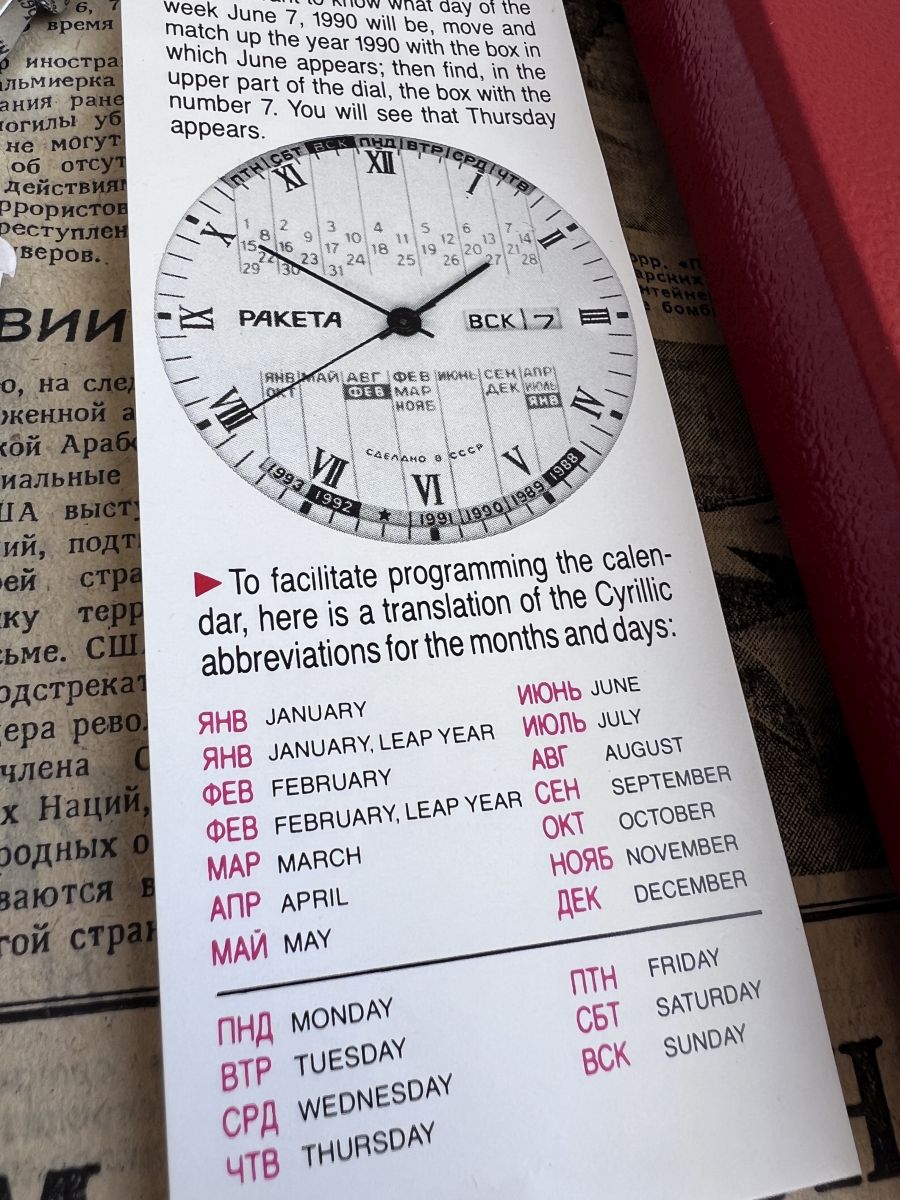
The leaflet translates the abbreviations for months and days.
On dials made for the Soviet market, everything is in Cyrillic.
Days: ПНД Monday, ВТР Tuesday, СРД Wednesday, ЧТВ Thursday, ПТН Friday, СБТ Saturday, ВСК Sunday. Sunday has a dark background.
Months: ЯНВ January, ФЕВ February, МАР March, АПР April, МАЙ May, ИЮНЬ June, ИЮЛЬ July, АВГ August, СЕН September, ОКТ October, НОЯБ November, ДЕК December.
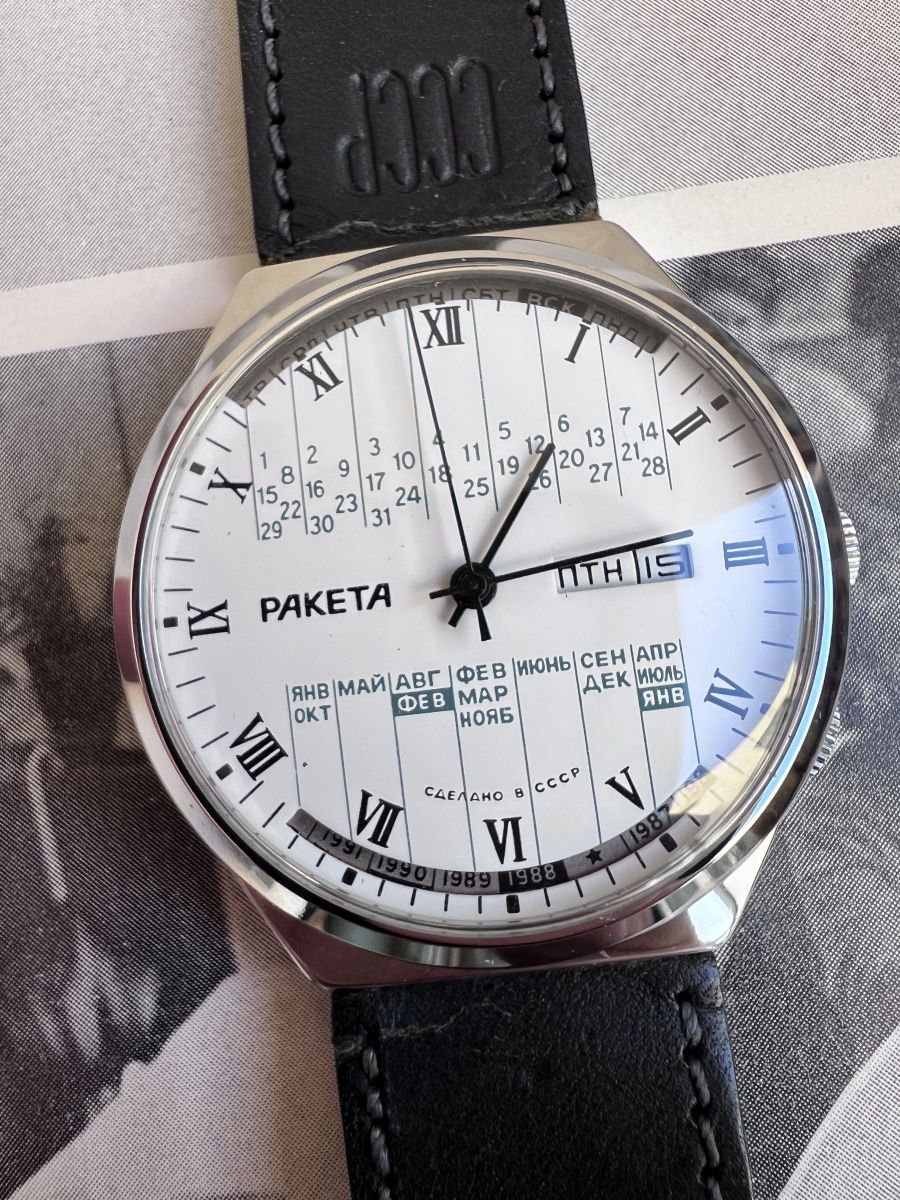
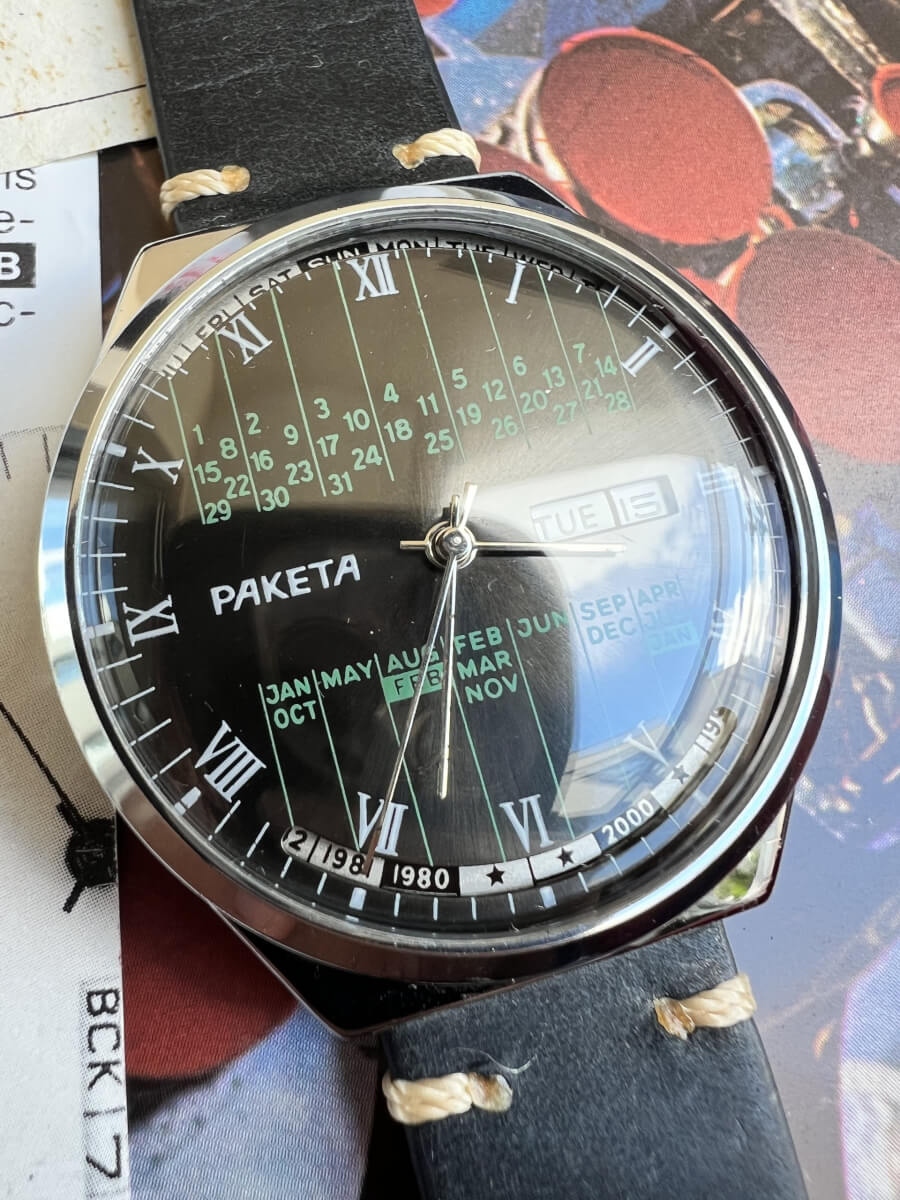
There are also export dials in English, with SUN, MON, JAN, OCT.
English export dial. At the bottom, the disc passes from 2000 to 1980, separated by two stars.
Why seven columns are enough
Two months that begin on the same day of the week have the same calendar. In an ordinary year, January and October begin on the same day. So do February, March and November. So do April and July. So do September and December. The twelve months therefore fall into seven boxes, one for each possible day of the week.
From one year to the next, everything shifts by one day, because 365 days make 52 weeks and one day. On the disc, each year therefore sits in the box next to the previous one.
Leap years and the stars
A leap year has one more day, 29 February. After that day, the shift is two steps instead of one. The dial handles this in two ways.
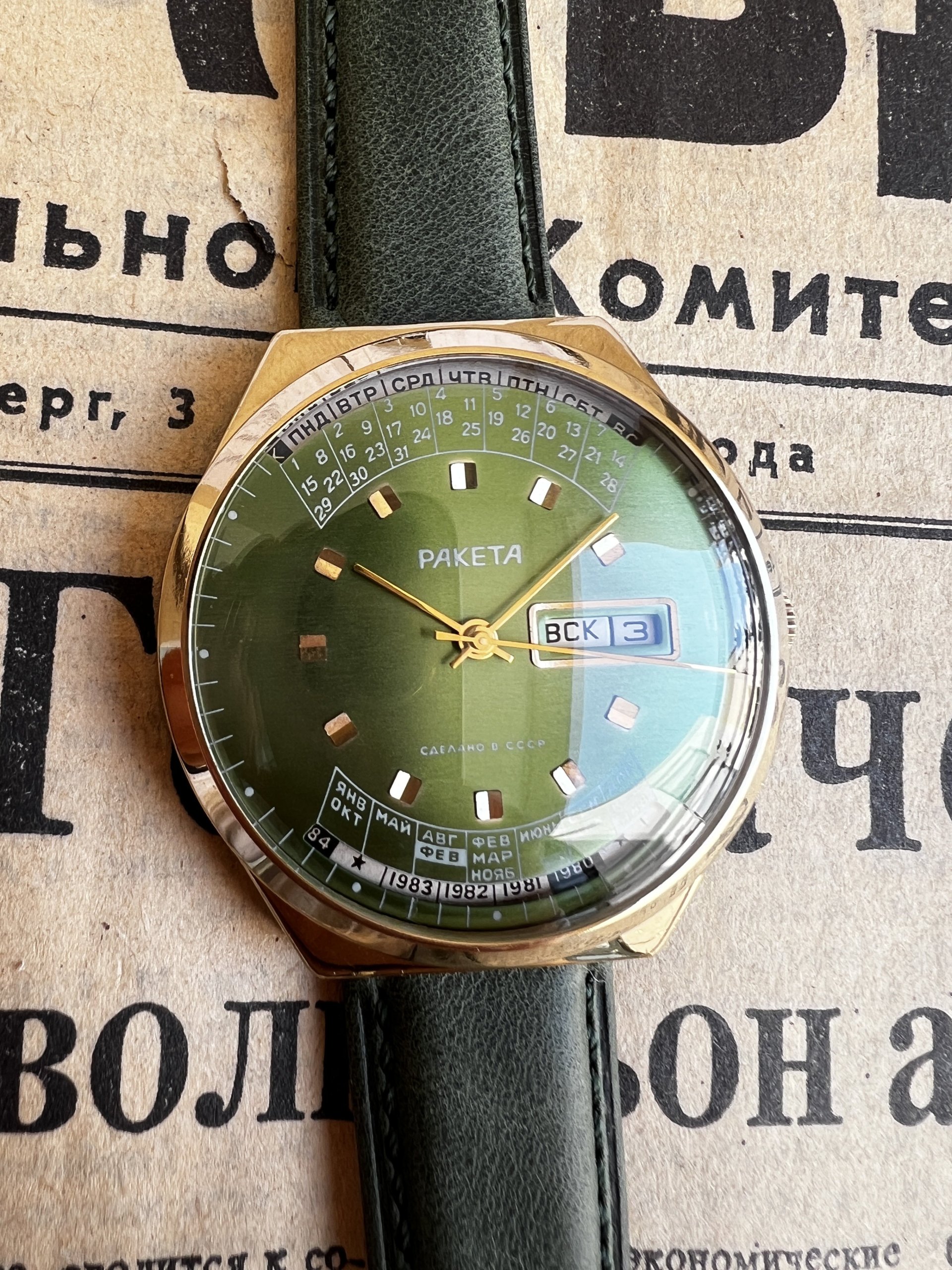
On the disc, leap years have a dark background: 1980, 1984, 1988, 1992, 1996, 2000. Each one skips a box, marked with a star.
In the table of months, January and February appear twice. The ordinary boxes are for ordinary years. The framed or dark boxes, ЯНВ and ФЕВ, are for January and February of leap years. The leaflet says so.
Blue dial from 1989: the framed ЯНВ and ФЕВ boxes are for leap years.
Using it in 2026 and beyond
The printed years stop at 2000. The calendar itself repeats. Two years that begin on the same day of the week, and that are both ordinary or both leap years, have exactly the same calendar. You only need to set the disc to the twin.
The simplest rule: between 1901 and 2099, the calendar comes back identically every 28 years. 2026 is identical to 1998, and 2028 to 2000.
Enter a year: the tool lists every year on the disc that has the same calendar.
Here is the year to set for the next fifteen years.
2026: set 1998. Also 1987 or 1981.
2027: set 1999. Also 1993 or 1982.
2028, leap year: set 2000.
2029: set 1990.
2030: set 1991. Also 1985.
2031: set 1997. Also 1986.
2032, leap year: no twin on the disc. The simulator shows which year to use month by month.
2033: set 1994. Also 1983.
2034: set 1995. Also 1989.
2035: set 1990.
2036, leap year: set 1980.
2037: set 1998. Also 1987 or 1981.
2038: set 1999. Also 1993 or 1982.
2039: set 1994. Also 1983.
2040, leap year: set 1984.
In the photographs, the disc goes all the way round: after 2000 come two stars, then 1980. Counting the 21 years and the stars gives 28 boxes, the full 28-year cycle.
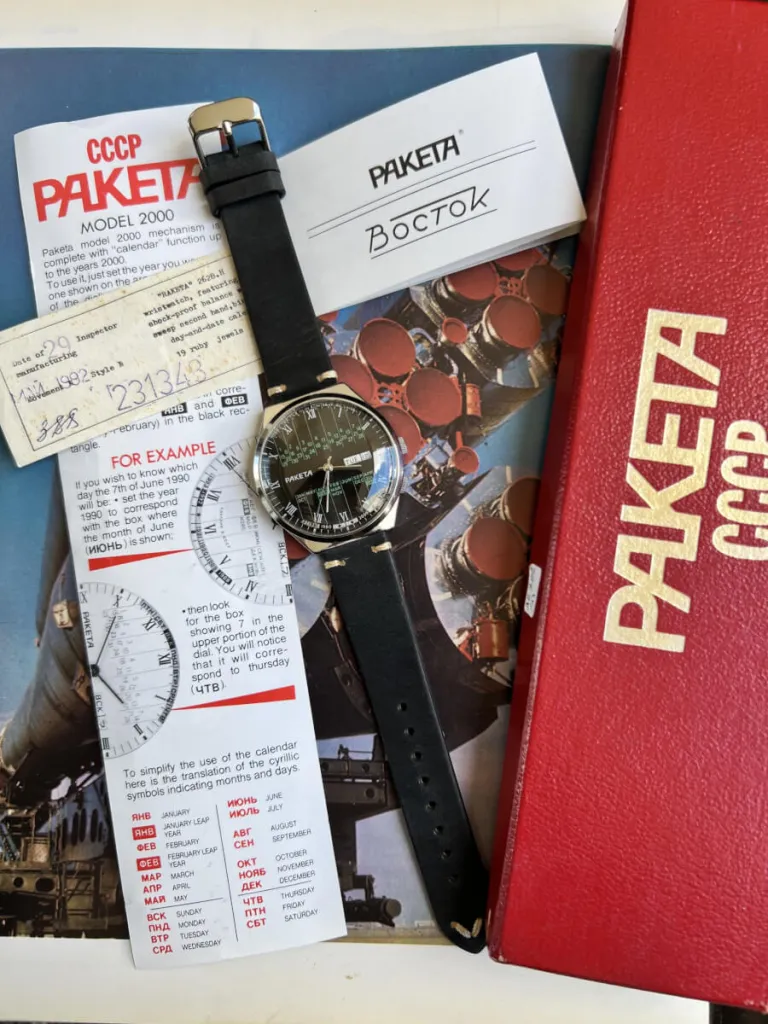
Full set: the watch, its box, its leaflet and its “MOD. 2000” guarantee card.
The movement and the case
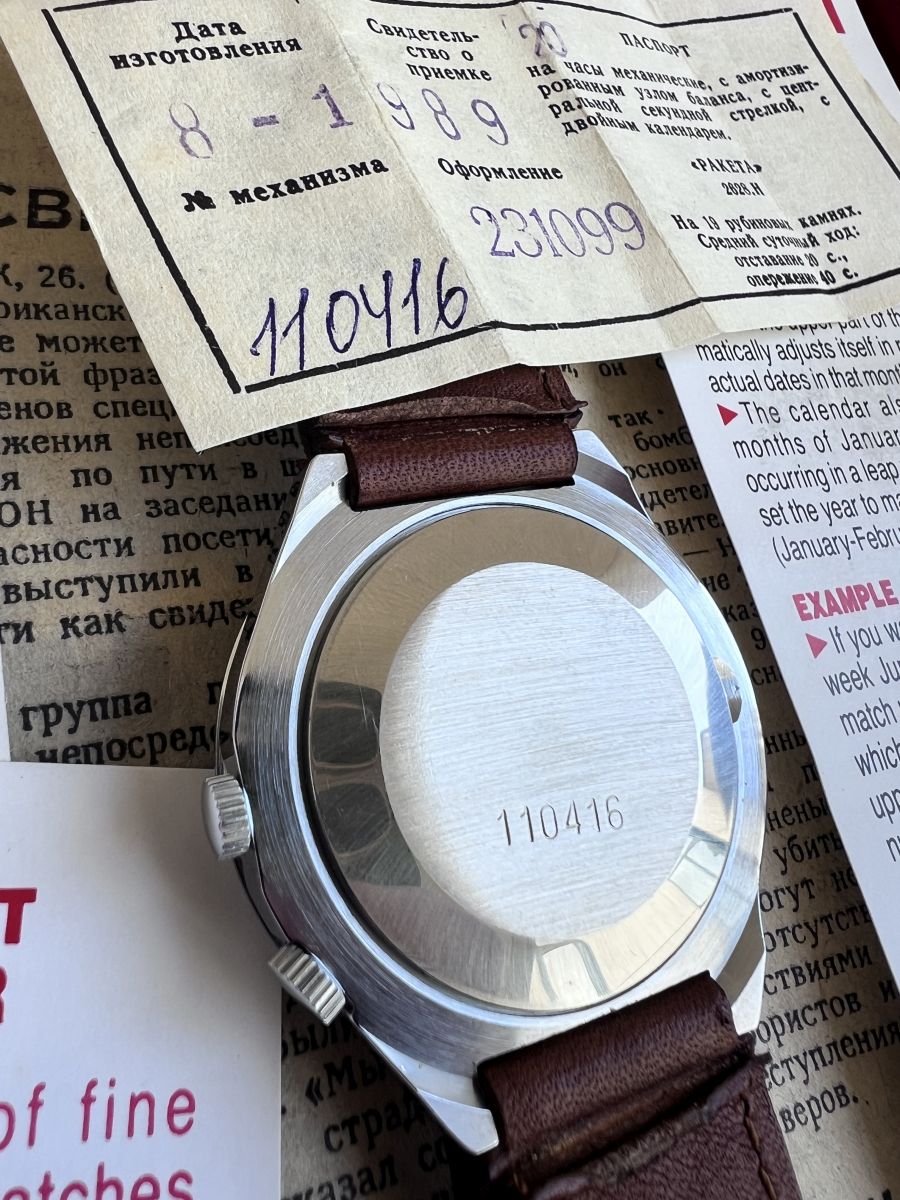
The movement is the Raketa calibre 2628.Н, hand-wound. The factory passport states 19 jewels, a shock-protected balance, a centre seconds hand and a day and date calendar.
The calendar disc is not linked to the movement. It is a calculating table set by hand. It therefore cannot go out of adjustment, and it works even when the watch is stopped.
The case measures 40 mm without the crown. It comes chromed or gold-plated.
Factory passport dated August 1989.
Setting the date and day in the window
The window at 3 o’clock is set with the 3 o’clock crown, as on any watch with the 2628.Н movement. This crown has three positions.
Pushed in: winds the watch.
Pulled out one step: sets the time. The day of the week changes each time the hands pass midnight. To correct it, turn the hands round.
Pulled out all the way: the date moves forward one day. There is nothing to turn, pulling the crown out is what makes the number jump.
To set the date quickly, pull the crown all the way out, push it back one step, and repeat. Each time the crown reaches the end of its travel, the date moves forward one day. Going from the 1st to the 15th therefore takes fourteen pulls.
The date only moves forward. If you overshoot, you have to go round the whole month. Once the date is right, push the crown back one step to set the time, then push it all the way in.
Where the “College” comes from
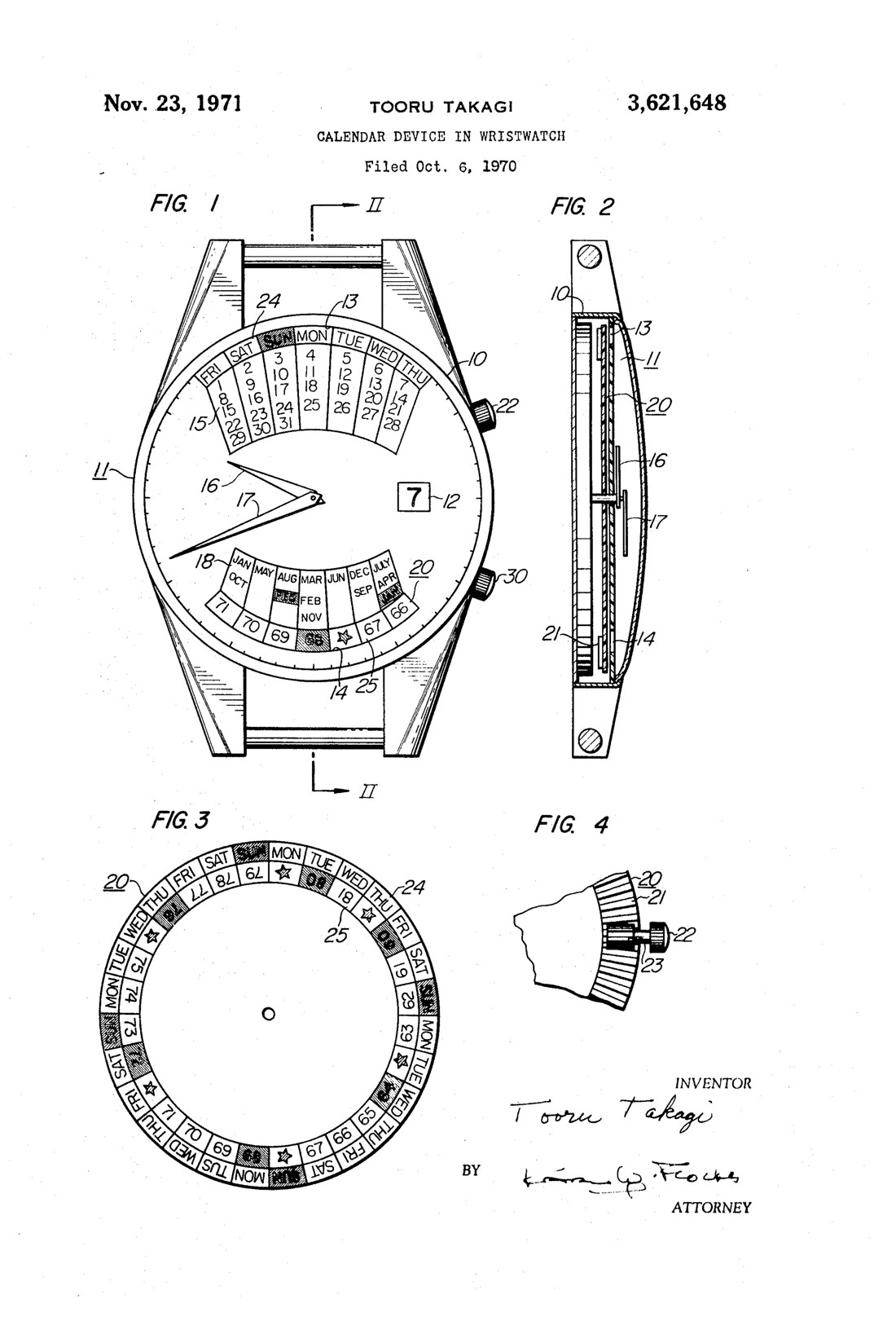
The principle is not Soviet. The Japanese brand Orient presented its multi-year calendar watch in 1965: a second crown turns a disc, the year is placed under the month, and the days of the week line up above the dates. A US patent describing this dial was granted to Orient in 1971, in the name of Tooru Takagi.
The Orient US patent, 1971: the dial, its two crowns and the disc of days and years. US Patent 3,621,648, public domain.
That Orient was known in the USSR, where it was already called « колледж », college, in the late 1970s. In all likelihood the Raketa took over the principle, and the nickname with it.
The production years
The Petrodvorets factory, in Leningrad, made this model from the mid-1980s into the 1990s. The earliest dated example we have noted at another dealer’s is from August 1986. The passports of the watches that have passed through our shop run from August 1989 to 1992 and 1993.
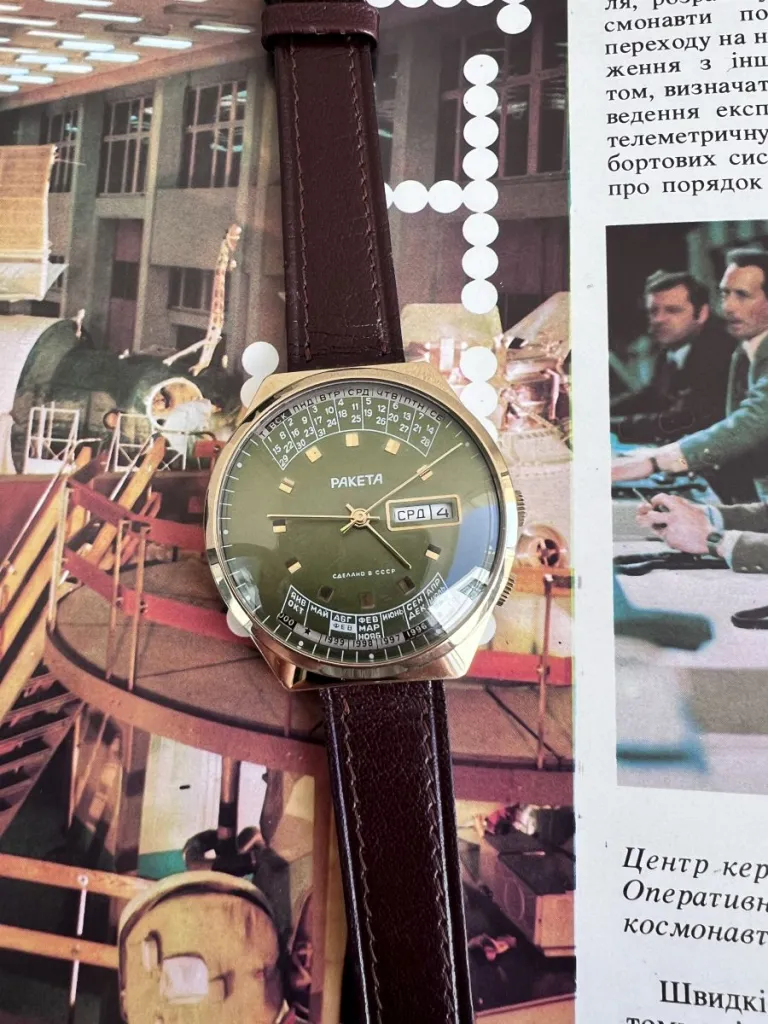
Production continued after the end of the USSR. Our red dial reads « Сделано в России », made in Russia, and its disc shows the years 1996 to 1999.
Dial colours
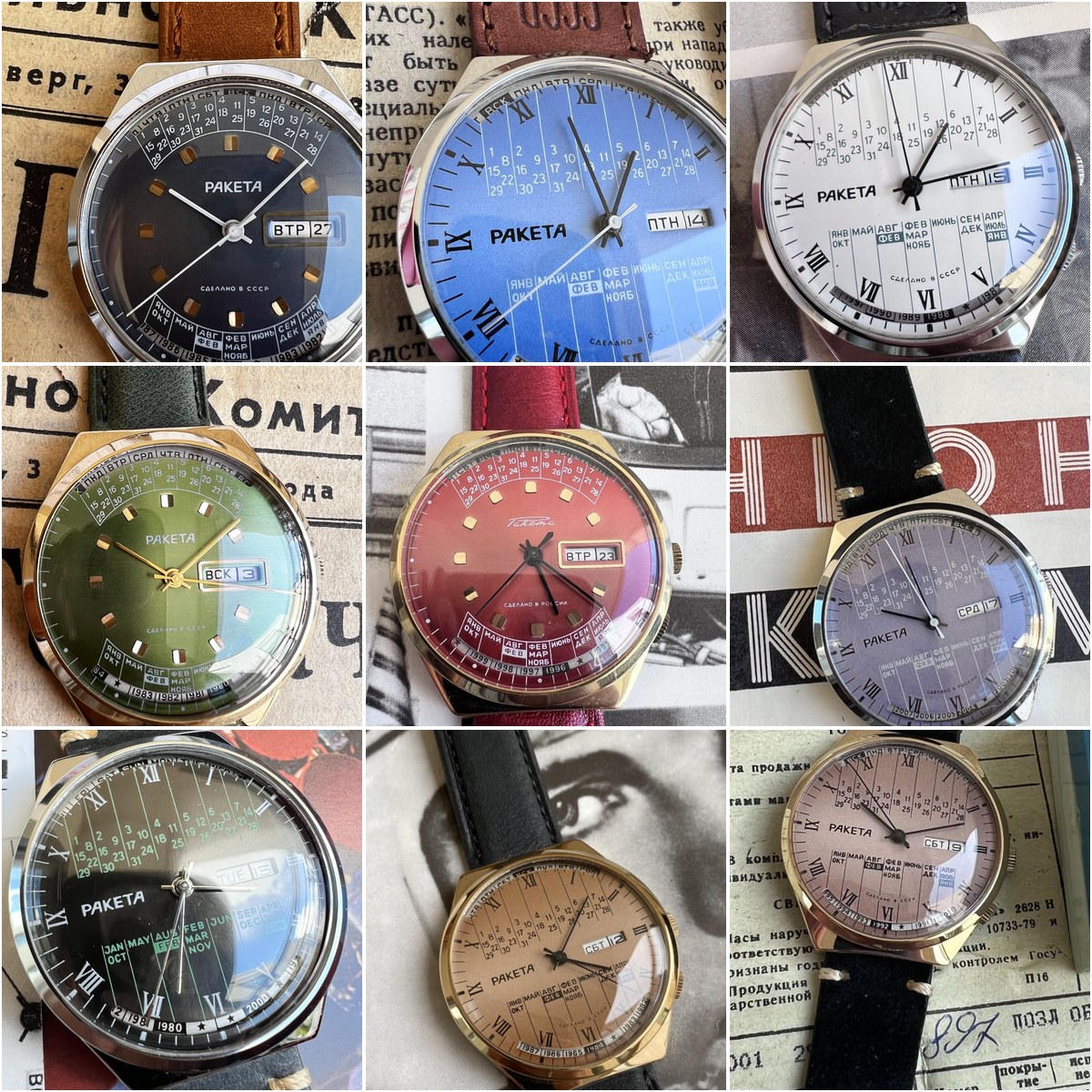
Nine dials that have passed through our shop: midnight blue, light blue, white, green, red, violet, black export, champagne, pink.
The model came in many colours. In our shop we have had midnight blue, light blue, white, green, burgundy red, violet, black, champagne and pink. There are two families of dials: with raised gilt markers, or with printed Roman numerals.
The text changes too. Most dials are in Cyrillic. Export versions carry the days and months in English, and sometimes the signature “Raketa” in Latin letters with “Made in USSR”.
We have found no certain factory colour beyond these. Black dials with gilt markers sold in a new case are recent productions, as their sellers state.
Enhanced dials
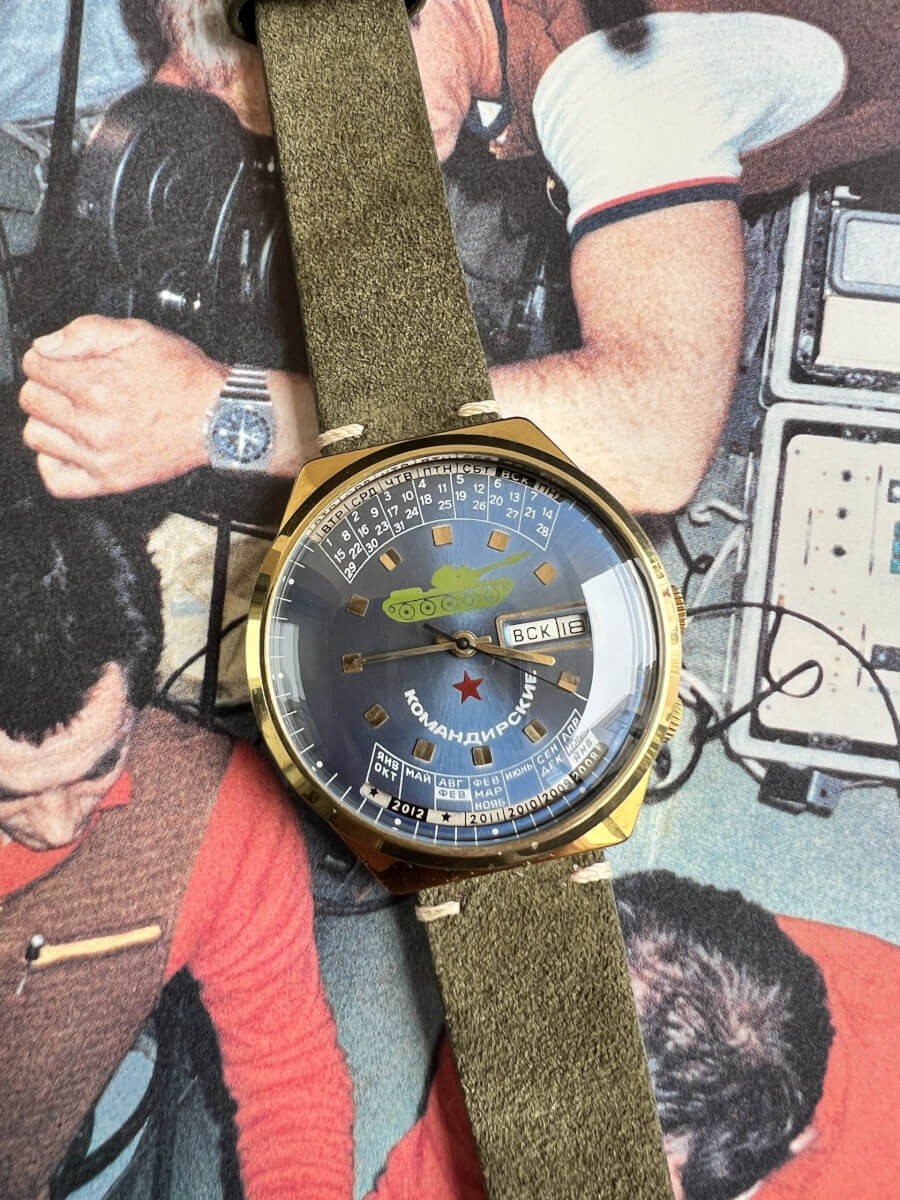
Enhanced dial: a tank, a red star and the word « командирские ».
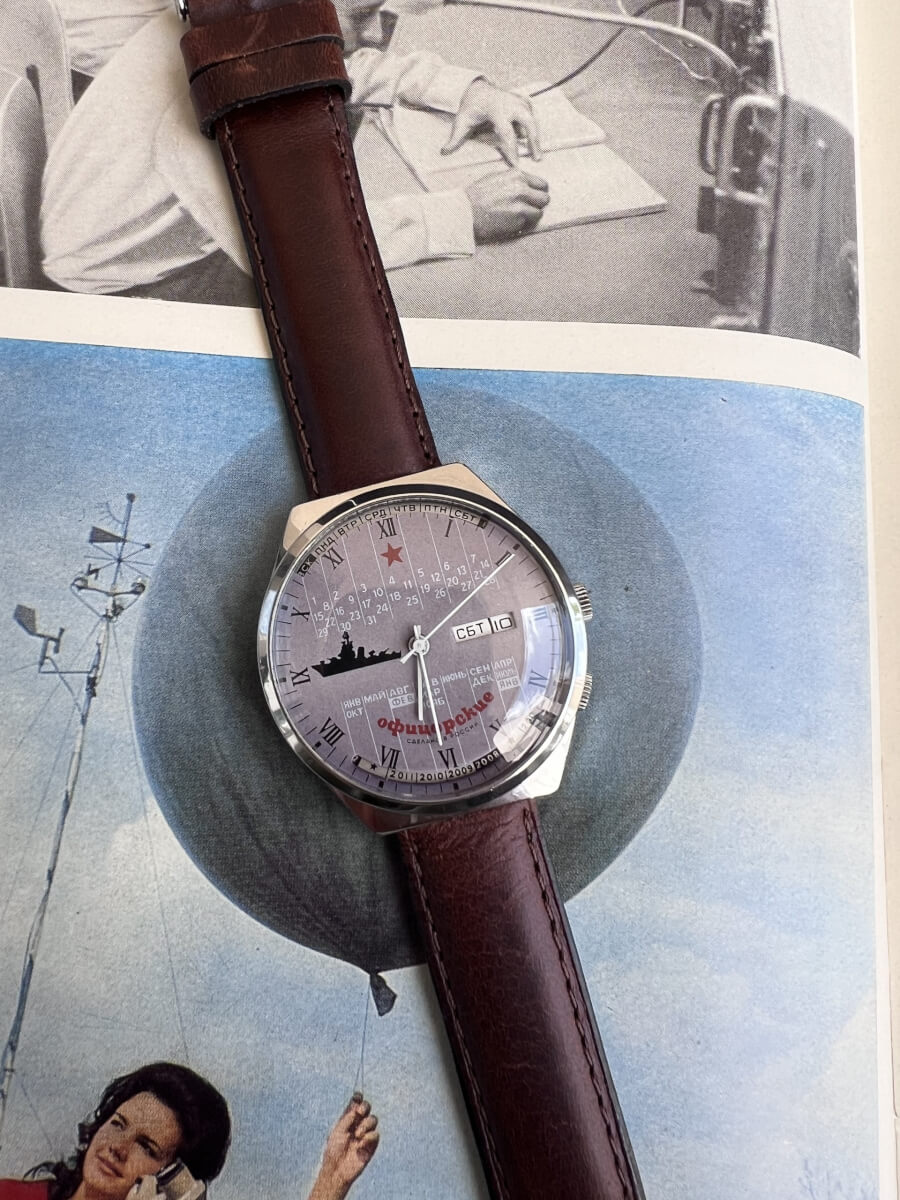
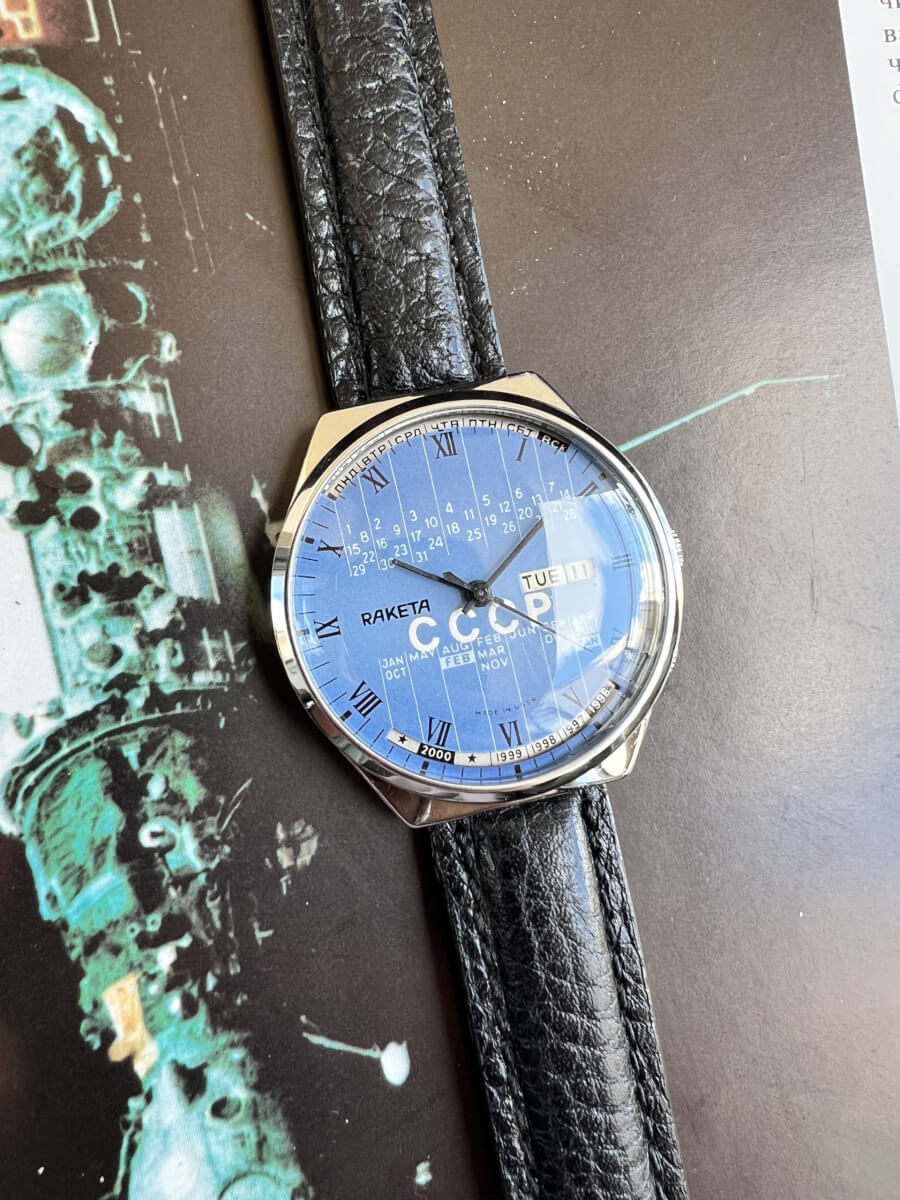
Some watches carry a decoration added to the factory dial: a tank, a warship, a MiG, a red star, the letters СССР or KGB. We call them enhanced dials.
The practice has two origins. The first is the army: soldiers personalised their watch, just as they decorated their demobilisation album. The second dates from the 1990s: these motifs were added for tourists visiting the country.
These are not fake watches. The watch, the movement and the dial are factory made, only the decoration was added. At the time, many found it very appealing. Today, collectors are divided. We offer some, and say so on each product page.
Warship version, marked « офицерские ».
Version with the letters СССР.
Available at Soviet in Paris
Each Raketa perpetual calendar in our shop is serviced by our watchmaker and sold with its service certificate.
The ДП-5В (DP-5V) is the field radiometer of Soviet civil defence: a green Bakelite console, a probe with a rotating gamma, beta and check-source shield, headphones and a manual that explains operation and maintenance. The one in this article served in an industrial bakery in Chișinău and was serviced in March 1991. Its owner shared his photos and documents with us, and we turned them into a tool that lets you operate it on screen, step by step.
The Moscow Games, from 19 July to 3 August 1980, boycotted by some sixty countries, produced more objects than any Soviet event: a bear cub, Misha, drawn by Viktor Chizhikov, an emblem made of running tracks, five thousand torches, watches from every factory, platinum coins, rings, tea glass holders, posters. This guide tells the story of the Games and reviews the objects, with the marks that authenticate them and the prices.
The 3017 chronograph of the First Moscow Watch Factory carries a five-digit number on the balance cock. The most common dating method reads it as a single series, from 1959 to 1979. Four factory passports show there are two, and that the same number can point to two watches made ten years apart. Here is how to read the number, the dial, the logo and the bridge, with a decoder to date your Strela, Poljot or Sekonda.
This website uses cookies to improve your experience while you navigate through the website.
Out of these cookies, the cookies that are categorised as necessary are stored on your browser as they are essential for the working of basic functionalities of the website.
We also use third-party cookies that help us analyse and understand how you use this website.
These cookies will be stored in your browser only with your consent.
You also have the option to opt out of these cookies.
But opting out of some of these cookies may affect your browsing experience.
Necessary cookies are absolutely essential for the website to function properly. This category only includes cookies that ensure basic functionalities and security features of the website. These cookies do not store any personal information.
Cookies that are not strictly necessary for the website to work and that are used specifically to collect personal data through analytics, ads and other embedded content are called non-necessary cookies. User consent is required before these cookies run on the website.
✕
Soviet in Paris
Offline right now. Leave your message and your email, we reply within 24 hours.
Hello 👋 A question about an item, an order or shipping? Write to us.
Your email is used only to reply to you.
Subscribe to our newsletter and get 10% off your first order.
Subscribe
★ New pieces before anyone else
★ New blog articles
★ Soviet in Paris news and updates
Join the Party
10% off your first order
Receive your welcome card and our next arrivals.
Your code appears here and is also sent to you by email. You can leave the Party in one click, at any time.