Four black numerals on a white dial, and a zero in place of the 12. The Raketa Big Zero had no name at the Petrodvorets factory, yet it became one of the most sought-after Soviet watches, and one of the most copied. Period catalogues, the 1988 Italian press, factory passports and pieces from our stock trace its story, from a watch for the visually impaired to an Italian fashion item, and on to the fake dials that flood today's listings.
SEPTEMBER 2026•15 MIN READ
by Marwen Yahyaoui
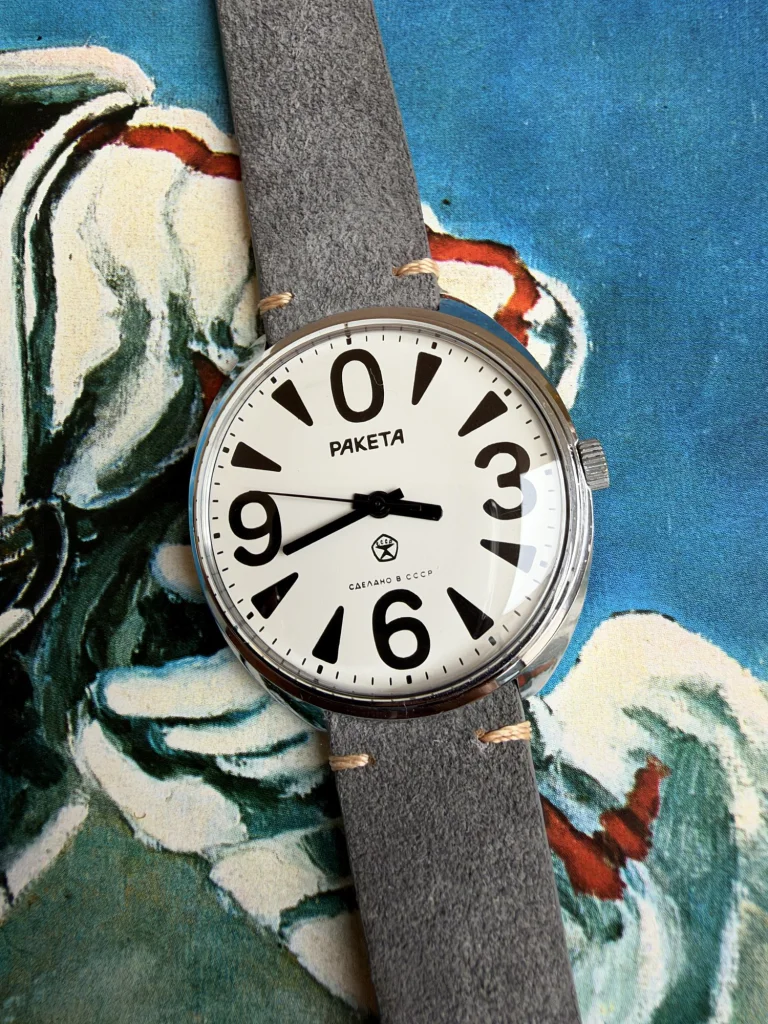
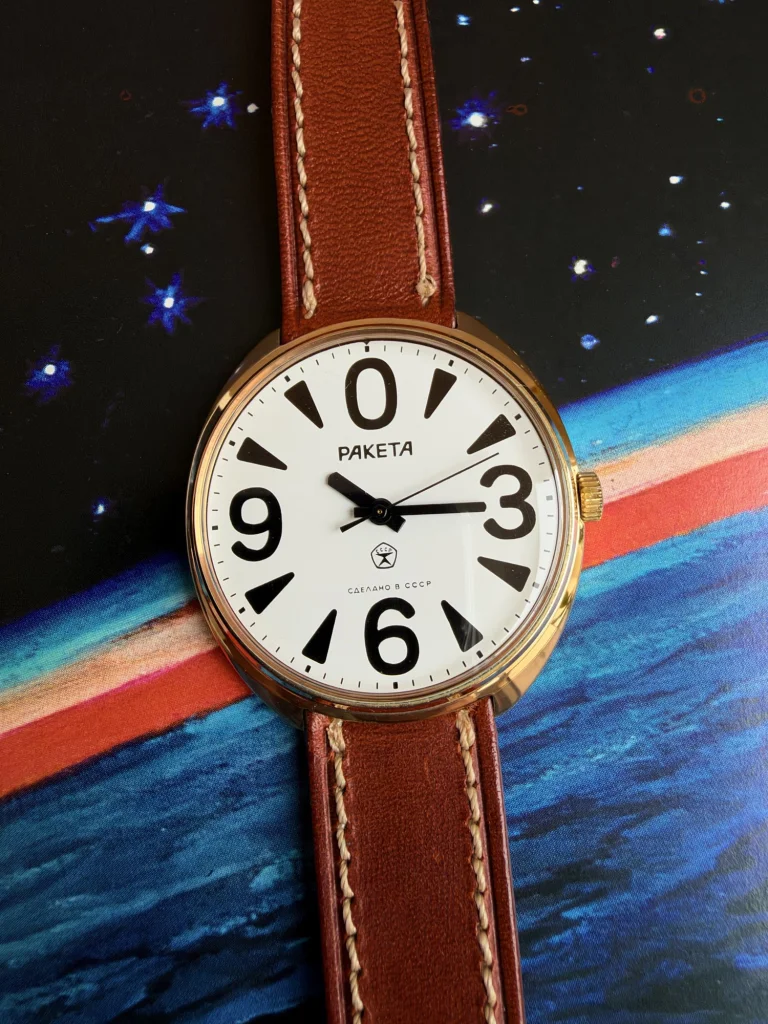
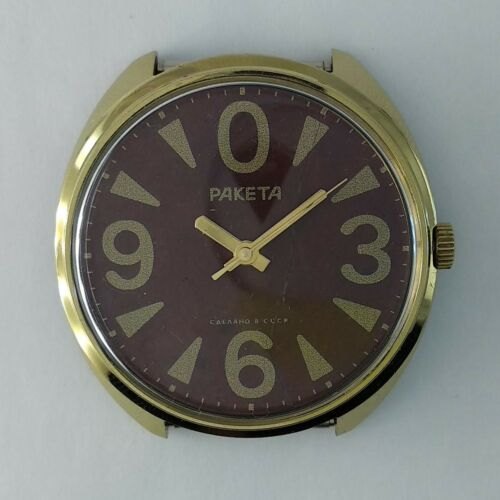
Four black numerals on a white dial, 0, 3, 6 and 9, and a zero where every other watch has a 12. At the Petrodvorets factory this Raketa had no name: the catalogues list it under a plain code. Collectors call it the Big Zero. Together with the Copernicus, it has been our best-selling Raketa for several years.
It is also one of the most copied Soviet watches. The vast majority of Big Zeros offered online carry a fake dial and fake hands, usually fitted to a period case and crown. This article draws on the factory catalogues, on the Italian press of 1988 and 1989 and on the passports of watches that went through our shop. It ends with two comparators between watches from our stock and copies, one for the Big Zero, the other for the Italian-market Gaigher.
A watch with no name, next to the watch for the blind
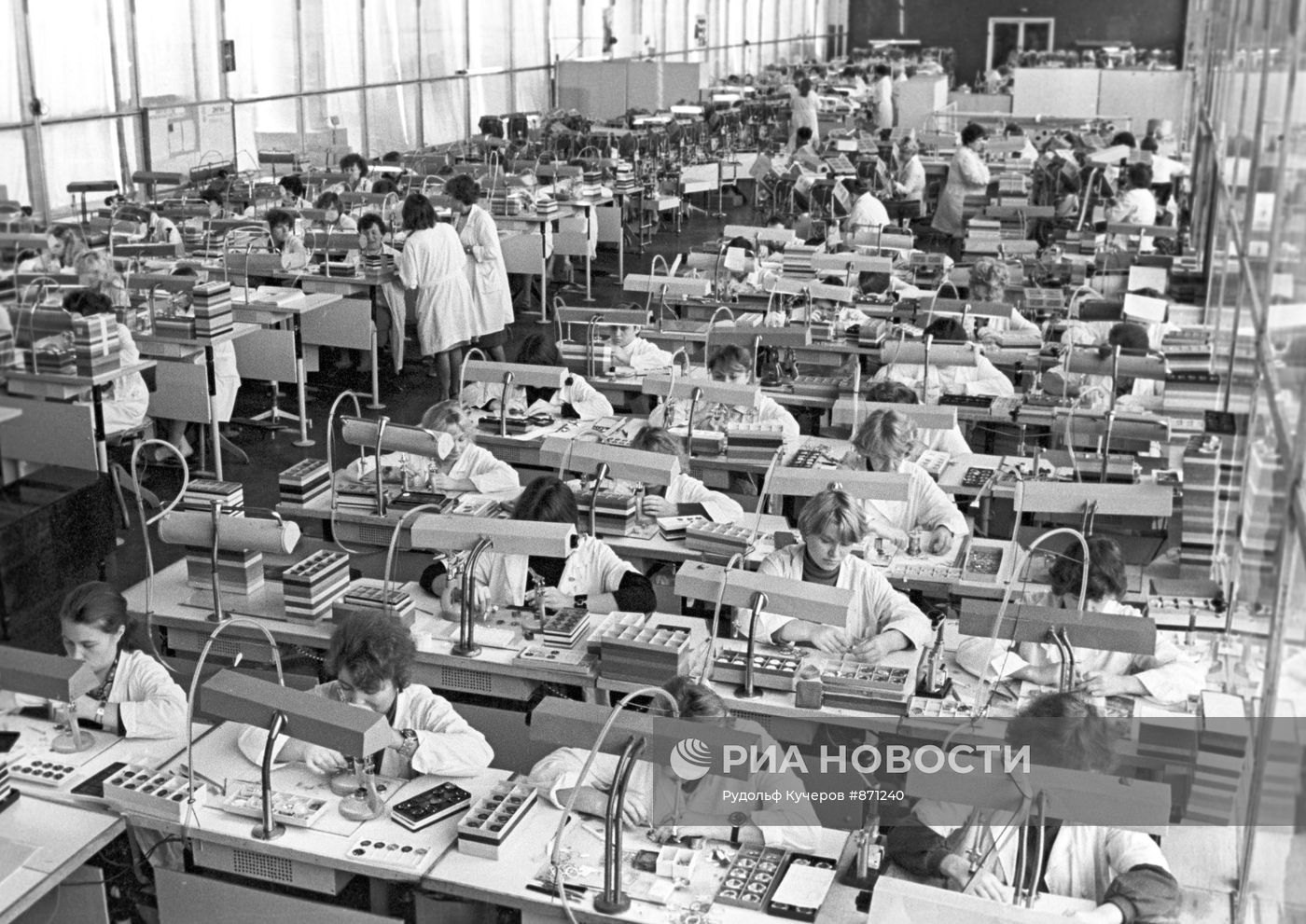
Raketa watches come from the Petrodvorets factory near Leningrad, where they were assembled in large glass-walled workshops, as here in 1980.
The assembly shop of the Raketa factory in Petrodvorets in 1980. Photo RIA Novosti / Rudolf Kucherov.
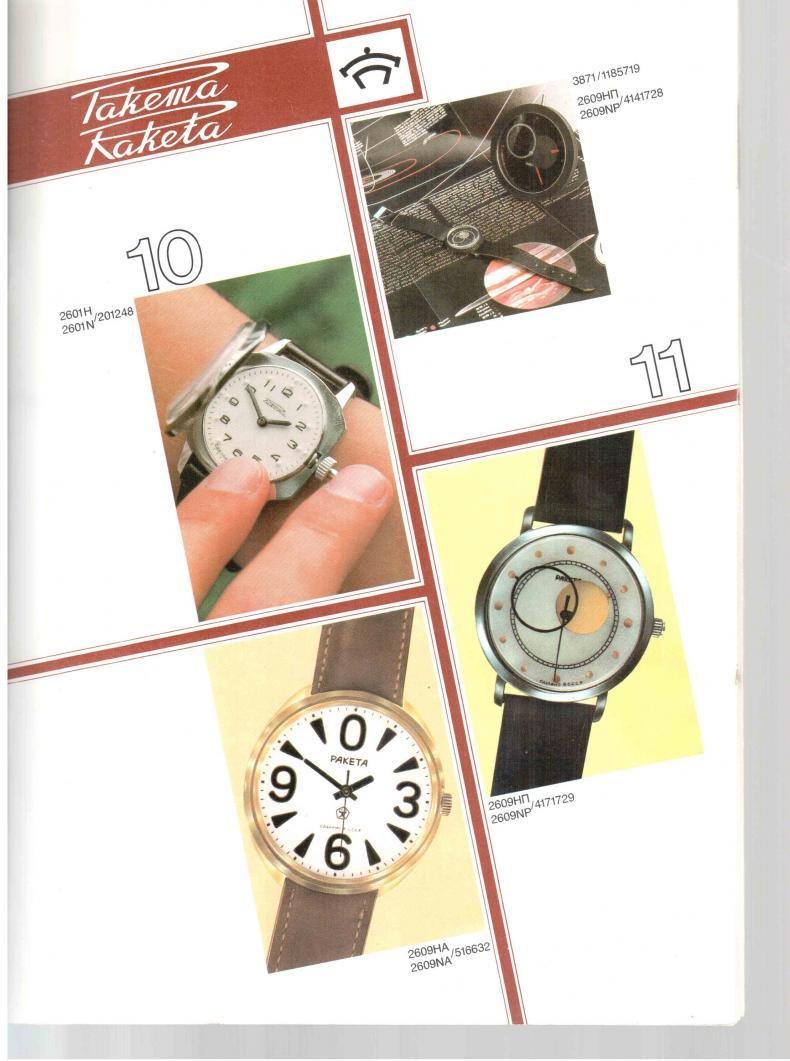
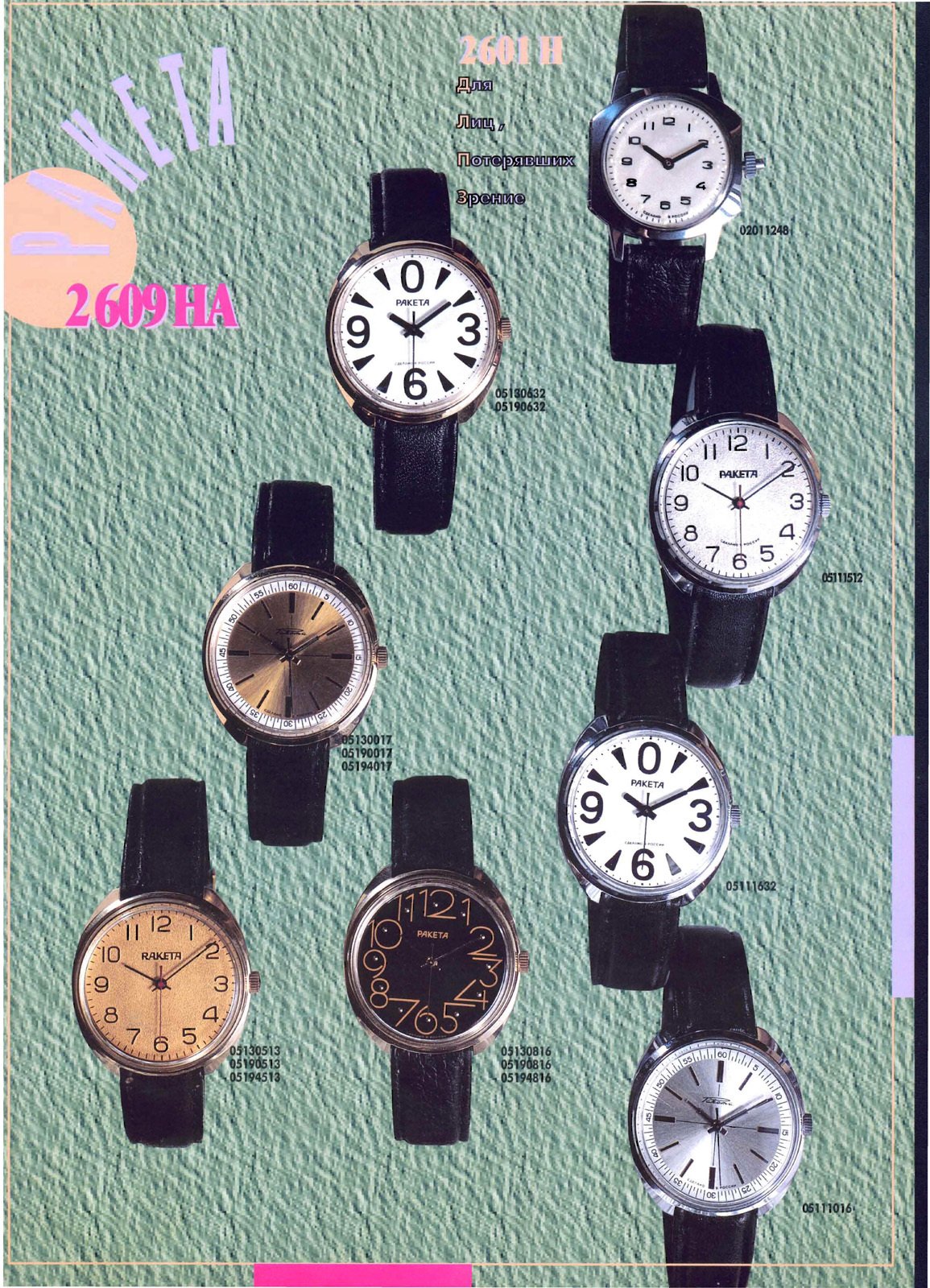
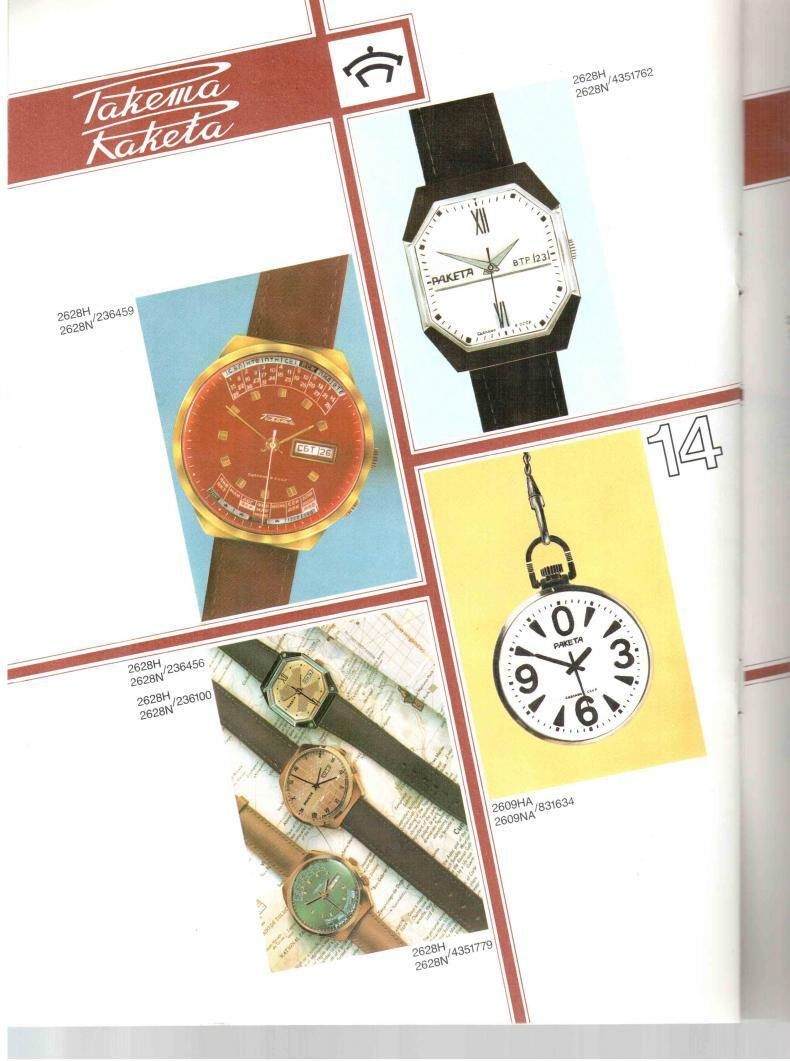
The Big Zero appears in a factory export catalogue printed in Budapest. It carries no date, and collectors place it between 1986 and 1989. The watch is listed under the code 2609НА/516632, the calibre followed by a design reference, with no model name at all.
On the same page, just above it, is the 2601Н, a tactile watch for the blind. The accompanying text states that the Petrodvorets factory is the only one in the Soviet Union making watches for the visually impaired and for people who have lost their sight. The 1992 catalogue again puts the two watches on the same page.
Export catalogue, c. 1989: the Big Zero below the watch for the blind, the Copernicus to its right.1992 catalogue: two Big Zeros, gold and chrome, with the 2601 Н “for people who have lost their sight”.
Former factory staff and several Russian dealers tell the same story. The dial was reportedly designed around 1984 or 1985 at the request of the All-Russian Society of the Blind (ВОС), for people with weak eyesight, hence the large contrasting numerals and the wide hands. Production was due to stop in 1986, until Italian buyers visiting the factory saw it as a symbol of perestroika and placed a large order. No document confirms this account, and the designer’s name has never been found.
Raketa veterans give a simpler explanation: everything starts from zero. A Swiss watch by ARSA, a brand known for its braille watches, already had large numerals and very similar triangles, with a 12, and may have served as a model. The large 1985 Raketa export catalogue does not yet show the Big Zero. Without a more precise document, its beginnings fall in the second half of the 1980s.
Gorbachev and the zero, a legend the dates contradict
Raketa tells the story like this today. In the mid-1980s, at a summit in Italy, Mikhail Gorbachev was asked to explain perestroika. He showed his Raketa and replied that, as on his watch, the Soviet people wanted to start everything from zero, and the line made the front page of Italian newspapers the next day. In 2022 its CEO, David Henderson-Stewart, added in Rossiyskaya Gazeta that the watch took its name from those headlines.
Nobody has ever produced the photo, the interview or the headline. The dates, however, are known. Gorbachev’s only visit to Italy as Soviet leader took place from 29 November to 1 December 1989. Yet the Big Zero was already fashionable there more than a year earlier: on 20 September 1988, La Stampa’s TuttoCome supplement announced that Soviet watches were going to sell like mad, “the Raketas, with the zero in place of the 12”. As for the watch made for his 1989 visit, it was not a Raketa but a Vostok with his portrait, ordered by an Italian company.
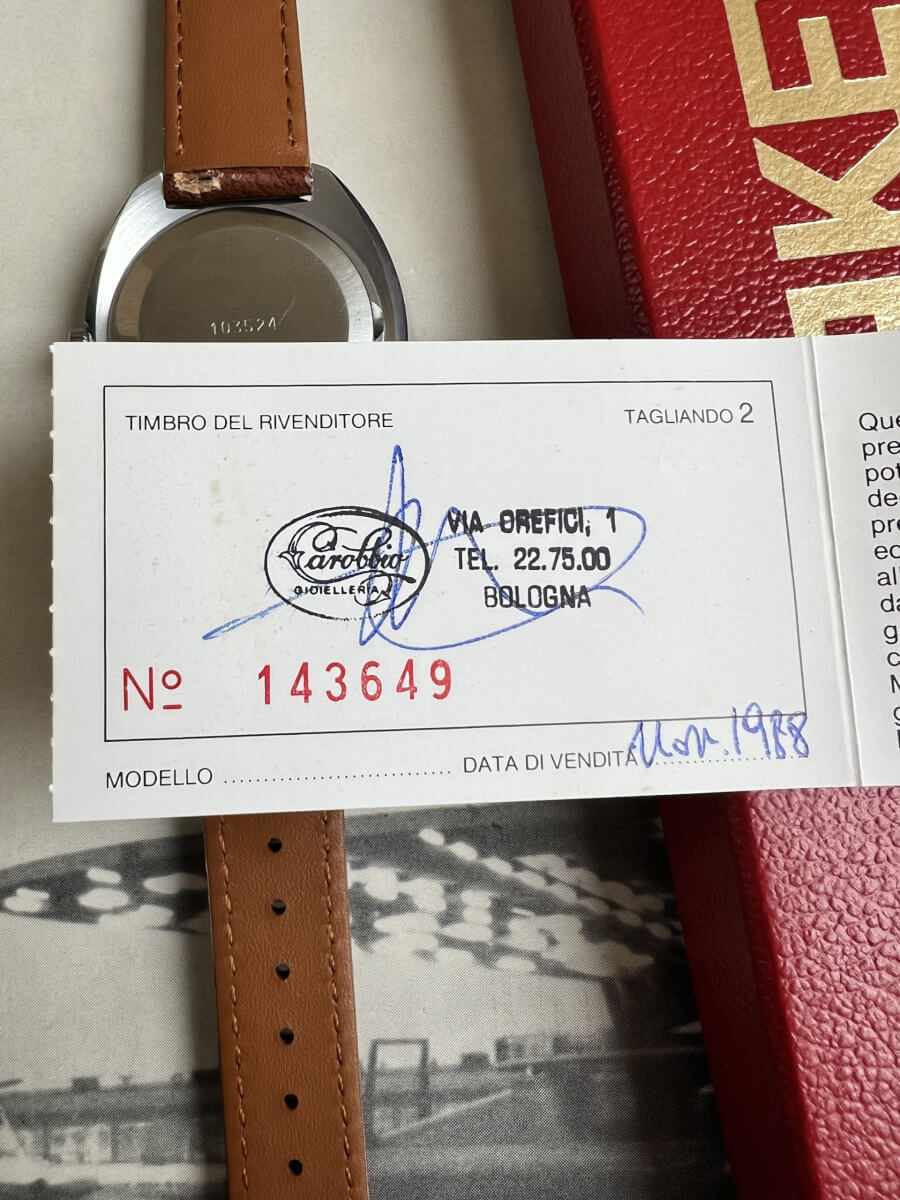
The Bologna jeweller’s stamp and the sale date, November 1988.
A Big Zero that went through our shop confirms it in its own way: its Italian warranty booklet bears the stamp of a Bologna jeweller and a sale date of November 1988, a year before Gorbachev’s visit.
Italians did meet Gorbachev, but in Moscow. In October 1988, Prime Minister Ciriaco De Mita went there with industrialists for the “Italia 2000” exhibition. According to StampaSera of 1 February 1989, he wore a Raketa there, which then joined his collection of some 400 watches, and TV host Renzo Arbore checked the time on his own on air. The Italian businessmen who came to the exhibition brought them back as souvenirs. The article does not say which dial.
A fake document also circulates widely online: the supposed front page of an American newspaper from March 1985, with a Big Zero filling the page. It is a photo montage, and the watermark of the website used to make it can still be read in a corner.
Italy, 1988: the Raketa wave
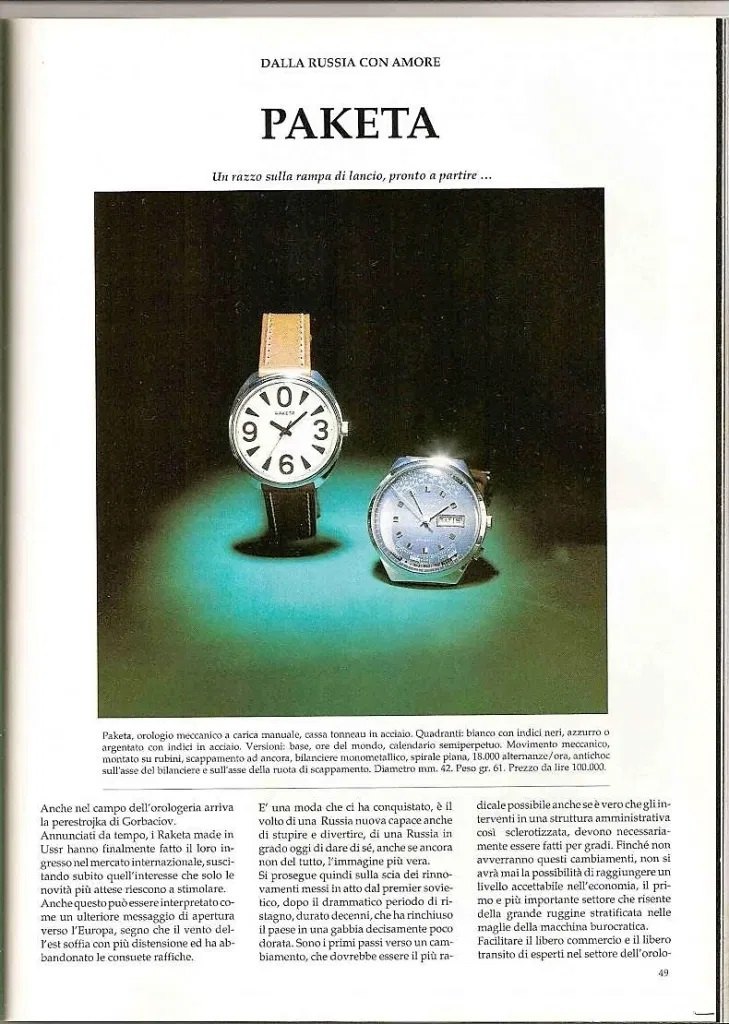
A first article devoted to it appeared on 25 October 1988 in TuttoCome, by Emanuela Minucci, under the title “Che ora fai, tovarish Gorbaciov?” (What time do you make it, comrade Gorbachev?). She counted five versions of the Raketa. The most requested replaces the 12 with a zero, and its four big black numerals on white are enough, she wrote, to make it a youth “cultwatch”. She also noted that no Raketa version has a name.
The figures followed. On 17 January 1989, the same supplement reported 40,000 Raketas sold in four months. On 1 February, StampaSera counted about ten versions and gave the prices: about 20,000 lire apiece in Moscow, around 100,000 lire in Italy. The Italian press often wrote “Paketa”, reading РАКЕТА as Latin letters. On 25 March, under the headline “A Mosca! A Mosca! (possibilmente senza Paketa al polso)” (To Moscow! To Moscow! Preferably without a Paketa on your wrist), Carlo Fruttero and Franco Lucentini opened La Stampa’s front page with fifty thousand “Soviet missiles” that had entered Italy in 1988 and four hundred thousand expected in 1989, before explaining that these were watches, “missile” being raketa in Russian. They took the figures from Moscow News, a Soviet monthly whose first Italian edition had just come out.
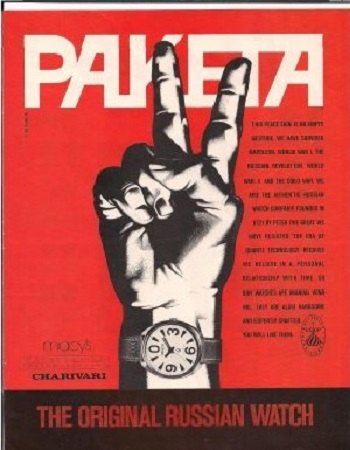
An Italian magazine of the time: the Raketa sells from 100,000 lire. Document from the URSS Watch collection.Italian advertisement of the time, with the Big Zero on the wrist. Document from the URSS Watch collection.
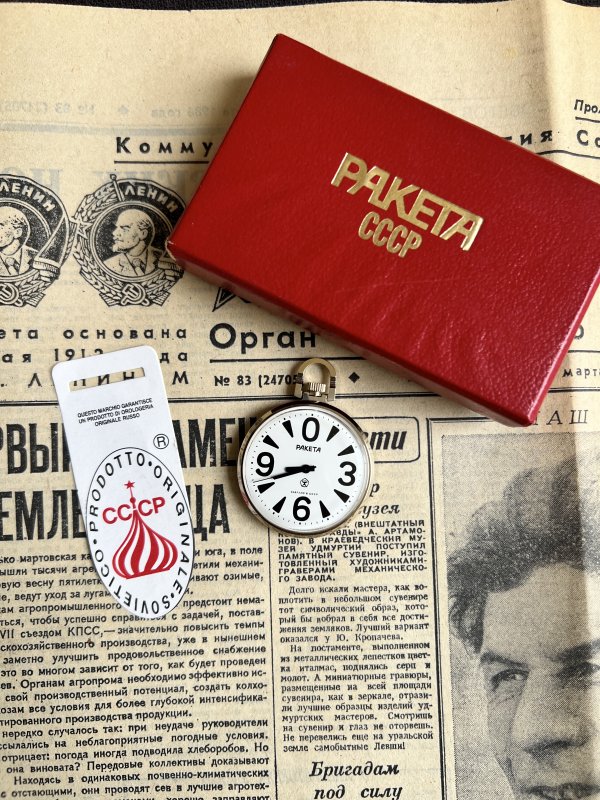
On 18 April 1989, TuttoCome reported an advertisement by the Soviet trade body Vremex and the Verona firm Visio: according to it, the only Soviet wristwatches officially imported into Italy were the Raketa and Poljot, distributed exclusively by Mirabilia, piazza Castello 11 in Milan, and the Vostok Komandirskie, distributed by Time Trend, also in Milan. The article added that Raketas were already being imitated, and that an authenticity mark, the domes of St Basil’s under the word CCCP, would from then on be applied to Soviet products.
In July 1989, in La Stampa, the art critic Gillo Dorfles found these watches “attractive because poor, and therefore exotic”, and noted a “curious reversal”: propaganda once portrayed Soviets as greedy for Western watches, “now it is our fashion that goes hunting for Soviet watches”. The Raketa name even sold other things: in spring 1989 TuttoCome announced “made in USSR” glasses branded Raketa for Persol, at the “proletarian price” of 128,000 lire, with a red star in the middle.
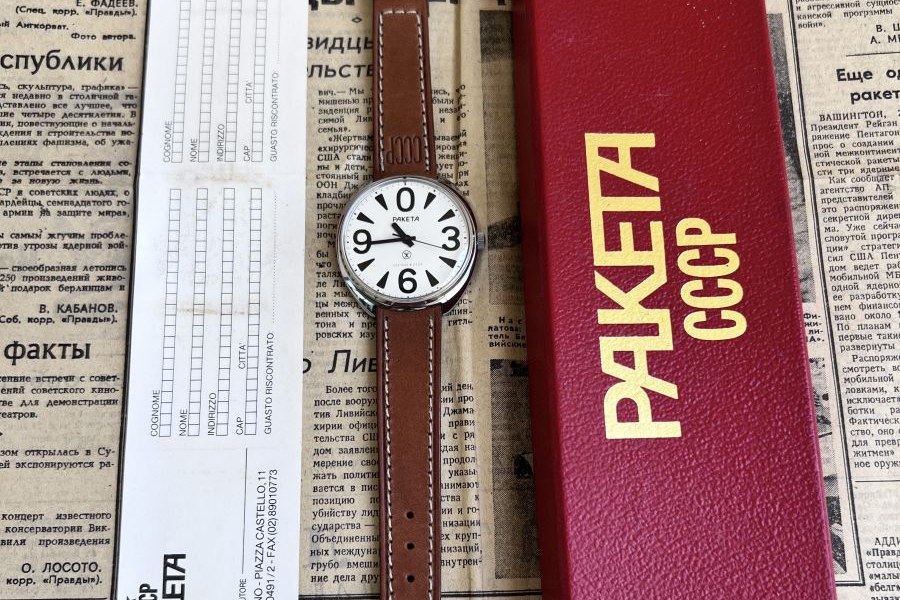
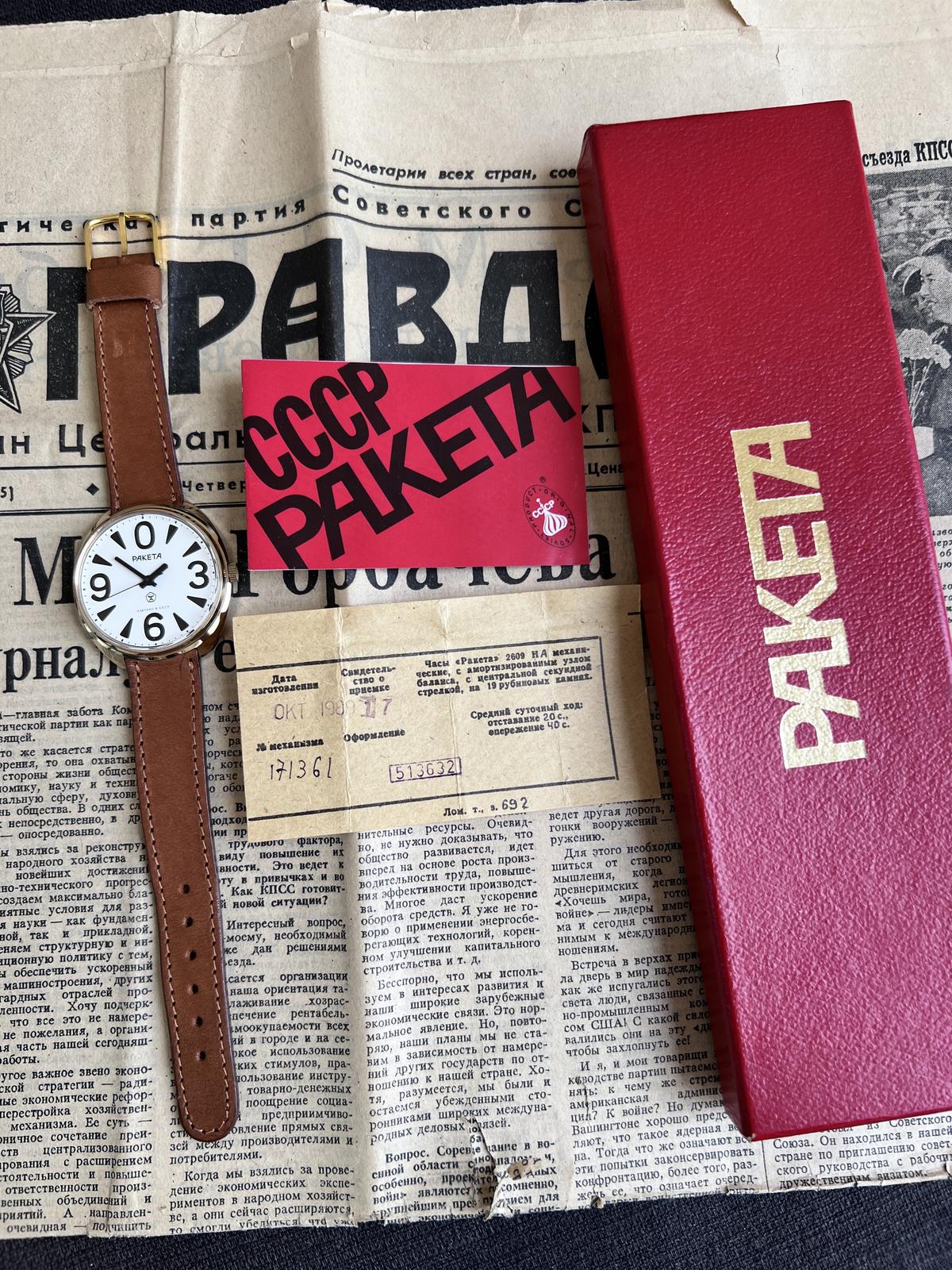
Our Italian-market Big Zeros still come with both documents: the Mirabilia warranty card, with the piazza Castello address, and the “Prodotto originale sovietico” tag with the domes of St Basil’s. They come in a red box stamped Ракета СССР, with a strap embossed CCCP. The fashion faded quickly. In February 1990 TuttoCome noted that “the perestroika effect that made Raketa’s fortune” was over, and the Naples firm Art Time, which imported the Vostok Komandirskie, launched watches bearing Michael Jackson and Madonna. By December Raketas were judged “troppo datati”, too dated. In 1992 La Stampa described the first visitors from the former USSR offering “orologi Paketa” and old cameras on the Ligurian Riviera.
The authenticity tag with the domes of St Basil’s, with our Big Zero pocket watch.Our Raketa “Gaigher”, specific to the Italian market.
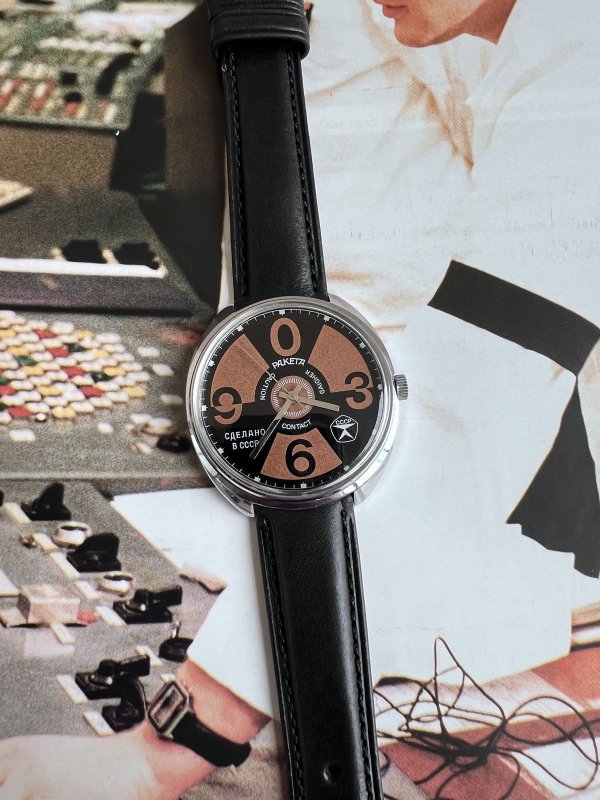
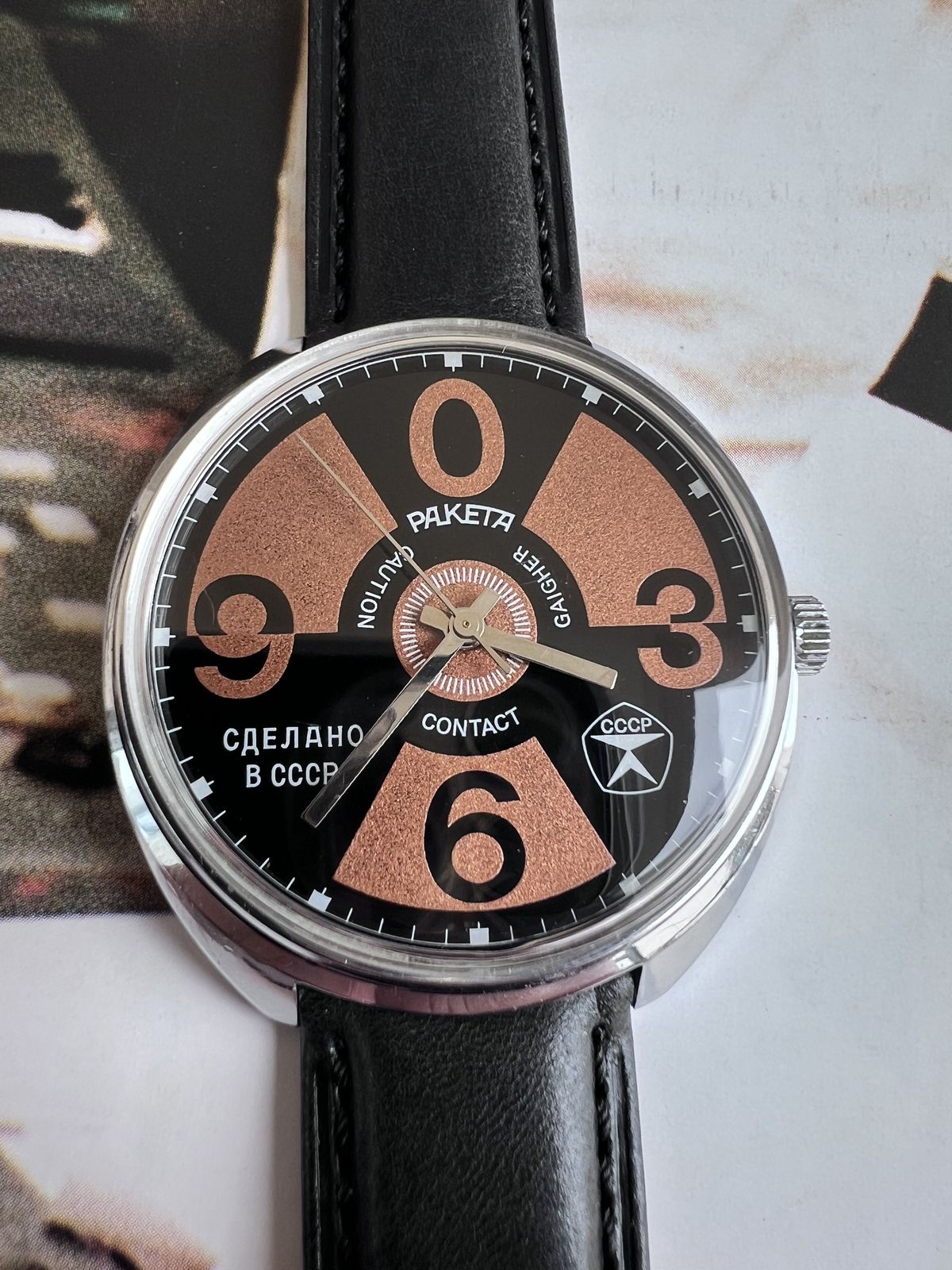
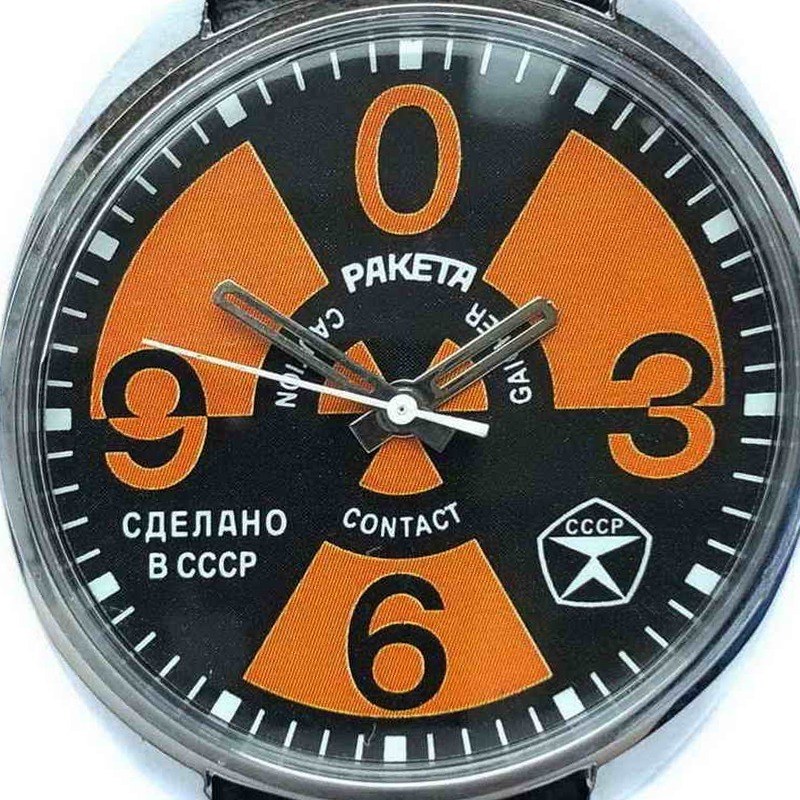
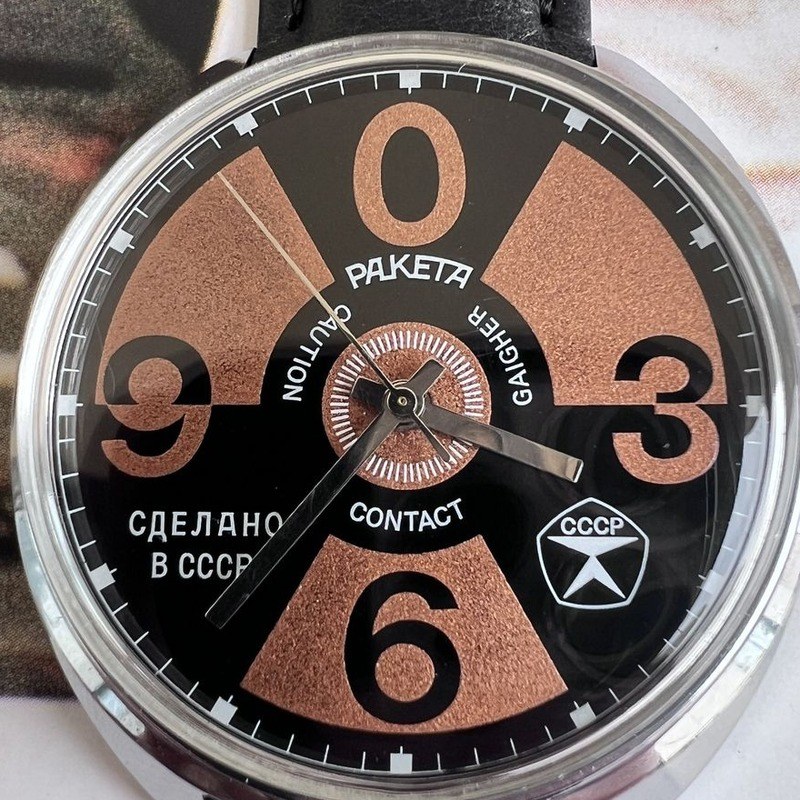
The Italian market also had Big Zeros of its own. Our Raketa “Gaigher” is one example: a black dial cut into four ochre sectors at 0, 3, 6 and 9, the words CAUTION, CONTACT and GAIGHER around the centre, as on a Geiger counter, and Сделано в СССР at 9 o’clock. Its dial is Italian, a period dial from the early 1990s: everything else on the watch is Soviet. The Gaigher exists in two colours, black and ochre or black and grey, and both have been copied.
The 2609.НА calibre and the 51 case
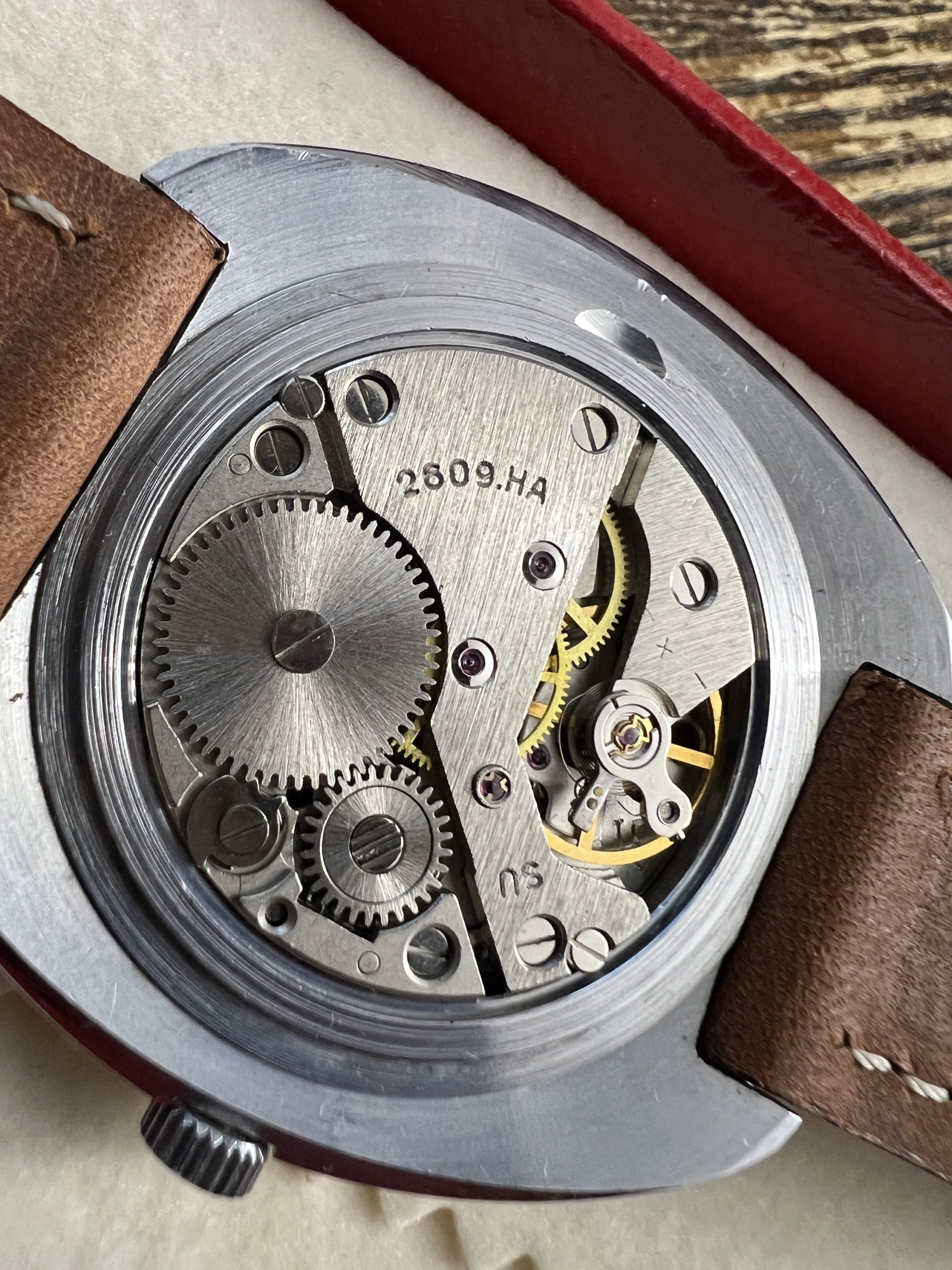
Every Soviet Raketa Big Zero has the same movement, the Petrodvorets 2609.НА calibre. The 1991 export catalogue describes it as follows: 26 mm in diameter, 3.98 mm thick, 19 jewels, centre seconds, shock protection on the balance staff, a balance beating at 0.4 second, that is 18,000 vibrations per hour, an average rate from 20 seconds slow to 40 seconds fast per day, and at least 42 hours of power reserve. The same text says that more than a hundred designs use this movement. The 1992 catalogue gives it only 16 jewels.
The 2609.НА calibre of a Big Zero that went through our shop.
The bridge reads 2609.HA and SU. The cushion case, known as 51 from its code, measures 39 mm without the crown and 40 mm lug to lug, with 18 mm lugs. It is chrome-plated or gold-plated brass, with a snap-on stainless steel back and an acrylic crystal. According to Russian collectors, a 2609 with chamfered edges, a finish dropped around 1982, gives away a reassembled watch: this case only appeared around 1985.
What the passports say
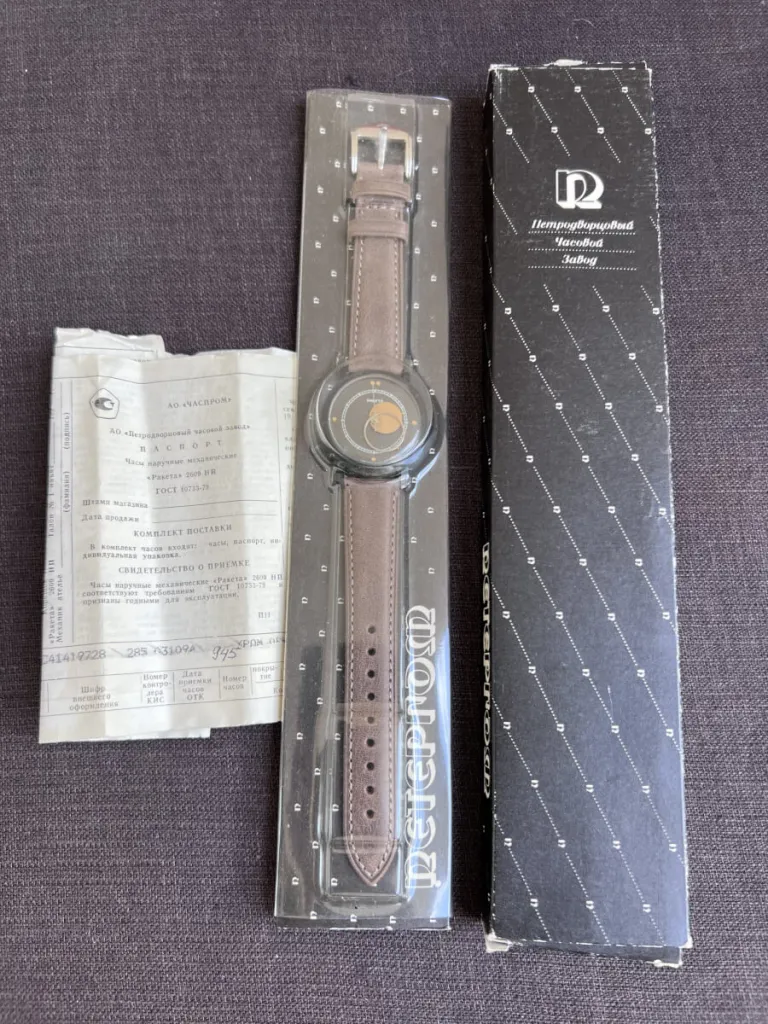
A new Big Zero was sold with a passport, a small slip filled in and stamped at the factory. The passport of a gold-plated Big Zero that went through our shop gives a manufacturing date of October 1989, the quality control stamp and movement number 171361, the same as the one engraved on the caseback. The “Оформление” (design) box reads 513632: the gold-plated cushion case and dial 632, the Big Zero dial. The chrome version has the code 511632. The printed text describes a 19-jewel Raketa 2609 НА, shock-protected, with centre seconds, rated from 20 seconds slow to 40 seconds fast per day, as in the catalogue.
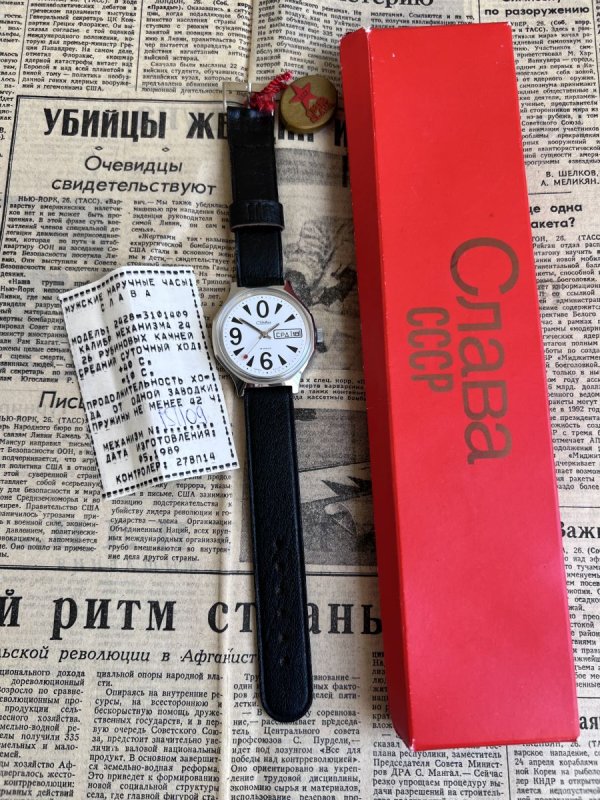
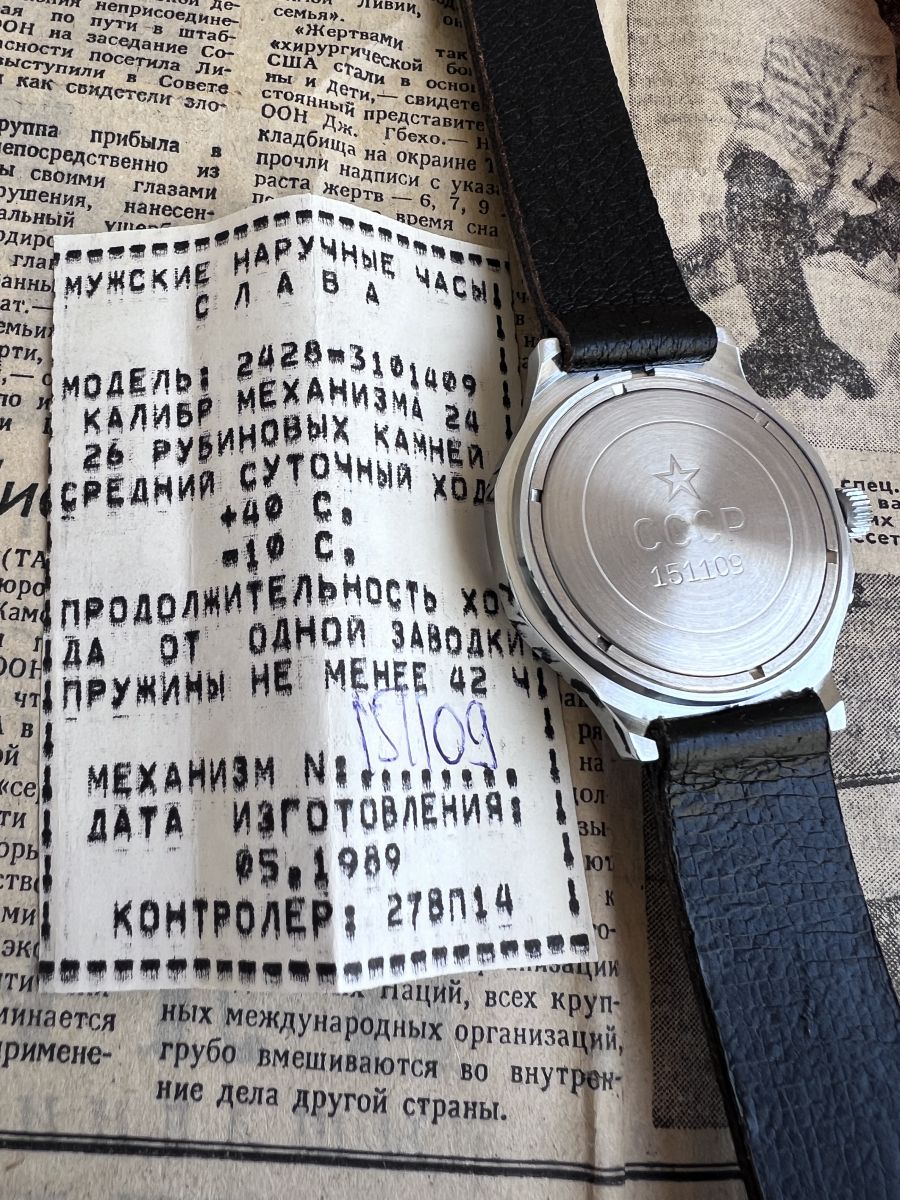
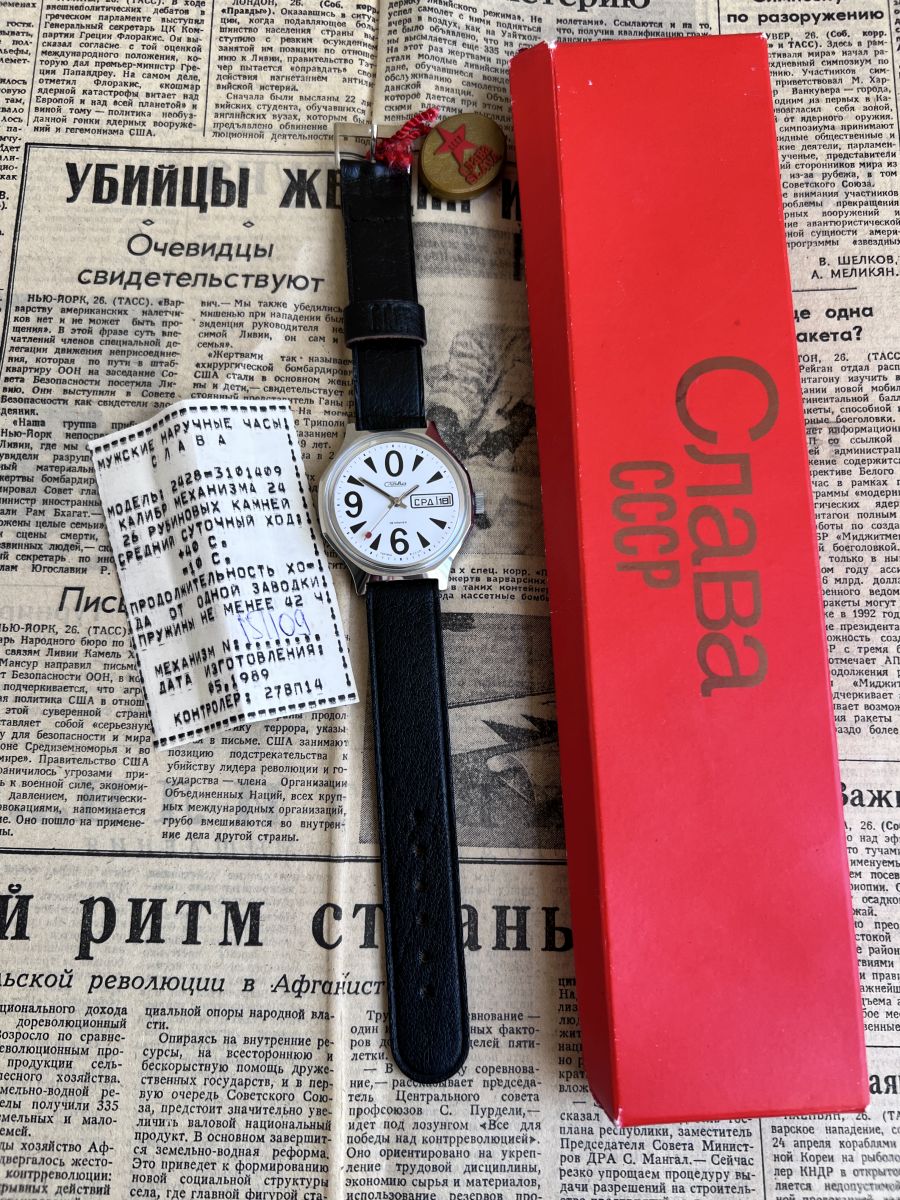
The passport of our Slava Big Zero is printed on a dot-matrix printer, with slashed zeros: Slava men’s wristwatch, model 2428-3101409, 2428 being the calibre number, 26 jewels, a rate from 10 seconds slow to 40 seconds fast, at least 42 hours of running, made in May 1989. The movement number, 151109, is added by hand and is engraved on the caseback.
October 1989, movement 171361, design 513632.Our Slava Big Zero: May 1989, movement 151109.
A passport does not prove everything. Copies printed from a single original circulate in Russia, and one of them, dated 1989, already bears the name Saint Petersburg, which Leningrad only took back in September 1991. The number, dates and names must match the watch.
Slava, pocket, small round, stone: the other Big Zeros
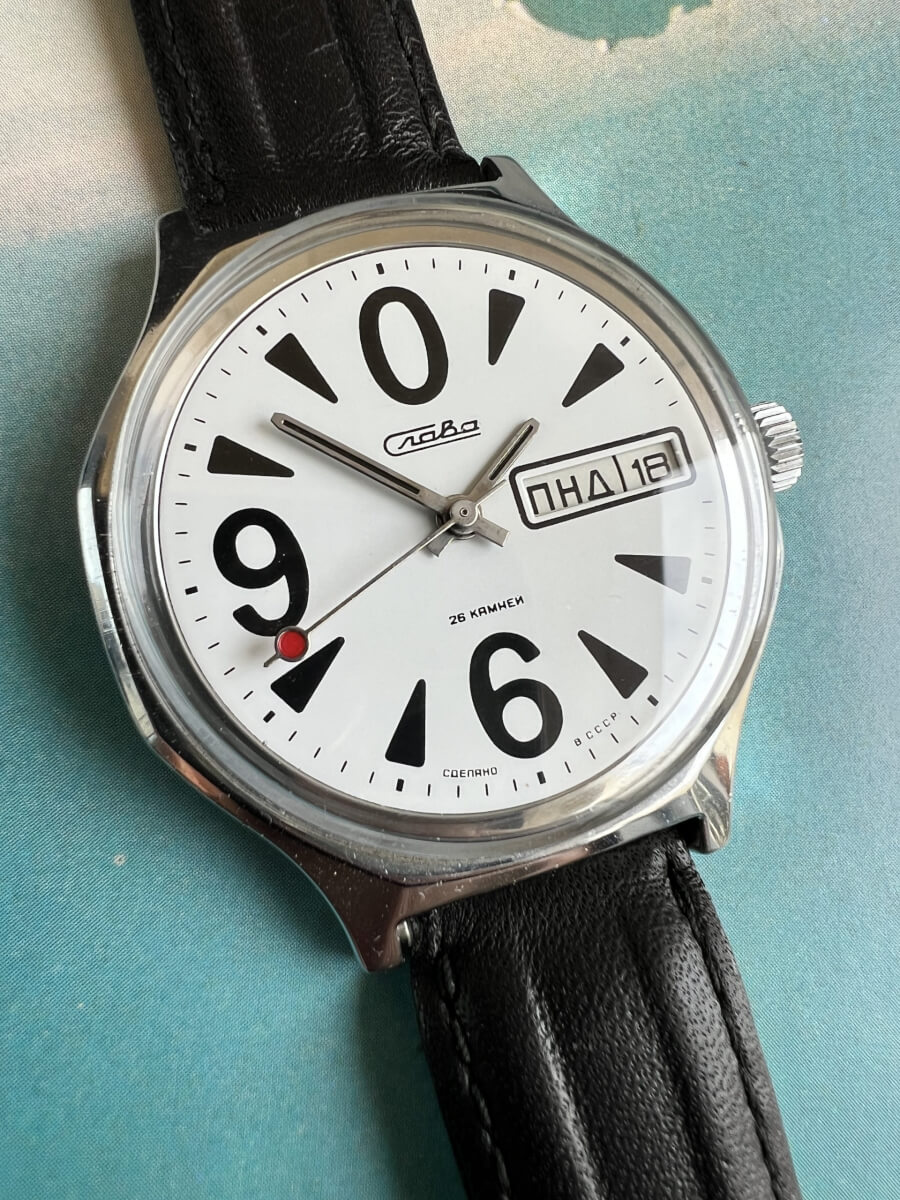
The success inspired the Second Moscow Watch Factory, which made its own Big Zero under the Slava name: the same four-numeral dial, but a 26-jewel 2428 calibre with day and date, in a 39 mm case. We have two in stock, one complete with its box, medallion and 1989 passport, and another on its period Slava strap.
1989 Slava Big Zero, complete.The Slava’s day and date window.
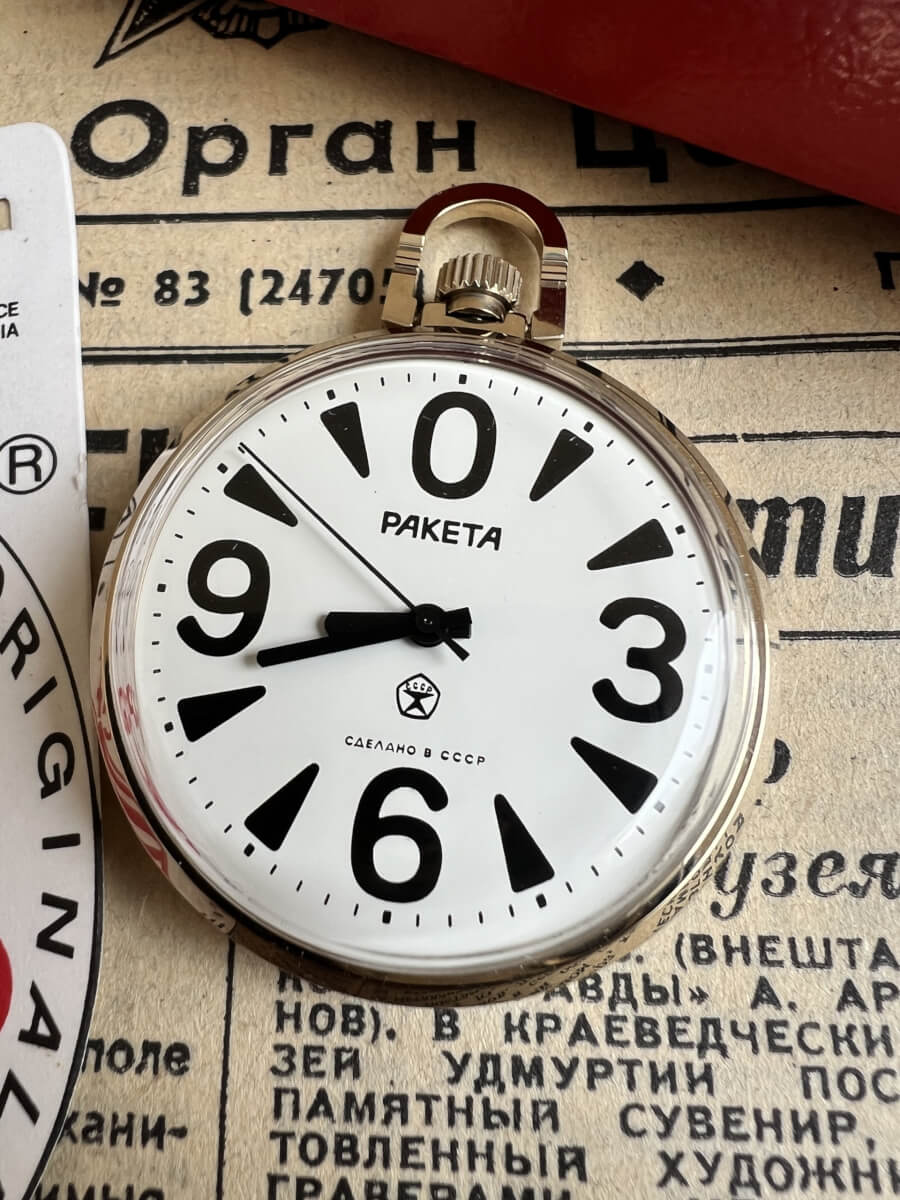
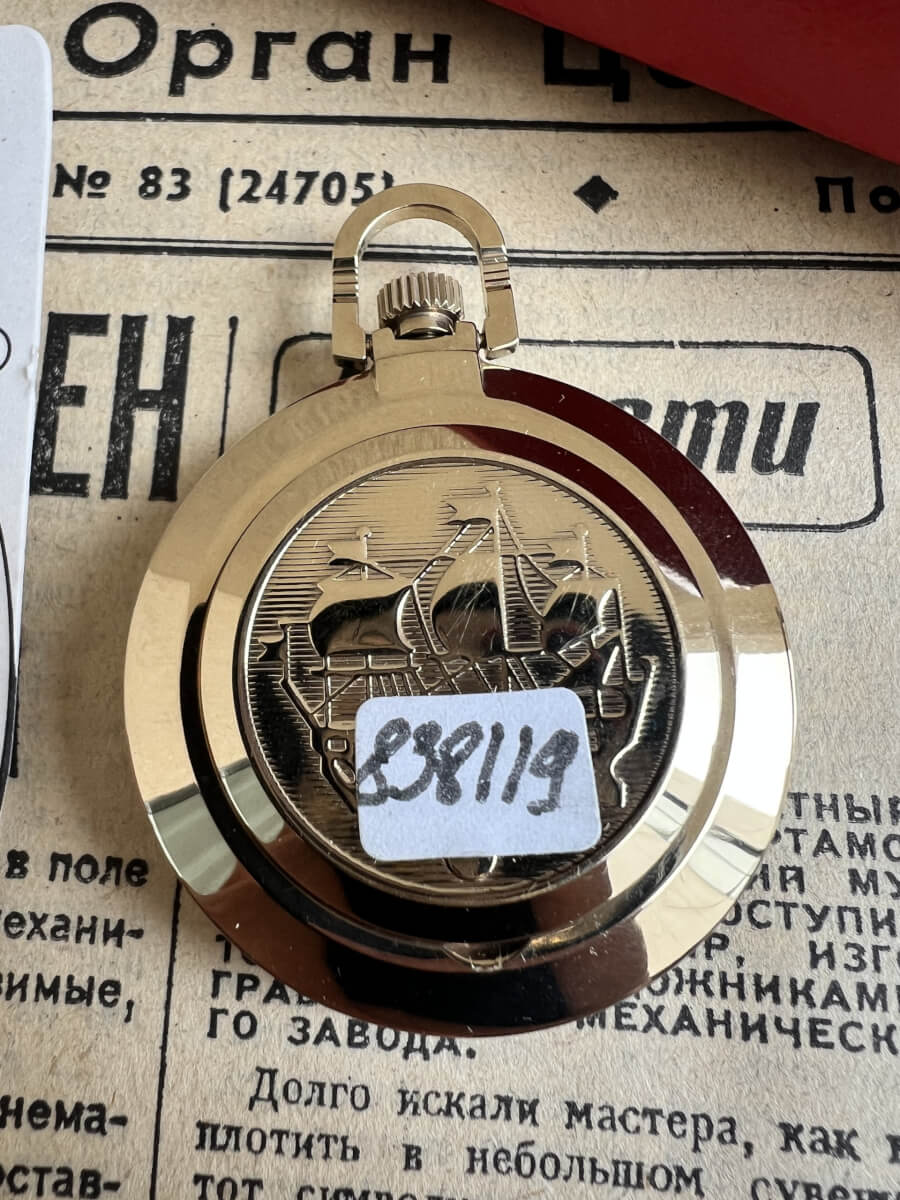
The late-1980s export catalogue also shows a Big Zero pocket watch, 2609НА/831634. Our example has a gold-plated case whose lid shows a sailing ship, in honour of the Scarlet Sails, the June white nights celebration in Leningrad.
The Big Zero pocket watch in the catalogue, c. 1989.Our Big Zero pocket watch.The Scarlet Sails ship.
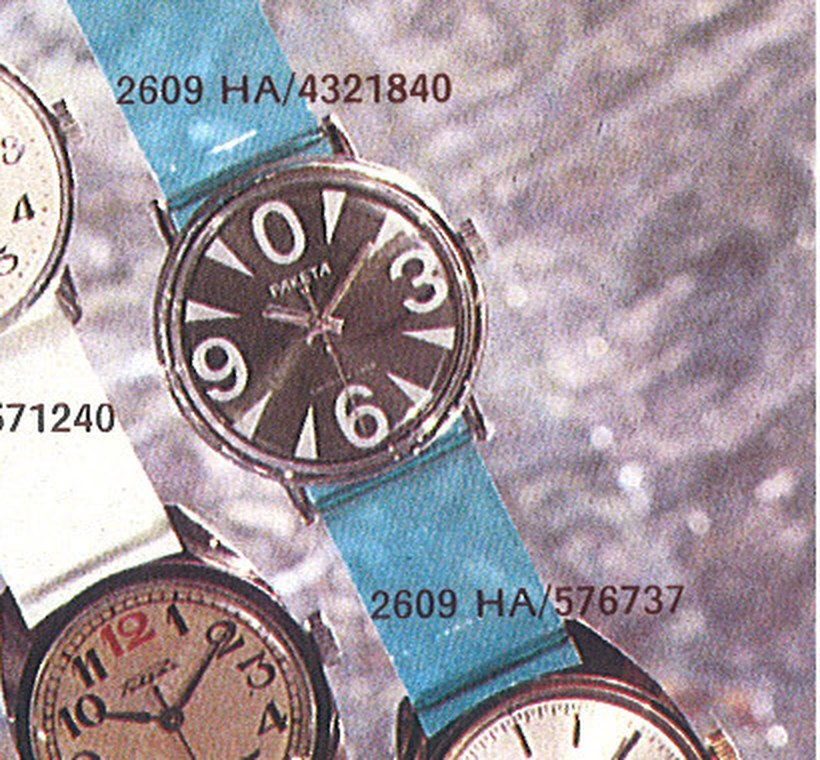
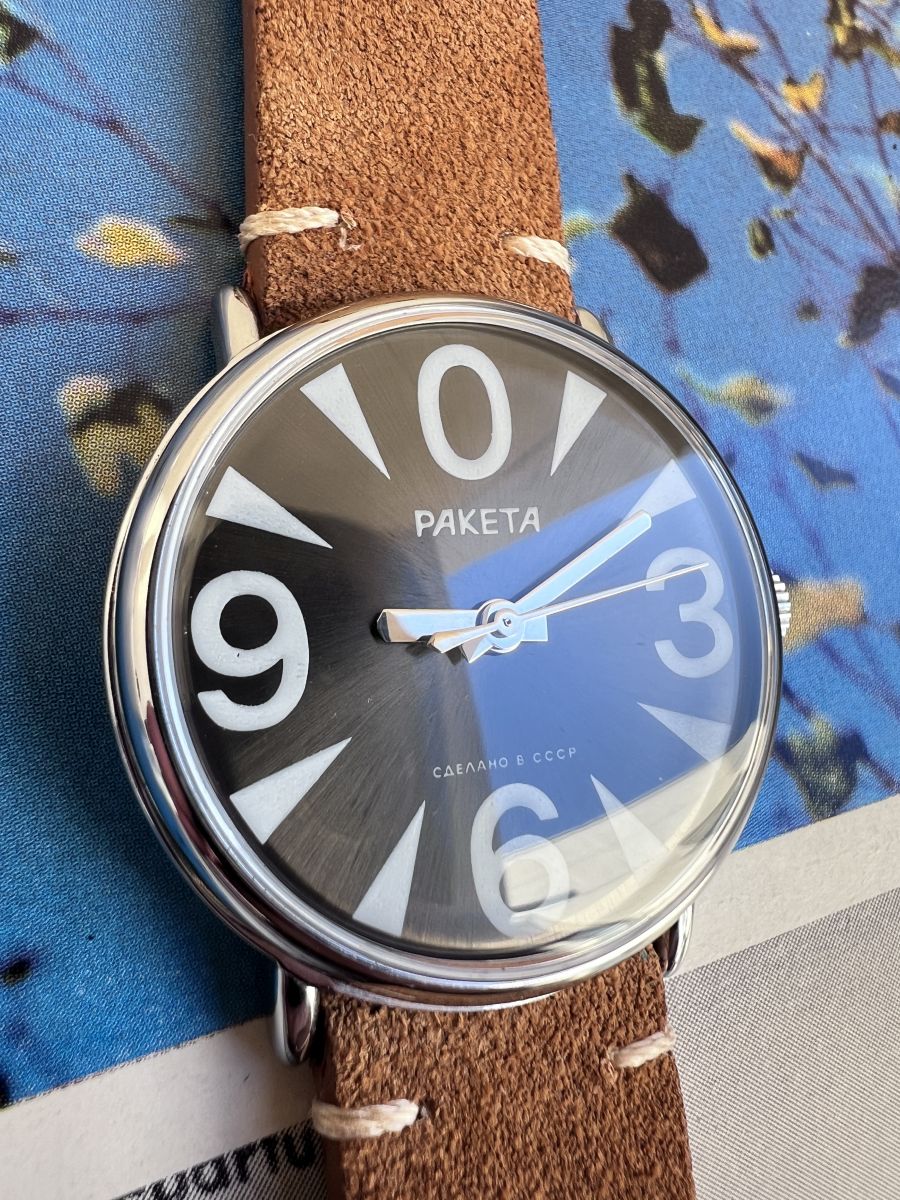
There is also a smaller Big Zero in a round case, with a white or black dial. The black one appears in the 1991 export catalogue as 2609 НА/4321840. It is the only black Big Zero the factory made: a small round case and chrome hands. No large black Big Zero in the cushion case ever left Petrodvorets, and the ones on sale are all copies.
The black Big Zero in the 1991 catalogue.Small round black version, chrome hands, sold by our shop.Small round white version, sold by our shop.
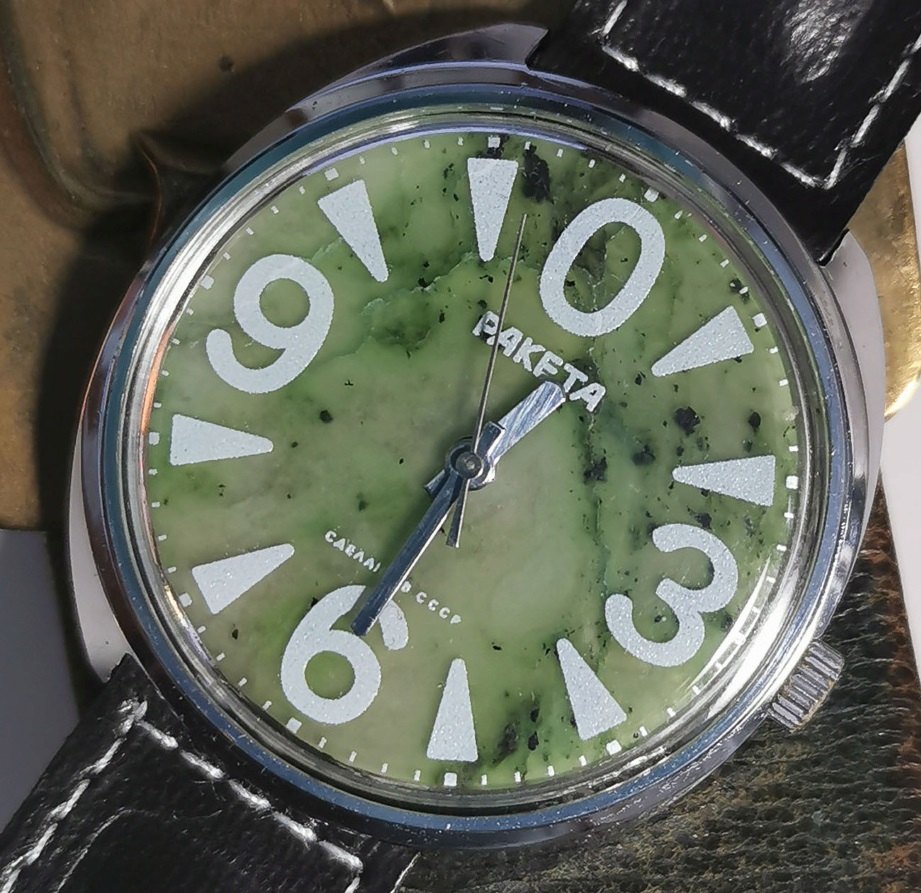
Around 1990-1992, the factory also fitted stone dials in the 51 case: nephrite, a green jade, with white or black markings, and jasper with gold markings, still on the 19-jewel 2609.НА calibre. We have never had one in hand.
Jade dial. Collection chass (FMR), via URSS Watch.Jasper dial. Photo Samun, via URSS Watch.
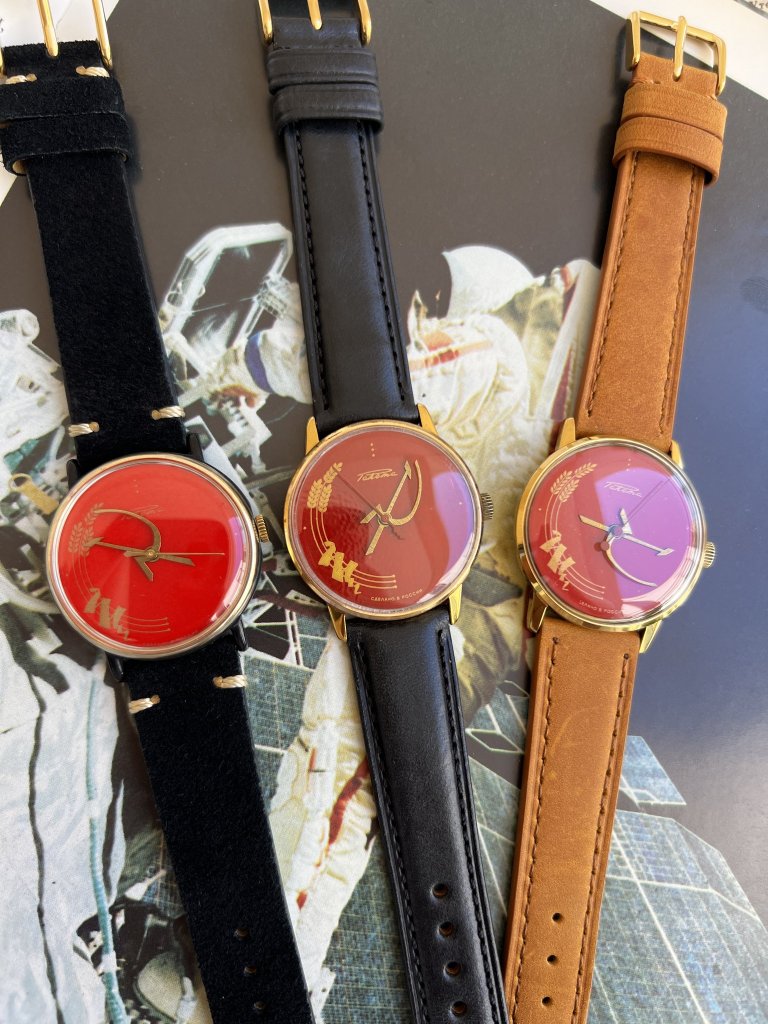
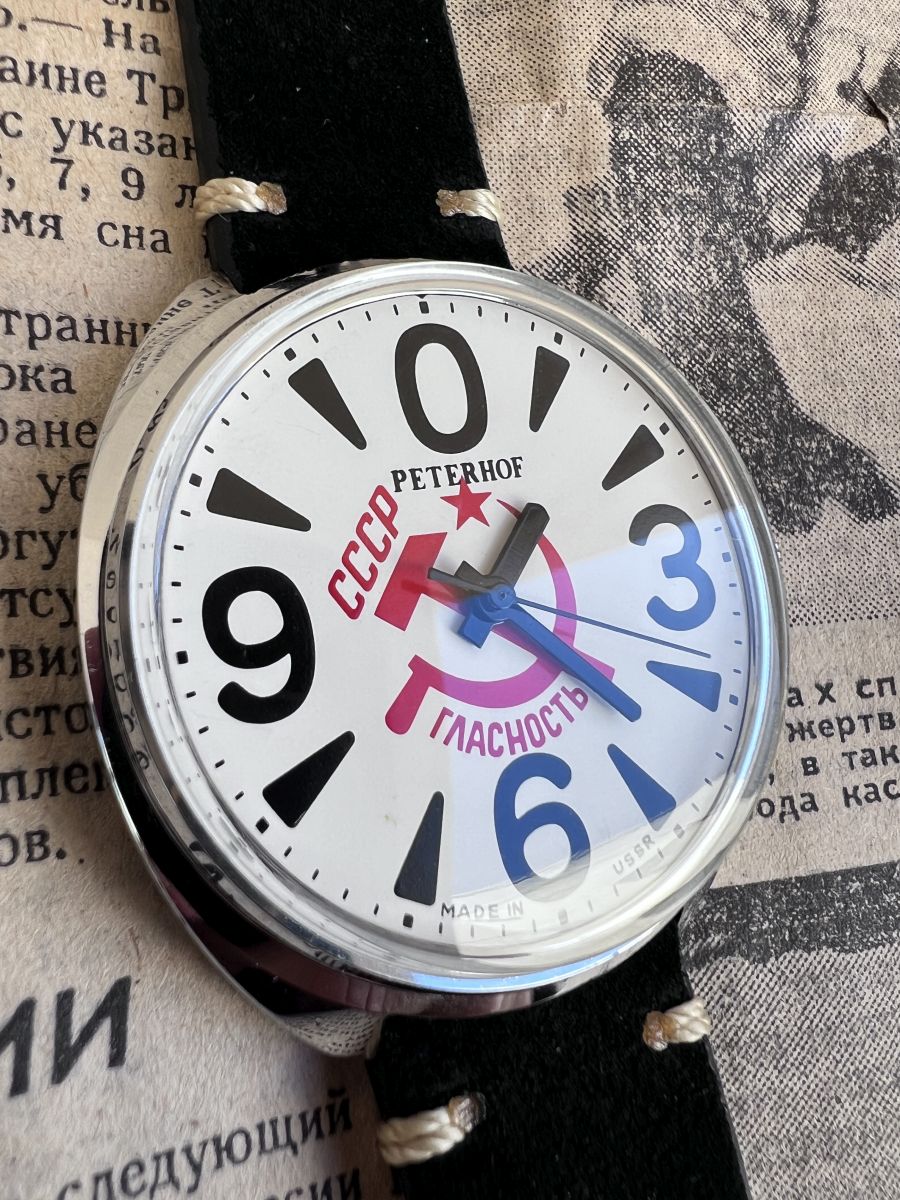
Message dials appeared at the same time. The best known has the hammer and sickle, СССР and ГЛАСНОСТЬ in red, signed Peterhof, a company linked to the factory that sold to tourists, around 1990-1991. Around 1995, apparently, a cooperative at the factory made more of them with a misleading “Made in USSR”. Other dials carry the arms of the RSFSR or an advertising logo, such as that of Lenwest, a shoe joint venture set up in Leningrad in 1988-1989 with the German firm Salamander among its shareholders. A series of 199 pieces was made in 1990 for an Academy of Sciences centre in Leningrad.
A Big Zero Glasnost signed Peterhof, sold by our shop.
Finally, some Big Zeros were made in Besançon by the Slava company, with a dial marked механизм СССР (USSR movement) instead of Сделано в СССР. All-red or all-blue dials, on the other hand, never left the factory.
Fake dials: the curse of the Big Zero
On a Big Zero, the fake part is almost always the dial. On the vast majority of Big Zeros on sale online, the case, crown and movement are period parts, but the dial and hands are new. These dials are printed in series and sell for a few dollars in Russia, then get fitted to ordinary Raketas in the 51 case. This is nothing new: as early as April 1989, La Stampa reported Raketa imitations in Italy.
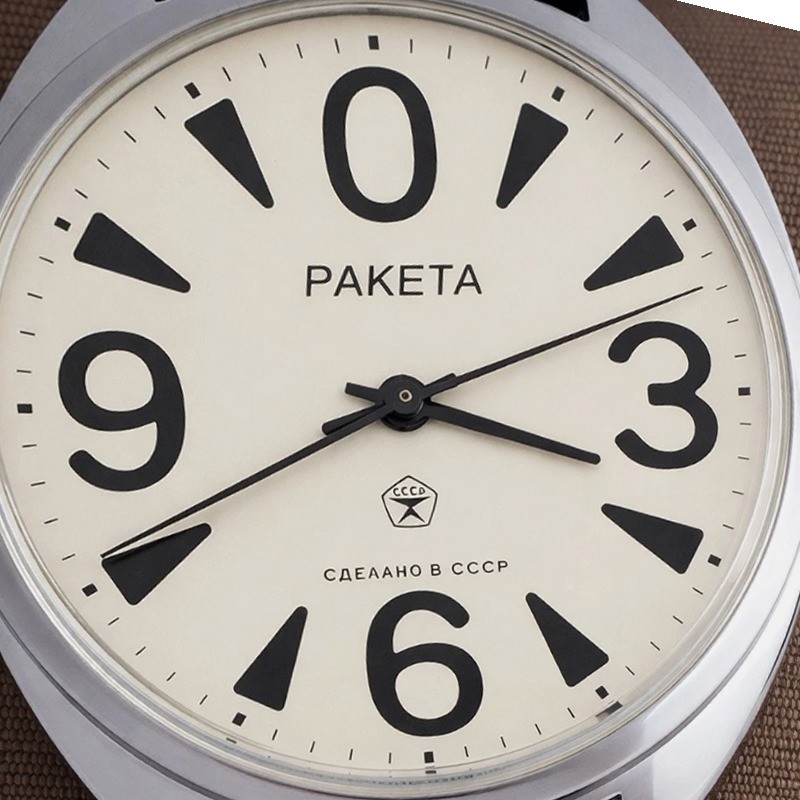
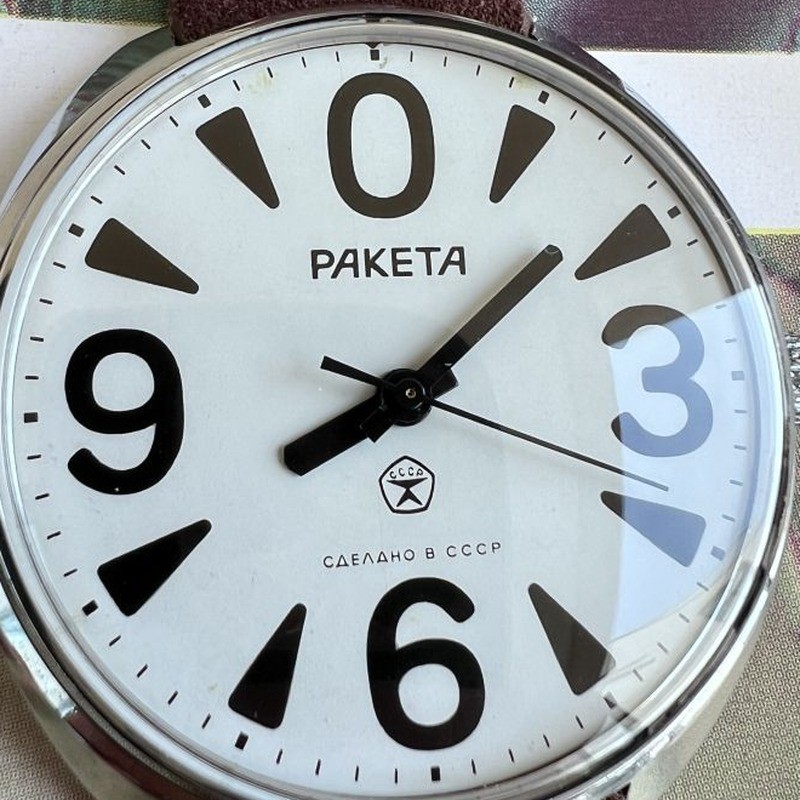
Side by side, the two dials are easy to tell apart. Left of the slider, our Big Zero no. 318492, in stock. On the right, a fake dial. Both photos have been cropped to the dial and brought to the same scale, so the numerals line up. There are several types of fake dials, and they do not all share the same flaws: the points listed below apply to this one. Move the slider, then go through them one by one.
Soviet Big ZeroFake dial
1The triangle above the 0. On a factory dial, a small black triangle marks 12 at the edge of the minute track, just above the zero. The fake has none.
2The hands. A Big Zero’s hands are thick, with a short, wide hour hand. The fake has thin stick hands.
3The РАКЕТА logo. Both А letters slant on the genuine dial. On the fake, all the letters stand upright, in an ordinary typeface.
4The quality mark. Inside the pentagon, the letters СССР follow an arc on the genuine dial. On the fake, they sit in a straight line.
5СДЕЛАНО. On the genuine dial, the Д and the А are drawn as pointed triangles, closed at the base. On the fake, the Д has a flat top and the А a bar across the middle, as in an ordinary typeface.
A few signs also work without a comparison: a large black dial in the cushion case, a red or blue dial, a mix of Latin and Cyrillic lettering, the Soviet quality mark on a Latin-lettered dial, hands that are too thin or taken from another Raketa.
The Italian-market Gaigher has its copies too, in both colours. Left of the slider, our Gaigher no. 117534. On the right, a fake Gaigher. Both photos have been aligned on the dial lettering.
Gaigher no. 117534Fake Gaigher
1The sectors. Copper-coloured with a grainy finish on the genuine Gaigher. Bright, flat orange on the fake.
2The centre. On the genuine one, a grainy disc ringed with fine white lines. The fake has an orange radiation trefoil instead.
3The hands. Solid on the genuine one, skeletonised on the fake.
4The minute track. Fine white lines and small square markers every five minutes on the genuine one. Thick white bars at every minute on the fake.
The ДП-5В (DP-5V) is the field radiometer of Soviet civil defence: a green Bakelite console, a probe with a rotating gamma, beta and check-source shield, headphones and a manual that explains operation and maintenance. The one in this article served in an industrial bakery in Chișinău and was serviced in March 1991. Its owner shared his photos and documents with us, and we turned them into a tool that lets you operate it on screen, step by step.
The Moscow Games, from 19 July to 3 August 1980, boycotted by some sixty countries, produced more objects than any Soviet event: a bear cub, Misha, drawn by Viktor Chizhikov, an emblem made of running tracks, five thousand torches, watches from every factory, platinum coins, rings, tea glass holders, posters. This guide tells the story of the Games and reviews the objects, with the marks that authenticate them and the prices.
The 3017 chronograph of the First Moscow Watch Factory carries a five-digit number on the balance cock. The most common dating method reads it as a single series, from 1959 to 1979. Four factory passports show there are two, and that the same number can point to two watches made ten years apart. Here is how to read the number, the dial, the logo and the bridge, with a decoder to date your Strela, Poljot or Sekonda.
This website uses cookies to improve your experience while you navigate through the website.
Out of these cookies, the cookies that are categorised as necessary are stored on your browser as they are essential for the working of basic functionalities of the website.
We also use third-party cookies that help us analyse and understand how you use this website.
These cookies will be stored in your browser only with your consent.
You also have the option to opt out of these cookies.
But opting out of some of these cookies may affect your browsing experience.
Necessary cookies are absolutely essential for the website to function properly. This category only includes cookies that ensure basic functionalities and security features of the website. These cookies do not store any personal information.
Cookies that are not strictly necessary for the website to work and that are used specifically to collect personal data through analytics, ads and other embedded content are called non-necessary cookies. User consent is required before these cookies run on the website.
✕
Soviet in Paris
Online. We answer in person, no AI and no chatbot. Reply right away, 20 min at most.
Hello 👋 A question about an item, an order or shipping? Write to us.
Your email is used only to reply to you.
Subscribe to our newsletter and get 10% off your first order.
Subscribe
★ New pieces before anyone else
★ New blog articles
★ Soviet in Paris news and updates
Join the Party
10% off your first order
Receive your welcome card and our next arrivals.
Your code appears here and is also sent to you by email. You can leave the Party in one click, at any time.







 Strane Mira