In the USSR the 24-hour watch was a working tool: winterers at Vostok station, drifting ice station crews and Northern Fleet submariners spent months with no sense of day and night. The history of Raketa 24-hour watches, the Antarctic dial versions, rare dials we have had in hand and a comparator against a fake dial.
SEPTEMBER 2026•19 MIN READ
by Marwen Yahyaoui
On a 24-hour dial, the hour hand goes round only once a day. The 24 sits at the top, the 12 at the bottom, and the upper half of the dial covers the night hours. At a polar station or aboard a submarine, where daylight no longer tells you the time, it is what lets you know whether it is morning or evening.
The Soviet Union had every reason to care. Part of its territory, from Murmansk to Chukotka, lies north of the Arctic Circle. It ran stations in Antarctica from 1956 onwards, and its submarines sailed under the pack ice. The Petrodvorets factory, maker of Raketa watches, built a whole family of 24-hour watches out of this, sought after by collectors and copied by forgers. The comparator at the end of the article shows a Raketa Antarctic from our stock against a fake dial.
Beyond the Arctic Circle
North of the Arctic Circle, the sun stops setting for part of the summer and stops rising for part of the winter. The closer you get to the pole, the longer these periods last, up to several months. An ordinary watch then shows 3 o’clock without saying whether it is morning or afternoon, and the light outside no longer settles the question. For anyone working in shifts for weeks on end, mixing up day and night becomes easy.
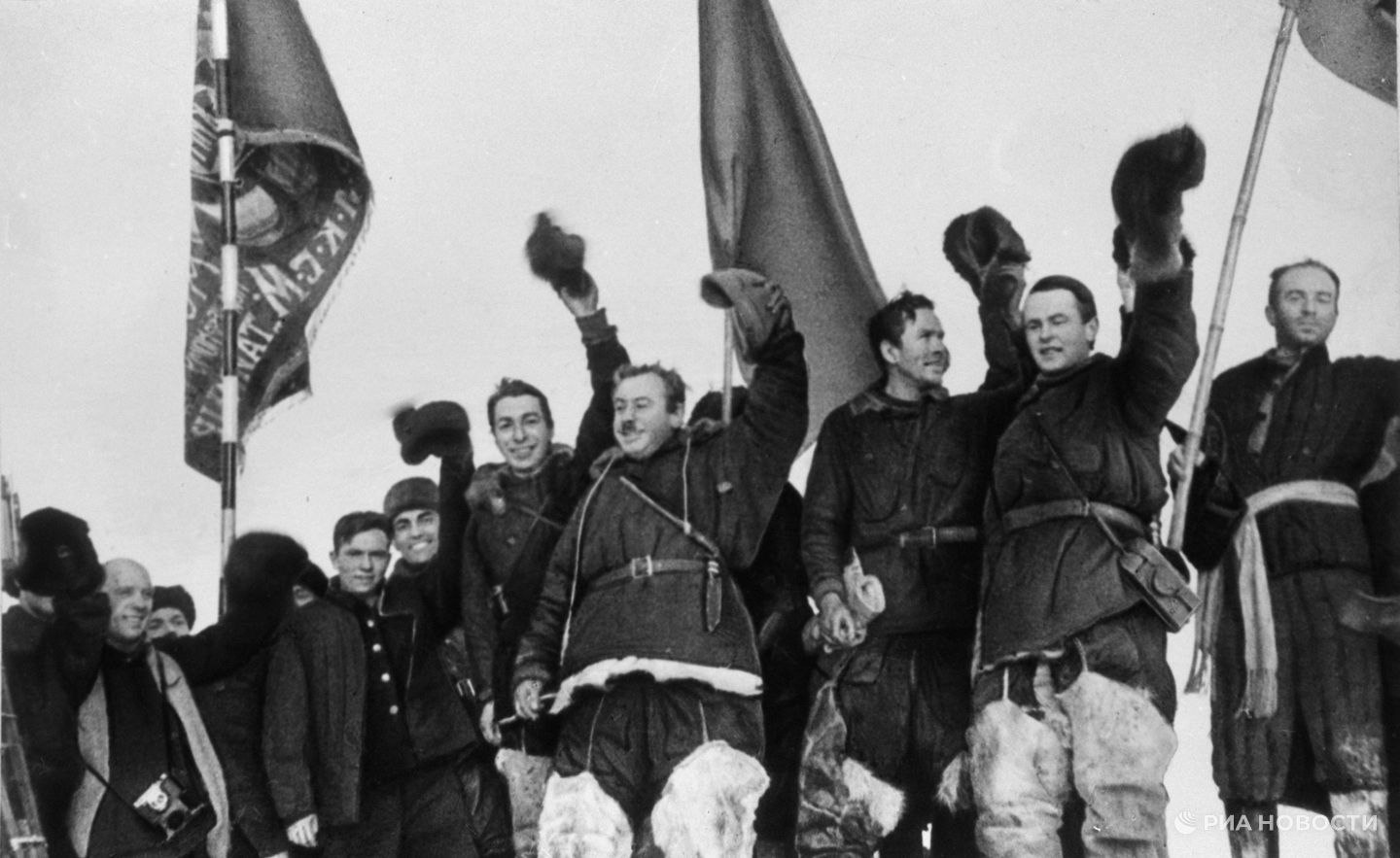
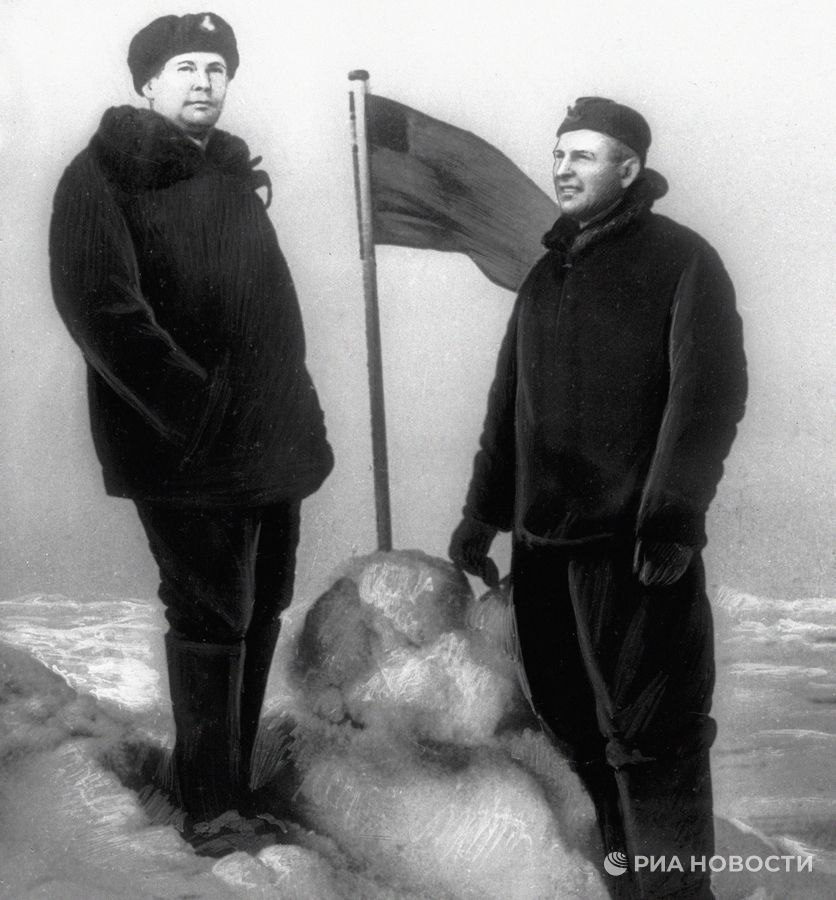
The USSR turned the Arctic into a permanent research field. On 21 May 1937, Ivan Papanin’s expedition settled on the pack ice near the North Pole and opened the first drifting station, Северный полюс-1 (North Pole-1). A long series of stations with the same name followed until the end of the USSR, their crews drifting with the ice for months.
The North Pole-1 expedition on the pack ice, 1937. Photo RIA Novosti.
In July 1937, a few weeks after the station was set up, the crew of pilot Mikhail Gromov, with co-pilot Andrei Yumashev and navigator Sergei Danilin, flew non-stop from Moscow to San Jacinto, California, over the North Pole, setting a world distance record for the 20th anniversary of the October Revolution. The Dmitrov porcelain factory marked the flight with this teacup, which is part of our stock. The route starts from the Kremlin tower, crosses the pole, where the camp and its СССР flag can be made out, then runs down to San Jacinto.
The start, from the Kremlin tower.Over the North Pole, with the Soviet camp.The arrival in San Jacinto, USA.
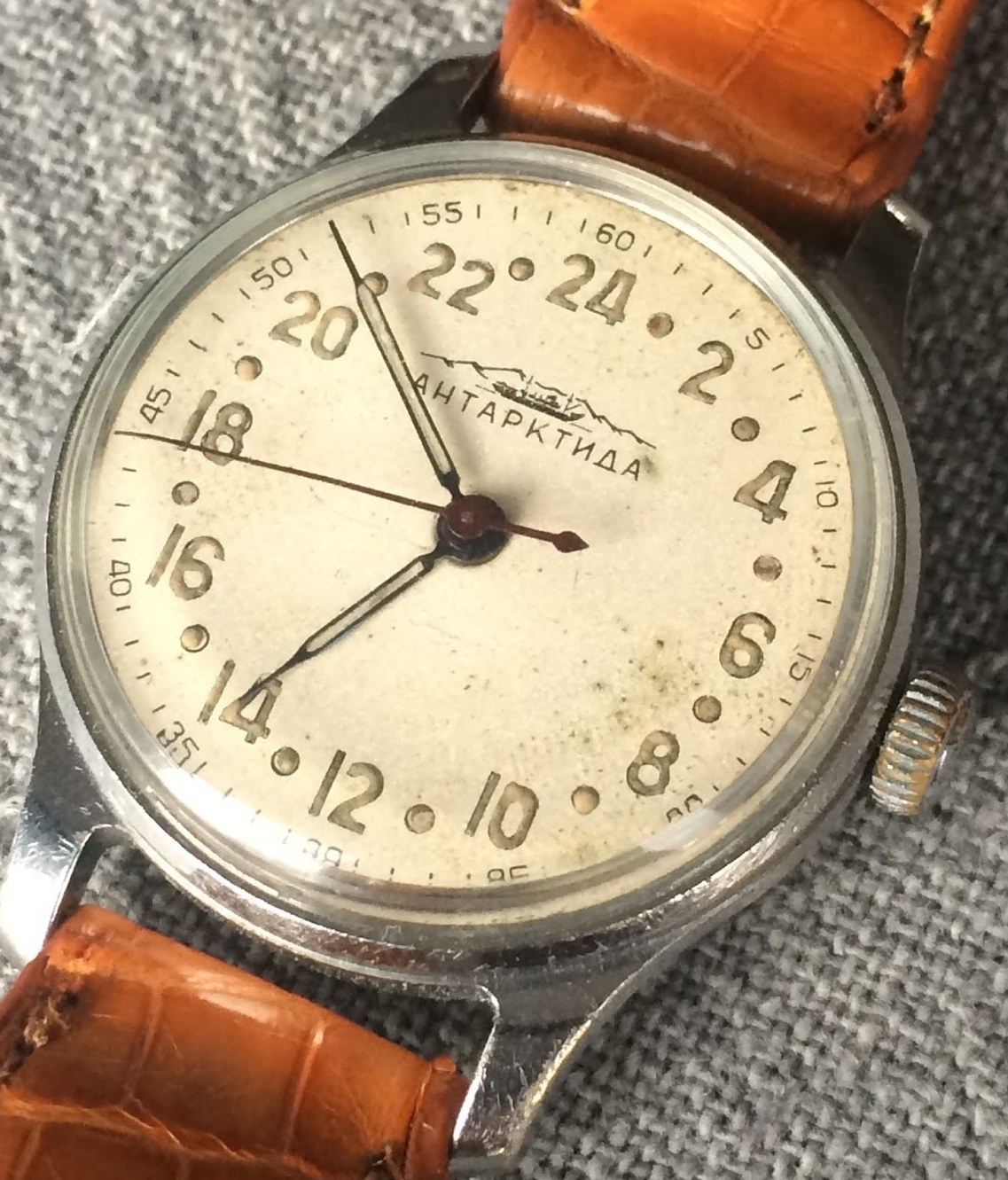
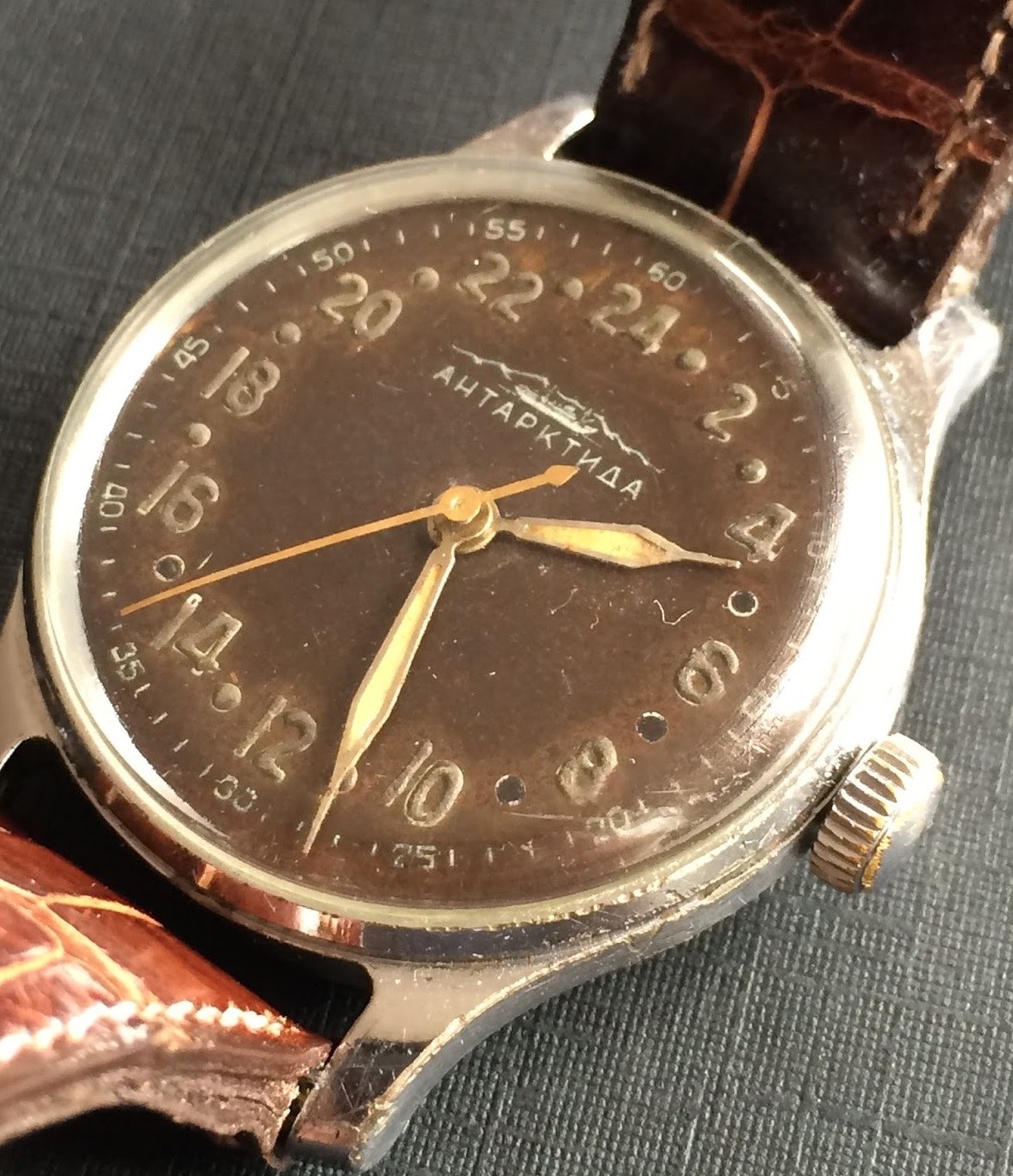
The first 24-hour watches produced in the USSR bear the names of these very places: Северный полюс (North Pole) and Антарктида (Antarctica). They came from the First Moscow Watch Factory at the time of the first Antarctic expeditions, measure 33 mm and house a 17-jewel ЧН-47М movement derived from the Pobeda’s, with 43 hours of power reserve. Above the name, a ship sails along a coast: most likely the Lena, one of the two ships of the first expedition. Only the even numerals are printed, the odd ones are replaced by luminous dots.
Model ЧН-189K, silvered dial. Koutouzoff collection, photo URSS Watch.Model ЧН-196K, black dial with white markings. Koutouzoff collection, photo URSS Watch.
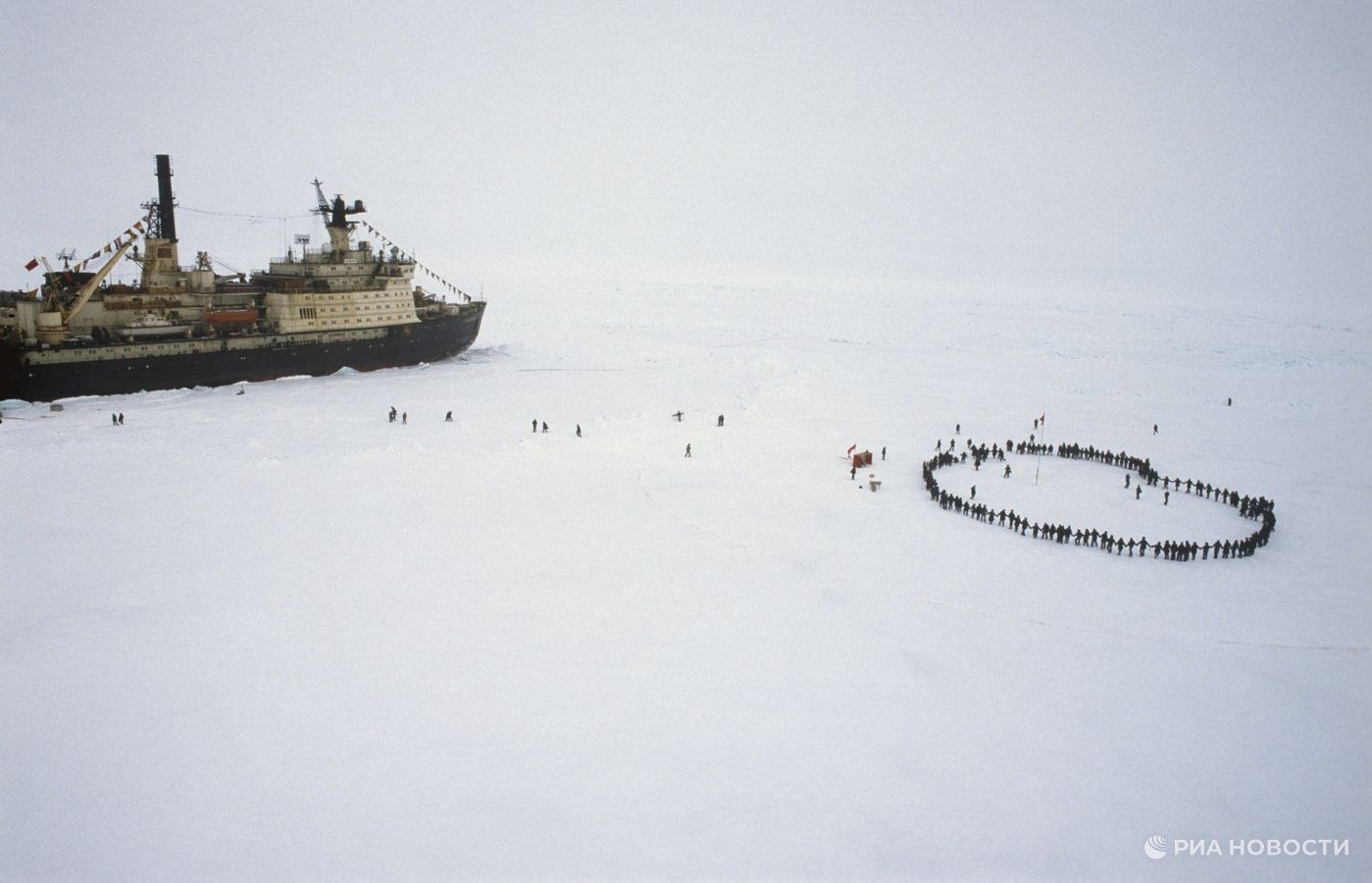
In 1987, fifty years after North Pole-1, the nuclear icebreaker Sibir led a high-latitude scientific expedition and landed its members on drifting station SP-29. Raketa dedicated a commemorative dial to the voyage, which we come back to below.
Members of the expedition leave the nuclear icebreaker Sibir for drifting station SP-29, 1987. Photo RIA Novosti / V. Chistyakov.
Soviet Antarctica, from Mirny to Vostok
In the south, it all began in 1955. The first Soviet Antarctic Expedition was approved on 13 July, led by the oceanologist Mikhail Somov. The ship Ob left Kaliningrad on 30 November, the first men went ashore on 5 January 1956, and Mirny station officially opened on 13 February 1956.
Other stations followed: Vostok on 16 December 1957, Novolazarevskaya on 18 January 1961, Molodyozhnaya on 14 January 1963, Bellingshausen on 22 February 1968, Leningradskaya on 25 February 1971, Russkaya on 9 March 1980 and Progress on 1 April 1988. These dates matter to collectors: the stations appear on the dials and help date them.
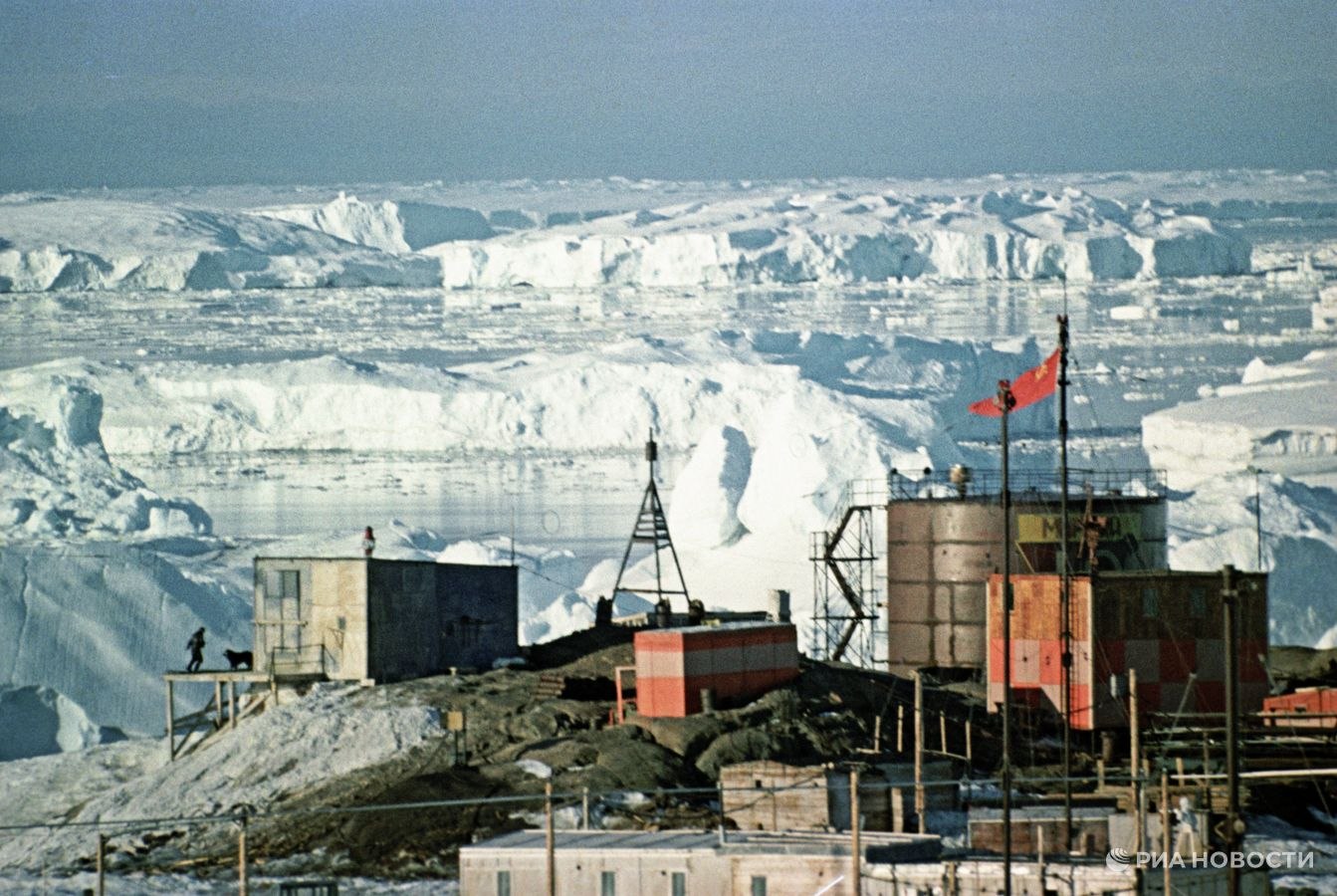
The Mirny observatory, the first Soviet station in Antarctica. Photo RIA Novosti / G. Koposov.
Vostok sits in the middle of the Antarctic plateau. On 21 July 1983 it recorded −89.2 °C, the lowest temperature ever measured by a weather station. Winterers spent months there without seeing the sun rise, then months without seeing it set, and the expedition’s doctors studied how the human body adapts to extreme conditions.
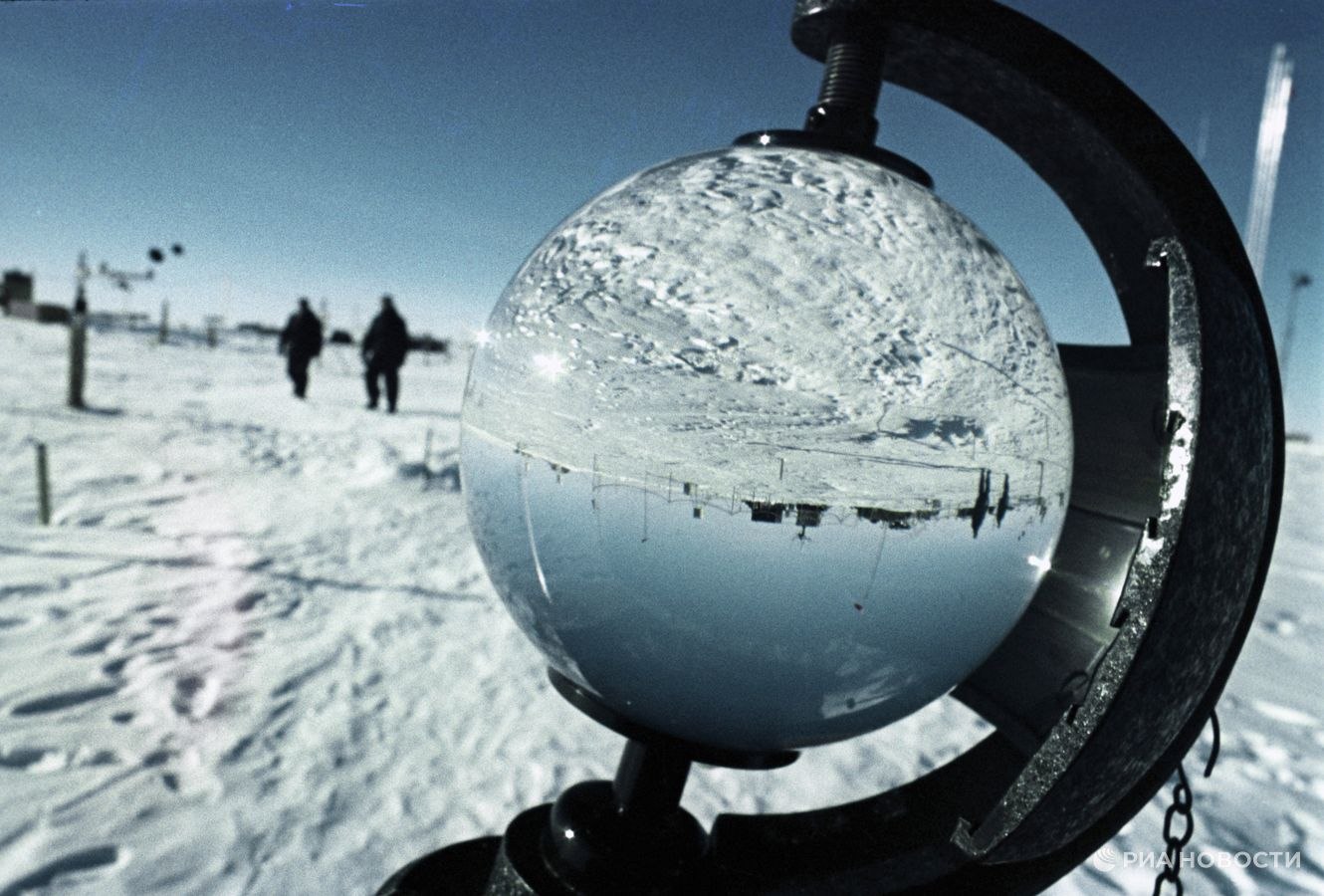
Vostok station. In the foreground, the glass sphere of a sunshine recorder, the instrument that logs hours of sunlight. Photo RIA Novosti / G. Koposov.Physiologist Alexander Zavadovsky at Vostok, where he studied human acclimatisation to extreme cold. Photo RIA Novosti / G. Koposov.
1970, a Raketa for the 16th expedition
It was for these men that Petrodvorets developed its first 24-hour watch. According to the manufacturer, the Polar model was designed in 1969, then chosen in 1970 as part of the equipment of the 16th Soviet Antarctic Expedition.
The watch tied to this expedition, the Raketa Antarctic 16 SAE (for 16-я Советская антарктическая экспедиция, 16th Soviet Antarctic Expedition), belongs to the second generation of Soviet polar 24-hour watches, after the Moscow ones. Navy blue dial, map of the continent, and six red synthetic rubies set where the six Soviet stations of the time stood, from Mirny to Leningradskaya. The movement is a 21-jewel calibre 2623 derived from the 2609, in a 35 mm gold-plated steel case. Production volumes of the Polar and the 16 SAE are unknown, probably just a few hundred. We have had two of them in hand, including this one, still in stock.
The Raketa Antarctic 16 SAE from our stock. The six red rubies mark the Soviet stations, the indices are applied and only odd numerals are printed.
The Antarctic dials, and what the red dots tell you
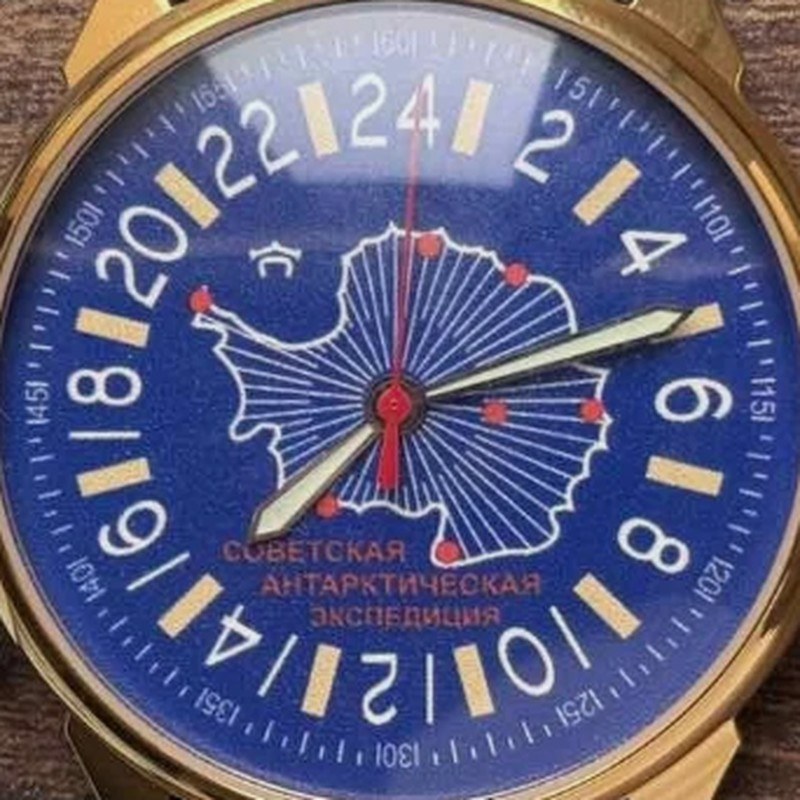
Then came a third generation, made from 1971 onwards. Blue dial, white map filled with rays, the legend Советская антарктическая экспедиция (Soviet Antarctic Expedition), a 19-jewel calibre 2623.Н with 44 hours of power reserve, and a gold-plated steel case. It comes in three dial versions, which the station dots are enough to tell apart, plus a small chrome series.
Six red dots. One dot per station, from Mirny to Leningradskaya. On this first model, the legend runs over the map. The dial most likely predates the opening of Russkaya in 1980.
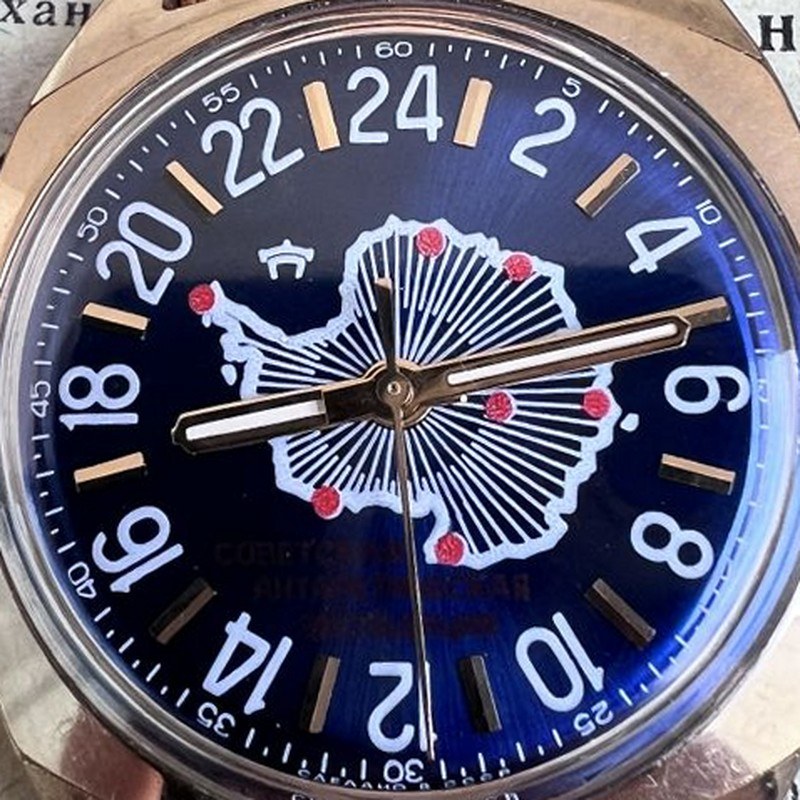
Seven red dots. The seventh dot is Russkaya, opened on 9 March 1980, so this dial cannot be earlier than that date. The legend no longer runs over the map. It was made at least until 1985, perhaps until 1987, and not beyond 1988, since Progress, the eighth station, opened on 1 April that year, is missing.
White dots. The stations turn white and the dial finish is less refined. This version replaced the previous one and was made between 1985 and 1988.
Chrome version. A small series was also made with chrome case, hands and markers.
The dots are not enough to authenticate a dial, though. A forger copying the seven-dot version copies the seven dots too, as the comparator below shows.
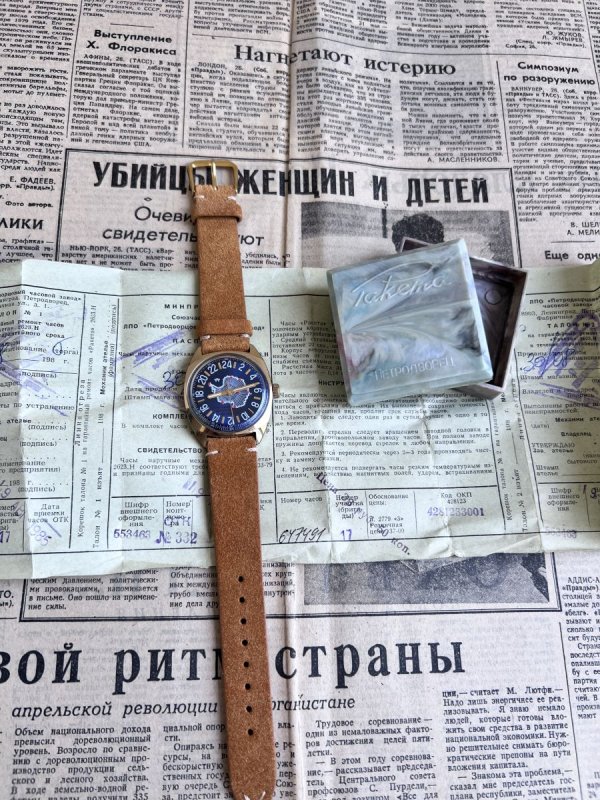
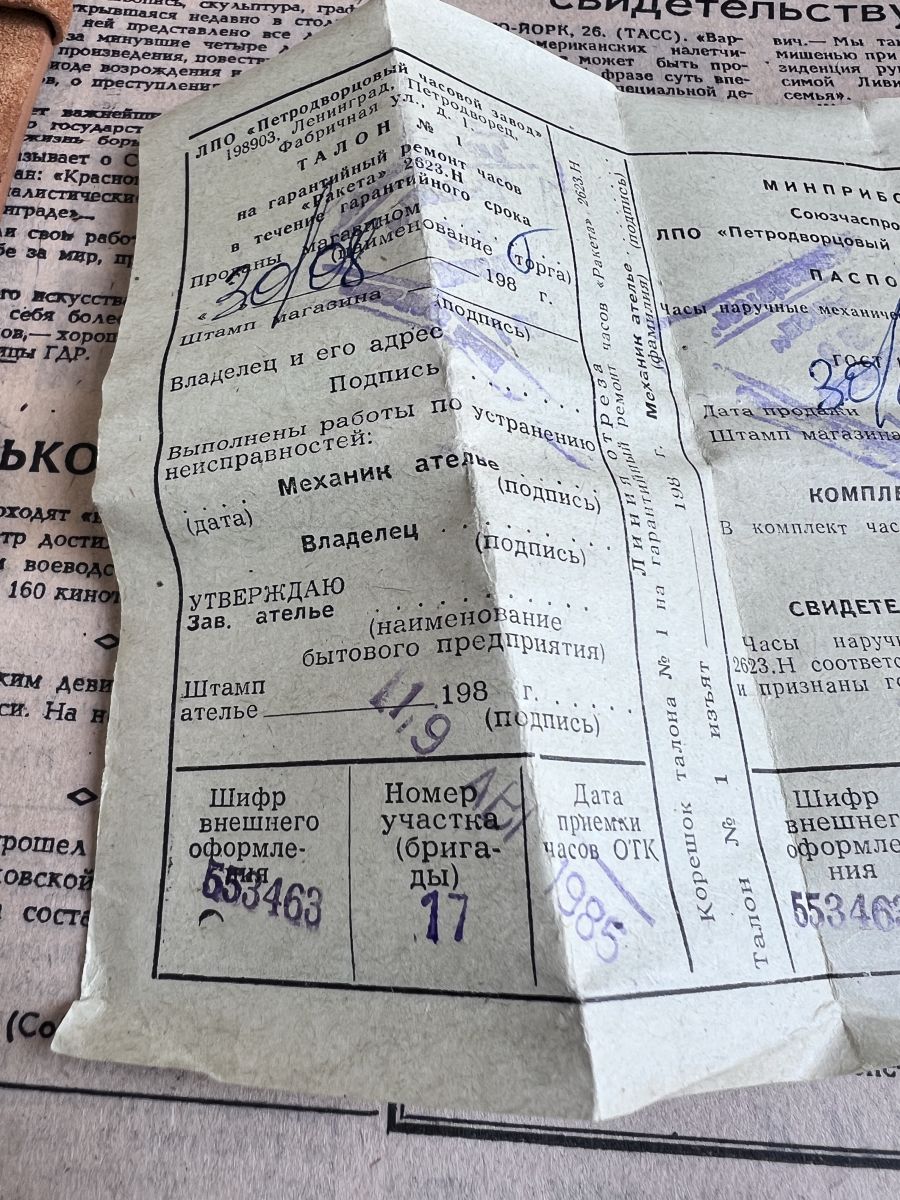
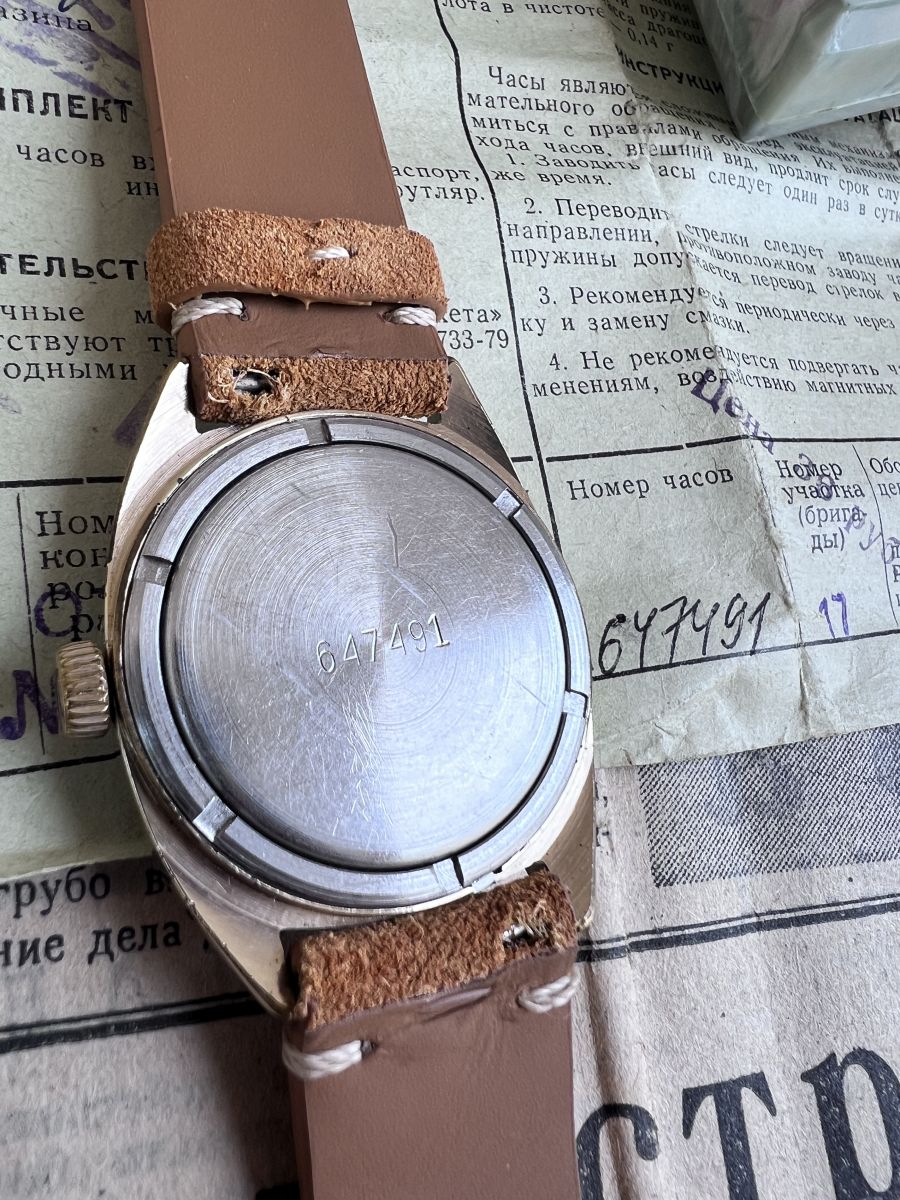
On the factory passport of our seven-dot example, the handwritten watch number, 647491, is the one engraved on the caseback. The factory quality control (OTK) accepted it in April 1985, under the stamp of inspector no. 332, brigade no. 17, so the seven-dot version was still leaving Petrodvorets at that date.
The technical text describes a gilded non-round case, a shock-protection device, a maximum loss of 20 seconds a day, and even the mass of pure gold in the gilding, 0.14 g, worth about €17 at the gold price of 25 September 2026. The watch is certified to state standard GOST 10733-79, with finish code 553463 and a printed retail price of 37 roubles. The average Soviet monthly wage was 190 roubles before tax in 1985, so the watch cost just under a fifth of a month’s pay, about €700 when applied to today’s average French gross salary. The instructions ask for winding once a day, preferably at the same time, and for cleaning and oiling every two to three years. A sale date, 30 August, is handwritten under the shop’s purple stamps. Both warranty repair coupons are still attached, so it was never repaired under warranty. After servicing by our watchmaker, it loses 0 to 10 seconds a day depending on position, within the 1985 tolerance.
Warranty coupon no. 1, never detached, with the April 1985 inspection date.The same number, 647491, on the caseback and on the passport.
Under the ice, the submarines
Submariners have the same problem. Once submerged, nothing separates day from night, and a patrol lasts for weeks. The Northern Fleet, based on the Kola Peninsula, also operated under the Arctic pack ice.
On 17 July 1962, K-3 Leninsky Komsomol, the first Soviet nuclear submarine, surfaced near the North Pole and the crew planted the red flag there, a first for the Soviet submarine fleet. During this voyage, the ice above the crew was in places 20 to 25 metres thick.
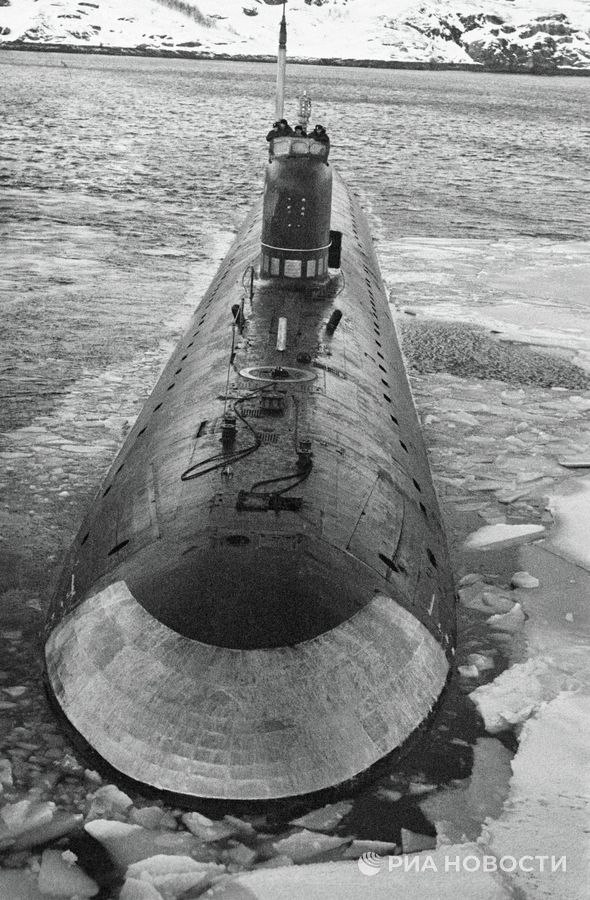
The nuclear submarine K-3 Leninsky Komsomol. Photo RIA Novosti / Mesyatsev.K-3 commander Lev Zhiltsov and his political officer A. Shturmanov by the flag they planted near the North Pole. Photo RIA Novosti.
On board, duty is organised in watches. In the traditional three-watch system, each watch lasts four hours and each crew stands two a day, twelve hours apart: the first from 8 to noon and from 8 pm to midnight, the second from noon to 4 pm and from midnight to 4 am, the third from 4 to 8 am and from 4 to 8 pm. On a 12-hour dial, both watches of one crew fall on exactly the same sector. On a 24-hour dial, they sit opposite each other.
Ship clocks followed the same logic. This one, from our stock, is a 24-hour submarine clock. Its dial is signed НКОМ, Second Moscow Watch Factory. НКОМ stands for the People’s Commissariat of General Machine Building, which the factory reported to. Since this commissariat only existed between February 1939 and November 1941, the clock most likely dates from those years, just before the factory was evacuated ahead of the German advance. Its movement descends from the Henry Moser marine clocks made in the Russian Empire before the revolution. Here the 0 sits at the top of the dial and the 12 at the bottom.
The 24-hour clock by the Second Moscow Watch Factory, 1939-1941.The case and its winding crown.
Underground, the command posts
The same reasoning applies underground. The Strategic Missile Forces, created in 1959, command their intercontinental missile silos from buried posts. The one filmed by Zvezda, the Russian Defence Ministry’s channel, lies 35 metres below ground. On alert, it seals itself off from the outside and runs autonomously, with rest quarters and food for the duty crew. Its stacked levels recall the compartments of a submarine.
None of the sources we consulted describes a Raketa 24-hour watch issued to these units, and a dial claiming so deserves caution. Between 1987 and 1991, however, the factory made special 24-hour dials for military units and schools, among them the ВАВПО air defence academy in 1989, an anti-submarine ship division of the Northern Fleet and the destroyer Bespokoyny in 1991, both shown below. The Strategic Missile Forces 24-hour dial we have in stock marks their 35th anniversary, which dates it to 1994, after the end of the USSR.
Petrodvorets and the calibre 2623
Every Raketa comes from the same factory. The Petrodvorets factory, near the Peterhof palace, was founded in 1721 by Peter the Great. It began assembling wristwatches in 1946 under the Zvezda and Pobeda names, specialised in watchmaking in 1949, and launched the Raketa brand, meaning “rocket”, in 1961 after Yuri Gagarin’s flight.
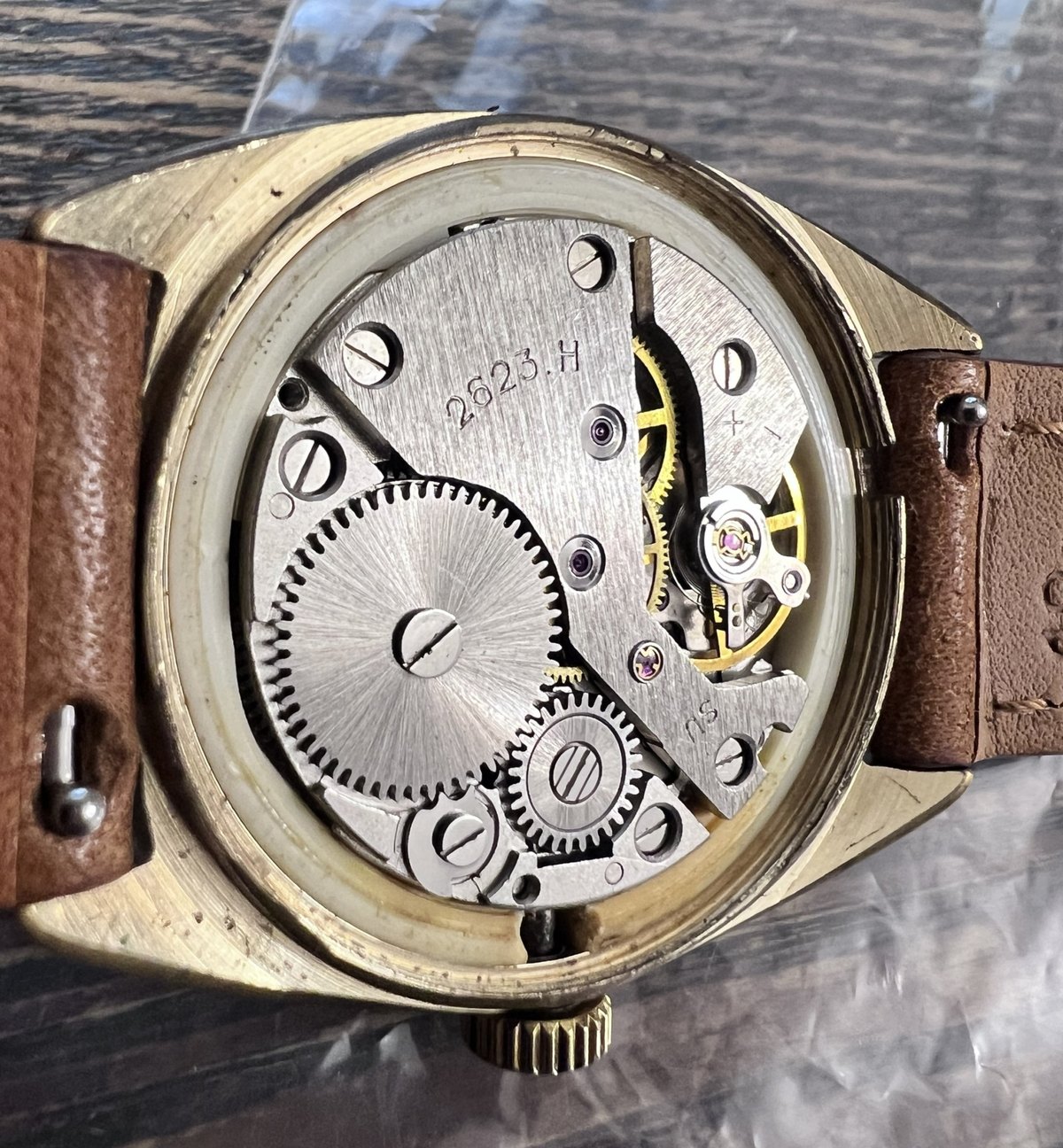
For its 24-hour watches the factory used a dedicated calibre, the 2623, derived from its 2609, then its 2623.Н version. The rule is simple: every Soviet Raketa 24-hour watch has a 2623 or 2623.Н movement. The 2623.Н comes in two finishes, a 1970s one with a chamfered edge and a simplified one without a bevel, made from the early 1980s. Checking the movement therefore weeds out most fake Raketa 24-hour watches. Most, not all, as we will see below.
The calibre 2623.Н, engraved on the bridge, inside a Raketa Antarctic from our stock.
Overall, the 2623.Н is very reliable. The 1985 passport advises cleaning every two to three years, but a watch worn regularly often stays running and accurate for ten years or more without a service.
For the civilian market, a first Raketa 24-hour watch appears in the 1972 general catalogue, then a second generation in the 1977 catalogue, in chrome or gold-plated cases.
What you find on the dials
On top of the 24-hour display, Soviet dials offer a few extra functions.
The plain 24-hour dial. One hour hand that goes round once a day, 24 at the top and 12 at the bottom. This is the case of the Antarctic models. Depending on the model, the dial prints only even numerals, as on the seven-dot version, or only odd ones, as on the 16 SAE. On some commemorative dials, such as the Lenin or the Sibir, the 24 is replaced by a 0.
To practise, here is the dial of our seven-dot Antarctic. Read the time, then pick an answer.
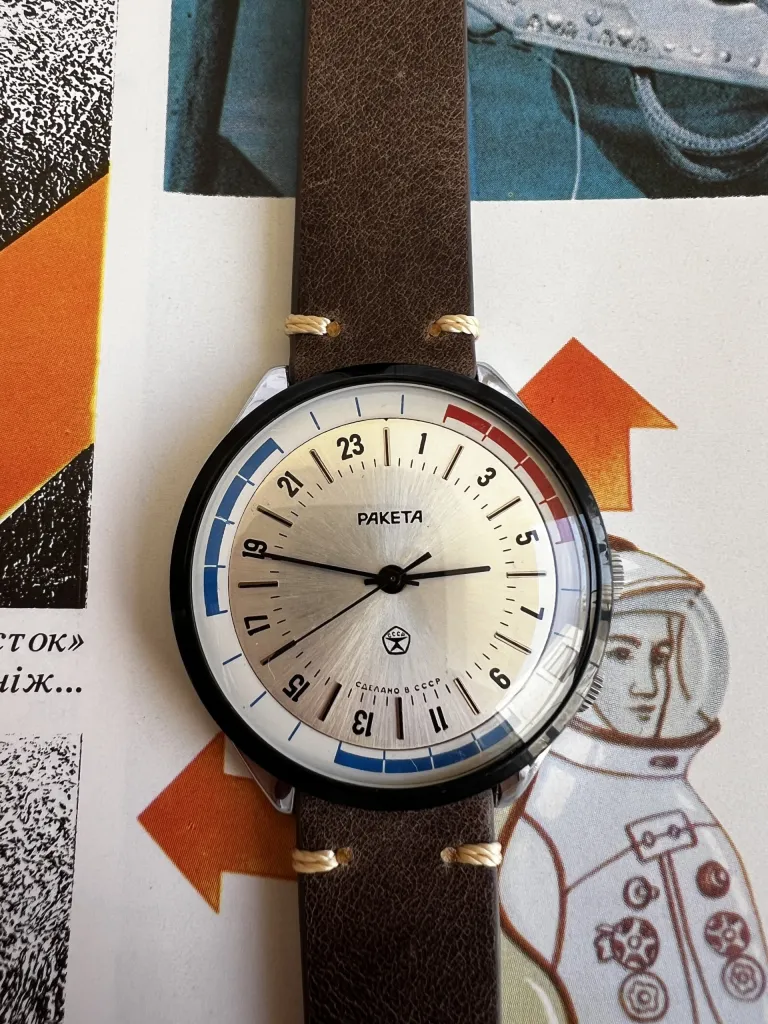
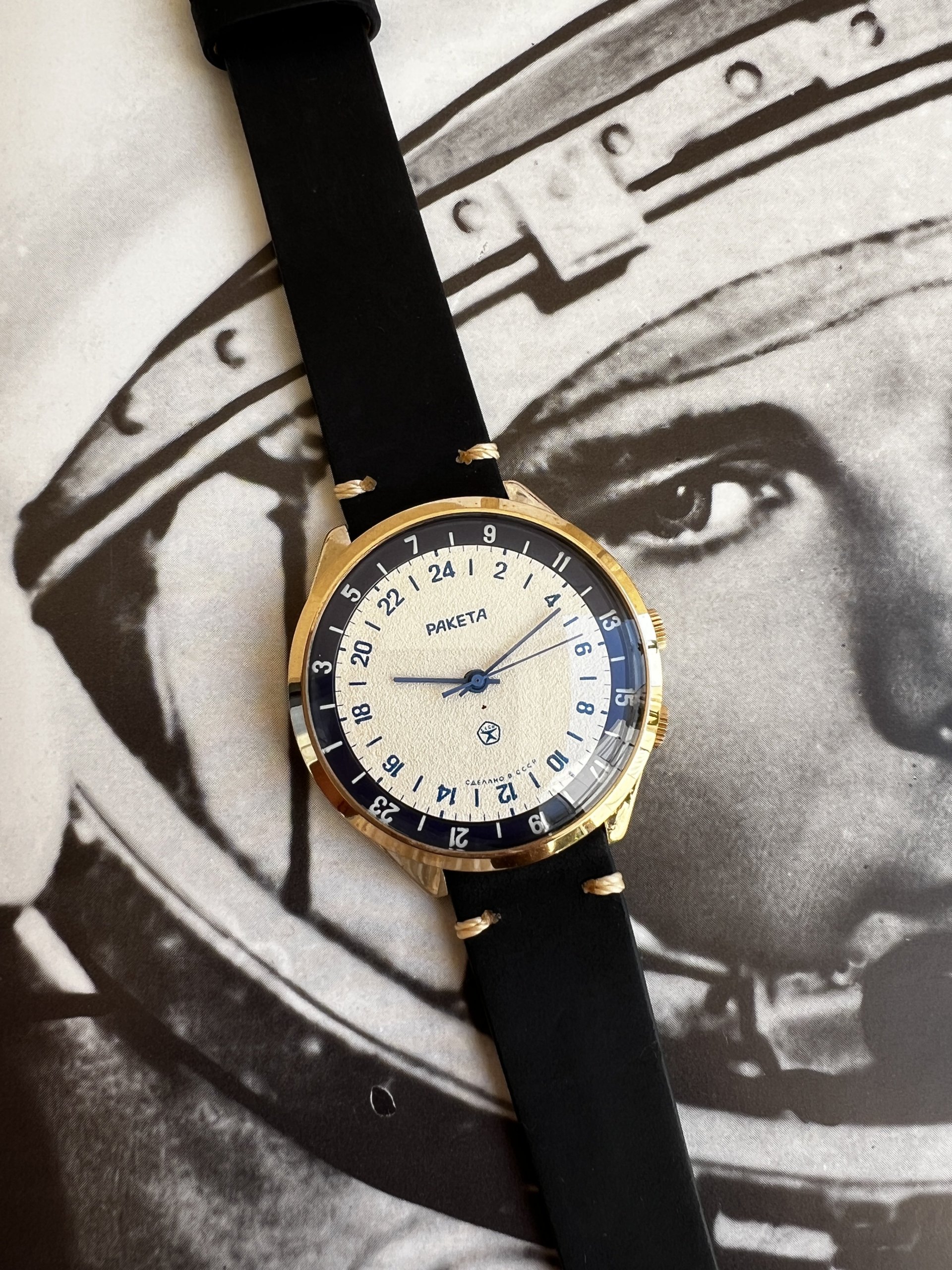
The rotating ring and the second crown. Some models add a movable inner ring driven by a second crown. It is set against a reference time, the start of a watch for instance, or the time in another zone. The more recent versions with the rotating ring measure 40 mm across, a fairly contemporary size that suits most men’s wrists.
Ring with blue sectors, turned by the second crown.Arctic Circle with two crowns, gold-plated case.
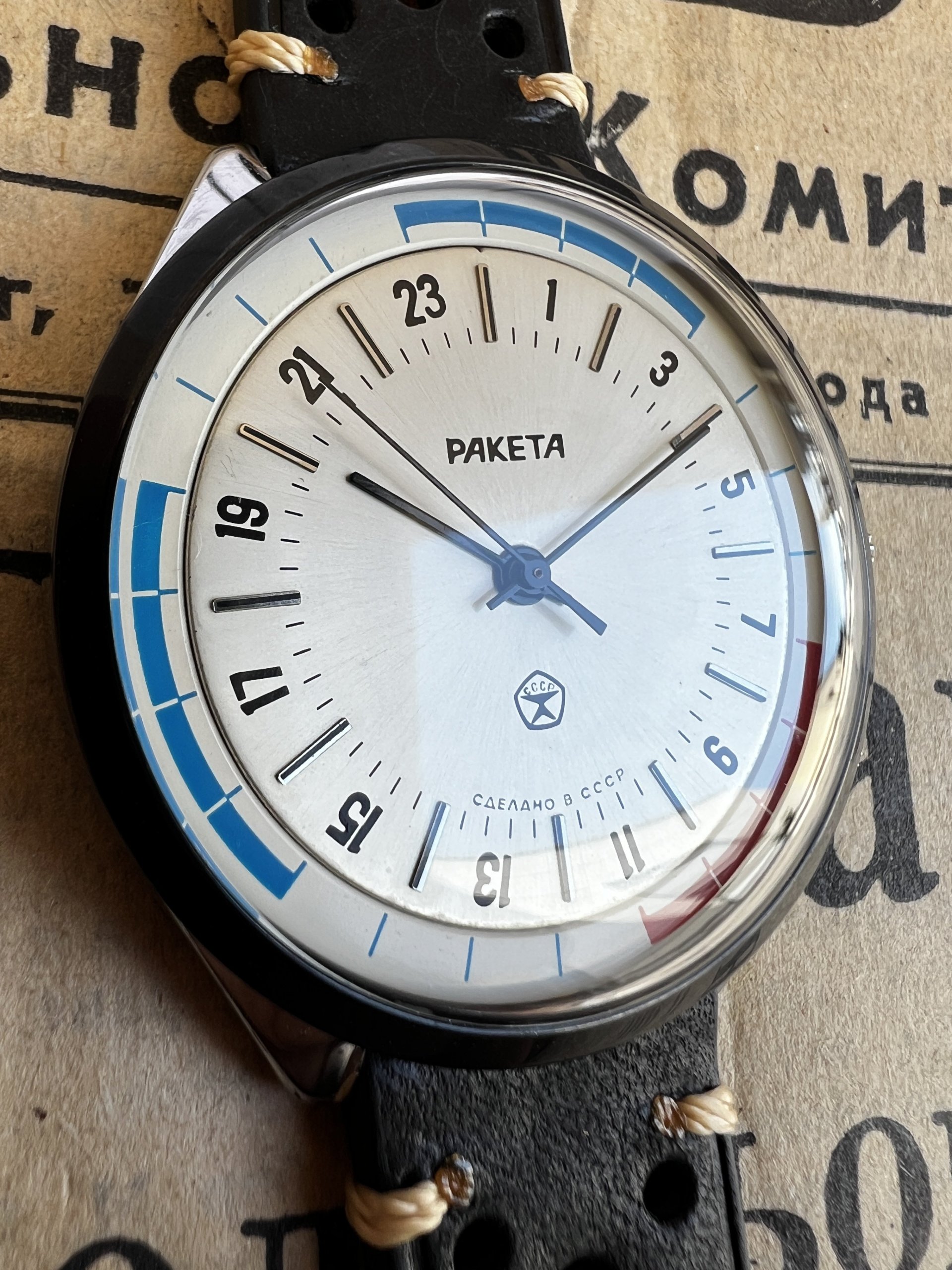
The Marine models and their watches. On some Marine models, the rotating ring carries coloured sectors. Turned to the time a watch begins, it shows at a glance how much time has passed and how much is left, at least that is the use most often attributed to it. Marine models exist with and without an anchor, and at least two fake dials imitate the anchor version. Models with a blue and red ring are often sold as “submariner” watches.
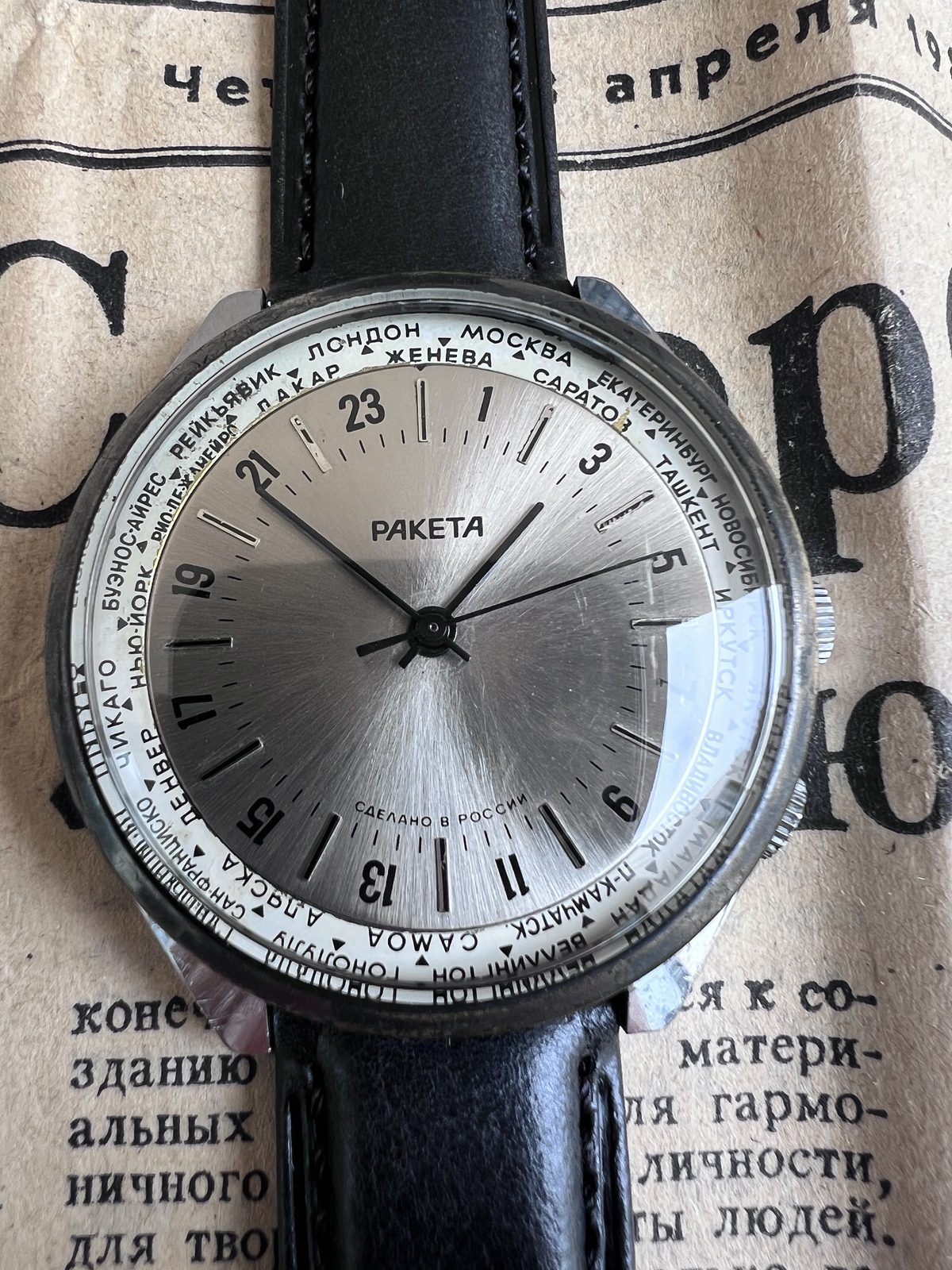
The second time zone, the World Time. The Города мира (Cities of the World) series, sold abroad as World Time, carries a ring of city names. On models with a rotating ring, you line your city up with local time and read the time elsewhere opposite each name. One detail sorts the examples: in 1991 Sverdlovsk took back its old name, Yekaterinburg. A Soviet World Time must therefore read Sverdlovsk, a Russian one Yekaterinburg. It is one of our best-selling models, and we have several in stock, including this one and a Russian version, compared below.
Soviet version: Свердловск on the ring, Сделано в СССР on the dial.Russian version: Екатеринбург on the ring, Сделано в России on the dial.
Commemorative dials. Finally, the factory made commemorative and commissioned dials for ships, companies or units, such as the polar explorers’ association ASPOL or the 1991 Zestril, given to doctors by a drug company.
One last point: Raketa kept printing “CCCP” after 1991, because it sold better than “Russia”. The vast majority of so-called Soviet Raketa 24-hour watches sold online are not authentic.
Rare 24-hour watches we have had in hand
These commissioned dials are rarely found. Here are the ones that have passed through our shop.
The nuclear icebreaker Lenin. The Lenin, the first nuclear-powered icebreaker, was launched in 1957 and entered service in 1959. For its twentieth anniversary, in the late 1970s, Raketa dedicated a white dial to it reading Атомному ледоколу Ленин XX лет (To the atomic icebreaker Lenin, XX years), with the ship in the pack ice and the atom symbol, the 0 at the top of the dial and a 2623 movement. This dial has been imitated: a black-dial version is in circulation, and it is a copy.
The destroyer Bespokoyny, 1991. A dial made for the destroyer Беспокойный (Restless), the fifteenth ship of Project 956 Sarych, the Sovremenny class for NATO. Laid down on 8 April 1987 at the Zhdanov Plant No. 190 in Leningrad and launched on 9 June 1990, she joined the fleet on 11 February 1992. The dial brings together the Soviet Navy ensign and the St Andrew’s cross, the ship’s silhouette, the dates 1914 and 1991 and the inscription ЭМ Беспокойный, ЭМ standing for эскадренный миноносец, destroyer. The rotating ring carries blue and red sectors, as on the Marine models.
The Raketa for the Lenin’s 20th anniversary.The Raketa for the destroyer Bespokoyny, 1991.
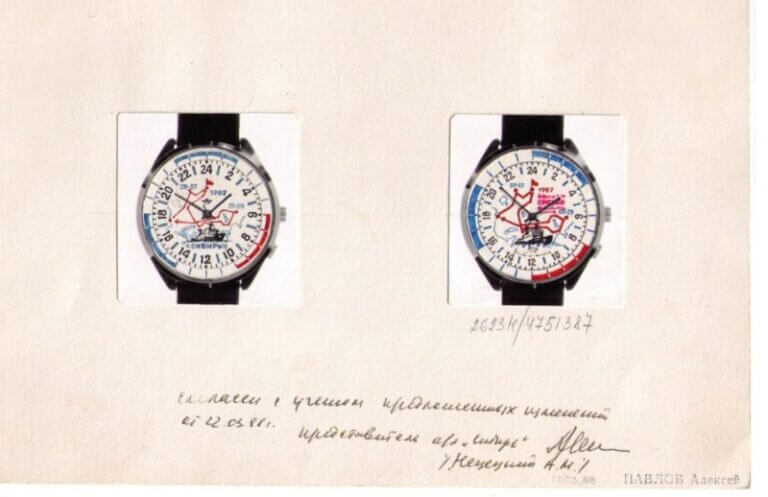
The Sibir, 1987. The Sibir expedition, headed by Artur Chilingarov, reached the geographic North Pole on 25 May 1987. The dial traces its route in red between drifting stations СП-27 and СП-29, with the inscription Атомный ледокол Сибирь, высокоширотная экспедиция (Atomic icebreaker Sibir, high-latitude expedition) and, here again, the 0 at the top. The model’s drawing, from the Raketa archives, bears the approval of the proposed changes by A. M. Netsetsky, head of radiation protection on board, dated 22 March 1988. Two examples are in our stock, No. 808 and No. 100.
The Sibir dial, No. 808.The Raketa archive drawing, with the handwritten approval of 22 March 1988.
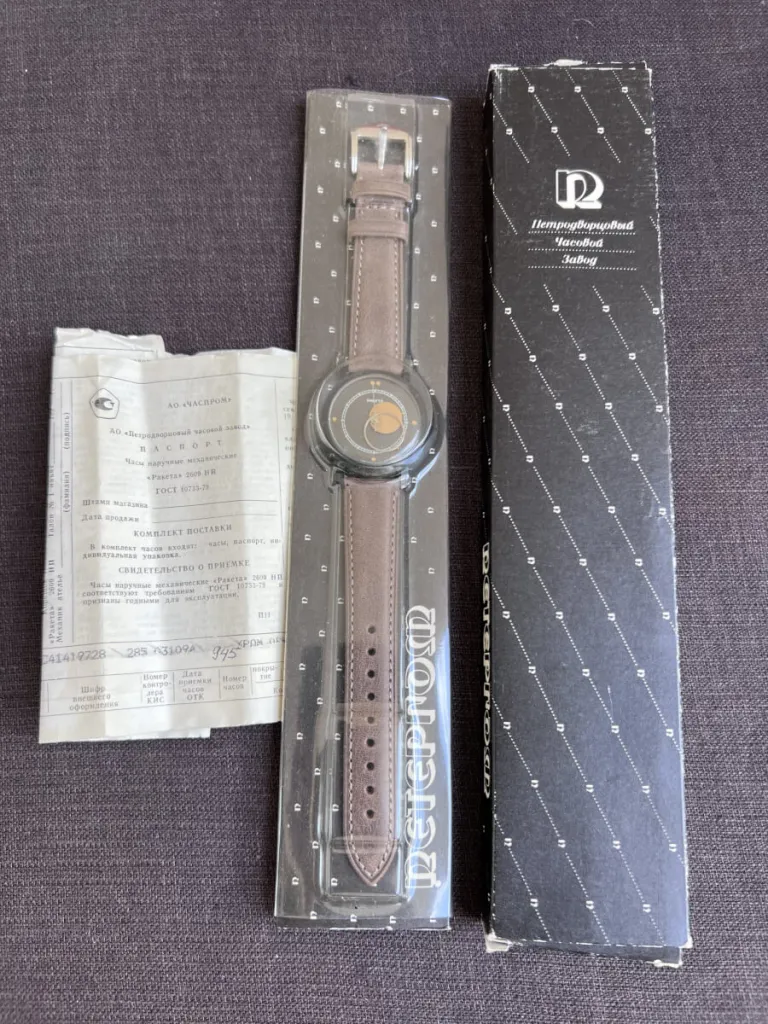
Arktikugol, 60 years. Arktikugol, the mining company working coal inside the Arctic Circle, was founded in 1931. For its 60th anniversary, Raketa made this 24-hour dial with a map and a ring of world cities, on a 2623.Н movement. We had it with its original box and document.
ВАВПО, 1989. A 24-hour dial made in 1989 for the ВАВПО military air defence academy, founded in Kiev in 1974, on a 2623.Н movement.
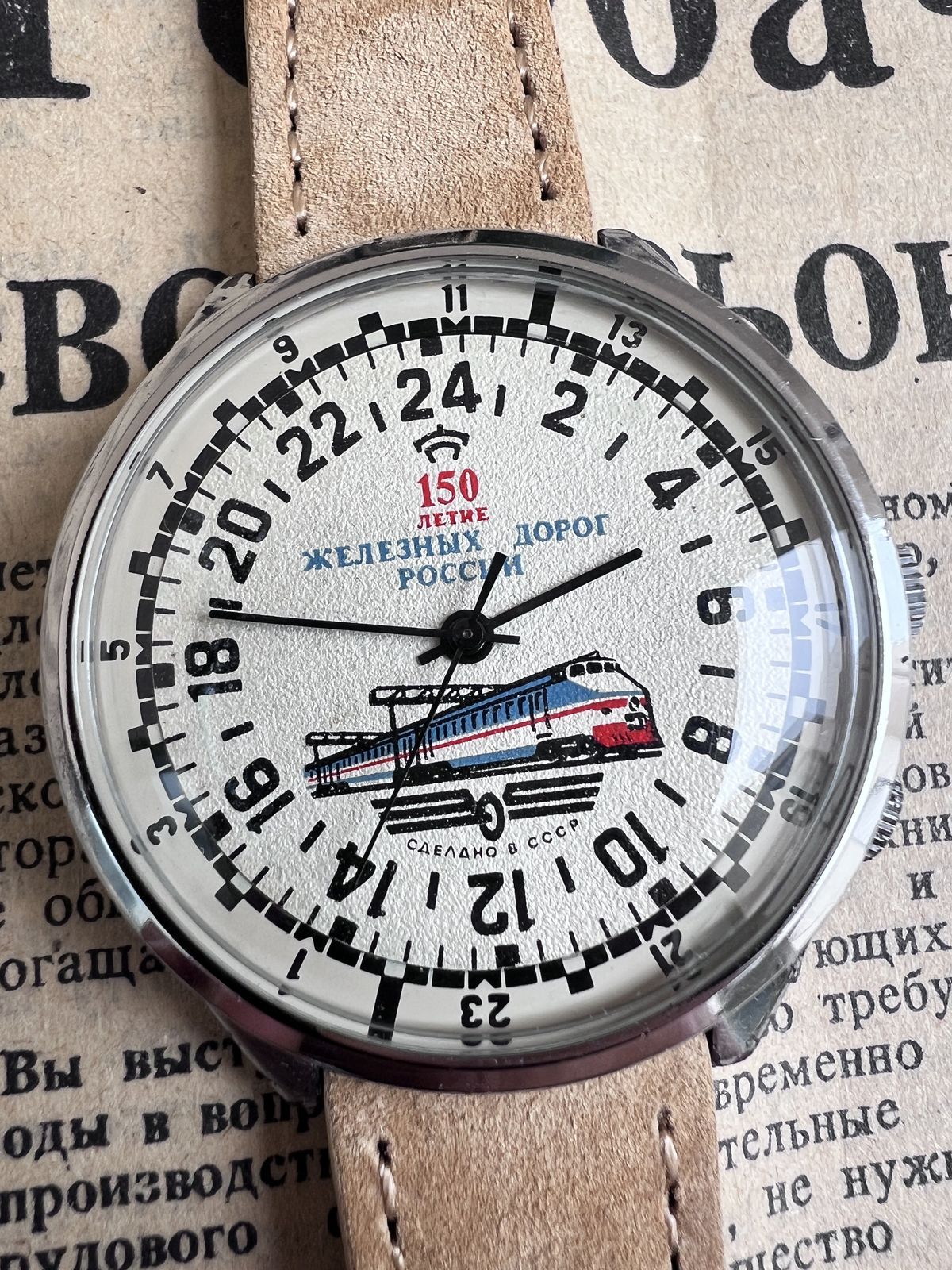
150 years of Russian railways, 1987. A white dial with an electric locomotive for the jubilee of the first Russian line, opened in 1837 between Saint Petersburg and Tsarskoye Selo, marked Сделано в СССР, on a 2623.Н movement. It is in our stock.
The first civilian Raketa 24-hour watches. One of the very first Raketa 24-hour watches sold to the public, with the 2623 Baltika movement, in a 34 mm case. We have one in stock.
Arktikugol, 60 years.ВАВПО, 1989.150 years of Russian railways, 1987.One of the first civilian Raketa 24-hour watches, 2623 Baltika movement.
Spotting a fake Raketa Antarctic
The Antarctic dial is among the copied ones. Forgers mostly reproduce dials, then fit them into period cases, on period movements. The result is what collectors call a franken, a watch assembled from parts that were never fitted together at the factory.
In practice, checking the movement, which weeds out most fake Raketa 24-hour watches, is not enough against a franken. The 2623.Н is there, the case can be consistent, and only the dial gives the watch away.
Left of the slider, the seven-dot Raketa Antarctic from our stock, new old stock with its April 1985 passport. On the right, a fake dial. Both photos have been cropped to the dial and brought to the same scale, so the numerals and the map line up. Move the slider, then go through the points listed below.
Period pieceFake dial
1The shade of blue. On the period piece, the dial is a sunburst royal blue that lightens or darkens with the angle. The copy is a lighter blue, flat and even, with no sunburst.
2The minute track. On the period piece, the minute numerals (5, 10, 15 and so on up to 60) are clean and clear of the ticks. On the copy, they are squeezed between the minute ticks, which gives barely legible “|60|” or “115|”.
3The numeral 1. On the period piece, the 1 in 10, 12, 14, 16 and 18 has a small flag at the top. On the copy, it is a plain bar.
4The hour markers. On the period piece, they are gold batons that catch the light. On the copy, beige batons printed flat.
5The legend. On the period piece, Советская антарктическая экспедиция is printed in a dark, discreet red that you guess more than read. On the copy, it is a bright orange red, perfectly legible.
6The map and the stations. On the copy, the outline and the rays of the map are thinner, and the red station dots smaller and flat.
7The hands. They are not part of the dial, but they show. On our piece, the seconds hand is thin and gold. On the copy, it is red, with a red centre cap.
Side by side, the two dials cannot be mistaken for a second. These copies are poor quality and the differences are glaring: the shade of blue, the minute track, the markers and the legend stand out before you even look for them. If you have doubts about a watch seen elsewhere, send us the photos.
For vintage wall clocks with a 12-hour dial, see Strane Mira, our second shop.
Available at Soviet in Paris
Raketa 24-hour watches are among the most collected Soviet watches. They make a good gift, and they resell and trade well between collectors.
Here are four of the pieces from this article, available in our stock. The others can be reached through the links in the text.
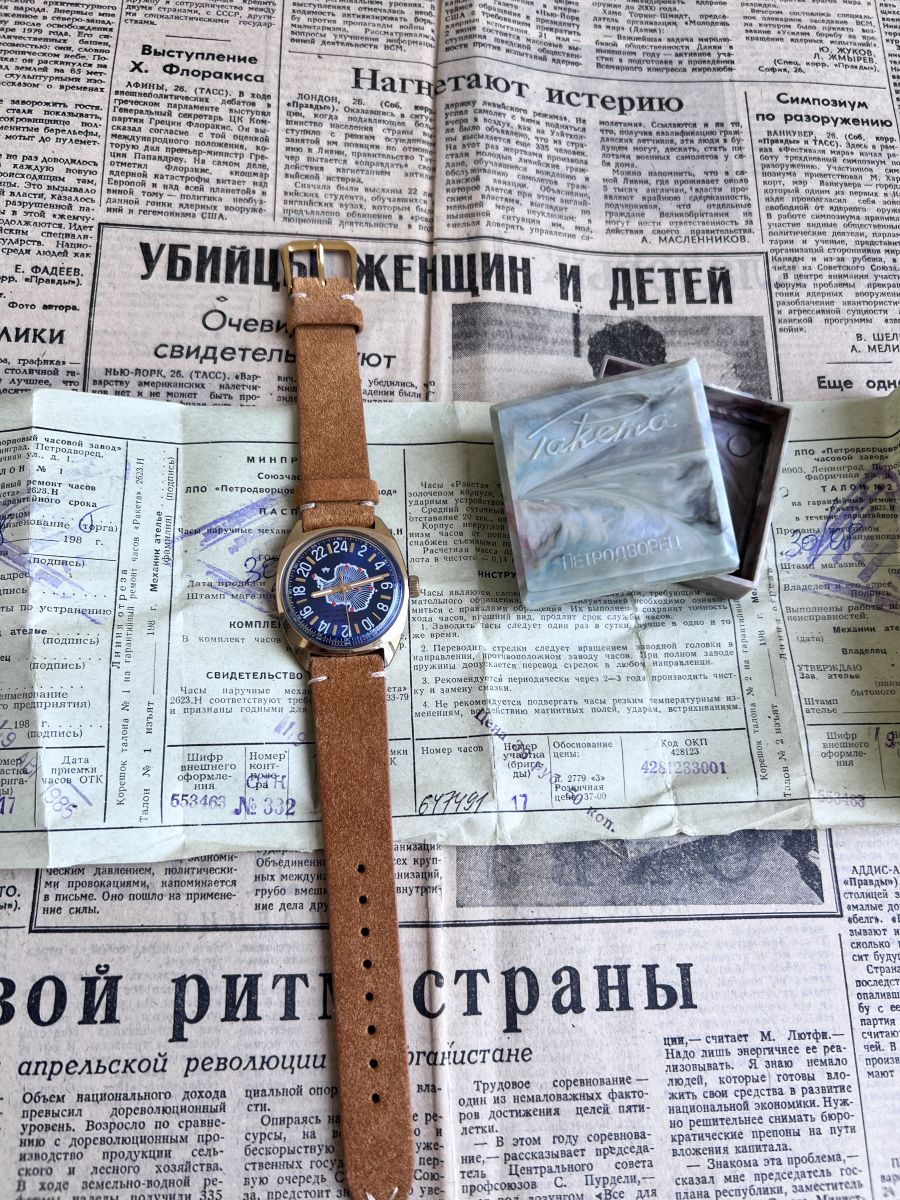
The ДП-5В (DP-5V) is the field radiometer of Soviet civil defence: a green Bakelite console, a probe with a rotating gamma, beta and check-source shield, headphones and a manual that explains operation and maintenance. The one in this article served in an industrial bakery in Chișinău and was serviced in March 1991. Its owner shared his photos and documents with us, and we turned them into a tool that lets you operate it on screen, step by step.
The Moscow Games, from 19 July to 3 August 1980, boycotted by some sixty countries, produced more objects than any Soviet event: a bear cub, Misha, drawn by Viktor Chizhikov, an emblem made of running tracks, five thousand torches, watches from every factory, platinum coins, rings, tea glass holders, posters. This guide tells the story of the Games and reviews the objects, with the marks that authenticate them and the prices.
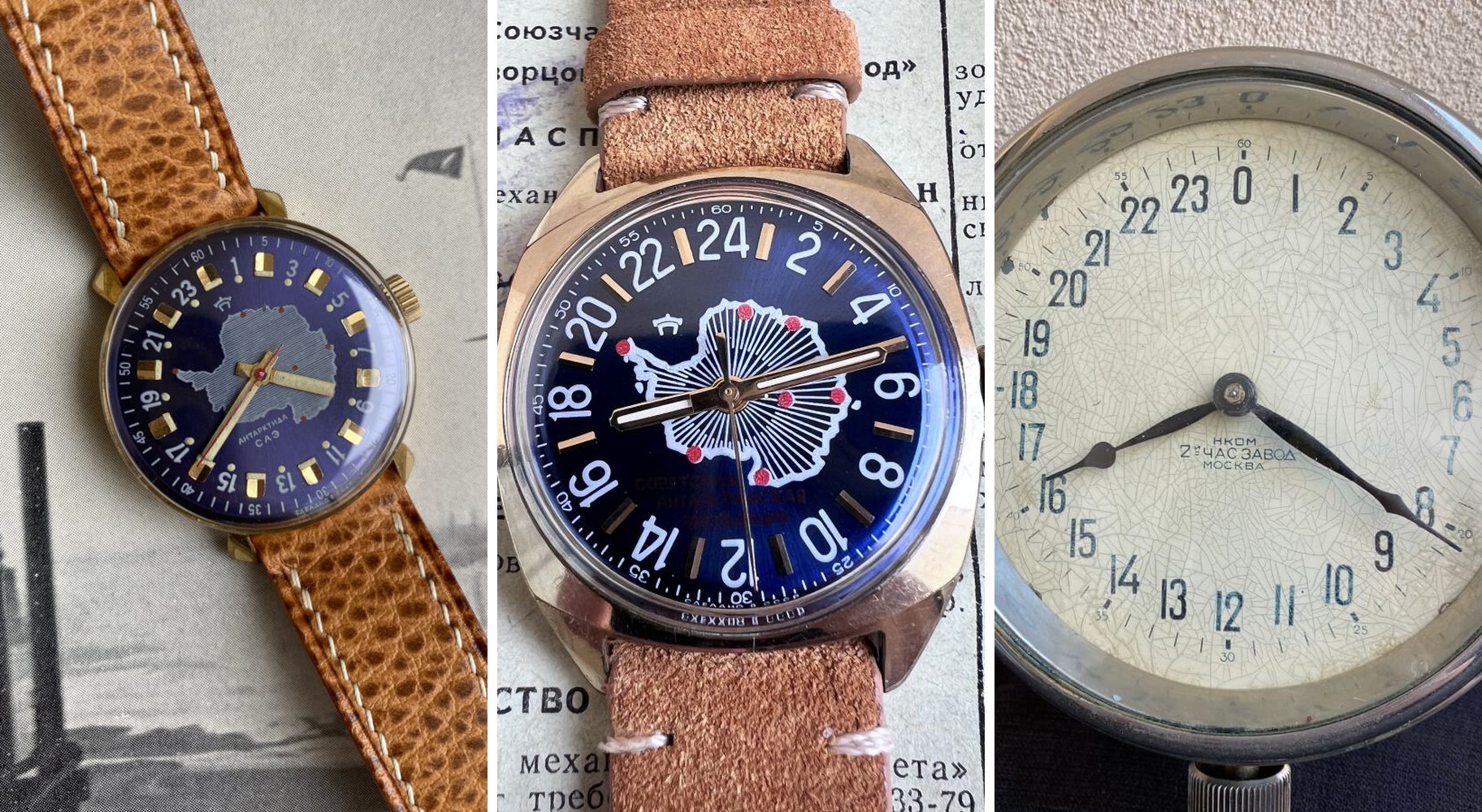
The 3017 chronograph of the First Moscow Watch Factory carries a five-digit number on the balance cock. The most common dating method reads it as a single series, from 1959 to 1979. Four factory passports show there are two, and that the same number can point to two watches made ten years apart. Here is how to read the number, the dial, the logo and the bridge, with a decoder to date your Strela, Poljot or Sekonda.
This website uses cookies to improve your experience while you navigate through the website.
Out of these cookies, the cookies that are categorised as necessary are stored on your browser as they are essential for the working of basic functionalities of the website.
We also use third-party cookies that help us analyse and understand how you use this website.
These cookies will be stored in your browser only with your consent.
You also have the option to opt out of these cookies.
But opting out of some of these cookies may affect your browsing experience.
Necessary cookies are absolutely essential for the website to function properly. This category only includes cookies that ensure basic functionalities and security features of the website. These cookies do not store any personal information.
Cookies that are not strictly necessary for the website to work and that are used specifically to collect personal data through analytics, ads and other embedded content are called non-necessary cookies. User consent is required before these cookies run on the website.
✕
Soviet in Paris
Offline right now. Leave your message and your email, we reply within 24 hours.
Hello 👋 A question about an item, an order or shipping? Write to us.
Your email is used only to reply to you.
Subscribe to our newsletter and get 10% off your first order.
Subscribe
★ New pieces before anyone else
★ New blog articles
★ Soviet in Paris news and updates
Join the Party
10% off your first order
Receive your welcome card and our next arrivals.
Your code appears here and is also sent to you by email. You can leave the Party in one click, at any time.



















 Strane Mira