The Raketa with hammer and sickle hands is rare, and it is counterfeited: dials and hands made in series today, fitted into cases that do not belong with them. The 1992 factory catalogue, the account of a former Petrodvorets employee, and a visual comparator between a period piece and a fake.
SEPTEMBER 2026•10 MIN READ
by Marwen Yahyaoui
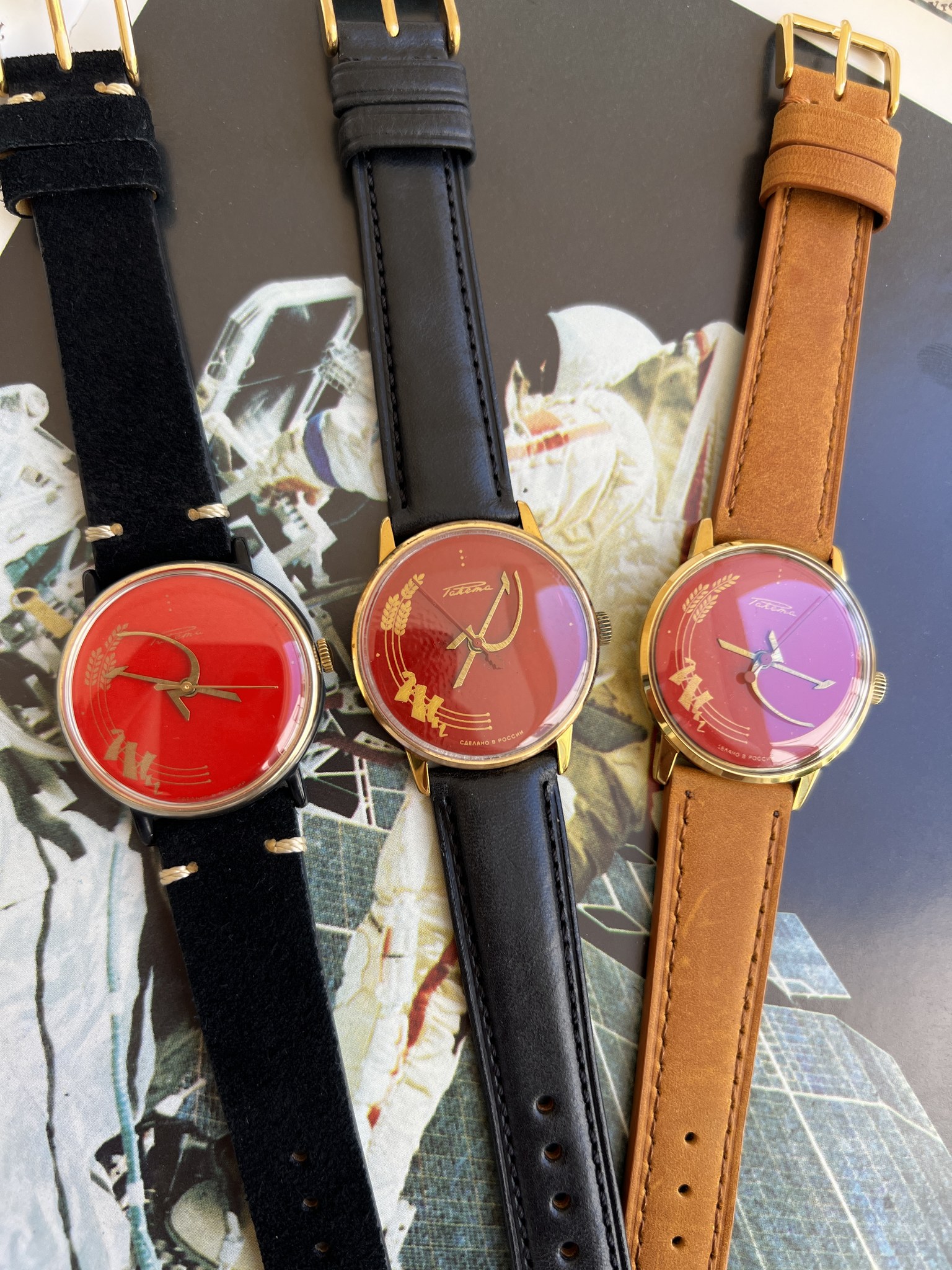
The hour hand is a hammer, the minute hand a sickle. The two cross once an hour and reform the symbol. Petrodvorets released this watch in its very last years, as the factory was falling apart, and it is hard to find today.
This model is also counterfeited. What circulates is not a period watch that has been put back in order: the dial is a recently made dial, ordered in batches, and the hands are new as well, produced in series and painted yellow. The whole thing is fitted into cases that match no version we have been able to document. The good news is that on the ones we have seen, the copy gives itself away in the same places every time. This guide brings together what we have been able to verify: the factory catalogue, the account of a former Petrodvorets employee, and what we observe on the pieces that pass through our hands.
What the 1992 catalogue says, and why there is nothing after it
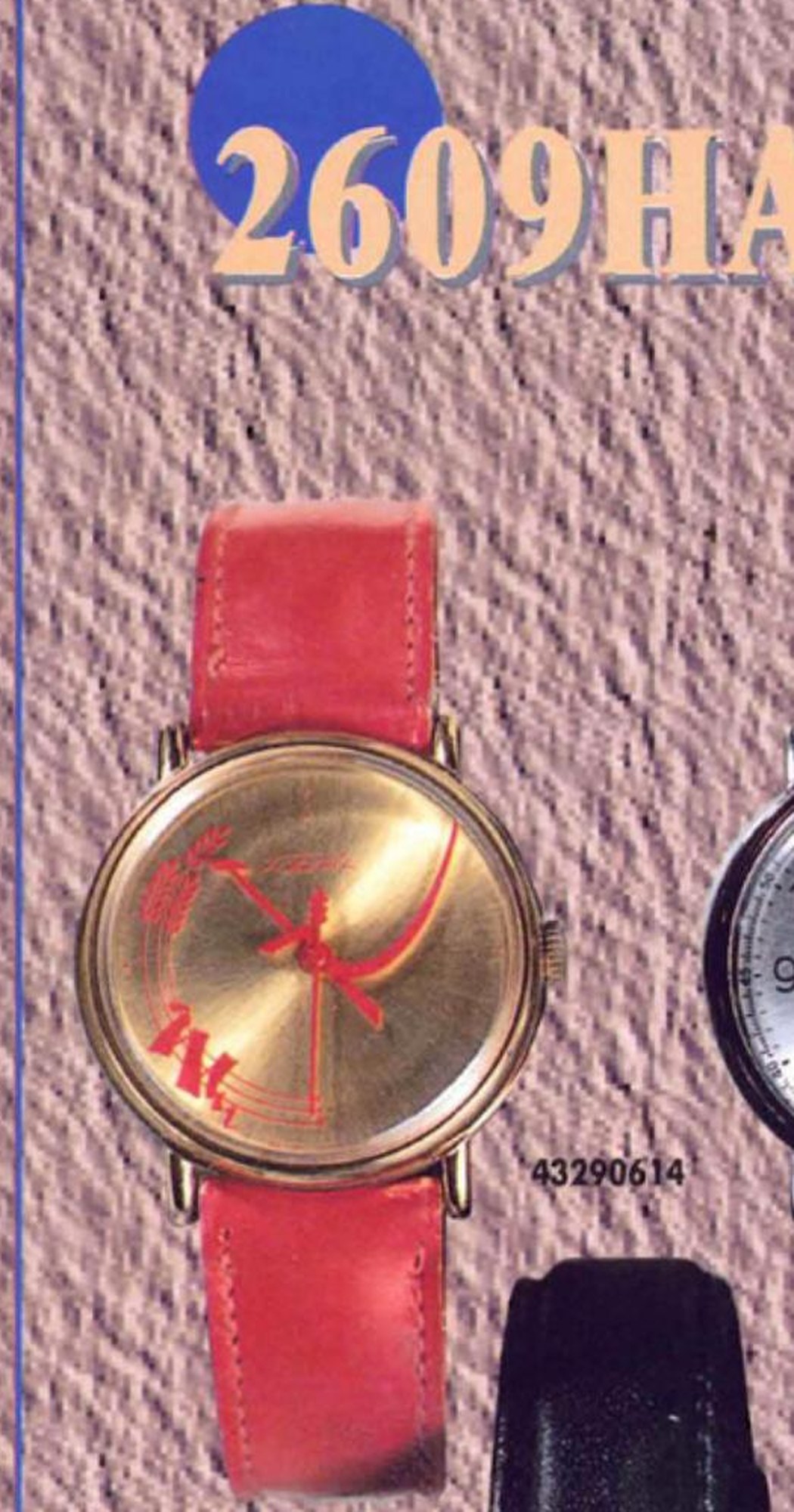
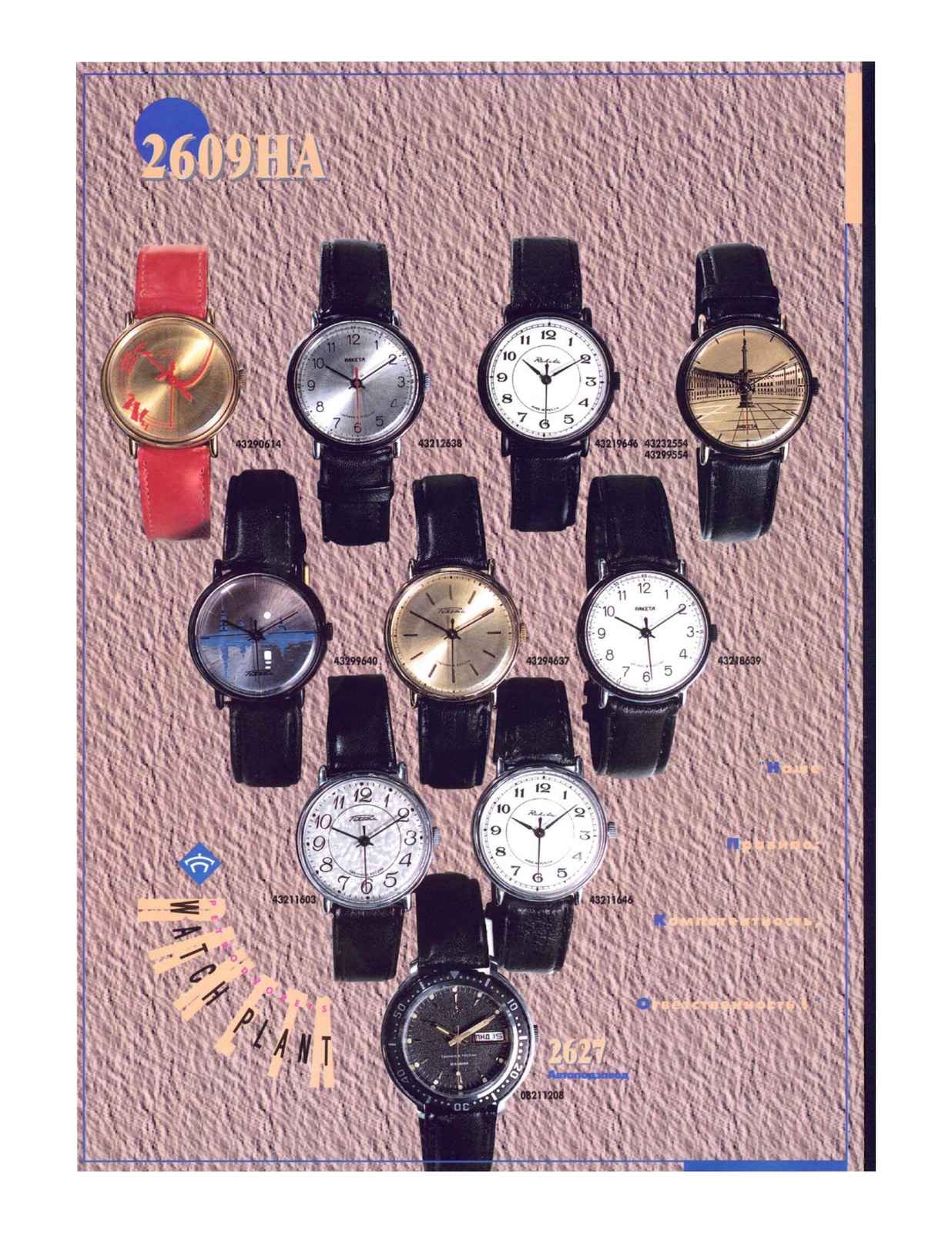
Reference 43290614 as it appears in the 1992 Petrodvorets catalogue, at the top of the 2609НА plate: gilt dial with sunray finish, hammer and sickle hands painted red, red strap.
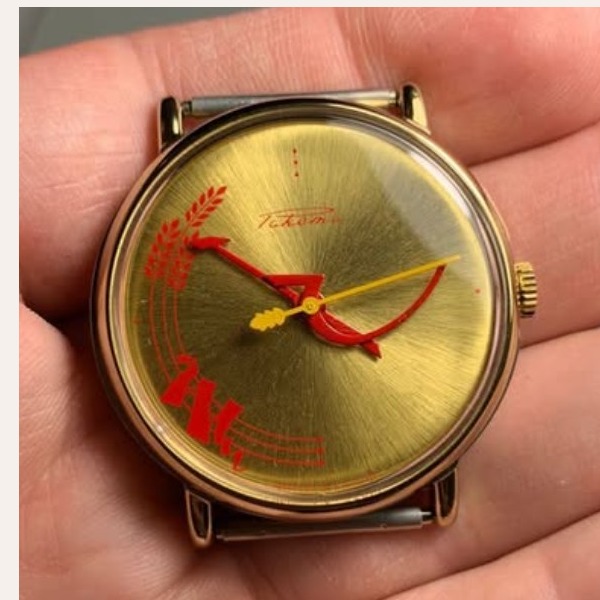
The catalogue published by the Petrodvorets factory in 1992, by then set up as a joint-stock company, lists the model under number 43290614, on the plate devoted to the 2609НА calibre. The piece photographed is not the one usually encountered: it has a gilt dial with a sunray finish, hammer and sickle hands painted red, and a red strap.
Dmitriy Brodnikovskiy, a former employee of the factory and a Raketa collector, told us that this gilt version comes from the factory museum and in all likelihood was never series-produced. The version that actually circulated is the red-dial one. He places production in 1992, with a titanium nitride treated case and a stainless steel back.
An example of the gilt dial version, with hammer and sickle hands painted red and a seconds hand drawn as an ear of wheat. This is the configuration described by catalogue reference 43290614.
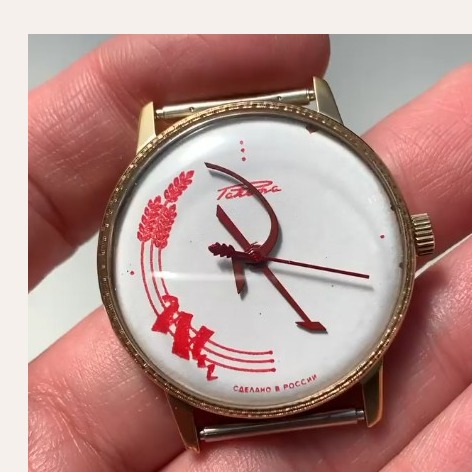
A white dial version also exists, with the same decoration printed in red and hammer and sickle hands painted red. It is met with far more rarely than the red dial.
The white dial version, decoration and hands in red. The Сделано в России marking and the sheaf of wheat are printed in the same red as the hands.
Then comes a documentary gap worth knowing about before buying. No Raketa catalogue from 1993 to 1997 is available online. The accessible series jumps from 1992 to 1998, including on ussr-watch.com, the most complete resource on the subject, and on the Russian-language forums. The factory was going through a severe industrial breakdown at the time, production was irregular and poorly documented.
The 2609НА plate in full. Our model is the piece at the top left, with the red strap.
The practical consequence: for this period, the absence of a piece from a catalogue proves nothing against it. An example dated 1993 or 1994 by a serious seller is not suspect in itself. No date earlier than 1992, on the other hand, is attested for this model.
The comparator: period piece against counterfeit
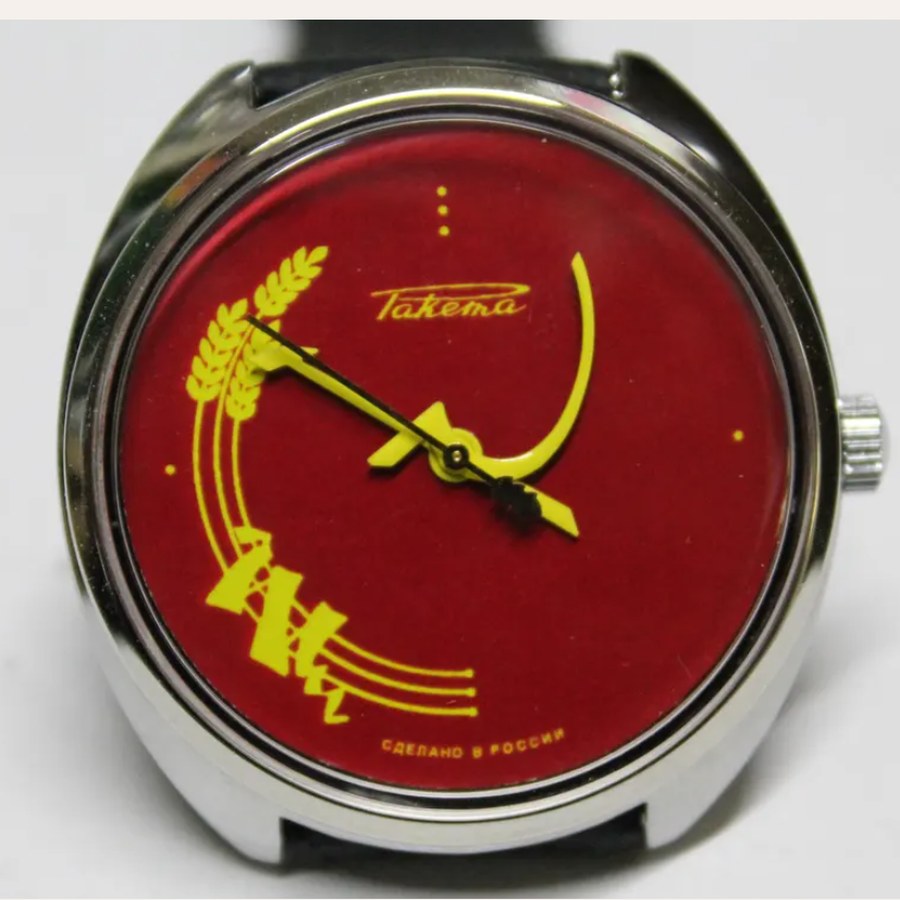
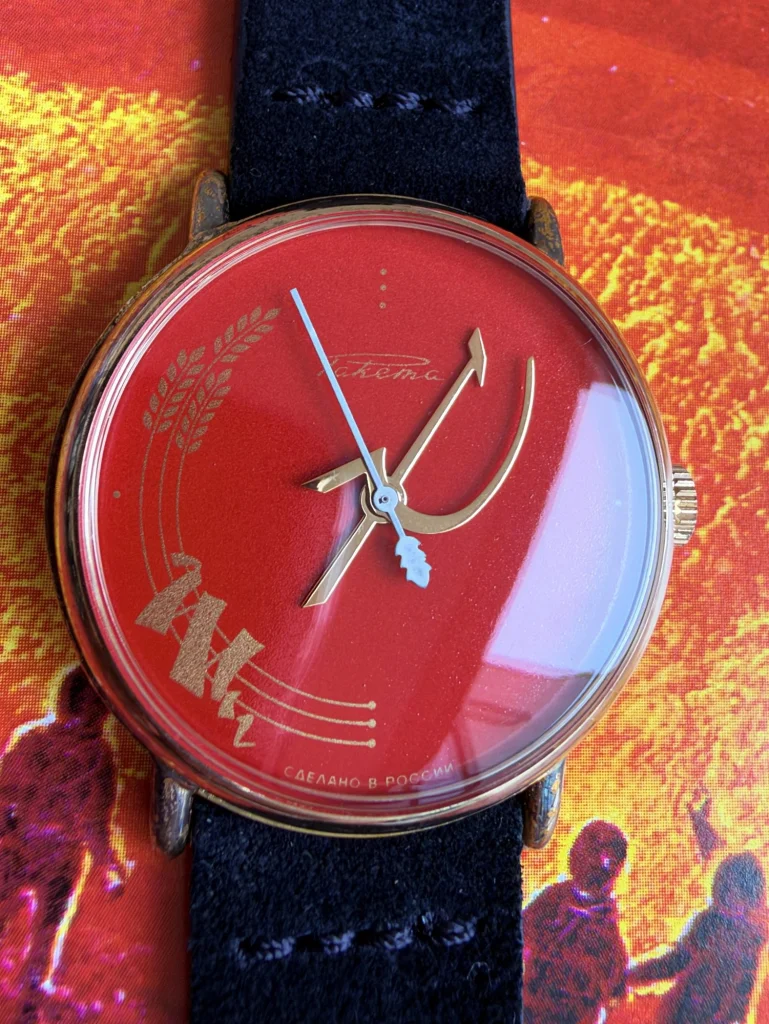
To the left of the slider, a piece from our stock. To the right, a fake we bought in order to look closely at how they are made. Move the slider, then go back over the five markers listed below.
Period pieceCounterfeit
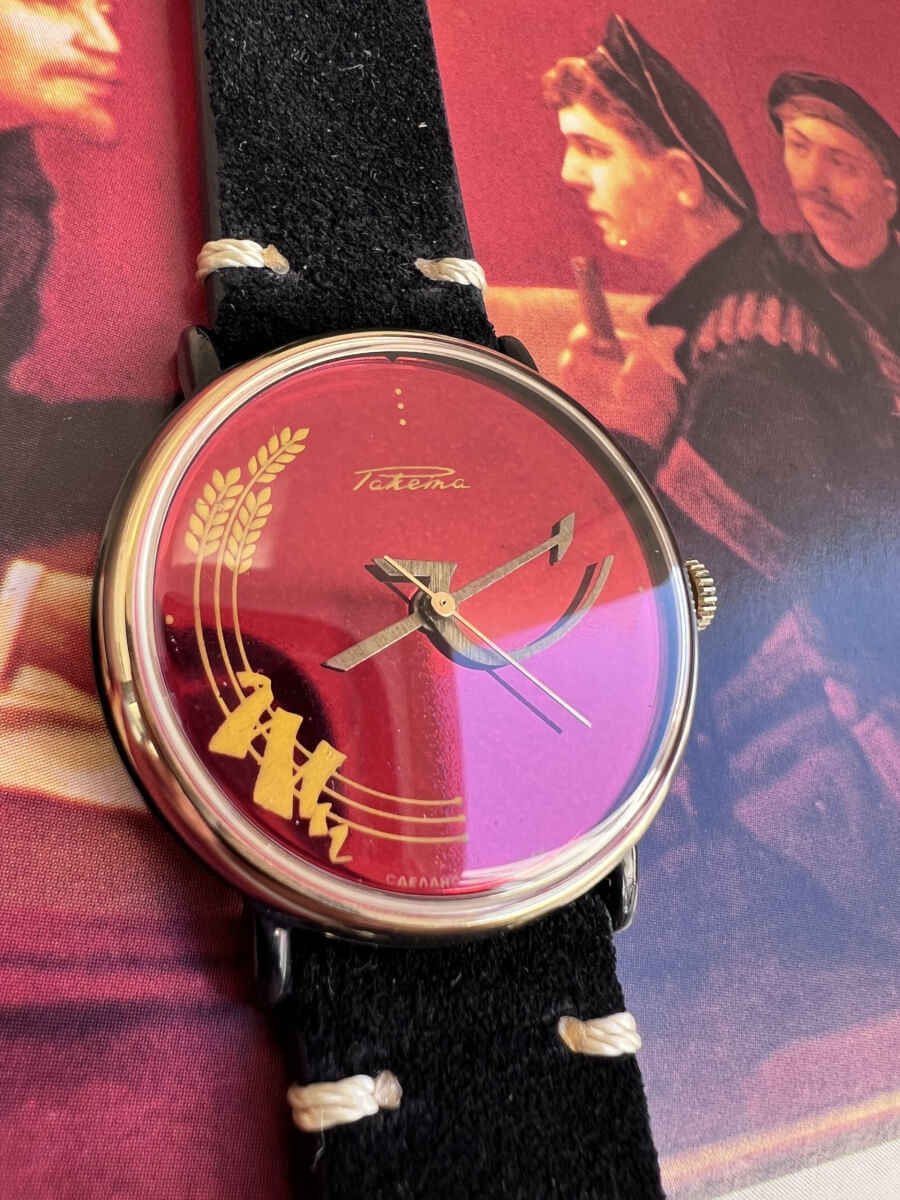
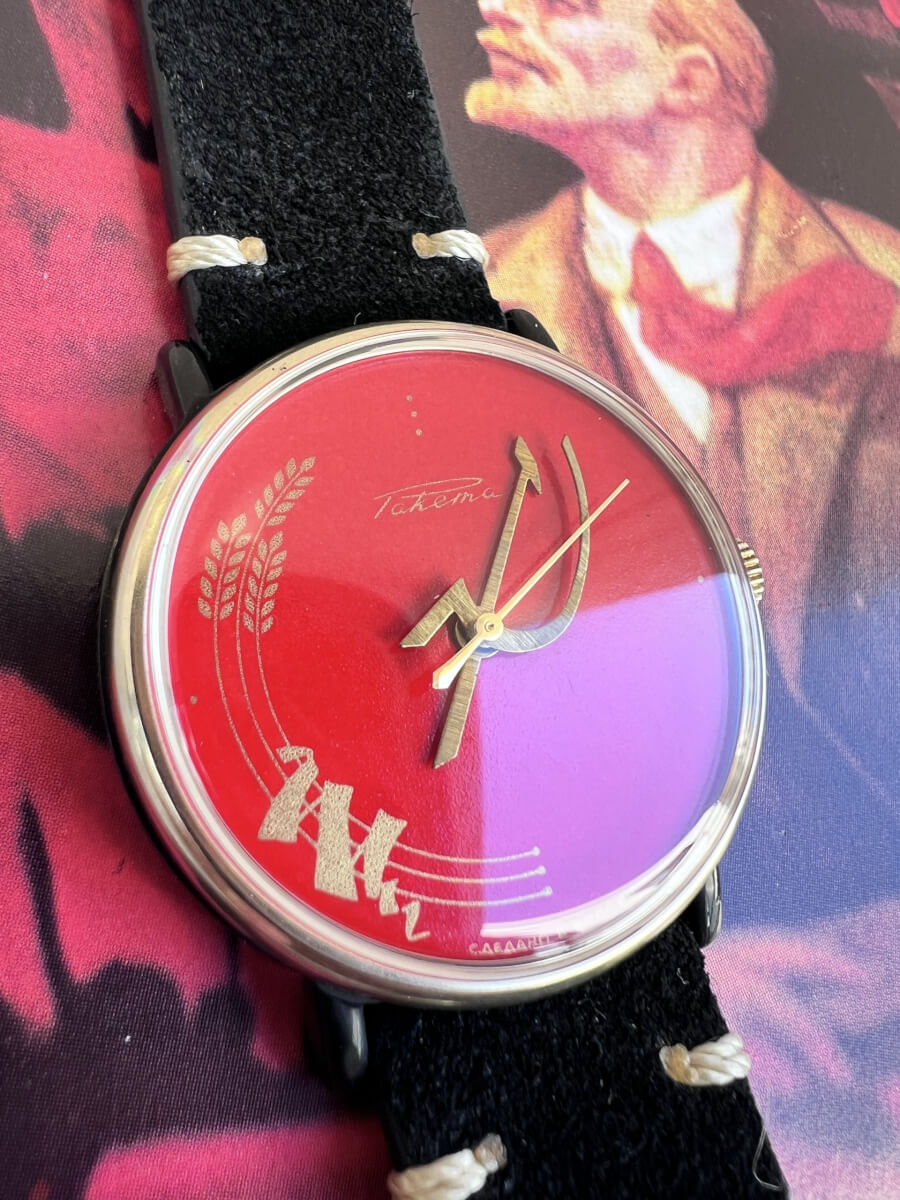
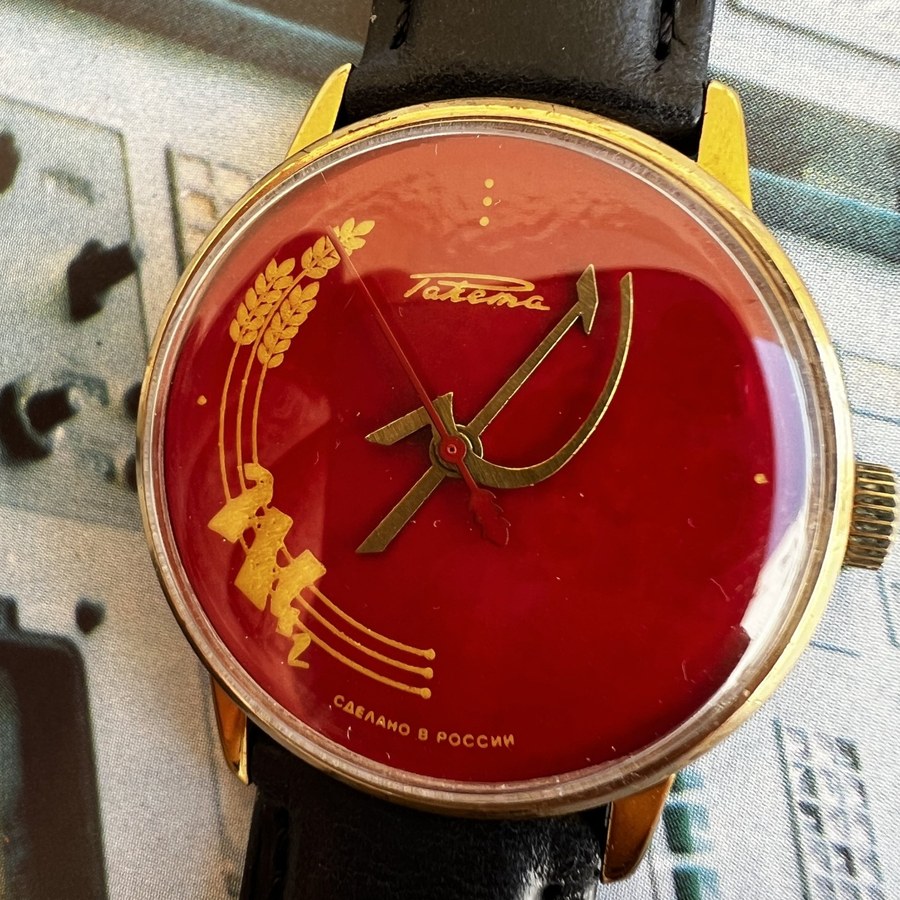
1The hands. This is the most important point. On a period piece, the hammer and the sickle are in bare brass, unpainted. They catch the light, change tone when you tilt the watch, and the relief can be seen on the edge. On the copy, they are two recently made parts painted a bright yellow, matte, uniform, identical from every angle. A hammer and sickle painted red do exist, they are documented by the 1992 catalogue. Painted yellow is the warning sign, because that is how all the copies we have seen are fitted.
2The grains of the sheaf of wheat. On a factory dial, each grain is clearly separate from its neighbour, you can count them. On copied dials, the grains merge and the sheaf becomes a continuous mass with a few notches. It is the easiest flaw to spot on a listing photo, provided the photo is large enough.
3The Сделано в России marking. On the period piece it is printed in a dark or discreet gilt tone, in small characters, and reads without fighting the red of the background. On the copy it is picked out in the same bright yellow as the rest of the decoration, larger and more contrasted.
4The length of the seconds hand. Its shape and its colour prove nothing: straight or drawn as an ear of wheat, in brass or painted, both are encountered. What can be seen is its length. On the period piece, it reaches the edge of the dial. On the copy in the comparator it is in fact brass, yet it stops well short of the edge. The dial was not fitted into the case it was meant for, and the proportions no longer follow.
5The case. It should be round, with a thin bezel and short lugs. The finish makes no difference: chromed, black, gilt or gold-plated, all are encountered on period pieces. What raises a flag is the shape. A wide case, with flat, splayed lugs, or a Big Zero type case, does not go with this dial.
The movement, and why it matters less than people think
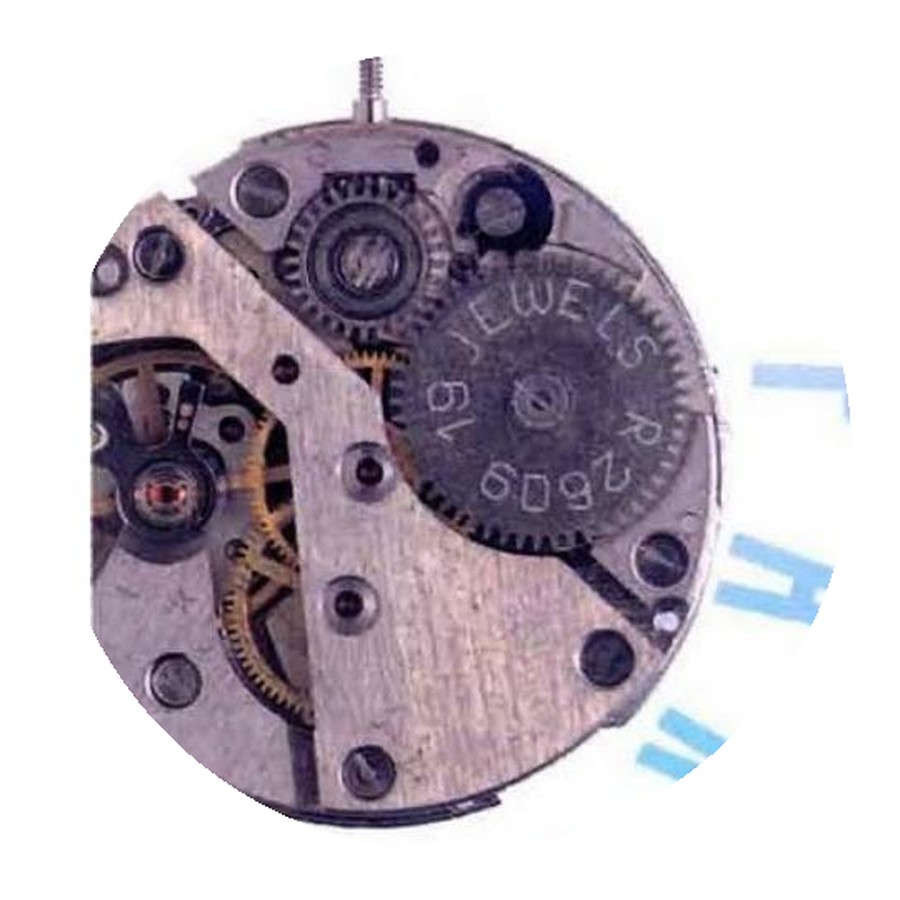
The base 2609НА calibre as presented in the 1992 Petrodvorets catalogue. The 2609 marking and the words 16 JEWELS are engraved on the bridge.
The 1992 catalogue describes the 2609НА as a 26 mm calibre, 3.98 mm high, sixteen jewels, centre seconds, shock protection on the balance staff, an oscillation period of 0.4 second, an average variation of minus ten to plus forty seconds a day and a power reserve of at least forty-two hours. The base case is described as white chromed brass, with a press-fit stainless steel back and a moulded acrylic crystal.
Depending on the seller, you will nonetheless come across listings mentioning seventeen, eighteen or nineteen jewels, or a 2614.Н calibre in place of the 2609. No hasty conclusion should be drawn from that. After 1991, production at Petrodvorets became chaotic, component stocks were used up in no particular order and calibre variants got mixed together. An unexpected jewel count is not in itself an indication of a copy.
In other words, the order of checking is as follows: the hands first, then the dial, the case third, and the movement last. On this particular model, the mechanism is the least telling criterion.
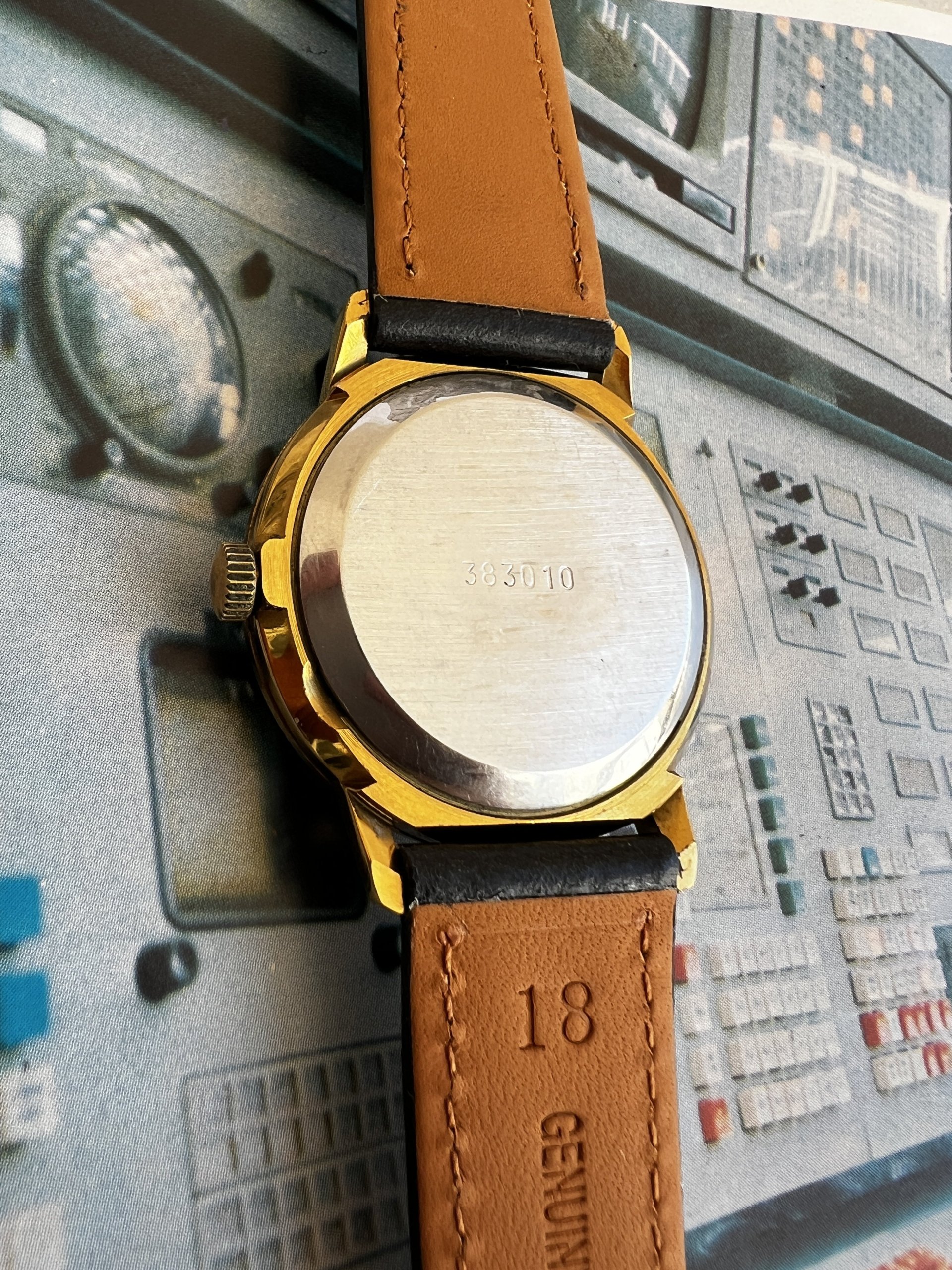
The press-fit steel back, on the gold-plated example number 383010 in our stock.
What to ask the seller
Five questions are enough to rule out the great majority of doubtful pieces. A serious seller will answer without difficulty, and a refusal to answer is itself an answer.
A photo of the hands taken at an angle, with raking light. Bare brass and yellow paint do not react in the same way.
A photo of the dial large enough to count the grains of the sheaf of wheat.
Are the dial and the hands the original ones, or have they been replaced? The question should be put exactly like that.
Are the case and the dial original together, or has the watch been assembled from several pieces?
Has the watch been serviced, and by whom? A piece sold unserviced can be a good deal, but the price should reflect it.
Rarity is a criterion in its own right
There is one marker that cannot be read on any photo of a dial, and that is nonetheless worth all the others put together: the number of examples a seller can have at the same time.
Here is our own situation, given as it is. We work with dozens of contacts who look on our behalf, we follow the auctions, and we do hundreds of flea markets. With that setup, we find one to two Raketa watches with hammer and sickle hands a year. Some years, none. This is not a lack of network, it is simply the real production of the model, out of a factory in full collapse and in all likelihood made in very small quantities.
This arithmetic applies to everyone. A seller listing ten, twenty or thirty examples of the same model on a marketplace did not hunt them down one by one. Nobody could. They were bought as a batch, from a supplier who produces them, which in all likelihood implies dials and hands made in series today, fitted onto salvaged cases. The case is commonly met with on the large peer-to-peer selling platforms and on the craft and vintage marketplaces.
One seller is active on Etsy at the moment, he has already sold dozens of fake watches of this model under the name Andrzej with the account RussianwatchPL, and he sells almost nothing but poor quality modern copies.
So there are two signs to check before even looking at the dial. The first, the number of identical pieces in the seller’s shop. The second, the uniformity of their stock: if their photos show ten watches with rigorously identical dials, without the slightest variation in tone, wear or patina, that is not a collection stock, it is a production run. Thirty years on, two period pieces never age in exactly the same way.
What is circulating today, and at what price
On the general marketplaces, this model is on offer permanently. A share of the listings we examine show the same characteristics: bright red dial of uniform appearance, hands painted flat yellow, a seconds hand too short for the dial, the Сделано в России marking in heavy yellow, and a shiny steel case with wide lugs matching no documented version. These examples are offered at around one hundred and forty euros, which places them well below the range for period pieces. Price alone is not enough to settle the matter, however, as a period watch in need of servicing or with a marked dial can legitimately fall into the same waters.
For a period piece, the range we observe lies between three hundred and eight hundred euros, depending on the seller, the condition of the dial, the presence of the original case and whether or not the watch has been serviced. The top of the range corresponds to examples that have been serviced, are guaranteed, and have an unaltered dial and a coherent case.
One last point is worth making. These fakes are not all sold in bad faith. Many sellers bought the watch themselves believing it was a period piece and resell it in complete good faith. Asking the five questions above remains the best way to settle the matter, without putting anyone on trial.
Available at Soviet in Paris
Two examples are currently in our stock. Both have brass hammer and sickle hands, a round case, and have been checked by our watchmaker.
Our full catalogue of Raketa watches can be browsed in the shop. If you are unsure about a piece seen elsewhere, send us the photos and we will tell you what we think.
The ДП-5В (DP-5V) is the field radiometer of Soviet civil defence: a green Bakelite console, a probe with a rotating gamma, beta and check-source shield, headphones and a manual that explains operation and maintenance. The one in this article served in an industrial bakery in Chișinău and was serviced in March 1991. Its owner shared his photos and documents with us, and we turned them into a tool that lets you operate it on screen, step by step.
The Moscow Games, from 19 July to 3 August 1980, boycotted by some sixty countries, produced more objects than any Soviet event: a bear cub, Misha, drawn by Viktor Chizhikov, an emblem made of running tracks, five thousand torches, watches from every factory, platinum coins, rings, tea glass holders, posters. This guide tells the story of the Games and reviews the objects, with the marks that authenticate them and the prices.
The 3017 chronograph of the First Moscow Watch Factory carries a five-digit number on the balance cock. The most common dating method reads it as a single series, from 1959 to 1979. Four factory passports show there are two, and that the same number can point to two watches made ten years apart. Here is how to read the number, the dial, the logo and the bridge, with a decoder to date your Strela, Poljot or Sekonda.
This website uses cookies to improve your experience while you navigate through the website.
Out of these cookies, the cookies that are categorised as necessary are stored on your browser as they are essential for the working of basic functionalities of the website.
We also use third-party cookies that help us analyse and understand how you use this website.
These cookies will be stored in your browser only with your consent.
You also have the option to opt out of these cookies.
But opting out of some of these cookies may affect your browsing experience.
Necessary cookies are absolutely essential for the website to function properly. This category only includes cookies that ensure basic functionalities and security features of the website. These cookies do not store any personal information.
Cookies that are not strictly necessary for the website to work and that are used specifically to collect personal data through analytics, ads and other embedded content are called non-necessary cookies. User consent is required before these cookies run on the website.
✕
Soviet in Paris
Offline right now. Leave your message and your email, we reply within 24 hours.
Hello 👋 A question about an item, an order or shipping? Write to us.
Your email is used only to reply to you.
Subscribe to our newsletter and get 10% off your first order.
Subscribe
★ New pieces before anyone else
★ New blog articles
★ Soviet in Paris news and updates
Join the Party
10% off your first order
Receive your welcome card and our next arrivals.
Your code appears here and is also sent to you by email. You can leave the Party in one click, at any time.