Japanese Micrometer Sextant - Tamaya Osaka - 7x35 Scope - 1970s
$680.99Unique piece


Japanese Micrometer Sextant - Tamaya Osaka - 7x35 Scope - 1970s
$680.99Unique piece
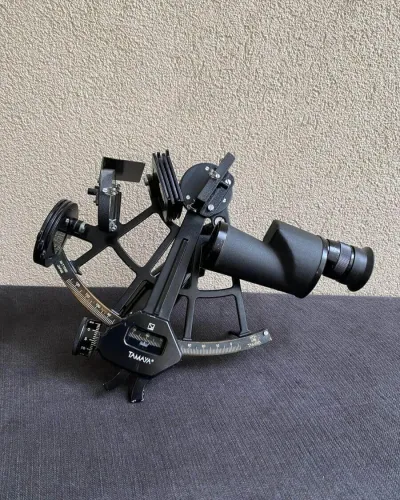
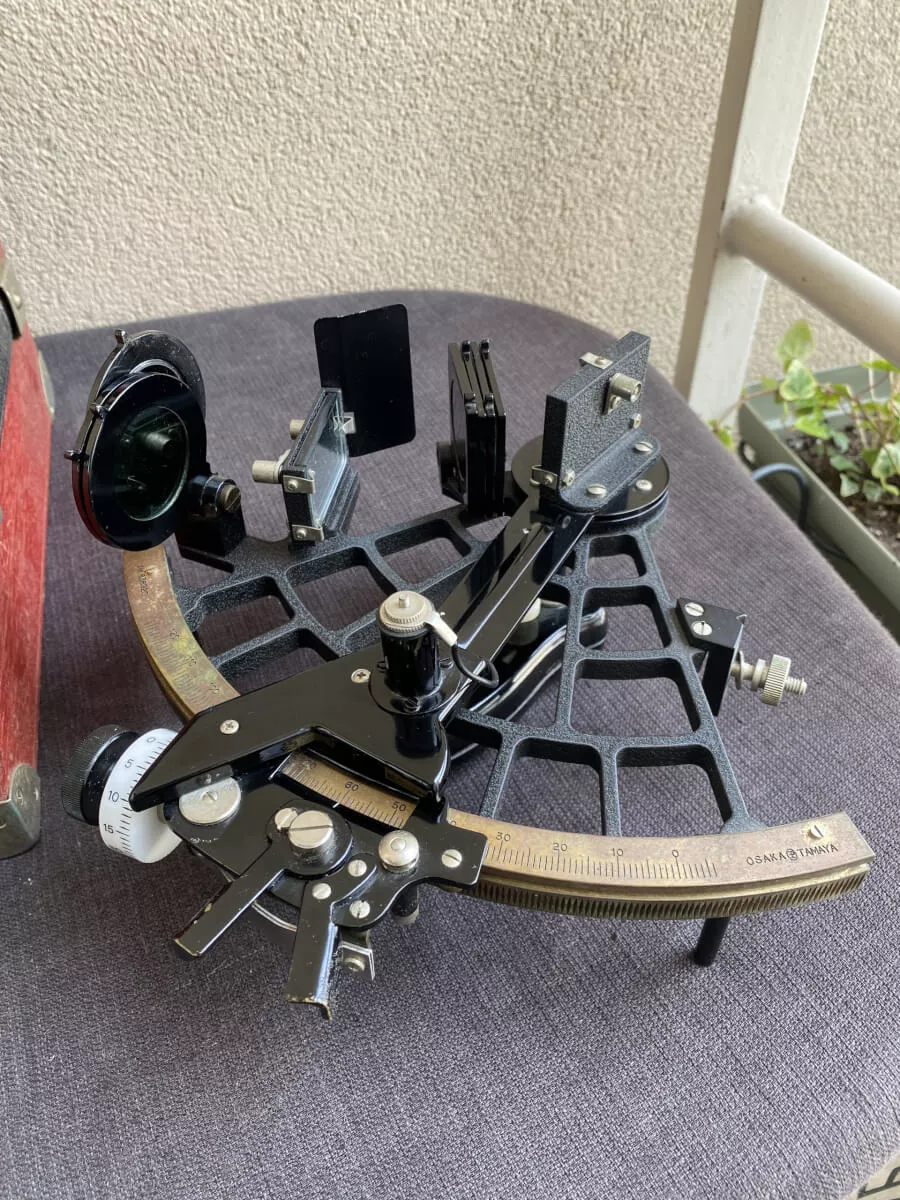
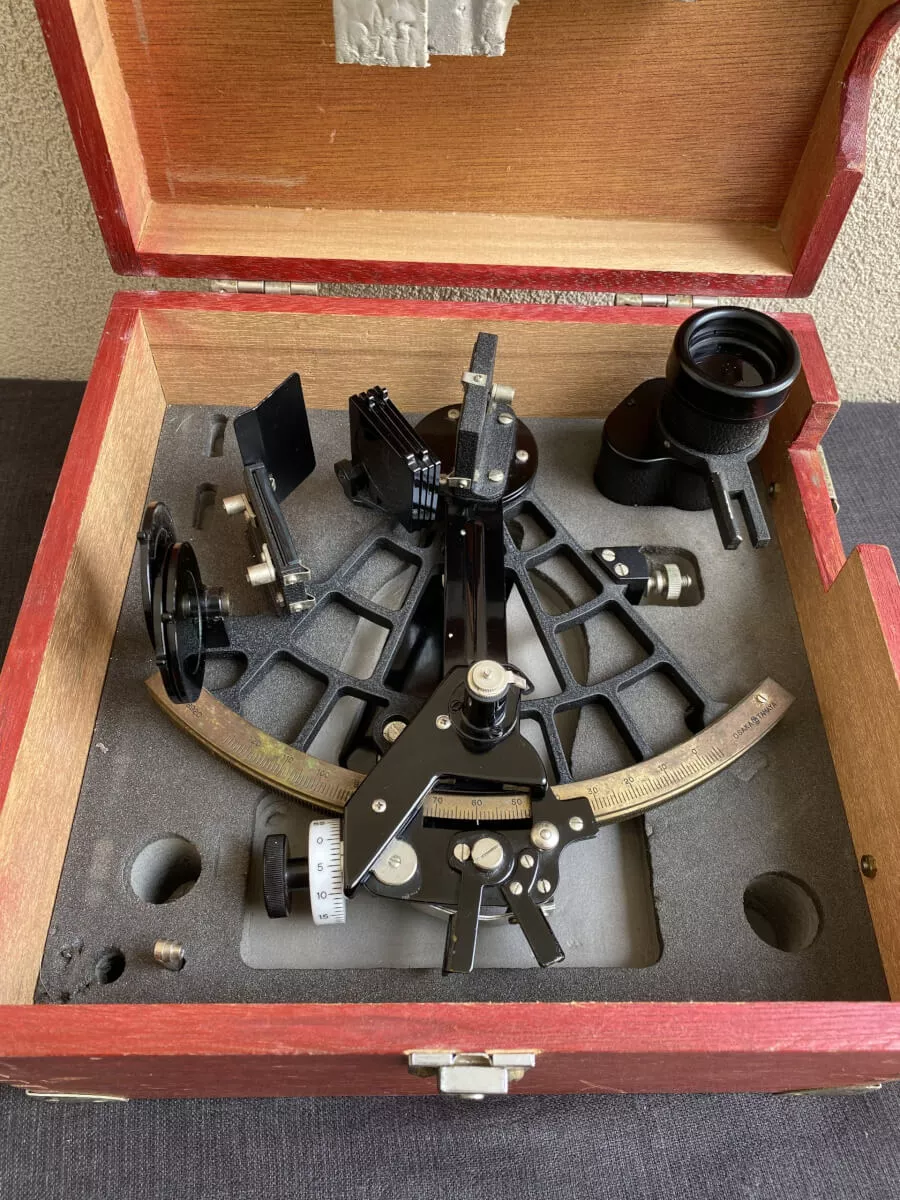
Japanese micrometer drum marine sextant signed Osaka Tamaya, 1970s. Supplied with its 7×35 telescope and shades, filters and mirrors in very good condition, in its red stained wooden case with metal corners.
1 in stock
Message received, dear comrade.
Our information desk usually replies within 24 hours at the address provided.The Brezhnev era. Détente with the West, SALT treaties, the Apollo-Soyuz mission. Economic stagnation and growing corruption.
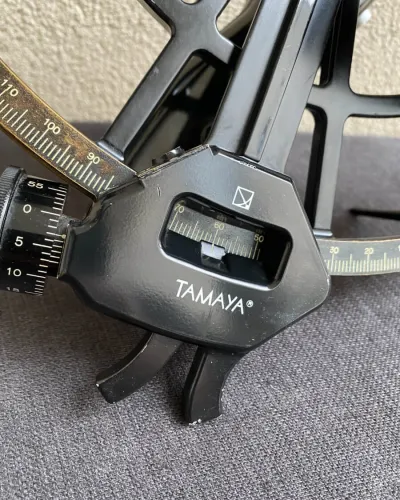
Japanese micrometer drum marine sextant signed Osaka Tamaya, supplied in its wooden case with its 7×35 telescope. The brass arc is engraved “OSAKA TAMAYA” with the maker’s logo, and the case lid carries the plate “TRADE MARK OSAKA TAMAYA & CO. NISHITENMA OSAKA”. The openwork frame is finished in black crackle paint and the handle is black lacquered. The white drum, graduated in minutes, is turned by a knurled knob, and the clamp on the index arm allows it to be moved quickly along the arc.
Coloured shades are fitted in front of both mirrors. Filters and mirrors are in very good condition. The 7×35 telescope, covered in black and marked “7×35”, fits onto its bracket. The red stained wooden case, with finger-jointed corners, is reinforced with metal corner pieces and closed by a chrome latch. A black handle on top is used to carry it. The interior keeps its foam fitting, with a place for each part. Numbers are handwritten on the lid.
A sextant measures the altitude of a celestial body above the horizon, or the angle between two landmarks ashore. Combined with a chronometer and a nautical almanac, this measurement gives the ship’s position. The micrometer drum lets the navigator read degrees and minutes directly, with no vernier or magnifier. Tamaya is one of the main Japanese makers of navigation instruments, already active in the first half of the 20th century. Its sextants are used in the merchant navy as well as in yachting, and the Spica model is still distributed today by Weems & Plath. This example carries the Osaka address, in the Nishitenma district.
1970s. A working celestial navigation instrument, ready for use at sea or for display.
Additional information
| Weight | 5 kg |
|---|---|
| Dimensions | 40 × 40 × 30 cm |