Soviet Navy Star Globe ZG - Celestial Navigation 1977 - As New - No. 7159
$748.99Unique piece


Soviet Navy Star Globe ZG - Celestial Navigation 1977 - As New - No. 7159
$748.99Unique piece
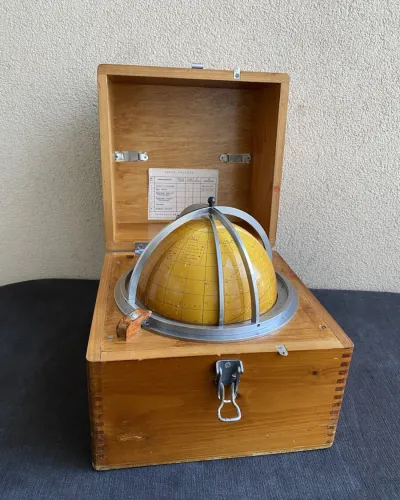
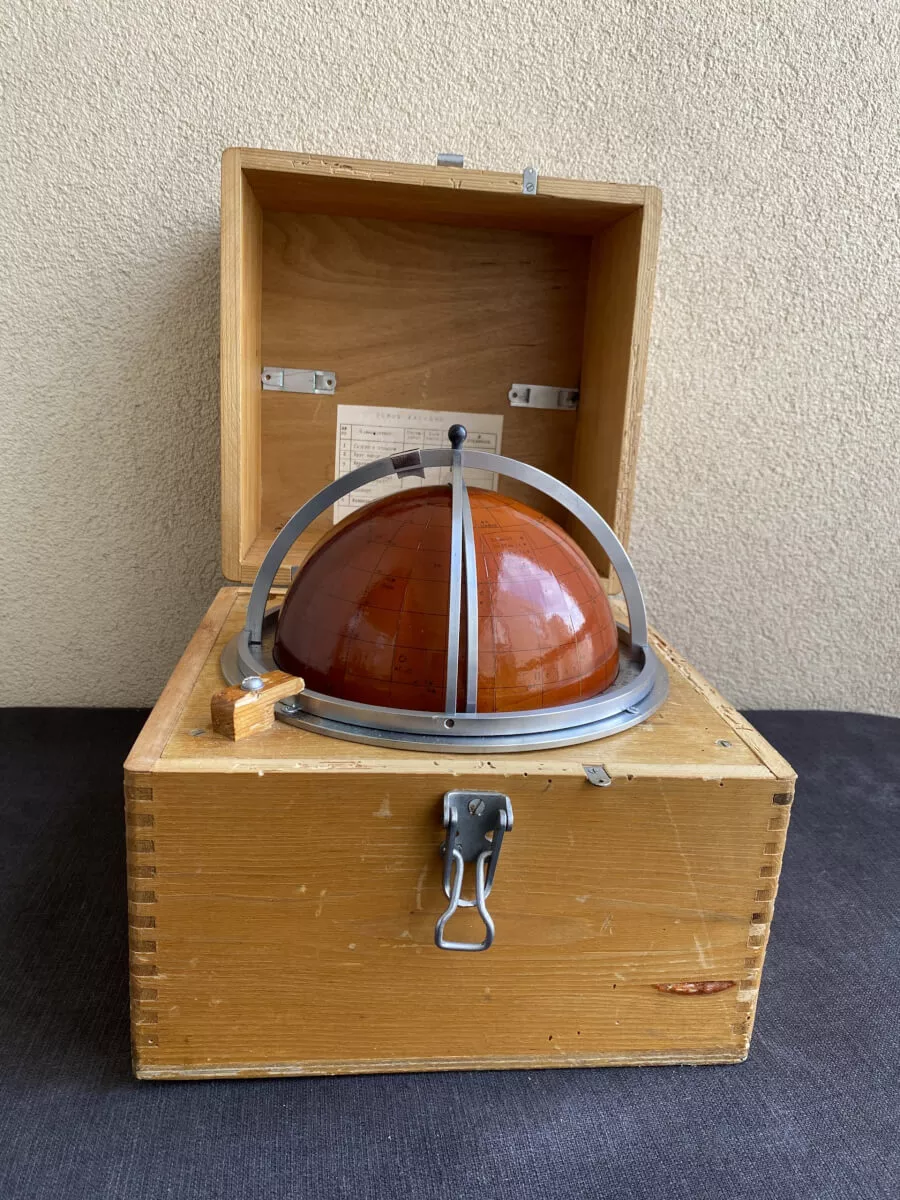
Soviet Navy ZG star globe for celestial navigation, dated 1977 and numbered 7159, in its wooden case with graduated horizon ring and arcs. Constellations named in Russian, star positions for epoch 1990.0. As new.
1 in stock
Message received, dear comrade.
Our information desk usually replies within 24 hours at the address provided.New Soviet Constitution, known as the "Brezhnev Constitution".



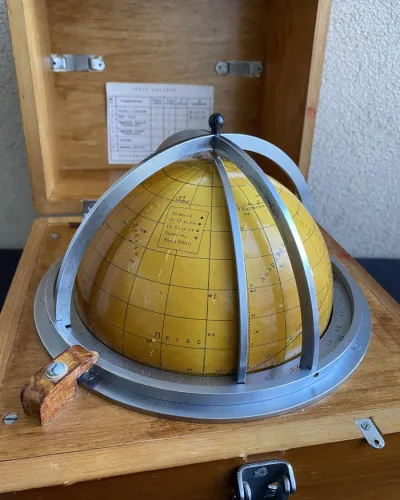
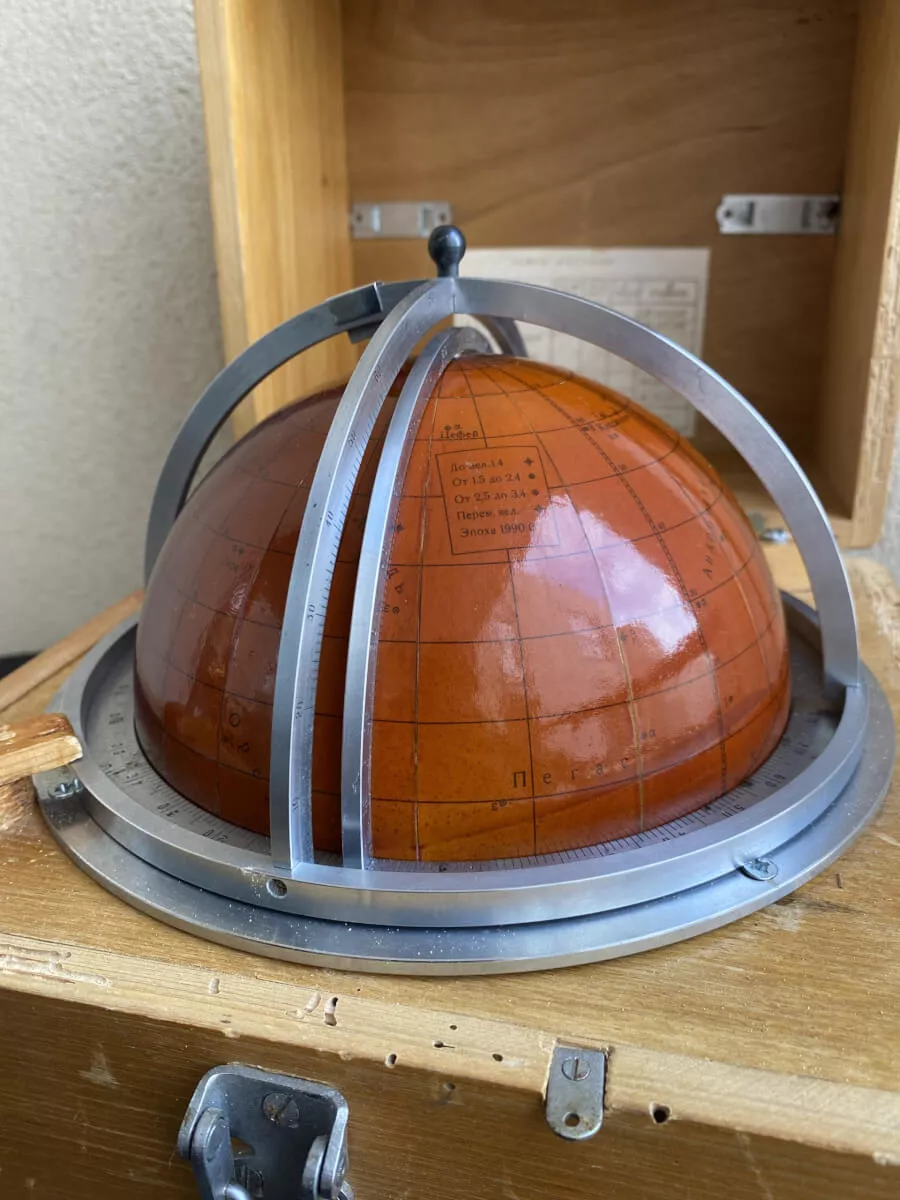
Soviet ZG star globe for celestial navigation, used by the Soviet Navy (VMF). It is kept in its wooden case with box joints, a metal latch, a carrying handle on top and a printed sheet pasted inside the lid. The sphere sits in a metal horizon ring graduated in degrees, with the cardinal points. Above it are vertical arcs graduated in degrees, joined at the top by a knob, and a movable strip is fixed at each pole.
The case carries a plate reading ЗГ (ZG, short for звёздный глобус, star globe) and an identification plate with the КБ logo in a circle, the year 1977 and the number 7159. The orange lacquered sphere shows the constellations of both hemispheres, named in Russian: Цефей (Cepheus), Кассиопея (Cassiopeia), Андромеда (Andromeda), Пегас (Pegasus), Орион (Orion), Телец (Taurus), Скорпион (Scorpius), Стрелец (Sagittarius), Тукан (Tucana), Феникс (Phoenix) and many others, with Полярная (Polaris) at the north celestial pole. The ecliptic is graduated with the names of the months, the celestial equator in hours marked in Roman numerals. A cartouche gives the key: До вел. 1.4 (up to magnitude 1.4), От 1.5 до 2.4 (1.5 to 2.4), От 2.5 до 3.4 (2.5 to 3.4), Перем. вел. (variable magnitude) and Эпоха 1990.0 (epoch 1990.0, the reference date for the star positions).
A star globe is a tool for celestial navigation. Before taking a sextant sight, the navigator sets the sphere for the ship’s position and the time, then reads the approximate altitude and bearing of the navigational stars. This tells him which stars to observe and where to look for them in the sky. Such instruments remained in use aboard ships until the 1980s.
This globe, dated 1977, is as new and complete with its case and arcs. It also works well as a decorative piece in a naval themed interior.
Additional information
| Weight | 5.5 kg |
|---|---|
| Dimensions | 40 × 40 × 50 cm |